

Skip to Content

International Journal of Neonatal Screening, Volume 10, Issue 1

2024 March - 26 articles

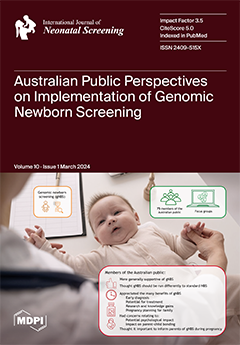
Cover Story: Recent dramatic reductions in the timeframes in which genomic sequencing can deliver results, as well as the price, mean its application in newborn screening programs is becoming a reality. Lynch and colleagues conducted focus groups with 75 members of the Australian public to explore their preferences and values regarding key genomics newborn screening (gNBS) characteristics and preferences for service delivery. Participants were generally supportive of gNBS, consistently highlighting receiving an early diagnosis as the leading benefit, which was frequently linked to the potential for early treatment and intervention, or access to other forms of assistance, such as peer support. Informing parents about the test during pregnancy was considered to be very important. View this paper
  • Issues are regarded as officially published after their release is announced to the table of contents alert mailing list .
  • You may sign up for email alerts to receive table of contents of newly released issues.
  • PDF is the official format for papers published in both, html and pdf forms. To view the papers in pdf format, click on the "PDF Full-text" link, and use the free Adobe Reader to open them.

Articles (26)

  • Article
  • Open Access
1 Citations
2,017 Views
10 Pages

Postponement of the Newborn Hearing Screening during the COVID-19 Pandemic; Parental Experiences and Worries

  • Rosanne B. van der Zee,
  • Sanne L. Peet,
  • Noëlle N. Uilenburg,
  • Hedwig J. A. van Bakel and
  • Evelien Dirks

Early identification of hearing loss through newborn hearing screening followed by an early start of intervention has proven to be effective in promoting speech and language development in children with hearing loss. During the COVID-19 pandemic, new...

  • Article
  • Open Access
7 Citations
3,983 Views
14 Pages

Portuguese Neonatal Screening Program: A Cohort Study of 18 Years Using MS/MS

  • Maria Miguel Gonçalves,
  • Ana Marcão,
  • Carmen Sousa,
  • Célia Nogueira,
  • Helena Fonseca,
  • Hugo Rocha and
  • Laura Vilarinho

The Portuguese Neonatal Screening Program (PNSP) conducts nationwide screening for rare diseases, covering nearly 100% of neonates and screening for 28 disorders, including 24 inborn errors of metabolism (IEMs). The study’s purpose is to assess...

  • Article
  • Open Access
1 Citations
2,862 Views
9 Pages

Retrospective Review of Positive Newborn Screening Results for Isovaleric Acidemia and Development of a Strategy to Improve the Efficacy of Newborn Screening in the UK

  • Rachel S. Carling,
  • Katy Hedgethorne,
  • Anupam Chakrapani,
  • Patricia L. Hall,
  • Nick Flynn,
  • Toby Greenfield,
  • Stuart J. Moat,
  • Joshua Ssali,
  • Lynette Shakespeare and
  • James R. Bonham
  • + 8 authors

Since the UK commenced newborn screening for isovaleric acidemia in 2015, changes in prescribing have increased the incidence of false positive (FP) results due to pivaloylcarnitine. A review of screening results between 2015 and 2022 identified 24 t...

  • Article
  • Open Access
8 Citations
5,163 Views
14 Pages

Expanded Newborn Screening for Inborn Errors of Metabolism in Hong Kong: Results and Outcome of a 7 Year Journey

  • Kiran Moti Belaramani,
  • Toby Chun Hei Chan,
  • Edgar Wai Lok Hau,
  • Matthew Chun Wing Yeung,
  • Anne Mei Kwun Kwok,
  • Ivan Fai Man Lo,
  • Terry Hiu Fung Law,
  • Helen Wu,
  • Sheila Suet Na Wong and
  • Cheuk Wing Fung
  • + 18 authors

Newborn screening (NBS) is an important public health program that aims to identify pre-symptomatic healthy babies that will develop significant disease if left undiagnosed and untreated. The number of conditions being screened globally is expanding...

  • Article
  • Open Access
9 Citations
4,257 Views
14 Pages

Newborn screening (NBS) for sickle cell disease (SCD) has significantly improved childhood survival but there are still gaps resulting in delayed care for affected infants. As a state-run program, there are no national quality assurance programs to e...

  • Article
  • Open Access
4 Citations
3,396 Views
13 Pages

Iowa Newborn Screening Program Experience with Hemoglobinopathy Screening over the Last Two Decades and Its Increasing Global Relevance

  • Ryan Jilek,
  • Jennifer Marcy,
  • Carol Johnson,
  • Georgianne Younger,
  • Amy Calhoun and
  • Moon Ley Tung

Hemoglobinopathies are the commonest monogenic disorder worldwide, with approximately seven percent of the world population being carriers of hemoglobinopathies. The healthcare utilization impact of thalassemia has resulted in global public health in...

  • Article
  • Open Access
9 Citations
4,368 Views
17 Pages

Future of Dutch NGS-Based Newborn Screening: Exploring the Technical Possibilities and Assessment of a Variant Classification Strategy

  • Gea Kiewiet,
  • Dineke Westra,
  • Eddy N. de Boer,
  • Emma van Berkel,
  • Tom G. J. Hofste,
  • Martine van Zweeden,
  • Ronny C. Derks,
  • Nico F. A. Leijsten,
  • Martina H. A. Ruiterkamp-Versteeg and
  • Marcel Nelen
  • + 9 authors

In this study, we compare next-generation sequencing (NGS) approaches (targeted panel (tNGS), whole exome sequencing (WES), and whole genome sequencing (WGS)) for application in newborn screening (NBS). DNA was extracted from dried blood spots (DBS)...

  • Article
  • Open Access
8 Citations
2,987 Views
10 Pages

Harnessing Next-Generation Sequencing as a Timely and Accurate Second-Tier Screening Test for Newborn Screening of Inborn Errors of Metabolism

  • Toby Chun Hei Chan,
  • Chloe Miu Mak,
  • Matthew Chun Wing Yeung,
  • Eric Chun-Yiu Law,
  • Jana Cheung,
  • Tsz Ki Wong,
  • Vincent Wing-Sang Cheng,
  • Jacky Kwan Ho Lee,
  • Jimmy Chi Lap Wong and
  • Kwok Yeung Tsang
  • + 3 authors

In this study, we evaluated the implementation of a second-tier genetic screening test using an amplicon-based next-generation sequencing (NGS) panel in our laboratory during the period of 1 September 2021 to 31 August 2022 for the newborn screening...

  • Article
  • Open Access
15 Citations
3,989 Views
14 Pages

Psychosocial Impact of a True-Positive, False-Positive, or Inconclusive Newborn Bloodspot Screening Result: A Questionnaire Study among Parents

  • Lieke M. van den Heuvel,
  • Sylvia M. van der Pal,
  • Rendelien K. Verschoof-Puite,
  • Jasmijn E. Klapwijk,
  • Ellen Elsinghorst,
  • Eugènie Dekkers,
  • Catharina P. B. van der Ploeg and
  • Lidewij Henneman

Expansion of newborn bloodspot screening (NBS) can increase health gain for more children but also increases the number of false-positive and uncertain results. The impact of abnormal and inconclusive NBS results on parental well-being and healthcare...

  • Article
  • Open Access
3 Citations
2,450 Views
9 Pages

New Cases of Maleylacetoacetate Isomerase Deficiency with Detection by Newborn Screening and Natural History over 32 Years: Experience from a German Newborn Screening Center

  • Gwendolyn Gramer,
  • Saskia B. Wortmann,
  • Junmin Fang-Hoffmann,
  • Dirk Kohlmüller,
  • Jürgen G. Okun,
  • Holger Prokisch,
  • Thomas Meitinger and
  • Georg F. Hoffmann

Newborn screening (NBS) for hepatorenal tyrosinemia type I (HT1) based on a determination of succinylacetone is performed in countries worldwide. Recently, biallelic pathogenic variants in GSTZ1 underlying maleylacetoacetate isomerase (MAAI) deficien...

  • Article
  • Open Access
3 Citations
4,868 Views
11 Pages

History of Neonatal Screening of Congenital Hypothyroidism in Portugal

  • Maria José Costeira,
  • Patrício Costa,
  • Susana Roque,
  • Ivone Carvalho,
  • Laura Vilarinho and
  • Joana Almeida Palha

Congenital hypothyroidism (CH) leads to growth and development delays and is preventable with early treatment. Neonatal screening for CH was initiated in Portugal in 1981. This study examines the history of CH screening in the country. Data were obta...

  • Article
  • Open Access
4 Citations
3,738 Views
12 Pages

Using the C14:1/Medium-Chain Acylcarnitine Ratio Instead of C14:1 to Reduce False-Positive Results for Very-Long-Chain Acyl-CoA Dehydrogenase Deficiency in Newborn Screening in Japan

  • Go Tajima,
  • Junko Aisaki,
  • Keiichi Hara,
  • Miyuki Tsumura,
  • Reiko Kagawa,
  • Fumiaki Sakura,
  • Hideo Sasai,
  • Miori Yuasa,
  • Yosuke Shigematsu and
  • Satoshi Okada

Very-long-chain acyl-CoA dehydrogenase (VLCAD) deficiency is a long-chain fatty acid oxidation disorder that manifests as either a severe phenotype associated with cardiomyopathy, a hypoglycemic phenotype, or a myopathic phenotype. As the hypoglycemi...

  • Article
  • Open Access
3,259 Views
17 Pages

Cytomegalovirus (CMV) infections exert a substantial impact on the practice of pediatric infectious diseases. Although most infections in children are minimally symptomatic, several populations are at risk for CMV-associated disease, including immuno...

  • Article
  • Open Access
5 Citations
2,290 Views
16 Pages

Stakeholder Views of the Proposed Introduction of Next Generation Sequencing into the Cystic Fibrosis Screening Protocol in England

  • Pru Holder,
  • Corinna C. Clark,
  • Louise Moody,
  • Felicity K. Boardman,
  • Jacqui Cowlard,
  • Lorna Allen,
  • Claire Walter,
  • James R. Bonham and
  • Jane Chudleigh

The project aimed to gather, analyse, and compare the views of stakeholders about the proposed UK cystic fibrosis (CF) screening protocol incorporating next generation sequencing (NGS). The study design was based on principles of Q-methodology with a...

  • Opinion
  • Open Access
5 Citations
2,143 Views
11 Pages

We look to the past as prologue for guidance in predicting and circumventing potential psychosocial–ethical challenges, including those that may influence the attachment process for some parents. We consider the evolution of bioethics and devel...

  • Article
  • Open Access
2 Citations
2,789 Views
11 Pages

Leading Risk Factors for Congenital Deafness in the Context of Universal Neonatal Screening: Our Observations in a Four-Year Retrospective Study

  • Antoine Paul,
  • Fanny Bense,
  • Claire Boithias Guerot,
  • Sofia De La Rubia,
  • Cécile Lebeaux and
  • Jean-François Papon

It has been demonstrated that universal hearing neonatal screening (UHNS) is efficient at providing early diagnosis and rehabilitation for deafness. The risk factors of deafness in children have been identified, but less specifically in those diagnos...

  • Article
  • Open Access
10 Citations
4,773 Views
9 Pages

Newborn Screening for Krabbe Disease: Status Quo and Recommendations for Improvements

  • Dietrich Matern,
  • Khaja Basheeruddin,
  • Tracy L. Klug,
  • Gwendolyn McKee,
  • Patricia U. Edge,
  • Patricia L. Hall,
  • Joanne Kurtzberg and
  • Joseph J. Orsini

Krabbe disease (KD) is part of newborn screening (NBS) in 11 states with at least one additional state preparing to screen. In July 2021, KD was re-nominated for addition to the federal Recommended Uniform Screening Panel (RUSP) in the USA with a two...

  • Article
  • Open Access
11 Citations
2,965 Views
11 Pages

Establishment of a Pilot Newborn Screening Program for Spinal Muscular Atrophy in Saint Petersburg

  • Anton Kiselev,
  • Marianna Maretina,
  • Sofia Shtykalova,
  • Haya Al-Hilal,
  • Natalia Maslyanyuk,
  • Mariya Plokhih,
  • Elena Serebryakova,
  • Marina Frolova,
  • Natalia Shved and
  • Andrey Glotov
  • + 13 authors

Spinal muscular atrophy 5q (SMA) is one of the most common neuromuscular inherited diseases and is the most common genetic cause of infant mortality. SMA is associated with homozygous deletion of exon 7 in the SMN1 gene. Recently developed drugs can...

  • Article
  • Open Access
5 Citations
4,244 Views
13 Pages

Experiences and Challenges with Congenital Hypothyroidism Newborn Screening in Indonesia: A National Cross-Sectional Survey

  • Aman Bhakti Pulungan,
  • Helena Arnetta Puteri,
  • Muhammad Faizi,
  • Paul Leslie Hofman,
  • Agustini Utari and
  • Jean-Pierre Chanoine

The expansion of newborn screening (NBS) for congenital hypothyroidism (CH) is essential to reducing the number of preventable intellectual disabilities in children. Because of logistical issues, including geographic extremes, distinct cultures, and...

  • Case Report
  • Open Access
5 Citations
2,739 Views
6 Pages

DNAJC12-deficient hyperphenylalaninemia is a recently described inborn error of metabolism associated with hyperphenylalaninemia, neurotransmitter deficiency, and developmental delay caused by biallelic pathogenic variants of the DNAJC12 gene. The lo...

  • Article
  • Open Access
29 Citations
5,611 Views
15 Pages

Australian Public Perspectives on Genomic Newborn Screening: Risks, Benefits, and Preferences for Implementation

  • Fiona Lynch,
  • Stephanie Best,
  • Clara Gaff,
  • Lilian Downie,
  • Alison D. Archibald,
  • Christopher Gyngell,
  • Ilias Goranitis,
  • Riccarda Peters,
  • Julian Savulescu and
  • Danya F. Vears
  • + 2 authors

Recent dramatic reductions in the timeframe in which genomic sequencing can deliver results means its application in time-sensitive screening programs such as newborn screening (NBS) is becoming a reality. As genomic NBS (gNBS) programs are developed...

  • Article
  • Open Access
4 Citations
2,210 Views
19 Pages

Influence of Season, Storage Temperature and Time of Sample Collection in Pancreatitis-Associated Protein-Based Algorithms for Newborn Screening for Cystic Fibrosis

  • Pia Maier,
  • Sumathy Jeyaweerasinkam,
  • Janina Eberhard,
  • Lina Soueidan,
  • Susanne Hämmerling,
  • Dirk Kohlmüller,
  • Patrik Feyh,
  • Gwendolyn Gramer,
  • Sven F. Garbade and
  • Olaf Sommerburg
  • + 2 authors

Newborn screening (NBS) for cystic fibrosis (CF) based on pancreatitis-associated protein (PAP) has been performed for several years. While some influencing factors are known, there is currently a lack of information on the influence of seasonal temp...

  • Article
  • Open Access
1 Citations
2,383 Views
9 Pages

Newborn screening (NBS) is a large-scale public health program in the US that screens 3.8 million newborns for up to 81 genetic conditions each year. Many of these conditions have comorbidities, including neurodevelopmental disorders (NDDs). These co...

  • Article
  • Open Access
24 Citations
4,814 Views
14 Pages

Light and Shadows in Newborn Screening for Lysosomal Storage Disorders: Eight Years of Experience in Northeast Italy

  • Vincenza Gragnaniello,
  • Chiara Cazzorla,
  • Daniela Gueraldi,
  • Andrea Puma,
  • Christian Loro,
  • Elena Porcù,
  • Maria Stornaiuolo,
  • Paolo Miglioranza,
  • Leonardo Salviati and
  • Alberto B. Burlina
  • + 1 author

In the last two decades, the development of high-throughput diagnostic methods and the availability of effective treatments have increased the interest in newborn screening for lysosomal storage disorders. However, long-term follow-up experience is n...

  • Communication
  • Open Access
4 Citations
2,639 Views
7 Pages

Incidental Detection of Classical Galactosemia through Newborn Screening for Phenylketonuria: A 10-Year Retrospective Audit to Determine the Efficacy of This Approach

  • Nathan W. P. Cantley,
  • Robert Barski,
  • Helena Kemp,
  • Sarah L. Hogg,
  • Hoi Yee Teresa Wu,
  • Ann Bowron,
  • Catherine Collingwood,
  • Jennifer Cundick,
  • Claire Hart and
  • Stuart J. Moat
  • + 5 authors

In the UK, Classical Galactosaemia (CG) is identified incidentally from the Newborn Screening (NBS) for phenylketonuria (PKU) using an “Other disorder suspected” (ODS) pathway when phenylalanine (Phe) and tyrosine (Tyr) concentrations are...

  • Article
  • Open Access
8 Citations
3,484 Views
14 Pages

Congenital cytomegalovirus (cCMV) infection is a leading cause of sensorineural hearing loss (SNHL) and neurodevelopmental disabilities in children worldwide. Some regions in the United States and Canada have implemented universal newborn screening f...

XFacebookLinkedIn
Int. J. Neonatal Screen. - ISSN 2409-515X