


Abstract
This study compares the carbon footprints of two municipal solid waste treatment technologies—anaerobic digestion and a gas recovery system—with the aim of evaluating their potential for biogas recovery and greenhouse gas (GHG) mitigation. The analysis applies the 2006 IPCC model to real operational data from the Paracambi Waste Treatment Complex (Rio de Janeiro, Brazil), integrating carbon footprint estimation and environmental compensation modeling through tree planting. From a different perspective, this work evaluates the replacement of biogas recovery with a biologically controlled system based on material segregation. Within the limits and parameters defined for the system, anaerobic digestion achieved net emissions of 0.0029 tCO2eq per ton of organic waste, compared to 1.14 tCO2eq per ton for the biogas recovery system. This represents a potential 393-fold reduction in GHG emissions. However, this result is specific to the modeled conditions and does not consider the full life cycle impacts of non-organic waste fractions. The results suggest that anaerobic digestion, when integrated into an efficient selective collection system, can significantly improve energy recovery and mitigate the carbon footprint of waste management systems.
1. Introduction
Global climate change experts have repeatedly warned about the impacts of uncontrolled greenhouse gas (GHG) emissions. Global carbon dioxide emissions have reached record levels. According to a March 2022 report from the International Energy Agency (IEA), global CO2 emissions reached approximately 36.3 gigatons (Gt), a 6% increase from 2020 [1].
In the world rankings, Brazil is the sixth largest emitter of greenhouse gases, responsible for 1469.64 million tons of CO2. The primary sectors that contribute most to GHG emissions in the country are Agriculture (34.83%), Energy (32.27%), Land Use Change and Forestry (25.8%), Solid Waste (4.72%), and Industrial Processes (2.39%) [2]. Furthermore, multiple studies point to carbon dioxide (CO2) as the primary driver of climate change and have shown a strong correlation between Earth’s temperatures and CO2 concentrations over the past 485 million years [3].
These findings confirm that efforts to combat greenhouse gas emissions remain insufficient. According to recent data from Ref. [4], 2024 marked the first year that the global annual average temperature exceeds 1.5 °C above pre-industrial levels. This year was also the warmest in all continental regions except Antarctica and Australasia, reinforcing the ongoing trend of global warming.
These recent publications highlight the urgent need for concrete action to reduce greenhouse gas emissions and address the challenges of global climate change. One tool that contributes to this is the carbon footprint, an efficient indicator that measures the volume of carbon emissions generated directly and indirectly by human activities and provides transparency to mitigation actions [5]. However, the literature still lacks systematic assessments that directly compare the carbon footprint of landfills with conventional biogas recovery and integrated systems that combine anaerobic digestion of the organic fraction with final disposal of the waste. A recent study reinforces this gap.
A case study in Iran shows that different technological arrangements can result in substantially different impacts [6]. This reinforces the need for more detailed comparative analyses.
It is therefore clear that continuously improving efficiency in reducing the carbon footprint is essential, providing a solid foundation for developing effective mitigation strategies and promoting sustainability.
This brings this study central research question: do urban solid waste treatment technologies, such as biogas recovery in landfills or anaerobic digestion, represent an effective way to mitigate the carbon footprint of the Paracambi Waste Treatment and Final Disposal Plant (RJ)?
To address this question, the objective of this study is to estimate the energy potential of these urban solid waste treatment technologies, with a specific focus on biogas recovery, using carbon footprint analysis. It should be noted, however, that not all possible technological combinations were investigated, limiting the scope to the most representative and viable alternatives for the local context.
2. Materials and Methods
This study was conducted at the Waste Treatment and Final Disposal Facility (WTDF) located in the municipality of Paracambi, Rio de Janeiro State. The plant encompasses a total area of 133,934.05 m2 and became operational in 2016 with an estimated usable life of 17 years. Currently, the landfill receives urban solid waste (MSW) from five municipalities divided into two administrative regions: the Centro-Sul Fluminense (Paracambi, Mendes, and Engenheiro Paulo de Frontin) and the Metropolitan Region (Queimados and Japeri).
These municipalities have small to medium-sized populations. Queimados has one of the highest population densities in the state. The municipalities have diverse economies and social indicators, reflecting regional challenges. Engenheiro Paulo de Frontin and Mendes are known for their strong Human Development Indexes (HDIs) and focus on rural tourism, while Japeri and Queimados face issues like high crime rates and inadequate public services. Paracambi, which has a historical industrial base, is now working to diversify its economy.
Although these areas have good access to major centers via road and rail, local infrastructure is still insufficient to meet the region’s urban, economic, and social development demands. This limits economic growth, hinders logistical integration, and complicates mobility for residents [7].
Furthermore, the region has a tropical climate, with variations in altitude that contribute to milder temperatures in Engenheiro Paulo de Frontin and Mendes, located in higher elevations. In the other municipalities, temperatures tend to be higher, with hot, humid summers and relatively dry winters [8].
2.1. Scenario 1: Landfills with Gas Recovery Systems
Landfill gas recovery is a simple technology that captures biogas produced by decomposing waste. This process involves drilling wells into the landfill or installing drainage systems to collect the gas, which is then sent to a treatment plant to remove impurities [9]. The Paracambi landfill implemented this system in May 2022.
The effectiveness of these technologies will be evaluated based on their carbon emissions, using the Intergovernmental Panel on Climate Change (IPCC) methodology. This approach is based on the first-order decay method. This method assumes that the organic component of the waste decomposes slowly over several decades, releasing methane (CH4) and carbon dioxide (CO2). Under stable conditions, the rate of CH4 production depends on the amount of carbon remaining in the waste. Consequently, CH4 emissions are highest in the initial years after waste disposal and gradually decrease as the decomposable carbon is consumed by bacteria.
The methodology provides specific guidelines for national greenhouse gas inventories, emphasizing the need for accurate data to ensure reliable results [10].
To estimate the potential emissions of CH4 and CO2 from organic waste in landfills, this study will apply a series of five Equations (1)–(5).
where CH4 emissions—amount of CH4 emitted into the atmosphere in year T, in gigagrams (Gg); T—year of inventory; x—category of biodegradable waste; CH4 generated—amount of CH4 generated from decomposable materials in year T (Equation (2)); Rt—amount of CH4 recovered in year T, in gigagrams (Gg); OXt—fraction of CH4 oxidized in year t.
CH4t emissions = [⅀x CH4 generatedx,t − Rt]·(1 − OXt)
The following equations are used to calculate CH4 emissions from food, paper, yard waste, and textile waste separately.
where DDOCm decompt—mass of decomposable degradable organic carbon decomposed in year T (Equation (3)); F—volume fraction of CH4 in the biogas generated is set at 0.5, as recommended by the IPCC; 16/12—the conversion factor from CH4 to CO2.
where DDOCmaᴛ—mass of decomposable degradable organic carbon accumulated in the landfill at the end of the previous year (Equation (4)); k—methane reaction constant. This constant is determined by the IPCC method according to the country’s climate type characterized as humid tropical; for Brazil, k = 0.090.
where DDOCmaᴛ—mass of decomposable degradable organic carbon accumulated in the landfill at the end of the inventory year; DDOCmdᴛ—mass of decomposable degradable organic carbon deposited in the landfill during the inventory year (Equation (5)).
where DDOCmdᴛ—mass of decomposable degradable organic carbon deposited in the inventory year, in Gg; W—mass of waste deposited, in Gg; DOC—fraction of degradable organic carbon in the year of deposition; DOCf—fraction of DOC; MCF—CH4 correction factor for aerobic decomposition in the year of deposition.
CH4 generated = DDOCm decompt·F·16/12
DDOCm decompt = DDOCmaᴛ −1·(1 − e−k)
DDOCmat = DDOCmdᴛ + (DDOCmaᴛ−1·e−k)
DDOCmdᴛ = W·DOC·DOCf·MCF
The DOC parameter is assigned based on the specific type of waste being analyzed. The DOCf is set at 0.5 which follows the methodology of specific fractions by waste category, as recommended by the Ref. [10]. The MCF is defined as 1 (one), as the landfill is a well-managed disposal site with measures like cover material, mechanical compaction, and waste leveling.
To assess the global warming potential (GWP), this study considers the two main gases produced in a landfill: CH4 and CO2. According to the IPCC technical report [10], methane is considered 21 times more potent than CO2 over a 100-year timescale, as indicated in Equation (6).
Carbon Footprint Emissions (CO2 equivalent) = CO2 + CH4·21
Energy production from solid waste in landfills and anaerobic digesters replaces the use of fossil fuels, thus avoiding CO2 emissions. The calculation for this biogas utilization is estimated as in Equation (7).
where EF refers to the amount of carbon avoided per unit of energy generation.
CO2 Avoidance = Electricity (kW/t)·EF
The CO2 emission factor (EF) mentioned above can be obtained from the monthly report of the Ministry of Science and Technology (MCTI) [11], which aims to estimate the amount of CO2 associated with a given amount of electricity generation.
To study and calculate the volume of CO2 in the samples, a value of 0.0385 (tCO2/MWh) was used, as shown in Table 1.

Table 1.
CO2 emission factor per unit of energy generation (tCO2/MWh).
Fugitive Emissions
Fugitive emissions are directly related to the landfill’s cover system, which acts as a barrier to prevent gases from being released into the atmosphere [12]. However, the effectiveness of this soil layer can diminish over time due to weather conditions, allowing gases to leak through the surface.
These fugitive methane emissions can be estimated using computer programs. A widely recognized and field-validated model is the California Landfill Methane Inventory Model (CALMIM, version 5.5). This is open-source and Java-based software, which is validated by the IPCC.
The use of CALMIM is particularly suitable for operational landfills, as it incorporates the seasonal influence on microbial oxidation potential and methane diffusion, offering a temporally refined representation of fluxes. In the present study, all simulations were conducted with local climate data and soil parameters compatible with the characteristics of the landfill cover, ensuring that the estimates realistically reflected the specific site conditions.
The program’s input data includes latitude, longitude, occupied area (in hectares), cover type (daily, intermediate, and final), cover percentage, amount of organic matter, percentage of vegetation present, gas recovery percentage, and seasonal methane oxidation rate for each cover type. The program automatically considers climatic factors based on geographic location, as well as the physical and chemical properties of the cover material.
For the Paracambi study site, the following conditions were used: geographic coordinates at −22°63′ latitude and −43°68′ longitude; landfill area of about 14 hectares; waste coverage set at 50% of the total area, with the cover material consisting of clayey soil. The organic matter content at 55%, which is consistent with the average for small and medium-sized municipalities as in Ref. [13]. Vegetation covers 25% of the landfill area. Gas recovery is equivalent to 67% (potential or nominal operational efficiency of the gas collection system).
2.2. Scenario 2: Anaerobic Digestion
For the second scenario, the study considers anaerobic digestion, a technology not currently used at the Paracambi Complex. This scenario assumes that municipal solid waste would first be sorted to separate the organic fraction and be sent for anaerobic digestion. At this stage, the biological transformation of waste occurs in an anaerobic environment. To optimize this process for biogas production, the system maintains a specific set of conditions for microbial activity with temperature control in the mesophilic (35–40 °C) or thermophilic (50–55 °C) ranges, moisture content between 50% and 80%, and pH ranging from 6.5 to 8.0 [14].
It is worth noting that this study did not include the energy consumption required to maintain mesophilic temperature conditions, as the focus was on direct and avoided methane and carbon dioxide emissions. In full-scale installations, this demand is often met by reusing the heat generated by biogas, minimizing the input of external energy.
However, even in controlled environments like biogas plants, some of the generated biogas can escape through unintentional leaks. To account for this, methane (CH4) emissions from the anaerobic digestion process were calculated according to the 2006 IPCC guidelines [10], as shown in Equation (8).
where CH4 emissions—total quantity emitted in the inventory year, in Gg; M—mass of organic waste treated, in Gg; EF—emission factor for treatment, in gCH4/kg; R—total quantity of CH4 recovered in the inventory year, in Gg.
CH4 emissions = (M·EF)·10−3 − R
Following IPCC guidelines, a standard EF for CH4 of 0.8 g/kg of waste was adopted due to the lack of specific national data. Therefore, in the present study, fully closed and climate-controlled anaerobic digestion systems are considered, in which the process temperature is controlled, ensuring stable mesophilic or thermophilic conditions. Under these conditions, external variables, such as tropical climate, do not significantly influence the system’s performance or fugitive methane emissions. Thus, the standard emission factor recommended by the Ref. [15]. However, the importance of studies based on specific measurements of the installation is highlighted, in order to avoid possible underestimations or overestimations of the actual CH4 emissions.
To determine the mass of organic waste undergoing anaerobic digestion, we used the total weight of waste sent to landfills in 2023 from the highest-generating municipalities. The average organic fraction was calculated using gravimetric data from small and medium-sized municipalities, according to the Rio de Janeiro State Solid Waste Plan [13].
The R-value was set to zero to determine the total methane emissions released into the atmosphere.
3. Results
3.1. Carbon Footprint Estimate for the First Scenario
By the end of 2023, the consortium entities and Large Generators had disposed of 180,614.59 tons of waste in landfills.
Using the methodology, the estimated Global Warming Potential (GWP) for this waste was approximately 96,783 tons of CO2 equivalent [10]. This data supports a 2024 study by Ref. [16], which highlights that landfills are a relevant source of methane (CH4) emissions due to the anaerobic decomposition of organic matter.
In the inventory year, approximately 10,087.85 tons of methane (CH4) were generated from the anaerobic decomposition of organic matter in the landfill. This represents a production rate of 0.056 tons of CH4 per ton of waste deposited, a value that falls within the internationally recognized range of 0.03 to 0.09 tons of CH4 per ton of municipal solid waste (MSW) [10]. It is important to note, however, that waste biodegradability and operational landfill conditions can strongly influence this range [17].
Of the total methane generated, only 275.56 tons was recovered for on-site energy generation. This data aligns with a 2021 analysis by the U.S. Environmental Protection Agency (EPA) that analyzed 396 landfills and determined that, on average, only 48% of generated methane is captured [18]. This low capture rate means the landfill had a significant uncontrolled emission of 9812.29 tons of CH4 into the atmosphere.
Furthermore, additional CO4 emissions occur when the CH4 is recovered and burned, due to the combustion reaction (CH4 + 2O2 → CO2 + 2H2O). Thus, it is estimated that the 275.56 tons of recovered CH4 resulted in the emission of 757.79 tons of CO2. However, this conversion contributes to climate impact mitigation, as methane has a GWP approximately 28 times greater than CO2 over 100 years [19]. Therefore, converting CH4 to CO2, while generating emissions, is an effective strategy for reducing climate impact.
The estimated carbon footprint of avoided CO2 from waste-to-energy production is 0.032 t CO2 eq./t of organic waste. This results in a net carbon footprint of 1.14 t CO2 eq./t of organic waste for the Paracambi Waste Treatment and Final Disposal Complex, a value that aligns with those of other large-scale landfills.
Recent studies show similar orders of magnitude: for example, a long-term analysis of a landfill in eastern China reported an average of 1.03 t CO2-eq/ton of MSW [20]. This comparison shows that values greater than 1 t CO2-eq/ton are plausible in scenarios with incomplete capture, methane leaks, and lag time in the installation of the collection system—factors that also influence the results obtained for Paracambi.
However, the study by Ref. [21] indicates that implementing strategies such as anaerobic digestion and composting can significantly lower these emissions. Furthermore, as noted by Ref. [22], recovering energy from biogas contributes to replacing fossil fuels, which in turn reduces indirect CO2 emissions [23].
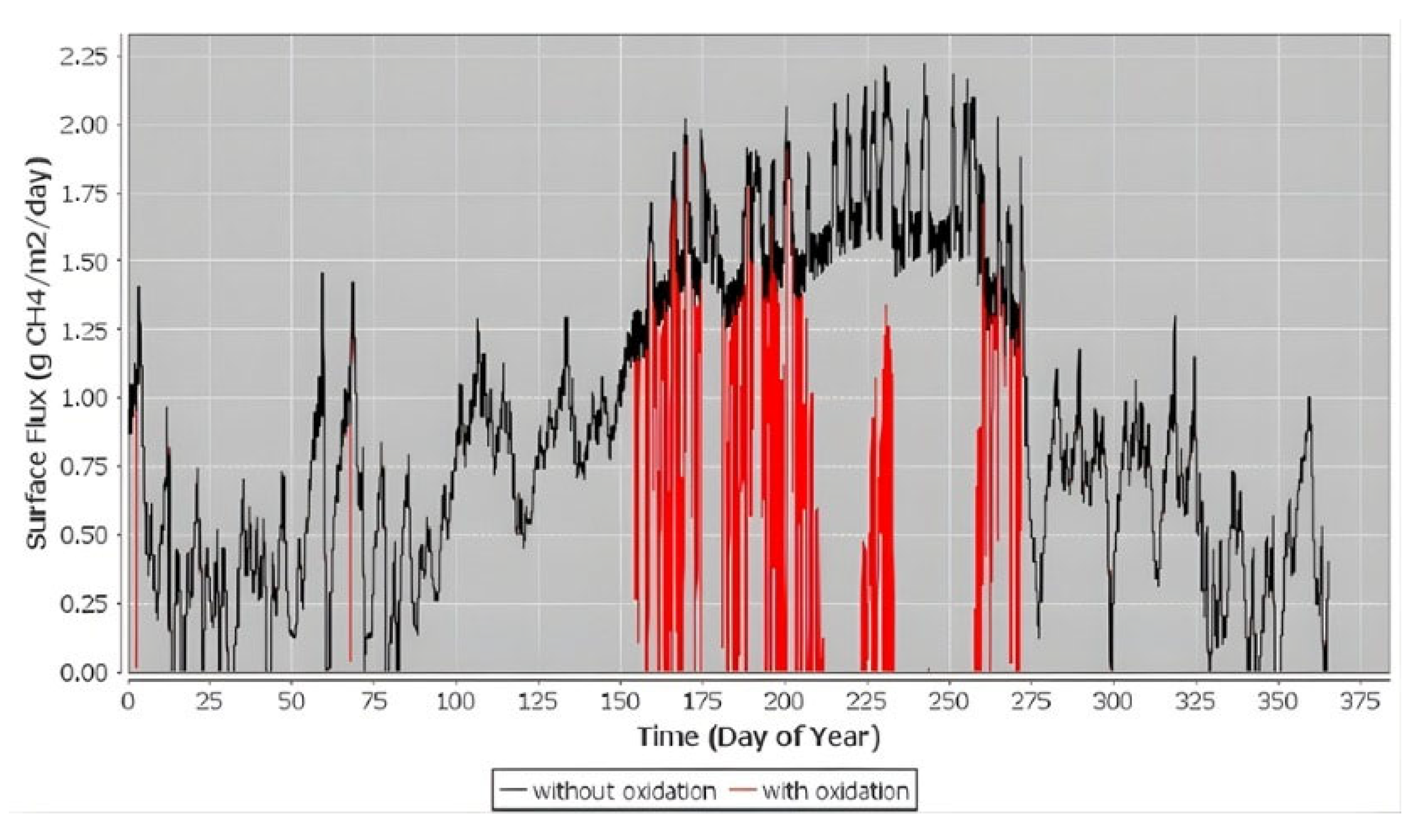
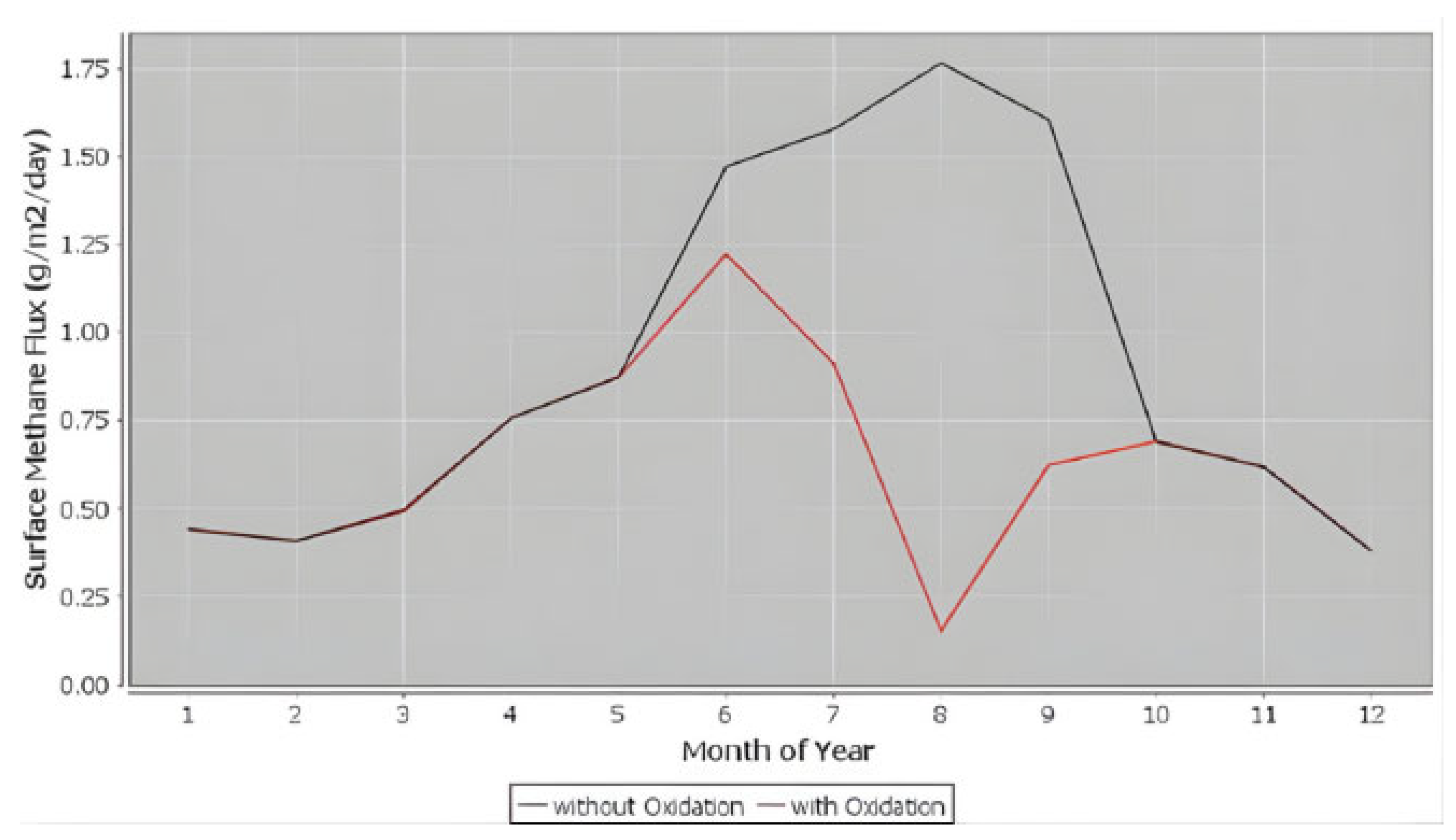
The CALMIM program estimated that the average fugitive methane emissions without oxidation is approximately 0.92 g CH4/m2/day, corresponding to 9.6 tons of CH4/year, as illustrated in Figure 1 and Figure 2.
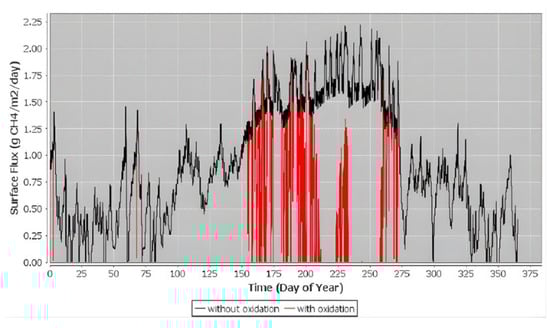
Figure 1.
Daily methane emissions from solid waste decomposition on the landfill surface. Source: CALMIM, version 5.5, 2013.
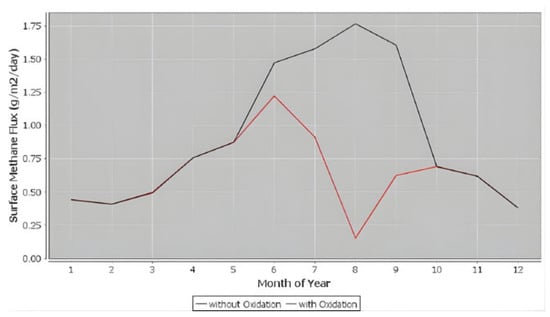
Figure 2.
Average monthly methane flux from solid waste decomposition on the landfill surface: annual approach. Source: CALMIM, version 5.5, 2013.
It is worth noting that fugitive emissions occur in greater quantities during the autumn and winter seasons, when the period is conducive to high soil moisture, providing suitable conditions for the production of methane gas by methanogenic microorganisms and, consequently, preventing the oxidation of this gas in the upper layer of the landfill. This relationship was confirmed in the study by Barbieri et al. (2020) [24], who analyzed soil evapotranspiration and concluded that this process is closely related to air humidity, temperature, and global solar radiation.
3.2. Carbon Footprint Estimate for the Second Scenario—Anaerobic Digestion
On condition that this biological treatment is implemented, it would generate approximately 129.29 tons of CH4, equivalent to 180,320.78 m3. The high efficiency of this system would allow for the recovery of 122.82 tons (171,304.74 m3) of methane for electricity production. This would result in only a minor system loss of 6.46 tons (9016.04 m3), indicating effective emission control.
Anaerobic digestion for energy production also generates carbon dioxide as a byproduct. This process resulted in a total of 170,583.33 m3 of CO2 (337.75 tons of CO2), an expected emission considered to have a lower impact on Global Warming Potential (GWP). Total estimated emissions to the environment were approximately 239,095.95 m3 of CO2 equivalent (473.41 tons). Consequently, the avoided carbon footprint rate is 0.016 t CO2 eq/t of organic waste, and the net emissions rate (considering both direct and indirect emissions) is 0.0029 t CO2 eq/t of organic waste.
3.3. Comparison of Carbon Footprint Emissions Across the Scenarios
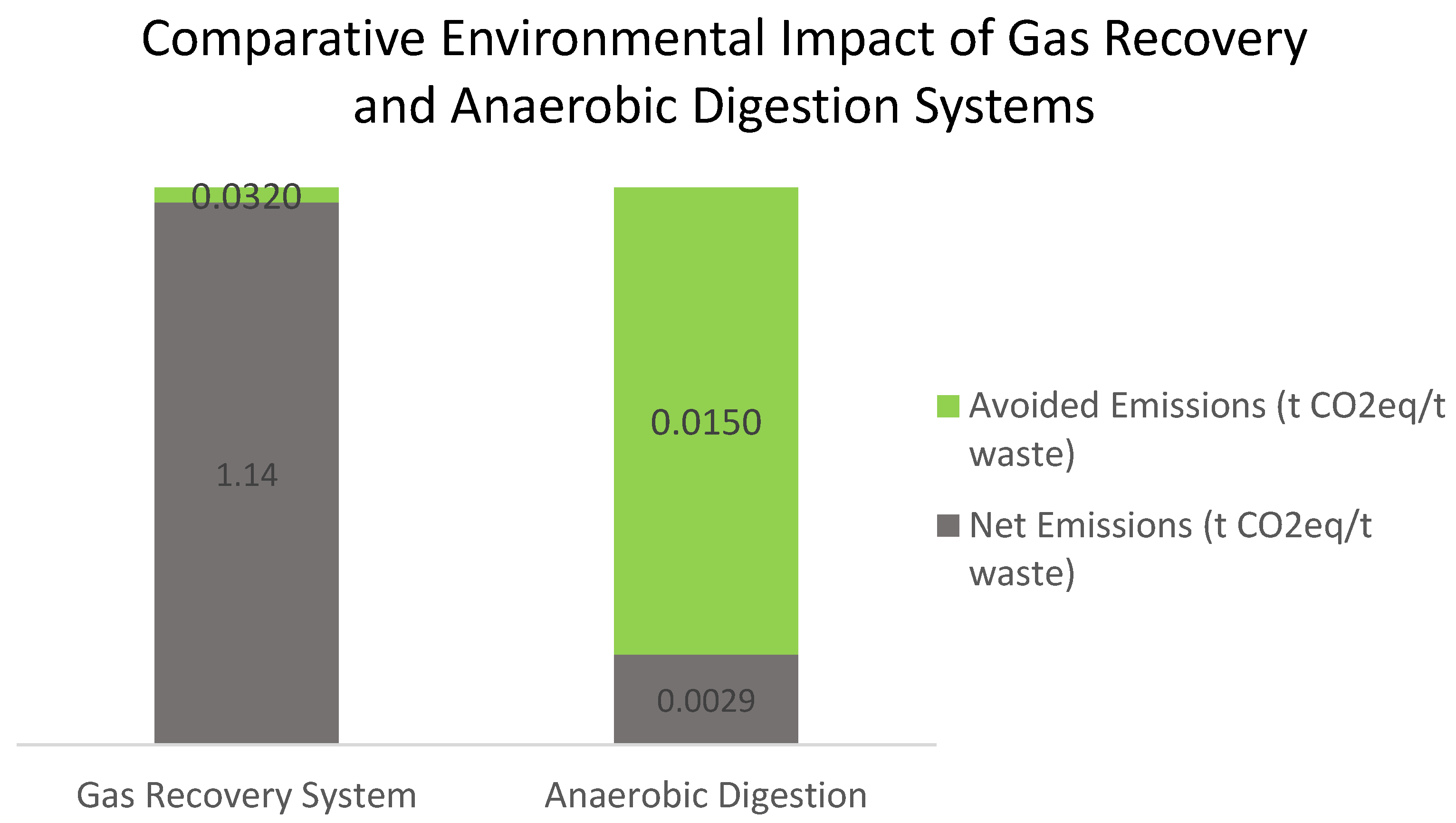
The fifth IPCC report [19] identified waste-to-energy as a key solution for mitigating methane emissions. However, different techniques offer varying potential for this purpose. As shown in Figure 3, the biogas recovery system at the landfills is still inefficient. The ratio of methane generated to methane recovered is approximately 35:1, indicating that a large portion of the gas is still emitted without being controlled.
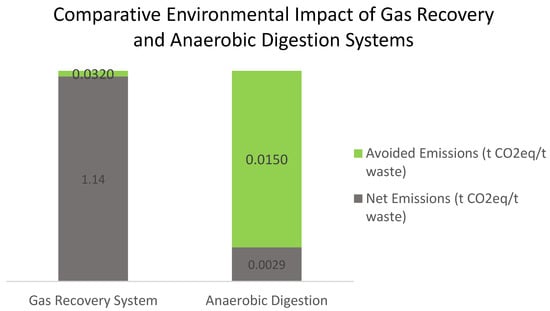
Figure 3.
Carbon footprint of net and avoided emissions (tCO2 equivalent). Source: Author’s elaboration.
The second scenario, which uses anaerobic digestion, had a much lower carbon footprint and higher recovery effectiveness. As shown in Figure 3, more than half of the methane was reused. Compared to the first scenario, anaerobic treatment resulted in 393 times lower greenhouse gas emissions.
Literature reports indicate that biogas capture systems in developing countries often operate with partial cover, late installation of the capture system, and high fugitive emissions, resulting in effective recovery efficiencies that can be very low in the initial implementation phases or in landfills with limited infrastructure. For example, in the case of the Bangkok Metropolitan Administration, Thailand, only 12% was recovered during the landfill’s lifespan [25]. These findings support the conservative choice of 3% recovery for the Paracambi case, given the site’s operational history.
3.4. Environmental Offset Modeling
Based on the data obtained from each scenario, it was estimated the ideal number of trees needed to neutralize the 2023 carbon emissions from the study area. In the first scenario, with a gas recovery system, the total gross emission was 13,820.90 t CO2eq, which would require planting approximately 46,070 trees to achieve net-zero GHG emissions. In the second scenario, with anaerobic digestion, the total gross emission was 510.52 t CO2eq, requiring planting approximately 1702 trees for neutralization.
To calculate the necessary planting area, it is necessary to define the tree density, or the spacing between seedlings. Using a 3 m × 3 m spacing, the first scenario would require about 41 hectares, while the second would need only 1.5 hectares.
4. Discussion
4.1. Carbon Footprint Estimate for the First Scenario
Fugitive emissions are most prevalent in the fall and winter seasons. The high soil moisture during these periods provides an ideal environment for methanogenic microorganisms to produce methane, while also inhibiting oxidation of gas in the landfill’s top layer. This relationship is supported by Ref. [24], who found that soil evapotranspiration is closely associated with air humidity, temperature, and global solar radiation.
4.2. Carbon Footprint Estimate for the Second Scenario—Anaerobic Digestion
Our results are consistent with other studies. Ref. [26] for example, found that anaerobic digestion of organic waste wastewater treatment plants yielded a methane recovery efficiency 90%, a range considered standard for this technology. Additionally, Ref. [27] showed that optimized anaerobic digestion systems can reduce greenhouse gas (GHG) emissions considerably compared to conventional waste disposal methods, reinforcing the effectiveness of this technology.
A study by Ref. [28] on German biogas plants found net emissions rates between 0.003 and 0.005 t CO2 eq/t of organic waste (0.3% and 0.5%). This positions the current scenario as environmentally positive and highlights the potential of anaerobic digestion to contribute to global climate goals, in alignment with the Paris Agreement.
4.3. Comparison of Carbon Footprint Emissions Across the Scenarios
Although the mass basis of the analyzed waste differs between scenarios, the comparison aims to illustrate the potential reduction in greenhouse gas emissions achievable through the implementation of selective collection and anaerobic digestion as part of an integrated solid waste management system.
This superior performance is because anaerobic digestion occurs in a closed, controlled reactor: factors like temperature, pH, retention time, and substrate composition can be monitored and adjusted to optimize biogas production. Conversely, gas production in landfills is highly unpredictable due to environmental conditions and the heterogeneous nature of the waste. As a result, the degradation of organic matter in landfills can take decades, leading to slow and unpredictable biogas production [29].
A case study in Malaysia observed the same pattern. Ref. [9] found that anaerobic digestion resulted in lower greenhouse gas (GHG) emissions and a smaller carbon footprint than landfill gas recovery. The efficiency of anaerobic digestion can be further enhanced when integrated with technological recycling systems. According to Ref. [9], this combination can significantly reduce GHG emissions by maximizing material reuse and biogas production, thereby reducing the need for final landfill disposal.
The findings reinforce the strategic role of anaerobic digestion as a sustainable management solution for organic waste, particularly in the context of public policies aimed at mitigating climate change. The capacity to drastically reduce net GHG emissions and generate renewable energy positions this process as a promising alternative to conventional landfill-based methods.
However, the reality in Brazil is different. Many landfills face significant financial and operational challenges with waste segregation, methane capture and utilization, which limits the positive impact on the carbon footprint [30].
Therefore, although landfill biogas recovery systems represent a technological improvement over direct atmospheric methane release, controlled anaerobic digestion emerges as a technique with greater potential for climate mitigation, renewable energy generation, and the promotion of a circular economy.
It is worth noting that in this study, the anaerobic digestion scenario was modeled considering only the organic fraction of MSW, as this is the material amenable to biological treatment. Non-organic fractions such as metals, plastics, and glass were considered to be managed through other routes (recycling or final disposal), in accordance with the guidelines of integrated solid waste management systems.
4.4. Adherence to the Sustainable Development Goals (SDGs)
This study reinforces the importance of combining public policies and business actions, to integrate technological innovation, environmental management, and sustainability goals. Thus, landfills, even after their operations have ceased, can contribute to the transition toward a more sustainable development model.
Silva and Silva emphasize that effective public policies are essential to overcoming obstacles to sustainability [31]. Their study highlights the importance of eco-innovation and sustainable engineering as key tools for improving waste management and promoting practices that align with the Sustainable Development Goals (SDGs). The results of this study show that mitigating the carbon footprint is directly aligned with six Sustainable Development Goals (SDGs).
Therefore, the importance of transparent business actions and the advancement of integrated solid waste management as urgent measures to combat climate change, particularly as unpredictable events become the new normal.
According to Ref. [32], Brazil has significant potential to transition to a cleaner energy matrix through the increased use of biomass. This would foster good practices and the development of new technological alternatives, thereby contributing synergistically to achieving the Sustainable Development Goals (SDGs).
Ribeiro and Oliveira argues that the Sustainable Development Goals are unattainable in a society with profound social inequalities [33]. For this reason, all public policies and technologies implemented to combat climate change will be ineffective if these inequalities are not reduced.
Promoting effective sustainability clearly requires a multidimensional approach that considers not only technical and technological aspects, but also the social and economic conditions of the population. For Ref. [34], the path to achieving the Sustainable Development Goals necessarily involves structured governance, adequate financing and political coherence between the different social sectors, with regulatory mechanisms adaptable to reality and active participation of society to, ultimately, strengthen environmental governance.
5. Conclusions
The results highlight the need for continuous monitoring and effective strategies to mitigate greenhouse gas emissions. Using advanced technologies to remove or convert methane into electricity is recommended, as this represents a crucial opportunity to reduce the environmental impact of landfills.
Clearly, the same amount of municipal solid waste can generate different carbon footprints based on several specific factors, particularly the type of treatment technology employed.
The study concludes that anaerobic digestion is the most suitable technology. It recovers 84% of the gas generated and results in a carbon footprint of only 0.0029 t O2 eq/t of waste. This contrasts sharply with the current gas recovery system, which is only 3% effective and has a carbon footprint of 1.14 t CO2 eq/t of waste. The current system also releases an additional 201.6 t CO2 eq per year in uncontrolled residual emissions.
It is also recommended that anaerobic digestion be integrated with recycling initiatives. Both methods are controlled and generally require relatively small areas compared to landfills. This strategy would conserve land for other uses and further minimize the carbon footprint.
From a public policy perspective, the results highlight the need for stronger regulations and economic incentives that favor low-environmental-impact technologies in both developed and developing countries. Additionally, including carbon footprint metrics as a mandatory criterion in municipal integrated solid waste management plans is critically important.
For municipal managers and landfill operators, this study provides strong data to support the transition from passive gas recovery to active, integrated, and energy-efficient technologies. It is recommended that anaerobic digestion be integrated with recycling, as both are controlled methods that require relatively small land areas. This strategy would conserve land resources for alternative uses and significantly contribute to minimizing the carbon footprint.
Author Contributions
Conceptualization, J.M.d.S.A., K.A.C. and W.K.d.F.; methodology, J.M.d.S.A., K.A.C. and W.K.d.F.; validation, J.M.d.S.A., K.A.C. and W.K.d.F.; formal analysis, J.M.d.S.A.; investigation, J.M.d.S.A.; resources, J.M.d.S.A.; data curation, J.M.d.S.A.; writing—original draft preparation, J.M.d.S.A.; writing—review and editing, K.A.C., W.K.d.F., G.d.G., P.M.d.B.T., F.S.S., J.d.S.F., J.B.F., M.A.C. and A.P.M.; visualization, J.M.d.S.A.; supervision, A.P.M.; project administration, A.P.M. All authors have read and agreed to the published version of the manuscript.
Funding
This study was financed in part by the Coordenação de Aperfeiçoamento de Pessoal de Nível Superior—Brasil (CAPES)—Finance Code 001.
Data Availability Statement
The data that support the findings of this study are available from the corresponding author, AMANCIO J.M.S., upon reasonable request.
Acknowledgments
To the Graduate Program in Environmental Technology at the Fluminense Federal University (UFF) for academic support; To the Centro-Sul Consortium for the support, cooperation, and access to the WTDF data.
Conflicts of Interest
The authors declare no conflicts of interest.
References
- International Energy Agency (IEA). Global Energy Review 2022; International Energy Agency (IEA): Paris, France, 2022.
- Climate Watch. GHG Emissions; Climate Watch: Washington, DC, USA, 2024. [Google Scholar]
- Demirbaş, F.; Ates, N. Evaluation of Carbon Footprint in a Waste Recovery/Recycle Facility. Energy Environ. Storage 2021, 1, 7–12. [Google Scholar] [CrossRef]
- European Union. Copernicus Global Climate Report 2024 Confirms Last Year as the Warmest on Record, First Ever Above 1.5 °C Annual Average Temperature; European Union: Reading, UK, 2025. [Google Scholar]
- Cui, Y.; Khan, S.U.; Deng, Y.; Zhao, M. Spatiotemporal Heterogeneity, Convergence and Its Impact Factors: Perspective of Carbon Emission Intensity and Carbon Emission per Capita Considering Carbon Sink Effect. Environ. Impact Assess. Rev. 2022, 92, 106699. [Google Scholar] [CrossRef]
- Sabeti, Z.; Nosratnejad, S.; Mousavi, M.; Mosaferi, M. Assessment of electricity generation potential and economic analysis through different municipal solid waste management scenarios: A case study. Biomass Convers. Biorefinery 2022, 15, 21883–21895. [Google Scholar] [CrossRef]
- Court of Accounts of the State of Rio de Janeiro (TCE-RJ). Annual Management Report 2021; Court of Accounts of the State of Rio de Janeiro (TCE-RJ): Rio de Janeiro, Brazil, 2021. [Google Scholar]
- National Institute of Meteorology (INMET). Climate Monitoring Report: June 2024; National Institute of Meteorology (INMET): Brasília, Brazil, 2024. [Google Scholar]
- Malakahmad, A.; Abualqumboz, M.S.; Kutty, S.R.M.; Abunama, T.J. Assessment of Carbon Footprint Emissions and Environmental Concerns of Solid Waste Treatment and Disposal Techniques; Case Study of Malaysia. Waste Manag. 2017, 70, 282–292. [Google Scholar] [CrossRef] [PubMed]
- Intergovernmental Panel on Climate Change (IPCC). 2006 IPCC Guidelines for National Greenhouse Gas Inventories; Intergovernmental Panel on Climate Change (IPCC): Hayama, Japan, 2006. [Google Scholar]
- Ministry of Science, Technology and Innovation (MCTI). CO2 Emission Factors—SIRENE Platform; Ministry of Science, Technology and Innovation (MCTI): Brasília, Brazil, 2023. [Google Scholar]
- Mariano, M.O.H.; Jucá, J.F.T. Field Tests for the Determination of Biogas Emissions in Solid Waste Landfill Cover Layers. Eng. Sanit. Ambient. 2010, 15, 223–228. [Google Scholar] [CrossRef]
- Government of the State of Rio de Janeiro. State Solid Waste Plan; Government of the State of Rio de Janeiro: Rio de Janeiro, Brazil, 2013. [Google Scholar]
- Gueri, M.D.; De Souza, S.N.M.; Kuczman, O. Operational Parameters of the Anaerobic Digestion Process of Food Waste: A Review. BIOFIX Sci. J. 2017, 3, 17–25. [Google Scholar] [CrossRef]
- Intergovernmental Panel On Climate Change. 2019 Refinement to the 2006 IPCC Guidelines for National Greenhouse Gas Inventories. Ipcc.ch. 2019. Available online: https://www.ipcc.ch/report/2019-refinement-to-the-2006-ipcc-guidelines-for-national-greenhouse-gas-inventories/ (accessed on 1 October 2025).
- de Carly Luz Andreazza, R.; de Lara, D.M.; Richter, M.F. Projection of Methane (CH4) Generated in a Lanfdill Using the ACM0001 Methodology. Rev. Bras. Climatol. 2024, 35, 504–528. [Google Scholar] [CrossRef]
- Energy Research Office (EPE). Study on the Cost-Effectiveness of the Use of Municipal Solid Waste in Landfills for Biomethane Production; Energy Research Office (EPE): Rio de Janeiro, Brazil, 2018. [Google Scholar]
- Themelis, N.J.; Bourtsalas, A.C. Methane Generation and Capture of U.S. Landfills. J. Environ. Sci. Eng. A 2021, 10, 199–206. [Google Scholar] [CrossRef]
- Stocker, T.F.; Qin, D.; Plattner, G.-K.; Tignor, M.; Allen, S.K.; Boschung, J.; Nauels, A.; Xia, Y.; Midgley, P.M.; Bex, V. Climate Change 2013: The Physical Science Basis. Contribution of Working Group I to the Fifth Assessment Report of the Intergovernmental Panel on Climate Change; Intergovernmental Panel on Climate Change (IPCC): Geneva, Switzerland, 2013. [Google Scholar]
- Wei, Y.; Xu, W.; Chen, Y.; Peng, Y.; Ke, H.; Zhan, L.; Lan, J.; Li, H.; Zhang, Y. Evaluation of greenhouse gas emission and reduction potential of high-food-waste-content municipal solid waste landfills: A case study of a landfill in the east of China. Waste Manag. 2024, 189, 290–299. [Google Scholar] [CrossRef]
- Silva dos Santos, I.F.; Braz Vieira, N.D.; de Nóbrega, L.G.B.; Barros, R.M.; Tiago Filho, G.L. Assessment of Potential Biogas Production from Multiple Organic Wastes in Brazil: Impact on Energy Generation, Use, and Emissions Abatement. Resour. Conserv. Recycl. 2018, 131, 54–63. [Google Scholar] [CrossRef]
- Alengebawy, A.; Mohamed, B.A.; Ghimire, N.; Jin, K.; Liu, T.; Samer, M.; Ai, P. Understanding the Environmental Impacts of Biogas Utilization for Energy Production through Life Cycle Assessment: An Action towards Reducing Emissions. Environ. Res. 2022, 213, 113632. [Google Scholar] [CrossRef] [PubMed]
- Edenhofer, O.; Pichs-Madruga, R.; Sokona, Y.; Seyboth, K.; Kadner, S.; Zwickel, T.; Eickemeier, P.; Hansen, G.; Schlömer, S.; von Stechow, C.; et al. (Eds.) Renewable Energy Sources and Climate Change Mitigation; Cambridge University Press: Cambridge, UK; New York, NY, USA, 2011; ISBN 9781107023406. [Google Scholar]
- Barbieri, J.D.; de Freitas, P.S.L.; Dallacort, R.; Rezende, R.; da Silva, A.L.B.R.; Fenner, W.; de Carvalho, M.A.C. Influence of Soil Coverage on Evapotranspiration and Dual Crop Coefficients on Soybean. J. Exp. Agric. Int. 2020, 42, 111–125. [Google Scholar] [CrossRef]
- Menikpura, S.N.M.; Sang-Arun, J.; Bengtsson, M. Climate co-benefits of energy recovery from landfill gas in developing Asian cities: A case study in Bangkok. Waste Manag. Res. 2013, 31, 1002–1011. [Google Scholar] [CrossRef]
- Galdi, S.M.; Szczuka, A.; Shin, C.; Mitch, W.A.; Luthy, R.G. Dissolved Methane Recovery and Trace Contaminant Fate Following Mainstream Anaerobic Treatment of Municipal Wastewater. ACS EST Eng. 2023, 3, 121–130. [Google Scholar] [CrossRef] [PubMed]
- Alves, L.; Santos, A.; Silva, A.; Putti, F.; Góes, B. A Eficiência Do Biodigestor No Tratamento de Dejetos Suínos Para Uso Como Biofertilizante. Peer Rev. 2023, 5, 85–99. [Google Scholar] [CrossRef]
- Wechselberger, V.; Reinelt, T.; Yngvesson, J.; Scharfy, D.; Scheutz, C.; Huber-Humer, M.; Hrad, M. Methane Losses from Different Biogas Plant Technologies. Waste Manag. 2023, 157, 110–120. [Google Scholar] [CrossRef]
- Shahbaz, M.; Ammar, M.; Korai, R.M.; Ahmad, N.; Ali, A.; Khalid, M.S.; Zou, D.; Li, X. Impact of C/N Ratios and Organic Loading Rates of Paper, Cardboard and Tissue Wastes in Batch and CSTR Anaerobic Digestion with Food Waste on Their Biogas Production and Digester Stability. SN Appl. Sci. 2020, 2, 1436. [Google Scholar] [CrossRef]
- De Sousa, F.D.C. Perspectives on the Production and Energy Recovery of Biogas from Sanitary Landfills. Rev. Estud. Debate 2022, 29, 76–92. [Google Scholar] [CrossRef]
- da Silva, L.A.; Silva, L.C.O. Public Policies for Solid Waste and Environmental Technological Innovation: A Narrative Review on the Implementation of Reverse Logistics. Res. Soc. Dev. 2024, 13, e29131047002. [Google Scholar] [CrossRef]
- Sampaio, C.A.C.; Philippi, A., Jr. Impact of Environmental Sciences on the 2030 Agenda; Oficina de Texto: São Paulo, Brazil, 2021. [Google Scholar]
- Ribeiro, D.B.; dos Anjos Oliveira, E.F. Sustainable Development and Science, Technology and Innovation Policy in Brazil. Soc. Quest. 2024, 2, 45–64. [Google Scholar] [CrossRef]
- De Sousa, B.H.A.B.; Da Silva, C.A.; De Souza, C.A.; De Oliveira, E.A.; De Souza, E.J.A.; De Farias Vilhena, F.A.; Ferreira, H.S.; Nascimento, I.J.B.M.F.D.; Fagundes, J.M.; Barros, K.M.; et al. A Integração Dos Objetivos De Desenvolvimento Sustentável (ODS) Nas Políticas Ambientais: Uma Revisão Integrativa. IOSR J. Bus. Manag. IOSR-JBM 2025, 27, 50–54. [Google Scholar] [CrossRef]
Disclaimer/Publisher’s Note: The statements, opinions and data contained in all publications are solely those of the individual author(s) and contributor(s) and not of MDPI and/or the editor(s). MDPI and/or the editor(s) disclaim responsibility for any injury to people or property resulting from any ideas, methods, instructions or products referred to in the content. |
© 2025 by the authors. Licensee MDPI, Basel, Switzerland. This article is an open access article distributed under the terms and conditions of the Creative Commons Attribution (CC BY) license.