Skip to Content
BatteriesBatteries
  • Article
  • Open Access

15 February 2026

Glycolic Acid-Induced Surface Reconstruction and In Situ Carbon Coating for High-Electrochemical-Performance Lithium-Rich Manganese-Based Cathodes


,
,
,
,
and
1
Chengdu Institute of Organic Chemistry, Chinese Academy of Sciences, Chengdu 610299, China
2
University of Chinese Academy of Sciences, Beijing 101408, China
*
Authors to whom correspondence should be addressed.

Abstract

Lithium-rich manganese-based cathode materials (LRMs, Li1.2Mn0.54Ni0.13Co0.13O2) are promising prospects for subsequent-generation lithium-ion batteries owing to their elevated operating voltage, large specific capacity, and affordability. Nonetheless, their actual implementation is significantly impeded by irreversible lattice-oxygen redox reactions, surface structural disorder, and interfacial phase collapse, leading to low initial Coulombic efficiency (ICE), inadequate rate capability, and sluggish Li+ transport. Herein, we report a simple and mild glycolic acid-assisted surface-engineering strategy to enhance the electrochemical performance of LRM. Glycolic acid treatment induces controlled H+/Li+ ion exchange at the particle surface and anchors surface transition metals through the formation of transition metals (TM)–OH and TM–O–C=O bonds. Subsequent calcination constructs an in situ carbon layer-spinel-layered heterostructure, accompanied by the generation of coupled anionic and cationic vacancies. This reconstructed surface provides fast Li+ diffusion pathways and stabilized ion-transport channels, while the dual-vacancy configuration enhances lattice-oxygen reversibility and suppresses structural disorder. Consequently, the modified LRM delivers a high initial discharge capacity of 285.3 mAh⋅g−1 with an ICE of 89.9%, while maintaining 81% capacity retention after 100 cycles. Notably, it exhibits a significantly suppressed voltage decay of only 1.7 mV/cycle at 3C, markedly outperforming the pristine LRM. Density Functional Theory (DFT) calculations reveal that the surface-modified sample possesses enhanced electronic conductivity, as evidenced by the improved Density of States (DOS), and achieves superior structural stability through increased binding energies. This environmentally benign surface-engineering strategy offers a practical and efficient route toward the industrial application of LRM.

1. Introduction

Lithium-rich manganese-based cathode materials (LRMs), such as Li1.2Mn0.54Ni0.13Co0.13O2, are promising cathode materials due to their high theoretical capacities exceeding 250 mAh⋅g−1. However, their practical application is hindered by rapid capacity and voltage decay as well as poor rate capability. These drawbacks mainly stem from structural instability and intrinsically low electronic conductivity. During high-voltage cycling (>4.5 V), LRMs undergo surface reconstruction accompanied by irreversible lattice oxygen loss, which induces phase transitions from the layered structure to spinel- or rock-salt-like phases [1,2]. The resulting transition-metal migration, particularly of Mn and Ni into lithium layers [3], disrupts the layered framework, leading to increased polarization, elevated interfacial resistance, and continuous voltage fading. Moreover, sluggish lithium-ion transport further limits the rate performance of LRMs.
To address these issues, extensive efforts have been devoted to structural and interfacial engineering strategies, including bulk doping (NaBF4 [4], S2− [5], Cr6+ [6]), surface coating (Al2O3 [7], VPO5 [8]), and structural design and morphology control (high-entropy stabilization [9], oxygen vacancy [2]). Among them, surface modification has emerged as an effective approach to mitigate parasitic interfacial reactions and suppress structural deterioration without significantly altering the bulk chemistry. In particular, carbon-based coatings have been widely explored due to their ability to enhance electronic conductivity and buffer electrode–electrolyte interactions [10,11,12]. Nevertheless, conventional carbon coating methods often rely on high-temperature treatment of external carbon sources, which may result in non-uniform coverage, limited interfacial adhesion, or undesirable side reactions with the cathode surface. Recently, organic-acid-assisted surface treatments have been demonstrated as a versatile and mild route to regulate the surface chemistry of layered oxide cathodes. Through H+/Li+ exchange, organic acids selectively extract lithium ions from the near-surface region, generating cation and anion vacancies and altering the local coordination environment of transition metals [13,14]. Meanwhile, organic species adsorbed on the particle surface can act as in situ carbon precursors during subsequent thermal treatment, enabling the formation of conformal carbon layers tightly integrated with the host lattice. However, the interplay between vacancy chemistry induced by H+/Li+ exchange and in situ carbon layer formation in LRMs remains poorly understood, and systematic studies on their synergistic effects on structural stability and electrochemical kinetics are still limited.
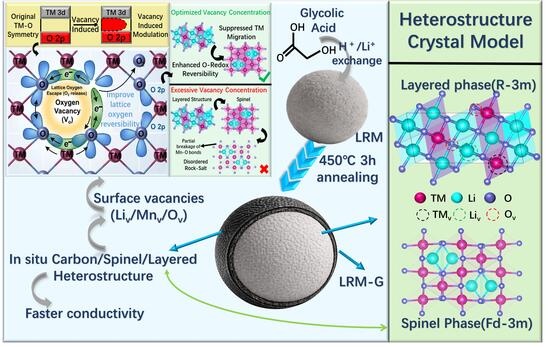
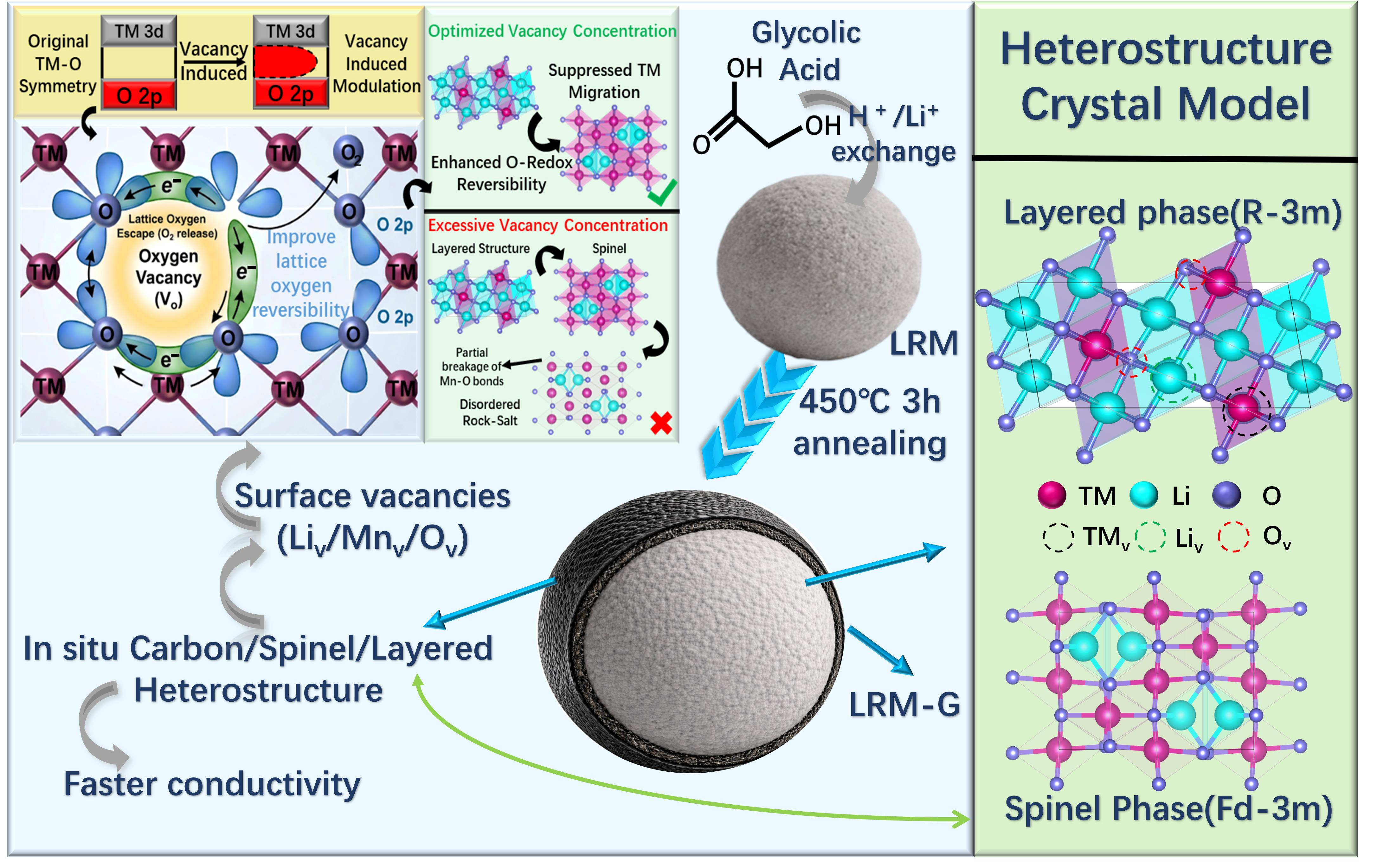
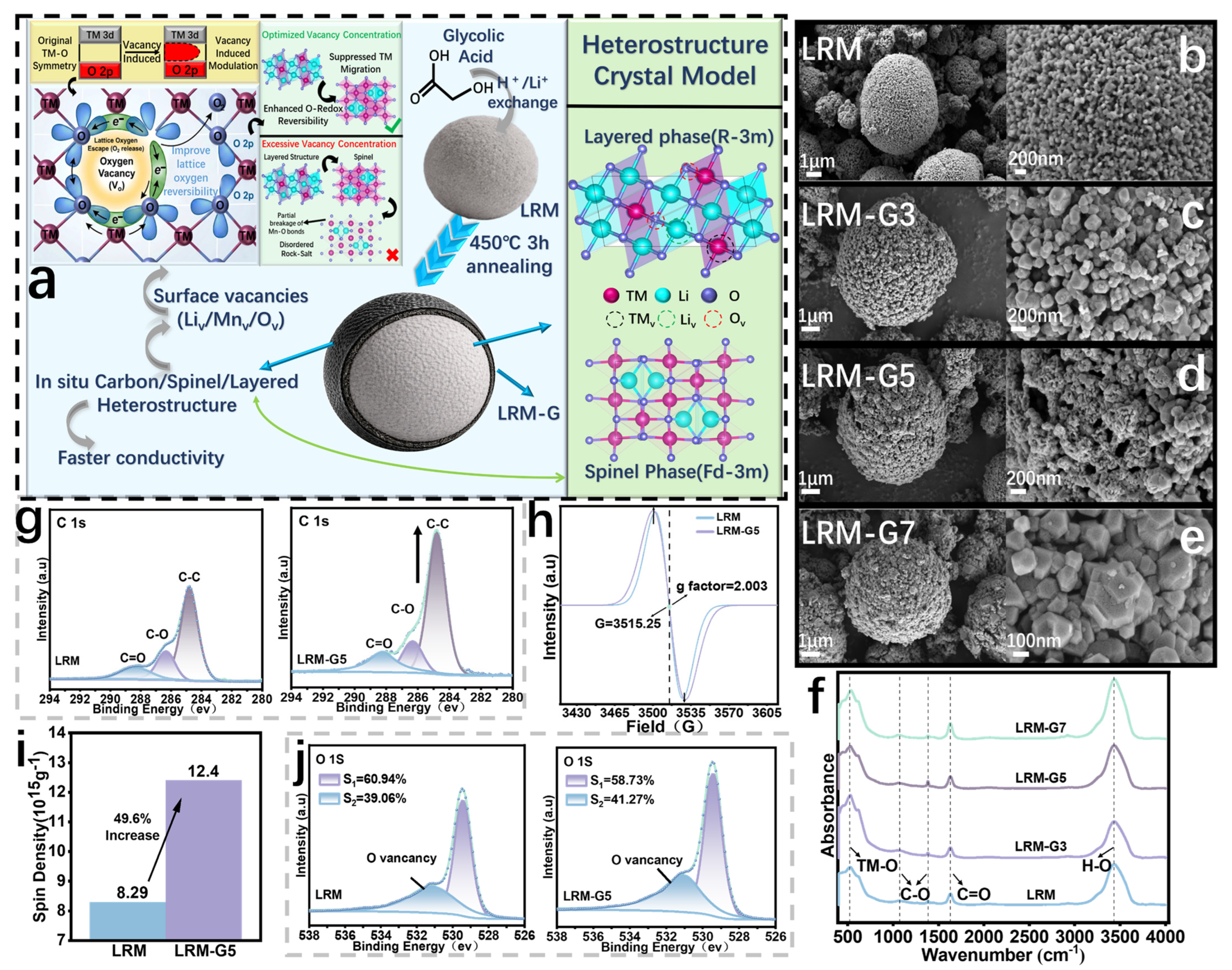
Herein, we propose a glycolic-acid-assisted surface reconstruction strategy to address the intrinsic interfacial instability and sluggish charge transport of LRMs. As schematically illustrated in Figure 1a, ion release from glycolic acid induces a surface H+/Li+ exchange, creating a locally reduced transition metal (TM) environment that triggers the in situ formation of TM–OH and TM–O–C=O chemical bonds on the LRM surface. Subsequent low-temperature annealing enables the simultaneous construction of a carbonaceous surface layer enriched with C–C bonding and a spinel-like reconstructed structure, thereby establishing efficient Li+ transport pathways without relying on excessive external carbon sources or high-temperature treatments. Distinct from conventional bulk doping or carbon-coating approaches, this mild and scalable strategy avoids lattice distortion while effectively mitigating interfacial degradation arising from the severe conductivity mismatch between LiTMO2 (TM=Mn, Ni, Co) and Li2MnO3 domains [15]. This work provides a versatile and fundamentally different paradigm for stabilizing lithium-rich cathode materials through chemically driven surface reconstruction.
Figure 1. Surface engineering with glycolic acid: (a) Design concept [16]; (be) SEM images of LRM, LRM-G3, LRM-G5, and LRM-G7; (f) FTIR spectra of the samples; (g,j) XPS C1s and O1s spectra of LRM and LRM-G5; (h,i) EPR spectra of oxygen vacancies (h) and spin numbers comparison (i) in LRM and LRM-G5.

2. Materials and Methods

2.1. Materials Preparation

Pristine LRM (Li1.2Mn0.54Ni0.13Co0.13O2) was prepared via a two-step approach involving co-precipitation and solid-state reaction. The precursor was formed by reacting a mixed sulfate solution (2 mol L−1, Mn:Ni:Co = 0.54:0.13:0.13) with a chelating precipitant (2 mol L−1 Na2CO3 with sodium citrate) in a nitrogen-purged CSTR. The reactor was operated at 60 °C with a stirring speed of 1250 rpm, maintaining a constant pH of 8.0 ± 0.04. The resulting precipitate was aged for 20 h, purified with deionized water, and dried. For lithiation, the precursor was ball-milled with LiOH·H2O (5% excess) and subjected to heat treatment under O2 flow at 500 °C (5 h) and 850 °C (12 h).
Surface modification was achieved by dispersing the as-synthesized LRM in 50 mL anhydrous ethanol and adding glycolic acid (C2H4O3, >98% purity, Aladdin) at loadings of 3, 5, and 7 wt.%. These mixtures were processed at 45 °C under vigorous stirring (1000 rpm) for 1 h. Upon drying, the solids were calcined at 450 °C for 3 h to produce the final derivatives, designated as LRM-G3, LRM-G5, and LRM-G7. Furthermore, to ensure the accuracy of carbon elemental analysis by eliminating potential contamination from non-intrinsic carbon sources, the pristine LRM was subjected to the same thermal treatment and designated as LRM-A.

2.2. Materials Characterization

The micro-morphology of the samples was investigated using field-emission scanning electron microscopy (SEM, ZEISS Sigma 300, Oberkochen, Germany) operated in secondary electron (SE) mode, with elemental mapping performed via energy-dispersive X-ray spectroscopy (EDS) mapping. Crystal structures were analyzed by X-ray diffraction (XRD, Rigaku Ultima IV, Tokyo, Japan) using a generator with a rated output power of 3 kW. Patterns were collected in the 2θ range of 10–80° at a scanning rate of 2°·min−1, followed by Rietveld refinement through the FullProf suite. Surface chemical states were examined via X-ray photoelectron spectroscopy (XPS, Thermo Scientific K-Alpha, East Grinstead, UK) using a 400 μm beam spot. The analysis chamber was maintained at a vacuum level superior to 5.0 × 10⁻⁷ mBar with an operating voltage of 12 kV. Atomic-scale microstructures were characterized using high-resolution transmission electron microscopy (HRTEM, Talos F200s, Eindhoven, the Netherlands) at an accelerating voltage of 200 kV. The instrument delivered an information resolution of ≤0.12 nm at 200 kV and exhibited high stability with a beam spot drift of ≤1 nm/min. Furthermore, Fourier-transform infrared (FTIR, Nicolet iS20, Madison, WI, USA) and electron paramagnetic resonance (EPR, Bruker ELEXSYS-II E500, Karlsruhe, Germany) spectroscopies were employed to identify functional groups and oxygen vacancy concentrations, respectively. The precise elemental contents before and after the reaction were determined by inductively coupled plasma–optical emission spectrometry (ICP-OES, Agilent 5110, Santa Clara, CA, USA).

2.3. Electrochemical Measurement

The active material was uniformly dispersed in anhydrous ethanol via ultrasonication for 30 min and subsequently dried under vacuum at 60 °C for 12 h. To prepare the electrode slurry, active material, Super P, and PVDF were dispersed in N-methyl-2-pyrrolidone at a mass ratio of 8:1:1. The homogenization process was strictly conducted in a controlled environment with a relative humidity of 1% RH. This slurry was applied to a prepared aluminum foil substrate and subjected to vacuum drying for 12 h at 105 °C. Circular electrodes (12 mm diameter) were cut from the dried foil, and the mass loading was quantified with ±0.01 mg accuracy. Using a Celgard 2325 separator (Charlotte, NC, USA) and lithium foil as the counter/reference electrode, CR2032 half-cells (Hefei, China) were constructed within an argon atmosphere glovebox where oxygen and moisture contents were maintained below 0.01 ppm. The electrolyte solution consisted of 1 M LiPF6 in a ternary solvent system of ethylene carbonate, diethyl carbonate, and ethyl methyl carbonate (1:1:1 by volume). A NEWARE BTS-4000 (Shenzhen, China) unit was utilized for galvanostatic charge–discharge and galvanostatic intermittent titration technique (GITT) tests. Cyclic voltammetry (CV) and Electrochemical impedance spectroscopy (EIS) measurements were carried out on a Multi Autolab M204 instrument (Utrecht, the Netherlands); CV curves were swept from 2.0 to 4.8 V at 0.1 mV s−1, and impedance spectra were acquired from 100 kHz to 10 mHz at 25 °C using a 5 mV perturbation.
The lithium-ion diffusion coefficient (DLi+) was calculated using the following Equation (1) [17], where the Warburg factor ( σ ) was determined from the slope obtained by linearly fitting the last five points in the low-frequency region of the EIS spectrum:
D L i + = ( R T 2 S n 2 F 2 C σ ) 2
In Equation (1), the universal gas constant, absolute temperature, and Faraday constant are represented by R (8.314 J⋅mol−1⋅K−1), T (298 K), and F (96,485 C⋅mol−1), respectively. Other key parameters include the electrode surface area S (1.44 cm−2), the number of electrons transferred n , the Warburg coefficient σ (derived from the slope of Z’ vs. ω−1/2), and the lithium-ion concentration in the cathode C .
Using the solid density from Table S1, the C can be further determined by Equation (2) [18].
C = x ρ M
x : lithium stoichiometric coefficient. ρ : material density. M : molar mass.

3. Results and Discussion

3.1. Microstructural Evolution and Structural Characterization

The morphologies of pristine and modified samples were examined by SEM, as shown in Figure 1b–e. All samples exhibit dense secondary particles with an average particle size of approximately 6 μm, indicating that the surface treatment does not alter the overall particle morphology. In contrast to pristine LRM, the surfaces of LRM-G3, LRM-G5, and LRM-G7 are uniformly covered by an additional surface layer, which can be attributed to the formation of an in situ carbon coating accompanied by a spinel-like reconstructed structure. To further evaluate the elemental distribution, EDS mapping was performed. As shown in Figures S1a,b and S2a–c, all elements are homogeneously distributed without observable segregation. Quantitative analysis summarized in Table S2 confirms that the pristine LRM sample exhibits a uniform elemental composition with a Mn:Ni:Co atomic ratio close to the nominal value of 0.54:0.13:0.13. As listed in Tables S3–S6, the carbon contents of LRM-A (5.12 at%), LRM-G3 (7.83 at%), LRM-G5 (8.68 at%), and LRM-G7 (9.61 at%) reveal that the annealing process itself does not introduce additional carbon sources, while the surface carbon concentration increases monotonically with increasing glycolic acid dosage.
FTIR spectroscopy was employed to probe the surface bonding environments. As shown in Figure 1f, the modified samples exhibit a markedly enhanced absorption band at approximately 520 cm−1, corresponding to the stretching and bending vibrations of TM–O bonds [19], indicative of the formation of metal–organic coordination. With increasing glycolic acid content, the C–O stretching vibration at ~1200 cm−1 and the symmetric C–O stretching vibration at ~1400 cm−1 display a pronounced blue shift accompanied by peak broadening, suggesting the establishment of TM–O–C bonding configurations and increased surface structural disorder in LRM-G3, LRM-G5, and LRM-G7 [20,21]. Moreover, the C=O stretching vibration centered at ~1560 cm−1 shows significantly enhanced intensity and peak broadening, characteristic of metal-coordinated carboxylate species, indicating that the carboxyl ions of glycolic acid undergo ion transfer and fully dissociate into carboxylate anions to form stable and highly ionic TM–O–C=O complexes. Consistently, the intensified O–H stretching vibration at ~3470 cm−1 further supports the formation of TM–OH bonding environments on the modified LRM-G surfaces induced by H+/Li+ exchange [22,23].
The occurrence of ion exchange reactions was further corroborated by ICP-OES analysis (Table S7). Relative to pristine LRM (Li: 8.88 wt.%, Mn: 35.38 wt.%), LRM-G5 shows a simultaneous decrease in Li and Mn mass fractions, with Li reduced to 8.76 wt.% and Mn reduced to 34.82 wt.%. The concurrent depletion of alkali and TM species clearly indicates the formation of lithium and manganese vacancies in the near-surface region, corroborating the glycolic acid-induced H+/Li+ exchange and cation extraction process. To elucidate the surface chemical states, XPS measurements were conducted. The C 1s spectra (Figure 1g) are consistent with the SEM, FTIR, and EDS results, where the significantly enhanced C–C bonding component in LRM-G5 provides direct evidence for the formation of an in situ carbon layer. Collectively, these results demonstrate that glycolic-acid-induced TM–organic coordination enables the successful in situ construction of a stable carbon coating on the LRM-G5 surface after low-temperature annealing [13,24].
To further elucidate the surface vacancy characteristics and elemental evolution, EPR spectroscopy was employed to probe the oxygen vacancy states associated with the in situ carbon-coated surface (Figure 1h). The EPR signals reveal that LRM-G5 exhibits a significantly higher oxygen vacancy concentration and increased density of unpaired oxygen electrons compared with pristine LRM. Furthermore, since the EPR spin number directly reflects the localized electronic environment of the material surface, the data were normalized to spin density and presented in a histogram for quantitative comparison (Figure 1i and Table S8). The results indicate that the oxygen vacancy spin concentration of LRM-G5 increased by 49.6%, rising from 8.29 × 10¹⁵ spins g−1 in LRM to 1.24 × 10¹⁶ spins g−1 in LRM-G5. This observation is further corroborated by the XPS O 1s spectra (Figure 1j). Relative to LRM, LRM-G5 displays a more pronounced oxygen vacancy component at ~531 eV alongside the characteristic lattice oxygen peak at ~529 eV [19,25]. The peak area percentages at 529 eV and 531 eV for LRM are 60.94% and 39.06%, respectively, while those for LRM-G5 are 58.73% and 41.27%, confirming the increased surface oxygen vacancy concentration in LRM-G5, indicating the successful modulation of the surface chemical environment.
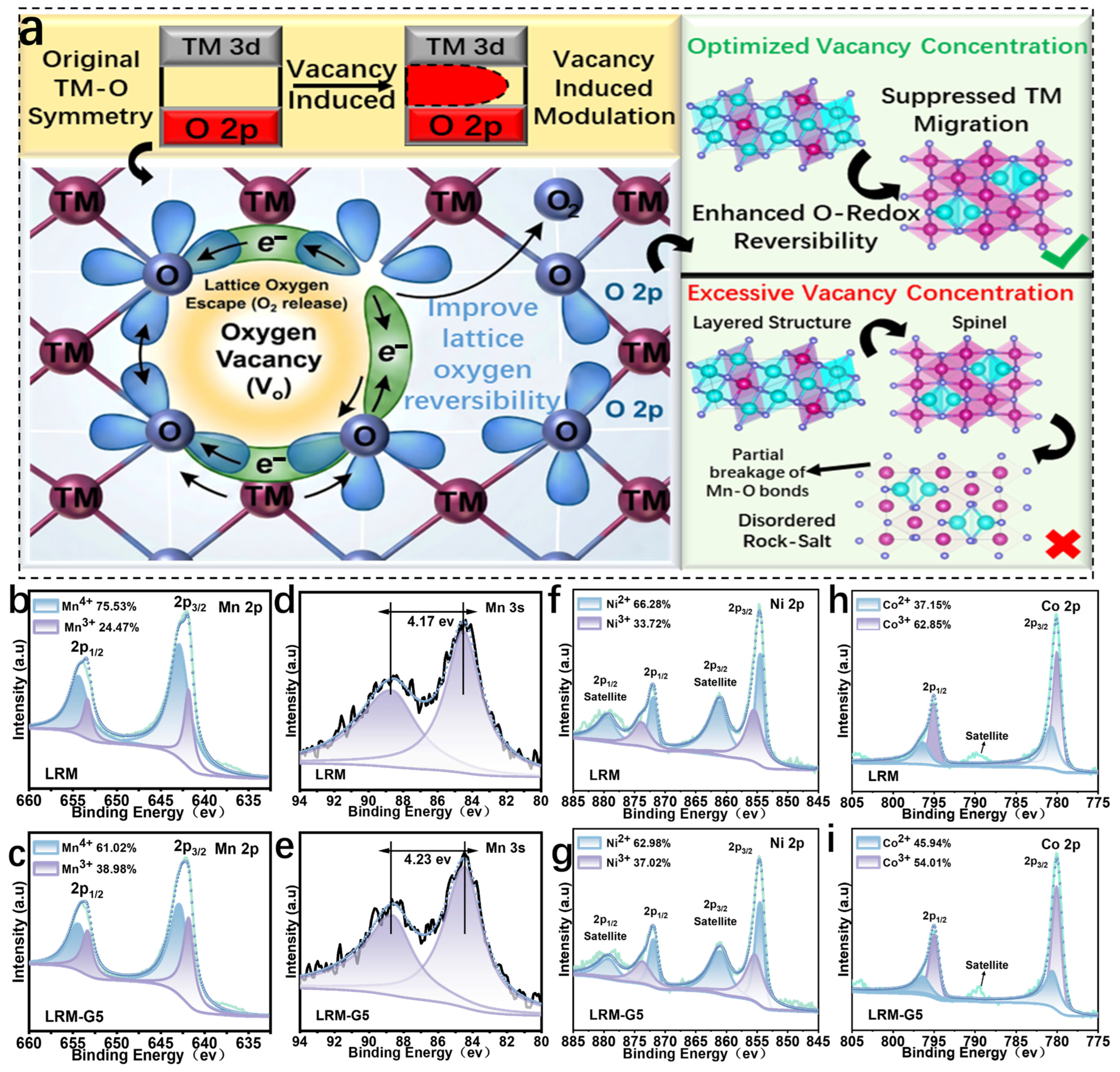
Nevertheless, the accumulation of surface oxygen vacancies is expected to induce a local charge imbalance, driving the reduction in transition-metal cations to maintain overall charge neutrality [26]. As depicted in Figure 2a, an increased oxygen vacancy concentration not only modulates the surface oxygen partial pressure but also triggers O 2p orbital modulation [27]. The introduction of these vacancies breaks the intrinsic TM-O symmetry, shifting the O 2p energy levels and facilitating their participation in charge compensation [28]. Additionally, the formation of oxygen vacancies leads to a localized charge redistribution, where the electrons originally involved in the TM-O covalent bond are partially transferred to the neighboring Mn 3d orbitals [29]. This process results in a decreased Mn-O hybridization strength and a shift in the O 2p band center closer to the Fermi level [30]. The weakened metal–oxygen interaction effectively reduces the bond-breaking energy required for oxygen hopping, thereby lowering the diffusion activation energy [31]. Moreover, an overabundance of oxygen vacancies often leads to uncontrolled lattice oxygen behavior during testing.
Figure 2. (a) Schematic illustration of the oxygen vacancy-mediated redox mechanism. Comparative XPS analysis of LRM and LRM-G5: (b,c) Mn 2p spectra; (d,e) Mn 3s spectra; (f,g) Ni 2p spectra; (h,i) Co 2p spectra.
To verify the surface stability of LRM-G samples, it is therefore essential to monitor the corresponding evolution of cationic oxidation states. This requirement is addressed by the XPS Mn 2p spectra in Figure 2b,c, which provide more details about the evolution of Mn oxidation states. Quantitative analysis indicates that the proportion of Mn4+ species in LRM-G5 (2p3/2 at 642.5 eV and 2p1/2 at 653.6 eV [32]) decreases markedly from 75.53% to 61.02% relative to pristine LRM. In the Mn 3s spectra (Figure 2d,e), LRM-G5 exhibits a larger multiple splitting (4.23 eV) than LRM (4.17 eV), in good agreement with the Mn 2p and ICP-OES results. Furthermore, the Ni 2p and Co 2p spectra (Figure 2f–i) provide complementary evidence for the overall reduction in transition-metal oxidation states [33], in accordance with the principle of local charge conservation at the modified surface.
Collectively, these results demonstrate that glycolic-acid-induced surface engineering effectively introduces lithium, oxygen, and manganese vacancies, leading to the formation of cation–anion dual vacancies on the LRM-G5 surface.
LRM are composed of monoclinic C2/m Li2MnO3 and trigonal R-3m LiTMO2 (TM = Ni/Co/Mn) phases [1,34], whose intrinsic kinetic mismatch results in heterogeneous Li+ diffusion across phase boundaries, thereby serving as a primary origin of voltage decay and structural degradation [35]. As previously discussed, glycolic-acid-assisted surface engineering effectively lowers the average oxidation state of transition metals. Given the annealing process employed for LRM-G, previous studies have demonstrated that this phenomenon is typically coupled with the migration of internal transition-metal cations toward surface Li sites [26]. This directional migration triggers the formation of a spinel phase (as shown in Figure 2a), which may, consequently, lead to the in situ construction of a carbon/spinel/layered heterostructure.
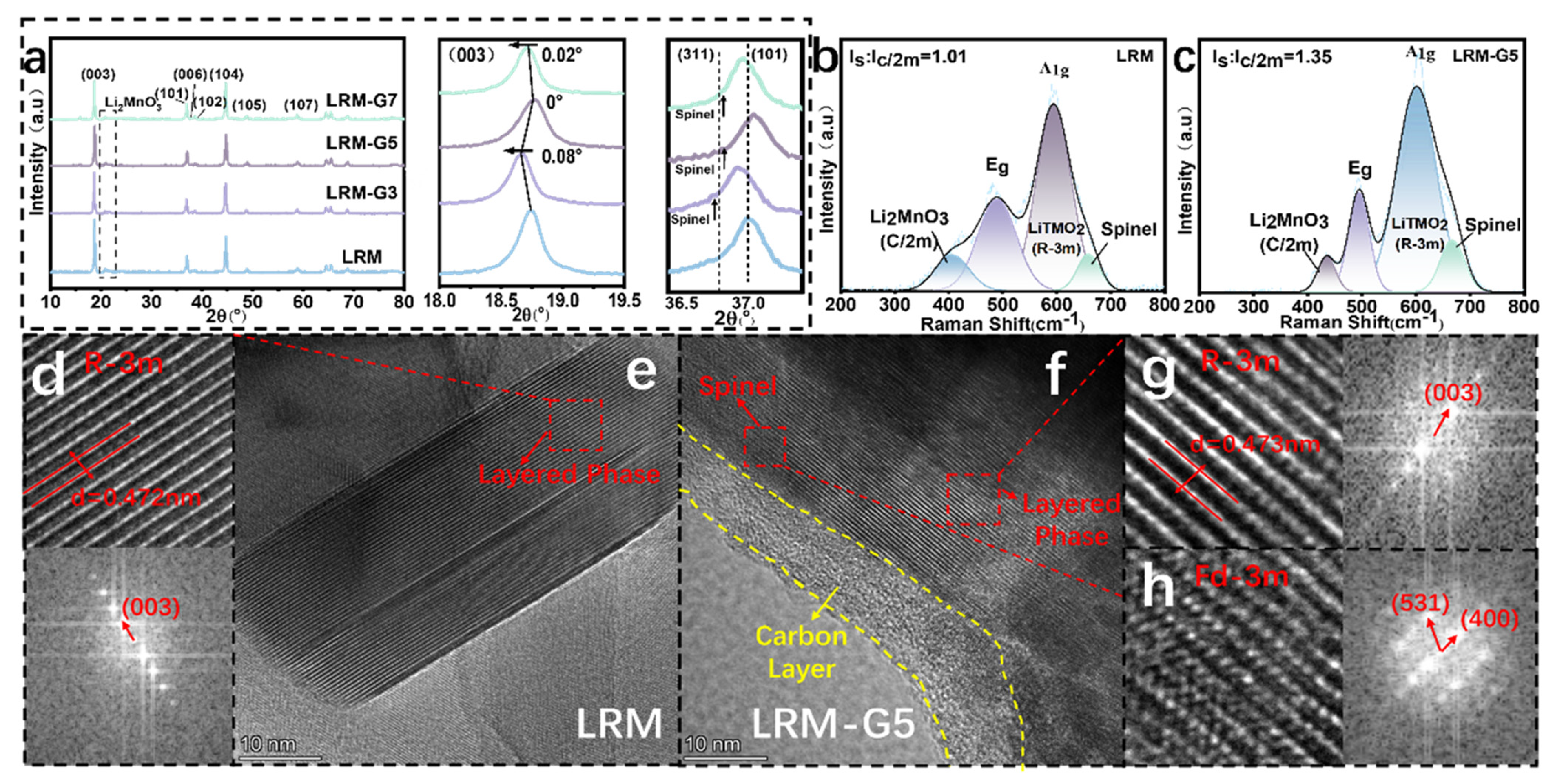
Thus, XRD was employed to investigate the crystal-structure evolution of the pristine and modified samples (Figure 3a). All samples display characteristic reflections of the layered R-3m structure ((003), (101), and (104)) along with signatures of the monoclinic C2/m Li2MnO3 phase [36], indicating that the bulk crystal framework remains intact after surface modification. The noticeable left shift in the (003) reflection suggests an expanded interlayer spacing along the c axis, which is consistent with Li migration toward surface transition-metal layers during annealing and provides indirect evidence for spinel-phase generation. Notably, modified samples exhibit a distinct shoulder peak assignable to the (311) plane [29], further confirming the emergence of a spinel phase.
Figure 3. Structural and microstructural characterization. (a) XRD patterns of LRM, LRM-G3, LRM-G5, and LRM-G7. (b,c) Raman spectra with fitting curves for LRM (b) and LRM-G5 (c). (d) FFT pattern corresponding to LRM. (e,f) HRTEM images of LRM (e) and LRM-G5 (f). (g,h) FFT patterns corresponding to LRM-G5.
Rietveld refinement results (Figure S3 and Table 1) further reveal a regulated structural rearrangement induced by the surface modification.
Table 1. Refined structural parameters from the Rietveld analysis.
Compared with pristine LRM, LRM-G3, LRM-G5, and LRM-G7 exhibit only slight variations in c/a ratios, confirming the preservation of the O3-type layered structure, while the marginal c-axis expansion is favorable for interlayer Li+ transport [36]. The slightly decreased I003/I104 ratio, indicating partial Li+/Ni2+ cation disordering [36], together with the ICP, EDS, and FTIR results, corroborates Li+ depletion (via H+/Li+ exchange) and subsequent transition-metal migration during annealing, which are key prerequisites for spinel formation.
Raman analysis (Figure 3b,c) reveals an increased intensity ratio between the spinel-related band at ~680 cm−1 and the Li2MnO3-related band at ~420 cm−1 in LRM-G5 [37], providing additional evidence for directed spinel-phase formation. The LRM-G5 sample shows an intensified A1g peak (~605 cm−1) relative to LRM, indicative of robust TM-O symmetric stretching vibrations and stronger bonding in the layered lattice [38], aligning well with the FTIR analysis. Moreover, the increased intensity and narrowed bandwidth of the Eg mode (~500 cm−1) reflect enhanced O-TM-O bending rigidity [39]. This observation implies a homogenization of TM-O bond lengths and angles, attributed to the structural reordering during the formation of the spinel phase [9]. HRTEM reveals that LRM-G5 preserves an intact layered bulk structure while forming an ordered carbon-spinel-layered heterostructure at the surface (Figure 3e,f). Fast Fourier transform (FFT) analysis confirms enlarged R-3m (003) lattice spacing and the presence of characteristic Fd-3m spinel planes (531) and (400) in Figure 3g,h [40].

3.2. Analysis of Electrochemical Performance

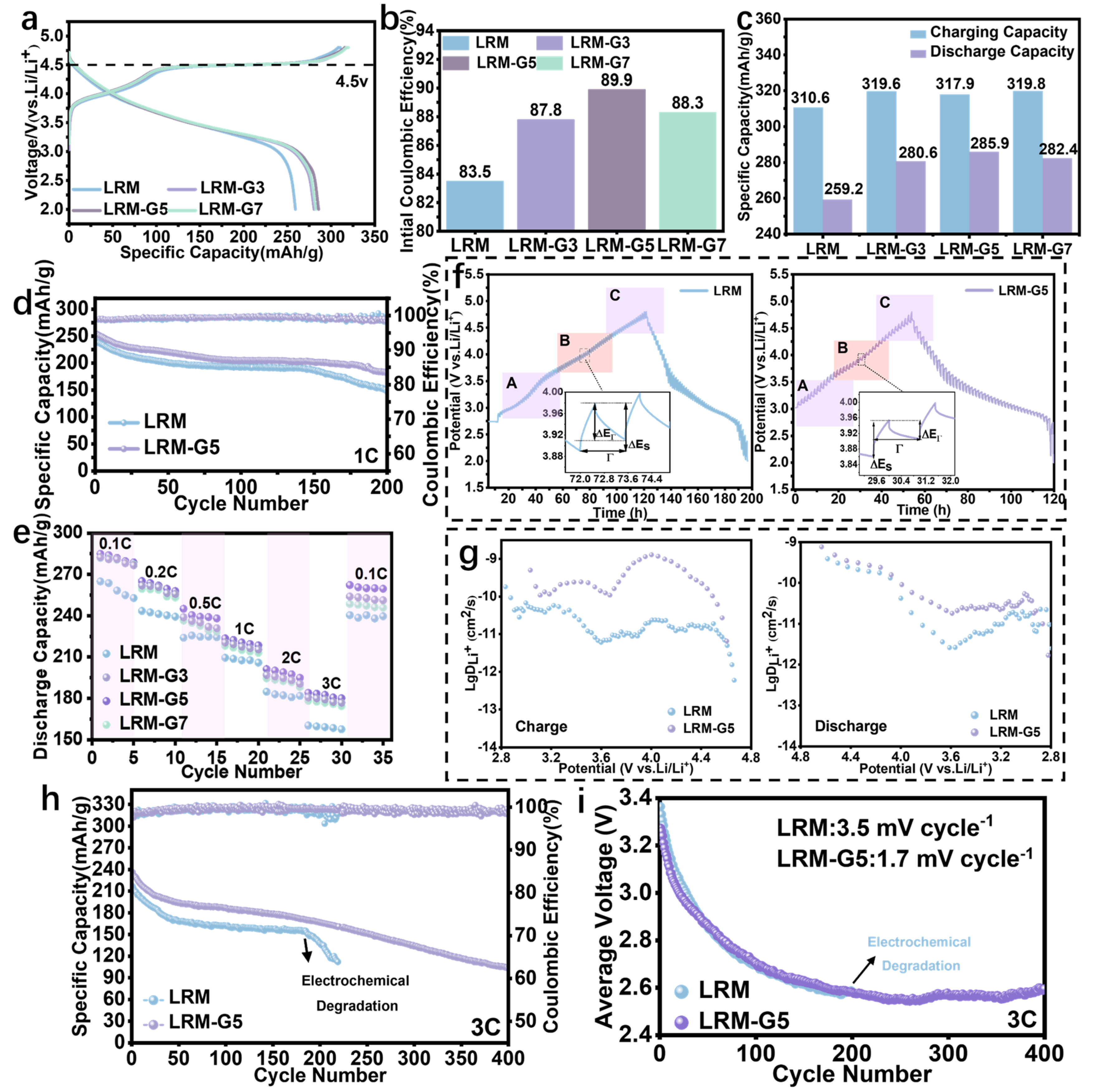
To further evaluate the electrochemical performance of the in situ carbon-spinel-layered heterostructure, coin cells were assembled using electrodes with tightly controlled active-material mass deviations within ±0.04 mg, thereby minimizing the influence of mass loading on electrochemical measurements (Tables S9 and S10). As shown in the initial charge–discharge profiles (Figure 4a–c), LRM, LRM-G3, LRM-G5, and LRM-G7 deliver initial Coulombic efficiencies of 83.5%, 87.8%, 89.9%, and 88.3%, respectively. Correspondingly, the initial discharge capacities reach 259.2, 280.6, 285.8, and 282.4 mAh⋅g−1. Notably, LRM-G5 achieves the lowest irreversible capacity loss and an enhanced capacity output. Such behavior reflects optimized charge-transfer kinetics and enhanced structural durability during the initial charging process, which may lead to improved overall reversibility. Based on these results, LRM and LRM-G5 were selected for subsequent long-term cycling tests. At a current density of 1 C (Figure 4d and Figure S4), LRM and LRM-G5 deliver discharge capacities of 253.9 and 239.2 mAh⋅g−1, maintaining 81% and 76% of their initial capacities after 100 cycles, respectively. After 200 cycles, LRM-G5 exhibits a capacity retention approximately 10% higher than that of pristine LRM, highlighting its improved long-term cycling stability. In Figure 4e, the pristine LRM delivers discharge capacities of 264.8, 243.4, 223.9, 209.4, 184.7, and 160.2 mAh⋅g−1 at 0.1C, 0.2C, 0.5C, 1C, 2C, and 3C, respectively. In contrast, the LRM-G5 sample demonstrates markedly enhanced capacities of 284.9, 265.2, 245.0, 220.5, 201.2, and 183.9 mAh⋅g−1 at the same rates. The cycling performance and voltage decay at high rates directly reflect the electrochemical and structural stability of the material. As shown in Figure 4h, LRM-G5 delivered a discharge capacity of 236.1 mAh⋅g−1 at 3 C, whereas LRM achieved only 216.5 mAh⋅g−1 and exhibited a distinct performance deterioration after 192 cycles. Voltage fading during effective cycling remains one of the most critical indicators for the industrial application of LRMs. As illustrated in Figure 4i, during the stable cycling window, the voltage decay rates for LRM and LRM-G5 are 3.5 and 1.7 mV/cycle, respectively. Compared with recent studies on organic acid modification and carbon coating (Table S11), the electrochemical performance demonstrated in this work exhibits competitive advantages. GITT measurements conducted after cycling (Figure 4f) were employed to assess electrochemical stability and Li+ diffusion kinetics at high voltages by analyzing voltage-relaxation behavior. The observed relaxation-time differences are generally associated with Li+ concentration gradients between the diffusion-inactive Li2MnO3 phase (regions A and C) and the electrochemically active LiTMO2 phase (region B) [2]. Notably, LRM-G5 exhibits a substantially reduced total relaxation time of 119.7 h compared with 196.6 h for LRM, indicating accelerated Li+ diffusion kinetics. Enlarged views of region B further reveal a smaller voltage deviation from equilibrium for LRM-G5, indicative of faster Li+ diffusion and improved kinetic reversibility. The GITT-derived Li+ diffusion coefficients during charge and discharge (Figure 4g) provide direct evidence that LRM-G5 experiences reduced surface Li+ concentration gradients and faster diffusion kinetics throughout electrochemical cycling.
Figure 4. Electrochemical performance evaluation. (a) Initial charge/discharge profiles of LRM and LRM-G5 at 0.1 C. (b) Comparison of the ICE for all samples. (c) The charge and discharge capacities of all samples. (d,h) Cycling performance at 1 C over 200 cycles (d) and at 3C over 400 cycles (h) for LRM and LRM-G5. (e) Rate capability of LRM, LRM-G3, LRM-G5 and LRM-G7 at various rates. (f) GITT curve during charge/discharge. (g) Li+ diffusion coefficients calculated from GITT for LRM and LRM-G5. (i) Voltage decay comparison between LRM and LRM-G5.
EIS was employed to further elucidate the origin of the enhanced Li+ diffusion kinetics in LRM-G5. The Nyquist plots obtained from EIS measurements consist of an ohmic resistance (Re) and a charge-transfer resistance (Rct). Re represents the intrinsic resistance arising from both cell configuration and material properties, whereas Rct directly reflects the resistance associated with interfacial redox reactions at the electrode-electrolyte interface [41,42].
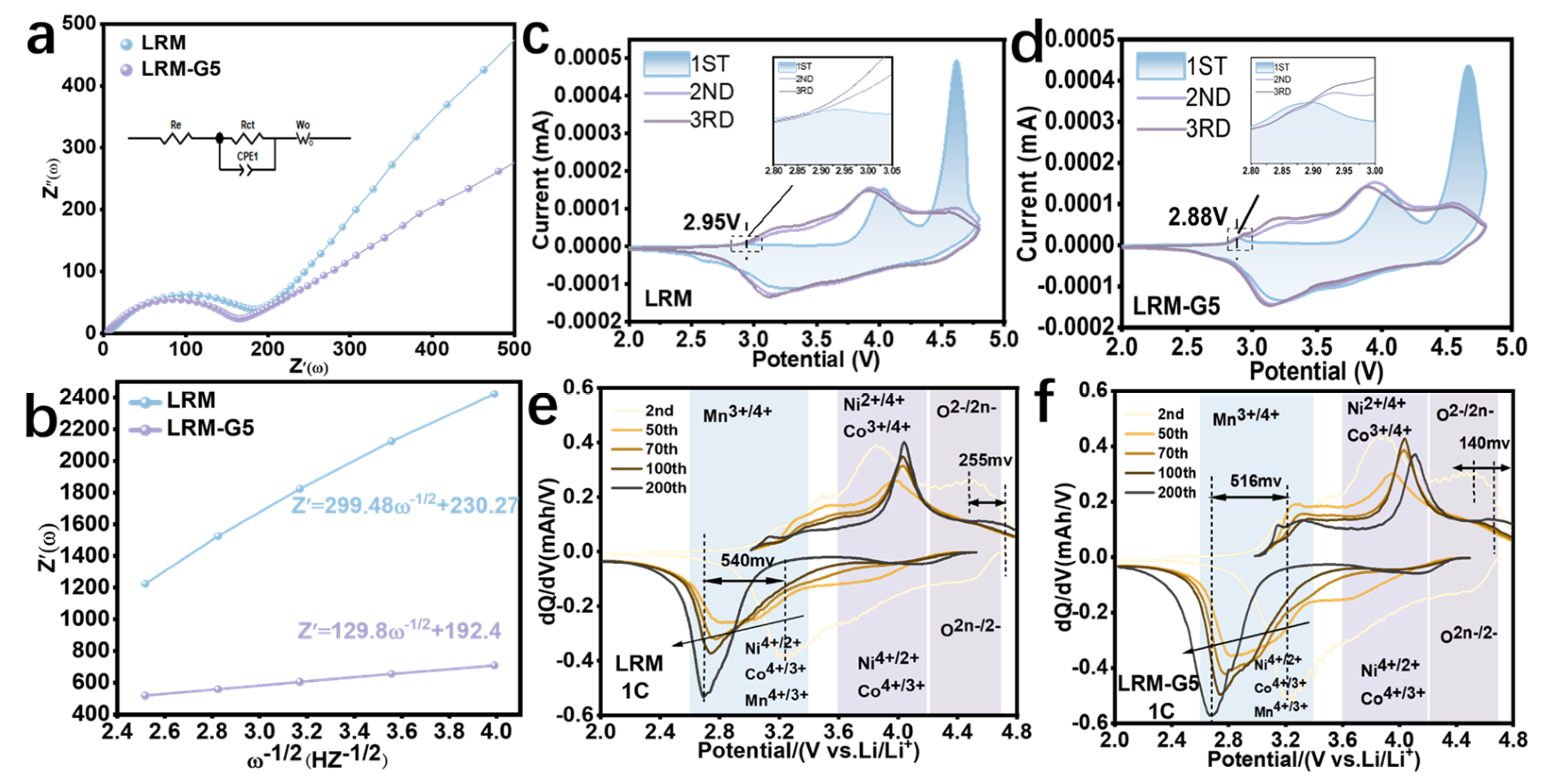
The EIS results are in agreement with the GITT-derived diffusion behavior trend. As shown in Figure 5a and Table S12, LRM-G5 exhibits lower ohmic resistance (Re = 3.673 Ω) and charge-transfer resistance (Rct = 149.5 Ω) compared with LRM (Re = 7.167 Ω; Rct = 174.0 Ω). These results indicate that the interfacial engineering strategy endows LRM-G5 with intrinsically lower impedance and enhanced interfacial electrochemical reactivity. The Li+ diffusion behavior was further quantified by fitting the Warburg impedance using the last five data points in the low-frequency region (Figure 5b) [43]. This linear fitting provides the Warburg coefficient, which directly characterizes the solid-state diffusion kinetics of Li+ within the active material lattice. As derived in Equation (1), Figure 5b and Table S12, the Li+ diffusion coefficient of LRM-G5 (2.47 × 10⁻¹⁶ cm2 s−1) is approximately one order of magnitude higher than that of LRM (4.65 × 10⁻¹⁷ cm2 s−1). The markedly enhanced Li+ diffusion coefficient directly reflects faster interfacial redox kinetics and improved electrochemical stability [44,45].
Figure 5. Electrochemical kinetics analysis. (a,b) Nyquist plots (a) and the corresponding Warburg impedance fitting curves (b). (c,d) CV curves of LRM (c) and LRM-G5 (d). (e,f) dQ/dV curves of LRM (e) and LRM-G5 (f).
These findings are further corroborated by the CV and dQ/dV analyses. In the first-cycle CV curves (Figure 5c,d), LRM-G5 exhibits a pronounced oxidation peak at 2.88 V, corresponding to the layered-to-spinel structural reconstruction [46], whereas the weak oxidation peak at 2.95 V for LRM suggests negligible or absent spinel phase formation. In addition, the intensity difference between the oxidation and reduction peaks around 4.5 V directly reflects the reversibility of lattice oxygen redox activity [47]. The peak currents at ~4.5 V for LRM and LRM-G5 are 4.95 mA and 4.36 mA. The smaller peak intensity difference observed for LRM-G5 compared with LRM is consistent with XPS and EPR results, indicating that the modified surface electronic environment induces oxygen vacancy formation, thereby enhancing lattice oxygen reversibility and Li+ interfacial activity. The dQ/dV profiles (Figure 5e,f) further elucidate the evolution of cationic redox activity during prolonged cycling. Compared to LRM, LRM-G5 exhibits more pronounced Mn3+/Mn4+ Oxidation peaks in the 2.8–3.2 V range, alongside intensified Ni2+/Ni4+ and Co3+/Co4+ couples within 3.6–4.2 V. Similarly, compared to the pristine LRM, LRM-G5 exhibits more pronounced reduction peaks at ~2.7 V. These peaks, associated with the Mn4+/Mn3+, Ni4+/Ni2+, and Co4+/Co3+ redox couples, show significantly intensified currents, indicating enhanced cationic redox activity and reversibility. These observations correlate well with the previously identified Mn vacancies and the reduced average oxidation states of surface transition metals [48].
Furthermore, the shifts in transition-metal reduction peaks from the 2nd to the 200th cycle are 540 mV for LRM and 516 mV for LRM-G5, while the corresponding lattice-oxygen-like oxidation peak shifts are 255 mV and 140 mV, respectively, demonstrating the superior interfacial stability and reversibility of LRM-G5. Considering the oxygen vacancy characteristics alongside the long-term cycling stability (400 cycles at 3C) and suppressed voltage decay, LRM-G5 appears to resist excessive vacancy accumulation and the resulting structural disordering. Nevertheless, this preliminary conclusion warrants further validation through comprehensive post-cycling characterization.
In summary, combined with its stable 3C cycling and mitigated voltage fading, LRM-G5 effectively resists vacancy-induced structural degradation. This behavior aligns with the structural insights from FTIR, XPS, and XRD, highlighting the improved integrity of the TM framework. Consequently, post-cycling characterizations were conducted to further elucidate the microstructural stability differences between LRM and LRM-G5.

3.3. Post-Cycling Characterization of Surface and Bulk Properties

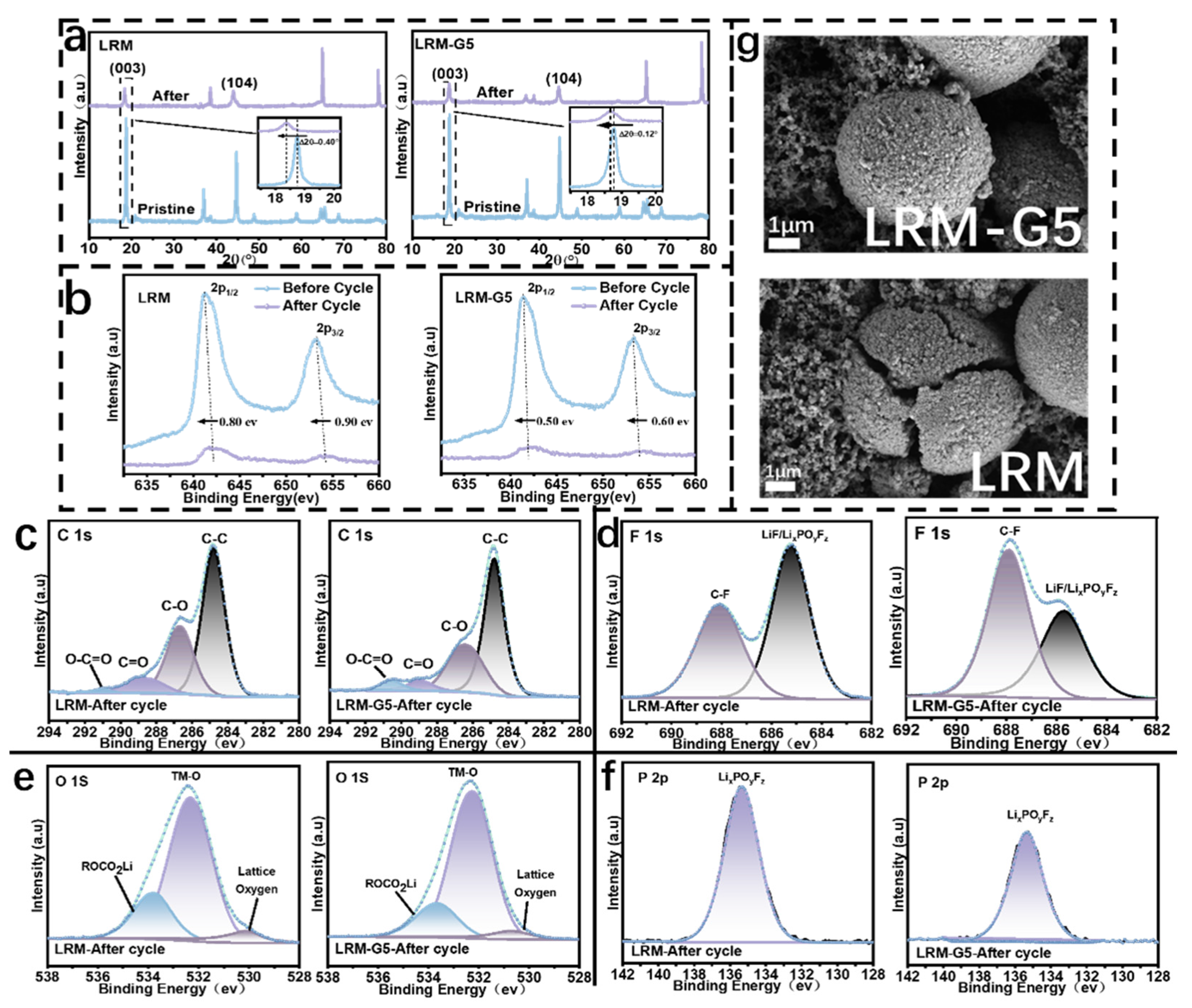
As shown in Figure S5a, significant structural disordering was observed in the bulk of the pristine LRM after long-term cycling. A thin and unstable cathode electrolyte interphase (CEI) was detected at the particle edges, and the original layered structure was poorly preserved. In contrast, Figure S5b reveals that although the carbon coating on LRM-G5 exhibits varying thicknesses (~0.5–6.5 nm), it effectively encapsulates the particle and stabilizes the CEI. The shift in the XRD (003) reflection before and after cycling in Figure 6a directly reflects the extent of structural degradation. The (003) peak shifts in LRM and LRM-G5 are 0.40° and 0.12°, respectively, indicating the markedly superior electrochemical structural stability of LRM-G5.
Figure 6. Structural and compositional evolution after cycling. (a) Comparison of XRD patterns before and after cycling. (b) Comparison of XPS Mn 2p spectra before and after cycling. (cf) Comparative XPS spectra of (c) C 1s, (d) F 1s, (e) O 1s, and (f) P 2p before and after cycling. (g) SEM images of the electrode before and after cycling.
In addition, the binding-energy shifts in the Mn 2p1/2 and 2p3/2 orbitals before and after cycling obtained from XPS analysis (Figure 6b) are consistent with this conclusion. Specifically, LRM-G5 exhibits smaller shifts of 0.5 and 0.6 eV, whereas LRM shows larger shifts of 0.8 and 0.9 eV, respectively. Consistent with the suppressed Mn dissolution evidenced by the intensified Mn3+/Mn4+ redox peaks in the dQ/dV profiles during long-term cycling, LRM-G5 demonstrates a more robust Mn-based redox reversibility. Post-cycling EIS (Figure S6 and Table S13) reveals that LRM-G5 maintains much lower Re (8.476 Ω) and Rct (150.7 Ω) than LRM (11.96 Ω and 338.4 Ω), indicating enhanced Li-ion transport stability. The results suggest that the in situ carbon/spinel/layered heterostructure effectively suppresses structural disordering triggered by phase transitions during cycling, thus ensuring the durability of the bulk lattice [5].
XPS orbital deconvolution in Figure 6c–f provides further insights into the uniformity of the CEI and the extent of electrolyte decomposition. In the C 1s spectra, the higher intensities of C=O and C–O species for LRM, together with the stronger ROCO2Li signal in the O 1s spectra, indicate a thicker CEI enriched with organic components [49]. This feature reflects intensified interfacial side reactions, leading to increased electrolyte/electrode interfacial resistance and continuous consumption of active materials. The F 1s spectra further support this conclusion, as the higher binding energy associated with C–F bonds in LRM-G5 suggests a lower degree of electrolyte–electrode interfacial degradation compared with LRM. The LiF/LixPOyFz species originate from the decomposition of the LiPF6-based electrolyte [50], and the higher binding energy observed for LRM implies more severe interfacial corrosion and more pronounced parasitic reactions. Consistently, the presence and intensity of LixPOyFz decomposition products in the P 2p spectra further corroborate this interfacial degradation behavior. Notably, after cycling, LRM-G5 exhibits stronger TM–O bonding compared with LRM, which can be attributed to the thicker CEI layer and more pronounced structural degradation in LRM that weakens the intrinsic metal–oxygen framework.

3.4. Density Functional Theory (DFT) Calculations

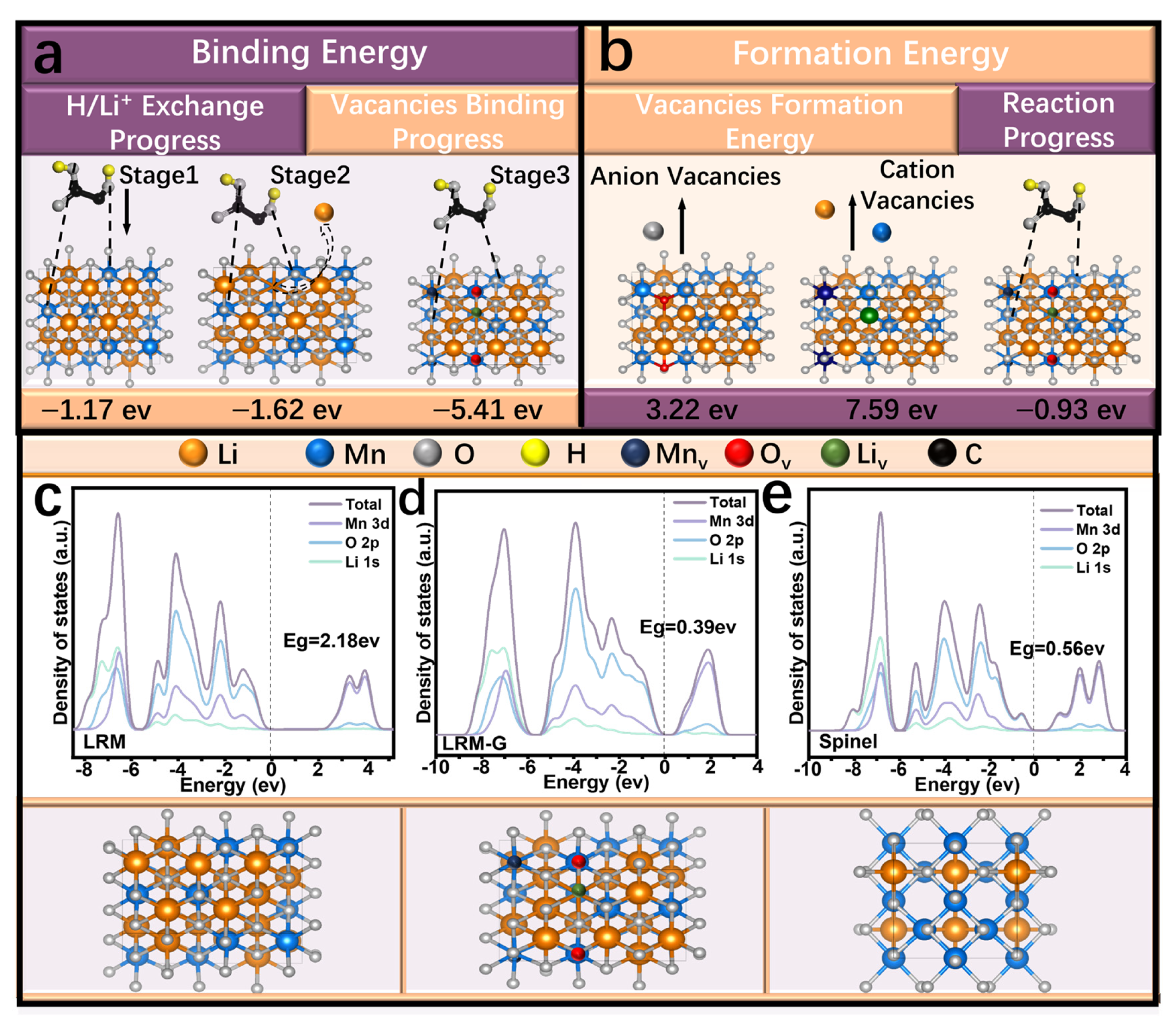
DFT calculations (detailed in Note S1) were employed to further verify the reaction process induced by glycolic acid in the formation of LRM-G5. Given that the high capacity of LRM is primarily attributed to the anionic redox of the Li2MnO3 phase above 4.5 V, a Li2MnO3 structural model was utilized to simplify the two-phase LRM system [13]. Notably, in our energetic analysis, a negative value (E < 0 eV) indicates a thermodynamically spontaneous reaction, while a positive value (E > 0 eV) denotes a non-spontaneous process that typically requires external energy to overcome a specific activation barrier [51]. For the resulting configurations, a higher absolute value for both binding energy and vacancy formation energy signifies greater stability [52]. Specifically, a high binding energy directly represents enhanced crystal structure stability, whereas a high vacancy formation energy implies that a greater energy input is required to overcome the barrier for structural modification.
In the binding energy calculations shown in Figure 7a, the reaction between glycolic acid and LRM is categorized into three distinct stages. Stage 1 involves the adsorption of glycolic acid onto the LRM surface with a binding energy of −1.17 eV, confirming the spontaneity of the initial interaction. Stage 2 describes the H+/Li+ exchange process on the LRM surface, during which Li ions are displaced by hydrogen ions, and TM-O-C=O chemical bonds are formed. The binding energy at Stage 2 increases to −1.62 eV, indicating higher stability than Stage 1. Building upon Stage 2, Stage 3 involves the subsequent generation of oxygen and manganese vacancies. This stage exhibits the highest absolute binding energy of −5.41 eV among the three stages, representing the most thermodynamically stable configuration. This provides robust energetic evidence for the superior physical and electrochemical structural stability of LRM-G5 throughout long-term cycling. In Figure 7b, the vacancy formation energies for oxygen anion escape and Li/Mn dual-vacancy formation from the LRM structure are 3.22 eV and 7.59 eV, respectively, confirming that these processes cannot occur spontaneously. Conversely, the formation energy for the glycolic acid-induced cation–anion dual-vacancy is −0.93 eV, demonstrating the spontaneity of this reaction pathway, which remains consistent with the binding energy results. Furthermore, the bandgap from the valence band maximum to the conduction band minimum in the DOS directly reflects the electronic transport kinetics of the material [26,53]. Calculations for LRM (Figure 7c), LRM-G5 (Figure 7d), and the spinel phase (Figure 7e) yielded values of 2.18 eV, 0.39 eV, and 0.56 eV, respectively. These results align with existing research suggesting that the spinel-like phase provides efficient pathways for Li+ and electron transport. Moreover, the DFT results are in excellent agreement with EIS and GITT measurements, collectively demonstrating the enhanced conductivity and faster reaction kinetics of LRM-G5.
Figure 7. Theoretical calculations and structural analysis. (a) Binding energy comparisons and the corresponding schematic of reaction energetics. (b) Vacancy formation energy comparisons and the associated schematic of reaction pathways. (ce) Density of States (DOS) for the pristine LRM (c), modified LRM-G (d), and the spinel phase (e).

4. Conclusions and Future Perspectives

In summary, through glycolic acid-assisted interfacial engineering combined with low-temperature annealing, an in situ carbon layer-spinel-layered heterostructure with intrinsically high Li+ diffusion kinetics was successfully and directionally constructed on the surface of pristine LRM. This interfacial reconstruction process is accompanied by the simultaneous formation of coupled anionic and cationic vacancies, including lithium, manganese, and oxygen vacancies, which collectively regulate the local coordination environment and electronic structure. As a result, the redox reversibility and structural stability of the surface transition-metal framework and lattice oxygen are markedly enhanced. From an electrochemical perspective, the engineered heterointerface effectively reduces the Li+ concentration gradient at the electrode–electrolyte interface, suppresses parasitic interfacial reactions, and mitigates electrolyte disorderly decomposition during prolonged cycling. These synergistic effects significantly improve interfacial charge-transfer kinetics and overall electrochemical stability. Importantly, the proposed surface modification strategy is scalable, low-temperature, and environmentally benign, demonstrating strong potential for practical industrial application in advanced lithium-ion battery systems.
For future industrialization, this synthesis requires optimizing mass transport and solvent reclamation. High-shear mixing and precise acid-to-solid ratios ensure batch consistency at scale, while elevated temperatures improve throughput. For effluent management, lithium glycolate (CH2(OH)COOLi) can be effectively reclaimed via vacuum distillation. Additionally, incorporating chemical precipitation to recover Li2CO3 provides a sustainable and cost-effective pathway, addressing both process compatibility and environmental requirements.
In essence, this sustainable framework facilitates the practical application of glycolic acid-mediated surface reconstruction, ensuring that the superior electrochemical performance of the in situ carbon-modified LRM is maintained from the laboratory to the factory floor.

Supplementary Materials

The following supporting information can be downloaded at: https://www.mdpi.com/article/10.3390/batteries12020070/s1, Table S1. Formula for Calculating Li+ Concentration; Figure S1. EDS elemental mapping of (a) LRM and (b) LRM-A; Table S2. EDS elemental analysis results of LRM; Table S3. EDS elemental analysis results of LRM-A; Figure S2. EDS elemental mapping of (a) LRM-G3, (b) LRM-G5, and (c) LRM-G7; Table S4. EDS elemental analysis results of LRM-G3; Table S5. EDS elemental analysis results of LRM-G5; Table S6. EDS elemental analysis results of LRM-G7; Table S7. Concentrations of key metallic elements (Li, Mn, Ni, Co) in LRM and LRM-G5 determined by ICP-OES; Table S8. EPR signal intensity comparison between LRM and LRM-G5; Figure S3. Rietveld refinement profiles of the XRD patterns for (a) LRM, (b) LRM-G3, (c) LRM-G5, and (d) LRM-G7; Table S9. Mass loading parameters of the electrodes for 1C cycling tests; Table S10. Mass loading parameters of the electrodes for rate capability tests; Figure S4. Comparison of the cycling performance at 1C for LRM and LRM-G5; Table S11. Recent Comparative Studies on the Electrochemical Performance of Lithium-Rich Manganese-Based Cathodes [13,14,22,35,54,55,56,57]; Table S12. EIS fitting parameters for LRM and LRM-G5 before cycling; Figure S5. Evaluation of structural and interfacial stability. (a,b) Post-cycling HRTEM images of (a) LRM and (b) LRM-G5; Figure S6. Nyquist plots of LRM and LRM-G5 after cycle; Table S13. EIS fitting parameters for LRM and LRM-G5 after cycling; Note S1. Details of DFT calculations [13,58,59,60,61,62,63].

Author Contributions

Conceptualization, X.Y., H.W., G.P. and Y.C.; methodology, X.Y., H.W., G.P. and Y.F.; software, X.Y., H.W. and G.P.; validation, X.Y., H.W. and G.P.; formal analysis, X.Y., H.W., G.P. and J.M.; investigation, G.P., H.W. and X.Y.; resources, X.Y., H.W. and G.P.; data curation, X.Y., H.W.; writing—original draft preparation, X.Y. and H.W.; writing—review and editing, G.P., H.W. and X.Y.; visualization, X.Y.; supervision, G.P. and H.W.; project administration, G.P. and H.W.; funding acquisition, G.P., H.W. and X.Y. All authors have read and agreed to the published version of the manuscript.

Funding

This work was supported by the Natural Science Foundation of Henan Province (China, No. 242300421619), and the APC was fully funded by Xichen Yang.

Data Availability Statement

Upon reasonable request, the datasets supporting the conclusions of this study can be obtained from the corresponding author.

Acknowledgments

The authors are grateful for the availability of the free software VESTA (ver.3.5.8), Zotero (ver.8.0.3) and Quantum ESPRESSO (ver.7.5) which were used for crystal structure analysis, reference management and DFT calculations, respectively. The authors have reviewed and edited the output and take full responsibility for the content of this publication.

Conflicts of Interest

The authors declare no competing financial interests.

Abbreviations

The following abbreviations are used in this manuscript:
CEICathode electrolyte interphase
CVCyclic voltammetry
DLi+Lithium-ion diffusion coefficient
EISElectrochemical impedance spectroscopy
EPRElectron paramagnetic resonance
FFTFast Fourier transform
FTIRFourier transform infrared spectroscopy
GITTGalvanostatic intermittent titration technique
HRTEMHigh-resolution transmission electron microscopy
ICEInitial Coulombic efficiency
ICP-OESInductively coupled plasma–optical emission spectroscopy
LRMLithium-rich manganese-based cathode material
LRM-AAnnealed pristine lithium-rich manganese-based material
LRM-GXGlycolic-acid-treated LRM (X = 3,5,7 wt.%)
RctCharge-transfer resistance
ReElectrolyte resistance
SESecondary electron
SEMScanning electron microscopy
TMTransition metal
XPSX-ray photoelectron spectroscopy
XRDX-ray diffraction
DFTDensity Functional Theory
DOSDensity of States

References

  1. Thackeray, M.M.; Kang, S.-H.; Johnson, C.S.; Vaughey, J.T.; Benedek, R.; Hackney, S.A. Li2MnO3-Stabilized LiMO2 (M = Mn, Ni, Co) Electrodes for Lithium-Ion Batteries. J. Mater. Chem. 2007, 17, 3112. [Google Scholar] [CrossRef]
  2. Ajayi, S.O.; Dolla, T.H.; Bello, I.T.; Liu, X.; Makgwane, P.R.; Mathe, M.K.; Ehi-Eromosele, C.O. Recent Developments Strategies in High Entropy Modified Lithium-Rich Layered Oxides Cathode for Lithium-Ion Batteries. Inorg. Chem. Commun. 2025, 172, 113721. [Google Scholar] [CrossRef]
  3. He, W.; Guo, W.; Wu, H.; Lin, L.; Liu, Q.; Han, X.; Xie, Q.; Liu, P.; Zheng, H.; Wang, L.; et al. Challenges and Recent Advances in High Capacity Li-Rich Cathode Materials for High Energy Density Lithium-Ion Batteries. Adv. Mater. 2021, 33, 2005937. [Google Scholar] [CrossRef]
  4. Su, Z.; Guo, Z.; Xie, H.; Qu, M.; Peng, G.; Wang, H. In Situ Surface Reaction for the Preparation of High-Performance Li-Rich Mn-Based Cathode Materials with Integrated Surface Functionalization. ACS Appl. Mater. Interfaces 2024, 16, 39447–39459. [Google Scholar] [CrossRef]
  5. Zuo, X.; Chang, K.; Zhao, J.; Xie, Z.; Tang, H.; Li, B.; Chang, Z. Bubble-Template-Assisted Synthesis of Hollow Fullerene-like MoS2 Nanocages as a Lithium Ion Battery Anode Material. J. Mater. Chem. A 2016, 4, 51–58. [Google Scholar] [CrossRef]
  6. Fan, Y.; Olsson, E.; Johannessen, B.; D’Angelo, A.M.; Thomsen, L.; Cowie, B.; Smillie, L.; Liang, G.; Lei, Y.; Bo, G.; et al. Manipulation of Transition Metal Migration via Cr-Doping for Better-Performance Li-Rich, Co-Free Cathodes. ACS Energy Lett. 2024, 9, 487–496. [Google Scholar] [CrossRef]
  7. Wen, X.; Liang, K.; Tian, L.; Shi, K.; Zheng, J. Al2O3 Coating on Li1.256Ni0.198Co0.082Mn0.689O2.25 with Spinel-Structure Interface Layer for Superior Performance Lithium Ion Batteries. Electrochim. Acta 2018, 260, 549–556. [Google Scholar] [CrossRef]
  8. Zhang, Z.; Tao, J.; He, B.; Wang, H.; Gong, Y.; Jin, J.; Fang, X.; Wang, R. Improved Electrochemical Performance of Layered Li1.2Ni0.13Co0.13Mn0.54O2 Cathode Material via VPO5 Coating. Ionics 2024, 30, 2459–2468. [Google Scholar] [CrossRef]
  9. Xi, Z.; Sun, Q.; Li, J.; Qiao, Y.; Min, G.; Ci, L. Modification Strategies of High-Energy Li-Rich Mn-Based Cathodes for Li-Ion Batteries: A Review. Molecules 2024, 29, 1064. [Google Scholar] [CrossRef]
  10. Li, K.; Yuan, Z.; Yu, H.; Xia, K.; Jiang, G.; Xiong, J.; Yuan, S. Glucose-Based Surface Modification of Li1.2Mn0.54Ni0.13Co0.13O2 as a Cathode Materialfor Lithium-Ion Batteries. Int. J. Electrochem. Sci. 2022, 17, 220220. [Google Scholar] [CrossRef]
  11. Song, B.; Liu, H.; Liu, Z.; Xiao, P.; Lai, M.O.; Lu, L. High Rate Capability Caused by Surface Cubic Spinels in Li-Rich Layer-Structured Cathodes for Li-Ion Batteries. Sci. Rep. 2013, 3, 3094. [Google Scholar] [CrossRef] [PubMed]
  12. Wu, J.; Chen, Z.; Cheng, J.; Wen, Q.; Gao, W.; Wang, X.; Tuo, C. Accelerating Li+ Intercalation Kinetics through Synergetic Modification in Li-Rich Cathode. J. Mater. Sci. 2023, 58, 16785–16796. [Google Scholar] [CrossRef]
  13. Guo, W.; Zhang, C.; Zhang, Y.; Lin, L.; He, W.; Xie, Q.; Sa, B.; Wang, L.; Peng, D. A Universal Strategy toward the Precise Regulation of Initial Coulombic Efficiency of Li-Rich Mn-Based Cathode Materials. Adv. Mater. 2021, 33, 2103173. [Google Scholar] [CrossRef]
  14. Feng, W.; Huang, Z.; Li, W. Improving the Performance of Li-Rich Mn-Based Cathode Materials via Combined Surface Modification with Glacial Acetic Acid and Li3PO4. J. Electroanal. Chem. 2022, 917, 116250. [Google Scholar] [CrossRef]
  15. Fan, Y.; Zhang, W.; Zhao, Y.; Guo, Z.; Cai, Q. Fundamental Understanding and Practical Challenges of Lithium-Rich Oxide Cathode Materials: Layered and Disordered-Rocksalt Structure. Energy Storage Mater. 2021, 40, 51–71. [Google Scholar] [CrossRef]
  16. Park, M.; Zhang, X.; Chung, M.; Less, G.B.; Sastry, A.M. A Review of Conduction Phenomena in Li-Ion Batteries. J. Power Sources 2010, 195, 7904–7929. [Google Scholar] [CrossRef]
  17. Yang, S.; Wang, X.; Yang, X.; Bai, Y.; Liu, Z.; Shu, H.; Wei, Q. Determination of the Chemical Diffusion Coefficient of Lithium Ions in Spherical Li[Ni0.5Mn0.3Co0.2]O2. Electrochim. Acta 2012, 66, 88–93. [Google Scholar] [CrossRef]
  18. Chen, H.; Ericson, T.; Temperton, R.H.; Källquist, I.; Liu, H.; Eads, C.N.; Mikheenkova, A.; Andersson, M.; Kokkonen, E.; Brant, W.R.; et al. Investigating Surface Reactivity of a Ni-Rich Cathode Material toward CO2, H2O, and O2 Using Ambient Pressure X-Ray Photoelectron Spectroscopy. ACS Appl. Energy Mater. 2023, 6, 11458–11467. [Google Scholar] [CrossRef]
  19. Ma, D.; Zhao, H.; Cao, F.; Zhao, H.; Li, J.; Wang, L.; Liu, K. A Carbonyl-Rich Covalent Organic Framework as a High-Performance Cathode Material for Aqueous Rechargeable Zinc-Ion Batteries. Chem. Sci. 2022, 13, 2385–2390. [Google Scholar] [CrossRef] [PubMed]
  20. Liang, Y.; Wang, H.; Zhou, J.; Li, Y.; Wang, J.; Regier, T.; Dai, H. Covalent Hybrid of Spinel Manganese–Cobalt Oxide and Graphene as Advanced Oxygen Reduction Electrocatalysts. J. Am. Chem. Soc. 2012, 134, 3517–3523. [Google Scholar] [CrossRef] [PubMed]
  21. Xu, Z.; Li, R.; Xie, G.; Qian, D.; Fang, H.; Wang, Z. Electrochemical Conversion from Hydroxyl to Carbonyl Groups for Improved Performance of Dual-Carbon Lithium Ion Capacitors. Energy Storage Mater. 2024, 66, 103195. [Google Scholar] [CrossRef]
  22. Zhou, H.; Cheng, W.; Liu, Q.; Wang, W.; Zhang, W.; Tan, Z.; Ding, J.; Huang, Y. Near-Surface Reconstruction Strategy Stabilizing High-Voltage Redox Reactions in Single Crystal Li-Rich Mn-Based Oxides. Chem. Eng. J. 2024, 500, 157021. [Google Scholar] [CrossRef]
  23. Xiao, B.; Wang, B.; Liu, J.; Kaliyappan, K.; Sun, Q.; Liu, Y.; Dadheech, G.; Balogh, M.P.; Yang, L.; Sham, T.-K.; et al. Highly Stable Li1.2Mn0.54Co0.13Ni0.13O2 Enabled by Novel Atomic Layer Deposited AlPO4 Coating. Nano Energy 2017, 34, 120–130. [Google Scholar] [CrossRef]
  24. Momma, K.; Izumi, F. VESTA 3 for Three-Dimensional Visualization of Crystal, Volumetric and Morphology Data. J. Appl. Crystallogr. 2011, 44, 1272–1276. [Google Scholar] [CrossRef]
  25. Dou, S.; Li, B.; Guo, Z.; Teng, R.; Ren, L.; Li, H.; Zhao, W.; Wei, F. Boosting Electrochemical Performances of Li-Rich Mn-Based Cathode Materials by La Doping via Enhanced Structural Stability. Coatings 2025, 15, 643. [Google Scholar] [CrossRef]
  26. Admasu Beshiwork, B.; Wan, X.; Xu, M.; Guo, H.; Sirak Teketel, B.; Chen, Y.; Song Chen, J.; Li, T.; Traversa, E. A Defective Iron-Based Perovskite Cathode for High-Performance IT-SOFCs: Tailoring the Oxygen Vacancies Using Nb/Ta Co-Doping. J. Energy Chem. 2024, 88, 306–316. [Google Scholar] [CrossRef]
  27. Hao, J.; Dong, J.; Su, Y.; Yan, K.; Zhao, J.; Che, H.; Lu, Y.; Li, N.; Zhang, B.; Zhang, P.; et al. Triple Modifications of Li-Rich Manganese-Based Cathode Materials Using LiMnPO4 One-Step Method. Chem. Eng. J. 2025, 503, 158252. [Google Scholar] [CrossRef]
  28. Zhang, Y.; Wen, X.; Shi, Z.; Qiu, B.; Chen, G.; Liu, Z. Oxygen-Defects Evolution to Stimulate Continuous Capacity Increase in Co-Free Li-Rich Layered Oxides. J. Energy Chem. 2023, 82, 259–267. [Google Scholar] [CrossRef]
  29. Vu, N.H.; Dao, V.-D.; Im, W.B. Elucidating Roles of Cation Disorder and Spinel Phase in High-Capacity Integrated Spinel-Layered Cathodes. J. Power Sources 2021, 507, 230315. [Google Scholar] [CrossRef]
  30. Gou, X.; Hao, Z.; Hao, Z.; Yang, G.; Yang, Z.; Zhang, X.; Yan, Z.; Zhao, Q.; Chen, J. In Situ Surface Self-Reconstruction Strategies in Li-Rich Mn-Based Layered Cathodes for Energy-Dense Li-Ion Batteries. Adv. Funct. Mater. 2022, 32, 2112088. [Google Scholar] [CrossRef]
  31. Zhao, E.; Li, Q.; Meng, F.; Liu, J.; Wang, J.; He, L.; Jiang, Z.; Zhang, Q.; Yu, X.; Gu, L.; et al. Stabilizing the Oxygen Lattice and Reversible Oxygen Redox Chemistry through Structural Dimensionality in Lithium-Rich Cathode Oxides. Angew. Chem. Int. Ed. 2019, 58, 4323–4327. [Google Scholar] [CrossRef]
  32. Ilton, E.S.; Post, J.E.; Heaney, P.J.; Ling, F.T.; Kerisit, S.N. XPS Determination of Mn Oxidation States in Mn (Hydr)Oxides. Appl. Surf. Sci. 2016, 366, 475–485. [Google Scholar] [CrossRef]
  33. Laïk, B.; Richet, M.; Emery, N.; Bach, S.; Perrière, L.; Cotrebil, Y.; Russier, V.; Guillot, I.; Dubot, P. XPS Investigation of Co–Ni Oxidized Compounds Surface Using Peak-On-Satellite Ratio. Application to Co20 Ni80 Passive Layer Structure and Composition. ACS Omega 2024, 9, 40707–40722. [Google Scholar] [CrossRef] [PubMed]
  34. Zuo, Y.; Li, B.; Jiang, N.; Chu, W.; Zhang, H.; Zou, R.; Xia, D. A High-Capacity O2-Type Li-Rich Cathode Material with a Single-Layer Li2 MnO3 Superstructure. Adv. Mater. 2018, 30, 1707255. [Google Scholar] [CrossRef]
  35. Yang, P.; Shang, L.; Wang, H.; Yan, Z.; Zhang, K.; Li, Y.; Chen, J. Layered-Spinel Heterogeneous Structure and Oxygen Vacancies Enable Superior Electrochemical Performance for Li-Rich Cathodes. Angew. Chem. Int. Ed. 2025, 64, e202501539. [Google Scholar] [CrossRef]
  36. Wang, F.; Zuo, P.; Xue, Z.; Liu, Y.; Wang, C.; Chen, G. Fluorination Effect on Lithium- and Manganese-Rich Layered Oxide Cathodes. ACS Energy Lett. 2024, 9, 1249–1260. [Google Scholar] [CrossRef]
  37. Wu, Q.; Maroni, V.A.; Gosztola, D.J.; Miller, D.J.; Dees, D.W.; Lu, W. A Raman-Based Investigation of the Fate of Li2MnO3 in Lithium- and Manganese-Rich Cathode Materials for Lithium Ion Batteries. J. Electrochem. Soc. 2015, 162, A1255–A1264. [Google Scholar] [CrossRef]
  38. García-Alonso, J.; Krüger, S.; Kelm, K.; Guney, E.; Yuca, N.; Villar-García, I.J.; Saruhan, B.; Pérez-Dieste, V.; Maestre, D.; Méndez, B. Synthesis and Characterization of Core–Shell NMC Microparticles as Cathode Materials for Li-Ion Batteries: Insights from Ex Situ and in Situ Microscopy and Spectroscopy Techniques. Mater. Adv. 2025, 6, 298–310. [Google Scholar] [CrossRef]
  39. Cheng, X.; Pecht, M. In Situ Stress Measurement Techniques on Li-Ion Battery Electrodes: A Review. Energies 2017, 10, 591. [Google Scholar] [CrossRef]
  40. Liu, T.; Dai, A.; Lu, J.; Yuan, Y.; Xiao, Y.; Yu, L.; Li, M.; Gim, J.; Ma, L.; Liu, J.; et al. Correlation between Manganese Dissolution and Dynamic Phase Stability in Spinel-Based Lithium-Ion Battery. Nat. Commun. 2019, 10, 4721. [Google Scholar] [CrossRef]
  41. LeBel, F.-A.; Messier, P.; Sari, A.; Trovão, J.P.F. Lithium-Ion Cell Equivalent Circuit Model Identification by Galvanostatic Intermittent Titration Technique. J. Energy Storage 2022, 54, 105303. [Google Scholar] [CrossRef]
  42. Mao, Z.; Farkhondeh, M.; Pritzker, M.; Fowler, M.; Chen, Z. Dynamics of a Blended Lithium-Ion Battery Electrode During Galvanostatic Intermittent Titration Technique. Electrochim. Acta 2016, 222, 1741–1750. [Google Scholar] [CrossRef]
  43. Chien, Y.-C.; Liu, H.; Menon, A.S.; Brant, W.R.; Brandell, D.; Lacey, M.J. Rapid Determination of Solid-State Diffusion Coefficients in Li-Based Batteries via Intermittent Current Interruption Method. Nat. Commun. 2023, 14, 2289. [Google Scholar] [CrossRef]
  44. Zhang, M.; Liu, Y.; Li, D.; Cui, X.; Wang, L.; Li, L.; Wang, K. Electrochemical Impedance Spectroscopy: A New Chapter in the Fast and Accurate Estimation of the State of Health for Lithium-Ion Batteries. Energies 2023, 16, 1599. [Google Scholar] [CrossRef]
  45. Sun, S.; Zhao, C.-Z.; Yuan, H.; Fu, Z.-H.; Chen, X.; Lu, Y.; Li, Y.-F.; Hu, J.-K.; Dong, J.; Huang, J.-Q.; et al. Eliminating Interfacial O-Involving Degradation in Li-Rich Mn-Based Cathodes for All-Solid-State Lithium Batteries. Sci. Adv. 2022, 8, eadd5189. [Google Scholar] [CrossRef] [PubMed]
  46. Hu, J.; Wang, F.; Xie, J.; Guo, H.; Sun, X.; Tian, J.; Zhuang, W. Surface Spinel and Oxygen Vacancies Induced by Multi-Gas-Solid Reactions Enhance the Electrochemical Performance of Lithium-Rich Manganese-Based Oxide Cathodes. Adv. Funct. Mater. 2025, 35, 2506459. [Google Scholar] [CrossRef]
  47. Hu, E.; Yu, X.; Lin, R.; Bi, X.; Lu, J.; Bak, S.; Nam, K.-W.; Xin, H.L.; Jaye, C.; Fischer, D.A.; et al. Evolution of Redox Couples in Li- and Mn-Rich Cathode Materials and Mitigation of Voltage Fade by Reducing Oxygen Release. Nat. Energy 2018, 3, 690–698. [Google Scholar] [CrossRef]
  48. Beatty, M.; Strickland, D.; Ferreira, P. A Review of Methods of Generating Incremental Capacity–Differential Voltage Curves for Battery Health Determination. Energies 2024, 17, 4309. [Google Scholar] [CrossRef]
  49. Wu, F.; Mullaliu, A.; Diemant, T.; Stepien, D.; Parac-Vogt, T.N.; Kim, J.; Bresser, D.; Kim, G.; Passerini, S. Beneficial Impact of Lithium Bis(Oxalato)Borate as Electrolyte Additive for High-voltage Nickel-rich Lithium-battery Cathodes. InfoMat 2023, 5, e12462. [Google Scholar] [CrossRef]
  50. Zhao, J.; Liang, Y.; Zhang, X.; Zhang, Z.; Wang, E.; He, S.; Wang, B.; Han, Z.; Lu, J.; Amine, K.; et al. In Situ Construction of Uniform and Robust Cathode–Electrolyte Interphase for Li-Rich Layered Oxides. Adv. Funct. Mater. 2021, 31, 2009192. [Google Scholar] [CrossRef]
  51. Prasetyo, N.; Hünenberger, P.H.; Hofer, T.S. Single-Ion Thermodynamics from First Principles: Calculation of the Absolute Hydration Free Energy and Single-Electrode Potential of Aqueous Li+ Using Ab Initio Quantum Mechanical/Molecular Mechanical Molecular Dynamics Simulations. J. Chem. Theory Comput. 2018, 14, 6443–6459. [Google Scholar] [CrossRef]
  52. Deng, T.; Qiu, P.; Yin, T.; Li, Z.; Yang, J.; Wei, T.; Shi, X. High-Throughput Strategies in the Discovery of Thermoelectric Materials. Adv. Mater. 2024, 36, 2311278. [Google Scholar] [CrossRef]
  53. Liu, X.; Cheng, J.; Guan, Y.; Huang, S.; Lian, F. Oxygen Vacancy in Li-Rich Mn-Based Cathode Materials: Origination, Influence, Regulation and Characterization. Mater. Chem. Front. 2023, 7, 3434–3454. [Google Scholar] [CrossRef]
  54. Zhang, S.; Ye, Y.; Lai, Q.; Liu, T.; Yuan, S. Improved Electrochemical Performance of Li-Rich Cathode Materials via Spinel Li2MoO4 Coating 2023. Materials 2023, 16, 5655. [Google Scholar]
  55. Pang, S.; Xu, K.; Wang, Y.; Shen, X.; Wang, W.; Su, Y.; Zhu, M.; Xi, X. Enhanced Electrochemical Performance of Li-Rich Layered Cathode Materials via Chemical Activation of Li2MnO3 Component and Formation of Spinel/Carbon Coating Layer. J. Power Sources 2017, 365, 68–75. [Google Scholar] [CrossRef]
  56. Wang, Y.; Fan, P.; Liu, B.; Li, X.; Fu, Y.; Du, G.; Liu, J.; Chen, S.; Sun, H. Improved Electrochemical Performance of Lithium-Rich Manganese-Based Materials via a PI/MWCNT Composite Coating Layer. ACS Omega 2025, 10, 27415–27423. [Google Scholar] [CrossRef] [PubMed]
  57. Guo, H.; Wei, Z.; Jia, K.; Qiu, B.; Yin, C.; Meng, F.; Zhang, Q.; Gu, L.; Han, S.; Liu, Y.; et al. Abundant Nanoscale Defects to Eliminate Voltage Decay in Li-Rich Cathode Materials. Energy Storage Mater. 2019, 16, 220–227. [Google Scholar] [CrossRef]
  58. Grimme, S.; Antony, J.; Ehrlich, S.; Krieg, H. A Consistent and Accurate Ab Initio Parametrization of Density Functional Dispersion Correction (DFT-D) for the 94 Elements H-Pu. J. Chem. Phys. 2010, 132, 154104. [Google Scholar] [CrossRef]
  59. Kresse, G.; Furthmüller, J. Efficient Iterative Schemes for Ab Initio Total-Energy Calculations Using a Plane-Wave Basis Set. Phys. Rev. B 1996, 54, 11169–11186. [Google Scholar] [CrossRef]
  60. Perdew, J.P.; Burke, K.; Ernzerhof, M. Generalized Gradient Approximation Made Simple. Phys. Rev. Lett. 1996, 77, 3865–3868. [Google Scholar] [CrossRef] [PubMed]
  61. Levämäki, H.; Kuisma, M.; Kokko, K. Space Partitioning of Exchange-Correlation Functionals with the Projector Augmented-Wave Method. J. Chem. Phys. 2019, 150, 054101. [Google Scholar] [CrossRef] [PubMed]
  62. Gebhardt, J.; Elsässer, C. DFT with Corrections for an Efficient and Accurate Description of Strong Electron Correlations in NiO. J. Phys. Condens. Matter. 2023, 35, 205901. [Google Scholar] [CrossRef] [PubMed]
  63. Choudhary, K.; Tavazza, F. Convergence and Machine Learning Predictions of Monkhorst-Pack k-Points and Plane-Wave Cut-off in High-Throughput DFT Calculations. Comput. Mater. Sci. 2019, 161, 300–308. [Google Scholar] [CrossRef] [PubMed]
Disclaimer/Publisher’s Note: The statements, opinions and data contained in all publications are solely those of the individual author(s) and contributor(s) and not of MDPI and/or the editor(s). MDPI and/or the editor(s) disclaim responsibility for any injury to people or property resulting from any ideas, methods, instructions or products referred to in the content.

Article Metrics

Citations

Article Access Statistics

Multiple requests from the same IP address are counted as one view.