A Study on the Restorative Effects of Hydrangea Flower Color and Structure on Human Psychology and Physiology


 and
and
Abstract
1. Introduction
- (1)
- Floral color significantly influences restorative outcomes.
- (2)
- Inflorescence type and petal structure affect visual attention and relaxation.
- (3)
- Color and structure interactively affect restorative outcomes.
2. Materials and Methods
2.1. Plant Materials
- (1)
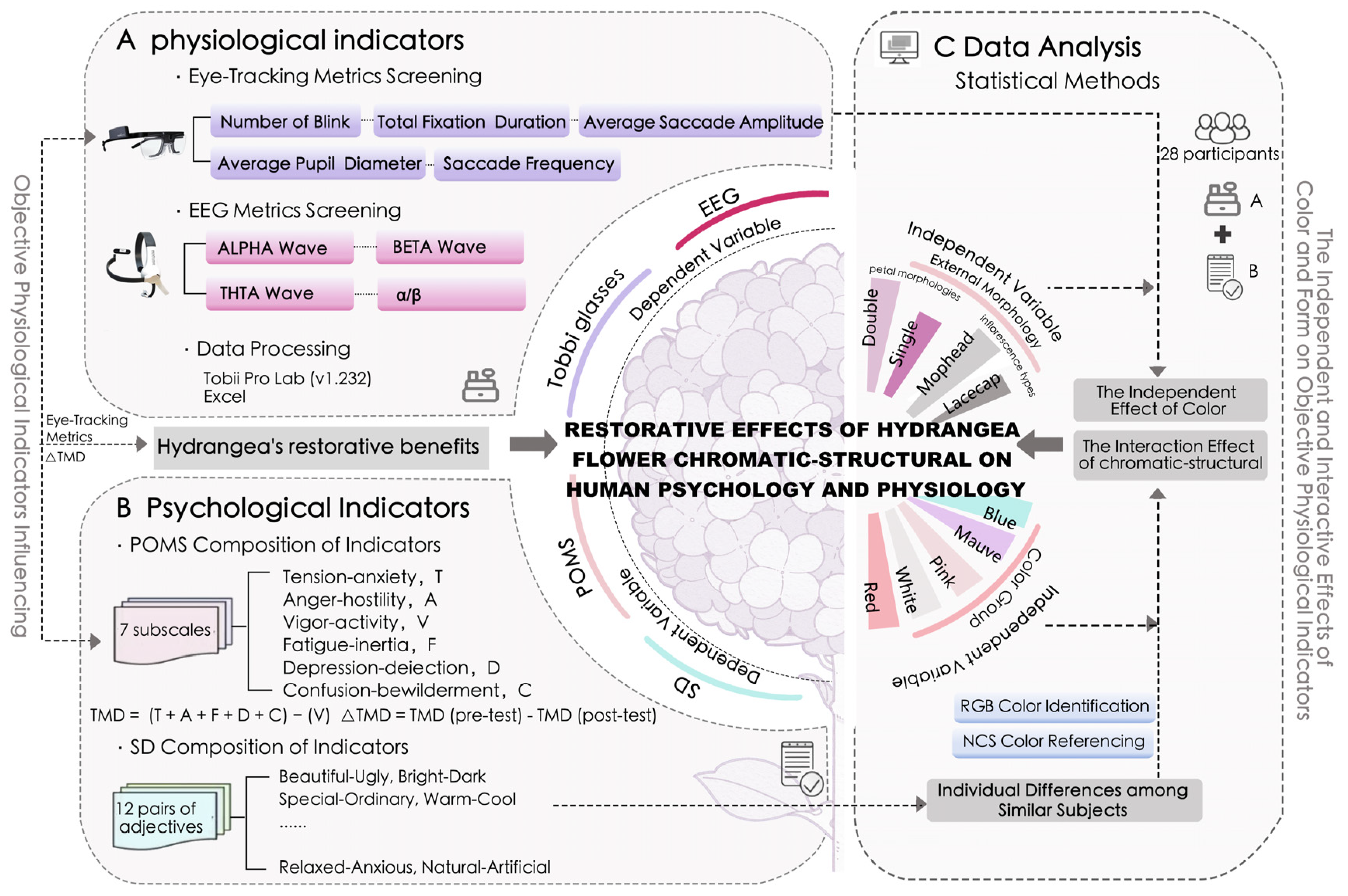
- Color Classification: Field color sampling is performed on the day of experimentation under clear skies and sufficient sunlight. RGB values are recorded and calibrated against the Natural Colour System (NCS) standard. To minimize environmentally induced chromatic variation, two intact florets from the primary bloom of each specimen are identified as representative color samples.
- (2)
- Inflorescence Types: Based on the ratio and arrangement of sterile and fertile flowers, the species is classified into mophead type and lacecap type. Mophead hydrangeas produce inflorescences predominantly composed of large, showy sterile flowers, with few or no visible fertile florets. These sterile florets are densely arranged into solid, spherical clusters. In contrast, lacecap hydrangeas form inflorescences characterized by a central dome of numerous small, fertile florets, encircled by one or more whorls of conspicuously larger sterile flowers, resulting in a flattened or gently concave, saucer-shaped structure [26,76]. This classification system is defined by the characteristics of individual florets within the inflorescence, specifically focusing on the number and structure of sepals in the decorative sterile flowers.
- (3)
- Petal Structure: Based on the sepal architecture and phyllotaxis of ornamental florets (sterile flowers), specimen types are categorized as single or double. The single type presents a single whorl of 4–5 sepals that spread radially without overlapping, constituting a single-layered floret structure. In contrast, the double-type develops more than two whorls (8–20 sepals) arranged in imbricate layers, where sterile sepals exhibit petaloid transformation and hyperplastic growth.
2.2. Study Participants
2.3. Data Acquisition
2.3.1. Eye-Tracking
2.3.2. EEG Data
2.3.3. Subjective Psychological Assessment
2.4. Experimental Methods
- (1)
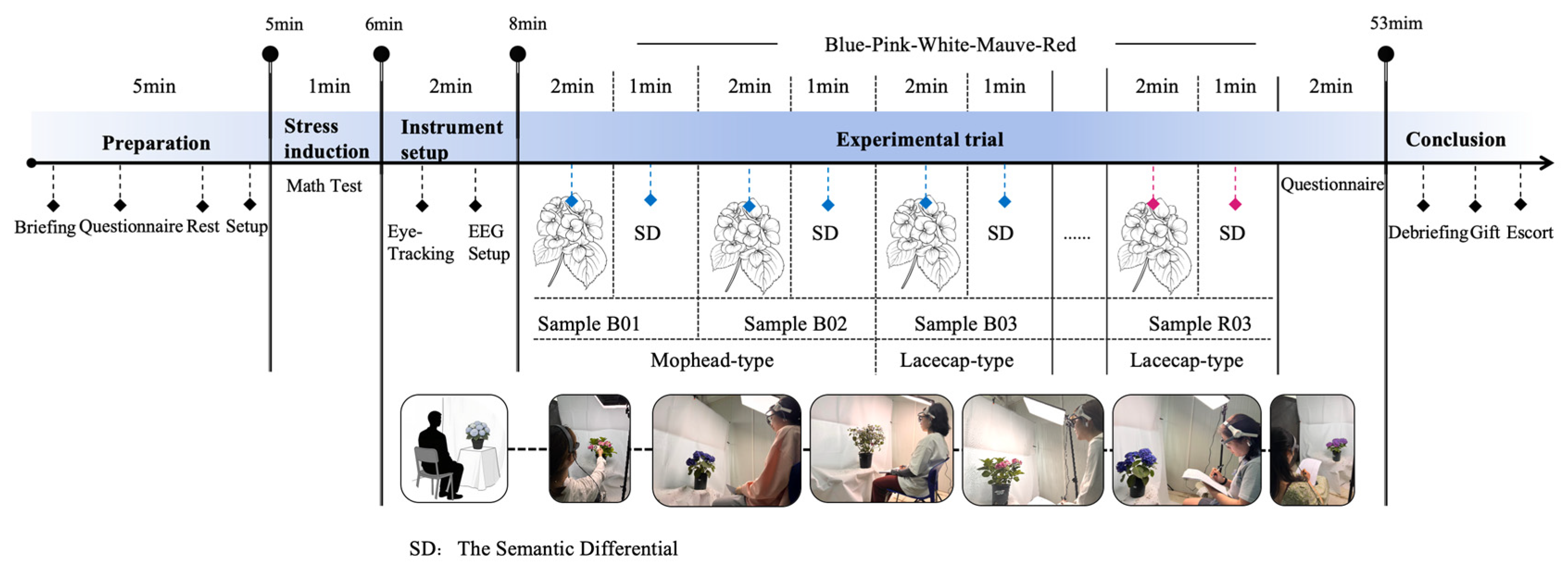
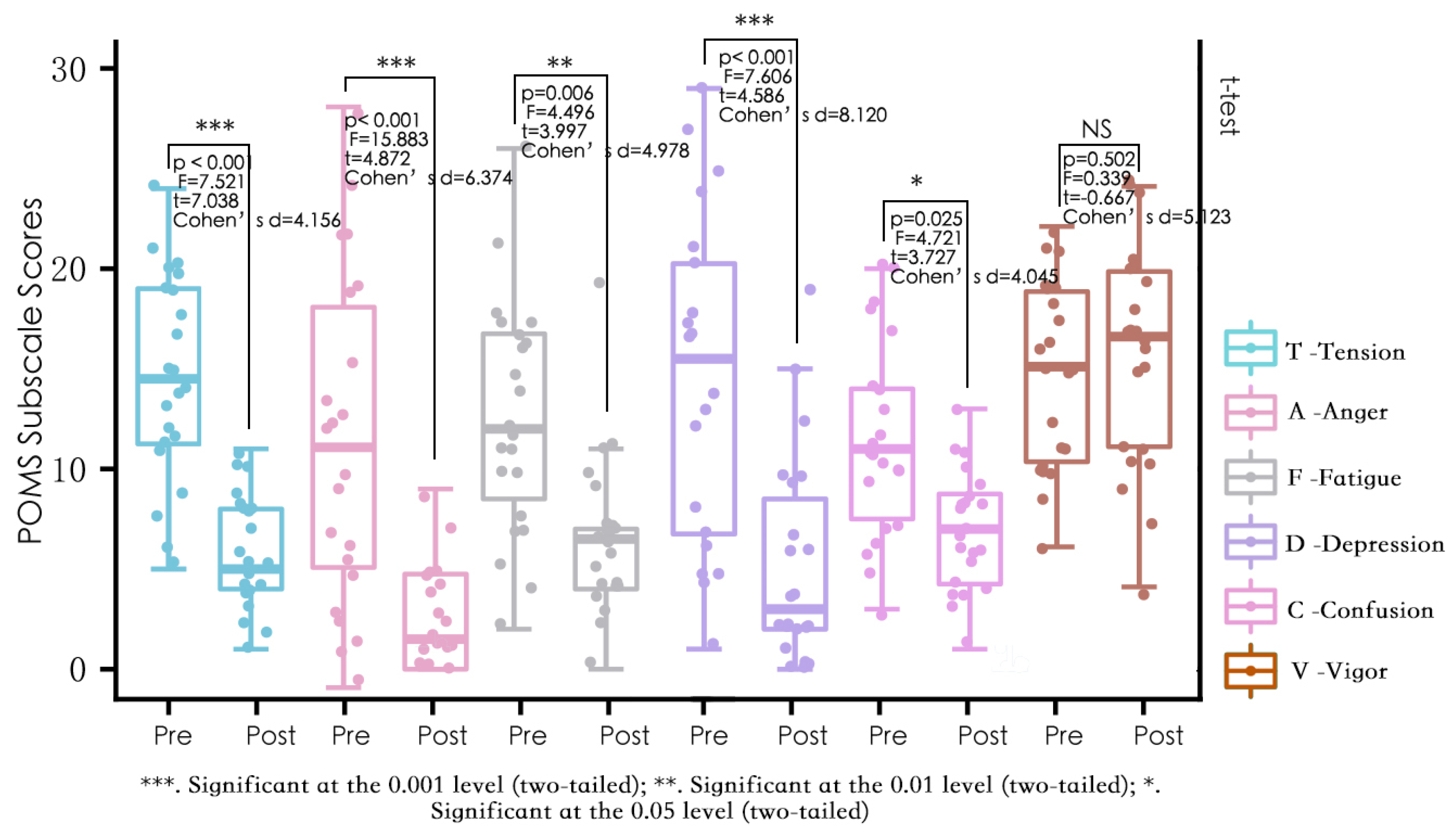
- Preparation: On arrival at the laboratory, participants rested for 3 min, provided demographics and consent, and completed the pre-test POMS while experimenters calibrated equipment.
- (2)
- Stress induction: Participants completed a challenging mental arithmetic task within one minute, which included 15 problems involving three-digit addition, subtraction, multiplication, and division. They were informed that their performance would be recorded and monitored. A minimum of six correct answers was required, without the use of formulas or calculators. Previous studies have shown that performing mental arithmetic under time-limited or complex conditions significantly increases cognitive load and stress levels [89].
- (3)
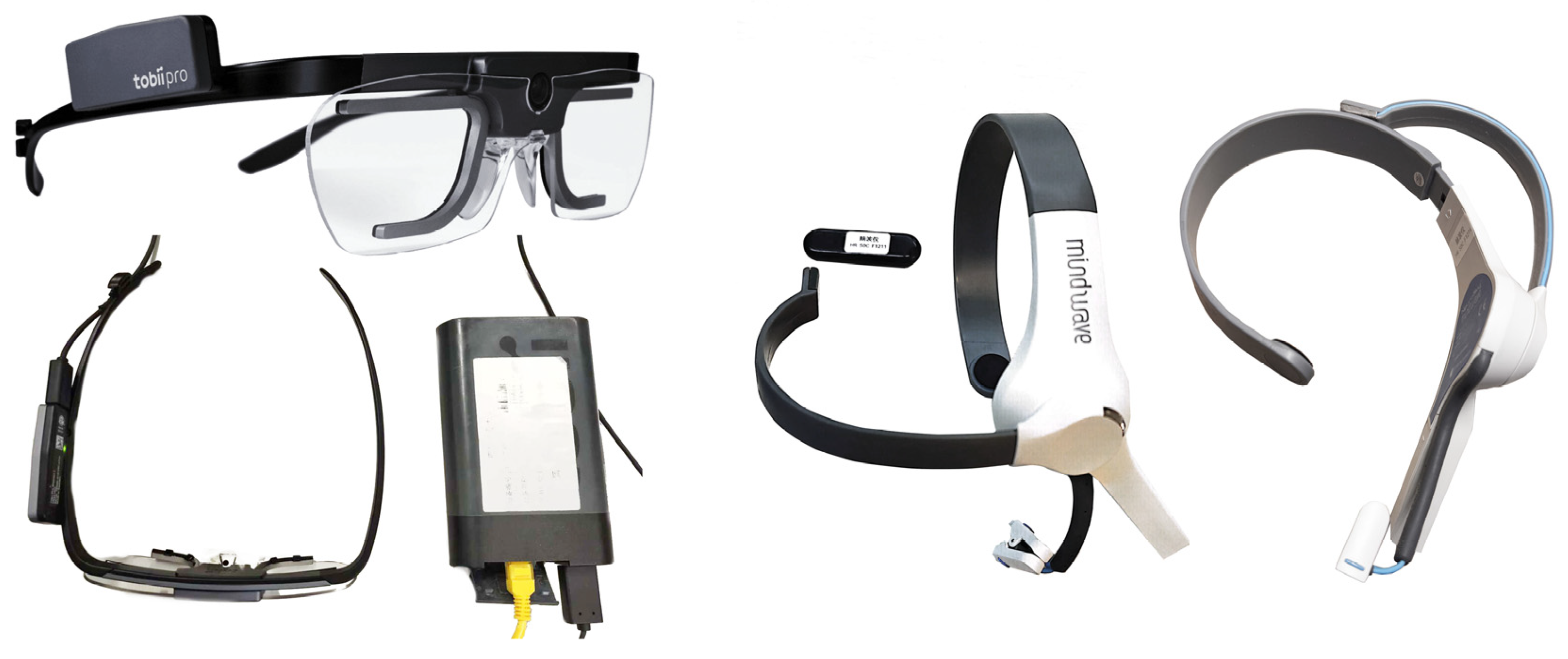
- Instrument Setup: Participants wore the Tobii Pro Glasses 2 eye-tracker and performed a 5-s calibration by fixating on a 5-mm black dot, verified via Tobii Pro Glasses Controller (v1.14). The NeuroSky MindWave Mobile-EEG headset was then fitted to ensure firm contact of the forehead sensor and stable signal acquisition.
- (4)
- Experimental Trial: Seated comfortably in a reclining chair, participants viewed 15 hydrangea specimens presented in random order (2 min each). Eye movement and EEG data were continuously recorded during viewing. After observing each specimen, participants filled out the SD questionnaire and rested briefly. After viewing all specimens, they completed the post-test POMS questionnaire.
- (5)
- Conclusion: Participants received a gift and were debriefed. The total duration of the session was approximately 53 min (Figure 2).
2.5. Data Analysis
3. Results
3.1. Self-Reported Emotional Data
3.2. Restorative Benefits of Hydrangea Based on Eye Movement Analysis
3.3. Physiological Data
4. Discussion
4.1. The Emotional Impact of Viewing Hydrangea
4.2. Color Effects on Emotional and Physiological Responses
4.3. Structural Effects and Interactive Influences
4.4. Theoretical Interpretation (SRT, ART, Evolutionary Perspective)
4.5. Study Limitations
5. Conclusions
Author Contributions
Funding
Institutional Review Board Statement
Informed Consent Statement
Data Availability Statement
Conflicts of Interest
Abbreviations
| SD | Semantic Differential |
| POMS | The Profile of Mood States |
| TFD | Total Fixation Duration |
| APD | Average Pupil Diameter |
| ASA | Average Saccade Amplitude |
| NB | Number of Blink |
| SF | Saccade Frequency |
| NCS | Natural Colour System |
| GBD | Global Burden of Disease |
| SRT | Stress Recovery Theory |
| ART | Attention Restoration Theory |
| EEG | Electroencephalography |
Appendix A

| No. | Sample ID | Image | Color Data (RGB/NCS) | Color & Structure | No. | Sample ID | Image | Color Data (RGB/NCS) | Color & Structure |
|---|---|---|---|---|---|---|---|---|---|
| 1 | B01 |  | 58, 65. 137 NCS S4050-R70B | Blue Mophead Single | 9 | W03 |  | 228, 209, 200 NCS S1002-R | White Lacecap Double |
| 2 | B02 |  | 131, 143, 170 NCS S3020-R90B | Blue Lacecap Double | 10 | M01 |  | 77, 51, 114 NCS S4050-R50B | Mauve Mophead Single |
| 3 | B03 |  | 104, 114, 147 NCS S4030-R70B | Blue Mophead Double | 11 | M02 |  | 128, 94, 155 NCS S2040-R50B | Mauve Lacecap Double |
| 4 | P01 |  | 187, 79, 97 NCS S1060-R10B | Pink Mophead Double | 12 | M03 |  | 167, 104, 168 NCS S3030-R50B | Mauve Mophead Double |
| 5 | P02 |  | 206, 112, 122 NCS S2040-R10B | Pink Mophead Single | 13 | R01 |  | 217, 0, 61 NCS S1575-R10B | Red Mophead Single |
| 6 | P03 |  | 191, 104, 113 NCS S0550-R10B | Pink Lacecap Double | 14 | R02 |  | 153, 29, 70 NCS S2060-R20B | Red Mophead Double |
| 7 | W01 |  | 240, 228, 216 NCS S0500-N | White Mophead Double | 15 | R03 |  | 184, 39, 70 NCS S1070-R10B | Red Lacecap Double |
| 8 | W02 |  | 255, 224, 219 NCS S0502-R | White Mophead Single |
| Dependent Variable | Type III Sum of Squares | df | Mean Square | F | p | ηp2 | |
|---|---|---|---|---|---|---|---|
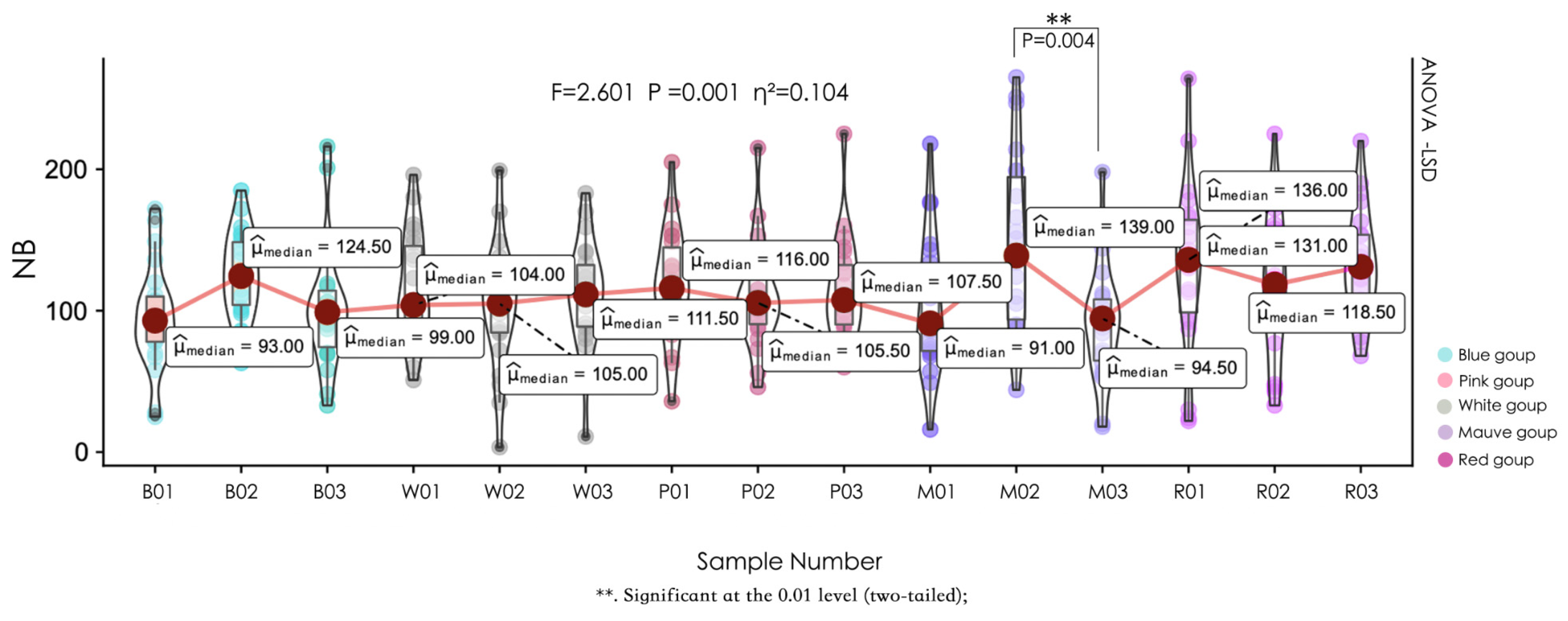
| NB | Modified Model | 69,344.424 a | 14 | 4953.173 | 2.601 | 0.001 | 0.104 |
| Clour | 17,764.752 | 4 | 4441.188 | 2.332 | 0.056 | 0.029 | |
| Inflorescence | 14,924.291 | 1 | 14,924.291 | 7.838 | 0.005 | 0.024 | |
| Structure | 9.618 | 1 | 9.618 | 0.005 | 0.943 | 0.000 | |
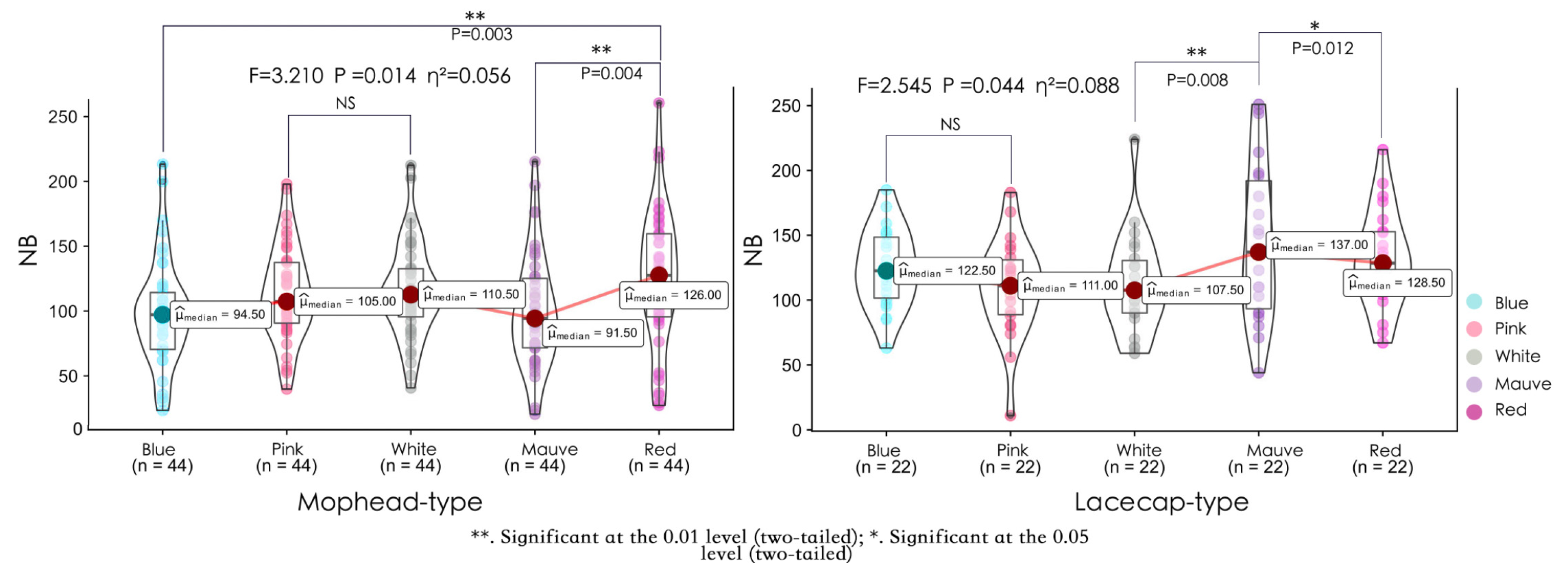
| Clour × Inflorescence | 27,939.845 | 4 | 6984.961 | 3.668 | 0.006 | 0.045 | |
| Clour × Structure | 6705.973 | 4 | 1676.493 | 0.880 | 0.476 | 0.011 | |
| SF | Modified Model | 5.317 b | 14 | 0.380 | 2.059 | 0.014 | 0.084 |
| Clour | 1.504 | 4 | 0.376 | 2.039 | 0.089 | 0.025 | |
| Inflorescence | 1.061 | 1 | 1.061 | 5.755 | 0.017 | 0.018 | |
| Structure | 0.013 | 1 | 0.013 | 0.069 | 0.793 | 0000 | |
| Clour × Inflorescence | 2.502 | 4 | 0.626 | 3.393 | 0.010 | 0.041 | |
| Clour × Structure | 0.827 | 4 | 0.207 | 1.121 | 0.347 | 0.014 | |
| ASA | Modified Model | 63.499 c | 14 | 4.536 | 2.790 | <0.001 | 0.110 |
| Clour | 14.570 | 4 | 3.643 | 2.241 | 0.065 | 0.028 | |
| Inflorescence | 5.323 | 1 | 5.323 | 3.274 | 0.071 | 0.010 | |
| Structure | 1.105 | 1 | 1.015 | 0.680 | 0.410 | 0.002 | |
| Clour × Inflorescence | 34.887 | 4 | 8.722 | 5.365 | <0.001 | 0.064 | |
| Clour × Structure | 33.107 | 4 | 8.277 | 5.091 | <0.001 | 0.061 | |
| APD | Modified Model | 2.421 d | 14 | 0.173 | 1.978 | 0.019 | 0.081 |
| Clour | 1.617 | 4 | 0.404 | 4.619 | 0.001 | 0.055 | |
| Inflorescence | 3.682 × 10⁻⁵ | 1 | 3.682 × 10⁻⁵ | 0.000 | 0.984 | 0.000 | |
| Structure | 0.001 | 1 | 0.001 | 0.014 | 0.908 | 0.000 | |
| Clour × Inflorescence | 0.416 | 4 | 0.104 | 1.189 | 0.316 | 0.015 | |
| Clour × Structure | 0.508 | 4 | 0.127 | 1.451 | 0.217 | 0.018 |
| N | Mean ± SD | df | F | t | p | Cohen’s d | ||
|---|---|---|---|---|---|---|---|---|
| NB | Mophead-type | 220 | 108.290 ± 44.992 | 328 | 0.283 | −3.129 | 0.002 | 44.507 |
| Lacecap-type | 110 | 124.554 ± 43.517 | ||||||
| Single-type | 110 | 108.500 ± 46.460 | 328 | 0.236 | −1.487 | 0.138 | 45.015 | |
| Double-type | 220 | 116.318 ± 44.278 | ||||||
| SF | Mophead-type | 220 | 1.019 ± 0.438 | 328 | 0.154 | −2.584 | 0.10 | 0.435 |
| Lacecap-type | 110 | 1.15 ± 0.428 | ||||||
| Single-type | 110 | 1.026 ± 0.456 | 328 | 0.237 | −1.059 | 0.290 | 0.438 | |
| Double-type | 220 | 1.119 ± 0.440 | ||||||
| ASA | Mophead-type | 220 | 6.972 ± 1.327 | 328 | 0.006 | −1.568 | 0.118 | 1.319 |
| Lacecap-type | 110 | 7.212 ± 1.304 | ||||||
| Single-type | 110 | 7.043 ± 1.250 | 328 | 1.310 | −0.089 | 0.929 | 1.324 | |
| Double-type | 220 | 7.056 ± 1.359 |
References
- Giles-Corti, B.; Vernez-Moudon, A.; Reis, R.; Turrell, G.; Dannenberg, A.; Badland, H.; Foster, S.; Lowe, M.; Sallis, J.; Stevenson, M.; et al. City planning and population health: A global challenge. Lancet 2016, 388, 2912–2924. [Google Scholar] [CrossRef] [PubMed]
- Lederbogen, F.; Kirsch, P.; Haddad, L.; Streit, F.; Tost, H.; Schuch, P.; Wüst, S.; Pruessner, J.; Rietschel, M.; Deuschle, M.; et al. City living and urban upbringing affect neural social stress processing in humans. Nature 2011, 474, 498–501. [Google Scholar] [CrossRef] [PubMed]
- Murray, C.; Vos, T.; Lozano, R.; Naghavi, M.; Flaxman, A.; Michaud, C.; Ezzati, M.; Shibuya, K.; Salomon, J.; Abdalla, S.; et al. Disability-adjusted life years (DALYs) for 291 diseases and injuries in 21 regions, 1990–2010: A systematic analysis for the Global Burden of Disease Study 2010. Lancet 2012, 380, 2197–2223. [Google Scholar] [CrossRef]
- Charlson, F.; Baxter, A.; Dua, T.; Degenhardt, L.; Whiteford, H.; Vos, T. Excess mortality from mental, neurological and substance use disorders in the Global Burden of Disease Study 2010. Epidemiol. Psychiatr. Sci. 2015, 24, 121–140. [Google Scholar] [CrossRef]
- Whiteford, H.; Degenhardt, L.; Rehm, J.; Baxter, A.; Ferrari, A.; Erskine, H.; Charlson, F.; Norman, R.; Flaxman, A.; Johns, N.; et al. Global burden of disease attributable to mental and substance use disorders: Findings from the Global Burden of Disease Study 2010. Lancet 2013, 382, 1575–1586. [Google Scholar] [CrossRef]
- Funk, M. Global Burden of Mental Disorders and the Need for a Comprehensive, Coordinated Response from Health and Social Sectors at the Country Level; WHO: Geneva, Switzerland, 2012. [Google Scholar]
- Kaplan, S. The restorative benefits of nature: Toward an integrative framework. J. Environ. Psychol. 1995, 15, 169–182. [Google Scholar] [CrossRef]
- Ulrich, R.S. Aesthetic and affective response to natural environment. In Behavior and the Natural Environment; Springer: Boston, MA, USA, 1983; pp. 85–125. [Google Scholar] [CrossRef]
- Cackowski, J.M.; Nasar, J.L. The restorative effects of roadside vegetation: Implications for automobile driver anger and frustration. Environ. Behav. 2003, 35, 736–751. [Google Scholar] [CrossRef]
- Ulrich, R.S. View through a window may influence recovery from surgery. Science 1984, 224, 420–421. [Google Scholar] [CrossRef]
- Ulrich, R.S.; Parsons, R. Influences of passive experiences with plants on individual well-being and health. In The Role of Horticulture in Human Well-Being and Social Development; Timber Press: Portland, OR, USA, 1992; pp. 93–105. [Google Scholar]
- Elsadek, M.; Liu, B.; Lian, Z.; Xie, J. The influence of urban roadside trees and their physical environment on stress relief measures: A field experiment in Shanghai. Urban For. Urban Green. 2019, 42, 51–60. [Google Scholar] [CrossRef]
- Elsadek, M.; Li, Y.; Makvandi, M.; Zhang, D. Seasonal Influence of Sakura Trees on Human Health: Evidence from Physiological and Psychological Responses. Environ. Behav. 2024, 56, 614–648. [Google Scholar] [CrossRef]
- Wang, Y.; Qu, H.; Bai, T.; Chen, Q.; Li, X.; Luo, Z.; Lv, B.; Jiang, M. Effects of variations in color and organ of color expression in urban ornamental bamboo landscapes on the physiological and psychological responses of college students. Int. J. Environ. Res. Public Health 2021, 18, 1151. [Google Scholar] [CrossRef] [PubMed]
- Lee, J.; Park, B.J.; Tsunetsugu, Y.; Ohira, T.; Kagawa, T.; Miyazaki, Y. Effect of forest bathing on physiological and psychological responses in young Japanese male subjects. Public Health 2011, 125, 93–100. [Google Scholar] [CrossRef] [PubMed]
- Wu, L.; Dong, Q.; Luo, S.; Li, Y.; Liu, Y.; Li, J.; Zhu, Z.; He, M.; Luo, Y.; Chen, Q. An empirical study of the restoration potential of urban deciduous forest space to youth. Int. J. Environ. Res. Public Health 2022, 19, 3453. [Google Scholar] [CrossRef]
- Park, B.J.; Tsunetsugu, Y.; Kasetani, T.; Morikawa, T.; Kagawa, T.; Miyazaki, Y. Physiological effects of forest recreation in a young conifer forest in Hinokage Town, Japan. Silva Fenn 2009, 43, 291–301. [Google Scholar] [CrossRef]
- Lee, J.; Park, B.J.; Tsunetsugu, Y.; Kagawa, T.; Miyazaki, Y. Restorative effects of viewing real forest landscapes, based on a comparison with urban landscapes. Scand. J. For. Res. 2009, 24, 227–234. [Google Scholar] [CrossRef]
- Brown, D.K.; Barton, J.L.; Gladwell, V.F. Viewing nature scenes positively affects recovery of autonomic function following acute-mental stress. Env. Sci. Technol. 2013, 47, 5562–5569. [Google Scholar] [CrossRef]
- Sheth, J.N.; Newman, B.I.; Gross, B.L. Why we buy what we buy: A theory of consumption values. J. Bus. Res. 1991, 22, 159–170. [Google Scholar] [CrossRef]
- Huang, L.C.; Yeh, T.F. Floral consumption values for consumer groups with different purchase choices for flowers. HortTechnology 2009, 19, 563–571. [Google Scholar] [CrossRef][Green Version]
- Igarashi, M.; Aga, M.; Ikei, H.; Namekawa, T.; Miyazaki, Y. Physiological and psychological effects on high school students of viewing real and artificial pansies. Int. J. Environ. Res. Public Health 2015, 12, 2521–2531. [Google Scholar] [CrossRef] [PubMed]
- Song, C.; Igarashi, M.; Ikei, H.; Miyazaki, Y. Physiological effects of viewing fresh red roses. Complement. Ther. Med. 2017, 35, 78–84. [Google Scholar] [CrossRef]
- Ikei, H.; Komatsu, M.; Song, C.; Himoro, E.; Miyazaki, Y. The physiological and psychological relaxing effects of viewing rose flowers in office workers. J. Physiol. Anthropol. 2014, 33, 6. [Google Scholar] [CrossRef]
- Talbott, J.; Stem, D.; Ross, J.; Gillen, C. Flowering Plants as a Therapeutic/Environmental Agent in a Psychiatric Hospital. HortScience 1976, 11, 365–366. [Google Scholar] [CrossRef]
- Dirr, M. Hydrangeas for American Gardens; Timber Press: Portland, OR, USA, 2004. [Google Scholar]
- Parsons, R. The potential influences of environmental perception on human health. J. Environ. Psychol. 1991, 11, 1–23. [Google Scholar] [CrossRef]
- Zhang, L.; Dempsey, N.; Cameron, R. Flowers–Sunshine for the soul! How does floral colour influence preference, feelings of relaxation and positive up-lift? Urban For. Urban Green. 2023, 79, 127795. [Google Scholar] [CrossRef]
- Zheng, S.; Zhou, Y.; Qu, H. Physiological and psychological responses to tended plant communities with varying color characteristics. J. For. Res. 2024, 35, 32. [Google Scholar] [CrossRef]
- Neale, C.; Griffiths, A.; Chalmin-Pui, L.; Mendu, S.; Boukhechba, M.; Roe, J. Color aesthetics: A transatlantic comparison of psychological and physiological impacts of warm and cool colors in garden landscapes. Wellbeing Space Soc. 2021, 2, 100038. [Google Scholar] [CrossRef]
- Jang, H.; Kim, J.; Kim, K.; Pak, C. Human brain activity and emotional responses to plant color stimuli. Color Res. Appl. 2014, 39, 307–316. [Google Scholar] [CrossRef]
- Paddle, E.; Gilliland, J. Orange is the new green: Exploring the restorative capacity of seasonal foliage in schoolyard trees. Int. J. Environ. Res. Public Health 2016, 13, 497. [Google Scholar] [CrossRef]
- Hoyle, H.; Hitchmough, J.; Jorgensen, A. All about the ‘wow factor’? The relationships between aesthetics, restorative effect and perceived biodiversity in designed urban planting. Landsc. Urban Plan. 2017, 164, 109–123. [Google Scholar] [CrossRef]
- Li, X.; Zhang, Z.; Gu, M.; Jiang, D.; Wang, J.; Lv, Y.; Zhang, Q.; Pan, H. Effects of plantscape colors on psycho-physiological responses of university students. J. Food Agric. Environ. 2012, 10, 702–708. [Google Scholar]
- Kovács, I.; Julesz, B. Perceptual sensitivity maps within globally defined visual shapes. Nature 1994, 370, 644–646. [Google Scholar] [CrossRef]
- Van Tonder, G.J.; Lyons, M.J.; Ejima, Y. Visual structure of a Japanese Zen garden. Nature 2002, 419, 359–360. [Google Scholar] [CrossRef] [PubMed]
- Balling, J.D.; Falk, J.H. Development of visual preference for natural environments. Environ. Behav. 1982, 14, 5–28. [Google Scholar] [CrossRef]
- Orians, G.H.; Heerwagen, J.H. Evolved responses to landscapes. In The Adapted Mind: Evolutionary Psychology and the Generation of Culture the Adapted Mind: Evolutionary Psychology and the Generation of Culture; Oxford University Press: Oxford, UK, 1992. [Google Scholar] [CrossRef]
- Sommer, R.; Summit, J. An exploratory study of preferred tree form. Environ. Behav. 1995, 27, 540–557. [Google Scholar] [CrossRef]
- Zhu, Z.X.; Chen, Q.B. The Research System and Application of Ornamental Bamboo Forests on Human Physiological and Psychological Response. J. Bamboo Res. 2020, 39, 38–45. (In Chinese) [Google Scholar] [CrossRef]
- Hassan, A.; Chen, Q.; Jiang, T.; Lyu, B.; Li, N.; Li, S.; Shangquan, Z.; Li, Y.; Jun, Z.; Luo, Q.; et al. Psychophysiological effects of bamboo plants on adults. Biomed. Environ. Sci. 2017, 30, 846–850. [Google Scholar] [CrossRef]
- Nordh, H.; Hagerhall, C.M.; Holmqvist, K. Exploring view pattern and analysing pupil size as a measure of restorative qualities in park photos. In Proceedings of the II International Conference on Landscape and Urban Horticulture, Bologna, Italy, 9–13 June 2009; Volume 881, pp. 767–772. [Google Scholar] [CrossRef]
- Liu, L.; Qu, H.; Ma, Y.; Wang, K.; Qu, H. Restorative benefits of urban green space: Physiological, psychological restoration and eye movement analysis. J. Environ. Manag. 2022, 301, 113930. [Google Scholar] [CrossRef]
- Sedghikhanshir, A.; Zhu, Y.; Beck, M.; Jafari, A. The impact of visual stimuli and properties on restorative effect and human stress: A literature review. Build. 2022, 12, 1781. [Google Scholar] [CrossRef]
- Liu, Y.; Zhou, J. A review of Eye-Tracking Applications in biophilic design. Build. Environ. 2025, 267, 112179. [Google Scholar] [CrossRef]
- Kaplan, S.; Kaplan, R. The visual environment: Public participation in design and planning. J. Soc. Issues 1989, 45, 59–86. [Google Scholar] [CrossRef]
- Lowenstein, O.; Feinberg, R.; Loewenfeld, I.E. Pupillary movements during acute and chronic fatigue: A new test for the objective evaluation of tiredness. Investig. Ophthalmol. Vis. Sci. 1963, 2, 138–157. [Google Scholar]
- Martínez-Soto, J.; de la Fuente Suárez, L.; Gonzáles-Santos, L.; Barrios, F. Observation of environments with different restorative potential results in differences in eye patron movements and pupillary size. IBRO Rep. 2019, 7, 52–58. [Google Scholar] [CrossRef] [PubMed]
- Valtchanov, D.; Ellard, C.G. Cognitive and affective responses to natural scenes: Effects of low level visual properties on preference, cognitive load and eye-movements. J. Environ. Psychol. 2015, 43, 184–195. [Google Scholar] [CrossRef]
- Franěk, M.; Šefara, D.; Petružálek, J.; Cabal, J.; Myška, K. Differences in eye movements while viewing images with various levels of restorativeness. J. Environ. Psychol. 2018, 57, 10–16. [Google Scholar] [CrossRef]
- Zheng, J.; Huang, Y.; Chen, Y.; Guan, L.; Liu, Q. Subjective preference and visual attention to the attributes of ornamental plants in urban green space: An eye-tracking study. Forests 2022, 13, 1871. [Google Scholar] [CrossRef]
- Fu, H.; Xue, P. Cognitive restoration in following exposure to green infrastructure: An eye-tracking study. J. Green Build. 2023, 18, 65–88. [Google Scholar] [CrossRef]
- Ding, N.; Zhong, Y.; Li, J.; Xiao, Q.; Zhang, S.; Xia, H. Visual preference of plant features in different living environments using eye tracking and EEG. PLoS ONE 2022, 17, e0279596. [Google Scholar] [CrossRef]
- Nakamura, R.; Fujii, E. Studies of the characteristics of the electroencephalogram when observing potted plants: Pelargonium hortorum “Sprinter Red” and Begonia evansiana. Tech. Bull. Fac. Hortic. Chiba Univ. 1990, 43, 177–183. [Google Scholar]
- Snider, J.G.; Osgood, C.E. Semantic Differential Technique: A Sourcebook; Aldine Publishing Company: Chicago, IL, USA, 1969. [Google Scholar]
- Kang, J.; Zhang, M. Semantic differential analysis of the soundscape in urban open public spaces. Build. Environ. 2010, 45, 150–157. [Google Scholar] [CrossRef]
- Koga, K.; Iwasaki, Y. Psychological and physiological effect in humans of touching plant foliage-using the semantic differential method and cerebral activity as indicators. J. Physiol. Anthropol. 2013, 32, 7. [Google Scholar] [CrossRef]
- Li, Z.; Sun, X.; Zhao, S.; Zuo, H. Integrating eye-movement analysis and the semantic differential method to analyze the visual effect of a traditional commercial block in Hefei, China. Front. Archit. Res. 2021, 10, 317–331. [Google Scholar] [CrossRef]
- McNair, D.M. Profile of Mood States; Educational and Industrial Testing Service: San Diego, CA, USA, 1992. [Google Scholar]
- Yamane, K.; Kawashima, M.; Fujishige, N.; Yoshida, M. Effects of interior horticultural activities with potted plants on human physiological and emotional status. In Proceedings of the XXVI International Horticultural Congress: Expanding Roles for Horticulture in Improving Human Well-Being and Life Quality, Toronto, ON, Canada, 11–17 August 2002; Volume 639, pp. 37–43. [Google Scholar] [CrossRef]
- Park, S.H.; Mattson, R.H. Effects of flowering and foliage plants in hospital rooms on patients recovering from abdominal surgery. HortTechnology 2008, 18, 563–568. [Google Scholar] [CrossRef]
- Adachi, M.; Rohde, C.L.E.; Kendle, A.D. Effects of floral and foliage displays on human emotions. HortTechnology 2000, 10, 59–63. [Google Scholar] [CrossRef]
- Kim, E.; Mattson, R.H. Stress recovery effects of viewing red-flowering geraniums. J. Ther. Hortic. 2002, 13, 4–12. [Google Scholar]
- Zhao, R.; Zhang, Y.; Wang, X.; Niu, L. Effects of Paeonia suffruticosa viewing on physiology and psychology of university students. Landsc. Archit. 2019, 26, 109–113. [Google Scholar]
- Elsadek, M.; Liu, B. Effects of viewing flowering plants on employees’ wellbeing in an office-like environment. Indoor Built Environ. 2021, 30, 1429–1440. [Google Scholar] [CrossRef]
- Elsadek, M.; Sun, M.; Fujii, E. Psycho-physiological responses to plant variegation as measured through eye movement, self-reported emotion and cerebral activity. Indoor Built Environ. 2017, 26, 758–770. [Google Scholar] [CrossRef]
- Xie, J.; Liu, B.; Elsadek, M. How can flowers and their colors promote individuals’ physiological and psychological states during the COVID-19 lockdown? Int. J. Environ. Res. Public Health 2021, 18, 10258. [Google Scholar] [CrossRef]
- Ai, L.; Wang, H.; Feng, Y.; Li, T.; Li, Z.; Zou, M.; Zhang, Q. The healing power of Camellia japonica L.: How flower types influence urban residents’physiological and psychological wellbeing. Front. Psychol. 2025, 16, 1489859. [Google Scholar] [CrossRef] [PubMed]
- Kuzmina, N.M.; Fedorov, A.V.; Nikolaev, N.V. Flowering phenology and prospects for using representatives of the genus Hydrangea L. in the landscaping of cities in the Middle Urals. IOP Conf. Ser. Earth Environ. Sci. 2023, 1154, 012030. [Google Scholar] [CrossRef]
- Meng, Y.; Zhao, Z.; Liang, T.; Lu, Z. Comprehensive Evaluation of Flower Border Application Value of New and Superior Plants in Hefei Area. J. Landsc. Res. 2024, 16, 69. [Google Scholar]
- Khamraeva, D.; Rakhimova, N.; Temirov, E. Introduction assessment of highly ornamental shrubs and forms in the conditions of the Tashkent Botanical Garden (Uzbekistan). In E3S Web of Conferences; EDP Sciences: Les Ulis, France, 2024; Volume 537, p. 06001. [Google Scholar]
- Hu, Y.; Cao, M.; Ge, J.; Li, Q.; Chen, L.; Li, Y. Application of Shrub Landscape on Campus from the Perspective of Ornamental Characteristics of Plants. J. Landsc. Res. 2023, 15, 79–82. [Google Scholar]
- Fujisaki, K. Characteristics of Hydrangeas and their usage at Japanese gardens in Kamakura area. Бoтаника Семантика ландшафт Япoнских Садoв 2021, 43–46. [Google Scholar]
- Deng, Y.; Han, Y.; Qi, X.; Sun, X.; Jia, X.; Chen, S. Analysis on germplasm resources of species in Hydrangea Linn. and comparisons on their flower color variability and resistance to leaf-spot disease. J. Plant Resour. Env. 2018, 27, 90–100. [Google Scholar]
- Chalker-Scott, L. How Are Hydrangea Flower Colors Determined? Washington State University: Pullman, WA, USA, 2018. [Google Scholar]
- Halcomb, M.; Sandra, R. Hydrangea Production; University of Tennessee: Knoxville, TN, USA, 2010. [Google Scholar]
- Awada, M.; Becerik-Gerber, B.; Liu, R.; Seyedrezaei, M.; Lu, Z.; Xenakis, M.; Lucas, G.; Roll, S.; Narayanan, S. Ten questions concerning the impact of environmental stress on office workers. Build. Environ. 2023, 229, 109964. [Google Scholar] [CrossRef]
- Robbins, R.; Stonehill, M. Investigating the neuroSky mindwave™ EEG headset. Transp. Res. Found. 2014, 1, 14–20. [Google Scholar]
- Vourvopoulos, A.; Liarokapis, F. Evaluation of commercial brain–computer interfaces in real and virtual world environment: A pilot study. Comput. Electr. Eng. 2014, 40, 714–729. [Google Scholar] [CrossRef]
- Campisi, P.; La Rocca, D. Brain waves for automatic biometric-based user recognition. IEEE Trans. Inf. Forensics Secur. 2014, 9, 782–800. [Google Scholar] [CrossRef]
- Je, H.; Lee, Y. Therapeutic effects of interactive experiences in virtual gardens: Physiological approach using electroencephalograms. J. Digit. Landsc. Arch. 2020, 5, 422–429. [Google Scholar] [CrossRef]
- Freeman, F.; Mikulka, P.; Prinzel, L.; Scerbo, M. Evaluation of an adaptive automation system using three EEG indices with a visual tracking task. Biol. Psychol. 1999, 50, 61–76. [Google Scholar] [CrossRef]
- Lee, H.K.; Nam, C.Y. The effects of job stress, depression, and psychological happiness on job satisfaction of office workers. J. Korean Acad. Soc. Nurs. Educ. 2015, 21, 490–498. [Google Scholar] [CrossRef]
- Heikura, E.; Aunola, K.; Tolvanen, A.; Ryba, T.; Selänne, H. Student-athletes’mood state profiles: The role of sports, sex, and performance level in sports and in school. J. Appl. Sport Psychol. 2023, 35, 836–853. [Google Scholar] [CrossRef]
- Contini, E.W.; Wardle, S.G.; Carlson, T.A. Decoding the time-course of object recognition in the human brain: From visual features to categorical decisions. Neuropsychologia 2017, 105, 165–176. [Google Scholar] [CrossRef] [PubMed]
- Song, C.; Ikei, H.; Miyazaki, Y. Physiological effects of visual stimulation with forest imagery. Int. J. Environ. Res. Public Health 2018, 15, 213. [Google Scholar] [CrossRef]
- Kim, S.O.; Oh, Y.A.; Park, S.A. Foliage plants improve concentration and emotional condition of elementary school students performing an intensive assignment. HortScience 2020, 55, 378–385. [Google Scholar] [CrossRef]
- Shelat, S.; Schooler, J.W.; Giesbrecht, B. Predicting attentional lapses using response time speed in continuous performance tasks. Front. Cogn. 2024, 3, 1460349. [Google Scholar] [CrossRef]
- Sweller, J. Cognitive load during problem solving: Effects on learning. Cogn. Sci. 1988, 12, 257–285. [Google Scholar] [CrossRef]
- Fang, J.L. Research on the Restorative Effects of Plant Color on Human Physiology and Psychology; Shenyang Jianzhu University: Shenyang, China, 2021; (In Chinese). [Google Scholar] [CrossRef]
- Hemphill, M. A note on adults’ color–emotion associations. J. Genet. Psychol. 1996, 157, 275–280. [Google Scholar] [CrossRef]
- Xi, L. The Physiological and Psychological Influences of Landscape Plant Colors on Human; Beijing Forestry University: Beijing, China, 2012. (In Chinese) [Google Scholar]
- Küller, R.; Mikellides, B.; Janssens, J. Color, arousal, and performance—A comparison of three experiments. Color Res. Appl. 2009, 34, 141–152. [Google Scholar] [CrossRef]
- Kaya, N.; Epps, H.H. Relationship between color and emotion: A study of college students. Coll. Stud. J. 2004, 38, 396–405. [Google Scholar]
- Wang, Y.Q.; Jiang, M.Y.; Huang, Y.S.; Sheng, Z.Y.; Huang, X.; Lin, W.; Chen, Q.B.; Li, X.; Luo, Z.H.; Lv, B.Y. Physiological and psychological effects of watching videos of different durations showing urban bamboo forests with varied structures. Int. J. Environ. Res. Public Health 2020, 17, 3434. [Google Scholar] [CrossRef]
- Summit, J.; Sommer, R. Further studies of preferred three shapes. Environ. Behav. 1999, 31, 550–576. [Google Scholar] [CrossRef]
- Muderrisoglu, H.; Erogl, E.; Ozkan, S.; Ak, K. Visual perception of tree forms. Build Environ. 2006, 41, 796–806. [Google Scholar] [CrossRef]
- Serpa, Â.; Muhar, A. Effects of plant size, texture and colour on spatial perception in public green areas—A cross-cultural study. Landsc. Urban Plann 1996, 36, 19–25. [Google Scholar] [CrossRef]
- Driver, B.L.; Greene, P. Man’s nature: Innate determinants of response to natural environments. In Proceedings of the Children, Nature, and the Urban Environment: Proceedings of a Symposium-Fair, Washington, DC, USA, 19–23 May 1975; General Technical Report NE-30. US Department of Agriculture, Forest Service, Northeastern Forest Experiment Station: Upper Darby, PA, USA, 1977; pp. 62–70. [Google Scholar]
- Kellert, S.R.; Wilson, E.O. The Biophilia Hypothesis; Island Press: Washington, DC, USA, 1995. [Google Scholar]
- Aydogan, A.; Cerone, R. Review of the effects of plants on indoor environments. Indoor Built Environ. 2021, 30, 442–460. [Google Scholar] [CrossRef]


| Author | Plant Material | Flowering | Physiological Metrics | Subjective Measures | Color | Structure | Live Plants | Main Conclusions |
|---|---|---|---|---|---|---|---|---|
| Igarashi M. et al. [22] | Pansy | √ | √ | √ | - | - | √ | Induction of psychophysiological relaxation |
| Song C. et al. [23] | Rose | √ | √ | √ | - | - | √ | Improved mood state |
| Talbott J.A. et al. [25] | Chrysanthemum | √ | √ | - | - | - | √ | Enhanced food intake and vocalization |
| Nakamura R. et al. [54] | Begonia, Geranium | √ | √ | - | - | - | √ | Increased relaxation |
| Ai L. et al. [65] | Camellia | √ | √ | √ | √ | √ | - | Restoration influenced by planting Structure and flower color |
| Yamane K. et al. [60] | Pansy | √ | √ | √ | - | - | √ | Flowering plants exert stronger positive effects |
| Park S.H. et al. [61] | Dendrobium, Cestrum aurantiacum | √ | √ | √ | - | - | √ | Accelerated post-operative recovery |
| Adachi M. et al. [62] | Lathyrus odoratus, Larkspur | √ | - | √ | √ | - | - | Elevated pleasure and positive affect |
| Kim E. et al. [63] | Geranium | √ | √ | √ | - | - | √ | Promoted stress recovery in high-stress women |
| Renlin Z. et al. [64] | Peony | √ | √ | √ | - | - | √ | Mitigation of tension |
| Elsadek M. et al. [65] | Hydrangea | √ | √ | √ | √ | - | √ | Blue hydrangeas enhance relaxation |
| No. | Sample ID | Color & Structure | Crown Width (cm) | Height (cm) | Flower Head | Bloom Size (cm) |
|---|---|---|---|---|---|---|
| 1 | B01 | Blue Mophead Single | 46.5 | 35 | 4 | 3.6 |
| 2 | B02 | Blue Lacecap Double | 50 | 41 | 13 | 4 |
| 3 | B03 | Blue Mophead Double | 45.5 | 34 | 4 | 3.2 |
| 4 | P01 | Pink Mophead Double | 51 | 44 | 5 | 4 |
| 5 | P02 | Pink Mophead Single | 55 | 40.5 | 5 | 6 |
| 6 | P03 | Pink Lacecap Double | 51.5 | 42 | 5 | 5 |
| 7 | W01 | White Mophead Double | 49 | 41 | 4 | 3.2 |
| 8 | W02 | White Mophead Single | 51 | 37 | 5 | 3.4 |
| 9 | W03 | White Lacecap Double | 56 | 40.5 | 5 | 4.5 |
| 10 | M01 | Mauve Mophead Single | 53 | 48 | 9 | 3.8 |
| 11 | M02 | Mauve Lacecap Double | 56.5 | 50 | 12 | 5 |
| 12 | M03 | Mauve Mophead Double | 58 | 46.5 | 11 | 3.5 |
| 13 | R01 | Red Mophead Single | 55.5 | 49 | 10 | 4 |
| 14 | R02 | Red Mophead Double | 51.5 | 38.5 | 4 | 6 |
| 15 | R03 | Red Lacecap Double | 56 | 45 | 14 | 5.2 |
| Metric | Abbr. | Definition | Significance | Unit |
|---|---|---|---|---|
| Total Fixation Duration | TFD | Cumulative duration of all fixations | Overall cognitive processing time | ms |
| Number of Blink | NB | Total blink count within a specified period | Attentional dispersion & information processing load | counts |
| Average Pupil Diameter | APD | Mean diameter of pupil constriction and dilation | Level of mental workload | mm |
| Saccade Frequency | SF | Number of saccades per unit time | Visual search behavior; stimulus salience | s−1 |
| Average Saccade Amplitude | ASA | Distance between two consecutive fixation points | Information acquisition range; feature distinctiveness | mm |
| Alpha Wave | α | Neural oscillations at 8–13 Hz | Relaxed wakefulness; mental calmness and internalized attention; | μV/Hz |
| Beta Wave | β | Neural oscillations at 14–30 Hz | Active cognition, concentration, and alertness | μV/Hz |
| Theta Wave | θ | Neural oscillations at 4–7 Hz | Drowsiness, introspective states, memory retrieval | μV/Hz |
| Blue& White | Blue& Pink | Blue&Mauve | Blue& Red | White& Pink | White& Mauve | White& Red | Pink& Mauve | Pink& Red | Mauve& Red | |
|---|---|---|---|---|---|---|---|---|---|---|
| Beautiful | 1.697 | 2.121 ** | 1.924 | 1.682 | 2.121 ** | 1.924 | 1.697 | 4.045 | 2.121 ** | 1.924 * |
| Ugly | 0.110 | 0.110 * | 0.110 | 0.110 | 0.080 | 0.080 | 0.080 | 0.050 | 0.060 | 0.060 |
| Bright | 1.894 *** | 1.818 *** | 1.121 | 1.121 | 1.894 | 1.894 *** | 1.894 *** | 1.818 *** | 1.818 *** | 1.091 |
| Dark | 0.350 *** | 0.350 *** | 0.350 | 0.350 | 0.000 | 0.270 ** | 0.200 * | 0.270 ** | 0.200 * | 0.270 |
| Special | 1.242 | 1.773 ** | 1.485 | 1.303 | 1.773 *** | 1.485 * | 1.303 | 1.773 | 1.773 * | 1.485 |
| Ordinary | 0.520 | 0.330 | 0.330 | 0.330 | 0.520 *** | 0.520 ** | 0.520 ** | 0.210 | 0.210 | 0.210 |
| Warmth | 0.730 | 0.620 *** | 0.800 | 1.380 *** | 1.5 *** | 0.800 | 1.380 *** | 1.500 *** | 1.500 | 1.380 *** |
| Cool | 0.485 | 0.485 *** | 0.530 | 0.485 *** | 0.333 ** | 0.530 | 0.333 | 0.530 *** | 0.152 | 0.530 *** |
| Pleasant | 1.455 | 1.803 * | 1.485 | 1.576 | 1.804 * | 1.485 | 1.576 | 1.803 | 1.803 | 1.576 |
| Unpleasant | 0.200 | 0.200 * | 0.200 | 0.200 | 0.080 | 0.110 | 0.080 | 0.110 | 0.080 | 0.110 |
| Enrich | 1.591 ** | 1.591 | 1.924 | 1.591 | 1.530 * | 1.924 *** | 1.470 * | 1.924 * | 1.530 | 1.924 * |
| Monotonous | 0.380 * | 0.180 | 0.180 | 0.180 | 0.380 * | 0.380 ** | 0.380 * | 0.150 | 0.180 | 0.180 |
| Vitality | 1.621 | 1.955 ** | 1.682 | 1.803 * | 1.955 | 1.682 | 1.803 | 1.955 | 1.955 | 1.803 |
| Decay | 0.300 *** | 0.300 *** | 0.300 * | 0.300 *** | 0.060 | 0.170 | 0.060 | 0.170 * | 0.050 | 0.170 |
| Stable | 1.636 ** | 1.546 * | 1.182 | 1.515 | 1.636 | 1.636 * | 1.636 | 1.546 * | 1.546 | 1.515 |
| Unstable | 0.360 ** | 0.360 * | 0.360 * | 00.360 ** | 0.150 | 0.200 | 0.110 | 0.200 | 0.150 | 0.200 |
| Soft | 1.710 ** | 1.700 ** | 1.260 | 1.210 | 1.710 | 1.710 ** | 1.710 *** | 1.700 ** | 1.700 *** | 1.260 |
| Rough | 0.182 | 0.182 | 0.182 | 0.303 | 0.091 | 0.152 | 0.303 *** | 0.152 | 0.303 ** | 0.303 * |
| Harmony | 1.909 ** | 1.758 * | 1.455 | 1.561 | 1.909 | 1.909 * | 1.909 * | 1.758 | 1.758 | 1.561 |
| Disharmony | 0.260 * | 0.260 | 0.260 * | 0.260 * | 0.140 | 0.110 | 0.090 | 0.140 | 0.140 | 0.110 |
| Relax | 1.742 ** | 1.758 ** | 1.546 | 1.379 | 1.758 | 1.742 | 1.742 * | 1.758 | 1.758 * | 1.546 |
| Anxious | 0.150 | 0.150 * | 0.150 | 0.150 | 0.060 | 0.090 | 0.060 | 0.090 | 0.060 | 0.090 |
| Natural | 1.773 | 1.727 | 1.697 | 1.697 | 1.773 | 1.773 | 1.773 | 1.727 | 1.727 | 1.591 |
| Artificial | 0.170 | 0.150 | 0.270 | 0.230 | 0.170 | 0.270 | 0.230 | 0.270 | 0.230 | 0.230 |
| Mean ± SD | df | t | p | F | Cohen’s d | |
|---|---|---|---|---|---|---|
| ΔTMD | SF | 330 | 41.000 ± 29.949 | 0.112 * | 0.042 | SF |
| ASA | 330 | 7.052 ± 1.322 | 0.294 ** | <0.001 | ASA | |
| TFD | 330 | 110.994 ± 12.889 | 0.149 ** | 0.007 | TFD | |
| NB | 330 | 113.712 ± 45.098 | 0.158 ** | 0.004 | NB | |
| APD | 330 | 3.129 ± 0.301 | −0.168 ** | 0.002 | APD |
| N | Mean ± SD | df | F | p | η2 | |
|---|---|---|---|---|---|---|
| SF | 330 | 1.062 ± 0.438 | 4 | 1.723 | 0.144 | 0.021 |
| ASA | 330 | 7.052 ± 1.322 | 4 | 1.594 | 0.176 | 0.019 |
| TFD | 330 | 110.994 ± 12.889 | 4 | 0.088 | 0.986 | 0.001 |
| NB | 330 | 113.712 ± 45.098 | 4 | 1.972 | 0.098 | 0.024 |
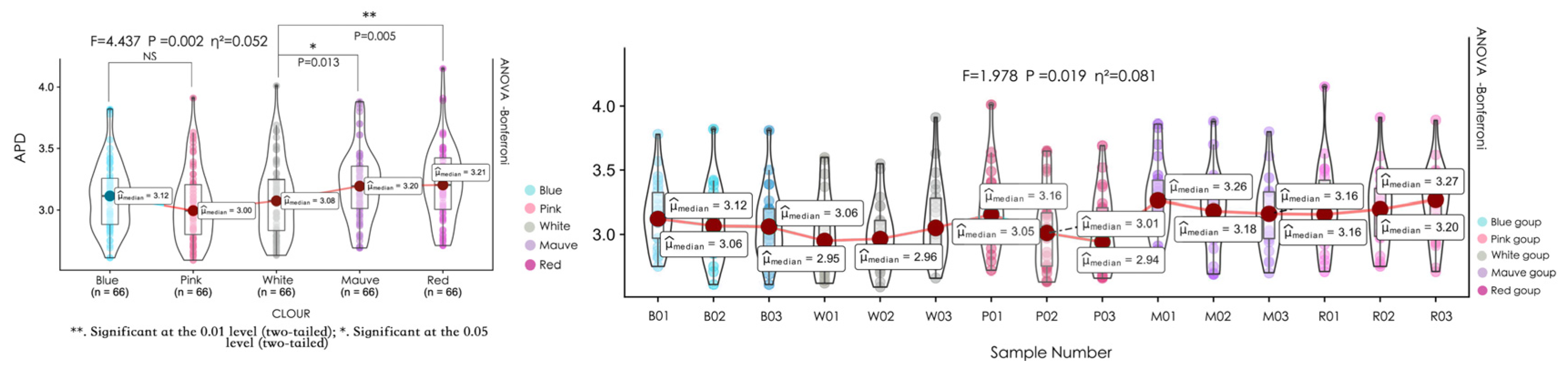
| APD | 330 | 3.129 ± 0.301 | 4 | 4.437 | 0.002 | 0.052 |
| Dependent Variable | Type III Sum of Squares | df | Mean Square | F | p | ηp2 | |
|---|---|---|---|---|---|---|---|
| NB | Clour | 17,764.752 | 4 | 4441.188 | 2.332 | 0.056 | 0.029 |
| Inflorescence | 14,924.291 | 1 | 14,924.291 | 7.838 | 0.005 | 0.024 | |
| Clour × Inflorescence | 27,939.845 | 4 | 6984.961 | 3.668 | 0.006 | 0.045 | |
| SF | Clour | 1.504 | 4 | 0.376 | 2.039 | 0.089 | 0.025 |
| Inflorescence | 1.061 | 1 | 1.061 | 5.755 | 0.017 | 0.018 | |
| Clour × Inflorescence | 2.502 | 4 | 0.626 | 3.393 | 0.010 | 0.041 | |
| ASA | Clour | 14.570 | 4 | 3.643 | 2.241 | 0.065 | 0.028 |
| Inflorescence | 5.323 | 1 | 5.323 | 3.274 | 0.071 | 0.010 | |
| Structure | 1.105 | 1 | 1.015 | 0.680 | 0.410 | 0.002 | |
| Clour × Inflorescence | 34.887 | 4 | 8.722 | 5.365 | <0.001 | 0.064 | |
| Clour × Structure | 33.107 | 4 | 8.277 | 5.091 | <0.001 | 0.061 | |
| N | Mean ± SD | df | F | t | p | Cohen’s d | ||
|---|---|---|---|---|---|---|---|---|
| NB | Mophead-type | 220 | 108.290 ± 44.992 | 328 | 0.283 | −3.129 | 0.002 | 44.507 |
| Lacecap-type | 110 | 124.554 ± 43.517 | ||||||
| Single-type | 110 | 108.500 ± 46.460 | 328 | 0.236 | −1.487 | 0.138 | 45.015 | |
| Double-type | 220 | 116.318 ± 44.278 |
| Wave | Time (s) | Mean ± SD | Median (p25, p75) | H | p | ε2 | Clour | Mean Rank |
|---|---|---|---|---|---|---|---|---|
| α/β | 90 | 1.851 ± 1.072 | 1.6500 (1.1250, 2.3400) | 15.216 | 0.004 | 0.035 | Blue | 133.67 |
| Pink | 162.14 | |||||||
| White | 197.17 | |||||||
| Mauve | 172.98 | |||||||
| Red | 161.55 | |||||||
| θ | 70 | 141,715.840 ± 101,854.303 | 112,111.45 (77,792.47, 175,295.27) | 9.980 | 0.041 | 0.018 | Blue | 181.36 |
| Pink | 171.73 | |||||||
| White | 151.29 | |||||||
| Mauve | 182.21 | |||||||
| Red | 140.91 |
| Mean ± SD | df | t | p | F | Cohen’s d | |
|---|---|---|---|---|---|---|
| Pre-TMD | 52.77± 32.318 | 26.239 | 5.606 | <0.001 | 18.636 | 24.257 |
| Post-TMD | 11.77 ± 11.505 |
Disclaimer/Publisher’s Note: The statements, opinions and data contained in all publications are solely those of the individual author(s) and contributor(s) and not of MDPI and/or the editor(s). MDPI and/or the editor(s) disclaim responsibility for any injury to people or property resulting from any ideas, methods, instructions or products referred to in the content. |
© 2025 by the authors. Licensee MDPI, Basel, Switzerland. This article is an open access article distributed under the terms and conditions of the Creative Commons Attribution (CC BY) license.
Share and Cite
Li, Q.; Ou, X.; Cai, S.; Guo, L.; Zhou, X.; Gong, X.; Li, Y.; Zhai, Z.; Elsadek, M.; Tang, H. A Study on the Restorative Effects of Hydrangea Flower Color and Structure on Human Psychology and Physiology. Horticulturae 2026, 12, 34. https://doi.org/10.3390/horticulturae12010034
Li Q, Ou X, Cai S, Guo L, Zhou X, Gong X, Li Y, Zhai Z, Elsadek M, Tang H. A Study on the Restorative Effects of Hydrangea Flower Color and Structure on Human Psychology and Physiology. Horticulturae. 2026; 12(1):34. https://doi.org/10.3390/horticulturae12010034
Chicago/Turabian StyleLi, Qinhan, Xueni Ou, Shizhen Cai, Li Guo, Xiangyu Zhou, Xueqian Gong, Yinan Li, Zhigao Zhai, Mohamed Elsadek, and Haoyuan Tang. 2026. "A Study on the Restorative Effects of Hydrangea Flower Color and Structure on Human Psychology and Physiology" Horticulturae 12, no. 1: 34. https://doi.org/10.3390/horticulturae12010034
APA StyleLi, Q., Ou, X., Cai, S., Guo, L., Zhou, X., Gong, X., Li, Y., Zhai, Z., Elsadek, M., & Tang, H. (2026). A Study on the Restorative Effects of Hydrangea Flower Color and Structure on Human Psychology and Physiology. Horticulturae, 12(1), 34. https://doi.org/10.3390/horticulturae12010034