Abstract
Blueberry (Vaccinium spp.) is a high-value crop due to its growing global demand, recognized nutraceutical properties, and strong linkage with emerging technologies in precision agriculture and postharvest management. To characterize the scientific evolution and intellectual structure, we conducted a bibliometric analysis of 474 documents indexed in Scopus between 1987 and 2025. A systematic search strategy based on taxonomic, agronomic, and technological descriptors was applied, followed by data cleaning and analysis with Bibliometrix and VOSviewer. Performance indicators and science-mapping techniques were used to examine temporal growth, geographical distribution, institutional and author leadership, and thematic structure. Scientific output shows a sustained upward trend with a maximum of 42 articles in 2024, confirming the consolidation of blueberry as a model crop for interdisciplinary research. Research articles represent over 75% of the total (359/474), evidencing an application-oriented and experimentally grounded field. Agricultural and Biological Sciences dominate (382 documents), followed by Engineering (70) and Biochemistry, Genetics, and Molecular Biology (66), reflecting increasing integration of crop management, technological innovation, and food science. Thematic mapping identified five main clusters: physiology and health, plant protection, agronomic management and digitalization, processing and stability of phenolic compounds, and analytical characterization. The analysis reveals gaps in the integration of physiology, food science, and metabolomics, as well as in the biological validation of biomarkers and the study of peripheral Vaccinium species. Overall, the field exhibits a consolidated and sustainability-oriented interdisciplinarity, highlighting opportunities to advance toward more comparable analytical protocols, digital traceability, and artificial-intelligence-assisted decision support along the blueberry value chain.
1. Introduction
Blueberry (Vaccinium spp.) has emerged over the last decades as one of the most rapidly expanding and strategically valuable berries within the global horticultural sector. Its rise is associated not only with growing consumption driven by its well-recognized nutraceutical properties but also with genetic, physiological, and technological advances that have enabled its cultivation under diverse agro-climatic conditions [1,2]. The genus Vaccinium, comprising between 300 and 400 species across the Northern Hemisphere, places particular emphasis on highbush blueberry (V. corymbosum L.), derived from complex interspecific crosses that resulted in high-yielding cultivars with superior firmness and fruit-quality traits [1,3].
Global demand for blueberries, particularly those in the Cyanococcus section, has intensified. North America remains the main consumer, accounting for approximately 58% of the fresh-fruit market, while Europe, China, and Latin America have shown remarkable expansion in cultivated area and export volume [4]. This growth has been driven largely by the development of southern highbush blueberry (SHB; V. corymbosum hybrids), which has enabled production in subtropical and tropical regions such as South Africa, Spain, Morocco, Mexico, Chile, China, Peru, and Argentina. In parallel, innovations in protected agriculture, environmental control, fertigation, and canopy management have increased physiological efficiency, productivity, and profitability [5,6,7].
Over the past decades, scientific research on blueberry (Vaccinium spp.) has shifted from a predominantly agronomic and physiological lens toward a broader interdisciplinary framework that now integrates biotechnology, food science, engineering, postharvest technology, and human health [8,9,10]. This diversification reflects both the geographic expansion of the crop and the growing valuation of its bioactive compounds, resulting in research agendas centered on productivity, quality, traceability, and sustainability [11,12,13]. As scientific output becomes more heterogeneous, synthesis tools are needed to describe the field’s evolution, its core knowledge structures, and its thematic and institutional interdependencies.
Literature reviews play a critical role in synthesizing existing evidence and identifying research gaps [14,15,16]. Yet the rapid acceleration in global scientific production now generating millions of articles annually poses challenges for monitoring knowledge advancement [15]. Traditional reviews also face limitations related to subjective selection criteria or emphasis on high-impact journals [16]. In this context, bibliometric analysis offers a systematic, transparent, and reproducible approach to mapping the cognitive organization of a field, identifying influential actors, and tracing thematic evolution over time [17,18,19].
In this regard, although two previous bibliometric studies on blueberries exist, both exhibit limitations that justify the contribution of the present work. The first, based on Web of Science, focuses primarily on descriptive productivity indicators and does not examine the intellectual structure of the field through co-authorship, coupling, or conceptual evolution [20]. The second, a comparative analysis of berries, restricts its scope to the last decade and provides only a partial view of Vaccinium research. In contrast, our study offers a comprehensive, longitudinal, and multi-method mapping of the scientific ecosystem, allowing for a more precise understanding of cognitive architecture, thematic interdependencies, and emerging research fronts in blueberry (Vaccinium spp.) research [21].
For this reason, the objective of this study was to analyze the evolution, structure, and dynamics of global scientific knowledge on blueberry through a bibliometric approach capable of revealing the intellectual organization, the most influential actors, and major thematic trends. Specifically, we asked: (i) how has scientific production progressed in temporal, geographical, and institutional terms? (ii) which topics, approaches, and technologies dominate or emerge as future research fronts? and (iii) what gaps persist at the interface between production, postharvest, and sustainability? To address these questions, we conducted a systematic search of Scopus (1987–2025), extracted metadata from peer-reviewed documents, and analyzed them using Bibliometrix/Biblioshiny (R) and VOSviewer (v.1.6.20). Performance indicators and co-authorship, bibliographic coupling, and keyword co-occurrence networks were applied to provide a comprehensive and quantitative perspective on the blueberry research landscape, identifying major lines of development, thematic interconnections, and strategic gaps for future inquiry.
2. Materials and Methods
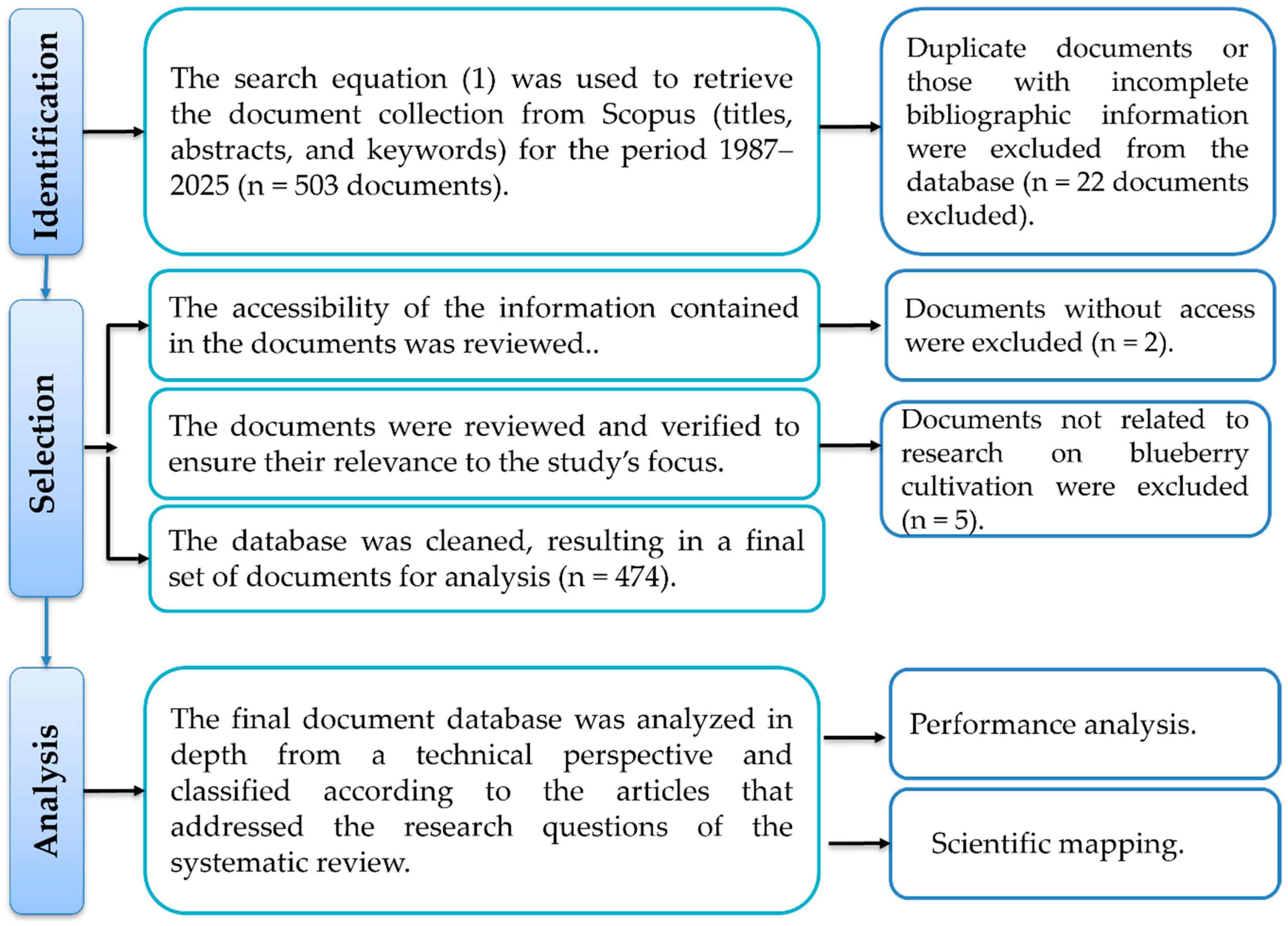
The bibliometric analysis conducted in this study differs from traditional narrative or scoping reviews in that it focuses on mapping, quantifying, and evaluating the cognitive and evolutionary structure of scientific knowledge on blueberry (Vaccinium spp.). This approach enabled the identification of research trends, knowledge gaps, and emerging areas, providing a comprehensive view of the global scientific dynamics of the crop [22]. The methodological procedure followed a stepwise systematic approach that included the definition of the search equation, the collection and refinement of the database, performance analysis, scientific mapping, and the visualization of thematic and structural networks [23]. All bibliographic data were retrieved from the Scopus database on 14 October 2025, which served as the cut-off date for document inclusion. The dataset comprised peer-reviewed articles, reviews, conference papers, book chapters, and Early Access publications that were already indexed in Scopus at the time of extraction. Figure 1 illustrates the relevant phases of the workflow employed in this bibliometric analysis.
Figure 1.
Search and data-cleaning scheme for the bibliometric analysis database.
2.1. Definition of the Search Equation
Research manuscripts reporting large datasets that are deposited in a publicly available database should specify where the data have been deposited and provide the relevant accession numbers. If the accession numbers have not yet been obtained at the time of submission, please state that they will be provided during review. They must be provided prior to publication.
The search equation was constructed with the aim of retrieving scientific publications that directly addressed aspects related to blueberry production, agronomic management, postharvest handling, processing, and commercialization. The search was carried out in the Scopus database, recognized for its robustness and scientific coverage [24,25], selecting the title, abstract, and keyword fields (TITLE-ABS-KEY), and it was restricted to peer-reviewed documents. The search equation used was as follows:
- TITLE-ABS-KEY (blueberry OR “Vaccinium corymbosum” OR “Vaccinium spp.”) AND TITLE-ABS-KEY (“protected cultivation” OR “protected agriculture” OR “greenhouse” OR “tunnel” OR “shade net” OR “net house” OR “agribusiness” OR “fair trade” OR “processing”) AND TITLE-ABS-KEY (irrigation OR fertigation OR fertilization OR “nutrient management” OR pruning OR training OR “crop management” OR “harvest” OR “postharvest” OR “storage” OR “shelf life” OR “diseases” OR “pests” OR “crop protection” OR “biological control” OR “Transformation” OR “Commercialization” OR “Marketing” OR “export” OR “markets”).
The search strategy was designed to delimit the bibliometric analysis to scientific output directly related to blueberry (Vaccinium spp.) production systems, agronomic management, postharvest handling, technological innovation, and value-chain sustainability. For this purpose, the search equation integrated three complementary components: (i) taxonomic descriptors (“blueberry,” “Vaccinium spp.,” “Vaccinium corymbosum”), (ii) production-system terms associated with protected cultivation, processing, and agro-industrial environments, and (iii) management-related descriptors covering irrigation, fertigation, crop protection, harvest, storage, shelf life, and commercialization. This structure combined taxonomic, agronomic, and technological descriptors, ensuring the inclusion of interdisciplinary studies related to blueberry production, quality, sustainability, and value chain.
Rather than aiming to retrieve the entire biological, ecological, or genomic literature on Vaccinium spp., the query was intentionally scoped to reflect the thematic boundaries of this study, which focuses on agronomic performance, technological development, postharvest behavior, and sustainable production frameworks. Prior to final selection, broader and narrower versions of the equation were tested, and the adopted query demonstrated the best balance between thematic specificity and disciplinary inclusiveness, avoiding both the overexpansion of unrelated genomic or purely ecological studies and the omission of relevant agronomic or postharvest research. This approach aligns with best practices in targeted bibliometric reviews, where the search strategy is tailored to the conceptual domain under analysis rather than to the entire taxonomic group.
2.2. Preliminary Results and Database Refinement
The initial search yielded a total of 503 documents published between 1987 and 2025. A rigorous screening process was subsequently applied to ensure the quality and relevance of the information. At this stage, duplicate records (n = 13), documents with incomplete metadata or without access (n = 11), and publications not directly related to the study topic (n = 5) were removed. As a result, a final database consisting of 474 valid documents was obtained. These were exported in CSV and BibTeX formats, preserving all essential metadata, including authors, affiliations, year of publication, keywords, abstracts, source, and references required for subsequent analysis. Inclusion criteria considered original research articles, review papers, book chapters, and conference proceedings, provided they were peer reviewed, and their content contributed directly to knowledge on blueberry (Vaccinium spp.) within the framework of protected agriculture, sustainable production, postharvest, and international marketing. This process made it possible to consolidate a solid and representative information base suitable for exploring the scientific evolution and thematic interconnections within the field of study [26].
2.3. Data Processing and Analysis
Data processing was carried out in RStudio (v.4.4.0) using the Bibliometrix package and its Biblioshiny interface, complemented by VOSviewer software (v.1.6.20) for the construction of co-authorship, co-citation, bibliographic coupling, and keyword co-occurrence networks [27,28]. Filters were applied by year, country, institution, journal, subject area, and document type to describe temporal evolution, identify the most influential actors, and analyze the intellectual structure of the field. These tools made it possible to develop comprehensive scientific mapping, quantifying productivity, impact, interconnections, and thematic specialization of global knowledge on Vaccinium spp., with an emphasis on the transition toward technological, digital, and sustainable approaches in the blueberry value chain.
2.4. Performance Analysis
Performance analysis is an essential phase in bibliometric studies, the objective of which is to quantify and compare the scientific contributions of the different actors that make up a field of research. This descriptive and evaluative approach makes it possible to examine the level of productivity, visibility, and impact of authors, institutions, countries, and journals, thus providing a comprehensive perspective on scientific development [29]. Its application is common both in mapping studies and in reviews without structural analysis, since it provides an empirical baseline for interpreting knowledge dynamics. Among the most relevant metrics are the number of publications, which reflect academic productivity, and the citation count, which indicates the influence and recognition of the works within the scientific community. Additionally, composite indicators such as the h-index and the average number of citations per document allow for a more balanced assessment of individual and collective performance within the field under analysis.
2.5. Scientific Mapping
Scientific mapping makes it possible to examine the conceptual structure and the interrelationships among the different components that shape a research field. This approach facilitates the identification of intellectual, thematic, and structural linkages within the scientific literature [17,18]. To characterize the blueberry (Vaccinium spp.) research domain, we employed bibliometric techniques including citation analysis, bibliographic coupling, co-word analysis, and co-authorship analysis.
To ensure methodological transparency and reproducibility, all network analyses were conducted using clearly defined selection thresholds. In Bibliometrix/Biblioshiny, co-occurrence networks were generated using a minimum occurrence threshold of five keywords, while author and institutional networks were constructed using a minimum productivity threshold of three documents. For VOSviewer analyses, nodes were included only when they reached the software’s default relevance filter, and networks were visualized using a minimum cluster size of five items and a link strength threshold of one. When integrated with network-based visualization models, these techniques provide a comprehensive view of the dynamics of knowledge generation and transfer. The resulting maps graphically represent the cognitive organization of the field, reveal relationships among authors, institutions, and journals, and expose the thematic connections that articulate scientific development. In the present study, this methodological approach enabled the identification of consolidated research cores, emerging trends, and interdisciplinary linkages, thereby clarifying the intellectual structure and thematic cohesion within global Vaccinium research.
3. Results and Discussion
3.1. Number of Published Documents
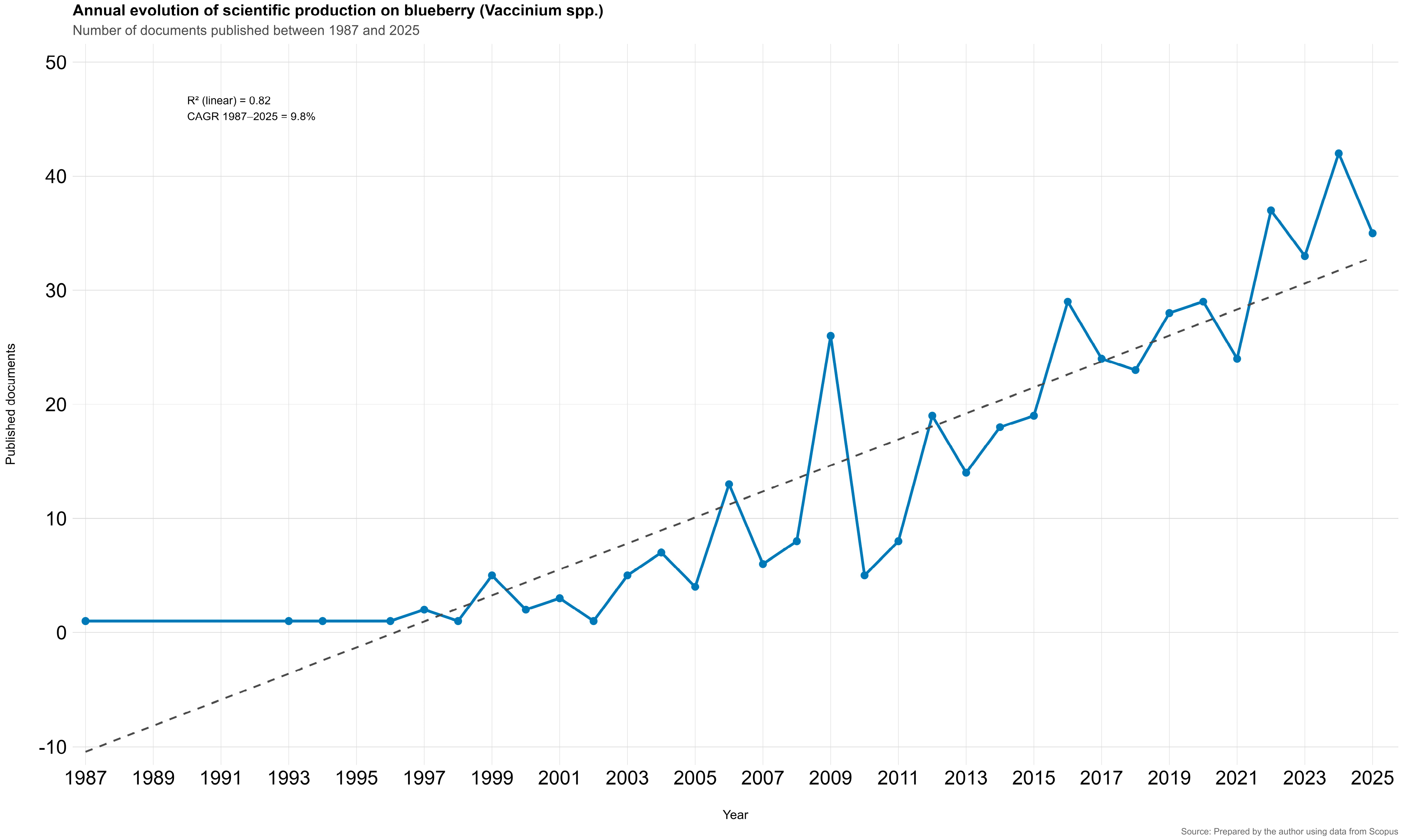
The bibliometric analysis of the annual evolution of scientific production on blueberry (Vaccinium spp.) (Figure 2) confirms a robust and statistically consistent growth trajectory over nearly four decades. The linear regression fitted to the annual output shows a high explanatory power (R2 = 0.82), indicating that the increase in publications follows a stable long-term trend rather than random year-to-year fluctuations. Similarly, the compound annual growth rate (CAGR) of 9.8% between 1987 and 2025 quantitatively reinforces the sustained expansion of scientific activity in this field.
Figure 2.
Historical evolution of publications.
Between 1987 and 2005, growth remained modest, corresponding to an exploratory phase characterized by isolated contributions in physiology, pathology, ecology, and basic agronomic management [30,31,32,33]. From 2006 onward, however, a clear structural transition is observed, marked by thematic diversification, the formation of specialized research groups, and the integration of blueberry into global agendas related to nutrition, biotechnology, precision agriculture, food science, and agricultural sustainability [34,35,36,37,38]. This inflection point coincides with the commercial expansion of the crop and the emergence of new producing regions, factors that collectively increased the visibility and demand for scientific knowledge on Vaccinium spp.
During the most recent period (2016–2025), scientific production intensified noticeably, culminating in a historical peak of 42 published articles in 2024, which positions blueberry as a consolidated model system in interdisciplinary horticultural research. Although certain fluctuations appear in specific years likely reflecting cyclic funding dynamics and the variability of international collaborations, the general tendency remains upward and statistically consistent. The accumulated total of 474 documents underscores the maturity of the field and its expansion toward advanced domains such as genomics, stress physiology, postharvest technologies, bioactive compounds, and sustainable production systems [34,39,40]. Taken together, Figure 2 portrays a field undergoing scientific consolidation, with increasing productivity, methodological sophistication, and thematic specialization. These patterns position research on Vaccinium spp. at an advanced stage of development, with strong strategic projection within contemporary agricultural, technological, and food science research.
3.2. Types of Documents Published
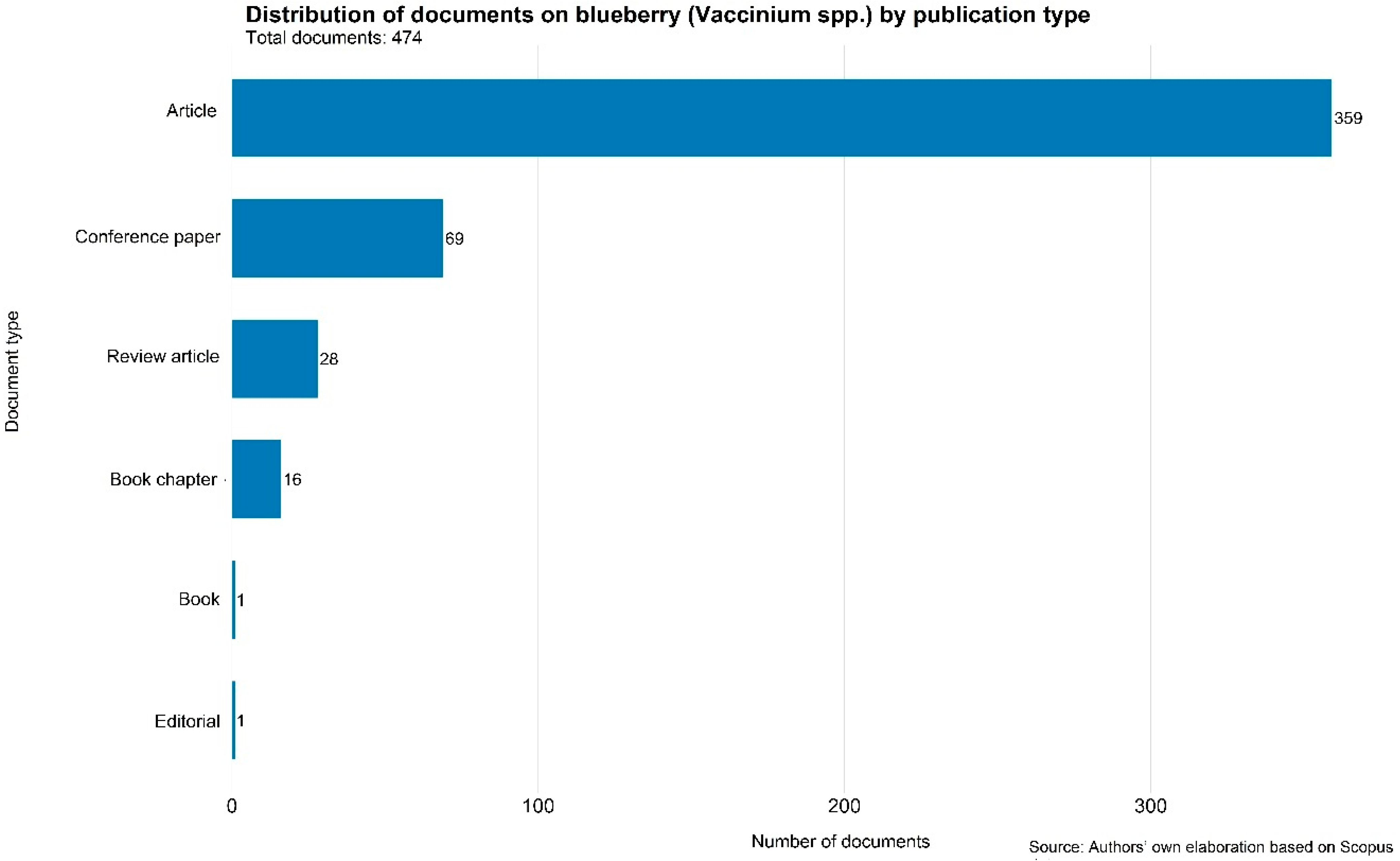
The analysis of the distribution of documents (Figure 3) by publication type shows a scientific structure dominated by research articles, which accounts for more than 75% of the total (359 out of 474 documents). This predominance evidences the consolidation of blueberry (Vaccinium spp.) as a formally established field of study within the academic literature, supported by the publication of peer-reviewed experimental results [41]. The analysis of document distribution by publication type reveals a scientific output largely dominated by research articles, which account for over 75% of the total (359 out of 474 documents). This predominance indicates that research on blueberry (Vaccinium spp.) has become a formally established scholarly field, sustained primarily by the dissemination of peer-reviewed experimental findings [42]. Review articles (28) confirm the maturity of the field, since this type of document typically emerges when there is a sufficiently broad body of knowledge to be systematized and critically examined.
Figure 3.
Types of documents published.
In contrast, book chapters, books, and editorials account for a marginal proportion (less than 5% of the total), suggesting that the dissemination of generated knowledge remains concentrated in specialized scientific outlets rather than in compilations or interdisciplinary synthesis works [43]. Taken together, the distribution reflects a dynamic ecosystem of scientific production with a strong reliance on formal scholarly communication, which supports the consolidation of academic networks, enhances citability, and contributes to positioning blueberry as a model crop in global horticultural research.
This pattern aligns with trends reported in other fruit-related bibliometric studies. For example, a bibliometric assessment on wine and grape authenticity showed that scientific articles constituted 91.88% of all publications, while reviews (4.05%) and conference proceedings (4.05%) represented only minor fractions of the total output [44]. Likewise, a bibliometric analysis of post-harvest fruit quality identified 1050 journal articles, compared with 189 conference papers and 72 reviews, demonstrating a strong predominance of peer-reviewed article formats within fruit science research [45]. These convergent findings corroborate the distribution observed for blueberry (Vaccinium spp.) and reinforce the interpretation that this field exhibits the typical characteristics of a scientifically consolidated domain, where empirical research is primarily disseminated through indexed journal articles to maximize visibility, methodological rigor, and citability.
3.3. Knowledge Areas Covered by the Scientific Field According to the Published Documents
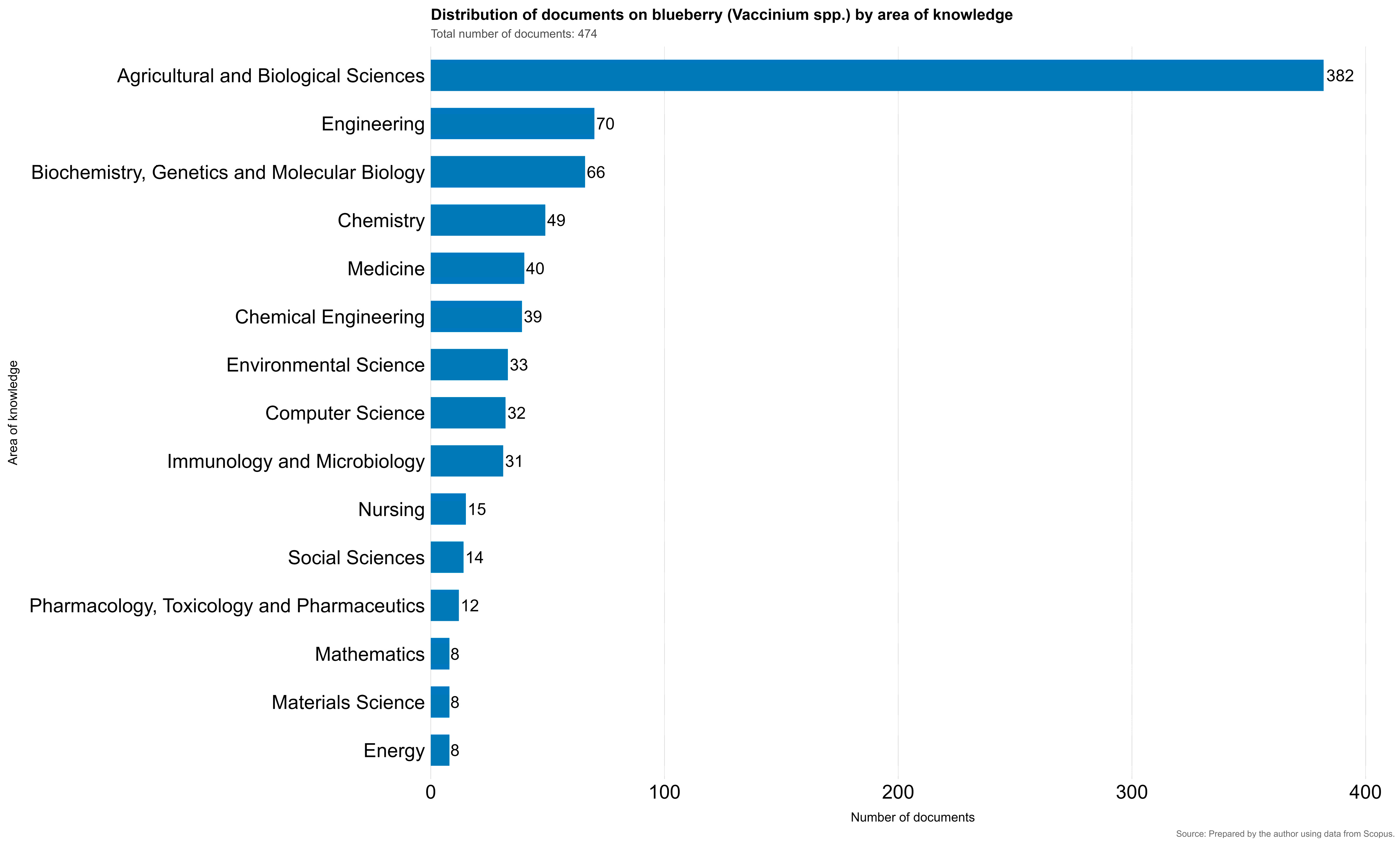
The distribution by knowledge areas (Figure 4) shows a notable concentration of research on blueberry (Vaccinium spp.) within Agricultural and Biological Sciences, with 382 documents, reflecting the consolidation of this crop as a study model in plant physiology, applied genetics, and sustainable agronomic management [46,47,48]. The predominance of this area is complemented by the growth of Engineering (70) and Biochemistry, Genetics and Molecular Biology (66), which evidences the convergence between crop science and technological innovation. In recent years, this integration has favored the emergence of advanced postharvest approaches aimed at quality control, anthocyanin preservation, and spoilage prediction through optical sensors and artificial intelligence [49,50]. Likewise, simulation models and deep learning algorithms are being used to monitor the crop, perform automated fruit classification, detect surface defects, and estimate biochemical content, evidencing a transition from descriptive analysis toward predictive and prescriptive analytics along the blueberry value chain [51,52,53,54,55].
Figure 4.
Thematic areas in which the published documents are integrated.
The secondary areas Chemistry (49), Medicine (40), and Chemical Engineering (39) reinforce the multidimensional nature of the field, particularly in the study of bioactive compounds and their nutraceutical applications [34]. In parallel, advances in Environmental Sciences (33) and Computer Science (32) suggest a broadening of the research spectrum toward sustainability, biosystem modeling, and process optimization through computational intelligence algorithms [10,37,56]. Emerging disciplines such as Energy, Materials Science, and Mathematics open new frontiers linked to the design of biodegradable or edible packaging, modeling and simulation, the development of drying technologies in processing, and efficient storage practice [57,58,59,60].
Taken together, the figure evidences a scientifically mature field with increasing interdisciplinarity, in which blueberry research is shifting from pure biological understanding toward the integration of engineering tools, data science, and machine learning, shaping a domain with strong prospects for precision agriculture and circular bioeconomy. To empirically support this interpretation, we calculated the Rao–Stirling diversity index using Scopus subject--area co-classifications as disciplinary inputs [61]. The resulting value (Drs = 0.75 on a 0–1 scale) indicates a highly diversified knowledge base, where contributions extend beyond Agricultural and Biological Sciences into Engineering, Chemistry, Medicine, Environmental Science, and Computer Science. This quantitative evidence confirms that research on Vaccinium spp. has evolved into a genuinely multidisciplinary field, integrating technological innovation, health sciences, and sustainability.
3.4. Countries of Origin of the Publications
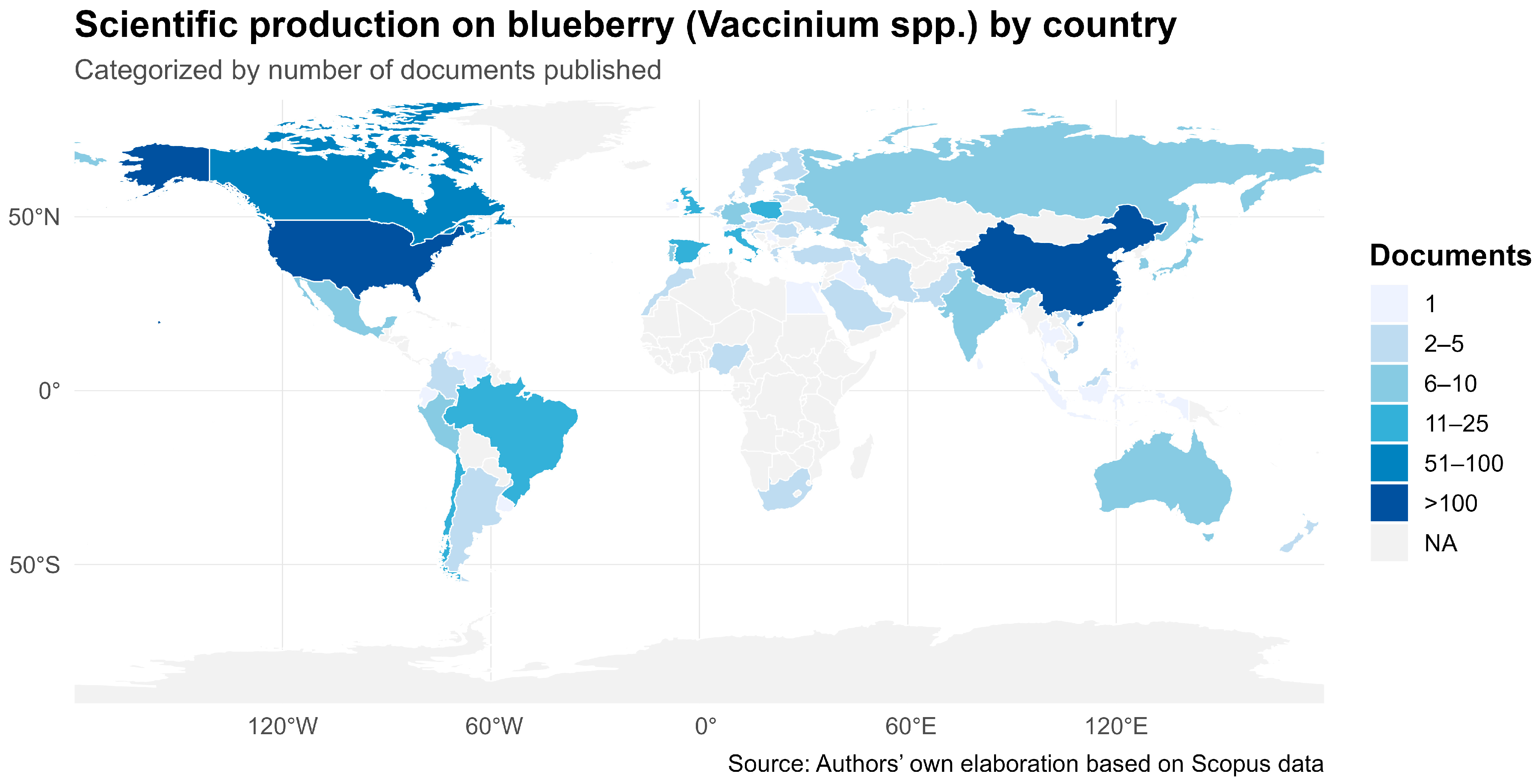
The global map (Figure 5) of scientific production on blueberry (Vaccinium spp.) shows a clear concentration of knowledge in countries with technologically consolidated agro-industrial systems and robust academic structures. The United States (162 documents) leads scientific output, not only because of its current production volume, but due to its historical leadership in agronomic, physiological, and biotechnological research on the crop [62,63,64]. Its universities and innovation centers have developed management, physiology, postharvest, and fruit quality models that served as a reference for the global expansion of the crop [10,65,66]. In second place is China (111), which over the last decade has experienced exponential growth both in cultivated area and in scientific production, likely driven by state programs in agricultural innovation, plant biotechnology, and market development [10,67]. Canada (57) completes the leading group, standing out in studies on postharvest, quality, and the positive health effects of fruit consumption or derived food products [11,68,69].
Figure 5.
Global distribution of scientific production.
In Latin America, scientific activity is concentrated in Chile (24 documents), Brazil (22), and Peru (7), with an applied focus on fruit quality, productive physiology, and postharvest technologies. Chile maintains a central role in export activity and in generating knowledge on agronomic management, physiology, irrigation and fertilization, and protected production of the crop [70,71,72,73]. Brazil contributes through research on pest and disease management via biological control, as well as studies on specific cultivars [74,75], whereas Peru, the world’s main exporter, directs its research toward technology, using emerging tools for disease detection and for postharvest processing of the fruit [76,77]. Taken together, these countries reflect geoeconomic and scientific reconfiguration in which the Global South is emerging not only as a producer but increasingly as a generator of specialized knowledge.
In Europe, scientific production is concentrated mainly in Spain (20 documents), Italy (19), the United Kingdom (16), and Poland (15), with significant contributions in biotechnology, nutraceutical quality, and sustainability. These countries focus their research on secondary metabolism and the assessment of the fruit’s antioxidant potential, as well as on environmental studies centered on life cycle analysis associated with blueberry production [39,78,79,80,81]. Likewise, Portugal (10) and Germany (9) stand out in research lines related to processing technologies and postharvest quality of the fruit or derived products [82,83].
Asian countries such as India, Japan, South Korea, and Vietnam show sustained growth in their contribution, focusing on postharvest, nutraceutical topics, production in controlled environments, and sustainability [84,85,86,87]. Although with a lower number of publications, their contribution is characterized by the early adoption of computer vision tools, machine learning, and simulation for fruit classification [52,88]. On the other hand, in Colombia only two indexed publications on blueberry have been recorded, which reflects a still incipient field and a probable prevalence of gray literature in theses or non-indexed journals. The first study analyzes the effect of thermal processing on the polyphenols and antioxidant capacity of Vaccinium meridionale, highlighting its functional value compared to other Andean fruits [89]. The second study addresses the valorization of pomace as a by-product, applying drying and milling to obtain powders rich in fiber and anthocyanins, with potential as a functional ingredient. Both works emphasize postharvest and circular economy approaches, guiding future research toward technological valorization and agro-industrial sustainability [79].
Finally, it can be concluded that there is a scientific globalization of blueberry research, in which North America and Europe maintain historical leadership in knowledge generation, while Asia and Latin America are emerging as poles of technological innovation and productive sustainability, thereby consolidating blueberry as a biological and technological model in contemporary precision agriculture.
3.5. Co-Authorship Network by Country
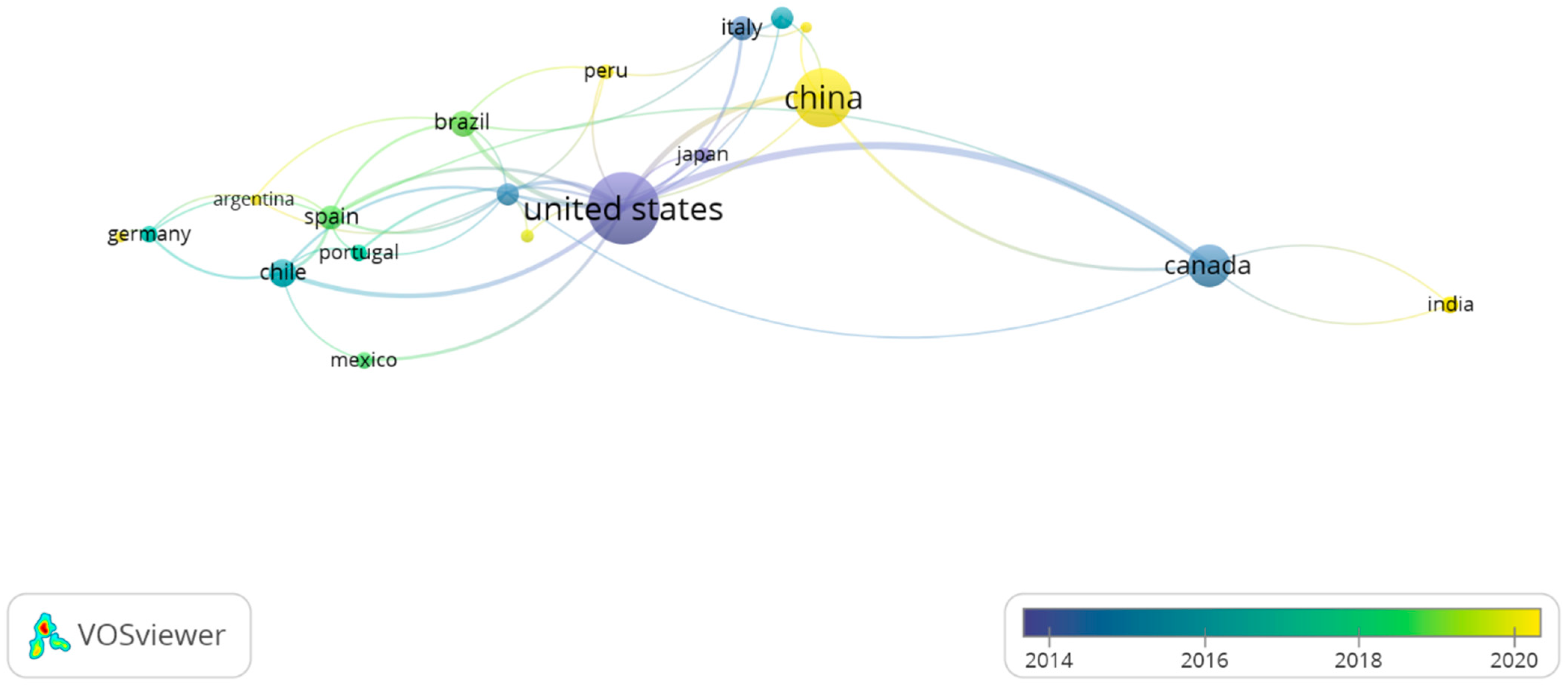
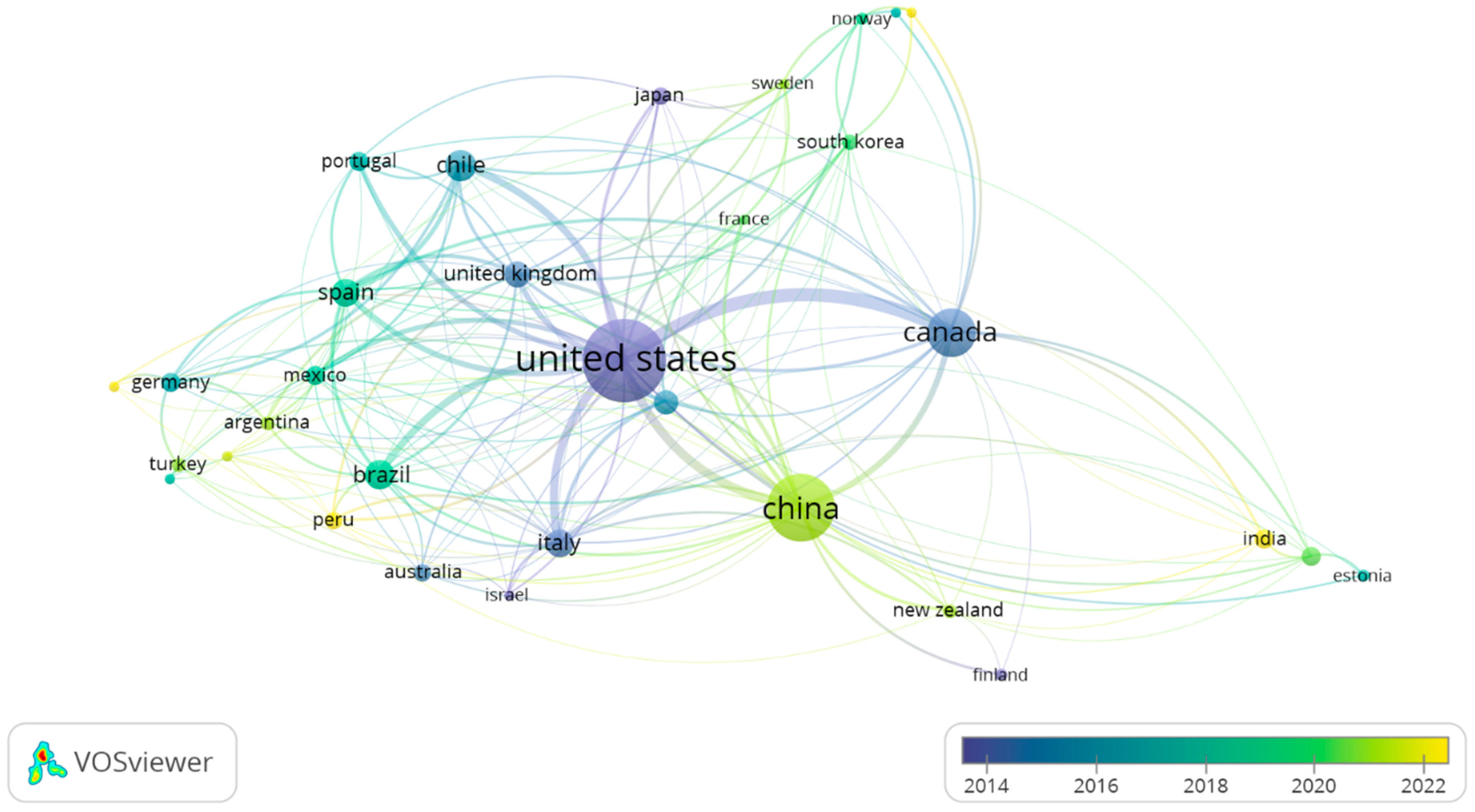
The co-authorship network by country (Figure 6) reveals a global structure of scientific collaboration around the study of blueberry (Vaccinium spp.), in which the links among nations reflect knowledge exchange and the capacity for integration among research systems. The largest and most connected nodes namely the United States, China, and Canada concentrate the highest productivity and network cohesion, acting as hubs of cooperation with Europe, Asia, and Latin America. This network represents not only the geographical distribution of studies, but also scientific interdependence, in which the circulation of authors, projects, and data generates a shared knowledge ecosystem [90].
Figure 6.
Co-authorship network among countries.
A high centrality of the United States is observed, with a multinodal collaboration pattern that links with China, Canada, Spain, and Brazil, reflecting a hierarchical structure typical of mature scientific fields. China appears as an emerging node with increasing connectivity, because of its expansion and interest in the crop and its different market types. In Latin America, countries such as Chile, Mexico, and Brazil stand out for their insertion into international networks, mainly in applied areas such as postharvest, nutraceutical quality, and technologies, while Peru and Argentina are strengthening ties with European research centers.
Finally, the network shows a trend toward regional and thematic diversification. Europe maintains a relevant role through Spain, Italy, and Poland, focusing on studies of sustainability and the chemistry of bioactive compounds, while Asia is expanding its presence in technological innovation and machine learning. Overall, the co-authorship structure reveals a transition from a system concentrated in a few hubs to a more distributed and multidisciplinary network, in which international collaboration becomes a key driver for the scientific and technological evolution of blueberry. International collaboration was assessed using a full counting approach, in which each country appearing in the authors’ affiliations received one full credit for a given publication. This method, aligned with the default procedure of Bibliometrix and VOSviewer, allows a direct interpretation of collaborative intensity without distributing fractional weights among co-authoring countries.
3.6. Bibliographic Coupling Network Among Countries
The bibliographic coupling network (Figure 7) makes it possible to identify those countries whose publications share a common referential base, that is, those that cite the same scientific sources in their studies on Vaccinium spp. [18]. In this network, composed of 48 countries and a total link strength of 4917, the United States (162 documents, strength 917), Canada (56, 421), and China (111, 330) emerge as the main articulation nodes, reflecting their dominant role in shaping the conceptual and methodological framework of the field [91]. The high overlap in cited references evidences an academic dependency on these countries, which act as cognitive structuring hubs for global research on blueberry physiology, genetics, and postharvest.
Figure 7.
Bibliographic coupling network among countries.
European countries display a well-defined coupling network: the United Kingdom (203), Italy (195), Spain (192), Portugal (81), and Poland (85) form an intercontinental cooperation bloc that shares research lines in postharvest, sustainability, and protected agriculture. Latin America is integrated through Chile (175), Brazil (170), Mexico (73), and Peru (48), showing growth in output and thematic affinity with Europe, primarily focused on fruit quality and physiological studies. This articulation demonstrates that Latin American literature is nourished by consolidated theoretical frameworks from the Global North but is beginning to generate its own technological and contextual adaptations.
Finally, the presence of Asian countries such as Japan (51), South Korea (62), and India (29) reinforces the diversification of knowledge, highlighting their participation in advanced research on processing, predictive modeling, and machine learning applied mainly to postharvest management. Taken together, the numerical and structural analysis confirms that research on blueberry has reached a stage of global consolidation, with strong thematic interdependencies and a growing interdisciplinary synergy oriented toward sustainability and technological innovation.
3.7. Leading Institutions in Scientific Production
The institutional analysis shows that scientific production on blueberry is strongly concentrated in a small group of North American entities, which occupy the highest positions both in publication volume and in their structural centrality within the collaboration network (Table 1). The USDA Agricultural Research Service, the United States Department of Agriculture, and Dalhousie University each contribute 25 documents, forming the most cohesive institutional core. Their prominence reflects not only sustained research productivity but also a central role in shaping shared methodological frameworks and acting as reference nodes in the global knowledge structure [92,93,94,95,96].
Table 1.
Top 5 institutions with the highest scientific productivity.
A second tier, composed of the University of Florida (23 documents) and the University of Georgia (21), reinforces the diversification of research lines identified in the subject-area and keyword analyses. Their publication profiles show strong participation across agronomic management, ecophysiology, postharvest, and technological innovation, which suggests that these institutions function as bridging nodes that link traditionally biological research with advances in engineering and data-driven approaches [97,98,99,100,101]. Their presence in multiple thematic clusters indicates an integrative institutional behavior rather than specialization in a single domain.
Overall, the institutional distribution reveals a highly asymmetric but structurally coherent system dominated by North American organizations. These institutions anchor the intellectual and methodological development of the field, while emerging contributors from Europe, Latin America, and Asia participate mainly through thematic niches. This pattern supports the interpretation of blueberry research as a globally connected but hierarchically organized network, where a limited number of institutions define the disciplinary standards and scientific direction of the field.
3.8. Leading Authors in Academic Production
The analysis of leading authors (Table 2) and their position within the co-authorship network reveals a structurally organized research system with clear thematic concentration. Arnold Walter Schumann and Qamar Uz Zaman constitute the central axis of the network, exhibiting the highest productivity (11 and 10 documents, respectively), strong citation performance, and the largest total link strength. Their high degree and centrality confirm their role as structural hubs in research fronts related to automation, sensing technologies, and precision management of blueberry production systems. Their recurrent co-authorship and strong connectivity reflect the consolidation of a technologically oriented cluster with high internal cohesion.
Table 2.
Top 5 authors with the highest number of publications.
Luke R. Howard, Bin Li, and Changying Li occupy positions characterized by high citation impact and thematic specialization. Howard acts as a core node in the biochemical and functional-quality cluster, with his contributions shaping the foundations of anthocyanin stability and processing effects. Bin Li’s research strengthens the metabolomics-oriented front, supported by high-impact publications on anthocyanin transformation and advanced analytical methods. Meanwhile, Changying Li contributes to the engineering and digitalization cluster, particularly in computer vision and AI-based phenotyping, reflected in the strong thematic coherence of his citation profile.
Together, these authors form structurally differentiated but interconnected sub-networks that articulate the main thematic domains of blueberry research: precision agriculture, postharvest and processing, and biochemical characterization. Their prominence is not derived from biographical attributes, but rather from demonstrable bibliometric influence citation impact, network centrality, link strength, and thematic leadership within the global science mapping of Vaccinium spp.
3.9. Co-Authorship Network Among Authors
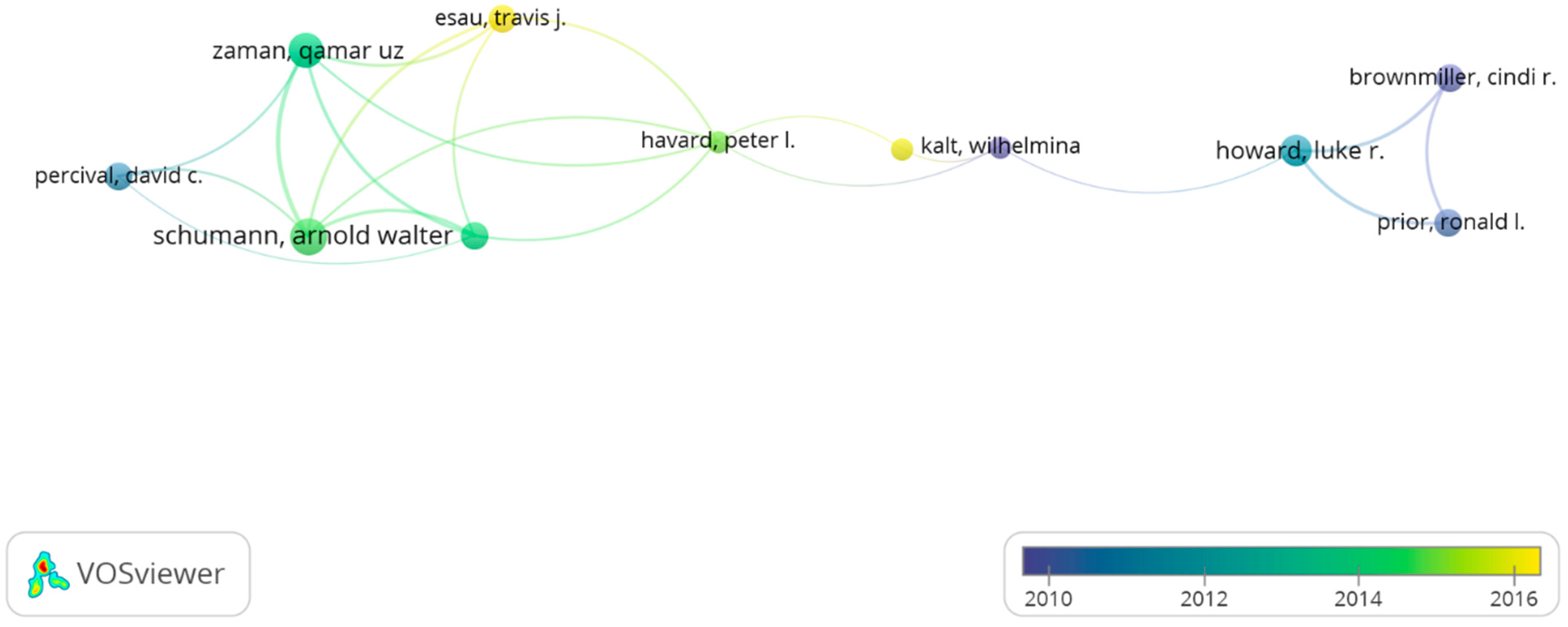
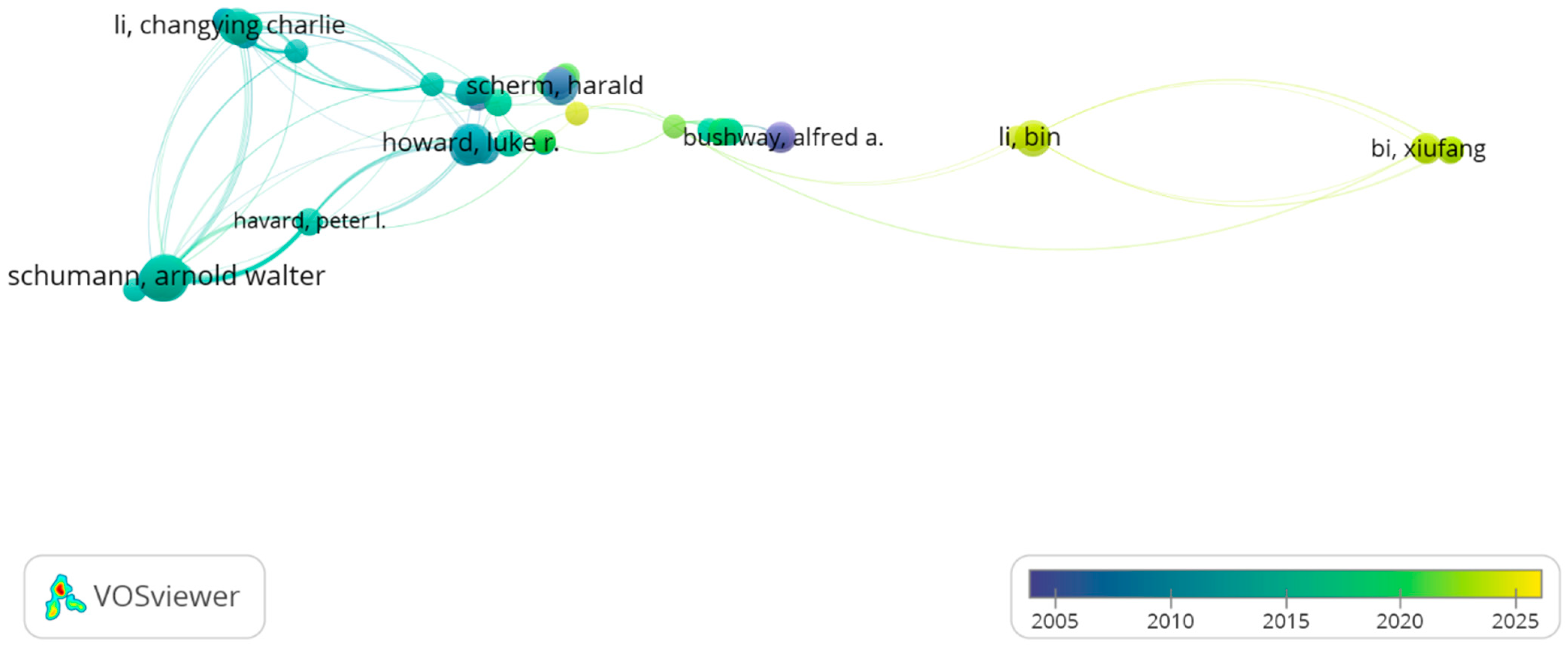
The co-authorship network (Figure 8) reveals the collaborative structure underlying scientific production on Vaccinium spp., comprising 11 main authors, 20 links, and a total link strength of 75, which together reflect a medium level of cooperation and a clear thematic organization. Rather than providing merely descriptive statistics, this network illustrates how specific author groups have shaped the conceptual and methodological evolution of blueberry research over time.
Figure 8.
Co-authorship network among authors.
The strongest collaborative nucleus is led by Arnold Walter Schumann (11 documents, 159 citations, link strength 27) and Qamar Uz Zaman (10 documents, 156 citations, link strength 27), who form a stable and highly connected cluster centered on automation, mechanization, and artificial intelligence applied to blueberry management [97]. Their sustained co-authorship, particularly in maturity detection, precision spraying, and harvest optimization, positions this cluster as the technological–engineering specialization, where research is oriented toward digital agriculture, computer vision, and intelligent mechanization.
A second, temporally earlier cluster is formed by Luke R. Howard, Ronald L. Prior, and Cindi R. Brownmiller, whose work between 2010 and 2014 established foundational knowledge on anthocyanins, polyphenols, and antioxidant stability during processing [93,102]. This group represents the biochemical–nutraceutical specialization, focusing on the behavior of phenolic compounds, antioxidant mechanisms, and the functional quality of the fruit. Their bridging role in the network indicates that this fundamental biochemical corpus provided the experimental basis that later enabled advances in postharvest modeling and AI-assisted quality assessment.
Finally, intermediate authors such as David C. Percival, Peter L. Havard, and Wilhelmina Kalt play an integrative role that connects technological innovation with agronomic performance and food chemistry. Percival’s research on yield estimation, automated harvesting, and energy and carbon assessments in wild blueberries [65,103] links the network to sustainability and production efficiency. Havard contributes an economic and engineering perspective through studies on technological feasibility and cost-effective precision agriculture [104,105], while Kalt provides a biochemical bridge through her influential work on anthocyanins, phenolics, and antioxidant capacity in processed products [11]. Together, this group forms a hybrid or integrative specialization, articulating agronomics, sustainability, and food chemistry.
Overall, the co-authorship network highlights how collaboration clusters correspond to distinct thematic specializations—technological engineering, biochemical quality, and integrative agronomic research—demonstrating that the interdisciplinary evolution of blueberry research has been structured around stable, highly productive author groups that collectively define the intellectual architecture of the field.
3.10. Bibliographic Coupling Network Among Authors
The bibliographic coupling network among authors (Figure 9) makes it possible to identify the extent of intellectual relatedness based on overlaps in the references cited in their publications, where a higher degree of coupling indicates that researchers are grounding their work on a similar bibliographic corpus [25]. In this case, the network is composed of 61 authors connected through 227 links, with a total link strength of 3742, which represents a consolidated and highly cohesive system of scientific collaboration. The link strength reflects the degree of thematic proximity among authors: the higher the value, the greater the similarity in the references used and, therefore, the closer the conceptual alignment of their research lines [106,107]. Arnold Walter Schumann (11 documents, 159 citations, link strength 465), Qamar Uz Zaman (10 documents, 156 citations, link strength 464), and Li Changying “Charlie” (7 documents, 201 citations, link strength 363) stand out, forming the densest core of the network. This group leads research on precision agriculture, computer vision, and intelligent mechanization, demonstrating a high degree of interdependence in the production of knowledge applied to mechanical harvesting, maturity estimation, and automated management of blueberry fields.
Figure 9.
Bibliographic coupling network among authors.
The second relevant cluster is composed of Luke R. Howard (8 documents, 1144 citations, link strength 281), Ronald L. Prior (6 documents, 590 citations, link strength 235), Fumiomi Takeda (5 documents, 179 citations, link strength 312), and Peter L. Havard (4 documents, 39 citations, link strength 239), with a focus on biochemistry, physiology, and postharvest quality. Their bibliographic coupling reflects the persistence of an interdisciplinary approach between food science and agricultural engineering. These researchers share numerous references related to polyphenols, anthocyanins, and thermal stability of antioxidant compounds, generating a common theoretical base that supports the transition toward more technological research. In this group, the intermediate link-strength values (between 235 and 312) indicate an indirect but coherent collaboration, in which bibliographic convergence serves as a bridge between chemical studies and developments in agricultural automation.
Finally, authors such as Li Bin (7 documents, 118 citations, link strength 87) and Bi Xiufang (5 documents, 18 citations, link strength 184) emerge, representing the recent expansion of the field toward Asia, particularly China. Their scientific output, with lower but increasing link-strength values, is concentrated between 2020 and 2025 and addresses topics such as metabolomics, nanoencapsulation, and anthocyanin stability during processing and storage. This temporal shift toward the most recent part of the network reflects the evolution of knowledge toward emerging technologies and the strengthening of new research hubs outside the traditional North American sphere.
3.11. Main Journals Selected by Authors for Publishing Their Documents
Scientific production on Vaccinium spp. is concentrated in specialized journals in horticulture, plant physiology, and food science, showing a combination of applied and higher-impact outlets (Table 3). Acta Horticulturae ranks first with 56 documents, published under the International Society for Horticultural Science (ISHS), classified in Q4, with an h-index of 74 and based in Belgium. Although its SJR ranking is modest, its high productivity reflects its role as the main techno-scientific dissemination channel in horticulture, especially for congresses and symposia on berries and agronomic management [108,109,110]. Its practical focus, oriented toward technology transfer, makes it a key venue for disseminating innovations in blueberry production, crop physiology, and postharvest.
Table 3.
Top 5 journals with the highest number of publications.
In contrast, Plant Disease, Food Chemistry, and the Journal of Agricultural and Food Chemistry represent the high-impact (Q1) core within the publication system, with h-indices of 135, 348, and 358, respectively. These journals host cutting-edge research on plant pathology, metabolomics, and food chemistry, thereby consolidating the interface between blueberry physiology and molecular science [80,111,112]. Plant Disease (21 articles) places emphasis on crop phytosanitary issues, including pathogen characterization and fungicide efficacy [113,114], whereas Food Chemistry (12 articles) and the Journal of Agricultural and Food Chemistry (8 articles) lead research on anthocyanins, polyphenols, and bioactive compounds with nutraceutical value [115,116]. Their high citation levels and the prestige of publishers such as Elsevier and the American Chemical Society demonstrate the scientific maturity and international recognition of studies on the functional quality of blueberry fruit.
HortScience, with 10 documents and an h-index of 109, occupies an intermediate position (Q2) and reflects a balance between applied and experimental research. Published by the American Society for Horticultural Science (ASHS), this journal has become a relevant venue for studies on reproductive physiology and agronomic management of blueberry [117,118]. Its participation in the bibliometric network, together with Acta Horticulturae, suggests that studies on Vaccinium spp. combine technical journals with high publication frequency and scientific journals with high impact and international visibility, evidencing a dual editorial structure that supports both practical dissemination and advanced research in the berry field.
3.12. Bibliographic Coupling Network Among Journals
The bibliographic coupling network among journals reveals the editorial structure and thematic interconnections that underpin research on Vaccinium spp., comprising 61 sources, 227 links, and a total link strength of 3742 (Figure 10). In this network, the link-strength indicator quantifies the degree of similarity in the references cited by articles from different journals: higher values indicate that the publications share a common theoretical and methodological foundation [42]. In this context, Acta Horticulturae is positioned as the most influential node, with 56 documents, 302 citations, and a link strength of 91, reflecting its role as the central axis of scientific production on blueberry. Its proximity to journals such as HortScience (10 documents, link strength 52) and HortTechnology (8 documents, link strength 28) consolidates a cluster oriented toward applied and agronomic research, linked to crop physiology, management practices, and agricultural mechanization.
Figure 10.
Bibliographic coupling network among journals.
A second group of high-impact journals, such as Plant Disease (21 documents, 224 citations, link strength 59), Food Chemistry (12 documents, 414 citations, link strength 14), and the Journal of Agricultural and Food Chemistry (8 documents, 630 citations, link strength 45), forms a complementary cluster focused on quality, biochemistry, and plant health. This group articulates biotechnological research with food science, connecting disciplines such as phytopathology, metabolomics, and the evaluation of bioactive compounds. The temporality of the links (2015–2025) suggests a recent trend toward interdisciplinarity, in which technical horticultural and production journals converge with those of higher impact in chemistry and food science. This dual configuration reflects the maturity of the field: an editorial system that combines high technical productivity with journals of scientific excellence, supporting both practical innovation and analytical deepening along the blueberry value chain.
3.13. Top Ten Most Cited Articles
The analysis of the ten most cited documents (Table 4) reveals two complementary layers of scientific influence that structure the evolution of blueberry research. The first layer comprises foundational studies in phenolic chemistry, bioavailability, and human health papers that, although not exclusively focused on blueberries, have provided the biochemical and biomedical frameworks on which blueberry-specific research has been built. The second layer consists of articles directly centered on blueberry quality, postharvest behavior, processing effects, and technological innovation.
Table 4.
Top 10 most cited articles.
The foundational group is led by the highly influential review “Chlorogenic acids and other cinnamates nature, occurrence and dietary burden” (1255 citations), which provides an exhaustive mapping of chlorogenic acids and cinnamates across foods and their metabolic relevance. While its scope transcends blueberries, it established the chemical and nutritional foundations required for characterizing phenolic compounds in Vaccinium spp. In parallel, “Dietary factors affecting polyphenol bioavailability” (464 citations) elucidates the mechanisms governing absorption, metabolism, and interactions of polyphenols within the food matrix and human physiology. Complementary biomedical frameworks are provided by “Flavonoids, cognition, and dementia: actions, mechanisms, and potential therapeutic utility for Alzheimer disease” (412 citations), which details neuroprotective mechanisms of dietary flavonoids, and “Effects and mechanisms of resveratrol on aging and age-related diseases” (273 citations), a seminal review outlining antioxidant, anti-inflammatory, and anti-aging pathways relevant to compounds also present in blueberries. Together, these papers constitute the conceptual base that supports mechanistic interpretations in blueberry-related nutrition and health studies.
Conversely, the second group of highly cited articles is directly focused on blueberry research and its technological, nutritional, and postharvest dimensions. The review “Recent research on the health benefits of blueberries and their anthocyanins” (469 citations) is the most influential Vaccinium-specific work, synthesizing epidemiological, clinical, and biochemical evidence linking blueberry consumption with improvements in cardiovascular function, metabolic regulation, and cognitive health. In the technological domain, “Atmospheric cold plasma inactivation of aerobic microorganisms on blueberries and effects on quality attributes” (298 citations) introduced a novel non-thermal preservation technology capable of reducing microbial load while preserving key quality traits such as firmness and color. The effects of processing and storage are thoroughly documented in “Processing and storage effects on monomeric anthocyanins, percent polymeric color, and antioxidant capacity of processed blueberry products” (279 citations) and “Anthocyanins, phenolics, and antioxidant capacity of processed lowbush blueberry products” (194 citations), which collectively demonstrate significant anthocyanin loss (>50% over time) and highlight the necessity of improved preservation strategies for maintaining bioactive stability.
Additional influential studies expand the phytochemical and functional context. “Berry antioxidants: small fruits providing large benefits” (236 citations) positions blueberries within the broader category of antioxidant-rich berries, emphasizing their nutraceutical potential, while “Fruit cuticular waxes as a source of biologically active triterpenoids” (211 citations) broadens the biochemical perspective to structural compounds with biological activity, reinforcing the multidimensional nature of blueberry phytochemistry.
Taken together, this citation structure reveals dual knowledge architecture: (i) general phenolic, nutritional, and biomedical frameworks that underpin mechanistic understanding, and (ii) blueberry-specific research addressing fruit quality, processing stability, and technological innovation. This duality reflects the interdisciplinary nature of the field and explains why the most influential articles range from broad biochemical reviews to highly specialized studies on Vaccinium spp.
3.14. Most Frequently Used Keywords
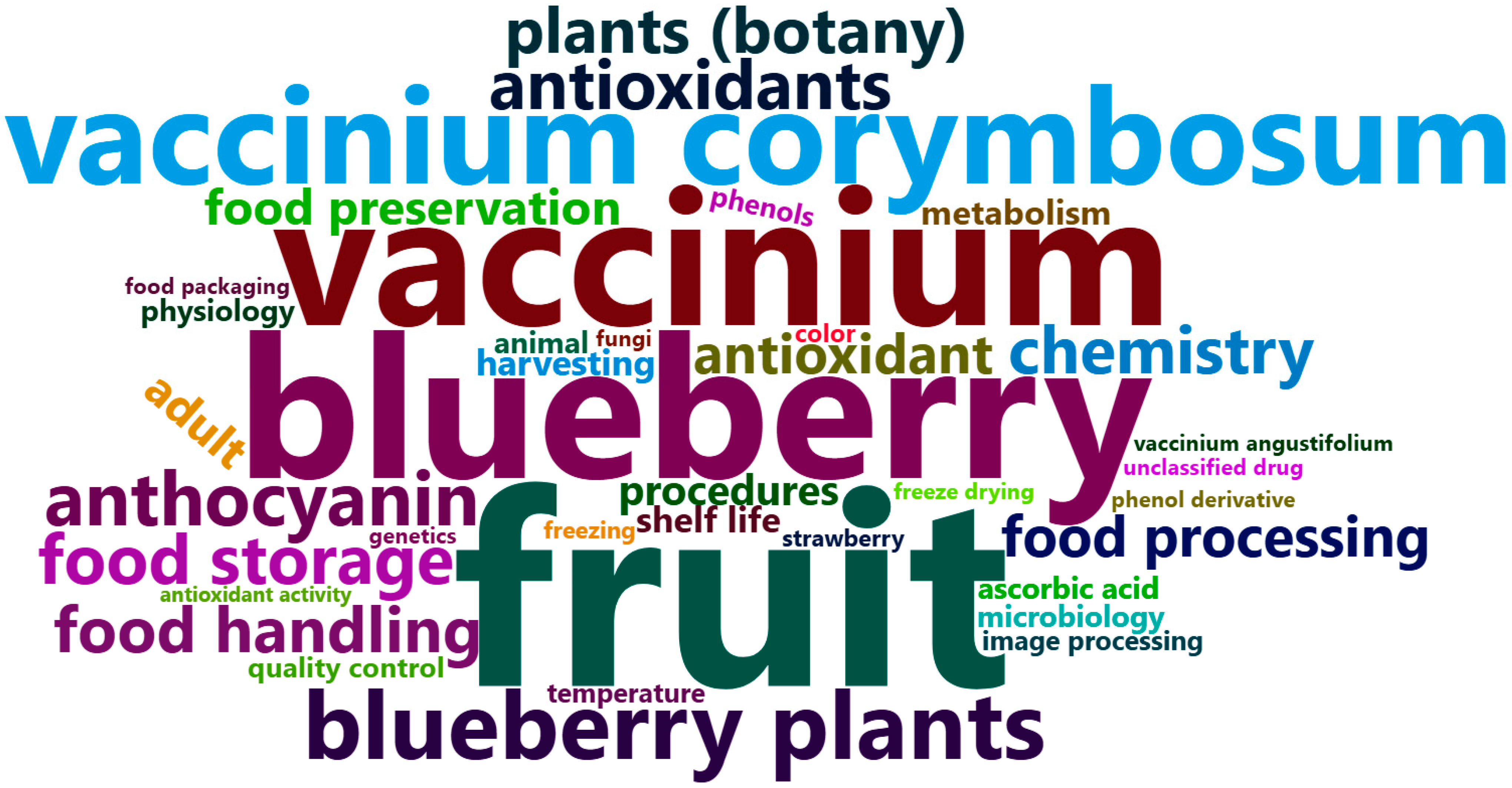
The co-occurrence analysis and keyword word cloud (Figure 11) reveal the predominant thematic and conceptual trends in the literature on blueberries (Vaccinium spp.). As expected, the terms “blueberry” (133 occurrences) and “vaccinium” (127) constitute the central anchors of the network, supported by highly connected terms such as “fruit” (181) and “vaccinium corymbosum” (90). This semantic core confirms the consolidation of the crop as a model system for studying functional foods, phytochemistry, and agro-industrial innovation. The prominent presence of terms such as “anthocyanin” (50), “antioxidants” (46), “antioxidant activity” (14), and “phenols” (19) reinforces the strong scientific focus on the bioactive compounds that define the nutraceutical value of the species [39,128,129]. Together, these elements depict a mature research field that integrates plant physiology, food chemistry, and biotechnology.
Figure 11.
Most frequently used keywords by authors.
Likewise, the network shows a robust line of research related to postharvest management and fruit quality, reflected in the high frequency of terms such as “food storage” (46), “food handling” (43), “food preservation” (33), “food processing” (38), and “shelf life” (24). These concepts highlight the emphasis placed on the stability of phenolic metabolites, as well as on the optimization of handling and processing strategies to maintain fruit quality during commercialization [128,130]. The appearance of terms such as “freezing” (16), “freeze drying” (15), and “food packaging” (15) underscores the relevance of technological interventions aimed at preserving antioxidant capacity in fresh and processed blueberries [131,132,133]. Additionally, descriptors such as “temperature” (18), “color” (17), and “quality control” (19) point to the importance of physicochemical monitoring across the supply chain, key considerations for industrial standardization, export competitiveness, and quality assurance [134,135,136].
Finally, the presence of biological and physiological descriptors such as “metabolism” (23), “microbiology” (20), “physiology” (20), “ascorbic acid” (20), and “animal” (20) reveals the growing integration between agricultural sciences, postharvest biology, and biomedicine. These links reflect the ongoing interest in understanding how blueberry-derived compounds influence metabolic pathways, oxidative responses, and cellular regulation in different biological models [137]. Such research has been instrumental in advancing evidence on the role of blueberries in mitigating oxidative stress, inflammation, neurodegeneration, and other chronic health conditions [138,139]. Overall, the co-occurrence analysis shows that the study of Vaccinium spp. has evolved from a primarily agronomic focus to a holistic and interdisciplinary domain that encompasses phytochemical complexity, processing technologies, and potential human health benefits.
3.15. Keyword Co-Occurrence Network
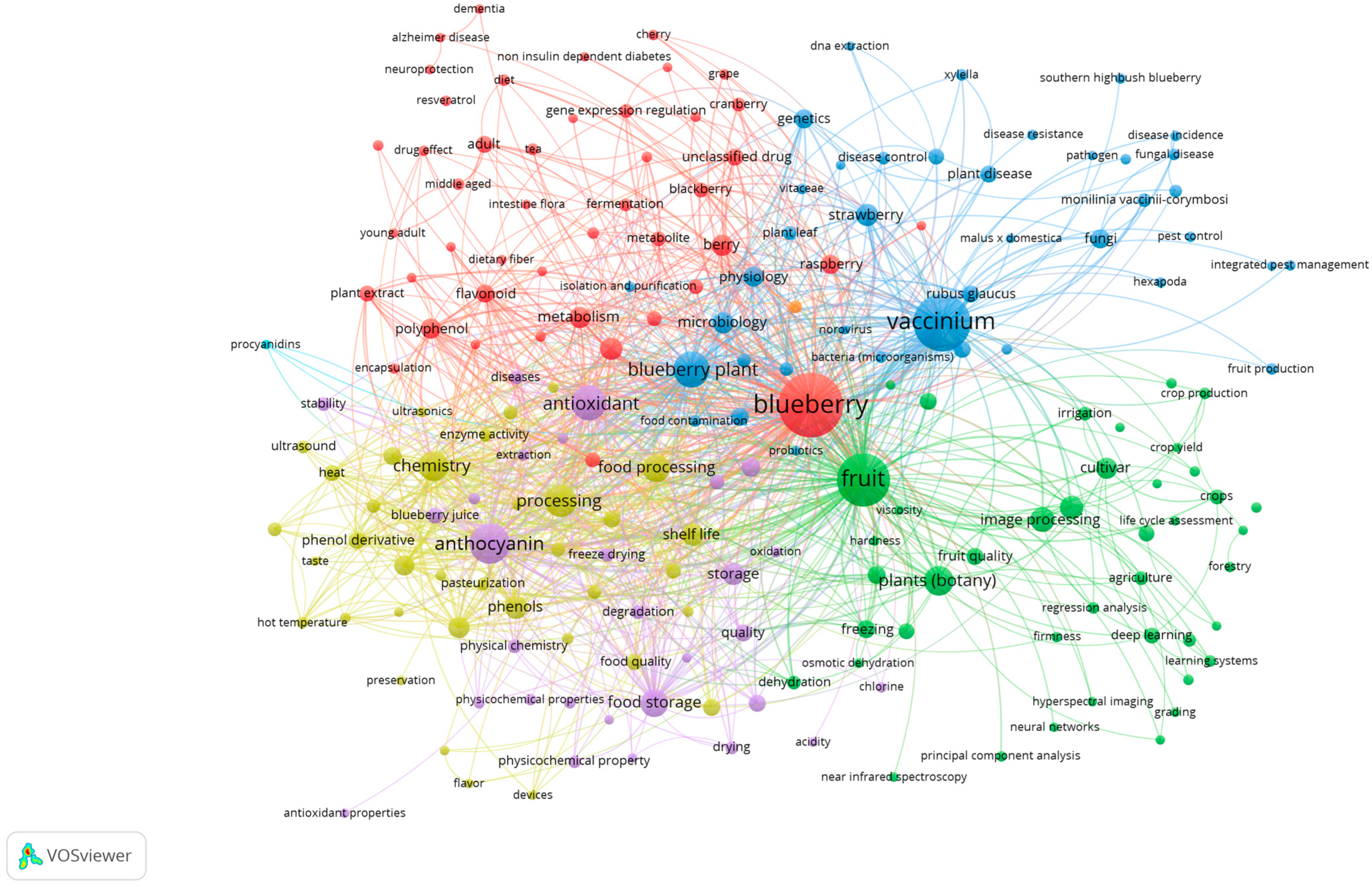
The keyword co-occurrence network (Figure 12) reveals a highly interconnected thematic structure centered on “blueberry,” “fruit,” and “Vaccinium.” After data cleaning and the removal of controlled vocabulary from Scopus indexation fields, the resulting map shows several dense clusters that collectively articulate the dominant research axes in blueberry science: nutritional and physiological studies, agronomy and production systems, food processing and chemistry, postharvest preservation, and plant health and phytopathology. The proximity among nodes reflects strong conceptual co-occurrence, illustrating how plant biology, agronomy, food chemistry, and human health have become increasingly integrated within the scientific community.
Figure 12.
Keyword co-occurrence network.
Red cluster—Nutrition, physiology, and chronic disease research: This cluster is organized around “blueberry,” “metabolism,” “antioxidant activity,” “microbiology,” “biological activity,” and terms related to metabolic and neurodegenerative conditions such as “Alzheimer disease,” “dementia,” or “non-insulin dependent diabetes.” This cluster encompasses the most consolidated body of research linking blueberry consumption, polyphenolic compounds, and physiological responses in humans. Studies in this domain investigate the effects of blueberry intake or phenolic extracts on oxidative stress, cognitive performance, gut microbiota, metabolic regulation, and biomarkers of chronic disease, particularly among older adults [125,140,141]. The co-occurrence of polyphenol, dietary fiber, flavonoid, and resveratrol indicates a strong focus on the biochemical pathways underlying neuroprotection, inflammation modulation, and metabolic homeostasis. Overall, the red cluster positions blueberries as a reference model in nutraceuticals and functional foods, integrating human physiology, phenolic chemistry, and experimental evidence on the prevention of chronic and neurodegenerative disorders.
Green cluster—Production systems, agronomy, and digital agriculture: The green cluster is dominated by the terms “fruit,” “plants (botany),” “cultivar,” “crop yield,” “irrigation,” “image processing,” “fruit quality,” “deep learning,” “neural networks,” and “hyperspectral imaging.” This group captures the agronomic and technological-productive dimension of blueberry research. On one side, the cluster includes concepts related to plant physiology, crop management, cultivar performance, and yield. On the other, it integrates advances in agricultural digitalization through computer vision, machine learning, and non-destructive optical sensing. These tools have been applied to fruit grading, color and texture characterization, maturity prediction, and automated disease detection [52,77,88]. The involvement of terms linked to quality evaluation, regression analysis, and multivariate modeling reflects the use of analytical frameworks to enhance quality control throughout the production chain [49,65,142]. Altogether, the green cluster illustrates the transition of blueberry cultivation toward precision agriculture, where sensor technologies, data analytics, and intelligent algorithms improve efficiency, productivity, and fruit quality.
Yellow cluster—Food processing, chemistry, and phenolic compounds: This cluster centers on “processing,” “chemistry,” “anthocyanin,” “phenols,” “phenol derivative,” “blueberry juice,” “enzyme activity,” “ultrasound,” and “encapsulation.” This group represents the core of food chemistry and food processing research. The co-occurrence patterns indicate strong interest in the extraction, stability, degradation kinetics, and functionality of anthocyanins and other phenolic compounds, as well as the influence of thermal and non-thermal processing techniques such as heating, pasteurization, ultrasonics, and microencapsulation on antioxidant retention [60,143,144]. Terms such as chemistry, enzyme activity, and phenol derivative underscore the role of biochemical transformations and matrix interactions during processing and product formulation [145,146,147]. In summary, the yellow cluster captures the physicochemical and technological foundation of blueberry research, focusing on how processing conditions modulate the preservation and bioavailability of functional compounds.
Purple cluster—Postharvest quality, physicochemical properties, and shelf life: The purple cluster is organized around “food storage,” “food quality,” “physicochemical property,” “drying,” “freezing,” “osmotic dehydration,” and “preservation.” This cluster encompasses studies dedicated to postharvest behavior and shelf-life extension of blueberries and blueberry-based products. Research within this group quantifies the effects of storage temperature, water activity, dehydration processes, freezing protocols, and controlled-environment conditions on texture, color, firmness, and other quality parameters. These studies have enabled the identification of optimal combinations of temperature, humidity, and time that minimize quality losses and maintain acceptable sensory and nutritional attributes throughout distribution and storage [148,149]. Thus, the purple cluster represents a methodological axis focused on physicochemical characterization and optimization of preservation strategies, crucial for the development of dehydrated ingredients, shelf-stable products, and value-added blueberry derivatives.
Blue cluster—Phytopathology, crop ecology, and plant health in Vaccinium: This cluster centers on “Vaccinium,” connected with “plant disease,” “fungi,” “Monilinia vaccinii-corymbosi,” “disease incidence,” “fungal disease,” “disease control,” “pest control,” “integrated pest management,” and species such as Rubus glaucus and Malus × domestica. This group corresponds to the phytopathological and ecological dimension of blueberry research [150,151]. Its co-occurrence structure highlights fungal diseases, pathogen ecology, epidemiology, and the development of control strategies that encompass both chemical and non-chemical approaches. The presence of terms like fruit production and crop production indicates that plant health is analyzed in relation to productivity and crop stability, integrating cultural practices, disease-resistant cultivars, fungicide use, and biological control within broader IPM frameworks [56,66,152,153,154]. This cluster provides the agronomic and phytosanitary foundation of the field, identifying major pathogens, quantifying their impact on yield and fruit quality, and proposing management approaches that improve resilience and sustainability in Vaccinium cropping systems.
Together, the five clusters illustrate how blueberry research has evolved from taxonomic, physiological, and phytosanitary foundations toward a multidimensional landscape that integrates plant biology, agronomy, food chemistry, human health, and industrial technology. The co-occurrence structure reflects the convergence of production, processing, functional properties, and chronic disease prevention, positioning Vaccinium spp. as a strategic model in the development of functional foods, high-efficiency production systems, and sustainable agro-industrial pipelines.
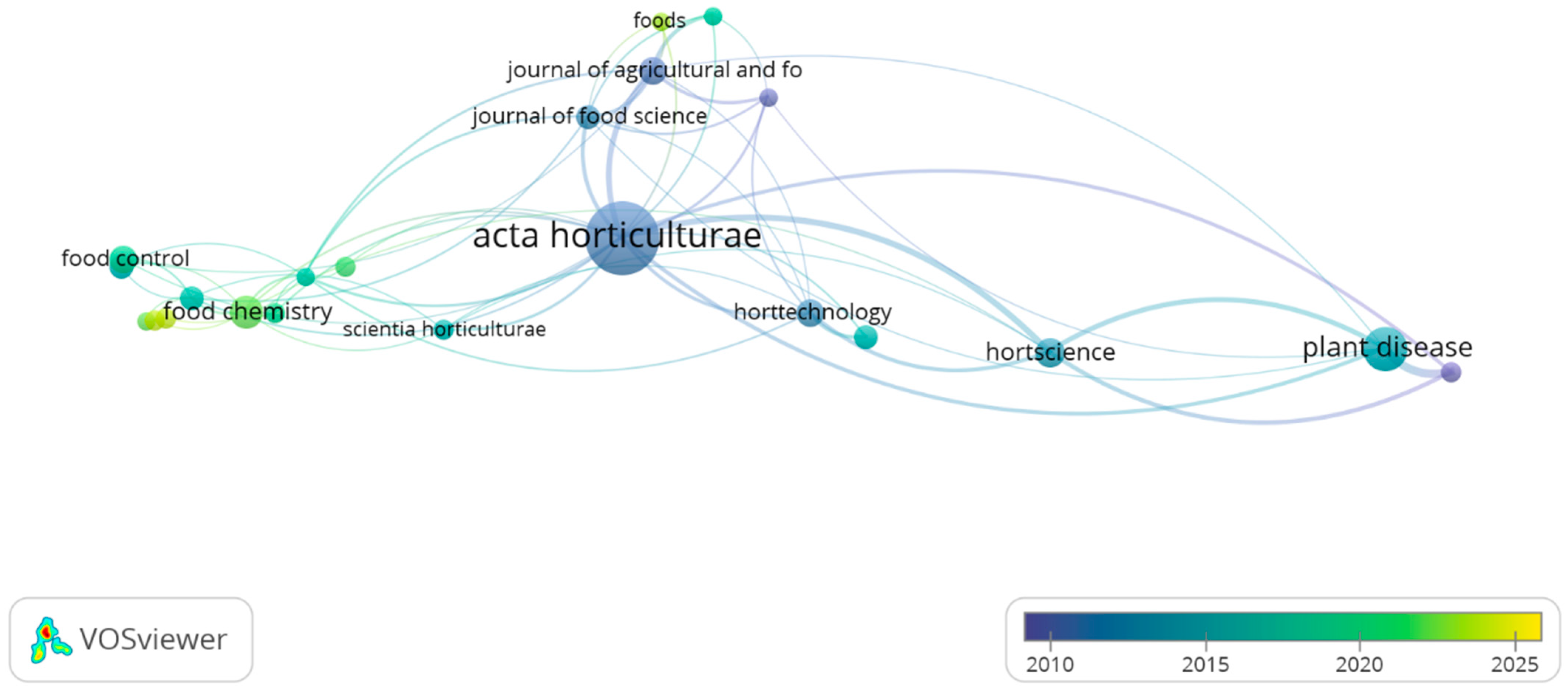
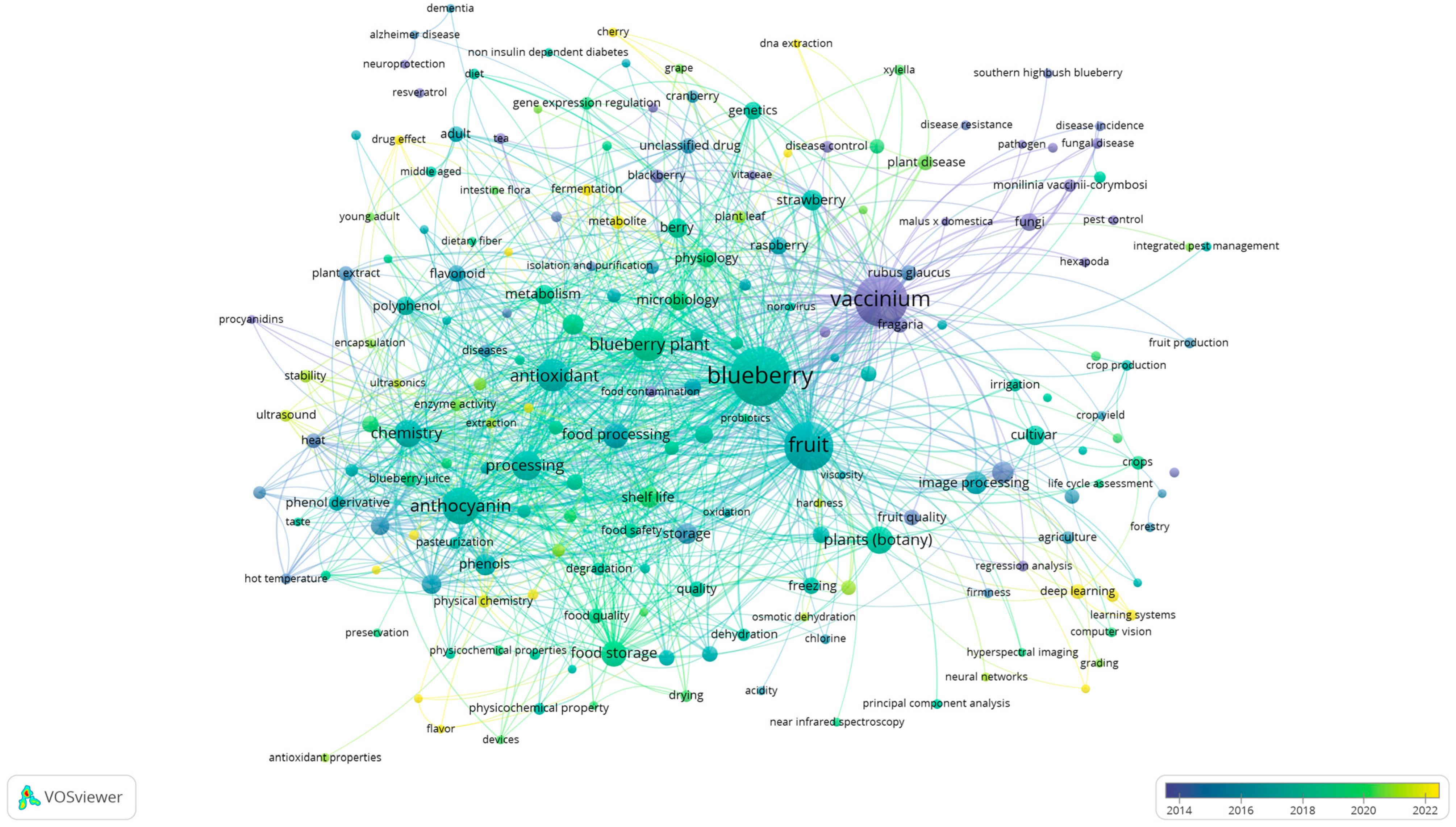
To complement this structural interpretation, the temporal evolution map of keywords (Figure 13) provides additional insight into how research priorities have shifted over the last decade. Early-period terms (2014), represented by darker nodes, are predominantly agronomic and phytopathological (plant disease, irrigation, cultivar, physiology), signaling an initial focus on crop performance and field management. Mid-period concepts (2016–2019) transition toward food chemistry and phytochemical analysis, including anthocyanin, phenols, antioxidant, and food processing, reflecting the consolidation of nutraceutical and postharvest research. More recent and emergent terms (>2022), shown in yellow-green nodes, include image processing, deep learning, computer vision, neural networks, and hyperspectral imaging, indicating a decisive shift toward AI-driven quality monitoring, non-destructive sensing, and sustainability-oriented data analytics. This temporal progression demonstrates a clear transition from descriptive biological inquiry to a technologically intensified, data-driven research paradigm within the global blueberry scientific landscape.
Figure 13.
Temporal evolution of keyword co-occurrence in blueberry (Vaccinium spp.).
3.16. Thematic Map Analysis
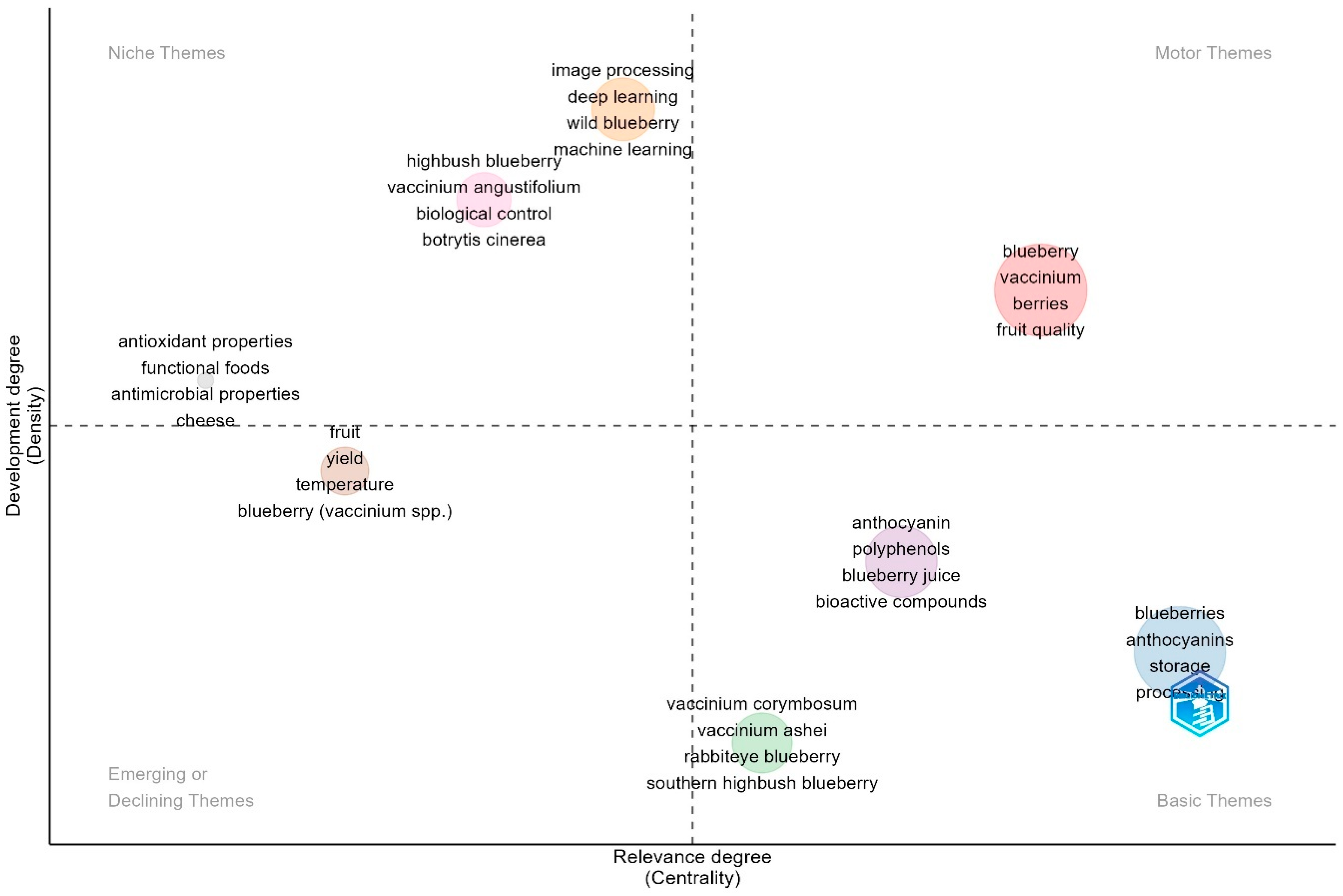
The analysis of thematic or strategic maps makes it possible to examine the evolution and dynamics of research clusters based on networks constructed through keyword co-occurrence [155]. This approach acts as an indicator of the concentration of studies around specific topics or categories, organized according to their centrality and density [156]. Consequently, the thematic map summarizes the structure and maturity of the literature into four well-defined typologies, as shown in Figure 14.
Figure 14.
Thematic map of the area of knowledge analyzed.
The quadrants divide topics into four categories: driving topics, core topics, emerging or declining topics, and specialized or niche topics. Taken together, the chart synthesizes the cognitive structure of the field, allowing knowledge gaps to be visualized and future research to be guided [42]. In the upper-right quadrant are the motor themes, represented by “blueberry,” “vaccinium,” “berries,” and “fruit quality.” These concepts are highly central and well developed, indicating that they constitute the consolidated core of scientific knowledge on the crop and fruit quality [111,157]. The literature in this quadrant focuses on fruit physiology, physicochemical characteristics, and commercial quality parameters. However, strong concentration on these topics suggests thematic saturation and the need to deepen research on sustainability, intelligent postharvest management, and responses to abiotic stresses, which are still underrepresented in this area.
In contrast, the lower-right quadrant groups the basic themes “anthocyanins,” “polyphenols,” “bioactive compounds,” and “blueberry juice,” which are essential for understanding the chemical composition and functional value of blueberry [135,158]. These themes exhibit high centrality but lower development, which makes them conceptual pillars still in expansion. Research in this group is oriented toward the characterization of antioxidant compounds and their implications for human health, although a gap remains in their biological validation and in the integration of metabolomic data with bioactivity studies.
The upper-left quadrant groups the niche themes, among which “image processing,” “deep learning,” “biological control,” and “machine learning” stand out. These topics emerge as highly specialized areas, with low connectivity to the rest of the network but high innovation potential. Their development suggests the incorporation of artificial intelligence and computer vision tools for assessing crop status and detecting diseases, marking a trend toward digitalization and precision agriculture [10,159]. However, their thematic isolation highlights the need to integrate these advances with traditional agronomic and physiological studies, so that they can contribute effectively to the comprehensive management of blueberry cultivation.
Finally, the lower left and center quadrants contain emerging or declining topics, such as “antioxidant properties,” “functional foods,” “temperature,” and “yield,” which, although relevant in the early stages, have lost prominence or are in the process of being redefined. This reflects a transition from descriptive studies to more technological and integrative approaches. Overall, the thematic map shows a field in consolidation, where the driving and basic themes are well structured, but the interconnection between biotechnological, physiological, and digital approaches still represents a key gap for future interdisciplinary research.
3.17. Detection of Knowledge Gaps and Future Research Trends Through Multiple Correspondence Analysis
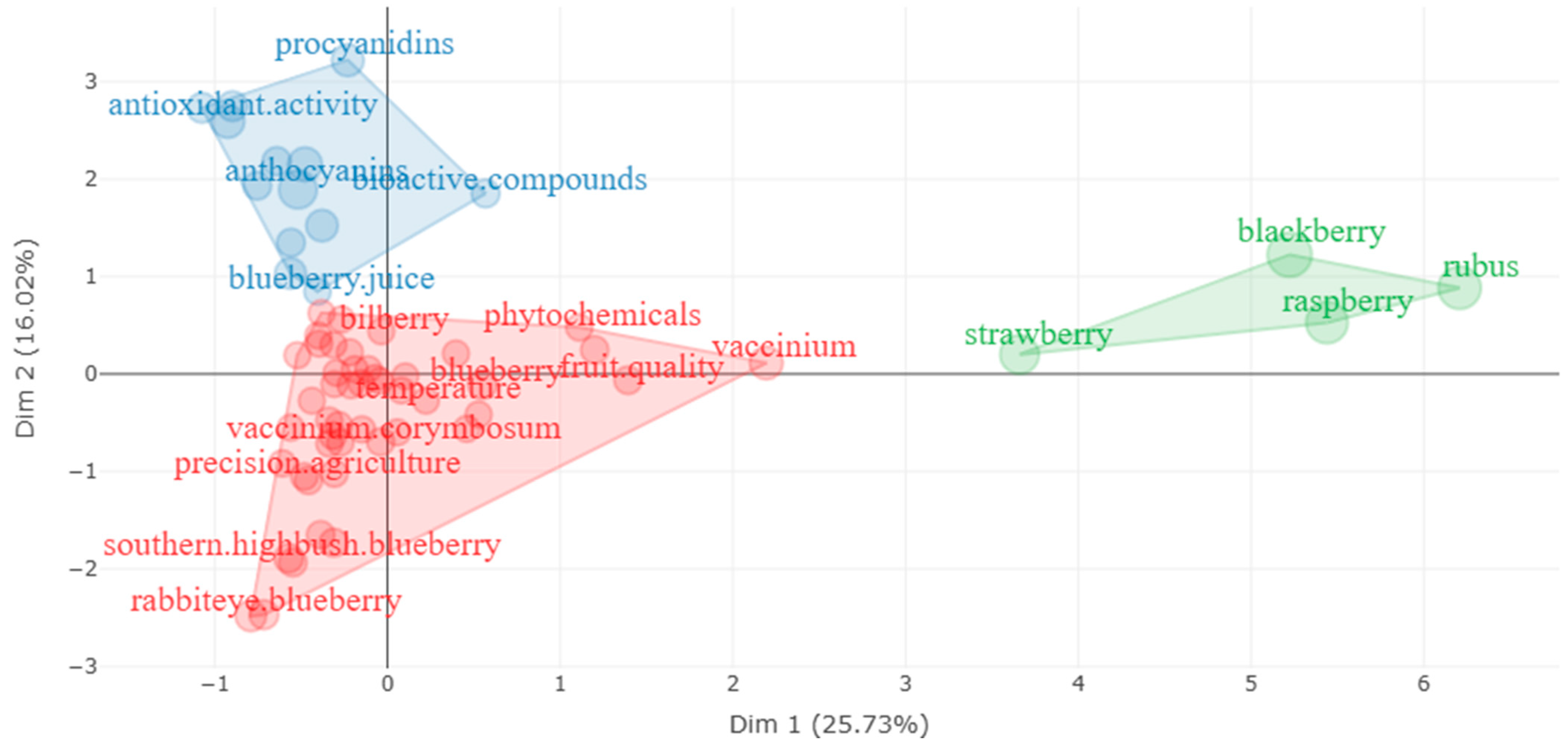
Analysis of the multiple correspondence graph (Figure 15) clearly shows the structural segmentation of scientific knowledge about the genus Vaccinium, where three conceptual nuclei are distributed along the factorial axes, explaining more than 40% of the total variability. Axis 1 (25.73%) separates agronomic and genetic studies, focused on cultivated species such as V. corymbosum, V. ashei, and V. virgatum, from those that explore the chemical and antioxidant properties of bioactive compounds. Axis 2 (16.29%), on the other hand, differentiates analytical and laboratory approaches from physiological and productive characterization work. This organization highlights a structural gap between plant biology and food science, that is, between understanding physiological processes and assessing the nutraceutical potential of the fruit. The lack of integration between physiology, genetics, and metabolomics studies limits the development of predictive models on how growing conditions, irrigation management, or post-harvest practices influence the concentration of anthocyanins, proanthocyanidins, and other phenols relevant to quality and human health.
Figure 15.
Multiple correspondence analysis of the analyzed knowledge area.
Complementarily, the map shows that wild or less-studied species such as V. virgatum and V. ashei occupy a peripheral position, which reflects knowledge gaps in the genetic and adaptive exploration of Vaccinium diversity. This limitation hinders the identification of genes and metabolic pathways associated with resistance to heat or water stress, a critical aspect in the context of climate change. In addition, research lines related to biological control, sensory quality, and the effect of soil microbiota appear weakly represented, indicating an epistemological fragmentation that hampers the development of sustainable and integrated agronomic management strategies. The scant interconnection between fruit physiology and advances in bioprocessing or nanotechnology applied to the preservation and valorization of bioactive compounds is also noteworthy, representing a strategic gap for industrial scaling.
Regarding emerging trends, the displacement of the blue group indicates an evolution toward the digitalization of blueberry research, with marked growth in the use of image processing, deep learning, and predictive modeling. These tools are beginning to be applied to disease detection, yield estimation, and fruit classification based on color, firmness, or phenolic content. Such convergence between artificial intelligence and phenomics points to sensor-based precision agriculture, in which hyperspectral vision systems, real-time data analysis, and agricultural robotics are integrated into crop management. In this regard, the development of correlation models between digital images, environmental variables, and metabolite concentration could transform quality assessment methods, reduce postharvest losses and strengthen traceability and sustainability across the production system.
Finally, the green group, linked to Rubus, Fragaria, and Sambucus, represents a line of interdisciplinary and intergeneric expansion that may redefine future research on berries. The semantic proximity between Vaccinium and these genera suggests a trend toward the comparison of biosynthetic pathways, antioxidant profiles, and ecological adaptation mechanisms, which will make it possible to identify shared genetic and metabolic markers. This opens the possibility for integrated breeding programs aimed at developing varieties with greater antioxidant stability, climate tolerance, and functional quality. In summary, the map evidences a paradigm shift: from fragmented and descriptive research toward a multidimensional, digital, and biotechnological approach, in which the interaction among physiology, genomics, artificial intelligence, and sustainability will shape the course of advanced research on Vaccinium and other berries over the next decade.
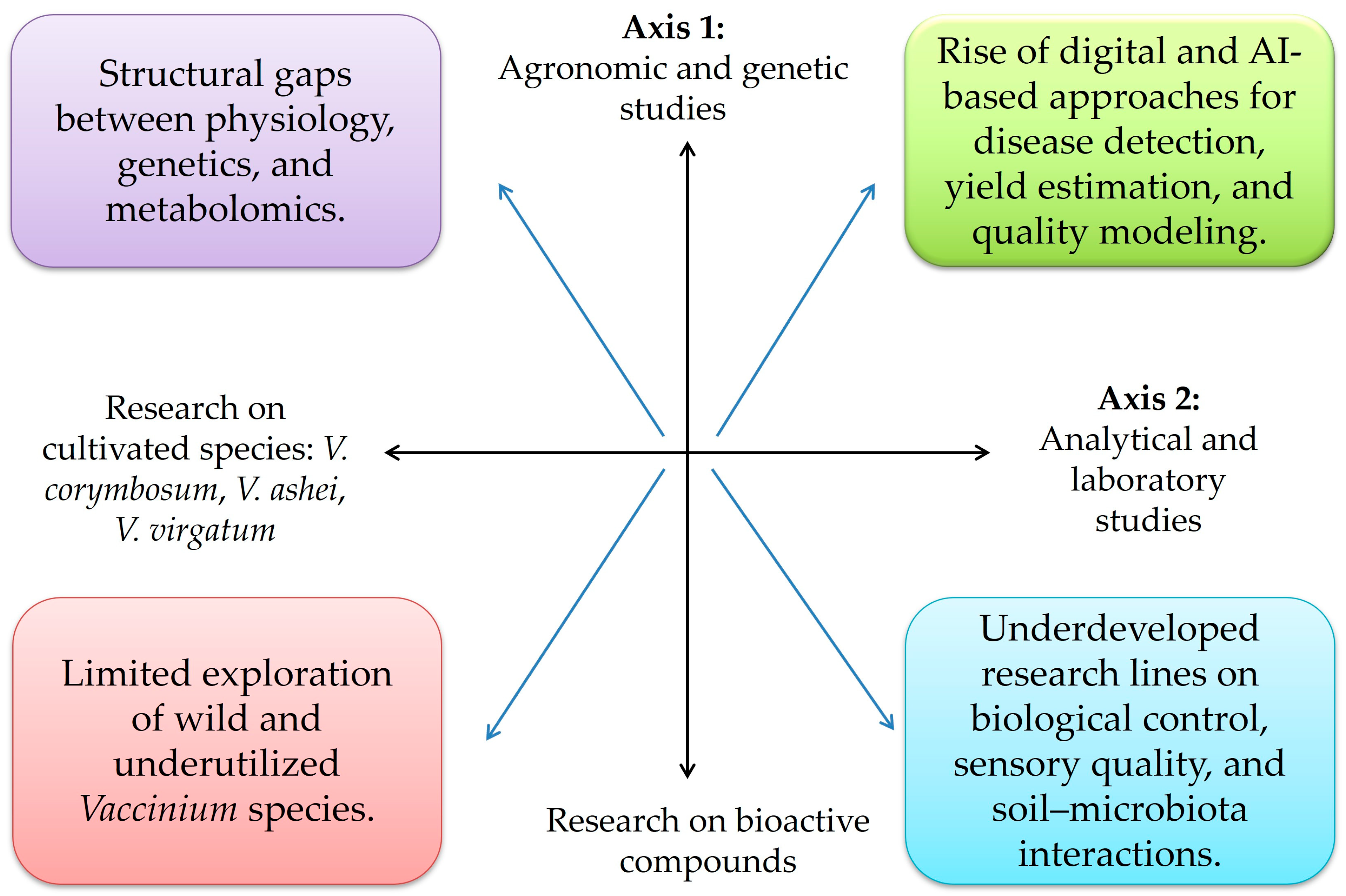
To provide a cohesive synthesis of the knowledge gaps and emerging trends identified in this section, Figure 16 presents an integrative framework that consolidates the key insights derived from the multiple correspondence analysis. This framework organizes the findings into four interconnected domains: (i) structural gaps between physiology, genetics, and metabolomics that hinder predictive modeling of bioactive compound profiles; (ii) limited exploration of wild and underutilized Vaccinium species, which constrains progress in breeding for climate resilience; (iii) weakly represented research lines on biological control, sensory quality, and soil–microbiota interactions, reflecting an unmet need for integrated and sustainable agronomic strategies; and (iv) the accelerating transition toward digital and AI-based approaches, including image processing, deep learning, and phenomics for disease detection, yield estimation, and postharvest quality modeling. By consolidating these dispersed elements into a unified visual framework, Figure 16 enhances interpretability and provides a structured foundation for guiding future research on Vaccinium spp.
Figure 16.
Integrative framework of knowledge gaps and emerging research trends in Vaccinium spp.
4. Limitations of the Study
As with any bibliometric study, the present analysis is constrained by its reliance on a single bibliographic database (Scopus). Although Scopus provides extensive multidisciplinary coverage, it may omit publications indexed exclusively in Web of Science, PubMed, AGRIS, or regional repositories, potentially leading to an underrepresentation of research from emerging scientific communities. In addition, variations in database indexing policies and metadata completeness may influence document retrieval, citation counts, or subject classifications, meaning that the results reflect the scientific landscape captured within Scopus rather than an exhaustive representation of all global blueberry research.
A second limitation arises from the inherent dependency on metadata quality. Inconsistencies in institutional affiliations, automated subject-area assignment, and database-specific author disambiguation may affect the accuracy of collaboration networks and productivity indicators. Similarly, citation-based metrics tend to favor older documents and may understate the early impact of recent advances in areas such as metabolomics, digital agriculture, machine learning, and advanced postharvest technologies. These structural characteristics of bibliometric data must therefore be considered when interpreting temporal trends or influence patterns.
To mitigate these limitations, rigorous data-cleaning procedures were implemented, including the removal of non-relevant indexing terms, manual verification of author clusters, and harmonization of institutional names. All analyses were performed using standardized bibliometric software (Bibliometrix/Biblioshiny and VOSviewer (v.1.6.20), ensuring reproducibility and methodological transparency. While the study acknowledges the intrinsic constraints of metadata-driven approaches, these methodological safeguards substantially reduced noise, improved cluster validity, and strengthened the reliability of the thematic and network structures reported.
5. Conclusions and Recommendations
Scientific research on blueberries (Vaccinium spp.) has evolved into a consolidated interdisciplinary domain that integrates plant physiology, food science, engineering, and biotechnology. The analysis of 474 publications over nearly four decades reveals a sustained and accelerating growth trajectory, supported by strong international collaboration networks and institutional leadership concentrated in the United States, China, and Canada. The thematic structure of the field organized into five well-defined clusters demonstrates a transition from agronomic foundations toward technologically enhanced approaches that incorporate bioactive compound analysis, postharvest modeling, and digital tools for crop monitoring and quality assessment.
Based on the evidence generated, several strategic research needs emerge. First, greater integration between agronomic research and multi-omics approaches (genomics, metabolomics, and phenomics) is required to elucidate metabolic pathways associated with fruit quality, stress tolerance, and postharvest behavior. Second, there is a need to advance predictive modeling of blueberry responses to climate change, particularly under temperature extremes, water stress, and shifting production areas. Third, the standardization of analytical protocols for phenolic and antioxidant quantification (ORAC, FRAP, DPPH) is essential to improve comparability and methodological reproducibility across laboratories. Additionally, the expansion of digital traceability systems and AI-based quality monitoring represents a crucial frontier for strengthening sustainability, transparency, and efficiency throughout the blueberry value chain.
As a final strategic recommendation, the establishment of a global institutional consortium would benefit from a more operational definition. Such a consortium should prioritize: (i) developing shared multi-omics and data-integration repositories to enhance interoperability, (ii) adopting harmonized analytical and phenotyping protocols, (iii) implementing unified digital traceability and image-based quality-evaluation tools, and (iv) promoting collaborative frameworks for modeling climate-response scenarios. Defining these concrete actions transforms the consortium from a conceptual proposal into a practical mechanism capable of accelerating methodological convergence, improving reproducibility, and strengthening the global coherence of Vaccinium research.
Taken together, these findings delineate a clear scientific agenda centered on methodological convergence, integrative analytical frameworks, and technology-driven innovation. Advancing these pillars will enhance global research consistency, support more resilient and knowledge-based production systems, and consolidate Vaccinium spp. as a model crop for interdisciplinary progress within contemporary agricultural and food sciences.
Author Contributions
Conceptualization, D.A.P., G.M.A., J.R. and E.V.; methodology, D.A.P., G.M.A., J.R. and E.V.; software, D.A.P., G.M.A., J.R. and E.V.; validation, D.A.P., G.M.A., J.R. and E.V.; formal analysis, D.A.P., G.M.A., J.R. and E.V.; investigation, D.A.P., G.M.A., J.R. and E.V.; resources, D.A.P., G.M.A., J.R. and E.V.; data curation, D.A.P., G.M.A., J.R. and E.V.; writing—original draft preparation, D.A.P., G.M.A., J.R. and E.V.; writing—review and editing, D.A.P., G.M.A., J.R. and E.V.; visualization, D.A.P., G.M.A., J.R. and E.V.; supervision, D.A.P., G.M.A., J.R. and E.V.; project administration, D.A.P., G.M.A., J.R. and E.V.; funding acquisition, E.V. All authors have read and agreed to the published version of the manuscript.
Funding
This research received no external funding.
Data Availability Statement
Not applicable.
Acknowledgments
This work is not associated with any research project; it forms part of an undergraduate thesis submitted to obtain the degree of Agricultural Management Engineer, entitled: “Bibliometric and Systematic Review of Trends, Challenges, and Opportunities in Blueberry (Vaccinium spp.) Production within Modern Agriculture for the Departments of Cundinamarca, Boyacá, and Antioquia.” Special thanks also go to Javier Quecho Mogollon, who served as a tutor at the Industrial University of Santander, Colombia.
Conflicts of Interest
Authors, Gina Amado, Jader Rodriguez and Edwin Villagran were employed by the company Corporación Colombiana de Investigación Agropecuaria. The remaining authors declare that the research was conducted in the absence of any commercial or financial relationships that could be construed as a potential conflict of interest.
References
- Bieniasz, M.E.; Konieczny, A.M. Opportunities to Improve Effectiveness of Pollination of Blueberry CV.‘Bluecrop’. Agriculture 2022, 12, 2126. [Google Scholar] [CrossRef]
- Zydlik, Z.; Pacholak, E.; Rutkowski, K.; STYŁA, K.; Zydlik, P. The Influence of a Mycorrhizal Vaccine on the Biochemical Properties of Soil in the Plantation of Blueberry. Zemdirbyste-Agriculture 2016, 103, 61–66. [Google Scholar] [CrossRef][Green Version]
- Prodorutti, D.; Pertot, I.; Giongo, L.; Gessler, C. Highbush Blueberry: Cultivation, Protection, Breeding and Biotechnology. Eur. J. Plant Sci. Biotechnol. 2007, 1, 44–56. [Google Scholar][Green Version]
- Fang, Y.; Nunez, G.H.; Silva, M.N.d.; Phillips, D.A.; Munoz, P.R. A Review for Southern Highbush Blueberry Alternative Production Systems. Agronomy 2020, 10, 1531. [Google Scholar] [CrossRef]
- Bañados, M.P. Expanding Blueberry Production into Non-Traditional Production Areas: Northern Chile and Argentina, Mexico and Spain. In Proceedings of the IX International Vaccinium Symposium 810, Corvallis, OR, USA, 4 March 2009; pp. 439–445. [Google Scholar]
- Finn, C.E.; Olmstead, J.W.; Hancock, J.F.; Brazelton, D.M. Welcome to the Party! Blueberry Breeding Mixes Private and Public with Traditional and Molecular to Create a Vibrant New Cocktail. In Proceedings of the X International Symposium on Vaccinium and Other Superfruits 1017, Maastricht, The Netherlands, 13 January 2014; pp. 51–62. [Google Scholar]
- Retamales, J.B.; Hancock, J.F. Blueberries; Cabi: Wallingford, UK, 2018; Volume 27, ISBN 1780647263. [Google Scholar]
- Porter Starr, K.N.; Connelly, M.A.; Wallis, J.; North, R.; Zhang, Q.; Song, K.; González-Delgado, J.M.; Brochu, H.N.; Icenhour, C.R.; Iyer, L.K. Effects of Blueberry Consumption on Fecal Microbiome Composition and Circulating Metabolites, Lipids, and Lipoproteins in a Randomized Controlled Trial of Older Adults with Overweight or Obesity: The BEACTIVE Trial. Nutrients 2025, 17, 1200. [Google Scholar] [CrossRef] [PubMed]
- Rowland, L.J.; Ogden, E.L.; Vinyard, B.T. Phenotypic Evaluation of a Hybrid Diploid Blueberry Population for Plant Development and Fruit Quality Traits. Agronomy 2020, 10, 1067. [Google Scholar] [CrossRef]
- Zhang, W.; Wang, K.; Chen, C. Artificial Neural Network Assisted Multiobjective Optimization of Postharvest Blanching and Drying of Blueberries. Foods 2022, 11, 3347. [Google Scholar] [CrossRef]
- Kalt, W.; Cassidy, A.; Howard, L.R.; Krikorian, R.; Stull, A.J.; Tremblay, F.; Zamora-Ros, R. Recent Research on the Health Benefits of Blueberries and Their Anthocyanins. Adv. Nutr. 2020, 11, 224–236. [Google Scholar] [CrossRef]
- Obedgiu, S. The Role of Biotechnology in Climate Change Adaptation and Postharvest Loss Mitigation in Blueberries. In Handbook of Nature-Based Solutions to Mitigation and Adaptation to Climate Change; Springer: Berlin/Heidelberg, Germany, 2025; pp. 1–38. [Google Scholar]
- Lopes, S.; Santos, R.; Wessel, D.; Brás, I.; Silva, M.E.; Ferreira, T.; Pereira, C. Mathematical Modeling of a Sustainable Dewatering Process for Blueberries and Raspberries Preservation. In International Conference on Energy and Environment Research; Springer: Berlin/Heidelberg, Germany, 2023; pp. 139–151. [Google Scholar]
- Snyder, H. Literature Review as a Research Methodology: An Overview and Guidelines. J. Bus. Res. 2019, 104, 333–339. [Google Scholar] [CrossRef]
- Ozturk, O. Bibliometric Review of Resource Dependence Theory Literature: An Overview. Manag. Rev. Q. 2021, 71, 525–552. [Google Scholar] [CrossRef]
- Linnenluecke, M.K.; Marrone, M.; Singh, A.K. Conducting Systematic Literature Reviews and Bibliometric Analyses. Aust. J. Manag. 2020, 45, 175–194. [Google Scholar] [CrossRef]
- Montalván-Burbano, N.; Pérez-Valls, M.; Plaza-Úbeda, J. Analysis of Scientific Production on Organizational Innovation. Cogent Bus. Manag. 2020, 7, 1745043. [Google Scholar] [CrossRef]
- Rocha, G.A.O.; Pichimata, M.A.; Villagran, E. Research on the Microclimate of Protected Agriculture Structures Using Numerical Simulation Tools: A Technical and Bibliometric Analysis as a Contribution to the Sustainability of Under-Cover Cropping in Tropical and Subtropical Countries. Sustainability 2021, 13, 10433. [Google Scholar] [CrossRef]
- Villagrán, E.; Romero-Perdomo, F.; Numa-Vergel, S.; Galindo-Pacheco, J.R.; Salinas-Velandia, D.A. Life Cycle Assessment in Protected Agriculture: Where Are We Now, and Where Should We Go Next? Horticulturae 2023, 10, 15. [Google Scholar] [CrossRef]
- Yuan, B.-Z.; Sun, J. Bibliometric Analysis of Blueberry (Vaccinium corymbosum L.) Research Publications Based on Web of Science. Food Sci. Technol. 2021, 42, e96321. [Google Scholar] [CrossRef]
- Zakaria, R.; Vit, P.; Wijaya, A.; Ahmad, A.H.; Othman, Z.; Mezzetti, B. Evolution of Blueberry (Vaccinium corymbosum L.), Raspberry (Rubus idaeus L.) and Strawberry (Fragaria x Ananassa Duch.) Research: 2012–2021. J. Berry Res. 2022, 12, 365–381. [Google Scholar] [CrossRef]
- Haruna, E.U.; Asiedu, W.K.; Bello, L.O. Mapping the Knowledge Domain of Natural Capital and Sustainability: A Bibliometric Analysis Using the Scopus Database for Future Research Direction. Dev. Sustain. Econ. Financ. 2025, 5, 100035. [Google Scholar] [CrossRef]
- Santillan-Angeles, A.; Mendoza-Perez, C.; Villagrán, E.; Garcia, F.; Flores-Velazquez, J. Bibliometric Analysis of Hydrothermal Wastewater Treatment in the Last Two Decades. Water 2025, 17, 746. [Google Scholar] [CrossRef]
- Manley, K.; Nyelele, C.; Egoh, B.N. A Review of Machine Learning and Big Data Applications in Addressing Ecosystem Service Research Gaps. Ecosyst. Serv. 2022, 57, 101478. [Google Scholar] [CrossRef]
- Villagran, E.; Espitia, J.J.; Velázquez, F.A.; Rodriguez, J. Solar Dryers: Technical Insights and Bibliometric Trends in Energy Technologies. AgriEngineering 2024, 6, 4041–4063. [Google Scholar] [CrossRef]
- Espitia, J.J.; Velázquez, F.A.; Rodriguez, J.; Gomez, L.; Baeza, E.; Aguilar-Rodríguez, C.E.; Flores-Velazquez, J.; Villagran, E. Solar Energy Applications in Protected Agriculture: A Technical and Bibliometric Review of Greenhouse Systems and Solar Technologies. Agronomy 2024, 14, 2791. [Google Scholar] [CrossRef]
- Herrera-Franco, G.; Montalván-Burbano, N.; Carrión-Mero, P.; Bravo-Montero, L. Worldwide Research on Socio-Hydrology: A Bibliometric Analysis. Water 2021, 13, 1283. [Google Scholar] [CrossRef]
- Aria, M.; Cuccurullo, C. Bibliometrix: An R-Tool for Comprehensive Science Mapping Analysis. J. Informetr. 2017, 11, 959–975. [Google Scholar] [CrossRef]
- Donthu, N.; Kumar, S.; Mukherjee, D.; Pandey, N.; Lim, W.M. How to Conduct a Bibliometric Analysis: An Overview and Guidelines. J. Bus. Res. 2021, 133, 285–296. [Google Scholar] [CrossRef]
- Nickerson, N.L.; MacNeill, B.H. Studies on the Spread of Red Leaf Disease, Caused by Exobasidium Vaccinii, in Lowbush Blueberries. Can. J. Plant Pathol. 1987, 9, 307–310. [Google Scholar] [CrossRef]
- Tamada, T. Blueberry Culture and Research in Japan. J. Small Fruit Vitic. 1996, 3, 227–241. [Google Scholar] [CrossRef]
- Stretch, A.W.; Ehlenfeldt, M.K.; Brewster, V.; Vorsa, N.; Polashock, J. Resistance of Diploid Vaccinium Spp. to the Fruit Rot Stage of Mummy Berry Disease. Plant Dis. 2001, 85, 27–30. [Google Scholar] [CrossRef]
- Starrett, M.C. Initial Shoot Growth and Development of Micropropagated Blueberry Plants Following Inoculation with an Ericoid Mycorrhizal Isolate. In Proceedings of the XXVI International Horticultural Congress: Berry Crop Breeding, Production and Utilization for a New Century 626, Toronto, ON, Canada, 1 November 2003; pp. 191–197. [Google Scholar]
- Mounika, A.; Ilangovan, B.; Mandal, S.; Yashwant, W.S.; Gali, S.P.; Shanmugam, A. Prospects of Ultrasonically Extracted Food Bioactives in the Field of Non-Invasive Biomedical Applications—A Review. Ultrason. Sonochem 2022, 89, 106121. [Google Scholar] [CrossRef] [PubMed]
- Blanchet, R.; Willows, N.; Johnson, S.; Salmon Reintroduction Initiatives, O.N.; Batal, M. Traditional Food, Health, and Diet Quality in Syilx Okanagan Adults in British Columbia, Canada. Nutrients 2020, 12, 927. [Google Scholar] [CrossRef] [PubMed]
- Zaman, Q.U.; Schumann, A.W.; Percival, D.C.; Gordon, R.J. Estimation of Wild Blueberry Fruit Yield Using Digital Color Photography. Trans. ASABE 2008, 51, 1539–1544. [Google Scholar] [CrossRef]
- Mari, A.; Kekes, T.; Boukouvalas, C.; Krokida, M. Integrating Life Cycle Assessment in Innovative Berry Processing with Edible Coating and Osmotic Dehydration. Foods 2025, 14, 1167. [Google Scholar] [CrossRef]
- Allan-Wojtas, P.; Goff, H.D.; Stark, R.; Carbyn, S. The Effect of Freezing Method and Frozen Storage Conditions on the Microstructure of Wild Blueberries as Observed by Cold-stage Scanning Electron Microscopy. Scanning 1999, 21, 334–347. [Google Scholar] [CrossRef]
- Rashwan, A.K.; Osman, A.I.; Karim, N.; Mo, J.; Chen, W. Unveiling the Mechanisms of the Development of Blueberries-Based Functional Foods: An Updated and Comprehensive Review. Food Rev. Int. 2024, 40, 1913–1940. [Google Scholar] [CrossRef]
- Cai, Z.; Wang, L.; Zhang, Q.; Yang, W.; Zhang, C.; Wang, H.; Xiao, H. Eco-Friendly Coating Engineered with Antimicrobial Lipopeptides Maintains Freshness and Induces Genes Expression in Anthocyanin Biosynthesis of Blueberry. Int. J. Biol. Macromol. 2025, 306, 141590. [Google Scholar] [CrossRef] [PubMed]
- Rocha, G.A.O.; Medina, A.N.C.; Arias, L.G.; Caita, J.F.A.; Villagran, E. Análisis Sobre La Actividad Científica Referente a Las Estrategias de Climatización Pasiva Usada En Invernaderos: Parte 1: Análisis Bibliométrico. Cienc. Lat. Rev. Científica Multidiscip. 2022, 6, 4596–4623. [Google Scholar]
- Villagran, E.; Espitia, J.J.; Rodriguez, J.; Gomez, L.; Amado, G.; Baeza, E.; Aguilar-Rodríguez, C.E.; Flores-Velazquez, J.; Akrami, M.; Gil, R. Use of Lighting Technology in Controlled and Semi-Controlled Agriculture in Greenhouses and Protected Agriculture Systems—Part 1: Scientific and Bibliometric Analysis. Sustainability 2025, 17, 1712. [Google Scholar] [CrossRef]
- Rocha, G.A.O.; Medina, A.N.C.; Arias, L.G.; Caita, J.F.A.; Villagran, E. Análisis Sobre La Actividad Científica Referente a Las Estrategias de Climatización Pasiva Usada En Invernaderos: Parte 2: Análisis Técnico. Cienc. Lat. Rev. Científica Multidiscip. 2022, 6, 2220–2245. [Google Scholar]
- da Costa, N.L.; de Lima, M.D. A Methodological Framework for Wine and Grape Authenticity: Combining Bibliometrics and Text Mining. Qual. Quant. 2025, 1–26. [Google Scholar] [CrossRef]
- dos Santos, U.J.; Rocha, A.; dos Santos, A.E.O.; Guimarães, G.H.C.; Florêncio, R.R. Post-Harvest Fruit Quality: A Bibliometric Analysis. Res. Soc. Dev. 2025, 14, e1314348405. [Google Scholar] [CrossRef]
- Couture, A.; Gaudreau, L.; Van Sterthem, A.; Gosselin, A.; Dubé, Y.; Nguyen, T.T.A.; Brégard, A.; Dorais, M. How Can High Tunnel Coverings and an Insect-Proof Barrier Improve Productivity and Pest Management in Berry Crops? In Proceedings of the IV International Symposium on Organic Greenhouse Horticulture 1428, Cancun, Mexico, 16 May 2025; pp. 101–108. [Google Scholar]
- Song, Z.; Xu, B.; Kang, S.; Dai, H.; Zhou, X.; Li, M.; Luo, M.; Ji, S.; Zhou, Q. Calcium Chloride Treatment Delayed the Softening of Postharvest Blueberries by Regulating ABA Biosynthesis and Signal Transduction. Sci. Hortic. 2025, 339, 113879. [Google Scholar] [CrossRef]
- Ngoc, N.P.; Thao, P.T.P. Yield-Limiting Nutrient Response of Lowbush Blueberry Grown in Recent and Ancient Alluvial Soils of the Mekong Delta. PeerJ 2024, 12, e17992. [Google Scholar] [CrossRef]
- Wang, D.; Zhang, M.; Mujumdar, A.S.; Yu, D. Advanced Detection Techniques Using Artificial Intelligence in Processing of Berries. Food Eng. Rev. 2022, 14, 176–199. [Google Scholar] [CrossRef]
- Bracamonte, D.; Chang, A.; Vinces, L.; Oliden, J. A Blueberry Classification Algorithm Using Convolutional Neural Networks Developed in Python and a Raspberry Pi 4. In Proceedings of the 2022 Congreso Internacional de Innovación y Tendencias en Ingeniería (CONIITI), Bogota, Colombia, 5–7 October 2022; IEEE: Piscataway, NJ, USA, 2022; pp. 1–5. [Google Scholar]
- Tianyi, Z.; Fengzhi, D. A Review of Machine Vision Based Fruit Recognition Applications. In Proceedings of the International Conference on Artificial Life Science and Technology, Oita, Japan, 20–23 January 2022; Volume 27, pp. 827–830. [Google Scholar]
- Majid, A.; Khan, M.A.; Alhaisoni, M.; Tariq, U.; Hussain, N.; Nam, Y.; Kadry, S. An Integrated Deep Learning Framework for Fruits Diseases Classification. Comput. Mater. Contin. 2022, 71, 1387–1402. [Google Scholar] [CrossRef]
- Huang, Y.; Wang, D.; Liu, Y.; Zhou, H.; Sun, Y. Measurement of Early Disease Blueberries Based on Vis/Nir Hyperspectral Imaging System. Sensors 2020, 20, 5783. [Google Scholar] [CrossRef]
- Sheikh, M.H.; Mim, T.T.; Reza, M.S.; Hena, M.H. Leaf Diseases Detection for Commercial Cultivation of Obsolete Fruit in Bangladesh Using Image Processing System. In Proceedings of the 2019 8th International Conference System Modeling and Advancement in Research Trends (SMART), Moradabad, India, 22–23 November 2019; IEEE: Piscataway, NJ, USA, 2019; pp. 271–275. [Google Scholar]
- Zhai, Y.; Liang, Z.; Zhang, L.; Xu, S.; Huang, C.; Zhou, X.; Li, M.; Huang, Y. Machine Learning Based Blueberry Detection Method by CIE-YOLOv5. In Proceedings of the International Conference on Computer Graphics, Artificial Intelligence, and Data Processing (ICCAID 2023), Qingdao, China, 1–3 December 2023; SPIE: Bellingham, WA, USA, 2024; Volume 13105, pp. 462–467. [Google Scholar]
- Pérez, R.; Laca, A.; Laca, A.; Díaz, M. Environmental Behaviour of Blueberry Production at Small-Scale in Northern Spain and Improvement Opportunities. J. Clean. Prod. 2022, 339, 130594. [Google Scholar] [CrossRef]
- Waterhouse, G.I.N.; Sun-Waterhouse, D.; Su, G.; Zhao, H.; Zhao, M. Spray-Drying of Antioxidant-Rich Blueberry Waste Extracts; Interplay between Waste Pretreatments and Spray-Drying Process. Food Bioprocess Technol. 2017, 10, 1074–1092. [Google Scholar] [CrossRef]
- Wang, W.; Zhang, W.; Li, L.; Deng, W.; Liu, M.; Hu, J. Biodegradable Starch-Based Packaging Films Incorporated with Polyurethane-Encapsulated Essential-Oil Microcapsules for Sustained Food Preservation. Int. J. Biol. Macromol. 2023, 235, 123889. [Google Scholar] [CrossRef]
- Zheng, Z.; Chen, J.; Tian, W.; Zhang, C.; An, Z. Finite Element Analysis of Blueberry Stack Damage. J. Food Process Eng. 2021, 44, e13840. [Google Scholar] [CrossRef]
- Kaushalya, K.G.D.; Rupasinghe, H.P.V. Microencapsulation of Fermented Wild Blueberry to Improve the Stability of (Poly) Phenols. Appl. Food Res. 2025, 5, 100764. [Google Scholar] [CrossRef]
- Cassi, L.; Champeimont, R.; Mescheba, W.; De Turckheim, E. Analysing Institutions Interdisciplinarity by Extensive Use of Rao-Stirling Diversity Index. PLoS ONE 2017, 12, e0170296. [Google Scholar] [CrossRef] [PubMed]
- Heller, C.R.; Nunez, G.H. Preplant Fertilization Increases Substrate Microbial Respiration but Does Not Affect Southern Highbush Blueberry Establishment in a Coconut Coir-Based Substrate. HortScience 2022, 57, 17–21. [Google Scholar] [CrossRef]
- Lehman, J.S.; Oudemans, P. V Phenology of Apothecium Production in Populations of Monilinia Vaccinii-Corymbosi from Early-and Late-Maturing Blueberry Cultivars. Phytopathology 1997, 87, 218–223. [Google Scholar] [CrossRef] [PubMed]
- Renquist, S. An Evaluation of Blueberry Cultivars Grown in Plastic Tunnels in Douglas County, Oregon. Int. J. Fruit Sci. 2005, 5, 31–38. [Google Scholar] [CrossRef]
- Chang, Y.K.; Zaman, Q.; Farooque, A.A.; Schumann, A.W.; Percival, D.C. An Automated Yield Monitoring System II for Commercial Wild Blueberry Double-Head Harvester. Comput. Electron. Agric. 2012, 81, 97–103. [Google Scholar] [CrossRef]
- Shen, X.; Sheng, L.; Benedict, C.; Kruger, C.E.; Su, Y.; Schacht, E.; Zhang, Y.; Zhu, M.-J. Evaluation of Pre-Harvest Microbiological Safety of Blueberry Production with or without Manure-Derived Fertilizer. Front. Microbiol. 2020, 10, 3130. [Google Scholar] [CrossRef]
- Bin, L.I.; Yiwen, B.A.O.; Jiaxin, L.I.; Wanqi, H.; Yahua, X.; Xu, S.I.; Liang, W.; Ying, H.E. Comprehensive Utilization of Blueberry Processing By-Product Resources and Development Trend of New Business Forms. J. Food Sci. Technol. 2024, 42, 1–10. [Google Scholar]
- Hicklenton, P.; Forney, C.; Domytrak, C. Use of Row Covers and Post Harvest Storage Techniques to Alter Maturity and Marketing Period for Highbush Blueberries. In Proceedings of the XXVI International Horticultural Congress: Berry Crop Breeding, Production and Utilization for a New Century 626, Toronto, ON, Canada, 1 November 2003; pp. 287–295. [Google Scholar]
- Butot, S.; Cantergiani, F.; Moser, M.; Jean, J.; Lima, A.; Michot, L.; Putallaz, T.; Stroheker, T.; Zuber, S. UV-C Inactivation of Foodborne Bacterial and Viral Pathogens and Surrogates on Fresh and Frozen Berries. Int. J. Food Microbiol. 2018, 275, 8–16. [Google Scholar] [CrossRef]
- Retamal-Salgado, J.; Bastías, R.M.; Wilckens, R.; Paulino, L. Influence of Microclimatic Conditions under High Tunnels on the Physiological and Productive Responses in Blueberry’O’Neal’. Chil. J. Agric. Res. 2015, 75, 291–297. [Google Scholar] [CrossRef]
- Max, J.F.J.; Horst, W.J.; Mutwiwa, U.N.; Tantau, H.J. Effects of Greenhouse Cooling Method on Growth, Fruit Yield and Quality of Tomato (Solanum lycopersicum L.) in a Tropical Climate. Sci. Hortic. 2009, 122, 179–186. [Google Scholar] [CrossRef]
- Stückrath, R.; Quevedo, R.; de la Fuente, L.; Hernández, A.; Sepúlveda, V. Effect of Foliar Application of Calcium on the Quality of Blueberry Fruits. J. Plant Nutr. 2008, 31, 1299–1312. [Google Scholar] [CrossRef]
- Calderón-Orellana, A.; Hermosilla, N.; Bastías, R.M. Impact of the Covering Material on Drought Tolerance Responses and Soil Water Content in Two Cultivars of Young Blueberry Plants under Protected Cultivation. Water 2023, 15, 2326. [Google Scholar] [CrossRef]
- Viencz, T.; Santana, K.; Ayub, R.A.; Botelho, R.V. Development, Photosynthesis and Yield of Blueberry Cultivar ‘Climax’Growth with Different Substrates and Nitrogen Fertilization under Protected Cultivation. Cienc. Rural 2021, 51, e20190367. [Google Scholar] [CrossRef]
- Marucci, R.C.; Ruber, S.E.; Pec, M.; Liburd, O.E. Are Predatory Mites Effective as Biological Control Agents to Suppress Oligonychus Ilicis (Acari: Tetranychidae) in Blueberry Plantings? J. Econ. Entomol. 2024, 117, 834–842. [Google Scholar] [CrossRef]
- Obregón Domínguez, J.A.; Medina, C.A.M.; Barraza, G. Artificial Neural Networks in the Retention of Anthocyanins and Total Phenolics in the Osmotic Pre-Treatment of Biloxi Variety Blueberry (Vaccinium corymbosum L.) Jam. Rev. Fac. Nac. Agron. Medellín 2024, 77, 10877–10885. [Google Scholar] [CrossRef]
- Sullca, C.; Molina, C.; Rodríguez, C.; Fernández, T. Diseases Detection in Blueberry Leaves Using Computer Vision and Machine Learning Techniques. Int. J. Mach. Learn. Comput. 2019, 9, 656–661. [Google Scholar] [CrossRef]
- Cerrato, A.; Piovesana, S.; Aita, S.E.; Cavaliere, C.; Felletti, S.; Laganà, A.; Montone, C.M.; Vargas-de-la-Cruz, C.; Capriotti, A.L. Detailed Investigation of the Composition and Transformations of Phenolic Compounds in Fresh and Fermented Vaccinium Floribundum Berry Extracts by High-resolution Mass Spectrometry and Bioinformatics. Phytochem. Anal. 2022, 33, 507–516. [Google Scholar] [CrossRef] [PubMed]
- Calabuig-Jiménez, L.; Hinestroza-Córdoba, L.I.; Barrera, C.; Seguí, L.; Betoret, N. Effects of Processing and Storage Conditions on Functional Properties of Powdered Blueberry Pomace. Sustainability 2022, 14, 1839. [Google Scholar] [CrossRef]
- Cardeñosa, V.; Girones-Vilaplana, A.; Muriel, J.L.; Moreno, D.A.; Moreno-Rojas, J.M. Influence of Genotype, Cultivation System and Irrigation Regime on Antioxidant Capacity and Selected Phenolics of Blueberries (Vaccinium corymbosum L.). Food Chem. 2016, 202, 276–283. [Google Scholar] [CrossRef]
- Girgenti, V.; Peano, C.; Bounous, M.; Baudino, C. A Life Cycle Assessment of Non-Renewable Energy Use and Greenhouse Gas Emissions Associated with Blueberry and Raspberry Production in Northern Italy. Sci. Total Environ. 2013, 458, 414–418. [Google Scholar] [CrossRef]
- Barba, F.J.; Jäger, H.; Meneses, N.; Esteve, M.J.; Frígola, A.; Knorr, D. Evaluation of Quality Changes of Blueberry Juice during Refrigerated Storage after High-Pressure and Pulsed Electric Fields Processing. Innov. Food Sci. Emerg. Technol. 2012, 14, 18–24. [Google Scholar] [CrossRef]
- Vilela, A.; Gonçalves, B.; Ribeiro, C.; Fonseca, A.T.; Correia, S.; Fernandes, H.; Ferreira, S.; Bacelar, E.; Silva, A.P. Study of Textural, Chemical, Color and Sensory Properties of Organic Blueberries Harvested in Two Distinct Years: A Chemometric Approach. J. Texture Stud. 2016, 47, 199–207. [Google Scholar] [CrossRef]
- Ozeki, M.; Tamada, T. The Potentials of Forcing Culture of Southern Highbush Blueberry in Japan. In Proceedings of the VIII International Symposium on Vaccinium Culture 715, Sevilla, Spain, 31 August 2006; pp. 241–246. [Google Scholar]
- Takahashi, S.; Che, J.; Horiuchi, N.; Cho, H.Y.; Onwona-Agyeman, S.; Kojima, K.; Yamada, M.; Ogiwara, I. Production of Low-Potassium Fruit of Potted and Fertigated Southern Highbush Blueberry (Vaccinium corymbosum L. Interspecific Hybrid). Hortic. J. 2021, 90, 161–171. [Google Scholar] [CrossRef]
- Song, H.-N.; Ji, S.-A.; Park, H.-R.; Kim, H.-H.; Hogstrand, C. Impact of Various Factors on Color Stability of Fresh Blueberry Juice during Storage. Prev. Nutr. Food Sci. 2018, 23, 46. [Google Scholar] [CrossRef] [PubMed]
- Ayyadurai, P.; Ragavendran, C.; Sillanpää, M. Transforming Blueberries into a Nexus of Sustainability and Health Benefits: A Review. S. Afr. J. Bot. 2025, 184, 862–879. [Google Scholar] [CrossRef]
- Park, B.; Shin, T.-S.; Cho, J.-S.; Lim, J.-H.; Park, K.-J. Characterizing Hyperspectral Microscope Imagery for Classification of Blueberry Firmness with Deep Learning Methods. Agronomy 2021, 12, 85. [Google Scholar] [CrossRef]
- Bernal-Roa, L.J.; Díaz-Moreno, C. Antioxidant Capacity Analysis of Red Fruits during the Pulp Process. In Proceedings of the II International Conference on Postharvest Quality Management of Horticultural Products of Interest for Tropical Regions, Bogotá, Colombia, 8 January 2014. [Google Scholar]
- Espitia, J.J.; Amado, G.; Rodriguez, J.; Gomez, L.; Gil, R.; Flores-Velasquez, J.; Baeza, E.; Aguilar, C.E.; Akrami, M.; Arias, L.A. CO2 Enrichment in Protected Agriculture: A Bibliometric Review on Greenhouses, Controlled Environment Systems, and Vertical Farms—Part 1. Horticulturae 2025, 11, 476. [Google Scholar] [CrossRef]
- Batagelj, V. On Fractional Approach to Analysis of Linked Networks. Scientometrics 2020, 123, 621–633. [Google Scholar] [CrossRef]
- Copes, W.E.; Scherm, H.; Ware, G.O. Sequential Sampling to Assess the Incidence of Infection by Monilinia Vaccinii-Corymbosi in Mechanically Harvested Rabbiteye Blueberry Fruit. Phytopathology 2001, 91, 348–353. [Google Scholar] [CrossRef]
- Brownmiller, C.; Howard, L.R.; Prior, R.L. Processing and Storage Effects on Blueberry (Vaccinium corymbosum L.) Polyphenolics. Acta Hort. 2009, 84, 347–354. [Google Scholar] [CrossRef]
- Yeo, J.R.; Weiland, J.E.; Sullivan, D.M.; Bryla, D.R. Susceptibility of Highbush Blueberry Cultivars to Phytophthora Root Rot. HortScience 2016, 51, 74–78. [Google Scholar] [CrossRef]
- Percival, D.; MacKenzie, J.L. Use of Plant Growth Regulators to Increase Polyphenolic Compounds in the Wild Blueberry. Can. J. Plant Sci. 2007, 87, 333–336. [Google Scholar] [CrossRef]
- Forney, C.F.; Eaton, L.J.; Gao, L. Development of a New Harvest Container for Wild Blueberries. HortTechnology 2006, 16, 33. [Google Scholar] [CrossRef]
- Schumann, A.W.; Mood, N.S.; Mungofa, P.D.K.; MacEachern, C.; Zaman, Q.; Esau, T. Detection of Three Fruit Maturity Stages in Wild Blueberry Fields Using Deep Learning Artificial Neural Networks. In 2019 ASABE Annual International Meeting; American Society of Agricultural and Biological Engineers: St. Joseph, MI, USA, 2019; p. 1. [Google Scholar]
- Chang, Y.K.; Zaman, Q.U.; Chattha, H.; Read, S.; Schumann, A.W. Sensing System Using Digital Cameras for Spot-Application of Fertilizer in Wild Blueberry Fields. In 2014 Montreal, Quebec Canada July 13–July 16, 2014; American Society of Agricultural and Biological Engineers: St. Joseph, MI, USA, 2014; p. 1. [Google Scholar]
- Takeda, F.; Krewer, G.; Li, C.; MacLean, D.; Olmstead, J.W. Techniques for Increasing Machine Harvest Efficiency in Highbush Blueberry. Horttechnology 2013, 23, 430–436. [Google Scholar] [CrossRef]
- Kuzy, J.D.; Li, C. Blueberry Bruise Detection by Pulse-Phase Thermography and Neural Network. In 2015 ASABE Annual International Meeting; American Society of Agricultural and Biological Engineers: St. Joseph, MI, USA, 2015; p. 1. [Google Scholar]
- Ogden, A.B.; van Iersel, M.W. Southern Highbush Blueberry Production in High Tunnels: Temperatures, Development, Yield, and Fruit Quality during the Establishment Years. HortScience 2009, 44, 1850–1856. [Google Scholar] [CrossRef]
- Khanal, R.C.; Howard, L.R.; Brownmiller, C.R.; Prior, R.L. Influence of Extrusion Processing on Procyanidin Composition and Total Anthocyanin Contents of Blueberry Pomace. J. Food Sci. 2009, 74, H52–H58. [Google Scholar] [CrossRef] [PubMed]
- Percival, D.; Dias, G. Energy Consumption and Greenhouse Gas Production in Wild Blueberry Production. In Proceedings of the X International Symposium on Vaccinium and Other Superfruits 1017, Maastricht, The Netherlands, 13 January 2014; pp. 163–168. [Google Scholar]
- Esau, T.; Zaman, Q.; Groulx, D.; Corscadden, K.; Chang, Y.; Schumann, A.; Havard, P. Economic Analysis for Smart Sprayer Application in Wild Blueberry Fields. In 2015 ASABE Annual International Meeting; American Society of Agricultural and Biological Engineers: St. Joseph, MI, USA, 2015; p. 1. [Google Scholar]
- Esau, T.; Zaman, Q.; Groulx, D.; Chang, Y.; Schumann, A.; Havard, P. Smart Sprayer for Spot-Application of Agrochemicals in Wild Blueberry Fields. In 2014 Montreal, Quebec Canada July 13–July 16, 2014; American Society of Agricultural and Biological Engineers: St. Joseph, MI, USA, 2014; p. 1. [Google Scholar]
- Carrión-Mero, P.; Montalván-Burbano, N.; Paz-Salas, N.; Morante-Carballo, F. Volcanic Geomorphology: A Review of Worldwide Research. Geosciences 2020, 10, 347. [Google Scholar] [CrossRef]
- Villagran, E.; Rocha, G.A.O.; Mojica, L.; Florez-Velazquez, J.; Aguilar, C.E.; Gomez, L.; Gomez, D.; Antolinez, E.; Numa, S. Scientific Analysis of Cut Flowers: A Review of the Main Technical Issues Developed. Ornam. Hortic. 2024, 30, e242699. [Google Scholar] [CrossRef]
- Boudreau-Forgues, Ã.-M.; Gaudreau, L.; Nguyen, T.T.A.; Gosselin, A.; Thériault, L.; Brégard, A.; Dorais, M. Impact of Silicon Applications on the Agronomic and Nutritional Performance of Container-Grown Organic Highbush Blueberries. In Proceedings of the IV International Symposium on Organic Greenhouse Horticulture 1428, Cancun, Mexico, 16 May 2025; pp. 55–62. [Google Scholar]
- Smith, B.J.; Miller-Butler, M.A.; Curry, K.J.; Sakhanokho, H.F. Effect of Phytophthora Cinnamomi Isolate, Inoculum Delivery Method, and Flood and Drought Conditions on Vigor, Disease Severity Scores, and Survival of Blueberry Plants. In Proceedings of the XI International Vaccinium Symposium 1180, Orlando, FL, USA, 25 November 2017; pp. 93–104. [Google Scholar]
- Smith, B.J.; Miller-Butler, M.A. Effect of Nitrogen Fertilization and Fungicides on Botryosphaeria Stem Blight Lesion Development on Detached Blueberry Stems. In Proceedings of the XI International Vaccinium Symposium 1180, Orlando, FL, USA, 25 November 2017; pp. 61–70. [Google Scholar]
- Jin, Z.; Huang, H.; Huang, H.; Li, L.; Zeng, Y.; Cheng, X.; Pathier, D.; Gan, L.; Shen, W. The Delayed Senescence in Harvested Blueberry by Hydrogen-Based Irrigation Is Functionally Linked to Metabolic Reprogramming and Antioxidant Machinery. Food Chem. 2024, 453, 139563. [Google Scholar] [CrossRef]
- Dawidowicz, A.L.; Typek, R. Transformation of 5-O-Caffeoylquinic Acid in Blueberries during High-Temperature Processing. J. Agric. Food Chem. 2014, 62, 10889–10895. [Google Scholar] [CrossRef]
- Shantharaj, D.; Román-Écija, M.; Velasco-Amo, M.P.; Navas-Cortés, J.A.; Landa, B.B.; De La Fuente, L. European Xylella Fastidiosa Strains Can Cause Symptoms in Blueberry. Plant Dis. 2024, 108, 2658–2662. [Google Scholar] [CrossRef]
- Lan, C.Z.; Ruan, H.C.; Yao, J.A. First Report of Phytophthora Cinnamomi Causing Root and Stem Rot of Blueberry (Vaccinium corymbosum) in China. Plant Dis. 2016, 100, 2537. [Google Scholar] [CrossRef]
- Correia, R.; Grace, M.H.; Esposito, D.; Lila, M.A. Wild Blueberry Polyphenol-Protein Food Ingredients Produced by Three Drying Methods: Comparative Physico-Chemical Properties, Phytochemical Content, and Stability during Storage. Food Chem. 2017, 235, 76–85. [Google Scholar] [CrossRef] [PubMed]
- Howard, L.R.; Castrodale, C.; Brownmiller, C.; Mauromoustakos, A. Jam Processing and Storage Effects on Blueberry Polyphenolics and Antioxidant Capacity. J. Agric. Food Chem. 2010, 58, 4022–4029. [Google Scholar] [CrossRef]
- Kingston, P.H.; Scagel, C.F.; Bryla, D.R.; Strik, B. Suitability of Sphagnum Moss, Coir, and Douglas Fir Bark as Soilless Substrates for Container Production of Highbush Blueberry. HortScience 2017, 52, 1692–1699. [Google Scholar] [CrossRef]
- Qiu, D.; Wei, X.; Fan, S.; Jian, D.; Chen, J. Regeneration of Blueberry Cultivars through Indirect Shoot Organogenesis. HortScience 2018, 53, 1045–1049. [Google Scholar] [CrossRef]
- Clifford, M.N. Chlorogenic Acids and Other Cinnamates–Nature, Occurrence and Dietary Burden. J. Sci. Food Agric. 1999, 79, 362–372. [Google Scholar] [CrossRef]
- Bohn, T. Dietary Factors Affecting Polyphenol Bioavailability. Nutr. Rev. 2014, 72, 429–452. [Google Scholar] [CrossRef]
- Williams, R.J.; Spencer, J.P.E. Flavonoids, Cognition, and Dementia: Actions, Mechanisms, and Potential Therapeutic Utility for Alzheimer Disease. Free Radic. Biol. Med. 2012, 52, 35–45. [Google Scholar] [CrossRef] [PubMed]
- Lacombe, A.; Niemira, B.A.; Gurtler, J.B.; Fan, X.; Sites, J.; Boyd, G.; Chen, H. Atmospheric Cold Plasma Inactivation of Aerobic Microorganisms on Blueberries and Effects on Quality Attributes. Food Microbiol. 2015, 46, 479–484. [Google Scholar] [CrossRef]
- Brownmiller, C.; Howard, L.R.; Prior, R.L. Processing and Storage Effects on Monomeric Anthocyanins, Percent Polymeric Color, and Antioxidant Capacity of Processed Blueberry Products. J. Food Sci. 2008, 73, H72–H79. [Google Scholar] [CrossRef]
- Zhou, D.-D.; Luo, M.; Huang, S.-Y.; Saimaiti, A.; Shang, A.; Gan, R.-Y.; Li, H.-B. Effects and Mechanisms of Resveratrol on Aging and Age-related Diseases. Oxid. Med. Cell. Longev. 2021, 2021, 9932218. [Google Scholar] [CrossRef] [PubMed]
- Manganaris, G.A.; Goulas, V.; Vicente, A.R.; Terry, L.A. Berry Antioxidants: Small Fruits Providing Large Benefits. J. Sci. Food Agric. 2014, 94, 825–833. [Google Scholar] [CrossRef]
- Szakiel, A.; Pączkowski, C.; Pensec, F.; Bertsch, C. Fruit Cuticular Waxes as a Source of Biologically Active Triterpenoids. Phytochem. Rev. 2012, 11, 263–284. [Google Scholar] [CrossRef]
- Kalt, W.; McDonald, J.E.; Donner, H. Anthocyanins, Phenolics, and Antioxidant Capacity of Processed Lowbush Blueberry Products. J. Food Sci. 2000, 65, 390–393. [Google Scholar] [CrossRef]
- Fenniri, M.Z.; Pico, J.; Cohen, T.R.; Castellarin, S.D.; Rosado, A. Postharvest Evolution of Physical and Taste-Related Parameters, Antioxidant Capacity, and Phenolic Composition of Berry Crop Wild Relatives in the Pacific Northwest. Postharvest Biol. Technol. 2025, 227, 113603. [Google Scholar] [CrossRef]
- Wu, Y.; Han, T.; Yang, H.; Lyu, L.; Li, W.; Wu, W. Known and Potential Health Benefits and Mechanisms of Blueberry Anthocyanins: A Review. Food Biosci. 2023, 55, 103050. [Google Scholar] [CrossRef]
- Wu, Y.; Xu, L.; Liu, X.; Hasan, K.M.F.; Li, H.; Zhou, S.; Zhang, Q.; Zhou, Y. Effect of Thermosonication Treatment on Blueberry Juice Quality: Total Phenolics, Flavonoids, Anthocyanin, and Antioxidant Activity. Lwt 2021, 150, 112021. [Google Scholar] [CrossRef]
- Cao, X.; Zhang, F.; Zhao, D.; Zhu, D.; Li, J. Effects of Freezing Conditions on Quality Changes in Blueberries. J. Sci. Food Agric. 2018, 98, 4673–4679. [Google Scholar] [CrossRef]
- Hien, N.T.; Tojo, S.; Chosa, T.; Ban, T. Effects of Prior Freezing Conditions on the Performance of the Freeze Drying Process of Blueberry. In Proceedings of the XI International Vaccinium Symposium 1180, Orlando, FL, USA, 25 November 2017; pp. 77–84. [Google Scholar]
- Zhang, Q.-G.; Tao, L.-R.; Cai, M.-Y. Process and Storage Quality of Quick Freezing Blueberries in LN_2-Spraying Fluidized Bed. Adv. J. Food Sci. Technol. 2014, 6, 852–866. [Google Scholar]
- Cao, X.; Zhang, F.; Zhu, D.; Zhao, D.; Zhao, Y.; Li, J. Evaluation of the Effects of Immersion Thawing Methods on Quality of Blueberries. J. Food Process Eng. 2020, 43, e13538. [Google Scholar] [CrossRef]
- Buckow, R.; Kastell, A.; Terefe, N.S.; Versteeg, C. Pressure and Temperature Effects on Degradation Kinetics and Storage Stability of Total Anthocyanins in Blueberry Juice. J. Agric. Food Chem. 2010, 58, 10076–10084. [Google Scholar] [CrossRef]
- Giuggioli, N.R.; Geobaldo, F.; Ceccarelli, R.; Peano, C. Improvement of Fruit Storage in the Supply Chain with Modified Atmosphere Packaging. In Proceedings of the 5th International Technical Symposium on Food Processing, Monitoring Technology in Bioprocesses and Food Quality Management, Potsdam, Germany, 31 August–2 September 2009; Elsevier: Amsterdam, The Netherlands, 2009; pp. 853–856. [Google Scholar]
- Oteiza, J.M.; Prez, V.E.; Pereyra, D.; Jaureguiberry, M.V.; Sánchez, G.; Sant’Ana, A.S.; Barril, P.A. Occurrence of Norovirus, Rotavirus, Hepatitis A Virus, and Enterovirus in Berries in Argentina. Food Environ. Virol. 2022, 14, 170–177. [Google Scholar] [CrossRef]
- Thalacker-Mercer, A.; Blum, J. Discovery and Application of Dietary Compounds to Optimize Human Health, a Focus on Skeletal Muscle Regeneration. Curr. Opin. Biotechnol. 2021, 70, 131–135. [Google Scholar] [CrossRef]
- Wang, Y.; Haskell-Ramsay, C.; Gallegos, J.L.; Lodge, J.K. Effects of Chronic Consumption of Specific Fruit (Berries, Cherries and Citrus) on Cognitive Health: A Systematic Review and Meta-Analysis of Randomised Controlled Trials. Eur. J. Clin. Nutr. 2023, 77, 7–22. [Google Scholar] [CrossRef]
- Das, Q.; Shay, J.; Gauthier, M.; Yin, X.; Hasted, T.-L.; Ross, K.; Julien, C.; Yacini, H.; Kennes, Y.M.; Warriner, K. Effects of Vaccination against Coccidiosis on Gut Microbiota and Immunity in Broiler Fed Bacitracin and Berry Pomace. Front. Immunol. 2021, 12, 621803. [Google Scholar] [CrossRef] [PubMed]
- Cacabelos, R. Role of Nutrition in the Prevention of Alzheimer’s Disease. Aging Health 2005, 1, 359–362. [Google Scholar] [CrossRef]
- Gan, Z.; Zhang, Y.; Gao, W.; Wang, S.; Liu, Y.; Xiao, Y.; Zhuang, X.; Sun, A.; Wang, R. Effects of Nonthermal Plasma-Activated Water on the Microbial Sterilization and Storage Quality of Blueberry. Food Biosci. 2022, 49, 101857. [Google Scholar] [CrossRef]
- Xin, M.; Liu, Z.; Nie, Y.; Wang, Y.; Tian, J.; Huang, W.; Yang, S.; Yang, Y.; Li, B. Mechanism of Protein Binding to Blueberry Anthocyanins in the Presence of 2-Furaldehyde, a Sucrose Degradation Product. Food Hydrocoll. 2025, 162, 111028. [Google Scholar] [CrossRef]
- Chernenko, S. Encapsulation of Polyphenols in Baked Goods: A Strategy for Enhancing Stability and Antioxidant Activity. Technol. Audit Prod. Reserv. 2025, 4, 45–51. [Google Scholar] [CrossRef]
- Yang, H.; Guo, J.; Lin, S.; Huang, L.; Cheng, X.; Yi, W.; Wang, R.; Shan, Y.; Jiang, N.; Ding, S. New Insights into the Mechanism of Quick-Freezing Reducing Blueberry Flavor Loss: Coupling Cellular Microstructure Maintenance and Fatty Acid Metabolism Regulation. Food Res. Int. 2025, 221, 117581. [Google Scholar] [CrossRef]
- Arabia, A.; Muñoz, P.; Munné-Bosch, S. Fruit-Specific Effects of Tryptophan and Melatonin as Active Components to Extend the Functionality of Red Fruits during Post-Harvest Processing. Food Chem. 2025, 463, 141487. [Google Scholar] [CrossRef]
- Karimova, N.Y.; Alekseenko, E.V.; Shanenko, E.F. Development of the Powdered Concentrate for Soft Drink Based on Freeze-Dried Blueberry Juice. Food Syst. 2025, 8, 244–251. [Google Scholar] [CrossRef]
- Ozkan, G.; Oner, M.E.; Fischer, A.; Juadjur, A.; Aganovic, K.; Dräger, G.; Capanoglu, E.; Esatbeyoglu, T. Effects of Non-Thermal Food Processing Techniques on the Composition, Bioaccessibility and Shelf-Life of Bioactive Compounds in a Fruit Juice Blend. Food Chem. X 2025, 31, 103000. [Google Scholar] [CrossRef]
- Perez, M.F.; Chacón, F.I.; Sineli, P.E.; Poehlein, A.; Daniel, R.; Dib, J.R. Impact of Postharvest Management Practices on the Microbiome of Blueberry from Tucumán, Argentina. J. Agric. Food Res. 2025, 21, 101915. [Google Scholar] [CrossRef]
- Reeh, K.W.; Cutler, G.C. Laboratory Efficacy and Fungicide Compatibility of Clonostachys Rosea against Botrytis Blight on Lowbush Blueberry. Can. J. Plant Sci. 2013, 93, 639–642. [Google Scholar] [CrossRef]
- Lehman, J.S.; Oudemans, P.V. Variation and Heritability of Phenology in the Fungus Monilinia Vaccinii-Corymbosi on Blueberry. Phytopathology 2000, 90, 390–395. [Google Scholar] [CrossRef] [PubMed]
- Smagghe, G. Case Studies on Entomovectoring in the Greenhouse and Open Field. In Entomovectoring for Precision Biocontrol and Enhanced Pollination of Crops; Springer: Berlin/Heidelberg, Germany, 2020; pp. 123–136. [Google Scholar]
- Zhu, J.; Wang, Y.; Li, X.; Li, B.; Liu, S.; Chang, N.; Jie, D.; Ning, C.; Gao, H.; Meng, X. Combined Effect of Ultrasound, Heat, and Pressure on Escherichia Coli O157: H7, Polyphenol Oxidase Activity, and Anthocyanins in Blueberry (Vaccinium corymbosum) Juice. Ultrason. Sonochem. 2017, 37, 251–259. [Google Scholar] [CrossRef] [PubMed]
- El Horri, H.; Bartolini, S.; Remorini, D.; Ceccanti, C.; Florio, M.; D’Asaro, L.; Jain, G.; Massai, R.; Landi, M.; Guidi, L. Light Down-Conversion Technology Improves Vegetative Growth, Berry Production, and Postharvest Quality in Tunnel-Cultivated Blueberry. Agronomy 2025, 15, 1708. [Google Scholar] [CrossRef]
- Cobo, M.J.; López-Herrera, A.G.; Herrera-Viedma, E.; Herrera, F. An Approach for Detecting, Quantifying, and Visualizing the Evolution of a Research Field: A Practical Application to the Fuzzy Sets Theory Field. J. Informetr. 2011, 5, 146–166. [Google Scholar] [CrossRef]
- Madsen, D.Ø.; Berg, T.; Di Nardo, M. Bibliometric Trends in Industry 5.0 Research: An Updated Overview. Appl. Syst. Innov. 2023, 6, 63. [Google Scholar] [CrossRef]
- Fan, L.; Martynenko, A.; Doucette, C.; Hughes, T.; Fillmore, S. Microbial Quality and Shelf Life of Blueberry Purée Developed Using Cavitation Technology. J. Food Sci. 2018, 83, 732–739. [Google Scholar] [CrossRef] [PubMed]
- Zhu, N.; Zhu, Y.; Yu, N.; Wei, Y.; Zhang, J.; Hou, Y.; Sun, A. Evaluation of Microbial, Physicochemical Parameters and Flavor of Blueberry Juice after Microchip-Pulsed Electric Field. Food Chem. 2019, 274, 146–155. [Google Scholar] [CrossRef] [PubMed]
- Mohammed, M.A.; Lakhan, A.; Abdulkareem, K.H.; Almujally, N.A.; Al, B.B.S.M.T.; Memon, S.; Marhoon, H.A.; Martinek, R. Edge-Cloud Remote Sensing Data-Based Plant Disease Detection Using Deep Neural Networks with Transfer Learning. IEEE J. Sel. Top. Appl. Earth Obs. Remote Sens. 2024, 17, 11219–11229. [Google Scholar] [CrossRef]
Disclaimer/Publisher’s Note: The statements, opinions and data contained in all publications are solely those of the individual author(s) and contributor(s) and not of MDPI and/or the editor(s). MDPI and/or the editor(s) disclaim responsibility for any injury to people or property resulting from any ideas, methods, instructions or products referred to in the content. |
© 2025 by the authors. Licensee MDPI, Basel, Switzerland. This article is an open access article distributed under the terms and conditions of the Creative Commons Attribution (CC BY) license (https://creativecommons.org/licenses/by/4.0/).