
Alternative Proteins from Filamentous Fungi: Drivers of Transformative Change in Future Food Systems



Abstract
1. Introduction
1.1. Sustainability of Protein-Rich Food Production Systems
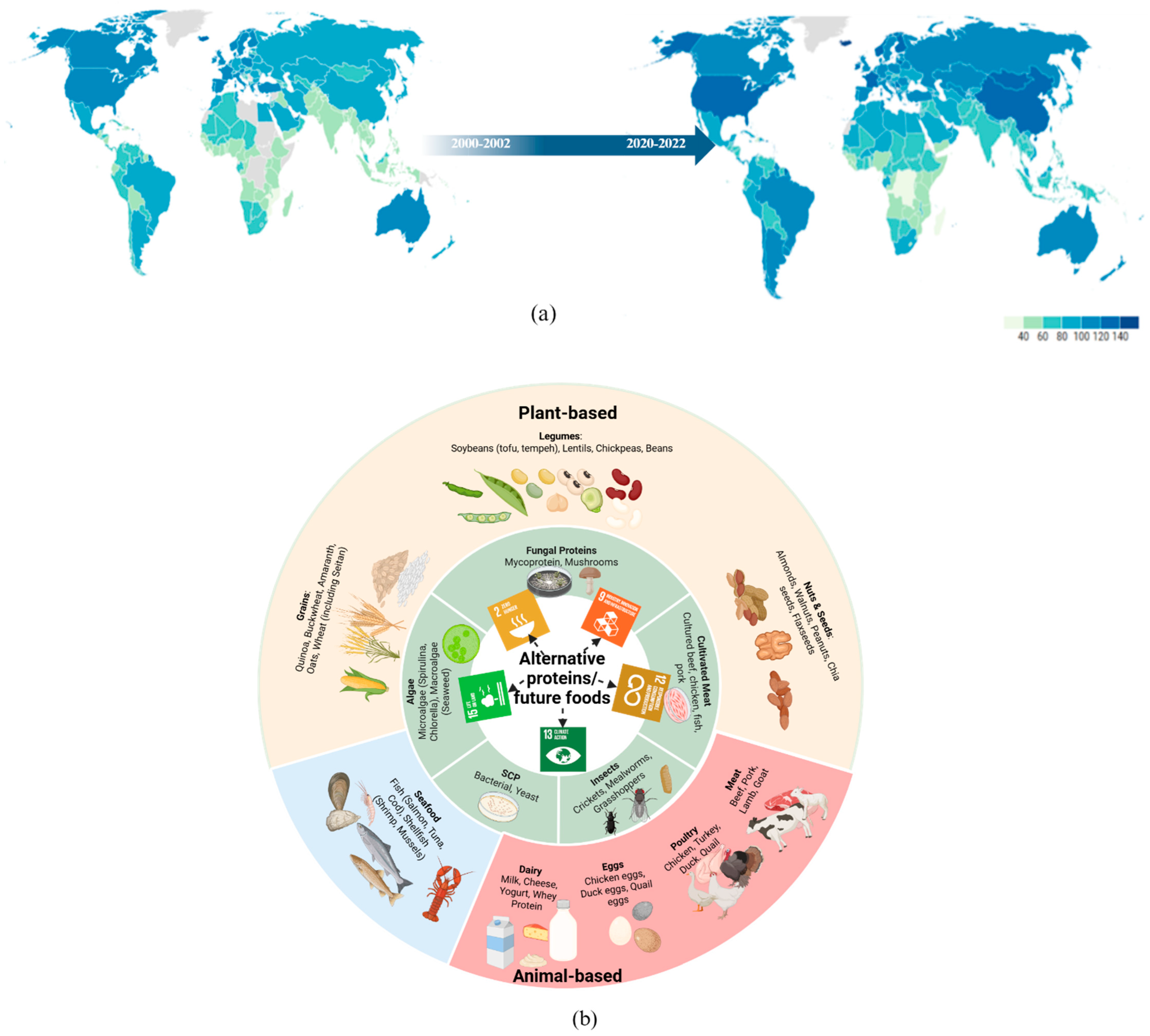
1.2. Sustainability in Dietary Protein Patterns from Conventional to Revolutionary
2. Materials and Methods
3. Results and Discussion
3.1. Production Platforms of Filamentous Fungi Proteins and Bioactive Compounds for Sustainable Food Systems
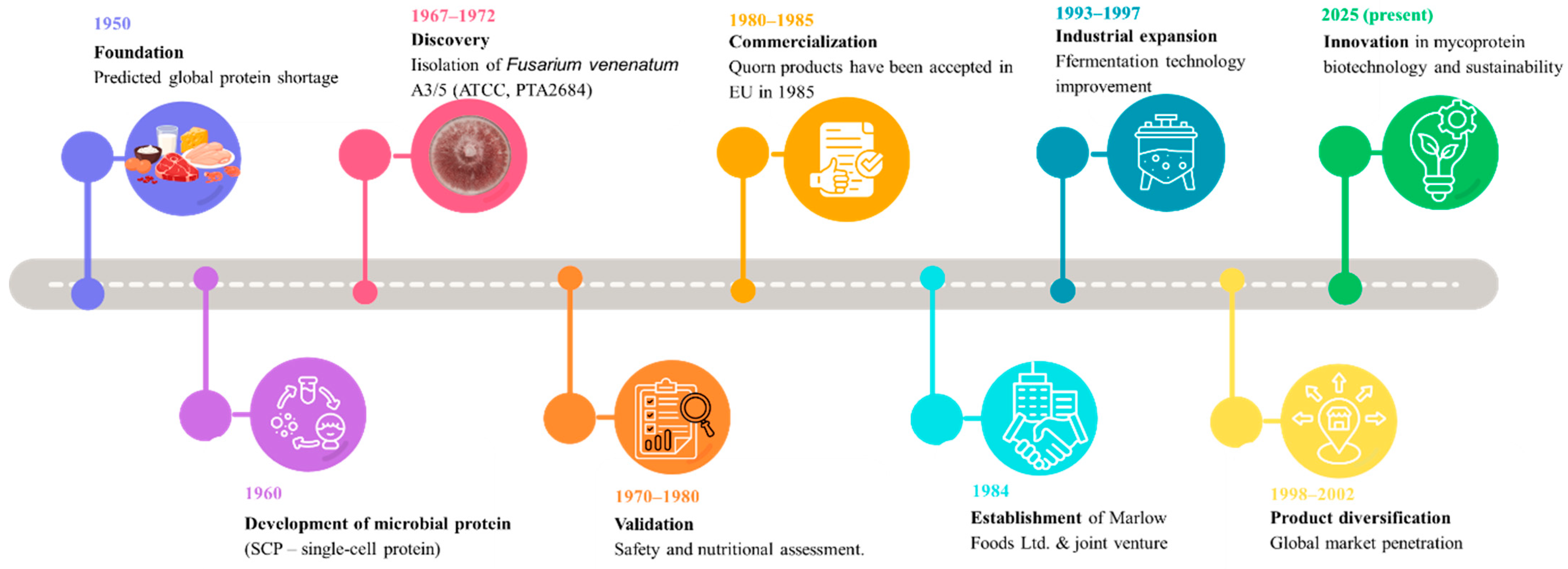
3.1.1. History of Mycoprotein
3.1.2. Fungal Cultivations and Fermentation Modes
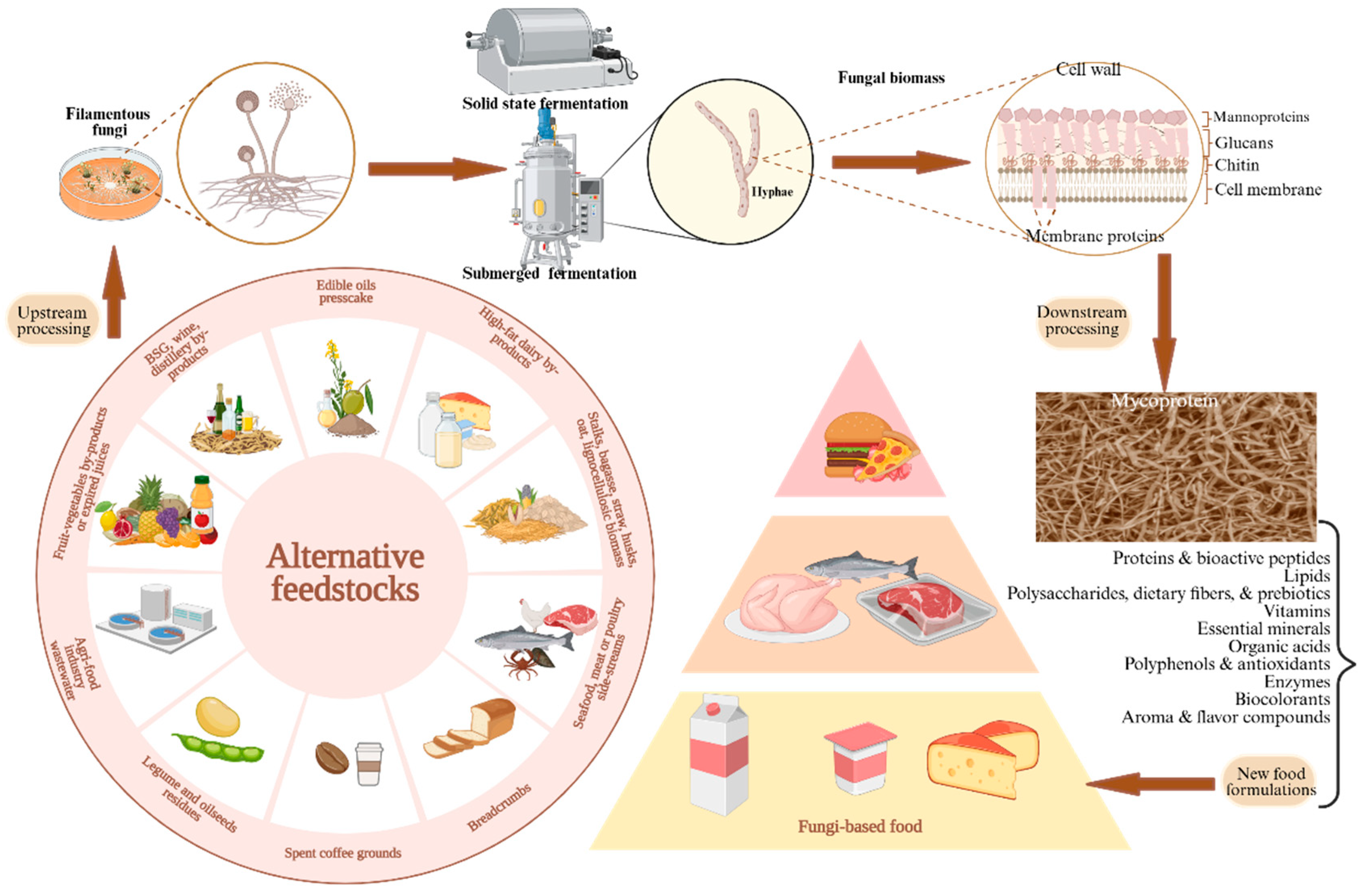
3.1.3. Alternative Feedstock and Biovalorization Strategies
3.1.4. Upstream and Downstream Processes
3.2. Biotechnological Innovations of Filamentous Fungi in Food Applications
3.3. Novel Process Development for Fungi-Based Foods
3.3.1. Emerging Fungi-Based Foods
3.3.2. Bioengineered Fungal Strain to Advance Fungal Food Fermentations
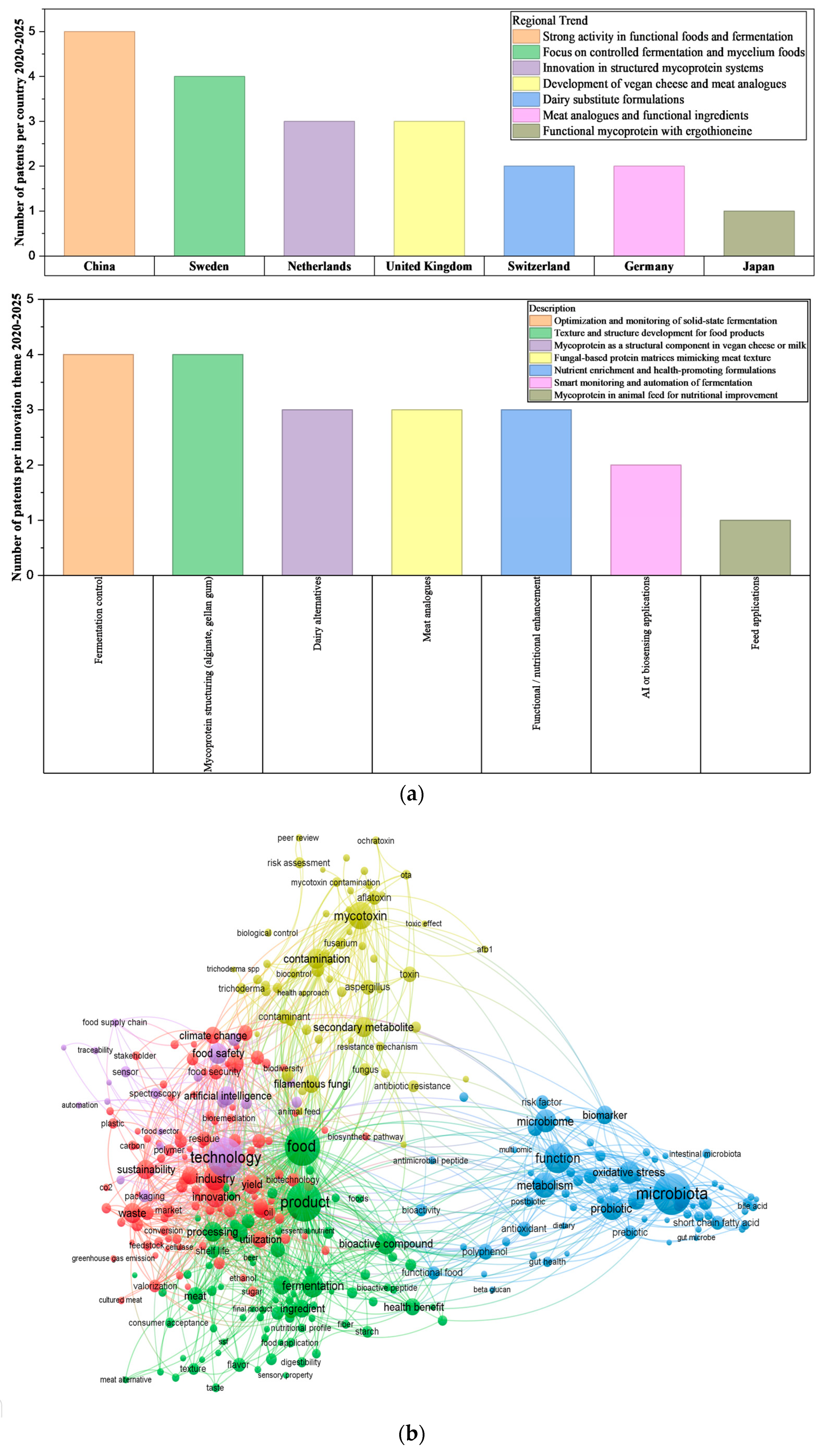
3.3.3. Next-Generation Smart Fermentation Systems
3.3.4. Advanced Structuring Technologies for Fungi-Based Foods
3.4. Nutritional Value, Sensory and Textural Advantages of Mycoprotein
3.5. Safety, Regulatory Issues and Consumer’s Acceptance of Mycoprotein
3.6. Future Opportunities and Challenges of Mycoprotein
4. Conclusions
Author Contributions
Funding
Institutional Review Board Statement
Informed Consent Statement
Data Availability Statement
Conflicts of Interest
Abbreviations
| UN | United Nation |
| SDGs | Sustainable Development Goals |
| WIPO | World Intellectual Property Organization |
| GHG | Greenhouse gas emissions |
| FAO | Food and Agriculture Organization |
| WHO | World Health Organization |
| FDA | Food and Drug Administration |
| EFSA | European Food Safety Authority |
| EU | Europe |
| U.S. | United States |
| RNA | Ribonucleic Acid |
| GRAS | Generally Recognized as Safe |
| AI | Artificial intelligence |
| ML | Machine learning |
| IoT | Internet of things |
| PDCAAS | Protein Digestibility-Corrected Amino Acid Score |
| BCAAs | Branched-chain amino acids |
| SCFA | Short-chain fatty acid |
References
- Mundhe, S.; Pawase, P.A.; Bashir, O.; Pathare, A.M.; Mudgal, S.; Spandana, K.; Ahmad, M. Investigative studies on protein quality, absorption pathways, and techno-functional comparison of mycoprotein, insect, and algal proteins for global food security and sustainability. Food Res. Int. 2025, 221, 117469. [Google Scholar] [CrossRef]
- Ray, S.; Suri, S. Culinary Applications and Consumer Acceptance. In The Sustainable Plate: Unveiling the Science of Meat Substitutes and Impact on Global Health; Ray, S., Suri, S., Eds.; Springer Nature: Cham, Switzerland, 2025; pp. 79–99. ISBN 978-3-031-94604-2. [Google Scholar]
- FAO; IFAD; UNICEF; WFP; WHO. The State of Food Security and Nutrition in the World 2024. Financing to End Hunger, Food Insecurity and Malnutrition in All Its Forms; The State of Food Security and Nutrition in the World (SOFI); FAO: Rome, Italy, 2024; ISBN 978-92-5-138882-2. [Google Scholar]
- Gil, M.; Rudy, M.; Duma-Kocan, P.; Stanisławczyk, R.; Krajewska, A.; Dziki, D.; Hassoon, W.H. Sustainability of Alternatives to Animal Protein Sources, a Comprehensive Review. Sustainability 2024, 16, 7701. [Google Scholar] [CrossRef]
- Wang, B.; Shi, Y.; Lu, H.; Chen, Q. A critical review of fungal proteins: Emerging preparation technology, active efficacy and food application. Trends Food Sci. Technol. 2023, 141, 104178. [Google Scholar] [CrossRef]
- Barzee, T.J.; Cao, L.; Pan, Z.; Zhang, R. Fungi for future foods. J. Future Foods 2021, 1, 25–37. [Google Scholar] [CrossRef]
- Dupont, J.; Dequin, S.; Giraud, T.; Le Tacon, F.; Marsit, S.; Ropars, J.; Richard, F.; Selosse, M.-A. Fungi as a Source of Food. Microbiol. Spectr. 2017, 5. [Google Scholar] [CrossRef] [PubMed]
- Pouris, J.; Kolyva, F.; Bratakou, S.; Vogiatzi, C.A.; Chaniotis, D.; Beloukas, A. The Role of Fungi in Food Production and Processing. Appl. Sci. 2024, 14, 5046. [Google Scholar] [CrossRef]
- Strong, P.J.; Self, R.; Allikian, K.; Szewczyk, E.; Speight, R.; O’Hara, I.; Harrison, M.D. Filamentous fungi for future functional food and feed. Curr. Opin. Biotechnol. 2022, 76, 102729. [Google Scholar] [CrossRef]
- Elhalis, H. Exploring Fungal Mycelium for Sustainable Food Solutions: From Biomass Utilization to Byproduct Innovation. Food Rev. Int. 2025, 1–33. [Google Scholar] [CrossRef]
- Pobiega, K.; Sękul, J.; Pakulska, A.; Latoszewska, M.; Michońska, A.; Korzeniowska, Z.; Macherzyńska, Z.; Pląder, M.; Duda, W.; Szafraniuk, J.; et al. Fungal Proteins: Sources, Production and Purification Methods, Industrial Applications, and Future Perspectives. Appl. Sci. 2024, 14, 6259. [Google Scholar] [CrossRef]
- Amara, A.A.; El-Baky, N.A. Fungi as a Source of Edible Proteins and Animal Feed. J. Fungi 2023, 9, 73. [Google Scholar] [CrossRef]
- Ahmad, M.I.; Farooq, S.; Alhamoud, Y.; Li, C.; Zhang, H. A review on mycoprotein: History, nutritional composition, production methods, and health benefits. Trends Food Sci. Technol. 2022, 121, 14–29. [Google Scholar] [CrossRef]
- Ritchie, H.; Roser, M. Half of the World’s Habitable Land Is Used for Agriculture. Our World Data. 2019. Available online: https://ourworldindata.org/global-land-for-agriculture (accessed on 25 October 2025).
- Derbyshire, E.J. Is There Scope for a Novel Mycelium Category of Proteins alongside Animals and Plants? Foods 2020, 9, 1151. [Google Scholar] [CrossRef] [PubMed]
- Hadi, J.; Brightwell, G. Safety of Alternative Proteins: Technological, Environmental and Regulatory Aspects of Cultured Meat, Plant-Based Meat, Insect Protein and Single-Cell Protein. Foods 2021, 10, 1226. [Google Scholar] [CrossRef]
- Muazzam, A.; Samad, A.; Alam, A.N.; Hwang, Y.-H.; Joo, S.-T. Microbial Proteins: A Green Approach Towards Zero Hunger. Foods 2025, 14, 2636. [Google Scholar] [CrossRef]
- Poore, J.; Nemecek, T. Reducing food’s environmental impacts through producers and consumers. Science 2018, 360, 987–992. [Google Scholar] [CrossRef]
- Ritchie, H. Less Meat Is Nearly Always Better than Sustainable Meat, to Reduce Your Carbon Footprint. Our World Data. 2020. Available online: https://ourworldindata.org/less-meat-or-sustainable-meat (accessed on 25 October 2025).
- Shahid, M.; Shah, P.; Mach, K.; Rodgers-Hunt, B.; Finnigan, T.; Frost, G.; Neal, B.; Hadjikakou, M. The environmental impact of mycoprotein-based meat alternatives compared to plant-based meat alternatives: A systematic review. Future Foods 2024, 10, 100410. [Google Scholar] [CrossRef]
- Mekonnen, M.M.; Gerbens-Leenes, W. The Water Footprint of Global Food Production. Water 2020, 12, 2696. [Google Scholar] [CrossRef]
- FAO; WHO. Sustainable Healthy Diets: Guiding Principles; Food and Agriculture Organization (FAO): Rome, Italy; World Health Organization (WHO): Geneva, Switzerland, 2019. [Google Scholar]
- Lucas, E.; Guo, M.; Guillén-Gosálbez, G. Low-carbon diets can reduce global ecological and health costs. Nat. Food 2023, 4, 394–406. [Google Scholar] [CrossRef]
- United Nations. The Sustainable Development Goals Report 2022; United Nations: New York, NY, USA, 2022. [Google Scholar]
- European Commission The European Green Deal Striving to be the First Climate-Neutral Continent. Available online: https://commission.europa.eu/strategy-and-policy/priorities-2019-2024/european-green-deal_en (accessed on 1 November 2025).
- Schulze, M.; Janssen, M. Self-determined or non-self-determined? Exploring consumer motivation for sustainable food choices. Sustain. Prod. Consum. 2024, 45, 57–66. [Google Scholar] [CrossRef]
- Onyeaka, H.; Anumudu, C.K.; Okpe, C.; Okafor, A.; Ihenetu, F.; Miri, T.; Odeyemi, O.A.; Anyogu, A. Single Cell Protein for Foods and Feeds: A Review of Trends. Open Microbiol. J. 2022, 16, e187428582206160. [Google Scholar] [CrossRef]
- Khatami, K.; Qazanfarzadeh, Z.; Jiménez-Quero, A. Fungal fermentation: The blueprint for transforming industrial side streams and residues. Bioresour. Technol. 2026, 440, 133426. [Google Scholar] [CrossRef] [PubMed]
- Miller, V.; Reedy, J.; Cudhea, F.; Zhang, J.; Shi, P.; Erndt-Marino, J.; Coates, J.; Micha, R.; Webb, P.; Mozaffarian, D.; et al. Global, regional, and national consumption of animal-source foods between 1990 and 2018: Findings from the Global Dietary Database. Lancet Planet. Health 2022, 6, e243–e256. [Google Scholar] [CrossRef]
- Lumsden, C.L.; Jagermeyr, J.; Ziska, L.; Fanzo, J. Critical overview of the implications of a global protein transition in the face of climate change: Key unknowns and research imperatives. One Earth 2024, 7, 1187–1201. [Google Scholar] [CrossRef]
- Barolo, M.I.; Castelli, M.V.; López, S.N. Antimicrobial Activity of Fungal Endophytes Associated with Peperomia argyreia (Piperaceae). Appl. Microbiol. 2024, 4, 753–770. [Google Scholar] [CrossRef]
- Hoxha, L.; Lennartsson, P.R.; Taherzadeh, M.J. Grape marc biotransformation to protein-rich food ingredients using fungal fermentation. Food Chem. Adv. 2025, 8, 101058. [Google Scholar] [CrossRef]
- Hoxha, L.; Wang, R.; Taherzadeh, M.J.; Undeland, I. In vitro protein digestion and mineral accessibility of edible filamentous fungi cultivated on winery and distillery by-products. Food Biosci. 2025, 73, 107711. [Google Scholar] [CrossRef]
- Hyttinen, E.; Pajumo, M.; Valtonen, A.; Ritala, A.; Uusitalo, J.; Nordlund, E. Potato and dairy industry side streams as feedstock for fungal and plant cell cultures. Biocatal. Agric. Biotechnol. 2024, 61, 103367. [Google Scholar] [CrossRef]
- Pranoto, Y.; Christia, A.; Sardjono. Effect of Fermentation by Rhizopus oligosporus or Amylomyces rouxii on In-Vitro Starch and Protein Digestibility of Decorticated Red Sorghum (Sorghum bicolor L. Moench). Int. J. Adv. Sci. Eng. Inf. Technol. 2020, 10, 2362–2366. [Google Scholar] [CrossRef]
- Rousta, N.; Ferreira, J.A.; Taherzadeh, M.J. Production of L-carnitine-enriched edible filamentous fungal biomass through submerged cultivation. Bioengineered 2021, 12, 358–368. [Google Scholar] [CrossRef]
- Starzyńska-Janiszewska, A.; Stodolak, B.; Fernández-Fernández, C.; Mickowska, B.; Verardo, V.; Gómez-Caravaca, A.M. Phenolic Profile, Antioxidant Activity and Amino Acid Composition of Moringa Leaves Fermented with Edible Fungal Strains. Foods 2022, 11, 3762. [Google Scholar] [CrossRef]
- Fazili, A.B.A.; Shah, A.M.; Zan, X.; Naz, T.; Nosheen, S.; Nazir, Y.; Ullah, S.; Zhang, H.; Song, Y. Mucor circinelloides: A model organism for oleaginous fungi and its potential applications in bioactive lipid production. Microb. Cell Factories 2022, 21, 29. [Google Scholar] [CrossRef]
- Labuda, R.; Bacher, M.; Gratzl, H.; Doppler, M.; Parich, A.; Aufy, M.; Lemmens-Gruber, R.; Schuhmacher, R.; Rychli, K.; Wagner, M.; et al. Luteapyrone, a Novel ƴ-Pyrone Isolated from the Filamentous Fungus Metapochonia lutea. Molecules 2021, 26, 6589. [Google Scholar] [CrossRef]
- Wu, C.; Jiang, N.; Wang, R.; Jiang, S.; Yuan, Z.; Luo, X.; Wu, J.; Shi, H.; Wu, R. Linoleic acid enrichment of cheese by okara flour and Geotrichum candidum overexpressing Δ12 fatty acid desaturase. J. Sci. Food Agric. 2023, 103, 2960–2969. [Google Scholar] [CrossRef]
- Choukade, R.; Kango, N. Purification of Aspergillus tamarii mycelial fructosyltransferase (m-FTase), optimized FOS production, and evaluation of its anticancer potential. J. Food Sci. 2022, 87, 3294–3306. [Google Scholar] [CrossRef]
- Šelo, G.; Planinić, M.; Tišma, M.; Tomas, S.; Koceva Komlenić, D.; Bucić-Kojić, A. A Comprehensive Review on Valorization of Agro-Food Industrial Residues by Solid-State Fermentation. Foods 2021, 10, 927. [Google Scholar] [CrossRef] [PubMed]
- Gmoser, R.; Fristedt, R.; Larsson, K.; Undeland, I.; Taherzadeh, M.J.; Lennartsson, P.R. From stale bread and brewers spent grain to a new food source using edible filamentous fungi. Bioengineered 2020, 11, 582–598. [Google Scholar] [CrossRef] [PubMed]
- Wikandari, R.; Nisrina, H.; Setiowati, A.D.; Millati, R. Enhanced Bioaccumulation of Essential Minerals in Filamentous Fungal Biomass During Cultivation to Produce High Quality Vegan Food. Pol. J. Food Nutr. Sci. 2025, 75, 274–282. [Google Scholar] [CrossRef]
- Abd Razak, D.L.; Abd Rashid, N.Y.; Jamaluddin, A.; Abd Ghani, A.; Abdul Manan, M. Antioxidant activities, tyrosinase inhibition activity and bioactive compounds content of broken rice fermented with Amylomyces rouxii. Food Res. 2021, 5, 65–72. [Google Scholar] [CrossRef]
- Brück, W.M.; Erismann, Y.; Andlauer, W. Fermentative Liberation and Transformation of Bioactive Compounds: Ellagic Acid from Nut Press Cake Ellagitannins. Appl. Sci. 2024, 14, 1141. [Google Scholar] [CrossRef]
- Hameed, A.; Hussain, S.A.; Nosheen, S.; Muhammad, Z.; Wu, Y.; Ullah, S.; Suleria, H.A.R.; Song, Y. Microencapsulation of microbial antioxidants from Mucor circinelloides, their physico-chemical characterization, in vitro digestion and releasing behaviors in food. Appl. Biol. Chem. 2020, 63, 28. [Google Scholar] [CrossRef]
- Averianova, L.A.; Balabanova, L.A.; Son, O.M.; Podvolotskaya, A.B.; Tekutyeva, L.A. Production of Vitamin B2 (Riboflavin) by Microorganisms: An Overview. Front. Bioeng. Biotechnol. 2020, 8, 570828. [Google Scholar] [CrossRef] [PubMed]
- Dianatdar, F.; Etemadifar, Z.; Taherzadeh, M.J. Production of B vitamins and carotenoids as active biomolecules by edible filamentous fungus neurospora intermedia. Food Biosci. 2025, 69, 106850. [Google Scholar] [CrossRef]
- Pimenta, L.P.S.; Gomes, D.C.; Cardoso, P.G.; Takahashi, J.A. Recent Findings in Azaphilone Pigments. J. Fungi 2021, 7, 541. [Google Scholar] [CrossRef]
- Chin, X.H.; Soh, R.; Chan, G.; Ng, P.; Thong, A.; Elhalis, H.; Yoganathan, K.; Chow, Y.; Liu, S.Q. Modulating the aroma and taste profile of soybean using novel strains for fermentation. Curr. Res. Food Sci. 2025, 10, 100933. [Google Scholar] [CrossRef]
- Chen, D.; Xu, Y.; Li, H.; Zhu, X. Optimization of Monascus purpureus Culture Conditions in Rice Bran for Enhanced Monascus Pigment Biosynthesis. Fermentation 2025, 11, 505. [Google Scholar] [CrossRef]
- Da Silva, V.L.; Ienczak, J.L.; Moritz, D. Agro-industrial residues for the production of red biopigment by Monascus ruber: Rice flour and sugarcane molasses. Braz. J. Microbiol. 2021, 52, 587–596. [Google Scholar] [CrossRef]
- Oviedo-Albarracín, C.; Chacón-Navarrete, H.; Cámara-Martos, F.; Bermúdez-Luque, A.; Koysuren, B.; Nitin, N.; Fotidis, I.; Yan, Y.; Moreno-García, J. Increasing the Lipid Content of Filamentous Fungi: Potential Alternatives to Conventional Meat through Culture Medium Modification and High-Lipid Yeast Immobilization. Food Bioprocess Technol. 2025, 18, 10789–10805. [Google Scholar] [CrossRef]
- Singh, U.; Gautam, A.; Singha, T.K.; Tiwari, A.; Tiwari, P.; Sahai, V.; Sharma, S. Mass production of Pleurotus eryngii mycelia under submerged culture conditions with improved minerals and vitamin D2. LWT 2020, 131, 109665. [Google Scholar] [CrossRef]
- Abdel-Mageed, H.M.; Nada, D.; Radwan, R.A.; Mohamed, S.A.; Gohary, N.A.E.L. Optimization of catalytic properties of Mucor racemosus lipase through immobilization in a biocompatible alginate gelatin hydrogel matrix for free fatty acid production: A sustainable robust biocatalyst for ultrasound-assisted olive oil hydrolysis. 3 Biotech 2022, 12, 285. [Google Scholar] [CrossRef] [PubMed]
- Chen, Z.; Chen, C.; Yang, R.; Jin, H.; Liu, B.; Wang, Z.; Tan, Y.; Xue, Q.; Hu, Y. The formation mechanism of sufu gels fermented by Mucor racemosus during pre-fermentation. LWT 2024, 203, 116309. [Google Scholar] [CrossRef]
- Salgado, J.C.S.; Heinen, P.R.; Messias, J.M.; Oliveira-Monteiro, L.M.; Cereia, M.; Rechia, C.G.V.; Maller, A.; Kadowaki, M.K.; Ward, R.J.; Polizeli, M.d.L.T.d.M. Enhancing Xylanase Production from Aspergillus tamarii Kita and Its Application in the Bioconversion of Agro-Industrial Residues into Fermentable Sugars Using Factorial Design. Fermentation 2024, 10, 241. [Google Scholar] [CrossRef]
- Mano, J. Fast and easy edible protein production by nitrogen-supplemented koji fermentation. NPJ Sci. Food 2025, 9, 150. [Google Scholar] [CrossRef]
- Wang, C.; Hu, C.; Li, X.; Shen, R.; Yin, L.; Wu, Q.; Hu, T. Effects of Rhizopus oligosporus-Mediated Solid-State Fermentation on the Protein Profile and α-Glucosidase Inhibitory Activity of Selenium-Biofortified Soybean Tempeh. Foods 2025, 14, 2899. [Google Scholar] [CrossRef]
- Gandia, A.; Nussbaum, N.; Zermatten, C.; Rühs, P.A. Fungal-Based Foods Beyond Mushrooms: Traditional Practices and Modern Innovations. In Fungi; Navarro Simarro, P., Ed.; Springe: New York, NY, USA, 2026; pp. 233–258. ISBN 978-1-0716-4989-3. [Google Scholar]
- Wijaya, C.H.; Nuraida, L.; Nuramalia, D.R.; Hardanti, S.; Świąder, K. Oncom: A Nutritive Functional Fermented Food Made from Food Process Solid Residue. Appl. Sci. 2024, 14, 10702. [Google Scholar] [CrossRef]
- Maini Rekdal, V.; Villalobos-Escobedo, J.M.; Rodriguez-Valeron, N.; Olaizola Garcia, M.; Prado Vásquez, D.; Rosales, A.; Sörensen, P.M.; Baidoo, E.E.K.; Calheiros de Carvalho, A.; Riley, R.; et al. Neurospora intermedia from a traditional fermented food enables waste-to-food conversion. Nat. Microbiol. 2024, 9, 2666–2683. [Google Scholar] [CrossRef] [PubMed]
- Akinsemolu, A.A.; Onyeaka, H.N. Mycoproteins as sustainable food sources: Current applications and future prospects. Discov. Appl. Sci. 2025, 7, 191. [Google Scholar] [CrossRef]
- Risner, D.; McDonald, K.A.; Jones, C.; Spang, E.S. A techno-economic model of mycoprotein production: Achieving price parity with beef protein. Front. Sustain. Food Syst. 2023, 7, 1204307. [Google Scholar] [CrossRef]
- Majumder, R.; Miatur, S.; Saha, A.; Hossain, S. Mycoprotein: Production and nutritional aspects: A review. Sustain. Food Technol. 2024, 2, 81–91. [Google Scholar] [CrossRef]
- Amobonye, A.; Lalung, J.; Awasthi, M.K.; Pillai, S. Fungal mycelium as leather alternative: A sustainable biogenic material for the fashion industry. Sustain. Mater. Technol. 2023, 38, e00724. [Google Scholar] [CrossRef]
- Reardon, K.F. Practical monitoring technologies for cells and substrates in biomanufacturing. Curr. Opin. Biotechnol. 2021, 71, 225–230. [Google Scholar] [CrossRef] [PubMed]
- Niyigaba, T.; Küçükgöz, K.; Kołożyn-Krajewska, D.; Królikowski, T.; Trząskowska, M. Advances in Fermentation Technology: A Focus on Health and Safety. Appl. Sci. 2025, 15, 3001. [Google Scholar] [CrossRef]
- Borkertas, S.; Viskelis, J.; Viskelis, P.; Streimikyte, P.; Gasiunaite, U.; Urbonaviciene, D. Fungal Biomass Fermentation: Valorizing the Food Industry’s Waste. Fermentation 2025, 11, 351. [Google Scholar] [CrossRef]
- Hoxha, L.; Taherzadeh, M.J.; Marangon, M. Sustainable repurposing of grape marc: Potential for bio-based innovations. Waste Manag. 2025, 203, 114871. [Google Scholar] [CrossRef] [PubMed]
- Parchami, M.; Sar, T.; Bulkan, G.; Ferreira, J.A.; Taherzadeh, M.J. 18—Versatility of filamentous fungi in novel processes. In Current Developments in Biotechnology and Bioengineering; Taherzadeh, M.J., Ferreira, J.A., Pandey, A., Eds.; Elsevier: Amsterdam, The Netherlands, 2023; pp. 533–574. ISBN 978-0-323-91872-5. [Google Scholar]
- Malos, I.G.; Ghizdareanu, A.-I.; Vidu, L.; Matei, C.B.; Pasarin, D. The Role of Whey in Functional Microorganism Growth and Metabolite Generation: A Biotechnological Perspective. Foods 2025, 14, 1488. [Google Scholar] [CrossRef]
- Sousa, D.; Simões, L.; Oliveira, R.; Salgado, J.M.; Cambra-López, M.; Belo, I.; Dias, A. Evaluation of biotechnological processing through solid-state fermentation of oilseed cakes on extracts bioactive potential. Biotechnol. Lett. 2023, 45, 1293–1307. [Google Scholar] [CrossRef]
- Organo, N.D.; Granada, S.M.J.M.; Pineda, H.G.S.; Sandro, J.M.; Nguyen, V.H.; Gummert, M. Assessing the potential of a Trichoderma-based compost activator to hasten the decomposition of incorporated rice straw. Sci. Rep. 2022, 12, 448. [Google Scholar] [CrossRef] [PubMed]
- Wang, Y.; Cai, C.; Lu, J.; Li, X.; Wang, Z.; Chu, J. Efficient crop straws biotreatment using the fungus Cerrena Unicolor GC.u01. AMB Express 2024, 14, 28. [Google Scholar] [CrossRef] [PubMed]
- Ng, Z.Y.; Kee, P.E.; Abdullah, R.; Lan, J.C.-W.; Ling, T.C.; Jiang, J.-J.; Lim, J.W.; Khoo, K.S. Conversion of lignocellulosic biomass waste into mycoprotein: Current status and future directions for sustainable protein production. Biomass Convers. Biorefinery 2024, 15, 31337–31363. [Google Scholar] [CrossRef]
- Mili, C.; Kalita, S.; Tayung, K. Hydrolysis efficiency of sugarcane bagasse treated with fungal consortia isolated from leaf litter. Biomass Convers. Biorefinery 2025, 15, 2881–2892. [Google Scholar] [CrossRef]
- Parchami, M.; Mahboubi, A.; Agnihotri, S.; Taherzadeh, M.J. Biovalorization of brewer’s spent grain as single-cell protein through coupling organosolv pretreatment and fungal cultivation. Waste Manag. 2023, 169, 382–391. [Google Scholar] [CrossRef]
- França, E.d.S.; de Souza, A.F.; Rodríguez, D.M.; de Paula, N.Z.; Neves, A.G.D.; Cardoso, K.B.B.; Campos-Takaki, G.M.d.; de Lima, M.A.B.; Porto, A.L.F. Valorization of Spent Coffee Grounds as a Substrate for Fungal Laccase Production and Biosorbents for Textile Dye Decolorization. Fermentation 2025, 11, 396. [Google Scholar] [CrossRef]
- Svensson, S.; Bucuricova, L.; Ferreira, J.A.; Filho, P.F.S.; Taherzadeh, M.J.; Zamani, A. Valorization of Bread Waste to a Fiber- and Protein-Rich Fungal Biomass. Fermentation 2021, 7, 91. [Google Scholar] [CrossRef]
- Ferreira, J.A.; Varjani, S.; Taherzadeh, M.J. A Critical Review on the Ubiquitous Role of Filamentous Fungi in Pollution Mitigation. Curr. Pollut. Rep. 2020, 6, 295–309. [Google Scholar] [CrossRef]
- Rodríguez, L.A.; Groff, M.C.; Garay, S.A.; Díaz, M.E.; Sardella, M.F.; Scaglia, G. Bioconversion of Olive Pomace: A Solid-State Fermentation Strategy with Aspergillus sp. for Detoxification and Enzyme Production. Fermentation 2025, 11, 456. [Google Scholar] [CrossRef]
- Saleem, M.; Saeed, M.T. Potential application of waste fruit peels (orange, yellow lemon and banana) as wide range natural antimicrobial agent. J. King Saud Univ.—Sci. 2020, 32, 805–810. [Google Scholar] [CrossRef]
- Jadhav, R.; Mach, R.L.; Mach-Aigner, A.R. Protein secretion and associated stress in industrially employed filamentous fungi. Appl. Microbiol. Biotechnol. 2024, 108, 92. [Google Scholar] [CrossRef] [PubMed]
- Whittaker, J.A.; Johnson, R.I.; Finnigan, T.J.A.; Avery, S.V.; Dyer, P.S. The Biotechnology of Quorn Mycoprotein: Past, Present and Future Challenges. In Grand Challenges in Fungal Biotechnology; Nevalainen, H., Ed.; Springer International Publishing: Cham, Switzerland, 2020; pp. 59–79. ISBN 978-3-030-29541-7. [Google Scholar]
- Zeng, B.; Nilsson, K.; Teixeira, P.G.; Bergenståhl, B. Study of mycoprotein extraction methods and its functional properties. Colloids Surf. Physicochem. Eng. Asp. 2023, 659, 130800. [Google Scholar] [CrossRef]
- González, A.; Cruz, M.; Losoya, C.; Nobre, C.; Loredo, A.; Rodríguez, R.; Contreras, J.; Belmares, R. Edible mushrooms as a novel protein source for functional foods. Food Funct. 2020, 11, 7400–7414. [Google Scholar] [CrossRef]
- Grossmann, L.; Weiss, J. Alternative Protein Sources as Technofunctional Food Ingredients. Annu. Rev. Food Sci. Technol. 2021, 12, 93–117. [Google Scholar] [CrossRef]
- Kamal, H.; Le, C.F.; Salter, A.M.; Ali, A. Extraction of protein from food waste: An overview of current status and opportunities. Compr. Rev. Food Sci. Food Saf. 2021, 20, 2455–2475. [Google Scholar] [CrossRef]
- Machado, M.; Bautista-Hérnandez, I.; Gómez-García, R.; Silva, S.; Costa, E.M. Bioactive Food Proteins: Bridging Nutritional and Functional Benefits with Sustainable Protein Sources. Foods 2025, 14, 3035. [Google Scholar] [CrossRef]
- Jafarzadeh, S.; Qazanfarzadeh, Z.; Majzoobi, M.; Sheiband, S.; Oladzadabbasabad, N.; Esmaeili, Y.; Barrow, C.J.; Timms, W. Alternative proteins; A path to sustainable diets and environment. Curr. Res. Food Sci. 2024, 9, 100882. [Google Scholar] [CrossRef]
- Siddiqui, S.A.; Bahmid, N.A.; Karim, I.; Mehany, T.; Gvozdenko, A.A.; Blinov, A.V.; Nagdalian, A.A.; Arsyad, M.; Lorenzo, J.M. Cultured meat: Processing, packaging, shelf life, and consumer acceptance. LWT 2022, 172, 114192. [Google Scholar] [CrossRef]
- Future Market Insights Fungal Protein Market Size, Demand & Forecast 2024–2034. Available online: https://www.futuremarketinsights.com/reports/fungal-protein-market (accessed on 30 November 2025).
- Yang, M.; Qian, Z.; Zhan, Q.; Zhong, L.; Hu, Q.; Zhao, L. Application of definitive screening design to optimization of the protein extraction and functional properties of proteins in Auricularia auricula. J. Sci. Food Agric. 2023, 103, 1226–1236. [Google Scholar] [CrossRef]
- Torres-Martínez, B.D.M.; Vargas-Sánchez, R.D.; Torrescano-Urrutia, G.R.; Esqueda, M.; Rodríguez-Carpena, J.G.; Fernández-López, J.; Perez-Alvarez, J.A.; Sánchez-Escalante, A. Pleurotus Genus as a Potential Ingredient for Meat Products. Foods 2022, 11, 779. [Google Scholar] [CrossRef]
- Tzachor, A. Novel foods for human and planetary health. Nat. Food 2022, 3, 247–248. [Google Scholar] [CrossRef]
- Mazac, R.; Meinilä, J.; Korkalo, L.; Järviö, N.; Jalava, M.; Tuomisto, H.L. Incorporation of novel foods in European diets can reduce global warming potential, water use and land use by over 80. Nat. Food 2022, 3, 286–293. [Google Scholar] [CrossRef] [PubMed]
- Cheng, K.-E.; Lin, L.-Y.; Chen, C.-C.; Guo, J.-H. Mycoprotein as a functional ingredient in chiffon cake: Impacts on batter rheology, nutritional value, texture, and sensory quality. Int. J. Food Sci. Technol. 2025, 60, vvaf209. [Google Scholar] [CrossRef]
- You, X.-Y.; Ding, Y.; Bu, Q.-Y.; Wang, Q.-H.; Zhao, G.-P. Nutritional, Textural, and Sensory Attributes of Protein Bars Formulated with Mycoproteins. Foods 2024, 13, 671. [Google Scholar] [CrossRef]
- Kim, H.-S.; Oh, C.-J.; Jeong, K.-J.; Choi, M.-H.; Shin, H.-J.; Oh, D.-S. Culture and mycelim-mat formation characteristics of mutant strains by gamma-ray treatment. J. Mushroom 2020, 18, 393–397. [Google Scholar] [CrossRef]
- Graham, A.E.; Ledesma-Amaro, R. The microbial food revolution. Nat. Commun. 2023, 14, 2231. [Google Scholar] [CrossRef] [PubMed]
- Maini Rekdal, V.; van der Luijt, C.R.B.; Chen, Y.; Kakumanu, R.; Baidoo, E.E.K.; Petzold, C.J.; Cruz-Morales, P.; Keasling, J.D. Edible mycelium bioengineered for enhanced nutritional value and sensory appeal using a modular synthetic biology toolkit. Nat. Commun. 2024, 15, 2099. [Google Scholar] [CrossRef]
- Stöppelmann, F.; Chan, L.F.; Hildebrand, G.; Hermann-Ene, V.; Vetter, W.; Rigling, M.; Zhang, Y. Molecular decoding a meat-like aroma generated from Laetiporus sulphureus-mediated fermentation of onion (Allium cepa L.). Food Res. Int. Ott. Ont 2024, 192, 114757. [Google Scholar] [CrossRef]
- Zhang, X.-Y.; Li, B.; Huang, B.-C.; Wang, F.-B.; Zhang, Y.-Q.; Zhao, S.-G.; Li, M.; Wang, H.-Y.; Yu, X.-J.; Liu, X.-Y.; et al. Production, Biosynthesis, and Commercial Applications of Fatty Acids from Oleaginous Fungi. Front. Nutr. 2022, 9, 873657. [Google Scholar] [CrossRef]
- Takahashi, J.A.; Barbosa, B.V.R.; Martins, B.d.A.; P Guirlanda, C.; A F Moura, M. Use of the Versatility of Fungal Metabolism to Meet Modern Demands for Healthy Aging, Functional Foods, and Sustainability. J. Fungi 2020, 6, 223. [Google Scholar] [CrossRef]
- Chai, K.F.; Ng, K.R.; Samarasiri, M.; Chen, W.N. Precision fermentation to advance fungal food fermentations. Curr. Opin. Food Sci. 2022, 47, 100881. [Google Scholar] [CrossRef]
- Liu, X.; Dong, J.; Liao, J.; Tian, L.; Qiu, H.; Wu, T.; Ge, F.; Zhu, J.; Shi, L.; Jiang, A.; et al. Establishment of CRISPR/Cas9 Genome-Editing System Based on Dual sgRNAs in Flammulina filiformis. J. Fungi 2022, 8, 693. [Google Scholar] [CrossRef]
- Yamasaki, F.; Nakazawa, T.; Oh, M.; Bao, D.; Kawauchi, M.; Sakamoto, M.; Honda, Y. Gene targeting of dikaryotic Pleurotus ostreatus nuclei using the CRISPR/Cas9 system. FEMS Microbiol. Lett. 2022, 369, fnac083. [Google Scholar] [CrossRef] [PubMed]
- Lian, L.; Zhang, G.; Zhu, J.; Wang, Y.; Wang, L.; Liu, R.; Shi, L.; Ren, A.; Zhao, M. Swi6B, an alternative splicing isoform of Swi6, mediates the cell wall integrity of Ganoderma lucidum. Environ. Microbiol. 2021, 23, 4405–4417. [Google Scholar] [CrossRef]
- Hernández, G.; Ponce de la Cal, A.; Louis, Y.; Baró Robaina, Y.; Coll, Y.; Spengler, I.; Mirabal-Gallardo, Y. Identification of Secondary Metabolites by UHPLC-ESI-HRMS/MS in Antifungal Strain Trichoderma harzianum (LBAT-53). J. Fungi 2024, 10, 547. [Google Scholar] [CrossRef] [PubMed]
- Leal, K.; Rojas, E.; Madariaga, D.; Contreras, M.J.; Nuñez-Montero, K.; Barrientos, L.; Goméz-Espinoza, O.; Iturrieta-González, I. Unlocking Fungal Potential: The CRISPR-Cas System as a Strategy for Secondary Metabolite Discovery. J. Fungi 2024, 10, 748. [Google Scholar] [CrossRef]
- Gong, P.; Shi, R.; Liu, Y.; Luo, Q.; Wang, C.; Chen, W. Recent advances in monascus pigments produced by Monascus purpureus: Biosynthesis, fermentation, function, and application. LWT-Food Sci. Technol. 2023, 185, 115162. [Google Scholar] [CrossRef]
- Cheng, Y.; Bi, X.; Xu, Y.; Liu, Y.; Li, J.; Du, G.; Lv, X.; Liu, L. Artificial intelligence technologies in bioprocess: Opportunities and challenges. Bioresour. Technol. 2023, 369, 128451. [Google Scholar] [CrossRef]
- Todhunter, M.E.; Jubair, S.; Verma, R.; Saqe, R.; Shen, K.; Duffy, B. Artificial intelligence and machine learning applications for cultured meat. Front. Artif. Intell. 2024, 7, 1424012. [Google Scholar] [CrossRef] [PubMed]
- Wainaina, S.; Taherzadeh, M.J. Automation and artificial intelligence in filamentous fungi-based bioprocesses: A review. Bioresour. Technol. 2023, 369, 128421. [Google Scholar] [CrossRef]
- Yee, C.S.; Zahia-Azizan, N.A.; Abd Rahim, M.H.; Mohd Zaini, N.A.; Raja-Razali, R.B.; Ushidee-Radzi, M.A.; Ilham, Z.; Wan-Mohtar, W.A.A.Q.I. Smart Fermentation Technologies: Microbial Process Control in Traditional Fermented Foods. Fermentation 2025, 11, 323. [Google Scholar] [CrossRef]
- Sharma, V.; Mottafegh, A.; Joo, J.-U.; Kang, J.-H.; Wang, L.; Kim, D.-P. Toward microfluidic continuous-flow and intelligent downstream processing of biopharmaceuticals. Lab. Chip 2024, 24, 2861–2882. [Google Scholar] [CrossRef]
- Podrażka, M.; Bączyńska, E.; Kundys, M.; Jeleń, P.S.; Witkowska Nery, E. Electronic Tongue—A Tool for All Tastes? Biosensors 2018, 8, 3. [Google Scholar] [CrossRef]
- Seesaard, T.; Wongchoosuk, C. Recent Progress in Electronic Noses for Fermented Foods and Beverages Applications. Fermentation 2022, 8, 302. [Google Scholar] [CrossRef]
- Ajayeoba, T.A.; Ijabadeniyi, O.A. Transforming Food for the Future: Precision Fermentation as a Key to Sustainability, Nutrition, and Health. Nutr. Health 2025. [Google Scholar] [CrossRef]
- Wang, Y.; Wang, Y.; Xu, F. Artificial intelligence-driven fermentation optimization for α-amylase hyperproduction enabled by Raman monitoring and metabolic network analysis. Bioresour. Technol. 2026, 439, 133287. [Google Scholar] [CrossRef] [PubMed]
- Kim, G.B.; Kim, W.J.; Kim, H.U.; Lee, S.Y. Machine learning applications in systems metabolic engineering. Curr. Opin. Biotechnol. 2020, 64, 1–9. [Google Scholar] [CrossRef]
- Fischer, A.R.H.; Hilboesen, O. Consumer acceptance of mycelium as protein source. Food Qual. Prefer. 2025, 122, 105304. [Google Scholar] [CrossRef]
- Focker, M.; Liu, C.; Wang, X.; van der Fels-Klerx, H.J. The use of artificial intelligence to improve mycotoxin management: A review. Mycotoxin Res. 2025, 41, 529–540. [Google Scholar] [CrossRef]
- Holt, R.R.; Munafo, J.P.; Salmen, J.; Keen, C.L.; Mistry, B.S.; Whiteley, J.M.; Schmitz, H.H. Mycelium: A Nutrient-Dense Food To Help Address World Hunger, Promote Health, and Support a Regenerative Food System. J. Agric. Food Chem. 2024, 72, 2697–2707. [Google Scholar] [CrossRef]
- Scott, N.; Ting, K.C. Controlled Biology-Based Indoor Circular Food Systems. Am. Soc. Agric. Biol. Eng. 2021, 28, 19–24. [Google Scholar]
- Bhardwaj, A.; Vasselli, J.; Lucht, M.; Pei, Z.; Shaw, B.; Grasley, Z.; Wei, X.; Zou, N. 3D Printing of Biomass-Fungi Composite Material: A Preliminary Study. Manuf. Lett. 2020, 24, 96–99. [Google Scholar] [CrossRef]
- Demircan, E.; Aydar, E.F.; Mertdinc (Mertdinç), Z.; Kasapoglu (Kasapoğlu), K.N.; Ozcelik (Özçelik), B. 3D printable vegan plant-based meat analogue: Fortification with three different mushrooms, investigation of printability, and characterization. Food Res. Int. 2023, 173, 113259. [Google Scholar] [CrossRef]
- Tiupova, A.; Harasym, J. Structure-Forming Properties of Pleurotus ostreatus: A Promising Resource for Edible 3D Printing Applications. Molecules 2025, 30, 3350. [Google Scholar] [CrossRef]
- Mandliya, S.; Pratap-Singh, A.; Vishwakarma, S.; Dalbhagat, C.G.; Mishra, H.N. Incorporation of Mycelium (Pleurotus eryngii) in Pea Protein Based Low Moisture Meat Analogue: Effect on Its Physicochemical, Rehydration and Structural Properties. Foods 2022, 11, 2476. [Google Scholar] [CrossRef]
- Santhapur, R.; Jayakumar, D.; McClements, D.J. Formation and Characterization of Mycelium–Potato Protein Hybrid Materials for Application in Meat Analogs or Substitutes. Foods 2024, 13, 4109. [Google Scholar] [CrossRef]
- Smith, K.; Watson, A.W.; Lonnie, M.; Peeters, W.M.; Oonincx, D.; Tsoutsoura, N.; Simon-Miquel, G.; Szepe, K.; Cochetel, N.; Pearson, A.G.; et al. Meeting the global protein supply requirements of a growing and ageing population. Eur. J. Nutr. 2024, 63, 1425–1433. [Google Scholar] [CrossRef]
- Finnigan, T.J.A.; Theobald, H.E.; Bajka, B. Mycoprotein: A Healthy and Sustainable Source of Alternative Protein-Based Foods. Annu. Rev. Food Sci. Technol. 2025, 16, 105–125. [Google Scholar] [CrossRef]
- Finnigan, T.J.A.; Wall, B.T.; Wilde, P.J.; Stephens, F.B.; Taylor, S.L.; Freedman, M.R. Mycoprotein: The Future of Nutritious Nonmeat Protein, a Symposium Review. Curr. Dev. Nutr. 2019, 3, nzz021. [Google Scholar] [CrossRef] [PubMed]
- Derbyshire, E.J.; Delange, J. Fungal Protein—What Is It and What Is the Health Evidence? A Systematic Review Focusing on Mycoprotein. Front. Sustain. Food Syst. 2021, 5, 581682. [Google Scholar] [CrossRef]
- Xiong, R.-G.; Zhou, D.-D.; Wu, S.-X.; Huang, S.-Y.; Saimaiti, A.; Yang, Z.-J.; Shang, A.; Zhao, C.-N.; Gan, R.-Y.; Li, H.-B. Health Benefits and Side Effects of Short-Chain Fatty Acids. Foods 2022, 11, 2863. [Google Scholar] [CrossRef] [PubMed]
- Nussbaum, N.; von Wyl, T.; Gandia, A.; Romanens, E.; Rühs, P.A.; Fischer, P. Impact of malt concentration in solid substrate on mycelial growth and network connectivity in Ganoderma species. Sci. Rep. 2023, 13, 21051. [Google Scholar] [CrossRef]
- Bezirhan Arikan, E.; Canli, O.; Caro, Y.; Dufossé, L.; Dizge, N. Production of Bio-Based Pigments from Food Processing Industry By-Products (Apple, Pomegranate, Black Carrot, Red Beet Pulps) Using Aspergillus carbonarius. J. Fungi 2020, 6, 240. [Google Scholar] [CrossRef]
- Lin, L.; Xu, J. Production of Fungal Pigments: Molecular Processes and Their Applications. J. Fungi 2023, 9, 44. [Google Scholar] [CrossRef]
- Mwaheb, M.A.; Hasanien, Y.A.; Zaki, A.G.; Abdel-Razek, A.S.; Al Halim, L.R.A. Fusarium verticillioides pigment: Production, response surface optimization, gamma irradiation and encapsulation studies. BMC Biotechnol. 2024, 24, 84. [Google Scholar] [CrossRef] [PubMed]
- Jacobson, M.F.; DePorter, J. Self-reported adverse reactions associated with mycoprotein (Quorn-brand) containing foods. Ann. Allergy. Asthma. Immunol. 2018, 120, 626–630. [Google Scholar] [CrossRef]
- Dzeladini, L.; Chan, D.; Kummerow, M. P41: A Case Report of Mycoprotein Allergy. Intern. Med. J. 2017, 47, 17. [Google Scholar] [CrossRef]
- Cardoso Alves, S.; Díaz-Ruiz, E.; Lisboa, B.; Sharma, M.; Mussatto, S.I.; Thakur, V.K.; Kalaskar, D.M.; Gupta, V.K.; Chandel, A.K. Microbial meat: A sustainable vegan protein source produced from agri-waste to feed the world. Food Res. Int. 2023, 166, 112596. [Google Scholar] [CrossRef]
- Patil, P.J.; Usman, M.; Zhang, C.; Mehmood, A.; Zhou, M.; Teng, C.; Li, X. An updated review on food-derived bioactive peptides: Focus on the regulatory requirements, safety, and bioavailability. Compr Rev Food Sci Food Saf. 2022, 21, 1732–1776. [Google Scholar] [CrossRef]
- Dean, D.; Rombach, M.; de Koning, W.; Vriesekoop, F.; Satyajaya, W.; Yuliandari, P.; Anderson, M.; Mongondry, P.; Urbano, B.; Luciano, C.A.G.; et al. Understanding Key Factors Influencing Consumers’ Willingness to Try, Buy, and Pay a Price Premium for Mycoproteins. Nutrients 2022, 14, 3292. [Google Scholar] [CrossRef]
- Chezan, D.; Flannery, O.; Patel, A. Factors affecting consumer attitudes to fungi-based protein: A pilot study. Appetite 2022, 175, 106043. [Google Scholar] [CrossRef]
- Cedeno, F.R.P.; Olubiyo, O.J.; Ferreira, S. From microbial proteins to cultivated meat for alternative meat-like products: A review on sustainable fermentation approaches. J. Biol. Eng. 2025, 19, 44. [Google Scholar] [CrossRef] [PubMed]
- Brooker, P.G.; Hendrie, G.A.; Anastasiou, K.; Woodhouse, R.; Pham, T.; Colgrave, M.L. Marketing strategies used for alternative protein products sold in Australian supermarkets in 2014, 2017, and 2021. Front. Nutr. 2022, 9, 1087194. [Google Scholar] [CrossRef] [PubMed]



| Category | Subcategory | % of Category | Area (Mln km2) |
|---|---|---|---|
| Earth’s Surface | Land | 29% | 141 |
| Ocean | 71% | 369 | |
| Land Surface | Habitable land | 76% | 107 |
| Glaciers | 10% | 14 | |
| Barren land 1 | 14% | 20 | |
| Habitable Land | Agriculture | 45% | 48 |
| Forests | 38% | 40 | |
| Shrub | 13% | 14 | |
| Urban and built-up land 2 | 1% | 1 | |
| Freshwater bodies 3 | 2% | 2 | |
| Agricultural Land | Livestock (meat, dairy) | 80% | 38 (6 Mln km2 cropland for feed + 32 Mln km2 grazing land) |
| Crops for food | 16% | 8 | |
| Non-food crops 4 | 4% | 2 | |
| Global Calorie Supply 5 | From meat & dairy | 17% | — |
| From plant-based food | 83% | — | |
| Global Protein Supply 5 | From meat & dairy | 38% | — |
| From plant-based food | 62% | — |
| Category | Land (m2) | Water (L) | GHG (kg CO2-eq) | Reference |
|---|---|---|---|---|
| Beef | 164 | 728 | 25 | [15,16,17,18,19,20] |
| Lamb & mutton | 185 | 901 | 20 | |
| Pork | 11 | 1110 | 6.5 | |
| Chicken | 7 | 381 | 4.3 | |
| Eggs | 6 | 521 | 3.8 | |
| Milk | 27 | 1904 | 1.4 | |
| Cheese | 40 | 2539 | 8.4 | |
| Farmed fish | 3.7 | 1619 | 3.5 | |
| Farmed shrimp/prawns | 2 | 2380 | 10 | |
| Beans | 7.3 | 203 | 0.65 | |
| Peas | 3.4 | 178 | 0.36 | |
| Nuts | 7.9 | 2531 | −0.8 | |
| Groundnuts | 3.5 | 708 | 0.4 | |
| Grains | 4.6 | 3167 | 0.2 | |
| Insect protein | 0.35 | 200 | 0.82 | |
| Microalgal protein | 0.35 | 500 | 12.9 | |
| Bacterial protein | 0.04 | 36.4 1 | 0.44 | |
| Mycoprotein | 0.082 | 53.9 | 0.58 | |
| Cultured meat | 0.2 | 445 | 2.05 |
| Compound Category | Filamentous Fungi (GRAS Species) | Fungal Metabolites | Industrial Application | Growing Substrate | References |
|---|---|---|---|---|---|
| Mycoprotein | Fusarium venenatum, Aspergillus spp. (oryzae, sojae), Rhizopus spp. (oryzae, delemar), Amylomyces rouxii, Neurospora spp. (intermedia, crassa, sitophila), Mucor spp. (circinelloides, miehei, azygosporus), Paecilomyces variotii | Proteins (>40%) | Meat alternatives, protein-rich foods, fortified and functional foods | Plant and industrial side streams (potato starch and liquor, whey, bread, pea, oat, grape marc, wine lees, vinasse, olive mill water, Oncom substrate) | [15,31,32,33,34,35,36,37] |
| Bioactive peptides | Aspergillus spp. (oryzae, sojae), Monascus spp. (purpureus, pilosus), Neurospora intermedia, Rhizopus oligosporus, Fusarium venenatum, Cordyceps militaris | Cordymin and other bioactive peptides | Functional foods and nutritional fortification through bioactive peptides with multiple health-promoting activities (antihypertensive, antioxidant, antidiabetic, anticancer, antithrombotic, and immunomodulator) | Koji, rice, corn, pea by-products, bread leftovers, semi-synthetic media, grain-based substrates, silkworm pupae | [36,37] |
| Lipids | Mucor spp. (circinelloides, miehei, azygosporus), Rhizopus oryzae, Geotrichum candidum | Triglycerides, polyunsaturated fatty acids (γ-linolenic acid) | Nutritional lipids, functional lipids | Whey, plant substrates, industrial residues | [31,38,39,40] |
| Polysaccharides/dietary fibers/prebiotics | Mucor rouxii, Rhizopus spp., Aspergillus spp., Neurospora spp., Fusarium venenatum, Cordyceps militaris, Paecilomyces variotii | β-glucan, chitin, chitosan, chitooligosaccharides, fructooligosaccharides (FOS) | Functional foods and prebiotics with potential health benefits: promoting gut microbiota, anticancer, antidiabetic, immunomodulatory, antioxidant, and antitumor effects | Rice, wheat, plant flours, grain-based substrates, silkworm pupae, semi-synthetic media, agro-industrial residues (potato liquor, whey, bread leftovers, spent coffee grounds, vinasse, olive mill water, fish industry residues) | [34,37,41,42] |
| Essential minerals | Neurospora intermedia, Aspergillus oryzae, Rhizopus spp. | Iron (Fe), Zinc (Zn), Calcium (Ca), Copper (Cu), phosphorus (P) | Mineral-enriched foods, enhances micronutrient intake, and mineral accessibility | Grape marc, wine lees, vinasse, stale bread, brewers’ spent grain, mineral-enriched media | [33,43,44] |
| Bioactive compounds/Polyphenols | Aspergillus spp., Rhizopus spp., Actinomucor elegans, Amylomyces rouxii, Monascus spp., Mucor spp., Neurospora spp., Fusarium spp., Cordyceps militaris | Caffeoylquinic acid, ellagic acid, quercetin and kaempferol glycosides, flavones, hydroxycinnamic acids, carotenoids, ergosterol, γ-aminobutyric acid, L-carnitine, cordycepin, adenosine | Functional foods, antioxidant-rich, natural preservatives, nutraceuticals with anti-inflammatory, antihypertensive, antidiabetic, anti-fatigue, and antitumor properties | Koji, rice, corn, wheat, Oncom substrate, bread leftovers, silkworm pupae, grain-based substrates, semi-synthetic media | [36,37,39,45,46,47] |
| Vitamins | Ashbya gossypii, Neurospora intermedia, Rhizopus oryzae, Aspergillus oryzae | Riboflavin (Vitamin B2), Vitamin E, Vitamin D2, B-group vitamins (B1, B2, B3, B6) | Vitamin-enriched food and nutritional fortification | Glucose media, stale bread, brewers’ spent grain | [43,48,49] |
| Enzymes | Aspergillus spp., Rhizopus spp., Trichoderma reesei, Mucor spp., Neurospora intermedia | Proteases, amylases, lipases, cellulases, hemicellulases, β-glucosidase, feruloyl esterase, endo-1,4-β-xylanases (GH10, GH11), and other hydrolytic enzymes | Food processing applications, proteolysis and protein modification (soft, cheese-like gels), starch and fiber hydrolysis, prebiotic production, bread and beverage improvement, olive oil hydrolysis. | Koji, Tempeh, Oncom, Sufu, plant flours, bread leftovers, buckwheat, quinoa, ginseng, tangerine peel, oat, semi-synthetic media, Adams’ medium | [31,36,37,39,50] |
| Organic acids | Aspergillus spp., Rhizopus spp., Neurospora intermedia, Monascus spp., Fusarium venenatum, Cordyceps militaris | Lactic, fumaric, citric, gluconic, and kojic acids | Food acidification, flavor enhancement, antioxidant and preservative effects, prebiotic potential | Koji, rice, corn, Oncom substrate, bread leftovers, wheat bran, tomato pomace, fruit/vegetable by-products, industrial residues, semi-synthetic media | [31,36,37,39,50] |
| Aroma & Flavor Compounds | Geotrichum candidum, Penicillium spp. (roqueforti, camemberti, nalgiovense, chrysogenum), Rhizopus oryzae, Neurospora crassa | Proteolytic and lipolytic metabolites, glutamate, methionine, cysteine, volatile aroma compounds (smoky, cheesy, floral notes) | Enhances aroma and umami flavor in fermented dairy, meat, and soybean products, improving sensory appeal. | Whey, cheese, meat, soybean substrates | [31,51] |
| Pigments/bioolorants | Monascus spp., Neurospora intermedia | MonAzPs pigments, yellow (monascin, ankaflavin), orange (rubropunctatin, monascorubrin), red (rubropunctamine, monascorubramine); carotenoids (neurosporaxanthin)) | Natural red, orange, and yellow food biocolorants with high-yield production from low-cost substrates; suitable for commercial use. | Rice, rice flour, corn molasses, Oncom substrate | [37,39,50,52,53] |
| Country | Applicant | Product Application | Biotechnological Innovation |
|---|---|---|---|
| 2025 | |||
| Sweden (EP) | Millow Holding AB | Edible mycelium-based products | Application of electrical, static magnetic, and low electromagnetic fields in solid-state fermentation of non-mushroom filamentous fungi to enhance production. |
| Sweden (EP) | Millow Holding AB | Mycelium-based food and feed | AI- and NIR spectroscopy-assisted method to monitor and control high-solid fermentation of edible filamentous fungi. |
| Netherlands (EP) | Meatless B.V. | Structured food product | Mycoprotein–alginate system forming fibrous textures via calcium-induced curing |
| Netherlands (EP) | Meatless B.V. | Cheese alternative | Mycoprotein (fungal hyphae) as structural component in vegan cheese formulations |
| Japan | Kikkoman Corporation | Fermented koji mold product | High ergothioneine-content mycoprotein fermented material for functional foods |
| 2024 | |||
| Sweden (US) | Millow Holding AB | Protein-rich biomass | Solid-state fermentation of edible filamentous fungi under controlled conditions (temperature, humidity, pH, light, gas flow) to produce protein-rich biomass. |
| Sweden (EP) | Millow Holding AB | Protein-rich biomass | Controlled solid-state fermentation of edible filamentous fungi with environmental parameter monitoring for optimized biomass. |
| United Kingdom | Marlow Foods Ltd. | Hard vegan cheese | Fusarium venenatum mycoprotein with starch and vegetable oil, formulated with low hydrocolloid content. |
| United Kingdom | Marlow Foods Ltd. | Soft vegan cheese | Fusarium venenatum mycoprotein and oil–starch system creating smooth texture with minimal hydrocolloid. |
| Switzerland (WO) | Planetary SA | Dairy substitute | Mycoprotein dispersed in water with high-acyl gellan gum, providing milk- or cream-like texture. |
| Switzerland (EP) | Planetary SA | Milk/cream substitute | Mycoprotein dispersed in water/oil for dairy-like sensory profile |
| Germany (WO) | Nosh.Bio GmbH | Mycoprotein-based meat analogue | Filamentous fungal biomass processed to achieve desired texture and dry-matter characteristics. |
| Germany (WO) | Nosh.Bio GmbH | Functional mycoprotein ingredient | Alkali-treated and homogenized fungal biomass enhancing functional properties. |
| China | Qingdao Qian Dikang Functional Foods Co., Ltd. | Fermented detox food | Mycoprotein–probiotic formulation promoting detoxification and health restoration. |
| China | Qingdao Qian Dikang Functional Foods Co., Ltd. | Tianjin Institute of Industrial Biotechnology, Chinese Academy of Sciences | Fermented mycoprotein fried chicken nuggets |
| China | Qingdao Qian Dikang Functional Foods Co., Ltd. | Guizhou Hongqi Biotechnology Co., Ltd. | Plant amino-acid mycoprotein |
| Netherlands (EP) | Meatless B.V. | Structured food product | Mycoprotein–alginate hydrocolloid premix forming skin-cured texture through calcium crosslinking. |
| Netherlands (WO) | Meatless B.V. | Structured food product | Mycoprotein-based premix using alginate hydrocolloid curing (earlier patent family). |
| 2022 | |||
| Sweden (WO) | Millow Holding AB | Protein-rich biomass | Early method for high-solid fermentation of edible filamentous fungi with continuous monitoring of environmental parameters to produce protein-rich biomass. |
| 2021 | |||
| United Kingdom | Marlow Foods Ltd. | Meat-free food product | Mycoprotein (Fusarium venenatum) blended with potato and plant proteins; vegan meat analogue |
| China | Zhongxiang Xingli Food Co., Ltd. | Edible fungus soluble protein product | Mycoprotein-enriched fermented product with improved digestibility and nutrient availability. |
| 2020 | |||
| China | Suqian Yibai Feed Co., Ltd. | River crab feed | Feed formulation containing 1–4% mycoprotein to improve nutrition and growth performance. |
Disclaimer/Publisher’s Note: The statements, opinions and data contained in all publications are solely those of the individual author(s) and contributor(s) and not of MDPI and/or the editor(s). MDPI and/or the editor(s) disclaim responsibility for any injury to people or property resulting from any ideas, methods, instructions or products referred to in the content. |
© 2025 by the authors. Licensee MDPI, Basel, Switzerland. This article is an open access article distributed under the terms and conditions of the Creative Commons Attribution (CC BY) license.
Share and Cite
Hoxha, L.; Taherzadeh, M.J. Alternative Proteins from Filamentous Fungi: Drivers of Transformative Change in Future Food Systems. Fermentation 2026, 12, 7. https://doi.org/10.3390/fermentation12010007
Hoxha L, Taherzadeh MJ. Alternative Proteins from Filamentous Fungi: Drivers of Transformative Change in Future Food Systems. Fermentation. 2026; 12(1):7. https://doi.org/10.3390/fermentation12010007
Chicago/Turabian StyleHoxha, Luziana, and Mohammad J. Taherzadeh. 2026. "Alternative Proteins from Filamentous Fungi: Drivers of Transformative Change in Future Food Systems" Fermentation 12, no. 1: 7. https://doi.org/10.3390/fermentation12010007
APA StyleHoxha, L., & Taherzadeh, M. J. (2026). Alternative Proteins from Filamentous Fungi: Drivers of Transformative Change in Future Food Systems. Fermentation, 12(1), 7. https://doi.org/10.3390/fermentation12010007