


Abstract
In this paper, we study the two-dimensional linear stability of a regularized Casson fluid (i.e., a fluid whose constitutive equation is a regularization of the Casson obtained through the introduction of a smoothing parameter) flowing down an incline. The stability analysis has been performed theoretically by using the long-wave approximation method. The critical Reynolds number at which the instability arises depends on the material parameters, on the tilt angle as well as on the prescribed inlet discharge. In particular, the results show that the regularized Casson flow has stability characteristics different from the regularized Bingham. Indeed, for the regularized Casson flow an increase in the yield stress of the fluid induces a stabilizing effect, while for the Bingham case an increase in the yield stress entails flow destabilization.
1. Introduction
The rheological behaviour of materials such as suspensions, dispersion, and polymer solutions, is distinctly different from that of Newtonian fluids. In particular, such materials often exhibit flow properties characterized by a critical value of stress (i.e., yield stress, usually denoted as ), below which the materials do not deform, and above which they flow accordingly to their rheological properties. They are usually referred as viscoplastic materials, which include, e.g., the Bingham [1], the Herschel–Bulkley [2], and the Casson model [3].
The flow stability analysis of these models can have useful application in several industrial processes (e.g., food and pharmaceutical industries) and environmental phenomena (e.g., debris and lava flow). In general, flows are unstable when the corresponding Reynolds is larger than a critical threshold usually referred to as critical Reynolds number and denoted as . The pioneering works on stability of Newtonian flow down an incline has been reported in [4,5]. In these papers the authors provide a proportionality relation between the so-called critical Reynolds number, , and the tilt angle and later experimentally validated in [6]. Then, the interest to properly describe fluids with complex rheological behaviour led to an increase in theoretical, numerical, and experimental studies, see e.g., [7,8,9,10,11,12,13,14,15,16,17,18,19,20,21,22,23,24,25,26,27,28,29,30,31,32].
Recently, the onset of instability for viscoplastic fluids, flowing down an incline, has been investigated in [10,16]. In particular, a stability analysis has been performed numerically by using a spectral method in [16] and the long-wave approximation in [10], through a regularization of the Bingham law. The Bingham law describes a material characterized by the presence of a yield stress below which the continuum behaves like a rigid body and above which it flows as a linear viscous fluid. In this paper, we theoretically investigate the flow stability through the long-wave approximation technique following the approach reported in [10] and in [28]. In particular, we focus on a fluid modelled as a regularized Casson, since it has the advantage of being easy to handle analytically. The Casson constitutive law is widely used to model blood flow [33]. Recently, studies regarding the peristaltic Casson flow (important to understand artery and vein physiology [34,35]), has been developed in [36,37,38,39,40,41].
In the “ideal” Casson model the stress is undetermined at zero strain rate. The presence of a yield stress has been widely discussed [42,43,44,45,46] and it is still an open debate. The use of a regularized model allows to avoid the problems due to this singularity and so to avoid several analytical and numerical issues [47,48]. Indeed, the singularity at zero strain rate can be smoothed out and the exact model can be recovered through introduction of a positive parameter, chosen quite arbitrarily, which accounts for the accuracy of the approximation [10,16,49,50].
To the best of the authors’ knowledge, the analysis of the onset of instability of a flow down an incline when the fluid is modelled as a regularized Casson material has not been presented in the literature before, and this motivates our investigations. Actually, the aim and novelty of this paper is two-fold. First, we study the stability properties of the regularized Casson flow down an incline. Then, we compare the obtained results with the one illustrated in [10] regarding the flow of a regularized Bingham. In particular, our findings highlight that the regularized Bingham fluid and the regularized Casson fluid have stability properties dramatically different. Indeed, although the two models belong to the same “viscoplastic family”, they show an opposite stability behaviour as the yield stress increases.
The paper is organized as follows: in Section 2 and Section 3 we formulate the mathematical problem and the main characteristics of a regularized Casson flow down an incline, respectively. In Section 4, following [10,16,51], we briefly recall linear stability analysis by using the long-wave approximation method. Then, in Section 5 and Section 6, we report results and some final remarks.
2. Mathematical Model
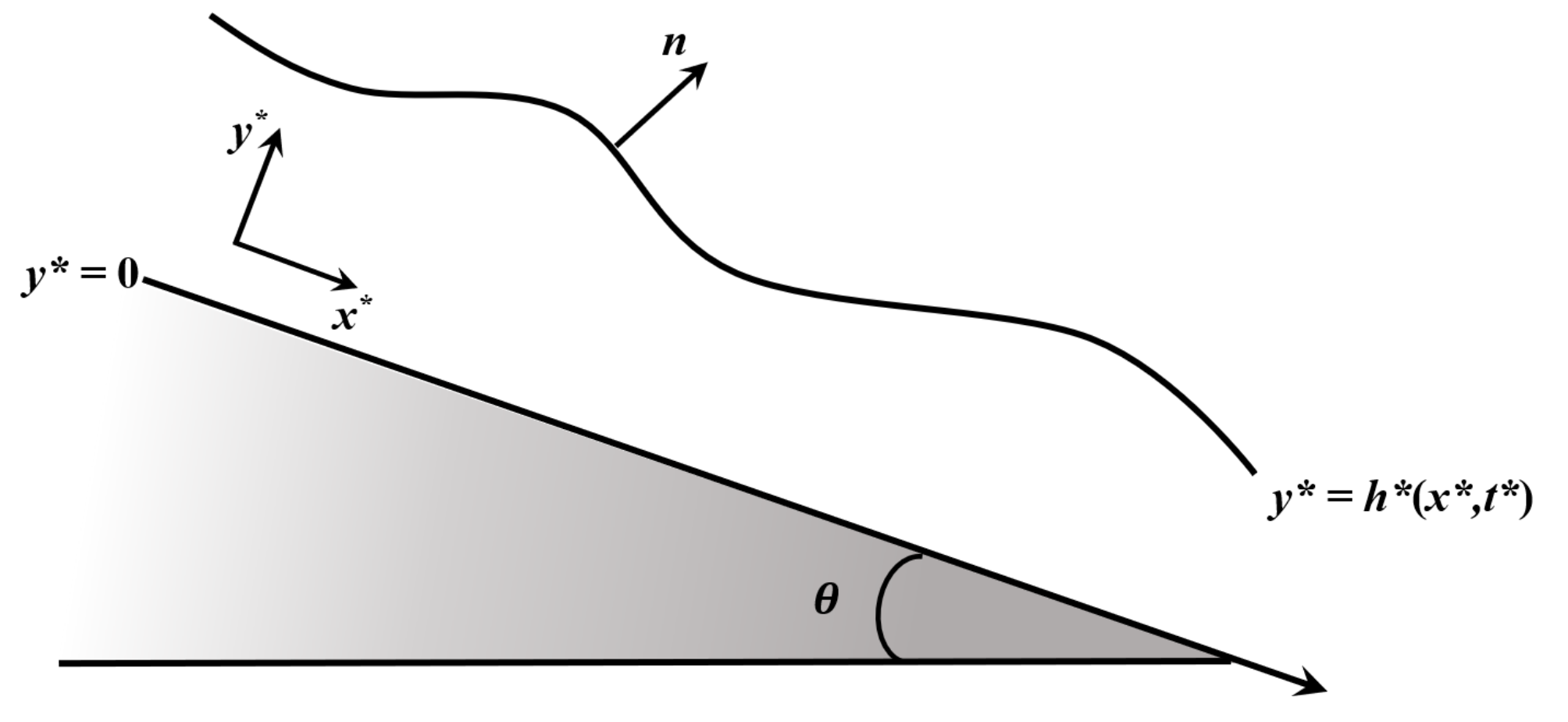
We proceed similarly to [10,16] briefly reporting the main theoretical background. Throughout the paper the “*” represents a dimensional quantity. Let us consider a reference framework as the one depicted in Figure 1. We denote the tilt angle as and suppose that the flow domain of the flow is given by
where is the length of the domain and is the upper free surface (not a priori known) and .
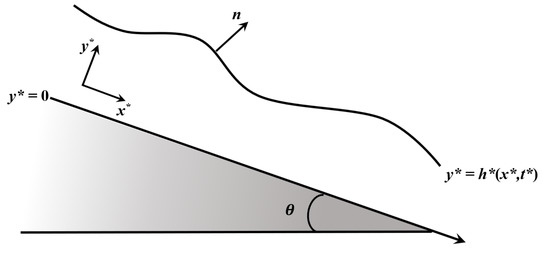
Figure 1.
Reference framework.
We denote by the Cauchy stress tensor and set
where is the deviatoric part.
The governing equations for the two-dimensional incompressible flow, , are
where is gravity and is the constant material density and, to take the notation as light as possible, we denote , , . We consider the non-slip and impermeability conditions on and the kinematical–dynamical conditions on , namely
where is the outer normal (see Figure 1).
Exploiting , we rewrite as
We introduce the characteristic quantities
and the strain-rate . Next, we consider the following dimensionless variables
where denotes the reference velocity which will be selected to normalize the dimensionless longitudinal velocity. Exploiting (5)–(7), the system (2) becomes
where
and
are the Reynolds number and Freude number, respectively.
Finally, we recall that the flow is driven prescribing the inlet discharge which we assume to be constant in time. So, denoting as the flow rate per unit fluid layer width, we have
provided that the layer is flat and its thickness is (which does not vary in time). From (9) and (10) we have
Therefore, the flow rate can be rewritten in terms of and for given physical (, , ) and geometrical () parameters. In the sequel, we shall see that can be also expressed only on terms of the Reynolds number through the normalization of the dimensionless longitudinal velocity.
3. Regularized Casson
Similarly to [10,16,52], we introduce a dimensional regularization parameter into the dimensionless Casson model, setting
where , is the Bingham number, which represents the ratio between the yield stress and the characteristic viscous stress, with the yield stress, and , so that when we formally retrieve the Casson constitutive law [38].
We recall that for a regularized Bingham fluid the function r, see [10,16], is given by
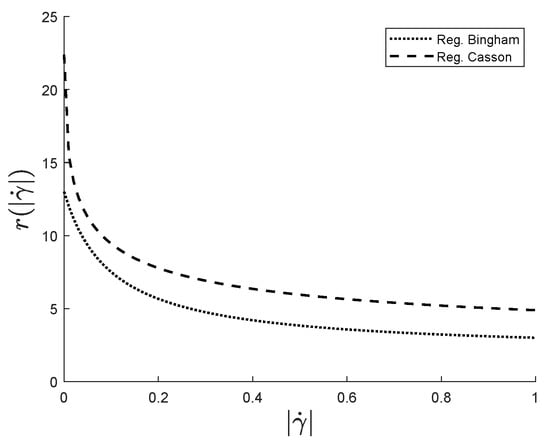
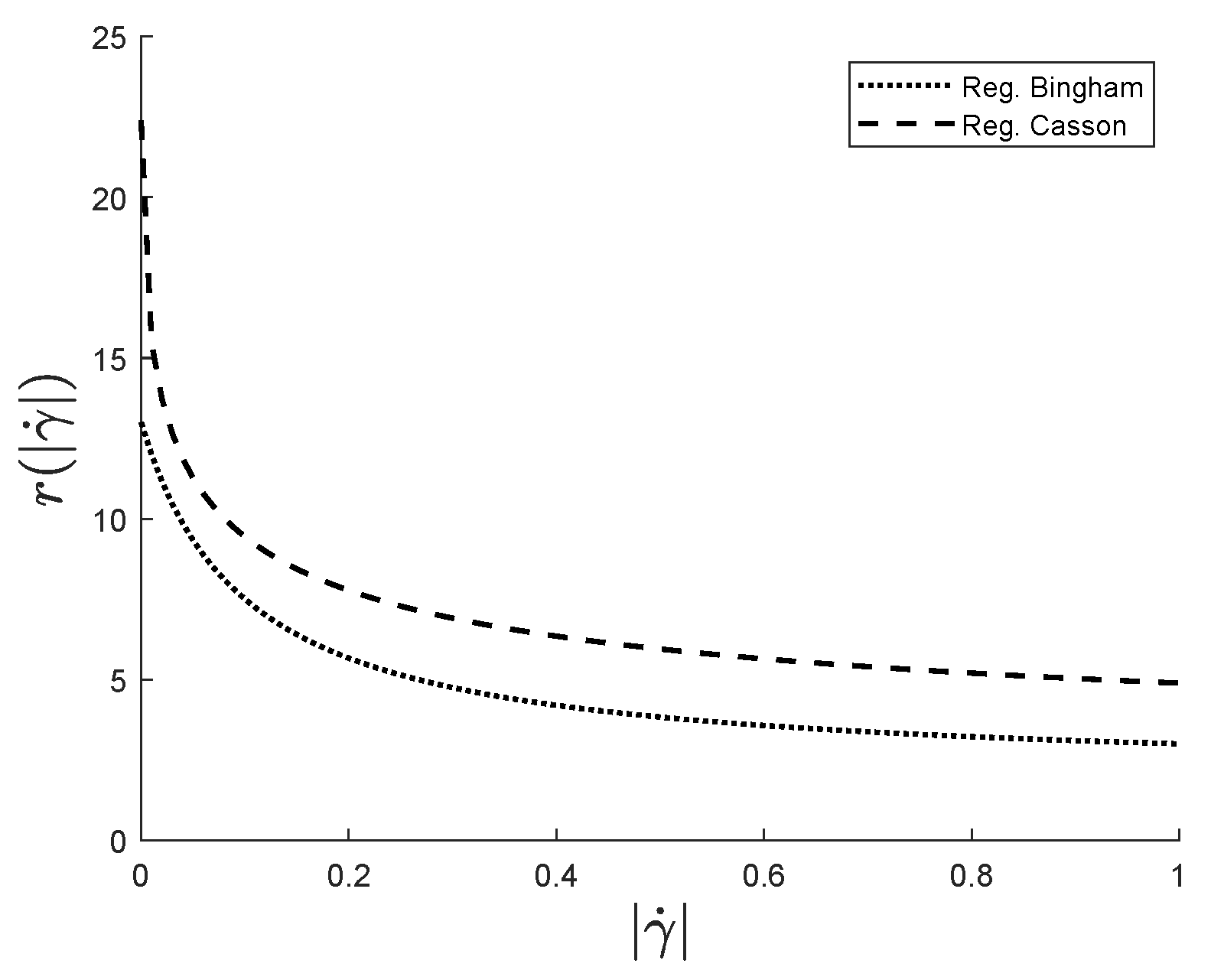
The plot of r, by using (13) and (14), with respect to for selected values of and is shown in Figure 2. In particular, the function gives the regularized relation between the shear stress and shear strain rate .
By using (9) and (10) the Bingham number and the regularization parameter can be rewritten in terms of , namely
with
and
with
respectively. The parameters and do not depend on the flow and on the tilt angle , so that the parameter X is constant once the fluid and the tilt angle have been selected, i.e., it depends only on the “material” and geometrical properties.
We look for a solution in the form , , thus system (8) is reduced to
which leads to
Thus, we have and, from (13)
which, by integrating with respect to y with , leads to
where
Now, we normalize the velocity of the free surface so that , obtaining the implicit relation between and , i.e.,
where
and
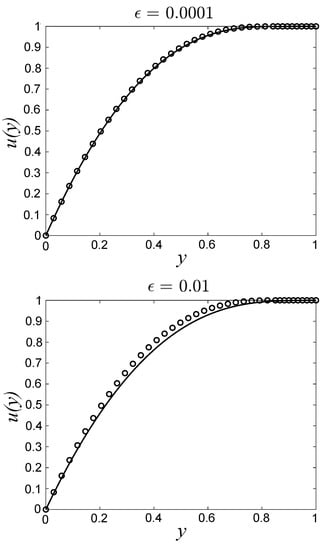
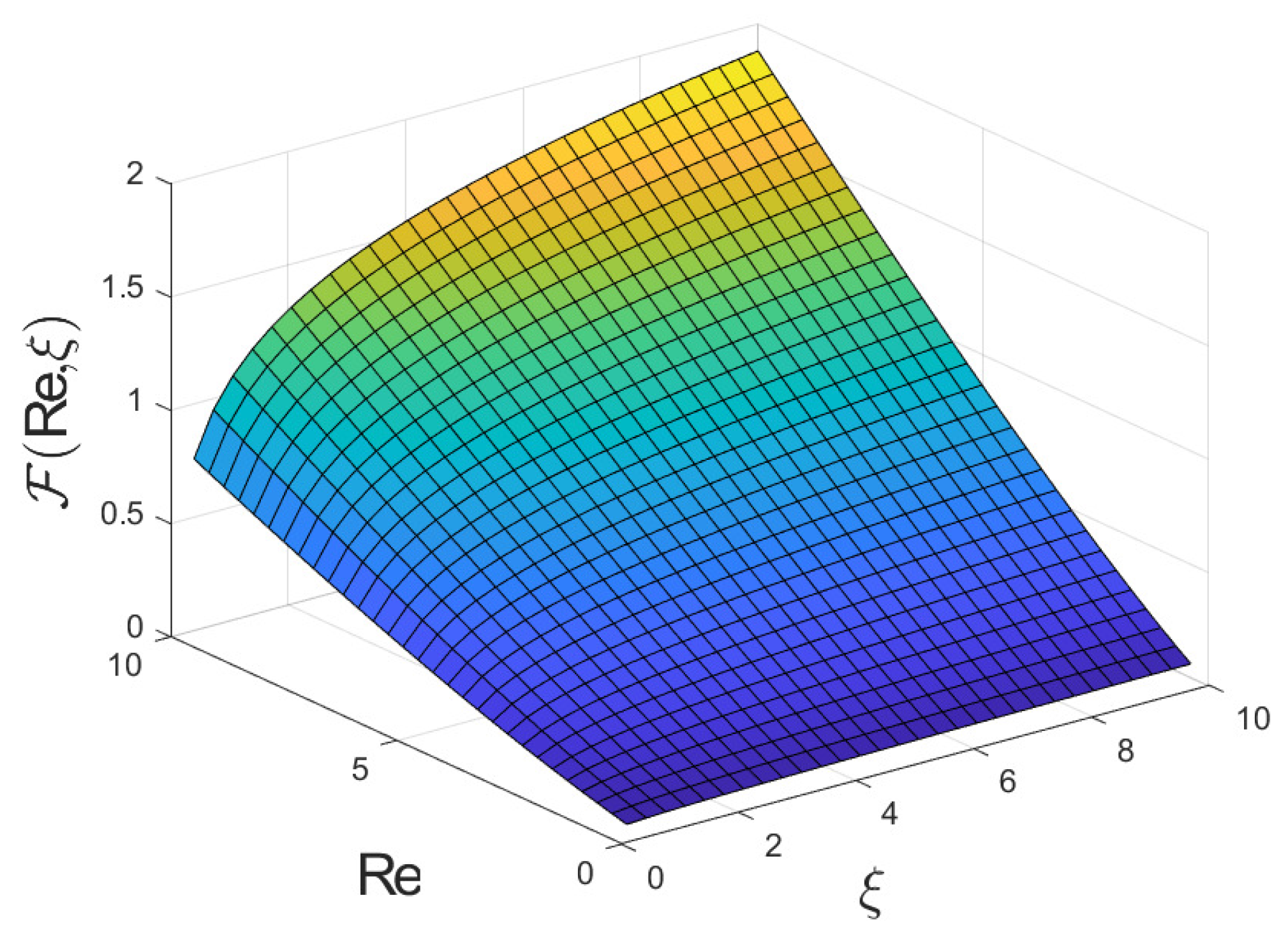
As expected, we obtain a one-to-one relation between and and we denote by the unique solution to (23) such that . The plot is displayed in Figure 3. Moreover, we recall that is expressed in terms of through (15), where now is the solution of (23). Relation (23) defines as which, as expected, is a one-to-one relation between Re and . The plot of is displayed in Figure 4, which highlights that, for given , , and , there exists a unique fulfilling (23). Consequently, recalling that Equation (23) derives from the normalization of u, for any Re we obtain a unique value of , which we denoted as , such that .
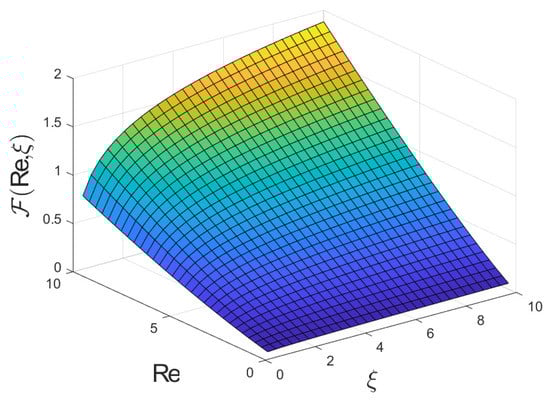
Figure 3.
Plot of for and for the regularized Casson model (given by (23)).
We remark that for we retrieve the Casson flow whose normalized velocity field is given by
with
is the flat yield surface [10,16]. The velocity field is normalized so that , i.e.,
that leads, using (15) and (27), to the following implicit relation between and
where
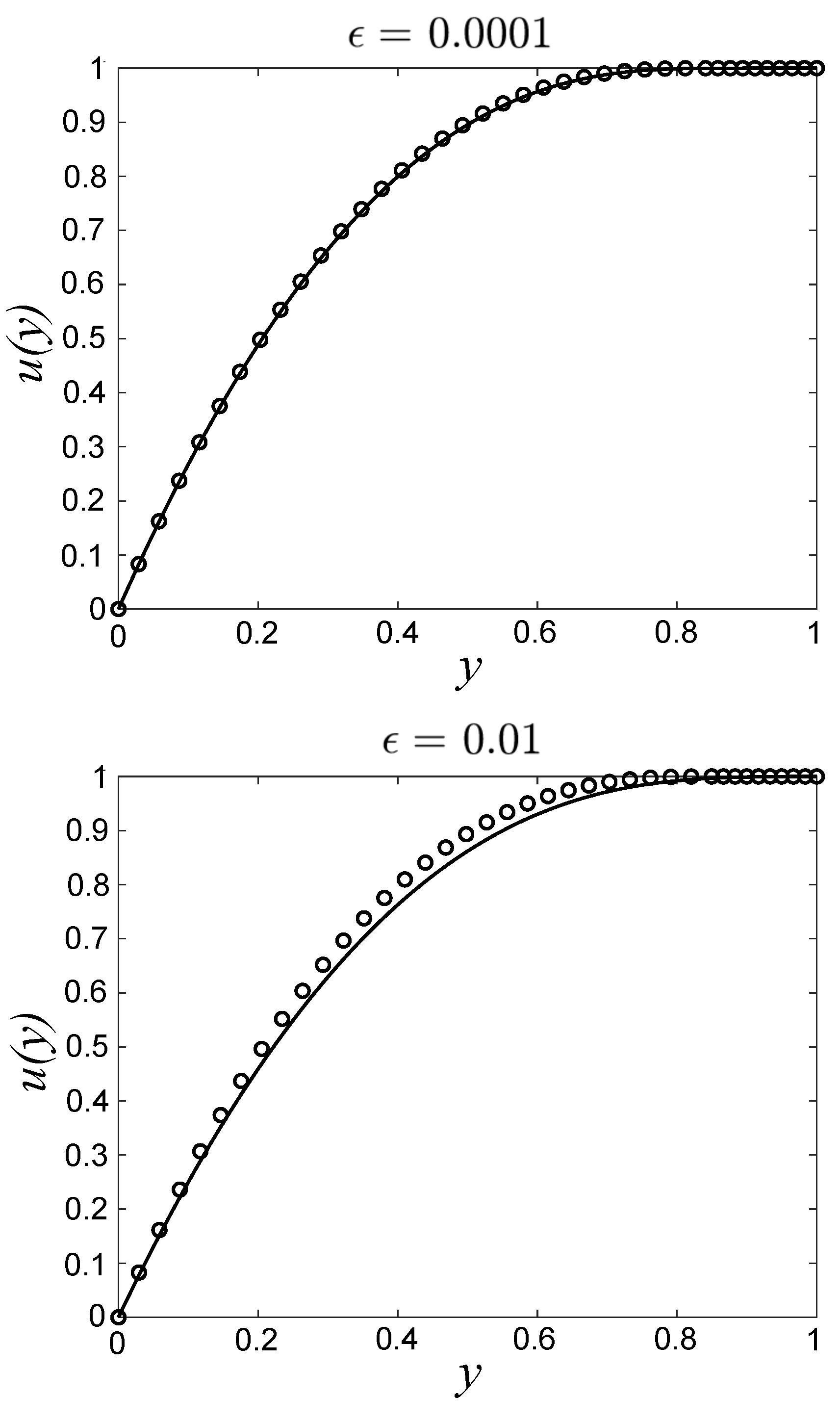
The regularized and the “exact” profiles of are given by (21) and (26), respectively. They become very similar when as shown in Figure 4.
It is worth noting that in case , i.e., Newtonian flow, Equation (23), for , and Equation (29) simply reduce to , whose trivial solution is .
The equations governing the regularized and exact Bingham flow have been reported in [10]. In this paper, we have adopted the same notations as in [10], thus the comparison between the two models can be performed easily.
4. Linear Stability Furthermore, Long-Wave Approximation
In this section, we briefly recall the main characteristic of the linear stability analysis as reported in [10,16,51] and we refer the readers to [10,16] for more details on the derivation of the formulas here summarized.
We consider the basic flow consisting of , with , with given by (21), and, where, recalling (20), Then, we perturb the basic flow superimposing small disturbances, in the form of travelling waves, so that
and
where is the wave number, is the complex wave speed and the notation represents the infinitesimal disturbance. We write the velocity field in terms of the stream function, i.e.,
as
where, here and in the sequel, denotes the differentiation with regard to y. Defining by and the real and imaginary part of c, we recall that gives the growth/attenuation factor of the mode. Hence, the basic flow , , is unstable when the parameters involved in the problem, namely , , and , are selected so that . The transition between the two regimes is identified by the so-called marginal or neutral curve, i.e., the set of , , and at which .
Then, we consider disturbances of long wavelength , i.e., , expanding and c in powers of up to the first order in , namely
where and solve
and
with
and r given by (13). In particular, we have that , while , thus
In particular, we can find the critical value of , denoted as , such that
by prescribing the material characteristics and the tilt angle (i.e., , , and ). Hence, for the mode is stable, while instability arises when , since for and vice versa. Moreover, we eventually remark that the identification of means, from the practical point of view, the identification of a critical discharge, , above which the flow becomes unstable.
5. Results
The critical value of the Reynolds number, , is computed by solving the system given by the system of algebraic Equations (23) and (38) with MATLAB® 2022a, using the function fsolve.
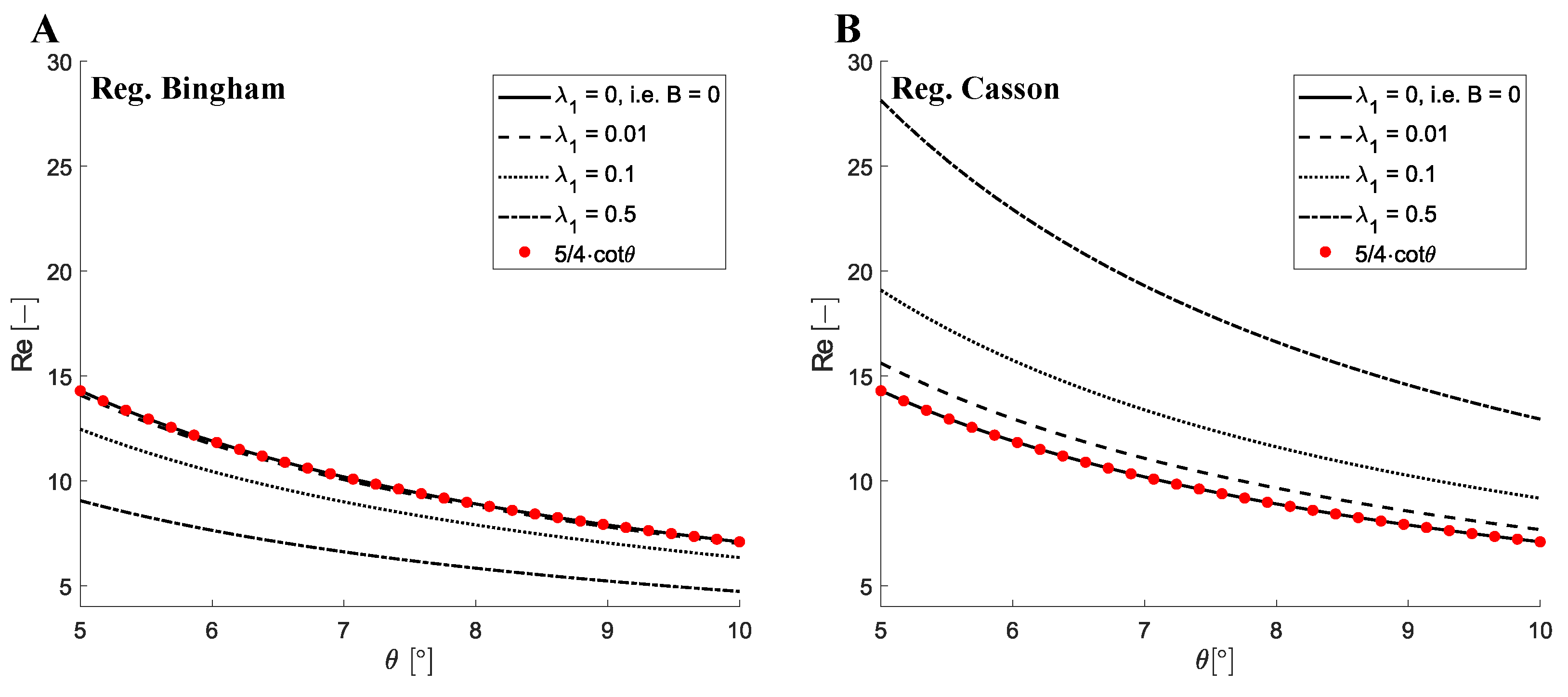
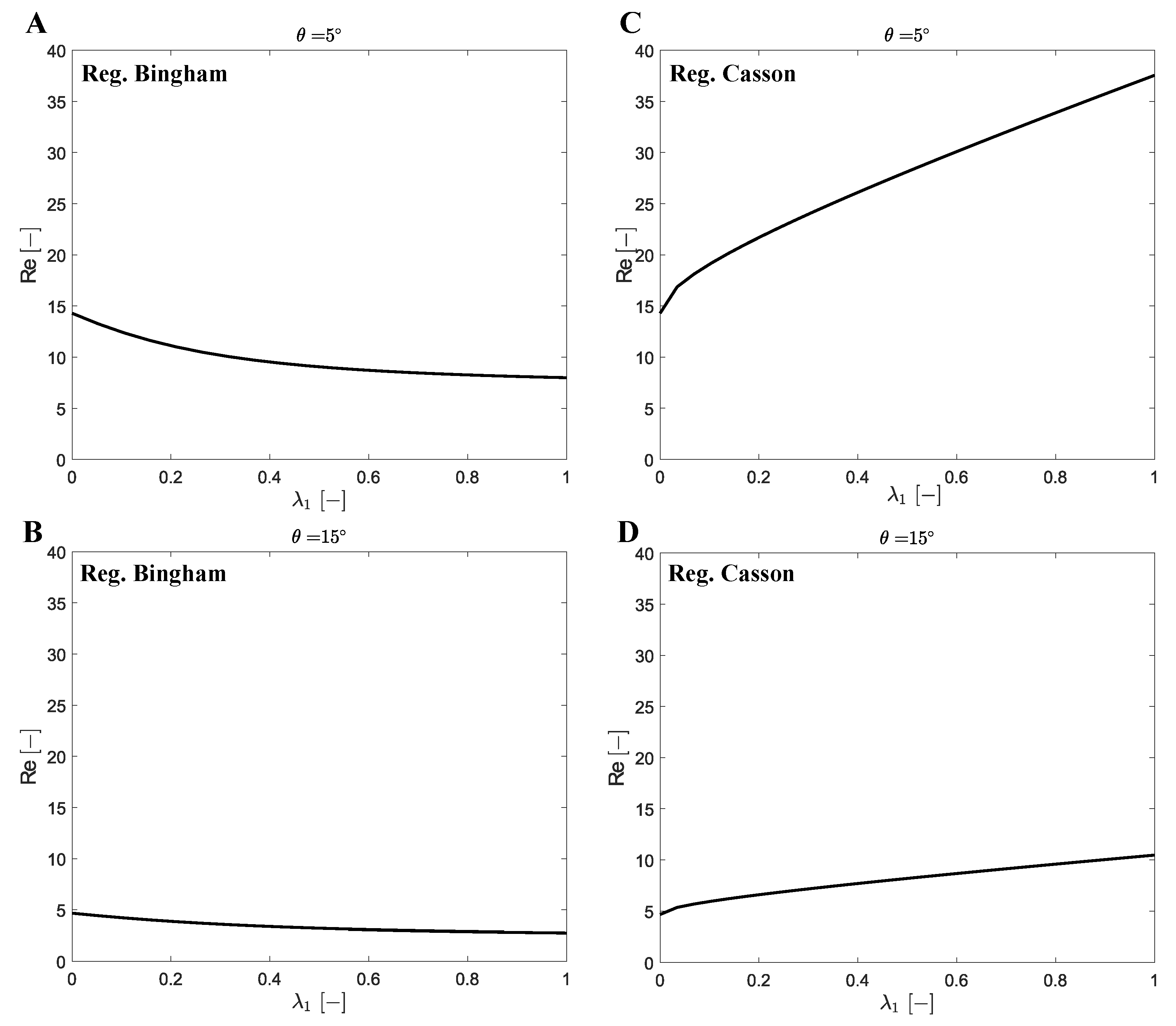
Figure 5 shows the variation of with respect to the tilt angle for different value of the material parameter , when by considering the regularized Bingham and Casson model. Similar to [10], at a given , decreases for increasing values of and coincides with , when , i.e., . However, recalling the proportionality relation (16) between and , we have that (see Figure 5A) the yield stress destabilizes the flow when this is modelled using a regularized Bingham flow, while (see Figure 5B) the regularized Casson flow is more stable than the Newtonian flow (i.e., the yield stress has a stabilizing effect on the flow when the material is modelled as a regularized Casson fluid). Coherently, in the case of regularized Casson fluid, Rec is an increasing function of , namely an increase in the yield stress leads to a flow stabilization (Figure 6C,D). For the regularized Bingham, we have an opposite behaviour. Indeed, Figure 6A,B highlight that decreases as (i.e., ) increases. Moreover, it is worth noting that, as physically expected, an increase of leads to flow destabilization in both cases.
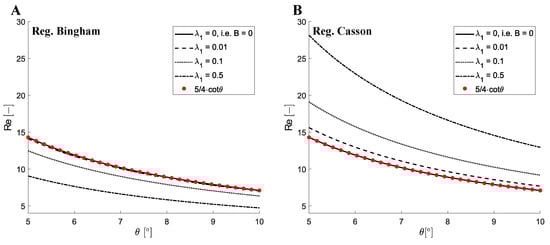
Figure 5.
Evolution of the critical Reynolds number, , with respect to the tilt angle, , with for different values of in the case of the flow modelled as a regularized Bingham (A) and regularized Casson (B) fluid. The theoretical Newtonian flow (i.e., ) is given by the red circles. The continuous line is the Newtoian flow computed by our code. We emphasize that the theoretical curve and the computed one coincide.
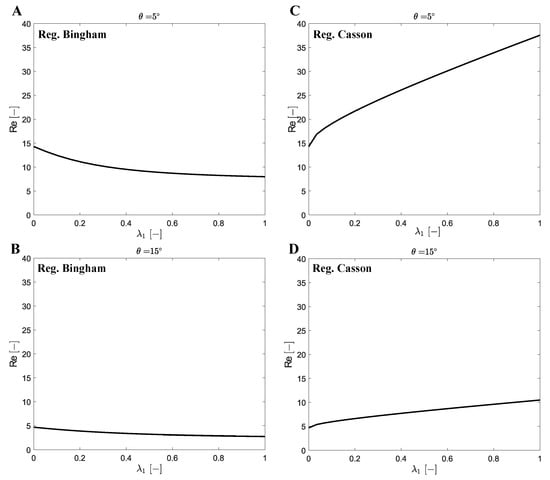
Figure 6.
Plot of the critical Reynolds number, , as a function of with for different values of for a regularized Bingham (A,B) and regularized Casson (C,D) fluid. The case of Newtonian flow corresponds to , i.e., .
In Table 1, we report the values of and when for various values of when a regularized Bingham and Casson models are considered. We notice that when , i.e., when the flow is Newtonian, as in [10]. Again, coherently with the results obtained in [10], as increases the superficial wave speed increases also for the regularized Casson fluid.

Table 1.
Values of and for given values of with and for both the regularized Bingham and Casson models.
6. Conclusions
In this paper, the stability analysis of a free surface regularized Casson flow down an incline has been theoretically investigated and compared to the one obtained for the regularized Bingham flow. In both cases the benchmark represented by the Newtonian case (i.e., when , thus ) has been recovered. Our results show that for a regularized Casson fluid increases with increasing values of the “material” parameter (that is proportional to see (16)), while for a regularized Bingham fluid decreases when (i.e., ) increases [10,16]. Therefore, our findings (obtained within the long-wave approximation method) show that the flow of the regularized Casson fluid is stabilized by increasing yield stress contrary to what happens with the regularized Bingham.
The stability analysis of the exact Bingham model, investigated in [16], shows that the flow down an incline is unconditionally stable for every Reynolds number. Therefore, our results are unexpected, highlighting that, although in a regularized formulation, models belonging to the same class of viscoplastic fluids can have stability characteristics completely different. Although we are not aware of any studies on the stability of the Casson fluid flowing down an incline, we suppose that the results of [12] can also be extended to this case. Therefore, we show that (as for the regularized Bingham fluid [10]) the regularized Casson can have stability properties that are different from the classic Casson flow. It is worth remarking that the our study has been developed by applying the long-wave approximation to the flow of regularized Bingham and Casson fluids down an incline.
We have in fact shown that the flow along an incline of a Casson-type material becomes increasingly stable as the yield stress increases. Exactly the opposite behaviour occurs with the Bingham fluid. Therefore, this feature can be used, from an experimental point of view, to highlight the difference between the two rheological models. We believe that our results can pave the way to experimental studies on the flow down an incline.
Author Contributions
Conceptualization, B.C., L.I.P., L.F. and A.F.; methodology, B.C., L.I.P., L.F. and A.F.; software, B.C.; formal analysis, L.F. and A.F.; investigation, B.C., L.I.P., L.F. and A.F.; writing— original draft preparation, B.C., L.I.P., L.F. and A.F.; writing—review and editing, B.C., L.F. and A.F. All authors have read and agreed to the published version of the manuscript.
Funding
This research was partially supported by GNFM of Italian INDAM.
Informed Consent Statement
Not applicable.
Data Availability Statement
Not applicable.
Conflicts of Interest
The authors declare no conflict of interest.
References
- Bingham, E.C. Fluidity and Plasticity; McGraw-Hill: New York, NY, USA, 1922. [Google Scholar]
- Herschel, W.H.; Bulkley, R. Konsistenzmessungen von gummi-benzollosungen. Kolloid-Z. 1926, 39, 291–300. [Google Scholar] [CrossRef]
- Casson, N. A Flow Equation for Pigment-oil Suspensions of the Printing Ink Type. In Rheology of Disperse Systems; Mill, C.C., Ed.; Pergamon Press: Oxford, UK, 1959; pp. 84–104. [Google Scholar]
- Benjamin, T.B. Wave formation in laminar flow down an inclined plane. J. Fluid Mech. 1957, 2, 554. [Google Scholar] [CrossRef]
- Yih, C.-S. Stability of liquid flow down an inclined plane. Phys. Fluids 1963, 6, 321. [Google Scholar] [CrossRef]
- Liu, J.; Paul, J.D.; Gollub, J.P. Measurements of the primary instabilities of film flows. J. Fluid Mech. 1993, 250, 69–101. [Google Scholar] [CrossRef]
- Allouche, M.H.; Millet, S.; Botton, V.; Henry, D.; Hadid, H.B.; Rousset, F. Stability of a flow down an incline with respect to two-dimensional and three-dimensional disturbances for Newtonian and non-Newtonian fluids. Phys. Rev. E 2015, 92, 063010. [Google Scholar] [CrossRef]
- Allouche, M.H.; Botton, V.; Millet, S.; Henry, D.; Dagois-Bohy, S.; Güzel, B.; Hadid, H. B. Primary instability of a shear-thinning film flow down an incline: Experimental study. J. Fluid Mech. 2017, 821, R1. [Google Scholar] [CrossRef]
- Balmforth, N.J.; Liu, J.J. Roll waves in mud. J. Fluid Mech. 2004, 519, 33–54. [Google Scholar] [CrossRef]
- Calusi, B.; Farina, A.; Fusi, L.; Rosso, F. Long-wave instability of a regularized Bingham flow down an incline. Phys. Fluids 2022, 34, 054111. [Google Scholar] [CrossRef]
- Chakraborty, S.; Sheu, T.W.-H.; Ghosh, S. Dynamics and stability of a power-law film flowing down a slippery slope. Phys. Fluids 2019, 31, 013102. [Google Scholar] [CrossRef]
- Falsaperla, P.; Giacobbe, A.; Mulone, G. Stability of the plane Bingham–Poiseuille flow in an inclined channel. Fluids 2020, 5, 141. [Google Scholar] [CrossRef]
- Fernandez-Nieto, E.D.; Noble, P.; Vila, J.-P. Shallow water equations for non-Newtonian fluids. J. Non-Newtonian Fluid Mech. 2010, 165, 712–732. [Google Scholar] [CrossRef]
- Forterre, Y.; Pouliquen, O. Long-surface-wave instability in dense granular flows. J. Fluid Mech. 2003, 486, 21–50. [Google Scholar] [CrossRef]
- Fusi, L. Channel flow of viscoplastic fluids with pressure-dependent rheological parameters. Phys. Fluids 2018, 30, 073102. [Google Scholar] [CrossRef]
- Fusi, L.; Calusi, B.; Farina, A.; Rosso, F. Stability of laminar viscoplastic flows down an inclined open channel. Eur. J. Mech.-B/Fluid 2022, 95, 137–147. [Google Scholar] [CrossRef]
- Hu, J.; Millet, S.; Botton, V.; Hadid, H.B.; Henry, D. Inertialess temporal and spatio-temporal stability analysis of the two-layer film flow with density stratification. Phys. Fluids 2006, 18, 104101. [Google Scholar] [CrossRef]
- Hu, J.; Yin, X.Y.; Hadid, H.B.; Henry, D. Linear temporal and spatiotemporal stability analysis of two-layer falling films with density stratification. Phys. Rev. E 2008, 77, 026302. [Google Scholar] [CrossRef]
- Hu, J.; Hadid, H.B.; Henry, D.; Mojtabi, A. Linear temporal and spatiotemporal stability analysis of a binary liquid film flowing down an inclined uniformly heated plate. J. Fluid Mech. 2008, 599, 269–298. [Google Scholar] [CrossRef]
- Hu, T.; Fu, Q.F.; Xing, Y.; Yang, L.J.; Xie, L. Stability of a thin viscoelastic film falling down an inclined plane. Phys. Rev. Fluids 2021, 6, 083902. [Google Scholar] [CrossRef]
- Métivier, C.; Nouar, C. Stability of a Rayleigh–Bénard Poiseuille flow for yield stress fluids—Comparison between Bingham and regularized models. Int. J. Non-Linear Mech. 2011, 46, 1205–1212. [Google Scholar] [CrossRef]
- Millet, S.; Botton, V.; Rousset, F.; Hadid, H.B. Wave celerity on a shearthinning fluid film flowing down an incline. Phys. Fluids 2008, 20, 031701. [Google Scholar] [CrossRef]
- Millet, S.; Botton, V.; Hadid, H.B.; Henry, D.; Rousset, F. Stability of twolayer shear-thinning film flows. Phys. Rev. E 2013, 88, 043004. [Google Scholar] [CrossRef]
- Millet, S.; Usha, R.; Botton, V.; Rousset, F. The mechanism of long-wave instability in a shear-thinning film flow on a porous substrate. Acta Mech. 2019, 230, 2201–2220. [Google Scholar] [CrossRef]
- Mogilevskiy, E. Stability of a non-Newtonian falling film due to three-dimensional disturbances. Phys. Fluids 2020, 32, 073101. [Google Scholar] [CrossRef]
- Ng, C.-O.; Mei, C.C. Roll waves on a shallow layer of mud modelled as a power-law fluid. J. Fluid Mech. 1994, 263, 151–184. [Google Scholar] [CrossRef]
- Noble, P.; Vila, J.-P. Thin power-law film flow down an inclined plane: Consistent shallow-water models and stability under large-scale perturbations. J. Fluid Mech. 2013, 735, 29–60. [Google Scholar] [CrossRef]
- Mounkaila Noma, D.; Dagois-Bohy, S.; Millet, S.; Botton, V.; Henry, D.; Ben Hadid, H. Primary instability of a visco-plastic film down an inclined plane: Experimental study. J. Fluid Mech. 2021, 922, R2. [Google Scholar] [CrossRef]
- Nsom, B.; Ramifidisoa, L.; Latrache, N.; Ghaemizadeh, F. Linear stability of shear-thinning fluid down an inclined plane. J. Mol. Liquids 2019, 277, 1036–1046. [Google Scholar] [CrossRef]
- Pascal, J.P.; D’Alessio, S.J.D. Instability of power-law fluid flows down an incline subjected to wind stress. Appl. Math. Model. 2007, 31, 1229–1248. [Google Scholar] [CrossRef]
- Rousset, F.; Millet, S.; Botton, V.; Hadid, H.B. Temporal stability of carreau fluid flow down an incline. J. Fluids Eng. 2007, 129, 913–920. [Google Scholar] [CrossRef]
- Ruyer-Quil, C.; Chakraborty, S.; Dandapat, B.S. Wavy regime of a powerlaw film flow. J. Fluid Mech. 2012, 692, 220–256. [Google Scholar] [CrossRef]
- Merrill, E.W.; Margetts, W.G.; Cokelet, G.C.; Gilliland, E.R. The Casson equation and rheology of the blood near shear zero. In Proceedings Fourth International Congress on Rheology; Copley, A.L., Ed.; Interscience: New York, NY, USA, 1965; Part 4; pp. 135–143. [Google Scholar]
- Farina, A.; Fasano, A.; Rosso, F. Mathematical models for some aspects of blood microcirculation. Symmetry 2021, 13, 1020. [Google Scholar] [CrossRef]
- Fasano, A.; Sequeira, A. Hemomath: The Mathematics of Blood; Springer: Berlin/Heidelberg, Germany, 2017. [Google Scholar]
- Charakopoulos, A.; Karakasidis, T.; Sarris, I. Analysis of magnetohydrodynamic channel flow through complex network analysis. Chaos 2021, 31, 043123. [Google Scholar] [CrossRef] [PubMed]
- Fusi, L. Lubrication flow of a generalized Casson fluid with pressure-dependent rheological parameters. J. Non-Newton. Fluid Mech. 2019, 274, 104199. [Google Scholar] [CrossRef]
- Guadagli, S.; Palade, L.I.; Fusi, L.; Farina, A. On a Casson Fluid Motion: Nonuniform Width Symmetric Channel and Peristaltic Flows. Fluids 2021, 6, 356. [Google Scholar] [CrossRef]
- Reddy, M.G.; Kumara, B.C.P.; Makinde, O.D. Cross Diffusion Impacts on Hydromagnetic Radiative Peristaltic Carreau-Casson Nanofluids Flow in an Irregular Channel. Defect Diffus. Forum 2017, 377, 62–83. [Google Scholar] [CrossRef]
- Sofos, F.; Karakasidis, T.; Spetsiotis, D. Molecular dynamics simulations of ion separation in nano-channel water flows using an electric field. Mol. Simul. 2019, 45, 1395–1402. [Google Scholar] [CrossRef]
- Song, L.; Huo, X.; Zhang, L.; Xie, Y.; Yang, M. Fast estimation on the pressure of detonation products of cyclotetramethylene tetranitramine through molecular dynamics simulations. Int. J. Mod. Phys. B 2021, 35, 2150106. [Google Scholar] [CrossRef]
- Astarita, G. Letter to the editor: The engineering reality of the yield stress. J. Rheol. 1990, 34, 275–277. [Google Scholar] [CrossRef]
- Barnes, H.A. The yield stress—A review or ‘πανταρϵι’—Everything flows? J. Non-Newton. Fluid Mech. 1999, 81, 133–178. [Google Scholar] [CrossRef]
- Barnes, H.A.; Walters, K. The yield stress myth? Rheol. Acta 1985, 24, 323–326. [Google Scholar] [CrossRef]
- Frigaard, I.; Nouar, C. On the usage of viscosity regularisation methods for visco-plastic fluid flow computation. J. Non-Newton. Fluid Mech. 2005, 127, 1–26. [Google Scholar] [CrossRef]
- Frigaard, I.A.; Paso, K.G.; de Souza Mendes, P.R. Bingham’s model in the oil and gas industry. Rheol. Acta 2017, 56, 259–282. [Google Scholar] [CrossRef]
- Fusi, L.; Farina, A.; Rosso, F. On the mathematical paradoxes for the flow of a viscoplastic film down an inclined surface. Int. J. Non-Linear Mech. 2014, 58, 139–150. [Google Scholar] [CrossRef]
- Fusi, L.; Farina, A.; Rosso, F. Roscani, S. Pressure driven lubrication flow of a Bingham fluid in a channel: A novel approach. J. Non-Newtonian Fluid Mech. 2015, 221, 66–75. [Google Scholar] [CrossRef]
- Bercovier, M.; Engleman, M. A finite-element method for incompressible non-Newtonian flows. J. Comput. Phys. 1980, 36, 313–326. [Google Scholar] [CrossRef]
- Papanastasiou, T.C. Flows of materials with yield. J. Rheol. 1987, 31, 385–404. [Google Scholar] [CrossRef]
- Pascal, J. P. Linear stability of fluid flow down a porous inclined plane. J. Phys. D Appl. Phys. 1999, 32, 417. [Google Scholar] [CrossRef]
- Allouche, M.; Frigaard, I.A.; Sona, G. Static wall layers in the displacement of two visco-plastic fluids in a plane channel. J. Fluid Mech. 2000, 424, 243–277. [Google Scholar] [CrossRef]
Publisher’s Note: MDPI stays neutral with regard to jurisdictional claims in published maps and institutional affiliations. |
© 2022 by the authors. Licensee MDPI, Basel, Switzerland. This article is an open access article distributed under the terms and conditions of the Creative Commons Attribution (CC BY) license (https://creativecommons.org/licenses/by/4.0/).