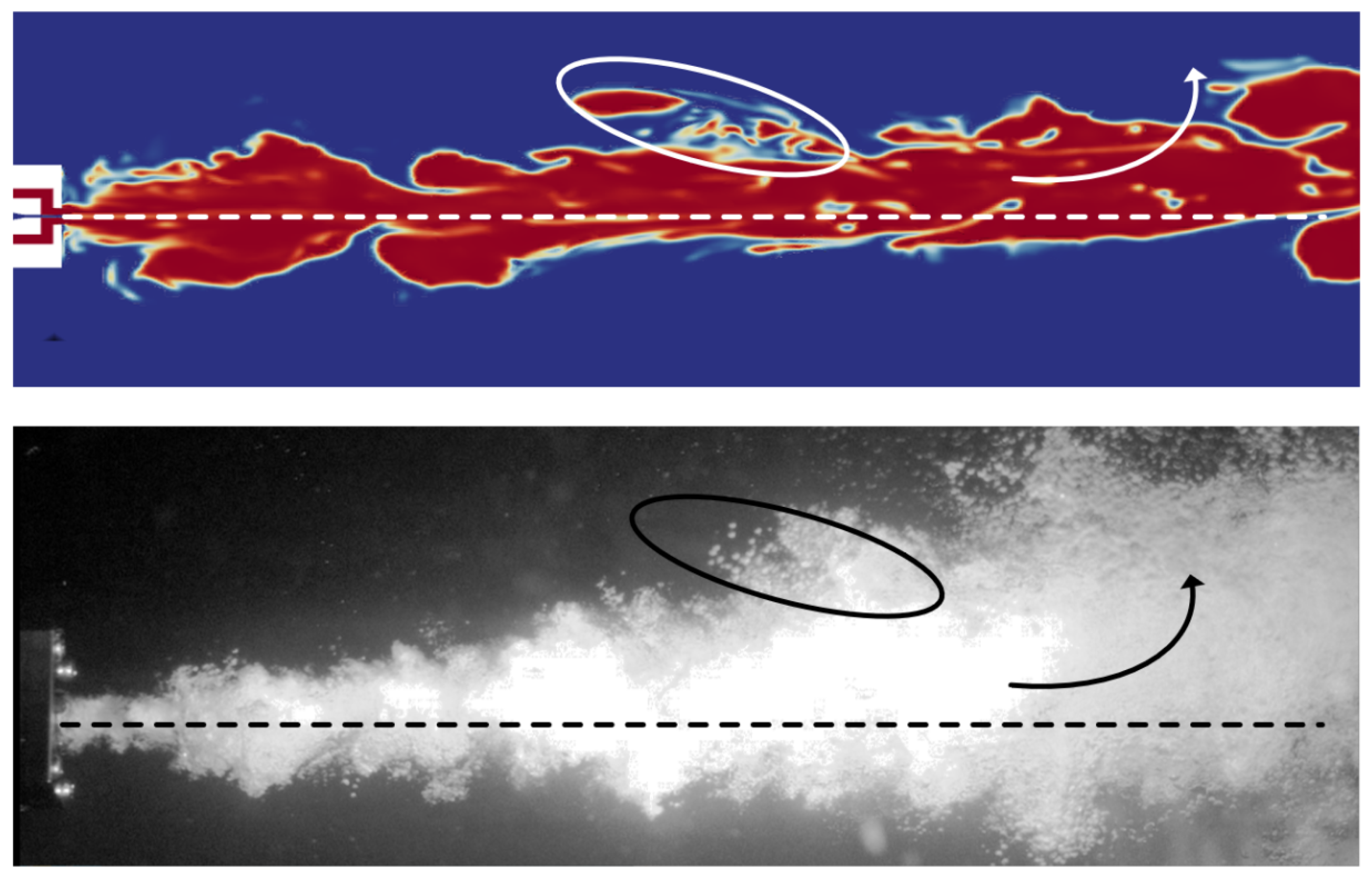
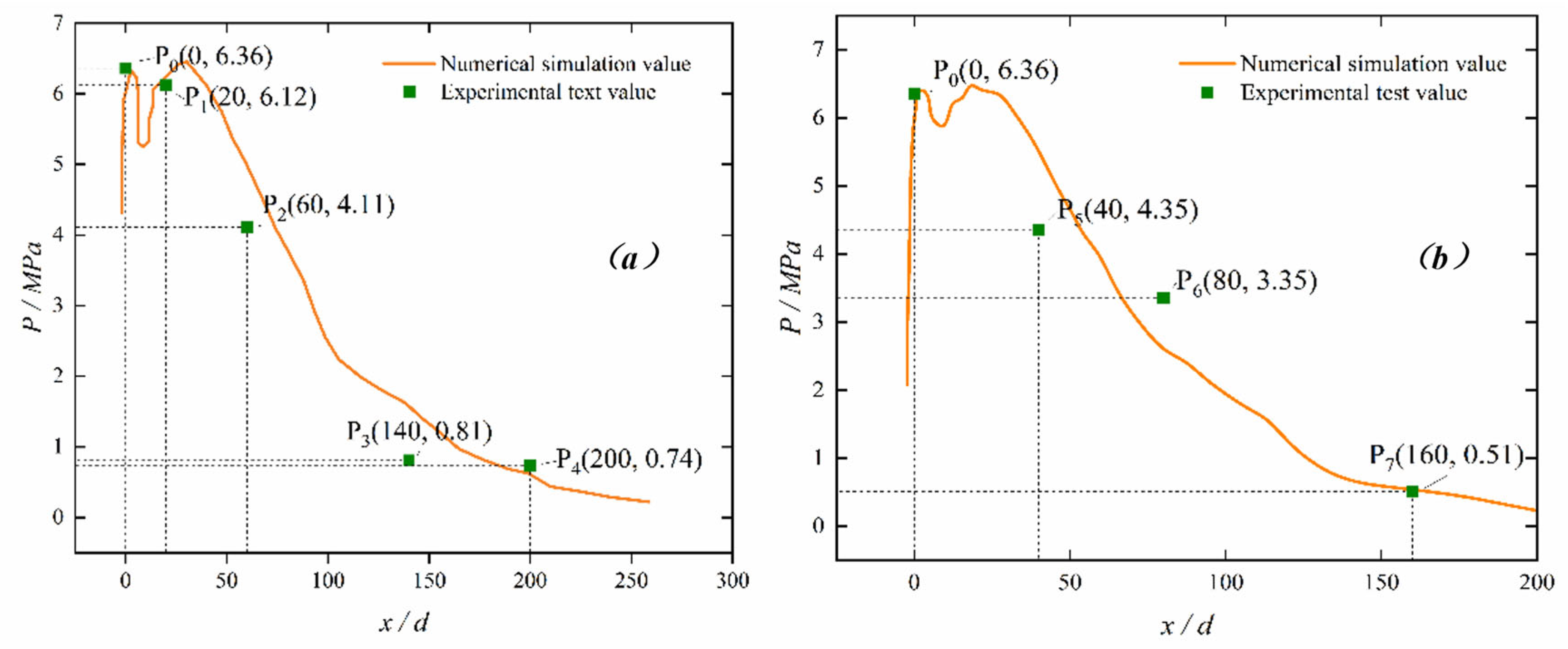
The structure of the jet flow field will be impacted by various jet generation parameters, which in turn determines the cleaning effect of the jet. In this study, a numerical simulation of the supercavitating high-pressure water jet was conducted, focusing on the analysis of the flow field structure, velocity field, and volume fraction. The flow field structure of the supercavitating high-pressure water jet was explored under two working conditions: unconstrained open space and semi-confined impact target, considering different operating parameters.
3.1. Typical Flow Regime Evolution Law in Unconstrained Supercavitating Jet
The evolution of the flow regime in an unconstrained jet within open spaces is impacted by multiple factors, including nozzle geometric parameters and working parameters, leading to present different flow characteristics. Through numerical simulation analysis, it was found by this study that the initial momentum of the liquid jet is primarily affected by variations in the working parameters of the water jet. More specifically, an augmentation in the initial momentum of the liquid jet facilitates an extension of the water jet’s core section distance. However, under a submerged environment, when the liquid jet loses the protection of gas bubbles, its kinetic energy experiences a rapid decay. Consequently, gas bubbles hold a decisive role in shaping the flow regime evolution of a supercavitating jet. Preliminary calculations have revealed the existence of three typical flow regimes in a supercavitating jet. Hence, this section aims to provide an in-depth elaboration on the flow regime of three typical flow fields represented by the three gas supply parameters: low (40 L/min), medium (100 L/min), and high (200 L/min).
- (1)
The gas supply rate is 40 L/min.
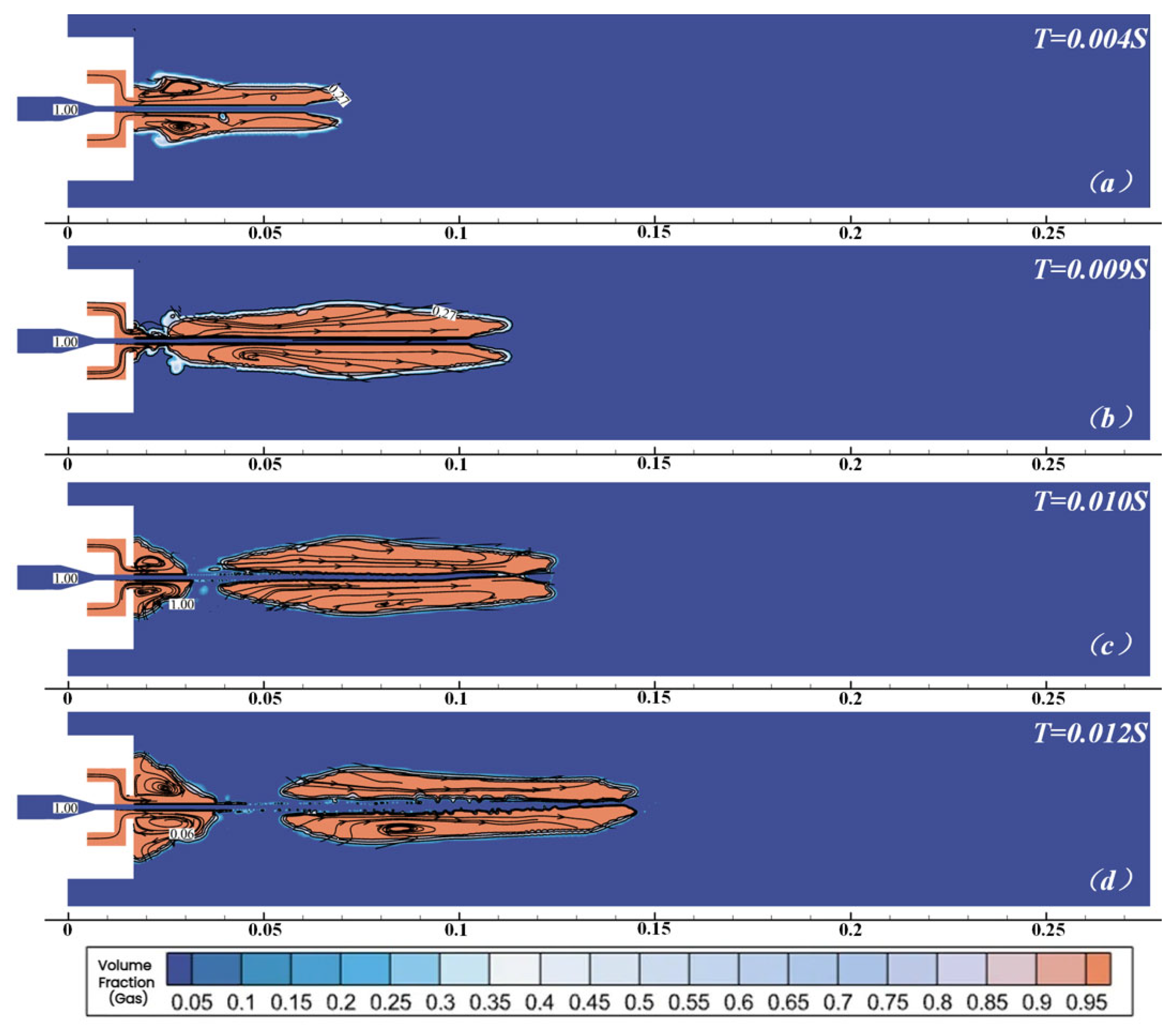
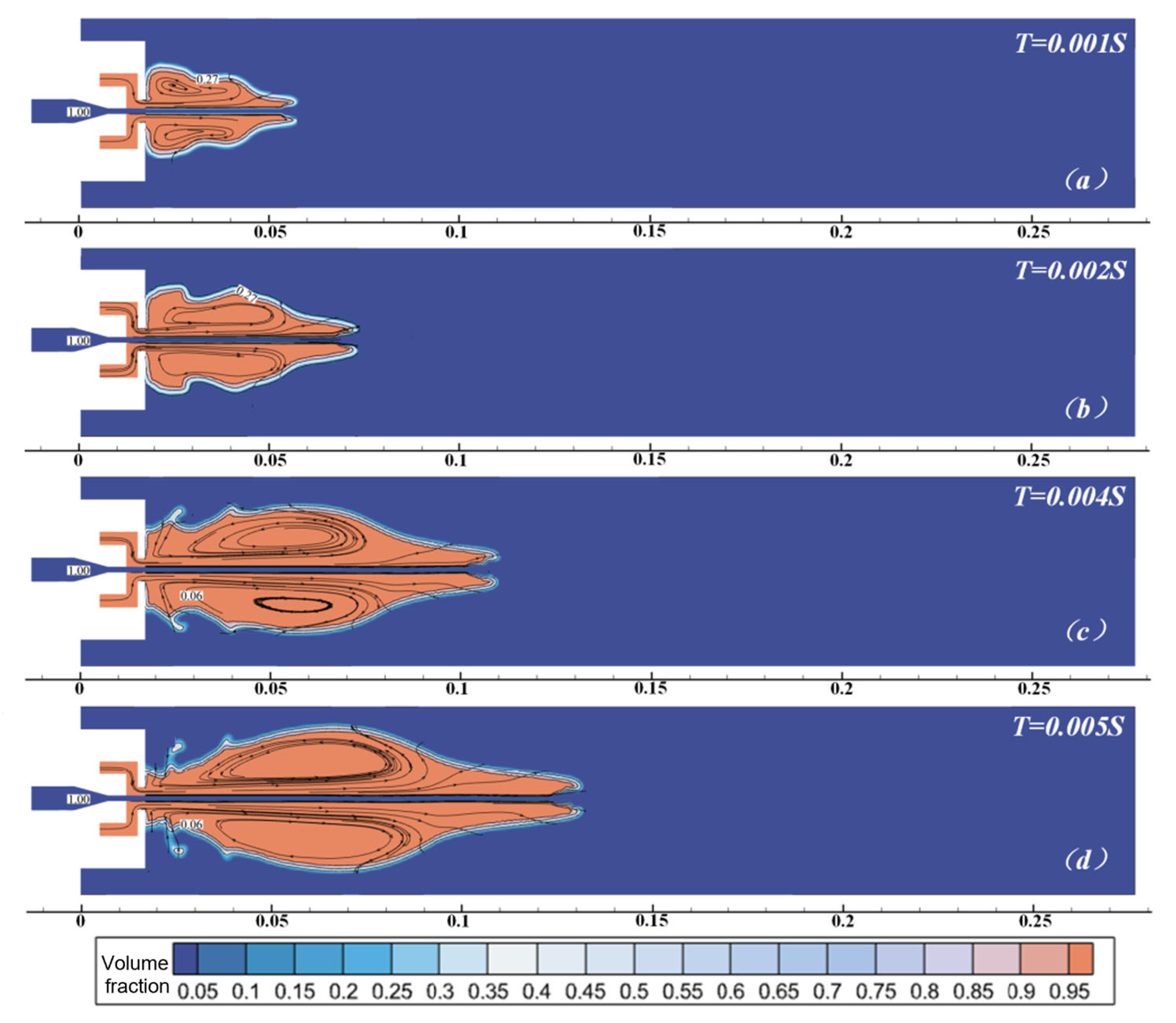
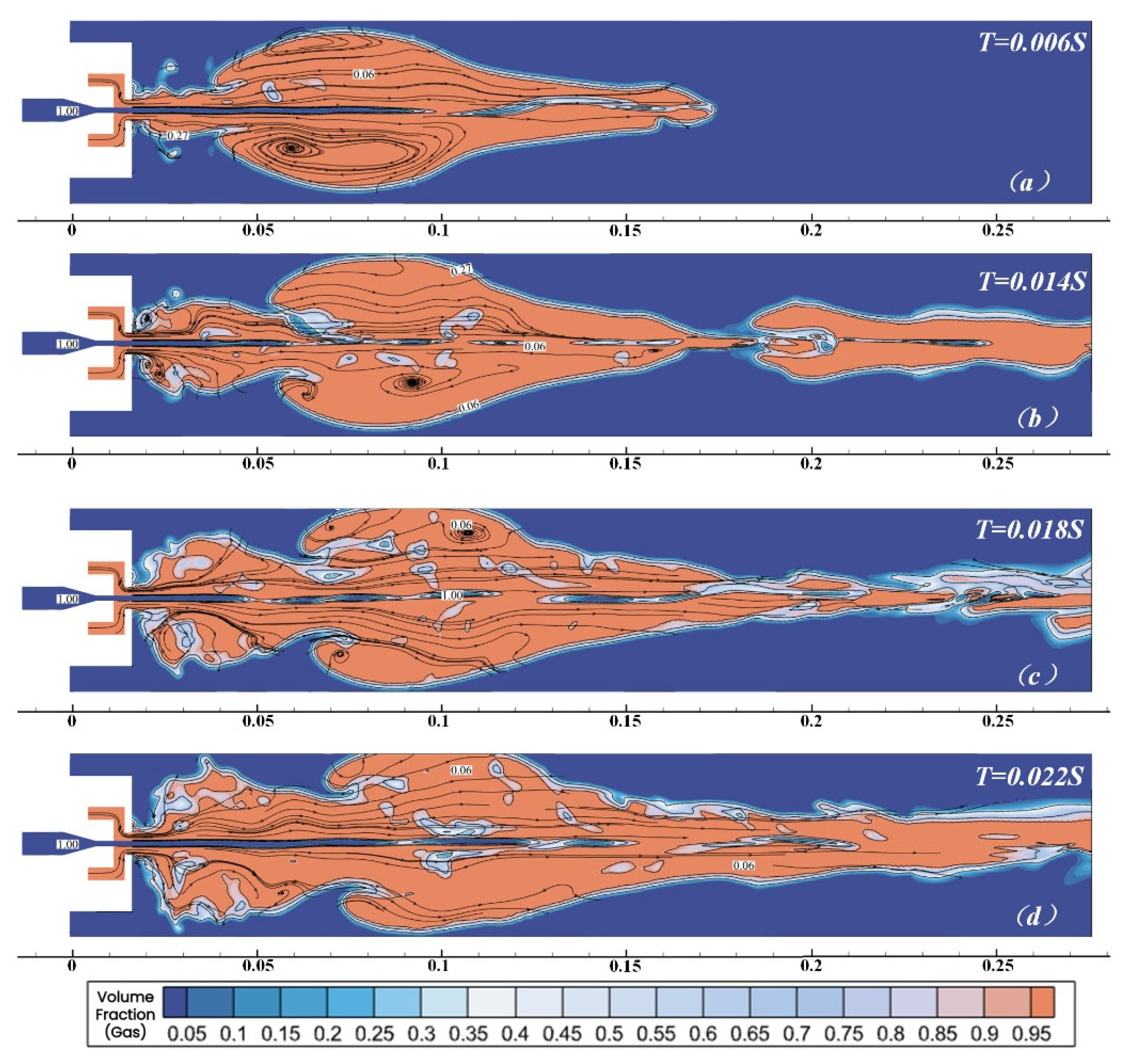
Figure 12 illustrates the distribution cloud map of gas and liquid volume fraction in the initial stage of jet development under unconstrained conditions. The working parameters are defined as follows: the pressure at the water jet nozzle inlet is defined as 10 MPa, the diameter of the water jet nozzle is defined as 1 mm, the diameter of the water jet nozzle outlet is defined as 6 mm, and the gas supply rate at the nozzle is defined as 40 L/min.
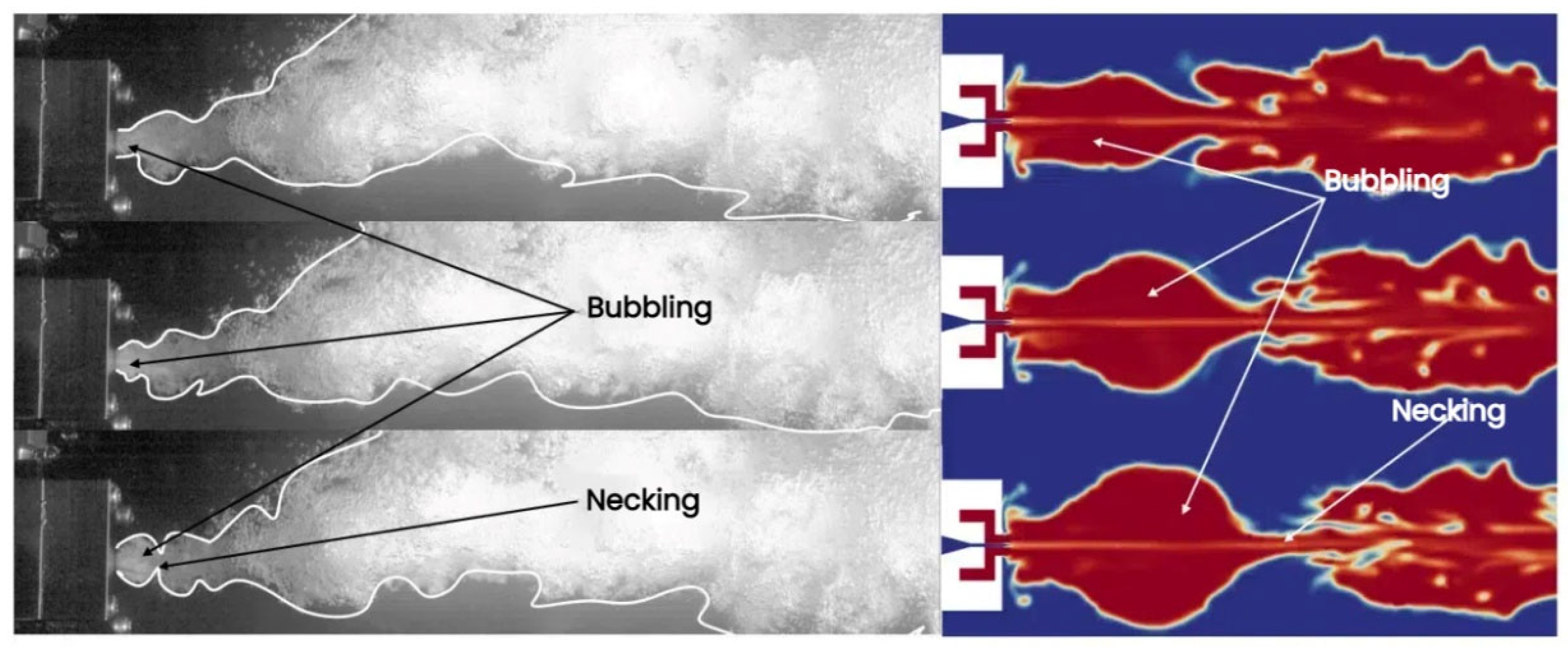
In the initial stage of gas cavity formation (0.004 s), the gas cavity is not completely formed due to the small intake volume and the large momentum of the liquid jet. The front liquid jet, lacking the package of low-viscosity cavity areas, is directly exposed to the environmental medium. Consequently, the momentum of the liquid jet rapidly decays within a short period of time. Under submerged conditions, the development of the gas jet is significantly restricted due to the much higher density of the environmental medium compared to air. This results in uneven surface forces on the gas cavity, particularly in downstream areas where gas momentum is relatively low, hindering the development of a gas cavity at the top. However, the newly added gas jet at the rear maintains a large momentum. After being obstructed at the front end, a bubbling area gradually forms outside the jet, leading to the creation of a large vortex. This vortex structure induces external deformation of the jet and induces a trend of inward rotation in the external gas.
As the jet continues to develop, its flow regime evolution is observed to have transitioned into a novel phase. The necking phenomenon, triggered by the progression of vortices, has manifested at the rear of the initial cavity. This necking is attributed to the inward suction of internal vortices, which progressively penetrate the core area of the water jet. A deficiency in gas supply results in the low momentum of the subsequent gas replenishment, challenging the maintenance of cavity continuity with the gas of diminished momentum, as illustrated in
Figure 12c. When necking occurs, a water jet area emerges, devoid of an air envelope. Consequently, the evolution of the flow regime during this stage exerts an adverse influence on the stability of the water jet.
As depicted in
Figure 12d, with the further progression of the jet, cavities are reformed in the vicinity of the nozzle. Influenced by the resistance of the external medium, a bubbling structure similar to that of the previous cavity is exhibited by these newly formed cavities. Within the jet cavity, new inward rotating vortices are gradually formed.
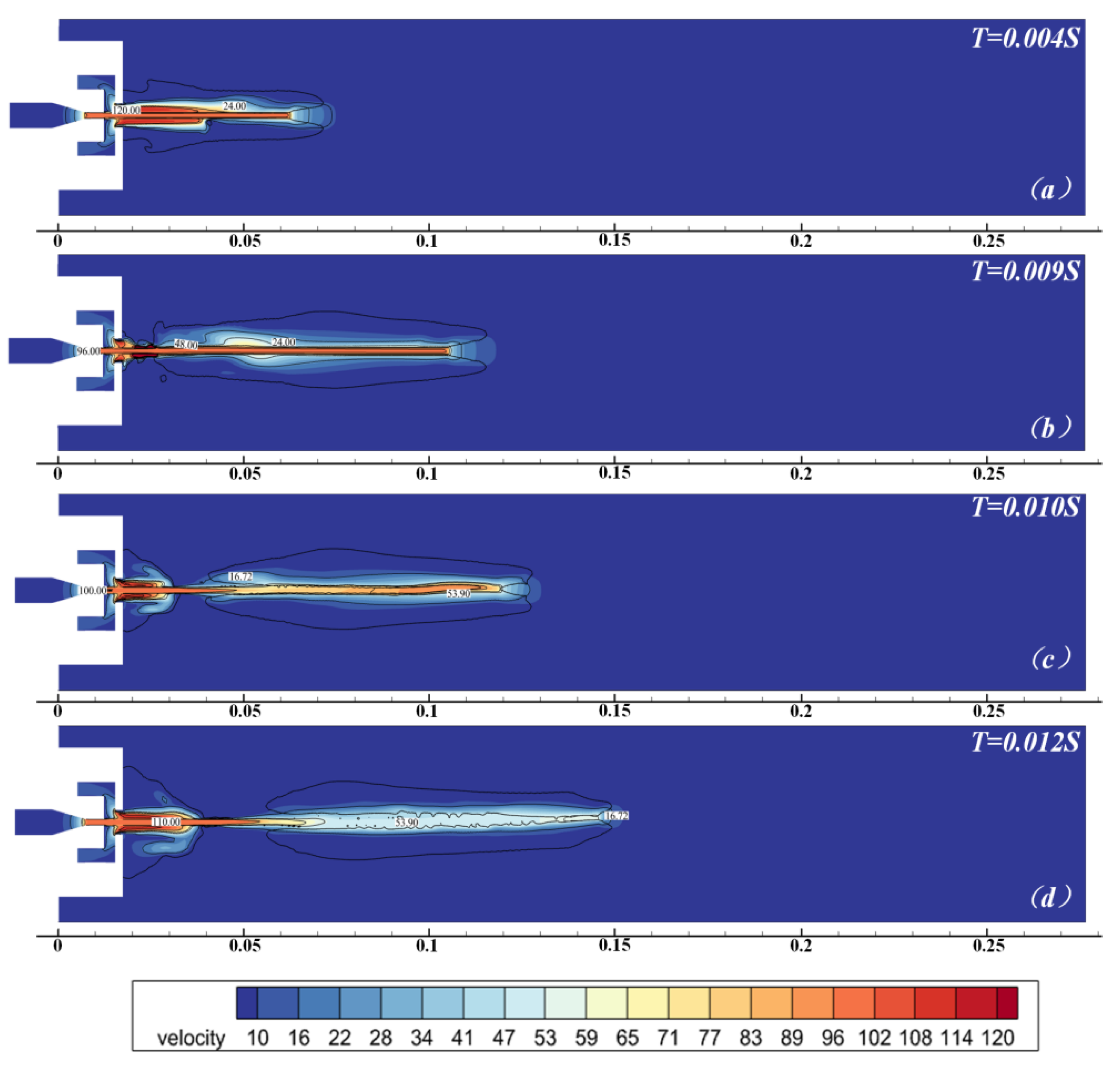
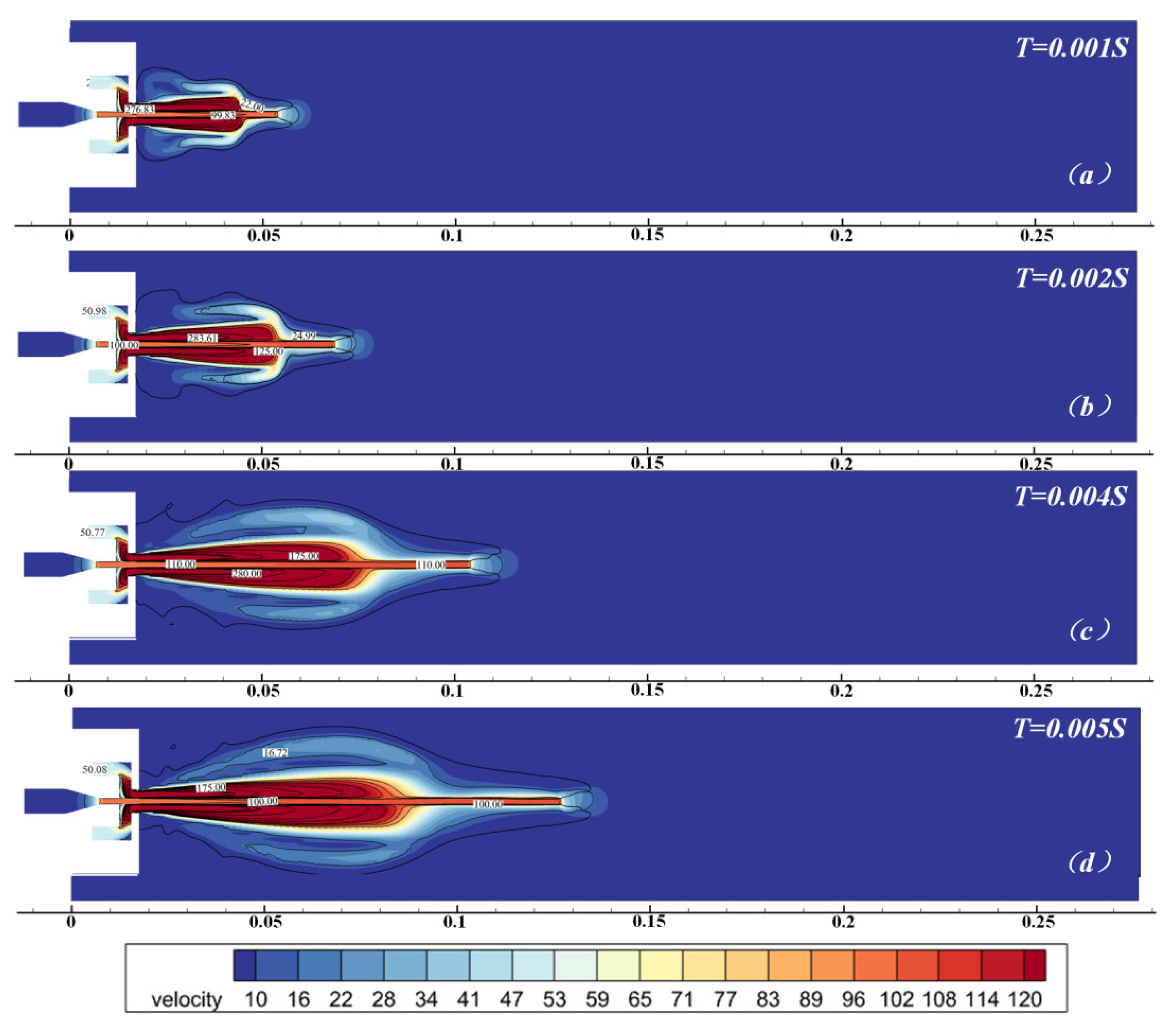
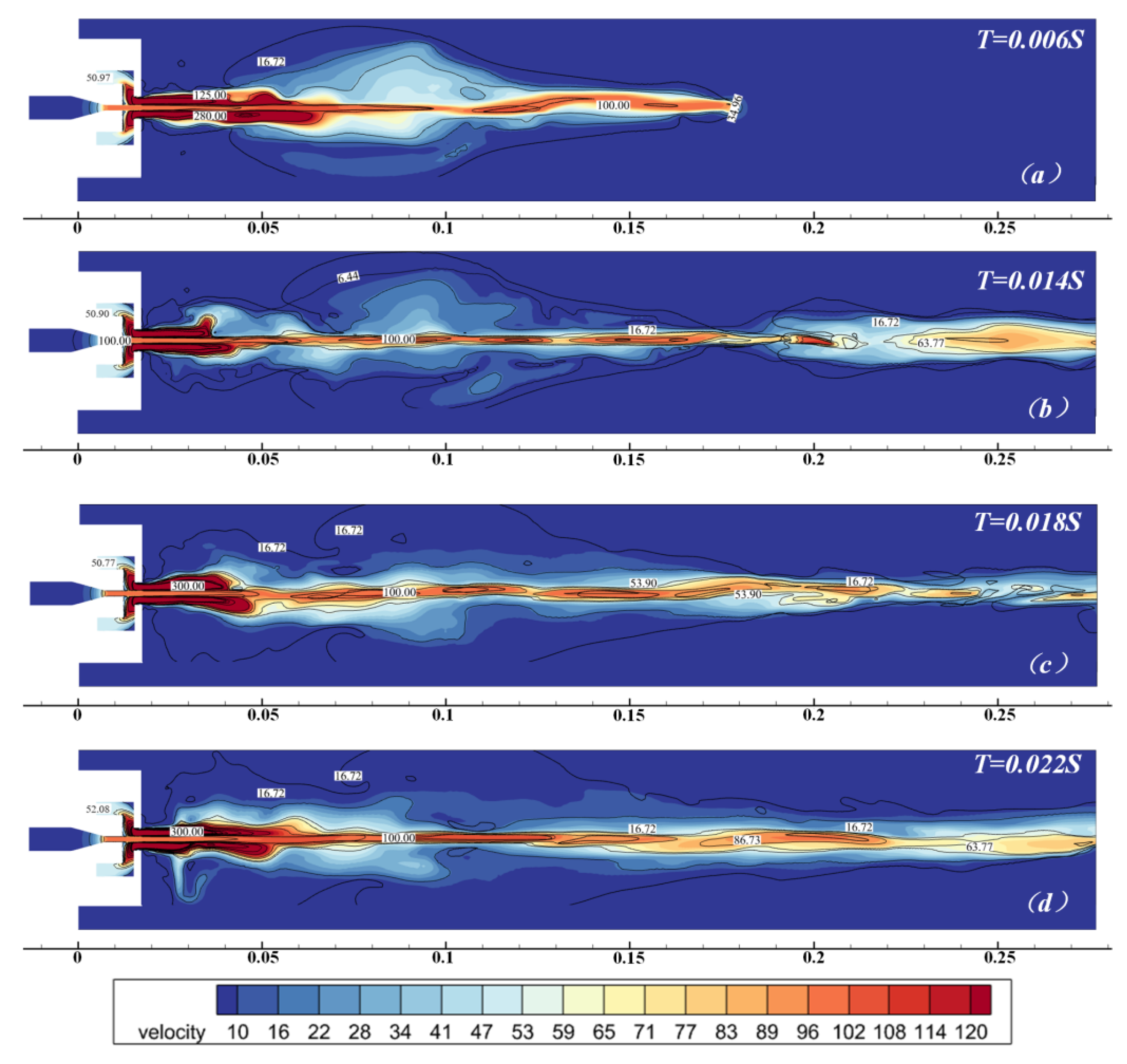
In addition to the evolution of flow regime being analyzed, attention is also merited toward the velocity distribution of supercavitating jet in the initial stage. The velocity distribution, as shown in
Figure 13, is represented by the external thick black solid line denoting the gas cavity contour.
In the initial stage of jet initiation, the rapid pace is maintained by the liquid jet, which possesses high momentum. However, significant resistance is encountered by the liquid jet as it is gradually exposed to the environmental medium without being enveloped by the low-viscosity cavity region. Consequently, a rapid decay in its velocity begins, as depicted in
Figure 13a.
With the introduction of the gas jet and the formation of cavity, the core area of the jet is further developed downstream. Due to the enveloping effect of the gas on the jet, the direct contact area between the liquid and the environmental medium is reduced inside the gas cavity, thereby decreasing frictional drag, allowing for the jet velocity within the gas cavity to be maintained at a higher level, as shown in
Figure 13b.
However, outside the gas cavity, significant changes are observed in the velocity distribution of the jet, particularly after the necking phenomenon occurs. A portion of the jet loses the protection of the gas cavity due to the necking phenomenon, thus being directly exposed and influenced by the environmental medium. Consequently, its velocity rapidly decreases, falling even below the velocity of the jet enveloped by the cavity downstream, as shown in
Figure 13c. Furthermore, the velocity of the jet enveloped in the cavity rapidly decreases due to the lack of continuous water jet momentum supply downstream.
As depicted in
Figure 14a, during the continued development, a pronounced bulging phenomenon was experienced by the second cavity due to the blocking effect at its front end, leading to further bubbling of the jet area downstream lacking cavity protection. In the ongoing development of the second cavity, the initial necking amplitude is small, causing its rear to be continuously replenished with gas and forming a relatively persistent gas cavity (0.012 to 0.03 s).
As the cavity evolves to a particular phase, the necking phenomenon occurs again, as shown in
Figure 14b. Nonetheless, due to its extended duration and the substantial size of cavity, the core section of the water jet is capable of being maintained at a distance reaching up to 0.25 m.
During the gas bulging process, the momentum of the gas gradually diminishes. Due to insufficient initial momentum of the gas supply, the buoyancy acting on the cavity body starts to become dominant, leading to a tendency for the gas to float upwards. Consequently, during the third instance of the necking-bubbling phenomenon, the gas is seen to rise and separate from the cavity, as clearly demonstrated in
Figure 14c. In this process, portions of the cavity, while undergoing necking, are sucked upstream, impacting the nozzle wall. This interaction causes the water jet at 0.05 m to be partially exposed to the external medium, triggering the onset of momentum dissipation. Ultimately, around approximately 0.17 m, fragmentation of the water jet is initiated.
In the velocity distribution of the supercavitating jet, trends corresponding to the evolution of flow regime can be observed. As depicted in
Figure 15b, in the core section of the water jet, detached from the bubble envelope at approximately 0.15 m, the kinetic energy of the jet begins to be dissipated gradually.
As the jet continues to evolve, a larger cavity cycle is observed to emerge, allowing for the core section of the jet to be sustained over a greater distance.
Figure 15c illustrates that the core section of the jet, is observed to only begin exhibiting significant dissipation of kinetic energy after persisting up to a distance of 0.2 m. Due to the rising and overflowing of gas, along with the increased amplitude of cavity necking, the subsequent gas supply is deemed insufficient to form a complete gas cavity that can effectively envelop the water jet. Consequently, the water jet is exposed to the environmental medium at 0.05 m, and due to this insufficient gas encapsulation and protection, the water jet is deemed to have inadequate momentum replenishment. This means that the jet velocity cannot be effectively sustained, even when the downstream water jet remains enveloped by the cavity, as depicted in
Figure 15d.
Under conditions of low gas supply, a supercavitating jet undergoes a sequence of periodic transformations, characterized by necking, expansion, and recoil, accompanied by upward gas escape. It is noteworthy, however, that the precise periodicity of these phenomena is not clearly defined, largely owing to the stochastic nature of gas and jet development, which exerts a degree of influence on the evolution of the flow regime through the magnitude of necking amplitude.
The aforementioned phenomenon is described, providing fundamental insights into the evolution of the flow regime of a supercavitating jet under low-gas-supply conditions. Due to space and effort constraints, this study did not further explore the specifics of flow regime evolution under these conditions. Nevertheless, several valuable conclusions are drawn through a comparison between the gas-assisted cavity jet and the pure water jet without gas assistance.
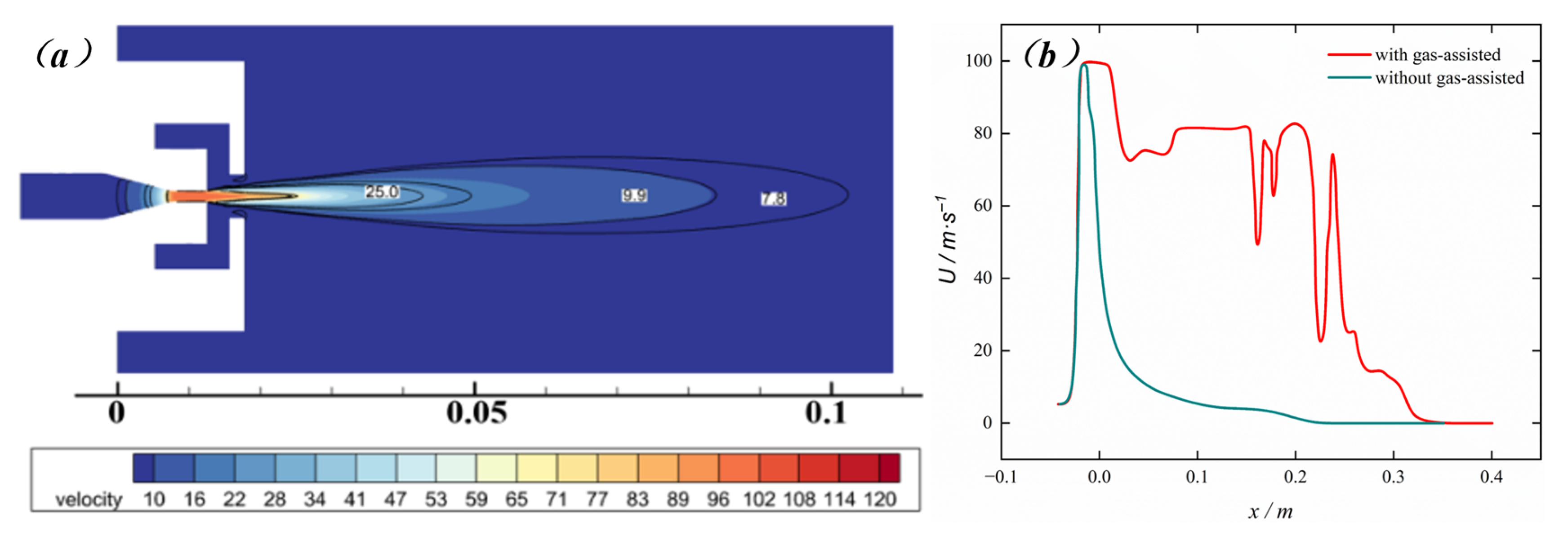
The velocity distribution contour map of the submerged jet without gas assistance is presented in
Figure 16. The exit velocity of the jet approaches 100 m/s, which is close to the velocity calculated by empirical Formula (11). However, in submerged conditions, the momentum of the pure water jet dissipates rapidly, rendering it challenging to maintain its initial velocity. This outcome indicates that without gas assistance, the water jet encounters difficulties in sustaining high speed over extended distances in a submerged environment.
Figure 16b compares the velocity of the supercavitating jet at the moment depicted in
Figure 15c with the axial velocity of the jet without gas assistance. It is observed that with gas assistance, the water jet can significantly extend the distance of its core section under submerged conditions. This result comprehensively illustrates the efficacy of gas assistance in enhancing the performance of water jets.
While gas-assisted technology has the potential to markedly enhance the performance of water jets, it is insufficient for maintaining a sustained and stable cavitation environment at low-gas-supply rates. During the development of the jet, the rapid replenishment to the necking area is hindered by the insufficient gas supply, affecting the stability of the cavity. Simultaneously, when the initial momentum of the gas is insufficient, the jet becomes susceptible to dominance by upward buoyancy during necking at the front end, resulting in upward escape and further exacerbating the deficiency of axial gas supply. To address these issues and enhance the performance of the water jet, the evolution of the flow regime in the supercavitating jet with increased gas supply is investigated in the subsequent study.
- (2)
The gas supply rate is 100 L/min.
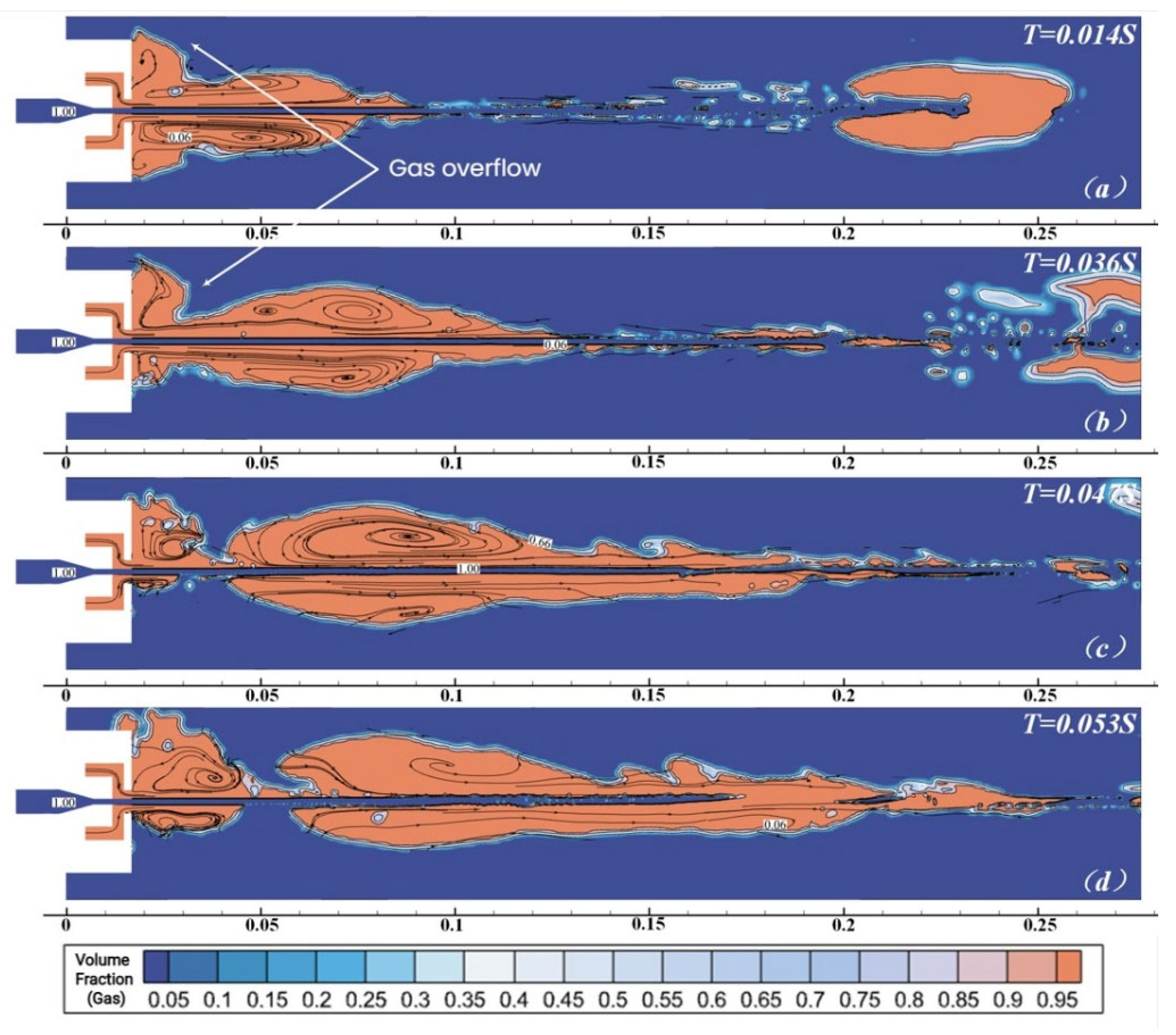
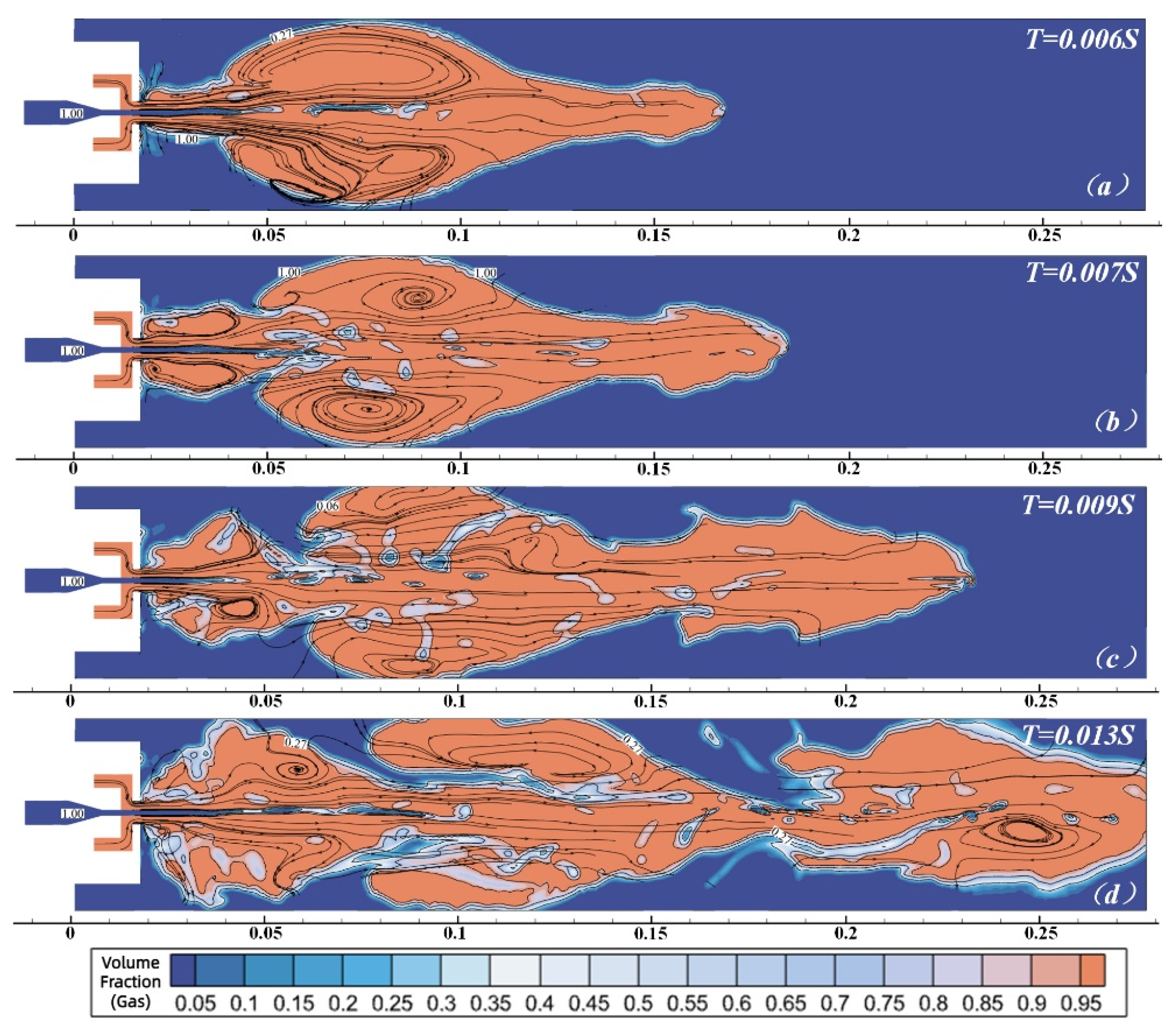
Under unconstrained conditions, the gas supply of the supercavitating jet, when increased to 100 L/min, exhibits a necking-bubbling phenomenon in its flow regime evolution. However, it is characterized by subtle differences compared to conditions of low gas supply. This is illustrated in
Figure 17.
Initially, under low-gas-supply conditions, cavities are observed to be elongated and prone to necking. In comparison, cavities under medium-gas-supply conditions display a fuller morphology, characterized by a bulging diameter that has significantly increased to more than twice the original diameter. This change is attributed to an increase in the gas supply per unit time. Despite the front end of the cavity still being affected by a clogging effect, the sufficient gas supply accentuates the bulging phenomenon, as depicted in
Figure 12a.
Secondly, the increase in gas supply significantly boosts the initial momentum of the gas jet. At the identical time point (0.005 s), the cavity, under conditions of medium gas supply, has progressed to 0.13 m, whereas under low-gas-supply conditions, it only reaches 0.06 m. This enhancement establishes a solid foundation for the development of a growing and stable cavity structure.
Worth noting is the observation, as illustrated in
Figure 17b, that under conditions of medium gas supply, the necking trend at the rear end of the jet is similar to that at low gas supply. However, the original cavity structure is destroyed due to the phenomenon of rear gas impacting the wall during the bulging period. This destruction allows for more gas to be replenished to the downstream area, further strengthening the cavity structure. This phenomenon indicates that under conditions of medium gas supply, the gas jet possesses stronger kinetic energy and replenishment capability, which are instrumental in maintaining the stability of the cavity.
Furthermore, as evident from
Figure 18, under conditions of medium gas supply, the gas jet can maintain a notably high flow velocity at the outlet, reaching up to 175 m/s, which is much higher than the maximum flow velocity at low gas supply. Simultaneously, the initial vortex is formed more rapidly, but after being impacted by the wall, the momentum of the vortex quickly dissipates, enabling the axial high-speed airflow to take precedence. Downstream bulging cavities are promptly replenished by this airflow, giving rise to a low-viscosity region. Consequently, the stability of the cavity is preserved, and the jet’s penetration force is enhanced.
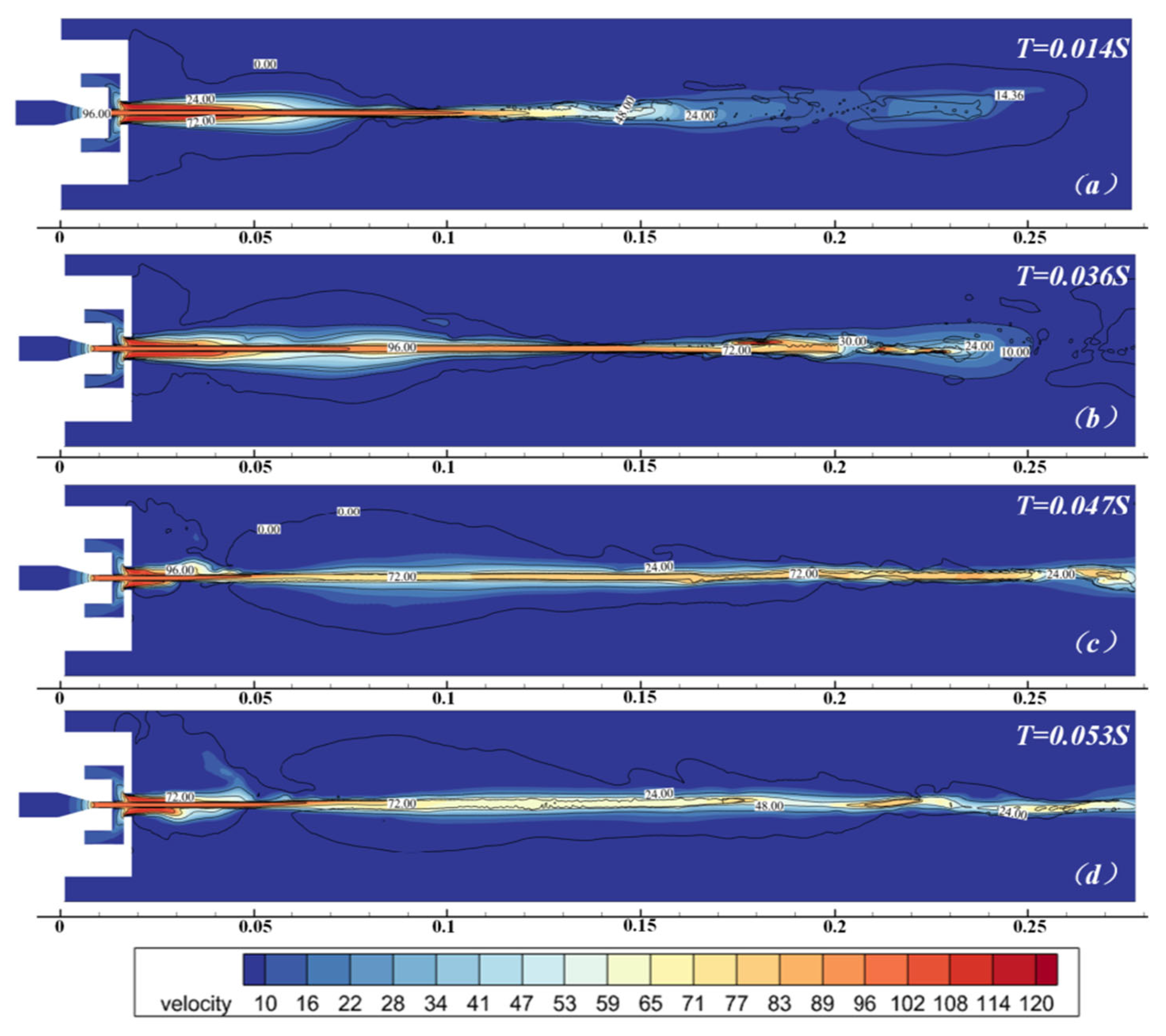
Finally, under medium-gas-supply conditions, larger cavities are formed, which can effectively sustain the core section of the water jet, pushing it further away. Inside the water jet area surrounded by the cavity, the jet velocity is maintained at a high level. Nevertheless, once the water jet detaches from the protection of the cavity, its kinetic energy will quickly dissipate.
During the process of further development, instability arises significantly at the flow interface. This instability is caused by the tangential velocity difference at the gas–liquid interface, combined with the influence of oblique shock waves from high-speed jets. As a result, the interface between gas bubbles and the external environment undergoes deformation, enabling vortices to persist and evolve. Notably, vortex development is more pronounced under medium-gas-supply conditions, as evident in
Figure 19a, compared to scenarios with low gas supply.
The intense vortex action is observed to cause the jet to rupture prematurely at a distance of 0.1 m. It should be noted that despite the rupture, the jet does not entirely lose its kinetic energy.
Figure 20a reveals that although the water jet underwent a rupture process in the middle, it was still enveloped by a low-viscosity cavity and did not dissipate kinetic energy as described earlier. Instead, the jet retains a higher velocity characteristic. This indicates that under conditions of medium gas supply, the jet, even after experiencing rupture, retains a degree of cleaning ability and penetration power.
As the jet progresses further, the bubble is still observed to undergo necking-bubbling phenomena. At medium-gas-supply conditions, the necking phenomenon does not lead to cavity breakage, contrary to the scenario at low gas supply. This is attributed to the sufficient upstream gas volume and momentum. Instead, a low-viscosity region channel is formed within a distance of 0.15 m, and whether it can continue to form a gas cavity beyond 0.2 m is contingent upon the amplitude of the preceding necking.
The noteworthy aspect is that under medium-gas-supply conditions, the formation and maintenance mechanism of a gas cavity is found to be markedly distinct from those observed under low-gas-supply conditions. When subjected to a small necking amplitude, the obstructive effect on the gas jet is diminished, allowing the gas jet to travel further distances. Consequently, under conditions of ample gas supply, the gas cavity can sustain a greater distance, even with a minor necking amplitude. For instance, as depicted in
Figure 20c, in the process of further development, with a small necking amplitude, the gas cavity is capable of being propelled at a velocity of 40 m/s to a distance of 0.25 m and may continue to extend further. In contrast, as seen in
Figure 20b, with a large necking amplitude, the gas cavity is observed to completely disintegrate within a short distance of approximately 0.2 m during its progression.
In addition, under medium-gas-supply conditions, the jet velocity at the gas outlet is characterized by a relatively high value, and the velocity distribution is observed to exhibit significant randomness. The variation in this distribution, coupled with the velocity difference between the gas and the jet surface, and the presence of oblique shock waves, are collectively responsible for the premature fragmentation of the water jet at certain positions, such as at 0.05 m, as depicted in
Figure 19c. However, due to the sufficient momentum of the high-pressure water jet, this fragmentation is quickly reconstructed, and due to the water jet almost always passing through the cavity, its speed remains largely unattenuated over a considerable distance, within 0.15 m. This observation suggests that despite undergoing more complex flow regime changes under medium-gas-supply conditions, the jet can still maintain a high level of stability and penetration.
In summary, with an increase in gas supply, the cavity is made fuller and the diameter of the cavity bulge is increased. However, due to the increased velocity difference at the interface with the water jet, it may also cause the jet to rupture prematurely over a short distance. Despite this, the jet performance under medium gas supply remains superior to that under low gas supply. This is because even if the jet ruptures, it is still moving in a low-resistance cavity, relying on the kinetic energy of the jet itself for supplementation, and the performance is still well. Furthermore, under medium gas supply, the phenomenon of necking-bubbling is observed, and the formation of stable gas channels is dependent on the amplitude of necking. Under conditions of low gas supply, gas movement primarily relies on water jet injection; in contrast, under medium gas supply, gas movement relies more heavily on its own momentum.
- (3)
The gas supply rate is 200 L/min.
To further investigate the impact of increased gas supply on the evolution of supercavitating jet flow patterns, particularly the maintenance ability of the water jet core section, this study conducts simulation research with a gas supply of 200 L/min. As illustrated in
Figure 21, at this supply rate, the position of the gas cavity remains similar to the previous working condition, which is mainly attributed to the higher resistance experienced by the front end in a pure water environment. Nevertheless, due to the increase in gas supply per unit time, the blockage phenomenon at the front end of the gas cavity is more significant, leading to a further increase in the bulging diameter.
From the trace in
Figure 21a, it can be seen that the development of the cavity exhibits asymmetry. In the case of high momentum, large vortices are generated within the cavity, reaching velocities of up to 50 m/s. These vortices, due to their high momentum, trigger more severe necking phenomena, causing the jet to start breaking at the front end. This phenomenon is in stark contrast to the performance under low-gas-supply conditions, indicating the adverse effect of increased gas supply on jet stability.
It is worth noting that as the jet continues to develop, the broken jet will lose the continuous structure of the core section of the water jet and diffuse with high momentum towards the outside of the jet axis. As illustrated in
Figure 21b, this phenomenon further intensifies the instability of the jet.
Meanwhile, due to severe necking and instability on the outside of the gas cavity, a substantial amount of external media is sucked into the interior of the bubble jet, as shown in
Figure 21d. The bulging part of the cavity is cut off by these entrained jets, thereby diminishing the self-momentum of the gas cavity. From
Figure 22, it can be seen that buoyancy gradually becomes dominant, causing the gas cavity to rise and overflow. This not only causes gas waste but also makes it difficult for the downstream gas region to achieve the expected effect. At the same time, the external medium sucked in by this part will also have an impact on the water jet wrapped in the low-viscosity area, causing the resistance of the water jet to increase and the jet to dissipate again.
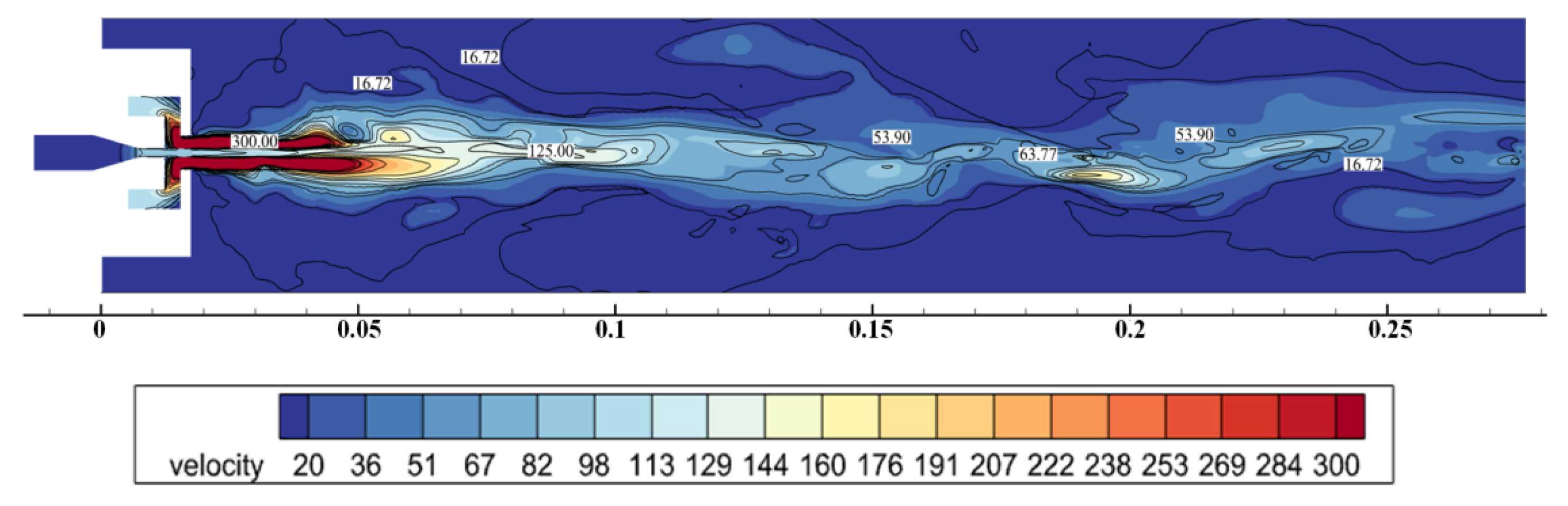
Furthermore, due to the swift velocity of the gas jet, which can reach 300 m/s or even higher, as shown in
Figure 22, a larger velocity difference is generated at the interface between the gas jet and the water jet. This difference in velocity renders the surface tension of the core section of the water jet insufficient to resist the force of the external medium, leading to the early occurrence of Kelvin Helmholtz instability. Consequently, this has a negative impact on the jet stability expected in this study.
As illustrated in
Figure 22, during the subsequent development process, the gas flow rate in the cavity can still reach around 50 m/s. Nevertheless, due to the water jet being broken at the front end and almost no complete and continuous water jet existing at the rear, even if the downstream flow velocity is shown to be relatively high on the velocity cloud map, it is primarily composed of gas and does not possess the expected water jet cleaning effect described in this study.
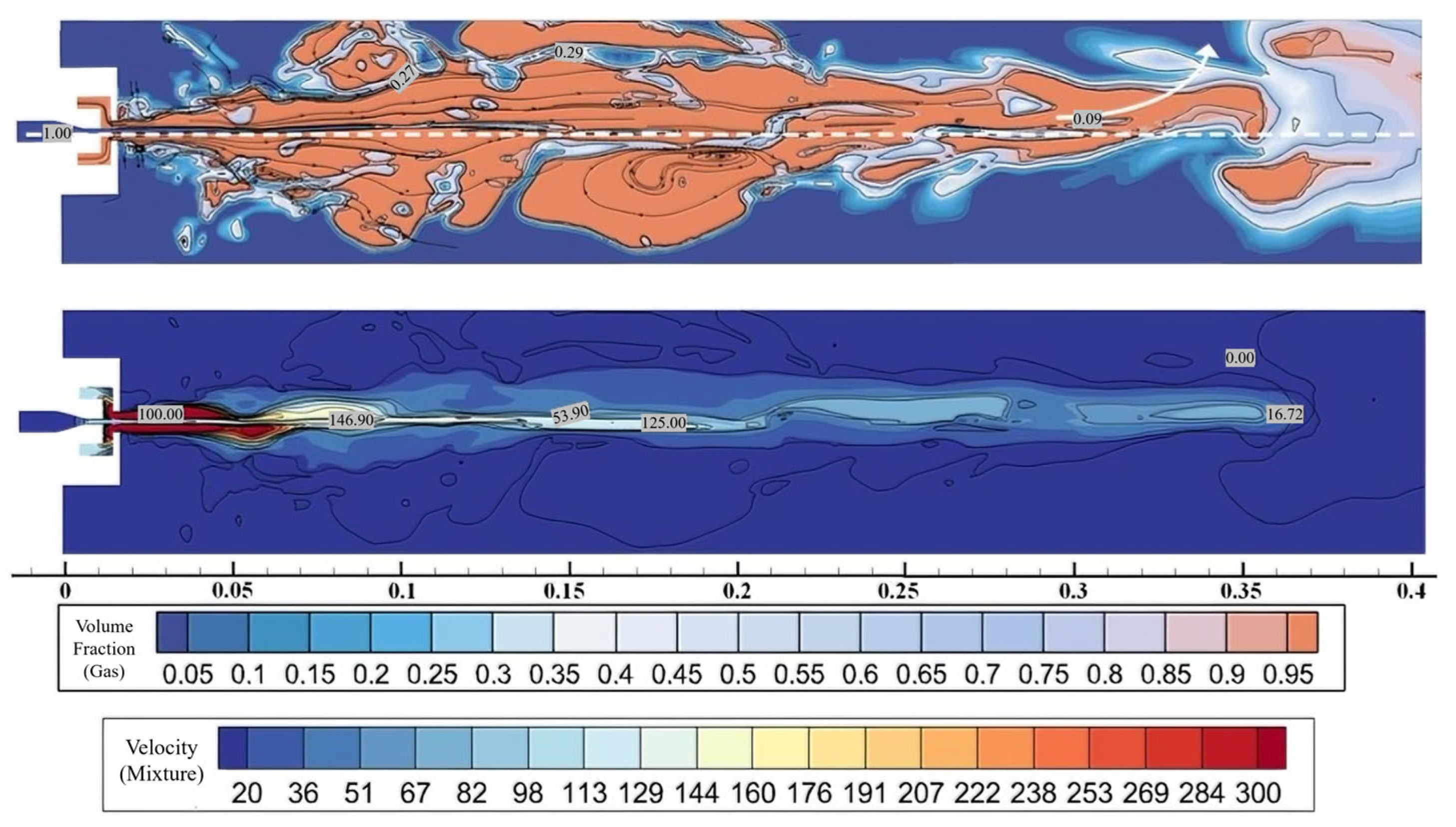
Figure 23 displays the volume and velocity distribution of the core section of the water jet at a relatively distant time after a period of development. It is observed that the core section only lasted a distance of 0.1 m when maintained at a longer distance, which did not display the superiority of higher gas supply compared to 0.15 m observed in the above. Simultaneously, excessive suction of the external medium caused the cavity to start breaking and overflowing at the front end. At the tail of jet development, as the gas momentum is depleted, the cavities gradually become affected by buoyancy and begin to move upwards.
To comprehensively evaluate the unconstrained jet performance, the flow regime is characterized by two key indicators: necking intensity and jet penetration. The quantitative analysis results under different gas supply rates are estimated as shown in
Table 3.
In brief, this section examines the evolution of flow regime at higher gas supply rates. It was found that excessive gas supply actually had a negative impact on the maintenance of the core section of the water jet. The too rapid gas flow jet is found to induce the water jet to break prematurely. Simultaneously, the necking and suction effect of the cavity is enhanced, causing a substantial external medium to be sucked into the cavity. Under the combined action of these factors, gas cavity rupture and overflow at the front end, resulting in an insufficient gas supply at the rear. Therefore, while an increase in gas supply can be effective, it is not always beneficial. Of course, increasing gas supply may promote the generation of water jet cavitation, which may offer superior performance in scenarios where such a phenomenon is desirable, yet it is not what this study requires. Due to space and effort constraints, further exploration into the optimal gas supply volume is not pursued here.
3.2. Typical Flow Regime Evolution Law in Semi-Constrained Supercavitating Jet
As the exploration of flow regime evolution in this study is aimed to serve cleaning needs, this study continues to simulate the semi-constrained impinging jet to explore the dynamic characteristics of supercavitating jets when impacting the target plate.
It is noteworthy that based on the results observed in the above regarding the flow regime evolution of the unconstrained jet, a significant finding has emerged; due to the presence of gravity, the gas jet is subjected to huge buoyancy, stemming from the density difference, leading gas to float upwards. Therefore, in this case, when spraying from the bottom up, the surface of the target plate becomes covered with gas, allowing the wall jet to still travel within the low-resistance zone, and the kinetic energy dissipation of the wall jet is reduced, thereby enabling a larger cleaning area to be achieved.
It can be anticipated that when the target plate is impacted at a vertical angle, the maximum impact force can be obtained. However, upon diffusion on the target plate, the shear stress generated on the wall is almost negligible, meaning the cleaning effect of diffusion can be ignored. Consequently, this study concentrates on the flow regime evolution and force analysis subsequent to tangential impacts at angles of 15 and 30 degrees.
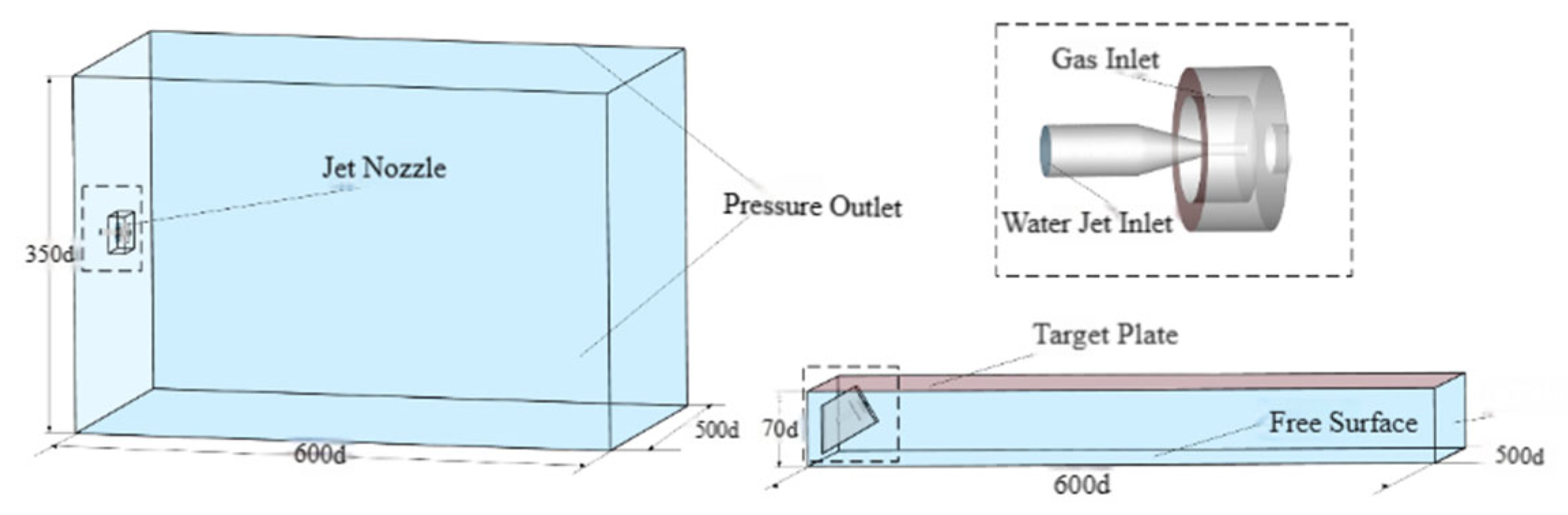
During the preliminary research, it was observed that the flow regime, under various working parameters, demonstrated similar characteristics, and the flow regime of the impinging jet was more affected by the impact angle. Consequently, the subsequent step of this study is directed towards simulating the working conditions with operating parameters of = 2 mm, = 8 mm, = 120 L/min, and = 10 MPa.
3.2.1. Flow Regime Evolution of Tangentially Impinging Jet
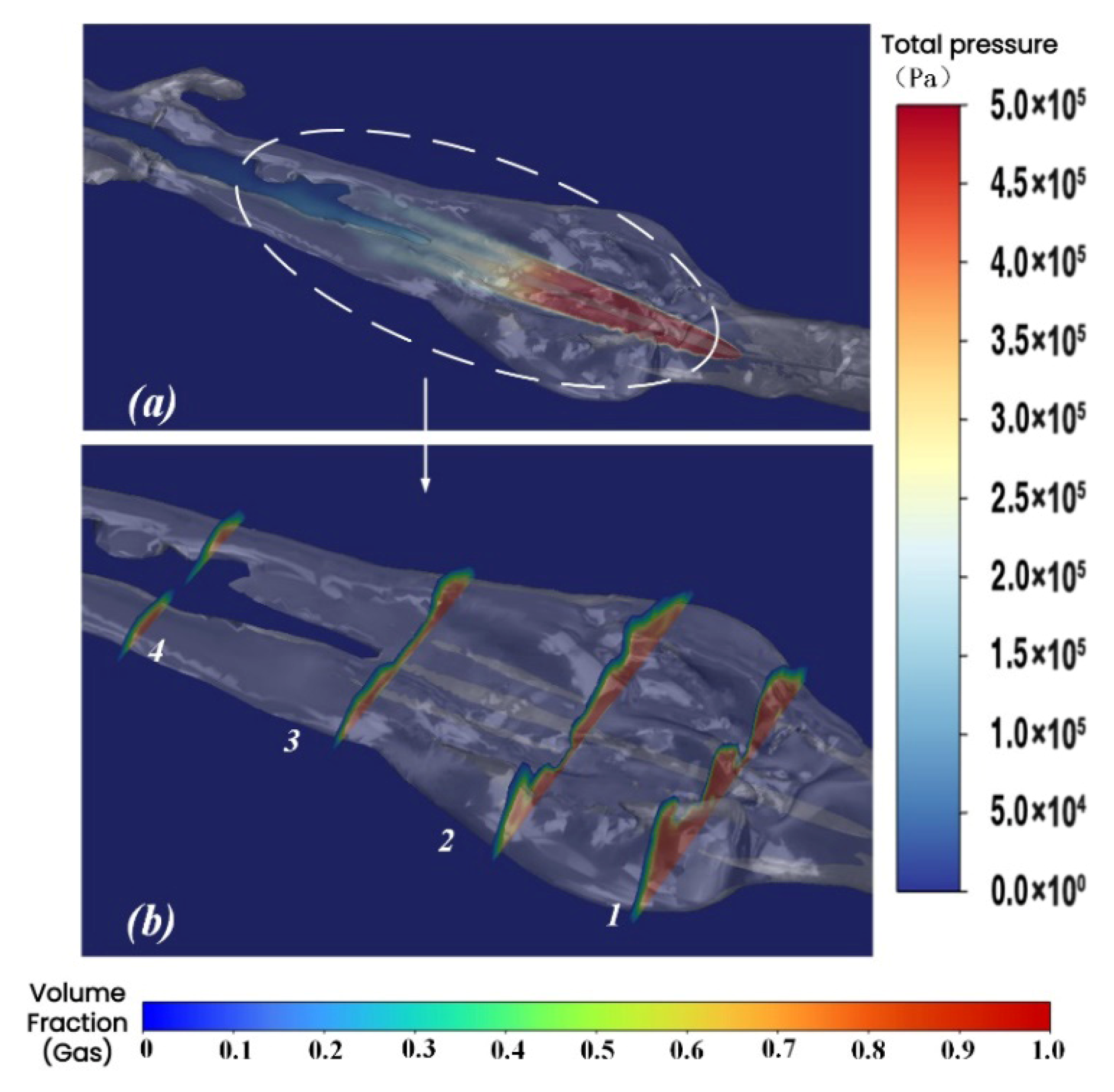
The distribution cloud map of gas and liquid volume fractions during the development stage of the wall jet is presented in
Figure 24, where red denotes the volume fraction of the gaseous phase. It can be seen that the flow regime in the initial stage of the jet is basically the same as described above, showing necking expansion. However, due to the direct impact of the jet downstream on the target plate, the impact of downstream necking will not be transmitted to the upstream, and even if there is swelling in the upstream, it can rapidly progress downstream. Consequently, unlike the unconstrained jet, the initial stage of the jet, even with the same working parameters as described above, will not experience severe necking expansion, causing the gas jet to break and even affecting the core area of the water jet. Instead, a relatively stable gas cavity is exhibited.
However, as the tangential angle increases, this study found that the necking phenomenon of the cavity jet becomes more severe. To illustrate this phenomenon,
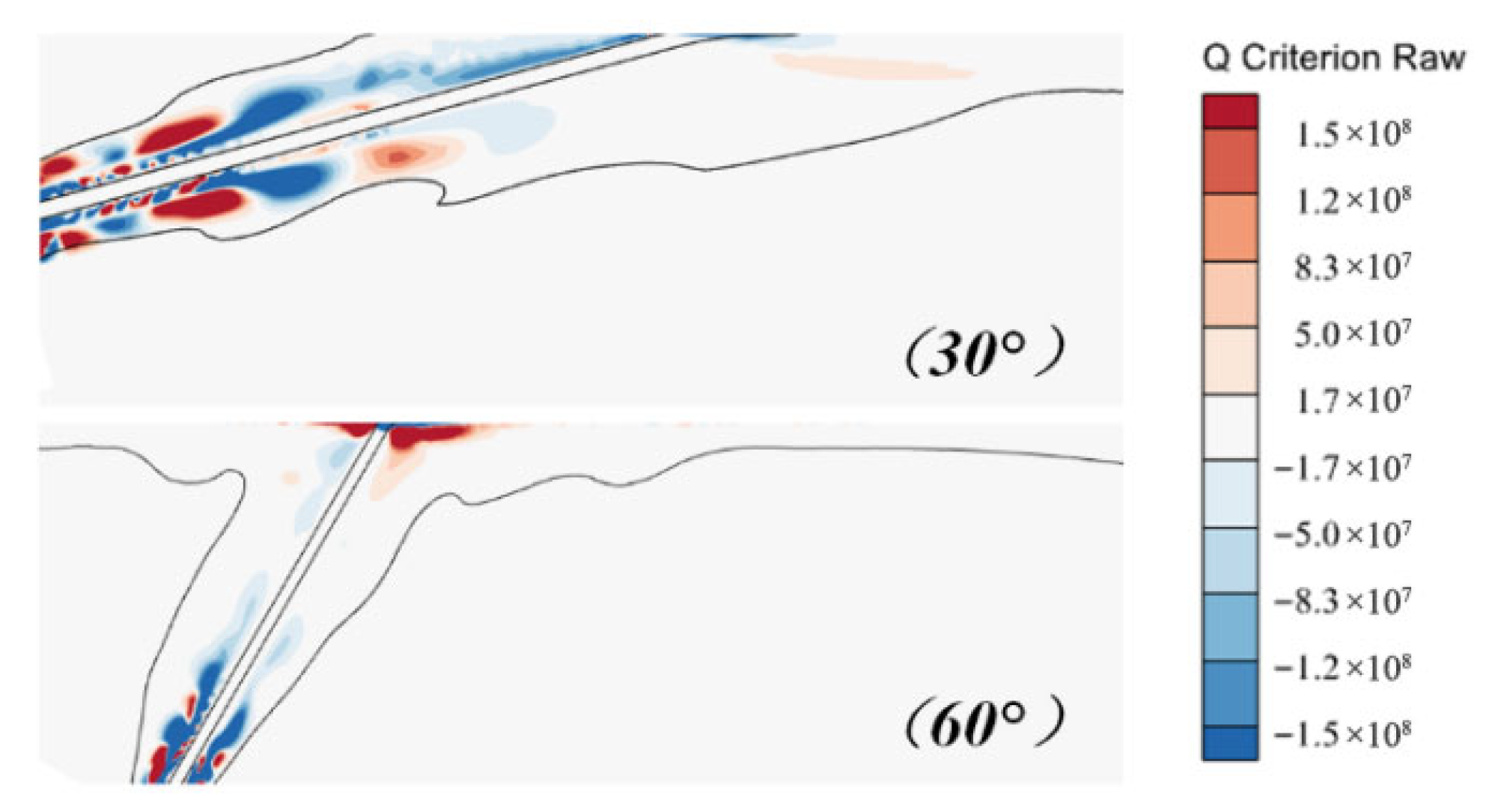
Figure 25 show the vorticity distribution under the Q criterion at a certain moment. It is observable that the vorticity is predominantly concentrated in the near-wall region and the jet outlet region.
In the jet outlet area, due to the sufficient initial gas momentum, a large velocity difference at the interface between the gas cavity and water jet is observed; therefore, there exists a maximum region with distributed vortices. Nevertheless, at the outlet stage, both the gas and water jet possess relatively ample momentum; hence, the larger vorticity here did not have a significant impact on the jet fragmentation. As the gas jet continues to develop, it sucked a portion of the environmental medium, leading to a decrease in momentum and vorticity, thereby resulting in a more stable outer gas cavity.
It is worth noting that in the near-wall region, the jet body transitions from radial to tangential motion, thus forming a radial wall jet. Due to the velocity discontinuity between this jet and the upper environmental fluid, shear vortices form in the mainstream region of the free jet, and the vorticity value will have a maximum at the wall. However, as the impact angle increases from small to large, this velocity discontinuity becomes more pronounced, resulting in a huge velocity gradient. Consequently, with an increase in the impact angle, the vorticity near the wall sharply increases, leading to more severe necking phenomenon in the near-wall region at large angles.
This study revealed that in the initial stage of near-wall impact jet, the necking-bubbling phenomena is similar to that of an unconstrained jet. As the impact angle increases, the necking phenomenon intensifies. Due to the large angle impact, the velocity discontinuity at the wall is more pronounced. The evolution law of the jet under different working parameters is basically the same as the above. Therefore, this section will not further elaborate on the flow regime evolution in the initial stage of the jet.
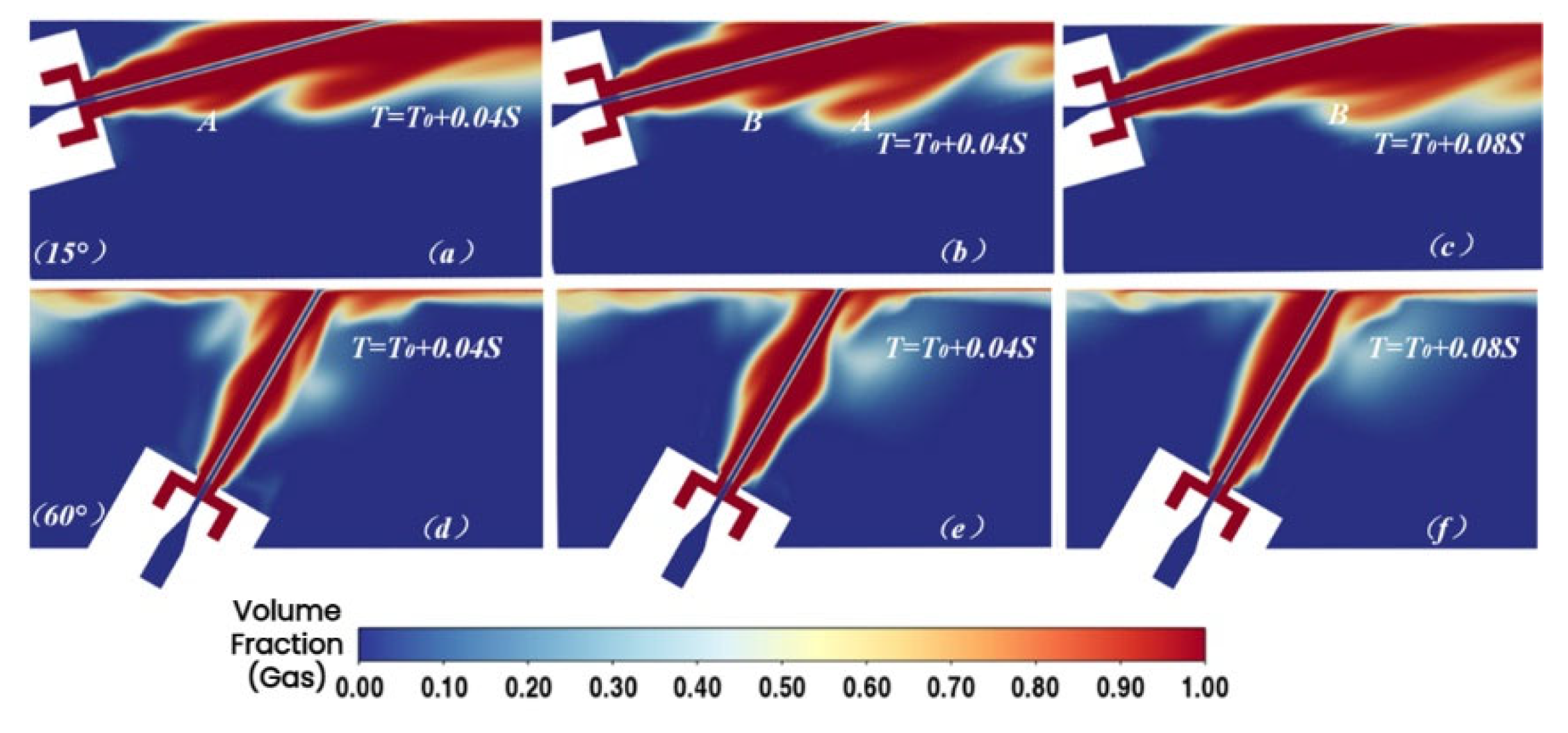
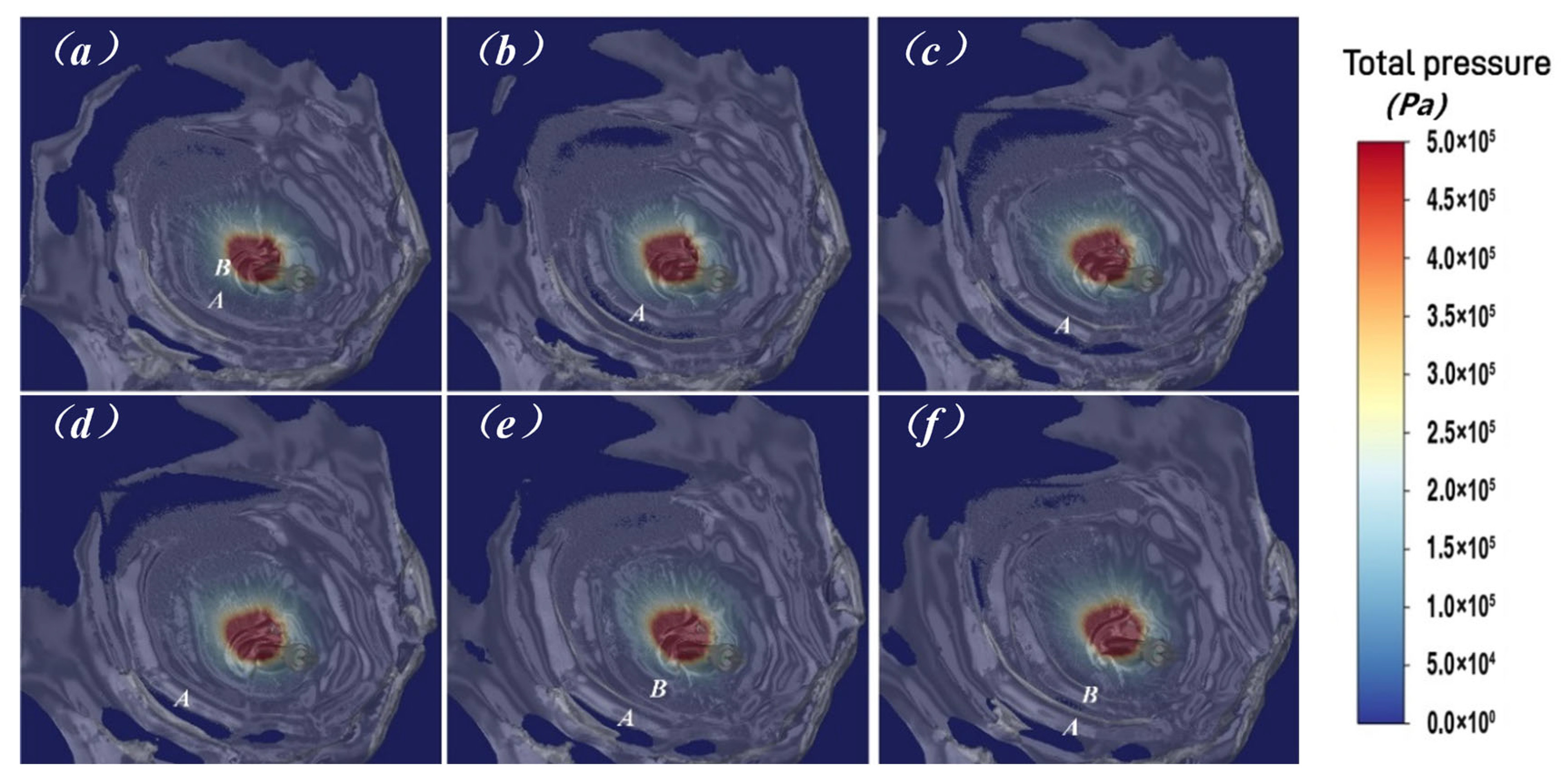
As the supercavitating jet continues to develop, the behavior of the cavity on the wall is depicted in
Figure 26. The transparent material on the target plate is a rendering of the gas profile near the wall. It can be seen that when the supercavitating jet impacts the wall at 60°, the gas jet, influenced by gravity, adheres to the surface of the target plate and spreads around like water waves, then dissipates or overflows from the target plate. The reason for the appearance of waves is similar to the previously mentioned bulging phenomenon. From wave B in
Figure 26f, it can be seen that wave B is a continuation of the upstream bulging phenomenon. The bulging jet part, upon striking the target plate, and over time, gradually evolves into an arc-shaped wave, as illustrated in
Figure 26f. Meanwhile, due to the strong nonlinear instability of the wave surface, it is still possible to experience gas cavity fragmentation during the forward development of the airflow. As shown in
Figure 26a,b, the gas cavity downstream of wave A has begun to rupture, and the rupture is gradually intensifying over time.
Compared to larger angle impacts, small-angle impacts shows another pattern in the evolution of the cavity on the target plate. As evident from
Figure 27b, it can be seen that gas cavities gradually develop from a single cavity to three cavities after impacting the target plate, indicating a shift of the gas jet from the central axis to both sides. This phenomenon is attributed to the fact that the initial momentum of the gas jet can still maintain a relatively large level after impacting the wall. The reason for maintaining a large momentum is the tangential impact on the wall, which reduces the impact angle, thereby reducing kinetic energy loss. Consequently, a significant tangential velocity difference between the gas–liquid two phase interface is observed where the cavity just contacts the wall, leading to a phenomenon similar to “necking-bubbling”. In addition, the obstruction by the target plate contributes to the above phenomenon. However, due to the presence of vortices, gas cavities eventually rotate forward and diffuse outward, with only a portion of the gas being guided along the axis by a water jet.
Simultaneously, the small-angle tangential impact of the liquid jet is observed to allow the liquid phase to maintain a certain velocity and develop along the wall, causing a certain injection effect on the gas jet, resulting in a faster gas cavity velocity and thinner thickness on the central axis during the subsequent development process. Nevertheless, during the injection process, a portion of the gas will gradually be sucked into the liquid jet near the wall, causing a decrease in gas volume. When the gas volume is reduced to a certain extent, the liquid phase jet will be exposed to the environmental medium, resulting in a rapid decrease in kinetic energy.
3.2.2. Velocity Distribution of Tangentially Impinging Jet
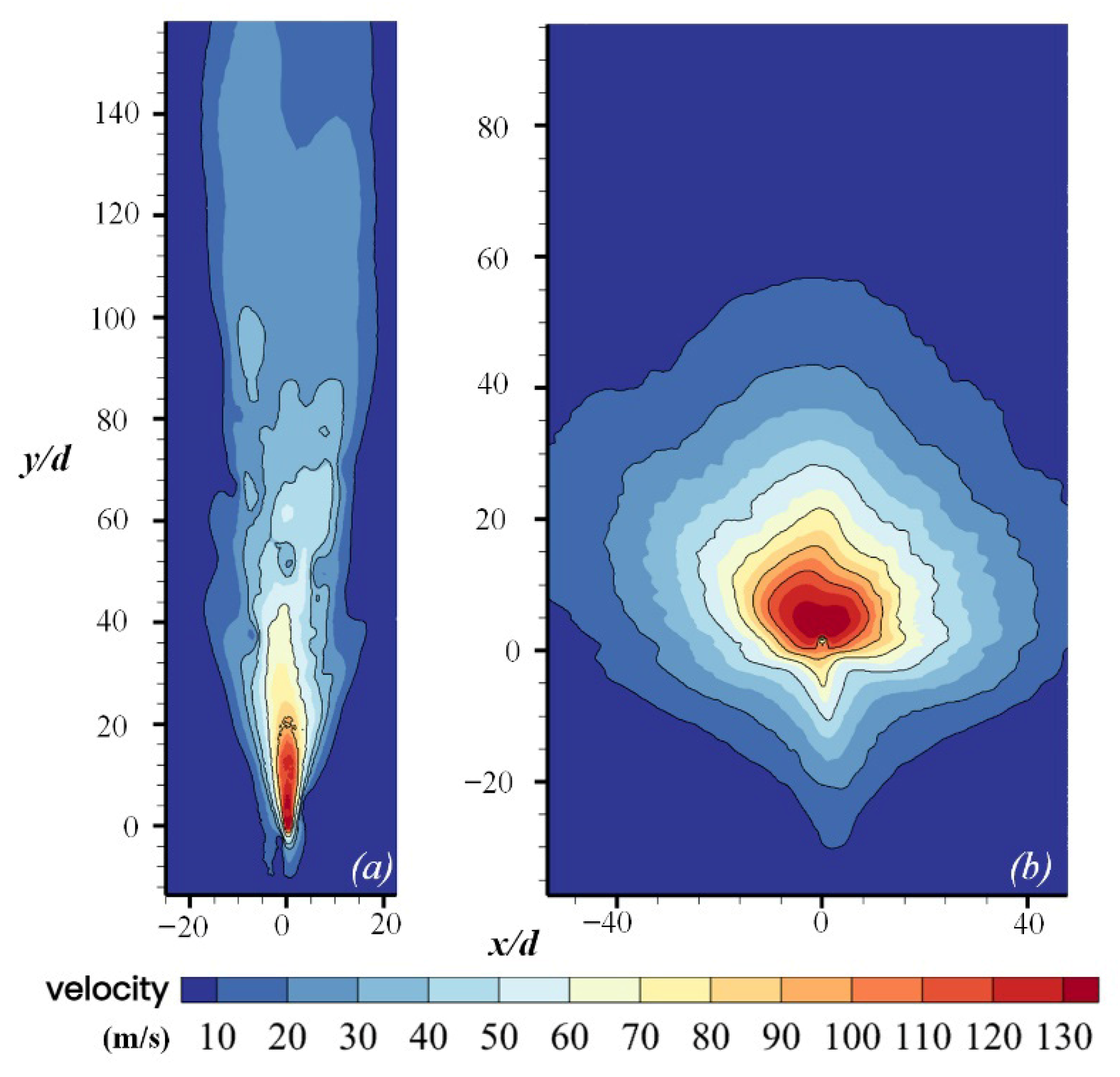
According to the introduction, when cleaning marine artificial bodies, the tangential force is deemed more effective in cleaning marine organisms and other structures. Hence, the subsequent analysis of the force exerted on the target plate will be transformed into an analysis of the momentum of the tangential water jet flowing on the wall of the target plate. Given the positive correlation between velocity and momentum, the following discussion will be simplified to an analysis of velocity. Due to the presence of boundary layers, there will be a severe velocity gradient on the wall. To address this issue, a cross-section that crosses the height of the first layer of the two layers of mesh is selected for analysis.
As shown in
Figure 28b, when the wall is impacted at a large angle, the velocity distribution is observed to exhibit a radiative pattern, which will result in a more concentrated force of the water jet impact. Upon diffusing on the wall of the target plate, the flow velocity is maintained at 90 m/s for approximately 20d. Subsequently, the jet velocity rapidly decreases within a distance of 15d due to the dissipating of the cavity protection. When the jet reduces the tangential impact angle, a slender velocity distribution is formed, allowing the flow velocity above 70 m/s to persist for a distance of 40d. Within the subsequent 40–80d distance, the flow velocity begins to significantly decrease. This is due to the evolution of the cavity, as the cavity near the axis gradually becomes thinner, reducing the protection of the jet. However, due to portions of the cavity still advancing with the jet, it can travel at a speed of 20 m/s to a distance of 140d, but at this speed, most of its cleaning ability is lost, retaining only a cleaning effect on some easily cleaned stains. From this, it can be seen that when a cleaning distance as far as possible is required, using a small-angle tangential cleaning can achieve the desired effect.
By increasing the pressure and diameter of the water jet, the cleaning distance of the jet can be increased to some extent. However, this approach significantly increases energy consumption. Furthermore, influenced by the evolution of the cavity flow regime, despite these adjustments, the jet still cannot avoid losing its cleaning ability at a distance of more than 150d. Although this has significantly increased the cleaning distance in comparison to a submerged jet, this study indicates that there is potential for further optimization if the cavity flow regime is appropriately restricted.