
Article

Modeling and Experimental Analysis of Low-Viscosity/High-Permeability Sealant Penetration Dynamics in Oil-Filled Submarine Cables
1
Hainan Power Grid Co., Ltd., Haikou 572019, China
2
CSG Electric Power Res. Inst. Co., Ltd., Guangzhou 510663, China
*
Authors to whom correspondence should be addressed.
Fluids 2026, 11(1), 16; https://doi.org/10.3390/fluids11010016
Submission received: 15 November 2025 / Revised: 23 December 2025 / Accepted: 27 December 2025 / Published: 5 January 2026

Abstract

Insulating oil leakage from oil-filled submarine cables compromised operational integrity and posed environmental risks. This study proposed a novel sealant-plugging repair technique that combines low-viscosity/high-permeability sealant permeation and high-viscosity/low-permeability sealant replacement and pressurization. The permeation process of the low-viscosity sealant, from the injection port to the outlet, was visualized using the Volume of Fluid (VOF) method. Analysis focused on: (1) sealant volume fraction in the sealing cavity; (2) sealant leakage volume fraction along the radial gaps at outlet 2; and (3) relative velocity of the permeating sealant along the radial gaps at outlet 2. Application of 0.4 MPa of sealant pressure achieved the key balance, characterized by: (i) Completed displacement of air from the sealing cavity; (ii) Full permeation of sealant into the gaps between the armored copper strip gaps and the radial gaps; (iii) Avoidance of the excessive sealant leakage flow observed at 0.5 MPa, promoting efficient sealant usage; (iv) A short time to reach permeation and leakage steady state. This study demonstrated the feasibility of the low-viscosity sealant penetration into both the gaps between the armored copper strips and the radial gaps under 0.4 MPa injection pressure. It provided theoretical and experimental guidance for this process within the sealant plugging repair technique.

1. Introduction

Oil-filled submarine cables are key components of marine power transmission infrastructure, enabling island interconnections, the electrification of offshore drilling platforms, and the grid integration of offshore wind farms into ultra-high-voltage systems [1]. Their reliable operation depends on internal insulating oil, which eliminates air gaps within the insulation layer, thereby enhancing dielectric strength and operational stability.
However, the harsh marine environment subjects these cables to significant mechanical hazards, including ship anchor impacts and sustained hydrodynamic forces from ocean currents. Such events can compromise the structural integrity of the lead sheath and the anticorrosive layer, ultimately leading to insulating oil leakage at the armor layer [2]. Persistent insulating oil leakage not only degrades cable performance but also poses substantial risks to the marine ecosystem.
Current research addressing insulating oil leakage primarily focuses on three areas:
(1)
Leak detection: Systems utilizing methods like laser-induced fluorescence sensors identified leakage through characteristic insulating oil spectral signatures [3].
(2)
Leak localization: Spectral analysis models quantified insulating oil content in seawater near leaks, enabling precise localization [4,5,6].
(3)
Leak recovery: Specialized devices were designed for retrieving leaked insulating oil from the marine environment [7,8].
Recent research shows a clear transition in submarine cable engineering from experience-based maintenance to intelligent, condition-based operation strategies. The adoption of standardized offshore inspection and protection practices derived from the oil and gas industry has been shown to effectively reduce failure rates in offshore wind power cables [9]. In addition, coordinated international repair mechanisms and shared technical resources have been identified as key factors in improving maintenance efficiency for long-distance and deep-sea submarine cables [10]. With the rapid development of data-driven technologies, machine learning-based condition monitoring and fault diagnosis methods have demonstrated strong potential for early fault detection and maintenance decision support [11]. Meanwhile, the optimization of auxiliary systems, such as accumulator lifting systems in oil-filled submarine cable pumping stations, plays a critical role in maintaining internal pressure stability and ensuring long-term operational safety [12]. Despite these advances, existing studies primarily focus on reliability enhancement and fault prevention, while the risks and consequences associated with insulating oil leakage during abnormal operation remain insufficiently explored.
Significant progress has also been made in the study of insulating oil leakage mechanisms and response technologies. Advances in sensing technologies and data analytics have substantially improved oil spill detection and monitoring capabilities, enabling earlier warning and enhanced situational awareness [13]. From an emergency management perspective, improved response frameworks emphasizing rapid decision-making, automation, and system integration have been proposed to reduce response time and environmental damage following leakage events [14]. Real-time sensing systems for subsea infrastructure have further demonstrated the feasibility of proactive leakage prediction and active response strategies [15]. In addition, recent reviews of oil spill modeling research indicate a trend toward high-resolution numerical models that couple multiple physical processes and support scenario-based response evaluation [16]. However, many of these studies are oriented toward general oil spill events or subsea pipelines, with relatively limited focus on leakage scenarios specific to oil-filled submarine cables.
From a physical modeling standpoint, the leakage and dispersion of insulating oil in the marine environment involve complex oil–water and oil–gas two-phase flow processes. Comparative studies of Eulerian and Volume of Fluid (VOF) methods have provided important guidance for selecting appropriate numerical models under different flow regimes and interface conditions [17]. Methodological advances in interface-capturing techniques have further improved numerical stability and accuracy in predicting phase interactions and free-surface evolution [18]. Application-oriented simulations have increasingly addressed marine leakage scenarios, including the migration of leaked oil in submarine sediments [19] and the dispersion behavior of underwater gas–oil two-phase leakage plumes [20]. These studies confirm the importance of high-fidelity two-phase flow simulations for understanding leakage dynamics and evaluating the effectiveness of active response measures in submarine cable systems.
While leak detection and location enable timely identification and precise localization, existing leak mitigation strategies predominantly rely on passive post-leak collection. These approaches, though valuable for environmental mitigation, fail to address the fundamental problem: the persistent leakage source within the cable itself. Consequently, developing a solution capable of actively sealing the leakage pathway represents an unmet need.
To address this gap, this paper proposes a novel sealant-plugging repair technique specifically for oil-filled submarine cable insulation oil leaks. This technique fundamentally shifts the paradigm from passive mitigation to active intervention. External sealing cavities are installed on both sides of the leakage points at the armor layer. Low-viscosity/high-permeability sealant is then injected under pressure into the sealing cavities, enabling deep penetration and subsequent curing within the cable’s inter-layer channels. This process permanently seals both the armored copper strip gaps and radial gaps, eliminating the leakage source. The following sections detail the technique’s design, simulation analysis of sealant permeation dynamics, and experimental validation.

2. Materials and Methods

2.1. Low-Viscosity/High-Permeability Sealant Selection

The low-viscosity/high-permeability sealant employed in this study was selected based on its essential performance characteristics for deep penetration and effective plugging (Table 1): low viscosity (facilitating penetration into the armored copper strip gaps and the radial gaps), rapid curing (enabling timely sealing), and moderate hardness (ensuring durable sealing without compromising cable flexibility).
(1) Low viscosity: Several articles [21,22,23] involved the preparation of silica sealant. The silicone sealant itself has fluidity, especially before curing, and its viscosity can be effectively adjusted by the molecular structure, filler content and type of the matrix polymer (such as linear polysiloxane L-PDMS [22]) to meet the requirements of ‘infiltration gap’. One study [22] specifically pointed out that through molecular design (such as the use of B-PDMS) and nano-filler dispersion, low construction viscosity can be achieved while maintaining good thixotropy (shear thinning), which was very conducive to the penetration of materials into complex gaps. For the polyurethane porous material (foam) mentioned in [24] and the polyurethane sealant in [25], the initial viscosity of the raw material (prepolymer or component) can be adjusted by selecting the type, molecular weight, and filler content of the polyether polyol to achieve better construction permeability.
(2) Rapid curing: Two studies, [23,25], clearly studied the room temperature curing of two-component silicone sealant and two-component polyurethane sealant, respectively. After the two components of such materials were mixed, they can be cured in a few hours to 24 h through chemical reactions (such as hydrosilylation, amino, and isocyanate reaction) at room temperature to achieve ‘timely sealing’. The curing rate can be controlled by the type and amount of catalyst, the activity of the curing agent (such as aromatic amine [25]) and other factors. The polyurethane foams mentioned in [24] usually also have a faster reaction curing rate and are suitable for on-site molding.
(3) Moderate hardness: [26] Polyurethane (PU) elastomers were studied, and their initial hardness can be adjusted in a wide range according to the formulation (such as soft segment PTMEG type, hard segment TDI/DMTDA ratio) to meet the requirements of ‘moderate hardness’. However, its hardness will change significantly (decrease or increase) in aging environments such as heat, water and ultraviolet, and its durability is facing challenges. Another study [23] showed that the hardness (or modulus) of silicone sealant can be precisely controlled by crosslinking density (controlled by the ratio of vinyl silicone oil to hydrogen silicone oil), from soft to moderate strength. However, it is also pointed out that the increase of crosslinking density will lead to the decrease of elongation at break, and it is necessary to balance ‘hardness’ and ‘flexibility’. As elastomers, the hardness of fluor-silicone rubber [27] and special chloroprene rubber [28] can also be adjusted by formula, and have good mechanical properties and certain environmental tolerance (such as oil resistance [27]). However, the hardness retention rate after long-term aging (especially high temperature and damp heat [26,28,29]) was a problem that needs attention. The high-strength polyurethane sealant [25] exhibits high tensile shear strength after curing, but its hardness may be high. It is necessary to adjust the ratio of soft and hard segments to obtain more moderate hardness and flexibility.
Furthermore, fluor-silicone was chosen for its excellent chemical stability, corrosion resistance in marine environments, and minimal ecological impact due to its inert nature and low toxicity after curing [27,28,30].

2.2. Sealant Plugging Repair Experimental Device

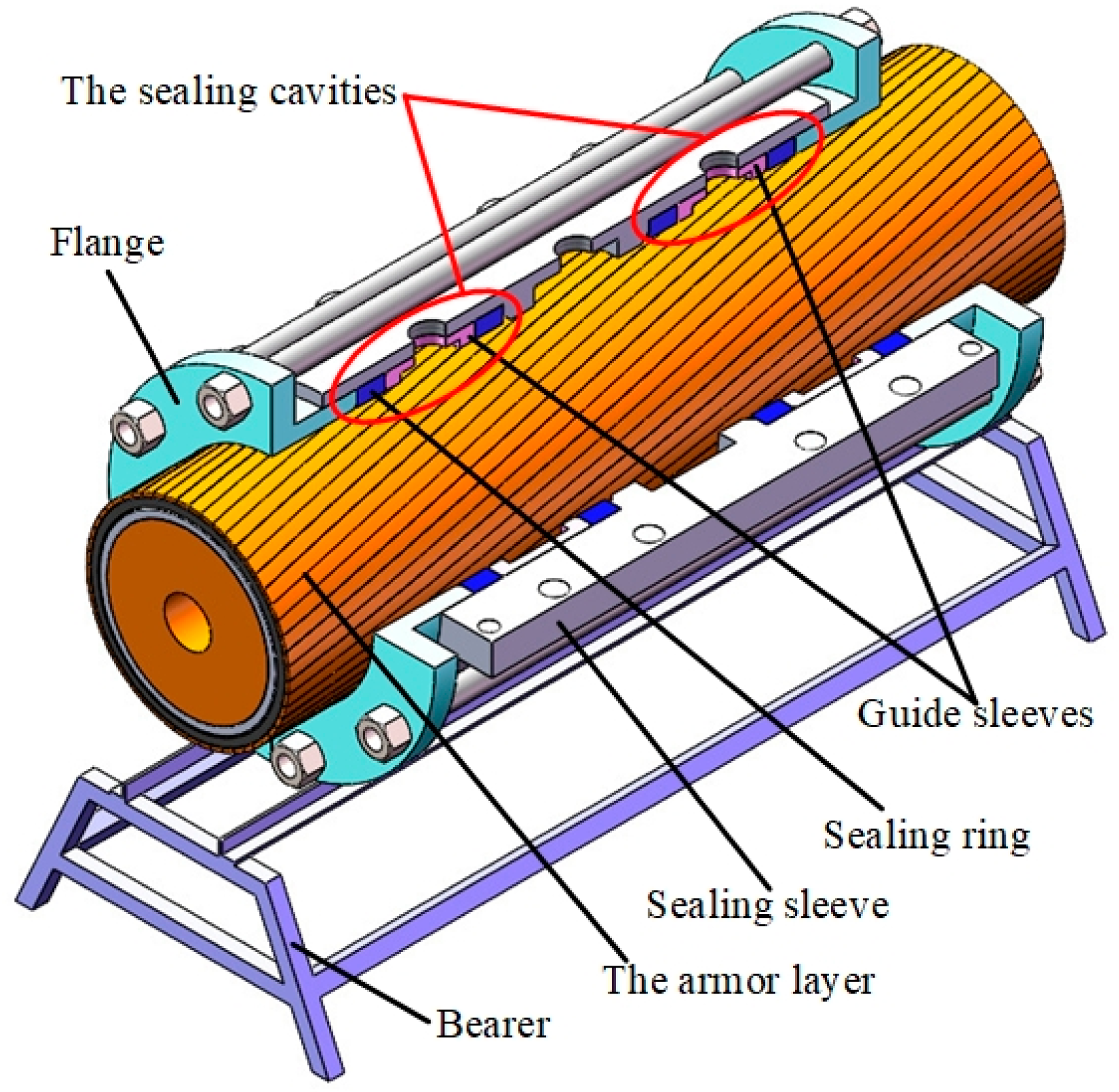
The custom-designed sealant plugging repair experimental device (Figure 1) comprised four primary components:
(1)
Flange: Configured as separable upper and lower units for assembly efficiency and compression of sealing rings.
(2)
Sealing sleeve: Employed separable upper and lower halves for ease of installation.
(3)
Guide sleeve: Provided rigid support in the middle of the two sealing rings.
(4)
Sealing rings: Two rings were utilized. Their primary function was to seal the radial gaps between the outer surface of the armor layer and the inner surface of the sealing sleeves, thereby defining the boundaries of the sealing cavity.
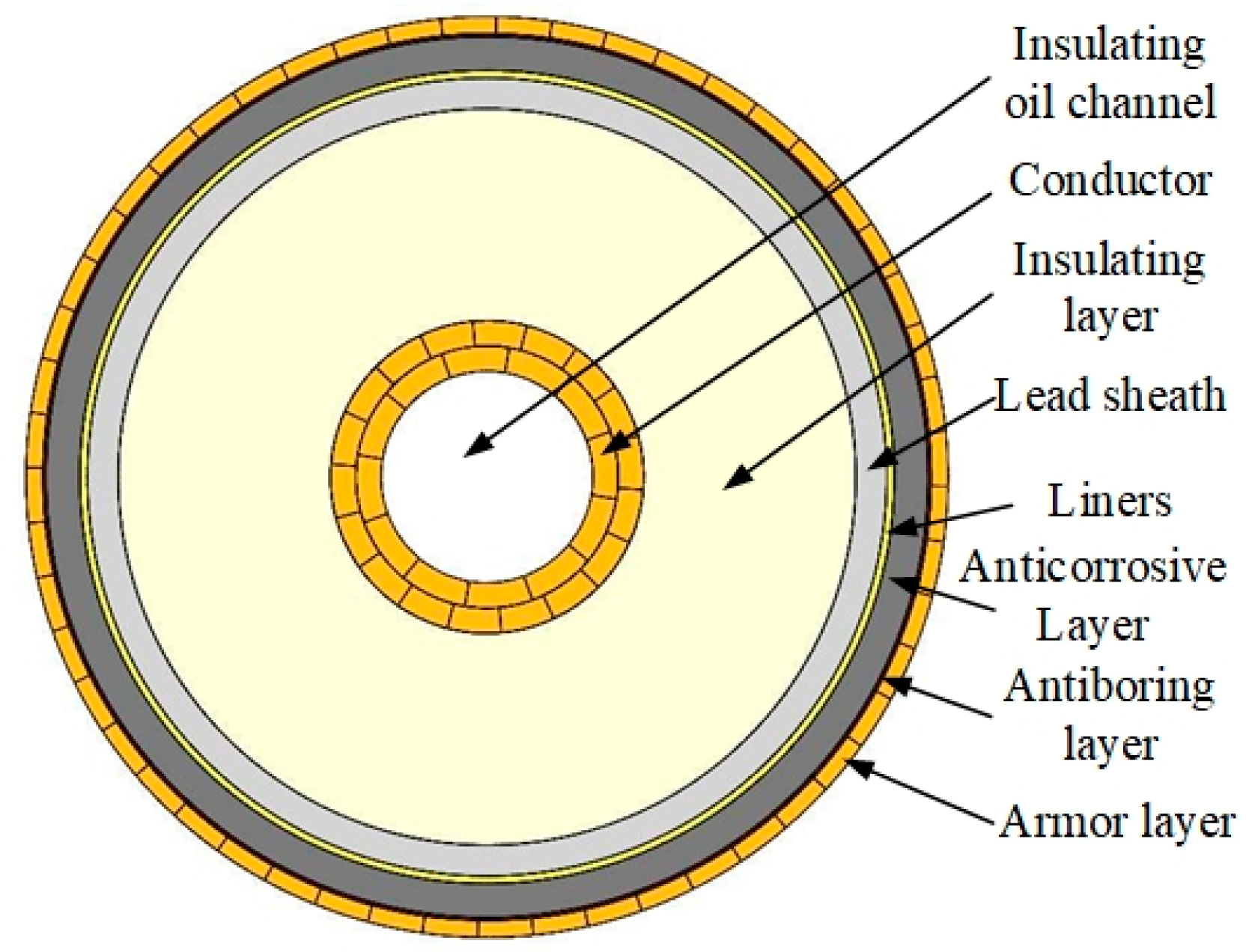
The sealing cavity was formed by a constrained volume bounded by dual sealing rings, a guide sleeve, the inner surface of the sealing sleeve, and the outer surface of the armor layer (Figure 2). Size and material parameters of each concentric layer of oil-filled submarine cable are shown in Table 2. Thermophysical properties (thermal conductivity, specific heat, and density) of the materials used in the cable construction are shown in Table A1.

2.3. Sealant Plugging Repair Mechanism

After the sealant plugging repair experimental device was installed subsea, hot air was used to expel the mixture of seawater and insulating oil from inside the device through its outlet. The continuous purging with hot air provided a dry environment for the sealant, during which the sealant displaced air as it penetrated.
The sealant plugging repair mechanism operated through the following sequential steps:
(1)
Low-viscosity/high-permeability sealant penetration
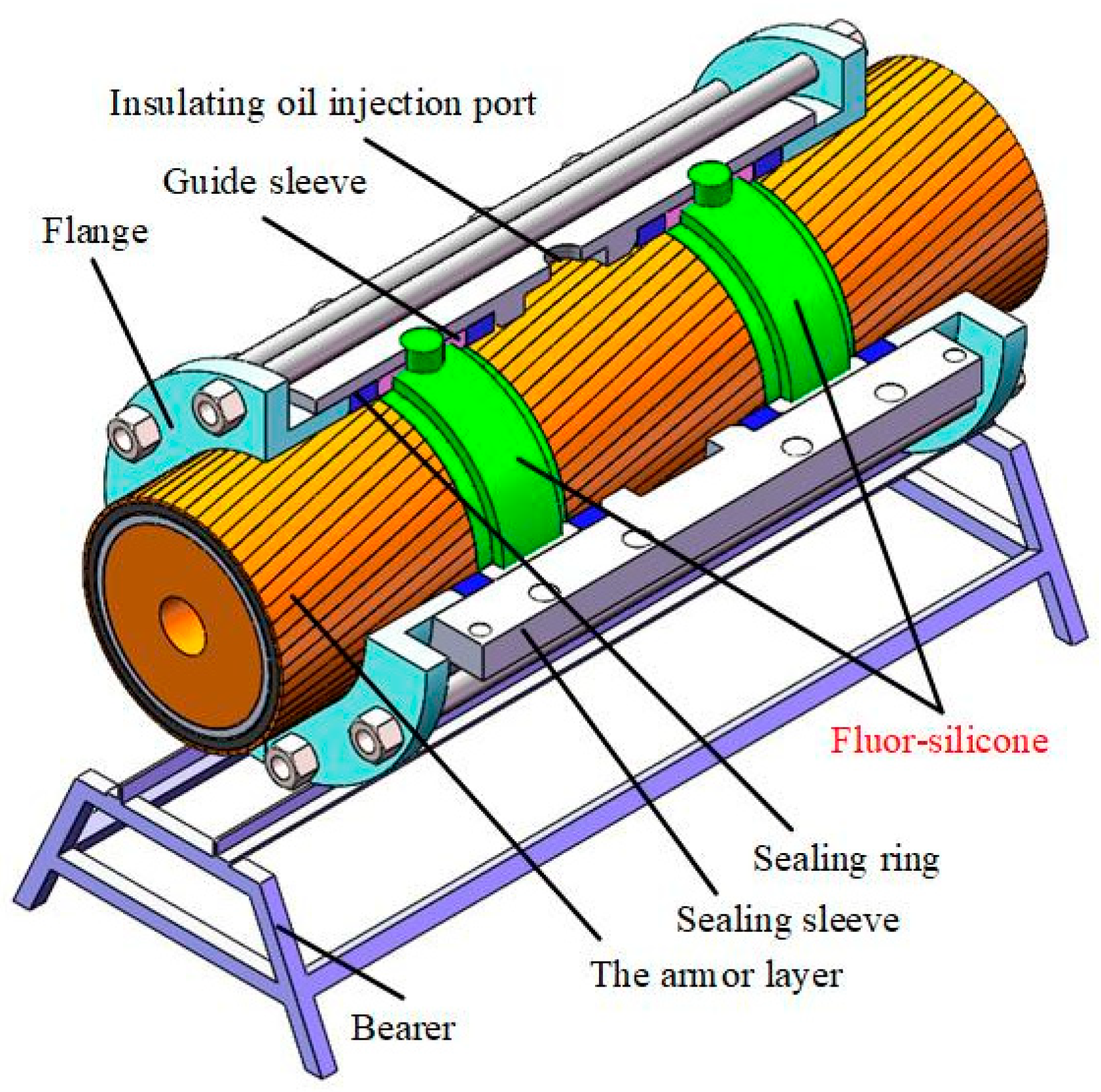
A low-viscosity/high-permeability sealant was then injected under pressure to achieve comprehensive penetration into (Figure 3):
(i)
The armored copper strip gaps between adjacent copper strips stranded in the armor layer.
(ii)
The radial gaps between the outer surface of the armor layer and the inner surface of the sealing sleeves.
This dual-path infiltration ensured the complete filling of all potential leakage pathways at the microscopic level.
(2)
High-viscosity/low-permeability sealant replacement and pressurization
The final stage involved the displacement of the low-viscosity/high-permeability sealant by a high-viscosity/low-permeability sealant. During the pressurized application, the high-viscosity/low-permeability sealant:
(i)
It fully occupied the annular sealing cavities.
(ii)
Generated a uniform circumferential sealing pressure.
(iii)
Established a permanent barrier against insulting oil leakage.
The viscosity gradient design enabled sequential filling from micro-gaps to macro-cavities, and the pressure pressurization characteristics ensured hermetic sealing under operational conditions.
(3)
Sealant plugging repair plugging efficacy verification
Insulating oil at 0.6 MPa was injected through the insulating oil injection port to verify the sealant plugging repair plugging efficacy.
An insulation oil pressure of 0.6 MPa represents the maximum operating oil pressure under normal conditions in an oil-filled submarine cable. It is used to verify that the cured sealant must withstand this maximum oil pressure in order to ensure effective sealing against insulation oil leakage. If no insulating oil leakage is observed along the armored copper strip gaps and the radial gaps on either side of the sealed section, and pressure decayed monitoring <0.01 MPa/24 h; it confirms the effectiveness of the sealant plugging repair technique.
Figure 3. Schematic diagram of the fluor-silicone being injected into the sealing cavities.
Fluids 11 00016 g003

3. Computational Modeling of Sealant Permeation Dynamics

This study employed computational fluid dynamics to simulate the permeation process of the fluor-silicone along the radial gaps. Simulations were conducted under injection pressures ranging from 0.1 MPa to 0.5 MPa. The sealant permeation process involved a two-phase flow, where the fluor-silicone constituted the liquid phase and the air initially present within the sealing cavities constituted the gas phase.

3.1. Theoretical Model

The Volume of Fluid (VOF) method was utilized to track the interface between the immiscible liquid and gas phases. Within this framework, the computational domain was discretized into control volumes. Each control volume was assigned a volume fraction (α) representing the proportion of the liquid phase it contains. The model incorporated the following assumptions:
(1)
The liquid phase was incompressible.
(2)
The liquid and gas phases within the computational domain were immiscible.
The volume fraction of the liquid phase in the i t h control volume was defined as:
α i 0 ,   C e l l   c o n t a i n s   o n l y   g a s                                                 1 ,   C e l l   c o n t a i n s   o n l y   l i q u i d                                         0 < a < 1 , C e l l   c o n t a i n s   t h e   l i q u i d g a s   i n t e r f a c e
Surface tension forces arising from molecular attraction between the liquid and gas phases were modeled. Applying the divergence theorem, the continuum surface force model expressed the surface tension force as a volumetric force ( F v o l ). For the cell containing only liquid and gas phases, this force simplifies to:
F v o l = σ i j ρ k i α i 1 2 ( ρ i + ρ j )
where σ i j represents the surface tension coefficient between the liquid and gas phases, taken as 0.3 N/m based on the work of Macdowell et al. [31]; ρ represents the density kg/m3; k i represents the interface curvature, and α i represents the gradient of the volume fraction.
The viscous model was modeled using the Realizable k ε model [31,32,33,34,35,36]. The governing equations for the turbulent kinetic energy (k) and its dissipation rate (ε) were:
t ρ k + x j ρ k u j = x j μ + μ t σ k k x j + G k + G b ρ ε Y M + S k
t ρ ε + x j ρ ε u j = x j μ + μ t σ ε ε x j + ρ C 1 S ε + S ε ρ C 2 ε 2 k + v ε + C 1 ε ε k C 3 ε C b
C 1 = m a x 0.43 , η η + 5 , η = S k ε , S = 2 S i j S i j
where ρ represents the density of sealant (liquid phase) 960 kg/m3; x j ( j = 1,2 , 3 ) represents the Cartesian coordinate components; u j represents the velocity component of sealant in x j direction (m/s); k represents the turbulent kinetic energy (m2/s2); ε represents the turbulent dissipation rate (m2/s2); μ represents the dynamic viscosity of sealant; μ t   represents the turbulent viscosity (determined by turbulence model) (Pa·s); G k represents the turbulent kinetic energy production due to mean velocity gradients (m2/s3); G b represents the turbulent kinetic energy production due to buoyancy (m2/s3); Y M represents the contribution of fluctuating dilatation in compressible turbulence to dissipation rate (m2/s3); S k represents the source term for k (m2/s3); S ε : represents the source term for ε (m2/s4); σ k represents the turbulent Prandtl number for k = 1.0; σ ε represents the turbulent Prandtl number for ε = 1.2 ; C 1 ε = 1.44 ; C 2 = 1.9 ; C 3 ε represents the coefficient for buoyancy effects in the ε equation (value depends on flow direction relative to gravity).

3.2. Sealant Permeation Fluid Domain and Boundary Conditions

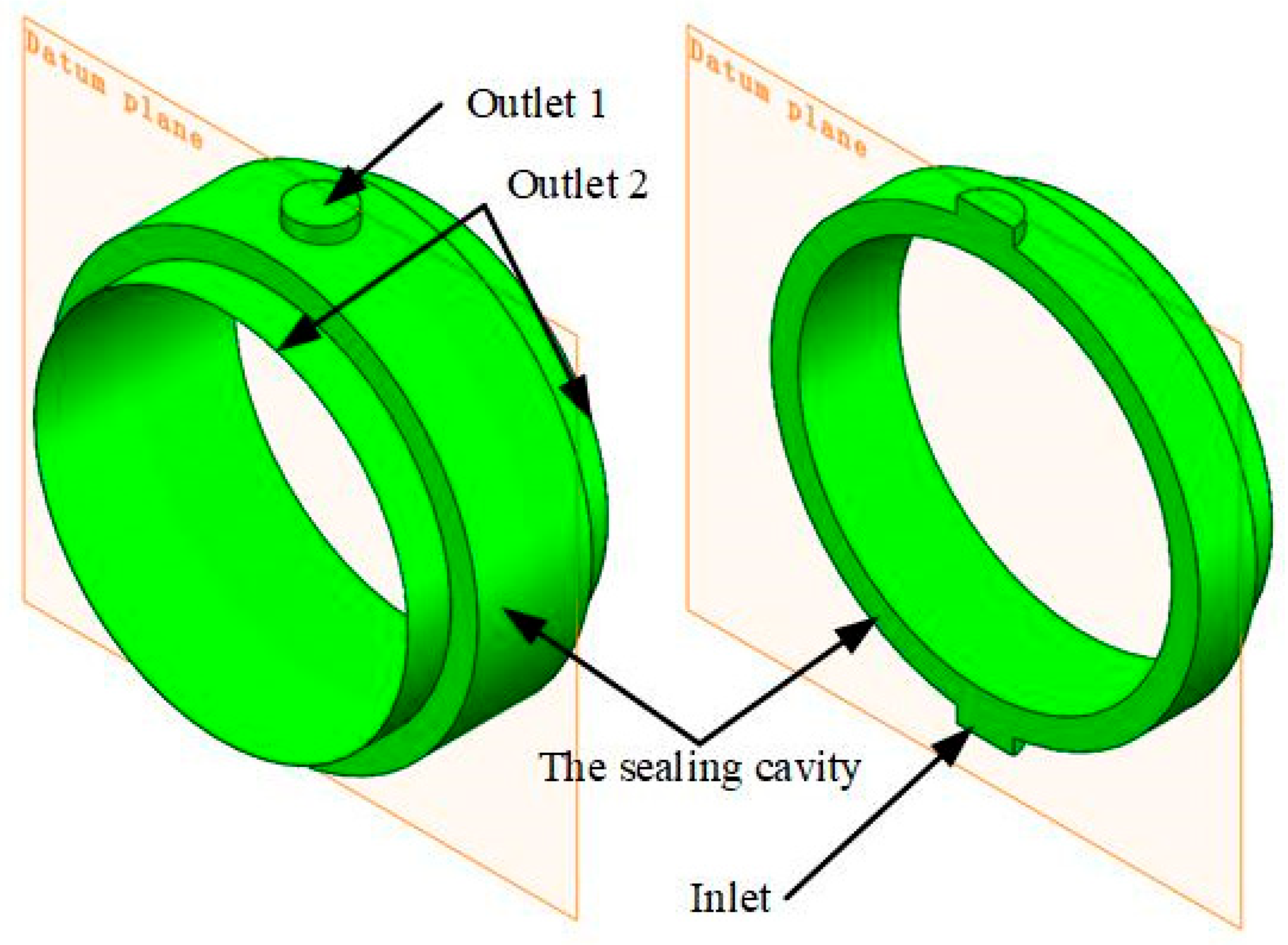
The armor layer of the oil-filled submarine cable consisted of helically wound armored copper strips. While V-shaped gaps existed between adjacent copper strips, this study focused on the sealant permeation along the radial gaps and within the sealing cavity itself. The armored copper strip gaps were simplified accordingly for computational efficiency while retaining the primary flow path of interest. The sealant permeation fluid domain and boundary conditions were illustrated in Figure 4.
(1)
Inlet: The sealant injection port, located at the lower end of the sealing sleeve, was modeled as a pressure inlet boundary condition (0.1 MPa–0.5 MPa).
(2)
Outlet 1: Positioned at the upper end of the sealing sleeve to allow air displaced by the sealant to escape, was modeled as a pressure outlet (atmospheric pressure).
(3)
Outlet 2: Represented the radial gaps, and this outlet ensured that sealant could permeate into the armored copper strip gaps, which were modeled as a pressure outlet (atmospheric pressure).
(4)
Walls: All other surfaces, including the armor layer and sealing sleeve walls, were defined as no-slip wall boundary conditions.
This study focused on the infiltration process of the sealant under different injection pressures. The parameters of the sealant fluid domain are as follows:
(1)
Both the sealant inlet and outlet 1 were cylinders with a diameter of 20 mm, located 14.65 mm from the armor layer.
(2)
The sealing cavity has an inner diameter of 130.7 mm, an outer diameter of 150 mm (corresponding to the inner diameter of the plugging device), and a width of 40 mm.
(3)
Outlet 2 has an inner diameter of 130.7 mm, an outer diameter of 131 mm, and a width of 15 mm.

3.3. Mesh Subdivision and Independence Analysis

The sealant permeation fluid domain was discretized using a structured hexahedral mesh, chosen for its accuracy and efficiency in capturing the interface dynamics via the VOF method. To enhance calculation accuracy in key areas:
(1)
Local grid refinement was applied at both the inlet and outlet 1 regions.
(2)
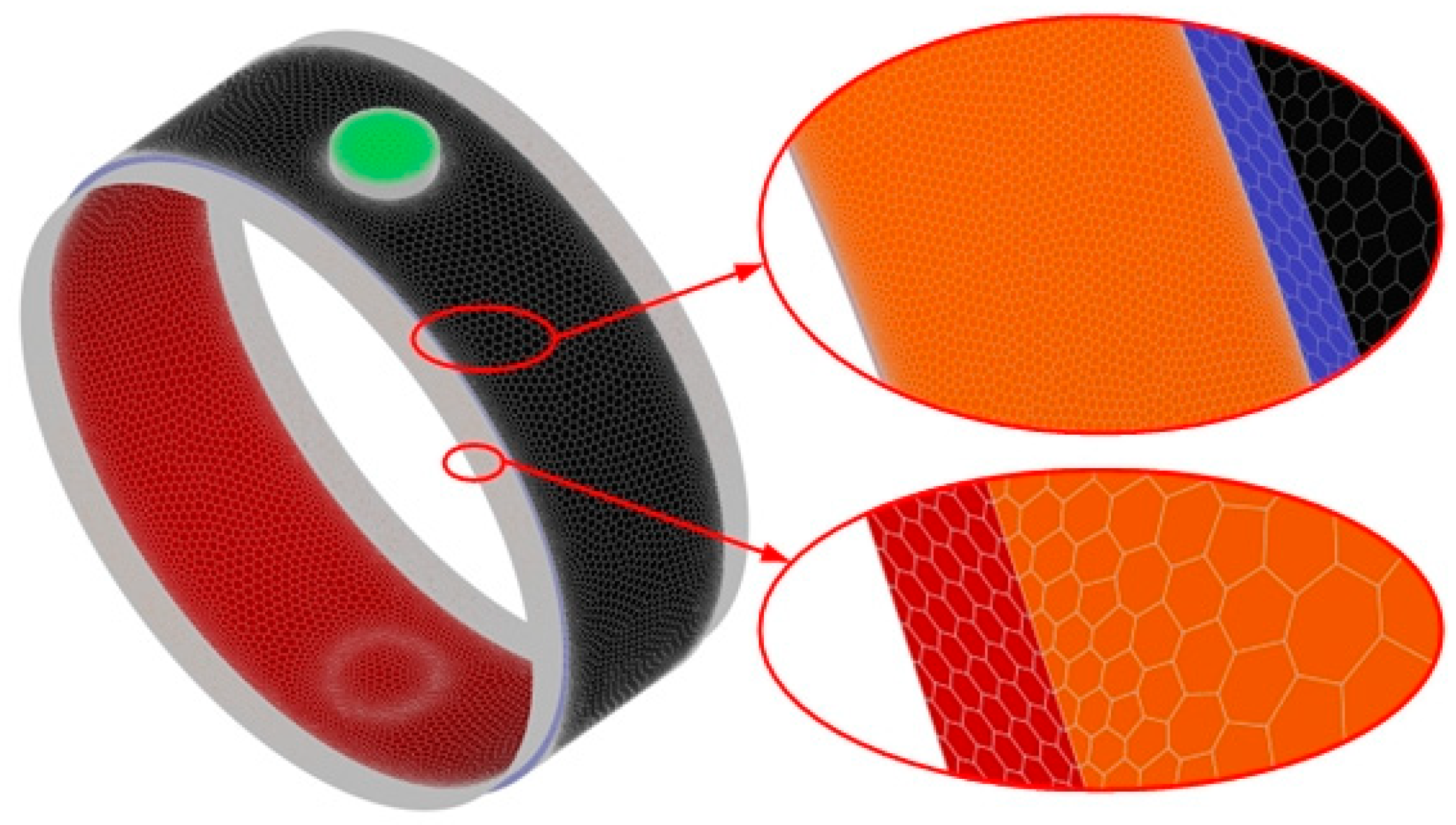
The thickness of the sealing cavity was 9.5 mm, which was divided into five layers, and the hexahedral mesh size was 1.9 mm. Special attention was paid to the radial gaps (Outlet 2), which had a thickness of 0.15 mm. To accurately resolve the flow within thin gaps, the mesh size at the radial gaps was set to 0.03 mm (Figure 5).
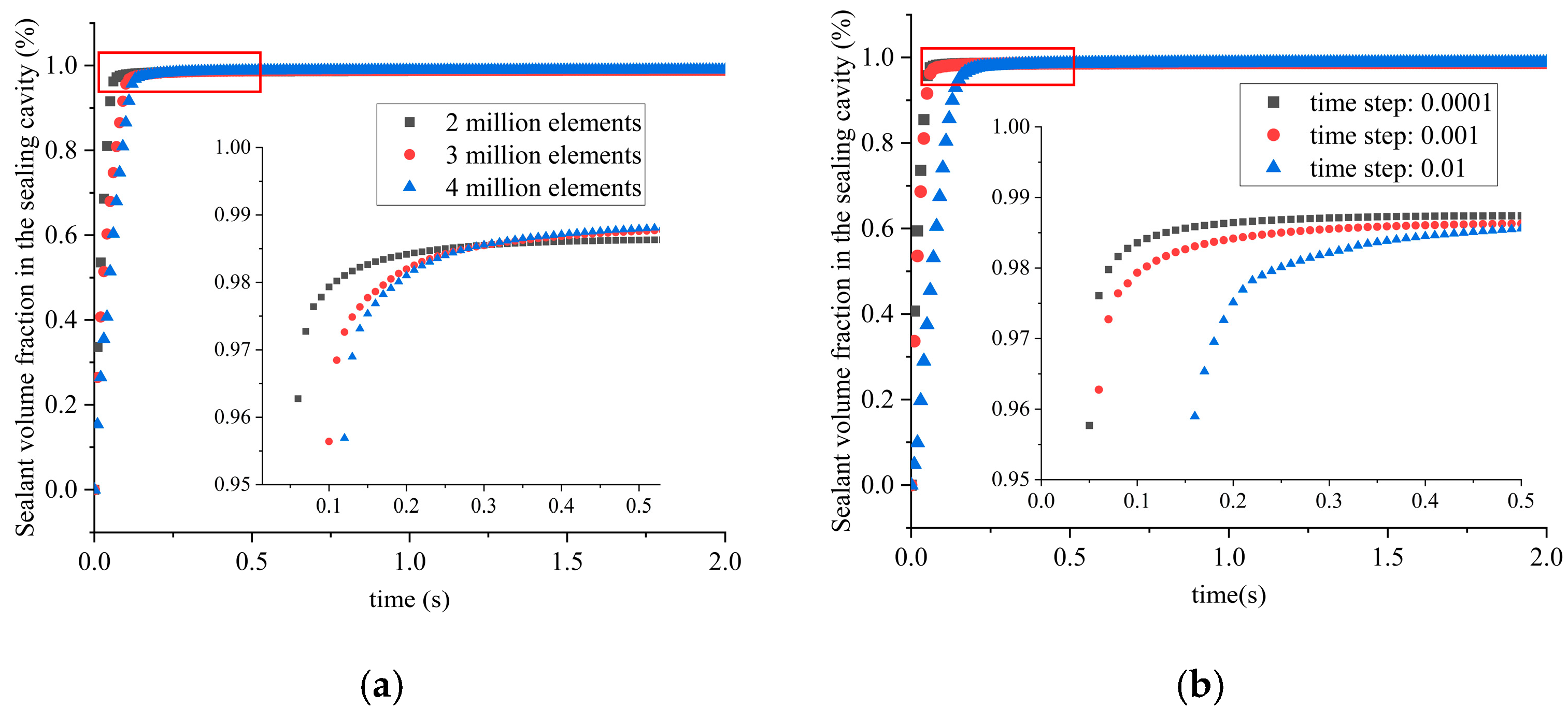
To ensure the reliability of numerical simulations, a mesh independence analysis and time steps analysis were conducted by comparing the sealant volume fraction in the sealant cavity under three mesh densities and time steps (three mesh densities: 2 million, 3 million, and 4 million elements; three time steps: 0.0001, 0.001, and 0.01). The results demonstrated that increasing the mesh count from 2 million to 3 million elements led to minor variations in the calculated volume fraction (relative deviation < 2%), indicating diminishing sensitivity to mesh refinement. Further refinement to 4 million elements showed negligible differences compared to the 3 million-element case (maximum relative error < 0.5%), with key parameters such as stabilized volume fraction and penetration time converging to consistent values. The results show that while Δt = 0.0001 yields the smoothest and most accurate results, it significantly increases computational cost. Conversely, Δt = 0.01 may lead to numerical oscillations due to the excessively large step size, compromising solution stability and reliability (Figure 6b). In comparison, Δt = 0.001 ensured both computational accuracy and result stability while markedly improving computational efficiency. Based on these observations, the 3 million-element mesh and Δt = 0.001 were selected for subsequent simulations as it achieved a balance between computational accuracy and efficiency (Figure 6).

4. Results and Discussion

Computations utilizing the Volume of Fluid (VOF) method provided a detailed visualization of the sealant permeation process, tracking its progression from the injection port to the outlet of the sealing sleeve. The analysis focused on three key aspects governing permeation efficacy: (1) sealant volume fraction in the sealing cavity; (2) sealant leakage volume fraction along the radial gaps at outlet 2; and (3) relative velocity of the permeating sealant along the radial gaps at outlet 2.

4.1. Sealant Volume Fraction in the Sealing Cavity

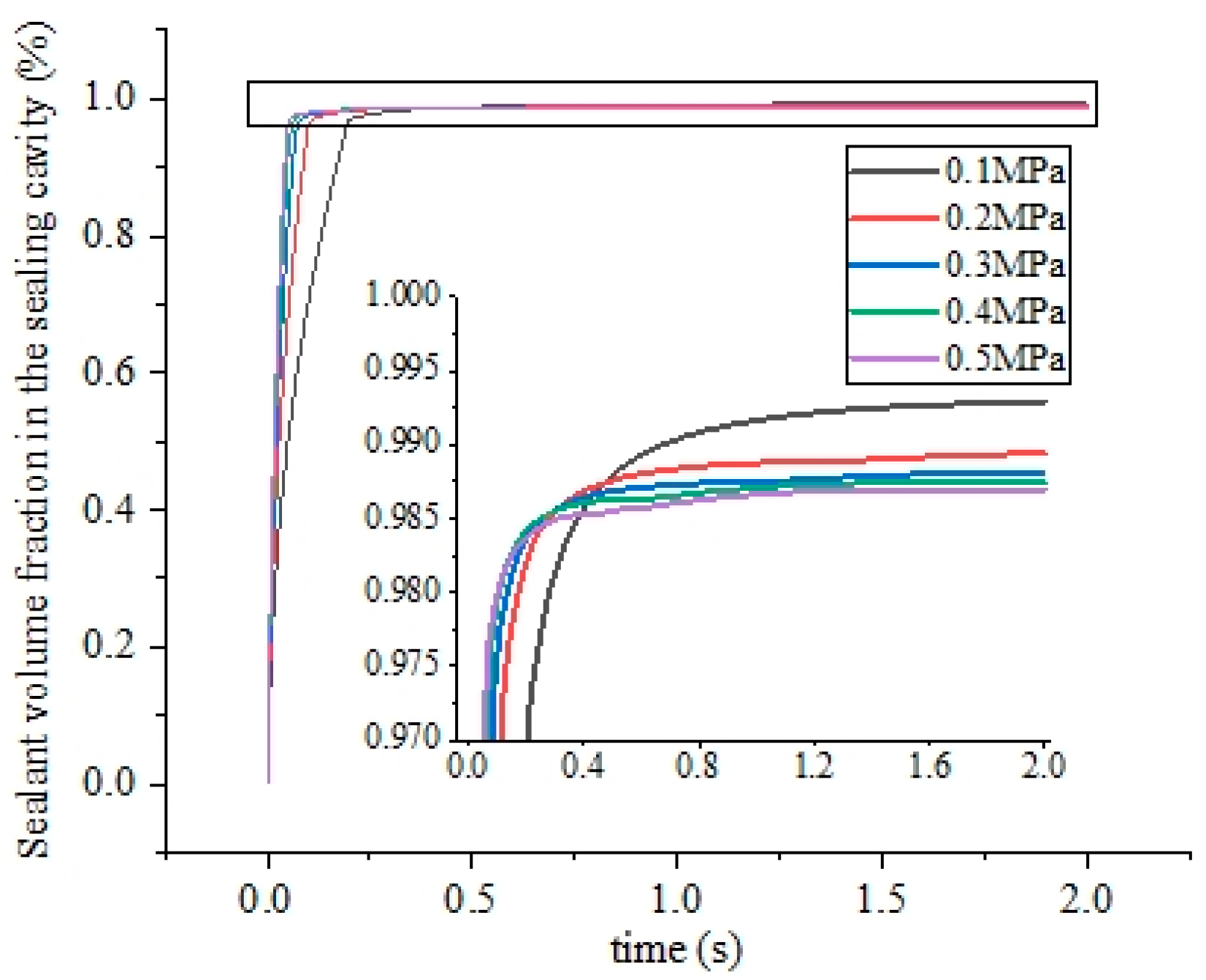
The results demonstrated a clear pressure-dependent penetration behavior, characterized by three distinct phases (Figure 7):
(1)
Initial penetration phase (0–0.5 s):
(i)
All pressure conditions exhibited rapid initial sealant filling;
(ii)
Higher pressures (0.4–0.5 MPa) achieved >90% the sealing cavity filling within 0.3 s;
(iii)
Lower pressures (0.1–0.2 MPa) required approximately 0.5 s to reach 60% filling.
(2)
Transition phase (0.5–1.5 s):
(i)
Penetration rates decreased as the sealing cavity approached full occupancy;
(ii)
0.4 MPa showed a balanced performance with 98.5% filling at 1.2 s;
(iii)
0.5 MPa exhibited a minor overshoot (101.5%) due to potential compression effects.
(3)
Stabilization phase (>1.5 s):
(i)
All systems reached equilibrium (99.2 ± 0.8% filling);
(ii)
Higher pressures demonstrate slightly reduced final volumes (0.5 MPa: 98.7%) versus lower pressures (0.2 MPa: 99.5%).
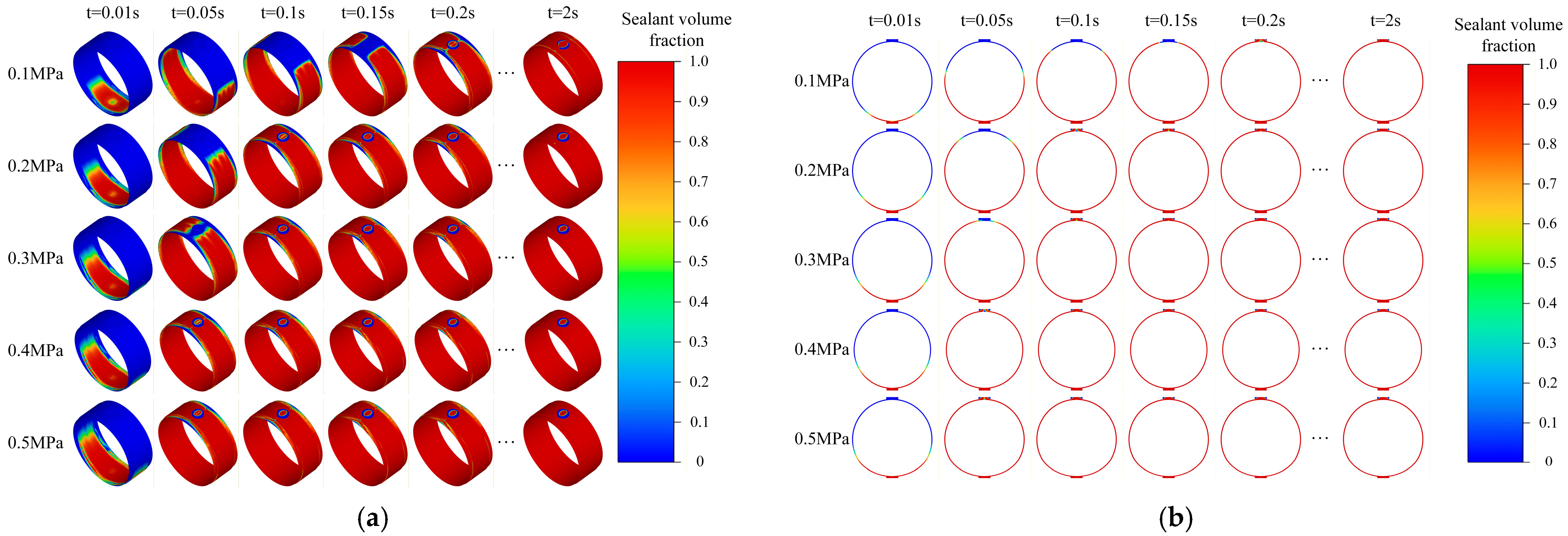
Figure 8a (axial view) and Figure 8b (datum plane view) illustrate two essential phenomena:
(1)
Sealant volume fraction distribution (scalar field): Color gradients (0–1) quantitatively represented filling completeness, with red colors indicating fully filled regions (Φ = 1.0) and blue colors showing unfilled/air-entrapped zones.
(2)
Unfilled/air-entrapped zones (phase interface): Sharp transitions in volume fraction reveal air-entrapped fronts, with bubble-like residuals visible at low-pressure conditions.
The results demonstrated a clear pressure-dependent penetration visual behavior, characterized by three distinct pressure ranges (Figure 8a,b)
(1)
Low pressure (0.1–0.2 MPa):
(i)
Irregular penetration fronts with significant air entrapment (local Φ drop < 0.5);
(ii)
Incomplete filling (terminal axial Φ < 0.8).
(2)
Suitable pressure (0.3–0.4 MPa):
(i)
Smooth advancement with complete air expulsion (no Φ discontinuity);
(ii)
Uniform filling (mean Φ > 0.95).
(3)
Excessive pressure (0.5 MPa):
(i)
Potential over-penetration artifacts (Φ > 1.0 at boundaries);
(ii)
Vortex-induced air entrainment (annular low-Φ regions).

4.2. Sealant Leakage Volume Fraction Along the Radial Gaps

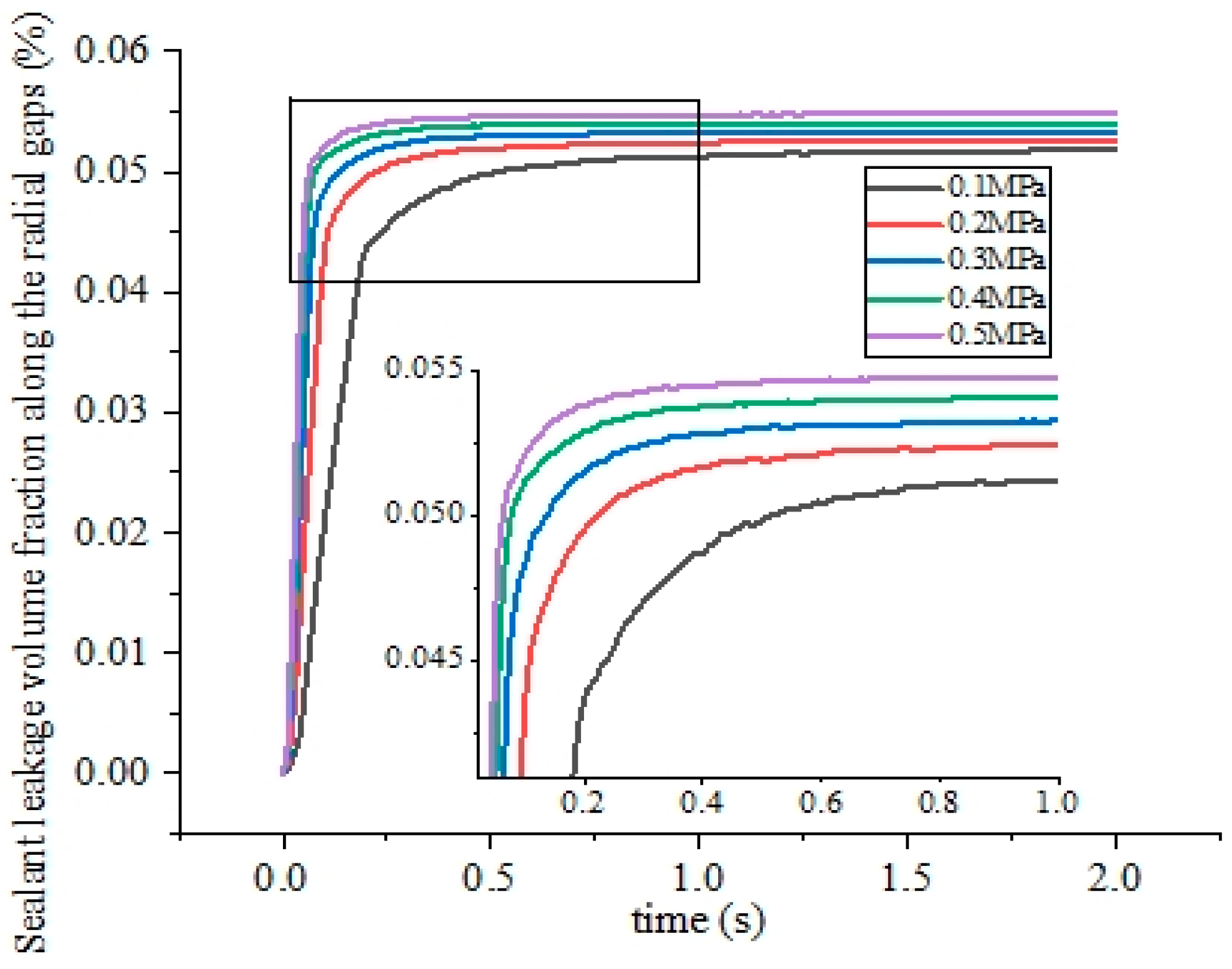
The results demonstrated a clear pressure-dependent leakage behavior, characterized by four distinct pieces of information (Figure 9):
(1)
All pressures showed rapid initial leakage (t < 0.2 s) followed by stabilization;
(2)
0.1 MPa: minimal leakage (<1%) but incomplete sealing;
(3)
0.4 MPa: balance leakage (2.8%) with completed sealing cavity filling;
(4)
0.5 MPa: excessive leakage (5.5%) due to over-penetration.

4.3. Sealant Permeation Relative Velocity Along the Radial Gaps

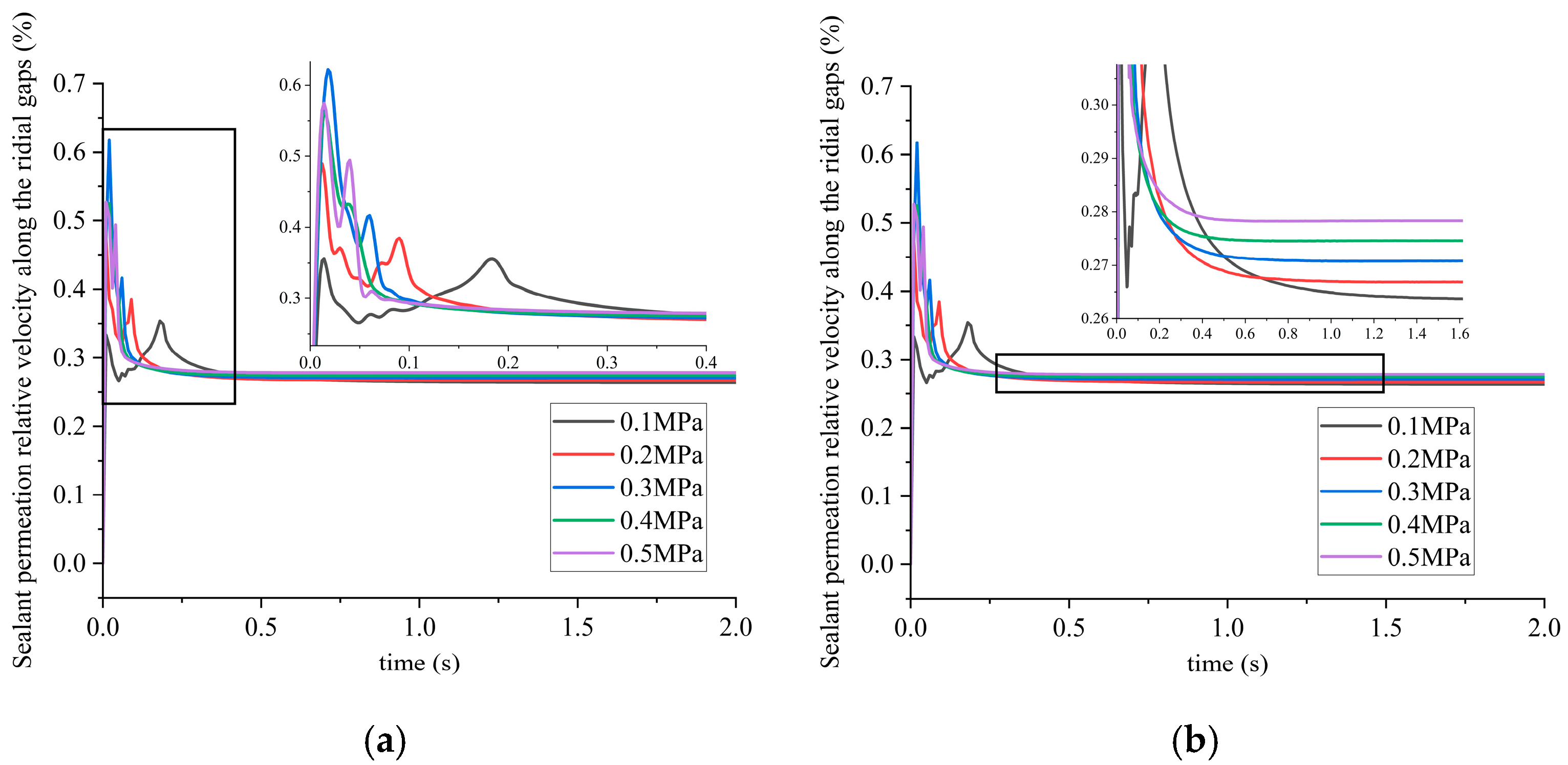
The sealant permeation relative velocity was defined as the ratio of the sealant leakage velocity along the radial gaps to its injection velocity at the inlet (Figure 10). Key dynamic characteristics:
(1)
Initial phase (t < 0.05 s):
(i)
0.5 MPa achieved peak velocity (0.65 m/s), 300% faster than 0.1 MPa.
(2)
Stabilization phase (t > 0.2 s):
(i)
0.4 MPa maintained a steady velocity (0.28 ± 0.03 m/s);
(ii)
0.5 MPa exhibited strong oscillations (± 15%).
(3)
Fluctuation analysis (0.5 MPa):
(i)
Revealed flow instabilities at t = 0.12–0.18 s for injection pressure ≥ 0.4 MPa;
(ii)
Correlated with vortex formation in filling patterns.

4.4. Determination of Suitable Sealant Injection Pressure

Synthesizing the results from (1) sealant volume fraction in the sealing cavity; (2) sealant leakage volume fraction along the radial gaps at outlet 2; and (3) relative velocity of the permeating sealant along the radial gaps at outlet 2:
(1)
Pressures below 0.3 MPa led to inadequate sealing the cavity filling, significant unfilled/air-entrapped zones.
(2)
Pressures at 0.4 MPa and 0.5 MPa ensured rapid sealing of the cavity filling, effective air purging, and fast stabilization. They also promoted complete penetration into the armored copper strip gaps and the radial gaps.
(3)
However, the 0.5 MPa pressure resulted in the highest sealant leakage volume fraction along the radial gaps, indicating excessive flow through the radial gaps before the sealing cavity saturation, representing inefficient sealant utilization.
(4)
Recommended pressure (0.4 MPa): this pressure achieved the balance.
(i)
Effective air purging: completed displacement of air from the sealing cavity.
(ii)
Complete permeation: ensured sealant fully penetrated the armored copper strip gaps and the radial gaps.
(iii)
Minimized waste: avoided the excessive sealant leakage flow observed at 0.5 MPa, promoting efficient sealant usage.
(iv)
Rapid process: short time to reach permeation and leakage steady state.
As can be seen from Figure 10a, as the sealant injection pressure increases, the duration of relative velocity fluctuation along the radial gap shortens. This indicated that higher pressure facilitates faster filling of the sealing cavity. When the injection pressure increases gradually from 0.1 MPa to 0.3 MPa, the amplitude of the relative velocity fluctuation also increases. However, as the pressure further rose from 0.3 MPa to 0.5 MPa, the fluctuation amplitude showed a trend of first decreasing and then increasing. Furthermore, as shown in Figure 10b, when the injection pressure increases from 0.3 MPa to 0.5 MPa, the time required for the relative velocity to stabilize shows minimal difference. Considering both the relative velocity fluctuation (indicative of flow separation and reattachment) and the stabilization time (reflecting low inertia and fast response) comprehensively, an injection pressure of 0.4 MPa was selected as the recommended condition.

5. Sealant Penetration Experiment

5.1. Experimental Setup and Parameters

Experimental validation of the sealant penetration process was conducted under controlled laboratory conditions to ensure consistency and reproducibility.
(1)
Environmental Conditions
All tests were performed in a climate-controlled laboratory maintained at 25 ± 1 °C and 65 ± 5% relative humidity. Temperature and humidity were continuously monitored using a calibrated digital hygro-thermometer. These conditions were selected to simulate typical offshore seabed environments and to ensure stable sealant viscosity and curing behavior.
(2)
Test Specimen
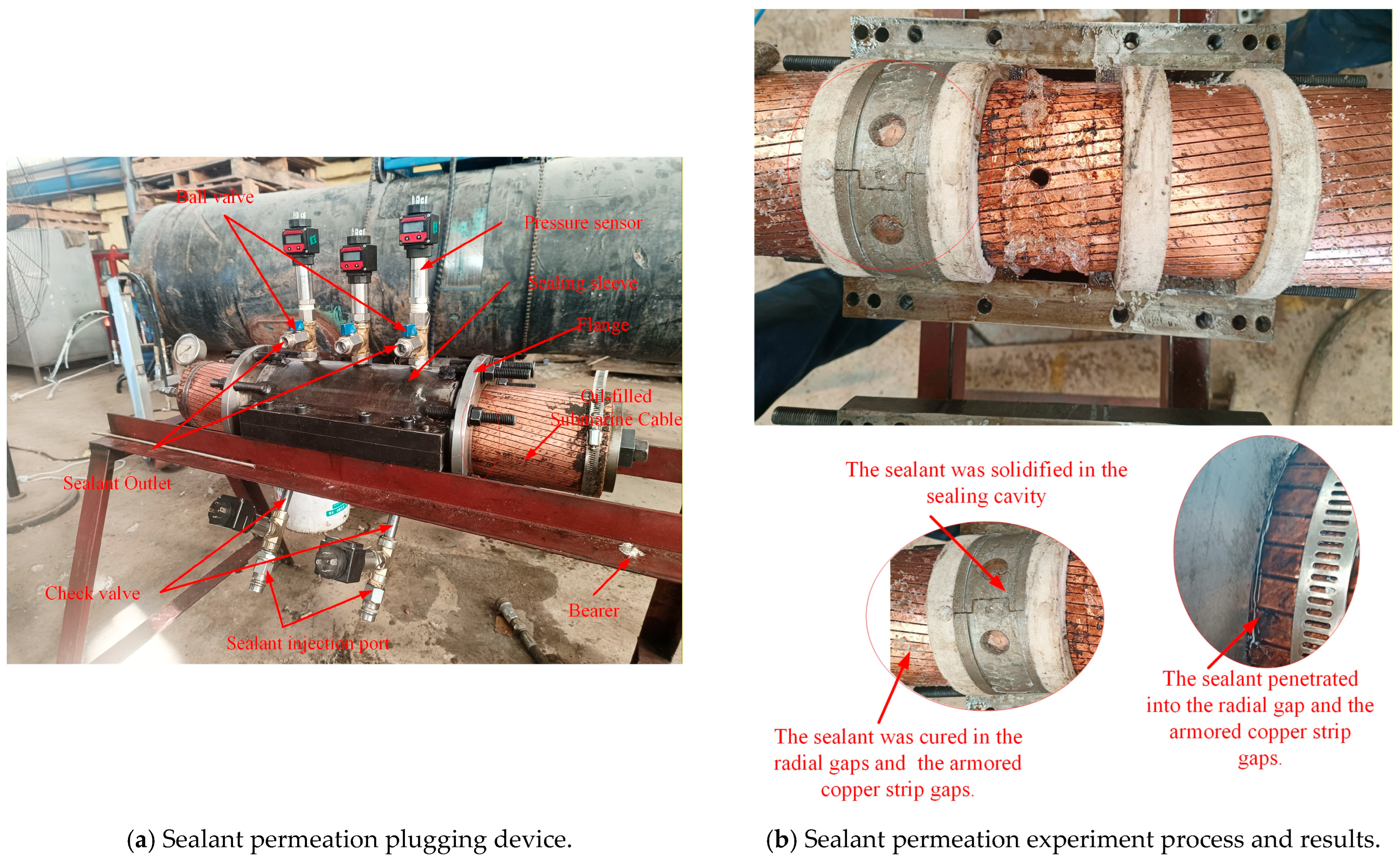
A 1000 mm-long segment of a 500 kV oil-filled submarine cable was used, with an armor layer outer diameter of 131.7 mm and a radial gap of 0.15 mm (Figure 11a). The cable segment was pre-cleaned with alcohol to remove surface contaminants and moisture.
(3)
Sealant Preparation
The fluor-silicone sealant (Table 1) was prepared by mixing components A and B in a 1:1 weight ratio using a dual-cartridge static mixer.

5.2. Experimental Procedure and Observations

The sealant penetration process was systematically documented according to the following chronological sequence:
(1)
Initial injection (t = 0 s): Sealant injection commenced at 0.4 MPa with simultaneous timing initiation.
(2)
Radial permeation onset (t = 0.02 s): Sealant permeation was observed at the radial gaps interface.
(3)
Outlet flow initiation (t = 0.5 s): Sealant discharge was noted at the sealing sleeve outlet, prompting partial closure of the ball valve to modulate flow.
(4)
Uniform permeation (t = 2.1 s): Homogeneous sealant distribution was achieved throughout the armored copper strip and the radial gaps. The ball valves were subsequently closed to initiate the curing process within the gaps.

5.3. Validation of Results and Error Analysis

The experimental permeation dynamics demonstrated close alignment with simulation predictions under 0.4 MPa injection pressure. Post-curing inspection revealed complete filling of both the armored copper strip gaps and the radial gaps interstices with solidified sealant (Figure 11b). To ensure repeatability, the experiment was conducted three times under identical conditions. The average time to achieve uniform permeation was 2.1 s with a standard deviation of ±0.15 s. The discrepancy between the simulated stabilization time (~1.8 s) and the experimental result (~2.1 s) was attributed to minor friction losses and variations in sealant properties that were not fully captured by the ideal CFD model. This represents an acceptable error margin of approximately 14% for this complex transient flow process.

6. Conclusions

This study proposed an innovative sealant plugging repair technique specifically designed for oil-filled submarine cable insulation oil leaks.
(1)
The repair mechanism involved two key operational phases: low-viscosity/high-permeability sealant permeation and high-viscosity/low-permeability sealant replacement and pressurization.
(2)
Through comprehensive evaluation of sealant behavior—including (1) sealant volume fraction in the sealing cavity; (2) sealant leakage volume fraction along the radial gaps at outlet 2; and (3) relative velocity of the permeating sealant along the radial gaps at outlet 2, the study identified 0.4 MPa as the recommended injection pressure. This parameter achieves performance benchmarks:
(i)
0.4 MPa achieved 98.5% cavity filling within 1.2 s;
(ii)
Leakage was limited to 2.8% at 0.4 MPa, compared to 5.5% at 0.5 MPa;
(iii)
Steady-state velocity stabilized at 0.28 ± 0.03 m/s.
(3)
Experimental validation showed complete gap filling with a process time of 2.1 ± 0.15 s. The experimental permeation dynamics demonstrated close alignment with simulation predictions under 0.4 MPa injection pressure. Post-curing inspection revealed complete filling of both the armored copper strip gaps and the radial gaps interstices with solidified sealant.
This study demonstrated the feasibility of the low-viscosity sealant penetration into both the gaps between the armored copper strips and the radial gaps under 0.4 MPa injection pressure. It provided theoretical and experimental guidance for this process within the sealant plugging repair technique.

Author Contributions

Writing—original draft, M.Z. and B.H.; investigation, M.Z., Z.Z. and M.F.; methodology, M.Z. and B.H.; software, M.Z., C.C. and L.J.; data curation, M.Z. and S.H.; formal analysis, M.Z.; writing—review and editing, M.Z., B.H., L.Z. and S.H. All authors have read and agreed to the published version of the manuscript.

Funding

This work was funded by China Southern Power Grid Co, Ltd. Technology Project. No.07000KC24010005 (SEPRI-K24B024).

Institutional Review Board Statement

Not applicable.

Informed Consent Statement

Not applicable.

Data Availability Statement

The original contributions presented in this study are included in the article. Further inquiries can be directed to the corresponding authors.

Conflicts of Interest

Ming Zhang studied at China University of Petroleum (Beijing) and was an intern at the CSG Electric Power Research Institute Co., Ltd. The authors declare no conflicts of interest.

Abbreviations

The following abbreviations are used in this manuscript:
VOFVolume of fluid
CFDComputational fluid dynamics

Appendix A

Table A1 presents the thermophysical properties (thermal conductivity, specific heat, and density) of the materials used in the cable construction.
Table A1. Thermophysical Properties of Cable Construction Materials.
Concentric
Layer
MaterialDensity
(kg/m3)
Specific Heat Capacity
(J/(kg•K))
Thermal Conductivity
(W/(m•K))
Armor layerFlat copper wire8940385385
Antiboring layerRibbon copper8940385385
Anticorrosive layerPolyethylene sheath930–96023000.33–0.52
LinersBronze belt870038050
Lead sheathLead alloy sleeve1134013035
Insulating layerImpregnated paper tape///
ConductorCopper8940385395 (Pure 20 °C)

References

  1. Liao, J.; Chu, J.; Gao, F.; Chen, Y.; Zhang, C.; Yu, S.; Li, H.; Zhong, L. Research progress on Performance of Alkylbenzene Insulating Oil for Submarine cable. Insul. Mater. 2021, 54, 20–25. [Google Scholar] [CrossRef]
  2. Wang, Z.; Tang, Y.; Jia, L. Electric-thermal coupling and ampacity of 500 kV DC submarine cable under the action of vertical ocean currents. Electr. Power Eng. Technol. 2024, 43, 140–149. [Google Scholar] [CrossRef]
  3. Li, Y.; Liu, Y.; Xie, M.; Zhang, Z. A Buoy-Type Submarine Cable Insulation Medium Leakage Monitoring System. Liaoning Province. CN202210605348.8, 6 September 2022. [Google Scholar]
  4. Liao, J.; Hou, M.; Liu, Z.; Li, Y.; Xiao, L.; Liao, Z. Location Method, Device and System of Insulating Oil Leakage Point of Submarine Cable. Guangdong Province. CN202311169026.4, 14 November 2023. [Google Scholar]
  5. Huang, X.; Zhang, Y.; Feng, B.; Jiang, D.; Lu, Z.; Fu, M.; Wu, C.; Hou, S.; Guo, Q.; Hui, B.; et al. A Leak Detection Method, Device and Equipment for Submarine Oil-Filled Cables. Hainan Province. CN202311208575.8, 15 December 2023. [Google Scholar]
  6. Jiang, D.; Feng, B.; Chen, Y.; Huang, X.; Hou, S.; Hui, B.; Li, X.; Zhu, W.; Zhou, X.; Zhan, Y.; et al. A Method and System for Locating Leaks and Identifying the Extent of Leaks in Submarine Oil-Filled Cables. Hainan Province. CN202410207824.X, 7 May 2024. [Google Scholar]
  7. Wu, Q.; Guo, Q.; Wang, J.; Cen, Z.; Zhang, W.; Chen, H.; Zhao, D.; Zhu, D.; Huang, X.; Chen, Y.; et al. Insulating Oil Recovery Devices and Methods. Hainan Province. CN202310893729.5, 1 September 2023. [Google Scholar]
  8. Zhu, D.; Li, X.; Zhang, S.; Zhao, D.; Pang, T.; Huang, X.; Zhang, Y.; Guo, Q.; Cen, Z.; Wang, J.; et al. A Suitable for Oil-Filled Submarine Cable Insulation Medium Recovery Oil Guide Device. Hainan Province. CN202311508960.4, 19 March 2024. [Google Scholar]
  9. McLaurin, D.; Aston, A.; Brand, J. Prevention of offshore wind power cable incidents by employing offshore oil/gas common practices. In Proceedings of the International Conference on Offshore Mechanics and Arctic Engineering, Online, 16–18 February 2021; American Society of Mechanical Engineers: New York, NY, USA, 2021; Volume 84768, p. V001T02A002. [Google Scholar]
  10. Agarwal, M.S. Enhancing Capacity-of and Capabilities-In repair of submarine Communication Cables through International Cooperation. In Viewing Maritime Activities Through A Legal Lens; National Maritime Foundation: New Delhi, India, 2024; pp. 116–131. [Google Scholar]
  11. Lv, T.; Cen, Z.; Huang, X.; Cai, C.; Zeng, K.; Zhang, Y.; Chen, Z.; Tang, X. Review of Data-Driven Condition Monitoring and Fault Diagnosis Technologies for Submarine Cable; Frontier Academic Forum of Electrical Engineering; Springer: Singapore, 2025; pp. 597–610. [Google Scholar]
  12. Cai, C.; Huang, X.; Zeng, K.; Hu, Y.; Lv, T.; Cen, Z.; Chen, H.; Wang, J. The Optimization Design and Performance Analysis of the Accumulator Lifting System for 500kV Oil-Filled Submarine Cable Pumping Station. In Proceedings of the 2024 IEEE 8th Conference on Energy Internet and Energy System Integration (EI2), Shanghai, China, 25–28 October 2024; IEEE: Piscataway, NJ, USA, 2024; pp. 2803–2807. [Google Scholar]
  13. Al-Ruzouq, R.; Gibril, M.B.A.; Shanableh, A.; Kais, A.; Hamed, O.; Al-Mansoori, S.; Khalil, M.A. Sensors, features, and machine learning for oil spill detection and monitoring: A review. Remote Sens. 2020, 12, 3338. [Google Scholar] [CrossRef]
  14. Kostyuk, A.; Tumanov, A.; Tumanov, V.; Zybina, O. Improving Emergency Response Systems in the Oil and Gas Industry to Reduce Environmental Damage. E3S Web Conf. 2020, 221, 01008. [Google Scholar] [CrossRef]
  15. Chen, Y.H.; Shen, S.C.; Wu, Y.K.; Lee, C.Y.; Chen, Y.J. Design and testing of real-time sensing system used in predicting the leakage of subsea pipeline. Sensors 2022, 22, 6846. [Google Scholar] [CrossRef]
  16. Keramea, P.; Spanoudaki, K.; Zodiatis, G.; Gikas, G.; Sylaios, G. Oil spill modeling: A critical review on current trends, perspectives, and challenges. J. Mar. Sci. Eng. 2021, 9, 181. [Google Scholar] [CrossRef]
  17. Sun, Z.; He, W.; Han, J.; Bo, H. Comparative Investigation of Eulerian and VOF Models in Gas-Liquid Two-Phase Flow Simulation. In Proceedings of the International Conference on Nuclear Engineering, American Society of Mechanical Engineers. Prague, Czech Republic, 4–8 August 2024; Volume 88261, p. V006T07A059. [Google Scholar]
  18. Mirjalili, S.; Jain, S.S.; Dodd, M. Interface-capturing methods for two-phase flows: An overview and recent developments. Cent. Turbul. Res. Annu. Res. Briefs 2017, 2017, 13. [Google Scholar]
  19. Liu, X.; Liu, S.; Zheng, T.; Zhu, C.; Jeng, D.S. Numerical Study on the Migration of Leaked Oil in Submarine Sediment Caused by Pipeline Leakage Using Two-phase Flow Model. J. Mar. Environ. Eng. 2023, 11, 41–56. [Google Scholar] [CrossRef]
  20. Sun, Y.; Zhu, X.; Cao, X.; Sun, S.; Bian, J. Numerical analysis of dispersion characteristics of underwater gas-oil two-phase leakage process. Mar. Pollut. Bull. 2023, 197, 115766. [Google Scholar] [CrossRef]
  21. Wen, F.; Wang, L.; Li, S.; Guo, H.; Liu, B. Preparation and properties of rGO@Al2O3 filled thermal conductive silicon gel. J. Mater. Eng. 2024, 52, 139–145. [Google Scholar] [CrossRef]
  22. Yang, D.; Wang, Z.; Ye, N.; Li, J.; Lu, Y. Preparation and Properties of Low Migration Thermal Conductive Silicone Gel. Polym. Bull. 2023, 36, 329–337. [Google Scholar] [CrossRef]
  23. Liu, H.; Chen, X.; Xiao, Y.; Xing, Z.; Ju, M.; Xu, L. Preparation and Properties of Two-Component Silicone Gel cured at Room Temperature. J. East China Univ. Sci. Technol. 2017, 43, 66–69+148. [Google Scholar] [CrossRef]
  24. Duan, Y.; Xu, Y.; Hong, F.; Liu, C.; Yan, X.; Ke, X.; Jiang, X.; You, F. Progress in Research of Preparation, Structure and Properties of Porous Polyurethane Sound-Absorbing Materials. Polym. Mater. Sci. Eng. 2024, 40, 137–147. [Google Scholar] [CrossRef]
  25. Du, H.; Yu, C.; Li, Y.; Zhang, J.; Wang, Y.; Dong, B.; Cao, H. Study on a Two-Component High Strength Polyurethane Sealant. Eng. Plast. Appl. 2014, 42, 38–41. [Google Scholar] [CrossRef]
  26. Lu, P.; Zu, H.; An, J.; Su, J. Aging properties of polyurethane elastomers under different environmental conditions. Acta Mater. Compos. Sin. 2025, 42, 2557–2566. [Google Scholar] [CrossRef]
  27. Li, W.; An, Q.; Qin, P. Preparation and properties of hydrophobic fluorosilicone rubber. New Chem. Mater. 2019, 47, 99–102+106. [Google Scholar]
  28. Yu, C.; Wen, Q.; Zhu, J.; Yu, H.; Wang, X. Aging in Sea Water and in Hot Air and Service Life Prediction of Neoprene. Polym. Mater. Sci. Eng. 2011, 27, 37–39. [Google Scholar] [CrossRef]
  29. Yao, M.; Jiang, X.; Yang, Z.; Li, K.; Shen, M.; Tong, Y.; Zhang, B.; Li, X. Research on high temperature and thermal aging insulation properties of silicon gel materials for high voltage IGBT packaging. Insul. Mater. 2023, 56, 1–8. [Google Scholar] [CrossRef]
  30. Zhu, W.; Xie, Q. Life prediction model of silicone rubber for cable accessories based on Arrhenius formula. Insul. Mater. 2023, 56, 107–111. [Google Scholar] [CrossRef]
  31. Macdowell, L.G. Surface tension of bulky colloids, capillarity under gravity, and the microscopic origin of the Kardar-Parisi-Zhang equation. Phys. Rev. E 2023, 108, L022801. [Google Scholar] [CrossRef]
  32. Tran, V.T.; Nguyen, D.K.; Dang, N.T.; Le, K.N.M.; Duong, Y.H.P.; Le, T.M. Numerical Simulation of Gas Flow in a Tunnel Drying Kiln System. In Proceedings of the IOP Conference Series: Earth and Environmental Science; IOP Publishing: Bristol, UK, 2023; Volume 1226, p. 012019. [Google Scholar]
  33. Fleury, M.; Minnig, C.; Gisiger, J.; Espie, T. A silicate based sealant to plug seepage behind the casing. In Proceedings of the 15th Greenhouse Gas Control Technologies Conference, Online, 15–18 March 2021; pp. 15–18. [Google Scholar]
  34. Alizadeh Fard, M.; Baruah, A.; Barkdoll, B.D. CFD modeling of stagnation reduction in drinking water storage tanks through internal piping. Urban Water J. 2021, 18, 608–616. [Google Scholar] [CrossRef]
  35. Paz-Paredes, I.; Jiménez, F.; Muñoz, J.A.D.; Trejo, F.; Ancheyta, J. Computational Fluid Dynamics for Modeling of Hydrotreating Fixed-Bed Reactors: A Review. Processes 2025, 13, 894. [Google Scholar] [CrossRef]
  36. Tran, N.T.; Gehde, M. Modelling of rheological and thermal properties for thermoset injection molding simulation process. AIP Conf. Proc. 2023, 2884, 110001. [Google Scholar] [CrossRef]
Figure 1. Structure of sealant plugging repair experimental device, including flange, sealing sleeve, sealing rings, and guide sleeves. Schematic diagram of the sealing cavities.
Fluids 11 00016 g001
Figure 2. A structural schematic diagram of an oil-filled submarine cable (based on IEC 60228 and IEC 60414 standards) was composed of multi-layer flexible materials, such as lead sheath, anticorrosive layer, liners, and so on.
Fluids 11 00016 g002
Figure 4. Schematic of the sealant permeation fluid domain and boundary conditions: inlet (sealant injection port), outlet 1 (air discharge vent), outlet 2 (the radial gaps), and Walls.
Fluids 11 00016 g004
Figure 5. Sealant permeation fluid domain mesh: (left) Overall view showing hexahedral structure, (right) detail view highlighting local refinement at the inlet, outlet 1, and particularly at the radial gaps (Outlet 2).
Fluids 11 00016 g005
Figure 6. Temporal evolution of sealant volume fraction in the sealing cavity under (a) different mesh densities and (b) different time steps.
Fluids 11 00016 g006
Figure 7. Illustrated the temporal evolution of sealant volume fraction in the sealing cavity under varying injection pressures (0.1–0.5 MPa).
Fluids 11 00016 g007
Figure 8. Axial view (a) and datum plane view (b) visualization of sealant permeation and air entrapment/displacement after 2 s under different injection pressures (0.1–0.5 MPa).
Fluids 11 00016 g008
Figure 9. Time-dependent sealant leakage volume fraction through radial gaps (outlet 2) under varying injection pressures (0.1–0.5 MPa).
Fluids 11 00016 g009
Figure 10. Pressure-dependent evolution of sealant penetration velocity along the radial gaps with local velocity fluctuation and steady-state analysis (0.1–0.5 MPa). (a) Local amplification of relative velocity fluctuation value; (b) local amplification of relative velocity stable value.
Fluids 11 00016 g010
Figure 11. Experimental validation of sealant penetration: (a) the sealing penetration plugging experiment device; (b) post-curing results demonstrating the gaps penetration and the sealing cavity filling effectiveness.
Fluids 11 00016 g011
Table 1. Material parameters of the fluor-silicone.
ParametersFluor-Silicone
AppearanceTransparent or translucent liquid
A viscosity0.18 (Pa·s)
B viscosity0.068 (Pa·s)
Max viscosity0.1 (Pa·s)
Use ratioA:B = 1:1
Operating time25 °C, the allowable operation times were 12 min.
Curing timeThe curing time in the interlayer was less than 60 min.
Mixing Density960 (kg/m3)
Table 2. Size and material parameters of each concentric layer of oil-filled submarine cable.
Concentric LayerInner Diameter/mmOuter Diameter/mmMaterial
Armor layer125.9130.7Flat copper wire
Antiboring layer125.4125.9Ribbon copper
Anticorrosive layer115.4125.4Polyethylene sheath
Liners113.4115.4Bronze belt
Lead sheath104.5113.4Lead alloy sleeve
Insulating layer44.6104.5Impregnated paper tape
Conductor3044.6Copper
Insulating oil channel/30/
Disclaimer/Publisher’s Note: The statements, opinions and data contained in all publications are solely those of the individual author(s) and contributor(s) and not of MDPI and/or the editor(s). MDPI and/or the editor(s) disclaim responsibility for any injury to people or property resulting from any ideas, methods, instructions or products referred to in the content.