2.1. Characterization of Phase, Morphology, and Element Distribution
The phase structure of the ZnS/gel-derived TiO
2-0.48 composites, with and without hydrazine hydrate (N
2H
4) treatment, was examined by X-ray diffraction (XRD), as shown in
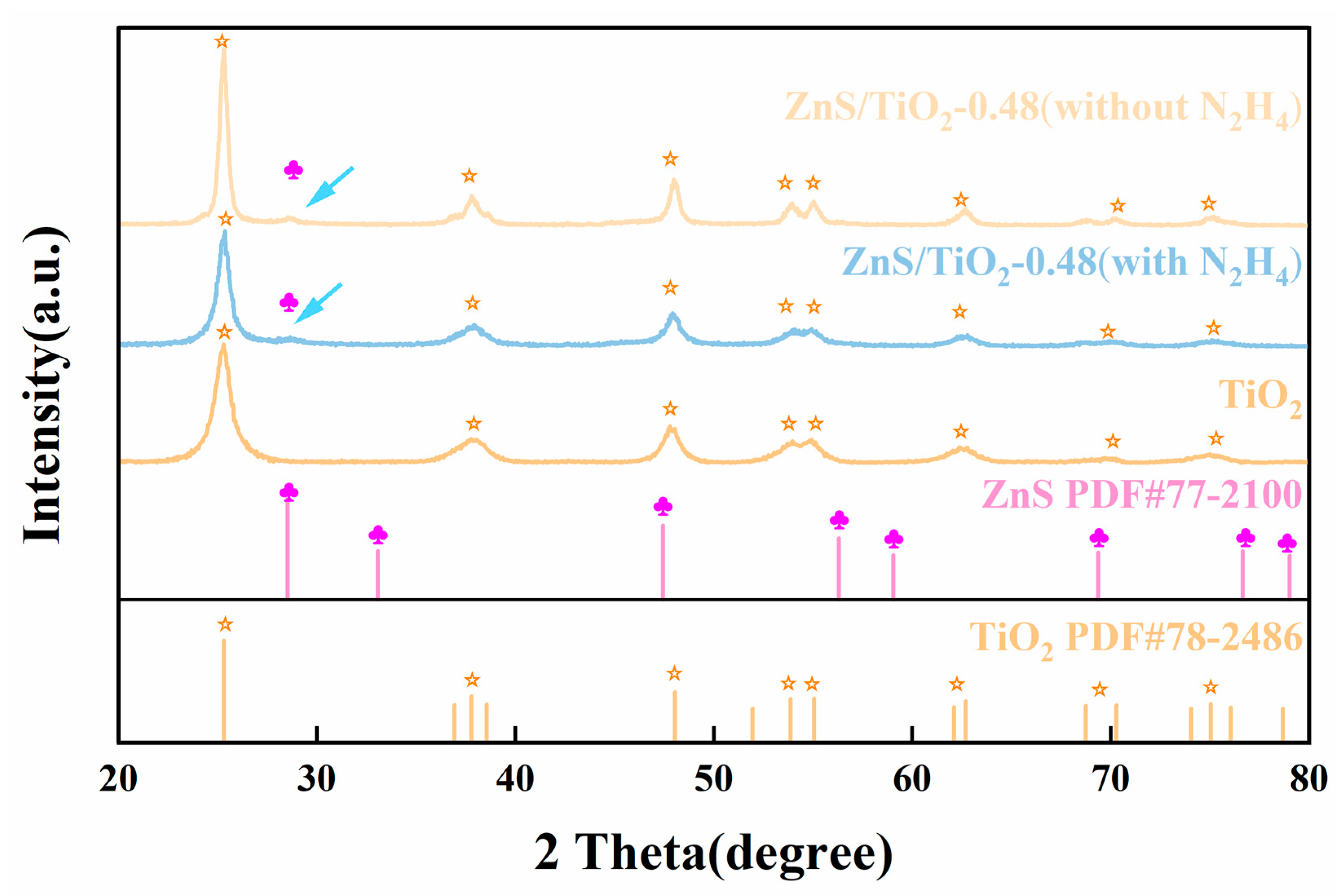
Figure 1. All samples exhibit diffraction peaks corresponding to anatase gel-derived TiO
2 (PDF#78-2486) and sphalerite-type ZnS (PDF#77-2100), confirming the formation of the ZnS/TiO
2 heterostructure without detectable impurity phases or phase transitions. It should be noted that the diffraction features associated with ZnS are intrinsically weak due to its low loading and highly dispersed nature within the gel-derived TiO
2 matrix. As a result, the ZnS-related reflections are broad and of low intensity in both untreated and N
2H
4-treated samples, indicating limited long-range crystalline order. Upon N
2H
4 treatment, a slight broadening and attenuation of the diffraction peaks are observed, particularly for the TiO
2 (101) and ZnS (111) reflections, suggesting increased lattice disorder. Crystallite sizes estimated using the Scherrer equation are therefore regarded as indicative of relative trends rather than absolute values. For the untreated composite, average grain sizes of gel-derived TiO
2 and ZnS are estimated to be 162 ± 15 nm and 118 ± 7 nm, respectively. In the presence of N
2H
4, these values decrease significantly to 102 ± 6 nm (TiO
2) and 31 ± 1 nm (ZnS). It is important to find that defect formation in ZnS and gel-derived TiO
2 follows different pathways under N
2H
4 treatment. In the case of ZnS, hydrazine influences the nucleation and growth process, leading to suppressed crystallite growth and enhanced lattice disorder. By contrast, gel-derived TiO
2 undergoes a post-synthetic modification, in which N
2H
4 induces surface reduction and oxygen vacancy formation without fundamentally altering the original crystal growth process. This distinction highlights the different roles of N
2H
4 in modulating the structural and electronic properties of the two semiconductors. These results suggest that hydrazine treatment modulates the structural coherence of the ZnS/TiO
2 system, providing a defect-prone framework that is favorable for interfacial charge regulation, rather than inducing a simple phase transformation or crystallinity collapse.
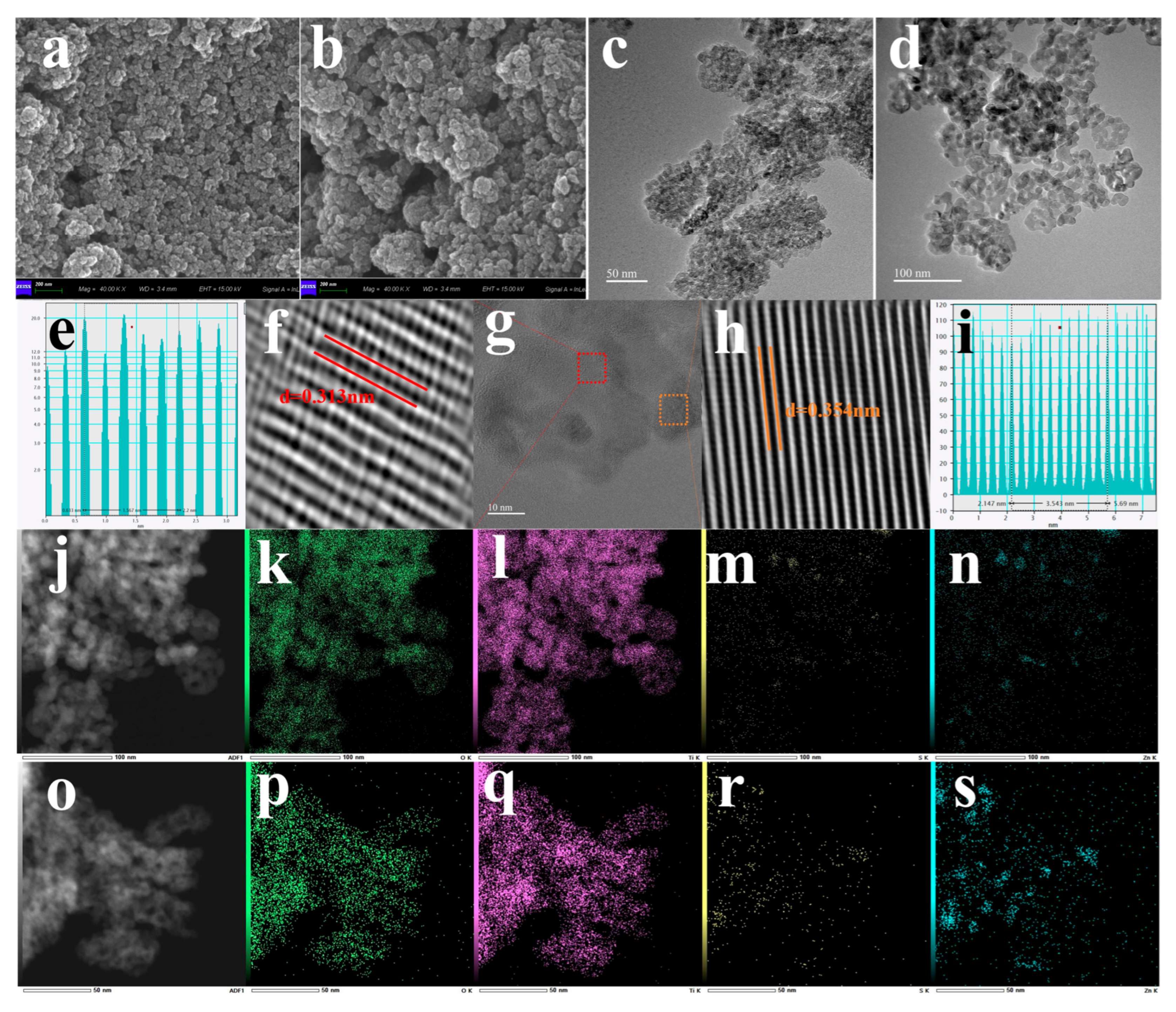
The morphology, microstructure, and elemental distribution of ZnS/gel-derived TiO
2-0.48 composites—prepared with and without hydrazine hydrate (N
2H
4)—were systematically characterized using scanning electron microscopy (SEM), transmission electron microscopy (TEM), high-resolution TEM (HRTEM), and energy-dispersive X-ray spectroscopy (EDS), as shown in
Figure 2.
The SEM images (
Figure 2a,b) reveal that both composites consist of agglomerated nanoparticles with irregular surfaces. The sample treated with N
2H
4 displays smaller primary crystallites and a more loosely packed morphology, featuring rougher surfaces and broader interparticle gaps. In contrast, the untreated composite exhibits larger, more compact domains with smoother textures, consistent with the larger crystallite sizes observed by XRD. These morphological differences indicate that hydrazine hydrate effectively regulates crystal growth, leading to nanostructural refinement that favors light scattering and reactant accessibility.
TEM observations (
Figure 2c,d) further highlight differences in aggregate architecture. The N
2H
4-treated sample appears more transparent and fragmented, suggesting thinner nanosheet-like features with enhanced dispersion. Meanwhile, the untreated composite shows darker contrast and denser particle overlap, pointing to thicker domains and stronger stacking effects. These microstructural differences likely influence interfacial area and charge carrier transport across the heterojunction.
High-resolution lattice imaging (
Figure 2f,h) of the N
2H
4-treated ZnS/gel-derived TiO
2-0.48 sample reveals distinct fringe spacings of 0.313 nm and 0.354 nm, which correspond to the (111) plane of ZnS and the (101) plane of TiO
2, respectively. The clear fringe continuity and sharp phase boundaries support the preservation of crystalline identity and formation of a coherent interface. A representative HRTEM image of the interface region (
Figure 2g) shows tight lattice contact without apparent amorphous gaps, confirming successful heterojunction construction. The corresponding FFT-derived line profiles (
Figure 2e,i) further validate the observed lattice periodicity.
Elemental distribution maps obtained via EDS (
Figure 2j–s) confirm the homogeneous dispersion of Ti, Zn, S, and O throughout both composite systems. The corresponding elemental compositions obtained from EDS analysis are summarized in
Table S1. Notably, the sulfur signal in the N
2H
4-treated sample is visibly less intense, suggesting a reduction in sulfur content compared to the untreated counterpart. Quantitative EDS analysis shows that the S/Zn atomic ratio decreases from 0.30(untreated) to 0.22(N
2H
4-treated), indicating the introduction of sulfur vacancies. Similarly, the O/Ti ratio drops from 2.01 to 1.54, consistent with the formation of oxygen-deficient gel-derived TiO
2 domains.
These observations collectively demonstrate that hydrazine-assisted synthesis not only reduces grain size and nanosheet thickness, but also promotes the formation of anion vacancies and tight interfacial coupling. Such combined structural and compositional modifications are expected to facilitate charge transfer, inhibit recombination, and enhance CO2 activation, thereby contributing to the superior photocatalytic performance of the treated ZnS/gel-derived TiO2-0.48 composite.
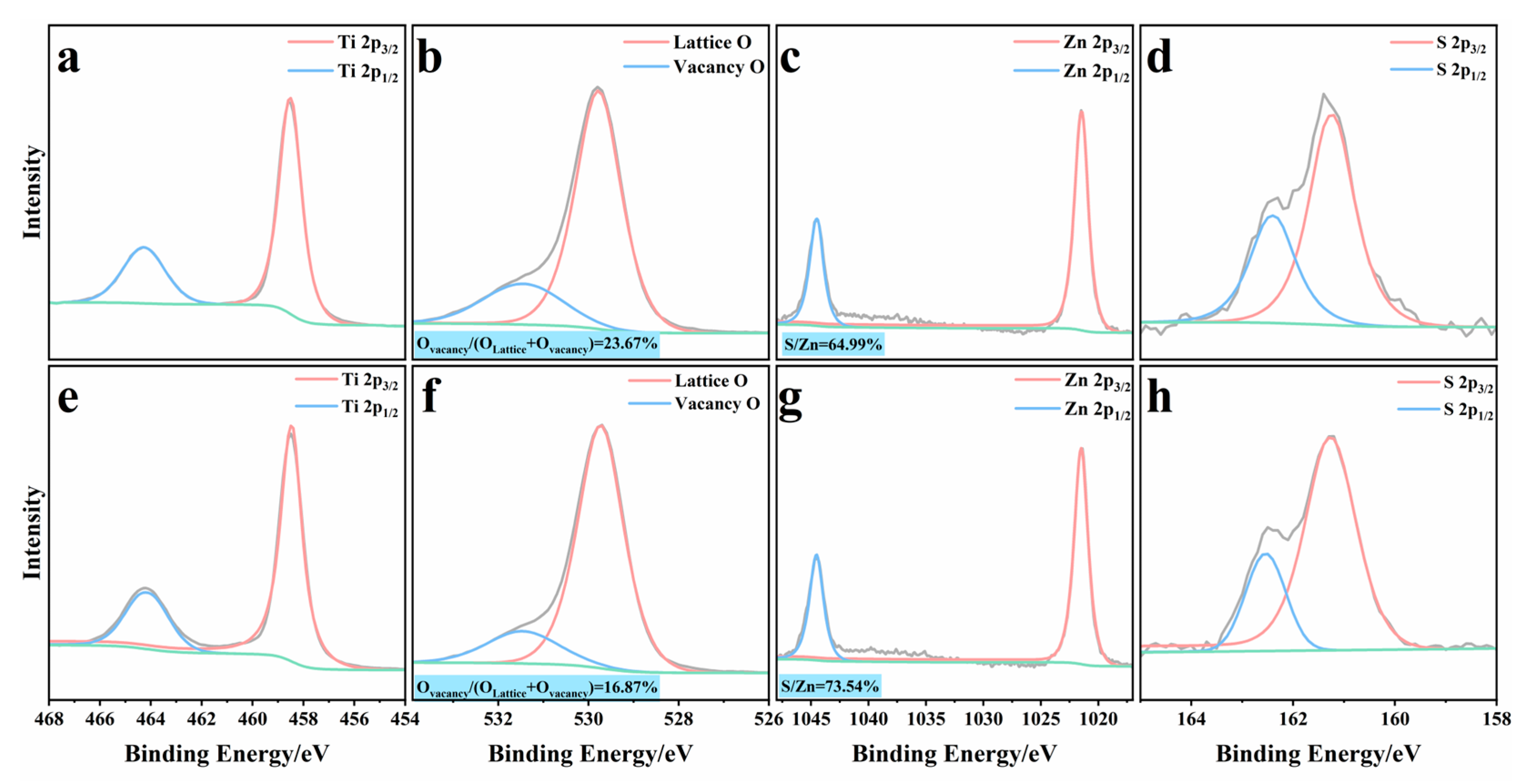
The chemical states and surface compositions of ZnS/gel-derived TiO
2-0.48 composites—with and without hydrazine hydrate (N
2H
4) treatment were probed by high-resolution X-ray photoelectron spectroscopy (XPS), as presented in
Figure 3. Firstly, XPS survey spectra were further collected to investigate the surface elemental composition of the ZnS/gel-derived TiO
2-0.48 composites as exhibited in
Figure S1. The XPS survey spectra reveal the presence of Ti, O, Zn, and S elements in the ZnS/gel-derived TiO
2-0.48 composites, and the corresponding surface elemental compositions derived from the survey analysis are summarized in
Table S2. After N
2H
4 treatment, the S/Zn atomic ratio decreases from 0.70 to 0.61, while the O/Ti ratio decreases from 2.11 to 2.02. Although the absolute atomic ratios differ from those obtained by EDS due to the surface-sensitive nature of XPS, the observed variations indicate a relative depletion of sulfur species in ZnS and a reduced oxygen coordination environment in the near-surface region of gel-derived TiO
2. Core-level spectra for Ti 2p, O 1s, Zn 2p, and S 2p were recorded to evaluate the oxidation states and defect-related species in both systems. In the Ti 2p region (
Figure 3a,e), two well-resolved peaks appear at 458.5 eV (Ti 2p
3/2) and 464.2 eV (Ti 2p
1/2), characteristic of Ti
4+ in anatase-phase gel-derived TiO
2. No evidence of lower oxidation states (e.g., Ti
3+) is observed, indicating that the titanium lattice remains chemically stable during the synthetic process. However, a subtle negative shift (~0.2 eV) is noted in the treated sample, suggesting an increased local electron density around Ti centers, likely caused by nearby anion vacancies (e.g., O or S vacancies).
The O 1s spectra (
Figure 3b,f) were deconvoluted into two components: lattice oxygen (O_L) at ~529.6 eV and non-lattice oxygen species (O_V), including surface hydroxyl groups and oxygen vacancies, centered near 531.2 eV. The N
2H
4-treated composite shows an increased O_V/O_L intensity ratio, which indicates a higher concentration of surface oxygen vacancies or defect-related hydroxyl groups. This trend is consistent with the reduction in the O/Ti atomic ratio from EDS analysis (1.54 vs. 2.01), supporting the occurrence of surface nonstoichiometry.
For the Zn 2p spectra (
Figure 3c,g), both samples display typical Zn
2+ doublets at ~1021.7 eV (Zn 2p
3/2) and ~1044.8 eV (Zn 2p
1/2, in line with divalent zinc in ZnS. While the peak positions remain essentially unchanged, the overall Zn signal in the treated sample is slightly attenuated, which may reflect partial surface relaxation or increased structural disorder induced by hydrazine treatment.
The most pronounced difference appears in the S 2p region (
Figure 3d,h). Both samples exhibit a pair of peaks at ~161.6 eV and ~162.8 eV, corresponding to the S 2p
3/2 and S 2p
1/2 components of sulfide anions (S
2−). In the N
2H
4-treated sample, the S 2p intensity is significantly reduced, with no signals attributable to oxidized sulfur species, such as SO
42− or S
0. This intensity suppression, coupled with the lower S/Zn atomic ratio (0.22 vs. 0.30), provides compelling evidence for the formation of sulfur vacancies (V_S), which are known to modulate electronic structure and facilitate surface charge trapping.
Taken together, the XPS results demonstrate that hydrazine hydrate treatment induces both sulfur and oxygen vacancy formation, without altering the fundamental valence states of the TiO2 and ZnS components. These anionic defects are expected to enhance interfacial charge separation and provide additional active sites, thereby contributing to improved photocatalytic efficiency and CH4 selectivity in CO2 reduction.
2.2. Characterization of Photoelectrochemical Test
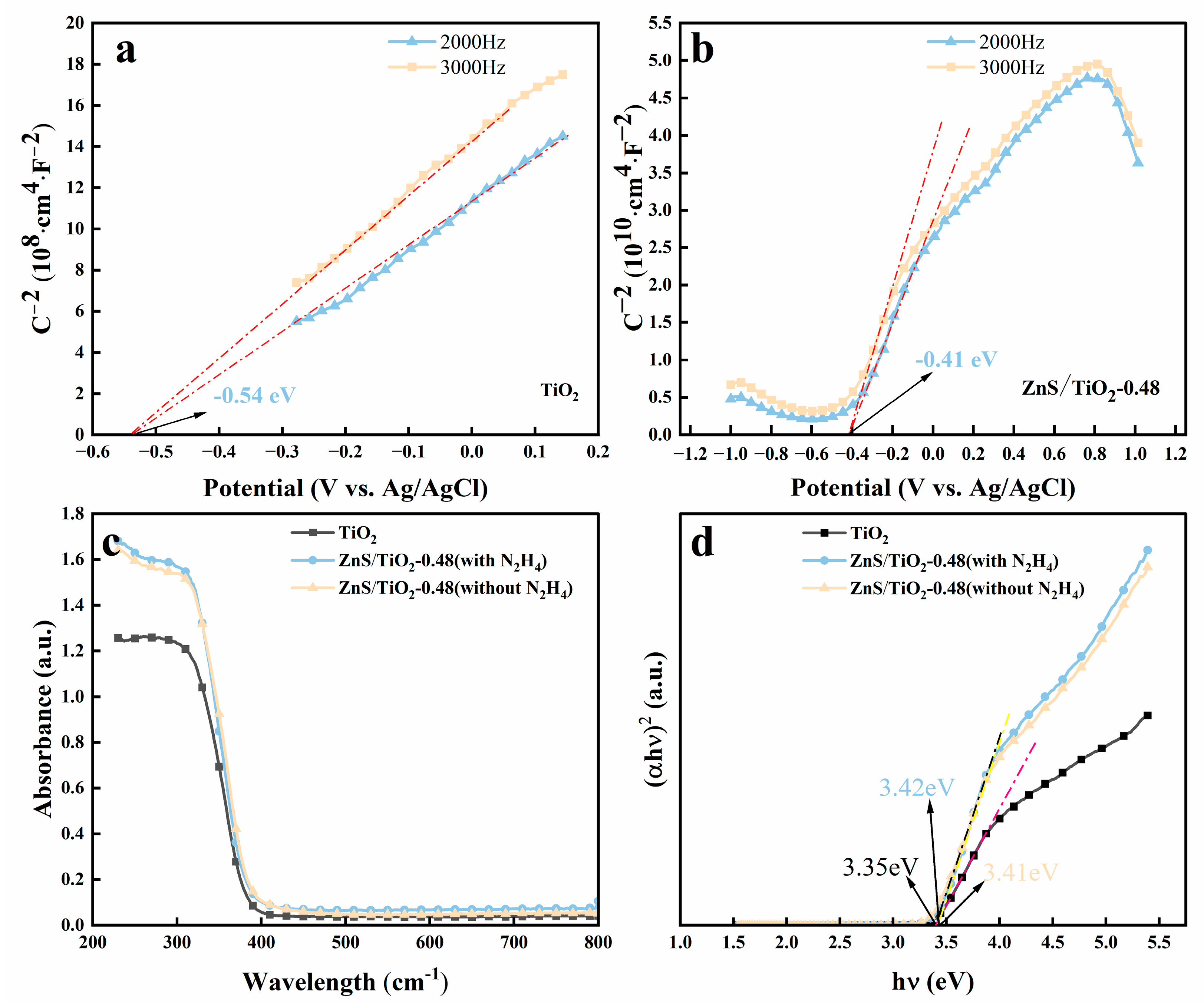
The optical response and interfacial electronic properties of the synthesized samples were systematically investigated using Mott–Schottky (MS) analysis and UV–vis diffuse reflectance spectroscopy (DRS), as shown in
Figure 4. The MS plots (
Figure 4a,b) exhibit linear relationships with positive slopes for both pure gel-derived TiO
2 and the ZnS/gel-derived TiO
2-0.48 composite, indicating typical n-type semiconductor behavior when measured at frequencies of 2000 and 3000 Hz. The extrapolated flat-band potentials (V_fb) were determined to be −0.54 V vs. Ag/AgCl for pure gel-derived TiO
2 and −0.41 V for the N
2H
4-treated ZnS/gel-derived TiO
2-0.48 composite. It should be noted that, in heterojunction systems, the flat-band potential derived from MS analysis does not represent the absolute conduction band edge position of an individual semiconductor component, but rather reflects the effective Fermi level of the composite electrode, which is influenced by interfacial charge redistribution upon heterojunction formation [
34]. In this context, a rigorous determination of the band offsets at the ZnS/TiO
2 interface would require combined ultraviolet photoelectron spectroscopy (UPS) and X-ray photoelectron spectroscopy (XPS) valence band analyses following the Kraut method, which has been widely adopted for quantitative band alignment determination in semiconductor heterojunctions [
34,
35]. Such measurements are beyond the scope of the present work. Assuming a typical offset of approximately 0.1–0.2 V between the flat-band potential and the conduction band minimum for n-type semiconductors, the apparent conduction band positions can be qualitatively estimated. The observed positive shift of the flat-band potential in the composite relative to pure gel-derived TiO
2 suggests a redistribution of charge carriers at the ZnS/TiO
2 interface [
36].
The UV–vis absorption spectra (
Figure 4c) reveal that all samples possess strong absorption in the ultraviolet region. Upon ZnS loading, a visible-light absorption tail emerges, particularly for the N
2H
4-treated ZnS/gel-derived TiO
2-0.48 composite, which displays an enhanced response in the 350–500 nm range compared to both the untreated composite and pure gel-derived TiO
2. This enhancement is attributed to defect-state-induced light trapping and possible band structure distortion resulting from sulfur vacancy formation. Tauc plot analysis (
Figure 4d), based on the Kubelka–Munk transformation, was employed to estimate the apparent optical band gaps of the samples. The band gap of pure gel-derived TiO
2 is determined to be 3.35 eV, while the untreated and N
2H
4-treated ZnS/gel-derived TiO
2-0.48 composites exhibit slightly larger apparent band gap values of 3.41 eV and 3.42 eV, respectively. These values should be regarded as apparent band gaps reflecting the dominant absorption edge of the composite system, rather than intrinsic band gaps of the heterojunction interface. Due to the relatively low loading and high dispersion of ZnS, its intrinsic wide band gap (~3.7 eV) contributes weakly to the overall absorption and overlaps with that of TiO
2, resulting in a single apparent absorption edge in the UV–vis diffuse reflectance spectra. The enhanced visible-light absorption tail observed for the composites is therefore attributed to defect-related sub-bandgap states and light scattering effects induced by interface formation and lattice disorder, rather than a direct narrowing of the intrinsic band gaps.
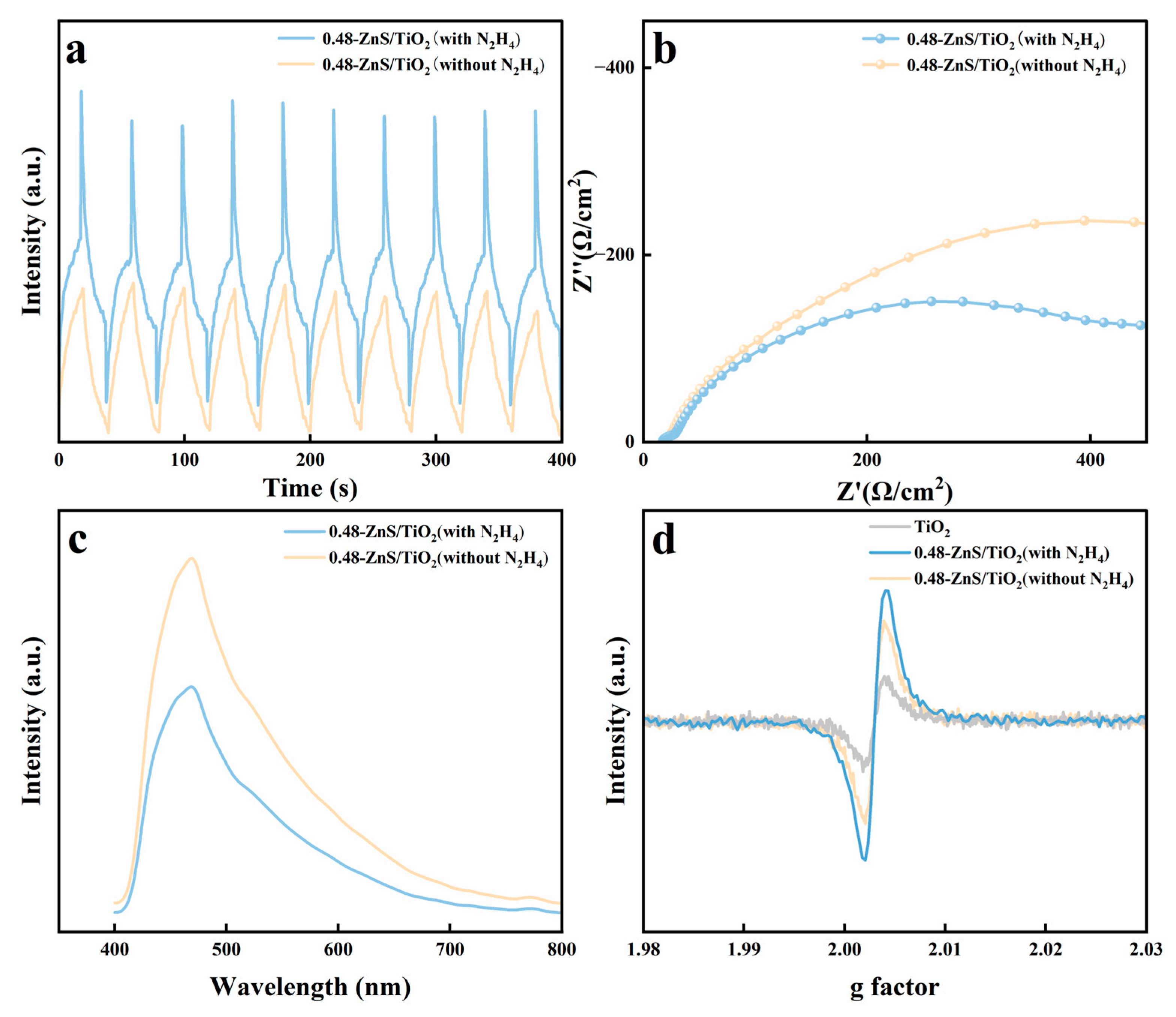
To elucidate the charge carrier dynamics and defect structures in ZnS/gel-derived TiO
2-0.48 composites with and without N
2H
4 treatment, a series of complementary measurements including transient photocurrent, electrochemical impedance spectroscopy (EIS), steady-state photoluminescence (PL), and electron paramagnetic resonance (EPR) were performed, as summarized in
Figure 5.
Figure 5a displays the transient photocurrent responses under chopped light irradiation. The N
2H
4-treated ZnS/gel-derived TiO
2-0.48 composite generates a markedly higher and more stable photocurrent than the untreated counterpart. This enhancement in photocurrent intensity reflects improved separation and transport of photoinduced charge carriers, which is attributed to the formation of sulfur vacancies and optimized heterojunction architecture. The rapid rise and decay of current upon light on/off cycles further confirm fast photoresponse and excellent reversibility.
The Nyquist plots (
Figure 5b) reveal a significantly smaller semicircle radius for the 0.48-ZnS/TiO
2 sample with N
2H
4 treatment compared with the untreated sample. The charge transfer resistance (Rct), estimated from the diameter of the semicircle, decreases from approximately 245 Ω·cm
2 for 0.48-ZnS/TiO
2 (without N
2H
4) to about 164 Ω·cm
2 after N
2H
4 treatment, indicating more efficient interfacial charge transfer induced by sulfur vacancy formation. This result aligns with the improved photocurrent response and suggests enhanced electronic conductivity and better interface contact across the heterojunction.
The PL spectra (
Figure 5c) were normalized with respect to the corresponding optical absorption to ensure a meaningful comparison of emission intensities among different samples and provide insight into the recombination behavior of photogenerated charge carriers. The untreated composite exhibits a pronounced emission centered at ~470 nm, which is mainly associated with near-band-edge and shallow trap-related radiative recombination in gel-derived TiO
2. In contrast, the N
2H
4-treated ZnS/gel-derived TiO
2-0.48 composite shows a significantly quenched emission intensity in this spectral region. It should be noted that the PL quenching discussed here primarily refers to the suppression of band-edge-related radiative recombination rather than defect-related visible emission. This behavior indicates enhanced interfacial charge transfer and reduced excitonic recombination due to the introduction of interfacial coupling between ZnS and TiO
2. Although hydrazine treatment increases the density of defect states, such defects mainly act as charge trapping and transfer sites that facilitate carrier separation, rather than directly enhancing radiative recombination in the observed spectral range.
EPR analysis (
Figure 5d) was used to directly identify unpaired electron species associated with paramagnetic defect centers. A prominent signal at g ≈ 2.002 was observed for the N
2H
4-treated composite, consistent with the presence of sulfur vacancies (V_S) and/or oxygen vacancies (V_O). The untreated sample exhibits a much weaker signal, while pristine gel-derived TiO
2 shows negligible paramagnetic response. These findings confirm the effective generation of surface defects during hydrazine-assisted synthesis.
Collectively, these electrochemical and spectroscopic characterizations demonstrate that hydrazine treatment plays a dual role: (i) promoting interfacial charge separation through nanostructural refinement and improved contact, and (ii) introducing abundant sulfur and oxygen vacancies that act as active centers for enhanced carrier trapping and selective multi-electron CO2 conversion. These features contribute synergistically to the superior photocatalytic performance observed in ZnS/gel-derived TiO2 heterojunction systems.
2.3. Photocatalytic CO2 Adsorption and Reduction Performance
The photocatalytic CO
2 reduction performance of ZnS/gel-derived TiO
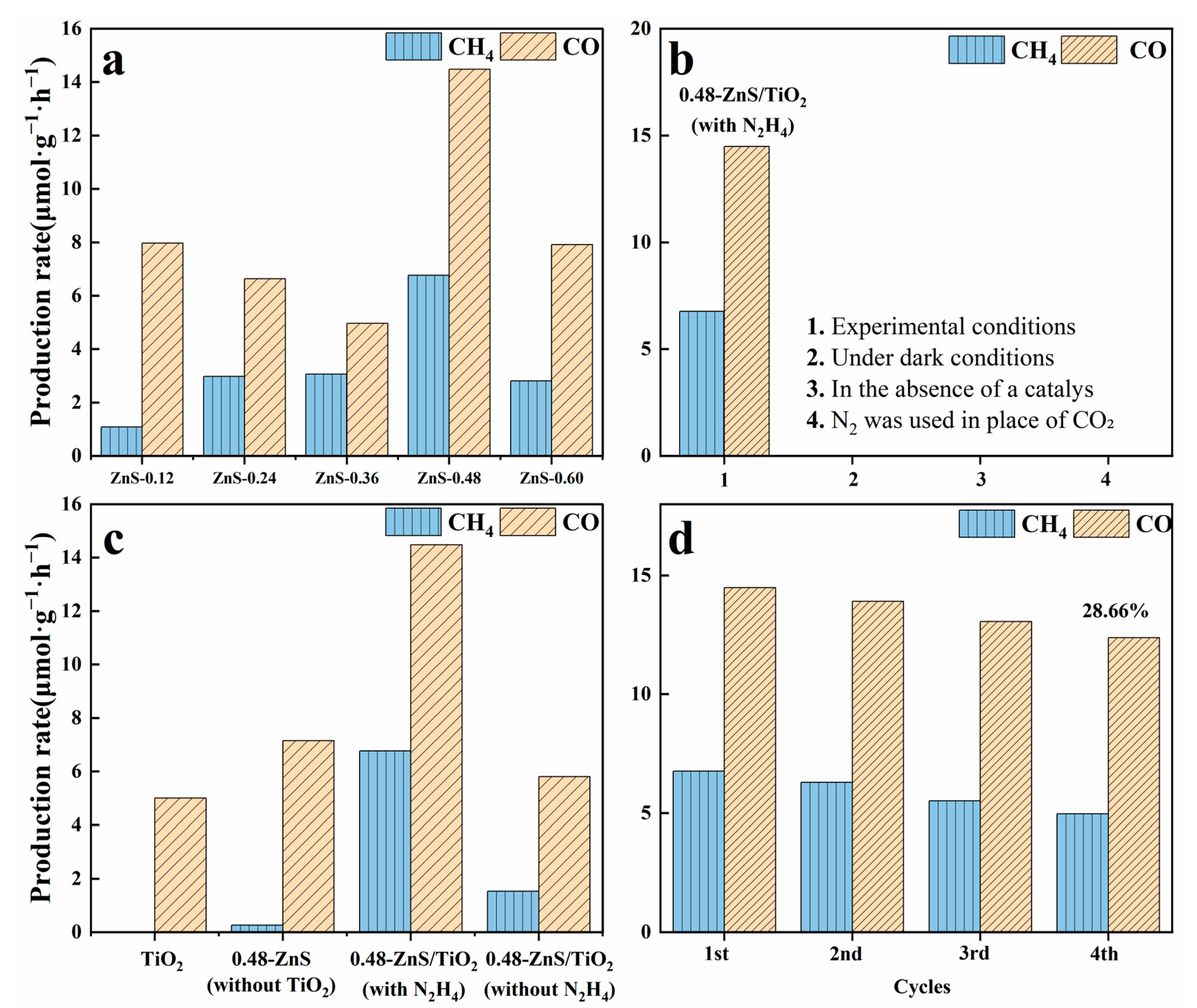
2 composites—with varying ZnS loadings and hydrazine treatment—was evaluated under simulated solar irradiation. The evolved gaseous products were analyzed using online gas chromatography, as illustrated in
Figure 6. Each data point represents the average value of at least three independent measurements. Methane (CH
4) and carbon monoxide (CO) were identified as the principal products, confirming the occurrence of a multi-electron reduction process over the catalyst surface.
As shown in
Figure 6a, the CH
4 and CO production rates exhibit a clear dependence on ZnS loading. When the ZnCl
2 precursor amount was gradually increased from 0.12 to 0.48 mmol, the CH
4 yield steadily improved, peaking at 6.76 μmol·g
−1·h
−1 for the ZnS/gel-derived TiO
2-0.48 sample. However, further increasing the ZnS content to 0.60 mmol resulted in a sharp decline in CH
4 production, likely due to excessive ZnS coverage blocking gel-derived TiO
2 active sites or generating charge recombination centers. CO production followed a similar trend, with a maximum rate of 14.47 μmol·g
−1·h
−1 observed near the same composition, indicating that optimal heterojunction formation and charge transfer balance are critical for achieving high activity. Notably, although CH
4 production increases with ZnS loading, the CO yield does not exhibit a proportional increase. This behavior suggests that CO acts as a reaction intermediate and is increasingly consumed via subsequent hydrogenation steps toward CH
4 on ZnS-rich interfacial/defect sites, rather than desorbing as the final CO product. Therefore, increasing ZnS content primarily shifts the product distribution toward the deep-reduction methanation pathway instead of simply enhancing CO formation. Control experiments were performed to validate the photocatalytic origin of the products (
Figure 6b). In the absence of light, catalyst, or CO
2, no CH
4 or CO was detected, while significant product generation occurred only under full reaction conditions (light + CO
2 + catalyst). These results unambiguously confirm that the observed products originate from photocatalytic CO
2 reduction rather than residual contaminants or thermal side reactions.
To further elucidate the respective contributions of each component and the effect of hydrazine modification, comparative photocatalytic tests were carried out using pure gel-derived TiO
2, ZnS-only (0.48 mmol), and ZnS/gel-derived TiO
2-0.48 composites with and without N
2H
4 treatment (
Figure 6c). Pristine gel-derived TiO
2 exhibits low overall activity and primarily favors CO formation, reflecting its limited ability to drive multielectron reduction processes. The ZnS-only sample also shows marginal CO
2 photoreduction activity under the same conditions. In contrast, the ZnS/gel-derived TiO
2-0.48 composite displays significantly enhanced activity, which is further improved after N
2H
4 treatment. Notably, the N
2H
4-treated ZnS/gel-derived TiO
2-0.48 sample achieves the highest CH
4 yield and overall product formation, outperforming both the untreated composite and the single-component systems. These results indicate that the enhanced CH
4-selective CO
2 photoreduction arises from the synergistic interaction at the defect-engineered ZnS/TiO
2 heterojunction interface. In this system, hydrazine treatment primarily acts as a defect-engineering and interfacial modulation strategy, which promotes charge separation, facilitates intermediate stabilization, and thereby favors the deep-reduction pathway toward CH
4, rather than solely enhancing the activity of the ZnS component itself.
To further elucidate the individual contributions of each component and the role of hydrazine treatment, comparative photocatalytic tests were performed using pure gel-derived TiO
2, ZnS-only (0.48 mmol), and ZnS/gel-derived TiO
2-0.48 composites with and without N
2H
4 modification (
Figure 6c). Pristine gel-derived TiO
2 exhibits low overall activity and predominantly produces CO, which can be attributed to its limited capability to sustain multi-electron transfer required for deep CO
2 reduction. The ZnS-only sample (with N
2H
4 treatment) also shows marginal CO
2 photoreduction activity, indicating that defect-engineered ZnS alone is insufficient to drive efficient methanation. In contrast, the N
2H
4-treated ZnS/gel-derived TiO
2-0.48 composite delivers the highest CH
4 yield and total product formation, significantly outperforming both the untreated composite and the single-component systems. This pronounced enhancement highlights the essential role of defect–interface synergy in the heterostructure. Specifically, hydrazine treatment introduces sulfur-vacancy-related sites on ZnS and modulates the interfacial electronic structure, while the ZnS/TiO
2 heterojunction facilitates interfacial charge separation and electron accumulation, jointly promoting CO
2 activation and the subsequent hydrogenation of CO-derived intermediates toward the deep-reduction CH
4 pathway.
The operational durability of catalyst was examined through four repeated photocatalytic cycles (
Figure 6d). The ZnS/gel-derived TiO
2-0.48 composite maintained consistent product yields across all runs, with CH
4 and CO production fluctuating slightly within the ranges of 5.9–6.7 μmol·g
−1·h
−1 and 12.8–14.1 μmol·g
−1·h
−1, respectively. Despite the low absolute product amounts, the consistent product formation over multiple cycles confirms that the detected signals are reproducible and not attributable to random noise or experimental artifacts. These findings demonstrate the catalysts structural robustness and reaction reproducibility under simulated solar illumination.
In summary, the ZnS/gel-derived TiO2-0.48 heterojunction—particularly when modified by hydrazine hydrate—exhibits enhanced photocatalytic CO2 reduction efficiency, pronounced CH4 selectivity, and long-term stability. These features make it a promising candidate for future solar-to-fuel conversion technologies.
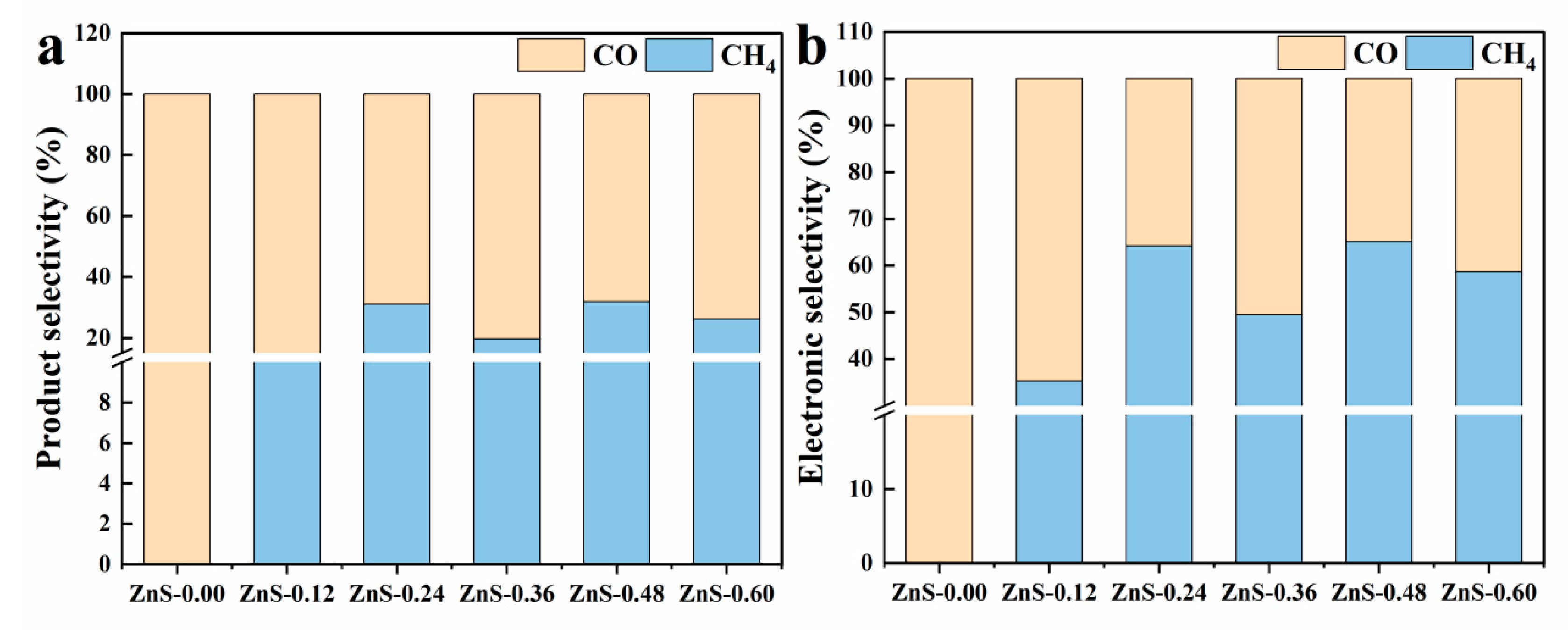
To further understand the carbon conversion preference and electron utilization pathways, both product selectivity and electronic selectivity for CO
2 photoreduction were systematically examined across the prepared catalysts. As shown in
Figure 7a, pristine gel-derived TiO
2 exhibits near-exclusive selectivity toward CO formation, with CH
4 accounting for less than 10% of the total product distribution. This behavior is attributed to the limited ability of gel-derived TiO
2 to facilitate the multielectron transfer steps required for CH
4 evolution. Upon incorporation of ZnS, the CH
4 proportion increases markedly compared to pristine gel-derived TiO
2 and reaches a high level at moderate to high ZnS loadings (ZnS/gel-derived TiO
2-0.24 and 0.48). Among these samples, the ZnS/gel-derived TiO
2-0.48 composite is identified as the optimal catalyst based on its superior CH
4 yield and overall photocatalytic performance. At this optimal composition, CH
4 accounts for 31.7% of the total product yield, indicating that the ZnS domain and its associated surface/interface defects significantly promote deep-level CO
2 reduction.
Electronic selectivity, calculated based on the number of electrons involved in the formation of each product (8 electrons for CH
4 and 2 electrons for CO), is presented in
Figure 7b as a complementary metric to conventional product selectivity. Consistent with the product distribution trends, gel-derived TiO
2 exhibits predominant electron consumption toward CO formation (≈84%), whereas the ZnS/gel-derived TiO
2-0.48 composite shows a higher fraction of electrons directed toward CH
4 formation (~38.9%). Rather than serving as an independent descriptor, electronic selectivity is used here to further illustrate the preferential allocation of photogenerated electrons toward multi-electron reduction pathways in the defect-engineered heterojunction. This analysis supports the conclusion drawn from product selectivity and yield measurements, namely that the ZnS/gel-derived TiO
2-0.48 composite achieves an effective balance between CH
4 yield and electron utilization efficiency, consistent with its superior photocatalytic performance. Therefore, electronic selectivity is employed to reinforce, rather than replace, the conventional selectivity analysis by highlighting the electron-intensive nature of CH
4 formation.
2.4. DFT Calculations and Heterojunction Analysis
To clarify the origin of the enhanced CH4 selectivity in ZnS/gel-derived TiO2 composites, we combined DFT calculations and band structure characterization to reveal how interfacial energetics and charge dynamics modulate CO2 reduction pathways.
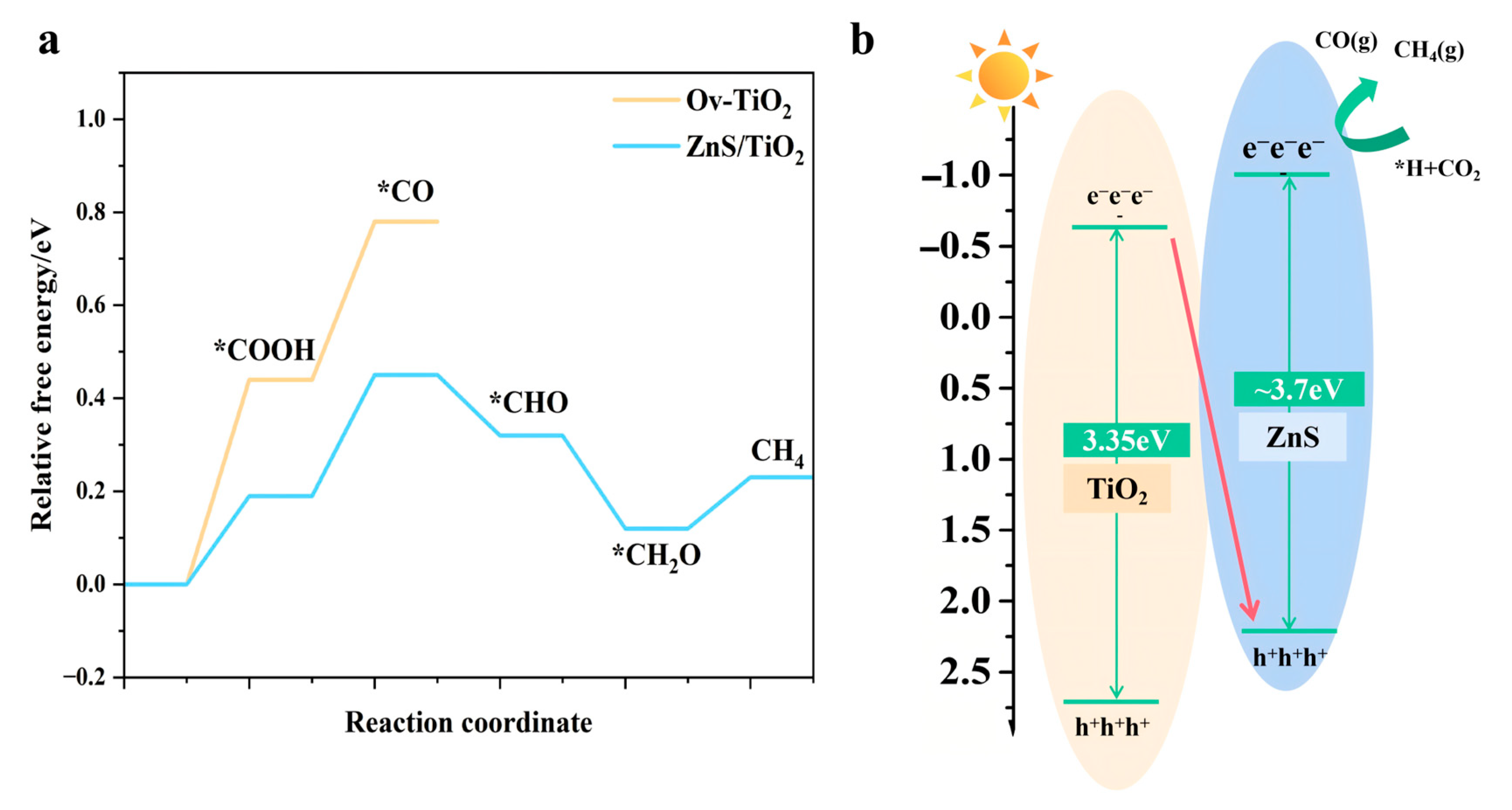
As shown in
Figure 8a, the Gibbs free energy profile for CO
2 photoreduction to CH
4 was computed on two model surfaces: oxygen-vacancy gel-derived TiO
2(Ov–TiO
2) and the ZnS/TiO
2 heterointerface. The formation energy of the initial protonated intermediate *COOH is significantly lower on ZnS/TiO
2 (ΔG = +0.21 eV) compared to Ov–TiO
2 (+0.51 eV), indicating more favorable CO
2 activation at the heterojunction. Similarly, *CO adsorption is more thermodynamically stabilized on ZnS/TiO
2 (ΔG = +0.51 eV) than on Ov–TiO
2 (ΔG = +0.84 eV), and the overall energy span for full CH
4 formation is narrower. These results suggest that the ZnS/gel-derived TiO
2 interface facilitates lower-barrier, multielectron transfer steps, thereby enhancing CH
4 selectivity over the CO-dominated pathway observed on bare gel-derived TiO
2.
The corresponding band structure analysis is illustrated in
Figure 8b based on the flat-band potentials derived from Mott–Schottky measurements and the optical bandgaps obtained from UV–vis diffuse reflectance spectroscopy. Pristine gel-derived TiO
2 exhibits a flat-band potential of −0.54 V vs. Ag/AgCl and an optical bandgap of 3.35 eV, confirming its typical n-type semiconductor behavior. For the N
2H
4-treated ZnS/gel-derived TiO
2-0.48 composite, a flat-band potential of −0.41 V vs. Ag/AgCl and an optical bandgap of 3.42 eV were obtained. It should be emphasized that, in a multiphase composite system, the flat-band potential extracted from Mott–Schottky analysis represents an apparent flat-band potential of the composite electrode, rather than the intrinsic flat-band potential of pristine ZnS. The measured value can be influenced by the dominant semiconductor/electrolyte interface, surface states, and interfacial charge redistribution. Therefore, it should not be directly used to assign the absolute band edge positions of ZnS. According to well-established literature [
17,
18], ZnS possesses a wide bandgap (~3.6–3.8 eV) with a much more negative conduction band edge (typically around −0.8 to −1.0 V vs. NHE) than that of TiO
2. Considering this intrinsic band structure and the work-function-driven Fermi level equilibration at the ZnS/TiO
2 interface, electrons tend to transfer from ZnS to TiO
2 upon contact, leading to interfacial band bending and the formation of an internal electric field [
17]. Under light irradiation, the relative energetic alignment favors a Z-scheme -like interfacial charge migration pathway, in which photogenerated electrons with strong reductive power are preferentially retained on the ZnS side, while photogenerated holes with strong oxidative power remain on the gel-derived TiO
2 side. Meanwhile, the less energetic charge carriers recombine at the heterojunction interface. Such a charge migration scenario effectively preserves the redox potentials required for multi-electron CO
2 reduction and H
2O oxidation, rather than following a conventional type-II charge transfer process.
Complementary photoelectrochemical results, including enhanced photocurrent response, reduced charge-transfer resistance, and suppressed photoluminescence intensity, consistently indicate efficient interfacial charge separation and prolonged carrier lifetimes. Collectively, these results support a physically reasonable and experimentally consistent Z-scheme-compatible mechanism, which underlies the enhanced and selective CO2-to-CH4 photoconversion observed for the ZnS/gel-derived TiO2 composite.