Study on the Influencing Factors of the Migration and Transformation Behavior of Hexavalent Chromium in a Soil–Groundwater System: A Review


Abstract
1. Introduction
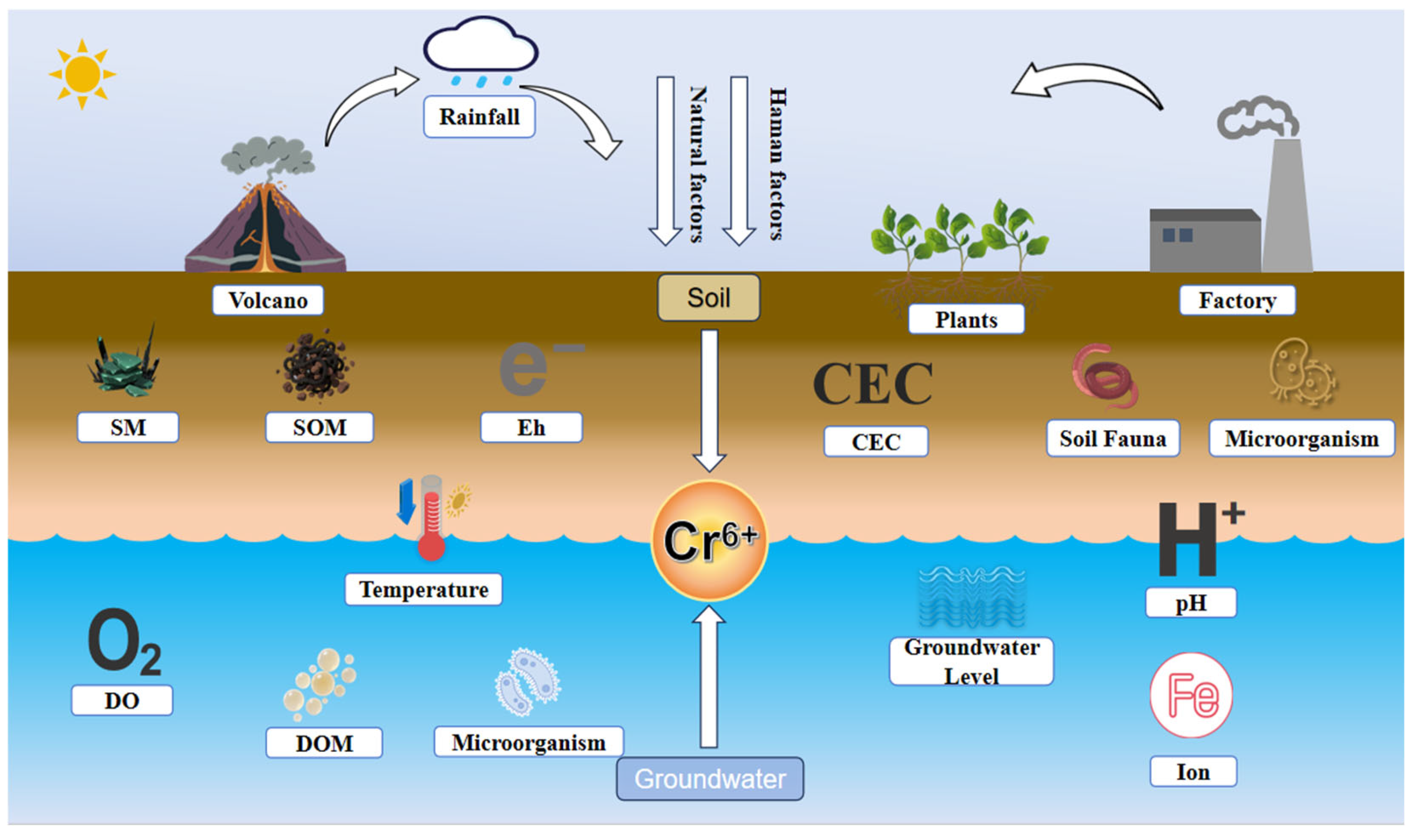
2. Factors Affecting the Transport and Transformation of Chromium VI in Soil
2.1. Soil Physicochemical Properties
2.1.1. pH
2.1.2. Redox Potential
2.1.3. Cation Exchange Capacity
2.1.4. Soil Organic Matter
2.1.5. Soil Minerals
2.2. Soil Biota
2.2.1. Soil Plants
2.2.2. Soil Fauna
2.2.3. Soil Microorganisms
3. Factors Affecting the Transport and Transformation of Cr(VI) in Groundwater
3.1. Influence of Groundwater Physicochemical Properties
3.1.1. pH
3.1.2. Dissolved Oxygen (DO)
3.1.3. Dissolved Organic Matter (DOM)
3.1.4. Ionic Composition
3.2. Influence of Hydrogeological Conditions
3.2.1. Groundwater Flow
3.2.2. Groundwater Level Dynamics
3.2.3. Aquifer Media
3.3. Microbial Mediation
4. Synergistic Effects in Soil–Groundwater Systems
4.1. Climatic Drivers
4.1.1. Temperature
4.1.2. Rainfall
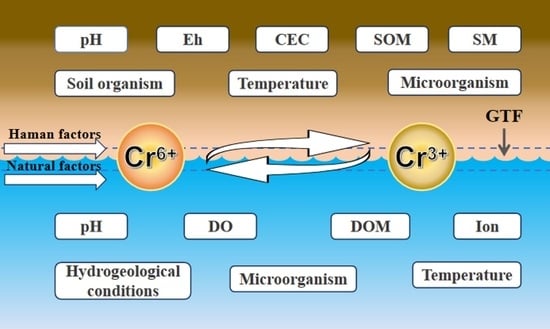
4.2. Migration, Transformation, and Comprehensive Impact of Cr(VI) at the Soil–Groundwater Interface
5. Effects of Coexisting Pollutants on the Migration and Transformation of Cr(VI)
5.1. Microplastics
5.2. Pesticides
5.3. Surfactants
6. Conclusions and Prospects
- (1)
- Mechanistic investigation of multi-factor synergies is urgently needed to deepen the understanding of cooperative mechanisms among physicochemical properties and biological processes during Cr(VI) transport. The behavior of Cr(VI) in coupled water–soil systems is influenced by complex interacting factors. Developing conceptual and numerical models that simulate Cr(VI) transport under varying factor combinations will help quantify the strength and direction of these interactions, providing a theoretical basis for accurate prediction of Cr(VI) dynamics.
- (2)
- Comprehensive indicator development integrating hydro-pedological and anthropogenic factors should be advanced through frameworks that incorporate biological activity and human impacts into a holistic indicator system, wherein biological parameters such as microbial community structure and enzyme activity, which can help assess the role of biotransformation in Cr(VI) mobility. At the same time, human activities including industrial emission intensity and agricultural fertilizer use, should be quantified to evaluate their influence on Cr(VI) levels in soil and groundwater.
- (3)
- Conducting quantitative mechanistic studies on the migration and transformation of hexavalent chromium (Cr(VI)) enables more effective intervention in its transport pathways. By elucidating the influence mechanisms of various factors on Cr(VI) mobility, targeted measures can be implemented to control its concentration at the source within the water–soil coupled system. For already contaminated water–soil systems, quantitative mechanistic research provides scientific guidance for remediation. By simulating and predicting the effects of restoration strategies on Cr(VI) transport, such studies help enhance remediation efficiency and support the sustainable management of water and soil environments.
- (4)
- Conduct multimedia toxicity tests for Cr(VI) to establish quantitative relationships among environmental concentrations, bioavailability, and toxic effects. Based on risk assessment models incorporating toxicological endpoints, link the environmental behavior of Cr(VI) directly to human health and ecological risks, thereby promoting the application of toxicological evidence in environmental remediation technologies.
Author Contributions
Funding
Institutional Review Board Statement
Informed Consent Statement
Data Availability Statement
Acknowledgments
Conflicts of Interest
References
- Ning, J.; Li, P.; He, X.; Elumalai, V.; Fida, M.; Xu, D.; Zhang, P. Occurrence and Enrichment Mechanisms of Groundwater Hexavalent Chromium in Typical Loess Area of China. Environ. Pollut. 2025, 367, 125654. [Google Scholar] [CrossRef] [PubMed]
- Guo, S.; Liu, H.; Li, J.; Yang, J. Migration Characteristics of Chromium and Organic Compounds Released from Waste Leather Fragments in Soil under Rainfall. Process Saf. Environ. Prot. 2023, 169, 757–765. [Google Scholar] [CrossRef]
- Zhang, Y.; Wei, Y.; Liao, Z.; Xu, X.; Han, Z.; Liang, W.; Long, Y.; Guo, J. Determination of Soil-Groundwater Systems Recharge Mechanism in the Middle Inner Mongolia Plateau by Isotopic Tracers. Environ. Earth Sci. 2020, 79, 473. [Google Scholar] [CrossRef]
- Zhu, S.; Li, S.; Shao, M.; Qiao, J.; Zhu, Y. Source Identification and Migration Fate of Heavy Metals of Soil-Groundwater System in a Thousand-Year Cultivation Region. Environ. Geochem. Health 2024, 46, 345. [Google Scholar] [CrossRef]
- Kebede, A.S.; Nicholls, R.J.; Clarke, D.; Savin, C.; Harrison, P.A. Integrated Assessment of the Food-Water-Land-Ecosystems Nexus in Europe: Implications for Sustainability. Sci. Total Environ. 2021, 768, 144461. [Google Scholar] [CrossRef]
- Mu, H.; Zhang, X.; Jian, S. Simulating Land Use through Integrated Soil and Water Ecosystem Services: Case Study of Yanguan City in China. Land 2024, 13, 2002. [Google Scholar] [CrossRef]
- Coetzee, J.J.; Bansal, N.; Chirwa, E.M.N. Chromium in Environment, Its Toxic Effect from Chromite-Mining and Ferrochrome Industries, and Its Possible Bioremediation. Expo. Health 2020, 12, 51–62. [Google Scholar] [CrossRef]
- Luo, M.; Duan, W.; Li, S.; Yang, Y.; Yang, G.; Li, H.; Yu, X. Remediation of Hexavalent Chromium in Water and Soil by Pristine and Chemically Modified Pine Barks: Effects and Mechanisms. Environ. Technol. Innov. 2024, 36, 103876. [Google Scholar] [CrossRef]
- Prasad, S.; Yadav, K.K.; Kumar, S.; Gupta, N.; Cabral-Pinto, M.M.S.; Rezania, S.; Radwan, N.; Alam, J. Chromium Contamination and Effect on Environmental Health and Its Remediation: A Sustainable Approaches. J. Environ. Manag. 2021, 285, 112174. [Google Scholar] [CrossRef]
- Xu, H.; Zhang, H.; Qin, C.; Li, X.; Xu, D.; Zhao, Y. Groundwater Cr(VI) Contamination and Remediation: A Review from 1999 to 2022. Chemosphere 2024, 360, 142395. [Google Scholar] [CrossRef]
- Wu, K.; Li, Y.; Peng, P.; Li, Y.; Peng, S.; Lu, P.; Zhang, D.; Zhou, S. Elevated Chromium Levels and Potential Health Risks among Six Heavy Metals in Agricultural Soils of China. Environ. Res. 2025, 287, 123106. [Google Scholar] [CrossRef] [PubMed]
- Veluprabakaran, V.; Kavitha, M. Evaluation of Heavy Metals in Ground and Surface Water in Ranipet, India Utilizing HPI Model. Environ. Monit. Assess. 2023, 195, 875. [Google Scholar] [CrossRef] [PubMed]
- Wei, Y.; Zheng, N.; An, Q.; Chen, C.; Pan, J.; Wang, S.; Peng, L.; Qin, Y. Cr(VI) Stress-Driven Enrichment of Rhizosphere Microbial Functions and Metabolic Regulation Synergistically Reduce Chromium Bioavailability. J. Hazard. Mater. 2026, 501, 140786. [Google Scholar] [CrossRef]
- Larsen, K.K.; Wielandt, D.; Schiller, M.; Bizzarro, M. Chromatographic Speciation of Cr(III)-Species, Inter-Species Equilibrium Isotope Fractionation and Improved Chemical Purification Strategies for High-Precision Isotope Analysis. J. Chromatogr. A 2016, 1443, 162–174. [Google Scholar] [CrossRef] [PubMed]
- Ertani, A.; Mietto, A.; Borin, M.; Nardi, S. Chromium in Agricultural Soils and Crops: A Review. Water Air Soil Pollut. 2017, 228, 190. [Google Scholar] [CrossRef]
- Wani, K.I. Chromium in Plant-Soil Nexus: Speciation, Uptake, Transport and Sustainable Remediation Techniques. Environ. Pollut. 2022, 315, 120350. [Google Scholar] [CrossRef]
- Qi, W.; Yang, Y.; Xu, Y.; Teng, X.; Ma, J.; Xu, W.; Ye, Z.; Fang, X.; Liu, D. Synergistic Effects of Unmodified Tea Leaves and Tea Biochar Application on Remediation of Cr-Contaminated Soil. Toxics 2024, 12, 888. [Google Scholar] [CrossRef]
- Li, Y.; Lin, J.; Wu, Y.; Jiang, S.; Huo, C.; Liu, T.; Yang, Y.; Ma, Y. Transformation of Exogenous Hexavalent Chromium in Soil: Factors and Modelling. J. Hazard. Mater. 2024, 480, 135799. [Google Scholar] [CrossRef]
- Xiao, W.; Ye, X.; Yang, X.; Li, T.; Zhao, S.; Zhang, Q. Effects of Alternating Wetting and Drying versus Continuous Flooding on Chromium Fate in Paddy Soils. Ecotoxicol. Environ. Saf. 2015, 113, 439–445. [Google Scholar] [CrossRef]
- Wang, C.; Xu, M.; Zhang, J.; Ding, Q.; Ling, R.; Guo, L. Influence of Soils pH and Eh on Vertical Migration and Transformation of Cr VI. Chin. J. Environ. Eng. 2016, 19, 1–7. (In Chinese) [Google Scholar] [CrossRef]
- Zhang, W.-J.; Lin, M.-F. Influence of Redox Potential on Leaching Behavior of a Solidified Chromium Contaminated Soil. Sci. Total Environ. 2020, 733, 139410. [Google Scholar] [CrossRef] [PubMed]
- Li, Y.; Wei, M.; Wei, W.; Zhang, W.; Liu, L. Feasibility of Soil Oxidation-Reduction Potential in Judging Shear Behaviour of Hydrocarbon-Contaminated Soil. J. Environ. Manag. 2023, 342, 118303. [Google Scholar] [CrossRef] [PubMed]
- Pang, H.; Wang, Y.; Qin, Q.; Yuan, Y.; Liu, J.; Ding, J.; Xu, B.; Wang, L. New Insights into the Cation Exchange Resin-Driven Carbon Migration and Recovery from Waste Activated Sludge: Mass Transfer Environment and Cation Exchange Force. J. Water Process Eng. 2024, 66, 105970. [Google Scholar] [CrossRef]
- Duan, X.; Xu, M.; Zhou, Y.; Yan, Z.; Du, Y.; Zhang, L.; Zhang, C.; Bai, L.; Nie, J.; Chen, G.; et al. Effects of Soil Properties on Copper Toxicity to Earthworm Eisenia fetida in 15 Chinese Soils. Chemosphere 2016, 145, 185–192. [Google Scholar] [CrossRef]
- Miranda, L.S.; Ayoko, G.A.; Egodawatta, P.; Hu, W.-P.; Ghidan, O.; Goonetilleke, A. Physico-Chemical Properties of Sediments Governing the Bioavailability of Heavy Metals in Urban Waterways. Sci. Total Environ. 2021, 763, 142984. [Google Scholar] [CrossRef]
- Sun, X.; Qin, L.; Wang, L.; Zhao, S.; Yu, L.; Wang, M.; Chen, S. Aging Factor and Its Prediction Models of Chromium Ecotoxicity in Soils with Various Properties. Sci. Total Environ. 2022, 847, 157622. [Google Scholar] [CrossRef]
- Ashraf, A.; Bibi, I.; Niazi, N.K.; Ok, Y.S.; Murtaza, G.; Shahid, M.; Kunhikrishnan, A.; Li, D.; Mahmood, T. Chromium(VI) Sorption Efficiency of Acid-Activated Banana Peel over Organo-Montmorillonite in Aqueous Solutions. Int. J. Phytoremediation 2017, 19, 605–613. [Google Scholar] [CrossRef]
- Zhang, X.; Zhang, X.; Li, L.; Fu, G.; Liu, X.; Xing, S.; Feng, H.; Chen, B. The Toxicity of Hexavalent Chromium to Soil Microbial Processes Concerning Soil Properties and Aging Time. Environ. Res. 2022, 204, 111941. [Google Scholar] [CrossRef]
- Wang, W.; Fang, X.; Fu, Q.; Huang, C.; Fang, L.; Zhang, J.; Feng, X.; Tan, W.; Liu, F.; Li, J.; et al. Iron(II/III) Alters the Relative Roles of the Microbial Byproduct and Humic Acid during Chromium(VI) Reduction and Fixation by Soil-Dissolved Organic Matter. Environ. Sci. Technol. 2025, 59, 2778–2790. [Google Scholar] [CrossRef]
- Pradas Del Real, A.E.; Pérez-Sanz, A.; García-Gonzalo, P.; Castillo-Michel, H.; Gismera, M.J.; Lobo, M.C. Evaluating Cr Behaviour in Two Different Polluted Soils: Mechanisms and Implications for Soil Functionality. J. Environ. Manag. 2020, 276, 111073. [Google Scholar] [CrossRef]
- Miao, C.; Rong, H.; Wei, X.; Shang, J.; Zhou, H.; Lv, Y. Reduction of Hexavalent Chromium by Compost-Derived Dissolved Organic Matter. Environ. Sci. Process. Impacts 2024, 26, 2297–2308. [Google Scholar] [CrossRef]
- Bashir, M.A.; Naveed, M.; Ashraf, S.; Mustafa, A.; Ali, Q.; Rafique, M.; Alamri, S.; Siddiqui, M.H. Performance of Zea mays L. Cultivars in Tannery Polluted Soils: Management of Chromium Phytotoxicity through the Application of Biochar and Compost. Physiol. Plant. 2020, 173, 129–147. [Google Scholar] [CrossRef] [PubMed]
- Zhang, J.; Yin, H.; Chen, L.; Liu, F.; Chen, H. The Role of Different Functional Groups in a Novel Adsorption-Complexation-Reduction Multi-Step Kinetic Model for Hexavalent Chromium Retention by Undissolved Humic Acid. Environ. Pollut. 2018, 237, 740–746. [Google Scholar] [CrossRef] [PubMed]
- Parthasarathy, G.; Choudary, B.M.; Sreedhar, B.; Kunwar, A.C. Environmental Mineralogy: Spectroscopic Studies on Ferrous Saponite and the Reduction of Hexavalent Chromium. Nat. Hazards 2007, 40, 647–655. [Google Scholar] [CrossRef]
- Hausladen, D.M.; Fendorf, S. Hexavalent Chromium Generation within Naturally Structured Soils and Sediments. Environ. Sci. Technol. 2017, 51, 2058–2067. [Google Scholar] [CrossRef]
- He, Y.T.; Bigham, J.M.; Traina, S.J. Biotite Dissolution and Cr(VI) Reduction at Elevated pH and Ionic Strength. Geochim. Cosmochim. Acta 2005, 69, 3791–3800. [Google Scholar] [CrossRef]
- Matusik, J.; Bajda, T. Immobilization and Reduction of Hexavalent Chromium in the Interlayer Space of Positively Charged Kaolinites. J. Colloid Interface Sci. 2013, 398, 74–81. [Google Scholar] [CrossRef]
- Dultz, S.; An, J.-H.; Riebe, B. Organic Cation Exchanged Montmorillonite and Vermiculite as Adsorbents for Cr(VI): Effect of Layer Charge on Adsorption Properties. Appl. Clay Sci. 2012, 67–68, 125–133. [Google Scholar] [CrossRef]
- Zhu, C.; Wang, Q.; Huang, X.; Li, T.; Yang, G. Microscopic Understanding about Adsorption and Transport of Different Cr(VI) Species at Mineral Interfaces. J. Hazard. Mater. 2021, 414, 125485. [Google Scholar] [CrossRef]
- Feng, X.H.; Zhai, L.M.; Tan, W.F.; Zhao, W.; Liu, F.; He, J.Z. The Controlling Effect of pH on Oxidation of Cr(III) by Manganese Oxide Minerals. J. Colloid Interface Sci. 2006, 298, 258–266. [Google Scholar] [CrossRef]
- Yan, Y.; Zhou, X.; Liu, L.; Li, R.; Zhao, J.; Zhang, J.; Cai, Z.; Dini-Andreote, F.; Penuelas, J.; Huang, X. Transitions within Agroecosystems Impact Protists Diversity and Soil Multifunctionality. Commun. Earth Environ. 2025, 6, 634. [Google Scholar] [CrossRef]
- Nanda, S.; Tripathy, S.; Kumar Das, P. Delineating the Role of Rhizospheric Microbes in the Amelioration of Hexavalent Chromium Stress in Plants. Sustain. Chem. Environ. 2025, 9, 100198. [Google Scholar] [CrossRef]
- Banerjee, S.; Ghosh, S.; Jha, S.; Kumar, S.; Sarkar, D.; Datta, R.; Bhattacharyya, P. Enhancing Mycophytoremediation Potential of Chrysopogon zizanioides in Chromite-Asbestos Mine Waste Soil Using Arbuscular Mycorrhizal Fungi: A Natural Bioaccelerator for Soil Ecosystem Rehabilitation. Sci. Total Environ. 2025, 989, 179884. [Google Scholar] [CrossRef]
- Das, M.; Bramhanand, P.S.; Laxminarayana, K.; Roy Chowdhury, S. Effectiveness of Common Macrophytes for Phytoremediation of Hexavalent Cr Prevalent in Chromite Mining Areas. Int. J. Phytoremediation 2022, 24, 787–795. [Google Scholar] [CrossRef] [PubMed]
- Guo, S.; Xiao, C.; Zhou, N.; Chi, R. Speciation, Toxicity, Microbial Remediation and Phytoremediation of Soil Chromium Contamination. Environ. Chem. Lett. 2021, 19, 1413–1431. [Google Scholar] [CrossRef]
- Bouhadi, M.; Lahmidi, A.; Am, A.; Elhajjouji, H.; Elkouali, M.; Talbi, M.; Fougrach, H. Study of the Toxicity and Translocation of Chromium (VI) in Vicia faba Plant. Bull. Environ. Contam. Toxicol. 2024, 112, 40. [Google Scholar] [CrossRef] [PubMed]
- Han, F.X.; Sridhar, B.B.M.; Monts, D.L.; Su, Y. Phytoavailability and Toxicity of Trivalent and Hexavalent Chromium to Brassica Juncea. New Phytol. 2004, 162, 489–499. [Google Scholar] [CrossRef]
- Zhu, H.; Hu, L.; Wang, Y.; Mei, P.; Zhou, F.; Rozhkova, T.; Li, C. Effects of Streptomyces Sp. HU2014 Inoculation on Wheat Growth and Rhizosphere Microbial Diversity under Hexavalent Chromium Stress. Ecotoxicol. Environ. Saf. 2024, 276, 116313. [Google Scholar] [CrossRef]
- Adiloğlu, S.; Göker, M. Phytoremediation: Elimination of Hexavalent Chromium Heavy Metal Using Corn (Zea mays L.). Cereal Res. Commun. 2021, 49, 65–72. [Google Scholar] [CrossRef]
- Pillai, S.S.; Girija, N.; Williams, G.P.; Koshy, M. Impact of Organic Manure on the Phytoremediation Potential of Vetiveria zizanioides in Chromium-Contaminated Soil. Chem. Ecol. 2013, 29, 270–279. [Google Scholar] [CrossRef]
- Jia, X.; Zhang, B.; Han, Y.; Guan, J.; Gao, H.; Guo, P. Role of Reactive Oxygen Species (ROS) on Biochar Enhanced Chromium Phytoremediation in the Soil-Plant System: Exploration on Detoxification Mechanism. Environ. Int. 2024, 199, 109471. [Google Scholar] [CrossRef]
- Ruiz, E.; Rodríguez, L.; Alonso-Azcárate, J. Effects of Earthworms on Metal Uptake of Heavy Metals from Polluted Mine Soils by Different Crop Plants. Chemosphere 2009, 75, 1035–1041. [Google Scholar] [CrossRef] [PubMed]
- Sharma, P.; Bakshi, P.; Chouhan, R.; Gandhi, S.G.; Kaur, R.; Sharma, A.; Bhardwaj, R.; Alsahli, A.A.; Ahmad, P. Combined Application of Earthworms and Plant Growth Promoting Rhizobacteria Improve Metal Uptake, Photosynthetic Efficiency and Modulate Secondary Metabolites Levels under Chromium Metal Toxicity in Brassica juncea L. J. Hazard. Mater. 2025, 482, 136489. [Google Scholar] [CrossRef] [PubMed]
- Zheng, Z.; Zheng, Y.; Tian, X.; Yang, Z.; Jiang, Y.; Zhao, F. Interactions between Iron Mineral-Humic Complexes and Hexavalent Chromium and the Corresponding Bio-Effects. Environ. Pollut. 2018, 241, 265–271. [Google Scholar] [CrossRef] [PubMed]
- Soni, S.K.; Singh, R.; Tiwari, S. Management of Chromium(VI)-Contaminated Soils through Synergistic Application of Vermicompost, Chromate Reducing Rhizobacteria and Arbuscular Mycorrhizal Fungi (AMF) Reduced Plant Toxicity and Improved Yield Attributes in Ocimum basilicum L. Arch. Microbiol. 2022, 204, 614. [Google Scholar] [CrossRef]
- Banerjee, S.; Ghosh, S.; Jha, S.; Bhattacharyya, P. Innovative Green Vermi-Remediation of Chromite-Asbestos Mine Waste: From Toxicity Reduction to Soil-Crop-Microbe Health Improvement Utilizing Novel Multimodal Statistical Approach. J. Environ. Chem. Eng. 2025, 13, 116019. [Google Scholar] [CrossRef]
- Nirola, R.; Megharaj, M.; Subramanian, A.; Thavamani, P.; Ramadass, K.; Aryal, R.; Saint, C. Analysis of Chromium Status in the Revegetated Flora of a Tannery Waste Site and Microcosm Studies Using Earthworm E. fetida. Environ. Sci. Pollut. Res. 2018, 25, 5063–5070. [Google Scholar] [CrossRef]
- Fierer, N. Embracing the Unknown: Disentangling the Complexities of the Soil Microbiome. Nat. Rev. Microbiol. 2017, 15, 579–590. [Google Scholar] [CrossRef]
- Bibi, S.; Hussain, A.; Hamayun, M.; Rahman, H.; Iqbal, A.; Shah, M.; Irshad, M.; Qasim, M.; Islam, B. Bioremediation of Hexavalent Chromium by Endophytic Fungi; Safe and Improved Production of Lactuca sativa L. Chemosphere 2018, 211, 653–663. [Google Scholar] [CrossRef]
- Latha, S.; Vinothini, G.; Dhanasekaran, D. Chromium [Cr(VI)] Biosorption Property of the Newly Isolated Actinobacterial Probiont Streptomyces werraensis LD22. 3 Biotech 2015, 5, 423–432. [Google Scholar] [CrossRef]
- Sun, Y.-Y.; Li, Q.-S.; Jiang, H.-M.; Li, Y.-H.; Zhu, M.-S.; Miao, L.-K.; Zhou, H.-Z.; Huang, J.-W.; Fan, X.-X.; Wang, J.-F. Microbial Communities Outperform Extracellular Polymeric Substances in the Reduction of Hexavalent Chromium by Anaerobic Granular Sludge. Environ. Technol. Innov. 2024, 34, 103616. [Google Scholar] [CrossRef]
- Luo, X.B.; Chen, X.W.; Zhai, F.H.; Zhang, X.; Zhao, Y.X.; Zhang, H.; Li, H.H.; Xu, B.; Ouyang, J.X.; Li, H.; et al. Enhanced Chromium Detoxification Mediated by an Arbuscular Mycorrhizal Fungus via Arbutin-Derived Hydroquinone. New Phytol. 2026, 249, 1011–1025. [Google Scholar] [CrossRef] [PubMed]
- Haider, I.; Ali, M.A.; Sanaullah, M.; Shakeel, M.T.; Naqvi, S.A.H.; Akmal, M.; Khan, M.A.A.; Iqbal, M.U.; Ahmad, N.; Moustafa, M.; et al. Interactive Effects of Soil Moisture and Temperature on Chromium-Induced Microbial and Enzymatic Stress. World J. Microbiol. Biotechnol. 2025, 41, 148. [Google Scholar] [CrossRef] [PubMed]
- Yan, S.; Guo, H.; Yin, J.; Hu, H.; Cui, D.; Gao, B. Genesis of High Hexavalent Chromium Groundwater in Deep Aquifers from Loess Plateau of Northern Shaanxi, China. Water Res. 2022, 216, 118323. [Google Scholar] [CrossRef] [PubMed]
- Bowman, G.; Harris, G.; Kirk, M.; Jin, Q. A Data-Driven Simplified Nernst Equation for Estimating Reduction Potentials in Groundwater from pH and Temperature. Groundwater 2025, 63, 725–735. [Google Scholar] [CrossRef]
- Salman, S.A.; Elnazer, A.A. Assessment and Speciation of Chromium in Groundwater of South Sohag Governorate, Egypt. Groundw. Sustain. Dev. 2020, 10, 100369. [Google Scholar] [CrossRef]
- Zheng, Y.; Liu, S.; Dai, C.; Duan, Y.; Makhinov, A.N.; Hon, L.K.; Araruna Júnior, J.T. Study on the Influence Mechanism of Underground Mineral Element Fe(II) on Cr(VI) Transformation under Subsurface and Groundwater Interaction Zones. Environ. Sci. Eur. 2020, 32, 62. [Google Scholar] [CrossRef]
- DeSimone, L.A.; Pope, J.P.; Ransom, K.M. Machine-Learning Models to Map pH and Redox Conditions in Groundwater in a Layered Aquifer System, Northern Atlantic Coastal Plain, Eastern USA. J. Hydrol. Reg. Stud. 2020, 30, 100697. [Google Scholar] [CrossRef]
- Oze, C.; Sleep, N.H.; Coleman, R.G.; Fendorf, S. Anoxic Oxidation of Chromium. Geology 2016, 44, 543–546. [Google Scholar] [CrossRef]
- Panousi, E.; Mamais, D.; Noutsopoulos, C.; Antoniou, K.; Koutoula, K.; Mastrantoni, S.; Koutsogiannis, C.; Gkioni, A. Biological Treatment of Groundwater with a High Hexavalent Chromium Content under Anaerobic and Anoxic Conditions. J. Chem. Technol. Biotechnol. 2016, 91, 1681–1687. [Google Scholar] [CrossRef]
- Fan, W. Linking Groundwater Microbiome and Functional Ecological Clusters to Geogenic High Hexavalent Chromium from Deep Aquifers in a Loess Plateau. Water Res. 2023, 244, 120545. [Google Scholar] [CrossRef] [PubMed]
- Gao, J.; Zhang, Y.; Yuan, S.; Li, L.; Dong, B.; Xu, Z. Significant Role of Sludge-Derived Organic Matter in Enhancing Cr (III) Immobilization by Jarosite: Insights from Molecular Selective Adsorption and Co-Precipitation. J. Hazard. Mater. 2025, 490, 137743. [Google Scholar] [CrossRef] [PubMed]
- Zhao, Y.; Zhao, S.; Shi, X.; Lu, J.; Cui, Z.; Yu, H.; Ye, B.; Li, X. Influence of Environmental Factors on Changes in the Speciation of Pb and Cr in Sediments of Wuliangsuhai Lake, during the Ice-Covered Period. Environ. Geochem. Health 2024, 46, 116. [Google Scholar] [CrossRef] [PubMed]
- Liang, J.; Huang, X.; Yan, J.; Li, Y.; Zhao, Z.; Liu, Y.; Ye, J.; Wei, Y. A Review of the Formation of Cr(VI) via Cr(III) Oxidation in Soils and Groundwater. Sci. Total Environ. 2021, 774, 145762. [Google Scholar] [CrossRef]
- Jobby, R.; Jha, P.; Yadav, A.K.; Desai, N. Biosorption and Biotransformation of Hexavalent Chromium [Cr(VI)]: A Comprehensive Review. Chemosphere 2018, 207, 255–266. [Google Scholar] [CrossRef]
- Eliopoulos, I.-P.D.; Eliopoulos, G.D.; Economou-Eliopoulos, M. The Cr(VI) Stability in Contaminated Coastal Groundwater: Salinity as a Driving Force. Minerals 2021, 11, 160. [Google Scholar] [CrossRef]
- Liu, P.; Song, Y.; Wei, J.; Mao, W.; Ju, J.; Zheng, S.; Zhao, H. Synergistic Effects of Earthworms and Plants on Chromium Removal from Acidic and Alkaline Soils: Biological Responses and Implications. Biology 2023, 12, 831. [Google Scholar] [CrossRef]
- Wu, X.; Ye, T.; Xie, C.; Li, K.; Liu, C.; Yang, Z.; Han, R.; Wu, H.; Wang, Z. Experimental and Modeling Study on Cr(VI) Migration from Slag into Soil and Groundwater. Processes 2022, 10, 2235. [Google Scholar] [CrossRef]
- He, Y.; Ou, G.; Zhang, Z.; Shen, Z.; Wei, H.; Ding, X.; Wang, Q.; Zhang, K.; Chen, Y.; Ye, W. On-Site Monitoring and Numerical Simulation on Groundwater Flow and Pollution Plume Evolution in a Hexavalent-Chromium Contaminated Site. J. Hazard. Mater. 2024, 479, 135662. [Google Scholar] [CrossRef]
- Dokou, Z.; Karagiorgi, V.; Karatzas, G.P.; Nikolaidis, N.P.; Kalogerakis, N. Large Scale Groundwater Flow and Hexavalent Chromium Transport Modeling under Current and Future Climatic Conditions: The Case of Asopos River Basin. Environ. Sci. Pollut. Res. 2016, 23, 5307–5321. [Google Scholar] [CrossRef]
- Ma, J.; Chen, W.; Chen, M.; Zhong, K.; Yao, N.; Zhang, X.; Zhang, H.; Jeppesen, E.; Zhou, Q. Water Level Fluctuations Associated with Hydrological Connectivity Consolidate the Food Web Stability of the Largest Chinese Freshwater Lake via Mediating Trophodynamics and Trophic Structure. Ecol. Indic. 2023, 153, 110372. [Google Scholar] [CrossRef]
- Marazuela, M.Á.; Jiménez, J.; Baquedano, C.; Martínez-León, J.; Gasco-Cavero, S.; Cruz-Pérez, N.; Santamarta, J.C.; García-Gil, A. Hydrogeological and Hydrochemical Processes Affecting Groundwater Quality on Volcanic Islands: Insights from El Hierro (Canary Islands, Spain). J. Hydrol. 2025, 654, 132874. [Google Scholar] [CrossRef]
- Guo, H.; Chen, Y.; Hu, H.; Zhao, K.; Li, H.; Yan, S.; Xiu, W.; Coyte, R.M.; Vengosh, A. High Hexavalent Chromium Concentration in Groundwater from a Deep Aquifer in the Baiyangdian Basin of the North China Plain. Environ. Sci. Technol. 2020, 54, 10068–10077. [Google Scholar] [CrossRef] [PubMed]
- Chen, L.; Deng, Y.; Li, P.; Yang, H.; Su, H.; Wang, N.; Yang, R. Effect of Metal-Modified Sewage Sludge Biochar Tubule on Immobilization of Chromium in Unsaturated Soil: Groundwater Table Fluctuations Induced by Rainfall. Chemosphere 2024, 365, 143378. [Google Scholar] [CrossRef] [PubMed]
- Liu, R.; Qiu, J.; Wang, S.; Fu, R.; Qi, X.; Jian, C.; Hu, Q.; Zeng, J.; Liu, N. Hydrochemical and Microbial Community Characteristics and the Sources of Inorganic Nitrogen in Groundwater from Different Aquifers in Zhanjiang, Guangdong Province, China. Environ. Res. 2024, 252, 119022. [Google Scholar] [CrossRef] [PubMed]
- Dindi, E.; Shehu, A.; Dindi, A. Groundwater Vulnerability Assessment—Case Study: Tirana–Ishmi Aquifer, Albania. Hydrology 2024, 11, 110. [Google Scholar] [CrossRef]
- Duttagupta, S.; Mukherjee, A.; Routh, J.; Devi, L.G.; Bhattacharya, A.; Bhattacharya, J. Role of Aquifer Media in Determining the Fate of Polycyclic Aromatic Hydrocarbons in the Natural Water and Sediments along the Lower Ganges River Basin. J. Environ. Sci. Health Part A 2020, 55, 354–373. [Google Scholar] [CrossRef]
- Zhang, B.; Wang, Z.; Shi, J.; Dong, H. Sulfur-Based Mixotrophic Bio-Reduction for Efficient Removal of Chromium (VI) in Groundwater. Geochim. Cosmochim. Acta 2020, 268, 296–309. [Google Scholar] [CrossRef]
- Xia, Y.; Wen, Y.; Yang, Y.; Song, X.; Wang, Y.; Zhang, Z. Exploring Bio-Remediation Strategies by a Novel Bacteria Micrococcus Sp. Strain HX in Cr(VI)-Contaminated Groundwater from Long-Term Industrial Polluted. Ecotoxicol. Environ. Saf. 2025, 289, 117474. [Google Scholar] [CrossRef]
- Tang, L.; Yang, J.; Liu, X.; Kang, L.; Li, W.; Wang, T.; Qian, T.; Li, B. Biodegradation of Phenanthrene-Cr (VI) Co-Contamination by Pseudomonas Aeruginosa AO-4 and Characterization of Enhanced Degradation of Phenanthrene. Sci. Total Environ. 2024, 918, 170744. [Google Scholar] [CrossRef]
- Panda, J.; Sarkar, P. Bioremediation of Chromium by Novel Strains Enterobacter aerogenes T2 and Acinetobacter Sp. PD 12 S2. Environ. Sci. Pollut. Res. 2012, 19, 1809–1817. [Google Scholar] [CrossRef]
- Rahman, Z.; Thomas, L.; Chetri, S.P.K.; Bodhankar, S.; Kumar, V.; Naidu, R. A Comprehensive Review on Chromium (Cr) Contamination and Cr(VI)-Resistant Extremophiles in Diverse Extreme Environments. Environ. Sci. Pollut. Res. 2023, 30, 59163–59193. [Google Scholar] [CrossRef] [PubMed]
- Rascio, I.; Allegretta, I.; Gattullo, C.E.; Porfido, C.; Suranna, G.P.; Grisorio, R.; Spiers, K.M.; Falkenberg, G.; Terzano, R. Evidence of Hexavalent Chromium Formation and Changes of Cr Speciation after Laboratory-Simulated Fires of Composted Tannery Sludges Long-Term Amended Agricultural Soils. J. Hazard. Mater. 2022, 436, 129117. [Google Scholar] [CrossRef]
- Zhao, R.; Zhang, X.; Zhou, Y.; Li, J.; Guo, B.; Oyama, K.; Tokoro, C. Influence of Elevated Temperature on the Species and Mobility of Chromium in Ferrous Sulfate-Amended Contaminated Soil. J. Environ. Manag. 2024, 356, 120457. [Google Scholar] [CrossRef] [PubMed]
- Barnie, S.; Zhang, J.; Wang, H.; Yin, H.; Chen, H. The Influence of pH, Co-Existing Ions, Ionic Strength, and Temperature on the Adsorption and Reduction of Hexavalent Chromium by Undissolved Humic Acid. Chemosphere 2018, 212, 209–218. [Google Scholar] [CrossRef] [PubMed]
- Tuci, G.A.; Valentino, F.; Parmar, A.C.; Pavan, P.; Gottardo, M. Minimizing Tannery Sludge in Landfilling through a Mixed Microbial Culture Approach: Effect of Oxidizing Pretreatment, Temperature and Hydraulic Retention Time on Process Performances and Chromium Fate. Biochem. Eng. J. 2023, 200, 109073. [Google Scholar] [CrossRef]
- Zhu, S.; Chen, J.; Zhu, Y.; Zhang, B.; Jia, J.; Pan, M.; Yang, Z.; Cao, J.; Shen, Y. Influencing Factors of Hexavalent Chromium Speciation Transformation in Soil from a Northern China Chromium Slag Site. Molecules 2025, 30, 3076. [Google Scholar] [CrossRef]
- Liang, X.; Jian, Z.; Tan, Z.; Dai, R.; Wang, H.; Wang, J.; Qiu, G.; Chang, M.; Li, T. Dissolved Oxygen Concentration Prediction in the Pearl River Estuary with Deep Learning for Driving Factors Identification: Temperature, pH, Conductivity, and Ammonia Nitrogen. Water 2024, 16, 3090. [Google Scholar] [CrossRef]
- Boschetti, T.; Segadelli, S.; Gori, F.; Antolini, G.; Bellini, L.; Raso, A.; Selmo, E.; Barbieri, M.; Iacumin, P.; Guidetti, E.; et al. A Preliminary Study on the Effects of Rainfall-Related Conditions on Chromium Increase in Ultramafic-Hosted Springs: A Possible Climate Change Concern? Sci. Total Environ. 2025, 958, 177826. [Google Scholar] [CrossRef]
- Wei, Y.; Xu, X.; Zhao, L.; Chen, X.; Qiu, H.; Gao, B.; Cao, X. Migration and Transformation of Chromium in Unsaturated Soil during Groundwater Table Fluctuations Induced by Rainfall. J. Hazard. Mater. 2021, 416, 126229. [Google Scholar] [CrossRef]
- Zeng, J.; Tabelin, C.B.; Gao, W.; Tang, L.; Luo, X.; Ke, W.; Jiang, J.; Xue, S. Heterogeneous Distributions of Heavy Metals in the Soil-Groundwater System Empowers the Knowledge of the Pollution Migration at a Smelting Site. Chem. Eng. J. 2023, 454, 140307. [Google Scholar] [CrossRef]
- Zhao, X.; Sobecky, P.A.; Zhao, L.; Crawford, P.; Li, M. Chromium(VI) Transport and Fate in Unsaturated Zone and Aquifer: 3D Sandbox Results. J. Hazard. Mater. 2016, 306, 203–209. [Google Scholar] [CrossRef]
- Wei, Y.; Chen, Y.; Cao, X.; Xiang, M.; Huang, Y.; Li, H. A Critical Review of Groundwater Table Fluctuation: Formation, Effects on Multifields, and Contaminant Behaviors in a Soil and Aquifer System. Environ. Sci. Technol. 2024, 58, 2185–2203. [Google Scholar] [CrossRef]
- Wang, T.; Liu, Y.; Wang, J.; Wang, X.; Liu, B.; Wang, Y. In-Situ Remediation of Hexavalent Chromium Contaminated Groundwater and Saturated Soil Using Stabilized Iron Sulfide Nanoparticles. J. Environ. Manag. 2019, 231, 679–686. [Google Scholar] [CrossRef]
- Kapoor, R.T.; Bani Mfarrej, M.F.; Alam, P.; Rinklebe, J.; Ahmad, P. Accumulation of Chromium in Plants and Its Repercussion in Animals and Humans. Environ. Pollut. 2022, 301, 119044. [Google Scholar] [CrossRef] [PubMed]
- Fan, L.; Sun, F.; Yang, Z. Metagenomic Analyses Reveal Nitrogen Metabolism Responses to Copper and Chromium Contamination in Sludge-Based Microbial Communities. J. Water Process Eng. 2022, 49, 102951. [Google Scholar] [CrossRef]
- Bi, S.; Liu, S.; Liu, E.; Xiong, J.; Xu, Y.; Wu, R.; Liu, X.; Xu, J. Adsorption Behavior and Mechanism of Heavy Metals onto Microplastics: A Meta-Analysis Assisted by Machine Learning. Environ. Pollut. 2024, 360, 124634. [Google Scholar] [CrossRef] [PubMed]
- Godoy, V.; Blázquez, G.; Calero, M.; Quesada, L.; Martín-Lara, M.A. The Potential of Microplastics as Carriers of Metals. Environ. Pollut. 2019, 255, 113363. [Google Scholar] [CrossRef]
- Zhang, J.; Wei, J.; Hu, T.; Du, L.; Chen, Z.; Zhang, Y.; Zhang, W. Polystyrene Microplastics Reduce Cr(VI) and Decrease Its Aquatic Toxicity under Simulated Sunlight. J. Hazard. Mater. 2023, 445, 130483. [Google Scholar] [CrossRef]
- D’ors, A.; Pereira, M.; Bartolomé, M.C.; López-Rodas, V.; Costas, E.; Sánchez-Fortún, S. Toxic Effects and Specific Chromium Acquired Resistance in Selected Strains of Dyctiosphaerium chlorelloides. Chemosphere 2010, 81, 282–287. [Google Scholar] [CrossRef]
- Fang, S.; Hua, C.; Yang, J.; Liu, F.; Wang, L.; Wu, D.; Ren, L. Combined Pollution of Soil by Heavy Metals, Microplastics, and Pesticides: Mechanisms and Anthropogenic Drivers. J. Hazard. Mater. 2025, 485, 136812. [Google Scholar] [CrossRef]
- Yu, X.; Mu, T.; Zhou, T.; Huang, Y.; Chen, H.; Dong, C.; Wu, L.; Christie, P. Transformation of Exogenous Hexavalent Chromium and Imidacloprid in Soils. J. Soils Sediments 2024, 24, 863–873. [Google Scholar] [CrossRef]
- Gonçalves, R.A.; Holmberg, K.; Lindman, B. Cationic Surfactants: A Review. J. Mol. Liq. 2023, 375, 121335. [Google Scholar] [CrossRef]
- Lin, Z.; Huan, Z.; Zhang, J.; Li, J.; Li, Z.; Guo, P.; Zhu, Y.; Zhang, T. CTAB-Functionalized δ-FeOOH for the Simultaneous Removal of Arsenate and Phenylarsonic Acid in Phenylarsenic Chemical Warfare. Chemosphere 2022, 292, 133373. [Google Scholar] [CrossRef]
- Chen, B.; Duan, J.; Zhang, Y.; Cai, P.; Wang, F. Mechanistic Insights into Surfactant-Induced Transformation of Chromium-Bearing Schwertmannite and Chromate Redistribution during Dissolution and Recrystallization. J. Hazard. Mater. 2025, 488, 137360. [Google Scholar] [CrossRef]



| Types of Plants | Mechanism |
|---|---|
| Brassica juncea | Brassica juncea (Indian mustard) typically exhibits bioaccumulation and translocation factors greater than 1 for hexavalent chromium, enabling it to absorb and transfer Cr(VI) to its aboveground tissues. Combined application with plant growth-promoting rhizobacteria and earthworms significantly enhances its uptake and tolerance, demonstrating its utility in remediating soils in mining areas. This integrated approach can upregulate the expression of metal transporter genes, directly promoting chromium absorption. |
| Triticum aestivum | Triticum aestivum is relatively sensitive to chromium(VI), exhibiting a low no observed effect concentration (NOEC) for growth, and thus can serve as a sensitive indicator plant for chromium contamination in ecological risk assessment. |
| Zea mays L. | Zea mays L. is a hyperaccumulator plant suitable for the phytoremediation of Cr(VI)-contaminated soils. It is also widely cultivated and readily adopted by farmers. Therefore, maize can be prioritized as a hyperaccumulator for chromium remediation of agricultural soils contaminated with Cr(VI). |
| Vetiveria zizanioides | Vetiveria zizanioides can sequester and immobilize large amounts of hexavalent chromium within its root tissues, with minimal translocation to aerial parts. However, its tolerance to high concentrations of chromium is limited, and elevated levels can still lead to a reduction in biomass. |
| Ion | Mechanism | Impact on Cr(VI) |
|---|---|---|
| Ca2+ | CrO42− can directly form calcium chromate precipitate with Ca2+; owing to its similar ionic radius and structure to CO32−, it can also incorporate into the calcite (CaCO3) lattice through doping. | It facilitates the formation of Cr(VI)-bearing calcium carbonate minerals, thereby immobilizing Cr(VI), while carbonation treatment can release and extract Cr(VI). |
| Mn(II)/MnO2 | It can directly oxidize relatively stable trivalent chromium (Cr(III)) in the environment into hexavalent chromium (Cr(VI)) with higher mobility; meanwhile, reductive dissolution of manganese oxides occurs during this process, which consequently restricts the migration capacity of Cr(VI). | It promotes the formation of Cr(VI) and regulates its migration. |
| [B(OH)4]− | As a buffering agent, B(OH)4− can regulate or stabilize the aqueous environment in groundwater. Furthermore, it competes with Cr(VI) for adsorption sites on sediment or other carrier surfaces, thereby hindering the adsorption and immobilization of Cr(VI). | It significantly inhibits the reduction of Cr(VI) to Cr(III). |
| Fe(III) | Under acidic conditions, Fe(III) provides adsorption sites for Cr(VI) and facilitates the oxidation of Cr(III) by H2O2/HO. In contrast, under alkaline conditions, Fe(III) competitively consumes H2O2. | Under acidic conditions, it promotes the re-oxidation of Cr(III), whereas under alkaline conditions, it suppresses the oxidation of Cr(III). |
Disclaimer/Publisher’s Note: The statements, opinions and data contained in all publications are solely those of the individual author(s) and contributor(s) and not of MDPI and/or the editor(s). MDPI and/or the editor(s) disclaim responsibility for any injury to people or property resulting from any ideas, methods, instructions or products referred to in the content. |
© 2026 by the authors. Licensee MDPI, Basel, Switzerland. This article is an open access article distributed under the terms and conditions of the Creative Commons Attribution (CC BY) license.
Share and Cite
Zhao, X.; Hao, M.; Fan, T.; Liu, A.; Feng, C. Study on the Influencing Factors of the Migration and Transformation Behavior of Hexavalent Chromium in a Soil–Groundwater System: A Review. Toxics 2026, 14, 98. https://doi.org/10.3390/toxics14010098
Zhao X, Hao M, Fan T, Liu A, Feng C. Study on the Influencing Factors of the Migration and Transformation Behavior of Hexavalent Chromium in a Soil–Groundwater System: A Review. Toxics. 2026; 14(1):98. https://doi.org/10.3390/toxics14010098
Chicago/Turabian StyleZhao, Xiangyi, Mengqiuyue Hao, Tuantuan Fan, Ang Liu, and Chenglian Feng. 2026. "Study on the Influencing Factors of the Migration and Transformation Behavior of Hexavalent Chromium in a Soil–Groundwater System: A Review" Toxics 14, no. 1: 98. https://doi.org/10.3390/toxics14010098
APA StyleZhao, X., Hao, M., Fan, T., Liu, A., & Feng, C. (2026). Study on the Influencing Factors of the Migration and Transformation Behavior of Hexavalent Chromium in a Soil–Groundwater System: A Review. Toxics, 14(1), 98. https://doi.org/10.3390/toxics14010098