Abstract
Atmospheric fine particles (PM2.5, aerodynamic diameter ≤ 2.5 µm) have a serious effect on human health. This study combined concentration weighted trajectory (CWT) analysis with the HYSPLIT trajectory ensemble (Ens-HYSPLIT-CWT), to separate the sources of PM2.5 transported to Beijing, and further investigate the effect of PM2.5 originated from different sources on human health. We found that north region air masses usually come with clean events under the blessing of meteorological conditions, combined with the clean air mass transported from the north, as high wind speed near the surface promotes the horizontal diffusion of pollutants. Additionally, north region air masses contribute to the decrease in aerosol optical depth (AOD) at Beijing and surrounding areas, with AF (daily attributable fraction associated with short-term PM2.5 exposure) values of Beijing only at 0.14. During the study period (from January to March 2024), south region air masses usually come with high PM2.5 values, which is correlated to the meteorological conditions and pollutant spatial distribution. The air masses coming from the south region contain high temperature and relative humidity (RH), promoting the occurrence of high pollution events. AOD spatial distribution observed from satellites showed that except for the dominance of north region air mass sources, the south region presents high AOD values, further resulting in the highest AF value of 0.75 obtained at Beijing, which is 5 times higher than the north region’s dominant AF mean value. It is worth noting that the air mass originated from the east region, which originally contributed relatively clean air masses before emission reduction, increased its contribution to air mass pollution after emission reduction due to the decrease in pollution concentration in other regions. As a result, the mean PM2.5 in this source area was second only to south region air masses and local emission sources, and the AF value even exceeded local emissions, second only to south region air mass sources, reaching 0.5. This result emphasizes that in future pollution control policy adjustments and research on human health, attention needs to be paid to the contribution of eastward air masses.
1. Introduction
Atmospheric fine particles (PM2.5, aerodynamic diameter ≤ 2.5 µm) poses significant effects on climate systems [1] and human health [2,3,4]. Studies have shown that exposure to PM2.5 increases the risk of respiratory and cardiovascular diseases [5,6,7,8,9,10]. The rapid industrialization and urbanization in China over recent decades has resulted in severe air quality deterioration, particularly in urban areas [11]. Fortunately, regulatory measures such as the Air Pollution Prevention and Control Action Plan (2013–2017) have successfully reduced anthropogenic emissions and ambient PM2.5 [12,13]. However, despite the decrease of PM2.5 concentration, recent epidemiological assessments estimate that PM2.5 exposure was associated with approximately one million premature deaths in China during 2017 [14].
Recent advances in health science have enhanced our understanding of the effects of respirable particles on human health. The correlation between fine particle exposure and human mortality was first conclusively demonstrated by a seminal Harvard study across six American cities in 1996. This study established that PM2.5 significantly increased non-accidental death rates, particularly among the elderly (RR = 1.5%, 95% CI: 1.1–1.9%) [15]. Epidemiological evidence demonstrates a direct correlation between PM2.5 exposure and excess mortality, with respiratory disease patients being particularly vulnerable to the effects of air pollution. A substantial portion of non-accidental deaths has been linked to poor air quality, especially in regions with elevated particle concentrations. Studies indicate that PM2.5 associated excess deaths in China reached 1.3 million in 2013 [16]. A comprehensive 25-year analysis of global disease burden by Cohen et al. [17] revealed that ambient PM2.5 was linked to 1.1 million premature deaths across the country in 2015. Further research documented approximately 170,000 additional deaths from acute PM2.5 exposure in 2015 [18], while the combined mortality impact from all air pollutants was estimated at 1.35 million deaths in 2017 [19]. Recent assessments by Lelieveld et al. [20] indicate that outdoor air pollution contributed to approximately 1.36 million premature deaths across China in 2020, while multiple epidemiological studies have quantified the mortality burden from fine particle exposure in the country.
Back-trajectory analysis is often employed in air mass source attribution studies. The HYSPLIT model serves as a key tool for tracking air parcel pathways and identifying pollution origins. For instance, Wu et al. [21] recently applied HYSPLIT in Zhoushan to analysis 24 h backward trajectories, classifying air masses as continental when their pathways spent over 5% of the previous day above land masses, while designating remaining trajectories as marine-influenced. Statistical clustering techniques are frequently employed to categorize multiple air mass trajectories over extended monitoring periods. Li et al. [22] employed cluster analysis in Wuhan to identify distinct air mass patterns during autumn 2019, revealing three primary transport pathways: local circulation, northerly flows, and long-range transport from northeastern and coastal regions. However, clustering approaches have inherent limitations: the algorithms may separate trajectories with similar directional origins into different clusters based solely on transport distance, potentially complicating source attribution.
The Chinese government has implemented two emission reduction measures (the Air Pollution Prevention and Control Action Plan from 2013 to 2017 and the Blue-Sky Protection Campaign from 2018 to 2020), effectively reducing PM2.5 concentrations and weakening their impact on human health during polluted events. The impact of PM2.5 on human health before the emission reduction, i.e., before 2020, is no longer applicable to the current environment and conditions. During the COVID-19 pandemic (December 2019 to December 2022), the government controlled a significant reduction in anthropogenic emission sources, resulting in PM2.5 concentrations that are not representative of actual emissions. Model simulations can quantify PM2.5 concentration from different sources but may not fully and effectively reproduce observed PM2.5 concentrations. Researchers commonly use the HYSPLIT backward trajectory model to distinguish the main sources of polluted air masses when using only observation data. However, traditional approaches combining HYSPLIT back-trajectories with cluster analysis have limitations in accurately characterizing pollution transport pathways [21]. Air masses with the same direction but different transmission distances will be divided into different sources, resulting in errors in air mass source classification, thus affecting the assessment of the impact of air masses from different sources on human health. To address these methodological constraints, we present an enhanced analytical framework that integrates concentration-weighted trajectory (CWT) analysis with HYSPLIT ensemble trajectories (Ens-HYSPLIT-CWT). This combined approach enables more robust differentiation of air mass origins and provides deeper insights into the health burden associated with PM2.5 from various source regions, especially under the current background of emission reductions.
2. Materials and Methods
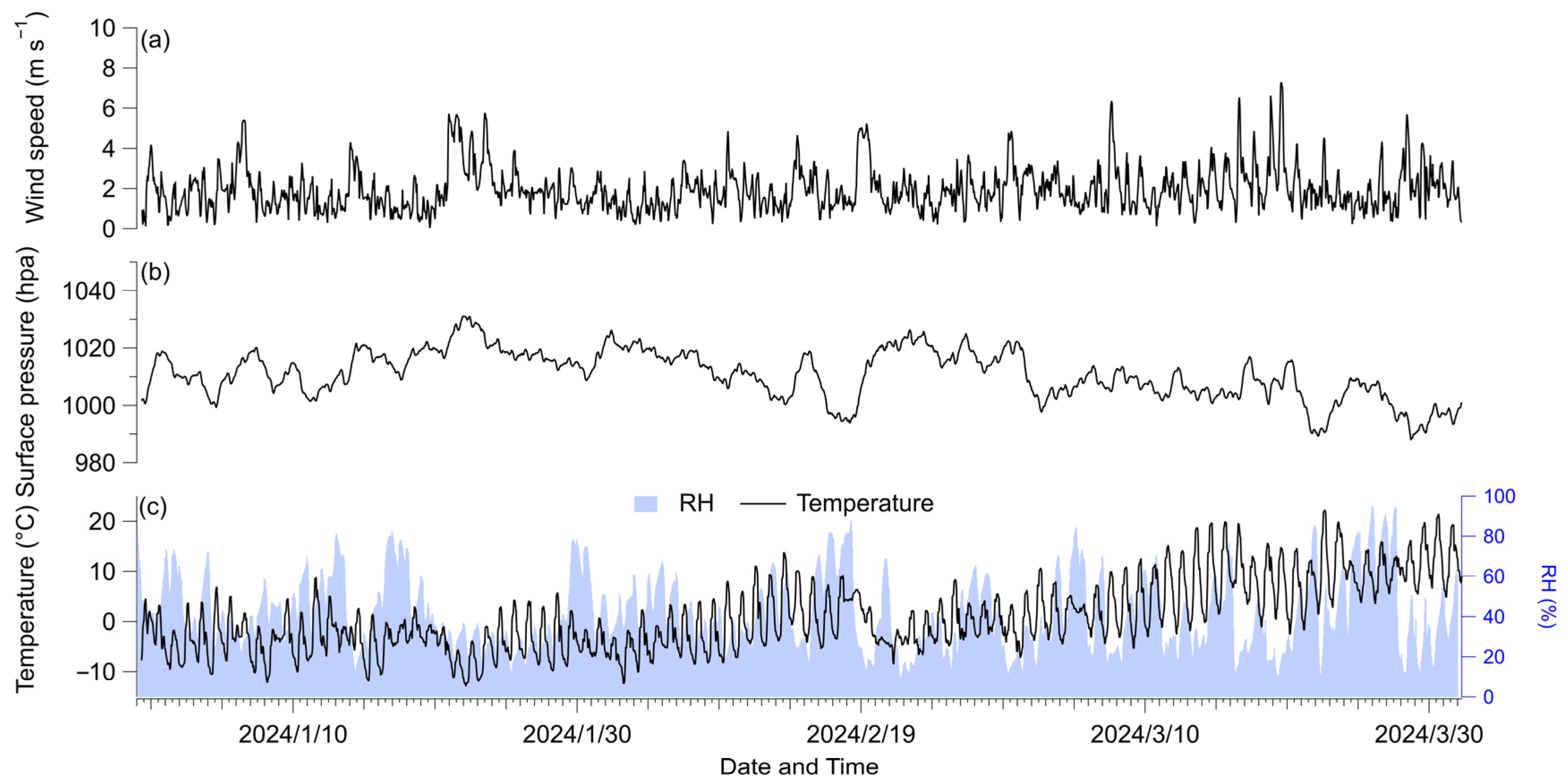
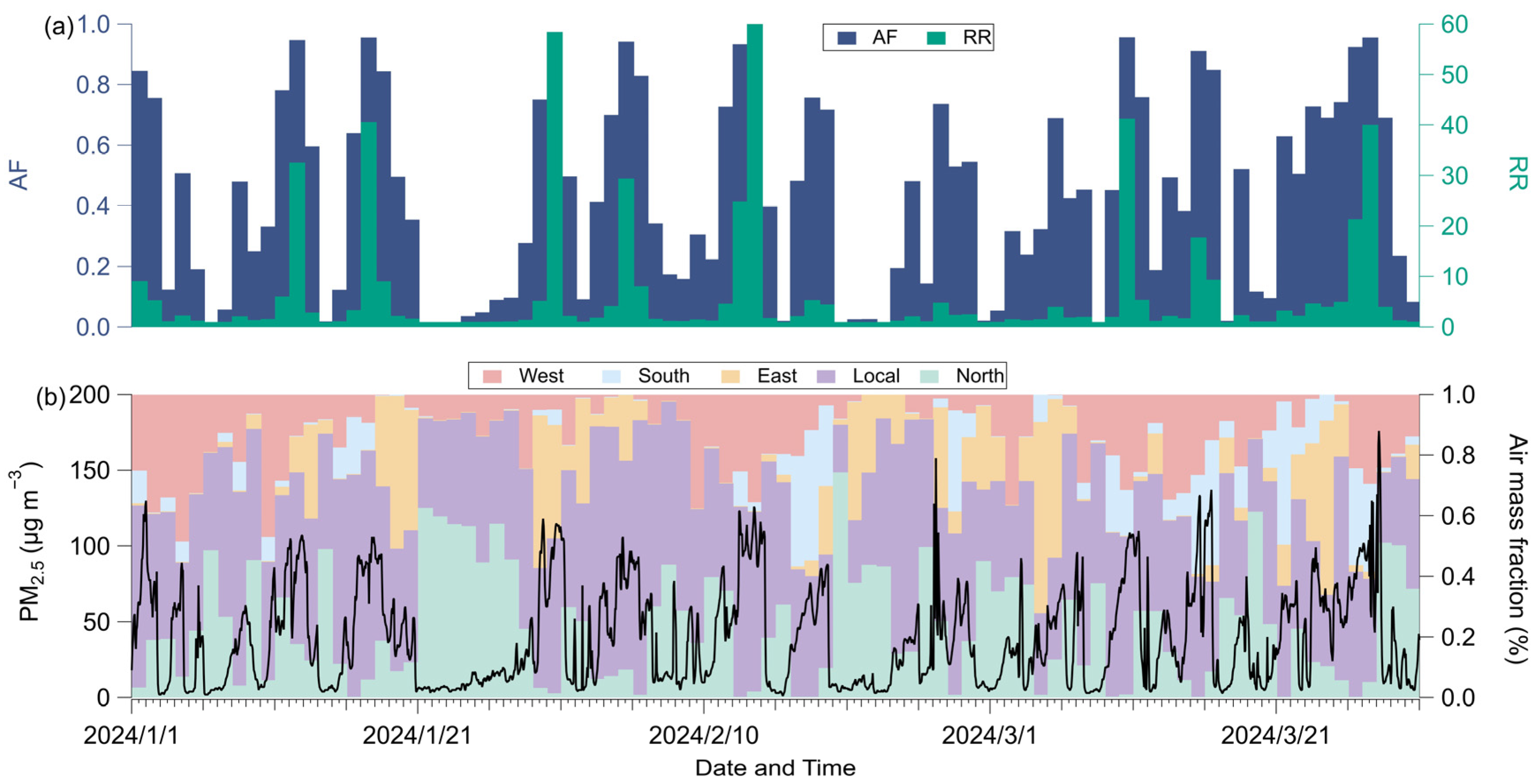
Meteorological data, including temperature, relative humidity (RH), surface pressure, and wind speed (Figure 1), were obtained for the latitude and longitude coordinates of ground observation stations from the European Centre for Medium-Range Weather Forecasts (ECMWF) ERA5 reanalysis dataset, available at https://cds.climate.copernicus.eu/datasets (accessed on 1 December 2025). The PM2.5 data (Figure 2b) were obtained from in situ air quality monitoring conducted by the China National Environmental Monitoring Center, with the monitoring station located in Chaoyang (39.98° N, 116.40° E), situated in the central urban area of Beijing (from January to March 2024).
Figure 1.
Temporal evolution for wind speed (a); surface pressure (b); and temperature and relative humility (RH) (c).
Figure 2.
Temporal evolution for (a) daily attributable fraction (AF) and relative risk (RR) associated with short-term exposure to PM2.5; (b) PM2.5 and air mass fraction derived from the Concentration-Weighted Trajectory (CWT) method (b).
2.1. Satellite Data
Our analysis of atmospheric aerosol properties utilized Collection 6 (C006) Level 3 aerosol optical depth (AOD) measurements at 550 nm wavelength, integrating retrievals from both Dark Target (DT) and Deep Blue (DB) algorithms. These observations were obtained through the Moderate Resolution Imaging Spectroradiometer (MODIS) aboard NASA’s Aqua platform. The MODIS instrument series, deployed on both Terra and Aqua satellites, represents NASA Goddard’s advanced Earth observation system, with Terra crossing the equator during morning hours (10:30 LT, descending node) and Aqua during afternoon periods (13:30 LT, ascending node) [23,24]. The MODIS sensor system achieves comprehensive global coverage through its extensive viewing swath (~2330 km) and frequent revisit capability (1–2 days), collecting data across 36 spectral channels. Aerosol retrievals specifically utilize seven specialized bands spanning near-UV to near-IR wavelengths (0.415–2.155 μm), enabling sophisticated AOD determinations over diverse surface types [23,25]. The retrieval methodology implements distinct algorithmic approaches: the DT algorithm suite processes vegetated and dark-soil regions, with separate variants optimized for terrestrial and oceanic surfaces [26,27], while the enhanced DB algorithm, refined in C006, extends coverage to bright surfaces and provides comprehensive land surface capabilities [28]. All satellite data products were accessed and processed through NASA’s Giovanni web interface (https://giovanni.gsfc.nasa.gov/giovanni/, accessed on 1 December 2025), facilitating standardized data acquisition and analysis protocols.
2.2. Air Mass Sources
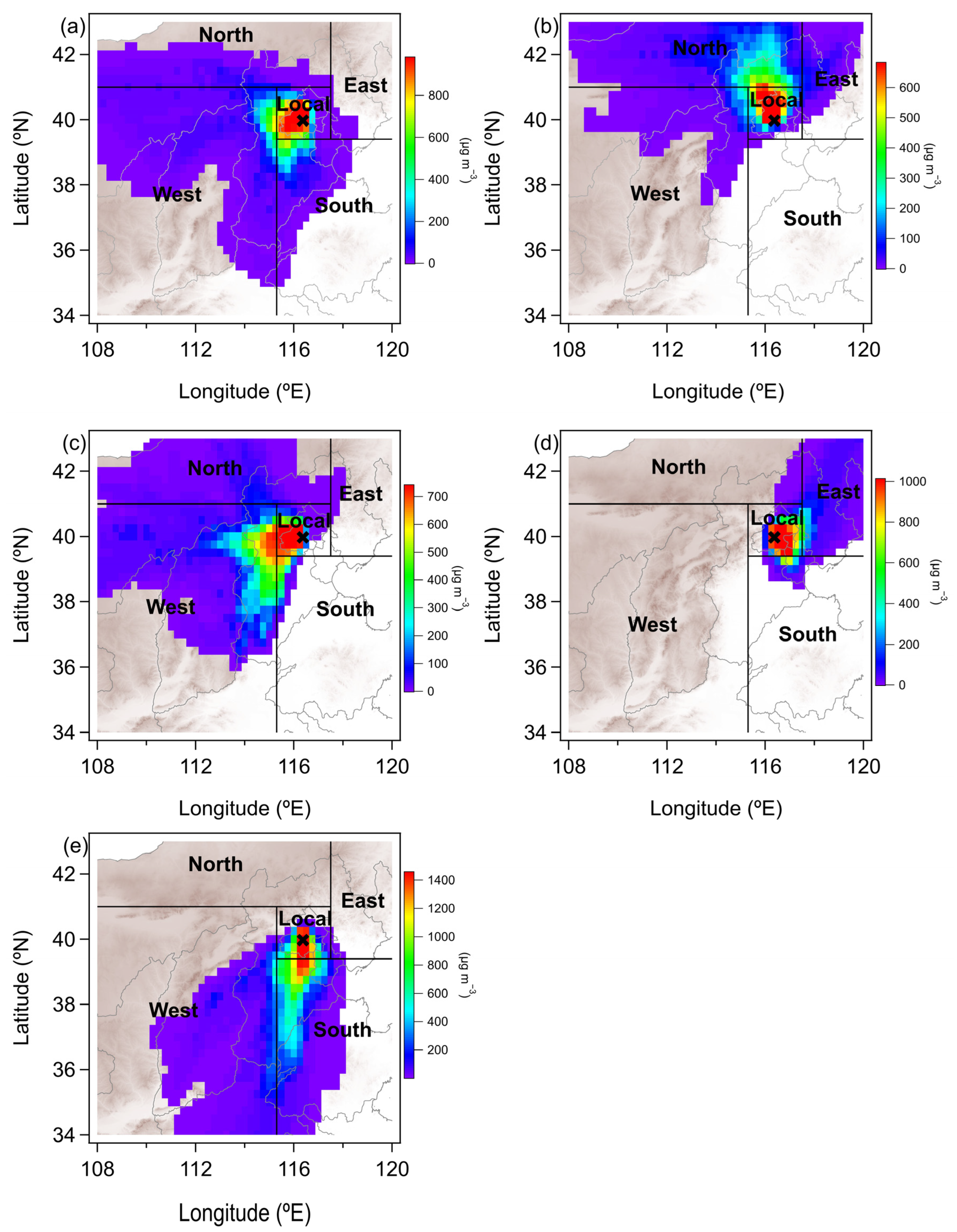
Source attribution (Figure 3) was performed using the Ens-HYSPLIT-CWT method, following recent developments by Hu et al. [13]. Hu et al.’s method improved upon traditional CWT analysis, which cannot provide hourly resolution for pollutant source analysis, enabling the use of CWT to analyze pollutant sources at an hourly resolution. Back-trajectories were computed at three-hour intervals using meteorological inputs from GDAS reanalysis (1-degree resolution, available at ftp://arlftp.arlhq.noaa.gov/pub/archives/gdas1, accessed on 1 December 2025). For each analysis time, the model generated 27 ensemble members tracking 24 h air parcel pathways ending at our Beijing monitoring site (39.98° N, 116.40° E, 250 m a.s.l.).
Figure 3.
Typical examples of CWT analysis are shown for (a) a local emission event (8 January 2024); (b) a north region transport event (9 January 2024); (c) a west region transport event (10 January 2024); (d) an east region transport event (19 January 2024); (e) a south region transport event (17 February 2024).
The CWT methodology assigns pollution source intensities by integrating air mass residence times with measured pollutant concentrations across a 0.25-degree spatial grid. This statistical approach computes weighted average concentrations for each grid cell traversed by back-trajectories, providing quantitative estimates of regional source contributions to pollution levels at the receptor site [29,30,31].
The grid-specific weighted concentration integrates the average weighted concentration, where individual trajectories l contributes to a total of M pathways. is the PM2.5 concentration measured at the receptor site. The residence time parameter quantifies how long each trajectory remains within a specific grid cell. In calculation, trajectory frequency per grid cell replaces absolute residence time calculations. Additionally, a weighting function W(ni,j) is applied to reduce uncertainties in cells with limited trajectory counts, where denotes trajectory frequency per grid cell and represents the mean trajectory count across all cells.
Source attribution was accomplished through CWT analysis of 648 daily trajectories, with the study domain subdivided into five geographical sectors: the central Beijing region (115.3–117.5° E, 39.4–41° N), western plateau region (108–115.3° E, 34–41° N), northern plateau area (108–117.5° E, 41–43° N), eastern coastal plain (117.5–120° E, 39.4–43° N), and southern region (115.3–120° E, 34–39.4° N). Regional contributions were quantified by integrating CWT-derived concentrations across grid points within each defined sector (Figure 2b).
2.3. Health Burden Assessment
The estimated health burden owing to short-term PM2.5 exposure can be calculated as follows [32,33,34]:
were indicates the daily relative risk associated with short-term PM2.5 exposure, is the concentration-response coefficient for health endpoints exposed to PM2.5, ranging from 0.31 to 0.45, with 0.38 used in this manuscript as suggested by recent epidemiological studies [35,36]. The influence of AF on the results is less than 16% when using the maximum and minimum values of . is the daily PM2.5 concentration, and is the daily PM2.5 threshold concentration, which is assumed to be zero, similar to previous studies [19,37]. indicates the daily attributable fraction associated with short-term PM2.5 exposure.
3. Results and Discussion
3.1. Meteorology Influenced by Diverse Air Mass Sources
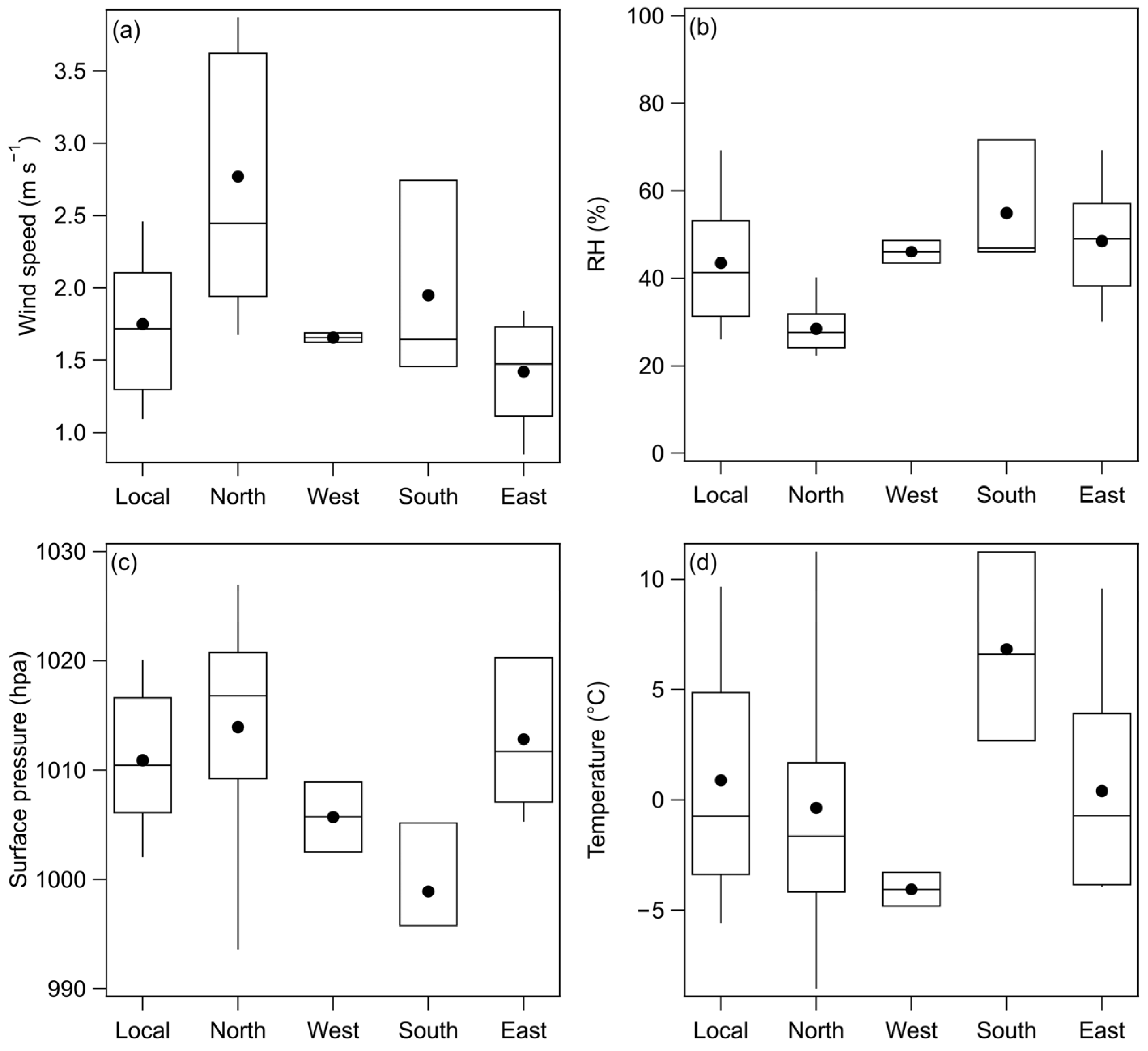
We conducted a statistical analysis of the meteorological conditions in the Beijing area under the influence of different air mass sources during the research period (Figure 4). The average wind speed in Beijing was highest (3 m s−1) when air masses originated from the north region, approximately twice as high as the lowest average wind speed (1.4 m s−1) associated with air masses from the east region. The 75th percentile wind speed for north region air masses was 3.6 m s−1, the highest among all air mass sources, while the 25th percentile wind speed (1.9 m s−1) exceeded the 75th percentile wind speed of both eastward and westward air masses. Average wind speeds during periods influenced by west region air masses and local emissions were similar at 1.7 m s−1. South region air masses were associated with an average wind speed of 1.9 m s−1 in the Beijing area. Surface wind speed can impact pollutant transport and diffusion, low wind speeds reduce the horizontal diffusion of pollutants, potentially exacerbating pollution concentrations and posing a threat to human health.
Figure 4.
Wind speed (a); RH (b); surface pressure (c) and temperature (d) distribution dominated by different air masse sources. Solid circle indicates mean value, upper and lower boundaries represent 75th and 25th percentiles, and whiskers above and below the box are 90th and 10th percentiles.
RH is another important factor affecting polluted events. High RH can lead to increased moisture absorption by particulate matter, resulting in an increase in particle size and further affecting optical properties, such as visibility, thereby exacerbating pollution events. As shown in Figure 4b, both the mean and distribution results indicate that air masses originating from the south region have the highest RH among all incoming air masses, with a mean of 55%, a 75th percentile value of 72%, and a 25th percentile value of 46%. This is closely related to the climate differences between northern and southern China, with more warm and humid air masses in the south and more dry and cold air masses in the north. Therefore, under the influence of southward air masses, warm and humid air moves into the Beijing area, leading to increased RH. In contrast, the lowest RH values in Beijing are associated with air masses from the north region, with an average of only 28%. Apart from the south region air masses, the second-highest RH is contributed by east region air masses (49%), followed by westward air masses (46%) and locally emitted air masses (43%).
Regarding temperature, the Beijing area exhibits the highest average temperature (6.8 °C) when under the influence of south region air masses. This is directly related to the latitudinal temperature variation, as the southern region is closer to the point of direct sunlight and experiences higher temperatures. The movement of warm air masses from the south to the Beijing area increases the temperature. The lowest average temperature (−4 °C) occurs under the influence of west region air masses, followed by north region air masses (0 °C) and local emission (1 °C). In terms of surface pressure, the Beijing area experiences the lowest average pressure (999 hPa) when influenced by south region air masses, followed by west region air masses (1005 hPa), local air masses (1011 hPa), east region air masses (1013 hPa), and north region air masses (1014 hPa).
3.2. Human Health Variations Influenced by Diverse Air Mass Sources
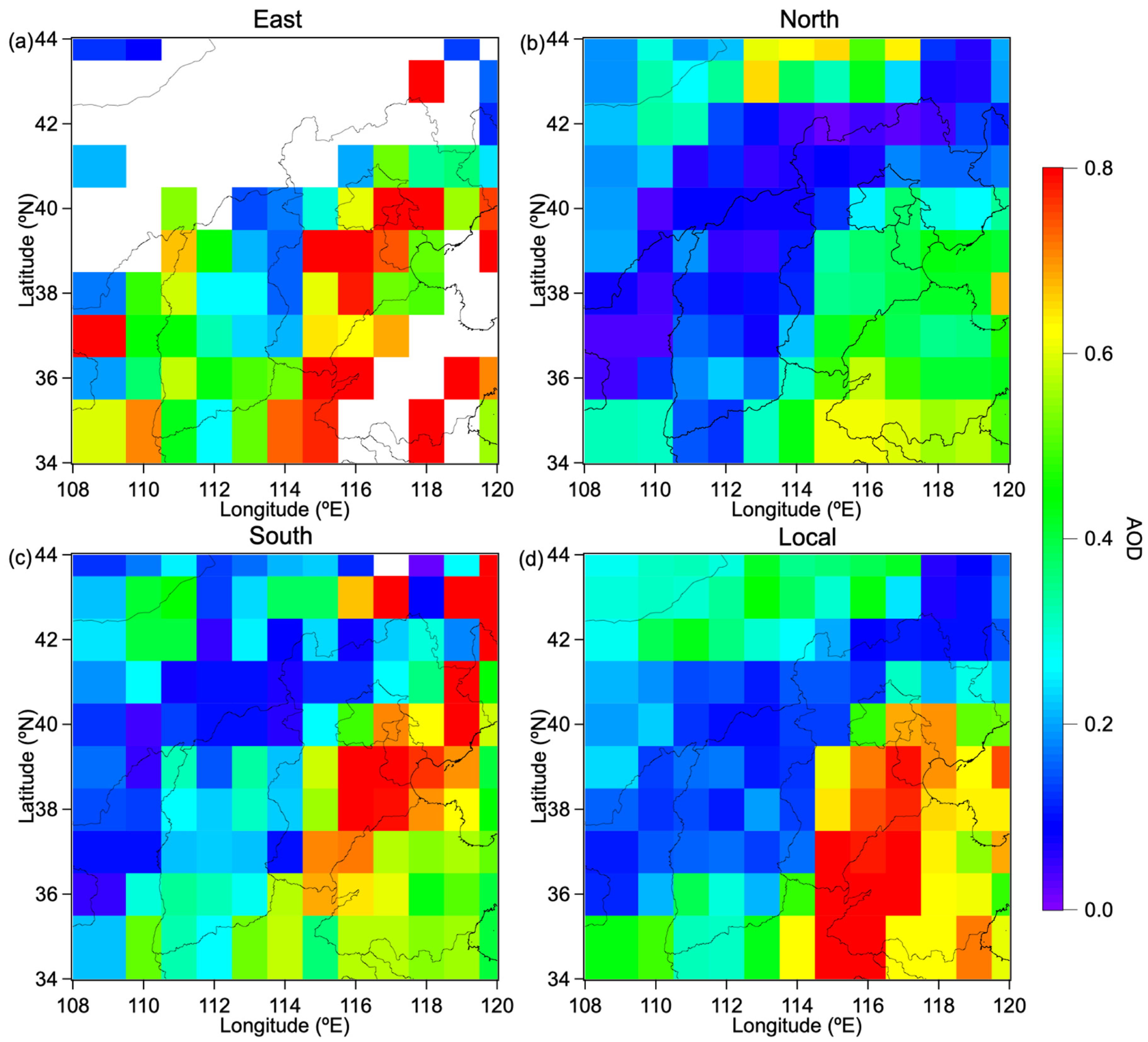
MODIS satellite observations of AOD distribution in Beijing and surrounding areas (Figure 5) reveal that AOD values are consistently low when Beijing is influenced by air masses originating from the north, with the maximum AOD in Beijing remaining below 0.3. Under these conditions, even the south region, which is prone to high AOD values, experiences a reduction in AOD to below 0.7. This improvement is primarily attributed to the influence of dry and clean air masses from the north. However, under the influence of air masses from other directions, certain areas in Beijing exhibit higher AOD values, corresponding to the observed PM2.5 concentrations. The phenomenon of low AOD in the north and high AOD in the south was also observed in Hu et al.’s research [38]. They investigated the sources of winter pollution events in Beijing at different levels using in situ aircraft measurement instruments, including a passive cavity aerosol spectrometer probe (PCASP) [39] and a single particle soot photometer (SP2, DMT Inc.) combined with weighted potential source contribution function (WPSCF) method [40]. They found that air masses from the south and southwestern regions are more likely to bring polluted aerosols, causing pollution events in Beijing. Comparing Hu et al.’s research on the trend of AOD in mainland China in earlier years [41], it was found that during 2002–2016, the AOD in eastern China, especially in southern Beijing and some southwest areas during the same months as this study period, showed high results, significantly higher than 0.7 and even exceeding 1. However, when compared with our current research results, it is evident that the government’s emission reduction measures have significantly reduced pollution levels.
Figure 5.
Spatial distribution of mean AOD values by source region: (a) eastern, (b) northern, (c) southern, and (d) local air masses during the study period.
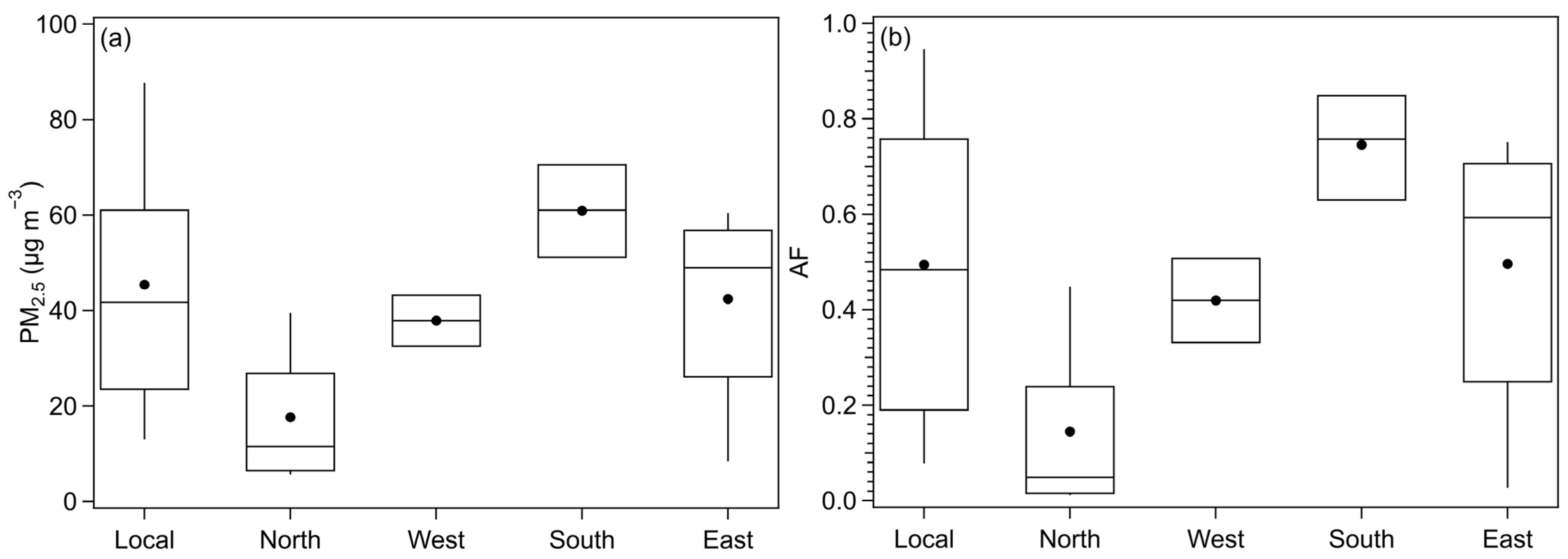
Analysis of the impact of different air mass sources on PM2.5 concentrations (Figure 6a) in Beijing reveals that the highest average value and concentration distribution occur under the influence of southward air masses, with a mean value of 61 μg m−3, falling within the light pollution range stipulated by the Chinese government. This finding is consistent with the research of Hu et al. [38], attributing the increase in PM2.5 to the transport of pollutants from high pollution areas in the south region. Air masses from local emissions, eastward transmission, and westward transport also result in mean PM2.5 values within the mild pollution range. Hu et al. [13] found that pollution events in Beijing were more influenced by local emissions between 2013 and 2020, which is reflected in our results as high mean and distribution of PM2.5 concentrations during local emission periods. Although eastward air masses were previously associated with cleaner conditions, our research indicates that they can now significantly impact pollution levels in Beijing, aligning with Hu et al.’s conclusion that the probability of relatively clean eastward air masses causing pollution has increased after effective control of other incoming pollutants [13]. Air masses from the north remain the primary source of clean air, consistently maintaining average PM2.5 levels below 75 μg m−3 during the study period.
Figure 6.
PM2.5 (a) and AF (b) distribution dominated by different air masse sources during the study period. Solid circle indicates mean value, upper and lower boundaries represent 75th and 25th percentiles, and whiskers above and below the box are 90th and 10th percentiles.
Figure 6b reveals that the daily attribution scores of PM2.5 aerosols from different air mass sources have varying impacts on human health. Due to the higher mean and distribution of PM2.5 concentrations in southbound air masses, they pose the greatest risk to human health, with an average AF of 0.75 and a 75th percentile of 0.85. PM2.5 from eastward air masses and local emissions also significantly affect human health, with average AF values of 0.5 and 0.49, respectively. Notably, PM2.5 from eastward air masses, previously thought to transport relatively clean air, can seriously impact human health, warranting increased attention in future policy adjustments and research. Although the average AF caused by locally emitted PM2.5 is slightly lower than that of eastward air masses, the distribution range is wider, suggesting that local emissions may have both high-risk and low-impact effects on human health. Westward air masses have a moderate impact on human health, with a relatively narrow distribution range. Air masses from the north have the least impact on human health, with an average AF of only 0.14, less than one-fifth of the result for southward air masses.
4. Conclusions
This study used HYSPLIT trajectory combined with concentration weighted trajectory (CWT) analysis to distinguish the different source directions of air masses in Beijing, and evaluated the distribution of PM2.5 in different directions and their impact on human health.
Research has found that, in addition to being influenced by northward air masses, the southern region is the main area where high AOD values occur. This also leads to a higher concentration of PM2.5 under southward air mass influence (with an average result of 61 μg m−3), which is 1.3 times higher than the average concentration of PM2.5 during local emission pollution events, second only to southward air masses. The clean air masses brought by the northward air masses also directly led to the lowest PM2.5 concentration in Beijing under the influence of this air mass, with an average result of only 17.7 μg m−3. Furthermore, the importance of eastward air masses in the average PM2.5 concentration results has increased, which is consistent with the research results of Hu et al. [13] and further indicates that policy adjustments need to pay more attention to the trend areas.
The distribution of AF caused by PM2.5 also shows a similar result, with the highest AF value of 0.75 under the influence of southward air masses. The AF value caused by clean air masses under the influence of northward air masses is the lowest, only 0.14, which is less than one-fifth of the result of southward air masses. Under the influence of local emissions, the air mass control with the highest frequency, the mean AF can reach 0.49, but the distribution range is extremely wide. The high value of the 90th percentile is the highest among all incoming air masses, reaching 0.95, while the low value of the 10th percentile can be as low as 0.7. The AF value of the eastward air mass also reached the second highest level among all air masses, further indicating that the proportion of PM2.5 pollution caused by the eastward air mass on human health in Beijing is gradually increasing. The higher impact on human health caused by the eastward air mass, emphasizes the need for the Chinese government to prioritize controlling pollutants in the eastern regions. This is crucial due to the profound influence of these pollutants on the health of Beijing residents, and should be considered in future macroeconomic regulations. Consequently, the classification of air masses by source region using our proposed method, along with an evaluation of their health impacts, provides valuable insights for governmental pollution source monitoring and emission reduction policies.
Author Contributions
Conceptualization, R.H., M.Z., X.L., Z.L. and W.P.; methodology, R.H., M.Z., X.L., Z.L. and W.P.; software, X.Z. and X.J.; validation, Z.Y., L.L. and Y.G.; formal analysis, R.H. and M.Z.; data curation, X.L.; writing—original draft preparation, R.H., M.Z., X.L., Z.L. and W.P.; writing—review and editing, R.H., M.Z., X.L., Z.L. and W.P. All authors have read and agreed to the published version of the manuscript.
Funding
This research received no external funding.
Institutional Review Board Statement
Not applicable.
Informed Consent Statement
Not applicable.
Data Availability Statement
The datasets used and/or analyzed during the current study are available from the corresponding author upon reasonable request.
Acknowledgments
We would like to thank Heyuan Liu for her contributions to this manuscript.
Conflicts of Interest
The authors declare no conflicts of interest.
References
- Wang, Y.; Wang, M.; Zhang, R.; Ghan, S.J.; Lin, Y.; Hu, J.; Pan, B.; Levy, M.; Jiang, J.H.; Molina, M.J. Assessing the effects of anthropogenic aerosols on Pacific storm track using a multiscale global climate model. Proc. Natl. Acad. Sci. USA 2014, 111, 6894–6899. [Google Scholar] [CrossRef]
- Bartell, S.M.; Longhurst, J.; Tjoa, T.; Sioutas, C.; Delfino, R.J. Particulate air pollution, ambulatory heart rate variability, and cardiac arrhythmia in retirement community residents with coronary artery disease. Environ. Health Perspect. 2013, 121, 1135–1141. [Google Scholar] [CrossRef]
- Brauer, M.; Amann, M.; Burnett, R.T.; Cohen, A.; Dentener, F.; Ezzati, M.; Henderson, S.B.; Krzyzanowski, M.; Martin, R.V.; Van Dingenen, R. Exposure assessment for estimation of the global burden of disease attributable to outdoor air pollution. Environ. Sci. Technol. 2012, 46, 652–660. [Google Scholar] [CrossRef]
- Pascal, M.; Falq, G.; Wagner, V.; Chatignoux, E.; Corso, M.; Blanchard, M.; Host, S.; Pascal, L.; Larrieu, S. Short-term impacts of particulate matter (PM10, PM10–2.5, PM2.5) on mortality in nine French cities. Atmos. Environ. 2014, 95, 175–184. [Google Scholar] [CrossRef]
- Cascio, W.E.; Long, T.C. Ambient air quality and cardiovascular health: Translation of environmental research for public health and clinical care. N. C. Med. J. 2018, 79, 306–312. [Google Scholar] [CrossRef]
- Fuertes, E.; Sunyer, J.; Gehring, U.; Porta, D.; Forastiere, F.; Cesaroni, G.; Vrijheid, M.; Guxens, M.; Annesi-Maesano, I.; Slama, R. Associations between air pollution and pediatric eczema, rhinoconjunctivitis and asthma: A meta-analysis of European birth cohorts. Environ. Int. 2020, 136, 105474. [Google Scholar] [CrossRef]
- Guo, H.; Chang, Z.; Wu, J.; Li, W. Air pollution and lung cancer incidence in China: Who are faced with a greater effect? Environ. Int. 2019, 132, 105077. [Google Scholar] [CrossRef] [PubMed]
- Knibbs, L.D.; de Waterman, A.M.C.; Toelle, B.G.; Guo, Y.; Denison, L.; Jalaludin, B.; Marks, G.B.; Williams, G.M. The Australian Child Health and Air Pollution Study (ACHAPS): A national population-based cross-sectional study of long-term exposure to outdoor air pollution, asthma, and lung function. Environ. Int. 2018, 120, 394–403. [Google Scholar] [CrossRef] [PubMed]
- Rodriguez-Villamizar, L.A.; Magico, A.; Osornio-Vargas, A.; Rowe, B.H. The effects of outdoor air pollution on the respiratory health of Canadian children: A systematic review of epidemiological studies. Can. Respir. J. 2015, 22, 282–292. [Google Scholar] [CrossRef]
- Sun, S.; Stewart, J.D.; Eliot, M.N.; Yanosky, J.D.; Liao, D.; Tinker, L.F.; Eaton, C.B.; Whitsel, E.A.; Wellenius, G.A. Short-term exposure to air pollution and incidence of stroke in the Women’s Health Initiative. Environ. Int. 2019, 132, 105065. [Google Scholar] [CrossRef]
- Huang, R.-J.; Zhang, Y.; Bozzetti, C.; Ho, K.-F.; Cao, J.-J.; Han, Y.; Daellenbach, K.R.; Slowik, J.G.; Platt, S.M.; Canonaco, F. High secondary aerosol contribution to particulate pollution during haze events in China. Nature 2014, 514, 218–222. [Google Scholar] [CrossRef] [PubMed]
- Zhang, Q.; Zheng, Y.; Tong, D.; Shao, M.; Wang, S.; Zhang, Y.; Xu, X.; Wang, J.; He, H.; Liu, W. Drivers of improved PM2.5 air quality in China from 2013 to 2017. Proc. Natl. Acad. Sci. USA 2019, 116, 24463–24469. [Google Scholar]
- Hu, K.; Liao, H.; Liu, D.; Jin, J.; Chen, L.; Li, S.; Wu, Y.; Wu, C.; Zhao, S.; Jiang, X. A novel method for quantifying the contribution of regional transport to PM2.5 in Beijing (2013–2020): Combining machine learning with concentration-weighted trajectory analysis. Geosci. Model Dev. 2025, 18, 3623–3634. [Google Scholar] [CrossRef]
- Xue, T.; Liu, J.; Zhang, Q.; Geng, G.; Zheng, Y.; Tong, D.; Liu, Z.; Guan, D.; Bo, Y.; Zhu, T. Rapid improvement of PM2.5 pollution and associated health benefits in China during 2013–2017. Sci. China Earth Sci. 2019, 62, 1847–1856. [Google Scholar] [CrossRef]
- Schwartz, J.; Dockery, D.W.; Neas, L.M. Is daily mortality associated specifically with fine particles? J. Air Waste Manag. Assoc. 1996, 46, 927–939. [Google Scholar] [CrossRef] [PubMed]
- Hu, J.; Huang, L.; Chen, M.; Liao, H.; Zhang, H.; Wang, S.; Zhang, Q.; Ying, Q. Premature mortality attributable to particulate matter in China: Source contributions and responses to reductions. Environ. Sci. Technol. 2017, 51, 9950–9959. [Google Scholar] [CrossRef]
- Cohen, A.J.; Brauer, M.; Burnett, R.; Anderson, H.R.; Frostad, J.; Estep, K.; Balakrishnan, K.; Brunekreef, B.; Dandona, L.; Dandona, R. Estimates and 25-year trends of the global burden of disease attributable to ambient air pollution: An analysis of data from the Global Burden of Diseases Study 2015. Lancet 2017, 389, 1907–1918. [Google Scholar] [CrossRef]
- Li, T.; Guo, Y.; Liu, Y.; Wang, J.; Wang, Q.; Sun, Z.; He, M.Z.; Shi, X. Estimating mortality burden attributable to short-term PM2.5 exposure: A national observational study in China. Environ. Int. 2019, 125, 245–251. [Google Scholar] [CrossRef]
- Yao, M.; Wu, G.; Zhao, X.; Zhang, J. Estimating health burden and economic loss attributable to short-term exposure to multiple air pollutants in China. Environ. Res. 2020, 183, 109184. [Google Scholar] [CrossRef]
- Lelieveld, J.; Evans, J.S.; Fnais, M.; Giannadaki, D.; Pozzer, A. The contribution of outdoor air pollution sources to premature mortality on a global scale. Nature 2015, 525, 367–371. [Google Scholar] [CrossRef]
- Wu, Y.; Liu, D.; Wang, X.; Li, S.; Zhang, J.; Qiu, H.; Ding, S.; Hu, K.; Li, W.; Tian, P. Ambient marine shipping emissions determined by vessel operation mode along the East China Sea. Sci. Total Environ. 2021, 769, 144713. [Google Scholar] [CrossRef] [PubMed]
- Li, S.; Liu, D.; Kong, S.; Wu, Y.; Hu, K.; Zheng, H.; Cheng, Y.; Zheng, S.; Jiang, X.; Ding, S. Evolution of source attributed organic aerosols and gases in a megacity of central China. Atmos. Chem. Phys. Discuss. 2022, 2022, 1–19. [Google Scholar] [CrossRef]
- Remer, L.A.; Kaufman, Y.; Tanré, D.; Mattoo, S.; Chu, D.; Martins, J.V.; Li, R.-R.; Ichoku, C.; Levy, R.; Kleidman, R. The MODIS aerosol algorithm, products, and validation. J. Atmos. Sci. 2005, 62, 947–973. [Google Scholar] [CrossRef]
- Levy, R.C.; Mattoo, S.; Munchak, L.; Remer, L.; Sayer, A.; Patadia, F.; Hsu, N. The Collection 6 MODIS aerosol products over land and ocean. Atmos. Meas. Tech. 2013, 6, 2989–3034. [Google Scholar] [CrossRef]
- Hsu, N.; Jeong, M.J.; Bettenhausen, C.; Sayer, A.M.; Hansell, R.; Seftor, C.; Huang, J.; Tsay, S.C. Enhanced Deep Blue aerosol retrieval algorithm: The second generation. J. Geophys. Res. Atmos. 2013, 118, 9296–9315. [Google Scholar] [CrossRef]
- Kaufman, Y.; Tanré, D.; Remer, L.A.; Vermote, E.; Chu, A.; Holben, B. Operational remote sensing of tropospheric aerosol over land from EOS moderate resolution imaging spectroradiometer. J. Geophys. Res. Atmos. 1997, 102, 17051–17067. [Google Scholar] [CrossRef]
- Tanré, D.; Kaufman, Y.; Herman, M.; Mattoo, S. Remote sensing of aerosol properties over oceans using the MODIS/EOS spectral radiances. J. Geophys. Res. Atmos. 1997, 102, 16971–16988. [Google Scholar] [CrossRef]
- Sayer, A.; Munchak, L.; Hsu, N.; Levy, R.; Bettenhausen, C.; Jeong, M.J. MODIS Collection 6 aerosol products: Comparison between Aqua’s e-Deep Blue, Dark Target, and “merged” data sets, and usage recommendations. J. Geophys. Res. Atmos. 2014, 119, 13965–13989. [Google Scholar] [CrossRef]
- Hopke, P.K.; Gao, N.; Cheng, M.-D. Combining chemical and meteorological data to infer source areas of airborne pollutants. Chemom. Intell. Lab. Syst. 1993, 19, 187–199. [Google Scholar] [CrossRef]
- Polissar, A.; Hopke, P.; Paatero, P.; Kaufmann, Y.; Hall, D.; Bodhaine, B.; Dutton, E.; Harris, J. The aerosol at Barrow, Alaska: Long-term trends and source locations. Atmos. Environ. 1999, 33, 2441–2458. [Google Scholar] [CrossRef]
- Xu, X.; Akhtar, U. Identification of potential regional sources of atmospheric total gaseous mercury in Windsor, Ontario, Canada using hybrid receptor modeling. Atmos. Chem. Phys. 2010, 10, 7073–7083. [Google Scholar] [CrossRef]
- Silva, R.A.; West, J.J.; Zhang, Y.; Anenberg, S.C.; Lamarque, J.-F.; Shindell, D.T.; Collins, W.J.; Dalsoren, S.; Faluvegi, G.; Folberth, G. Global premature mortality due to anthropogenic outdoor air pollution and the contribution of past climate change. Environ. Res. Lett. 2013, 8, 034005. [Google Scholar] [CrossRef]
- Tian, X.; Dai, H.; Geng, Y.; Wilson, J.; Wu, R.; Xie, Y.; Hao, H. Economic impacts from PM2.5 pollution-related health effects in China’s road transport sector: A provincial-level analysis. Environ. Int. 2018, 115, 220–229. [Google Scholar] [CrossRef]
- Xie, Y.; Dai, H.; Dong, H.; Hanaoka, T.; Masui, T. Economic impacts from PM2.5 pollution-related health effects in China: A provincial-level analysis. Environ. Sci. Technol. 2016, 50, 4836–4843. [Google Scholar] [CrossRef]
- Lai, H.-K.; Tsang, H.; Wong, C.-M. Meta-analysis of adverse health effects due to air pollution in Chinese populations. BMC Public Health 2013, 13, 360. [Google Scholar] [CrossRef]
- Shang, Y.; Sun, Z.; Cao, J.; Wang, X.; Zhong, L.; Bi, X.; Li, H.; Liu, W.; Zhu, T.; Huang, W. Systematic review of Chinese studies of short-term exposure to air pollution and daily mortality. Environ. Int. 2013, 54, 100–111. [Google Scholar] [CrossRef] [PubMed]
- Chen, K.; Zhou, L.; Chen, X.; Bi, J.; Kinney, P.L. Acute effect of ozone exposure on daily mortality in seven cities of Jiangsu Province, China: No clear evidence for threshold. Environ. Res. 2017, 155, 235–241. [Google Scholar] [CrossRef] [PubMed]
- Hu, K.; Zhao, D.; Liu, D.; Ding, S.; Tian, P.; Yu, C.; Zhou, W.; Huang, M.; Ding, D. Estimating radiative impacts of black carbon associated with mixing state in the lower atmosphere over the northern North China Plain. Chemosphere 2020, 252, 126455. [Google Scholar] [CrossRef] [PubMed]
- Strapp, J.W.; Leaitch, W.; Liu, P. Hydrated and dried aerosol-size-distribution measurements from the particle measuring systems FSSP-300 probe and the deiced PCASP-100X probe. J. Atmos. Ocean. Technol. 1992, 9, 548–555. [Google Scholar] [CrossRef]
- Ashbaugh, L.L.; Malm, W.C.; Sadeh, W.Z. A residence time probability analysis of sulfur concentrations at Grand Canyon National Park. Atmos. Environ. 1985, 19, 1263–1270. [Google Scholar] [CrossRef]
- Hu, K.; Kumar, K.R.; Kang, N.; Boiyo, R.; Wu, J. Spatiotemporal characteristics of aerosols and their trends over mainland China with the recent Collection 6 MODIS and OMI satellite datasets. Environ. Sci. Pollut. Res. 2018, 25, 6909–6927. [Google Scholar]
Disclaimer/Publisher’s Note: The statements, opinions and data contained in all publications are solely those of the individual author(s) and contributor(s) and not of MDPI and/or the editor(s). MDPI and/or the editor(s) disclaim responsibility for any injury to people or property resulting from any ideas, methods, instructions or products referred to in the content. |
© 2025 by the authors. Licensee MDPI, Basel, Switzerland. This article is an open access article distributed under the terms and conditions of the Creative Commons Attribution (CC BY) license (https://creativecommons.org/licenses/by/4.0/).