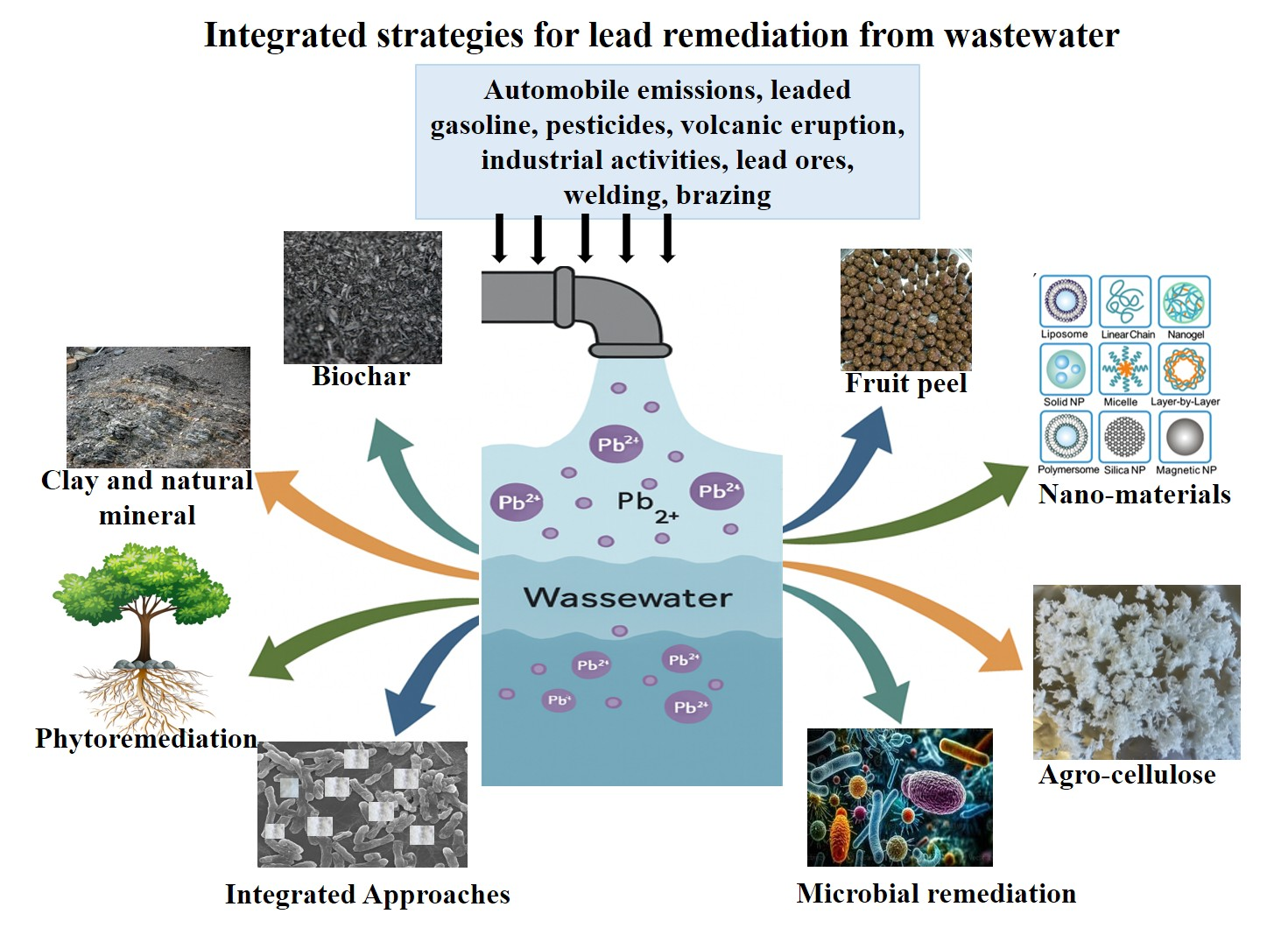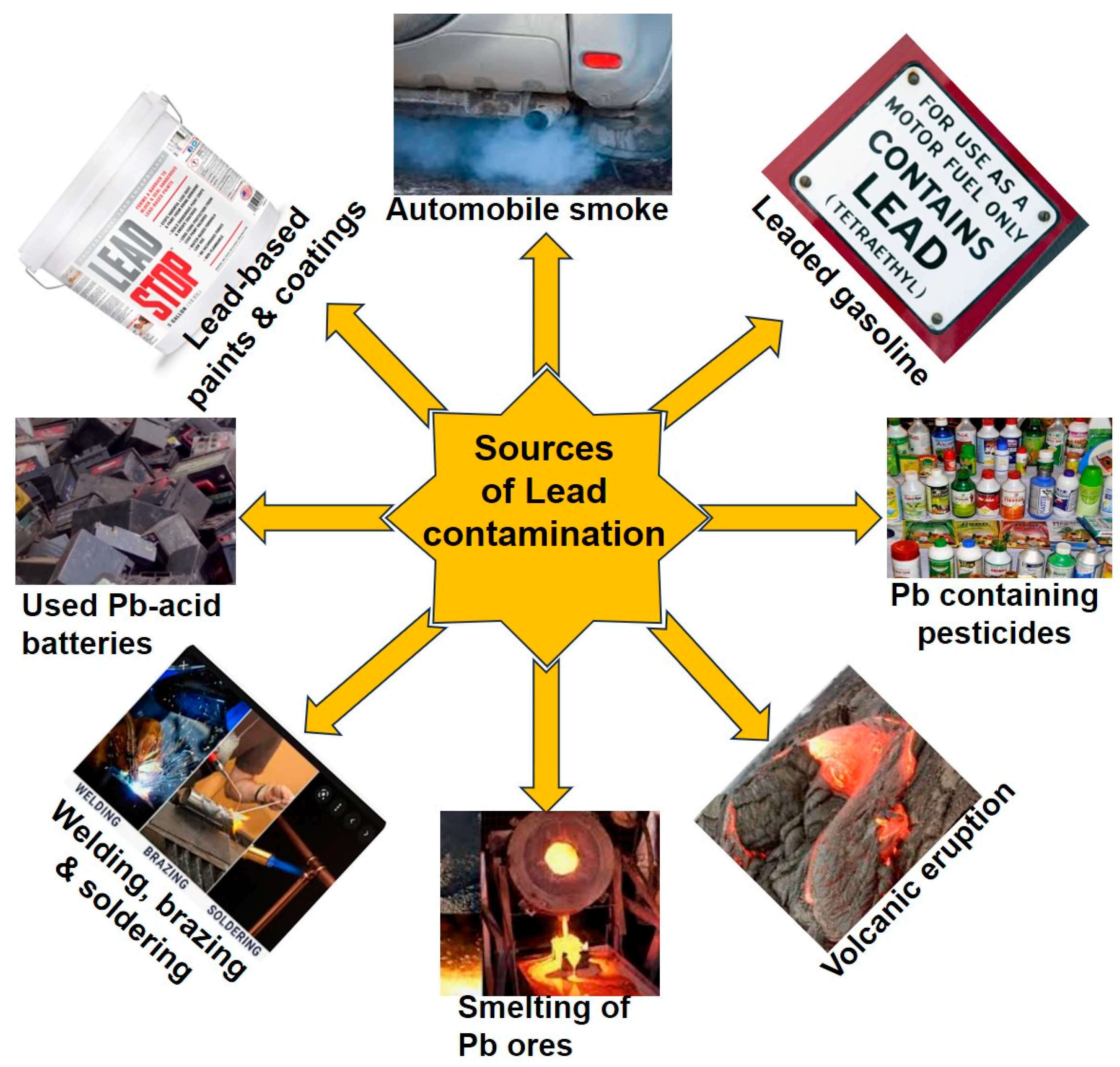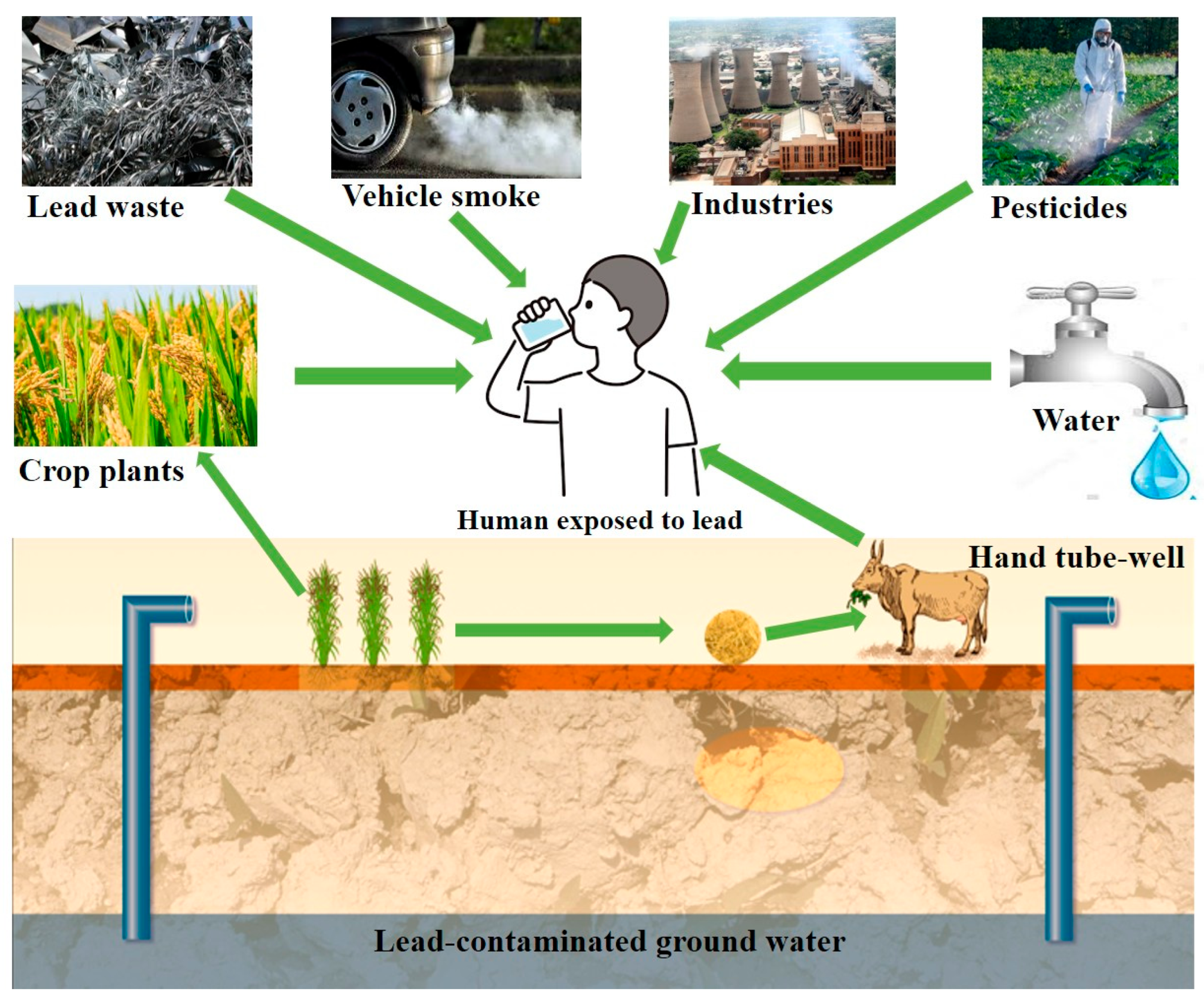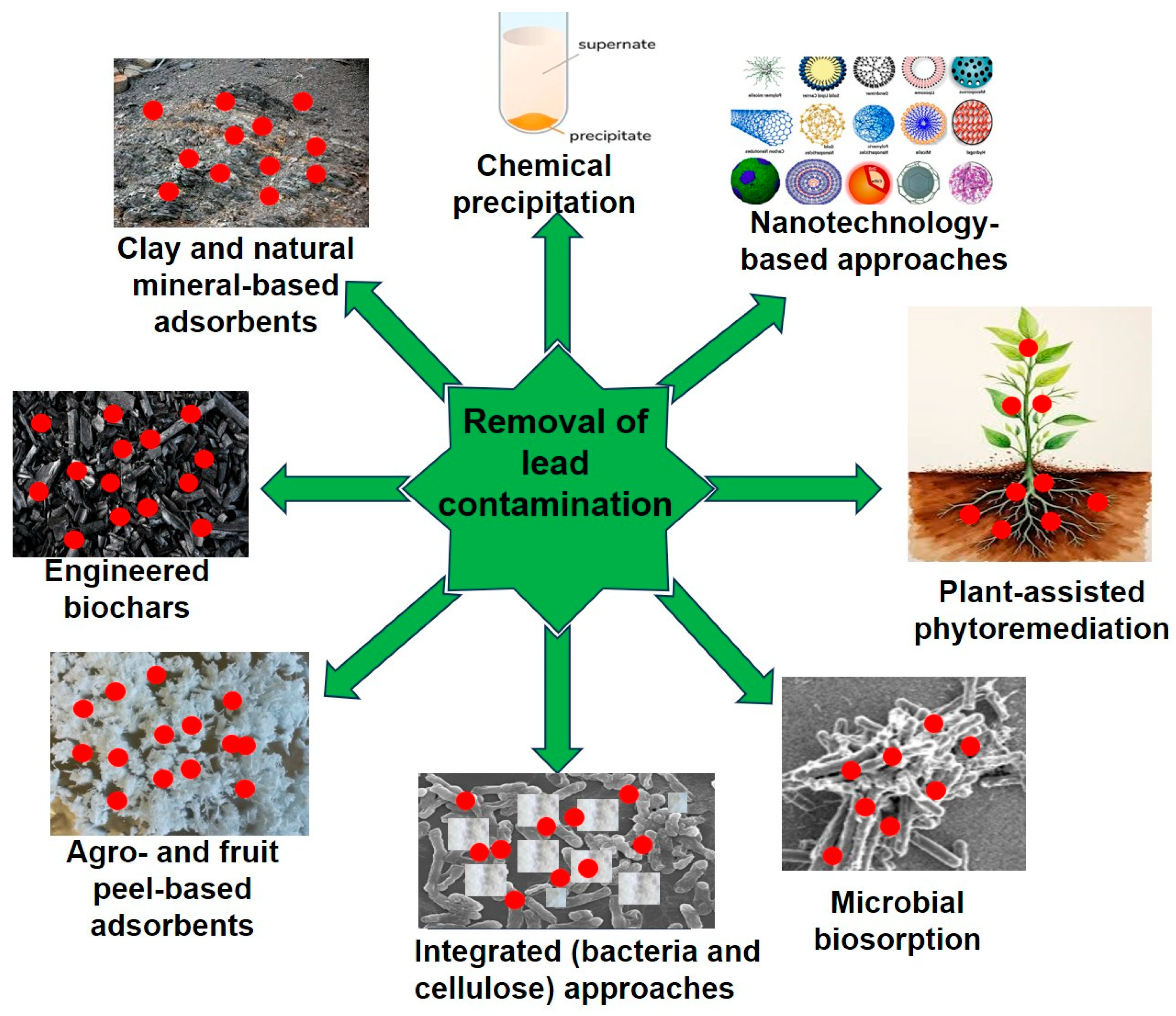



Comprehensive Review of Microbial, Plant, Biochar, Mineral, and Nanomaterial Solutions for Lead-Contaminated Wastewater
 , ,
, ,  , ,
, ,  ,
,  and
and 
Abstract
1. Introduction
1.1. Toxicological and Environmental Effects and Regulations
1.2. Pb Removal Strategies
1.3. Aim of the Study
2. Review Methods
3. Microbial Approaches for Pb Remediation
4. Agro-Waste- and Fruit Peel-Based Adsorbents for Pb Remediation
5. Phytoremediation-Based Strategies

| Plant Species | Type | Strategy Type | Mechanism | Pb Removal Efficiency | Reference |
|---|---|---|---|---|---|
| Eleusine indica | Herbaceous annual grass | Phytostabilization | Uptake into shoots | 7474 mg kg−1 | [145] |
| Lactuca sativa | Annual herb (Lettuce leaves) | Biosorption | Leaves | 71.22 mg/g (89.02%) | [146] |
| Eichornia crassipes | Water hyacinth | Rhizofiltration | Uptake into roots | 92.4% | [111] |
| Cannabis sativa L. | Industrial hemp | Phytoextraction | Uptake into roots | >100 µg/g | [138] |
| Helianthus annuus | Sunflower | Phytoextraction | Uptake into roots and shoots | 410 mg/kg (roots), 180 (shoots) | [141] |
| Vigna unguiculata | Cowpea | Phytoextraction | Uptake into roots | 58.1 mg/kg DW | [139] |
| Brassica pekinensis | Chinese cabbage | Phytoextraction | Uptake into roots | 50.0 mg/kg DW | [139] |
| Gomphrena globose | Globe Amaranth | Phytoextraction | Uptake into roots | 25.7 mg/kg DW | [139] |
| Helianthus annuus | Sunflower | Phytoextraction | Uptake into roots | 23.5 mg/kg DW | [139] |
| Limbarda crithmoides | Sunflower | Bioaccumulation | Uptake into roots and shoots | 906.2 mg/kg (roots), 474.2 (shoots) | [140] |
| Helianthus annuus | Sunflower | Bioaccumulation | Uptake into roots and shoots | 887.9 mg/kg (roots), 256.2 (shoots) | [140] |
| Hydrangea | Endless summer | Phytoextraction | Uptake into roots and shoots | 823.39 ± 163 mg/kg (roots), 81.11 ± 7.16 (shoots) | [147] |
| Hydrangea | Flowering plants | Phytoextraction | Uptake into roots and shoots | 408.13 ± 123.79 mg/kg (roots), 69.53 ± 7.18 mg/kg (shoots) | [147] |
| Hydrangea | Ayesha | Phytoextraction | Uptake into roots and shoots | 700.89 ± 44.59 mg/kg (roots), 93.86 ± 11.94 mg/kg (shoots) | [147] |
| Cyamopsis tetragonoloba | Cluster bean | Bioaccumulation | Uptake into roots, stems, and leaves | 336.92 mg/kg (roots), 124.19 mg/kg, (stems), 47.45 mg/kg (leaves) | [148] |
| Hedera colchica | Evergreen climbing plant | Bioaccumulation | Uptake into roots and shoots | 252 mg/kg (roots), 92.2 mg/kg (shoots) | [149] |
| Phyllostachys pubescens | Moso bamboo | Bioaccumulation | Uptake into roots, stems, and leaves | 4282.8 mg/kg (roots), 482.2 mg/kg, (stems), 148.8 mg/kg (leaves) | [150] |
| Plantago major L. | Perennial non-woody herb | Bioaccumulation | Uptake into roots | 9284.66 mg/kg | [151] |
| Miscanthus floridulus | Rhizomatous grass (herbaceous plant) | Bioaccumulation | Uptake into roots and shoots | 214.8 mg/kg (roots), 109.2 mg/kg (shoots) | [152] |
| Saccharum officinarum L. | Sugarcane | Phytoextraction | Uptake into roots and shoots | 1750 mg/kg (roots), 1250 mg/kg (shoots) | [153] |
| Brassica juncea L. | Indian Mustard | Bioaccumulation | Uptake into roots | 79.2 mg/kg | [137] |
| Koelreuteria paniculata | Deciduous ornamental tree | Bioaccumulation | Uptake into roots, stems, and leaves | 3187.87 ± 251.77 mg/kg (roots), 389.46 ± 21.7 mg/kg (stems), 253.11 ± 7.81 mg/kg (leaves) | [154] |
| Zea mays | Maize | Phytoattenuation | Uptake into roots and shoots | 182.3 ± 9.9 mg/kg (roots), 25.8 ± 4.4 mg/kg (shoots) | [155] |
6. Biochar and Activated Carbon-Based Technologies
| Feedstock/Source | Pyrolysis Temp; Time | pH; Initial Pb Conc. | Modification/Treatment | Maximum Pb Adsorption/Removal Capacity (mg/g) | Key Highlights | Reference |
|---|---|---|---|---|---|---|
| Rice straw | 420 °C; 4 h | 5.0; 0.5 mmol | KMnO4 | 305.25 mg/g, (90%) | MnOx showed high sorption capacity to Pb(II) | [169] |
| Green waste (GWB) | 650 °C | 9.3–10.6; 1.6–7.0 mg/kg | GWB (pH = 9.3) with Fe caused a decrease in their pH to 3.4 | 736 mg/g (92.9%) | Precipitation, surface complexation | [167] |
| Shell | 200 °C; 8 h | 6.0; 50 mg/L | FeCl3·6H2O, EDTA | 129.31 mg/g | Synthetic biochar (BC), magnetic biochar (M-BC), and EDTA functionalized magnetic biochar | [170] |
| Pinewood sawdust | 350 °C; 1 h | 7.0; 100 mg/L | Al(NO3)3·9H2O, MgSO4·7H2O | 591.20 mg/g | Complexations and electrostatic attraction | [171] |
| Eucalypts leaf | 700 °C; 2 h | 7.0 ± 0.05; 100 mg/L | Modified using ZnCl2, FeCl3 and FeSO4 | 52.40 mg/g, 84.1% | EDTA-2Na was effective in desorbing Pb(II) and regenerating the adsorbent. | [172] |
| Watermelon rind | 700 °C; 1 h | 10.49–10.72; 50 mM | MgO | 742 mg/g | Strong potential for environmental remediation | [168] |
| Douglas fir | 900–1000 °C; 10 s | 5.0; 100 mg/L | Modified using KOH | 140 mg/g | KOH activation remarkably increased the surface area from 535 to 1050 m2/g | [173] |
| Palm fiber | 400 °C; 2 h | 6.5; 100 mg/L | FeSO4·7H2O and FeCl3·6H2O | 188.18 mg/g (>97.9%) | Biochar showed a high removal rate, selectivity, separation, and reusability for Pb (II) | [174] |
| Pine wood | 600 °C; 1 h | 5.5; 50 mg/L | Modified using MnCl2·4H2O | 47.05 mg/g | Modifications were used to improve sorption ability | [175] |
| Hickory wood | 600 °C; 1 h | 6.0–7.0; 100 mg/L | KMnO4 | 153.10 mg/g | Dosage, initial solution pH, and affected heavy metal removal | [176] |
| Hickory wood | 600 °C; 2 h | 5.0; 100 mg/L | NaOH | 53.60 mg/g | Modification enhanced surface area, cation-exchange capacity, and thermal stability | [177] |
| Swine manure | 450 °C | 5.85; 228 mg/kg | The fresh swine manure was dried at 105 °C for 24 h before pyrolysis | 228 mg/g (92%) | Precipitation, ion exchange, π bond action | [178] |
| Crofton weed | 5.0–6.0; 200 mg/L | Modified using MgO | 384.08 mg/g | An efficient and low-cost MgO-biochar for Pb2+/Cd2+ removal | [179] | |
| Rice straw | 550 °C; 2 h | 5.0; 1 mmol/L | Not further modified | 176.12 mg/g | Higher pyrolysis temperature had higher affinities due to enhanced surface area | [180] |
| Corncob-to-xylose residue | 400 °C; 2 h | 5.00 ± 0.05; 100 to 500 mg/mL | Nitrogen doped magnesium oxide | 1429 mg/g | Ion exchange, precipitation, and complexation | [166] |
| Rice husk, wheat straw, and corncob | 550 °C | 5.5 ± 0.5; 1.95 mg/mL | Not further modified | 96.41%, 95.38%, and 96.92% | Environmentally friendly adsorbent materials for energy-efficient, cost-effective, and cleaner water production | [97] |
| Corn stalks | 800 °C; 2 h | 6.0; 200 mg/L | Nanoscale zero-valent iron, KOH | 480.9 mg/g | nZVI-HPB nano-composites present superior performance for Pb2+ removal | [181] |
| Pomelo peel | 250 °C; 2 h | ≈6.0; 50 mg/L | H3PO4 | 88.70 mg/g | Adsorption via chemical reduction and precipitation | [182] |
| Quercus robur | 250 °C; 4 h | 6.8 ± 0.5; 100 mg/L | Modified with FeCl3 and FeCl2 | 63.60 mg/g | Pb is removed by electrostatic interactions | [183] |
| Rice husk | 800 °C; 3 h | 5.0 ± 0.1; 250 mg/L | Manganese oxide | 86.50 mg/g | Adsorption was due to the existence of π-electrons and surface OFGs | [184] |
| Rice husk | 300 °C; 2 h | 5.0–6.0; 100 mg/L | β-cyclodextrin | 240.13 mg/g | Electrostatic attraction and complexation | [185] |
| Biogas residue | 700 °C; 2 h | 5.0; 50 mg/L | FeCl3, FeSO4·7H2O | 131.24 mg/g | Complexation and precipitation on the surface, with electrostatic attraction | [186] |
| Water hyacinth | 433 °C; 160 min | 5.42 ± 0.03; 50 mg/L | Modified through optimized pyrolysis conditions | 251.39 mg/g | Precipitation, surface adsorption, and functional group complexation | [187] |
| Date seed | 550 °C; 3 h | 6.0 ± 0.1; 4.0 mM | HCl | 188.55 mg/g | Surface-modified biochar improved Pb, copper, and nickel removal | [188] |
| Peanut shell | 400 °C; 1 h | 6.5; 20 mg/L | Hydrated manganese oxide | 330 mg/g | The adsorbent was fully regenerable without capacity loss | [189] |
| Sludge | 600 °C; 90 min | 6.0; 100 mg/L | Persulfate-zvi | 180 mg/g | Ion exchange, reduction, and electrostatic attraction | [190] |
| Swine sludge | 300 °C; 30 min | 5 ± 0.3; 100 mg/L | Thiourea | 145 mg/g (32%) | Adsorption rate ~5–8 times higher than unmodified biochar | [191] |
7. Nanotechnology-Based Approaches
| Nanomaterial/Composite | Composition/Type | Modification/Functionalization | Pb2+ Adsorption/Removal (%) | Key Advantages | Reference |
|---|---|---|---|---|---|
| Functionalized GOCA beads | Graphene oxide | Polyethylenimine modified graphene oxide | 602 mg/g | Enhanced adsorption capacity, high efficiency and selectivity, good reusability | [200] |
| MgO nanoparticles | Metal oxide nanoparticles | No surface modification | 148.6 mg/g | Adsorption + precipitation (MgO) | [201] |
| GO/PAMAMs composite | Graphene oxide/polyamidoamine dendrimers | Grafting to the GO/PAMAMs composite | 568.18 mg/g | High Pb2+ adsorption capacity, fast equilibrium (within 60 min) | [202] |
| MnO2@Fe3O4/PmPD core | Magnetic Fe3O4 nanoparticles coated with poly(m-phenylenediamine) and MnO2 shell | MnO2 formed via redox reaction between KMnO4 and PmPD | 438.6 mg/g | Electrostatic attraction, ion exchange, magnetically separable, and regenerable | [203] |
| CS/GO-SH composite | Chitosan/Sulfydryl-functionalized graphene oxide | Covalent modification (diazonium process) and electrostatic self-assembly with chitosan | 447 mg/g | Improved structural properties, enhanced surface area | [204] |
| Polypyrrole-polyaniline/Fe3O4 | Magnetic Fe3O4 nanoparticles | Surface coating with conducting polymer nanocomposite (PPy–PAn) | 243.9 mg/g (up to 100%) | High Pb2+ removal efficiency, magnetically separable, regenerable with HCl/HNO3 | [205] |
| MMSP-GO composite | Polyethylenimine-modified magnetic mesoporous silica with graphene oxide | Amine groups conjugated with GO carboxyl groups | 333 mg/g | High Pb2+ adsorption, strong affinity due to amine-carboxyl interactions | [206] |
| CNC-g-BA | Cellulose nanocrystals from banana fiber | Grafting with butyl acrylate monomer | 140.95 mg/g | Eco-friendly bio-based adsorbent | [207] |
| GO/MnFe2O4 nanohybrid | Graphene oxide with manganese ferrite (MnFe2O4) magnetic nanoparticles | Hybridization of GO with MnFe2O4 NPs | 673 mg/g | Reusability, fast kinetics, large surface area, low-cost | [208] |
| EDTA-mGO composite | EDTA functionalized magnetic graphene oxide | Metal chelation + magnetic Fe3O4 incorporation | 508.4 mg/g | Rapid magnetic separation (25 s), good reusability, spontaneous and endothermic adsorption process | [209] |
| GO/L-Trp composite | L-Tryptophan functionalized graphene oxide | Nucleophilic substitution reaction (GO functionalized with L-tryptophan) | 222 mg/g | Fast sorption, exothermic, and spontaneous process, reusable for multiple cycles | [210] |
| Ze-nWTR | Zeolite + nano-drinking water treatment residuals (nWTR) | Composite formation of zeolite with nWTR | 198.7 mg/g | High affinity for Pb2+, reusable, cost-effective, and sustainable | [211] |
| NH2–SG and NH2–SNHS | Amino-functionalized silica gel and silica nano hollow spheres | NH2 modification of SG and SNHS | 96.79 mg/g | High affinity for heavy metals (Cd2+, Ni2+, Pb2+), monodisperse shape and size | [212] |
| Sil-Phy-NPANI | Nanosilica functionalized with nanopolyaniline | Green functionalization of nanosilica with PANI | 186 mg/g | Efficient complexation/ion exchange via surface –NH2 and –OH groups | [213] |
| Sil-Phy-CrossNPANI | Nanosilica crosslinked nanopolyaniline | Immobilization via amine/hydroxyl groups | 300 mg/g | Very high Pb2+ adsorption capacity; fast equilibrium (15–20 min) | [213] |
| 1,4-phenylne diisocyanate (LPDIC) | Polymers synthesized from olive industry liquid waste (OILW) | Formation of urethane-linked polymeric foams from OILW organic components | 20.86 mg/g | Biobased, cost-effective, sustainable, and with multiple binding sites | [214] |
| Maghemite nanoparticles (c-Fe2O3) | Iron oxide nanoparticles | Single-step synthesis | 68.9 mg/g | High selectivity for multiple metals | [215] |
| MAMNPs | Maghemite (γ-Fe2O3) nanoparticles | Modification with homopolymers of mercaptoethylamino monomer | 118.51 mg/g | Strong affinity for multiple heavy metals | [216] |
| IIP-MMT | Montmorillonite substrate with polymeric imprint. Surface ion imprinting via AGET-ATRP | Incorporation of PHEMA brushes and SHA chelating ligand | 158.68 mg/g | Fast adsorption, strong stability, and reusability | [217] |
| Fe3O4/C | Magnetite (Fe3O4) nanoparticles | Integration of Fe3O4 with carbon | 123.5 mg/g (99.83%) | Fast kinetics (30 min), spontaneous adsorption, reusable with high adsorption in multiple cycles | [218] |
| MnO2/gelatin composite | Dumbbell-shaped MnO2 nanoparticles with gelatin matrix | immobilization on an amino-modified PMMA plate | 318.7 mg/g (83–100%) | Excellent stability and reusability; easy operation and practical application | [219] |
| Fe3O4@PTMT | Magnetic nanoparticles (MNPs) | Surface modification with organodisulfide polymer (PTMT) | 533.13 mg/g | Rapid magnetic separation (20 s), recyclable up to 5 cycles | [220] |
| ZnONPCS | ZnO nanoparticles (~10 nm) | Biogenic synthesis using casein as a reducing and capping agent | 194.93 mg/g (90%) | good regeneration and reusability, photocatalytic degradation of dyes | [221] |
| HFO-P(TAA/HEA) hybrid adsorbent | Hydrous ferric oxide (HFO) nanoparticles supported on porous polyhydrogel | In situ precipitation of HFO onto hydrogel matrix | 303.8 mg/g | High selectivity for Pb2+ over competing ions | [222] |
8. Clay and Natural Mineral-Based Adsorbents
| Material Type | Composition/Origin | Modification/Treatment | Pb2+ Adsorption Capacity (mg/g) | Key Advantages | Reference |
|---|---|---|---|---|---|
| Bentonite clay | Naturally occurring aluminosilicate clay mineral (rich in montmorillonite) | Used in natural form | >99% | Excellent removal efficiency for multiple heavy metals low-cost, natural, and eco-friendly adsorbent | [232] |
| Bentonite clay | Naturally occurring clay mineral | No chemical modification | 0–60 mg/g | Low-cost and environmentally friendly adsorbent Effective for treating polluted water | [233] |
| Montmorillonite | Montmorillonite clay | Starch-modified montmorillonite | 21.5 mg/g | Simple and low-cost modification process | [234] |
| Natural illitic clay | Collected from the Marrakech region, Morocco | Used in natural form | 15.90 mg/g | Natural, low-cost, and eco-friendly adsorbent | [235] |
| Natural clay | mainly composed of silica (SiO2), alumina (Al2O3), iron oxide (Fe2O3), and magnesium oxide (MgO) | Used in natural form | 86.4 mg/g (>95%) | Natural, low-cost, and eco-friendly adsorbent | [236] |
| Montmorillonite clay | Purified carbon-based sorbent used for medical purposes | Acid-processed to increase surface activity | 5.98 mg/g (75%) | Safe and edible sorbents suitable for medical/therapeutic use | [237] |
| Bentonite clay | Acid-activated bentonite | Bentonite treated with acid to enhance surface area | 21.36 mg/g | Low-cost and effective adsorbent for Pb2+ and Cu2+ removal Enhanced surface area and porosity | [238] |
| Activated bentonite–alginate | activated bentonite clay and sodium alginate | Bentonite activated with acid or thermal activation and incorporated into an alginate matrix | 107.52 mg/g | Excellent reusability Stable performance in the presence of competing salts | [239] |
| Nanoscale zero-valent iron composite | Activated carbon as support | Synthesized NZVI/AC composite with ultralow iron loading | 59.35 mg/g (95%) | Higher adsorption than AC alone | [240] |
| Natural zeolite and bentonite | Naturally occurring minerals: Zeolite and Bentonite | Used in natural form | moderate to low adsorption | Naturally available, low-cost, and eco-friendly. Suitable for application in both calcareous and sandy soils | [241] |
| Kaolinite clay | Natural kaolinite | Kaolinite system treated with Ca-silicate and Mg-silicate | >49.66% | Simultaneous carbon immobilization enhances environmental benefit | [242] |
| MoS2@Kaolin composite | Consisting of molybdenum disulfide (MoS2) nanosheets | Synthesized via a facile one-step hydrothermal method, forming MoS2 nanosheets on the kaolin surface | 280.39 mg/g | Excellent regeneration and selectivity in the presence of competing ions | [243] |
| Montmorillonite clay | Natural montmorillonite clay | No chemical modification | ~55 mg/L in solution | Demonstrates interactions between clay, microbes, and heavy metals | [244] |
| Montmorillonite composite | Consisting of carbon (C) and molybdenum disulfide (MoS2) nanosheets | one-step solvothermal method using glucose | 187.0 mg/g | Electrostatic interaction, surface diffusion, and formation of PbMoO4 on the surface Excellent selectivity and stability for Pb2+ removal | [224] |
| Natural kaolinite | Silicate clay minerals | No chemical modification | 7.75 mg/g | Naturally abundant clays and Competitive sorption capacity for multiple metals | [245] |
| Calcium bentonite clay | Obtained from the El Alamein region, northern Egypt | Acid and alkali treatment | 13 ± 0.04 mg/g | Low-cost, abundant, and eco-friendly Egyptian clay for wastewater treatment | [246] |
| Natural Bentonite (NB) | Obtained from the El Alamein region, northern Egypt | Used in natural form | 9 ± 0.03 mg/g | Low-cost, eco-friendly, and abundant | [246] |
| Na-bentonite | sodium bentonite clay combined with sawdust | composite mixture prepared with Na-bentonite | 58% | Low-cost natural composite material | [247] |
| Kaolinite-based clay | Natural kaolinite clay | Used in natural form | 69.93 mg/g (>98%) | high availability, ease of preparation, and low cost | [225] |
9. Integrated and Hybrid Approaches
10. Comparative Analysis and Performance Evaluation
11. Future Perspectives
12. Conclusions
Author Contributions
Funding
Institutional Review Board Statement
Informed Consent Statement
Data Availability Statement
Acknowledgments
Conflicts of Interest
References
- Rahman, A. Integrated Approaches of Arsenic Remediation from Wastewater: A Comprehensive Review of Microbial, Bio-Based, and Advanced Technologies. Toxics 2025, 13, 768. [Google Scholar] [CrossRef] [PubMed]
- Rahman, A.; Haque, A.; Ghosh, S.; Shinu, P.; Attimarad, M. Modified Shrimp-Based Chitosan as an Emerging Adsorbent Removing Heavy Metals (Chromium, Nickel, Arsenic, and Cobalt) from Polluted Water. Sustainability 2023, 15, 2431. [Google Scholar] [CrossRef]
- Rahman, A. Bioremediation of Toxic Metals for Protecting Human Health and the Ecosystem; Örebro University: Örebro, Sweden, 2016; ISBN 9789175291468. [Google Scholar]
- Nahar, N.; Rahman, A.; Moś, M.; Warzecha, T.; Ghosh, S.; Hossain, K.; Nawani, N.N.; Mandal, A. In Silico and in Vivo Studies of Molecular Structures and Mechanisms of AtPCS1 Protein Involved in Binding Arsenite and/or Cadmium in Plant Cells. J. Mol. Model. 2014, 20, 2104. [Google Scholar] [CrossRef] [PubMed]
- Prithviraj, D.; Deboleena, K.; Neelu, N.; Noor, N.; Aminur, R.; Balasaheb, K.; Abul, M. Biosorption of Nickel by Lysinibacillus Sp. BA2 Native to Bauxite Mine. Ecotoxicol. Environ. Saf. 2014, 107, 260–268. [Google Scholar] [CrossRef]
- Rahman, A.; Nahar, N.; Nawani, N.N.; Jass, J.; Desale, P.; Kapadnis, B.P.; Hossain, K.; Saha, A.K.; Ghosh, S.; Olsson, B.; et al. Isolation and Characterization of a Lysinibacillus Strain B1-CDA Showing Potential for Bioremediation of Arsenics from Contaminated Water. J. Environ. Sci. Health Part A Toxic Hazard. Subst. Environ. Eng. 2014, 49, 1349–1360. [Google Scholar] [CrossRef]
- Yewale, P.P.; Rahman, A.; Nahar, N.; Saha, A.; Jass, J.; Mandal, A.; Nawani, N.N. Sources of Metal Pollution, Global Status, and Conventional Bioremediation Practices. In Handbook of Metal-Microbe Interactions and Bioremediation; CRC Press: Boca Raton, FL, USA, 2017; pp. 25–40. [Google Scholar] [CrossRef]
- Haque, M.A.; Rahman, M.A.; Ferdousi, J.; Rahman, M.B.; Halilu, A. Fate of heavy metals in Swarna rice after traditional cooking and submerged fermentation linked to bacterial interactions. J. Bangladesh Acad. Sci. 2022, 46, 85–99. [Google Scholar] [CrossRef]
- Ying, X.L.; Markowitz, M.; Yan, C.H. Folk Prescription for Treating Rhinitis as a Rare Cause of Childhood Lead Poisoning: A Case Series. BMC Pediatr. 2018, 18, 219. [Google Scholar] [CrossRef]
- Gerke, L.; Seifert, R. Lead and Arsenic Intoxications by Traditional and Alternative Medicine: Men Are More Sensitive than Women. Naunyn. Schmiedebergs. Arch. Pharmacol. 2025, 398, 799–818. [Google Scholar] [CrossRef]
- McRae, A.; Vilcins, D.; Le, H.H.T.C.; Gorman, J.; Brune Drisse, M.N.; Onyon, L.; Sly, P.D.; Islam, M.Z. Lead in Traditional and Complementary Medicine: A Systematic Review. Rev. Environ. Health 2024, 39, 111–120. [Google Scholar] [CrossRef]
- Ceballos, D.M.; Herrick, R.F.; Dong, Z.; Kalweit, A.; Miller, M.; Quinn, J.; Spengler, J.D. Factors Affecting Lead Dust in Construction Workers’ Homes in the Greater Boston Area. Environ. Res. 2021, 195, 110510. [Google Scholar] [CrossRef]
- Collin, S.; Baskar, A.; Geevarghese, D.M.; Ali, M.N.V.S.; Bahubali, P.; Choudhary, R.; Lvov, V.; Tovar, G.I.; Senatov, F.; Koppala, S.; et al. Bioaccumulation of Lead (Pb) and Its Effects in Plants: A Review. J. Hazard. Mater. Lett. 2022, 3, 100064. [Google Scholar] [CrossRef]
- Nawani, N.; Rahman, A.; Mandal, A. Chapter 12—Microbial Biomass for Sustainable Remediation of Wastewater. In Biomass, Biofuels, Biochemicals; Circular Bioeconomy: Technologies for Waste Remediation; Elsevier: Amsterdam, The Netherlands, 2022. [Google Scholar]
- Santhosh, K.; Kamala, K.; Ramasamy, P.; Musthafa, M.S.; Almujri, S.S.; Asdaq, S.M.B.; Sivaperumal, P. Unveiling the Silent Threat: Heavy Metal Toxicity Devastating Impact on Aquatic Organisms and DNA Damage. Mar. Pollut. Bull. 2024, 200, 16139. [Google Scholar] [CrossRef]
- Zulfiqar, U.; Farooq, M.; Hussain, S.; Maqsood, M.; Hussain, M.; Ishfaq, M.; Ahmad, M.; Anjum, M.Z. Lead Toxicity in Plants: Impacts and Remediation. J. Environ. Manag. 2019, 250, 109557. [Google Scholar] [CrossRef]
- Sun, X.; Sun, M.; Chao, Y.; Shang, X.; Wang, H.; Pan, H.; Yang, Q.; Lou, Y.; Zhuge, Y. Effects of Lead Pollution on Soil Microbial Community Diversity and Biomass and on Invertase Activity. Soil Ecol. Lett. 2023, 5, 118–127. [Google Scholar] [CrossRef]
- Wani, A.L.; Ara, A.; Usmani, J.A. Lead Toxicity: A Review. Interdiscip. Toxicol. 2015, 8, 55–64. [Google Scholar] [CrossRef] [PubMed]
- Bellinger, D.C. Very Low Lead Exposures and Children’s Neurodevelopment. Curr. Opin. Pediatr. 2008, 20, 172–177. [Google Scholar] [CrossRef]
- Ankit Kumar Bharti, S.; Gopalakrishnan, A.V. Lead-Induced Nephrotoxicity and Its Therapeutic Interventions: An Updated Review. Biol. Trace Elem. Res. 2025, 1–36. [Google Scholar] [CrossRef]
- Patrick, L. Lead Toxicity, a Review of the Literature. Part I: Exposure, Evaluation, and Treatment. Altern. Med. Rev. 2006, 11, 2–22. [Google Scholar]
- Balali-Mood, M.; Naseri, K.; Tahergorabi, Z.; Khazdair, M.R.; Sadeghi, M. Toxic Mechanisms of Five Heavy Metals: Mercury, Lead, Chromium, Cadmium, and Arsenic. Front. Pharmacol. 2021, 12, 643972. [Google Scholar] [CrossRef]
- Gonzalez-Villalva, A.; Marcela, R.L.; Nelly, L.V.; Patricia, B.N.; Guadalupe, M.R.; Brenda, C.T.; Maria Eugenia, C.V.; Martha, U.C.; Isabel, G.P.; Fortoul, T.I. Lead Systemic Toxicity: A Persistent Problem for Health. Toxicology 2025, 515, 154163. [Google Scholar] [CrossRef]
- Sanders, T.; Liu, Y.; Buchner, V.; Tchounwou, P.B. Neurotoxic Effects and Biomarkers of Lead Exposure: A Review. Rev. Environ. Health 2009, 24, 15–45. [Google Scholar] [CrossRef] [PubMed]
- Hussein, A.H. Chemical Interactions Review: The Effect of Lead on Humans and The Diseases It Causes. Chemistry 2025, 1, 5–9. [Google Scholar]
- Mohsin, T. Effects of Lead on Human Health: A Review. J. Environ. Anal. Toxicol. 2022, 12, 665. [Google Scholar]
- Chen, C.; Ma, C.; Li, Q.; Hang, J.G.; Shen, J.; Nakayama, S.F.; Kido, T.; Lin, Y.; Feng, H.; Jung, C.R.; et al. Prenatal Exposure to Heavy Metals and Adverse Birth Outcomes: Evidence from an E-Waste Area in China. GeoHealth 2023, 7, e2023GH000897. [Google Scholar] [CrossRef]
- Mannaf, M.M.; Rahman, M.; Sabuj, S.T.; Talukder, N.; Lee, E.S. Current Progress in Advanced Functional Membranes for Water-Pollutant Removal: A Critical Review. Membranes 2025, 15, 300. [Google Scholar] [CrossRef]
- Nahar, N.; Rahman, A.; Nawani, N.N.; Ghosh, S.; Mandal, A. Phytoremediation of Arsenic from the Contaminated Soil Using Transgenic Tobacco Plants Expressing ACR2 Gene of Arabidopsis thaliana. J. Plant Physiol. 2017, 218, 121–126. [Google Scholar] [CrossRef] [PubMed]
- Elbana, T.A.; Magdi Selim, H.; Akrami, N.; Newman, A.; Shaheen, S.M.; Rinklebe, J. Freundlich Sorption Parameters for Cadmium, Copper, Nickel, Lead, and Zinc for Different Soils: Influence of Kinetics. Geoderma 2018, 324, 80–88. [Google Scholar] [CrossRef]
- Altıntıg, E.; Yenigun, M.; Sarı, A.; Altundag, H.; Tuzen, M.; Saleh, T.A. Facile Synthesis of Zinc Oxide Nanoparticles Loaded Activated Carbon as an Eco-Friendly Adsorbent for Ultra-Removal of Malachite Green from Water. Environ. Technol. Innov. 2021, 21, 101305. [Google Scholar] [CrossRef]
- Badmus, S.O.; Oyehan, T.A.; Saleh, T.A. Synthesis of a Novel Polymer-Assisted AlNiMn Nanomaterial for Efficient Removal of Sulfate Ions from Contaminated Water. J. Polym. Environ. 2021, 29, 2840–2854. [Google Scholar] [CrossRef]
- Saleh, T.A. Protocols for Synthesis of Nanomaterials, Polymers, and Green Materials as Adsorbents for Water Treatment Technologies. Environ. Technol. Innov. 2021, 24, 101821. [Google Scholar] [CrossRef]
- Abdel Salam, O.E.; Reiad, N.A.; ElShafei, M.M. A Study of the Removal Characteristics of Heavy Metals from Wastewater by Low-Cost Adsorbents. J. Adv. Res. 2011, 2, 297–303. [Google Scholar] [CrossRef]
- Rahman, A. Promising and Environmentally Friendly Removal of Copper, Zinc, Cadmium, and Lead from Wastewater Using Modified Shrimp-Based Chitosan. Water 2024, 16, 184. [Google Scholar] [CrossRef]
- Fu, F.; Wang, Q. Removal of Heavy Metal Ions from Wastewaters: A Review. J. Environ. Manag. 2011, 92, 407–418. [Google Scholar] [CrossRef]
- Barakat, M.A. New Trends in Removing Heavy Metals from Industrial Wastewater. Arab. J. Chem. 2011, 4, 361–377. [Google Scholar] [CrossRef]
- Aslam, A.; Kanwal, F.; Javied, S.; Nisar, N.; Torriero, A.A.J. Microbial biosorption: A sustainable approach for metal removal and environmental remediation. Int. J. Environ. Sci. Technol. 2025, 22, 13245–13276. [Google Scholar] [CrossRef]
- Vélez, J.M.B.; Martínez, J.G.; Ospina, J.T.; Agudelo, S.O. Bioremediation Potential of Pseudomonas Genus Isolates from Residual Water, Capable of Tolerating Lead through Mechanisms of Exopolysaccharide Production and Biosorption. Biotechnol. Rep. 2021, 32, e00685. [Google Scholar] [CrossRef] [PubMed]
- Kaur, B.; Choudhary, R.; Sharma, G.; Brar, L.K. Sustainable and Effective Microorganisms Method for Wastewater Treatment. Desalin. Water Treat. 2024, 319, 100419. [Google Scholar] [CrossRef]
- Bala, S.; Garg, D.; Thirumalesh, B.V.; Sharma, M.; Sridhar, K.; Inbaraj, B.S.; Tripathi, M. Recent Strategies for Bioremediation of Emerging Pollutants: A Review for a Green and Sustainable Environment. Toxics 2022, 10, 484. [Google Scholar] [CrossRef]
- Ha, N.T.H.; Ha, N.T.; Nga, T.T.H.; Minh, N.N.; Anh, B.T.K.; Hang, N.T.A.; Duc, N.A.; Nhuan, M.T.; Kim, K.W. Uptake of Arsenic and Heavy Metals by Native Plants Growing near Nui Phao Multi-Metal Mine, Northern Vietnam. Appl. Geochem. 2019, 108, 104368. [Google Scholar] [CrossRef]
- Kafle, A.; Timilsina, A.; Gautam, A.; Adhikari, K.; Bhattarai, A.; Aryal, N. Phytoremediation: Mechanisms, Plant Selection and Enhancement by Natural and Synthetic Agents. Environ. Adv. 2022, 8, 100203. [Google Scholar] [CrossRef]
- Hoareau, C.E.; Kabeya, C. Soil Remediation by Nanotechnology: Valuating Materials, Mechanisms, and Environmental Impacts. Ind. Domest. Waste Manag. 2024, 4, 132–142. [Google Scholar] [CrossRef]
- Satyam, S.; Patra, S. Innovations and Challenges in Adsorption-Based Wastewater Remediation: A Comprehensive Review. Heliyon 2024, 10, e29573. [Google Scholar] [CrossRef]
- Salazar Sandoval, S.; Bruna, T.; Maldonado-Bravo, F.; Jara, P.; Caro, N.; Rojas-Romo, C.; González-Casanova, J.; Gómez, D.R.; Yutronic, N.; Urzúa, M.; et al. Nanomaterials for Potential Detection and Remediation: A Review of Their Analytical and Environmental Applications. Coatings 2023, 13, 2085. [Google Scholar] [CrossRef]
- Filote, C.; Roșca, M.; Hlihor, R.M.; Cozma, P.; Simion, I.M.; Apostol, M.; Gavrilescu, M. Sustainable Application of Biosorption and Bioaccumulation of Persistent Pollutants in Wastewater Treatment: Current Practice. Processes 2021, 9, 1696. [Google Scholar] [CrossRef]
- Priya, A.K.; Gnanasekaran, L.; Dutta, K.; Rajendran, S.; Balakrishnan, D.; Soto-Moscoso, M. Biosorption of Heavy Metals by Microorganisms: Evaluation of Different Underlying Mechanisms. Chemosphere 2022, 307, 135957. [Google Scholar] [CrossRef]
- El Bestawy, E. Efficiency of Immobilized Cyanobacteria in Heavy Metals Removal from Industrial Effluents. Desalin. Water Treat. 2019, 159, 66–78. [Google Scholar] [CrossRef]
- Rezasoltani, S.; Champagne, P. An Integrated Approach for the Phycoremediation of Pb(II) and the Production of Biofertilizer Using Nitrogen-Fixing Cyanobacteria. J. Hazard. Mater. 2023, 445, 130448. [Google Scholar] [CrossRef]
- Qiao, W.; Zhang, Y.; Xia, H.; Luo, Y.; Liu, S.; Wang, S.; Wang, W. Bioimmobilization of Lead by Bacillus subtilis X3 Biomass Isolated from Lead Mine Soil under Promotion of Multiple Adsorption Mechanisms. R. Soc. Open Sci. 2019, 6, 181701. [Google Scholar] [CrossRef] [PubMed]
- Kondakindi, V.R.; Pabbati, R.; Erukulla, P.; Maddela, N.R.; Prasad, R. Bioremediation of Heavy Metals-Contaminated Sites by Microbial Extracellular Polymeric Substances—A Critical View. Environ. Chem. Ecotoxicol. 2024, 6, 408–421. [Google Scholar] [CrossRef]
- Danouche, M.; El Ghachtouli, N.; El Arroussi, H. Phycoremediation Mechanisms of Heavy Metals Using Living Green Microalgae: Physicochemical and Molecular Approaches for Enhancing Selectivity and Removal Capacity. Heliyon 2021, 7, e07609. [Google Scholar] [CrossRef] [PubMed]
- Rahman, A.; Nahar, N.; Nawani, N.N.; Jass, J.; Ghosh, S.; Olsson, B.; Mandal, A. Comparative Genome Analysis of Lysinibacillus B1-CDA, a Bacterium that Accumulates Arsenics. Genomics 2015, 106, 384–392. [Google Scholar] [CrossRef]
- Nawani, N.; Rahman, A.; Nahar, N.; Saha, A.; Kapadnis, B.; Mandal, A. Status of Metal Pollution in Rivers Flowing through Urban Settlements at Pune and Its Effect on Resident Microflora. Biologia 2016, 71, 494–507. [Google Scholar] [CrossRef][Green Version]
- Rocco, D.H.E.; Freire, B.M.; Oliveira, T.J.; Alves, P.L.M.; de Oliveira Júnior, J.M.; Batista, B.L.; Grotto, D.; Jozala, A.F. Bacillus subtilis as an Effective Tool for Bioremediation of Lead, Copper and Cadmium in Water. Discov. Appl. Sci. 2024, 6, 430. [Google Scholar] [CrossRef]
- Ahn, C.H.; Jung, W.; Park, Y.; Joo, J.C.; Nam, K. Evaluation of the Lead and Chromium Removal Capabilities of Bacillus subtilis Induced Food Waste Compost-Based Biomedia. Chemosphere 2023, 343, 140186. [Google Scholar] [CrossRef] [PubMed]
- Dinakarkumar, Y.; Ramakrishnan, G.; Gujjula, K.R.; Vasu, V.; Balamurugan, P.; Murali, G. Fungal Bioremediation: An Overview of the Mechanisms, Applications and Future Perspectives. Environ. Chem. Ecotoxicol. 2024, 6, 293–302. [Google Scholar] [CrossRef]
- Ruiz-Herrera, J.; Ortiz-Castellanos, L. Cell Wall Glucans of Fungi. A Review. Cell Surf. 2019, 5, 100022. [Google Scholar] [CrossRef] [PubMed]
- Stathatou, P.M.; Athanasiou, C.E.; Tsezos, M.; Goss, J.W.; Blackburn, L.C.; Tourlomousis, F.; Mershin, A.; Sheldon, B.W.; Padture, N.P.; Darling, E.M.; et al. Lead Removal at Trace Concentrations from Water by Inactive Yeast Cells. Commun. Earth Environ. 2022, 3, 132. [Google Scholar] [CrossRef]
- Abdelfattah, A.; Ali, S.S.; Ramadan, H.; El-Aswar, E.I.; Eltawab, R.; Ho, S.H.; Elsamahy, T.; Li, S.; El-Sheekh, M.M.; Schagerl, M.; et al. Microalgae-Based Wastewater Treatment: Mechanisms, Challenges, Recent Advances, and Future Prospects. Environ. Sci. Ecotechnol. 2023, 13, 100205. [Google Scholar] [CrossRef]
- Lintner, M.; Balzano, S.; Keul, N.; Heinz, P.; Maneckie, M.; Klimek, A.; Wanek, W.; Cyran, N.; Gruber, D.; Schmidt, K.; et al. Biosorption of Heavy Metals by Microalgae: Hazardous Side Effects for Marine Organisms. Chemosphere 2025, 372, 144080. [Google Scholar] [CrossRef]
- Fuertes-Rabanal, M.; Rebaque, D.; Largo-Gosens, A.; Encina, A.; Mélida, H. Cell Walls: A Comparative View of the Composition of Cell Surfaces of Plants, Algae, and Microorganisms. J. Exp. Bot. 2025, 76, 2614–2645. [Google Scholar] [CrossRef]
- Ordóñez, J.I.; Cortés, S.; Maluenda, P.; Soto, I. Biosorption of Heavy Metals with Algae: Critical Review of Its Application in Real Effluents. Sustainability 2023, 15, 5521. [Google Scholar] [CrossRef]
- Davis, T.A.; Volesky, B.; Mucci, A. A Review of the Biochemistry of Heavy Metal Biosorption by Brown Algae. Water Res. 2003, 37, 4311–4330. [Google Scholar] [CrossRef]
- Chen, Z.; Osman, A.I.; Rooney, D.W.; Oh, W.D.; Yap, P.S. Remediation of Heavy Metals in Polluted Water by Immobilized Algae: Current Applications and Future Perspectives. Sustainability 2023, 15, 5128. [Google Scholar] [CrossRef]
- Mohammed, A.H.; Shartooh, S.M.; Trigui, M. Biosorption and Isotherm Modeling of Heavy Metals Using Phragmites australis. Sustainability 2025, 17, 5366. [Google Scholar] [CrossRef]
- Yin, X.; Ke, T.; Zhu, H.; Xu, P.; Wang, H. Efficient Removal of Heavy Metals from Aqueous Solution Using Licorice Residue-Based Hydrogel Adsorbent. Gels 2023, 9, 559. [Google Scholar] [CrossRef] [PubMed]
- Peng, W.; Li, H.; Liu, Y.; Song, S. A Review on Heavy Metal Ions Adsorption from Water by Graphene Oxide and Its Composites. J. Mol. Liq. 2017, 230, 496–504. [Google Scholar] [CrossRef]
- Smoczyński, L.; Pierożyński, B.; Mikołajczyk, T. The Effect of Temperature on the Biosorption of Dyes. Processes 2020, 8, 636. [Google Scholar] [CrossRef]
- Ayele, A.; Haile, S.; Alemu, D.; Kamaraj, M. Comparative Utilization of Dead and Live Fungal Biomass for the Removal of Heavy Metal: A Concise Review. Sci. World J. 2021, 2021, 5588111. [Google Scholar] [CrossRef]
- Park, D.; Yun, Y.S.; Park, J.M. The Past, Present, and Future Trends of Biosorption. Biotechnol. Bioprocess Eng. 2010, 15, 86–102. [Google Scholar] [CrossRef]
- Pal, P.; Ghosh, S.K.; Mondal, S.; Maiti, T.K. Lead (Pb2+) Biosorption and Bioaccumulation Efficiency of Enterobacter Chuandaensis DGI-2: Isotherm, Kinetics and Mechanistic Study for Bioremediation. J. Hazard. Mater. 2025, 492, 138017. [Google Scholar] [CrossRef]
- Shaaban Emara, N.; Elwakil, B.H.; Zakaria, M.; Olama, Z.A. Mechanistic Action of Lead Removal by the Native Isolate Bacillus amyloliquefaciens ON261680.1. Arab. J. Chem. 2023, 16, 104962. [Google Scholar] [CrossRef]
- Li, Q.; Zhang, W.; Liao, S.; Xing, D.; Xiao, Y.; Zhou, D.; Yang, Q. Mechanism of Lead Adsorption by a Bacillus cereus Strain with Indole-3-Acetic Acid Secretion and Inorganic Phosphorus Dissolution Functions. BMC Microbiol. 2023, 23, 57. [Google Scholar] [CrossRef] [PubMed]
- Hui, C.Y.; Guo, Y.; Yang, X.Q.; Zhang, W.; Huang, X.Q. Surface Display of Metal Binding Domain Derived from PbrR on Escherichia Coli Specifically Increases Lead(II) Adsorption. Biotechnol. Lett. 2018, 40, 837–845. [Google Scholar] [CrossRef] [PubMed]
- Singh, J.S.; Abhilash, P.C.; Singh, H.B.; Singh, R.P.; Singh, D.P. Genetically Engineered Bacteria: An Emerging Tool for Environmental Remediation and Future Research Perspectives. Gene 2011, 480, 1–9. [Google Scholar] [CrossRef]
- Mwandira, W.; Nakashima, K.; Kawasaki, S.; Arabelo, A.; Banda, K.; Nyambe, I.; Chirwa, M.; Ito, M.; Sato, T.; Igarashi, T.; et al. Biosorption of Pb (II) and Zn (II) from Aqueous Solution by Oceanobacillus profundus Isolated from an Abandoned Mine. Sci. Rep. 2020, 10, 21189. [Google Scholar] [CrossRef]
- Monga, A.; Fulke, A.B.; Gaud, A.; Sharma, A.; Ram, A.; Dasgupta, D. Lead Removal Efficiency and Bioflocculation Potential of Bacteria Isolated from Water and Sediments of a Tropical Creek of India. Environ. Earth Sci. 2024, 83, 471. [Google Scholar] [CrossRef]
- Harun, F.A.; Yusuf, M.R.; Usman, S.; Shehu, D.; Babagana, K.; Sufyanu, A.J.; Jibril, M.M.; Bello, A.M.; Musa, K.A.; Jagaba, A.H.; et al. Bioremediation of Lead Contaminated Environment by Bacillus cereus Strain BUK_BCH_BTE2: Isolation and Characterization of the Bacterium. Case Stud. Chem. Environ. Eng. 2023, 8, 100540. [Google Scholar] [CrossRef]
- Ridene, S.; Werfelli, N.; Mansouri, A.; Landoulsi, A.; Abbes, C. Bioremediation Potential of Consortium Pseudomonas Stutzeri LBR and Cupriavidus Metallidurans LBJ in Soil Polluted by Lead. PLoS ONE 2023, 18, e0284120. [Google Scholar] [CrossRef] [PubMed]
- Zhu, X.; Lv, B.; Shang, X.; Wang, J.; Li, M.; Yu, X. The Immobilization Effects on Pb, Cd and Cu by the Inoculation of Organic Phosphorus-Degrading Bacteria (OPDB)with Rapeseed Dregs in Acidic Soil. Geoderma 2019, 350, 1–10. [Google Scholar] [CrossRef]
- Oyebamiji, O.O.; Corcoran, A.A.; Navarro Pérez, E.; Ilori, M.O.; Amund, O.O.; Holguin, F.O.; Boeing, W.J. Lead Tolerance and Bioremoval by Four Strains of Green Algae from Nigerian Fish Ponds. Algal Res. 2021, 58, 102403. [Google Scholar] [CrossRef]
- Shen, L.; Wang, J.; Li, Z.; Fan, L.; Chen, R.; Wu, X.; Li, J.; Zeng, W. A High-Efficiency Fe2O3@Microalgae Composite for Heavy Metal Removal from Aqueous Solution. J. Water Process Eng. 2020, 33, 101026. [Google Scholar] [CrossRef]
- Byamba, T.; Hasegawa, K.; Maeda, I. Removal of Pb (II) from Aqueous Solution by a Pectin-Producing Alga, Penium Margaritaceum, Immobilized on Filter Paper. Microbiol. Res. 2022, 13, 1007–1017. [Google Scholar] [CrossRef]
- Villen-guzman, M.; Jiménez, C.; Rodriguez-maroto, J.M. Batch and Fixed-bed Biosorption of Pb (II) Using Free and Alginate-immobilized Spirulina. Processes 2021, 9, 466. [Google Scholar] [CrossRef]
- Bangaraiah, P.; Peele, K.A.; Venkateswarulu, T.C. Removal of Lead from Aqueous Solution Using Chemically Modified Green Algae as Biosorbent: Optimization and Kinetics Study. Int. J. Environ. Sci. Technol. 2021, 18, 317–326. [Google Scholar] [CrossRef]
- Namkoong, H.; Biehler, E.; Namkoong, G.; Abdel-Fattah, T.M. Efficient Removal of Lead Ions from Aqueous Media Using Sustainable Sources Based on Marine Algae. ACS Omega 2022, 7, 39931–39937. [Google Scholar] [CrossRef]
- Isam, M.; Baloo, L.; Sapari, N.; Nordin, I.; Yavari, S.; Al-Madhoun, W. Removal of Lead Using Activated Carbon Derived from Red Algae (Gracilaria changii). MATEC Web Conf. 2018, 203, 3006. [Google Scholar] [CrossRef][Green Version]
- Pham, B.N.; Kang, J.; Lee, C.; Park, S. Removal of Heavy Metals (Cd2+, Cu2+, Ni2+, Pb2+) from Aqueous Solution Using Hizikia fusiformis as an Algae-Based Bioadsorbent. Appl. Sci. 2021, 11, 8604. [Google Scholar] [CrossRef]
- Abdelkarim, M.S.; Ali, M.H.H.; Kassem, D.A. Ecofriendly Remediation of Cadmium, Lead, and Zinc Using Dead Cells of Microcystis Aeruginosa. Sci. Rep. 2025, 15, 3677. [Google Scholar] [CrossRef]
- El Mahdaoui, A.; Radi, S.; Elidrissi, A.; Faustino, M.A.F.; Neves, M.G.P.M.S.; Moura, N.M.M. Progress in the Modification of Cellulose-Based Adsorbents for the Removal of Toxic Heavy Metal Ions. J. Environ. Chem. Eng. 2024, 12, 113870. [Google Scholar] [CrossRef]
- Amira, N.; Armir, Z.; Zulkifli, A.; Gunaseelan, S.; Palanivelu, S.D.; Salleh, K.M.; Hafiz, M.; Othman, C.; Zakaria, S. Polymers Regenerated Cellulose Products for Agricultural and Their Potential: A Review. Polymers 2021, 13, 13203586. [Google Scholar]
- Raji, Z.; Karim, A.; Karam, A.; Khalloufi, S. Adsorption of Heavy Metals: Mechanisms, Kinetics, and Applications of Various Adsorbents in Wastewater Remediation—A Review. Waste 2023, 1, 775–805. [Google Scholar] [CrossRef]
- Singh, R.J.; Martin, C.E.; Barr, D.; Rosengren, R.J. Immobilised Apple Peel Bead Biosorbent for the Simultaneous Removal of Heavy Metals from Cocktail Solution. Cogent Environ. Sci. 2019, 5, 1673116. [Google Scholar] [CrossRef]
- Ashfaq, A.; Nadeem, R.; Bibi, S.; Rashid, U.; Hanif, A.; Jahan, N.; Ashfaq, Z.; Ahmed, Z.; Adil, M.; Naz, M. Efficient Adsorption of Lead Ions from Synthetic Wastewater Using Agrowaste-Based Mixed Biomass (Potato Peels and Banana Peels). Water 2021, 13, 3344. [Google Scholar] [CrossRef]
- Amen, R.; Yaseen, M.; Mukhtar, A.; Klemeš, J.J.; Saqib, S.; Ullah, S.; Al-Sehemi, A.G.; Rafiq, S.; Babar, M.; Fatt, C.L.; et al. Lead and Cadmium Removal from Wastewater Using Eco-Friendly Biochar Adsorbent Derived from Rice Husk, Wheat Straw, and Corncob. Clean. Eng. Technol. 2020, 1, 100006. [Google Scholar] [CrossRef]
- Bernard, E.; Jimoh, A.; Odigure, J.O. Heavy Metals Removal from Industrial Wastewater by Activated Carbon Prepared from Coconut Shell. Res. J. Chem. Sci. 2013, 3, 3–9. [Google Scholar]
- Threepanich, A.; Praipipat, P. Powdered and Beaded Lemon Peels-Doped Iron (III) Oxide-Hydroxide Materials for Lead Removal Applications: Synthesis, Characterizations, and Lead Adsorption Studies. J. Environ. Chem. Eng. 2021, 9, 106007. [Google Scholar] [CrossRef]
- Rahman, A.; Yoshida, K.; Islam, M.M.; Kobayashi, G. Investigation of Efficient Adsorption of Toxic Heavy Metals (Chromium, Lead, Cadmium) from Aquatic Environment Using Orange Peel Cellulose as Adsorbent. Sustainability 2023, 15, 4470. [Google Scholar] [CrossRef]
- Bhattacharjee, C.; Dutta, S.; Saxena, V.K. A Review on Biosorptive Removal of Dyes and Heavy Metals from Wastewater Using Watermelon Rind as Biosorbent. Environ. Adv. 2020, 2, 100007. [Google Scholar] [CrossRef]
- Babazad, Z.; Kaveh, F.; Ebadi, M.; Mehrabian, R.Z.; Juibari, M.H. Efficient Removal of Lead and Arsenic Using Macromolecule-Carbonized Rice Husks. Heliyon 2021, 7, e06631. [Google Scholar] [CrossRef] [PubMed]
- Hegazy, I.; Ali, M.E.A.; Zaghlool, E.H.; Elsheikh, R. Heavy Metals Adsorption from Contaminated Water Using Moringa Seeds/ Olive Pomace Byproducts. Appl. Water Sci. 2021, 11, 95. [Google Scholar] [CrossRef]
- Panigrahi, T.; Narayanan, R. Reduction of Heavy Metals from Textile Effluent with Activated Carbon from Wheat Husk. Pollut. Res. 2020, 39, S138–S142. [Google Scholar]
- Tashauoei, H.R.; Hashemi, S.; Ardani, R.; Yavari, Z.; Asadi_Ghalhari, M. Adsorption of Lead from Aqueous Solution by Modified Beech Sawdust. J. Saf. Environ. Health Res. 2016, 1, 10–16. [Google Scholar] [CrossRef]
- Dias, M.; Pinto, J.; Henriques, B.; Figueira, P.; Fabre, E.; Tavares, D.; Vale, C.; Pereira, E. Nutshells as Efficient Biosorbents to Remove Cadmium, Lead, and Mercury from Contaminated Solutions. Int. J. Environ. Res. Public Health 2021, 18, 1580. [Google Scholar] [CrossRef] [PubMed]
- Anastopoulos, I.; Ighalo, J.O.; Adaobi Igwegbe, C.; Giannakoudakis, D.A.; Triantafyllidis, K.S.; Pashalidis, I.; Kalderis, D. Sunflower-Biomass Derived Adsorbents for Toxic/Heavy Metals Removal from (Waste) Water. J. Mol. Liq. 2021, 342, 117540. [Google Scholar] [CrossRef]
- Ezeonuegbu, B.A.; Machido, D.A.; Whong, C.M.Z.; Japhet, W.S.; Alexiou, A.; Elazab, S.T.; Qusty, N.; Yaro, C.A.; Batiha, G.E.S. Agricultural Waste of Sugarcane Bagasse as Efficient Adsorbent for Lead and Nickel Removal from Untreated Wastewater: Biosorption, Equilibrium Isotherms, Kinetics and Desorption Studies. Biotechnol. Rep. 2021, 30, e00614. [Google Scholar] [CrossRef]
- Çelebi, H.; Gök, G.; Gök, O. Adsorption Capability of Brewed Tea Waste in Waters Containing Toxic Lead(II), Cadmium (II), Nickel (II), and Zinc(II) Heavy Metal Ions. Sci. Rep. 2020, 10, 17570. [Google Scholar] [CrossRef]
- Abdullah Al-Dhabi, N.; Arasu, M.V. Biosorption of Hazardous Waste from the Municipal Wastewater by Marine Algal Biomass. Environ. Res. 2022, 204, 112115. [Google Scholar] [CrossRef] [PubMed]
- Huynh, A.T.; Chen, Y.C.; Tran, B.N.T. A Small-Scale Study on Removal of Heavy Metals from Contaminated Water Using Water Hyacinth. Processes 2021, 9, 1802. [Google Scholar] [CrossRef]
- Patel, H. Batch and Continuous Fixed Bed Adsorption of Heavy Metals Removal Using Activated Charcoal from Neem (Azadirachta indica) Leaf Powder. Sci. Rep. 2020, 10, 16895. [Google Scholar] [CrossRef]
- Polipalli, K.; Suraboyina, S.; Kashimalla, M.; Polumati, A. A Review on Value Addition of Agricultural Residues by Chemical and Bio-Chemical Processes to Abate Environmental Pollution. Green Technol. Sustain. 2025, 3, 100241. [Google Scholar] [CrossRef]
- Foong, S.Y.; Chin, B.L.F.; Lock, S.S.M.; Yiin, C.L.; Tan, Y.H.; Zheng, G.; Ge, S.; Liew, R.K.; Lam, S.S. Enhancing Wastewater Treatment with Engineered Biochar from Microwave-Assisted Approach—A Comprehensive Review. Environ. Technol. Innov. 2024, 36, 103835. [Google Scholar] [CrossRef]
- Rashmi, N.; Salmataj, S.A.; Kumar, P.S.; Bhat, P. Exploring Chemically and Physically Modified Plant-Based Fiber Biomass for Biosorption in Wastewater Treatment: A Concise Review. J. Water Process Eng. 2024, 67, 106245. [Google Scholar] [CrossRef]
- Ďuricová, A.; Prepilková, V.; Salva, J.; Mordáčová, M.; Schwarz, M.; Samešová, D.; Vanek, M.; Veverková, D.; Poništ, J. Influence of Different Conditions on the Sorption of Potentially Toxic Elements by Selected Sorbents: A Review. Mine Water Environ. 2024, 43, 588–622. [Google Scholar] [CrossRef]
- Solangi, N.H.; Kumar, J.; Mazari, S.A.; Ahmed, S.; Fatima, N.; Mubarak, N.M. Development of Fruit Waste Derived Bio-Adsorbents for Wastewater Treatment: A Review. J. Hazard. Mater. 2021, 416, 125848. [Google Scholar] [CrossRef]
- Alsawy, T.; Rashad, E.; El-Qelish, M.; Mohammed, R.H. A Comprehensive Review on the Chemical Regeneration of Biochar Adsorbent for Sustainable Wastewater Treatment. npj Clean Water 2022, 5, 29. [Google Scholar] [CrossRef]
- Luo, H.; Su, Z.; Liu, Y.; Yuan, D.; Wang, R.; Ning, Y.; Zhang, D.; Chen, X.; Wang, Z.; Gao, X.; et al. Effective Removal of Pb from Industrial Wastewater: A New Approach to Remove Pb from Wastewater Based on Engineered Yeast. J. Hazard. Mater. 2025, 481, 136516. [Google Scholar] [CrossRef]
- Darmenbayeva, A.; Rajasekharan, R.; Massalimova, B.; Bektenov, N.; Taubayeva, R.; Bazarbaeva, K.; Kurmanaliev, M.; Mukazhanova, Z.; Nurlybayeva, A.; Bulekbayeva, K.; et al. Cellulose-Based Sorbents: A Comprehensive Review of Current Advances in Water Remediation and Future Prospects. Molecules 2024, 29, 5969. [Google Scholar] [CrossRef]
- Ayob, A.; Zamre, N.M.; Izzati, N.; Ariffin, M.; Hidayu, N.; Rani, A.; Mohamad, F. Pineapple Waste as an Adsorbent to Remove Lead from Synthetic Wastewater. Int. J. Latest Res. Eng. Manag. 2020, 4, 1–8. [Google Scholar] [CrossRef]
- Shartooh, S.M.; Gabur, H.S. The Removal of Lead, Copper and Zinc from Industrial Wastewater Using Grape Fruit Peels. Rafidain J. Sci. 2014, 25, 22–31. [Google Scholar] [CrossRef]
- Joseph, L.; Kim, S.; Jung, B.; Choi, S.; Kim, Y. Removal of Pb2+, Cd2+, and Co2+ from Water Using Various Fruit Waste. Desalin. Water Treat. 2025, 323, 101339. [Google Scholar] [CrossRef]
- Wang, Q.; Wang, Y.; Tang, J.; Yang, Z.; Zhang, L.; Huang, X. New Insights into the Interactions between Pb(II) and Fruit Waste Biosorbent. Chemosphere 2022, 303, 135048. [Google Scholar] [CrossRef]
- Castañeda-Figueredo, J.S.; Torralba-Dotor, A.I.; Pérez-Rodríguez, C.C.; Moreno-Bedoya, A.M.; Mosquera-Vivas, C.S. Removal of Lead and Chromium from Solution by Organic Peels: Effect of Particle Size and Bio-Adsorbent. Heliyon 2022, 8, e10275. [Google Scholar] [CrossRef]
- Feng, N.C.; Guo, X.Y. Characterization of Adsorptive Capacity and Mechanisms on Adsorption of Copper, Lead and Zinc by Modified Orange Peel. Trans. Nonferrous Met. Soc. China Engl. Ed. 2012, 22, 1224–1231. [Google Scholar] [CrossRef]
- Jena, S.; Sahoo, R.K. Removal of Pb (II) from Aqueous Solution Using Fruits Peel as a Low Cost Adsorbent. Int. J. Sci. Eng. Technol. 2017, 5, 5–13. [Google Scholar]
- Kyzas, G.Z.; Mitropoulos, A.C. Zero-Cost Agricultural Wastes as Sources for Activated Carbons Synthesis: Lead Ions Removal from Wastewaters. Proceedings 2018, 2, 652. [Google Scholar] [CrossRef]
- Hashem, A.; Aniagor, C.O.; Fikry, M.; Taha, G.M.; Badawy, S.M. Characterization and Adsorption of Raw Pomegranate Peel Powder for Lead (II) Ions Removal. J. Mater. Cycles Waste Manag. 2023, 25, 2087–2100. [Google Scholar] [CrossRef]
- Petrović, M.; Šoštarić, T.; Stojanović, M.; Milojković, J.; Mihajlović, M.; Stanojević, M.; Stanković, S. Removal of Pb2+ ions by raw corn silk (Zea mays L.) as a novel biosorbent. J. Taiwan Inst. Chem. Eng. 2016, 58, 407–416. [Google Scholar] [CrossRef]
- Zhang, L.; Zhu, Y.; Gu, H.; Lam, S.S.; Chen, X.; Sonne, C.; Peng, W. A Review of Phytoremediation of Environmental Lead (Pb) Contamination. Chemosphere 2024, 362, 142691. [Google Scholar] [CrossRef]
- Aryal, M. Heliyon Phytoremediation Strategies for Mitigating Environmental Toxicants. Heliyon 2024, 10, e38683. [Google Scholar] [CrossRef]
- Pietrini, I.; Grifoni, M.; Franchi, E.; Cardaci, A.; Pedron, F.; Barbafieri, M.; Petruzzelli, G.; Vocciante, M. Enhanced Lead Phytoextraction by Endophytes from Indigenous Plants. Soil Syst. 2021, 5, 55. [Google Scholar] [CrossRef]
- Saran, A.; Fernandez, L.; Cora, F.; Savio, M.; Thijs, S.; Vangronsveld, J.; Merini, L.J. Phytostabilization of Pb and Cd Polluted Soils Using Helianthus Petiolaris as Pioneer Aromatic Plant Species. Int. J. Phytoremediat. 2019, 22, 459–467. [Google Scholar] [CrossRef] [PubMed]
- Pang, Y.L.; Quek, Y.Y.; Lim, S. Review on Phytoremediation Potential of Floating Aquatic Plants for Heavy Metals: A Promising Approach. Sustainability 2023, 15, 1290. [Google Scholar] [CrossRef]
- Lee, Y.; Cho, K. Phytoremediaton Strategies for Co-Contaminated Soils: Overcoming Challenges, Enhancing Efficiency, and Exploring Future Advancements and Innovations. Processes 2025, 13, 132. [Google Scholar] [CrossRef]
- Baldi, A.; Cecchi, S.; Grassi, C.; Zanchi, C.A.; Orlandini, S.; Napoli, M. Lead Bioaccumulation and Translocation in Herbaceous Plants Grown in Urban and Peri-Urban Soil and the Potential Human Health Risk. Agronomy 2021, 11, 2444. [Google Scholar] [CrossRef]
- Testa, G.; Corinzia, S.A.; Cosentino, S.L.; Ciaramella, B.R. Phytoremediation of Cadmium-, Lead-, and Nickel-Polluted Soils by Industrial Hemp. Agronomy 2023, 13, 995. [Google Scholar] [CrossRef]
- Yao, X.; Saikawa, E.; Warner, S.; D’Souza, P.E.; Ryan, P.B.; Barr, D.B. Phytoremediation of Lead-Contaminated Soil in the Westside of Atlanta, GA. GeoHealth 2023, 7, e2022GH000752. [Google Scholar] [CrossRef]
- Dridi, N.; Bouslimi, H.; Caçador, I.; Sleimi, N. Lead Tolerance, Accumulation and Translocation in Two Asteraceae Plants: Limbarda Crithmoides and Helianthus Annuus. S. Afr. J. Bot. 2022, 150, 986–996. [Google Scholar] [CrossRef]
- Saleem, M.; Asghar, H.N.; Zahir, Z.A.; Shahid, M. Impact of Lead Tolerant Plant Growth Promoting Rhizobacteria on Growth, Physiology, Antioxidant Activities, Yield and Lead Content in Sunflower in Lead Contaminated Soil. Chemosphere 2018, 195, 606–614. [Google Scholar] [CrossRef] [PubMed]
- Roongtanakiat, N.; Tangruangkiat, S.; Meesat, R. Utilization of Vetiver Grass (Vetiveria zizanioides) for Removal of Heavy Metals from Industrial Wastewaters. Chemosphere 2007, 33, 397–403. [Google Scholar] [CrossRef]
- Amorim, H.C.S.; Hurtarte, L.C.C.; Vergütz, L.; Silva, I.R.; Oldair, D.; Costa, V.; Pacheco, A.A.; Fontes, M.P.F. Chemosphere Lead Speciation and Availability Affected by Plants in a Contaminated Soil. Chemosphere 2021, 285, 131468. [Google Scholar] [CrossRef]
- Koornneef, K.; Kurissery, S.; Kanavillil, N. A Review on Phytoremediation of Decommissioned Mines and Quarries in Ontario: A Sustainable Approach. Sustainability 2025, 17, 5475. [Google Scholar] [CrossRef]
- Pan, P.; Lei, M.; Qiao, P.; Zhou, G.; Wan, X.; Chen, T. Potential of Indigenous Plant Species for Phytoremediation of Metal(Loid)-Contaminated Soil in the Baoshan Mining Area, China. Environ. Sci. Pollut. Res. 2019, 26, 23583–23592. [Google Scholar] [CrossRef]
- Nguyen, T.P.; Nguyen, V.D.; Trinh, M.T.; Han, P.L.; Nguyen, T.H.; Nguyen, M.T.; Vu, A.T. Effective Biosorptive Removal of Pb2+ Ions from Wastewater Using Modified Lettuce Leaves: A Novel Sustainable and Eco-Friendly Biosorbent. J. Hazard. Mater. Adv. 2025, 19, 100770. [Google Scholar] [CrossRef]
- Ma, W.; Zhao, B.; Lv, X.; Feng, X. Lead Tolerance and Accumulation Characteristics of Three Hydrangea Cultivars Representing Potential Lead-Contaminated Phytoremediation Plants. Hortic. Environ. Biotechnol. 2022, 63, 23–38. [Google Scholar] [CrossRef]
- Sharma, Y.; Kumari, N.; Sharma, V. Lead Accumulation, Translocation, Distribution and Photosynthetic Toxicity in Cyamopsis Tetragonoloba. Soil Sediment Contam. 2022, 31, 1043–1060. [Google Scholar] [CrossRef]
- Mirhosseini, M.S.; Saeb, K.; Rahnavard, A.; Kiadaliri, M. Phytoremediation of Nickel and Lead Contaminated Soils by Hedera Colchica. Soil Sediment Contam. 2021, 30, 122–133. [Google Scholar] [CrossRef]
- Liu, D.; Li, S.; Islam, E.; Chen, J.R.; Wu, J.S.; Ye, Z.Q.; Peng, D.L.; Yan, W.B.; Lu, K.P. Lead Accumulation and Tolerance of Moso Bamboo (Phyllostachys pubescens) Seedlings: Applications of Phytoremediation. J. Zhejiang Univ. Sci. B 2015, 16, 123–130. [Google Scholar] [CrossRef] [PubMed]
- Romeh, A.A.; Khamis, M.A.; Metwally, S.M. Potential of Plantago major L. for Phytoremediation of Lead-Contaminated Soil and Water. Water. Air. Soil Pollut. 2016, 227, 9. [Google Scholar] [CrossRef]
- Qin, J.; Zhao, H.; Liu, H.; Dai, M.; Zhao, P.; Chen, X.; Wu, X. The Difference of Lead Accumulation and Transport in Different Ecotypes of Miscanthus floridulus. Processes 2022, 10, 2219. [Google Scholar] [CrossRef]
- Xu, G.; Deng, C.; Wang, J.; Zhu, H.; Sun, Z.; Wang, X.; Zhu, K.; Yin, J.; Tang, Z. Lead Bioaccumulation, Subcellular Distribution and Chemical Form in Sugarcane and Its Potential for Phytoremediation of Lead-Contaminated Soil. Hum. Ecol. Risk Assess. 2020, 26, 1175–1187. [Google Scholar] [CrossRef]
- Su, R.; Xie, T.; Yao, H.; Chen, Y.; Wang, H.; Dai, X.; Wang, Y.; Shi, L.; Luo, Y. Lead Responses and Tolerance Mechanisms of Koelreuteria Paniculata: A Newly Potential Plant for Sustainable Phytoremediation of Pb-Contaminated Soil. Int. J. Environ. Res. Public Health 2022, 19, 14968. [Google Scholar] [CrossRef]
- Figlioli, F.; Sorrentino, M.C.; Memoli, V.; Arena, C.; Maisto, G.; Giordano, S.; Capozzi, F.; Spagnuolo, V. Overall Plant Responses to Cd and Pb Metal Stress in Maize: Growth Pattern, Ultrastructure, and Photosynthetic Activity. Environ. Sci. Pollut. Res. 2019, 26, 1781–1790. [Google Scholar] [CrossRef] [PubMed]
- Qiu, M.; Liu, L.; Ling, Q.; Cai, Y.; Yu, S.; Wang, S.; Fu, D.; Hu, B.; Wang, X. Biochar for the Removal of Contaminants from Soil and Water: A Review. Biochar 2022, 4, 19. [Google Scholar] [CrossRef]
- Khan, H.; Bin, Z.; Hussain, F.; Ahmad, J. Case Studies in Construction Materials Sustainable Multifunctional Biochar-Based Cementitious Composites for Carbon Sequestration, Energy Storage, and Smart Infrastructure Applications: A Review. Case Stud. Constr. Mater. 2025, 23, e05117. [Google Scholar] [CrossRef]
- Lima, M.A.; Islam, H.; Neogi, S.; Nasrin, K.; Sen, A.; Masood, A.; David, G.S.; Pathan, M.; Olalekan, B.A.; Bordin, C.; et al. Recent Advances in Biochar Technology for Aquatic Pollution Control: A Critical Review of Applications, Barriers, and Future Opportunities. Discov. Sustain. 2025, 6, 980. [Google Scholar] [CrossRef]
- Parlakidis, P. Advancements in Biochar-Based Materials for Decontamination and Analytical Detection of Pesticides and Mycotoxins in Food. Food Chem. 2025, 492, 145467. [Google Scholar] [CrossRef] [PubMed]
- Lati, B.; Firozjaee, T.T. Synthesis of Biochar-Iron Oxide Magnetic Nanocomposite for Ef Fi Cient and Rapid Removal of Pb (II) Heavy Metal from Water. Water Prac. Technol. 2024, 19, 181–199. [Google Scholar] [CrossRef]
- Simić, M.; Petrović, J.; Koprivica, M.; Ercegović, M.; Dimitrijević, J.; Vuković, N.S.; Fiol, N. Efficient Adsorption of Lead on Hydro-Pyrochar Synthesized by Two-Step Conversion of Corn Cob in Magnesium Chloride Medium. Toxics 2025, 13, 459. [Google Scholar] [CrossRef]
- Wang, C.; Wang, X.; Li, N.; Tao, J.; Yan, B.; Cui, X.; Chen, G. Adsorption of Lead from Aqueous Solution by Biochar: A Review. Clean Technol. 2022, 4, 629–652. [Google Scholar] [CrossRef]
- Naemah, F.; Saad, M.; Quan, O.C.; Nuraiti, T.; Izhar, T.; Salem, R.; Syafiuddin, A. Evaluation of the Use of Activated Carbon Derived from Coconut Shells to Treat Car Wash Wastewaters. Desalin. Water Treat. 2024, 319, 100452. [Google Scholar] [CrossRef]
- Jaber, L.; Namboorimadathil, S.; Laoui, T.; Abumadi, F. Recent Trends in Surface Impregnation Techniques on Activated Carbon for Efficient Pollutant Removal from Wastewater. Desalin. Water Treat. 2024, 319, 100562. [Google Scholar] [CrossRef]
- Ahmed, A.; Abdul-hameed, H.M. Synthesis and Characterization of Magnetic Activated Carbon Manufactured from Palm Stones by Physical Activation to Remove Lead from Aqueous Solution. Desalin. Water Treat. 2025, 321, 100951. [Google Scholar] [CrossRef]
- Shang, H.; Li, Y.; Liu, J.; Wan, Y.; Feng, Y.; Yu, Y. Preparation of Nitrogen Doped Magnesium Oxide Modified Biochar and Its Sorption Efficiency of Lead Ions in Aqueous Solution. Bioresour. Technol. 2020, 314, 123708. [Google Scholar] [CrossRef] [PubMed]
- Pan, H.; Yang, X.; Chen, H.; Sarkar, B.; Bolan, N.; Shaheen, S.M.; Wu, F.; Che, L.; Ma, Y.; Rinklebe, J.; et al. Pristine and Iron-Engineered Animal- and Plant-Derived Biochars Enhanced Bacterial Abundance and Immobilized Arsenic and Lead in a Contaminated Soil. Sci. Total Environ. 2021, 763, 144218. [Google Scholar] [CrossRef]
- Zhang, J.; Hou, D.; Shen, Z.; Jin, F.; O’Connor, D.; Pan, S.; Ok, Y.S.; Tsang, D.C.W.; Bolan, N.S.; Alessi, D.S. Effects of Excessive Impregnation, Magnesium Content, and Pyrolysis Temperature on MgO-Coated Watermelon Rind Biochar and Its Lead Removal Capacity. Environ. Res. 2020, 183, 109152. [Google Scholar] [CrossRef]
- Tan, G.; Wu, Y.; Liu, Y.; Xiao, D. Removal of Pb(II) Ions from Aqueous Solution by Manganese Oxide Coated Rice Straw Biochar—A Low-Cost and Highly Effective Sorbent. J. Taiwan Inst. Chem. Eng. 2018, 84, 85–92. [Google Scholar] [CrossRef]
- Li, M.; Wei, D.; Liu, T.; Liu, Y.; Yan, L.; Wei, Q.; Du, B.; Xu, W. EDTA Functionalized Magnetic Biochar for Pb(II) Removal: Adsorption Performance, Mechanism and SVM Model Prediction. Sep. Purif. Technol. 2019, 227, 115696. [Google Scholar] [CrossRef]
- Wang, H.; Wang, S.; Chen, Z.; Zhou, X.; Wang, J.; Chen, Z. Engineered Biochar with Anisotropic Layered Double Hydroxide Nanosheets to Simultaneously and Efficiently Capture Pb2+ and CrO42−from Electroplating Wastewater. Bioresour. Technol. 2020, 306, 123118. [Google Scholar] [CrossRef]
- Wang, S.Y.; Tang, Y.K.; Chen, C.; Wu, J.T.; Huang, Z.; Mo, Y.Y.; Zhang, K.X.; Chen, J.B. Regeneration of Magnetic Biochar Derived from Eucalyptus Leaf Residue for Lead(II) Removal. Bioresour. Technol. 2015, 186, 360–364. [Google Scholar] [CrossRef] [PubMed]
- Herath, A.; Layne, C.A.; Perez, F.; Hassan, E.B.; Pittman, C.U.; Mlsna, T.E. KOH-Activated High Surface Area Douglas Fir Biochar for Adsorbing Aqueous Cr(VI), Pb(II) and Cd(II). Chemosphere 2021, 269, 128409. [Google Scholar] [CrossRef]
- Zhou, X.; Liu, Y.; Zhou, J.; Guo, J.; Ren, J.; Zhou, F. Efficient Removal of Lead from Aqueous Solution by Urea-Functionalized Magnetic Biochar: Preparation, Characterization and Mechanism Study. J. Taiwan Inst. Chem. Eng. 2018, 91, 457–467. [Google Scholar] [CrossRef]
- Wang, S.; Gao, B.; Li, Y.; Mosa, A.; Zimmerman, A.R.; Ma, L.Q.; Harris, W.G.; Migliaccio, K.W. Manganese Oxide-Modified Biochars: Preparation, Characterization, and Sorption of Arsenate and Lead. Bioresour. Technol. 2015, 181, 13–17. [Google Scholar] [CrossRef]
- Wang, H.; Gao, B. Removal of Pb (II), Cu (II), and Cd (II) from Aqueous Solutions by Biochar Derived from KMnO4 Treated Hickory Wood. Bioresour. Technol. 2015, 197, 457–467. [Google Scholar] [CrossRef]
- Ding, Z.; Hu, X.; Wan, Y.; Wang, S.; Gao, B. Removal of Lead, Copper, Cadmium, Zinc, and Nickel from Aqueous Solutions by Alkali-Modified Biochar: Batch and Column Tests. J. Ind. Eng. Chem. 2016, 33, 239–245. [Google Scholar] [CrossRef]
- Yang, F.; Wang, B.; Shi, Z.; Li, L.; Li, Y.; Mao, Z.; Liao, L.; Zhang, H.; Wu, Y. Immobilization of Heavy Metals (Cd, Zn, and Pb) in Different Contaminated Soils with Swine Manure Biochar. Environ. Pollut. Bioavailab. 2021, 33, 55–65. [Google Scholar] [CrossRef]
- Cheng, S.; Zhao, S.; Guo, H.; Xing, B.; Liu, Y.; Zhang, C.; Ma, M. High-Efficiency Removal of Lead/Cadmium from Wastewater by MgO Modified Biochar Derived from Crofton Weed. Bioresour. Technol. 2022, 343, 55–65. [Google Scholar] [CrossRef] [PubMed]
- Zhao, M.; Dai, Y.; Zhang, M.; Feng, C.; Qin, B.; Zhang, W.; Zhao, N.; Li, Y.; Ni, Z.; Xu, Z.; et al. Mechanisms of Pb and/or Zn Adsorption by Different Biochars: Biochar Characteristics, Stability, and Binding Energies. Sci. Total Environ. 2020, 717, 126081. [Google Scholar] [CrossRef]
- Li, S.; Yang, F.; Li, J.; Cheng, K. Porous Biochar-Nanoscale Zero-Valent Iron Composites: Synthesis, Characterization and Application for Lead Ion Removal. Sci. Total Environ. 2020, 746, 136894. [Google Scholar] [CrossRef]
- Zhao, T.; Yao, Y.; Li, D.; Wu, F.; Zhang, C.; Gao, B. Facile Low-Temperature One-Step Synthesis of Pomelo Peel Biochar under Air Atmosphere and Its Adsorption Behaviors for Ag(I) and Pb(II). Sci. Total Environ. 2018, 640–641, 73–79. [Google Scholar] [CrossRef]
- Mohubedu, R.P.; Diagboya, P.N.E.; Abasi, C.Y.; Dikio, E.D.; Mtunzi, F. Magnetic Valorization of Biomass and Biochar of a Typical Plant Nuisance for Toxic Metals Contaminated Water Treatment. J. Clean. Prod. 2019, 209, 1016–1024. [Google Scholar] [CrossRef]
- Faheem; Yu, H.; Liu, J.; Shen, J.; Sun, X.; Li, J.; Wang, L. Preparation of MnOx-Loaded Biochar for Pb2+ Removal: Adsorption Performance and Possible Mechanism. J. Taiwan Inst. Chem. Eng. 2016, 66, 313–320. [Google Scholar] [CrossRef]
- Qu, J.; Dong, M.; Wei, S.; Meng, Q.; Hu, L.; Hu, Q.; Wang, L.; Han, W.; Zhang, Y. Microwave-Assisted One Pot Synthesis of β-Cyclodextrin Modified Biochar for Concurrent Removal of Pb(II) and Bisphenol a in Water. Carbohydr. Polym. 2020, 250, 117003. [Google Scholar] [CrossRef]
- Pan, J.; Gao, B.; Wang, S.; Guo, K.; Xu, X.; Yue, Q. Waste-to-Resources: Green Preparation of Magnetic Biogas Residues-Based Biochar for Effective Heavy Metal Removals. Sci. Total Environ. 2020, 737, 140283. [Google Scholar] [CrossRef]
- Zhou, R.; Zhang, M.; Li, J.; Zhao, W. Optimization of Preparation Conditions for Biochar Derived from Water Hyacinth by Using Response Surface Methodology (RSM) and Its Application in Pb2+ removal. J. Environ. Chem. Eng. 2020, 8, 104198. [Google Scholar] [CrossRef]
- Mahdi, Z.; El Hanandeh, A.; Yu, Q.J. Preparation, Characterization and Application of Surface Modified Biochar from Date Seed for Improved Lead, Copper, and Nickel Removal from Aqueous Solutions. J. Environ. Chem. Eng. 2019, 7, 103379. [Google Scholar] [CrossRef]
- Wan, S.; Wu, J.; Zhou, S.; Wang, R.; Gao, B.; He, F. Enhanced Lead and Cadmium Removal Using Biochar-Supported Hydrated Manganese Oxide (HMO) Nanoparticles: Behavior and Mechanism. Sci. Total Environ. 2018, 616–617, 1298–1306. [Google Scholar] [CrossRef]
- Chen, Y.D.; Ho, S.H.; Wang, D.; Wei, Z.S.; Chang, J.S.; Ren, N.Q. Lead Removal by a Magnetic Biochar Derived from Persulfate-ZVI Treated Sludge Together with One-Pot Pyrolysis. Bioresour. Technol. 2018, 247, 463–470. [Google Scholar] [CrossRef]
- Liu, J.; Huang, Z.; Chen, Z.; Sun, J.; Gao, Y.; Wu, E. Resource Utilization of Swine Sludge to Prepare Modified Biochar Adsorbent for the Efficient Removal of Pb(II) from Water. J. Clean. Prod. 2020, 257, 120322. [Google Scholar] [CrossRef]
- Shafiq, M.; Ali, A.; Tahir, M. Eco-Friendly Nanocomposite of Manganese-Iron and Plant Waste Derived Biochar for Optimizing Pb2+ Adsorption: A Response Surface Methodology Approach. Desalin. Water Treat. 2025, 322, 101091. [Google Scholar] [CrossRef]
- Yang, Q.; Yang, S.; Tu, C.; Zhu, X.; Guo, Z.; Liu, X.; Shen, B.; Luo, Y. Amino-Functionalized Magnetic Humic Acid Nanoparticles for Enhanced Pb (II) Adsorption: Mechanism Analysis and Machine Learning Prediction. J. Environ. Chem. Eng. 2024, 12, 113956. [Google Scholar] [CrossRef]
- Gatou, M.; Syrrakou, A.; Lagopati, N. Photocatalytic TiO2 -Based Nanostructures as a Promising Material for Diverse Environmental Applications: A Review. Reactions 2024, 5, 135–194. [Google Scholar] [CrossRef]
- Siraj, A.; Adugna, H.; Lemessa, R.; Deso, L. Carbon-Based Nanomaterials for Water Treatment: A Comprehensive Review of Recent Advances and Mechanisms. Chem. Eng. J. Adv. 2025, 23, 100834. [Google Scholar] [CrossRef]
- Pyrzynska, K. Recent Applications of Carbon Nanotubes for Separation and Enrichment of Lead Ions. Separations 2023, 10, 152. [Google Scholar] [CrossRef]
- Xu, S.; Zhou, C.; Xu, X.; Yang, K.; Wang, Z.; Liu, G.; Wu, W. Synthesis of Zeolite from Biomass Power Plant Ash for Removal of Pb2+ from Solution: Performance and Mechanism. J. Environ. Chem. Eng. 2025, 13, 116459. [Google Scholar] [CrossRef]
- Mittal, M.; Tripathi, S.; Shin, D.K. Biopolymeric Nanocomposites for Wastewater Remediation: An Overview on Recent Progress and Challenges. Polymers 2024, 16, 294. [Google Scholar] [CrossRef]
- Yang, J.; Hou, B.; Wang, J.; Tian, B.; Bi, J.; Wang, N.; Li, X. Nanomaterials for the Removal of Heavy Metals from Wastewater. Nanomaterials 2019, 9, 424. [Google Scholar] [CrossRef]
- Arshad, F.; Selvaraj, M.; Zain, J.; Banat, F.; Haija, M.A. Polyethylenimine Modified Graphene Oxide Hydrogel Composite as an Efficient Adsorbent for Heavy Metal Ions. Sep. Purif. Technol. 2019, 209, 870–880. [Google Scholar] [CrossRef]
- Mahdavi, S.; Jalali, M.; Afkhami, A. Heavy Metals Removal from Aqueous Solutions Using TiO2, Mgo, and Al2O3 Nanoparticles. Chem. Eng. Commun. 2013, 200, 448–470. [Google Scholar] [CrossRef]
- Zhang, F.; Wang, B.; He, S.; Man, R. Preparation of Graphene-Oxide/Polyamidoamine Dendrimers and Their Adsorption Properties toward Some Heavy Metal Ions. J. Chem. Eng. Data 2014, 59, 1719–1726. [Google Scholar] [CrossRef]
- Xiong, T.; Yuan, X.; Cao, X.; Wang, H.; Jiang, L.; Wu, Z.; Liu, Y. Mechanistic Insights into Heavy Metals Affinity in Magnetic MnO2@Fe3O4/Poly(m-Phenylenediamine) Core−shell Adsorbent. Ecotoxicol. Environ. Saf. 2020, 192, 110326. [Google Scholar] [CrossRef]
- Li, X.; Zhou, H.; Wu, W.; Wei, S.; Xu, Y.; Kuang, Y. Studies of Heavy Metal Ion Adsorption on Chitosan/Sulfydryl-Functionalized Graphene Oxide Composites. J. Colloid Interface Sci. 2015, 448, 389–397. [Google Scholar] [CrossRef]
- Afshar, A.; Sadjadi, S.A.S.; Mollahosseini, A.; Eskandarian, M.R. Polypyrrole-Polyaniline/Fe3O4 Magnetic Nanocomposite for the Removal of Pb(II) from Aqueous Solution. Korean J. Chem. Eng. 2016, 33, 669–677. [Google Scholar] [CrossRef]
- Wang, Y.; Liang, S.; Chen, B.; Guo, F.; Yu, S.; Tang, Y. Synergistic Removal of Pb(II), Cd(II) and Humic Acid by Fe3O4@Mesoporous Silica-Graphene Oxide Composites. PLoS ONE 2013, 8, 2–9. [Google Scholar] [CrossRef] [PubMed]
- Rani, K.; Gomathi, T.; Vijayalakshmi, K.; Saranya, M.; Sudha, P.N. Banana Fiber Cellulose Nano Crystals Grafted with Butyl Acrylate for Heavy Metal Lead (II) Removal. Int. J. Biol. Macromol. 2019, 131, 461–472. [Google Scholar] [CrossRef]
- Kumar, S.; Nair, R.R.; Pillai, P.B.; Gupta, S.N.; Iyengar, M.A.R.; Sood, A.K. Graphene Oxide-MnFe2O4 Magnetic Nanohybrids for Efficient Removal of Lead and Arsenic from Water. ACS Appl. Mater. Interfaces 2014, 6, 17426–17436. [Google Scholar] [CrossRef]
- Cui, L.; Wang, Y.; Gao, L.; Hu, L.; Yan, L.; Wei, Q.; Du, B. EDTA Functionalized Magnetic Graphene Oxide for Removal of Pb(II), Hg(II) and Cu(II) in Water Treatment: Adsorption Mechanism and Separation Property. Chem. Eng. J. 2015, 281, 1–10. [Google Scholar] [CrossRef]
- Tan, M.; Liu, X.; Li, W.; Li, H. Enhancing Sorption Capacities for Copper(II) and Lead(II) under Weakly Acidic Conditions by l -Tryptophan-Functionalized Graphene Oxide. J. Chem. Eng. Data 2015, 60, 1469–1475. [Google Scholar] [CrossRef]
- Elkhatib, E.A.; Moharem, M.L.; Saad, A.F.; Abdelhamed, S. Effective Elimination of Lead from Polluted Wastewater Utilizing a Novel Nanocomposite Derived from Byproducts of Drinking Water Industry. BMC Chem. 2025, 19, 188. [Google Scholar] [CrossRef] [PubMed]
- Najafi, M.; Yousefi, Y.; Rafati, A.A. Synthesis, Characterization and Adsorption Studies of Several Heavy Metal Ions on Amino-Functionalized Silica Nano Hollow Sphere and Silica Gel. Sep. Purif. Technol. 2012, 85, 193–205. [Google Scholar] [CrossRef]
- Mahmoud, M.E.; Fekry, N.A.; El-Latif, M.M.A. Nanocomposites of Nanosilica-Immobilized-Nanopolyaniline and Crosslinked Nanopolyaniline for Removal of Heavy Metals. Chem. Eng. J. 2016, 304, 679–691. [Google Scholar] [CrossRef]
- Ishraydeh, I.; Hamed, O.; Deghles, A.; Jodeh, S.; Azzaoui, K.; Hasan, A.; Assali, M.; Jaseer, A.; Mansour, W.; Hacıosmanoğlu, G.G.; et al. Olive Industry Liquid Waste from Trash to Metal Adsorbent for Wastewater Purification. BMC Chem. 2024, 18, 4. [Google Scholar] [CrossRef]
- Akhbarizadeh, R.; Shayestefar, M.R.; Darezereshki, E. Competitive Removal of Metals from Wastewater by Maghemite Nanoparticles: A Comparison Between Simulated Wastewater and AMD. Mine Water Environ. 2014, 33, 89–96. [Google Scholar] [CrossRef]
- Madrakian, T.; Afkhami, A.; Zadpour, B.; Ahmadi, M. New Synthetic Mercaptoethylamino Homopolymer-Modified Maghemite Nanoparticles for Effective Removal of Some Heavy Metal Ions from Aqueous Solution. J. Ind. Eng. Chem. 2015, 21, 1160–1166. [Google Scholar] [CrossRef]
- Zhu, C.; Hu, T.; Tang, L.; Zeng, G.; Deng, Y.; Lu, Y.; Fang, S.; Wang, J.; Liu, Y.; Yu, J. Highly Efficient Extraction of Lead Ions from Smelting Wastewater, Slag and Contaminated Soil by Two-Dimensional Montmorillonite-Based Surface Ion Imprinted Polymer Absorbent. Chemosphere 2018, 209, 246–257. [Google Scholar] [CrossRef]
- Mahmoodi, M.; Aslibeiki, B.; Abdolalipour Sakha, M.; Zarei, M. Oleaster Seed-Derived Activated Carbon/Ferrite Nanocomposite for Pb2+ Removal from Wastewater. Mater. Chem. Phys. 2023, 300, 127536. [Google Scholar] [CrossRef]
- Wang, X.; Huang, K.; Chen, Y.; Liu, J.; Chen, S.; Cao, J.; Mei, S.; Zhou, Y.; Jing, T. Preparation of Dumbbell Manganese Dioxide/Gelatin Composites and Their Application in the Removal of Lead and Cadmium Ions. J. Hazard. Mater. 2018, 350, 46–54. [Google Scholar] [CrossRef]
- Huang, X.; Yang, J.; Wang, J.; Bi, J.; Xie, C.; Hao, H. Design and Synthesis of Core–Shell Fe3O4@PTMT Composite Magnetic Microspheres for Adsorption of Heavy Metals from High Salinity Wastewater. Chemosphere 2018, 206, 513–521. [Google Scholar] [CrossRef]
- Somu, P.; Paul, S. Casein Based Biogenic-Synthesized Zinc Oxide Nanoparticles Simultaneously Decontaminate Heavy Metals, Dyes, and Pathogenic Microbes: A Rational Strategy for Wastewater Treatment. J. Chem. Technol. Biotechnol. 2018, 93, 2962–2976. [Google Scholar] [CrossRef]
- Zhang, Y.; Li, Z. Heavy Metals Removal Using Hydrogel-Supported Nanosized Hydrous Ferric Oxide: Synthesis, Characterization, and Mechanism. Sci. Total Environ. 2017, 580, 776–786. [Google Scholar] [CrossRef]
- Wang, P.; Shen, X.; Qiu, S.; Zhang, L.; Ma, Y.; Liang, J. Clay-Based Materials for Heavy Metals Adsorption: Mechanisms, Advancements, and Future Prospects in Environmental Remediation. Crystals 2024, 14, 1046. [Google Scholar] [CrossRef]
- Yang, X.; Zhou, Y.; Hu, J.; Zheng, Q.; Zhao, Y.; Lv, G.; Liao, L. Clay Minerals and Clay-Based Materials for Heavy Metals Pollution Control. Sci. Total Environ. 2024, 954, 176193. [Google Scholar] [CrossRef]
- Azanfire, B.E.; Bulgariu, D.; Cimpoeşu, N.; Bulgariu, L. Efficient Removal of Toxic Heavy Metals on Kaolinite-Based Clay: Adsorption Characteristics, Mechanism and Applicability Perspectives. Water 2025, 17, 1938. [Google Scholar] [CrossRef]
- Kumari, S.; Chowdhry, J.; Kumar, M. Zeolites in Wastewater Treatment: A Comprehensive Review on Scientometric Analysis, Adsorption Mechanisms, and Future Prospects. Environ. Res. 2024, 260, 119782. [Google Scholar] [CrossRef]
- Poorkhalil, A.; Tayefehseyfi, E.; Farrokhzad, H.; Mohsenzadeh, A. Journal of Hazardous Materials Advances Natural and Synthetic Zeolites for Arsenic Removal from Water: A Comprehensive Review of Mechanisms, Performance, and Future Perspectives. J. Hazard. Mater. Adv. 2025, 19, 100866. [Google Scholar] [CrossRef]
- García-rivas, J.; Morales, J.; Su, M.; García-vicente, A.; García-romero, E. Applied Clay Science Review and New Data on the Surface Properties of Palygorskite: A Comparative Study. Appl. Clay Sci. 2022, 216, 106311. [Google Scholar] [CrossRef]
- Ewis, D.; Ba-abbad, M.M.; Benamor, A.; El-naas, M.H. Applied Clay Science Adsorption of Organic Water Pollutants by Clays and Clay Minerals Composites: A Comprehensive Review. Appl. Clay Sci. 2022, 229, 106686. [Google Scholar] [CrossRef]
- Selim, K.; Rostom, M.; Abdel-khalek, N.; Khalek, M.A.A. Surface Modified Bentonite Mineral as a Sorbent for Pb2+ and Zn2+ Ions Removal from Aqueous Solutions Surface Modified Bentonite Mineral as a Sorbent for Pb2+ and Zn2+ Ions Removal from Aqueous Solutions. Physicochem. Probl. Miner. Process. 2020, 56, 145–157. [Google Scholar] [CrossRef]
- Zhao, D.; Zhang, Y.; Wu, C. Journal of Hazardous Materials Advances Adsorption of Pb (II) Ions by Functionalized Multi-Walled Carbon Nanotubes. J. Hazard. Mater. Adv. 2025, 19, 100764. [Google Scholar]
- Vhahangwele, M.; Mugera, G.W. The Potential of Ball-Milled South African Bentonite Clay for Attenuation of Heavy Metals from Acidic Wastewaters: Simultaneous Sorption of Co2+, Cu2+, Ni2+, Pb2+, and Zn2+ Ions. J. Environ. Chem. Eng. 2015, 3, 2416–2425. [Google Scholar] [CrossRef]
- Hussain, S.T.; Khaleefa Ali, S.A. Removal of Heavy Metal by Ion Exchange Using Bentonite Clay. J. Ecol. Eng. 2020, 22, 104–111. [Google Scholar] [CrossRef]
- Nguyen Van, H.; Chu Van, H.; Luu Hoang, T.; Vo Nguyen, D.K.; Ha Thuc, C.N. The Starch Modified Montmorillonite for the Removal of Pb(II), Cd(II) and Ni(II) Ions from Aqueous Solutions. Arab. J. Chem. 2020, 13, 7212–7223. [Google Scholar] [CrossRef]
- Abbou, B.; Lebkiri, I.; Ouaddari, H.; Kadiri, L.; Ouass, A.; Habsaoui, A.; Lebkiri, A.; Rifi, E.H. Removal of Cd(II), Cu(II), and Pb(II) by Adsorption onto Natural Clay: A Kinetic and Thermodynamic Study. Turk. J. Chem. 2021, 45, 362–376. [Google Scholar] [CrossRef] [PubMed]
- Sdiri, A.; Khairy, M.; Bouaziz, S.; El-Safty, S. A Natural Clayey Adsorbent for Selective Removal of Lead from Aqueous Solutions. Appl. Clay Sci. 2016, 126, 89–97. [Google Scholar] [CrossRef]
- Wang, M.; Bera, G.; Mitra, K.; Wade, T.L.; Knap, A.H.; Phillips, T.D. Tight Sorption of Arsenic, Cadmium, Mercury, and Lead by Edible Activated Carbon and Acid-Processed Montmorillonite Clay. Environ. Sci. Pollut. Res. 2021, 28, 6758–6770. [Google Scholar] [CrossRef]
- Pawar, R.R.; Lalhmunsiama; Bajaj, H.C.; Lee, S.M. Activated Bentonite as a Low-Cost Adsorbent for the Removal of Cu(II) and Pb(II) from Aqueous Solutions: Batch and Column Studies. J. Ind. Eng. Chem. 2016, 34, 213–223. [Google Scholar] [CrossRef]
- Pawar, R.R.; Lalhmunsiama; Ingole, P.G.; Lee, S.M. Use of Activated Bentonite-Alginate Composite Beads for Efficient Removal of Toxic Cu2+ and Pb2+ Ions from Aquatic Environment. Int. J. Biol. Macromol. 2020, 164, 3145–3154. [Google Scholar] [CrossRef]
- Liu, X. Performance of Pb(II) Removal by an Activated Carbon Supported Nanoscale Zero-Valent Iron Composite at Ultralow Iron Content. Eng. Sustain. Dev. 2019, 361, 61–62. [Google Scholar] [CrossRef] [PubMed]
- Wahba, M.M.; Rahim, I.S.; Zaghloul, M.A. Application of Clay Minerals to Decrease Hazard of Heavy Metals in Some Egyptian Soils. Am. J. Environ. Resour. Econ. 2017, 1, 24–31. [Google Scholar]
- Shang, Z.; Wang, T.; Ye, Q.; Wu, P.; Wu, J.; Sun, L.; Zhu, N. An Environmentally Friendly Strategy for Reducing the Environmental Risks of Heavy Metals Adsorbed by Kaolinite. J. Environ. Manag. 2024, 355, 120506. [Google Scholar] [CrossRef]
- Yuan, W.; Kuang, J.; Yu, M.; Huang, Z.; Zou, Z.; Zhu, L. Facile Preparation of MoS2@Kaolin Composite by One-Step Hydrothermal Method for Efficient Removal of Pb(II). J. Hazard. Mater. 2021, 405, 124261. [Google Scholar] [CrossRef]
- Su, M.; Han, F.; Wang, M.; Ma, J.; Wang, X.; Wang, Z.; Hu, S.; Li, Z. Clay-Assisted Protection of Enterobacter Sp. from Pb (II) Stress. Ecotoxicol. Environ. Saf. 2021, 208, 111704. [Google Scholar] [CrossRef]
- Sheikhhosseini, A.; Shirvani, M.; Shariatmadari, H. Competitive Sorption of Nickel, Cadmium, Zinc and Copper on Palygorskite and Sepiolite Silicate Clay Minerals. Geoderma 2013, 192, 249–253. [Google Scholar] [CrossRef]
- Eleraky, M.I.; Razek, T.M.A.; Hasani, I.W.; Fahim, Y.A. Adsorptive Removal of Lead, Copper, and Nickel Using Natural and Activated Egyptian Calcium Bentonite Clay. Sci. Rep. 2025, 15, 13050. [Google Scholar] [CrossRef]
- Mohajeri, P.; Smith, C.; Selamat, M.R.; Abdul Aziz, H. Enhancing the Adsorption of Lead (II) by Bentonite Enriched with PH-Adjusted Meranti Sawdust. Water 2018, 10, 1875. [Google Scholar] [CrossRef]
- Asheghmoalla, M.; Mehrvar, M. Integrated and Hybrid Processes for the Treatment of Actual Wastewaters Containing Micropollutants: A Review on Recent Advances. Processes 2024, 12, 339. [Google Scholar] [CrossRef]
- Ahuja, R.; Kalia, A.; Sikka, R.; Chaitra, P. Nano Modifications of Biochar to Enhance Heavy Metal Adsorption from Nano Modifications of Biochar to Enhance Heavy Metal Adsorption from Wastewaters: A Review. ACS Omega 2022, 7, 45825–45836. [Google Scholar] [CrossRef] [PubMed]
- Li, Y.; Wang, M.; Jiang, Q.; Zhang, S.; Yang, X.; Cao, W.; Wei, W. Effect of Nanomaterials on Microbial Metabolism and Their Applications in Fermentative Hydrogen Production: A Review. Biotechnol. Adv. 2025, 81, 108563. [Google Scholar] [CrossRef]
- Unimke, A.A.; Okezie, O.; Mohammed, S.E.; Mmuoegbulam, A.O.; Abdullahi, S.; Ofon, U.A.; Olim, D.M.; Badamasi, H.; Galadima, A.I.; Fatunla, O.K.; et al. Microbe–Plant–Nanoparticle Interactions: Role in Bioremediation of Petroleum Hydrocarbons. Water Sci. Technol. 2024, 90, 2870–2893. [Google Scholar] [CrossRef]
- Bhandari, G.; Gangola, S.; Dhasmana, A.; Rajput, V.; Gupta, S.; Malik, S.; Slama, P. Nano-Biochar: Recent Progress, Challenges, and Opportunities for Sustainable Environmental Remediation. Front. Microbiol. 2023, 14, 1214870. [Google Scholar] [CrossRef]
- Nunes, P.S.O.; Lacerda-junior, G.V.; Mascarin, G.M.; Guimar, R.A.; Medeiros, F.H.V.; Arthurs, S.; Bettiol, W. Microbial Consortia of Biological Products: Do They Have a Future? Biol. Control. 2024, 188, 105439. [Google Scholar] [CrossRef]
- Ahmed, W.; Mehmood, S.; Mahmood, M.; Ali, S.; Shakoor, A.; Li, W. Adsorption of Pb ( II ) from Wastewater Using a Red Mud Modified Rice-Straw Biochar: Influencing Factors and Reusability. Environ. Pollut. 2023, 326, 121405. [Google Scholar] [CrossRef]
- Mosa, K.A.; Saadoun, I.; Kumar, K.; Helmy, M.; Dhankher, O.P. Potential Biotechnological Strategies for the Cleanup of Heavy Metals and Metalloids. Front. Plant Sci. 2016, 7, 303. [Google Scholar] [CrossRef] [PubMed]
- Rajapaksha, A.U.; Chen, S.S.; Tsang, D.C.W.; Zhang, M.; Vithanage, M.; Mandal, S.; Gao, B.; Bolan, N.S.; Ok, Y.S. Engineered/Designer Biochar for Contaminant Removal/Immobilization from Soil and Water: Potential and Implication of Biochar Modification. Chemosphere 2016, 148, 276–291. [Google Scholar] [CrossRef] [PubMed]


| Microorganism | Type | Mechanism | Adsorption/Removal Efficiency (%) | Reference |
|---|---|---|---|---|
| Bacillus amyloliquefaciens | Bacteria | Biosorption | 10,000 ppm | [74] |
| Oceanobacillus profundus KBZ 3-2 | Bacteria | Biosorption | 97% | [78] |
| Bacillus sp. AKVPbR02 | Bacteria | Bioflocculation | 74–89.5% | [79] |
| Bacillus cereus | Bacteria | Bioaccumulation | 1000 mg/L | [80] |
| Pseudomonas stutzeri and Cupriavidusmetallidurans | Bacteria | Bioaugmentation | 71.02% | [81] |
| Bacillus subtilis X3 | Bacteria | Bioadsorption | 590.49 mg/g | [51] |
| Serratia marcescens | Bacteria | Biosorption; bioprecipitation | 97.57% | [82] |
| Chlorella sp. MOW 12 | Algae | Surface adsorption, intracellular uptake | 86–93% | [83] |
| Anabaena sp. | Cyanobacteria | Chelation, bioaccumulation | 98.90% | [50] |
| Nostoc muscorum | Cyanobacteria | Chelation, bioaccumulation | 88% | [50] |
| Saccharomyces cerevisiae | Yeast | Surface adsorption | 12 mg/g | [60] |
| Synechocystis sp. PCC6803 | Algae | Adsorption | 62.63 mg/g (88.89%) | [84] |
| Tolypthrix ceytonica | Cyanobacteria | Bioaccumulation | 94.22% | [49] |
| Anabaena variabilis | Cyanobacteria | Bioaccumulation | 98.61% | [49] |
| Penium margaritaceum | Algae | Adsorption | 3.4 mg/g (55.4%) | [85] |
| Spirulina | Cyanobacterium | Entrapment | 282.17 mg/g | [86] |
| green algae | Algae | Adsorption | 71–75% | [87] |
| Undaria pinnatifida | Marine Algae | Biosorption | 32.6 ppm (67.4%) | [88] |
| Gracilaria changii | Red Algae | Adsorption | 0.1 mg/g. | [89] |
| Hizikia fusiformis | Algae | Adsorption | 167.73 mg/g | [90] |
| Microcystis aeruginosa | Cyanobacterium | Adsorption | 81.3 mg/g (90%) | [91] |
| Adsorbent | Treatment/Modification | Adsorption Capacity (mg/g)/Removal% | Optimal Conditions | Reference |
|---|---|---|---|---|
| Orange peel cellulose | Chemically treated | 98.33% | pH 7, contact time 12 h, temperature 28 °C, | [100] |
| Pineapple waste | Chemically treated with NaOH | 85.88% | pH 2–4, contact time 60 min, temperature 28 °C, | [121] |
| Grape peel | Raw grape fruit peel powder | 57.9 ± 0.9 mg/L | pH 4, contact time 60 min, temperature 50 °C | [122] |
| Apple peel | Chemically treated and breaded | 73% | pH 7, contact time 6 h, temperature 25 °C | [95] |
| Lemon peel | Raw lemon peel powder | 99% | pH 10, contact time 24 h, temperature 20 °C | [123] |
| Mango peel | Raw mango peel powder | 96% | pH 4, contact time 24 h, temperature 20 °C | [123] |
| Banana peel | Raw banana peel powder | 98% | pH 10, contact time 24 h, temperature 20 °C | [123] |
| Orange peel | Raw orange peel powder | 98% | pH 10, contact time 24 h, temperature 20 °C | [123] |
| Watermelon rind | Raw watermelon rind powder | 230.5 mg/g | pH 5, contact time 24 h, temperature 25 °C | [124] |
| Lemon peel | Powdered and beaded | 5.67 mg/g 86% | pH 5–6, Contact time 90 min | [99] |
| Potato peel | Raw potato peel | 256.17 ± 2.17 mg kg−1 | pH 4–6, contact time 60 min, temperature 22 °C | [125] |
| Passion peels | Raw passion peel powder | 1077.47 ± 12.56 mg kg−1 | pH 4–6, contact time 60 min, temperature 22 °C | [125] |
| Orange peel | Raw orange peel powder | 264.55 ± 1.46 mg kg−1 | pH 4–6, contact time 60 min, temperature 22 °C | [125] |
| Orange peel | Modified with NaOH and CaCl2 | 209.8 mg/g | pH 5.5, contact time 120 min, temperature 25 °C | [126] |
| Orange peel | Raw orange peel powder | 19.146 mg/g (95.73%) | pH 2, contact time 40–60 min, temperature 50 °C | [127] |
| Lemon | Raw lemon peel powder | 19.318 mg/g (96.59%) | pH 2, contact time 40–60 min, temperature 50 °C | [127] |
| Banana | Raw banana peel powder | 19.180 mg/g (95.89%) | pH 4, contact time 40–60 min, temperature 50 °C | [127] |
| Watermelon | Raw watermelon peel powder | 19.392 mg/g (96.96%) | pH 2, contact time 40–60 min, temperature 50 °C | [127] |
| Potato peel | Raw potato peel | 217 mg/g | pH 6, contact time 24 h, temperature 50 °C | [128] |
| Pomegranate Peel | Raw pomegranate peel powder | 335 mg/L | pH 5.5, Temperature 30 °C, Contact time 120 min | [129] |
| Corn silk | Not modified | 90 mg/g | pH 5.0, Temperature 293–313 K, Contact time 60–120 min | [130] |
| Rice husk | Chemically modified with PTFE | 98.38% | pH 7.0, initial concentration of lead (10, 55, and 100 μg/L), Contact time ~30 min | [102] |
| Wheat husk | Modified via phosphoric acid | ~72.2% | pH 5.5, Room temperature, Contact time 6 h | [104] |
| Sawdust | Treated with H2SO4 and NaOH | 91.30% | pH 5, Temperature ≈ 23 °C, Contact time ~40 min | [105] |
| Technique | Adsorption Capacity (mg/g) | Removal Efficiency | Cost-Effectiveness | Environmental Sustainability | Regeneration Potential | Scalability | Key Challenges | Reference |
|---|---|---|---|---|---|---|---|---|
| Microbial approaches | 20–590 mg/g | Moderate to high | Moderate | High | Moderate | Moderate | Slow kinetics, environmental sensitivity | [51,84] |
| Agro-waste/Fruit peels | 30–1077 mg/g | Moderate to high | High | Very high | Low to moderate | Moderate | Fouling, limited selectivity | [125,129] |
| Biochar | 45–1429 mg/g | High | High | High | High | High | Inconsistent Pb adsorption capacity | [166] |
| Activated carbon | 100–591 mg/g | Very high | Moderate to low | Moderate | High | High | High cost and limited regeneration efficiency | [171] |
| Phytoremediation | 20–9284 mg/kg DW | Low to moderate | High | Very high | Low (biomass disposal) | Moderate to high | Long duration, affected by the climate | [145,151] |
| Nanotechnology-based materials | 20–673 mg/g | Very high | Low to moderate | Low to moderate | High | Low to moderate | Toxicity concerns, high production cost | [208] |
| Clay/Natural minerals | 7–280 mg/g | High | Very high | High | Moderate to high | High | Low adsorption capacity and slow kinetics for Pb removal | [243,245] |
| Integrated hybrid systems | Very high | Variable | High | High | High | Complexity in design and maintenance | [248] |
Disclaimer/Publisher’s Note: The statements, opinions and data contained in all publications are solely those of the individual author(s) and contributor(s) and not of MDPI and/or the editor(s). MDPI and/or the editor(s) disclaim responsibility for any injury to people or property resulting from any ideas, methods, instructions or products referred to in the content. |
© 2025 by the authors. Licensee MDPI, Basel, Switzerland. This article is an open access article distributed under the terms and conditions of the Creative Commons Attribution (CC BY) license (https://creativecommons.org/licenses/by/4.0/).
Share and Cite
Rahman, A.; Haque, M.A.; Rahman, M.M.; Shinu, P.; Rahman, M.M.; Khan, A.A.; Rushd, S. Comprehensive Review of Microbial, Plant, Biochar, Mineral, and Nanomaterial Solutions for Lead-Contaminated Wastewater. Toxics 2025, 13, 1082. https://doi.org/10.3390/toxics13121082
Rahman A, Haque MA, Rahman MM, Shinu P, Rahman MM, Khan AA, Rushd S. Comprehensive Review of Microbial, Plant, Biochar, Mineral, and Nanomaterial Solutions for Lead-Contaminated Wastewater. Toxics. 2025; 13(12):1082. https://doi.org/10.3390/toxics13121082
Chicago/Turabian StyleRahman, Aminur, Md Azizul Haque, Md Mahbubur Rahman, Pottathil Shinu, Muhammad Muhitur Rahman, Aftab Ahmad Khan, and Sayeed Rushd. 2025. "Comprehensive Review of Microbial, Plant, Biochar, Mineral, and Nanomaterial Solutions for Lead-Contaminated Wastewater" Toxics 13, no. 12: 1082. https://doi.org/10.3390/toxics13121082
APA StyleRahman, A., Haque, M. A., Rahman, M. M., Shinu, P., Rahman, M. M., Khan, A. A., & Rushd, S. (2025). Comprehensive Review of Microbial, Plant, Biochar, Mineral, and Nanomaterial Solutions for Lead-Contaminated Wastewater. Toxics, 13(12), 1082. https://doi.org/10.3390/toxics13121082