

Skip to Content

Logistics, Volume 5, Issue 1

2021 March - 18 articles

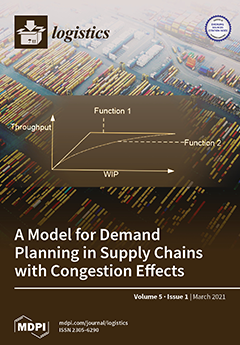
Cover Story: The predominant software system used for production planning is Materials Requirements Planning (MRP-II). The main problem in MRP-II is that the lead time for internal or external procurement is assumed constant. However, it is well known from queuing theory that lead time is based on resource load. This is particularly true in complex systems such as electronics manufacturing or aerospace machining, in which production times depend on probabilities. A unique contribution of this paper is that it demonstrates how to model congestion and load-dependent lead times through recipes, an aspect overlooked previously in the literature. The key takeaway from this paper is that it demonstrates how enterprise resource planning (ERP) systems can be modified to move away from fixed lead times toward load-dependent lead times. This is an important contribution with very interesting possibilities for supply chain practice. View this paper
  • Issues are regarded as officially published after their release is announced to the table of contents alert mailing list .
  • You may sign up for email alerts to receive table of contents of newly released issues.
  • PDF is the official format for papers published in both, html and pdf forms. To view the papers in pdf format, click on the "PDF Full-text" link, and use the free Adobe Reader to open them.

Articles (18)

  • Article
  • Open Access
15 Citations
7,038 Views
12 Pages

For decades, trade between Europe and China has grown consistently, which has resulted in increased container transportation volumes. Such transportation has been dominated by sea-based options. However, over the years, an air-based mode of transport...

  • Article
  • Open Access
40 Citations
22,302 Views
16 Pages

Impact of E-Procurement Adoption on Company Performance: Evidence from Indonesian Manufacturing Industry

  • Ilyas Masudin,
  • Ganis Dwi Aprilia,
  • Adhi Nugraha and
  • Dian Palupi Restuputri

This study was conducted to determine the performance impact of e-procurement adoption in Indonesian manufacturing companies. This study consists of four variables: top management support, information quality, implementation of e-procurement, and com...

  • Article
  • Open Access
21 Citations
7,529 Views
9 Pages

Measuring Disruptions in Last-Mile Delivery Operations

  • Andrés Muñoz-Villamizar,
  • Elyn L. Solano-Charris,
  • Lorena Reyes-Rubiano and
  • Javier Faulin

The rapid growth of urbanisation and e-commerce has increased the number of home deliveries that need to be made in retail operations. Consequently, there is also an increase in unexpected incidents, such as adverse traffic, unavailability of parking...

  • Article
  • Open Access
8 Citations
4,342 Views
16 Pages

The importance of considering forward and backward flows simultaneously in supply chain networks spurs an interest to develop closed-loop supply chain networks (CLSCN). Due to the expanded scope in the supply chain, designing CLSCN often faces signif...

  • Article
  • Open Access
26 Citations
6,442 Views
16 Pages

In the last decade, the Industry 4.0 concept has introduced automation and cyber-physical systems as the core elements of future logistics, supported by an array of technologies, such as augmented reality (AR) providing the necessary support for the...

  • Article
  • Open Access
16 Citations
7,541 Views
17 Pages

Supplier Selection Risk: A New Computer-Based Decision-Making System with Fuzzy Extended AHP

  • Marcus V. C. Fagundes,
  • Bernd Hellingrath and
  • Francisco G. M. Freires

Supplier risks have attracted significant attention in the supply chain risk management literature. In this article, we propose a new computational system based on the ‘Fuzzy Extended Analytic Hierarchy Process (FEAHP)’ method for supplier selection...

  • Article
  • Open Access
40 Citations
24,081 Views
21 Pages

28 February 2021

Health supply chains aim to improve access to healthcare, and this can be attained only when health commodities appropriate to the health needs of the global population are developed, manufactured, and made available when and where needed. The weak l...

  • Review
  • Open Access
10 Citations
7,551 Views
17 Pages

A Critical Review of a Holistic Model Used for Assessing Multimodal Transport Systems

  • Anthony K. C. Beresford,
  • Ruth Banomyong and
  • Stephen Pettit

26 February 2021

The purpose of this paper is to present a rigorous and critical review of an established cost/time-distance model. The model offers a perspective on the inter-relationships between transport modes, nodes, methods and cargo volumes, types and forms. O...

  • Article
  • Open Access
17 Citations
6,346 Views
18 Pages

Rolling Cargo Management Using a Deep Reinforcement Learning Approach

  • Rachid Oucheikh,
  • Tuwe Löfström,
  • Ernst Ahlberg and
  • Lars Carlsson

8 February 2021

Loading and unloading rolling cargo in roll-on/roll-off are important and very recurrent operations in maritime logistics. In this paper, we apply state-of-the-art deep reinforcement learning algorithms to automate these operations in a complex and r...

  • Article
  • Open Access
10 Citations
6,222 Views
16 Pages

Prioritized Solutions for Overcoming Barriers When Implementing Lean in the Healthcare Supply Chain: A Saudi Perspective

  • Abdulaziz M. Almutairi,
  • Mohammed Almanei,
  • Ahmed Al-Ashaab and
  • Konstantinos Salonitis

The main purpose of this paper is to propose solutions for overcoming the obstacles that healthcare organizations might face when implementing lean. An in-depth review of existing barriers for lean implementation in healthcare supply chain is present...

  • Feature Paper
  • Review
  • Open Access
8 Citations
7,180 Views
9 Pages

Cash Flow Bullwhip—Literature Review and Research Perspectives

  • Hicham Lamzaouek,
  • Hicham Drissi and
  • Naima El Haoud

The bullwhip effect is a pervasive phenomenon in all supply chains causing excessive inventory, delivery delays, deterioration of customer service, and high costs. Some researchers have studied this phenomenon from a financial perspective by shedding...

  • Article
  • Open Access
39 Citations
12,921 Views
22 Pages

In early 2020, COVID-19 infected people throughout the world and brought world commerce to a standstill. Many believe that governments and global businesses were not as prepared as they should have been. While academics have occasionally predicted th...

  • Article
  • Open Access
1 Citations
3,629 Views
19 Pages

The article presents the first theoretical and empirical estimation of the role of logistics in mitigating the effects of market information asymmetry in Poland. Following a review of international (Akerlof, Spencer, Stiglitz) and Polish literature (...

  • Article
  • Open Access
25 Citations
9,361 Views
14 Pages

Globalization has led to a significant effect on today’s manufacturing sector. Manufacturers need to find new and innovative ways to increase efficiency and reduce waste in the manufacturing supply chain. Lean/six sigma tools can help companies...

  • Article
  • Open Access
1 Citations
5,031 Views
24 Pages

A Model for Demand Planning in Supply Chains with Congestion Effects

  • Uday Venkatadri,
  • Shentao Wang and
  • Ashok Srinivasan

This paper is concerned with demand planning for internal supply chains consisting of workstations, production facilities, warehouses, and transportation links. We address the issue of how to help a supplier firmly accept orders and subsequently plan...

  • Article
  • Open Access
154 Citations
31,282 Views
19 Pages

Food Logistics 4.0: Opportunities and Challenges

  • Sandeep Jagtap,
  • Farah Bader,
  • Guillermo Garcia-Garcia,
  • Hana Trollman,
  • Tobi Fadiji and
  • Konstantinos Salonitis

30 December 2020

Food Logistics 4.0 is a term derived from Industry 4.0 focusing on all the aspects of food logistics management based on cyber-physical systems. It states that real-time information and the interconnectivity of things, supplemented with novel technol...

  • Article
  • Open Access
8 Citations
8,371 Views
15 Pages

28 December 2020

The calculation of lashing forces on containerships is one of the most important aspects in terms of cargo safety, as well as slot utilization, especially for large containerships such as more than 10,000 TEU (Twenty-foot Equivalent Unit). It is a ch...

XFacebookLinkedIn
Logistics - ISSN 2305-6290