Comparative Study of Key Aroma Components in Rice of Different Aroma Types Using Flavor Metabolomics


Abstract
1. Introduction
2. Materials and Methods
2.1. Chemicals and Reagents
2.2. Sample Collection
2.3. Sensory Evaluation of Rice Flavor
2.4. Flavor Metabolomic Analysis by HS-SPME-GC-MS
2.4.1. Metabolite Extraction
2.4.2. GC-MS Analysis
2.4.3. Calculation of Relative Odor Activity Value
2.5. GC-IMS Analysis
2.6. Statistical Analysis
3. Results
3.1. Sensory Evaluation and Aroma Classification of Rice
3.2. Analysis of Volatile Aroma Compounds in Different Rice Aromas Based on HS-SPME-GC-MS
3.2.1. VOCs in Rice with Different Aroma Types
3.2.2. Analysis of the Differential Volatile Profiling of Three Rice Cultivars
3.3. Analysis of Volatile Odor Components of Rice by GC-IMS Spectroscopy
3.3.1. Volatile Compounds Identified by GC-IMS
3.3.2. Differential Analysis of Volatile Compounds Based on GC-IMS
3.4. Comparison of Different Volatile Compounds in Rice with Different Aroma Type Based on HS-SPME-GC-MS and GC-IMS
4. Discussion
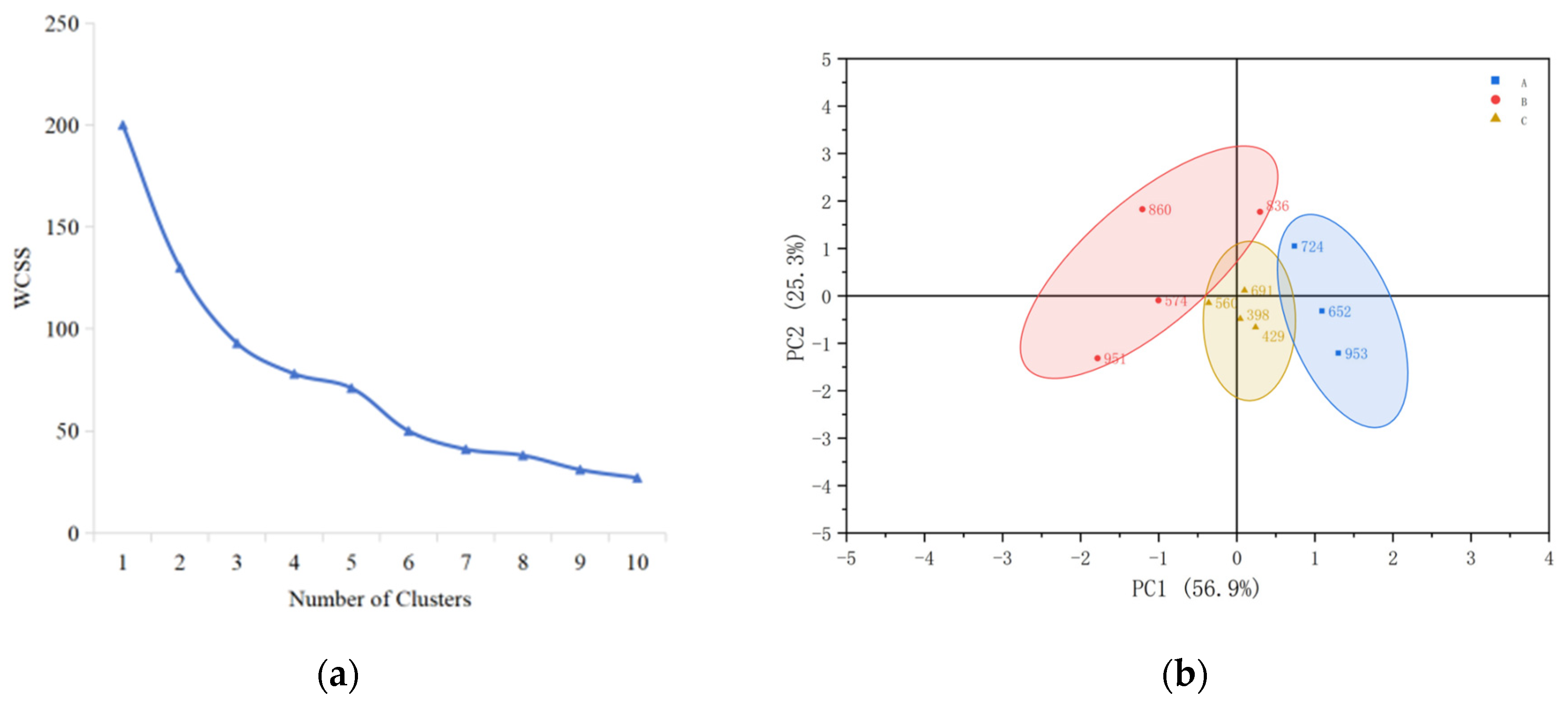
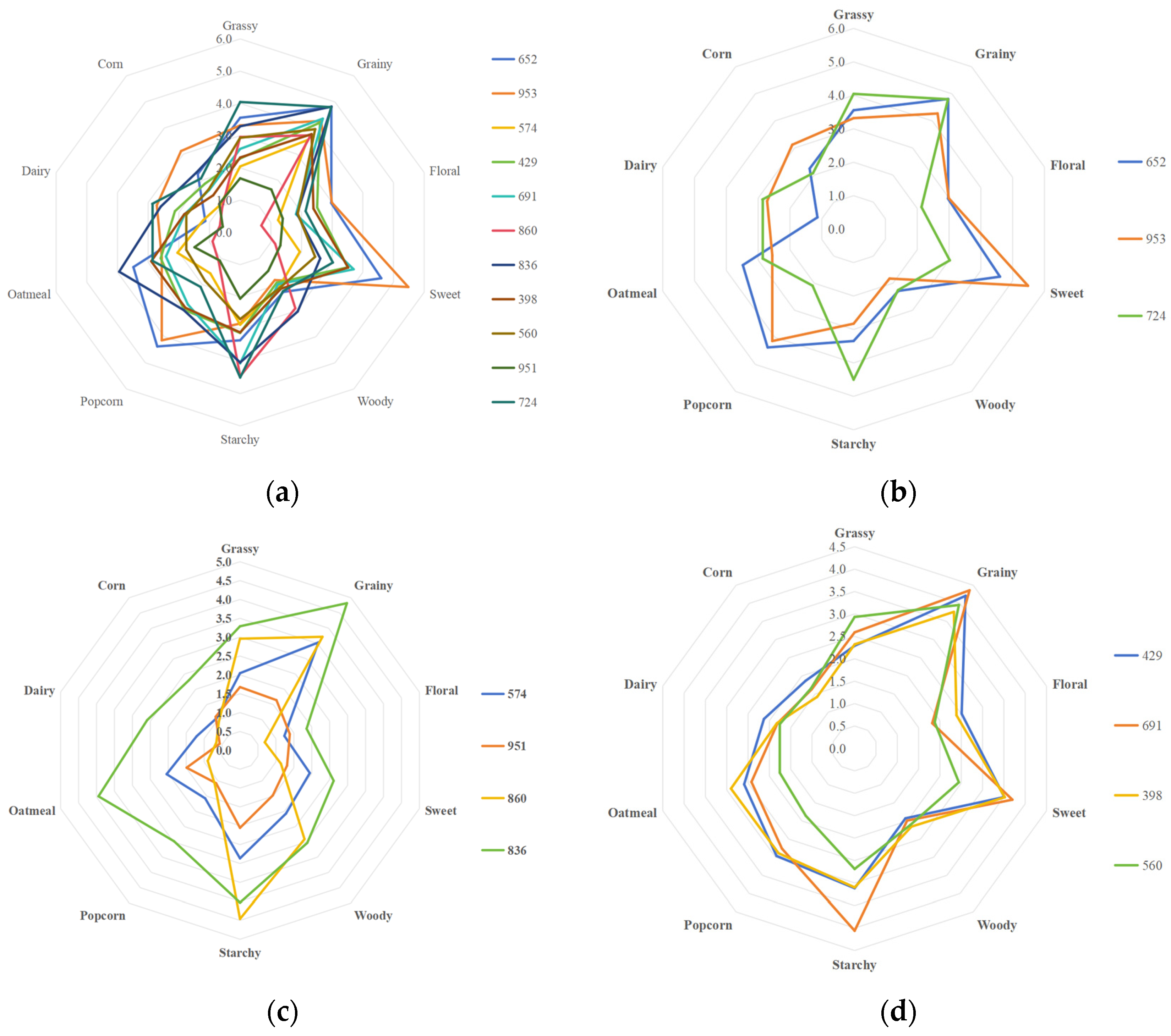
- Feasibility of distinguishing rice aromas based on sensory evaluation: Cluster analysis based on sensory evaluation data categorized rice aromas into three types: sweet aroma type (A), cereal aroma type (B), and complex aroma type (C). Type A exhibited a prominent sweet and popcorn aroma, type B exhibited a more prominent grainy and starchy aroma, and type C exhibited a more complex aroma.
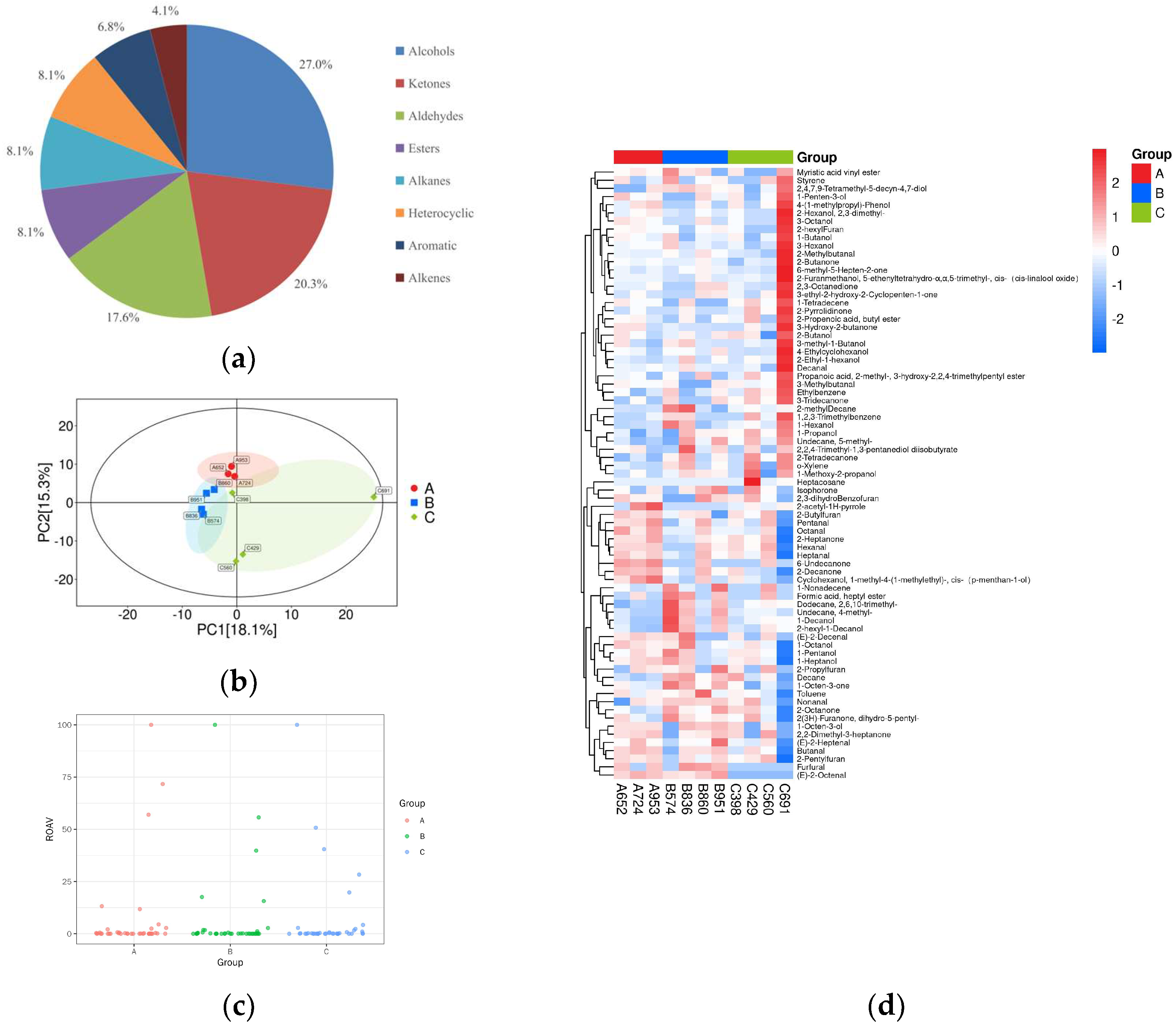
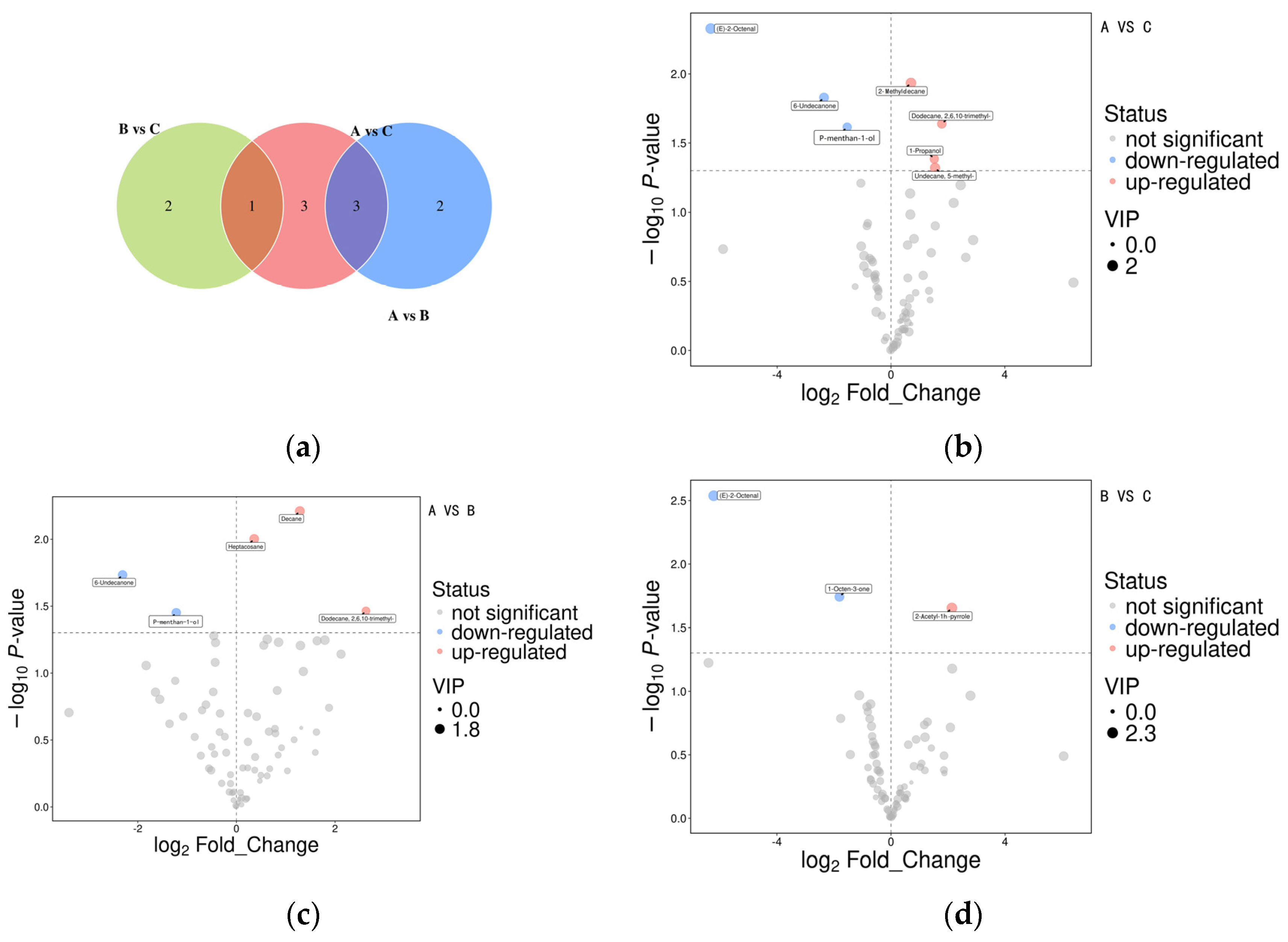
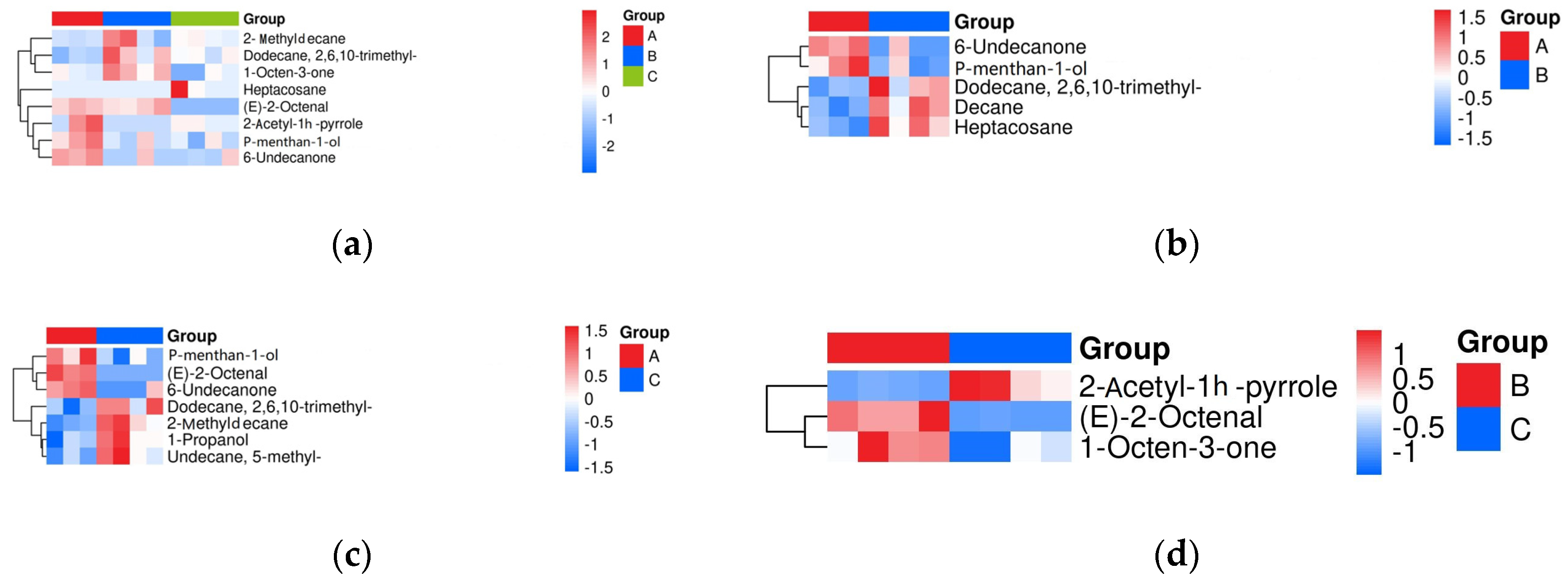
- Nontargeted metabolomics analysis using HS-SPME-GC-MS: The findings revealed the diversity and differences in volatile components of rice with different aroma types. A total of 74 volatile compounds were identified and classified into three aroma types through PCA, consistent with the sensory results. In the A versus B versus C comparison group, 8 major differential aroma compounds were identified, primarily including alkanes, aldehydes, ketones, alcohols, and heterocyclic compounds. (E)-2-Octenal, 6-Undecanone, 2-Acetyl-1h-pyrrole, and P-menthan-1-ol in type A gave it a better sweet aroma, Dodecane, 2,6,10-trimethyl-, 1-Octen-3-one, and 2-Methyldecane in type B gave it a better starchy and cereal flavor. 2-Acetyl-1h-pyrrole, Heptacosane, and 1-Propanol in type C contributed to a complex aroma.
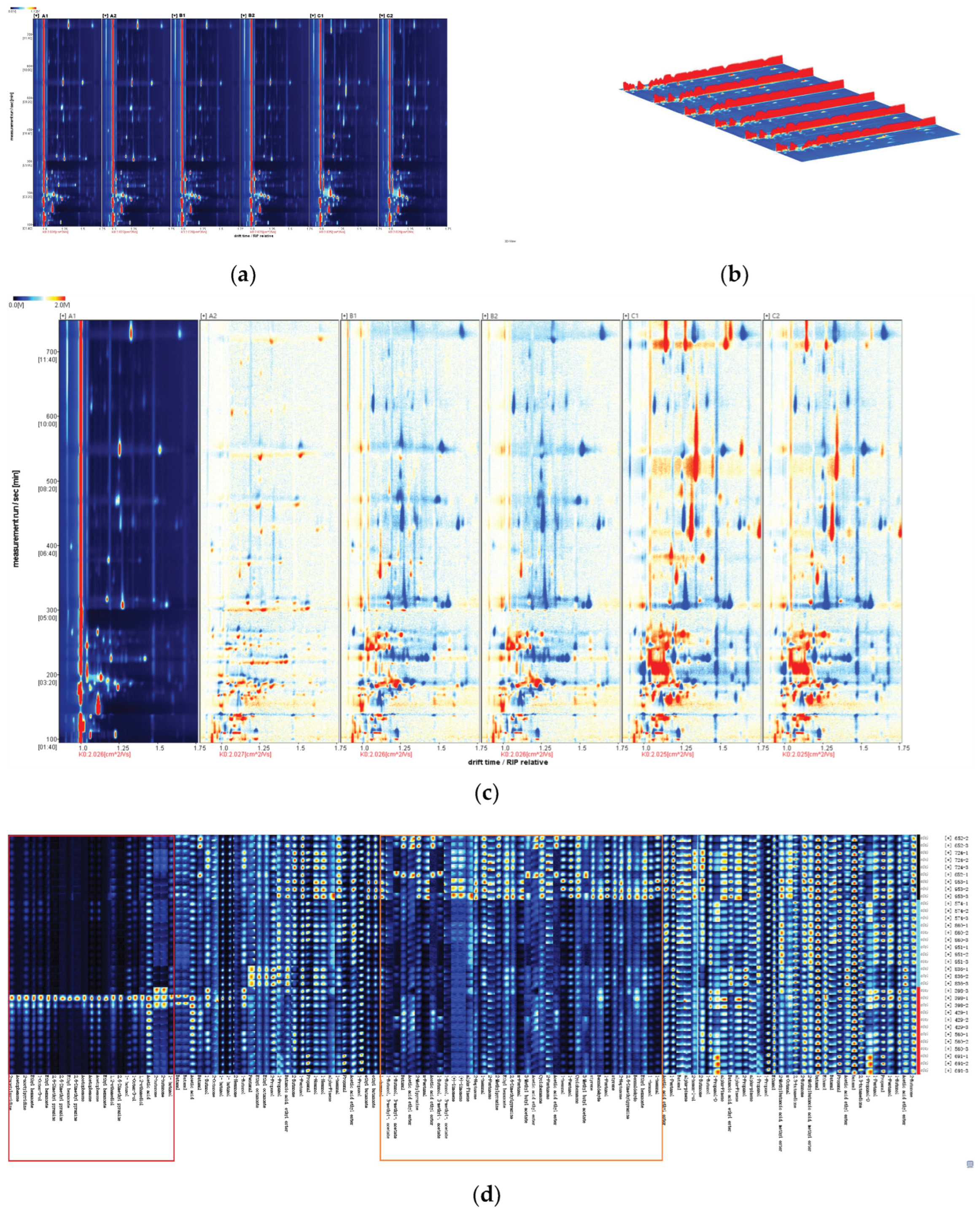
- GC-IMS analysis: The results revealed the diversity and differences in volatile components of rice with different aroma types. The fingerprints of rice samples with different aroma types showed significant differences. Compared with aroma type A, aroma type C was stronger and aroma type B was milder and more balanced, consistent with the results of sensory evaluation and flavor metabolomics. Samples of aroma type A contained (+)-limonene, 2-methylpyrazine, 2-pentanone, ethyl butanoate, n-pentanal, styrene, 1-butanol, 3-methyl-, acetate, 1-hexanal, 1-pentanol, and 2-heptanone, contributing to a more sweet aroma. Samples of aroma type C contained 1-octen-3-ol, 2,6-dimethyl pyrazine, 2-acetylpyridine, and ethyl hexanoate, contributing to a more complex aroma. The volatile aroma compounds in aroma type B fell between those in aroma types A and C, with no significant standout characteristics, consistent with the results of sensory evaluation and flavor metabolomics.
Author Contributions
Funding
Institutional Review Board Statement
Informed Consent Statement
Data Availability Statement
Acknowledgments
Conflicts of Interest
Abbreviations
| VOCs | Volatile organic compounds |
| HS-SPME-GC-MS | Headspace solid-phase microextraction gas chromatography mass spectrometry |
| HS-GC-IMS | Headspace gas chromatography-ion mobility spectrometry |
| GC-O | Gas chromatography-olfactometry |
| RI | Retention index |
| ROAV | Relative odor activity value |
| PCA | Principal component analysis |
| ANOVA | Analysis of variance |
| OPLS-DA | Orthogonal Partial Least Squares-Discriminant Analysis |
| VIP | Variable Importance in the Projection |
| RT | Retention time |
| QDA | Quantitative descriptive analysis |
| LAV | Laboratory Analysis View software |
References
- Verma, D.K.; Srivastav, P.P. A paradigm of volatile aroma compounds in rice and their product with extraction and identification methods: A comprehensive review. Food Res. Int. 2020, 130, 108924. [Google Scholar] [CrossRef] [PubMed]
- Murtaza, G.; Huma, N.; Sharif, M.K.; Zia, M.A. Probing a best suited brown rice cultivar for the development of extrudates with special reference to Physico-Chemical, microstructure and sensory evaluation. Food Sci. Technol. 2022, 42, e103521. [Google Scholar] [CrossRef]
- Molina, J.; Sikora, M.; Garud, N.; Flowers, J.M.; Rubinstein, S.; Reynolds, A.; Huang, P.; Jackson, S.; Schaal, B.A. Molecular evidence for a single evolutionary origin of domesticated rice. Proc. Natl. Acad. Sci. USA 2011, 108, 8351–8356. [Google Scholar] [CrossRef] [PubMed]
- Huang, X.; Kurata, N.; Wang, Z.X.; Wang, A.; Zhao, Q.; Zhao, Y.; Lu, Y. A map of rice genome variation reveals the origin of cultivated rice. Nature 2012, 490, 497–501. [Google Scholar] [CrossRef]
- Alvaro, D.M.; Willy, M. International Rice Outlook:International Rice Baseline Projections 2023–2033. AAES Res. Rep. 2024, 5, 1015. Available online: https://aaes.uada.edu/communications/publications/ (accessed on 12 October 2025).
- FAO. Food and Agriculture Organization. 2025. Available online: https://www.fao.org/worldfoodsituation/csdb/en?amp= (accessed on 12 October 2025).
- Zhang, X.; Dai, Z.; Fan, X.; Liu, M.; Ma, J.; Shang, W.; Zhou, Z. A study on volatile metabolites screening by HS-SPME-GC-MS and HS-GC-IMS for discrimination and characterization of white and yellowed rice. Cereal Chem. 2020, 97, 496–504. [Google Scholar] [CrossRef]
- Goodwin, H.L.; Koop, L.A.; Riste, M.E.; Miller, R.K.; Maca, J.V.; Chambers, E.; Hollingsworth, M.; Bett, K.; Webb, B.D.; McClung, A.M. Developing a common language for the U.S. rice industry: Linkages among breeders, producers, processors and consumers. In TAMRC Consumer Product Market Research; Texas A&M: College Station, TX, USA, 1996. [Google Scholar]
- Meullenet, J.F.; Marks, B.P.; Griftin, K.; Daniels, M.J. Effects of rough rice drying and storage conditions on sensory profiles of cooked rice. Cereal Chem. 1999, 76, 438–486. [Google Scholar] [CrossRef]
- Park, J.K.; Kim, S.S.; Kim, K.O. Effect of milling ratio on sensory properties of cooked rice and on physicochemical properties of milled and cooked rice. Cereal Chem. 2001, 78, 151–156. [Google Scholar] [CrossRef]
- Setyaningsih, W.; Majchrzak, T.; Dymerski, T.; Namiesnik, J.; Palma, M. Key-Marker volatile compounds in aromatic rice (Oryza sativa) grains: An HS-SPME extraction method combined with GCxGC-TOFMS. Molecules 2019, 24, 4180. [Google Scholar] [CrossRef]
- Lu, L.; Hu, Z.; Fang, C.; Hu, X. Characteristic Flavor Compounds and Functional Components of Fragrant Rice with Different Flavor Types. Foods 2023, 12, 2185. [Google Scholar] [CrossRef]
- Champagne, E.T. Rice aroma and flavor: A literature review. Cereal Chem. 2008, 85, 445–454. [Google Scholar] [CrossRef]
- Hu, X.; Lu, L.; Guo, Z.; Zhu, Z. Volatile compounds, affecting factors and evaluation methods for rice aroma: A review. Trends Food Sci. Technol. 2020, 97, 136–146. [Google Scholar] [CrossRef]
- Yang, D.S.; Lee, K.S.; Jeong, O.Y.; Kim, K.J.; Kays, S.J. Characterization of volatile aroma compounds in cooked black rice. J. Agric. Food Chem. 2008, 56, 235–240. [Google Scholar] [CrossRef] [PubMed]
- Hoffmann, J.F.; Bassinello, P.Z.; Colombari Filho, J.M.; Lindemann, I.S.; Elias, M.C.; Takeoka, G.R.; Vanier, N.L. Volatile compounds profile of Brazilianaromatic brown rice genotypes and its cooking quality characteristics. Cereal Chem. 2018, 96, 292–301. [Google Scholar] [CrossRef]
- Zheng, X.Z.; Lan, Y.B.; Zhu, J.M.; Westbrook, J.; Hoffmann, W.C.; Lacey, R.E. Rapid identification of rice samples using an electronic nose. J. Bionic Eng. 2009, 6, 290–297. [Google Scholar] [CrossRef]
- Wakte, K.; Zanan, R.; Hinge, V.; Khandagale, K.; Nadaf, A.; Henry, R. Thirty-three years of 2-acetvl-1-pyrroline, a principal basmati aroma compound in scented rice (Oryza sation L.): A status review. Sci. Food Agric. 2017, 97, 384–395. [Google Scholar] [CrossRef]
- Zhou, Y.; Gao, S.; Wei, J.; Chen, X.; Zhu, S.; Zhou, X. Systematical construction of rice flavor types based on HS-SPME-GC–MS and sensory evaluation. Food Chem. 2023, 413, 135604. [Google Scholar] [CrossRef]
- Griglione, A.; Liberto, E.; Cordero, C.; Bressanello, D.; Cagliero, C.; Rubiolo, P.; Bicchi, C.; Sgorbini, B. High-quality ltalian rice cultivars: Chemical indices of ageing and aroma quality. Food Chem. 2015, 172, 305–313. [Google Scholar] [CrossRef]
- Buttery, R.G.; Ling, L.C. 2-Acetyl-1-pyrroline: An important aroma component of cooked rice. Chem. Ind. 1982, 958–959. [Google Scholar]
- Routray, W.; Rayaguru, K. 2-Acetyl-1-pyrroline:key aroma component of aromatic rice and other food products. Food Rev. Int. 2018, 34, 539–565. [Google Scholar] [CrossRef]
- Dias, L.G.; Duarte, G.H.B.; Mariutti, L.R.B.; Bragagnolo, N. Aroma profile of rice varieties by a novel SPME method able to maximize 2-acetyl-1-pyrroline and minimize hexanal extraction. Food Res. Int. 2019, 123, 550–558. [Google Scholar] [CrossRef]
- Pal, S.; Bagchi, T.B.; Dhali, K.; Kar, A.; Sanghamitra, P.; Sarkar, S.; Majumder, J. Evaluation of sensory, physicochemical properties and Consumer preferenceof black rice and their products. J. Food Sci. Technol. 2019, 56, 1484–1494. [Google Scholar] [CrossRef] [PubMed]
- Lee, Y.S.; Oh, Y.; Kim, T.H.; Cho, Y.H. Quantitation of 2-acetyl-1-pyrroline inaseptic-packaged cooked fragrant rice by HS-SPME/GC-MS. Food Sci. Nutr. 2019, 7, 266–272. [Google Scholar] [CrossRef] [PubMed]
- Dong, S.Y.; Robert, L.; Shewfelt, K.-S.L.; Stanley, J.; Kays, J. Comparison of odor-active compounds from six distinctly different fice flavor types. Agric. Food Chem. 2008, 56, 2780–2787. [Google Scholar] [CrossRef]
- GB/T 16291.1-2012; Sensory Analysis—General Guidance for the Selection, Training and Monitoring of Assessors—Part 1: Selected Assessors. Standards Press of China: Beijing, China, 2012.
- Brown, M.D.; Chambers, D.H. Sensory characteristics and comparison of commercial plain yogurts and 2 new production sample options. J. Food Sci. 2015, 80, S2957–S2969. [Google Scholar] [CrossRef]
- Guo, F.; Ma, M.J.; Yu, M.; Bian, Q.; Hui, J.; Pan, X.; Su, X.X.; Wu, J.H. Classification of Chinese fragrant rapeseed oil based on sensory evaluation and gas chromatography-olfactometry. Front. Nutr. 2022, 9, 945144. [Google Scholar] [CrossRef]
- Guan, L.; Mi, Y.; Zhang, M.; Li, S.; Ye, G. Construction of aroma association network of cooked rice based on gas chromatography–mass spectrometry (GC–MS) and sensory analysis. Flavour. Fragr. J. 2024, 39, 45–57. [Google Scholar] [CrossRef]
- Zeng, H.; Han, H.; Huang, Y.; Wang, B. Rapid prediction of the aroma type of plain yogurts via electronic nose combined with machine learning approaches. Food Biosci. 2023, 56, 103269. [Google Scholar] [CrossRef]
- Kind, T.; Wohlgemuth, G.; Lee, D.Y. FiehnLib: Mass spectral and retention index libraries for metabolomics based on quadrupole and time-of-flight gas chromatography/mass spectrometry. Anal Chem. 2009, 81, 10038–10048. [Google Scholar] [CrossRef]
- Ye, G.; Guan, L.; Zhang, M.; Li, S.; Mi, Y. Study on the correlation between aroma compounds and texture of cooked rice: A case study of 15 Japonica rice species from Northeast China. Cereal Chem. 2025, 102, 167–180. [Google Scholar] [CrossRef]
- Xiao, Y.; Huang, Y.; Chen, Y.; Xiao, L.; Zhang, X.; Yang, C.; Wang, Y. Discrimination and characterization of the volatile profiles of five Fu brick teas from different manufacturing regions by using HS–SPME/GC–MS and HS–GC–IMS. Curr. Res. Food Sci. 2022, 5, 1788–1807. [Google Scholar] [CrossRef]
- Gemert, L.J.V. Compilations of Odour Threshold Values in Air, Water and Other Media; Oliemans Punter: Zeist, The Netherlands, 2003. [Google Scholar]
- Fan, Y.; Liu, W.; Xu, F.; Huang, Y.; Zhang, N.; Li, K.; Hu, H.; Zhang, H. Comparative flavor analysis of eight varieties of Xinjiang flatbreads from the Xinjiang Region of China. Cereal Chem. 2019, 96, 1022–1035. [Google Scholar] [CrossRef]
- Liu, D.Y.; Bai, L.; Feng, X.; Chen, Y.P.; Zhang, D.; Yao, W.S. Characterization of Jinhua ham aroma profiles in specific to aging time by gas chromatography-ion mobility spectrometry (GC-IMS). Meat Sci. 2020, 168, 108178. [Google Scholar] [CrossRef] [PubMed]
- Sailimuhan, A.; Ren, X.; Zhang, M.; Tuohetisayipu, T.; Li, S.; Wang, Z.; Liang, S.; Wang, Z. Characterization of japonica rice aroma profiles during in vitro mastication by gas chromatography-ion mobility spectrometry (GC-IMS) and electronic nose technology. Int. J. Food Eng. 2022, 18, 679–688. [Google Scholar]
- Zhou, C.G.; Tan, Y.Y.; Gossner, S.; Li, Y.F.; Shu, Q.Y.; Engel, K.H. Impact of Crossing Parent and Environment on the Metabolite Profiles of Progenies Generated from a Low Phytic Acid Rice (Oryza sativa L.) Mutant. J. Agric. Food Chem. 2019, 67, 2396–2407. [Google Scholar] [CrossRef]
- Ajarayasiri, J.; Chaiseri, S. Comparative study on aroma-active compounds in Thai, black and white glutinous rice varieties. Kasetsart J. Nat. Sci. 2008, 42, 715–722. [Google Scholar]
- Cho, S.; Kays, S.J. Aroma-active compounds of wild rice (Zizania palustris L.). Food Res. Int. 2013, 54, 1463–1470. [Google Scholar] [CrossRef]
- Hinge, V.; Patil, H.; Nadaf, A. Aroma volatile analyses and 2AP characterization at various developmental stages in Basmati and Non-Basmati scented rice (Oryza sativa L.) cultivars. Rice 2016, 9, 38. [Google Scholar] [CrossRef]
- Jezussek, M.; Juliano, B.O.; Schieberle, P. Comparison of key aroma compounds in cooked brown rice varieties based on aroma extract dilution analyses. J. Agric. Food Chem. 2002, 50, 1101–1105. [Google Scholar] [CrossRef]
- Limpawattana, M.; Yang, D.S.; Kays, S.J.; Shewfelt, R.L. Relating sensory descriptors to volatile components in flavor of specialty rice types. J. Food Sci. 2008, 73, 456–461. [Google Scholar] [CrossRef]
- Mahattanatawee, K.; Rouseff, R.L. Comparison of aroma active and sulfur volatiles in three fragrant rice cultivars using GC-Olfactometry and GC-PFPD. Food Chem. 2014, 154, 1–6. [Google Scholar] [CrossRef]
- Maraval, I.; Mestres, C.; Pernin, K.; Ribeyre, F.; Boulanger, R.; Guichard, E.; Gunata, Z. Odor-active compounds in cooked rice cultivars from Camargue (France) analyzed by GC-O and GC-MS. J. Agric. Food Chem. 2008, 56, 5291–5298. [Google Scholar] [CrossRef]
- Park, J.S.; Kim, K.Y.; Baek, H.H. Potent aroma-active compounds of cooked Korean non-aromatic rice. Food Sci. Biotechnol. 2010, 19, 1403–1407. [Google Scholar] [CrossRef]
- Zhao, Q.; Xue, Y.; Shen, Q. Changes in the major aroma-active compounds and taste components of Jasmine rice during storage. Food Res. Int. 2020, 133, 109160. [Google Scholar] [CrossRef] [PubMed]
- Dias, L.G.; Hacke, A.; Bergara, S.F.; Villela, O.V.; Mariutti, L.R.B.; Bragagnolo, N. Identification of volatiles and odor-active compounds of aromatic rice by OSME analysis and SPME/GC-MS. Food Res. Int. 2021, 142, 110206. [Google Scholar] [CrossRef] [PubMed]
- Zheng, Z.; Zhang, C.; Liu, K.; Liu, Q. Volatile Organic Compounds, Evaluation Methods and rocessing Properties for Cooked Rice Flavor. Rice 2022, 15, 53. [Google Scholar] [CrossRef]
- Nishant, G.; Mansi, G.; Devansh, B.; Neelansh, G.; Rudraksh, T.; Apuroop, S.; Ganesh, B. FlavorDB2: An Updated Database of Flavor Molecules. J. Food Sci. 2024, 89, 7076–7082. [Google Scholar] [CrossRef]
- Li, W.; Chen, Y.P.; Blank, I.; Li, F.; Li, C.; Liu, Y. GC × GC-ToF-MS and GC-IMS based volatile profile characterization of the Chinese dry-cured hams from different regions. Food Res. Int. 2021, 142, 110222. [Google Scholar] [CrossRef]
- Guo, X.; Schwab, W.; Ho, C.T.; Song, C.; Wan, X. Characterization of the aroma profiles of oolong tea made from three tea cultivars by both GC-MS and GC-IMS. Food Chem. 2022, 376, 131933. [Google Scholar] [CrossRef]
- Feng, H.; Timira, V.; Zhao, J.; Lin, H.; Wang, H.; Li, Z. Insight into the characterization of volatile compounds in smoke-flavored sea bass (lateolabrax maculatus) during processing via HS-SPME-GC-MS and HS-GC-IMS. Foods 2022, 11, 2614. [Google Scholar] [CrossRef]
- Yang, X.; Chen, Q.; Liu, S.; Hong, P.; Zhou, C.; Zhong, S. Characterization of the effect of different cooking methods on volatile compounds in fish cakes using a combination of GC-MS and GC-IMS. Food Chem. 2024, 22, 101291. [Google Scholar] [CrossRef]
- Zhao, Q.; Xi, J.; Xu, D.; Jin, Y.; Wua, F.; Tong, Q.; Yin, Y.; Xu, X. A comparative HS-SPME/GC-MS-based metabolomics approach for discriminating selected japonica rice varieties from different regions of China in raw and cooked form. Food Chem. 2022, 385, 132701. [Google Scholar] [CrossRef] [PubMed]
- Xiong, Y.; Zheng, X.; Tian, X.; Wang, C.; Chen, J.; Zhou, L.; Xu, D.; Wang, J.; Gilard, V.; Wu, M.; et al. Comparative study of volatile organic compound profiles in aromatic and non-aromatic rice cultivars using HS-GC-IMS and their correlation with sensory evaluation. LWT Food Sci. Technol. 2024, 203, 116321. [Google Scholar] [CrossRef]
- Widjaja, R.; Craske, J.D.; Wootton, M. Comparative studies on volatile components of non-fragrant and fragrant rice. J. Sci. Food Agric. 1996, 70, 151–161. [Google Scholar] [CrossRef]
- Bryant, R.J.; Mcclung, A.M. Volatile profiles of aromatic and nonaromatic rice cultivars using SPME/GC-MS. Food Chem. 2010, 124, 501–513. [Google Scholar] [CrossRef]
- Monsoor, M.A.; Proctor, A. Volatile component analysis of commercially milled head and broken rice. J. Food Sci. 2004, 69, 632–636. [Google Scholar] [CrossRef]
- Bi, X.; Asimi, S.; Zhang, M.; Zhou, Q.; Yang, Z.S. Effects of fatty acids on taste quality of cooked rice. Food Sci. 2019, 40, 8–14. [Google Scholar]
- Verma, D.K.; Mahato, D.K.; Srivastav, P.P. Simultaneous distillation extraction (SDE): A traditional method for extraction of aroma chemicals in rice. In Science and Technology of Aroma, Flavor, and Fragrance in Rice. Science and Technology of Aroma, Flavor, and Fragrance in Rice, 1st ed.; Apple Academic Press: Palm Bay, FL, USA, 2018. [Google Scholar]
- Wang, Z.Y.; Su, H.M.; Bi, X.; Zhang, M. Effect of fragmentation degree on sensory and texture attributes of cooked rice. J. Food Process Preserv. 2019, 43, e13920. [Google Scholar] [CrossRef]
- Matsui, K.; Sasahara, S.; Akakabe, Y.; Kajiwara, T. Linoleic Acid 10-Hydroperoxide as an Intermediate during Formation of 1-Octen-3-ol from Linoleic Acid in Lentinus decadetes. Biosci. Biotechnol. Biochem. 2003, 67, 2280–2282. [Google Scholar] [CrossRef]
- Choi, S.; Seo, H.S.; Lee, K.R.; Lee, S.; Lee, J. Effect of milling degrees on volatile profiles of raw and cooked black rice (Oryza sativa L. Cv. Sintoheugmi). Appl. Biol. Chem. 2018, 61, 91–105. [Google Scholar] [CrossRef]
- Bullard, R.W.; Holguin, G. Volatile components of unprocessed rice (Oryza sativa L.). J. Agric. Food Chem. 1977, 25, 99–103. [Google Scholar] [CrossRef]
- Cao, Y.; Xie, G.; Wu, C.; Lu, J. A study on characteristic flavor compounds in traditional chinese rice wine-guyue longshan rice wine. J. Inst. Brewing. 2010, 116, 182–189. [Google Scholar] [CrossRef]
- Liu, J.; Tang, X.; Zhang, Y.; Zhao, W. Determination of the volatile composition in brown millet, milled millet and millet bran by gas chromatography/mass spectrometry. Molecules 2012, 17, 2271–2282. [Google Scholar] [CrossRef]
- Izumi, Y.A.; Tetsuya, Y.A.; Mikio, N.; Hidemasa, S.; Tsutomu, H. Volatile Flavor Components of Cooked Rice. Agric. Biol. Chem. 1978, 42, 1229–1233. [Google Scholar]
- Zhao, Q.Y.; Xi, J.Z.; Xu, X.M.; Yin, Y.; Xu, D.; Jin, Y.M.; Wu, F.F. Volatile fingerprints and biomarkers of Chinese fragrant and non-fragrant japonica rice before and after cooking obtained by untargeted GC/MS-based metabolomics. Food Biosci. 2022, 47, 101764. [Google Scholar] [CrossRef]
- GB/T 15682-2008; Inspection of Grain and Oils-Method for Sensory Evaluation of Paddy or Rice Cooking and Eating Quality. Standards Press of China: Beijing, China, 2008.



| No. | 652 | 953 | 574 | 429 | 691 | 724 | 860 | 836 | 398 | 560 | 951 |
|---|---|---|---|---|---|---|---|---|---|---|---|
| varieties | Nanjing46 | Daohuaxiang | Kongyu131 | Suijing18 | jasmine rice | Longyang16 | Suxiu | Taixiangjing1402 | Jihong6 | Ningxiangjing9 | Zhongkefa5 |
| Descriptor | Definition | Reference Substance |
|---|---|---|
| Starchy | Aroma of bread and flour | Boiled starch:water (1:5) and cool |
| Grainy | a flavor reminiscent of raw grain | 28 mg/kg Butyraldehyde |
| Floral | The smell produced by a non-specific type of flower | 1600 mg/kg phenethyl alcohol |
| Popcorn | aroma of popcorn | 1300 mg/kg 2-Acetyl-1-pyrrolidine |
| Sweet | aroma of Demerara sugar | 255 mg/kg 4-Hydroxy-2,5-dimethylfuran-3-one |
| Grassy | A green, slightly earthy, and slightly sweet flavor | 26.3 mg/kg 1-Octanol |
| Woody | aroma of the dry, freshly cut wood smell | Toothpick |
| Oatmeal | aroma of cooked oatmeal | Quaker Oatmeal (Quaker, London, UK) |
| Dairy | aroma of uncooked milk | High-quality 2% Brand pasteurized milk |
| Corn | aroma of canned creamed corn | Cream Style Sweet Corn |
| No. | Volatile Compounds | RI | Formula | CAS | Category | Odor Description 1 | Odor Threshold 2 (μg/L) | Mean Content(μg/L) 3 ± Standard Deviation | ||
|---|---|---|---|---|---|---|---|---|---|---|
| A | B | C | ||||||||
| 1 | Butanal | 884 | C4H8O | 123-72-8 | Aldehydes | Bready, Chocolate, Creamy, Pear, Vegetable, Fatty, Earthy, Woody, Pungent, Nutty, Wine-Like, Meaty, Spicy, Citrus, Herbaceous, Green, Apple, Floral, Musty, Cocoa, Fruity, Malty, Characteristic, Aldehyde Odor, Banana, Cocoa, Musty, Bready | 9.0 | 1.87 ± 0.16 | 1.17 ± 0.48 | 2.20 ± 2.10 |
| 2 | 2-Butanone | 898 | C4H8O | 78-93-3 | Ketones | Ethereal, Ether, Fruity, Acetone, Camphor, Acetone-Like Odor, Sweet, Pleasant, Pungent, Moderately Sharp, Mint- Or Acetone-Like Odor, Pleasant, Camphoraceous | 50,000.0 | 23.01 ± 2.21 | 17.87 ± 6.34 | 23.02 ± 12.50 |
| 3 | 2-Methylbutanal | 907 | C5H10O | 96-17-3 | Aldehydes | Musty, Coffee, Cocoa, Nutty, Almond, Fermented, Hazelnut, Malt, Malt, Burnt, Choking, Estery Apple, Fruity, Green Grass, Sour | 1.0 | 0.45 ± 0.03 | 0.42 ± 0.12 | 0.31 ± 0.09 |
| 4 | 3-Methylbutanal | 910 | C5H10O | 590-86-3 | Aldehydes | Peach, Sour, Ethereal, Fatty, Aldehydic, Apple-Like Odor, Powerful Penetrating, Acrid Odor, Almond, Cocoa, Cheese, Chocolate, Malty | n.f. | 7.57 ± 0.70 | 7.05 ± 3.64 | 6.08 ± 1.75 |
| 5 | Pentanal | 968 | C5H10O | 110-62-3 | Aldehydes | Bready, Fermented, Berry, Malt, Fruity, Nutty, Acrid, Almond, Bitter, Oil, Pungent, Aldehyde, Banana, Grass, Lower Aldehyde, Oily, Green, Beany, Berry, Coffee, Green, Fatty | 12.0 | 3.14 ± 0.87 | 1.66 ± 1.06 | 4.39 ± 4.48 |
| 6 | Decane | 1000 | C10H22 | 124-18-5 | Alkanes | Alkane | n.f. | 0.35 ± 0.10 | 0.67 ± 0.09 | 0.74 ± 0.39 |
| 7 | 2-Butanol | 1023 | C4H10O | 78-92-2 | Alcohols | Oily, Sweet, Wine, Apricot, Has A Strong Vinous Odor, Sweet, Wine Odor Liquid, Strong, Pleasant Odor, Fruit, Medicine, Alcoholic | 43,000.0 | 3.39 ± 0.91 | 2.84 ± 0.25 | 2.32 ± 1.87 |
| 8 | Toluene | 1029 | C7H8 | 108-88-3 | Aromatics | Paint, Sweet, Pungent, Benzene-Like Odor | 2140.0 | 14.78 ± 2.55 | 14.12 ± 6.70 | 12.95 ± 4.60 |
| 9 | 1-Propanol | 1035 | C3H8O | 71-23-8 | Alcohols | Alcoholic, Fermented, Alcohol, Musty, Fusel, Pungent, Peanut, Similar To Ethanol, Alcohol, Candy | 30,000.0 | 3.45 ± 2.14 | 3.97 ± 2.23 | 2.63 ± 0.63 |
| 10 | 2-Methyl-decane | 1053 | C11H24 | 6975-98-0 | Alkanes | —— | n.f. | 1.13 ± 0.18 | ND | 1.23 ± 0.44 |
| 11 | Undecane, 5-methyl- | 1064 | C12H26 | 1632-70-8 | Alkanes | —— | n.f. | 1.04 ± 0.60 | ND | 1.87 ± 0.40 |
| 12 | Hexanal | 1072 | C6H12O | 66-25-1 | Aldehydes | Leafy, Sweaty, Tallow, Fresh, Fatty, Fruity, Aldehydic, Green, Characteristic Fruity Odor (On Dilution), Strong, Green Grass Odor, Sharp, Aldehyde Odor, Apple, Fresh, Oil, Leaves, Vinous, Grassy | 4.0 | 307.27 ± 33.46 | ND | 356.20 ± 210.81 |
| 13 | Ethylbenzene | 1111 | C8H10 | 100-41-4 | Aromatics | Aromatic, Pungent, Sweet, Gasoline-Like | 140,000.0 | 1.95 ± 1.72 | ND | 3.28 ± 0.75 |
| 14 | o-Xylene | 1119 | C8H10 | 95-47-6 | Aromatics | Geranium, Sweet, Aromatic Odor | 50.0 | 1.20 ± 0.19 | 1.66 ± 0.57 | 1.13 ± 0.94 |
| 15 | 2-n-Butyl furan | 1122 | C8H12O | 4466-24-4 | Heterocyclic | Mild, Wine, Sweet, Fruity, Spicy, Wet Hay, Noncharacteristic, Weak | n.f. | 3.27 ± 0.45 | 1.66 ± 1.19 | 3.77 ± 2.58 |
| 16 | 1-Methoxy-2-propanol | 1125 | C4H10O2 | 107-98-2 | Alcohols | Weak Pleasant Odor, Mild, Ethereal Odor | 10,000.0 | 25.29 ± 6.71 | 29.70 ± 5.43 | 19.75 ± 16.89 |
| 17 | Dodecane, 2,6,10-trimethyl- | 1140 | C15H32 | 3891-98-3 | Alkanes | —— | n.f. | 0.78 ± 0.68 | 3.68 ± 1.73 | 1.82 ± 1.05 |
| 18 | 1-Butanol | 1144 | C4H10O | 71-36-3 | Alcohols | Oil, Vanilla, Fusel, Sweet, Balsam, Medicinal, Harsh Fusel Odor With Banana, Odor Similar To Amyl Alcohol, Rancid, Strong Characteristic, Mildly Alcoholic Odor, Wine, Floral, Fragrant, Fruity | 500.0 | 8.84 ± 1.40 | 16.62 ± 17.70 | 12.43 ± 7.10 |
| 19 | Undecane, 4-methyl- | 1147 | C12H26 | 2980-69-0 | Alkanes | —— | n.f. | 0.89 ± 0.31 | 2.40 ± 1.12 | 1.07 ± 0.59 |
| 20 | 3-Hexanol | 1157 | C6H14O | 623-37-0 | Alcohols | Alcoholic, Ether, Medicinal, Solvent, Spice, Wine | 820.0 | 2.27 ± 0.22 | 1.82 ± 1.10 | 1.52 ± 1.16 |
| 21 | 1-Penten-3-ol | 1158 | C5H10O | 616-25-1 | Alcohols | Butter, Pungent, Tropical, Horseradish, Green, Vegetable, Bitter, Fruity, Fish, Oxidized, Wet Earth, Burnt, Grass, Slightly Meaty, Mushroom | 400.0 | 13.77 ± 3.29 | 6.53 ± 6.55 | 8.30 ± 5.88 |
| 22 | 2-Propenoic acid, butyl ester | 1168 | C7H12O2 | 141-32-2 | Esters | Sharp, Fragrant, Biting Characteristic Odor, Fruity | n.f. | 0.99 ± 0.28 | 0.44 ± 0.51 | 0.78 ± 0.54 |
| 23 | 2-Heptanone | 1173 | C7H14O | 110-43-0 | Ketones | Coconut, Soap, Herbal, Sweet, Woody, Fruity, Spicy, Cinnamon, Banana, Blue Cheese, Fruit, Green, Nut, Musty, Peardrops, Soapy, Butter | 20.0 | 11.46 ± 2.37 | 6.79 ± 1.93 | 16.27 ± 14.37 |
| 24 | Heptanal | 1175 | C7H14O | 111-71-7 | Aldehydes | Citrus, Ozone, Herbal, Fresh, Wine-Lee, Rancid, Fatty, Aldehydic, Green, Pungent Odor, Penetrating Fruity Odor, Citrus, Nut, Heavy, Oily, Planty Green, Putty, Milky | 3.0 | 10.31 ± 1.32 | 6.63 ± 2.71 | 10.44 ± 5.17 |
| 25 | 1-Butanol, 3-methyl- | 1205 | C5H12O | 123-51-3 | Alcohols | Oil, Alcoholic, Burnt, Whiskey, Malt, Banana, Fusel, Fruity, Characteristic, Disagreeable, Burnt, Cocoa, Floral | 250.0 | 7.14 ± 3.52 | 7.45 ± 1.99 | 6.52 ± 0.87 |
| 26 | 2-Pentylfuran | 1222 | C9H14O | 3777-69-3 | Heterocyclic | Butter, Green Bean, Vegetable, Earthy, Beany, Fruity, Metallic, Green, Greenbean, Butter, Floral, Pungent, Sweet, Buttery, Caramel, Fishy, Roasted, Popcorn | 6.0 | 12.80 ± 1.44 | 8.50 ± 1.80 | 15.35 ± 9.76 |
| 27 | 1-Decanol | 1237 | C10H22O | 112-30-1 | Alcohols | Orange, Rose, Fat, Waxy, Fatty, Floral, Sweet, Clean, Watery, Fruity, Orange, Fat, Oil, Citrus, Soapy, Unripe Fruit | 6.0 | 0.58 ± 0.19 | 1.16 ± 0.56 | 0.65 ± 0.33 |
| 28 | Styrene | 1243 | C8H8 | 100-42-5 | Alkenes | Balsamic, Gasoline, Floral, Sweet, Balsam, Plastic, Aromatic, Sweet, Floral | 3.6 | 0.40 ± 0.39 | 1.19 ± 1.10 | 0.35 ± 0.45 |
| 29 | 1-Pentanol | 1248 | C5H12O | 71-41-0 | Alcohols | Oil, Balsamic, Vanilla, Fusel, Sweet, Fusel-Like, Fruit, Green, Pungent, Yeast, Fruit, Wax, Bread-Like | 120.0 | 34.45 ± 4.85 | 28.07 ± 10.62 | 36.50 ± 17.34 |
| 30 | 1,2,3-Trimethylbenzene, | 1266 | C9H12 | 526-73-8 | Aromatics | Distinctive, Aromatic Odor | n.f. | 0.08 ± 0.13 | 0.17 ± 0.20 | 0.22 ± 0.16 |
| 31 | 2-Hexanol, 2,3-dimethyl- | 1269 | C8H18O | 19550-03-9 | Alcohols | —— | n.f. | 0.61 ± 0.33 | 0.21 ± 0.19 | 0.36 ± 0.45 |
| 32 | 3-Hydroxy-2-butanone | 1271 | C4H8O2 | 513-86-0 | Ketones | Butter, Cream, Milky, Fatty, Creamy, Sweet, Dairy, Buttery, Bland, Woody, Yogurt Odor, Green Pepper, Fermented, Milky, Fatty | n.f. | 15.09 ± 9.24 | 4.89 ± 1.75 | 9.38 ± 6.60 |
| 33 | 1-Decanol, 2-hexyl- | 1272 | C16H34O | 2425-77-6 | Alcohols | —— | n.f. | 0.50 ± 0.15 | 0.96 ± 0.37 | 0.54 ± 0.34 |
| 34 | 2-Octanone | 1276 | C8H16O | 111-13-7 | Ketones | Natural, Earthy, Gasoline, Weedy, Herbal, Woody, Bitter, Soap, Fatty, Green Cheese Aroma, Floral, Bitter, Fruity (Unripe Apple), Pleasant, Fat, Fragrant, Mold, Butter, Herb, Resin, Floral, Ketone, Musty, Soapy | 41.0 | 17.01 ± 3.06 | 20.55 ± 3.75 | 22.08 ± 5.74 |
| 35 | Octanal | 1279 | C8H16O | 124-13-0 | Aldehydes | Lemon, Citrus, Soap, Orange Peel, Fat, Waxy, Fatty, Aldehydic, Green, Strong, Fruity Odor, Fatty, Honey Odor On Dilution, Pungent Odor, Citrus-Like On Dilution, Aldehyde, Fruity, Pungent, Slightly Fragment, Soapy, Fresh, Citrus-Like | 1.4 | 2.27 ± 0.43 | 1.33 ± 0.42 | 2.28 ± 1.72 |
| 36 | 1-Nonadecene | 1306 | C19H38 | 18435-45-5 | Alkenes | —— | n.f. | 0.08 ± 0.04 | 0.18 ± 0.16 | 0.08 ± 0.16 |
| 37 | (E)-2-Heptenal | 1311 | C7H12O | 18829-55-5 | Aldehydes | Soap, Vegetable, Fresh, Fatty, Pungent, Almond, Green, Fruity, Melting Plastic, Soapy, Tallow | 13.0 | 2.77 ± 0.43 | 2.07 ± 0.81 | 2.97 ± 2.04 |
| 38 | 2,3-Octanedione | 1316 | C8H14O2 | 585-25-1 | Ketones | Dill, Buttery, Broccoli, Cooked, Green, Roasted Nuts | n.f. | 3.66 ± 0.78 | 2.92 ± 1.50 | 2.58 ± 0.72 |
| 39 | 5-Hepten-2-one, 6-methyl- | 1328 | C8H14O | 110-93-0 | Ketones | Apple, Mushroom, Citrus, Musty, Rubber, Nutty, Hazelnut, Bitter, Lemongrass, Powerful, Fatty, Green, Mushroom, Pepper, Strawberry, Sweet, Fruity, Lemongrass | 50.0 | 1.54 ± 0.27 | 1.34 ± 0.37 | 1.16 ± 0.24 |
| 40 | 1-Hexanol | 1350 | C6H14O | 111-27-3 | Alcohols | Oil, Alcoholic, Ethereal, Resin, Fusel, Sweet, Fruity, Green, Characteristic, Sweet Alcohol, Pleasant, Banana, Herb, Fatty, Floral, Grassy | 10.0 | 90.76 ± 14.00 | 120.41 ± 72.43 | 96.17 ± 19.66 |
| 41 | 2-Cyclopenten-1-one, 3-ethyl-2-hydroxy- | 1377 | C7H10O2 | 21835-01-8 | Ketones | Butterscotch, Chocolate, Caramel, Smoky, Sweet, Maple, Fenugreek, Savory, Strong Caramel | n.f. | 0.37 ± 0.25 | 0.36 ± 0.42 | 0.51 ± 0.38 |
| 42 | 2-Decanone | 1381 | C10H20O | 693-54-9 | Ketones | Floral, Orange, Peach, Fatty, Fruity, Musty | n.f. | 1.08 ± 0.12 | 0.65 ± 0.25 | 0.99 ± 0.83 |
| 43 | Nonanal | 1385 | C9H18O | 124-19-6 | Aldehydes | Citrus, Lime, Rose, Green, Fishy, Waxy, Fresh, Fatty, Peely, Aldehydic, Orris, Grapefruit, Orange-Rose Odor, Floral, Fat, Green, Lemon, Aldehyde, Floral, Grass, Slightly Pungent, Soapy, Tallow, Wax, Citrus-Like, Tallow, Fruity, Orange Peel | 1.0 | 17.78 ± 4.03 | 13.83 ± 1.28 | 12.87 ± 2.67 |
| 44 | 3-Octanol | 1392 | C8H18O | 589-98-0 | Alcohols | Citrus, Nut, Moss, Herbal, Earthy, Woody, Melon, Minty, Mushroom, Spicy, Oil, Burnt, Chemical, Metal | 18.0 | 0.68 ± 0.12 | 0.20 ± 0.40 | 0.33 ± 0.39 |
| 45 | Formic acid, heptyl ester | 1404 | C8H16O2 | 112-23-2 | Esters | Apple, Herbal, Waxy, Floral, Cucumber, Plum, Green | n.f. | 0.09 ± 0.16 | 0.27 ± 0.20 | 0.10 ± 0.20 |
| 46 | P-menthan-1-ol | 1413 | C10H20O | 3901-95-9 | Alcohols | —— | n.f. | 2.25 ± 0.75 | 0.80 ± 0.59 | 1.77 ± 1.85 |
| 47 | Furfural | 1416 | C5H4O2 | 98-01-1 | Aldehydes | Fragrant, Bread, Woody, Sweet, Baked, Almond, Peculiar Odor, Almond-Like Odor, Almond, Baked Potatoes, Burnt, Spice | 280.0 | 0.42 ± 0.36 | 0.46 ± 0.32 | 0.20 ± 0.40 |
| 48 | (E)-2-Octenal | 1418 | C8H14O | 2548-87-0 | Aldehydes | Nut, Fat, Herbal, Fresh, Green, Fatty, Banana, Waxy, Leaf, Cucumber, Green Leaf, Walnut, Almond, Fruity, Nutty | 3.0 | 0.56 ± 0.07 | 0.40 ± 0.09 | ND |
| 49 | 1-Octen-3-one | 1433 | C8H14O | 4312-99-6 | Ketones | Herbal, Earthy, Metal, Musty, Mushroom, Dirty, Metallic | 0.05 | 2.73 ± 0.45 | 3.88 ± 1.04 | 1.51 ± 1.48 |
| 50 | Cis-linalool oxide | 1436 | C10H18O2 | 5989-33-3 | Alcohols | Musty, Alcohol, Fenchyl, Camphor, Earthy, Floral, Green, Herbal, Wood | 320.0 | 2.02 ± 0.23 | 1.42 ± 0.63 | 1.61 ± 0.36 |
| 51 | 1-Tetradecene | 1442 | C14H28 | 1120-36-1 | Alkenes | Pleasant | n.f. | 0.60 ± 0.06 | 0.74 ± 0.33 | 0.53 ± 0.05 |
| 52 | 1-Octen-3-ol | 1447 | C8H16O | 3391-86-4 | Alcohols | Raw, Fishy, Oily, Earthy, Fungal, Chicken, Mushroom, Green, Cucumber, Floral, Plastic, Soap, Fatty, Fruity, Grass, Perfumy, Sweet, Balsamic | 1.0 | 43.75 ± 4.49 | 38.82 ± 6.43 | 47.65 ± 19.96 |
| 53 | 1-Heptanol | 1452 | C7H16O | 111-70-6 | Alcohols | Leafy, Coconut, Herbal, Peony, Strawberry, Chemical, Musty, Sweet, Woody, Violet, Green, Fragrant, Faint, Aromatic, Fatty, Mushroom | 3.0 | 5.71 ± 0.85 | 4.12 ± 1.23 | 5.76 ± 2.93 |
| 54 | 2-Propylfuran | 1481 | C7H10O | 4229-91-8 | Heterocyclic | —— | n.f. | 0.57 ± 0.49 | 0.57 ± 0.45 | 0.46 ± 0.55 |
| 55 | 2-Ethyl-1-hexanol | 1487 | C8H18O | 104-76-7 | Alcohols | Citrus, Rose, Fresh, Floral, Oily, Sweet, Mild, Green, Rose, Citrus Fresh Floral Oily Sweet, Rosy | n.f. | 11.54 ± 2.17 | 14.15 ± 5.82 | 13.33 ± 2.83 |
| 56 | Decanal | 1491 | C10H20O | 112-31-2 | Aldehydes | Citrus, Soap, Orange Peel, Tallow, Waxy, Floral, Sweet, Aldehydic, Floral-Fatty Odor, Penetrating, Floral, Fried, Fatty, Green | 9.0 | 0.74 ± 0.14 | 0.58 ± 0.21 | 0.47 ± 0.38 |
| 57 | 6-Undecanone | 1521 | C11H22O | 927-49-1 | Ketones | —— | 85.0 | 0.51 ± 0.10 | 0.09 ± 0.18 | 0.29 ± 0.37 |
| 58 | 4-Ethylcyclohexanol | 1535 | C8H16O | 4534-74-1 | Alcohols | —— | n.f. | 0.86 ± 0.16 | 0.80 ± 0.07 | 0.67 ± 0.16 |
| 59 | 2,2-Dimethyl-3-heptanone | 1539 | C9H18O | 19078-97-8 | Ketones | —— | n.f. | 1.90 ± 0.34 | 1.05 ± 0.73 | 1.85 ± 1.37 |
| 60 | 1-Octanol | 1555 | C8H18O | 111-87-5 | Alcohols | Burnt, Orange, Rose, Waxy, Chemical, Metal, Aldehydic, Mushroom, Green, Fresh, Aromatic, Bitter Almond, Burnt Matches, Fat, Floral, Moss, Nut, Green Herbaceous, Citrus-Like | 42.0 | 3.68 ± 0.17 | 2.70 ± 0.76 | 3.47 ± 1.74 |
| 61 | Isophorone | 1580 | C9H14O | 78-59-1 | Ketones | Cooling, Tobacco, Cedarwood, Leather, Musty, Woody, Sweet, Fruity, Camphoraceous, Camphor, Green, Peppermint-Like Odor, Spice | 2000.0 | 1.26 ± 1.12 | 1.74 ± 1.29 | 0.96 ± 1.12 |
| 62 | Myristic acid vinyl ester | 1594 | C16H30O2 | 5809-91-6 | Esters | —— | n.f. | 0.58 ± 0.06 | 0.52 ± 0.38 | 0.23 ± 0.29 |
| 63 | Heptacosane | 1622 | C27H56 | 593-49-7 | Alkanes | —— | n.f. | ND | ND | 0.22 ± 0.39 |
| 64 | (E)-2-Decenal | 1635 | C10H18O | 3913-81-3 | Aldehydes | Orange, Coriander, Rose, Tallow, Waxy, Oily, Fatty, Earthy, Floral, Aldehydic, Mushroom, Green | n.f. | 0.81 ± 0.09 | 0.43 ± 0.51 | 0.64 ± 0.45 |
| 65 | Furan, 2-hexyl- | 1755 | C10H16O | 3777-70-6 | Heterocyclic | —— | n.f. | 0.24 ± 0.01 | 0.16 ± 0.04 | 0.11 ± 0.13 |
| 66 | 3-Tridecanone | 1770 | C13H26O | 1534-26-5 | Ketones | —— | n.f. | 0.27 ± 0.24 | 0.26 ± 0.17 | 0.31 ± 0.02 |
| 67 | Phenol, 4-(1-methylpropyl)- | 1832 | C10H14O | 99-71-8 | Aromatics | —— | n.f. | 0.13 ± 0.06 | 0.03 ± 0.06 | 0.09 ± 0.05 |
| 68 | Propanoic acid, 2-methyl-, 3-hydroxy-2,2,4-trimethylpentyl ester | 1862 | C12H24O3 | 77-68-9 | Esters | —— | n.f. | 0.29 ± 0.25 | 0.85 ± 0.32 | 0.44 ± 0.06 |
| 69 | 2,2,4-Trimethyl-1,3-pentanediol diisobutyrate | 1873 | C16H30O4 | 6846-50-0 | Esters | —— | n.f. | 3.29 ± 0.99 | 3.34 ± 1.52 | 1.97 ± 0.54 |
| 70 | 2-Acetyl-1h-pyrrole | 1956 | C6H7NO | 1072-83-9 | Heterocyclic | Licorice, Coumarin, Bread, Musty, Nutty, Walnut, Bread, Cocoa, Hazelnut, Caramel, Fatty, Mothball, Oily, Putty | 170,000.0 | 0.06 ± 0.06 | ND | 0.02 ± 0.00 |
| 71 | 2(3H)-Furanone, dihydro-5-pentyl- | 2013 | C9H16O2 | 104-61-0 | Esters | Peach, Coconut, Waxy, Oily, Creamy, Sweet, Buttery | 7.0 | 0.61 ± 0.16 | 0.65 ± 0.15 | 0.71 ± 0.24 |
| 72 | 2-Pyrrolidinone | 2020 | C4H7NO | 616-45-5 | Ketones | —— | n.f. | 0.07 ± 0.13 | 0.06 ± 0.12 | 0.29 ± 0.11 |
| 73 | 2-Tetradecanone | 2122 | C14H28O | 2345-27-9 | Ketones | —— | n.f. | 0.02 ± 0.03 | 0.07 ± 0.03 | 0.06 ± 0.02 |
| 74 | Benzofuran, 2,3-dihydro- | 2361 | C8H8O | 496-16-2 | Heterocyclic | —— | n.f. | 0.18 ± 0.02 | 0.17 ± 0.12 | 0.12 ± 0.08 |
| Volatile Compounds | RI | ANOVA p-Value | Q-Value | Mean Content(μg/kg) * ± Standard Deviation | ||
|---|---|---|---|---|---|---|
| A | B | C | ||||
| 2-Methyldecane | 1053 | 0.012 | 0.363 | 1.13 ± 0.18 | 2.92 ± 1.26 | 1.23 ± 0.44 |
| Dodecane, 2,6,10-trimethyl- | 1140 | 0.035 | 0.623 | 0.78 ± 0.68 | 3.68 ± 1.73 | 1.82 ± 1.05 |
| P-menthan-1-ol | 1413 | 0.018 | 0.498 | 2.25 ± 0.75 | 0.80 ± 0.59 | 1.77 ± 1.85 |
| (E)-2-Octenal | 1418 | 0.001 | 0.333 | 0.56 ± 0.07 | 0.40 ± 0.09 | ND |
| 1-Octen-3-one | 1433 | 0.044 | 0.623 | 2.73 ± 0.45 | 3.88 ± 1.04 | 1.51 ± 1.48 |
| 6-Undecanone | 1521 | 0.022 | 0.498 | 0.51 ± 0.10 | 0.09 ± 0.18 | 0.29 ± 0.37 |
| Heptacosane | 1622 | 0.025 | 0.517 | ND | ND | 0.22 ± 0.39 |
| 2-Acetyl-1h-pyrrole | 1956 | 0.007 | 0.498 | 0.06 ± 0.06 | ND | 0.02 ± 0.00 |
| No. | Volatile Compounds | RI 1 | RT/s 2 | Drift Time/ms 3 | Peak Volume | ||
|---|---|---|---|---|---|---|---|
| A | B | C | |||||
| 1 | (+)-Limonene | 1189.3 | 433.309 | 1.65766 | 47.32 | 21.00 | 18.45 |
| 2 | 1,2-Ethanediol | 1611.1 | 1224.033 | 1.15889 | 193.75 | 156.70 | 307.64 |
| 3 | 1-Butanol-D | 1150.3 | 376.987 | 1.3813 | 1348.39 | 1055.02 | 1285.03 |
| 4 | 1-Butanol-M | 1150.8 | 377.739 | 1.18107 | 120.26 | 102.56 | 132.41 |
| 5 | 1-Butanol, 3-methyl-, acetate | 1098.9 | 313.929 | 1.29261 | 94.11 | 55.98 | 48.65 |
| 6 | 1-Hexanal-D | 1092.5 | 307.402 | 1.5605 | 2004.85 | 1105.25 | 812.02 |
| 7 | 1-Hexanal-M | 1090.7 | 305.662 | 1.2717 | 410.76 | 168.15 | 199.22 |
| 8 | 1-Hexanol-D | 1370.6 | 730.557 | 1.32995 | 2577.51 | 1732.20 | 1479.16 |
| 9 | 1-Hexanol-M | 1368.9 | 727.847 | 1.6473 | 858.88 | 403.07 | 317.09 |
| 10 | 1-Octen-3-ol | 1476.4 | 916.663 | 1.1603 | 140.36 | 152.57 | 455.21 |
| 11 | 1-Pentanol-D | 1257.5 | 546.758 | 1.51302 | 3641.90 | 2330.38 | 2190.92 |
| 12 | 1-Pentanol-M | 1258.7 | 548.929 | 1.25232 | 566.51 | 535.20 | 532.15 |
| 13 | 1-Propanol-D | 1043.8 | 263.684 | 1.2563 | 1635.42 | 2108.75 | 2257.31 |
| 14 | 1-Propanol-M | 1044.8 | 264.48 | 1.10846 | 77.39 | 82.29 | 62.42 |
| 15 | 2,3-Bbutanedione | 927.4 | 190.575 | 1.17797 | 2020.23 | 2355.91 | 2300.38 |
| 16 | 2,6-Dimethyl pyrazine-D | 1359.2 | 712.777 | 1.53432 | 96.20 | 87.06 | 325.36 |
| 17 | 2,6-Dimethyl pyrazine-M | 1359.4 | 713.102 | 1.14292 | 42.39 | 39.75 | 82.61 |
| 18 | 2-Acetylpyridine | 1569.9 | 1120.373 | 1.11215 | 138.31 | 152.23 | 372.34 |
| 19 | 2-Butanone | 912 | 183.29 | 1.24516 | 1833.67 | 1415.23 | 1477.38 |
| 20 | 2-Heptanone-D | 1192 | 437.464 | 1.62967 | 979.16 | 439.76 | 427.46 |
| 21 | 2-Heptanone-M | 1188.7 | 432.325 | 1.26116 | 853.13 | 439.76 | 521.98 |
| 22 | 2-Hexanone-D | 1097 | 311.827 | 1.50233 | 537.91 | 431.80 | 459.12 |
| 23 | 2-Hexanone-M | 1095 | 309.868 | 1.19273 | 449.86 | 393.95 | 430.29 |
| 24 | (E)-2-Hhexen-1-ol | 1348.6 | 696.854 | 1.17499 | 186.52 | 159.96 | 159.59 |
| 25 | 2-Methylbutanoic acid, methyl ester | 1028.1 | 250.954 | 1.18974 | 241.93 | 282.58 | 220.97 |
| 26 | 2-Methylpyrazine | 1292.7 | 616.299 | 1.06994 | 894.63 | 288.30 | 321.60 |
| 27 | 2-Nonanone-D | 1398 | 774.751 | 1.88186 | 49.58 | 47.39 | 49.36 |
| 28 | 2-Nonanone-M | 1401.7 | 780.967 | 1.87851 | 43.77 | 42.12 | 39.74 |
| 29 | 2-Octanone-D | 1295 | 621.087 | 1.75701 | 368.72 | 282.99 | 311.93 |
| 30 | 2-Octanone-M | 1292.4 | 615.705 | 1.33009 | 88.85 | 88.59 | 90.09 |
| 31 | 2-Pentanone | 996 | 226.78 | 1.3725 | 109.65 | 56.16 | 64.99 |
| 32 | 2-Propanol | 920.1 | 187.091 | 1.22384 | 1142.23 | 1759.81 | 1455.53 |
| 33 | 3-Methyl butyl acetate | 1149.9 | 376.536 | 1.31347 | 53.16 | 29.85 | 34.89 |
| 34 | Acetic acid | 1477.7 | 919.242 | 1.0518 | 2331.29 | 2504.44 | 4153.42 |
| 35 | Acetic acid ethyl ester-D | 914.3 | 184.354 | 1.32401 | 348.72 | 316.74 | 274.78 |
| 36 | Acetic acid ethyl ester-M | 918.1 | 186.15 | 1.09431 | 56.30 | 23.46 | 35.04 |
| 37 | Acetophenone-D | 1688.5 | 1445.218 | 1.17229 | 988.12 | 1180.18 | 4038.73 |
| 38 | Acetophenone-M | 1688 | 1443.765 | 1.38686 | 44.25 | 54.32 | 115.64 |
| 39 | α-Pinene | 992.3 | 224.692 | 1.29579 | 221.34 | 157.79 | 169.56 |
| 40 | Benzaldehyde | 1565.4 | 1109.612 | 1.14581 | 200.18 | 124.63 | 161.89 |
| 41 | Butanal | 894.9 | 175.517 | 1.28753 | 44.73 | 35.52 | 39.40 |
| 42 | Butanoic acid, ethyl ester | 1018.6 | 243.498 | 1.56902 | 171.15 | 179.31 | 126.95 |
| 43 | Cyclohexanone | 1292.1 | 614.912 | 1.15711 | 184.07 | 77.66 | 83.86 |
| 44 | Ethanol | 939.2 | 196.365 | 1.13225 | 3471.54 | 3298.02 | 3895.87 |
| 45 | Ethyl acrylate | 1025.7 | 249.08 | 1.41748 | 36.99 | 37.05 | 39.45 |
| 46 | Ethyl butanoate | 991 | 223.924 | 1.19944 | 1327.66 | 714.71 | 558.32 |
| 47 | Ethyl hexanoate-D | 1241.7 | 517.989 | 1.33922 | 361.29 | 366.11 | 920.86 |
| 48 | Ethyl hexanoate-M | 1242.7 | 519.833 | 1.78996 | 187.21 | 163.97 | 313.61 |
| 49 | Ethyl octanoate | 1401.9 | 781.337 | 1.47904 | 452.88 | 429.68 | 319.57 |
| 50 | Ethyl pentanoate | 1172.2 | 407.663 | 1.26934 | 121.34 | 88.84 | 99.17 |
| 51 | Heptanal | 1131.5 | 352.605 | 1.31628 | 30.45 | 24.15 | 26.67 |
| 52 | n-Pentanal | 990.2 | 223.486 | 1.41859 | 370.03 | 94.34 | 55.40 |
| 53 | Propanal-D | 791.5 | 135.056 | 1.06433 | 422.97 | 489.08 | 569.58 |
| 54 | Propanal-M | 790.4 | 134.684 | 1.14053 | 601.24 | 489.08 | 435.88 |
| 55 | Styrene | 1296.4 | 623.002 | 1.41216 | 326.33 | 208.17 | 181.32 |
Disclaimer/Publisher’s Note: The statements, opinions and data contained in all publications are solely those of the individual author(s) and contributor(s) and not of MDPI and/or the editor(s). MDPI and/or the editor(s) disclaim responsibility for any injury to people or property resulting from any ideas, methods, instructions or products referred to in the content. |
© 2026 by the authors. Licensee MDPI, Basel, Switzerland. This article is an open access article distributed under the terms and conditions of the Creative Commons Attribution (CC BY) license.
Share and Cite
Qi, S.; Ren, H.; Yang, H.; Zhang, L.; Zhang, M. Comparative Study of Key Aroma Components in Rice of Different Aroma Types Using Flavor Metabolomics. Foods 2026, 15, 200. https://doi.org/10.3390/foods15020200
Qi S, Ren H, Yang H, Zhang L, Zhang M. Comparative Study of Key Aroma Components in Rice of Different Aroma Types Using Flavor Metabolomics. Foods. 2026; 15(2):200. https://doi.org/10.3390/foods15020200
Chicago/Turabian StyleQi, Shengmin, Haibin Ren, Haiqing Yang, Lianhui Zhang, and Min Zhang. 2026. "Comparative Study of Key Aroma Components in Rice of Different Aroma Types Using Flavor Metabolomics" Foods 15, no. 2: 200. https://doi.org/10.3390/foods15020200
APA StyleQi, S., Ren, H., Yang, H., Zhang, L., & Zhang, M. (2026). Comparative Study of Key Aroma Components in Rice of Different Aroma Types Using Flavor Metabolomics. Foods, 15(2), 200. https://doi.org/10.3390/foods15020200