Slovenian Consumer Food Safety Study: Knowledge, Attitudes, and Practices from Shopping to Preparation Based on Questionnaire Analysis


Abstract
1. Introduction
2. Materials and Methods
2.1. The Consumer Food Safety Study and Questionnaire Design
2.2. Pilot Study
2.3. Questionnaire Administration
2.4. Statistical Analysis
3. Results and Discussion
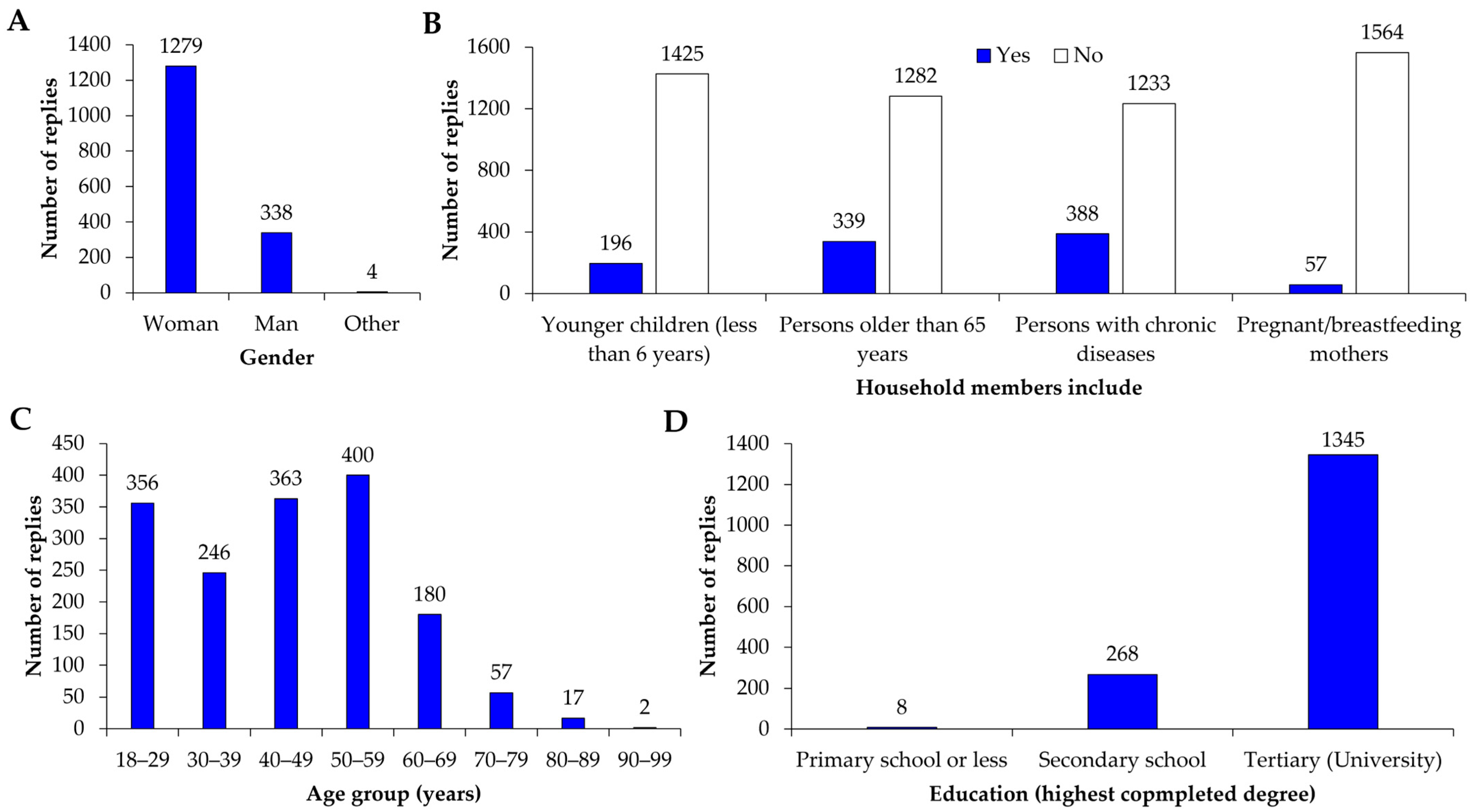
3.1. Demographic Characteristics of Participants
3.2. Levels of Knowledge (K), Attitudes (A), and Practices (P)—KAP
3.2.1. Habits
3.2.2. Shopping and Transport
Food Separation During Shopping and Transport
Buying Unpackaged Fruits and Vegetables
Shopping Order
Use of Cooler Bags/Insulated Bags
Transport Time
3.2.3. Refrigeration
Food Placement in the Refrigerator
Refrigerator Temperature
Checking Refrigerator Temperature and Expired/Spoiled Food
3.2.4. Food Labeling
Food Labels
Dates of Durability (Expiration Dates)
3.2.5. Food Preparation
Washing Fruits and Vegetables
(Not) Washing Raw Meat/Poultry
(Not) Preparing Food with Symptoms of Illness
Preventing Cross-Contamination with Appropriate Uses of Knives and Chopping Boards
3.3. Structural Equation Modeling (SEM) and the Relationships Between Knowledge (K), Attitudes (A), and Practices (P)—KAP
3.3.1. Structural Equation Modeling (SEM) Assumptions
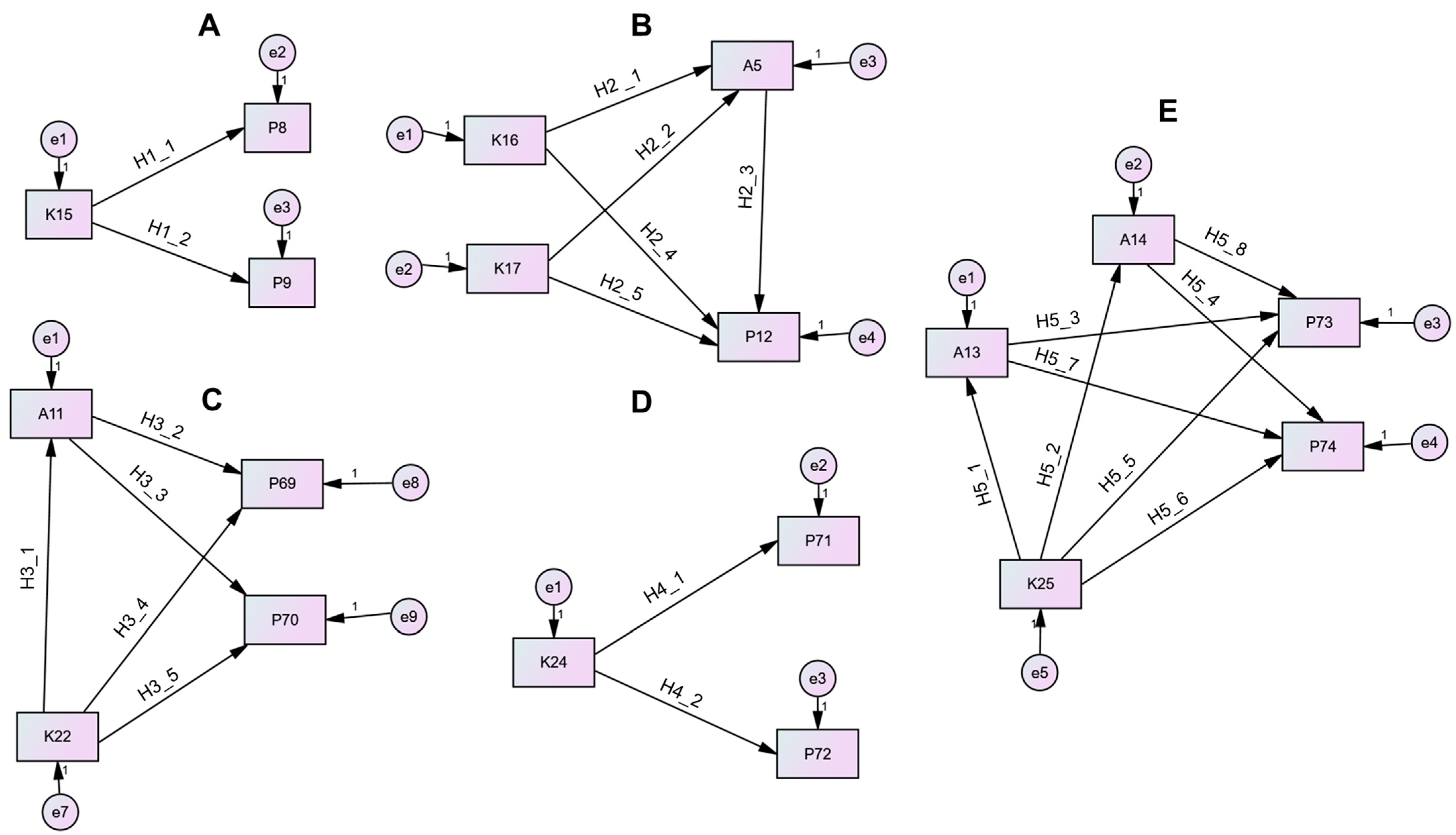
3.3.2. Structural Equation Modeling (SEM) Models
3.3.3. Relationships Between Knowledge (K), Attitudes (A), and Practices (P)—KAP
3.4. Limitations
4. Conclusions
Author Contributions
Funding
Institutional Review Board Statement
Informed Consent Statement
Data Availability Statement
Acknowledgments
Conflicts of Interest
Abbreviations
| A | Attitude |
| CFI | Comparative Fit Index |
| CFSS | Consumer Food Safety Study |
| C.R. | Critical Ratios |
| EFSA | European Food Safety Authority |
| FDA | Food and Drug Administration |
| FLI | Food Label Information |
| GFI | Goodness of Fit |
| H | Hypothesis |
| K | Knowledge |
| KAP | Knowledge Attitude Practice |
| MCFS | Matrix of Consumer Food Safety |
| NFI | Normed Fit Index |
| NIJZ | Slovenian National Institute of Public Health |
| P | Practice |
| p | Probability value |
| RMSEA | Root Mean Square Error of Approximation |
| S.E. | Standard Errors |
| SEM | Structural Equation Modeling |
| USDA | United States Department of Agriculture |
| WHO | World Health Organization |
Appendix A

| Topic | Questions | ||
|---|---|---|---|
| Knowledge (K) | Attitude (A) | Practice (P) | |
| Habits | P1 How would you describe your habits in terms of growing and buying food? | ||
| P2 How would you describe your eating habits? | |||
| P3 How would you describe your habits regarding food preparation at home? | |||
| Food shopping and transportation | K13 To what extent do you agree that during shopping/transport, it is necessary to ensure that wet foods are separated from dry foods? | P4 How often during shopping/transport, do you place food so that wet food is separated from dry food? | |
| K14 To what extent do you agree that during shopping/transport, it is necessary to take care that raw meat/poultry/fish do not come into contact with other foods? | P5 How often during shopping/ transport, do you place food so that raw meat/poultry/fish are not in contact with other foods? | ||
| A2 How important it is for you to add frozen products and perishable foods (e.g., dairy products, fresh meat, poultry and fish) to the shopping basket/cart last (right before going to the checkout)? | P6 How often when shopping for frozen products and perishable foods (e.g., dairy products, fresh meat, poultry and fish), you add these products to the shopping basket/cart last (right before going to the checkout)? | ||
| P7 How often do you use cooler bags/insulated bags to transport perishable foods (e.g., dairy products, frozen products, fresh meat, poultry and fish)? | |||
| Refrigeration | K15 To what extent do you agree that it is recommended to store fresh meat, poultry and fish on the lowest shelf in the refrigerator or to separate from cooked food and food consumed raw? | P8 How often do you place the food in the refrigerator in such a way that the food that is consumed raw is separated from the food that needs to be heat-treated (e.g., meat, fish, etc.)? | |
| P9 How often do you store fresh meat, poultry and fish on the lowest shelf in the refrigerator or separate from cooked food and food eaten raw? | |||
| P10 What do you use most often when buying unpackaged fruit and vegetables in the store? | |||
| A3 How important is it for you to take frozen products and perishable foods (e.g., dairy products, fresh meat, poultry and fish) home quickly after purchase? | P11 How long does it take from the checkout to your home when you buy frozen or perishable foods (e.g., dairy products, fresh meat, poultry and fish)? | ||
| A4 How important is it for you that you store food in accordance with the instructions on the packaging? | |||
| K16 To what extent do you agree that storing food at the appropriate temperature is important for food safety? | A5 How important is it for you at what temperature is the food stored in your refrigerator? | P12 How do you check the temperature in your refrigerator? | |
| K17 Up to what temperature is it recommended to store food in the refrigerator (at home)? | |||
| P13 How often do you check if the food in the refrigerator has spoiled (e.g., rot, mold) or if its Use by date has expired? | |||
| Food labeling | K22 To what extent do you agree that food labels contain information important for ensuring food safety (e.g., expiration date, instructions for storage and food preparation)? | A11 How important is it for you to follow the expiration date of the food? | P69 How often do you follow the date of expiration written as “Best before”? |
| P70 How often do you Follow the date of expiration written as “Use by”? | |||
| K23 To what extent do you agree that the instructions for proper food handling on the food packaging are clear enough for you to handle the food properly? | P68 How often do you read and follow the instructions for storage and use/preparation of food that are specified on the product label? | ||
| Food labeling | K27 What do you think the expiration date label “Use by” means? | P76 What do you most often do with food with an expired “Use by” date? | |
| K28 What do you think the expiration date label “Best before” means? | P77 What do you most often do with food with an expired “Best before” date? | ||
| Food preparation | K24 To what extent do you agree that fresh fruits and vegetables that are not peeled (e.g., apricots, peppers) must be washed before use? | P71 How often do you wash fruits and vegetables that you do not peel, if you eat them raw? | |
| P72 How often do you wash fruits and vegetables that you do not peel, if they are heat-treated? | |||
| K25 To what extent do you agree that by washing raw meat and poultry we ensure food safety? | A13 How important is it for you to wash raw red meat before heat treatment? | P73 How often do you wash raw red meat before cooking? | |
| A14 How important is it for you to wash poultry before heat treatment? | P74 How often do you wash the poultry before cooking? | ||
| K26 To what extent you agree that a person with symptoms of illness (e.g., vomiting, diarrhea, purulent wounds, discharge from the eyes/ears) can spread the infection during food preparation and pass it on to those who consume it? | P75 How often do you cook at home for members of your household even when you have symptoms such as vomiting, diarrhea, purulent wounds and discharge from the eyes/ears? | ||
| A12 How important is it for you that you do not cut fresh vegetables (for salad) on the same board and with the same knife that you previously used to cut raw meat/poultry (without washing the board and knife)? | P78 For lunch, you prepare meat/poultry/fish and a salad with various vegetables. What best describes your preparation process? [e.g., one (unwashed or washed with hot/cold water/detergent) or two knives and chopping boards] | ||
References
- WHO Food Safety. Available online: https://www.who.int/health-topics/food-safety#tab=tab_1 (accessed on 31 October 2025).
- EFSA Foodborne Outbreaks Dashboard. Available online: https://www.efsa.europa.eu/en/microstrategy/FBO-dashboard (accessed on 31 October 2025).
- Grilc, E.; Praprotnik, M.; Trkov, M.; Kotnik, E.; Berce, I.; Car Drnovšek, T. Črevesne Nalezljive Bolezni in Zoonoze v Sloveniji v Letu 2023; Nacionalni Inštitut za Javno Zdravje (NIJZ): Ljubljana, Slovenia, 2025. [Google Scholar]
- Conway, A.; Ehuwa, O.; Manning, M.; Maye, A.; Moran, F.; Jaiswal, A.K.; Jaiswal, S. Evaluation of Irish Consumers’ Knowledge of Salmonellosis and Food-Handling Practices. J. Consum. Prot. Food Saf. 2023, 18, 43–55. [Google Scholar] [CrossRef]
- Marklinder, I.; Eskhult, G.; Ahlgren, R.; Blücher, A.; Börjesson, S.-M.E.; Moazzami, M.; Schelin, J.; Danielsson-Tham, M.-L. A Structural Equation Model Demonstrating the Relationship between Food Safety Background, Knowledge, Attitudes and Behaviour among Swedish Students. Foods 2022, 11, 1595. [Google Scholar] [CrossRef] [PubMed]
- Mihalache, O.A.; Dumitraşcu, L.; Nicolau, A.I.; Borda, D. Food Safety Knowledge, Food Shopping Attitude and Safety Kitchen Practices among Romanian Consumers: A Structural Modelling Approach. Food Control 2021, 120, 107545. [Google Scholar] [CrossRef]
- Al-Jaberi, T.M.; Al-Nabulsi, A.A.; Osaili, T.M.; Olaimat, A.N.; Mutlaq, S. Food Safety Knowledge, Attitudes, and Practices among Jordanian Women Handling Food at Home during COVID-19 Pandemic. PLoS ONE 2023, 18, e0288323. [Google Scholar] [CrossRef]
- Soon, J.M.; Wahab, I.R.A.; Hamdan, R.H.; Jamaludin, M.H. Structural Equation Modelling of Food Safety Knowledge, Attitude and Practices among Consumers in Malaysia. PLoS ONE 2020, 15, e0235870. [Google Scholar] [CrossRef]
- Chuang, E.; Thomas, M.; Feng, Y. Young Adult Food Safety Knowledge Gaps and Perceptions of Roommates’ Food Handling Practices: A Survey of University Students in Indiana. Food Control 2021, 126, 108055. [Google Scholar] [CrossRef]
- Yu, H.; Lin, Z.; Lin, M.S.; Neal, J.A.; Sirsat, S.A. Consumers’ Knowledge and Handling Practices Associated with Fresh-Cut Produce in the United States. Foods 2022, 11, 2167. [Google Scholar] [CrossRef] [PubMed]
- Osaili, T.M.; Saeed, B.Q.; Taha, S.; Omar Adrees, A.; Hasan, F. Knowledge, Practices, and Risk Perception Associated with Foodborne Illnesses among Females Living in Dubai, United Arab Emirates. Foods 2022, 11, 290. [Google Scholar] [CrossRef]
- Perilli, M.; Telera, G.; Colacicco, G.; Cortazzi, N.; Iannetti, L.; Migliorati, G.; Pastoni, F.; Pomilio, F.; Sericola, M.; Toro, M.; et al. A Survey to Assess Food Safety Knowledge and Habits Among High School Students, their Parents and Teachers in Pescara and Chieti Provinces, Abruzzo Region (Italy). J. Food Prot. 2023, 86, 100186. [Google Scholar] [CrossRef]
- Jevšnik, M.; Ovca, A.; Bauer, M.; Fink, R.; Oder, M.; Sevšek, F. Food Safety Knowledge and Practices among Elderly in Slovenia. Food Control 2013, 31, 284–290. [Google Scholar] [CrossRef]
- Jevšnik, M.; Česen, A.; Šantić, M.; Ovca, A. Food Safety Knowledge and Practices of Pregnant Women and Postpartum Mothers in Slovenia. Foods 2021, 10, 2412. [Google Scholar] [CrossRef]
- Ovca, A.; Jevšnik, M.; Raspor, P. Food Safety Awareness, Knowledge and Practices among Students in Slovenia. Food Control 2014, 42, 144–151. [Google Scholar] [CrossRef]
- Al-Asmari, F.; Ismail, A.I.H. Evaluating Food Safety Knowledge and Practices among Saudi Women in Al-Ahsa Region, Saudi Arabia. Ital. J. Food Saf. 2023, 12, 10716. [Google Scholar] [CrossRef] [PubMed]
- Ovai, B.; Kunadu, A.P.-H.; Gake, N.; Doku, C.; Otwey, R.Y. Food Safety Risk Factors Associated with Chicken Consumption and Chicken Handling Practices in Accra, Ghana. Sci. Afr. 2022, 16, e01263. [Google Scholar] [CrossRef]
- Kavanaugh, M.; Fisher, K.; Quinlan, J.J. Use of Focus Groups to Identify Food Safety Risks for Older Adults in the U.S. Foods 2021, 11, 37. [Google Scholar] [CrossRef]
- Menini, A.; Mascarello, G.; Giaretta, M.; Brombin, A.; Marcolin, S.; Personeni, F.; Pinto, A.; Crovato, S. The Critical Role of Consumers in the Prevention of Foodborne Diseases: An Ethnographic Study of Italian Families. Foods 2022, 11, 1006. [Google Scholar] [CrossRef]
- Ferrero, A.; Zanchini, R.; Ferrocino, I.; D’Ambrosio, S.; Nucera, D.M. Consumers and Food Safety: Application of Metataxonomic Analyses and Multivariate Statistics in Order to Identify Behaviours Affecting Microbial Contaminations in Household Kitchens. Food Control 2022, 141, 109158. [Google Scholar] [CrossRef]
- Lavelle, F.; McKernan, C.; Murphy, B.; Dean, M. Food Safety and Convenience Meals: Consumers’ Actual and Perceived Behaviours—A Mixed Methods Study. Br. Food J. 2023, 125, 2838–2857. [Google Scholar] [CrossRef]
- Islam, M.d.N.; Roy, N.; Amin, M.d.B.; Madilo, F.K.; Karmakar, K.; Hossain, E.; Aktarujjaman, M.d.; Islam, M.d.S.; Airin, N.J. Food Safety Knowledge and Handling Practices among Household Food Handlers in Bangladesh: A Cross-Sectional Study. Food Control 2023, 147, 109578. [Google Scholar] [CrossRef]
- Vuksanović, N.; Demirović Bajrami, D.; Petrović, M.D.; Jotanović Raletić, S.; Radivojević, G. Knowledge about Food Safety and Handling Practices—Lessons from the Serbian Public Universities. Slov. J. Public Health 2022, 61, 145–154. [Google Scholar] [CrossRef]
- Elnahas, H.G.; Khafagy, G.M.; el-Sattar, E.M.A.; Elsayed, R.M. Assessment of Food Safety Knowledge and Practice and Factors that may affect them among the General Population at Family Medicine Outpatient Clinic. World Fam. Med. Middle East J. Fam. Med. 2022, 20, 108–119. [Google Scholar] [CrossRef]
- Ataya, D.; Iskandar, C.F.; Kharroubi, S.A.; Farran, M.T. Knowledge, Attitudes, and Practices towards Poultry Handling and Salmonella Risk among Households in Beirut, Lebanon. J. Agric. Food Res. 2024, 18, 101477. [Google Scholar] [CrossRef]
- Ishra, R.; Sharif, S.; Soar, J.; Khanam, R. Food Safety Knowledge among Adult Consumers in Bangladesh: A COVID-19 Comparative Study. Br. Food J. 2025, 127, 96–113. [Google Scholar] [CrossRef]
- Maestro, D.; Pašalić, A.; Ramić-Čatak, A.; Obradović, Z. Public Health Challenges in Households—Food Safety. J. Health Sci. 2024, 13, 202–208. [Google Scholar] [CrossRef]
- Wang, K.; Cong, L.; Mirosa, M.; Bai, L.; Hou, Y.; Bremer, P. Impact of COVID-19 on Chinese Urban Consumers’ Food Safety Knowledge and Behavior—A Comparative Study between pre and post Pandemic Eras. Food Res. Int. 2024, 194, 114905. [Google Scholar] [CrossRef]
- Marklinder, I.; Ahlgren, R.; Blücher, A.; Ehn Börjesson, S.-M.; Hellkvist, F.; Moazzami, M.; Schelin, J.; Zetterström, E.; Eskhult, G.; Danielsson-Tham, M.-L. Food Safety Knowledge, Sources Thereof and Self-Reported Behaviour among University Students in Sweden. Food Control 2020, 113, 107130. [Google Scholar] [CrossRef]
- Cho, T.J.; Kim, S.A.; Kim, H.W.; Rhee, M.S. A Closer Look at Changes in High-Risk Food-Handling Behaviors and Perceptions of Primary Food Handlers at Home in South Korea across Time. Foods 2020, 9, 1457. [Google Scholar] [CrossRef] [PubMed]
- Ballout, R.; Toufeili, I.; Kharroubi, S.A.; Kassem, I.I. Raw Meat Consumption and Food Safety Challenges: A Survey of Knowledge, Attitudes, and Practices of Consumers in Lebanon. Foods 2024, 13, 118. [Google Scholar] [CrossRef]
- Sterniša, M.; Smole Možina, S.; Levstek, S.; Kukec, A.; Raspor, P.; Jevšnik, M. Food Safety Knowledge, Self-Reported Practices and Attitude of Poultry Meat Handling among Slovenian Consumers. Br. Food J. 2018, 120, 1344–1357. [Google Scholar] [CrossRef]
- Ruby, G.E.; Ungku Zainal Abidin, U.F.; Lihan, S.; Jambari, N.N.; Radu, S. Predicting Intention on Safe Food Handling among Adult Consumers: A Cross Sectional Study in Sibu District, Malaysia. Food Control 2019, 106, 106696. [Google Scholar] [CrossRef]
- Kasza, G.; Izsó, T.; Kunszabó, A.; Szakos, D.; Lénárt, I.; Bozánné Békefi, E.; Vongxay, K.; Popp, J.; Oláh, J.; Lakner, Z.; et al. Consumer Knowledge, Attitudes, and Behaviour Regarding Food Safety—A Perspective from Laos. Heliyon 2024, 10, e29725. [Google Scholar] [CrossRef]
- Faculty of Social Sciences University of Ljubljana 1KA. 1KA Arnes, Virtualne Domene 2023. Available online: https://www.1ka.si (accessed on 25 September 2023).
- Mol, S.; Akay, K.U.; Guney, G.Ç. Seafood Safety at Home: Knowledge and Practices. Int. J. Gastron. Food Sci. 2018, 13, 95–100. [Google Scholar] [CrossRef]
- Nabwiire, L.; Shaw, A.M.; Nonnecke, G.R.; Talbert, J.; Chanes, C.; Boylston, T.; Tarte, R.; Prusa, K. Beef Handling Practices among Consumers in the U.S. Virgin Islands. J. Food Prot. 2023, 86, 100141. [Google Scholar] [CrossRef]
- Al-Sakkaf, A.; Redmond, E.; Brennan, C.; Gooneratne, R. Survey of New Zealand Poultry Consumers’ Handling of Raw Poultry and Food Safety Awareness to Provide Insight into Risk Factors for Campylobacteriosis. J. Food Prot. 2021, 84, 1640–1647. [Google Scholar] [CrossRef]
- Tomaszewska, M.; Bilska, B.; Kołożyn-Krajewska, D. Do Polish Consumers Take Proper Care of Hygiene while Shopping and Preparing Meals at Home in the Context of Wasting Food? Int. J. Environ. Res. Public Health 2020, 17, 2074. [Google Scholar] [CrossRef]
- Jevšnik, M.; Hlebec, V.; Raspor, P. Consumers’ Awareness of Food Safety from Shopping to Eating. Food Control 2008, 19, 737–745. [Google Scholar] [CrossRef]
- Saeed, B.Q.; Osaili, T.M.; Taha, S. Foodborne Diseases Risk Factors Associated with Food Safety Knowledge and Practices of Women in Sharjah-United Arab Emirate. Food Control 2021, 125, 108024. [Google Scholar] [CrossRef]
- Jevšnik, M.; Pirc, L.; Ovca, A.; Šantić, M.; Raspor, P.; Torkar, K.G. A Multimethod Study on Kitchen Hygiene, Consumer Knowledge and Food Handling Practices at Home. Processes 2022, 10, 2104. [Google Scholar] [CrossRef]
- Roy, N.; Aktarujjaman, M.; Siddiky, A.; Mollick, K.; Rosby, R.; Rogers, B.T.; Hossain, E.; Al Mamun, F.; Mamun, M.A. Food Safety Knowledge, Attitudes, Practices, and Associated Factors Among Adult Consumers in Bangladesh: Findings from a Nationwide Cross-Sectional Survey. Health Sci. Rep. 2024, 7, e70307. [Google Scholar] [CrossRef]
- Evans, E.W.; Redmond, E.C.; Alwan, N.; Ilic, S. Awareness and Attitudes of Student Dietitians in Lebanon, UK and USA towards Food Safety. Foods 2021, 10, 1875. [Google Scholar] [CrossRef]
- Andrade Batista, S.; Stedefeldt, E.; Batistela dos Santos, E.; Yoshio Nakano, E.; Cortez Ginani, V.; Braz Assunção Botelho, R. Understanding and Evaluating Risk Perception, Knowledge, and Food Safety Self-Reported Practices of Public-School Students in Brazil. Food Res. Int. 2024, 196, 115027. [Google Scholar] [CrossRef]
- Haidari, R.E.; Fahes, F.; Makke, F.; Nouredine, F.; Baydoun, K.; Mansour, S.; Hoballah, A. Socio-Demographic Determinants of Knowledge, Attitude and Practices towards Food Safety among Lebanese Population during the Economic Crisis: A Cross-Sectional Study. BMC Public Health 2022, 22, 2329. [Google Scholar] [CrossRef] [PubMed]
- Charlesworth, J.; Mullan, B.; Moran, A. Investigating the Predictors of Safe Food Handling among Parents of Young Children in the USA. Food Control 2021, 126, 108015. [Google Scholar] [CrossRef]
- Thakur, S.; Mathur, P. Food Safety Knowledge and Changes in Practices and Concerns of Indian Families during the COVID-19 Pandemic. Nutr. Food Sci. 2023, 53, 319–333. [Google Scholar] [CrossRef]
- Al Mamun, M.A.; Ghani, R.B.A.; Shill, L.C.; Afroz, F.; Chowdhury, A.I.; Akter, F.; Jahan, E.A.; Rana, M.M.; Li, J. Assessment of the Knowledge, Attitude, and Practice of Childbearing Mothers in the Geographically Coastal Region of Bangladesh for Cleanliness and Food Safety of Food Security. SAGE Open Med. 2024, 12, 20503121241264741. [Google Scholar] [CrossRef]
- Tomaszewska, M.; Trafialek, J.; Suebpongsang, P.; Kolanowski, W. Food Hygiene Knowledge and Practice of Consumers in Poland and in Thailand—A Survey. Food Control 2018, 85, 76–84. [Google Scholar] [CrossRef]
- Subuh, N.; Ballout, R.; Toufeili, I.; Kassem, I.I.; Kharroubi, S.A. Beliefs, Practices, and Knowledge of Household Food Handlers Regarding the Impact of Electricity Outages on Food Safety: Findings from a National Cross-Sectional Study in Lebanon. Foods 2025, 14, 855. [Google Scholar] [CrossRef] [PubMed]
- Pirnat, N.; Lampič, V.; Uršič, S.; Vivoda, M.; Pohar, M.; Veninšek Perpar, I.; Trojner Breg, Z.; Benko, V.; Hrženjak, V.; Goričanec, J.; et al. Higienska priporočila za varnost živil za potrošnike. Available online: https://nijz.si/wp-content/uploads/2022/07/higienska_priporocila_za_varnost_zivil_za_potrosnike_2011.pdf (accessed on 31 October 2025).
- WHO Public Health. Advice on Food Safety During Summer. Available online: https://www.who.int/europe/news-room/fact-sheets/item/public-health-advice-on-food-safety-during-summer (accessed on 31 October 2025).
- USDA. What Temperature Should a Refrigerator Maintain? Available online: https://ask.usda.gov/s/article/What-temperature-should-a-refrigerator-maintain (accessed on 31 October 2025).
- FDA. Refrigerator Thermometers—Cold Facts About Food Safety. Available online: https://www.fda.gov/food/buy-store-serve-safe-food/refrigerator-thermometers-cold-facts-about-food-safety (accessed on 31 October 2025).
- Ruby, G.E.; Ungku Zainal Abidin, U.F.; Lihan, S.; Jambari, N.N.; Radu, S. A Cross Sectional Study on Food Safety Knowledge among Adult Consumers. Food Control 2019, 99, 98–105. [Google Scholar] [CrossRef]
- Islam, M.d.N.; Roy, N.; Madilo, F.K.; Akinsemolu, A.; Arifuzzaman, M.d.; Shakil, M.d.I.H.; Nishi, J.F.; Akter, S.; Elius, M.d.; Islam, M.d.S. Knowledge, Perception, and Practical Understanding of Food Labels: A Cross-sectional Study among Bangladeshi Consumers. Food Sci. Nutr. 2024, 12, 7552–7567. [Google Scholar] [CrossRef]
- Ayad, A.A.; Abdulsalam, N.M.; Khateeb, N.A.; Hijazi, M.A.; Williams, L.L. Saudi Arabia Household Awareness and Knowledge of Food Safety. Foods 2022, 11, 935. [Google Scholar] [CrossRef]
- Mehanna, A.; Ashour, A.; Tawfik Mohamed, D. Public Awareness, Attitude, and Practice Regarding Food Labeling, Alexandria, Egypt. BMC Nutr. 2024, 10, 15. [Google Scholar] [CrossRef]
- Selvamurthy, S.; Rajalakshmi, M.; Mohan, R.; Premanandh, K. Young Consumer’s Awareness on Food Packet Labeling in Rural Tamil Nadu—A Convergent Mixed Methods Study. J. Sci. Soc. 2024, 51, 439–442. [Google Scholar] [CrossRef]
- Aytop, Y.; Çetinkaya, S.; Dağ, M.M. Consumer Food Safety Knowledge in Türkiye: What Are the Practices at Home? Cogent Food Agric. 2025, 11, 2479855. [Google Scholar] [CrossRef]
- Regulation (EU) No 1169/2011 of the European Parliament and of the Council of 25 October 2011 on the Provision of Food Information to Consumers. Available online: https://eur-lex.europa.eu/eli/reg/2011/1169/2025-04-01/eng (accessed on 31 October 2025).
- Pereira das Neves, C.; Lameiro Rodrigues, K.; Fagundes de Mello, J.; Kuka Valente Gandra, T.; Avila Gandra, E. Microbiological Evaluation of Beef Sold in Brazil and Consumer Knowledge about Food Safety. Acta Vet. Bras. 2024, 18, 118–127. [Google Scholar] [CrossRef]
- Godínez-Oviedo, A.; Sampedro Parra, F.; Machuca Vergara, J.J.; Gutiérrez González, P.; Hernández Iturriaga, M. Food Consumer Behavior and Salmonella Exposure Self-Perception in the Central Region of Mexico. J. Food Sci. 2019, 84, 2907–2915. [Google Scholar] [CrossRef] [PubMed]
- Carstens, C.K.; Salazar, J.K.; Sharma, S.V.; Chan, W.; Darkoh, C. Food Safety Attitudes, Behaviors, and Hygiene Measures among Predominantly Low-Income Parents in Houston, Texas. J. Food Prot. 2022, 85, 1745–1755. [Google Scholar] [CrossRef]
- USDA. Washing Food: Does it Promote Food Safety? Available online: https://www.fsis.usda.gov/food-safety/safe-food-handling-and-preparation/food-safety-basics/washing-food-does-it-promote-food (accessed on 31 October 2025).
- FDA. Food Safety Tips for Healthy Holidays. Available online: https://www.fda.gov/consumers/consumer-updates/food-safety-tips-healthy-holidays (accessed on 31 October 2025).
- NHS. Preparing and Cooking Food Safely: Avoiding Cross-Contamination. Available online: https://www.nhs.uk/live-well/eat-well/how-to-prepare-and-cook-food-safely/ (accessed on 31 October 2025).
- Food Standards Agency Why Avoiding Cross-Contamination is Important. Available online: https://www.food.gov.uk/print/pdf/node/192 (accessed on 31 October 2025).
- Soon-Sinclair, J.M.; Ha, T.M.; Limon, M.R.; Vanany, I.; Ongkunaruk, P.; Voe, P.; Boulom, S.; Yang, F.; Abdul Wahab, I.R.; Hamdan, R.H.; et al. Consumers’ Raw Poultry Washing Practices: A Cross-Sectional and Observational Study in Eight Southeast Asian Countries. Food Control 2024, 158, 110253. [Google Scholar] [CrossRef]
- Vinod, H.D. Matrix Algebra Topics in Statistics and Economics Using R. In Handbook of Statistics; Rao, M.B., Rao, C.R., Eds.; Computational Statistics with R.; Elsevier: Amsterdam, The Netherlands, 2014; Volume 32, pp. 143–176. [Google Scholar]
- Voss, S. Multicollinearity. In Encyclopedia of Social Measurement; Kempf-Leonard, K., Ed.; Elsevier: Amsterdam, The Netherlands, 2005; pp. 759–770. [Google Scholar]
- Pratt, J.W. Concavity of the Log Likelihood. J. Am. Stat. Assoc. 1981, 76, 103–106. [Google Scholar] [CrossRef]
- Soper Daniel Free A-Priori Sample Size Calculator for Structural Equation Models—Free Statistics Calculators. Available online: https://www.danielsoper.com/statcalc/calculator.aspx?id=89 (accessed on 31 October 2025).
- Lin, X.; Featherman, M.; Brooks, S.L.; Hajli, N. Exploring Gender Differences in Online Consumer Purchase Decision Making: An Online Product Presentation Perspective. Inf. Syst. Front. 2019, 21, 1187–1201. [Google Scholar] [CrossRef]
- Cheung, G.W.; Lau, R.S. Accuracy of Parameter Estimates and Confidence Intervals in Moderated Mediation Models. Organ. Res. Methods 2017, 20, 746–769. [Google Scholar] [CrossRef]


| Questionnaire Topic | Question Number | Question | Replies | Frequency (Percentage) |
|---|---|---|---|---|
| Habits | P1 | How would you describe your habits in terms of growing and buying food? | I eat mostly home-grown food. | 189 (11.7%) |
| I eat home-grown and bought food. | 1079 (66.6%) | |||
| I mostly eat bought food. | 335 (20.7%) | |||
| Other | 18 (1.1%) | |||
| P2 | How would you describe your eating habits? | I mostly eat home-cooked food. | 1181 (72.9%) | |
| I eat food prepared at home and food prepared outside the home (e.g., in restaurants and canteens) in approximately equal share. | 415 (25.6%) | |||
| I mostly eat food prepared outside the home (e.g., in restaurants and canteens). | 15 (0.9%) | |||
| Other | 10 (0.6%) | |||
| P3 | How would you describe your habits regarding food preparation at home? | I mostly use basic ingredients. | 1312 (80.9%) | |
| I use approximately the same share of basic ingredients and purchased pre-prepared meals. | 290 (17.9%) | |||
| I mostly use purchased pre-prepared meals. | 12 (0.7%) | |||
| I do not prepare food at home. | 3 (0.2%) | |||
| Other | 4 (0.2%) | |||
| Food shopping, transportation | P10 | What do you use most often when buying unpackaged fruit and vegetables in the store? | Disposable gloves and plastic bags | 485 (29.9%) |
| Plastic bags | 523 (32.3%) | |||
| Disposable gloves and reusable bags | 127 (7.8%) | |||
| Reusable bags | 169 (10.4%) | |||
| I do not use any of the above—I put unpackaged fruit/vegetables in the shopping basket/cart | 82 (5.1%) | |||
| I do not know, it depends, sometimes one thing and other times another | 194 (12.0%) | |||
| Other | 41 (2.5%) | |||
| P11 | Estimate how long it takes from the checkout to your home when you buy frozen or perishable foods (e.g., dairy products, fresh meat, poultry and fish): | Up to 30 min | 1338 (82.5%) | |
| From 30 min to 1 h | 213 (13.1%) | |||
| From 1 h to 1.5 h | 16 (1.0%) | |||
| From 1.5 h to 2 h | 8 (0.5%) | |||
| More than 2 h | 0 (0.0%) | |||
| Other | 46 (2.8%) | |||
| Refrigerator | P12 | How do you check the temperature in your refrigerator? | With a thermometer | 129 (8.0%) |
| With a thermostat | 297 (18.3%) | |||
| On the screen | 741 (45.7%) | |||
| I do not check | 434 (26.8%) | |||
| Other | 20 (1.2%) | |||
| P13 | How often do you check if the food in the refrigerator has spoiled (e.g., rot, mold) or if its use by date has expired? | Daily | 435 (26.8%) | |
| Weekly | 936 (57.7%) | |||
| Monthly | 140 (8.6%) | |||
| Annually | 7 (0.4%) | |||
| Never | 21 (1.3%) | |||
| Other | 82 (5.1%) | |||
| Food preparation | P78 | For lunch, you prepare meat/ poultry/fish and a salad with various vegetables. Which statement best describes your preparation process? | You cut meat/poultry/fish on the chopping board, then use the same knife and chopping board to cut vegetables. | 25 (1.5%) |
| You cut meat/poultry/fish on the chopping board, then rinse the knife and chopping board under COLD running drinking water and use them to cut vegetables. | 65 (4.0%) | |||
| You cut meat/poultry/fish on the chopping board, then rinse the knife and chopping board under HOT running drinking water and use them to cut vegetables. | 196 (12.1%) | |||
| You cut meat/poultry/fish on the chopping board, then wash the knife and chopping board with dish detergent and use them to cut vegetables. | 390 (24.1%) | |||
| You cut meat/poultry/fish with a knife (for meat) on one chopping board, and vegetables with another knife (for vegetables) on another chopping board. | 842 (51.9%) | |||
| Other | 103 (6.4%) |
| Questionnaire Topic | Question Number | Question | Replies | |||||
|---|---|---|---|---|---|---|---|---|
| Indicate to What Extent You Agree with the Following Statements: | Strongly Agree | Agree | Neither Agree nor Disagree | Disagree | Strongly Disagree | Do Not Know | ||
| Frequency (Percentage) | ||||||||
| Food shopping, transportation | K13 | During shopping/transport, it is necessary to ensure that wet foods are separated from dry foods. | 696 (42.9%) | 685 (42.3%) | 155 (9.6%) | 33 (2.0%) | 8 (0.5%) | 44 (2.7%) |
| K14 | During shopping/transport, it is necessary to take care that raw meat/poultry/fish do not come into contact with other foods. | 986 (60.8%) | 493 (30.4%) | 90 (5.6%) | 17 (1.0%) | 4 (0.2%) | 31 (1.9%) | |
| Refrigerator | K15 | It is recommended to store fresh meat, poultry and fish on the lowest shelf in the refrigerator or to separate from cooked food and food consumed raw. | 755 (46.6%) | 560 (34.5%) | 149 (9.2%) | 35 (2.2%) | 7 (0.4%) | 115 (7.1%) |
| K16 | Storing food at the appropriate temperature is important for food safety. | 1278 (78.8%) | 330 (20.4%) | 11 (0.7%) | 1 (0.1%) | 0(0.0%) | 1 (0.1%) | |
| Food labeling | K22 | Food labels contain information important for ensuring food safety (e.g., date of durability/expiration date, instructions for storage and food preparation). | 557 (34.4%) | 840 (51.8%) | 171 (10.5%) | 39 (2.4%) | 7 (0.4%) | 7 (0.4%) |
| K23 | The instructions for proper food handling on the food packaging are clear enough for you to handle the food properly. | 153 (9.4%) | 716 (44.2%) | 522 (32.2%) | 194 (12.0%) | 26 (1.6%) | 10 (0.6%) | |
| Food preparation | K24 | Fresh fruits and vegetables that are not peeled (e.g., apricots, peppers) must be washed before use. | 1295 (79.9%) | 271 (16.7%) | 41 (2.5%) | 7 (0.4%) | 1 (0.1%) | 6 (0.4%) |
| K25 | By washing raw meat and poultry we ensure food safety. | 510 (31.5%) | 426 (26.3%) | 306 (18.9%) | 149 (9.2%) | 106 (6.5%) | 124 (7.6%) | |
| K26 | A person with symptoms of illness (e.g., vomiting, diarrhea, purulent wounds, discharge from the eyes/ears) can spread the infection during food preparation and pass it on to those who consume it. | 1150 (70.9%) | 379 (23.4%) | 52 (3.2%) | 9 (0.6%) | 3 (0.2%) | 28 (1.7%) | |
| Questionnaire Topic | Question Number | Question | Replies | |||||
|---|---|---|---|---|---|---|---|---|
| Mark How Often… | Always | Almost Always | Sometimes | Mostly Not | Never | Do Not Know | ||
| Frequency (Percentage) | ||||||||
| Food shopping, transportation | P4 | During shopping/transport, you place food so that wet food is separated from dry food. | 496 (30.6%) | 600 (37.0%) | 243 (15.0%) | 175 (10.8%) | 91 (5.6%) | 16 (1.0%) |
| P5 | During shopping/transport, you place food so that raw meat/poultry/fish are not in contact with other foods. | 643 (39.7%) | 524 (32.3%) | 220 (13.6%) | 133 (8.2%) | 64 (3.9%) | 37 (2.3%) | |
| P6 | When shopping for frozen products and perishable foods (e.g., dairy products, fresh meat, poultry and fish), you add these products to the shopping basket/cart last (right before going to the checkout). | 441 (27.2%) | 538 (33.2%) | 309 (19.1%) | 223 (13.8%) | 95 (5.9%) | 15 (0.9%) | |
| P7 | You use cooler bags/insulated bags to transport perishable foods (e.g., dairy products, frozen products, fresh meat, poultry and fish). | 246 (15.2%) | 346 (21.3%) | 407 (25.1%) | 314 (19.4%) | 302 (18.6%) | 6 (0.4%) | |
| Refrigeration | P8 | You place the food in the refrigerator in such a way that the food that is consumed raw is separated from the food that needs to be heat-treated (e.g., meat, fish, etc.). | 572 (35.3%) | 573 (35.3%) | 257 (15.9%) | 132 (8.1%) | 68 (4.2%) | 19 (1.2%) |
| P9 | You store fresh meat, poultry and fish on the lowest shelf in the refrigerator or separate from cooked food and food eaten raw. | 539 (33.3%) | 533 (32.9%) | 279 (17.2%) | 155 (9.6%) | 74 (4.6%) | 41 (2.5%) | |
| Food labeling | P68 | Read and follow the instructions for storage and use/preparation of food that are specified on the product label. | 360 (22.2%) | 770 (47.5%) | 393 (24.2%) | 74 (4.6%) | 21 (1.3%) | 3 (0.2%) |
| P69 | Follow the date of durability/expiration date written as “Best before”. | 431 (26.6%) | 860 (53.1%) | 248 (15.3%) | 71 (4.4%) | 9 (0.6%) | 2 (0.1%) | |
| P70 | Follow the date of durability/expiration date written as “Use by”. | 567 (35.0%) | 811 (50.0%) | 193 (11.9%) | 40 (2.5%) | 7 (0.4%) | 3 (0.2%) | |
| Food preparation | P71 | Wash fruits and vegetables that you do not peel, if you eat them raw. | 1316 (81.2%) | 245 (15.1%) | 44 (2.7%) | 12 (0.7%) | 2 (0.1%) | 2 (0.1%) |
| P72 | Wash fruits and vegetables that you do not peel, if they are heat-treated. | 1209 (74.6%) | 271 (16.7%) | 98 (6.0%) | 26 (1.6%) | 10 (0.6%) | 7 (0.4%) | |
| P73 | Wash raw red meat before cooking. | 527 (32.5%) | 286 (17.6%) | 220 (13.6%) | 227 (14.0%) | 269 (16.6%) | 92 (5.7%) | |
| P74 | Wash the poultry before cooking. | 651 (40.2%) | 263 (16.2%) | 187 (11.5%) | 181 (11.2%) | 264 (16.3%) | 75 (4.6%) | |
| P75 | You cook at home for members of your household even when you have symptoms such as vomiting, diarrhea, purulent wounds and discharge from the eyes/ears. | 91 (5.6%) | 101 (6.2%) | 231 (14.3%) | 506 (31.2%) | 657 (40.5%) | 35 (2.2%) | |
| Questionnaire Topic | Question Number | Question | Replies | |||||
|---|---|---|---|---|---|---|---|---|
| Indicate How Important It Is for You… | Very Important | Important | Neither Important nor Unimportant | Unimportant | Not Important at All | Do Not Know | ||
| Frequency (Percentage) | ||||||||
| Food shopping, transportation | A2 | To add frozen products and perishable foods (e.g., dairy products, fresh meat, poultry and fish) to the shopping basket/cart last (right before going to the checkout). | 456 (28.1%) | 612 (37.8%) | 324 (20.0%) | 167 (10.3%) | 51 (3.1%) | 11 (0.7%) |
| A3 | To take frozen products and perishable foods (e.g., dairy products, fresh meat, poultry and fish) home quickly after purchase. | 1079 (66.6%) | 506 (31.2%) | 27 (1.7%) | 4 (0.2%) | 2 (0.1%) | 3 (0.2%) | |
| Refrigeration | A4 | That you store food in accordance with the instructions on the packaging. | 739 (45.6%) | 767 (47.3%) | 97 (6.0%) | 14 (0.9%) | 1 (0.1%) | 3 (0.2%) |
| A5 | At what temperature is the food stored in your refrigerator. | 534 (32.9%) | 887 (54.7%) | 160 (9.9%) | 22 (1.4%) | 4 (0.2%) | 14 (0.9%) | |
| Food labeling | A11 | To follow the expiration date of the food. | 601 (37.1%) | 831 (51.3%) | 149 (9.2%) | 33 (2.0%) | 6 (0.4%) | 1 (0.1%) |
| Food preparation | A12 | That you do not cut fresh vegetables (for salad) on the same board and with the same knife that you previously used to cut raw meat/poultry (without washing the board and knife). | 1238 (76.4%) | 300 (18.5%) | 56 (3.5%) | 11 (0.7%) | 5 (0.3%) | 11 (0.7%) |
| A13 | To wash raw red meat before heat treatment. | 434 (26.8%) | 421 (26.0%) | 324 (20.0%) | 176 (10.9%) | 147 (9.1%) | 119 (7.3%) | |
| A14 | To wash poultry before heat treatment. | 548 (33.8%) | 395 (24.4%) | 264 (16.3%) | 160 (9.9%) | 147 (9.1%) | 107 (6.6%) | |
| Questionnaire Topic | Question Number | Question | Replies | Frequency (Percentage) |
|---|---|---|---|---|
| Refrigeration | K17 | Up to what temperature is it recommended to store food in the refrigerator (at home)? | 0 °C | 5 (0.3%) |
| 1 °C | 7 (0.4%) | |||
| 2 °C | 24 (1.5%) | |||
| 3 °C | 63 (3.9%) | |||
| 4 °C | 446 (27.5%) | |||
| 5 °C | 311 (19.2%) | |||
| 6 °C | 194 (12.0%) | |||
| 7 °C | 137 (8.5%) | |||
| 8 °C | 331 (20.4%) | |||
| 9 °C | 12 (0.7%) | |||
| 10 °C | 56 (3.5%) | |||
| 11 °C | 7 (0.4%) | |||
| 12 °C | 12 (0.7%) | |||
| 13 °C | 4 (0.2%) | |||
| 14 °C | 2 (0.1%) | |||
| 15 °C | 10 (0.6%) |
| Questionnaire Topic | Question Number | Question | Replies | ||
|---|---|---|---|---|---|
| What Do You Think the Following Date of Durability/Expiration Date Labels Mean: “Use by” and “Best Before”? | The Date of Minimum Durability Until Which the Food Retains the Expected Quality | The Date Until Which the Food is Safe to Use | Do Not Know | ||
| Frequency (Percentage) | |||||
| Food labeling | K27 | Use by | 317 (19.6%) | 1294 (79.8%) | 10 (0.6%) |
| K28 | Best before | 1287 (79.4%) | 323 (19.9%) | 11 (0.7%) | |
| Questionnaire Topic | Question Number | Question | Replies | |||||
|---|---|---|---|---|---|---|---|---|
| I Throw It Away | I Use It as Soon as Possible | I Decide on the Use Based on Smell, Taste and Appearance | I Use It to Feed Animals | I Do Not Know | Other | |||
| Frequency (Percentage) | ||||||||
| Food labeling | P76 | What do you most often do with food with an expired “Use by” date? | 481 (29.7%) | 195 (12.0%) | 823 (50.8%) | 71 (4.4%) | 5 (0.3%) | 46 (2.8%) |
| P77 | What do you most often do with food with an expired “Best before” date? | 158 (9.7%) | 413 (25.5%) | 988 (61.0%) | 32 (2.0%) | 5 (0.3%) | 25 (1.5%) | |
| Model Number | Questionnaire Section | Food Safety Topic |
|---|---|---|
| 1 | 3. Food shopping, transportation and refrigeration | Placement of foods in the refrigerator |
| 2 | Refrigerator temperature | |
| 3 | 5. Food labeling and food preparation | Food labels and expiration dates |
| 4 | Washing of fruits and vegetables | |
| 5 | Washing of raw meat and poultry |
| Model | Hypothesis | Path | Estimate | S.E. | C.R. | p | Result |
|---|---|---|---|---|---|---|---|
| 1 | H1_1 | P8<---K15 | 0.371 | 0.020 | 18.898 | *** | Confirmed |
| H1_2 | P9<---K15 | 0.499 | 0.020 | 24.971 | *** | Confirmed | |
| 2 | H2_1 | A5<---K16 | 0.476 | 0.042 | 11.463 | *** | Confirmed |
| H2_2 | A5<---K17 | 0.031 | 0.009 | 3.557 | *** | Confirmed | |
| H2_3 | P12<---A5 | 0.228 | 0.029 | 7.785 | *** | Confirmed | |
| H2_4 | P12<---K16 | −0.035 | 0.051 | −0.690 | 0.490 | Not confirmed | |
| H2_5 | P12<---K17 | 0.013 | 0.010 | 1.236 | 0.216 | Not confirmed | |
| 3 | H3_1 | A11<---K22 | 0.078 | 0.023 | 3.427 | *** | Confirmed |
| H3_2 | P69<---A11 | 0.726 | 0.021 | 34.614 | *** | Confirmed | |
| H3_3 | P70<---A11 | 0.646 | 0.021 | 30.754 | *** | Confirmed | |
| H3_4 | P69<---K22 | 0.009 | 0.019 | 0.459 | 0.646 | Not confirmed | |
| H3_5 | P70<---K22 | 0.053 | 0.019 | 2.718 | 0.007 | Not confirmed | |
| 4 | H4_1 | P71<---K24 | 0.496 | 0.020 | 24.269 | *** | Confirmed |
| H4_2 | P72<---K24 | 0.513 | 0.031 | 16.807 | *** | Confirmed | |
| 5 | H5_1 | A13<---K25 | 0.756 | 0.016 | 46.284 | *** | Confirmed |
| H5_2 | A14<---K25 | 0.797 | 0.016 | 50.615 | *** | Confirmed | |
| H5_3 | P73<---A13 | 0.758 | 0.020 | 38.707 | *** | Confirmed | |
| H5_4 | P74<---A14 | 0.802 | 0.019 | 41.885 | *** | Confirmed | |
| H5_5 | P73<---K25 | 0.162 | 0.025 | 6.376 | *** | Confirmed | |
| H5_6 | P74<---K25 | 0.161 | 0.024 | 6.699 | *** | Confirmed | |
| H5_7 | P74<---A13 | 0.026 | 0.018 | 1.400 | 0.161 | Not confirmed | |
| H5_8 | P73<---A14 | 0.061 | 0.020 | 3.021 | 0.003 | Confirmed |
Disclaimer/Publisher’s Note: The statements, opinions and data contained in all publications are solely those of the individual author(s) and contributor(s) and not of MDPI and/or the editor(s). MDPI and/or the editor(s) disclaim responsibility for any injury to people or property resulting from any ideas, methods, instructions or products referred to in the content. |
© 2025 by the authors. Licensee MDPI, Basel, Switzerland. This article is an open access article distributed under the terms and conditions of the Creative Commons Attribution (CC BY) license (https://creativecommons.org/licenses/by/4.0/).
Share and Cite
Bensa, M.; Jevšnik Podlesnik, M.; Pezo, L.; Vovk, I. Slovenian Consumer Food Safety Study: Knowledge, Attitudes, and Practices from Shopping to Preparation Based on Questionnaire Analysis. Foods 2025, 14, 4215. https://doi.org/10.3390/foods14244215
Bensa M, Jevšnik Podlesnik M, Pezo L, Vovk I. Slovenian Consumer Food Safety Study: Knowledge, Attitudes, and Practices from Shopping to Preparation Based on Questionnaire Analysis. Foods. 2025; 14(24):4215. https://doi.org/10.3390/foods14244215
Chicago/Turabian StyleBensa, Maja, Mojca Jevšnik Podlesnik, Lato Pezo, and Irena Vovk. 2025. "Slovenian Consumer Food Safety Study: Knowledge, Attitudes, and Practices from Shopping to Preparation Based on Questionnaire Analysis" Foods 14, no. 24: 4215. https://doi.org/10.3390/foods14244215
APA StyleBensa, M., Jevšnik Podlesnik, M., Pezo, L., & Vovk, I. (2025). Slovenian Consumer Food Safety Study: Knowledge, Attitudes, and Practices from Shopping to Preparation Based on Questionnaire Analysis. Foods, 14(24), 4215. https://doi.org/10.3390/foods14244215