Abstract
Non-destructive assessment of kiwifruit quality is critical for postharvest preservation and grading. This paper proposes a novel quantitative evaluation method for the kiwifruit comprehensive quality index (KCQI) during shelf life, based on hyperspectral imaging (HSI) combined with a one-dimensional convolutional neural network (1D-CNN). Hyperspectral images of two kiwifruit cultivars were acquired at four shelf-life stages using an HSI system, and six quality parameters were measured as reference standards. Based on correlation and factor analyses, five key parameters—soluble solids content, firmness, L*, b*, and chroma—were selected to construct the KCQI. Three spectral band selection methods and three modeling algorithms were compared, with the competitive adaptive reweighted sampling (CARS)–1D-CNN model yielding the highest prediction accuracy ( = 0.82, RMSEP = 0.26, RPDP = 2.39). Subsequently, a spatial distribution map was generated to visualize the KCQI. These results demonstrate the potential of the HSI–1D-CNN approach for accurate postharvest quality monitoring and intelligent grading.
1. Introduction
Kiwifruit (Actinidia spp.) is renowned for its high vitamin C content, dietary fiber, and various antioxidants, and has become one of the fastest-growing fruit categories worldwide [1]. As a typical climacteric fruit, kiwifruit softens through cell wall degradation and increases in sweetness via starch hydrolysis to soluble sugars during postharvest storage and shelf life [2,3]. Accurate, non-destructive monitoring of these quality changes is essential for maintaining market value and optimizing supply chain performance. Traditional assessments rely on subjective distributor evaluations or laboratory physicochemical analyses; the former suffers from poor repeatability and high subjectivity, while the latter is destructive, time-consuming, and unsuitable for real-time, non-destructive monitoring [4,5]. Therefore, the development of rapid, non-destructive methods for the real-time quality evaluation of kiwifruit during shelf life is crucial for improving grading accuracy and extending postharvest longevity.
In recent years, hyperspectral imaging (HSI) has emerged as a research hotspot for non-destructive postharvest quality assessment of fruits and vegetables, owing to its “spectral-image integration” advantage [6,7]. Several studies have reported stage-wise progress in monitoring kiwifruit quality during shelf life. For example, Lee et al. acquired hyperspectral images of kiwifruit at five storage periods, establishing prediction models for soluble solid content (SSC) and firmness through second-derivative preprocessing coupled with support vector regression, achieving prediction set coefficients of determination () values of 0.940 and 0.878, respectively [8]. Hu et al. determined the HSI of seven storage-age kiwifruit fruits treated with 1-methylcyclopropene, and constructed prediction models for glucose, fructose, and sucrose using multiple linear regression algorithm, with prediction set coefficients of determination () of 0.934, 0.867, and 0.705, respectively [9]. Furthermore, Shang et al. employed the HSI combined with chemometric methods to estimate kiwifruit quality: they used competitive adaptive reweighted sampling (CARS) to select spectral bands correlated with SSC and firmness, and then built multiple linear regression models yielding validation values of 0.896 and 0.871 and relative predictive deviations (RPDs) of 3.12 and 2.81 for SSC and firmness, respectively [10]. Although the above studies verified the predictive ability of the HSI on kiwifruit quality, they have predominantly focused on single parameters, failing to reveal synergistic changes among multiple quality parameters during shelf life and lacking exploration of integrating these parameters into a comprehensive evaluation index.
Meanwhile, with the rapid development of artificial intelligence, deep learning techniques—exemplified by convolutional neural networks (CNNs)—have demonstrated outstanding performance in quantitative analysis of spectral data, offering new avenues for processing HSI datasets. For instance, Zheng et al. combined the HSI with a one-dimensional CNN (1D-CNN) to build a SSC prediction model for apples, achieving a prediction-set coefficient of determination () of 0.90 and an RMSEP of 0.37%, outperforming a PLSR-based model ( = 0.88, RMSEP = 0.44%) [11]. Wang et al. acquired hyperspectral images of apples using an HSI sensor, extracted SSC-related spectral bands via the successive projections algorithm (SPA), and developed a 1D-CNN–based SSC prediction model; this approach attained the best performance among chemometric methods, with calibration and prediction R2 values of 0.845 and 0.808, respectively [12]. Xu et al. integrated the HSI with CNN to predict SSC in pear, achieving higher accuracy than traditional PLSR and SVR models, further validating the reliability of CNNs for high-precision quality prediction [13]. Although these studies highlight the potential of HSI–CNN fusion for fruit quality estimation, a quantitative evaluation method specifically targeting the comprehensive quality of kiwifruit during shelf life remains undeveloped.
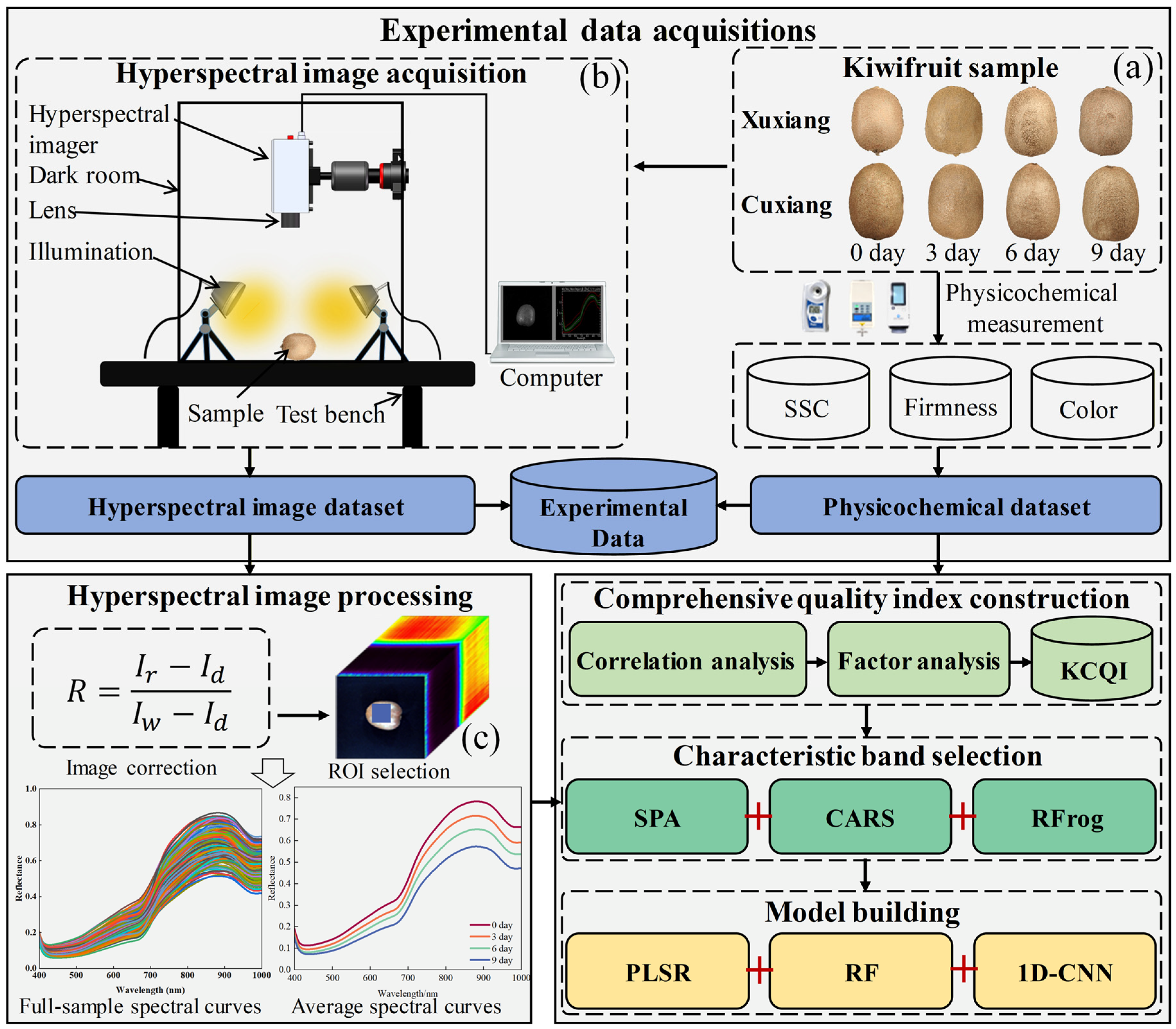
To address this gap, this paper aims to propose a novel kiwifruit comprehensive quality index (KCQI) during shelf life that integrates multiple quality parameters and develops a quantitative estimation method for the KCQI by combining the HSI with 1D-CNN. The specific objectives are as follows: (1) to construct a novel KCQI based on the synergistic integration of multiple quality parameters, (2) to develop a quantitative prediction model for the KCQI using selected spectral characteristic bands in conjunction with 1D-CNN, and (3) to realize the pixel-level mapping and spatial distribution visualization of the KCQI to reveal the law of quality evolution. Figure 1 shows the overall flowchart of this study.
Figure 1.
Flowchart of this study: (a) Kiwifruit samples; (b) Hyperspectral imaging system; and (c) Selection of the region of interest.
2. Materials and Methods
2.1. Samples
Two kiwifruit cultivars (‘Xuxiang’ and ‘Cuixiang’) (Figure 1a) were purchased on 15 November 2024 from the fruit wholesale market in Taian, Shandong Province, China. The fruits of both cultivars were obtained from the same delivery batch at the market. Immediately after purchase, all fruits were transported on the same day to the Postharvest Processing Laboratory of Shandong Agricultural University. Upon arrival, the fruits were held at ambient temperature for 3 h, after which samples exhibiting uniform shape, normal coloration, and no visible mechanical injury were selected. The selected fruits were sorted by cultivar and then arranged in ventilated polyethylene boxes (six fruits per box) and stored at 18 ± 2 °C to simulate typical retail shelf conditions. A total of 120 fruits per cultivar (240 total) were selected. At four storage times—day 0 (purchase day), day 3, day 6, and day 9—thirty fruits of each cultivar were randomly sampled for hyperspectral image acquisition and physicochemical analyses.
2.2. Hyperspectral Imaging System
Hyperspectral images of the kiwifruit samples were acquired using a GaiaField-V10E system (Dualix Spectral Imaging Technology Co., Ltd., Wuxi, Jiangsu, China). The system comprised a hyperspectral camera (GaiaField-V10E), two 200 W tungsten–halogen lamps (HSIA-LS-T-200W), an objective lens (HSIA-OL23), a standard white reference panel (HSIA-CT-150 × 150), a dark chamber, and a computer equipped with SpecView(version 2.9.3.3) data acquisition software. The system operated over a spectral range of 400–1000 nm with a spectral resolution of 2.8 nm and employs a detector array of 1392 × 1040 effective pixels to generate hyperspectral cubes consisting of 256 spectral bands.
2.3. Hyperspectral Image Acquisition and Correction
Kiwifruit samples were removed from the storage boxes and allowed to equilibrate to ambient temperature until their surfaces were free of condensation. Each fruit was then placed on the stage of a light-proof imaging chamber, ensuring that the pedicel was parallel to the stage surface (Figure 1b). To optimize image clarity and avoid overexposure, the camera exposure time and gain were set to 3.67 ms and 5 dB, respectively, with a fixed vertical distance of 46 cm between the lens and the sample. Prior to sample imaging, a standard white reference image () and a dark background image () (acquired with the lens capped) were acquired for radiometric correction using Equation (1):
where and denote the raw hyperspectral image and corrected reflectance image.
Corrected reflectance images were imported into ENVI 4.6 (Research Systems Inc., Boulder, CO, USA), where a 110 × 110-pixel region of interest (ROI) was manually delineated on each hyperspectral cube to encompass the principal scanned area of the fruit (Figure 1c). The average reflectance value of all pixels within the ROI was calculated and extracted as the representative spectral data for each fruit, serving as input for subsequent KCQI quantitative model development.
2.4. Physicochemical Measurement
2.4.1. Color
After HSI, a 1 cm2 section of peel was removed from the equatorial region of each kiwifruit using a fruit knife. The color parameters (L*, a*, b*) of the exposed flesh were measured with a color reader (CR-10Plus, Konica Minolta, Inc., Tokyo, Japan), and the chroma value was calculated [14]. Measurements were taken at four measurement points around the fruit, spaced 90° apart, and the average of these four readings was reported as the reference color value.
2.4.2. Firmness
Following color measurements, flesh firmness was determined using a digital fruit firmness tester (GY-4, Sanliang Technology Co., Ltd., Guangzhou, China) equipped with a 3.2 mm diameter stainless steel probe. The probe was vertically penetrated into the flesh at an acceleration rate of 5 mm/s until a penetration depth of 10 mm was achieved. The maximum force value displayed by the instrument at this depth was recorded. The average firmness value from four measurement points was adopted as the reference firmness value.
2.4.3. Soluble Solids Content
After firmness testing, flesh samples were collected from the four measurement sites and juice was extracted using a juice extractor. A few drops of the freshly expressed juice were placed on the prism plate of a digital refractometer (PAL-1, ATAGO, Tokyo, Japan), and the SSC was measured. The average of four measurements was reported as the reference SSC value.
2.5. Correlation and Factor Analysis
To construct the novel comprehensive quality index, correlation and factor analyses were performed on the kiwifruit quality dataset. First, Pearson correlation analysis was conducted to investigate the interrelationships among individual quality parameters. Next, parameters exhibiting significant correlations were normalized—each variable was mapped to a common scale to eliminate the effects of differing units. Finally, factor analysis was applied to extract the underlying principal factors from the full set of parameters, thereby laying the groundwork for constructing the new composite index.
In the factor analysis, data suitability was first evaluated by the Kaiser–Meyer–Olkin (KMO) measure and Bartlett’s test of sphericity. A KMO value greater than 0.5 indicated that the dataset was adequate for factor analysis, and a Bartlett’s test significance level of p = 0.00 confirmed that correlations among variables were sufficiently strong to proceed with factor extraction [15,16]. The number of factors retained was determined by cumulative variance contribution: factors accounting for a cumulative contribution of ≥80% were selected to define the optimal feature space [17]. Finally, representative quality parameters were chosen based on their loadings in the rotated component matrix. Parameters with absolute loadings greater than 0.5 and no significant cross-loadings were considered optimal. These selected parameters were then linearly combined, weighted by their respective factor loadings, to construct a novel comprehensive quality index. All correlation and factor analyses were performed in IBM SPSS Statistics 26 (SPSS Inc., Chicago, IL, USA).
2.6. Quantitative Prediction Model Development and Evaluation
2.6.1. Sample Set Division and Characteristic Band Selection
The full dataset was divided into a calibration set and a prediction set at an 8:2 ratio using the sample set partitioning based on joint X–Y distances (SPXY) algorithm. The SPXY approach considers both the distribution of the spectral predictors (X) and the target KCQI values (Y) during splitting, ensuring that the calibration and prediction sets are consistent in both spectral and response-value spaces, thereby enhancing model generalizability and prediction stability [18].
To mitigate multicollinearity and improve computational efficiency, three band-selection algorithms were applied to the hyperspectral bands: the SPA, CARS, and the random frog (RFrog) method. SPA, a forward-projection technique, iteratively removes redundant bands by minimizing projection residuals in the residual subspace, yielding a minimally redundant yet highly discriminative band subset that alleviates multicollinearity and stabilizes the model [19]. CARS constructs sampling weights based on the absolute values of PLS regression coefficients and employs an iterative weighted sampling strategy to dynamically adjust each band’s selection probability, preferentially retaining bands that contribute most to predictive performance [20]. RFrog, inspired by reversible-jump Markov chain Monte Carlo, evaluates the selection probability of each band in conjunction with the PLS model’s minimum cross-validation root-mean-square error (RMSECV) criterion to determine the optimal number of bands [21]. All the aforementioned characteristic selection methods were executed strictly on the calibration set defined by SPXY to ensure the integrity of model evaluation and prevent data leakage.
2.6.2. Model Development and Evaluation
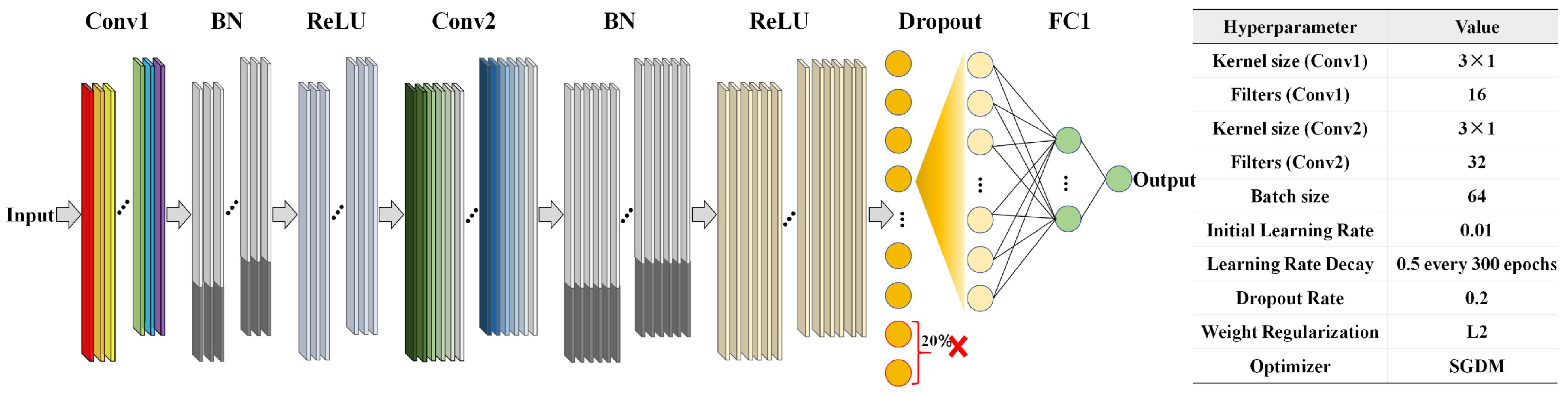
Using the raw reflectance values of kiwifruit as input, quantitative prediction models for the KCQI were developed using PLSR, random forest (RF), and 1D-CNN. PLSR identifies an orthogonal set of latent variables that maximizes the explained variance in the spectral data while optimizing covariance with the KCQI [22]. During modeling, 10-fold cross-validation was used to select the optimal number of latent variables and prevent overfitting. RF, a nonparametric ensemble method, constructs numerous decision trees on random subsets of samples and features, averaging their outputs to improve prediction stability and noise robustness; the number of trees was set to 100 and the minimum leaf-node size to 8 to balance bias and variance [23]. The 1D-CNN model automatically extracts multilevel local spectral features via one-dimensional convolution kernels [24]. As illustrated in Figure 2, the network comprises two convolutional layers (Conv1 and Conv2), each followed by batch normalization (BN) and ReLU activation layers, to accelerate convergence and introduce nonlinearity. A Dropout layer with a 20% drop rate was inserted after the second ReLU to suppress overfitting. A fully connected layer (FC1) then aggregates the multichannel feature maps into a single output, and a regression layer computes the semi-mean-square error to yield continuous KCQI predictions.
Figure 2.
1D-CNN model network structure demonstration.
Model performance was assessed by the calibration set coefficient of determination (), prediction set coefficient of determination (), RMSEC, RMSEP and the RPDP [12,25]. All modeling and evaluation procedures were carried out in MATLAB 2021 (MathWorks Inc., Natick, MA, USA).
3. Results and Discussion
3.1. Spectral Characteristics of Kiwifruit
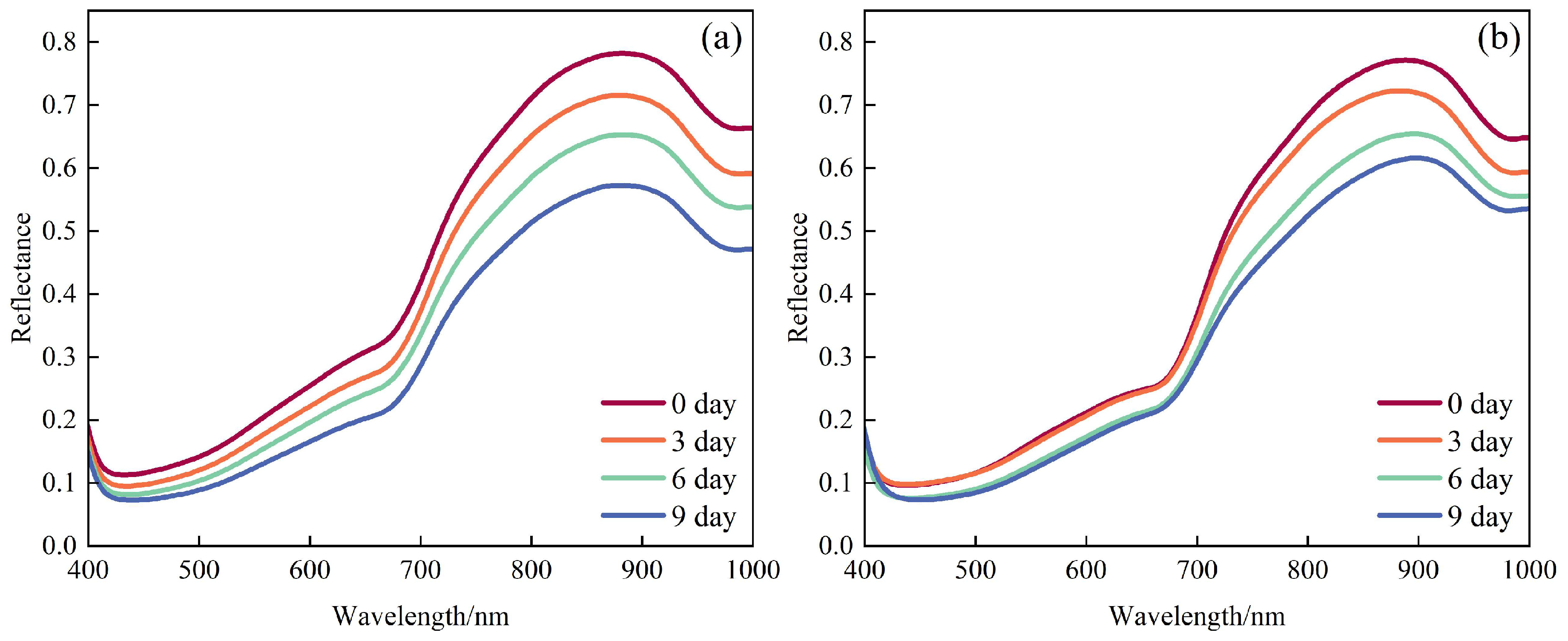
Figure 3 shows the average reflectance spectra (400–1000 nm) of ‘Xuxiang’ and ‘Cuixiang’ kiwifruit at shelf life stages of 0, 3, 6, and 9 days. An absorption feature around 420 nm is attributed to chlorophyll a and b absorption in the blue region [12]. The absorption peak at 670 nm corresponds to the characteristic red-light absorption of chlorophyll a; its amplitude decreased with storage time, indicating chlorophyll a degradation. In the near-infrared (NIR) region, reflectance at 830 nm declined continuously over the shelf life, reflecting both reduced scattering due to softening of cell walls and enlargement of intercellular spaces and enhanced NIR absorption resulting from accumulation of soluble solids [26]. The pronounced absorption near 970 nm arises from the strong second overtone of the O–H vibration in water molecules, and changes in its depth directly indicate dynamic regulation of fruit moisture content during storage [27].
Figure 3.
Average reflectance spectra of kiwifruit at different shelf life stages: (a) ‘Xuxiang’ and (b) ‘Cuixiang’.
3.2. Statistics and Analysis of Reference Values
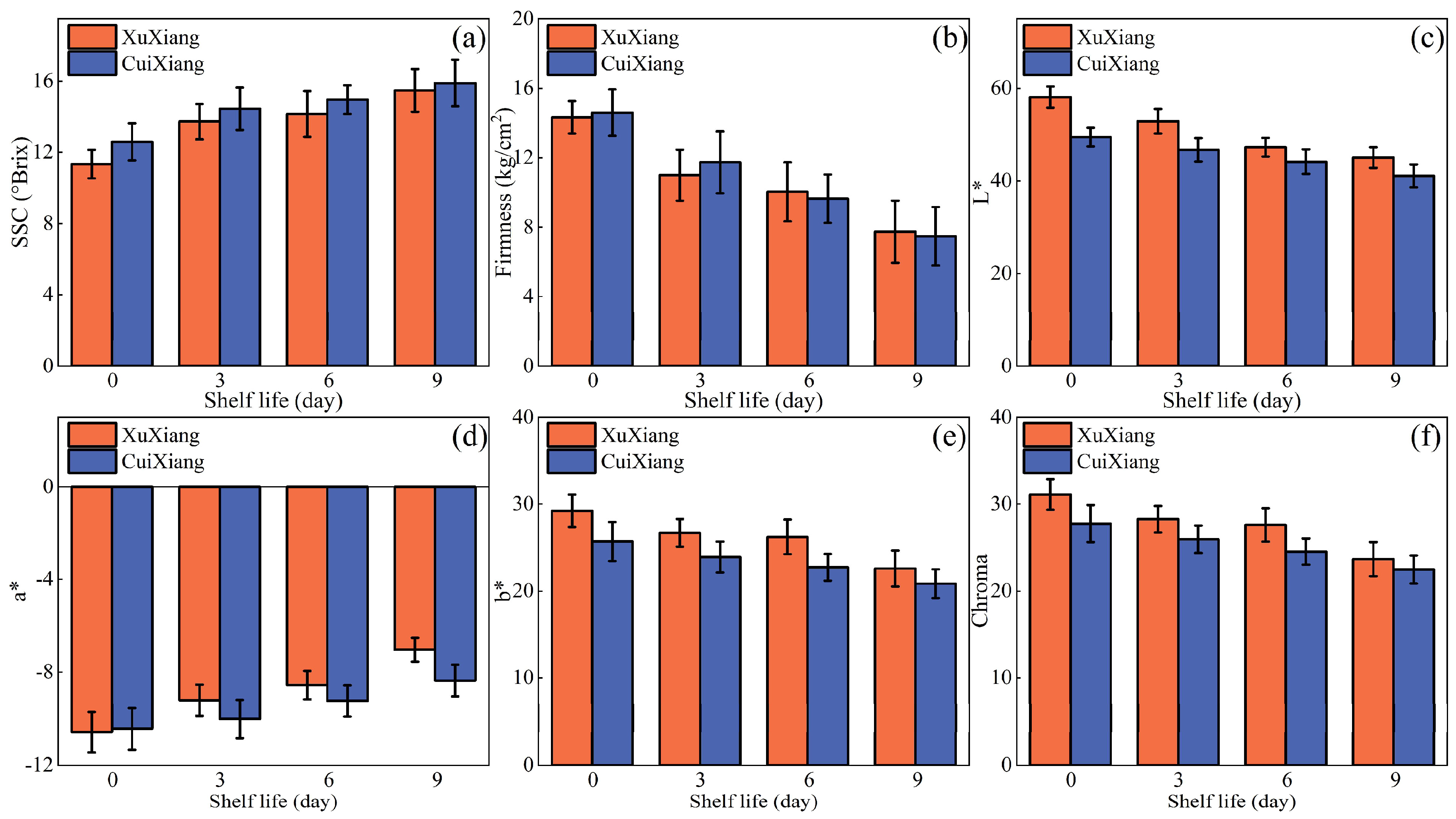
Figure 4 shows changes in kiwifruit quality parameters during shelf life. As storage time increased, the SSC of both cultivars increased from approximately 12 °Brix to 16–17 °Brix, and the a* value increased from about −9 to −6, both exhibiting a continuous upward trend. In contrast, L* values decreased from around 55 to 45, b* values from about 30 to 22, and chroma from approximately 32 to 24, all showing continuous declines. Meanwhile, fruit firmness fell from an initial 13–14 kg cm−2 to below 8 kg cm−2, reflecting moisture loss and textural changes resulting from cell-wall softening and tissue relaxation during storage. These trends indicate that, as storage time increased, soluble solids accumulate and pigmentation shifts toward red, while lightness, color saturation, and firmness decrease in parallel—providing the data basis for constructing a comprehensive quality index.
Figure 4.
Statistical analysis of changes in kiwifruit quality indicators over increasing shelf life. (a) SSC, (b) Firmness, (c) L*, (d) a*, (e) b* and (f) Chroma. Error bars represent the standard deviation (SD).
3.3. Correlation Analysis Results
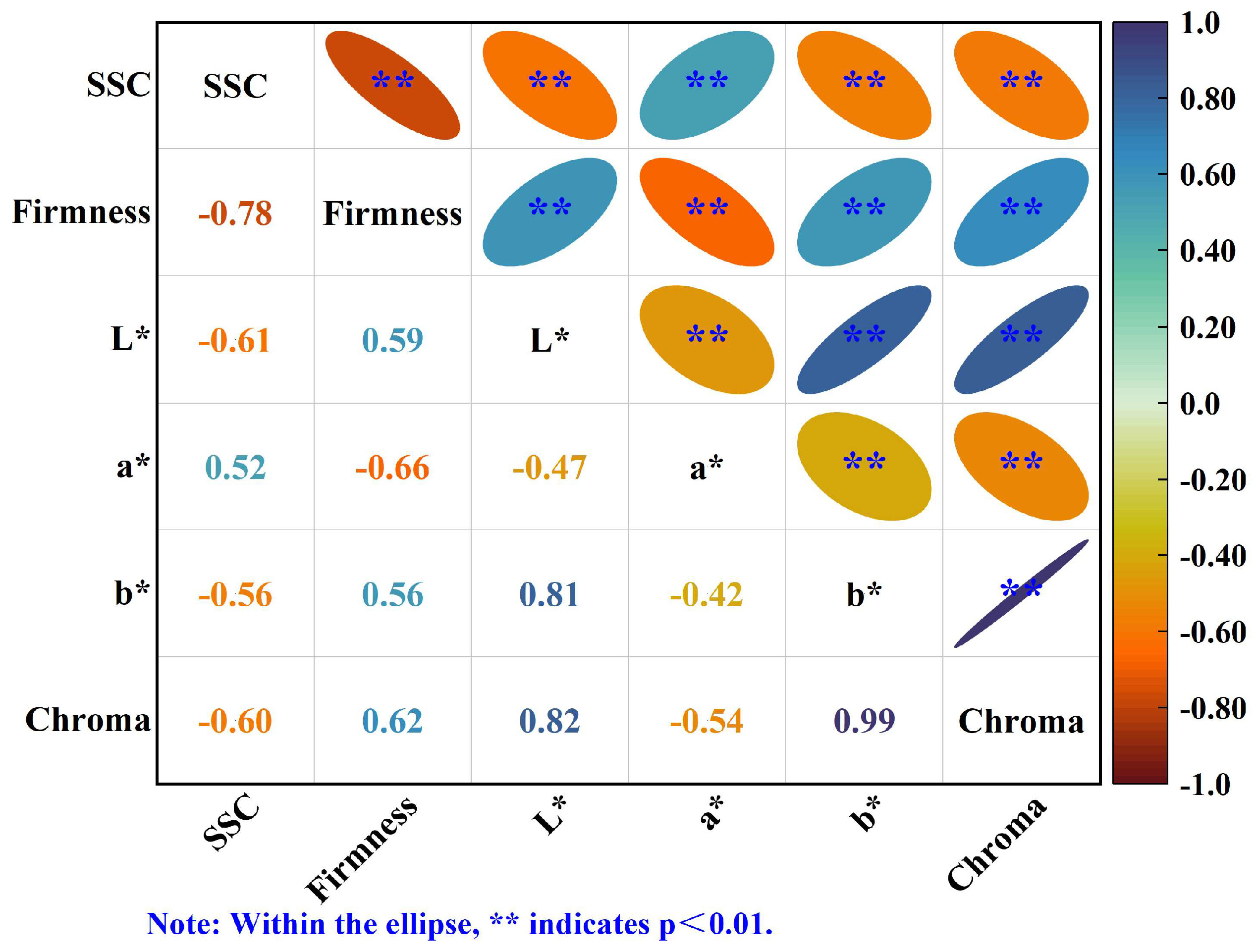
Pearson correlation coefficients among the quality parameters are displayed in Figure 5. SSC exhibited a significant positive correlation with a* (r = 0.52) and significant negative correlations with firmness, L*, b*, and chroma (r = −0.78, −0.61, −0.56, and −0.60, respectively). Firmness was positively correlated with L*, b*, and chroma (r = 0.59, 0.56, and 0.62, respectively) but negatively correlated with a* (r = −0.66). Additionally, L* correlated positively with b* and chroma, while a* correlated negatively with b* and chroma; b* and chroma exhibited a very strong positive correlation (r = 0.99). These interrelationships indicate that, as storage time increased, increases in soluble solids are concomitant with reddening of the peel (higher a*) and tissue softening (lower firmness), whereas lightness and color saturation metrics decline in tandem. These correlation patterns not only elucidate the intrinsic linkages underlying kiwifruit quality changes during storage but also inform the selection of representative parameters for subsequent factor-analysis–based index development.
Figure 5.
Pearson correlation matrix of kiwifruit quality parameters during shelf life.
3.4. Factor Analysis Results and Construction of the KCQI
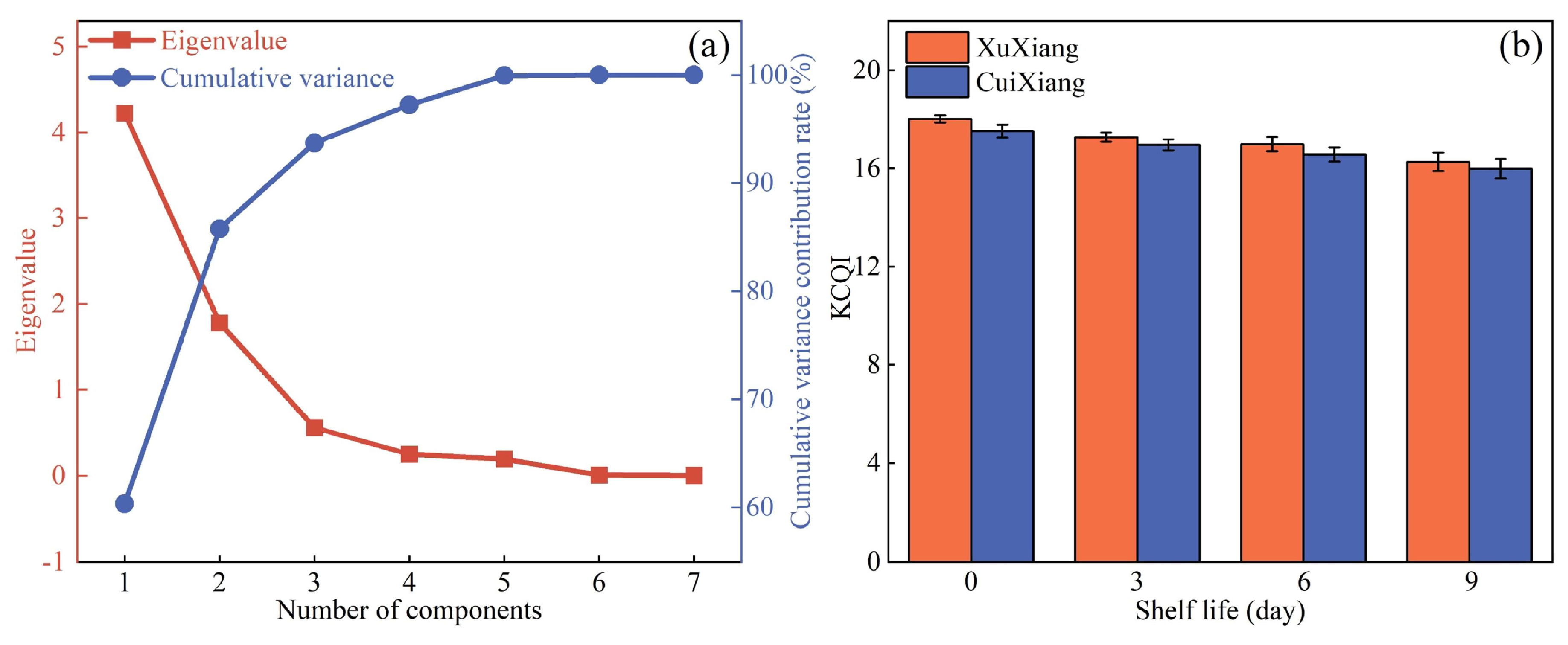
After normalizing all kiwifruit quality parameters, the dataset’s suitability for factor analysis was first evaluated. The KMO measure was 0.66, indicating that sampling adequacy met the requirements for factor analysis. Bartlett’s test of sphericity yielded a significance level of p = 0.000, demonstrating that the correlation matrix significantly deviated from an identity matrix and was therefore appropriate for extracting common factors. These results confirmed that the data were suitable for exploratory factor analysis. As shown in Figure 6a, the scree plot and cumulative variance contribution rates indicated that the first three factors accounted for more than 90% of the total variance. Therefore, these three factors were considered to capture the majority of the information contained in all quality parameters, exhibiting strong internal consistency and explanatory power.
Figure 6.
(a) Scree plot and cumulative variance contribution rates after factor analysis; (b) KCQI trend over shelf life. Error bars represent the SD.
To identify the original variables most strongly associated with these factors, we examined the factor-loading matrix (Table 1). Factor 1 was primarily loaded by soluble SSC, firmness, L*, and chroma; Factor 2 was dominated by b*; no variable exhibited sufficient loading on Factor 3, so it was excluded from the final evaluation framework. Since Factors 1 and 2 together explained 84.9% of the total variance, they were deemed to represent the major variation in the original quality parameters. Consequently, five key parameters were selected as comprehensive evaluation factors.
Table 1.
Component score coefficient matrix.
Based on the principle of using positive loadings in the numerator and negative loadings in the denominator, the KCQI was defined as follows:
where F denotes firmness and C denotes chroma.
Applying this formula to weight and integrate the selected quality parameters yielded the KCQI trend over the shelf life period (Figure 6b). At the early shelf-life stage, higher KCQI values indicated firmer, vibrant-colored fruit with lower SSC, corresponding to a crisp texture and higher acidity. As shelf life progressed, the gradual decrease in the KCQI reflected fruit softening, darkening color, and increased SSC, which associated with a soft texture and elevated sweetness. This composite index integrates both structural and compositional attributes of kiwifruit, providing a quantitative foundation and theoretical support for comprehensive quality assessment.
3.5. Characteristic Band Selection
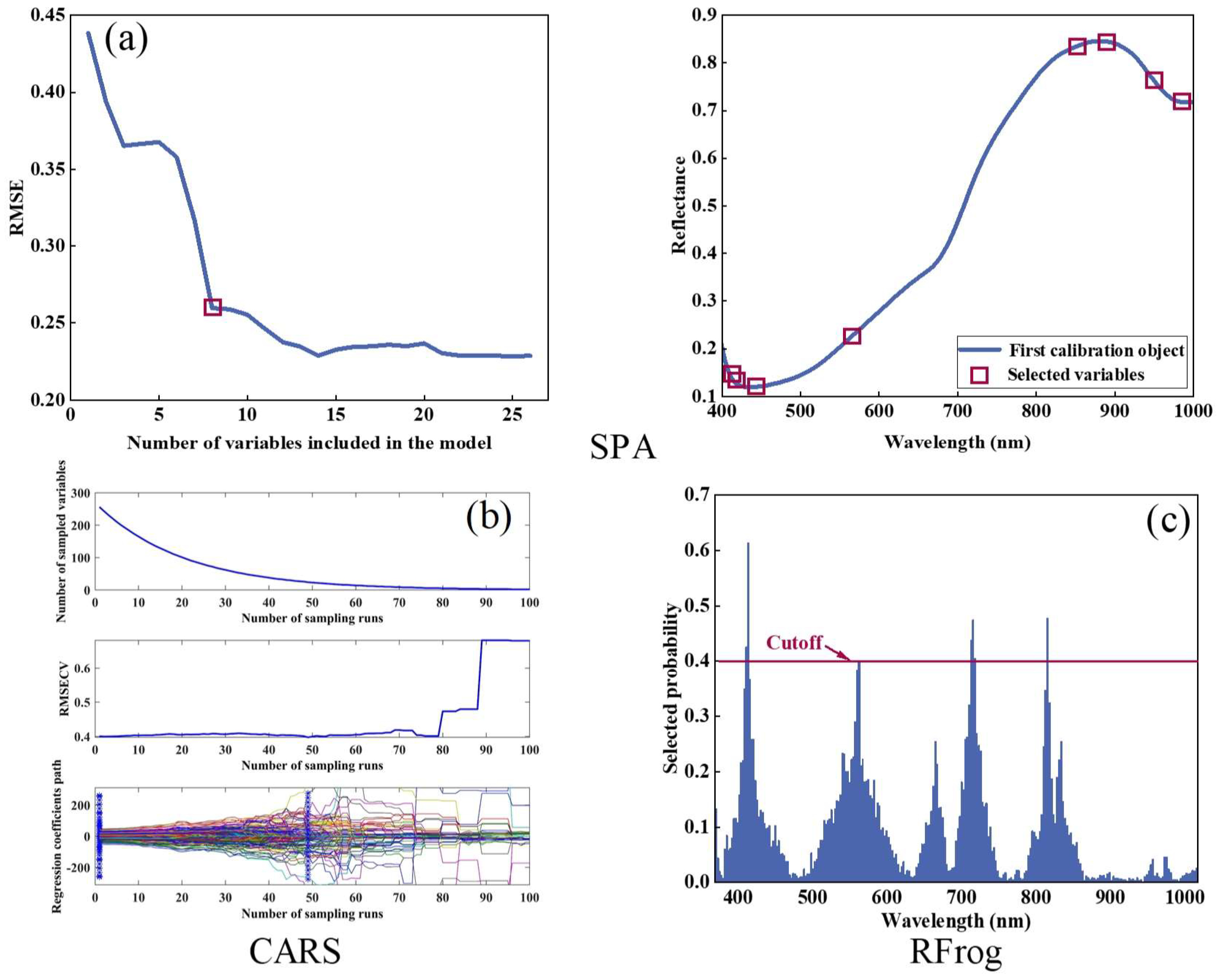
Characteristic band selection was performed using SPA, CARS and RFrog (Figure 7). In Figure 7a, the SPA procedure is illustrated: as the number of bands increased, the RMSE decreased continuously; when RMSE reached 0.2596, an F-test at significance level α = 0.25 indicated no significant difference from the minimum RMSE, resulting in eight characteristic bands. Figure 7b shows the CARS process: as Monte Carlo sampling iterations increased, the number of retained bands decreased; at 50 iterations, RMSECV attained its minimum value of 0.3972, corresponding to 19 characteristic bands. Figure 7c presents the selection probabilities for each band calculated by RFrog: when RMSECV reached its lowest value of 0.3373, a probability threshold of 0.40 was applied, yielding seven characteristic bands. The exact bands selected by each algorithm are listed in Table 2.
Figure 7.
Characteristic band selection. (a) SPA selection process, showing RMSE decreasing as the number of bands increases; (b) CARS selection process, with the number of retained bands decreasing as the number of sampling iterations increases and RMSECV varying dynamically; (c) RFrog selection probabilities for each band, with bands above the threshold line being selected.
Table 2.
The Characteristic bands selected for KCQI.
3.6. Model Development for KCQI Prediction
Using the selected characteristic bands, three predictive models for the KCQI were constructed based on PLSR, RF, and 1D-CNN algorithms. Table 3 summarizes each model’s performance metrics on both the calibration and prediction sets. Among them, the model combining CARS-extracted bands with 1D-CNN achieved the best performance: in the calibration set, and RMSEC were 0.8347 and 0.2768, respectively; in the prediction set, and RMSEP were 0.8205 and 0.2607, with an RPDP of 2.3853, the highest of all models. For further comparison, a 1D-CNN model using the full spectrum was developed as a baseline. The full-spectrum model showed calibration set and RMSEC of 0.8817 and 0.2241, and prediction set , RMSEP, and RPDP of 0.8238, 0.2657, and 2.4079, respectively, slightly outperforming the CARS-1D-CNN model. Nevertheless, the CARS algorithm achieved a substantial reduction in input variables—from 256 to only 19 bands—at a minimal cost to accuracy. This significantly enhances model simplicity and computational efficiency, which is of considerable practical value for developing portable real-time detection instruments.
Table 3.
Performance of KCQI predictive models constructed using characteristic bands.
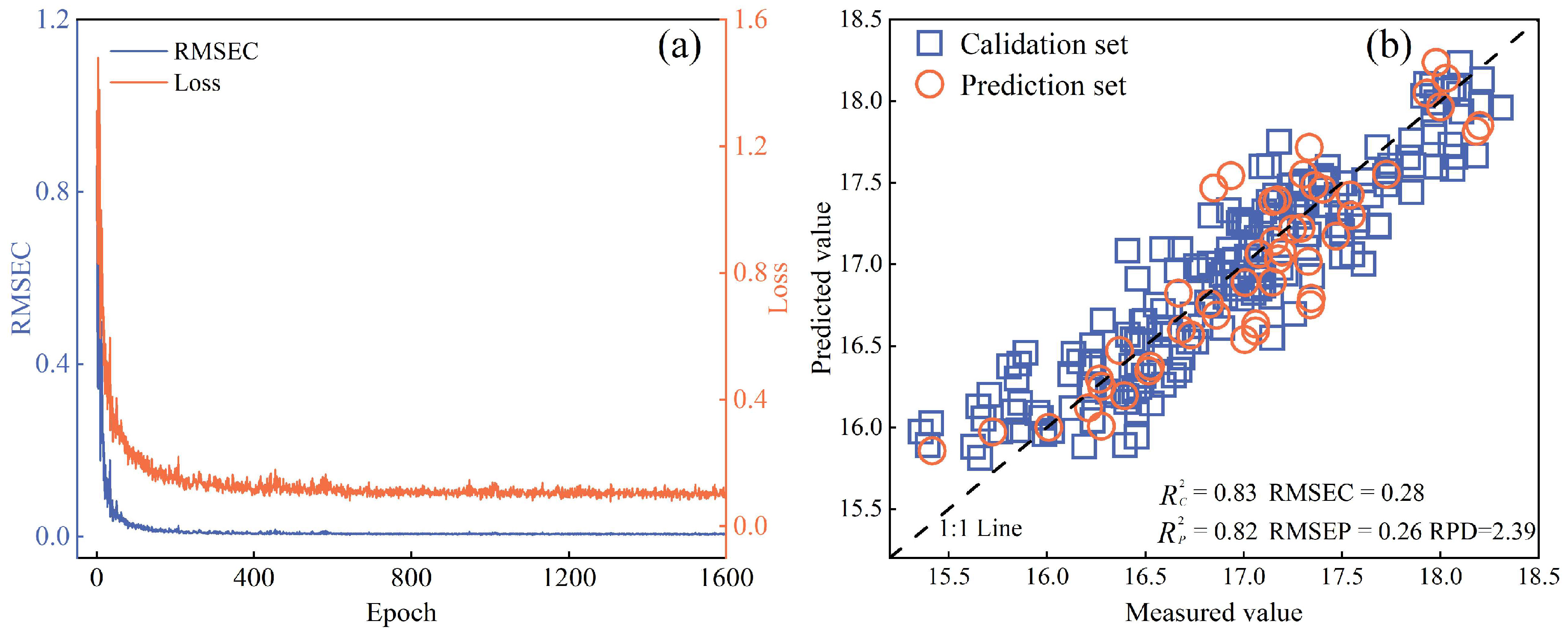
Figure 8 shows the training process of the CARS–1D-CNN model, showing the trends of loss and RMSEC over epochs, as well as the scatter plot of measured versus predicted values under optimal parameter settings. As shown in Figure 8a, both loss and RMSEC decreased continuously with increasing epochs, reaching lower levels by the 112th epoch, indicating good model fitting; subsequent training primarily served to fine-tune parameters for performance optimization. In Figure 8b, the scatter plot demonstrates that the predicted values closely align with the measured values along the diagonal, indicating a strong linear correlation and further validating the reliability of the constructed KCQI predictive model.
Figure 8.
Training process and measured-predicted scatter plot of the CARS–1D-CNN model. (a) Changes in RMSEC and loss during training; (b) Scatter plot of predicted vs. measured values of the model.
3.7. Visualization of KCQI
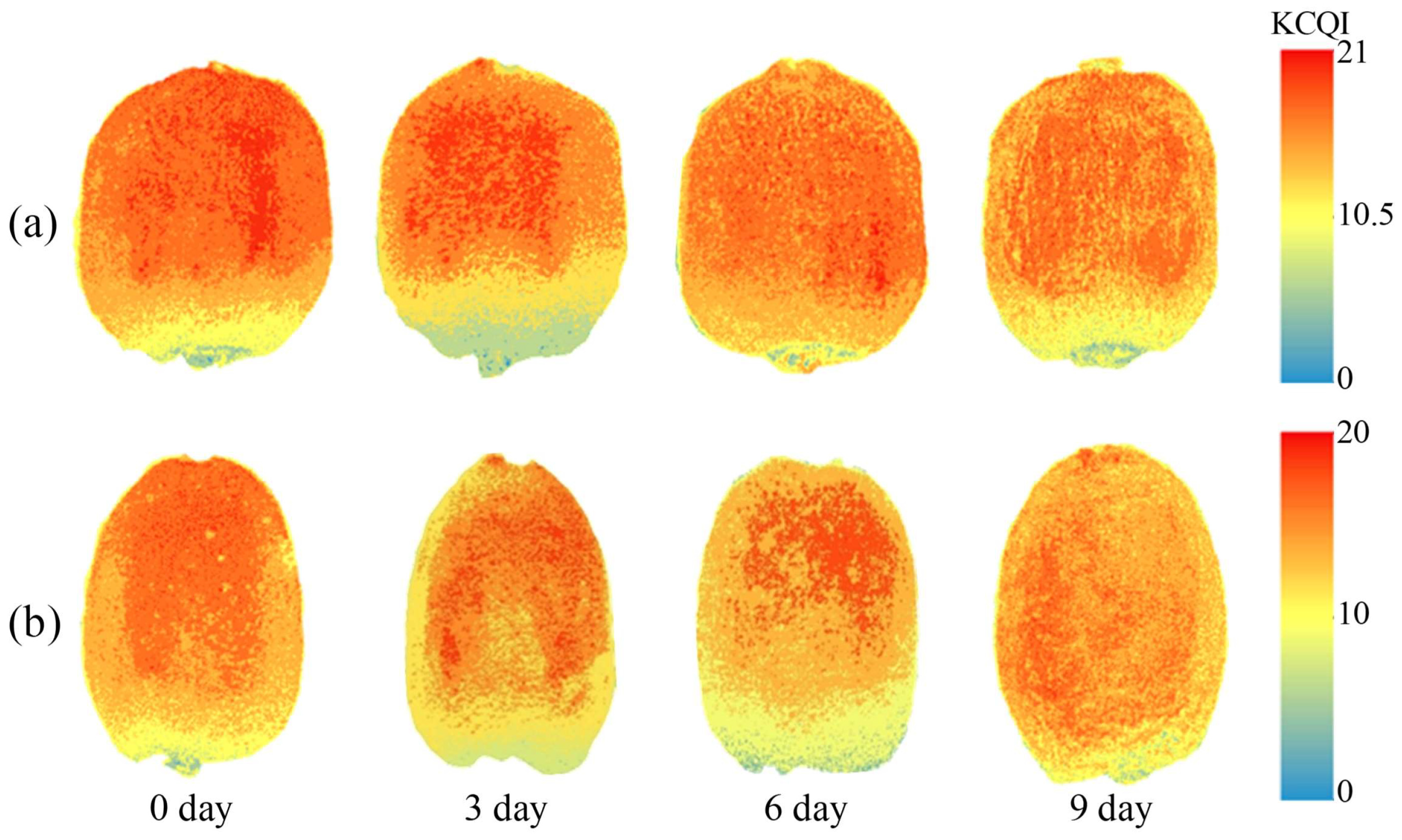
To visualize KCQI dynamics during shelf life, the developed CARS–1D-CNN model was implemented for pixel-wise KCQI prediction and spatial visualization (Figure 9). As shelf life progressed, both cultivars exhibited gradual chromatic shifts from dark red to red-yellow in pseudocolor maps, with high-KCQI domains (predominantly red) occupying most fruit-surface pixels. The adjacent colorbar specifies KCQI value ranges for corresponding pixels. These findings demonstrate that HSI-based KCQI spatial maps not only facilitate real-time monitoring of kiwifruit quality progression but also provide critical data foundations for the development of precision quality-sensing instruments.
Figure 9.
Visualization of KCQI. (a) ‘Xuxiang’ and (b) ‘Cuixiang’.
4. Conclusions
To our knowledge, this study is the first to employ the HSI and deep learning to assess the comprehensive quality of kiwifruit during shelf life. Our findings, confirmed by Pearson correlation analysis, revealed significant correlations among quality parameters (SSC, firmness, L*, a*, b*, and chroma) of kiwifruit at different shelf life. Meanwhile, the most representative quality parameters (SSC, firmness, L*, b*, chroma) were selected by factor analysis, and the KCQI incorporating multiple parameters was constructed. Furthermore, spectral characteristic bands related to the KCQI were optimized using SPA, CARS, and RFrog, and predictive models for the KCQI were constructed by combining PLSR, RF, and 1D-CNN. The CARS–1D-CNN model achieved the best performance: the calibration set ( = 0.8347, RMSEC = 0.2768) and prediction set ( = 0.8205, RMSEP = 0.2607), with an RPDP of 2.3853. Finally, the CARS–1D-CNN model was applied for pixel-level prediction on spectral images of kiwifruit, enabling visualization of KCQI distribution throughout shelf life. This study provides a novel method for assessing the quality of kiwifruit at different shelf life and offers technical support for developing rapid quality-testing instruments.
Notably, this study was conducted under controlled conditions using two specific kiwifruit cultivars. While the proposed method demonstrated excellent performance within this framework, its generalizability to fruits from different harvest seasons and orchards or subjected to varying pre-storage conditions requires further investigation. Future work should focus on validating and calibrating the model with larger and more diverse datasets encompassing a wider range of agricultural practices and environmental variations. This step is crucial for enhancing the model’s robustness and advancing its practical application in the commercial grading and quality monitoring of kiwifruit.
Author Contributions
Conceptualization, data curation, investigation, writing—original draft preparation, writing—review and editing, and visualization, Y.W.; Investigation, Data curation, Validation, K.Z., Y.L. and J.L.; Writing—review and editing, R.L. and B.M.; Conceptualization, Methodology, Resources, L.S.; Conceptualization, writing—review and editing, L.J. and X.C.; Conceptualization, data curation, writing—original draft preparation, H.Z.; Conceptualization, investigation, data curation, writing—original draft preparation, writing—review and editing, funding acquisition, project administration, and supervision, J.W. All authors have read and agreed to the published version of the manuscript.
Funding
This work was supported by the Shandong Province Key R&D Plan (2022CXGC020701), China Postdoctoral Science Foundation (2025M772484), Postdoctoral Innovation Program of Shandong Province (SDCX-ZG-202503062), and Young Talent of Lifting engineering for Science and Technology in Shandong (SDAST2024QTA050).
Institutional Review Board Statement
Not applicable.
Informed Consent Statement
Not applicable.
Data Availability Statement
The original contributions presented in this study are included in the article. Further inquiries can be directed to the corresponding authors.
Conflicts of Interest
The authors declare that they have no known competing financial interests or personal relationships that could have appeared to influence the work reported in this paper.
References
- Richardson, D.P.; Ansell, J.; Drummond, L.N. The nutritional and health attributes of kiwifruit: A review. Eur. J. Nutr. 2018, 57, 2659–2676. [Google Scholar] [CrossRef]
- Li, M.; Pullanagari, R.; Yule, I.; East, A. Segregation of ‘Hayward’kiwifruit for storage potential using Vis-NIR spectroscopy. Postharvest Biol. Technol. 2022, 189, 111893. [Google Scholar] [CrossRef]
- Chai, J.; Yang, B.; Xu, N.; Jiang, Q.; Gao, Z.; Ren, X.; Liu, Z. Effects of low temperature on postharvest ripening and starchiness in ‘Cuixiang’ kiwifruit. LWT 2024, 209, 116795. [Google Scholar] [CrossRef]
- Ma, H.; Liu, N.; Xie, G.; Tan, S.; Xu, Y.; Luo, Z. Postharvest ripening combined with 1-MCP keeps the shelf quality of kiwifruit after cold storage by regulating the antioxidant system and defense enzymes. Postharvest Biol. Technol. 2025, 222, 113370. [Google Scholar] [CrossRef]
- Zheng, Y.; Luo, F.; Wang, L.; Li, S.; Wang, X.; Zhu, Z. Comparison of the characteristics of phenolic compounds in Se-enriched kiwifruit and conventional kiwifruit. Food Chem. X 2025, 27, 102453. [Google Scholar] [CrossRef]
- Liang, D.; Wang, N.; Yin, H.; Cui, J.; Huang, Y.; Sun, Y.; Hu, Y. Assessment of the optical response of bruised kiwifruit using hyperspectral imaging and its relationships with water migration. Postharvest Biol. Technol. 2025, 225, 113515. [Google Scholar] [CrossRef]
- Cevoli, C.; Iaccheri, E.; Fabbri, A.; Ragni, L. Data fusion of FT-NIR spectroscopy and Vis/NIR hyperspectral imaging to predict quality parameters of yellow flesh “Jintao” kiwifruit. Biosyst. Eng. 2024, 237, 157–169. [Google Scholar] [CrossRef]
- Lee, J.E.; Kim, M.J.; Lee, B.Y.; Hwan, L.J.; Yang, H.E.; Kim, M.S.; Hwang, I.G.; Jeong, C.S.; Mo, C. Evaluating ripeness in post-harvest stored kiwifruit using VIS-NIR hyperspectral imaging. Postharvest Biol. Technol. 2025, 225, 113496. [Google Scholar] [CrossRef]
- Hu, W.; Sun, D.W.; Blasco, J. Rapid monitoring 1-MCP-induced modulation of sugars accumulation in ripening ‘Hayward’kiwifruit by Vis/NIR hyperspectral imaging. Postharvest Biol. Technol. 2017, 125, 168–180. [Google Scholar] [CrossRef]
- Shang, J.; Tan, T.; Feng, S.; Li, Q.; Huang, R.; Meng, Q. Quality attributes prediction and maturity discrimination of kiwifruits by hyperspectral imaging and chemometric algorithms. J. Food Process Eng. 2023, 46, e14348. [Google Scholar] [CrossRef]
- Zheng, Y.; Cao, Y.; Yang, J.; Xie, L. Enhancing model robustness through different optimization methods and 1-D CNN to eliminate the variations in size and detection position for apple SSC determination. Postharvest Biol. Technol. 2023, 205, 112513. [Google Scholar] [CrossRef]
- Wang, Z.; Wang, J.; Lan, W.; Wang, M.; Tu, K.; Zhu, L.; Pan, L. Exploring the impact of lenticels on the detection of soluble solids content in apples and pears using hyperspectral imaging and one-dimensional convolutional neural networks. Food Res. Int. 2025, 205, 115960. [Google Scholar] [CrossRef]
- Xu, X.; Chen, Y.; Yin, H.; Wang, X.; Zhang, X. Nondestructive detection of SSC in multiple pear (Pyrus pyrifolia Nakai) cultivars using Vis-NIR spectroscopy coupled with the Grad-CAM method. Food Chem. 2024, 450, 139283. [Google Scholar] [CrossRef] [PubMed]
- Topuz, A.; Feng, H.; Kushad, M. The effect of drying method and storage on color characteristics of paprika. LWT-Food Sci. Technol. 2009, 42, 1667–1673. [Google Scholar] [CrossRef]
- Shao, Y.; Shi, Y.; Qin, Y.; Xuan, G.; Li, J.; Li, Q.; Yang, F.; Hu, Z. A new quantitative index for the assessment of tomato quality using Vis-NIR hyperspectral imaging. Food Chem. 2022, 386, 132864. [Google Scholar] [CrossRef]
- Hsu, F.C.; Chen, C.N.; Shieh, M.D. Using stepwise backward elimination to specify terms related to tactile sense for product design. Adv. Eng. Inform. 2022, 46, 101193. [Google Scholar] [CrossRef]
- He, Y.; Pang, Y.; Zhang, Q.; Jiao, Z.; Chen, Q. Comprehensive evaluation of regional clean energy development levels based on principal component analysis and rough set theory. Renew. Energy 2018, 122, 643–653. [Google Scholar] [CrossRef]
- Sun, Y.; Yuan, M.; Liu, X.; Su, M.; Wang, L.; Zeng, Y.; Zang, H.; Nie, L. A sample selection method specific to unknown test samples for calibration and validation sets based on spectra similarity. Spectrochim. Acta Part A Mol. Biomol. Spectrosc. 2021, 258, 119870. [Google Scholar] [CrossRef]
- An, H.; Zhai, C.; Zhang, F.; Ma, Q.; Sun, J.; Tang, Y.; Wang, W. Quantitative analysis of Chinese steamed bread staling using NIR, MIR, and Raman spectral data fusion. Food Chem. 2023, 405, 134821. [Google Scholar] [CrossRef]
- Liu, L.; Zareef, M.; Wang, Z.; Li, H.; Chen, Q.; Ouyang, Q. Monitoring chlorophyll changes during Tencha processing using portable near-infrared spectroscopy. Food Chem. 2023, 412, 135505. [Google Scholar] [CrossRef]
- Xuan, G.; Gao, C.; Shao, Y. Spectral and image analysis of hyperspectral data for internal and external quality assessment of peach fruit. Spectrochim. Acta Part A Mol. Biomol. Spectrosc. 2022, 272, 121016. [Google Scholar] [CrossRef]
- Zhang, D.; Yang, Y.; Chen, G.; Tian, X.; Wang, Z.; Fan, S.; Xin, Z. Nondestructive evaluation of soluble solids content in tomato with different stage by using Vis/NIR technology and multivariate algorithms. Spectrochim. Acta Part A Mol. Biomol. Spectrosc. 2021, 248, 119139. [Google Scholar] [CrossRef]
- Ramos, A.P.M.; Osco, L.P.; Furuya, D.E.G.; Gonçalves, W.N.; Santana, D.C.; Teodoro, L.P.R.; Junior, C.A.d.S.; Capristo-Silva, G.F.; Li, J.; Baio, F.H.R.; et al. A random forest ranking approach to predict yield in maize with uav-based vegetation spectral indices. Comput. Electron. Agric. 2020, 178, 105791. [Google Scholar] [CrossRef]
- Li, Z.Y.; Huang, X.; Yang, J.X.; Luo, S.H.; Wang, J.; Fang, Q.L.; Hui, A.L.; Liang, F.X.; Wu, C.Y.; Wang, L.B.; et al. An improved 1D CNN with multi-sensor spectral fusion for SSC in pears. J. Food Compos. Anal. 2025, 144, 107732. [Google Scholar] [CrossRef]
- Sun, J.; Wang, G.; Zhang, H.; Xia, L.; Zhao, W.; Guo, Y.; Sun, X. Detection of fat content in peanut kernels based on chemometrics and hyperspectral imaging technology. Infrared Phys. Technol. 2020, 105, 103226. [Google Scholar] [CrossRef]
- Shao, Y.; Wang, Y.; Xuan, G. In-field and non-invasive determination of internal quality and ripeness stages of Feicheng peach using a portable hyperspectral imager. Biosyst. Eng. 2021, 212, 115–125. [Google Scholar] [CrossRef]
- Li, J.; Chen, L. Comparative analysis of models for robust and accurate evaluation of soluble solids content in ‘Pinggu’peaches by hyperspectral imaging. Comput. Electron. Agric. 2017, 142, 524–535. [Google Scholar] [CrossRef]
Disclaimer/Publisher’s Note: The statements, opinions and data contained in all publications are solely those of the individual author(s) and contributor(s) and not of MDPI and/or the editor(s). MDPI and/or the editor(s) disclaim responsibility for any injury to people or property resulting from any ideas, methods, instructions or products referred to in the content. |
© 2025 by the authors. Licensee MDPI, Basel, Switzerland. This article is an open access article distributed under the terms and conditions of the Creative Commons Attribution (CC BY) license (https://creativecommons.org/licenses/by/4.0/).