Skip to Content
PhotonicsPhotonics
  • Article
  • Open Access

24 March 2026

Photonic Crystal-Based Ultra-Wideband Bow-Tie Antenna for High-Gain and THz Frequency-Dependent Beam Scanning


,
,
,
,
,
and
1
ETA Laboratory, University Mohamed El Bachir El Ibrahimi of Bordj Bou Arreridj, Bordj Bou Arreridj 34000, Algeria
2
LIST Laboratory, University M’Hamed Bougara of Boumerdes, Boumerdes 35000, Algeria
3
Laboratory of Advanced Technologies in Electrical Engineering, Mouloud Mammeri University of Tizi Ouzou, Tizi-Ouzou 15000, Algeria
4
Advanced High Voltage Engineering Centre, School of Engineering, Cardiff University, Queen’s Buildings, The Parade, Cardiff CF24 3AA, UK

Abstract

One of the strongest electromagnetic engineering approaches for enhancing antenna performance is the use of photonic crystal (PhC) substrates. This technique can be efficiently applied to antenna design and offers notable advantages, such as gain improvement, increased bandwidth, and frequency-dependent beam scanning. In this paper, a bow-tie dipole antenna has been developed for terahertz operation over the 0.39–1.3 THz band, presenting a novel structure capable of producing strong ultra-wideband (UWB) field enhancement within its feed gap. The feed gap between the two metallic arms has a slot width of 1.24 λ0 (λ0 is the wavelength in free space at a center range of 0.8 THz), which facilitates the generation of an enhanced electric field. The PhC substrate enables surface-wave control through dispersion engineering, thereby enhancing the radiation efficiency of the antenna. The proposed antenna exhibits a radiation efficiency of approximately 73–93% over the entire UWB frequency band. Furthermore, the PhC substrate antenna achieves a maximum gain of 21 dB, exceeding that of a homogeneous-substrate THz bow-tie antenna by at least 3.3 dB. The results indicate that the antenna achieves |S11| < −10 dB impedance matching over the bandwidth of 105.9%, ranging from 0.4 to 1.3 THz. The proposed bow-tie dipole antenna integrated with a PhC substrate demonstrates a wide beam-scanning capability from −54° to +74° across the 0.39–1.16 THz band, while maintaining a compact footprint of 14.9 λ0 × 22.4 λ0. This combination of wide scanning, broad bandwidth, and ultra-low profile represents a notable advancement in the development of compact THz radiating structures.

1. Introduction

Terahertz (THz) systems have experienced rapid growth in recent years, driven by their transformative potential in high-speed wireless communications, advanced imaging, sensing, and radar applications [1,2,3], making them vital for next-generation technologies such as 6G networks [4,5]. Antennas are central to these THz technologies, enabling efficient transmission and reception of THz waves for applications such as non-invasive medical imaging [6,7], security screening [8], spectroscopy [9], and ultra-fast data links [10]. Consequently, they dictate key system parameters such as sensitivity, resolution, and data rates. However, THz antenna design faces significant challenges, including high propagation and material losses [11], limited beam control [12], and stringent integration constraints required for compact on-chip solutions [13]. Addressing these issues is essential for unlocking the full potential of THz systems in practical applications. These challenges are compounded by the intrinsic difficulties of integrating efficient radiating structures with THz transceivers while maintaining low loss, high gain, and controllable beam steering, all of which are critical for effective THz communication and sensing systems [14,15].
Recent research on terahertz beam-scanning antennas has explored a variety of enabling technologies, including phased arrays, mechanical scanning systems [16], frequency-dependent structures [17], and reconfigurable metasurfaces [18,19]. While these approaches demonstrate diverse mechanisms for beam steering, they often face significant practical limitations when applied to THz frequencies. For example, many phase-array and leaky-wave designs achieve only modest scanning ranges [20] or require complex feeding networks that increase design overhead and fabrication complexity [21,22]. Mechanical scanning and lens-based systems may offer beam control but at the cost of slow response and bulky structures that are difficult to integrate into compact THz platforms [23,24,25,26]. Additionally, several metasurface and photonic implementations have shown potential for beam manipulation yet suffer from low radiation efficiency or limited gain due to material and loss constraints at terahertz bands [27,28]. These limitations, such as restricted scanning range, lower gain, complex feeding requirements, and fabrication challenges, highlight the need for alternative antenna solutions capable of delivering wide-angle scanning and high performance in practical THz applications.
Bow-tie antennas are widely recognized for their inherent broadband performance, which is attributed to their flared triangular geometry that supports a wide range of resonant modes [29,30] and provides improved impedance matching over a broad frequency spectrum compared to conventional dipoles [31]. This broadband characteristic has made bow-tie configurations attractive for terahertz [32] and millimeter-wave applications [33], where wide operational bandwidth is critical for high-resolution imaging, broadband communication, and sensing systems [34,35]. In the THz regime, planar bow-tie antennas have been shown to offer continuous spectral coverage and stable radiation behavior across multi-bands by leveraging geometric tapering and careful dimensional optimization [36,37]. Building on these advantages, the antenna design presented in this work employs a bow-tie topology that, when integrated with a PhC substrate, achieves an UWB response with enhanced radiation performance suitable for advanced terahertz applications.
Recent advances have demonstrated that integrating PhC or photonic bandgap (PBG) structures with THz antennas can dramatically enhance performance [38,39]; these PhC substrates function as periodic dielectric structures wherein electromagnetic propagation is governed by deliberate spatial modulation of the permittivity, rather than by the uniform behavior of homogeneous materials [40,41]. This periodic modulation alters the local electromagnetic environment, leading to modified wave propagation characteristics that can be exploited for antenna performance enhancement [42,43]. When implemented as antenna substrates, PhC structures disrupt the formation and propagation of surface waves by breaking the continuous guiding paths that typically exist in uniform dielectric materials [44], thereby reducing substrate-guided energy leakage and minimizing power loss within the substrate [45]. As a result, a greater fraction of the input power is efficiently coupled into free-space radiation, which directly contributes to improvements in radiation efficiency and realized antenna gain [46].
In addition to surface-wave suppression, the periodic geometry of the PhC substrate introduces engineered dispersion characteristics that influence the phase velocity and propagation behavior of electromagnetic waves across the operating frequency range [47,48]. This controlled modification of wave dispersion enables more effective manipulation of the radiated fields, supporting improved beam shaping and enhanced directivity [49]. Furthermore, the frequency-dependent nature of the dispersion introduced by the periodic lattice allows gradual variation in the radiation angle with frequency, which can be leveraged to achieve frequency-dependent beam steering without the need for complex feeding networks or active components [50,51]. These properties make PhC substrates particularly attractive for high-frequency antenna applications, where conventional substrate materials often suffer from excessive loss, limited gain, and restricted beam control [52,53].
This paper demonstrates the effective use of a governed PhC substrate to suppress surface waves in a THz-printed bow-tie PhC substrate that modifies the propagation environment and minimizes substrate-guided modes, enabling a more efficient redistribution of electromagnetic energy into free space. As a result, the proposed antenna achieves a significant gain enhancement, reaching a peak gain of approximately 21 dB over the frequency band from 0.39 to 1.3 THz. Furthermore, the engineered PhC environment supports frequency-dependent beam steering, providing a total scanning range of Δθ = 128° across the operating region of 0.39 to 1.16 THz. These improvements are directly attributed to the incorporation of the PhC substrate, which enables superior performance in terms of radiation efficiency, gain, and beam control, making the proposed design highly suitable for advanced THz applications.
The remainder of the paper is organized as follows. Section 2 presents the bow-tie antenna geometry, the integration of the PhC substrate, and the expected electromagnetic behavior. Section 3 discusses the simulated results. Finally, Section 4 concludes the paper.

2. Antenna Design Based on Periodic Photonic Crystal Substrate

In order to exploit both broadband planar antenna performance and the unique electromagnetic control provided by periodic media, this work proposes a bow-tie antenna implemented on a substrate structured as a PhC. By replacing a conventional homogeneous dielectric with a periodic arrangement of air inclusions, the substrate reduces surface-wave losses and redirects radiation toward free space rather than into the substrate. This functional substrate approach has been shown to significantly enhance radiation efficiency, gain, and directivity in planar antennas compared with identical antennas on uniform high-εn substrates. In the following sections, we first present the geometry of the bow-tie antenna chosen for this study, then describe how the PhC substrate is integrated beneath it, and finally discuss the anticipated electromagnetic behavior resulting from this combined structure.

2.1. Bow-Tie Antenna Geometry

The proposed antenna employs a UWB bow-tie configuration designed to operate at terahertz frequencies. It is fabricated on a Quartz substrate with a thickness of 49.4 um and a relative dielectric constant of εr = 3.75 (with a dielectric loss tangent of tan δ = 0.0004), which is selected for its relatively low loss at sub-THz frequencies, good fabrication compatibility and thermal stability in the terahertz regime. The bow-tie structure provides broad impedance bandwidth and strong field confinement at the feed region, making it suitable for high-frequency applications.
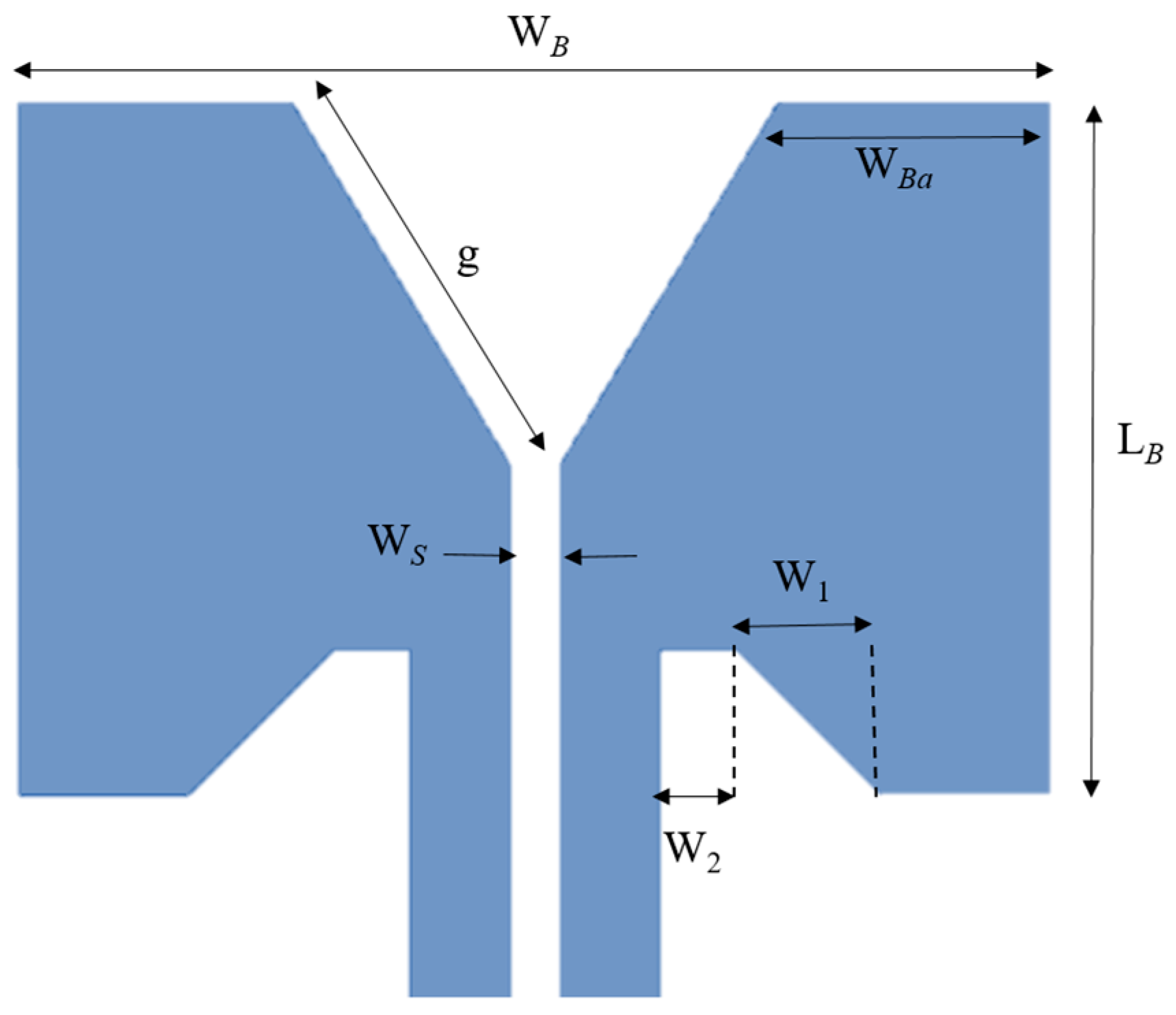
Figure 1 presents the geometry of bow-tie dipole unit that consists of two symmetrical triangular metallic arms separated by a feed gap of width g, where the excitation port is applied. The overall dimensions of the bow-tie structure are defined by the total width WB and the total height LB. The narrow feed section at the center has a width denoted by WS, which determines the capacitive coupling and impedance matching at the feed region. The upper portion of each arm extends horizontally with a width WBa, which controls the flare and contributes to the broadband performance of the antenna. To achieve a smooth transition between the feed line and the radiating arms, two intermediate dimensions, W1 and W2, are introduced to optimize the current distribution and minimize reflection at the junction. The combined effect of these parameters governs the antenna’s impedance bandwidth, resonance frequency, and radiation characteristics. Owing to its symmetric design and gradual flare, the bow-tie configuration ensures wideband impedance matching and stable radiation performance across the desired frequency range.
Figure 1. Structure of the bow-tie dipole unit.
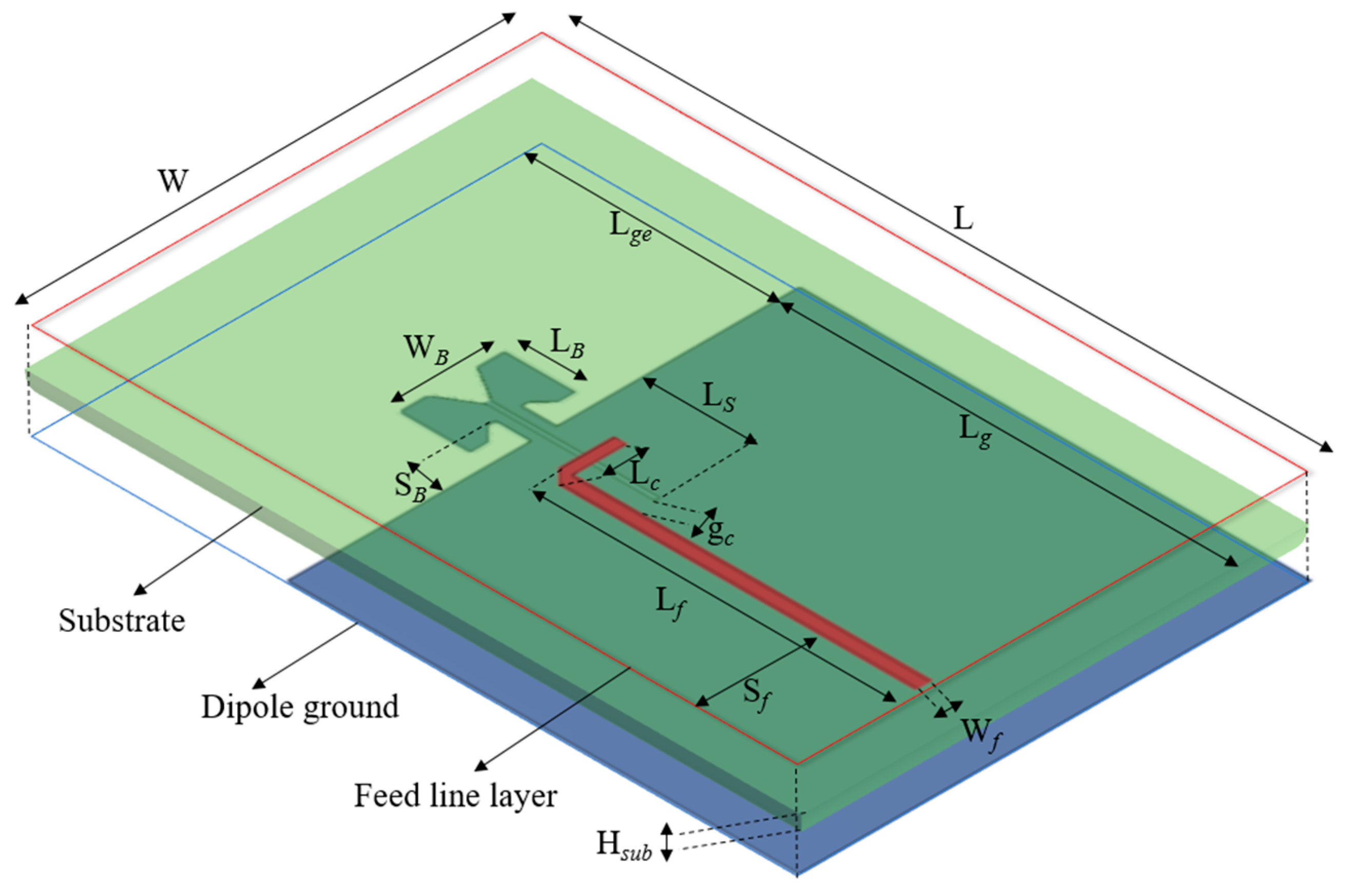
To provide a first-order estimation of the resonant frequency, the bow-tie antenna structure, as depicted in Figure 2, can be modeled as a dipole-like radiator with an effective electrical length   L e f f . A Quartz substrate is incorporated to support the bow-tie structure, and since the resonant behavior is strongly affected by the substrate’s dielectric characteristics, the antenna can be regarded as operating in a medium with an effective permittivity ε e f f . Consequently, the following relation can approximate the modified resonant frequency:
f r = C 2 L e f f ε e f f
where C is the speed of light in free space, Leff represents the effective current path length, and ε e f f is the effective dielectric constant of the substrate–air environment. The effective length can be expressed as L e f f = L B L , where ΔL accounts for the fringing-field and flare effects. This relation provides a reliable analytical approximation for predicting the fundamental resonance before performing full-wave electromagnetic optimization.
Figure 2. Structure of the bow-tie antenna.
To excite the antenna, a coupling-line feed is employed instead of a direct connection. This excitation technique allows electromagnetic energy to be capacitively coupled into the radiating arms through a narrow microstrip line positioned beneath the feed gap. Such an approach minimizes parasitic effects, improves impedance matching across a wide frequency range, and avoids fabrication challenges associated with direct contact at THz scales. The coupling line plays a critical role in achieving efficient energy transfer between the feeding network and the radiating bow-tie arms. It consists of a microstrip line of width Wf = 0.16 mm and length L f = 4.8 mm, separated from the antenna gap by a coupling distance of gc = 0.37 mm and a coupling-line length Lc = 0.87 mm. These dimensions were carefully optimized to obtain a strong capacitive coupling while maintaining wideband impedance matching across the 0.39–1.3 THz range.
The coupling mechanism can be modeled as a capacitively coupled network, where the equivalent coupling capacitance C c governs the amount of energy transferred into the radiating arms. The corresponding coupling reactance X C is given by
X C = 1 ω C c ,
where ω = 2πf is the angular frequency. Considering the coupling line as a short transmission section of characteristic impedance Z0 and length Lf, the input impedance at the feeding point can be expressed as
Z i n = Z 0 Z L + j Z 0 t a n ( β L f ) Z 0 + j Z L t a n ( β L f ) ,
where Z L denotes the impedance of the bow-tie structure at the coupling interface and β = 2 π / λ g is the phase constant, with λ g being the guided wavelength along the microstrip line.
The feed gap is a critical element in the bow-tie antenna, positioned at the junction between the two triangular arms. It functions as the region where electromagnetic energy is transferred from the coupling line into the radiating structure. The gap has a width (Ws) of 0.05 mm and a length (Ls) of 1.24 mm, optimized to ensure strong capacitive coupling and efficient energy transfer at terahertz frequencies. By introducing this gap, the electric field is highly concentrated within a small region, which enhances radiation efficiency and improves impedance matching across the 0.39–1.3 THz band. Figure 2 illustrates the structure of the antenna. Additionally, the optimized dimensions of the feed gap help to minimize reflection losses and maintain a smooth transition of current from the feeding line to the antenna arms, thereby supporting the antenna’s wideband performance and stable gain response. All parameters in this design are tabulated in Table 1 with detailed values.
Table 1. The optimal dimension of the bow-tie antenna.

2.2. Integration of Photonic Crystal

To achieve superior electromagnetic performance and better substrate engineering in terahertz antenna systems, periodic dielectric structures have been introduced to tailor the propagation of electromagnetic waves within the substrate. By embedding a periodic arrangement of air inclusions, the substrate effectively behaves as a PhC medium capable of manipulating the electromagnetic field distribution and suppressing unwanted surface-wave propagation. Such a configuration enables precise control of the effective dielectric constant and significantly influences the antenna’s impedance and radiation behavior.
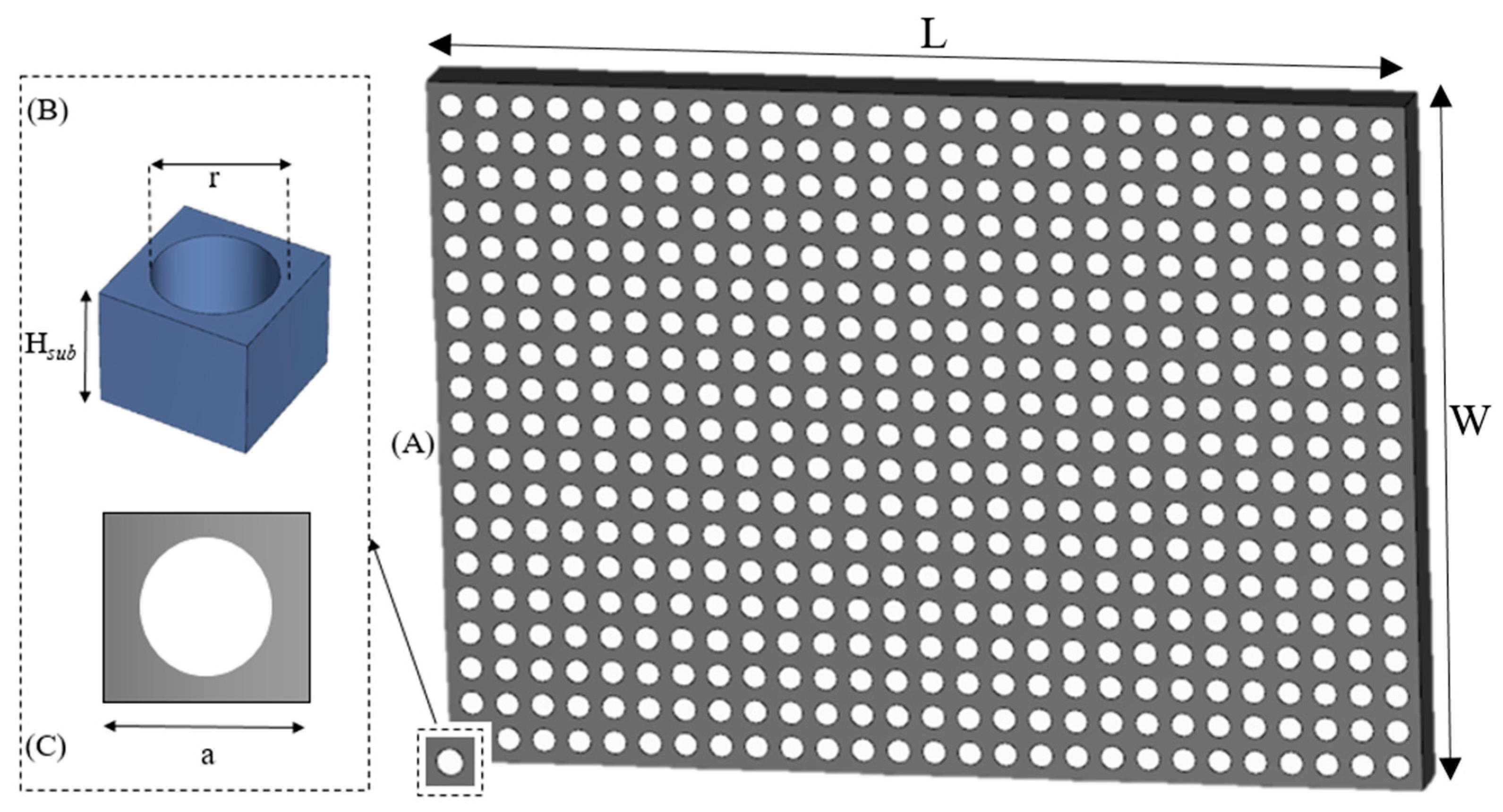
A PhC lattice is incorporated within the antenna substrate, forming a PhC substrate that effectively modifies the local dielectric properties surrounding the bow-tie radiator. The integration aims to control effective wavelength propagation, enhance impedance matching, and reduce surface losses. Each unit cell consists of a cylindrical air hole embedded in a square lattice, as illustrated in Figure 3, where (A) shows the three-dimensional (3D) view of the complete PhC substrate, (B) presents the 3D structure of a single PhC unit, and (C) depicts the top view of the corresponding unit cell. The principal geometrical parameters of the lattice are defined as the lattice constant a = 300 μm, the hole radius r = 200 μm, and the hole depth h = 90 μm. This periodic configuration modifies the substrate’s electromagnetic response, thereby optimizing wave confinement and improving the antenna’s overall performance.
Figure 3. PhC substrate: (A) three-dimensional (3D) view of the complete PhC substrate, (B) 3D structure of a single PhC unit and (C) top view of unit-cell PhC.
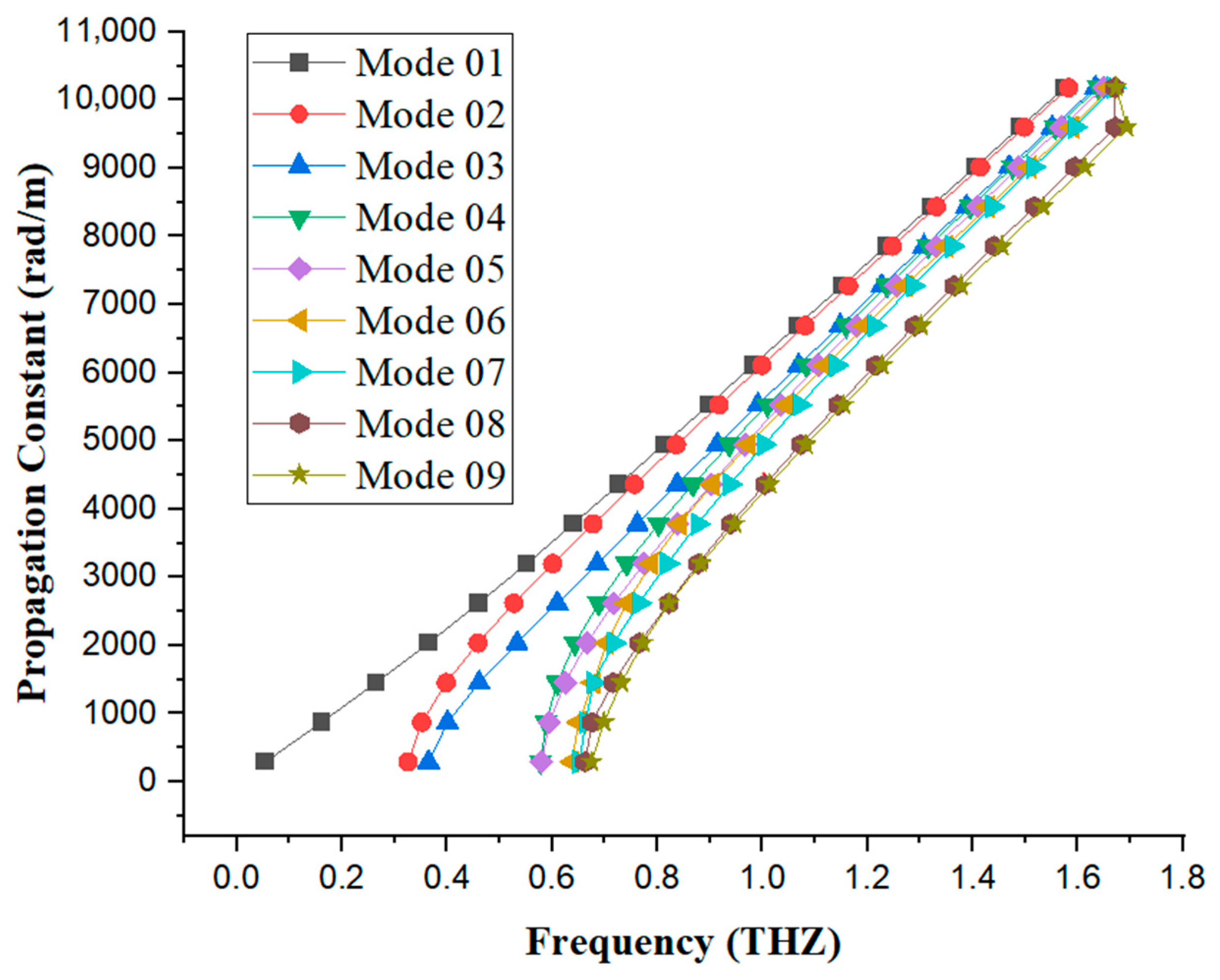
Figure 4 illustrates the dispersion characteristics of the proposed PhC unit cell, where the propagation constant (β) is plotted as a function of frequency in the terahertz range. Multiple eigenmodes (Mode 01–Mode 9) are shown, representing the supported electromagnetic modes within the periodic structure. It can be observed that all modes exhibit a monotonic increase in the propagation constant with frequency, confirming normal dispersive behavior in the considered band. At lower frequencies, only the fundamental mode (Mode 01) propagates, while higher-order modes emerge progressively as the frequency increases. This modal separation indicates the multimode nature of the structure at higher frequencies. The nearly linear trend of the dispersion curves at higher frequencies suggests stable phase progression and reduced group velocity variation, which is advantageous for controlled wave propagation and beam steering applications. Moreover, the absence of abrupt discontinuities or flat bands in the operating frequency range indicates that no complete bandgap exists within this region, ensuring continuous propagation through the PhC structure. The increasing density of modes at higher frequencies demonstrates stronger modal coupling and enhanced field confinement within the periodic lattice. This behavior plays a critical role in tailoring the effective refractive index of the PhC, which directly influences impedance matching, radiation efficiency, and beam-scanning performance of the antenna. Moreover, the dispersion analysis confirms that the designed PhC supports controlled wave propagation in the intended terahertz band, making it suitable for enhancing gain and directing radiation in the proposed antenna configuration.
Figure 4. Dispersion diagram of the proposed PhC unit cell.
The structural filling fraction, representing the ratio of air inclusion within each cell, is expressed as
f = π r 2 a 2 ,
Using an effective medium approximation, the equivalent permittivity of the PhC substrate can be estimated as
ε e f f . s u b   ε r 1 f + ε a i r f ,
where ε r and ε a i r = 1 , denote the dielectric constants of the original substrate and air, respectively. It is important to note that Equation (5) constitutes a quasi-static effective medium approximation, strictly valid only when a λ e f f . At higher frequencies within the operational band approaching 1.3 THz, where λ 0 = 230 and a = 300   μ m , the ratio a / λ 0 approaches unity and the substrate transitions toward the Bragg scattering regime. Consequently, Equation (5) is employed solely as a qualitative analytical tool; all quantitative results in Section 3 are derived from full-wave simulations that rigorously model the complete periodic geometry. By properly selecting a, r, and h, the designer can precisely control ε e f f , s u b , which directly affects the effective wavelength λ e f f = λ 0 ε e f f , s u b and, consequently, the resonant frequency f r described earlier in Equation (1). The modified permittivity also influences the characteristic impedance of the feeding line, given approximately by
Z 0 60 ε e f f . s u b ln ( 8 H s u b W f + W f 4 H s u b ) ,
where W f and H s u b denote the microstrip width and substrate thickness, respectively. A reduction in ε e f f , s u b leads to better impedance matching and improved radiation efficiency by limiting dielectric and surface-wave losses.
The primary theoretical objectives of embedding the PhC lattice are twofold: first, to enable beam steering by tailoring the in-plane dispersion of guided or leaky modes, and second, to enhance the realized gain by enlarging the effective aperture and minimizing substrate-induced losses. For a periodic surface supporting a mode with propagation constant β ( ω ) , the far-field beam direction θ ( ω ) satisfies the phase-matching relation:
β ω = k 0 ( ω ) s i n θ ( ω ) ,
where k 0 ω = ω / c   is the free-space wave number. Adjusting the PhC geometry modifies β ( ω ) , allowing deterministic control of the beam angle. For a discrete periodic chain with per-cell phase shift ϕ , the main-beam direction follows
θ = s i n 1 ϕ k 0 a ,
Thus, any perturbation in cell parameters or the effective refractive index induces a change in ϕ or   β , resulting in controllable beam tilting. The bow-tie dipole, excited via the capacitive coupling line, launches electromagnetic energy into the PhC-loaded substrate layer. The periodic air-hole lattice supports Bloch-mode propagation, producing spatial harmonics β n f = β 0 f + 2 π n / a . The n = 1 harmonic satisfies β n < k 0 across the operational band, enabling the guided energy to progressively leak into free space at a frequency-dependent angle. In this framework, the bow-tie provides wideband excitation and transverse aperture definition, while the PhC substrate sustains the leaky-wave traveling-wave mode.
In addition, gain enhancement results from increasing the effective aperture A e and radiation efficiency   η r a d [54]. The directivity and realized gain can be expressed, respectively, as follows:
D = 4 π A e λ 2           a n d           G = η r a d D ,
where λ = λ 0 / ε e f f , s u b is the effective wavelength in the substrate. Because the PhC reduces ε e f f , s u b , it increases λ and the normalized electrical aperture A e / λ 2 , leading to improved gain. Radiation efficiency is given by
η r a d R r R r + R l o s s ,
where R r and R l o s s denote radiation and loss resistances, respectively. The suppression of surface waves by the PhC reduces R l o s s , thereby enhancing η r a d and, consequently, the overall antenna performance as well.
Embedding a PhC lattice within the substrate fundamentally alters the electromagnetic dispersion and the effective dielectric properties of the medium, thereby enabling simultaneous control over the resonant frequency, impedance matching, radiation direction, and antenna gain. Through the engineered periodic arrangement of air inclusions, the substrate behaves as an artificial dielectric that manipulates field confinement and enables surface-wave control through dispersion engineering, leading to enhanced radiation efficiency and improved bandwidth stability. The tunable effective permittivity of the PhC medium allows designers to precisely shift the resonant behavior and tailor the beam-steering characteristics by modifying the lattice geometry. Moreover, the resulting improvement in impedance matching and reduction in substrate losses contribute to higher realized gain and more efficient radiation into free space. These analytical relations provide a comprehensive theoretical framework for optimizing the performance of terahertz antennas integrated with PhC substrates, offering a pathway toward compact, high-efficiency radiators with advanced beam and frequency agility suitable for next-generation communication and sensing applications.

2.3. Expected Electromagnetic Behavior

The expected electromagnetic behavior of the integrated PhC substrate can be theoretically described based on its periodic dielectric configuration, even in the absence of numerical simulations. The periodic inclusion of low-permittivity air holes introduces a spatial modulation of the refractive index, fundamentally altering how electromagnetic waves propagate within the substrate. This periodicity leads to modified dispersion characteristics and the formation of partial photonic bandgaps, in which certain frequency components are slowed, reflected, or redirected. Consequently, the effective propagation constant becomes frequency-dependent, allowing controlled variations in phase velocity and, therefore, predictable beam steering and resonance shifts.
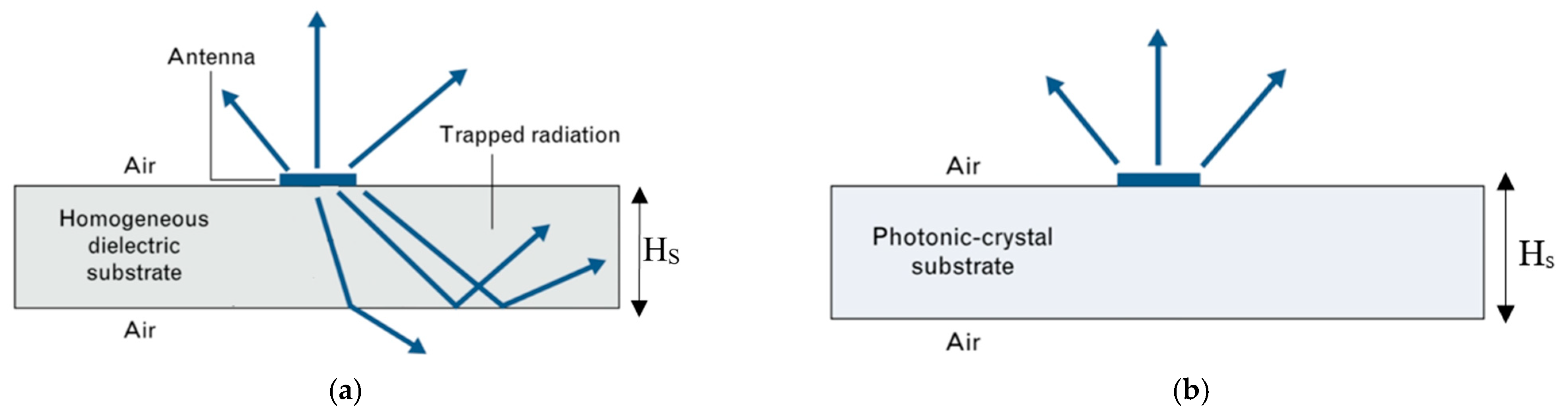
As illustrated in Figure 5, the contrast between a conventional homogeneous dielectric substrate and a PhC substrate can be clearly observed. In Figure 5a, the homogeneous substrate traps a significant portion of the radiated energy through total internal reflection, creating guided or surface-wave modes that contribute to radiation losses and reduced efficiency. In contrast, Figure 5b demonstrates that when the substrate is replaced by a PhC medium, the periodic air inclusions lower the effective permittivity, thereby increasing the critical radiation angle and enabling a larger fraction of the electromagnetic energy to radiate into free space. This mechanism provides surface-wave control through dispersion engineering, reduces surface-wave confinement, and enhances the upward radiation efficiency [55].
Figure 5. Generic behavior of a planar antenna on different substrates: (a) homogeneous substrate, (b) PhC substrate.
Moreover, the spatial redistribution of electromagnetic fields within the PhC lattice facilitates improved impedance matching between the feed line and the radiating element, resulting in a broader impedance bandwidth and higher realized gain. Therefore, even from a purely theoretical standpoint, the use of a PhC substrate is expected to produce a more directive radiation pattern, reduced substrate losses, and tunable resonance behavior, all governed by the geometric parameters and dielectric contrast of the periodic lattice.

2.4. Fabrication Feasibility

The proposed PhC bow-tie antenna is designed with fabrication compatibility as an explicit consideration. The metallic bow-tie and coupling-line layers are realized by standard photolithographic patterning and etching of a copper-clad Quartz laminate, a well-established process for micro-wave and millimeter-wave circuits. The periodic cylindrical air-hole array (radius r = 200 μm, depth h = 90 μm, and pitch a = 300 μm) is compatible with laser micromachining (CO2 or UV laser ablation) or high-precision CNC micro-milling, both of which provide the positional accuracy (±5 μm) and surface quality required for THz operation. Experimental characterization would employ a THz-VNA or THz-TDS measurement system with a calibrated antenna scanning stage for far-field radiation pattern acquisition. Full experimental validation constitutes the immediate next step of this research programmer.

3. Simulation Results and Discussion

3.1. Reflection Coefficient (S11)

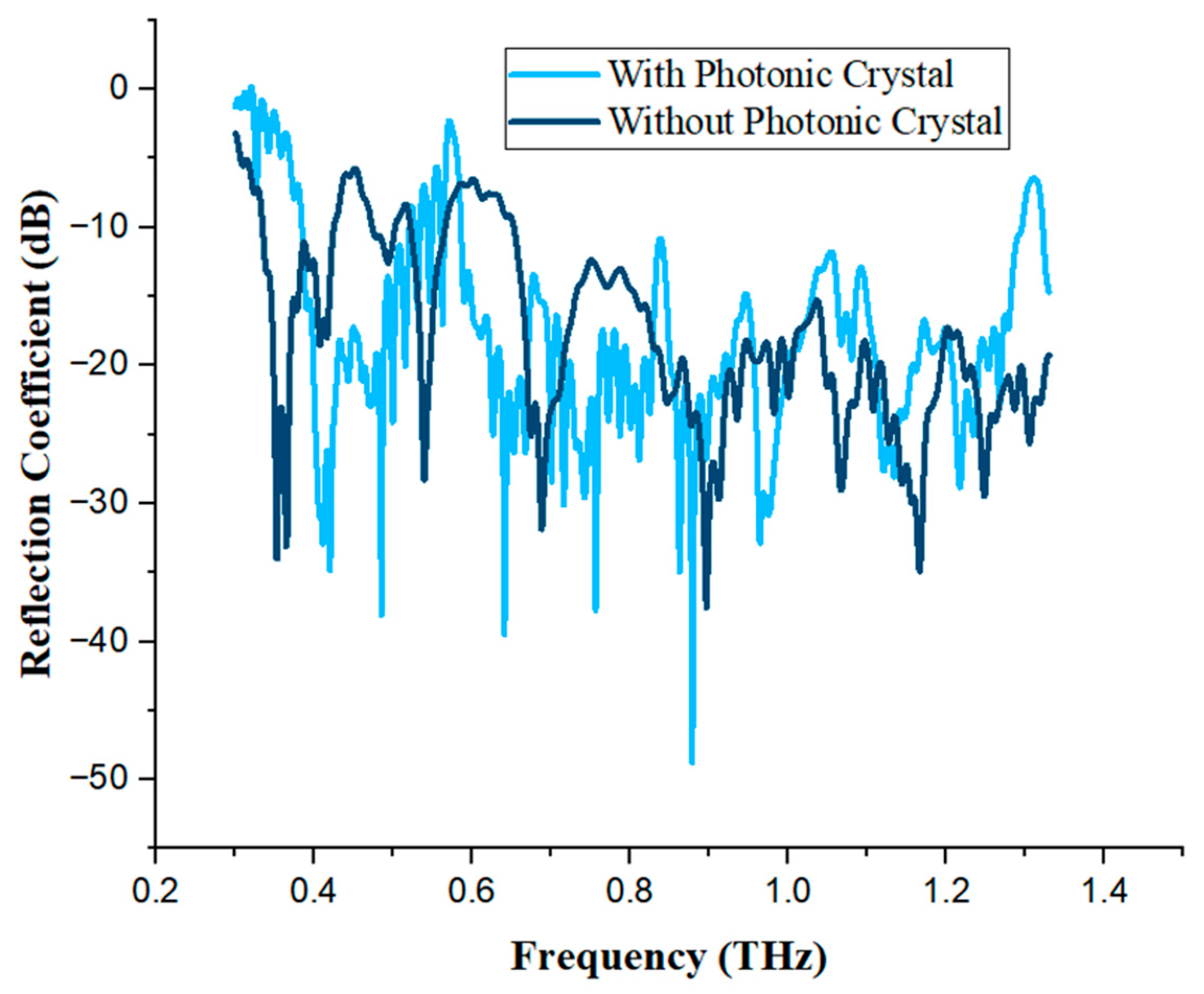
The broadband behavior of the reflection coefficient reveals that integrating the PhC substrate produces a substantial modification in the impedance characteristics of the bow-tie dipole antenna. As shown in Figure 6, the configuration without the PhC exhibits several isolated resonance minima but also extended regions where the reflection coefficient increases noticeably, indicating strong sensitivity of the input impedance to frequency variations due to surface-wave propagation and substrate-supported parasitic interactions. When the PhC structure is introduced, the reflection coefficient trace becomes significantly smoother and maintains lower reflection levels over a wider frequency span, demonstrating enhanced impedance stability and more uniform broadband matching.
Figure 6. Simulated reflection coefficient response of the proposed antenna in the presence of the PhC substrate and in its absence.
This improvement is attributed to the periodic dielectric arrangement of the PhC, which suppresses substrate-guided modes, redistributes reactive stored energy, and induces partial bandgap effects that minimize undesired resonant coupling. Such behavior aligns with previously reported findings on photonic bandgap and metamaterial-based substrates, where engineered periodicity has been shown to broaden the operational bandwidth, improve impedance matching, and enhance power-transfer efficiency by stabilizing the electromagnetic environment surrounding the radiating structure [56].
Therefore, the S11 behavior with PhC indicates not just a marginal improvement but a fundamental stabilization of the input impedance over frequency, which in turn will likely yield more efficient power transfer, more stable radiation characteristics, and better performance for applications requiring UWB operation.

3.2. Realized Gain and Radiation Pattern

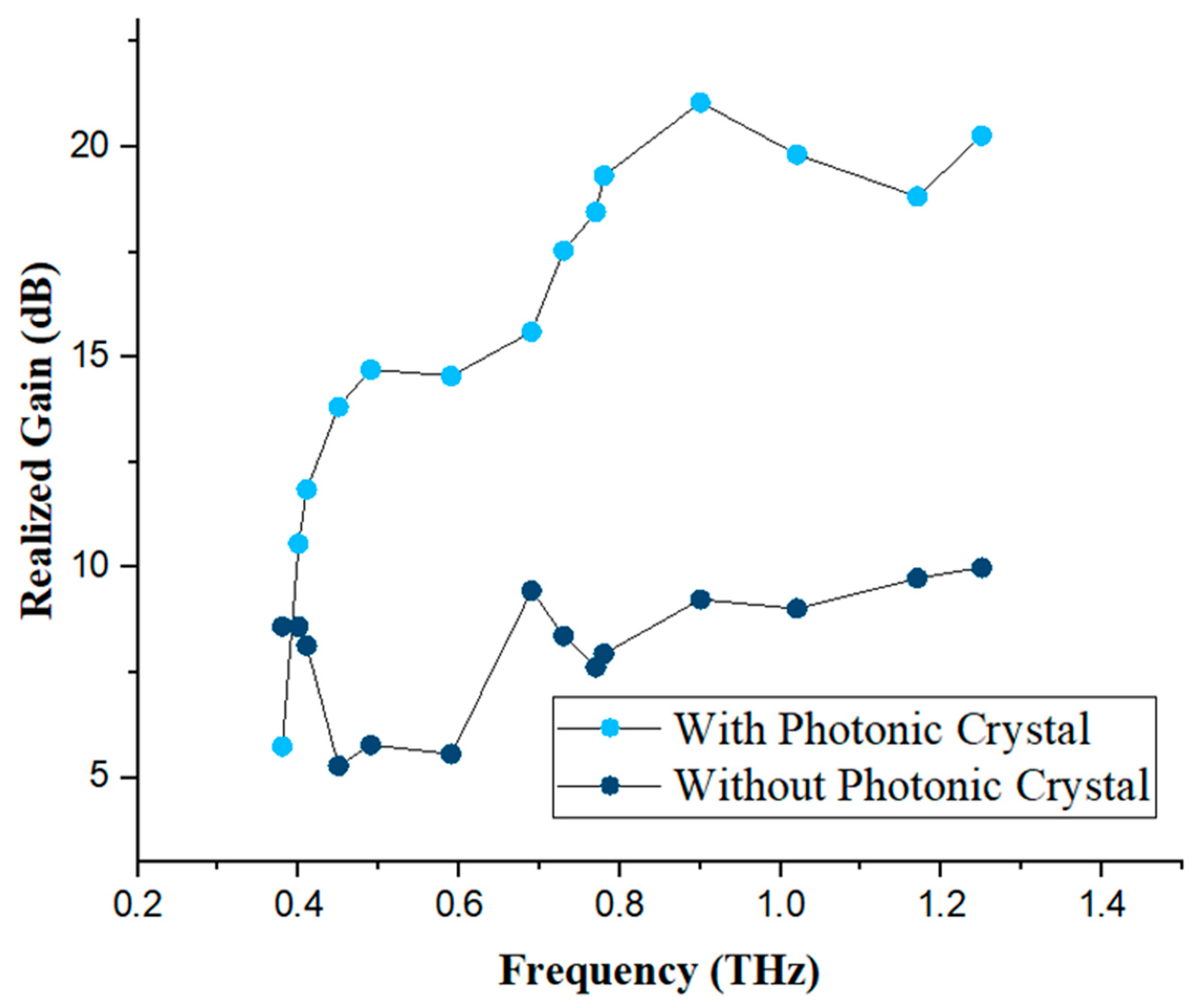
The realized-gain response demonstrates a substantial improvement in radiated performance when the PhC substrate is incorporated into the bow-tie antenna structure. As presented in Figure 7, the configuration employing the conventional substrate exhibits a relatively moderate and slowly varying gain level across the examined spectrum, reflecting the typical limitations imposed by substrate-supported surface waves and the inefficient confinement of electromagnetic energy within the radiating region. In contrast, the gain trace associated with the PhC-loaded configuration shows a pronounced enhancement over a wide frequency range, indicating that the introduction of the periodic dielectric lattice significantly strengthens the antenna’s ability to convert input power into effective radiation. This improvement can be attributed to several PhC-induced mechanisms, including the surface-wave control, reduction of unwanted energy trapping within the substrate, and modulation of the radiation boundary conditions to favor more directive and efficient radiation.
Figure 7. The realized gain performance of the designed bow-tie.
The periodicity of the PhC effectively creates regions of inhibited wave propagation, thereby minimizing power leakage into lateral modes and enabling a larger fraction of the input energy to be radiated into free space. Such behavior is consistent with reported findings in the literature, where photonic bandgap structures and engineered metamaterial substrates have been shown to improve radiation efficiency and increase antenna gain across wide bandwidths by reshaping the electromagnetic environment surrounding the radiating element [57,58]. Consequently, the observed gain enhancement confirms that the PhC substrate plays a pivotal role in improving the overall radiative capability of the proposed antenna across the full operational spectrum.
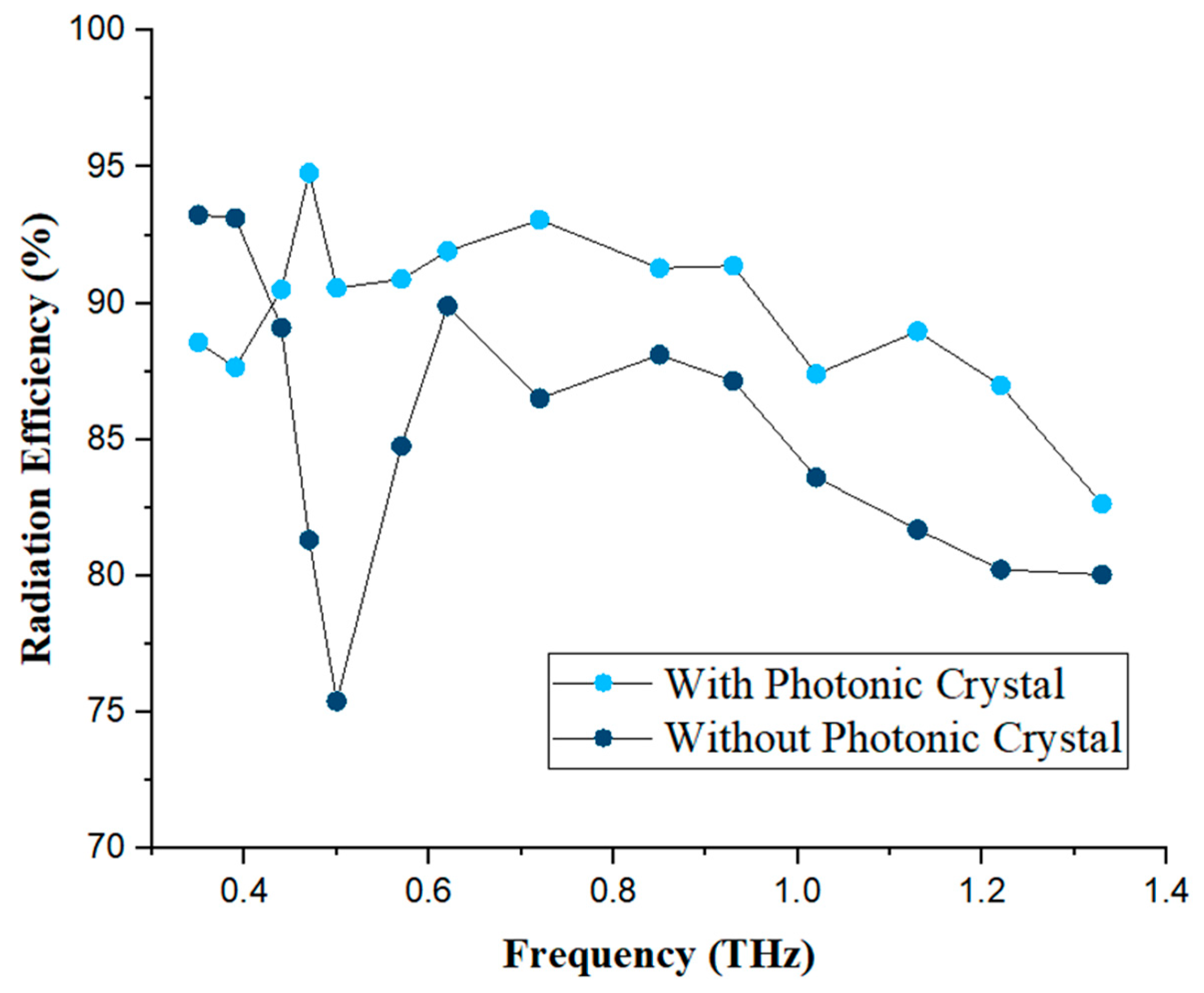
A comparison of the simulated radiation efficiency of the proposed UWB antenna, implemented with and without the PhC substrate, is presented in Figure 8. When the PhC substrate is employed, the antenna consistently exhibits high radiation efficiency, ranging from approximately 82% to 94.7% across the entire UWB frequency band. In contrast, the antenna realized on a homogeneous substrate experiences a pronounced degradation in efficiency as the operating frequency increases. This performance enhancement is primarily attributed to the enabling of surface-wave control through dispersion engineering excitation and the reduction in substrate-guided losses enabled by the PhC substrate, which improves the radiation mechanism and facilitates more efficient power transfer into free space.
Figure 8. Simulated radiation efficiency of the proposed antenna.
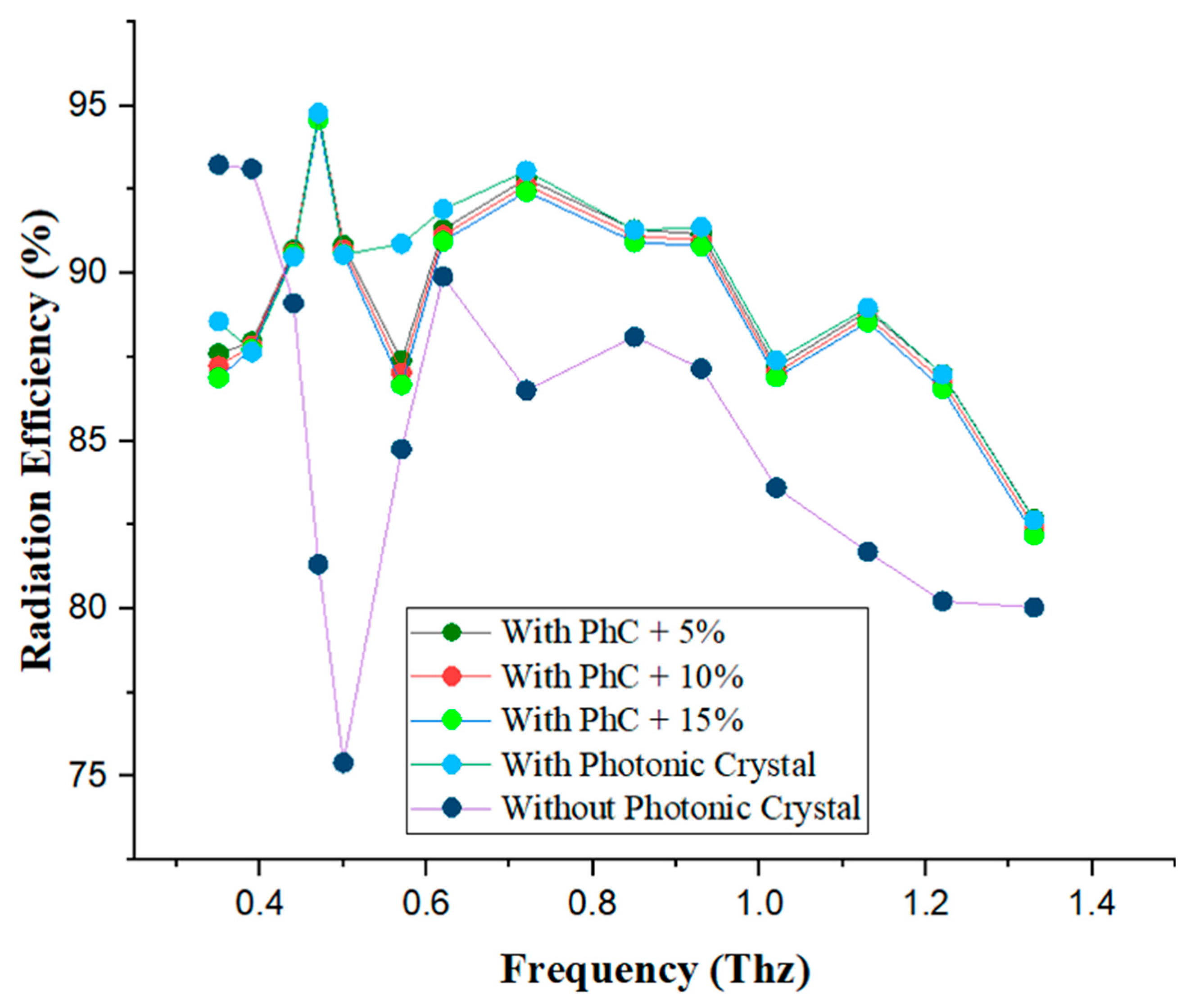
Figure 9 presents the simulated radiation efficiency of the proposed antenna as a function of frequency, with and without the integration of the PhC, and for different fabrication tolerance scenarios (±5%, ±10%, and ±15%). In the simulations, the Quartz substrate is modeled with a dielectric loss tangent of tan δ = 0.0004, which is explicitly included in the full-wave analysis. When the PhC is incorporated, the antenna exhibits high radiation efficiency across the operating band, remaining above approximately 80% from 0.35 to 1.2 THz. In addition, the curves corresponding to the ±5%, ±10%, and ±15% variations closely overlap with the nominal “With PhC” case, indicating that the radiation efficiency is only marginally affected by dimensional tolerances. This behavior demonstrates the strong robustness of the PhC-assisted configuration against fabrication inaccuracies. This high efficiency is primarily attributed to the PhC structure, which enables surface-wave control through dispersion engineering, enhances radiation extraction, and improves power confinement toward free-space radiation, rather than relying solely on low material loss assumptions. Moreover, all reported results are obtained from full-wave electromagnetic simulations that explicitly include dielectric loss effects.
Figure 9. Simulated radiation efficiency of the proposed antenna for different fabrication tolerance scenarios.
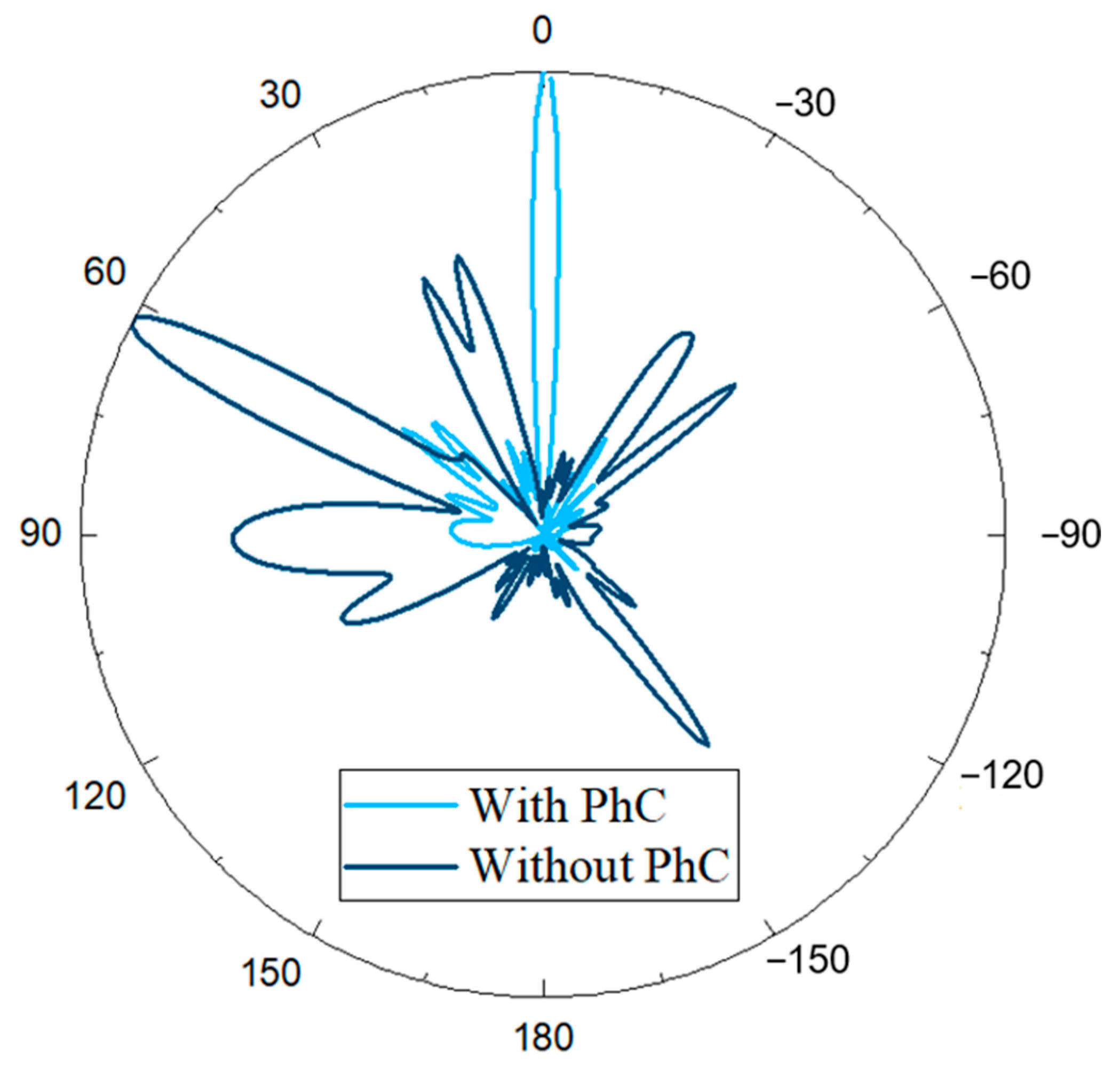
Figure 10 presents the normalized (φ = 90° elevation plan) radiation characteristics of the antenna at 0.57 THz for the two evaluated configurations. The reference design exhibits a fragmented pattern with multiple irregular lobes, indicating considerable energy dispersion and limited directive behavior. When the PhC substrate is introduced, the radiation curve becomes noticeably more concentrated toward the 0° direction, accompanied by reduced parasitic lobes across the angular spectrum. This enhancement reflects the substrate’s ability to restrict lateral surface-wave propagation and promote a more efficient forward-radiation profile. The contrast between the two curves highlights the functional impact of the periodic structure in reinforcing beam stability and improving angular confinement at terahertz frequencies.
Figure 10. The normalized radiation characteristics of the designed bow-tie antenna at 0.57 THz.
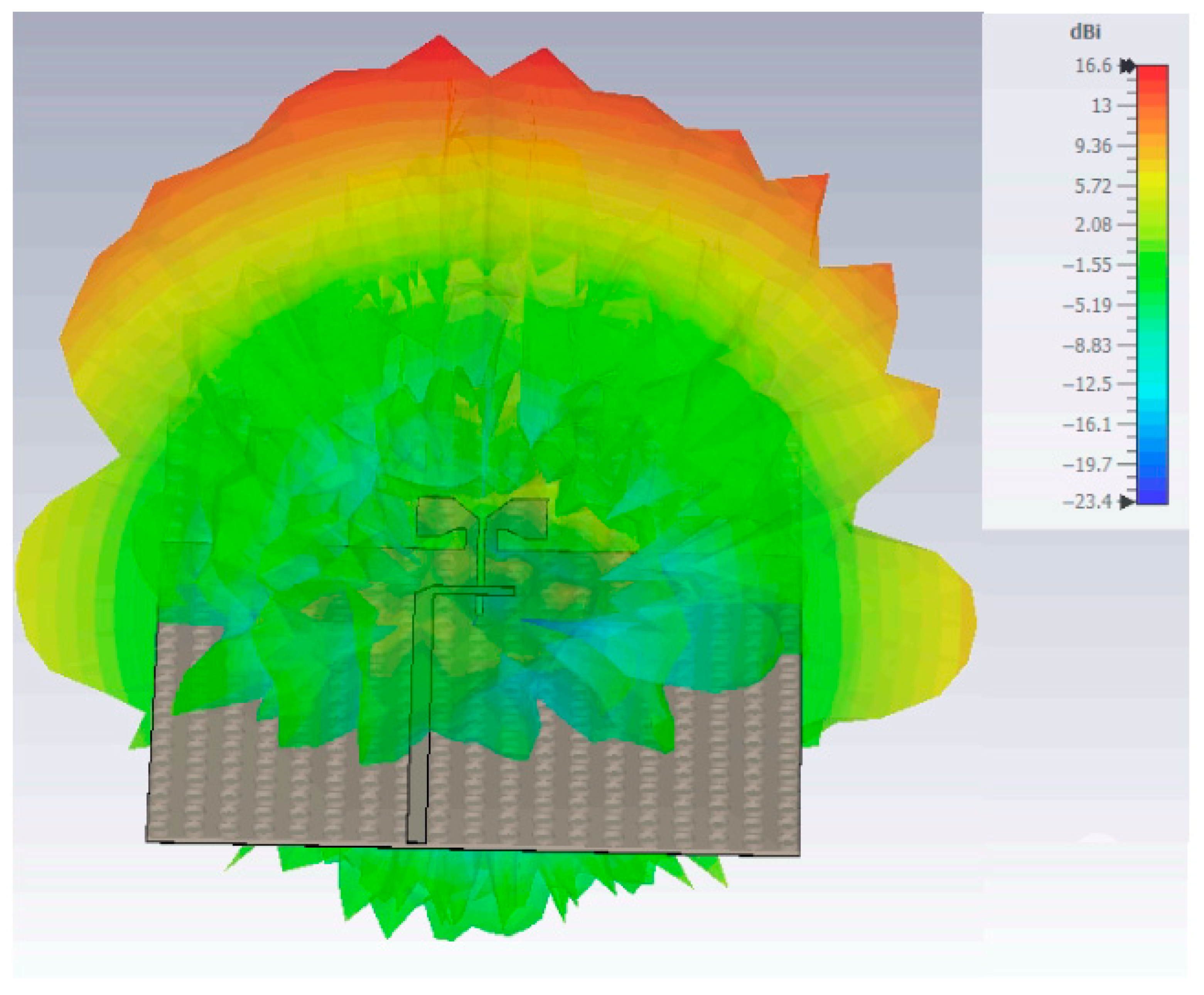
The simulated three-dimensional radiation pattern of the proposed antenna at 0.58 THz demonstrates a directional main lobe oriented along the 1° axis, as illustrated in Figure 11. The peak directivity reaches approximately 16.6 dB, indicating strong radiative efficiency in the boresight direction. The pattern exhibits a typical fan-like shape with moderate sidelobes, suggesting controlled spreading of energy in the orthogonal planes. This directional behavior aligns with the anticipated performance of the integrated PhC substrate, which is designed to suppress unwanted surface waves and redirect radiated energy toward free space. Such a radiation profile is advantageous for high-frequency terahertz applications, including point-to-point wireless links and sensing systems, where concentrated energy and reduced interference are critical.
Figure 11. The 3D radiation pattern of the designed bow-tie antenna at 0.58 THz.

3.3. Beam-Scanning Phenomenon

The use of a PhC substrate introduces a frequency-dependent phase response that enables a natural beam-scanning capability in the proposed antenna. Because the periodic structure modifies the dispersion characteristics of the guided mode, the phase constant varies as the operating frequency changes. This property allows the radiated beam to steer electronically across a wide angular range without requiring mechanical movement or complex phase-shifting networks, which is highly advantageous for terahertz systems.
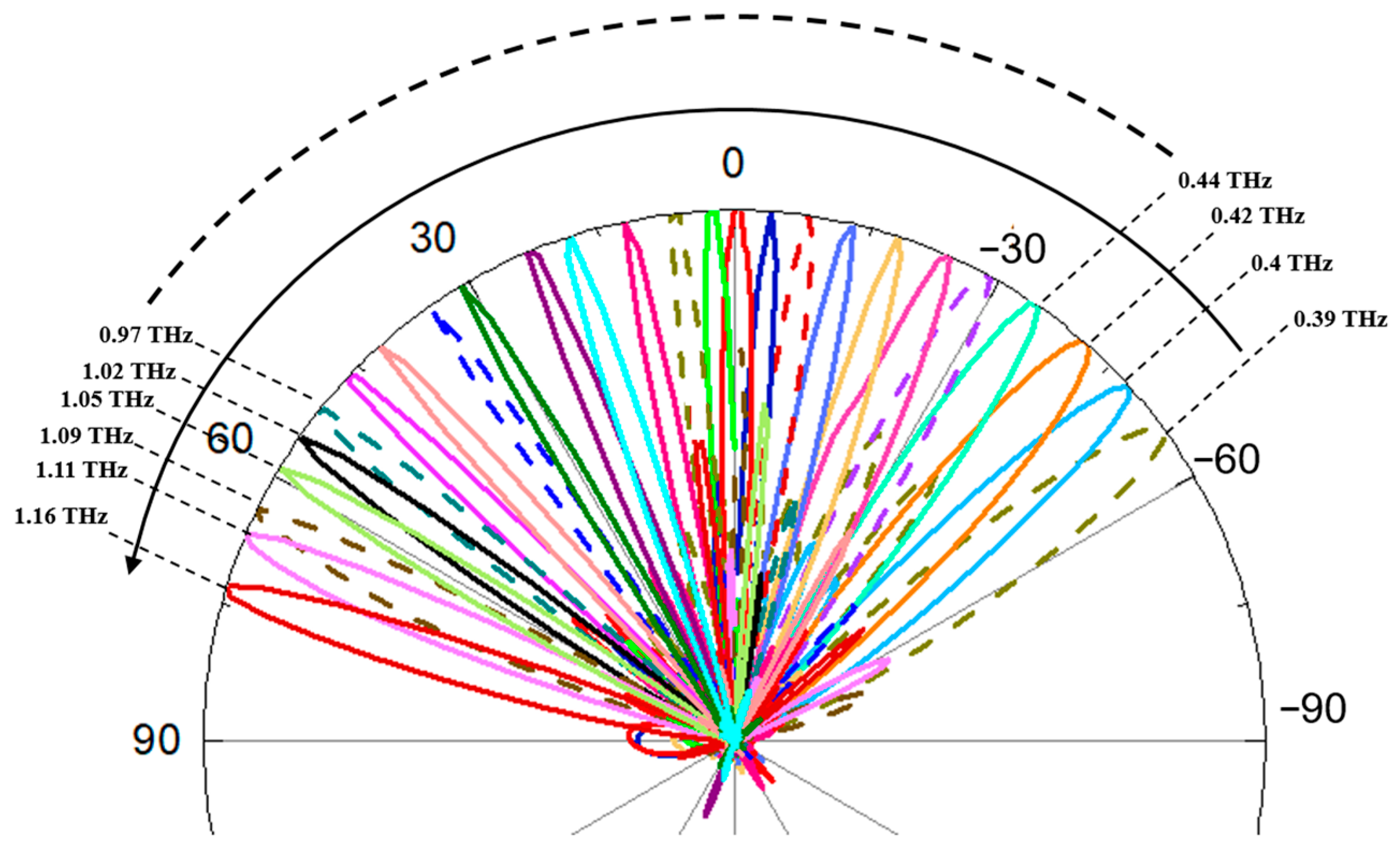
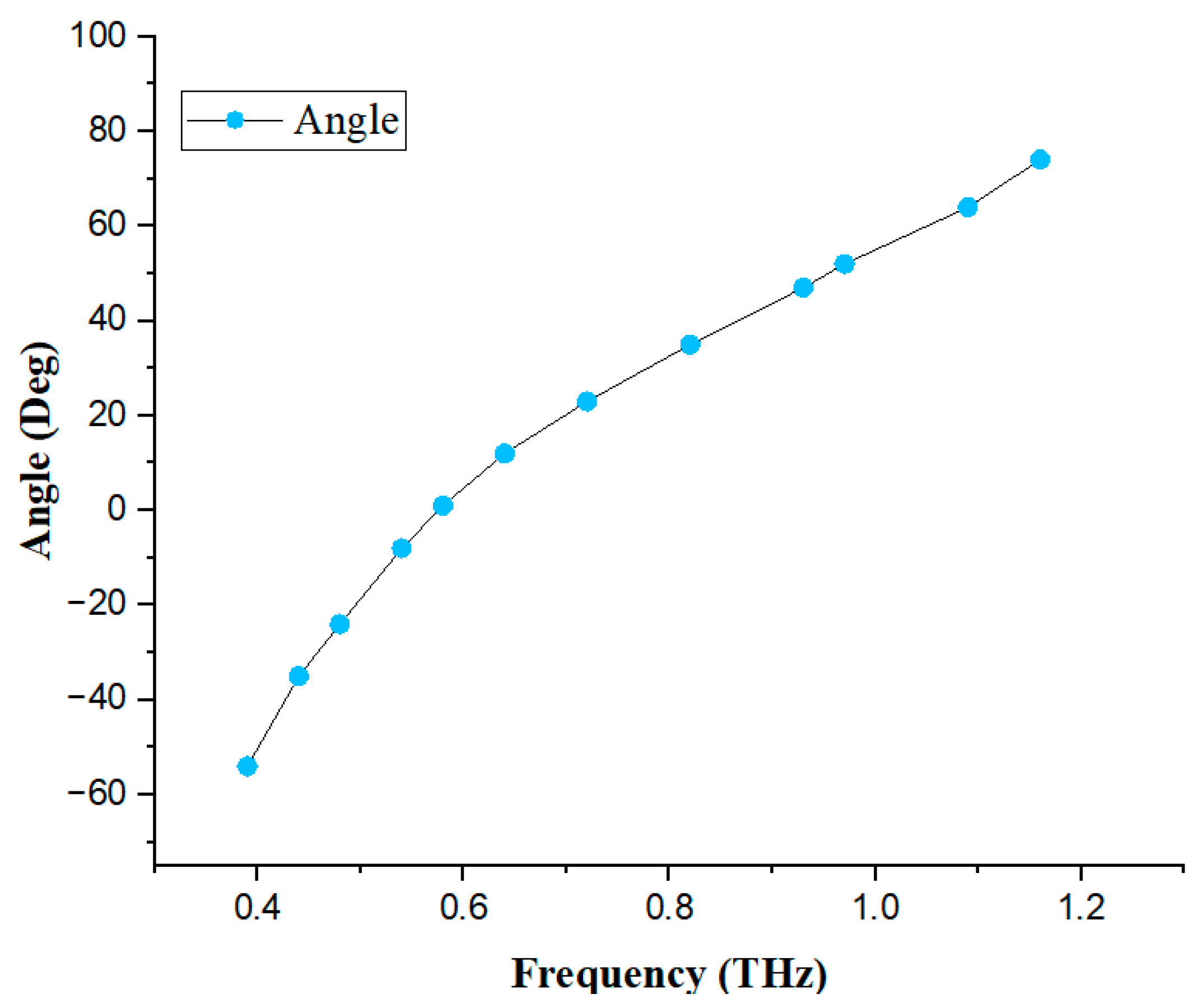
Figure 12 presents the normalized radiation patterns obtained across the operating band from 0.39 THz to 1.16 THz. A clear frequency-scanning behavior is observed: the main lobe starts at approximately −54° at 0.39 THz and progressively moves toward +74° at 1.16 THz, resulting in a total scanning range of nearly θ = 128 ° . This wide angular sweep confirms that the PhC arrangement effectively supports a traveling-wave radiation mechanism, where the periodic modulation facilitates controlled leakage of energy into free space at frequency-dependent angles.
Figure 12. Normalized radiation patterns demonstrating the frequency-dependent beam scanning of the proposed bow-tie antenna from 0.39 THz to 1.16 THz.
The beam-scanning behavior arises from the modified dispersion relation introduced by the PhC lattice. The relationship between the scanning angle and the operating frequency can be described using the leaky-wave radiation condition. For a periodic or PhC -based structure, the main-beam angle θ is expressed as
θ f = a r c s i n β ( f ) k 0 ( f ) ,
where β ( f ) is the frequency-dependent phase constant of the guided mode and k 0 f = 2 π f c is the free-space wave number. In periodic media, the radiating harmonic is given by
β n f = β 0 f + 2 π n a ,
where a is the structure period, n is the space harmonic index and β 0 is the propagation constant. Radiation occurs whenever | β n | < k 0 [59], and the corresponding angle follows according to
s i n θ = β n k 0 ,
Because β n and k 0 both depend on frequency, changing the frequency shifts the angle [60].
These expressions highlight how variations in frequency directly modify β n and therefore the radiation direction, leading to the beam-scanning phenomenon demonstrated in Figure 12.
The wide scanning range achieved confirms that the PhC substrate effectively manipulates the dispersion characteristics to support a robust leaky-wave radiation regime. This capability enables directional control using only frequency tuning, providing an efficient and compact approach for terahertz beam steering in high-data-rate wireless communications, imaging systems, and advanced sensing platforms.
The simulated beam-scanning behavior of the proposed periodic-substrate antenna exhibits a smooth and monotonic variation of the main-beam direction with respect to frequency. At lower frequencies, the beam points toward negative angles, indicating backward radiation, whereas increasing the frequency gradually shifts the beam through the broadside and ultimately into the forward region. This continuous steering characteristic is highly desirable for electronically controlled or frequency-scanned antenna systems, providing wide angular coverage without requiring additional phase-shifting circuitry. The obtained trend confirms that the dispersion properties of the PhC-based substrate directly govern the propagation constant and dictate the radiation angle, in strong agreement with previously reported theoretical analysis and simulation predictions, as illustrated in Figure 13.
Figure 13. Beam-steering angle variation with operating frequency for the photonic-substrate antenna.
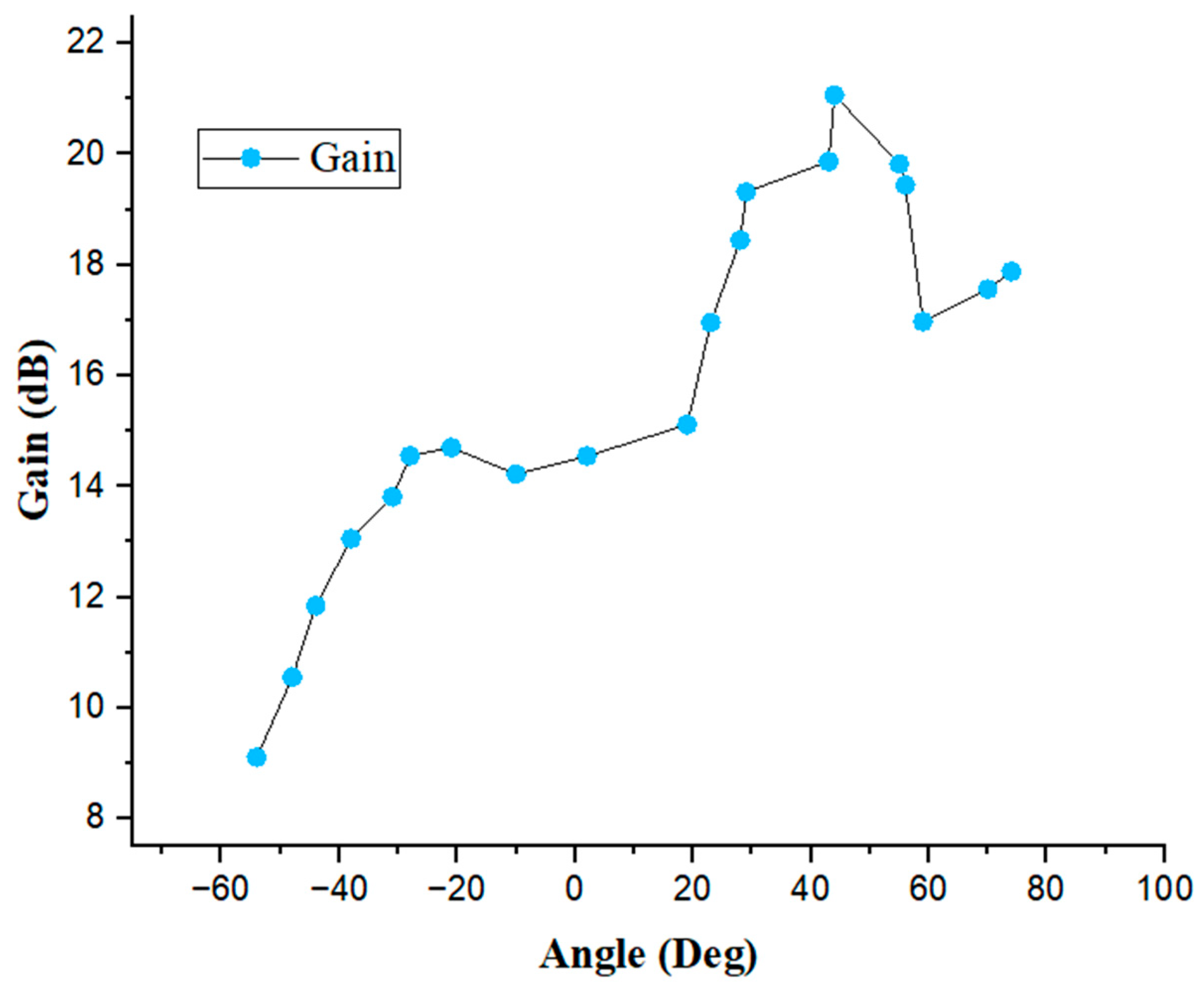
The antenna gain as a function of the radiation angle, illustrated in Figure 14, highlights the beam-scanning capability of the proposed design. The gain increases as the main beam scans from negative angles toward the forward direction, reaching a peak value of approximately 19–21 dB in the 40°–60° angular range. At larger backward scan angles, the gain decreases and reaches about 8 dB at −56°, resulting in an overall variation of approximately 12 dB across the 128° scanning range. This behavior is mainly attributed to the frequency-dependent leaky-wave radiation mechanism and the reduction in the effective radiating aperture when the beam is steered toward extreme angles, which is consistent with the typical behavior of leaky-wave antennas.
Figure 14. Variation in the antenna gain as a function of the radiation angle.

3.4. Parametric Analysis

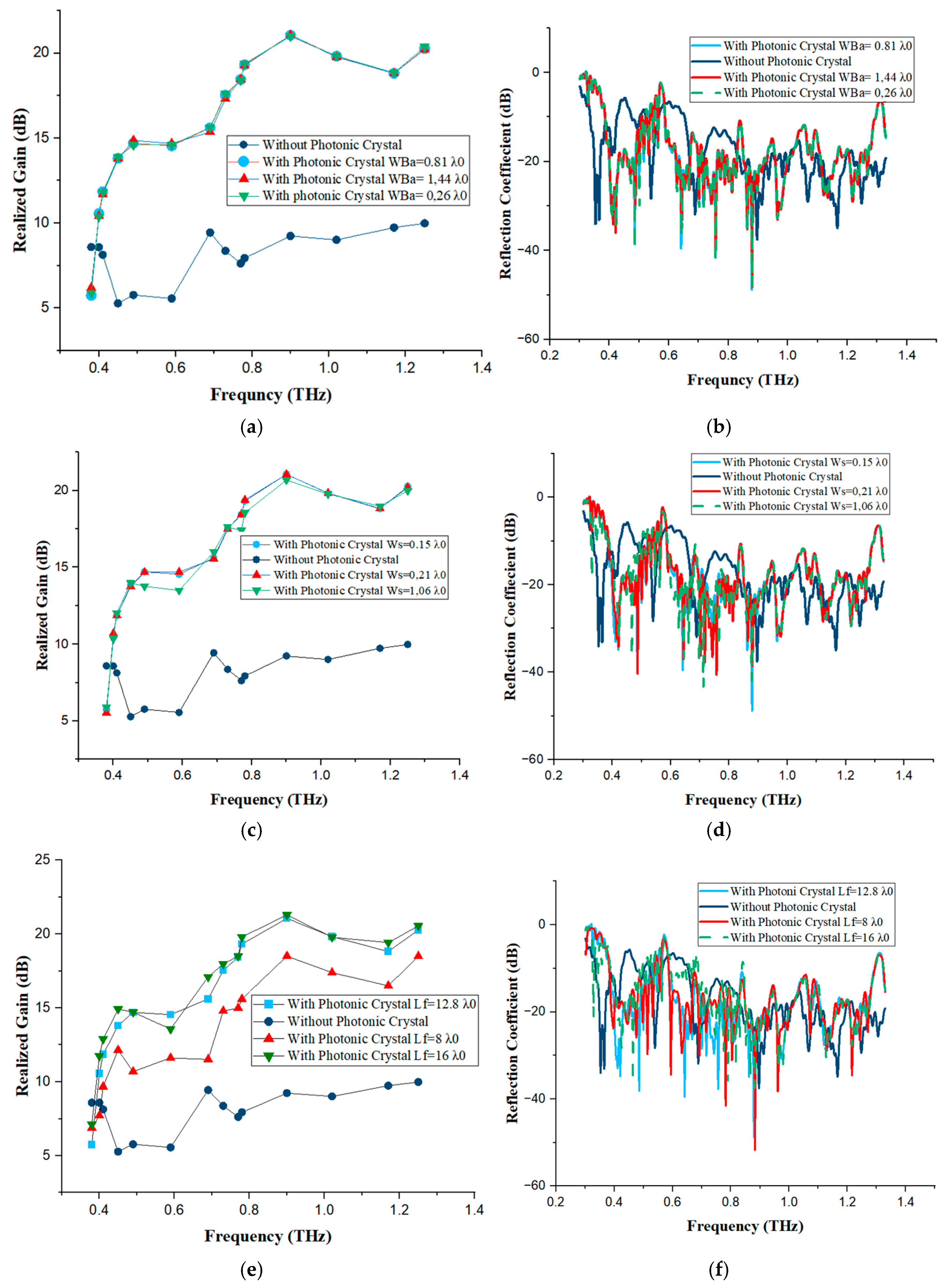
To clarify the design methodology and justify the selection of the final antenna dimensions, a comprehensive parametric analysis was carried out on the key geometric parameters of the proposed bow-tie antenna and its coupling feed structure. Figure 15 presents the simulated reflection coefficient (S11) and realized gain as functions of frequency for different values of the bow-tie arm width (WBa), the bow-tie slot width (Ws), and the coupling feed length ( L f ). As illustrated in Figure 15a,b, variations in WBa significantly influence both the impedance matching and the radiation performance of the antenna. Increasing WBa enhances the effective radiating aperture, leading to higher realized gain, while also affecting the broadband impedance response. An optimal value of WBa is therefore selected to achieve a balanced trade-off between wideband matching and stable high gain. Similarly, Figure 15c,d demonstrate the impact of the bow-tie slot width Ws on antenna behavior. Adjusting Ws modifies the current distribution and coupling between the bow-tie arms, resulting in noticeable changes in both S11 and gain. The optimized value of Ws provides improved impedance matching without degrading the radiation efficiency across the operating band. Finally, the effect of the coupling feed length L f is shown in Figure 15e,f. The parameter L f controls the electromagnetic coupling strength between the feed line and the radiating structure. Insufficient or excessive coupling leads to impedance mismatch and gain degradation, whereas the optimized L f ensures efficient power transfer, broadband impedance matching, and enhanced realized gain.
Figure 15. Simulated reflection coefficient (S11) and realized gain for different values of the bow-tie: (a,b) for value WBa, (c,d) for value WS and (e,f) for value Lf.
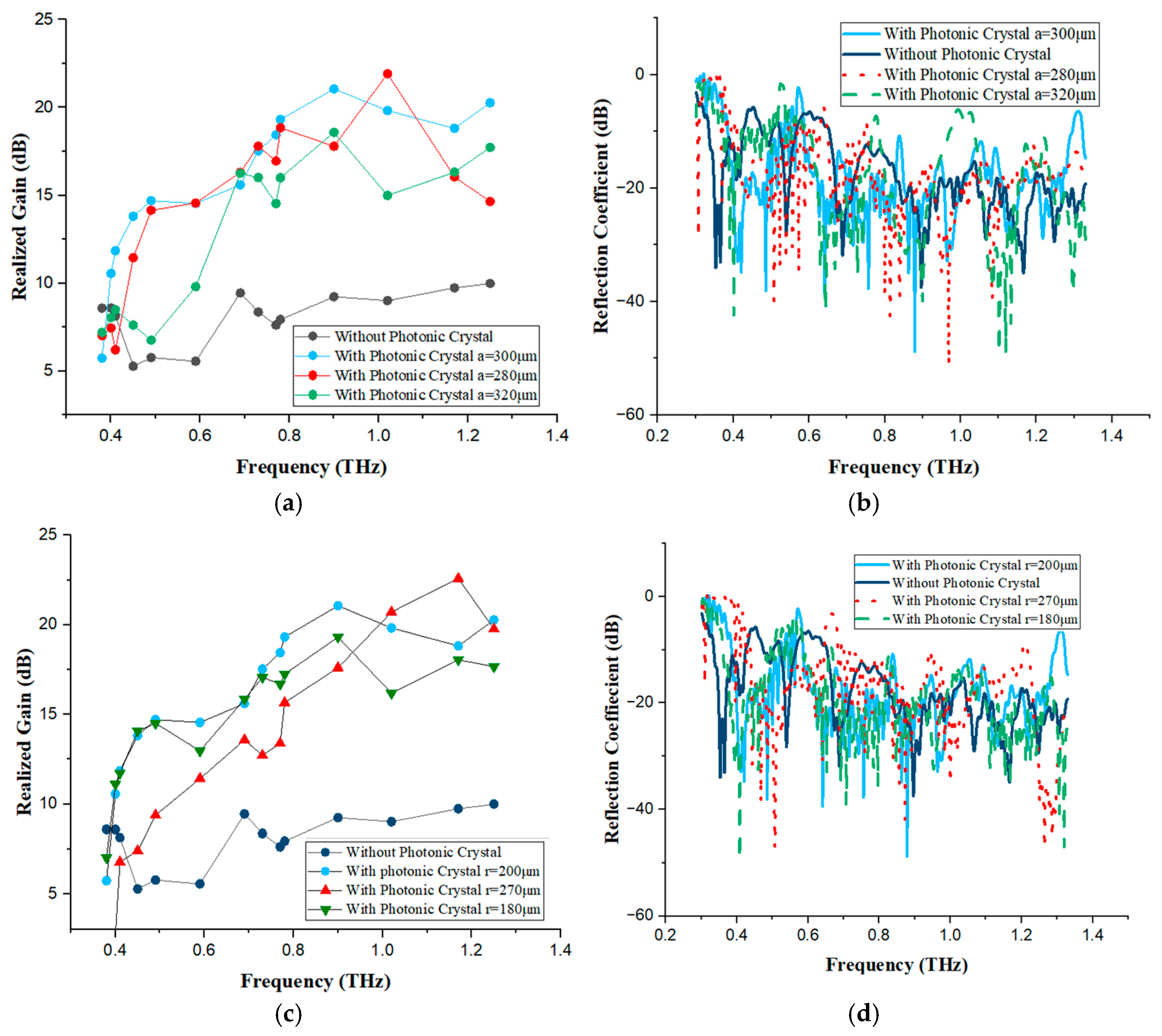
The influence of the PhC unit-cell geometrical parameters on the impedance matching and radiation performance of the proposed antenna as illustrated in Figure 16. Specifically, the effects of the PhC lattice constant a and the air-hole radius r on the realized gain and reflection coefficient S11 are investigated over the operating THz frequency band.
Figure 16. The influence of the PhC unit-cell geometrical parameters: (a,b) for parameter a and (c,d) for parameter r.
As shown in Figure 16a,b, variations in the lattice constant a significantly affect the antenna radiation characteristics. Increasing or decreasing a modifies the periodicity of the PhC structure, thereby altering the dispersion behavior and electromagnetic bandgap properties. An optimized lattice constant provides a constructive interaction between the radiated fields and the PhC surface modes, resulting in a notable enhancement in realized gain while maintaining satisfactory impedance matching across a wide frequency range. In contrast, non-optimized values of a lead to gain degradation and increased impedance mismatch due to inefficient coupling with the PhC modes. Moreover, the impact of the air-hole radius r is presented in Figure 16c,d. The parameter r directly controls the effective refractive index contrast of the PhC unit cell, influencing both the confinement and leakage of electromagnetic waves. As observed, increasing r generally improves gain performance by strengthening the bandgap effect and suppressing surface-wave propagation. However, excessive enlargement of r can deteriorate the impedance matching, indicating a trade-off between gain enhancement and broadband matching. The selected value of r achieves an optimal balance, ensuring high realized gain and stable S11 performance over the targeted THz band. The results confirm that careful optimization of the PhC unit-cell parameters is essential to effectively exploit the gain enhancement capability of the PhC while simultaneously preserving wideband impedance matching in the proposed THz antenna design.
A performance comparison between the proposed antenna and several previously reported THz designs is presented in Table 2. As illustrated in Table 2, the configurations reported in [61,62,63,64,65,66,67] employ different technologies, including leaky-wave antenna [61], PhC waveguide combined with a Luneburg lens [62], array-based architectures [63], PhC beamforming networks [64], liquid crystal structures [65], PhC implementations [66], and cascaded metasurfaces [67]. These designs demonstrate total scanning ranges from 45° to 120°, with peak gains between 13.7 dBi and 25.28 dBi. In contrast, the proposed antenna utilizing a PhC substrate achieves a significantly wider scanning range of 128° across 0.39–1.16 THz, together with a peak gain of 21 dBi. This demonstrates the enhanced beam-steering and radiation performance of the proposed approach relative to existing solutions in [61,62,63,64,65,66,67].
Table 2. Performance comparison of the proposed antenna with other past reported works.

4. Conclusions

In this work, a PhC-based UWB bow-tie antenna capable of high-gain and frequency-dependent beam scanning is presented. The PhC substrate is realized by embedding a periodic lattice of cylindrical air columns into a Quartz substrate. This periodic dielectric configuration enables surface-wave control through dispersion engineering and redirects electromagnetic energy toward free space through leaky-wave radiation, thereby enhancing radiation efficiency and improving the antenna gain. A comparison between conventional homogeneous substrate schemes and the proposed PhC substrate confirms that the latter provides superior gain and improved beam directivity. The proposed antenna simulated results show that the main beam scans from −54° to +74° with a peak gain of 21 dBi as the operating frequency varies from 0.39 to 1.16 THz. The results confirm that incorporating PhC loading with an optimized antenna geometry provides a promising pathway for realizing low-loss, high-performance terahertz antennas, making the proposed design a strong candidate for emerging electronic and terahertz applications.

Author Contributions

Conceptualization, A.G.; methodology, I.M.; software, A.G. and K.K.; validation, A.G., K.K. and M.B.; formal analysis, S.A.; investigation, A.G.; resources, K.K., A.H. and C.C.; data curation, M.B.; writing—original draft preparation, A.G. and S.A.; visualization, A.G. and K.K.; supervision, I.M. and A.H.; project administration, I.M. All authors have read and agreed to the published version of the manuscript.

Funding

This research received no external funding.

Data Availability Statement

The original contributions presented in this study are included in the article. Further inquiries can be directed to the corresponding author.

Conflicts of Interest

The authors declare no conflict of interest.

References

  1. Ji, X.; Chen, Y.; Li, J.; Wang, D.; Zhao, Y.; Wu, Q.; Li, M. Design of high-gain antenna arrays for terahertz applications. Micromachines 2024, 15, 407. [Google Scholar] [CrossRef] [PubMed]
  2. Zubair, M.; Jabbar, A.; Tahir, F.A.; Kazim, J.U.R.; Rehman, M.U.; Imran, M.; Liu, B.; Abbasi, Q.H. A high-performance sub-THz planar antenna array for THz sensing and imaging applications. Sci. Rep. 2024, 14, 17030. [Google Scholar] [CrossRef]
  3. Chen, M.; Rico-Fernández, J.; Wang, H.; Segura-Gómez, C.; Mesa, F.; Quevedo-Teruel, O. A Sub-THz Low-Cost Additive Manufactured Monolithic Geodesic H-Plane Horn Array Antenna. IEEE Trans. Terahertz Sci. Technol. 2025, 16, 296–306. [Google Scholar] [CrossRef]
  4. Nataraj, D.; Rao, K.C.; Chakradhar, K.S.; Sudhir, B.; Ujwala, G.V.; Lakshmunaidu, M.; Rao, P.K. A High-Gain Array Antenna Design for 6G Terahertz Wireless Systems. Eng. Technol. Appl. Sci. Res. 2025, 154, 25479–25485. [Google Scholar] [CrossRef]
  5. Zhu, N.; Ziolkowski, R.W. Photoconductive THz antenna designs with high radiation efficiency, high directivity, and high aperture efficiency. IEEE Trans. Terahertz Sci. Technol. 2013, 3, 721–730. [Google Scholar] [CrossRef]
  6. Apriono, C.; Aji, A.P.; Wahyudi, T.; Zulkifli, F.Y.; Rahardjo, E.T. High-performance radiation design of a planar bow-tie antenna combined with a dielectric lens and cascaded matching layers at terahertz frequency. Int. J. Technol. 2018, 3, 589–601. [Google Scholar] [CrossRef]
  7. Zhu, H.; Zhang, Y.; Ye, L.; Dang, Z.; Xu, R.; Yan, B. High-efficiency excitation of spoof surface plasmon polaritons through rectangular waveguide using dipole antenna. IEEE Trans. Antennas Propag. 2021, 70, 3899–3903. [Google Scholar] [CrossRef]
  8. Jamshed, M.A.; Nauman, A.; Abbasi, M.A.B.; Kim, S.W. Antenna selection and designing for THz applications: Suitability and performance evaluation: A survey. IEEE Access 2020, 8, 113246–113261. [Google Scholar] [CrossRef]
  9. Jia, R.; Kumar, S.; Tan, T.C.; Kumar, A.; Tan, Y.J.; Gupta, M.; Szriftgiser, P.; Alphones, A.; Ducournau, G.; Singh, R. Valley-conserved topological integrated antenna for 100-Gbps THz 6G wireless. Sci. Adv. 2023, 9, eadi8500. [Google Scholar] [CrossRef]
  10. Dash, S.; Psomas, C.; Patnaik, A.; Krikidis, I. An ultra-wideband orthogonal-beam directional graphene-based antenna for THz wireless systems. Sci. Rep. 2022, 12, 22145. [Google Scholar] [CrossRef]
  11. Peng, K.; Morgan, N.P.; Wagner, F.M.; Siday, T.; Xia, C.Q.; Dede, D.; Boureau, V.; Piazza, V.; i Morral, A.F.; Johnston, M.B. Direct and integrating sampling in terahertz receivers from wafer-scalable InAs nanowires. Nat. Commun. 2024, 15, 103. [Google Scholar] [CrossRef]
  12. Viti, L.; Purdie, D.G.; Lombardo, A.; Ferrari, A.C.; Vitiello, M.S. HBN-encapsulated, graphene-based, room-temperature terahertz receivers, with high speed and low noise. Nano Lett. 2020, 20, 3169–3177. [Google Scholar] [CrossRef] [PubMed]
  13. Li, Q.; Nie, C.; Liu, Z.; Zhou, X.; Cheng, X.; Liang, S.; Yao, Y. Circularly polarized ultra-wideband antenna for uni-traveling-carrier photodiode Terahertz source. Sensors 2023, 23, 9398. [Google Scholar] [CrossRef]
  14. Amarasinghe, Y.; Mendis, R.; Shrestha, R.; Guerboukha, H.; Taiber, J.; Koch, M.; Mittleman, D.M. Broadband wide-angle terahertz antenna based on the application of transformation optics to a Luneburg lens. Sci. Rep. 2021, 11, 5230. [Google Scholar] [CrossRef]
  15. Rodriguez-Cano, R.; Zhang, S.; Zhao, K.; Pedersen, G.F. Mm-wave beam-steerable endfire array embedded in a slotted metal-frame LTE antenna. IEEE Trans. Antennas Propag. 2020, 68, 3685–3694. [Google Scholar] [CrossRef]
  16. Khodja, K.; Merabet, I.; Gherbi, A.; Messaoudene, I.; Belazzoug, M.; Atia, S. Wideband Antipodal Vivaldi Antenna Integrated with GRIN Lens for High-Gain and Wide-Angle Dynamic Beam Scanning in Ka-Band. In 2025 2nd International Conference on Advances in Electronics, Control and Communication Systems (ICAECCS); IEEE: Blida, Algeria, 2025. [Google Scholar]
  17. Gherbi, A.; Messaoudene, I.; Belazzoug, M.; Chennouf, C.; Khodja, K.; Hammache, B.; Titouni, S.; Mansoul, A. Development of an Endfire Antenna Array Fed by a Rotman Lens for Multibeam Beamforming. In 2025 2nd International Conference on Advances in Electronics, Control and Communication Systems (ICAECCS); IEEE: Blida, Algeria, 2025. [Google Scholar]
  18. Zheng, D.; Wu, G.-B.; Jiang, Z.H.; Hong, W.; Chan, C.H.; Wu, K. Enabling beam-scanning antenna technologies for terahertz wireless systems: A review. Fundam. Res. 2025, 5, 556–570. [Google Scholar] [CrossRef] [PubMed]
  19. Liu, Y.-Q.; Dai, W.; Sun, J.; Zhang, Y.-Y.; Du, C.-H. An Ultra-High Numerical Aperture Microwave Metalens with Ultrathin Thickness. IEEE Antennas Wirel. Propag. Lett. 2025, 24, 3064–3068. [Google Scholar]
  20. Xiong, B.; Xie, W.; Zhu, Y. Designing a Novel THz Band 2-D Wide-Angle Scanning Phased-Array Antenna Based on a Decoupling Surface. Appl. Sci. 2024, 14, 8618. [Google Scholar]
  21. Liu, K.; Guo, Y.; Pu, M.; Ma, X.; Li, X.; Luo, X. Wide field-of-view and broadband terahertz beam steering based on gap plasmon geodesic antennas. Sci. Rep. 2017, 7, 41642. [Google Scholar] [CrossRef]
  22. Zohrevand, S.; Zadeh, M.A.C.; Farokhipour, E.; Erni, D.; Komjani, N. A small-aperture and high-performance endfire holographic antenna based on spoof surface plasmon polaritons. IEEE Antennas Wirel. Propag. Lett. 2024, 23, 2743–2747. [Google Scholar] [CrossRef]
  23. Strecker, K.; Otto, M.; Nagai, M.; O’hAra, J.F.; Mendis, R. Artificial dielectric beam-scanning prism for the terahertz region. Sci. Rep. 2023, 13, 13793. [Google Scholar] [CrossRef] [PubMed]
  24. Sugimoto, Y.; Sakakibara, K.; Nguyen, T.H.; Narita, T.; Kikuma, N. Mechanical/Electrical Hybrid Two-Dimensional Beam Scanning Cylindrical Dielectric Lens Antenna Fed by a Phased Array Primary Radiator. IEEE Access 2025, 13, 6977–6987. [Google Scholar]
  25. Castillo-Tapia, P.; Zetterstrom, O.; Algaba-Brazalez, A.; Manholm, L.; Johansson, M.; Fonseca, N.J.G. Two-dimensional beam steering using a stacked modulated geodesic Luneburg lens array antenna for 5G and beyond. IEEE Trans. Antennas Propag. 2022, 71, 487–496. [Google Scholar] [CrossRef]
  26. Castillo-Tapia, P.; Flores-Espinosa, N.; Mesa, F.; Viganó, M.C.; Quevedo-Teruel, O. Improving the scanning coverage of array antennas with multilayer lenses designed with a ray tracing. IEEE Antennas Wirel. Propag. Lett. 2024, 24, 552–556. [Google Scholar] [CrossRef]
  27. Yang, C.; Wu, G.-B.; Chen, B.; Chan, K.F.; Chan, C.H. Terahertz Bessel beam scanning enabled by dispersion-engineered metasurface. IEEE Trans. Microw. Theory Tech. 2023, 71, 3303–3311. [Google Scholar] [CrossRef]
  28. Zheng, S.; Li, C.; Wu, S.; Li, H.; Yang, G.; Fang, G. Terahertz transmissive metasurface for realizing beam steering by frequency scanning. J. Light. Technol. 2021, 39, 5502–5507. [Google Scholar] [CrossRef]
  29. Alfihed, S.; Foulds, I.G.; Holzman, J.F. Characteristics of bow-tie antenna structures for semi-insulating GaAs and InP photoconductive terahertz emitters. Sensors 2021, 21, 3131. [Google Scholar] [CrossRef]
  30. Zhu, Y.; Ding, Q.; Xiang, L.; Zhang, J.; Li, X.; Jin, L.; Shangguan, Y.; Sun, J.; Qin, H. 0.2-4.0 THz broadband terahertz detector based on antenna-coupled AlGaN/GaN HEMTs arrayed in a bow-tie pattern. Opt. Express 2023, 31, 10720–10731. [Google Scholar] [CrossRef] [PubMed]
  31. Montero-De-Paz, J.; Ugarte-Munoz, E.; Garcia-Munoz, L.E.; Mayorga, I.C.; Segovia-Vargas, D. Meander dipole antenna to increase CW THz photomixing emitted power. IEEE Trans. Antennas Propag. 2014, 62, 4868–4872. [Google Scholar] [CrossRef]
  32. Rakheja, S.; Sengupta, P.; Shakiah, S.M. Design and circuit modeling of graphene plasmonic nanoantennas. IEEE Access 2020, 8, 129562–129575. [Google Scholar] [CrossRef]
  33. Tian, Y.; Ouyang, J.; Hu, P.F.; Pan, Y. Millimeter-wave wideband circularly polarized endfire planar magneto-electric dipole antenna based on substrate integrated waveguide. IEEE Antennas Wirel. Propag. Lett. 2021, 21, 49–53. [Google Scholar] [CrossRef]
  34. Qu, S.W.; Ng, K.B. Millimeter-wave bowtie excited cavity-backed antenna with improved aperture. IEEE Antennas Wirel. Propag. Lett. 2012, 11, 697–700. [Google Scholar]
  35. Xue, C.; Cao, S.; Li, T.; Gao, X. An ultrathin dual-band Huygens’ meta-lens antenna with orthogonal linear polarization. IEEE Antennas Wirel. Propag. Lett. 2022, 22, 714–718. [Google Scholar] [CrossRef]
  36. Lin, H.; Zhang, Z.; Sun, D.; Ruan, J.; Zhang, B.; Song, Q. 3-D Bowtie Microarray Terahertz Detector Enhanced by Laser Excitation. IEEE Sens. J. 2024, 24, 16040–16046. [Google Scholar] [CrossRef]
  37. Scalici, M.; Scarpulla, S.; Livreri, P. A Novel Plasmonic Nanoantenna-Based Sensor with Graphene Tuning for Cancer Biomarker Detection. IEEE Sens. J. 2025, 25, 30622–30632. [Google Scholar] [CrossRef]
  38. Divya, G.; Babu, K.; Balakrishna, I.; Addepalli, T.; Mohammed, D.Z.; Zakaria, Z.; Al-Gburi, A.J.A. Encapsulated tri-band terahertz (THz) swiveled dielectric resonator antenna (DRA) with substrate integrated waveguide (SIW) and photonic band gap (PBG) crystal for gain enhancement. Sci. Rep. 2025, 15, 29210. [Google Scholar] [CrossRef]
  39. Hocini, A.; Temmar, M.; Khedrouche, D.; Zamani, M. Novel approach for the design and analysis of a terahertz microstrip patch antenna based on photonic crystals. Photonics Nanostructures-Fundam. Appl. 2019, 36, 100723. [Google Scholar] [CrossRef]
  40. Gonzalo, R.; De Maagt, P.; Sorolla, M. Enhanced patch-antenna performance by suppressing surface waves using photonic-bandgap substrates. IEEE Trans. Microw. Theory Tech. 2002, 47, 2131–2138. [Google Scholar] [CrossRef]
  41. Pang, K.; Xie, Y.; Jia, P.; Wu, P. High-endfire-gain dielectric image line-based periodic leaky-wave antenna with planar feeding. IEEE Antennas Wirel. Propag. Lett. 2024, 23, 4753–4757. [Google Scholar] [CrossRef]
  42. Kushwaha, R.K.; Karuppanan, P.; Malviya, L. Design and analysis of novel microstrip patch antenna on photonic crystal in THz. Phys. B Condens. Matter 2018, 545, 107–112. [Google Scholar] [CrossRef]
  43. Zhang, X.; Huang, S.; Zhang, T.; Zhuang, Y.; Xu, X.; Tang, F.; Duan, Z.; Wei, Y.; Gong, Y.; Hu, M. Reverse Smith-Purcell radiation in photonic crystals. Photonics Res. 2025, 13, 1060–1066. [Google Scholar] [CrossRef]
  44. Hossain, S.; Habib, S.; Razzak, S.M.A.; Markos, C.; Hai, N.H.; Habib, S. Highly birefringent, low-loss, and near-zero flat dispersion ENZ based THz photonic crystal fibers. IEEE Photonics J. 2020, 12, 7202109. [Google Scholar] [CrossRef]
  45. Mohammed, N.A.; Khedr, O.E.; El-Rabaie, E.-S.M.; Khalaf, A.A.M. Literature review: On-chip photonic crystals and photonic crystal fiber for biosensing and some novel trends. IEEE Access 2022, 10, 47419–47436. [Google Scholar] [CrossRef]
  46. Bai, N.; Xie, Y.; Hong, W.; Sun, X. A terahertz traveling-wave tube based on defect photonic crystal waveguide. IEEE Trans. Plasma Sci. 2020, 48, 1936–1941. [Google Scholar] [CrossRef]
  47. Akiki, E.; Verstuyft, M.; Kuyken, B.; Walter, B.; Faucher, M.; Lampin, J.-F.; Ducournau, G.; Vanwolleghem, M. High-Q THz photonic crystal cavity on a low-loss suspended silicon platform. IEEE Trans. Terahertz Sci. Technol. 2020, 11, 42–53. [Google Scholar] [CrossRef]
  48. Nagatsuma, T.; Hisatake, S.; Fujita, M.; Pham, H.H.N.; Tsuruda, K.; Kuwano, S.; Terada, J. Millimeter-wave and terahertz-wave applications enabled by photonics. IEEE J. Quantum Electron. 2015, 52, 0600912. [Google Scholar] [CrossRef]
  49. Roy, N.; Lou, B.; Fan, S.; Mayer, A.; Lobet, M. Twist-Induced Beam Steering and Blazing Effects in Photonic Crystal Devices. Light Sci. Appl. 2025, 14, 263. [Google Scholar] [CrossRef]
  50. Khodja, K.; Atia, S.; Messaoudene, I.; Belazzoug, M.; Merabet, I.; Melouki, N.; Denidni, T. Novel High Efficiency V-Band Pure TEM D-PRGW Antenna for 5G mmWave Applications. Int. J. Commun. Syst. 2025, 38, e6008. [Google Scholar] [CrossRef]
  51. Sakata, R.; Ishizaki, K.; De Zoysa, M.; Fukuhara, S.; Inoue, T.; Tanaka, Y.; Iwata, K.; Hatsuda, R.; Yoshida, M.; Gelleta, J.; et al. Dually modulated photonic crystals enabling high-power high-beam-quality two-dimensional beam scanning lasers. Nat. Commun. 2020, 11, 3487. [Google Scholar] [CrossRef]
  52. Sri, K.B.; Krishnan, S.; Roshan, A.; Saritha, M.A. Design, analysis, and fabrication of a holographic metasurface antenna for high frequency applications. Int. J. Eng. Res. Sustain. Technol. (IJERST) 2025, 3, 22–31. [Google Scholar] [CrossRef]
  53. Liu, Y.; Zhang, X.; Wang, Y.; Cai, H.; Sun, J.; Zhu, Y.; Li, L. Excitation of terahertz spoof surface plasmons on a roofed metallic grating by an electron beam. Micromachines 2024, 15, 293. [Google Scholar] [CrossRef]
  54. Geng, Y.; Wang, J.; Li, Y.; Li, Z.; Chen, M.; Zhang, Z. A Ka-band leaky-wave antenna array with stable gains based on HMSIW structure. IEEE Antennas Wirel. Propag. Lett. 2022, 21, 1597–1601. [Google Scholar] [CrossRef]
  55. Brown, E.R.; Mcmahon, O.B.; Parker, C.D. Photonic-crystal antenna substrates. Linc. Lab. J. 1998, 11, 159–174. [Google Scholar]
  56. Ahmad, I.; Ullah, S.; Ullah, S.; Habib, U.; Ahmad, S.; Ghaffar, A.; Alibakhshikenari, M.; Khan, S.; Limiti, E. Design and analysis of a photonic crystal based planar antenna for THz applications. Electronics 2021, 10, 1941. [Google Scholar] [CrossRef]
  57. Li, G.; Huang, C.; Huang, R.; Tang, B.; Huang, J.; Tan, J.; Xia, N.; Cui, H. Design of a high-gain and tri-band terahertz microstrip antenna using a polyimide rectangular dielectric column photonic band gap substrate. Photonics 2024, 11, 307. [Google Scholar] [CrossRef]
  58. Yashchyshyn, Y.; Tokarsky, P. Using a metasurface to enhance the radiation efficiency of subterahertz antennas printed on thick substrates. Sci. Rep. 2024, 14, 18167. [Google Scholar] [CrossRef]
  59. Apaydin, N.; Sertel, K.; Volakis, J.L. Nonreciprocal and magnetically scanned miniaturized leaky-wave antennas using coupled transmission lines. EPJ Appl. Metamater. 2014, 1, 3. [Google Scholar] [CrossRef]
  60. Huo, X.; Ma, Y.; Liu, J.; Zhou, Q. A Fixed-Frequency Beam-Scanning Leaky-Wave Antenna with Circular Polarization for mmWave Application. Photonics 2025, 12, 274. [Google Scholar] [CrossRef]
  61. Lu, P.; Haddad, T.; Tebart, J.; Steeg, M.; Sievert, B.; Lackmann, J.; Rennings, A.; Stöhr, A. Mobile THz communications using photonic assisted beam steering leaky-wave antennas. Opt. Express 2021, 29, 21629–21638. [Google Scholar] [CrossRef]
  62. Headland, D.; Withayachumnankul, W.; Yamada, R.; Fujita, M.; Nagatsuma, T. Terahertz multi-beam antenna using photonic crystal waveguide and Luneburg lens. APL Photonics 2018, 3, 126105. [Google Scholar] [CrossRef]
  63. Yao, S.S.; Cheng, Y.J.; Wu, Y.F.; Yang, H.N. THz 2-D frequency scanning planar integrated array antenna with improved efficiency. IEEE Antennas Wirel. Propag. Lett. 2021, 20, 983–987. [Google Scholar] [CrossRef]
  64. Haddad, T.; Biurrun-Quel, C.; Lu, P.; Tebart, J.; Sievert, B.; Makhlouf, S.; Grzeslo, M.; Teniente, J.; Del-Río, C.; Stöhr, A. Photonic-assisted 2-D terahertz beam steering enabled by a LWA array monolithically integrated with a BFN. Opt. Express 2022, 30, 38596–38612. [Google Scholar] [CrossRef] [PubMed]
  65. Fan, F.; Zhao, H.; Ji, Y.; Jiang, S.; Tan, Z.; Cheng, J.; Chang, S. Spin-decoupled beam steering with active optical chirality based on terahertz liquid crystal chiral metadevice. Adv. Mater. Interfaces 2023, 10, 2202103. [Google Scholar] [CrossRef]
  66. Chen, X.; Kong, F.; Li, K.; Du, L. Low terahertz circular polarization leaky-wave antenna based on photonic crystals. Opt. Quantum Electron. 2023, 55, 205. [Google Scholar] [CrossRef]
  67. Xu, H.; Cheng, J.; Guan, S.; Li, F.; Wang, X.; Chang, S. Terahertz single/dual beam scanning with tunable field of view by cascaded metasurfaces. APL Photonics 2024, 9, 106108. [Google Scholar] [CrossRef]
Disclaimer/Publisher’s Note: The statements, opinions and data contained in all publications are solely those of the individual author(s) and contributor(s) and not of MDPI and/or the editor(s). MDPI and/or the editor(s) disclaim responsibility for any injury to people or property resulting from any ideas, methods, instructions or products referred to in the content.

Article Metrics

Citations

Article Access Statistics

Multiple requests from the same IP address are counted as one view.