1. Introduction
Quantum communication and quantum computing are rapidly advancing toward practical platforms that promise security guarantees and distributed capabilities beyond classical limits [
1,
2,
3]. In parallel, photonic sources, detectors, and free-space optical (FSO) systems have accelerated the transition from laboratory demonstrations to field-deployable quantum links. This evolution is closely aligned with the broader development of a quantum internet, which emphasizes scalable architectures, interoperability, and network-layer functionality [
4,
5,
6].
Quantum key distribution (QKD) [
7,
8,
9] and quantum teleportation [
10,
11,
12] are foundational primitives for secure and faithful quantum-state transfer. Both rely on entanglement as a core physical resource. Significant progress has been achieved toward metropolitan and global-scale quantum communication through entanglement swapping and quantum repeater architectures [
11,
12,
13,
14]. However, near-term deployments remain constrained by hardware limitations, probabilistic entanglement generation, detector inefficiencies, and environmental noise.
In particular, free-space links, though attractive for long-haul and satellite-assisted quantum networking, are subject to attenuation, turbulence-induced scintillation, beam wander, depolarization, and timing jitter [
15,
16,
17]. Before fully fault-tolerant repeater constellations become operational, practical network performance will be dominated by link variability and routing structure rather than asymptotic repeater assumptions. The present work extends the simulation framework developed in our earlier study on quantum telecommunication in multi-agent systems by focusing on topology-dependent performance under atmospheric noise [
18].
1.1. Topology as a First-Order Design Variable
While point-to-point quantum links have been extensively modeled, comparatively fewer studies quantify how network topology interacts with physical channel impairments to determine system-level performance. In early-generation networks operating between direct links and fully repeater-enabled architectures, topology is not merely a design preference. It determines the following:
Hop count and entanglement swapping depth;
Visibility cascade dynamics;
Secret key rate decay with distance;
Hardware scaling complexity;
Synchronization and alignment overhead.
Recent studies on quantum routing and entanglement distribution emphasize that route choice can dominate throughput and fidelity even when underlying physical links are identical [
19,
20]. However, these analyses often assume idealized or homogeneous link models. A unified framework connecting turbulence statistics, depolarization, swapping inefficiency, and QKD bounds directly to graph structure remains underdeveloped.
1.2. Novelty and Contribution
The primary novelty of this work lies in constructing a unified topology-aware mapping that integrates the following concepts:
Free-space link budget modeling;
Gamma–Gamma turbulence statistics;
Depolarizing qubit noise;
Werner-state visibility formalism;
Non-ideal Bell-state measurement efficiency;
Multi-hop visibility cascade;
CHSH nonlocality certification;
Asymptotic decoy-state BB84 security bounds;
Emerging twin-field QKD considerations;
Explicit hardware scaling analysis.
Each of these components is individually established in the literature. The contribution here is their systematic coupling into a single framework that reveals topology-dependent performance divergence under identical physical-layer assumptions.
We demonstrate the following analytically and via simulation:
Mesh topologies preserve fidelity by minimizing swap depth;
Star architectures concentrate noise at the hub;
Ring configurations trade hardware simplicity for multiplicative degradation;
Hardware scaling laws fundamentally alter robustness interpretation.
The primary analytical result of this work is the explicit topology-dependent visibility cascade relation previewed here and derived formally in
Section 2.7:
which links graph structure (through hop count
h) directly to all major quantum performance metrics. This relation provides a compact analytical bridge connecting topology, entanglement degradation, teleportation fidelity, CHSH nonlocality, and QKD secret key rate. It is this explicit structural coupling, rather than the introduction of new channel physics, that constitutes the central theoretical contribution of the present work.
This systems-level synthesis clarifies that topology selection in near-term free-space quantum networks is not secondary to physical modeling but structurally determines achievable fidelity and throughput. The remainder of this paper develops the analytical framework, introduces non-ideal entanglement swapping, quantifies CHSH–visibility relations, evaluates QKD rate decay, and formalizes hardware scaling trade-offs.
2. System and Channel Model
2.1. Network Topologies
We consider a network of n photonic nodes to be arranged in three canonical graph structures:
Star topology: one central hub connected to peripheral nodes.
Fully connected mesh: each node connected directly to every other node.
Ring topology: each node connected to two nearest neighbors forming a closed loop.
The number of potential QKD pairings scales as
illustrating that security demand grows quadratically even when physical links do not.
Teleportation requires pre-shared entanglement, Bell-state measurement (BSM), and two classical bits for Pauli correction [
10].
2.2. Free-Space Optical Link Budget
Let
denote transmitted optical power (or single-photon probability per pulse),
transmitter and receiver aperture gains,
atmospheric attenuation coefficient in dB/km, and
d propagation distance in km. The received power is
where:
represents geometric/path loss;
includes detector efficiency, coupling losses, and filtering losses.
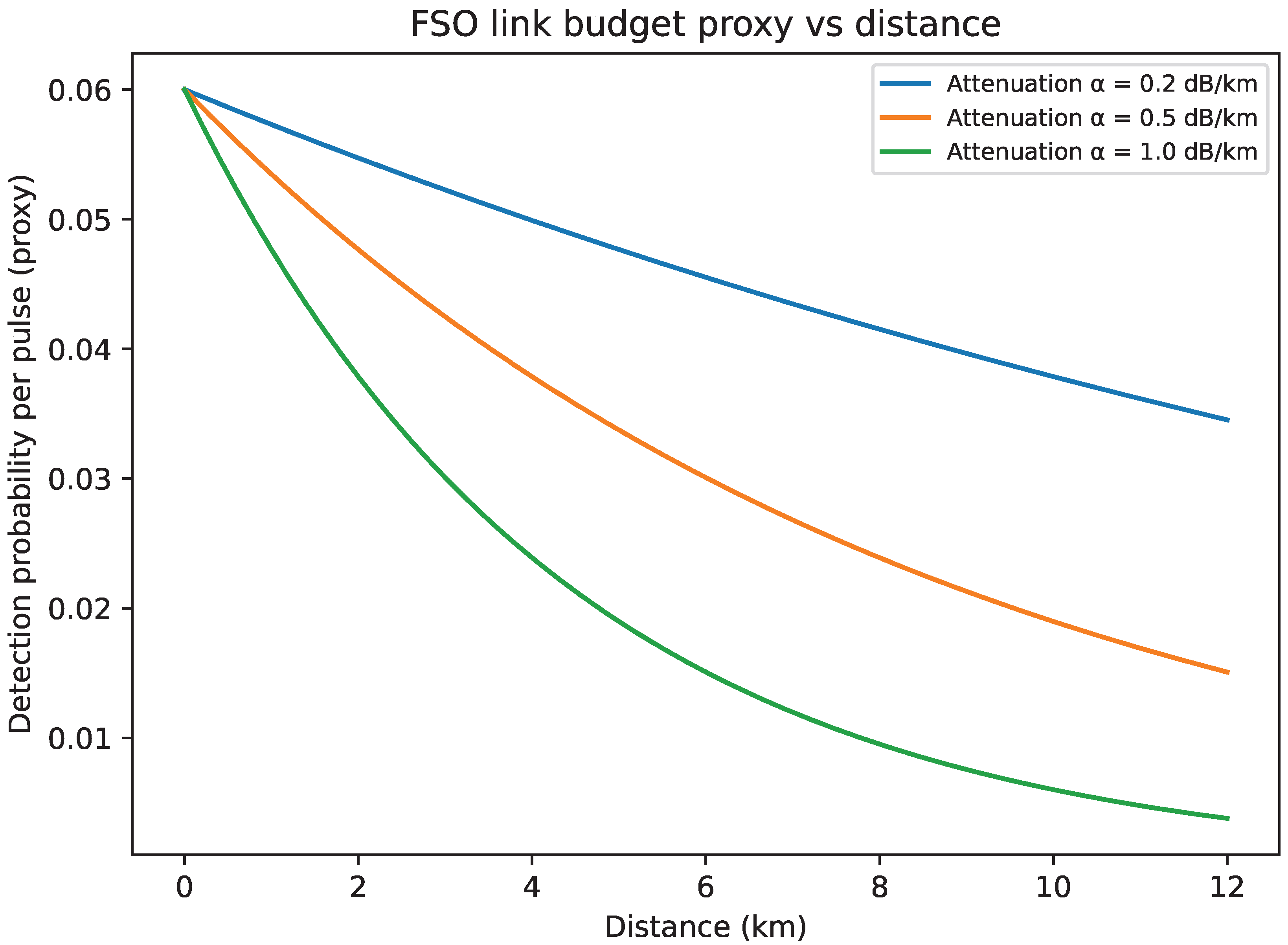
Figure 1 illustrates the resulting distance-dependent detection probability derived from Equation (
3) for representative atmospheric attenuation values, highlighting the exponential reduction in received signal strength with propagation distance. The corresponding channel transmittance is
This transmittance enters directly into QKD gain and secret key rate expressions.
2.3. Atmospheric Turbulence: Gamma–Gamma Model
Atmospheric turbulence induces irradiance fluctuations modeled by the Gamma–Gamma distribution as follows:
Here
describes the small-scale turbulence parameter;
describes the large-scale turbulence parameter;
is the normalization factor of the Gamma–Gamma probability density, where denotes the Euler gamma function;
is the modified Bessel function of the second kind.
The parameters are related to the Rytov variance
via empirical relations [
21]. Increasing
broadens the distribution tail, leading to deeper fades, reduced average visibility
V, and increased QBER.
This directly couples atmospheric physics to entanglement degradation.
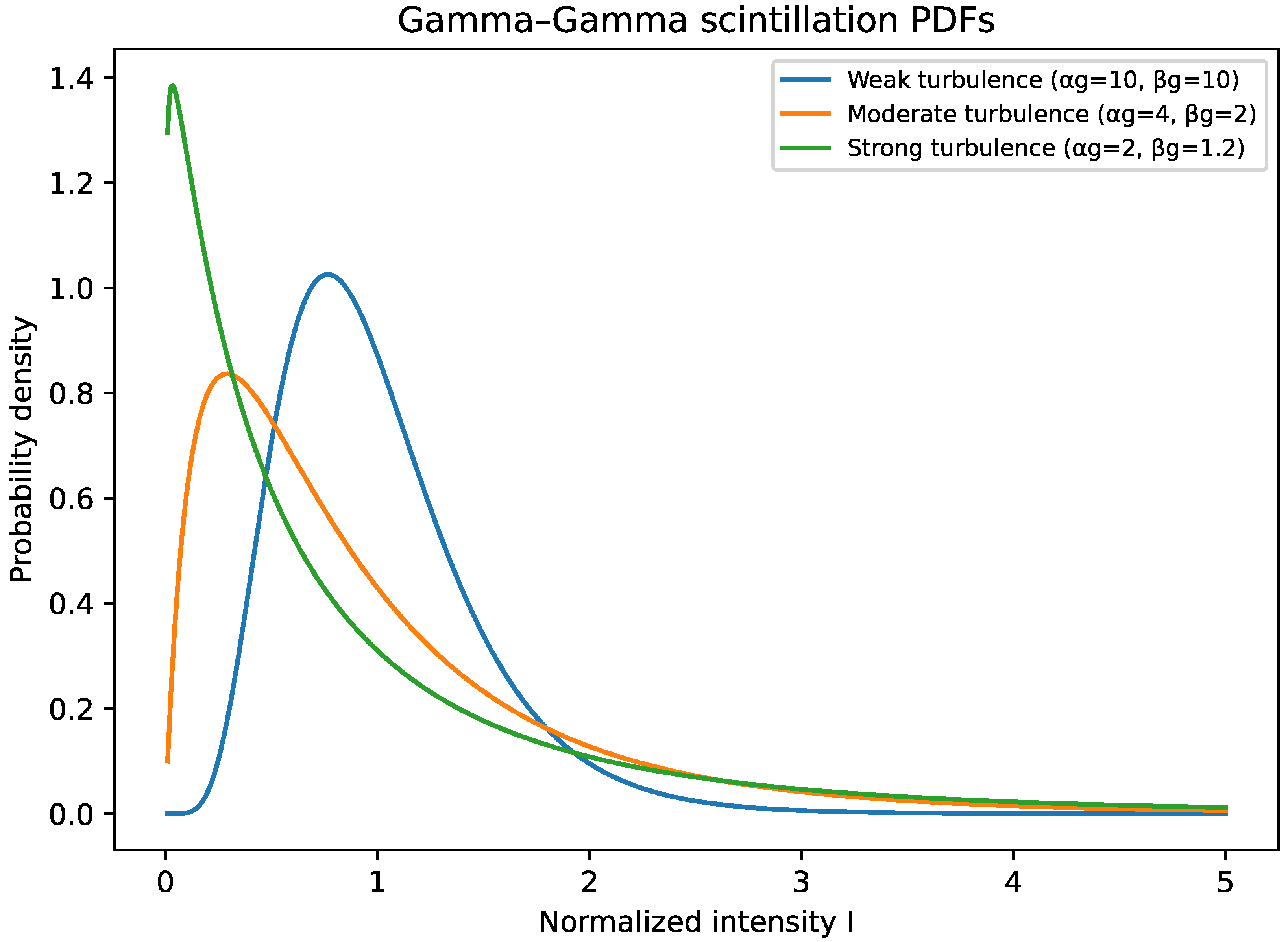
Figure 2 shows representative Gamma–Gamma irradiance distributions corresponding to weak, moderate, and strong turbulence regimes, parameterized by the values of
indicated in the legend. The broadening of the distribution with increasing turbulence strength illustrates the increasing probability of deep intensity fades.
2.4. Depolarizing Channel and Qubit Formalism
Polarization qubits are modeled as density operators
in a two-dimensional Hilbert space. Environmental depolarization is described by
where
is the depolarization probability;
are Pauli operators;
is the qubit density matrix.
This channel isotropically shrinks the Bloch sphere.
2.5. Werner-State Entanglement Model
Entangled resource states are modeled as Werner states as follows:
where
is entanglement visibility;
is a maximally entangled Bell state;
represents maximally mixed noise.
The teleportation fidelity becomes
The classical teleportation bound corresponds to .
Unity fidelity is achieved only in the ideal limit with noiseless operations. Realistic free-space systems satisfy .
2.6. CHSH Nonlocality and Visibility
For Werner states, the maximal CHSH parameter satisfies
Violation of Bell inequality requires
Thus entanglement visibility directly determines nonclassical certification and correlates with teleportation fidelity and QKD security.
2.7. Non-Ideal Entanglement Swapping
Consider two Bell pairs with visibilities
and
. Under ideal BSM,
However, practical Bell-state measurements are limited by the following:
We incorporate an effective BSM efficiency
as follows:
In this expression,
denotes the visibility of the
ith elementary link,
is the effective Bell-state measurement efficiency, and
h is the number of hops (or entanglement-swapping stages) along the end-to-end path. The end-to-end teleportation fidelity becomes
This expression makes the following explicit:
Visibility decays multiplicatively with hop count;
Non-ideal BSM introduces exponential suppression;
Topologies minimizing h inherently preserve entanglement.
3. Protocols and Performance Metrics
3.1. Asymptotic Decoy-State BB84 Security Bound
We consider the asymptotic decoy-state BB84 protocol. The lower bound on the secret key rate per pulse is given by [
3,
8,
9,
22]
where
is the sifting factor for BB84;
is the single-photon gain;
is the single-photon error rate;
is the overall gain for signal intensity ;
is the quantum bit error rate (QBER);
is the error correction inefficiency;
is the binary entropy function.
The decoy-state method, first introduced by Hwang [
22], enables estimation of
and
by varying intensity levels, thereby defeating photon number splitting attacks.
3.2. Channel Transmittance and Gain Dependence
For weak coherent pulses, the overall gain can be approximated as
where
Since
the secret key rate decays exponentially with distance in direct links.
3.3. Topology-Dependent Distance Scaling
In multi-hop networks, effective distance becomes
where
h is hop count.
Thus, the following is true:
Mesh topology: for any pair.
Star topology: via hub.
Ring topology: .
Because gain and visibility degrade multiplicatively across hops, topology directly alters the following:
This formalizes the observation that topology is not secondary to channel modeling but structurally governs achievable secure distance.
3.4. Twin-Field and Sending-or-Not-Sending QKD
Recent twin-field QKD (TF-QKD) protocols [
23,
24] have demonstrated secret key rate scaling proportional to
rather than
. Related protocol variants, including the sending-or-not-sending approach, further extend this framework for long-distance quantum key distribution.
In these architectures:
Two users send weak coherent states to a central measurement station.
Key rate depends on interference visibility at midpoint.
Measurement node need not be trusted.
This architecture naturally resembles a star topology with central measurement node. Therefore:
TF-QKD can mitigate exponential decay in long-distance star-like configurations.
Mesh architectures may not fully exploit TF-QKD advantages.
Ring structures incur cumulative interference instability.
While full TF-QKD modeling is beyond the present scope, this observation suggests that protocol choice may alter optimal topology selection for satellite or long-baseline FSO systems.
In particular, the sending-or-not-sending (SNS) variant of twin-field QKD employs phase-randomized weak coherent pulses sent by two users to a central interference station. The key generation relies on single-photon interference at this midpoint measurement node, which need not be trusted for security. Structurally, this architecture resembles a star-like topology in which users communicate through a central interference station rather than directly with one another. This midpoint-measurement structure alters the topology–security relationship; because the key rate scales approximately with rather than , long-distance performance degradation in star-like configurations can be partially mitigated. Consequently, protocol choice (TF-QKD versus direct BB84) may shift the topology that is optimal for free-space networks, particularly in satellite or long-baseline deployments.
3.5. Finite-Key Considerations
The present analysis adopts asymptotic security bounds. In the following practical finite-key regimes:
Statistical fluctuations increase required block size;
Multi-hop routing introduces additional classical communication overhead;
Visibility fluctuations widen error margins.
Finite-key penalties will amplify topology-dependent divergence, particularly in high-hop configurations.
3.6. Latency and End-to-End Delay
For
h hops, total latency becomes
Processing delay dominates short links, while propagation delay dominates long-distance free-space segments.
Since mesh minimizes h, it minimizes both of the following:
4. Methodology
4.1. Simulation Framework
To evaluate topology-dependent behavior under realistic impairments, we implement a circuit-level simulation framework incorporating the following:
Depolarizing noise on each qubit transmission;
Gamma–Gamma turbulence-induced visibility perturbation;
Non-ideal Bell-state measurement efficiency ,
Distance-dependent transmittance ;
Classical signaling delay accumulation.
Teleportation fidelity is computed by averaging over randomly sampled pure input states uniformly distributed on the Bloch sphere.
For each topology and noise parameter set:
Monte Carlo trials are performed;
Independent turbulence realizations are sampled;
Random depolarizing channels are applied per hop;
BSM success probability is weighted by .
Reported fidelities represent ensemble means unless otherwise specified.
4.2. Noise and Channel Parameters
The simulation parameter ranges are summarized in
Table 1.
Gamma–Gamma parameters
are derived from
using standard empirical mappings [
21].
4.3. Implementation of Entanglement Swapping
For multi-hop routing, entanglement swapping is simulated sequentially.
At each hop
and cumulative visibility follows Equation (
13).
This explicitly captures the following:
Swap inefficiency;
Detector losses;
Multi-hop degradation.
Thus mesh networks () avoid swap accumulation entirely.
4.4. Teleportation Fidelity Evaluation
For each trial:
A random pure input state is generated.
Entanglement visibility v is sampled.
Depolarizing channel applied.
Swapping cascade applied if .
Teleportation fidelity computed via Equation (
8).
Mean and standard deviation are reported.
Clarification on Unity Fidelity Entries
Entries equal to in per-iteration tables arise from finite-sample realizations where:
These represent idealized limit cases and do not imply realistic sustained unity fidelity under atmospheric turbulence.
4.5. Secret Key Rate Computation
Secret key rate
R is computed per Equation (
15) using distance-dependent
and topology-dependent hop distance accumulation.
For multi-hop configurations
reflecting cumulative QBER increase.
Secret key rate threshold distance is defined as the maximum d such that .
4.6. Error Band Representation
Fidelity curves presented in figures represent ensemble means over Monte Carlo trials.
Shaded regions (when shown) correspond to confidence bands.
Large standard deviations observed in
Table 2 (e.g.,
) reflect the following:
Smooth curves do not imply deterministic stability but represent expectation values.
Table 2.
Topology comparison: scaling and performance trade-offs.
Table 2.
Topology comparison: scaling and performance trade-offs.
| Topology | Links | Transceivers/Node | Worst-Case Hops |
|---|
| Star | | 1 (peripheral), (hub) | 2 |
| Mesh | | | 1 |
| Ring | n | 2 | |
4.7. Hardware Assumptions
We assume the following:
Single-photon detectors with 70– efficiency;
Passive linear-optics BSM;
No quantum memory purification;
Classical synchronization latency on FPGA-scale electronics.
Full repeater-based purification is outside the present scope.
5. Results
5.1. CHSH Violation and Entanglement Visibility
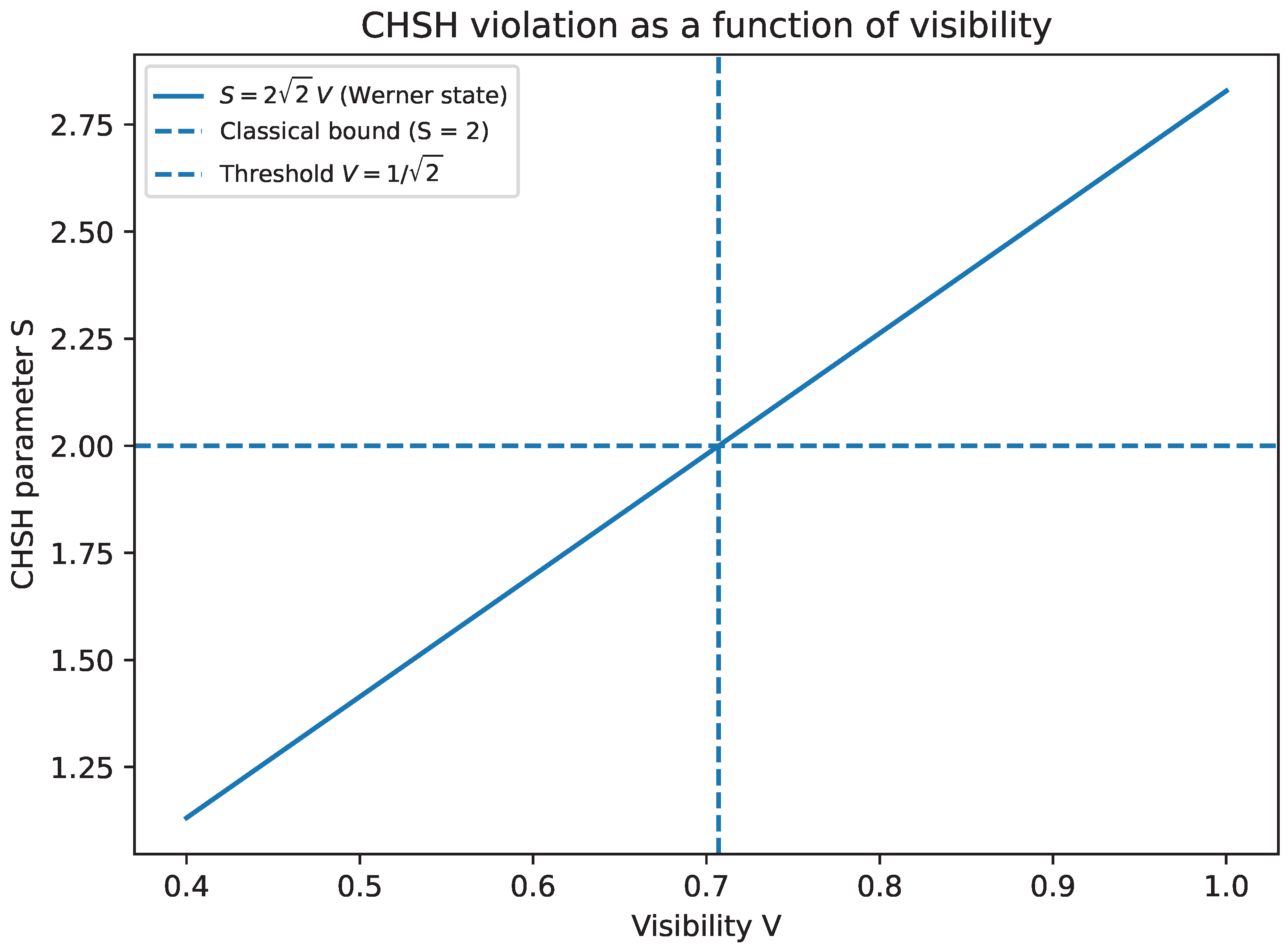
Figure 3 shows the CHSH parameter
S as a function of entanglement visibility
v. As established earlier in
Section 2.6, the maximal CHSH value for a Werner state is determined directly by the visibility relation given in Equation (
9). The curve in
Figure 3 is therefore obtained by evaluating this relation while varying the visibility over the interval
.
From the same relation, the Bell-inequality violation condition
yields the well-known visibility threshold given in Equation (
10). This threshold corresponds closely to the practical teleportation fidelity target
through the fidelity–visibility relation in Equation (
8).
Consequently, CHSH violation, teleportation fidelity, and QKD security are structurally linked through the entanglement visibility. Because these performance metrics depend directly on the visibility, any topology-induced reduction in the end-to-end visibility translates into reduced nonlocality certification, lower teleportation fidelity, and diminished secret key rate.
As turbulence increases (larger ), visibility decreases, pushing S toward the classical bound. This directly illustrates how atmospheric physics constrains nonclassical certification.
5.2. Teleportation Fidelity Across Topologies
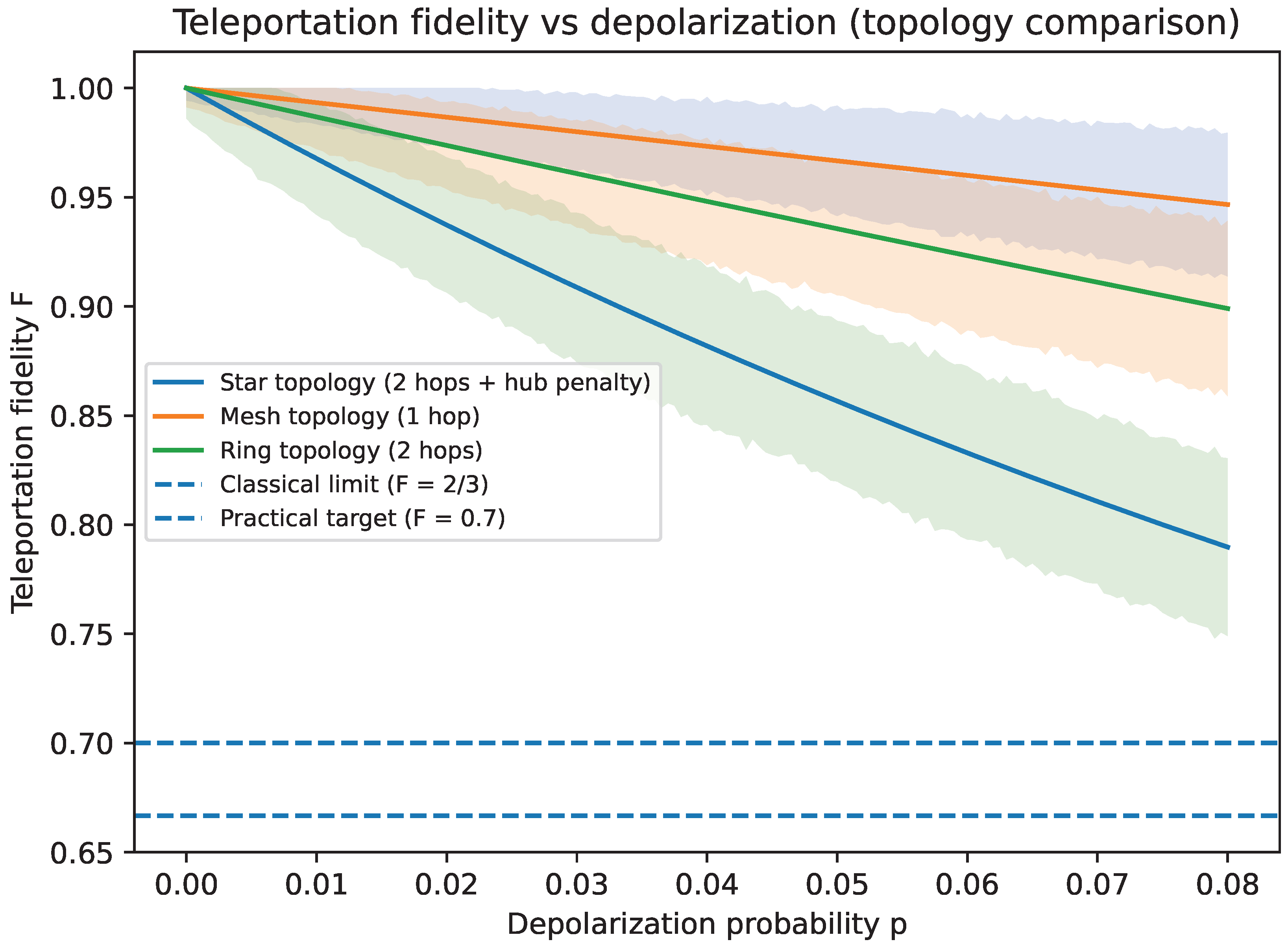
Figure 4 presents ensemble-averaged teleportation fidelity
F versus depolarization probability
p for star, mesh, and ring topologies.
The curves represent Monte Carlo ensemble means, and shaded regions in
Figure 4 explicitly denote the
confidence intervals computed from the ensemble distribution of fidelity values.
Key observations:
Mesh topology exhibits the slowest degradation.
Ring topology shows intermediate degradation.
Star topology degrades most rapidly under increasing p.
5.2.1. Mechanistic Explanation
This behavior is not merely empirical but follows directly from Equation (
13).
Mesh
For any two nodes,
. Therefore
with no swapping cascade. Visibility is preserved.
Star
Communication between two peripheral nodes requires
Noise at the hub multiplies across both links. Hub misalignment or detector inefficiency affects all pairs.
Ring
Worst-case routing requires multiple hops, so the end-to-end visibility follows the general cascade law given in Equation (
13). Consequently, multiplicative degradation dominates as
h increases.
Thus mesh robustness arises from hop minimization, not from superior physical links.
5.2.2. Variance Interpretation
Table 2 shows significant standard deviation in mesh and star configurations.
Large variance arises from:
Turbulence realization variability;
Stochastic swapping outcomes;
Hub aggregation effects (star topology).
Smooth mean curves in
Figure 4 represent expectation values, not deterministic behavior.
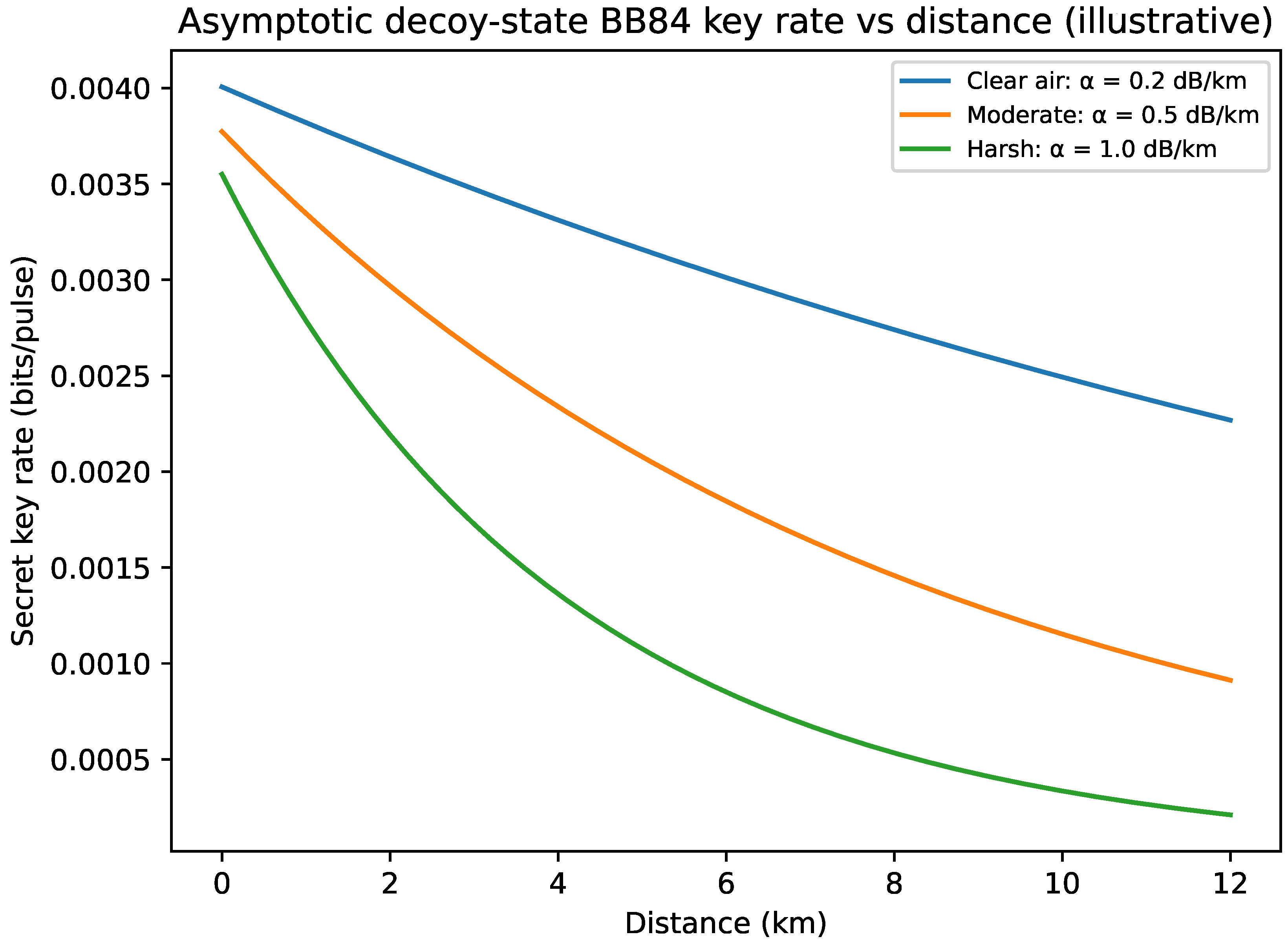
5.3. QKD Secret Key Rate Versus Distance
Figure 5 shows the asymptotic decoy-state BB84 with secret key rate
R as a function of distance
d for representative atmospheric attenuation coefficients, illustrating the exponential rate decay predicted by the channel transmittance model.
5.3.1. Topology Impact
Mesh
Since , effective distance equals physical distance.
The secret key rate approximately follows the exponential decay with propagation distance.
Star
Effective path length doubles for peripheral communication. Thus
leading to accelerated rate decay.
Ring
Worst-case routing accumulates hop distances as follows:
Additionally, QBER increases cumulatively as follows:
Thus ring networks exhibit the fastest degradation for distant node pairs.
5.3.2. Threshold Distance
The maximum operational distance is defined by .
Mesh topologies consistently achieve the longest secure distances under identical physical parameters because they avoid hop-induced multiplication.
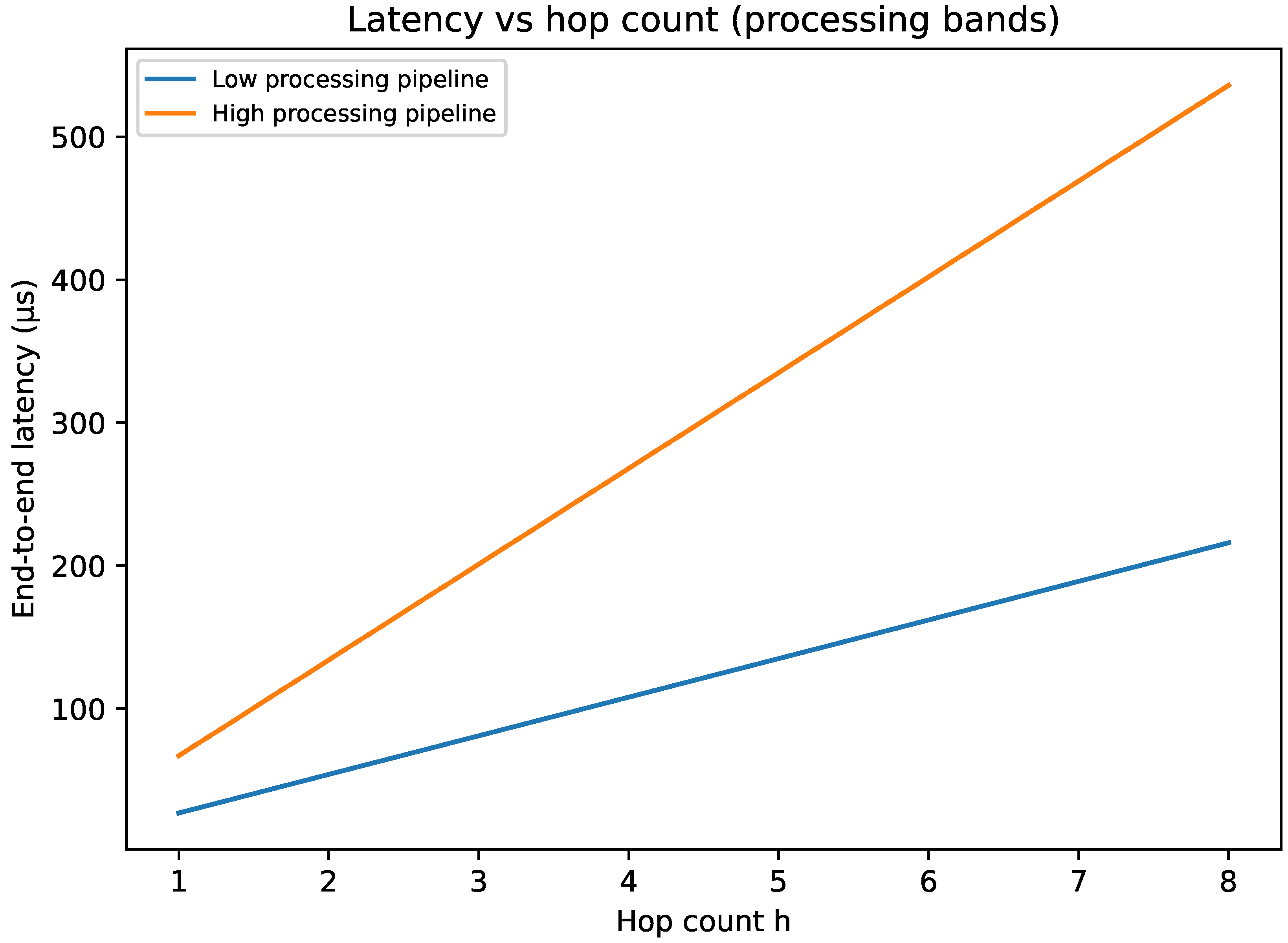
5.4. Latency and Routing Trade-Offs
Figure 6 shows the end-to-end latency
as a function of hop count
h under representative quantum processing and classical signaling assumptions.
Since
latency grows approximately linearly with
h.
Thus the following are true:
This reinforces that topology influences both quantum and classical performance metrics.
5.5. Joint Interpretation of Fidelity, CHSH, and QKD
Visibility v governs the following:
Teleportation fidelity ;
CHSH violation ;
QBER via depolarization and turbulence.
Topology alters effective through swap depth.
Thus the following are true:
All performance metrics are therefore coupled through visibility cascade dynamics.
6. Discussion
6.1. Topology–Performance Trade-Offs
The results demonstrate that mesh topologies preserve entanglement visibility by minimizing hop count, whereas star and ring configurations introduce multiplicative degradation through swapping cascades. However, robustness must be interpreted jointly with hardware scaling and operational complexity.
Topology selection is therefore a multi-objective design problem balancing the following:
6.2. Formal Resource Scaling Analysis
We now quantify hardware requirements for n nodes.
6.2.1. Star Topology
Total quantum links: .
Peripheral nodes: 1 transceiver each.
Central hub: transceivers.
Worst-case hop count: .
For peripheral-to-peripheral communication
Implications
Hub must maintain simultaneous pointing alignments.
Hub experiences aggregated noise and synchronization load.
Failure at hub disrupts entire network.
Thus star topology minimizes total link count but centralizes physical and quantum complexity.
6.2.2. Fully Connected Mesh
Total quantum links: .
Transceivers per node: .
Worst-case hop count: .
Implications
No swapping cascade.
No hub bottleneck.
Hardware scaling is quadratic in n.
Alignment complexity increases rapidly.
Entanglement source demand grows as .
Mesh robustness arises from hop minimization, but this robustness incurs significant hardware and optical alignment cost.
6.2.3. Ring Topology
End-to-end visibility follows the general cascade law given in Equation (
13).
Implications
Linear hardware scaling.
No single point of failure.
Multiplicative degradation dominates distant pairs.
Latency increases with hop count.
Ring topology offers balanced scaling but sacrifices long-range fidelity.
6.3. Comparative Scaling Summary
This section summarizes the structural scaling properties of common network topologies used in free-space photonic quantum communication.
Table 2 compares the number of links, transceiver requirements per node, and worst-case hop distance for star, mesh, and ring configurations. These metrics capture the trade-offs between hardware complexity and communication efficiency. Fully connected mesh networks minimize hop distance at the cost of rapid growth in link and transceiver requirements, while ring and star topologies offer reduced hardware complexity but increased path lengths or centralized load.
6.4. Hardware Requirements per Node
The answer depends on topology as follows:
Star: No. Only the hub requires transceivers.
Mesh: Yes. Each node requires transceivers.
Ring: No. Each node requires only two.
Thus mesh robustness is achieved at the expense of quadratic optical hardware scaling.
Concrete Example ( Nodes)
To make the scaling more tangible, consider a network of nodes.
Star topology: Total links = . The central hub requires 9 transceivers, while each peripheral node requires only 1. Worst-case hop count .
Fully connected mesh: Total links = . Each node requires transceivers. Worst-case hop count .
Ring topology: Total links = . Each node requires 2 transceivers. Worst-case hop count .
This simple example illustrates that the robustness advantage of the mesh architecture is obtained at the cost of substantially increased optical hardware and alignment complexity compared with star or ring configurations.
6.5. Entanglement Source Scaling
Let S denote entanglement sources per link.
Star: .
Ring: .
Mesh: .
For large
n, mesh architecture may become physically impractical without integrated photonic multiplexing and efficient resource management strategies, which are increasingly important in scalable quantum information systems [
25].
6.6. Synchronization and Pointing Overhead
Free-space links require the following:
In mesh networks, synchronization scales quadratically. In star networks, synchronization load is centralized. In ring networks, synchronization load is distributed but multi-hop coordination increases classical overhead.
6.7. Interpretation of Robustness
The conclusion that mesh topologies are most robust must therefore be interpreted carefully.
Mesh robustness arises because
It does not arise from superior physical links but from eliminating entanglement swapping depth.
Thus topology-dependent performance divergence is a structural consequence of visibility cascade physics.
6.8. Implications for Near-Term Free-Space Networks
In early-stage deployments lacking quantum repeaters, the following is true:
Minimizing hop count preserves fidelity.
Hardware scaling constrains mesh feasibility.
Star topology may be viable for small n.
Ring topology may suit moderate-scale networks.
Protocol choice (e.g., TF-QKD vs BB84) may further alter optimal topology selection.
These results provide a quantitative basis for topology-aware design in free-space photonic quantum networks.
7. Conclusions
We have presented a unified topology-aware analytical framework for evaluating free-space photonic quantum networks operating without full repeater infrastructures. By systematically coupling physical-layer channel impairments (attenuation, turbulence, and depolarization), non-ideal entanglement swapping efficiency, Werner-state visibility formalism, CHSH nonlocality certification, asymptotic decoy-state QKD security bounds, and explicit graph-theoretic topology structure, we have demonstrated that network topology is a first-order determinant of system-level quantum performance.
The central result is that identical physical links exhibit fundamentally different end-to-end behavior once embedded within distinct graph structures. Specifically
Mesh topologies minimize entanglement swapping depth (), thereby preserving visibility and maximizing teleportation fidelity and secret key rate, but require quadratic hardware scaling.
Star topologies minimize link count and entanglement source overhead but concentrate alignment, synchronization, and noise aggregation at a central hub.
Ring topologies offer linear hardware scaling and distributed control but incur multiplicative visibility degradation and increased latency with hop count.
These conclusions arise directly from the visibility cascade relation derived in Equation (
13), which makes explicit that hop count structurally governs entanglement preservation in the absence of quantum repeaters.
Furthermore, by linking entanglement visibility to teleportation fidelity (), CHSH violation (), and QKD security bounds, we have shown that all major performance metrics are coupled through topology-dependent visibility dynamics. The results provide a quantitative foundation for topology-aware design in near-term terrestrial, airborne, and satellite-assisted free-space quantum networks. Protocol selection (e.g., BB84 versus twin-field QKD) may further influence optimal topology choice, particularly for long-baseline configurations.
Future work will extend this framework to the following areas:
Finite-key security analysis;
Adaptive topology reconfiguration under turbulence variation;
Integration with quantum memory-assisted repeater segments;
Hardware-in-the-loop experimental validation.
As photonic quantum technologies mature, topology-aware performance modeling will remain central to bridging quantum communication theory and practical deployment.
Author Contributions
Conceptualization, S.A.; Methodology, S.A.; Software, S.A.; Validation, S.A. and S.Y.; Formal analysis, S.A.; Investigation, S.A.; Data curation, S.A.; Writing—original draft, S.A.; Writing—review & editing, S.A.; Visualization, S.A.; Supervision, S.Y.; Project administration, S.Y.; Funding acquisition, S.Y. All authors have read and agreed to the published version of the manuscript.
Funding
This research was funded by the U.S. Department of Energy under Award No. DE-NA0004189. The APC was funded by Sun Yi.
Data Availability Statement
Data are contained within the article.
Acknowledgments
This work builds upon prior modeling of quantum telecommunication in multi-agent systems [
18]. The authors acknowledge ongoing discussions in the broader quantum networking community.
Conflicts of Interest
The authors declare no conflicts of interest.
References
- Gisin, N.; Thew, R. Quantum communication. Nat. Photonics 2007, 1, 165–171. [Google Scholar] [CrossRef]
- Wehner, S.; Elkouss, D.; Hanson, R. Quantum internet: A vision for the road ahead. Science 2018, 362, eaam9288. [Google Scholar] [CrossRef] [PubMed]
- Pirandola, S.; Andersen, U.L.; Banchi, L.; Berta, M.; Bunandar, D.; Colbeck, R.; Englund, D.; Gehring, T.; Lupo, C.; Ottaviani, C.; et al. Advances in quantum cryptography. Adv. Opt. Photonics 2020, 12, 1012–1236. [Google Scholar] [CrossRef]
- Pirandola, S.; Braunstein, S.L. Unite to build a quantum internet. Nature 2016, 532, 169–171. [Google Scholar] [CrossRef]
- Awschalom, D.D.; Bernien, H.; Brown, R.; Clerk, A.; Chitambar, E.; Dibos, A.; Dionne, J.; Eriksson, M.; Fefferman, B.; Fuchs, G.D.; et al. A Roadmap for Quantum Interconnects; Q-NEXT/Argonne National Laboratory Technical Report; Argonne National Laboratory (ANL): Argonne, IL, USA, 2022. [Google Scholar]
- Cacciapuoti, A.S.; Caleffi, M.; Tafuri, F.; Cataliotti, F.S.; Gherardini, S.; Bianchi, G. The Quantum Internet: Networking Challenges in Distributed Quantum Computing. arXiv 2018, arXiv:1810.08421. [Google Scholar] [CrossRef]
- Ekert, A.K. Quantum cryptography based on Bell’s theorem. Phys. Rev. Lett. 1991, 67, 661–663. [Google Scholar] [CrossRef]
- Scarani, V.; Bechmann-Pasquinucci, H.; Cerf, N.J.; Dušek, M.; Lütkenhaus, N.; Peev, M. The security of practical quantum key distribution. Rev. Mod. Phys. 2009, 81, 1301–1350. [Google Scholar] [CrossRef]
- Shor, P.W.; Preskill, J. Simple proof of security of the BB84 protocol. Phys. Rev. Lett. 2000, 85, 441–444. [Google Scholar] [CrossRef]
- Bennett, C.H.; Brassard, G.; Crépeau, C.; Jozsa, R.; Peres, A.; Wootters, W.K. Teleporting an unknown quantum state via dual classical and Einstein–Podolsky–Rosen channels. Phys. Rev. Lett. 1993, 70, 1895–1899. [Google Scholar] [CrossRef]
- Briegel, H.-J.; Dür, W.; Cirac, J.I.; Zoller, P. Quantum repeaters: The role of imperfect local operations in quantum communication. Phys. Rev. Lett. 1998, 81, 5932–5935. [Google Scholar] [CrossRef]
- Sangouard, N.; Simon, C.; De Riedmatten, H.; Gisin, N. Quantum repeaters based on atomic ensembles. Rev. Mod. Phys. 2011, 83, 33–80. [Google Scholar] [CrossRef]
- Yin, J.; Cao, Y.; Li, Y.-H.; Liao, S.-K.; Zhang, L.; Ren, J.-G.; Cai, W.-Q.; Liu, W.-Y.; Li, B.; Dai, H.; et al. Satellite-based entanglement distribution over 1200 kilometers. Science 2017, 356, 1140–1144. [Google Scholar] [CrossRef] [PubMed]
- Liao, S.-K.; Cai, W.-Q.; Liu, W.-Y.; Zhang, L.; Li, Y.; Ren, J.-G.; Yin, J.; Shen, Q.; Cao, Y.; Li, Z.-P.; et al. Satellite-to-ground quantum key distribution. Nature 2017, 549, 43–47. [Google Scholar] [PubMed]
- Bedington, R.; Arrazola, J.M.; Ling, A. Progress in satellite quantum key distribution. npj Quantum Inf. 2017, 3, 30. [Google Scholar] [CrossRef]
- Barghouty, A.F.; Saif, B.N.; Lekki, J.D.; Rieffel, E.G.; Cooper, L.D.; Guha, S.; Mohageg, M. Workshop on Space Quantum Communications and Networks; NASA Workshop Report; National Aeronautics and Space Administration: Washington, DC, USA, 2020. [Google Scholar]
- Chiti, F.; Picchi, R.; Pierucci, L. A survey on non-terrestrial quantum networking: Challenges and trends. Comput. Netw. 2024, 252, 110668. [Google Scholar]
- Acha, S.; Yi, S. Application of quantum telecommunication in multi-agent system. Discov. Robot. 2025, 1, 3. [Google Scholar] [CrossRef]
- Shi, S.; Qian, C. Modeling and designing routing protocols in quantum networks. arXiv 2019, arXiv:1909.09329. [Google Scholar] [CrossRef]
- Gu, H.; Li, Z.; Yu, R.; Wang, X.; Zhou, F.; Liu, J. Fendi: High-fidelity entanglement distribution in the quantum internet. arXiv 2023, arXiv:2301.08269. [Google Scholar]
- Andrews, L.C.; Phillips, R.L. Laser Beam Propagation Through Random Media; SPIE Press: Bellingham, WA, USA, 2005. [Google Scholar]
- Wang, X.-B. Beating the photon-number-splitting attack in practical quantum cryptography. Phys. Rev. Lett. 2005, 94, 230503. [Google Scholar]
- Lucamarini, M.; Yuan, Z.L.; Dynes, J.F.; Shields, A.J. Overcoming the rate–distance limit of quantum key distribution without quantum repeaters. Nature 2018, 557, 400–403. [Google Scholar] [CrossRef]
- Wang, X.-B.; Hu, X.-L.; Yu, Z.-W.; Zhang, H.-L. Twin-field quantum key distribution with large misalignment error. Phys. Rev. A 2018, 98, 062323. [Google Scholar] [CrossRef]
- Gyongyosi, L.; Imre, S. Circuit depth reduction for gate-model quantum computers. Sci. Rep. 2020, 10, 11229. [Google Scholar] [CrossRef]
| Disclaimer/Publisher’s Note: The statements, opinions and data contained in all publications are solely those of the individual author(s) and contributor(s) and not of MDPI and/or the editor(s). MDPI and/or the editor(s) disclaim responsibility for any injury to people or property resulting from any ideas, methods, instructions or products referred to in the content. |