1. Introduction
Atomic fountain clocks play a crucial role in atomic timekeeping, high-precision navigation and positioning, geodesy, and fundamental physics research [
1,
2,
3,
4]. Currently, atomic fountain clocks worldwide primarily use cesium-133 (
133Cs) and rubidium-87 (
87Rb) atoms as working media. According to the current definition of the International System of Units (SI), the second is defined by the ground-state hyperfine transition of the cesium atom at a frequency of 9 192 631 770 Hz [
5,
6,
7]. In 2004, at its 16th meeting, the Consultative Committee for Time and Frequency (CCTF) recommended the ground-state hyperfine transition of the
87Rb atom as a secondary representation of the second, leading to extensive worldwide development of rubidium atomic fountain clocks as secondary frequency standards [
8,
9,
10,
11,
12]. The National Time Service Center (NTSC) of the Chinese Academy of Sciences initiated the development of rubidium atomic fountain clocks for timekeeping in 2019. The first rubidium fountain clock achieves a 1 s fractional frequency stability of 1.91 × 10
−13 and a one-day frequency stability better than 7 × 10
−16, and has contributed as a timekeeping clock to the realization of Coordinated Universal Time (UTC) since November 2022 [
13,
14]. The second rubidium atomic fountain clock employs a fully fiber-based optical system and provides a short-term fractional frequency stability of 1.4 × 10
−13 τ
−1/
2 and a one-day frequency stability of 4.7 × 10
−16 [
15]. At present, the NTSC is developing an integrated
87Rb atomic fountain clock.
Laser cooling of atoms is the key technique for preparing cold atomic ensembles and is primarily based on Doppler and sub-Doppler cooling mechanisms. To realize a cold-atom fountain, atoms are typically captured, cooled, and launched using a magneto-optical trap (MOT) in combination with moving optical molasses. In this design, six cooling laser beams arranged in a (1, 1, 1) configuration form three pairs of counter propagating beams. Together with a pair of upper and lower anti-Helmholtz coils that generate a magnetic-field gradient, these beams provide the cooling and trapping forces required for the atomic ensemble [
16,
17]. It is worth noting that the number of atoms captured in the MOT (N) scales strongly with the diameter of the cooling laser beams (D), typically following the relation N∝D
4. To guarantee a sufficient number of captured atoms, the MOT region retains the same cooling window clear aperture (35 mm) as used in the previous two generations of laboratory fountain clocks. However, generating such large beams to fully utilize this aperture using standard fiber collimators (Thorlabs, Inc., Newton, NJ, USA), typically requires long focal lengths, resulting in bulky systems. This presents a challenge for the integrated physics package, which strictly limits the telescope’s mechanical length to less than 140 mm to ensure system integration. In our previous research, the rubidium atomic fountain clock system utilized a collimation scheme based on an achromatic doublet with a focal length of f = 200 mm [
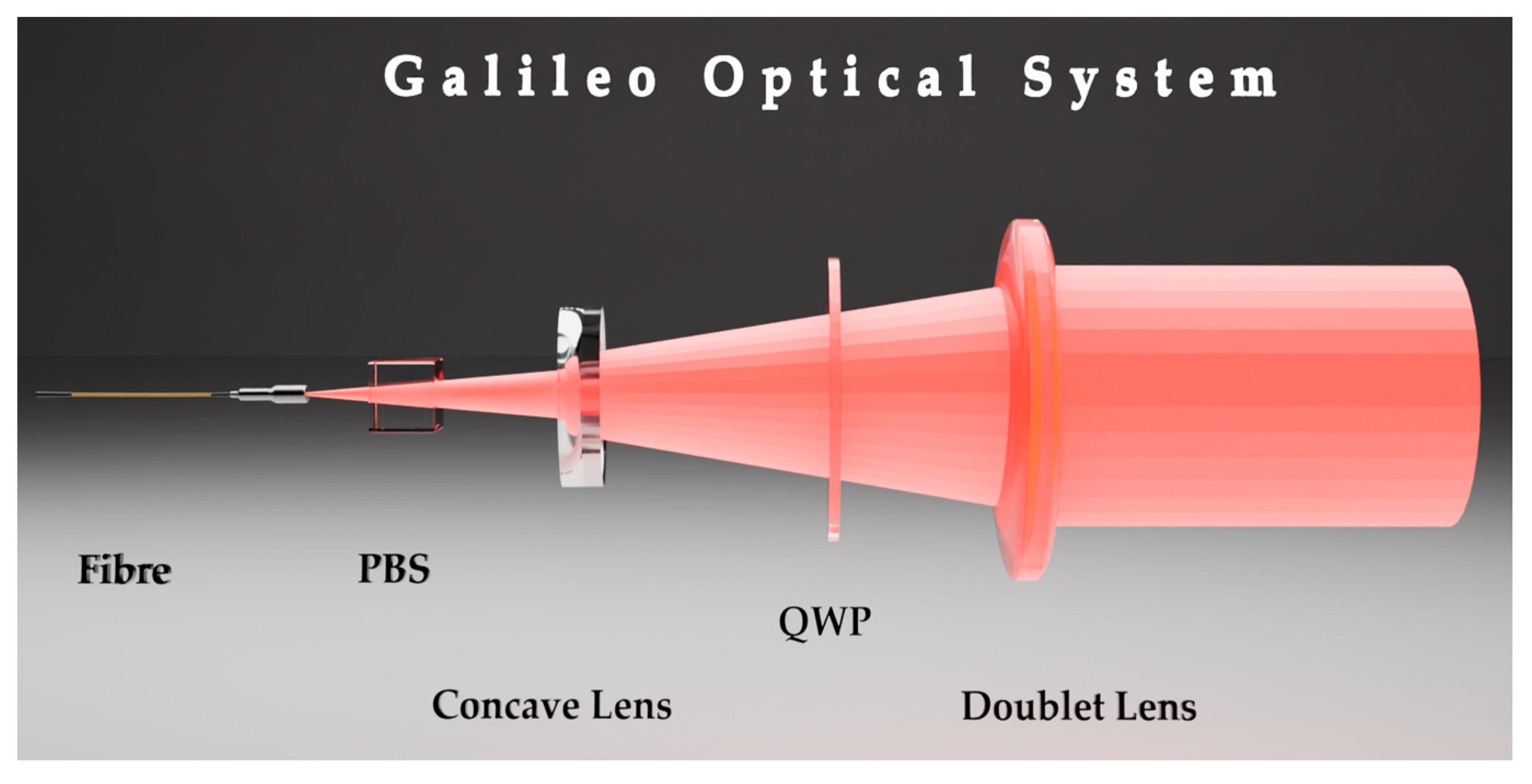
18]. To enable intra-barrel power adjustment, this scheme integrated a fiber adjuster, a polarizing beam splitter (PBS), a half-wave plate, a 25.4 mm PBS, and a quarter-wave plate. While this design met the basic collimation requirements and has been successfully applied in the timekeeping clock, it was constrained by the long focal length and complex internal components, resulting in a mechanical length exceeding 250 mm and limited compactness. To further improve the integration level and long-term stability, this work presents a compact Galilean collimating telescope design utilizing a plano-concave lens with a focal length of −25 mm. By offloading the power regulation function to tunable fiber attenuators in the optical distribution system, we eliminated the internal half-wave plate and the 25.4 mm PBS. Considering the compactness requirements of the integrated fountain clock physics package (a transportable, miniaturized system designed for mobility) and the stringent requirements of the cold-atom fountain with respect to the cooling light quality, a miniaturized laser collimating and beam-expanding telescope is designed. This design simplifies the structure while ensuring that the output beam satisfies three key optical properties: collimation, characterized by an output beam divergence angle below 0.25 mrad; coaxiality—defined as the parallelism between the output beam wave vector and the mechanical axis of the telescope—better than 0.3 mrad; and beam centering accuracy better than 0.1 mm with respect to the mechanical axis.
The remainder of this paper is organized as follows:
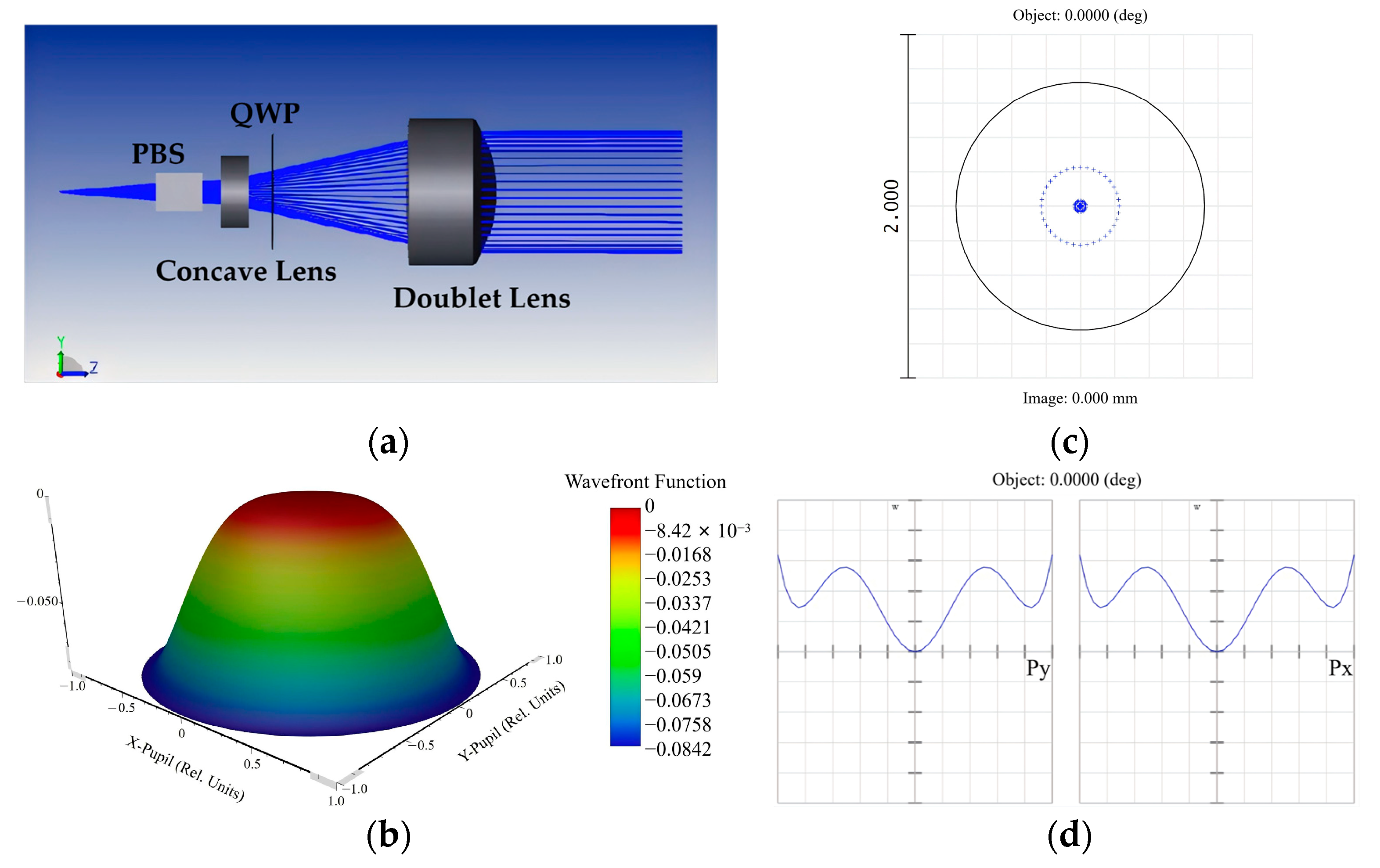
Section 2 presents the modeling and optimization of the Galilean laser collimation and beam-expanding optical path.
Section 3 describes the design and implementation of the telescope’s mechanical structure.
Section 4 provides a detailed analysis of the alignment techniques and experimental results for the collimation, coaxiality, and beam centering and Gaussian profile. Finally,
Section 5 summarizes the work and discusses future research prospects.
3. Mechanical Design and Implementation of the Laser Collimating and Beam-Expanding Telescope
3.1. Mechanical Modeling and Implementation
The mechanical structure of the telescope is designed to satisfy strict optical-element spacing requirements and coaxiality. The overall length of the body is primarily determined by the relative distances between the optical elements. Based on the optical simulation results in
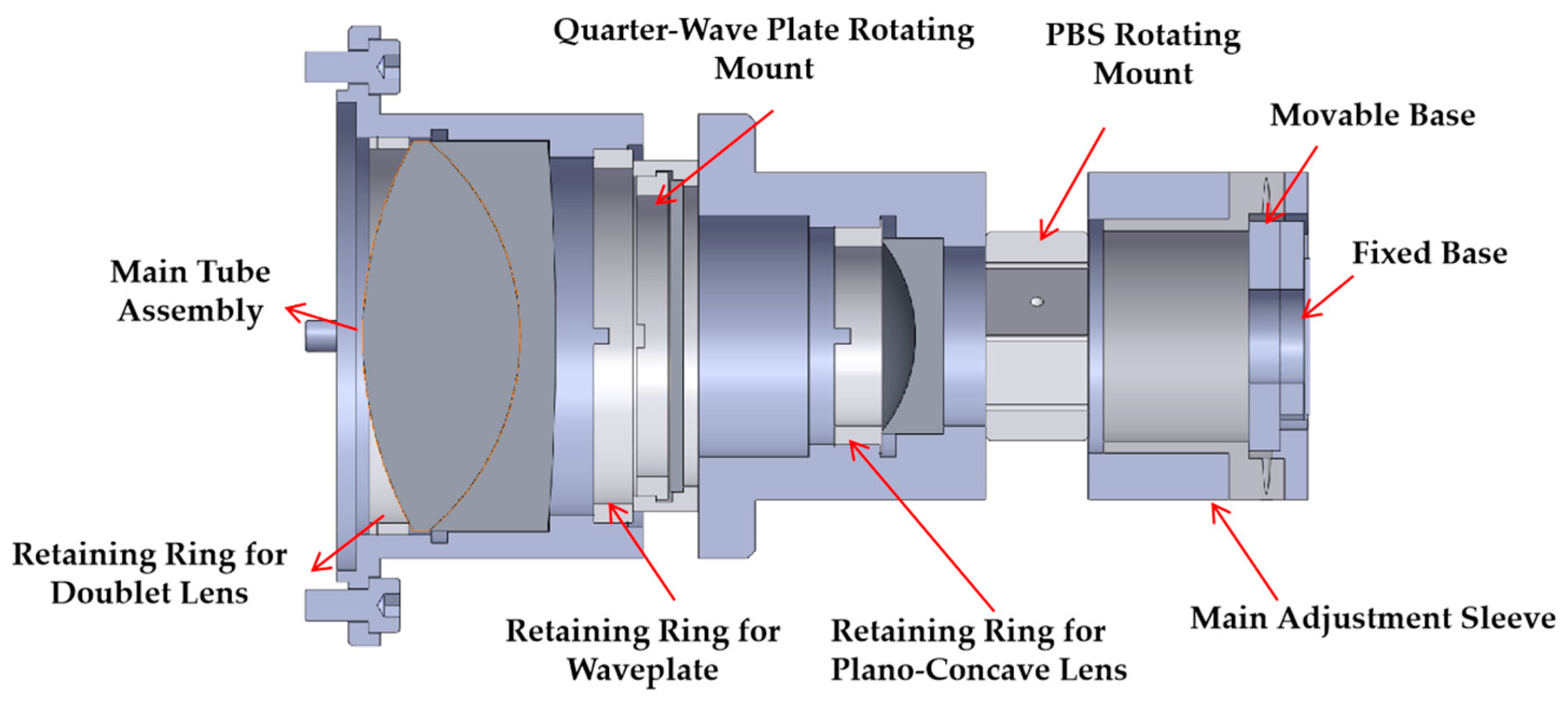
Section 2 and validation using a high-precision cage structure, we construct a three-dimensional mechanical model of the telescope using via mechanical modeling, as shown in
Figure 4. The collimating telescope mainly consists of the following components: the main lens barrel, a retaining ring for the 50 mm achromatic cemented doublet, a quarter-wave-plate rotation mount and its retaining ring, a retaining ring for the plano-concave lens, a rotation mount for the polarizing beam splitter, an adjustable sleeve, a movable base, a fixed base, and an end cap for the movable base. To ensure beam collimation, coaxiality, beam centering and Gaussian profile, and tunable polarization, the mechanical design is optimized in several key respects: control of the coaxiality of the optical elements, accuracy of the inter-element spacing, perpendicularity between the output end face and the optical axis, stress-free mounting of the elements, angular adjustment of the polarization optics, and five-degree-of-freedom adjustment of the fiber. As a result, the total length of the telescope is kept below 140 mm, yielding a highly integrated system.
The main lens barrel serves as the reference carrier and contains precision-machined stepped inner bores for mounting optical elements of different sizes. All inner bores are machined in a single clamping operation, ensuring a coaxiality better than 0.02 mm. The output end face (the surface on which the achromatic doublet is mounted) is taken as the optical reference surface, and its perpendicularity to the main optical axis is required to be better than 1′ (approximately 0.017°) to guarantee the orthogonality of the output beam wave vector. During the initial machining stage of the telescope, to achieve precise control of the spacing between optical elements, the plano-concave lens is used as the positioning reference, and adjustable distances of 10.00 mm and 8.00 mm are reserved for the achromatic cemented doublet and the adjustable sleeve, respectively. During alignment, shims with thicknesses of 1.00 mm and 2.00 mm are combined to adjust the position of the cemented doublet, together with fine tuning of the axial position of the adjustable sleeve, thereby accurately setting the relative distances between the optical elements. In the final telescope assembly, the shims are removed and the optical elements are fixed in position. The required output beam characteristics are then achieved solely by adjusting the fiber, which improves both structural stability and assembly efficiency.
3.2. Mechanical Design of Key Optical Components and Polarization Control
The mounting quality of the plano-concave lens and the achromatic cemented doublet strongly influences the wavefront performance of the system. To achieve stress-free assembly between the retaining ring and the lenses, the retaining ring is screwed into the telescope barrel using a fine-pitch thread. The perpendicularity tolerance of its end face is controlled within 0.01 mm. A layer of soft elastic material is inserted at the lens contact surface so that a uniform radial force is applied to the lens edge, thereby avoiding lens tilt and optical path differences caused by assembly stress. During alignment, each 90° rotation of the plano-concave lens used to adjust the output characteristics led to changes in collimation and the bending of the interference fringes. Analysis confirmed that insufficient preload of the retaining ring caused the lens to loosen. To address this issue, we optimized four parameters: thread pitch, number of engaged threads, retaining-ring tolerance, and the fit tolerance between the lens and the main lens barrel. The optimal parameter set was ultimately determined to be a thread pitch of 1 mm, six turns of thread, a retaining-ring tolerance of 0.00 mm, and a fit tolerance of 0.02 mm between the lens and the main lens barrel.
To meet the requirement of adjustable output polarization, this study designed a precision cylindrical sleeve-type rotation mount for the square PBS. The inner diameter of the sleeve is in a transition fit with the PBS to ensure a secure, stress-free mount. The rotating part and the main lens barrel employ a precision H7/g6 sliding fit, ensuring smooth rotation and keeping the runout of the rotation axis within 0.01 mm. This configuration effectively prevents beam-path deviation during adjustment and maintains the stability of the output beam. The coaxial accuracy between the mechanical center of the PBS and the system mechanical axis is jointly ensured by the coaxiality between the outer and inner diameters of the sleeve and by the fit clearance between the sleeve and the main lens barrel. Based on the same design concept, the quarter-wave plate employs the same rotational adjustment structure, enabling precise and stable control of the fast-axis orientation and generating the required left- or right-handed circularly polarized light.
3.3. Five-Degree-of-Freedom Light Source Adjustment Mechanism
The mechanical axis of the telescope is defined as the Z-axis, and the plane of the fiber end face as the X–Y plane. The fiber connector is fixed to a stationary base, which is coupled to a movable base via a “three-point support and three-point clamping” structure. The movable base is constrained by four symmetrically distributed lateral set screws on the adjustment sleeve. By adjusting the position of the movable base, the coordinates of the fiber output beam in the X and Y directions can be changed. Combined with translation along Z, this allows the fiber output to be positioned precisely at the focal point of the optical system, thereby enabling fine adjustment of the beam collimation. With the aid of the “three-point support and three-point clamping” structure, the emission angles of the fiber output around the X and Y axes (tilts and ) can be adjusted, thereby tuning the wave-vector direction of the output beam and enabling the high-precision adjustment of the beam centering and Gaussian profile.
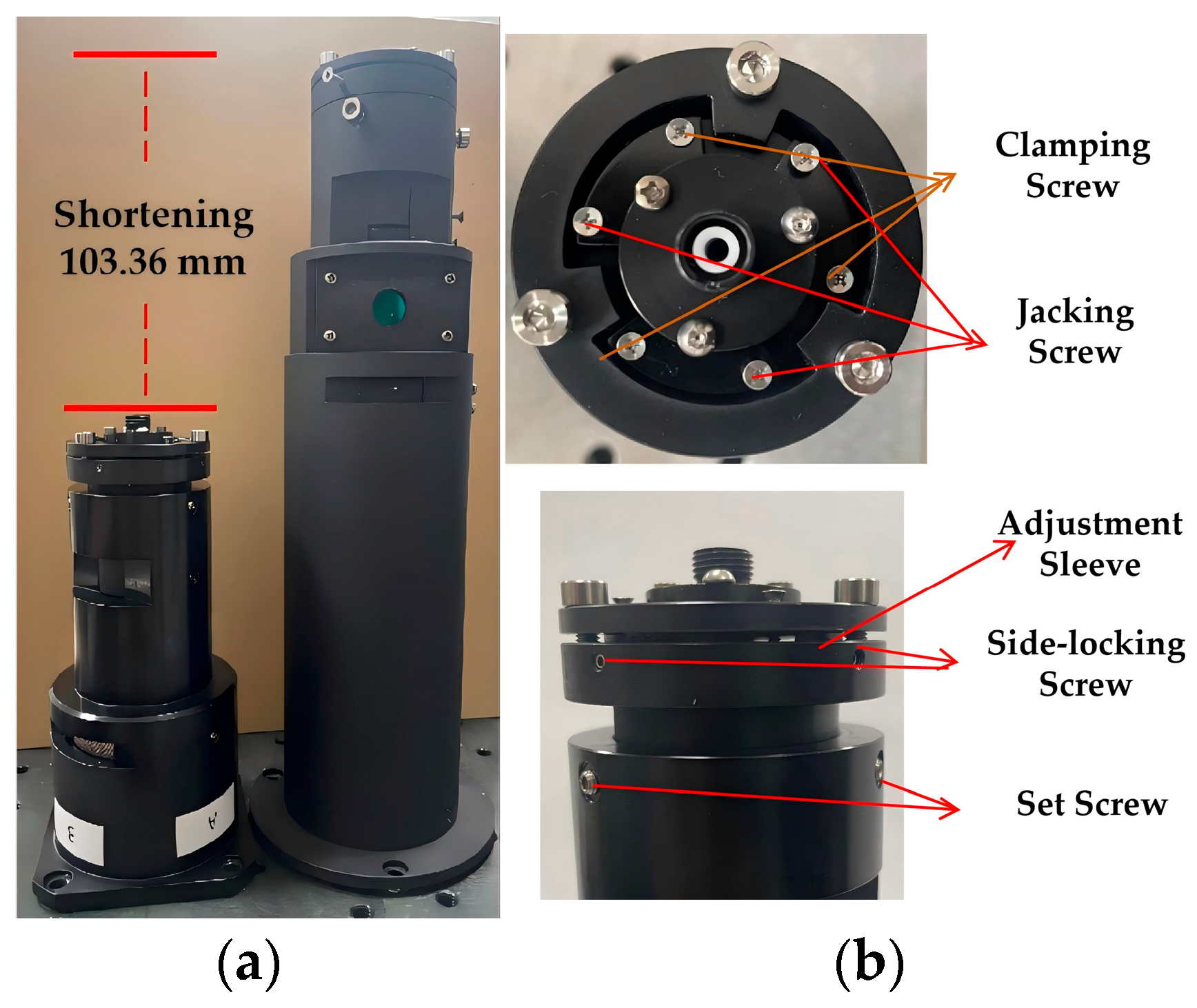
The telescope is manufactured entirely from an aerospace-grade aluminum alloy to ensure high rigidity and a low thermal expanding coefficient. The inner and outer surfaces of the telescope are treated with black anodizing to reduce stray-light reflections and enhance surface wear resistance and corrosion protection. As shown in
Figure 5, the total length of the telescope in this work is reduced by nearly one half compared with that of the collimating telescope used in the No. 1 rubidium atomic fountain clock at the NTSC, thereby meeting the compactness requirements of the integrated fountain clock physics package [
18].
4. Adjustment and Experimental Results
In an integrated 87Rb atomic fountain clock, the quality of the six cooling laser beams is a decisive factor for the final performance of the clock. Before presenting the specific adjustment results, it is essential to clarify how these optical parameters critically affect the atomic fountain:
- ●
Beam Diameter and SNR: As established in the Introduction, maximizing the beam diameter (N∝D4) is fundamental for increasing the number of captured atoms, which directly improves the signal-to-noise ratio (SNR) and frequency stability ().
- ●
Collimation and Recapture Efficiency: Excellent collimation ensures uniform wave vectors across the cooling region. Excessive divergence or convergence introduces radial force imbalances, leading to cloud expansion during the launch and significantly reducing the number of atoms falling back into the detection region (recapture efficiency).
- ●
Coaxiality and DCP Shifts: High-precision coaxiality and centering align the geometric centers of the counter-propagating beams. Misalignment causes a drift in the optical molasses center, imparting a transverse velocity to the atoms. This not only reduces the recapture efficiency but also introduces distributed cavity phase (DCP) shifts due to trajectory deviations in the microwave cavity.
- ●
Polarization and Temperature: High polarization purity is essential for efficient sub-Doppler cooling (polarization gradient cooling). Imperfect polarization limits the minimum attainable temperature of the atomic cloud.
Guided by these stringent requirements, we utilized the five-degree-of-freedom adjustment mechanism to fine-tune the output beams. The adjustment process primarily focuses on collimation, coaxiality, and beam profile centering:
Collimation: By extending or retracting the adjustment sleeve, the distance between the light source and the lens group is varied such that the source is positioned at the focal plane of the optical system.
Coaxiality: Coaxiality refers to the degree of coincidence between the wave vector of the output beam and the mechanical axis of the telescope. Before utilizing the five-degree-of-freedom light source adjustment structure for coaxiality alignment, it is essential to ensure that the optical axes of all individual optical components are coaxial with the telescope’s mechanical axis. Misalignment errors primarily manifest in two typical forms:
Parallel Off-Axis: The beam wave vector remains parallel to the mechanical axis, but the center of the beam spot is displaced from the optical axis. While the output beam remains collimated in this case, aperture vignetting and asymmetric aberrations degrade the beam spot quality.
Tilt Off-Axis: The wave vector itself deviates from the mechanical axis, causing the overall propagation direction of the beam to tilt.
Beam Centering and Gaussian Profile: On a cross-section perpendicular to the mechanical axis, the intensity distribution should be a circularly symmetric Gaussian profile with the mechanical axis of the telescope as its axis of symmetry.
4.1. Collimation Calibration
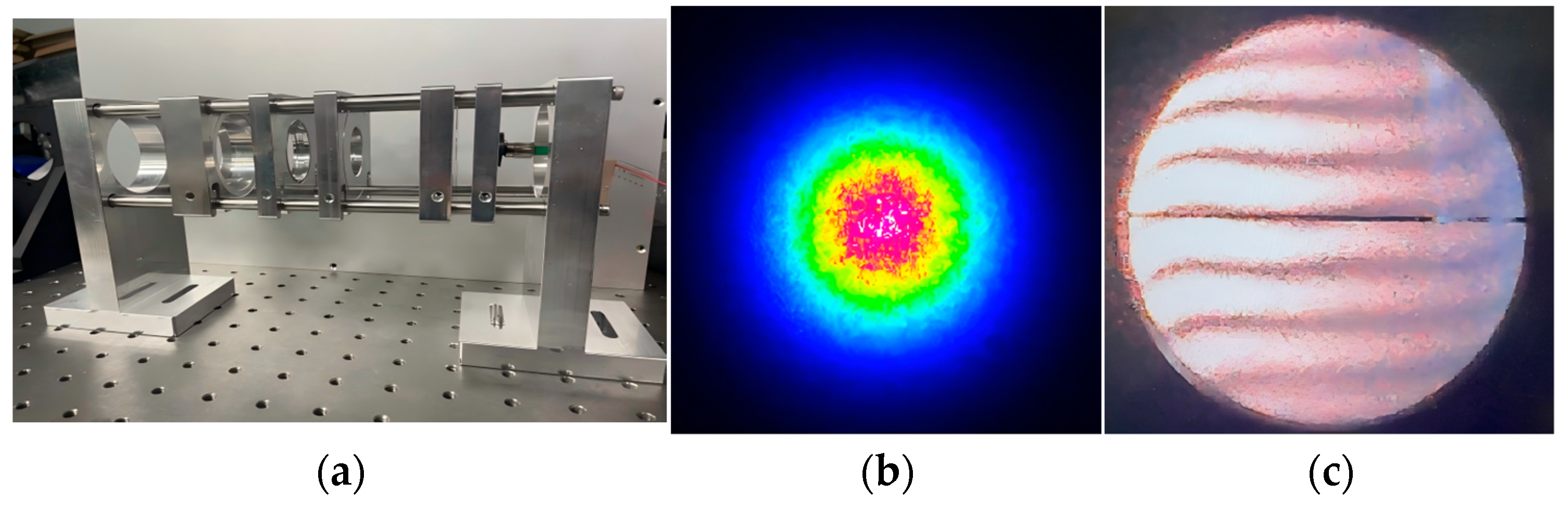
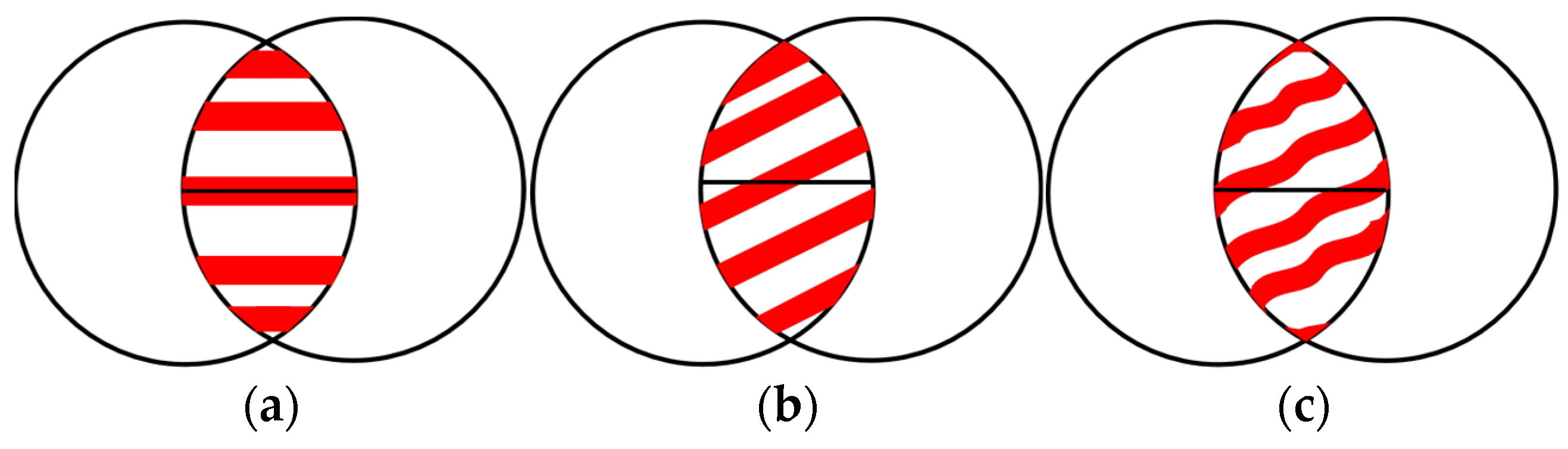
The collimation of the output beam is calibrated in real time by observing the interference fringe pattern produced by a shear interferometer located 3 m from the exit face of the collimating and beam-expanding telescope. When the laser beam is incident on the wedge plate of the shear interferometer, reflections from its front and rear surfaces interfere on an observation screen. The resulting interference fringes are used to assess the collimation and wavefront distribution of the incident beam. In
Figure 6, the interference fringes corresponding to incident collimated, divergent, and convergent beams are illustrated.
When the fringes are parallel to the reference line on the observation screen (typically parallel to the shear direction), the output beam is considered collimated. If the beam is not perfectly collimated (i.e., exhibits divergence or convergence), the interference fringes deviate from their orientation in the collimated case and form an angle with the reference line. The divergence angle of the beam is then obtained from this angle using Equations (1) and (2), thereby quantifying the degree of divergence or convergence of the output beam. If the interference fringes are curved, this indicates the presence of wavefront aberrations in the beam and, consequently, the degraded optical quality of the telescope output.
Table 2 lists the measured and calculated divergence angles for the six telescopes after collimation adjustment.
Based on the principle of shearing interferometry, the divergence angle
of the Gaussian beam can be quantitatively derived from the tilt angle of the interference fringes and the shear distance. The specific mathematical relationships are expressed as follows:
Here, is the radius of curvature of the laser beam wavefront, is the shear distance, is the fringe period on the observation screen, is the tilt angle of the interference fringes, is the diameter of the beam spot on the screen, and is the laser wavelength.
According to the measurements and calculations, the divergence angles of the output beams from all six collimating and beam-expanding telescopes are less than 0.25 mrad, satisfying the collimation requirements for the cooling laser in the MOT region.
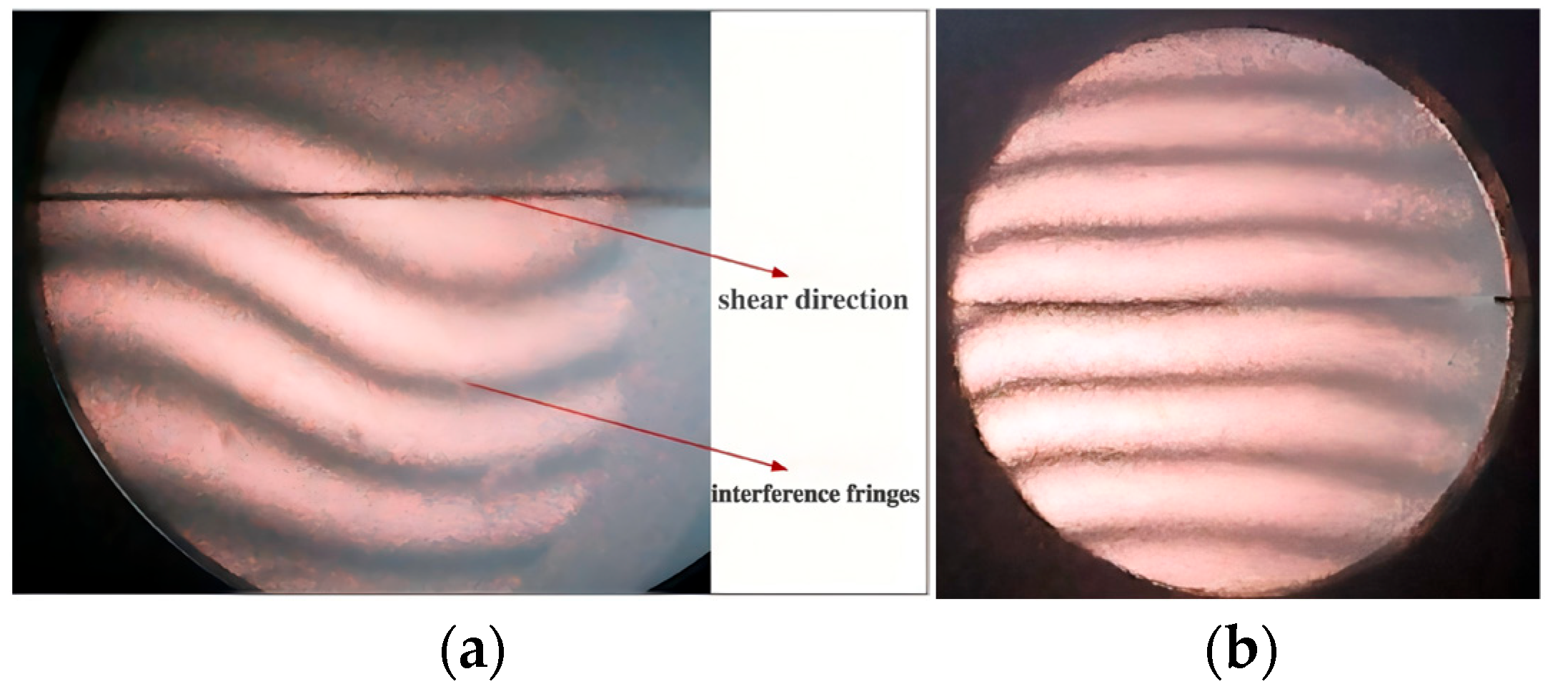
Figure 7 compares the collimation results of the telescope developed in this work with those of the telescope used in the No. 2 rubidium atomic fountain clock at the NTSC. In
Figure 7a, the interference fringes are noticeably curved, indicating wavefront aberrations. In contrast, the fringes in
Figure 7b are parallel to the shear direction and remain straight without obvious curvature, demonstrating that the combination of the plano-concave lens and the achromatic cemented doublet used in this work effectively corrects aberrations and improves both the wavefront quality and the collimation performance of the output beam [
21].
4.2. Coaxiality Calibration
The decenter errors of the internal optical elements in the telescope are fixed offsets whose magnitude and direction do not change when the telescope is rotated as a whole. In contrast, tilt errors introduced by the assembly of mechanical components, such as the fiber adapter, vary periodically with the rotation of the telescope. Based on this property, we propose a stepwise rotational compensation method for system alignment. By successively rotating the telescope by 90° and repeatedly adjusting it, the mechanical tilt errors are compensated in multiple directions in an averaged manner, thereby effectively suppressing tilt errors introduced by the fiber adapter and other mechanical components associated with the light source. After compensating the mounting tilt of the light source, the decenter and defocus of the source must be corrected again because these three errors are mutually coupled during adjustment and cannot be fully separated. Therefore, after using a 2 mm aperture stop to assist alignment and completing tilt-error compensation, the fiber–lens spacing must be further optimized to jointly correct wavefront deviations caused by the combined effects of decentering and spacing errors, thereby improving the overall wavefront quality of the system.
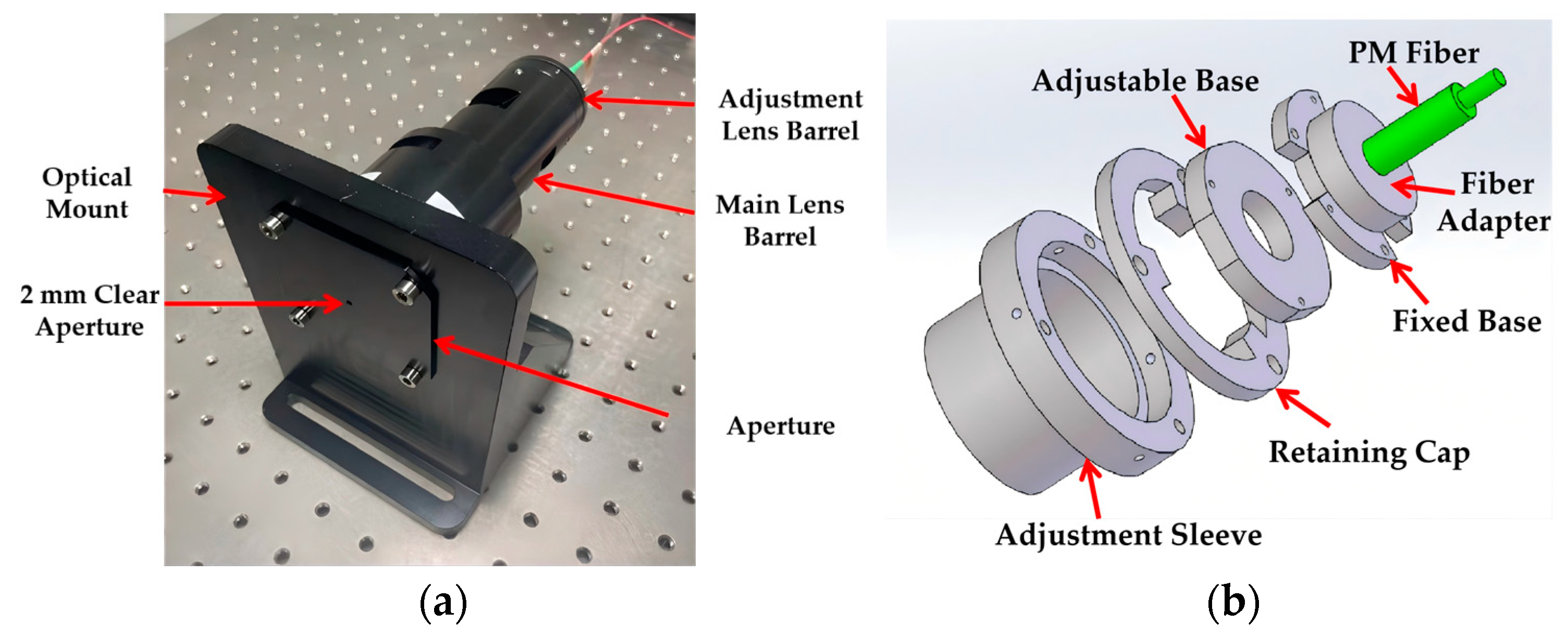
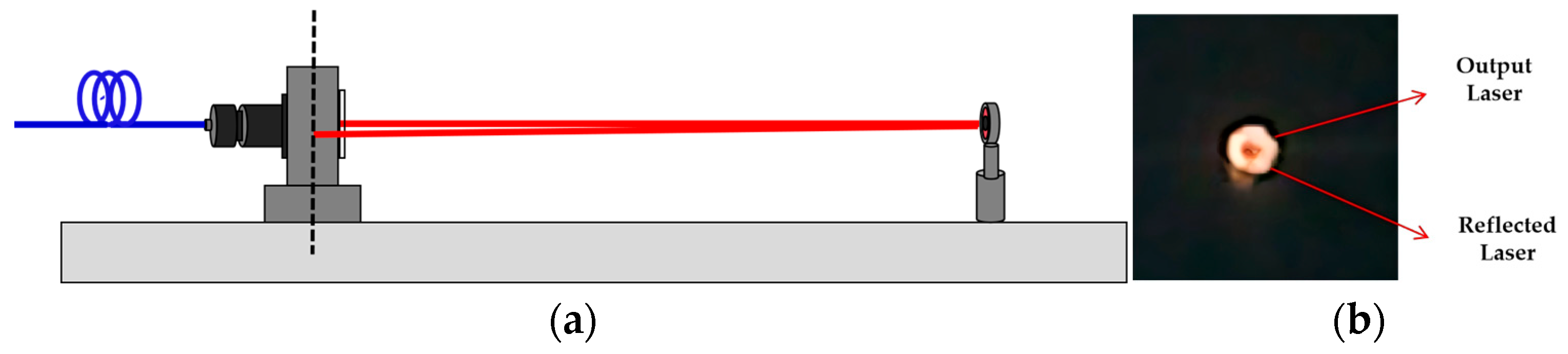
In the practical alignment procedure, the four mounting screws distributed at 90° intervals on the output end face of the telescope are used as references. After each 90° rotation of the telescope, the output characteristics are adjusted, and the “three-point support and three-point clamping” structure is employed to achieve high-precision telescope tilt correction. By monitoring the beam spot formed by reflection from a zero-degree high-reflectivity mirror located 3 m away, the pitch and yaw adjustment structures are finely tuned until the reflected spot coincides with the center of the incident beam, thereby ensuring coaxial alignment between the mechanical axis of the telescope and the incident reference beam, as illustrated in
Figure 8.
The “three-point support and three-point clamping” structure consists of three symmetrically and evenly spaced pairs of clearance holes and threaded holes. The threaded screws are used to clamp the movable base to the stationary base, whereas the screws in the clearance holes are used to push up the stationary base. The pitch of the stationary base is controlled by adjusting the insertion depth of the six screws; as the fiber is connected via a fiber connector and fixed to the stationary base, this operation indirectly adjusts the tilt angle of the fiber output beam. As shown in
Figure 9, when the output beam is tilted relative to the mechanical axis, the position of the reflected beam on the aperture deviates from the output hole. The lateral set screws are then adjusted to move the movable base and coarsely correct the position of the reflected beam. The “three-point support and three-point clamping” structure is subsequently used for fine adjustment until the reflected beam returns to the output aperture.
This adjustment process may affect the beam collimation; therefore, the aperture must be removed, and the collimation is restored by evaluating the fringe parallelism of a shear interferometer while simultaneously extending or retracting the adjustment sleeve to change the distance between the light source and the lens group. The aperture is repeatedly reinstalled to observe the position of the reflected beam, and the above steps are iterated until both the beam direction and the collimation are satisfactorily adjusted. The telescope is then rotated successively by 90°, and the same procedure is repeated for four independent orientations until the collimation and directionality requirements are met in all directions. Finally, the angle between the wave vector of the output beam and the mechanical axis is used as a figure of merit to quantify the parallelism between the optical axis and the mechanical axis of the telescope using Formula (3).
Here, is the angle between the mechanical axis of the telescope and the wave vector of the output beam, is the clear aperture of the stop, and is the distance from the output plane of the telescope to the plane of the zero-degree mirror. According to the adjustment results, the for all six telescopes is less than 0.3 mrad.
4.3. Beam Centering Accuracy and Gaussian Profile Measurement
Following the completion of directional and collimation adjustments for the collimating and expanding beam telescope, a final assessment of the output beam’s beam centering and Gaussian profile and optical axis alignment accuracy is imperative. The beam centering and Gaussian profile of the beam’s energy distribution and the precise alignment of the optical axis are critically linked to the symmetry of the optical molasses effect and the trapping efficiency within the magneto-optical trap (MOT). In this section, a beam-on-beam profiler is employed to quantitatively evaluate the beam quality through comprehensive analysis of the centroid offset and the Gaussian fit quality.
The measurement methodology is delineated into two primary phases:
- (1)
Establishment of the Mechanical Axis Reference
A 2 mm precision aperture stop is mounted at the output end face of the telescope, and its center is accurately aligned with the mechanical reference axis of the telescope during adjustment, ensuring that the center of the output beam coincides with the mechanical axis. At this stage, the laser beam is confined to a very small region around the mechanical axis. The beam profiler is set to the “Centroid option” mode, in which the measured centroid coordinates correspond to the intersection of the telescope’s mechanical axis with the detector image plane. This point is then defined as the origin (0, 0) of the detector coordinate system and is used as the absolute reference for subsequent measurements of optical-axis deviation.
- (2)
Measurement of the Actual Beam Profile
After establishing the reference, the aperture is removed, allowing the full expanded beam to illuminate the beam profiler. The profiler captures the complete beam spot image via its image sensor and calculates the intensity-weighted center of gravity, or centroid, using a weighted average algorithm. The horizontal (H) and vertical (V) coordinates of the beam centroid are calculated using Formulas (4) and (5).
Here, is the calculated horizontal coordinate of the beam centroid; is the calculated vertical coordinate of the beam centroid; is the light intensity value at pixel coordinates , where is the horizontal coordinate and is the vertical coordinate; and is the total light intensity of all pixels within the selected region.
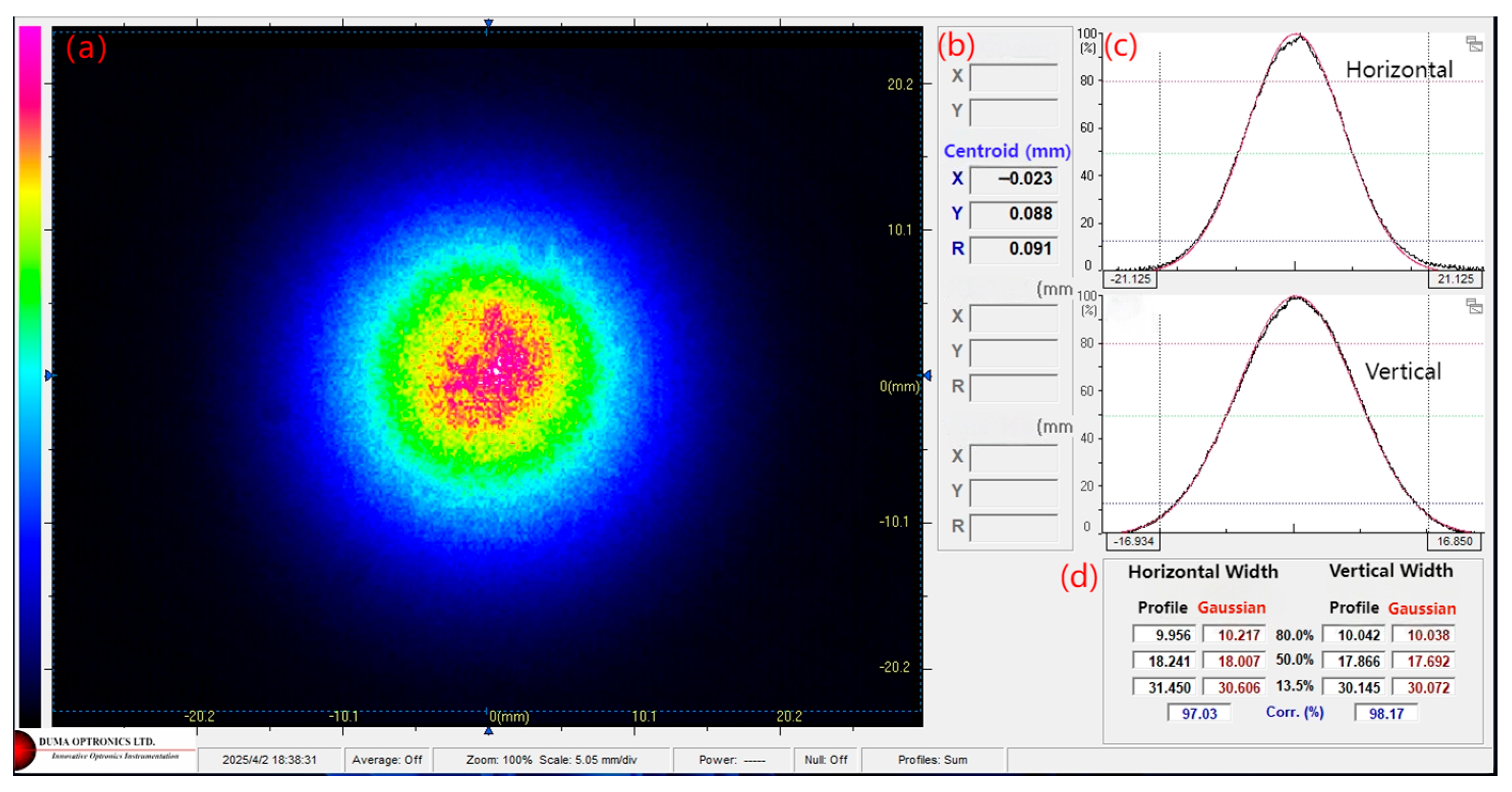
As shown in
Figure 10b, the centroid coordinates (x, y) displayed by the profiler give the position of the centroid of the actual output spot relative to the mechanical axis, and R denotes the offset with respect to this reference. This offset directly reflects the degree of parallelism between the wave vector of the output beam and the mechanical axis of the telescope, with a smaller offset indicating better system coaxiality. The Gaussian symmetry of the beam intensity distribution and centroid offset is evaluated through the goodness of Gaussian fit. The BeamOn software (Duma Optronics Ltd., Nesher, Israel, Version 1.08.06) fits the measured intensity distribution to an ideal circularly symmetric Gaussian function and computes the corresponding coefficient of determination. A higher goodness of fit indicates better agreement between the actual spot profile and the ideal Gaussian distribution, implying a more symmetric energy distribution and improved beam centering and Gaussian profile.
The measurement results show that the offsets between the optical axes of the six output beams and the mechanical axis of the telescope are less than 0.1 mm. Considering the pixel size of the beam profiler and minor fluctuations caused by air turbulence, the measurement uncertainty for beam centering is estimated to be ±0.02 mm. Consequently, the derived uncertainty for coaxiality (measured over a 3 m distance) is approximately ±0.01 mrad. The actual output beam diameter is approximately 35 mm. The Gaussian fit coefficients for the horizontal and vertical intensity distributions are 97.03% and 98.17%, respectively, satisfying the system requirements. After completing the adjustment and measurement of the collimation, coaxiality, and beam centering and Gaussian profile, the quarter-wave plate is rotated to generate the required left- or right-handed circularly polarized light. The polarization purity of the expanded beam is then further optimized to minimize residual polarization imperfections. Each of the six telescope output beams has a power of 15 mW, which is adjusted using tunable fiber attenuators (Precilasers, Shanghai, China) in the fountain clock optical system.
4.4. Long-Term Stability and Robustness Analysis
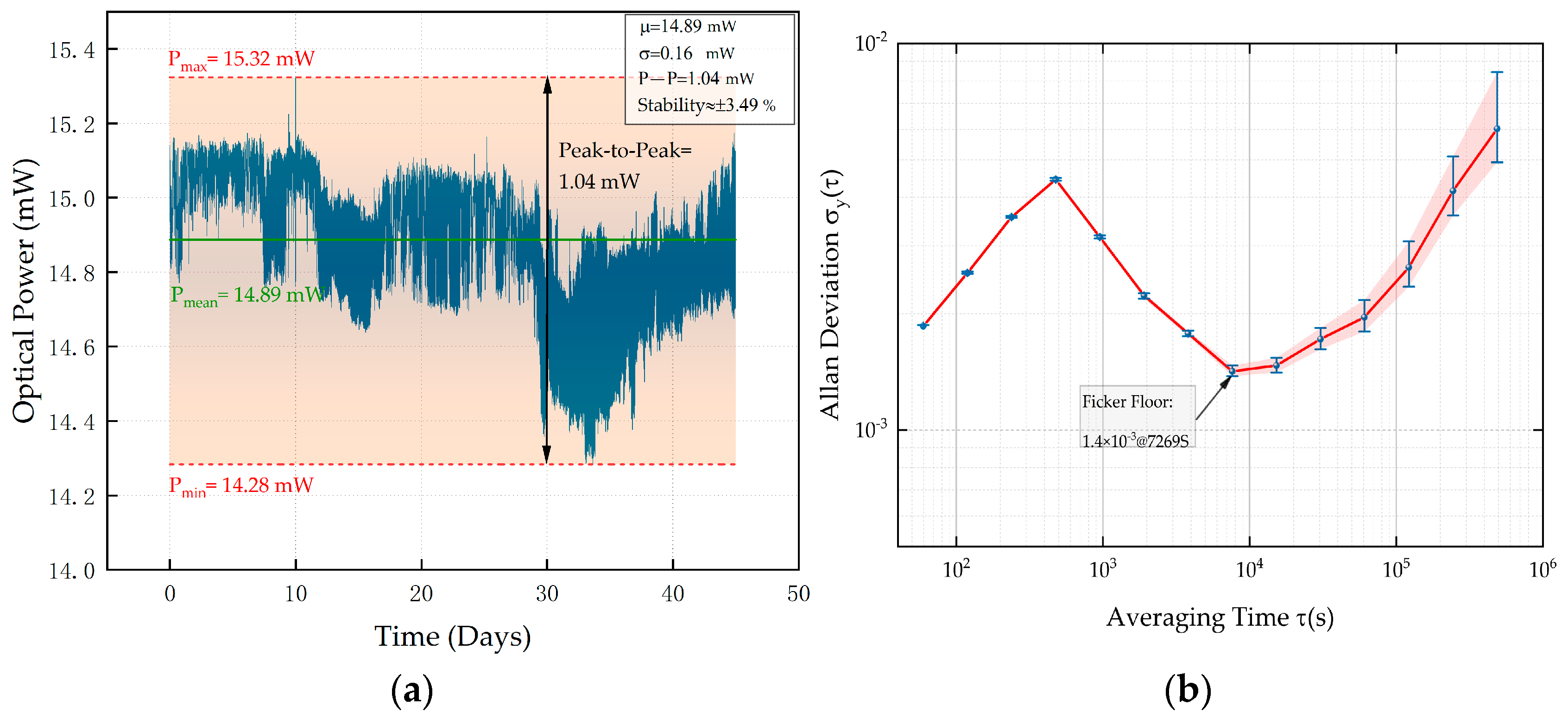
The long-term stability of the output power is influenced by multiple factors. However, considering the extreme sensitivity of optical coupling efficiency to angular and positional deviations, mechanical alignment stability is a critical determinant. Consequently, continuous monitoring of output power fluctuations provides an effective means by which to infer the long-term stability of the mechanical alignment, making it a reliable indirect indicator. To rigorously evaluate stability under ambient laboratory conditions, we conducted a continuous power monitoring experiment for 45 days without manual realignment.
Figure 11a illustrates the time-domain power fluctuations, recorded at a sampling interval of 60 s. Throughout the entire 45-day period, the telescope maintained highly stable output. The mean optical power was 14.89 mW, with a standard deviation of only 0.16 mW. As indicated by the shaded band in
Figure 11a, fractional power fluctuation remained strictly within ±1.2%. This result indicates that the compact mechanical design effectively suppresses long-term drift and maintains alignment stability over extended periods.
To further analyze stability and noise characteristics, the Allan deviation was calculated, as shown in
Figure 11b. Standard error bars and the confidence band (shaded area) demonstrate the statistical reliability of the measurements. Analysis reveals a flicker noise floor of approximately 1.4 × 10
−3 at an averaging time of
7269 s. Even at integration times extending to 6 × 10
5 s (approx. 1 week), the stability remains superior (<3 × 10
−3). These results indicate that the passive stability of the compact structure sufficiently mitigates typical laboratory environmental perturbations.
5. Conclusions
This study, targeting the application requirements of the National Time Service Center’s integrated rubidium-87 atomic fountain clock, designed and developed a compact laser collimating and beam-expanding telescope. The overall length of the telescope is approximately 136.25 mm, strictly meeting the stringent structural size limitations of the integrated system. Despite its compact form factor, the telescope achieves superior beam performance: the collimation of the output beam is better than 0.25 mrad, the coaxiality is better than 0.3 mrad, the centroid offset relative to the mechanical axis is less than 0.1 mm, the actual output beam diameter is approximately 35 mm, and the Gaussian theoretical fit rate exceeds 97%. All beam characteristics have been significantly improved compared to the previous telescope, validating the rationality and effectiveness of the design. Critically, the long-term robustness of the system was validated through a 45-day continuous power monitoring experiment. The telescope maintained fractional power fluctuations within ±1.2% without manual realignment, and the Allan deviation analysis revealed a stability floor of 1.3 × 10⁻³, indicating that the system effectively mitigates typical environmental perturbations. To ensure the long-term stability of the integrated system, future evaluations will incorporate environmental stress screening, specifically vibration and thermal cycling tests. These assessments will be conducted with the aim of verifying its mechanical reliability during transport and guaranteeing its robust operation over extended periods. In subsequent work, this telescope will be applied to the fountain clock system, and the flight time signal of the atomic fountain’s descent will be used as a reference to further optimize its polarization and power characteristics, thereby enhancing the signal-to-noise ratio of the cold atomic fountain’s flight time signal.



 ,
,