1. Introduction
Global lighting electricity consumption represents approximately 20% of the total societal electricity consumption. Substituting incandescent lamps with white light-emitting diodes (WLEDs) for lighting purposes constitutes an economically viable and efficient strategy to reduce electricity consumption [
1]. WLEDs have become predominant in the field of solid-state lighting owing to their significant advantages, including energy efficiency, environmental friendliness, and ease of adjustment [
2,
3]. Lead halide perovskites (LHPs) have garnered significant attention owing to their exceptional optoelectronic properties, low fabrication costs, straightforward solution-based preparation processes, and substantial application potential in solar cells, LEDs, and scintillators [
4,
5,
6,
7,
8]. However, the intrinsic toxicity and relatively poor chemical stability of LHPs have significantly impeded their practical applications [
9]. Moreover, LHPs demonstrate high vulnerability to water, oxygen, heat, and light. Ion migration under intense light or electric field conditions leads to significant material degradation, which poses a critical challenge given that the operational environment of photovoltaic materials inherently involves exposure to light fields or electric fields [
10,
11,
12]. Cryolite halides or halide double perovskites (A
2B′B″X
6) (HDPs) possess crystal structures that are analogous to those of lead-containing halide perovskites [
13,
14]. By replacing toxic lead ions with non-toxic metal cations, these materials emerge as promising substitutes for traditional lead-based halide perovskite materials [
15,
16,
17,
18]. However, the band gap of such materials is typically wide, and their photoluminescence (PL) is mainly attributed to parity-forbidden transitions, leading to relatively low efficiency. Doping has been demonstrated as one of the most effective and reliable strategies for modulating the optoelectronic properties of HDPs. By disrupting spin-confinement transitions and introducing additional emission centers, it is possible to simultaneously enhance the luminescence efficiency of the material and adjust its optical band gap [
19,
20,
21]. By incorporating Sb
3+ into Cs
2NaInCl
6 HDPs, bright blue emissions can be observed [
22,
23,
24,
25]. Furthermore, doping Cs
2InCl
5·H
2O with Ag
+ or Bi
3+ results in yellow-emissive materials exhibiting enhanced luminous efficiency [
18,
26,
27].
Moreover, elastic deformation caused by excited electrons and holes lowers the system energy, thereby generating a pronounced Stokes shift that efficiently prevents self-absorption. Utilizing self-trapped exciton (STE) materials as a single light-emitting layer in electroluminescent devices can minimize blue light pollution at the source, eliminating the need for a blue excitation source. At the same time, this strategy circumvents self-absorption effects, reduces secondary energy losses inherent in traditional LED excitation processes, and simplifies the overall device architecture. In recent years, extensive research has been conducted on metal–organic frameworks and perovskites for full-color WLEDs. Among them, metal halide perovskites with broadband emission characteristics are promising candidate materials for addressing issues related to mixed-component photon reabsorption and color instability. Karunadasa [
28] reported a two-dimensional organic–inorganic perovskite featuring undulating lead halide layers, which function as an efficient broadband white light emitter. Ma et al. [
29] synthesized [(EDBE)PbBr
4] (where EDBE = 2,2′-(ethylenedioxy)bis(ethylammonium)), successfully achieving white light emission with a correlated color temperature (CCT) of 6519 K and Commission Internationale de l’Eclairage (CIE) coordinates of (0.30, 0.42). Tang et al. [
30] successfully incorporated Na
+ into Cs
2AgInCl
6, thereby modulating the parity of the wave function of STEs to suppress the parity-forbidden transition and effectively lowering the electronic dimensionality of the semiconductor. Following Bi
3+ doping, a broadband white light emission with a fluorescence quantum efficiency of approximately 86% has been observed. Double perovskites based on In
3+ hold great promise for white lighting applications. However, the majority of current studies focus on Ag-In mixed systems, where the emission originates from excitons trapped in [AgCl
6]
5− octahedra. A significant challenge lies in the susceptibility of Ag
+ ions to reduction into elemental silver, which can compromise the structural integrity of the crystal lattice. Furthermore, the emission spectrum of this system lacks critical blue (400–480 nm) and red (610–700 nm) components, thereby limiting its ability to achieve a high color rendering index (CRI) and tunable CCT, both of which are crucial for advanced lighting applications. Shi et al. [
15] successfully doped Sb
3+ and Bi
3+ ions into the Cs
2NaInCl
6 crystal, resulting in the observation of white light with a PL quantum yield (QY) of 77%. The blue emission originates from the Jahn–Teller effect induced by the incorporation of Sb
3+ ions. Meanwhile, the introduction of Bi
3+ ions, which possess a larger ionic radius, further deforms the [SbCl
6]
3− octahedron, thereby enhancing the emission intensity of the yellow STEs. Theoretical calculations demonstrate that the incorporation of Bi
3+ doping introduces new subband energy levels, thereby resulting in yellow STE emissions. By precisely adjusting the Sb
3+/Bi
3+ doping ratio, it is feasible to modulate cold and warm white light emission. In the same year, a scalable aqueous synthesis strategy was established for the preparation of Sb
3+-doped Cs
2InCl
5·H
2O/Cs
2NaInCl
6 systems under ambient conditions, culminating in the fabrication and characterization of a prototype white light-emitting diode [
31]. Through precise stoichiometric control of Sb
3+ (blue-emitting sensitizer), Tb
3+ (green-emitting activator), and Sm
3+ (red-emitting activator) ions, Li et al. successfully achieved high efficacy and spectrally tunable white light emission in the Cs
2NaInCl
6:Sb
3+,Tb
3+, and Sm
3+ double perovskite system [
32]. These results substantiate that this family of double perovskite phosphors demonstrates considerable potential for solid-state lighting applications, particularly in lighting devices with a high color rendering index.
In this study, we demonstrate a one-pot synthetic strategy for the fabrication of white light-emitting indium-based halides. Cs2InCl5·H2O, a lead-free compound with excellent oxidation stability, was chosen as the host material and subsequently doped with Sb3+ ions. The incorporation of NaCl effectively modulates the bandgap configuration and energy transfer dynamics within the system, resulting in the formation of Sb-doped Cs2InCl5·H2O and Cs2NaInCl6 white light-emitting complexes. These materials are capable of emitting highly efficient white light, with tunable CCT ranging from 2500 K to 5000 K. The proposed synthesis method is characterized by its simplicity, scalability, and reproducibility. This study provides valuable insights into the development of WLEDs that are highly efficient, chemically stable, and capable of color-temperature tuning under single-excitation conditions.
3. Results
The undoped Cs
2NaInCl
6 and Cs
2InCl
5·H
2O exhibit weak STEs emissions at 530 nm and 580 nm, respectively.
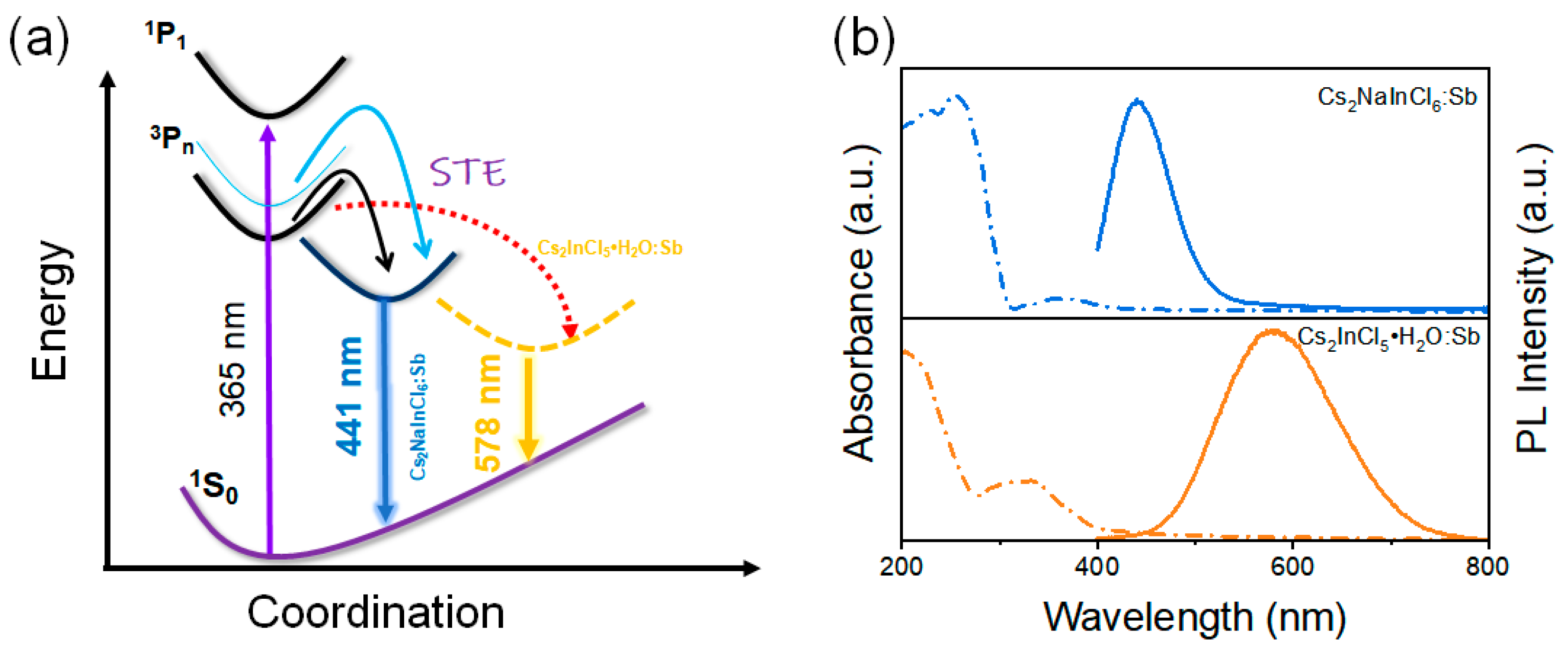
Figure 1a illustrates the formation process of STEs in Sb
3+-doped Cs
2InCl
5·H
2O and Sb
3+-doped Cs
2NaInCl
6 under 365 nm excitation. Prior research has demonstrated that the yellow and blue emissions originate from the excited states of [SbCl
6]
3− and [Sb(H
2O)Cl
5]
2−, respectively [
18,
22]. Compared with [Sb(H
2O)Cl
5]
2−, the octahedral deformation of [SbCl
6]
3− is less pronounced, resulting in lower energy consumption during the energy transfer process and a smaller band gap for luminescence. In addition, the strength of crystal filed of Sb
3+, along with the orbital orientation, significantly influences the formation of the cation valence band. In Sb
3+-doped Cs
2NaInCl
6, the moderate electron–phonon coupling energy and Stokes shift lead to a pronounced STEs narrowband blue emission [
23]. In Sb
3+-doped Cs
2InCl
5·H
2O, the [Sb(H
2O)Cl
5]
2− anion exhibits the greater structural deformation, which results in the higher energy consumption. Consequently, this leads to a smaller optical band gap and a larger Stokes shift. As depicted in
Figure 1b, upon doping with Sb
3+, Cs
2InCl
5·H
2O:Sb and Cs
2NaInCl
6:Sb exhibit yellow luminescence at 580 nm and blue luminescence at 447 nm, respectively, under excitation by 320 nm ultraviolet light, owing to the incorporation of discrete luminescent centers [
33]. These results suggest a feasible strategy to realize tunable white light emission by combining Sb
3+-doped Cs
2InCl
5·H
2O and Cs
2NaInCl
6.
In this work, guided by the literature, an Sb/In atomic ratio of 1:4 was selected to synthesize yellow light-emitting Cs
2InCl
5·H
2O:Sb [
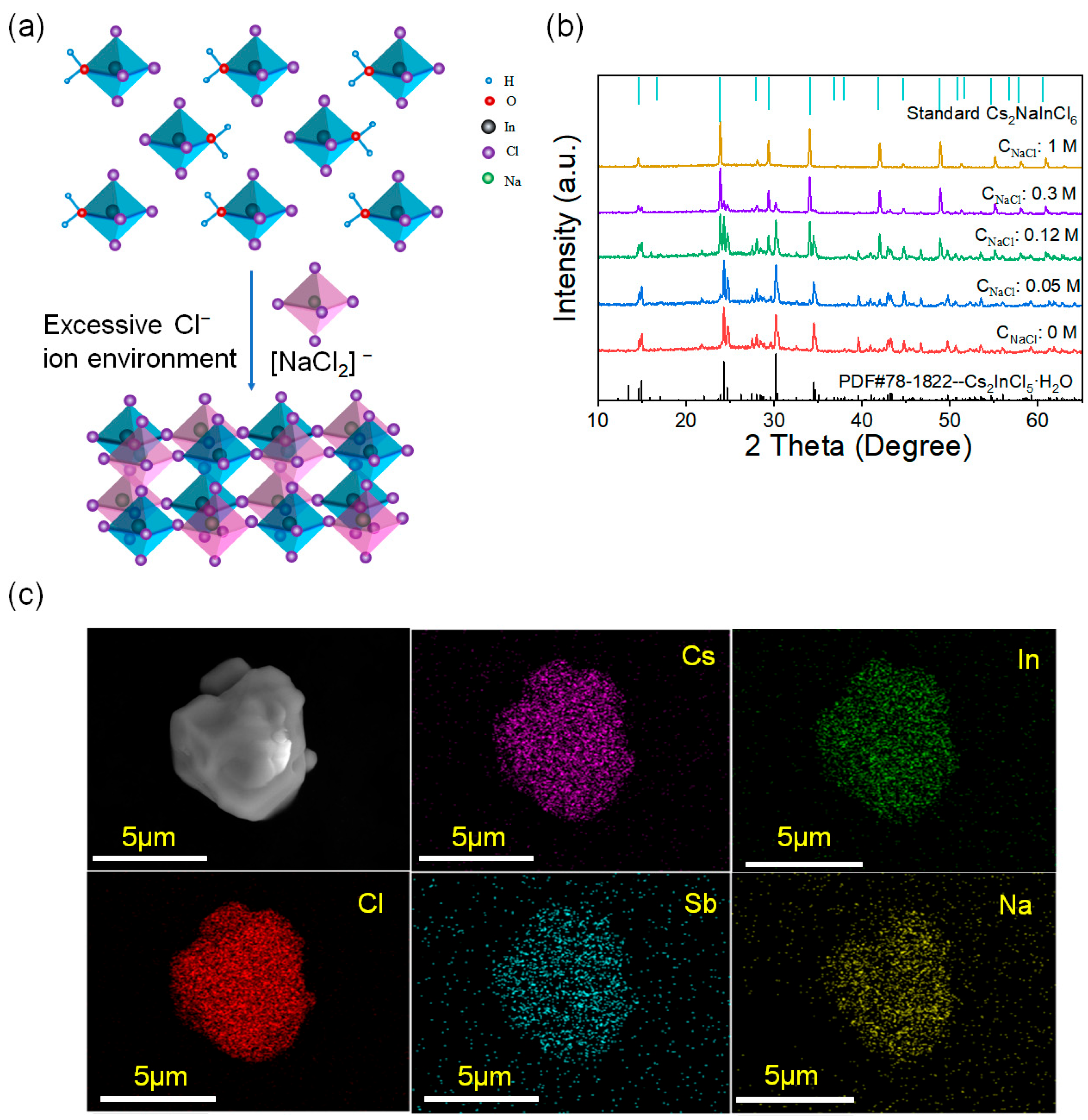
18]. As a result, the spectral characteristics of the material were modulated, enabling the targeted optical properties. The structural transformations occurring during synthesis are illustrated in
Figure 2a. The XRD results indicate that upon adding NaCl (0.05 mmol) to the synthetic raw materials, new diffraction peaks corresponding to Cs
2NaInCl
6 are observed in the XRD at 23.9°, 34.1°, and 41.0°. As the amount of NaCl is further increased, the relative proportion of Cs
2NaInCl
6 progressively rises. When the added NaCl reaches 0.3 mmol, the pristine Cs
2InCl
5·H
2O phase is significantly suppressed, leading to the dominance of the Cs
2NaInCl
6 component. This observation can likely be attributed to differences in solubility among the various phases under the given chemical conditions. When NaCl amount reaches 1 mmol, the synthesized compound is assigned to pure Cs
2NaInCl
6 without any impurities (
Figure 2b) [
15,
22,
26].
Herein, we report the preparation of a highly efficient white-emitting phosphor comprising two components, Cs
2InCl
5·H
2O and Cs
2NaInCl
6. This was achieved by dissolving 2 mmol of cesium chloride, 0.8 mmol of indium chloride, 0.2 mmol of antimony chloride, and 0.12 mmol of sodium chloride in hydrochloric acid (named as Cs
2Na
0.12In
0.80Cl
5.12:Sb). The SEM results indicate that the prepared samples exhibit an average size of 5 μm, featuring relatively distinct rhombic corners. This morphology aligns well with the targeted cubic phase material, thereby confirming the excellent crystallinity of the material (
Figure S1). The EDS mapping further showed that all constituent elements within the sample are relatively uniform, indicating effective bulk incorporation of Sb
3+ rather than surface-limited doping, in agreement with XRD analysis (
Figure 2c). Quantitative analysis of the elemental composition revealed that the ratios of Cs, Na, In, Cl, and Sb are 22.31, 0.89, 10.30, 66.17, and 0.33 (
Figure S2, Table S1), respectively, which are consistent with the expected proportions based on the injected NaCl solution. This suggests that a minor amount of NaCl can be sufficient to trigger the phase transition from Cs
2InCl
5·H
2O host to Cs
2NaInCl
6, inducing sufficient blue light emission (Cs
2NaInCl
6:Sb) Cs
2NaInCl
6.
After doping Sb
3+ into Cs
2NaInCl
6 and Cs
2InCl
5·H
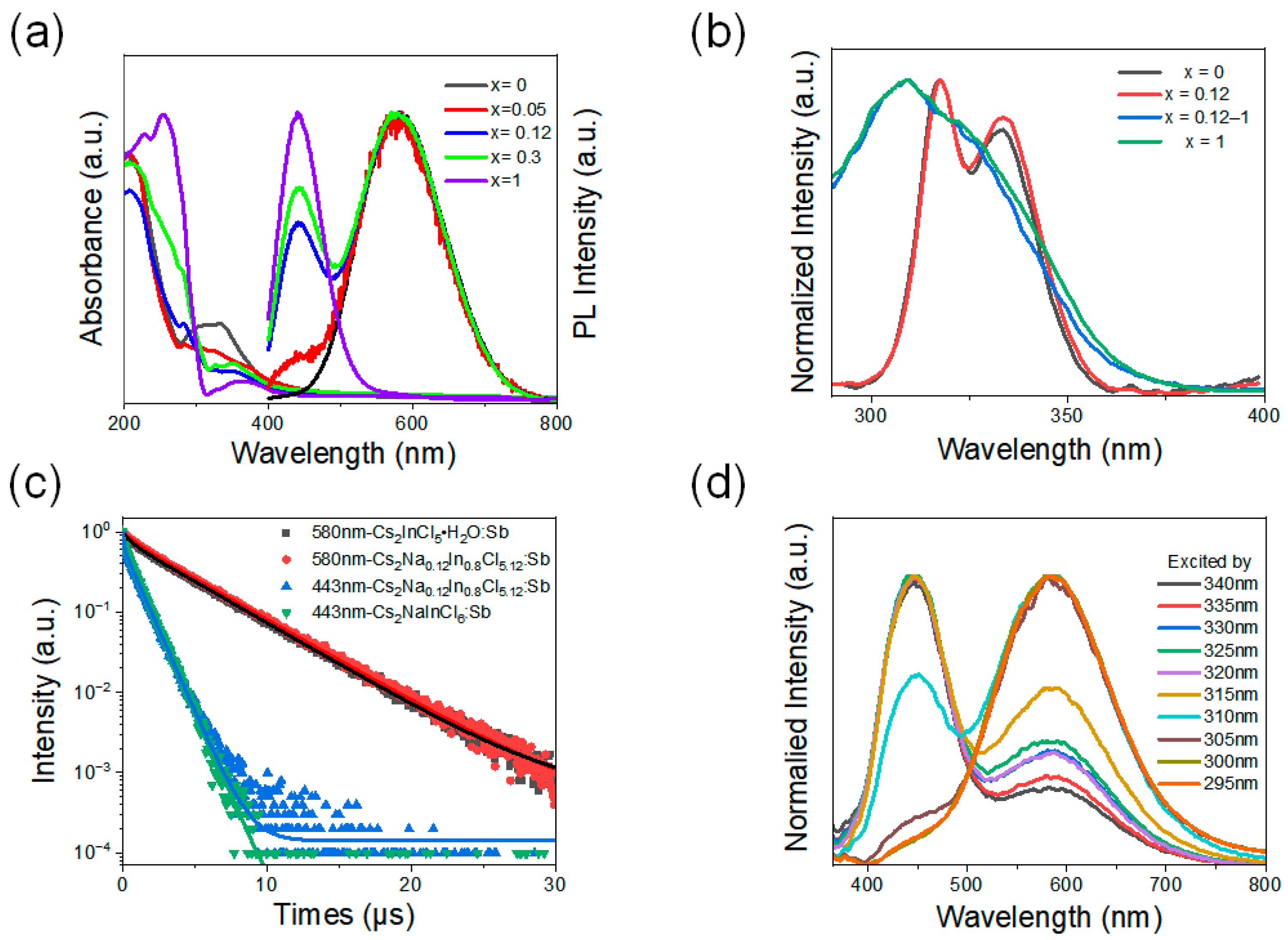
2O halide double perovskites, pronounced changes in optical properties were observed in their optical properties. As shown in
Figure 3a, the Cs
2InCl
5·H
2O:Sb (
x = 0) and Cs
2NaInCl
6:Sb (
x = 1) doped with Sb
3+ exhibit strong emissions at wavelengths of 580 nm (yellow) and 447 nm (blue), respectively, upon 365 nm excitation. The emission centers of Cs
2NaInCl
6:Sb and Cs
2InCl
5·H
2O:Sb synthesized via this environmentally friendly method align with those obtained using high-concentration hydrochloric acid. To investigate the effect of NaCl addition on photoluminescence performance, a series of samples with varying Na/In molar ratios (the atomic content of In
3+ remains unaltered (0.8 mmol)) were prepared under identical conditions. As shown in
Figure 3a, upon the incorporation of NaCl to the Cs
2InCl
5·H
2O:Sb sample, an emission peak with a full width at half maximum (FWHM) of 80 nm emerged at 447 nm. As the molar ratio of the NaCl increased, the proportion of blue light luminescence gradually rose, enabling continuous spectral tunability from the yellow light region to the blue light region. By precisely controlling the NaCl content, cold-to-warm white light tuning was readily achieved, thereby facilitating the adjustment of the color temperature for the white LED fabricated using this sample (
Figure S3).
By incorporating Na
+ and Cl
− into the synthetic environment, the formation of the [Sb(H
2O)Cl
5]
2− octahedral structure was effectively suppressed, thereby increasing the proportion of [SbCl
6]
3−. The PL of the sample exhibits no shift upon the addition of NaCl, thereby indicating that the two luminescent centers within the sample are independent and mutually unaffected. Absorption spectra indicate the absorption intensity at 252 nm for Sb
3+-doped Cs
2NaInCl
6 is significantly enhanced compared to Sb
3+-doped Cs
2InCl
5·H
2O. Additionally, the absorption spectrum exhibits a gradual redshift. This phenomenon can be attributed to the Jahn–Teller effect induced by the deformation of the water-coordinated [In(H
2O)Cl
5]
2− octahedron. Furthermore, the splitting distance between the two luminescent centers in Cs
2InCl
5·H
2O:Sb is considerably larger than that in [SbCl
6]
3− (Cs
2NaInCl
6:Sb) (as shown in
Figure 2a). Moreover, the absorption peak at 334 nm exhibits a consistent trend, characterized by a decrease in intensity and a gradual redshift as the NaCl concentration increases. This behavior suggests that the lattice environment surrounding Sb
3+ ions governs the configurational transition from the ground state (
1S
0) and the excited state (
3P
n).
Analysis of the excitation processes in the samples reveals that the transitions in both Cs
2NaInCl
6:Sb and Cs
2InCl
5·H
2O:Sb originate from the
1S
0→
3P
1 transition. Notably, for Cs
2NaInCl
6:Sb (x = 1), two distinct and prominent excitation centers are observed near 317 nm and 334 nm, both of which correspond to the
1S
0→
3P
1 transition, as illustrated in
Figure 3b. According to the selection rules, the transition is partially allowed. However, due to spin–orbit coupling, which leads to the mixing and enhancement of singlet (S = 0) and triplet (S = 1) spins, the spin-forbidden restriction can be effectively lifted. As reported in the literature, the splitting of the
1S
0→
3P
1 spectrum can be attributed to the pseudo-Jahn–Teller effect induced by lattice vibrations [
34,
35]. A relatively weak excitation center is observed at 280 nm, corresponding to the forbidden transition of
1S
0→
3P
2, which results from symmetry breaking. However, given that its absorption peak (approximately 260 nm) approaches the band edge of the host material, the excited-state electrons can readily enter the conduction band [
36]. Consequently, it becomes challenging to detect spectral branches associated with this transition in the plotted spectrum [
37]. In Cs
2InCl
5·H
2O:Sb, the excitation band within this region does not exhibit two distinct split excitation centers around 310 nm and 340 nm (
Figure 3b). In Cs
2NaInCl
6:Sb, the edgeband absorption is attributed to the electronic transition from
1S
0→
3P
1, no distinct excitation peak is observable. From the excitation spectra of Cs
2Na
0.12In
0.80Cl
5.12:Sb, it is evident that the yellow light at 580 nm in the white light sample originates from the photophysical process associated with Cs
2InCl
5·H
2O:Sb emission (x = 0.12). In contrast, the blue light at 447 nm corresponds to the spectral characteristics of Cs
2NaInCl
6:Sb (x = 0.12–1).
As illustrated in
Figure S4 and Table S2, within the temperature range of 87 K to 307 K, the FWHM of Peak 446 nm (Cs
2NaInCl
6:Sb) initially decreases as the temperature increases from 77 K to 127 K (57.4 → 52.8 nm), followed by a continuous increase from 127 K to 287 K (52.8 → 117.7 nm). This behavior is characteristic of thermally activated processes in luminescent materials, where the linewidth broadening at elevated temperatures is primarily governed by enhanced electron–phonon interactions. The accelerated broadening rate with increasing temperature suggests a dominant contribution from multi-phonon processes. In contrast, Peak 580 nm (Cs
2InCl
5·H
2O:Sb) maintains a constant FWHM (94.2 nm) across the temperature range of 87–307 K, demonstrating negligible thermal broadening. This temperature-independent emission profile indicates an exceptionally stable energy level configuration of the Sb
3+ luminescent center, which exhibits remarkable resistance to thermal perturbations. Consequently, this center serves as the dominant emission source under elevated temperatures. The emission intensity reaches its maximum value of 1.17 × 10
7 at 107 K, followed by a gradual decline to 0.685 × 10
7 at 287 K, representing superior thermal stability compared to Peak 446 nm. The temperature-dependent PL intensity can be expressed as follows:
where
I0 is the intensity at 0 K, A is a constant,
Eb is the exciton binding energy, and
Kb is the Boltzmann constant. The activation energy values derived from the fitting analysis of Peak 446 nm and Peak 580 nm in the luminescence spectrum are determined to be 0.05 eV and 0.10 eV, respectively, which is beneficial to radiative recombination.
The electron–phonon coupling constitutes the fundamental physical mechanism underlying the generation of STEs, and its strength can be quantitatively characterized by the Huang–Rhys factor (S). The electron–phonon interaction can be described approximately and quantitatively by the S and the phonon frequency (ℏω
phonon), which can be extracted by fitting the temperature-dependent FWHM curve using the following Equation:
The fitting analysis of Peak 446 nm reveals that the S is 2.88 and the ℏω
phonon is 0.026 eV. The relatively large S value facilitates the formation of STEs, while the thermal broadening is predominantly attributed to optical phonon vibrations. These results indicate the presence of medium-to-strong electron–phonon coupling in the sample, which promotes lattice self-trapping of excited-state electrons and leads to STE formation. This electron–phonon interaction is the fundamental mechanism responsible for the observed STE-related photoluminescence characteristics. For Peak 580 nm, the FWHM remains largely unchanged, indicating that the parameter S is approximately constant. The coupling strength of the material is inherently fixed, with the recombination rate primarily governed by intrinsic factors such as the system’s band structure, phonon spectrum, and temperature, rather than by variations in coupling strength. This suggests that the material exhibits significantly enhanced thermal stability in its luminescent properties [
18,
23].
The time-resolved PL (TRPL) decay curves of Cs
2InCl
5·H
2O:Sb, Cs
2NaInCl
6:Sb, and Cs
2Na
0.12In
0.80Cl
5.12:Sb are shown in
Figure 3c. The measurements of Cs
2InCl
5·H
2O:Sb and Cs
2NaInCl
6:Sb were conducted at 580 nm and 445 nm, respectively. The two luminescent components of Cs
2Na
0.12In
0.80Cl
5.12:Sb were fitted independently. The TRPL decay components for all the samples are listed in
Table S3. Both Cs
2NaInCl
6:Sb and Cs
2InCl
5·H
2O:Sb exhibit two distinct emission behaviors. For Cs
2NaInCl
6:Sb, the dominant fluorescence decay lifetimes are 0.09 μs (22%) and 1.04 μs (78%), whereas for Cs
2InCl
5·H
2O:Sb, the corresponding decay lifetimes are 0.62 μs (17%) and 4.19 μs (83%). The presence of microsecond-scale decay lifetimes is characteristic of self-trapped exciton (STE) emission. As reported in previous studies, the shorter and longer decay components can be attributed to radiative transitions from the spin-triplet excited states
3P
1→
1S
0 and
3P
0→
1S
0, respectively [
18,
38]. The fitting results indicate that the average fluorescence lifetimes are 1.01 μs and 4.08 μs, respectively. Compared to isolated three-dimensional structures, fully connected three-dimensional frameworks exhibit a more rigid lattice. Upon the occurrence of STEs, the more constrained [SbCl
6]
3− octahedra experience reduced structural deformation, require lower energy dissipation, and display shorter fluorescence decay lifetimes, which are consistent with the material’s structural characteristics (
Figure 2a). For the Cs
2Na
0.12In
0.80Cl
5.12:Sb sample, the fluorescence lifetime of the blue emission was measured as 1.06 μs, while that of the yellow emission was determined to be 4.13 μs. This finding confirms the presence of two distinct exciton recombination channels in the sample, which are attributed to Cs
2InCl
5·H
2O:Sb and Cs
2NaInCl
6:Sb, respectively (
Table S3). Furthermore, the fluorescence lifetimes of the two components in the white light-emitting sample closely resemble those of the individually synthesized samples, indicating that the crystalline quality of the white light sample prepared via the one-pot method is comparable to that of the separately prepared samples. Under 365 nm excitation, all three samples demonstrated strong fluorescence emissions, with absolute PLQY over 50.20% for Cs
2InCl
5·H
2O:Sb, 44.59% for Cs
2Na
0.12In
0.80Cl
5.12:Sb, and 46.64% for Cs
2NaInCl
6:Sb, respectively (
Figure S5). Owing to the presence of distinct photophysical processes, the excitation rules for the two materials exhibit inconsistencies. As illustrated in
Figure 3d, the same white light sample can yield varying luminescence spectra when excited via different mechanisms. With increasing excitation energy, the intensity of the yellow component rises, resulting in warm white emission that gradually shifts to pure yellow. Conversely, with decreasing excitation energy, the blue component becomes more prominent, leading to cold white emission that ultimately evolves into pure blue. In addition, under identical excitation conditions, the fluorescence spectra of the phosphors can be modulated by varying the NaCl content (
Figure S6). The Cs
2NaInCl
6:Sb and Cs
2InCl
5·H
2O:Sb exhibit superior luminescent performance, achieving broadband blue and yellow emissions under a comparable excitation wavelength range (295–365 nm), thereby meeting the requirements for high-efficiency WLEDs. The stability of phosphors is a critical factor that significantly influences the performance of WLEDs.
To investigate the stability of the prepared samples under ultraviolet light, the stability of the blue light-emitting Cs
2NaInCl
6:Sb, yellow light-emitting Cs
2InCl
5·H
2O:Sb, and white light-emitting Cs
2Na
0.12In
0.80Cl
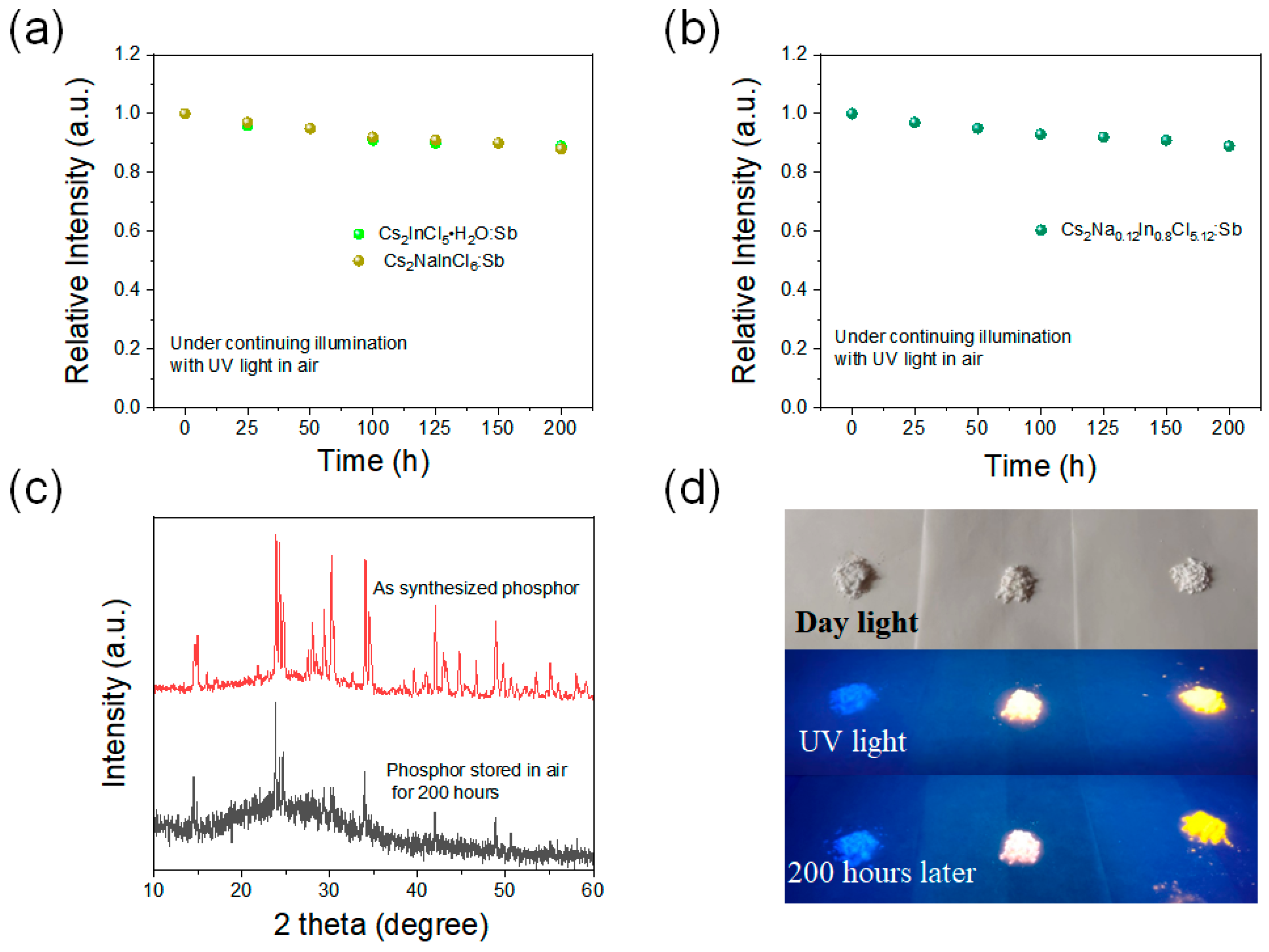
5.12:Sb samples were evaluated under irradiation from a 365 nm ultraviolet lamp. The results indicate that both the blue-emitting Cs
2NaInCl
6:Sb and the yellow-emitting Cs
2InCl
5·H
2O:Sb exhibit comparable stability. After continuous irradiation for 200 h, the spectral intensities of both materials are maintained at approximately 80% of their initial values (
Figure 4a,b); representative fluorescence spectra are provided in
Figure S7. The PL spectra of the Cs
2Na
0.12In
0.80Cl
5.12:Sb, Cs
2NaInCl
6:Sb, and Cs
2InCl
5·H
2O:Sb exposed to air for 2 months remain almost unchanged (temperature: 293 K, humidity: <25%) compared to the freshly prepared powders (
Figure S8). The temperature-dependent PL measurement of Cs
2Na
0.12In
0.80Cl
5.12:Sb is from 327 to 467 K in the air. The results indicate that the two emission peaks display comparable thermal stability, with the luminescence intensity at 385 K retaining approximately 60% of its initial value at 327 K (
Figure S9 and Table S4). Subsequently, XRD analysis of Cs
2Na
0.12In
0.80Cl
5.12:Sb confirm that the components retain their original crystal structure after 200 h of storage, with no significant phase transformation observed (
Figure 4c). The corresponding PL image of the powder under 365 nm is presented in
Figure 4d, indicating that the sample maintains excellent luminescent performance.
Owing to its high fluorescence emission intensity and superior ambient stability, the one-pot synthesized Cs
2Na
xInCl
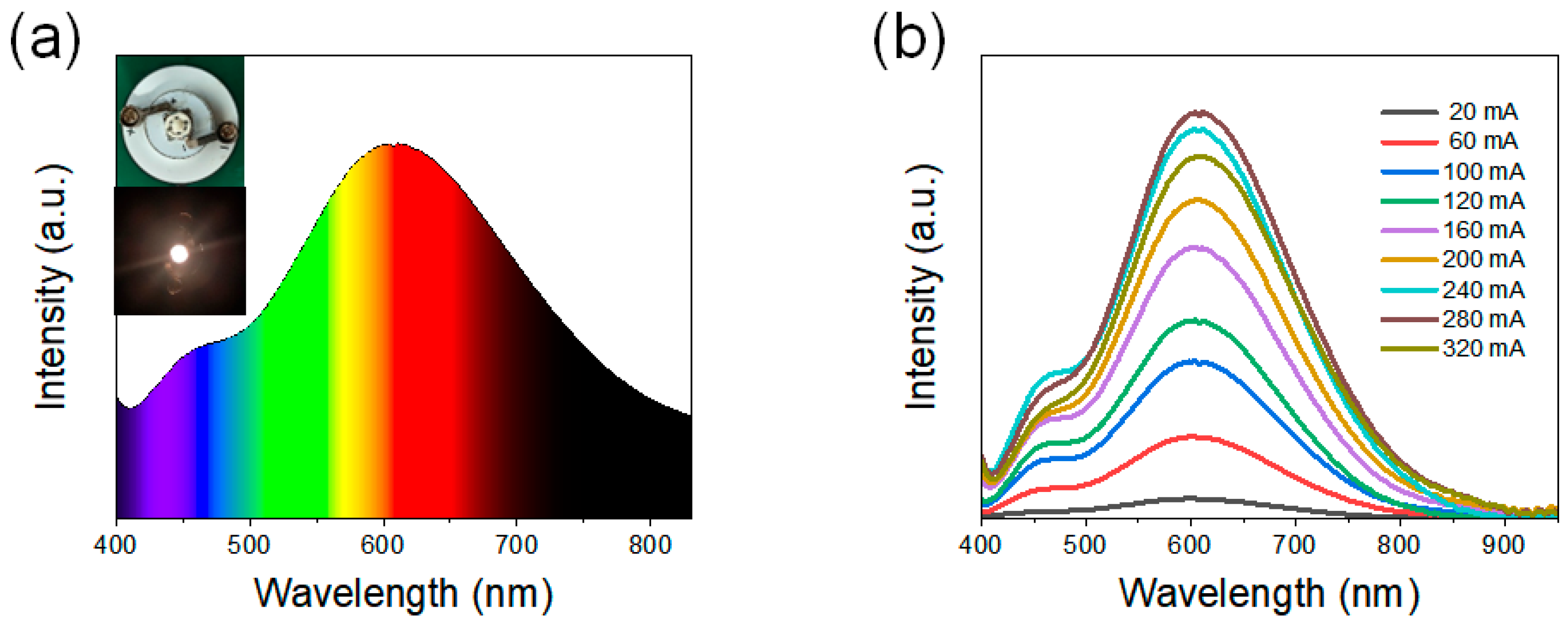
5+x:Sb is anticipated to serve as an efficient luminescent material for WLEDs. To demonstrate this concept, a WLED device was fabricated by employing the dual-component fluorescent material synthesized via the one-pot method in conjunction with a commercially available 365 nm chip. As depicted in
Figure 5a, the WLED device demonstrates a bright electroluminescence (EL) at a driving current of 240 mA. The CIE 1931 chromaticity coordinates are measured to be (0.4288, 0.4034), with a color rendering index (Ra) of 88.5 and a CCT of 3136 K for white light emission. The emission spectra of the LED at various forward bias currents (ranging from 20 to 320 mA) under different current densities are presented and the output power of white light emission exhibits a monotonic increase with the rise in forward current. Under varying driving currents, the spectra demonstrate negligible emission shifts, and the color temperature of the LED remains relatively stable, fluctuating only slightly within the range of 3027 to 3225 K (
Figure 5b). These results suggest that this type of 0D indium-based halide exhibits a significant potential for application in high-performance lighting-grade WLEDs.