


Abstract
The rapid development of detection technologies has increased the demand for multispectral camouflage materials capable of broadband concealment and effective thermal management. To address the conflicting optical requirements between infrared camouflage and LiDAR camouflage, we propose a composite design combining a germanium–ytterbium fluoride (Ge/YbF3) selective emitter with an amorphous silicon (a-Si) two-dimensional periodic microstructure. The multilayer film, optimized using the transfer-matrix method and a particle swarm optimisation algorithm, achieves low emissivity in the 3–5 μm and 8–14 μm infrared atmospheric windows and high emissivity within 5–8 μm for radiative cooling, while introducing a narrowband absorption peak at 1.55 μm. Additionally, the a-Si microstructure provides strong narrowband absorption at 10.6 μm via a grating-resonance mechanism. FDTD simulations confirm low emissivity in the infrared windows, high absorptance at LiDAR wavelengths, and good angular and polarization robustness. This work demonstrates a multifunctional photonic structure capable of integrating infrared camouflage, laser camouflage, and thermal-radiation control.
1. Introduction
Camouflage technology [1,2,3,4,5], an important component of electro-optical countermeasures, initially relied on specially engineered coatings to suppress target signatures in the visible and infrared bands [6,7,8,9,10,11,12,13,14,15,16,17,18,19,20,21,22]. With the rapid development of modern reconnaissance and guidance systems toward multimodal sensing, target detection has evolved from single-band imaging to integrated approaches combining visible imaging, infrared thermography, LiDAR ranging, and microwave radar [23,24]. This shift has significantly improved detection reliability and challenged traditional single-band camouflage strategies. As a result, next-generation camouflage materials must regulate reflection, absorption, and thermal emission across a broad spectral range spanning the visible, near-infrared, mid-infrared, laser, and microwave [25,26,27] regions. However, the distinct electromagnetic characteristics and functional requirements of each band make it difficult for any single material or structure to satisfy all spectral constraints simultaneously.
Among various sensing technologies, light detection and ranging (LiDAR) has emerged as a key high-precision detection method due to its active emission, narrowband detection, and high spatial resolution. Typical LiDAR systems operate at 905 nm, 1550 nm, and 10.6 μm, enabling accurate ranging and target profiling even under low-contrast or infrared-camouflaged environments [28,29,30,31,32,33,34,35]. Effective LiDAR camouflage requires strong absorption or low reflectance at these wavelengths, whereas infrared camouflage demands extremely low emissivity within the 3–5 μm and 8–14 μm atmospheric windows. These contradictory requirements make it challenging for conventional infrared camouflage materials to suppress LiDAR signals without compromising infrared camouflage performance.
Recent studies have explored multispectral camouflage through multilayer selective emitters, micro-/nano-structured surfaces, and metasurface engineering. Multilayer thin-film selective emitters, such as the Ge/YbF3 structure developed by Huang et al. [36], provide precise spectral control and simultaneously achieve visual camouflage, infrared camouflage, and radiative cooling. Microstructured emitters based on metal–dielectric–metal (MDM) resonators have also demonstrated narrowband absorption at 10.6 μm for CO2-laser suppression [37]. However, most existing designs suffer from two limitations: (i) laser absorption is often limited to a single wavelength and does not include the widely used 1.55 μm LiDAR band; and (ii) incorporating microstructures may deteriorate the low-emissivity characteristics of mid-infrared selective emitters. These challenges hinder the realization of coordinated camouflage across visible, infrared, and LiDAR bands.
To overcome these limitations, this work proposes a composite camouflage design integrating a Ge/YbF3 selective emitter with an a-Si two-dimensional periodic microstructure. The multilayer emitter achieves low emissivity in the 3–5 μm and 8–14 μm atmospheric windows and high emissivity in the 5–8 μm non-window region for radiative cooling. Meanwhile, the a-Si microstructure introduces narrowband absorption peaks at 1.55 μm and 10.6 μm through dielectric resonances, enabling effective LiDAR suppression. By combining two structures based on distinct physical mechanisms, the proposed system achieves simultaneous visual camouflage, infrared camouflage, and LiDAR camouflage over a broad spectral range, offering a promising pathway for multispectral camouflage material design.
2. Result
Multispectral camouflage relies on the distinct detection mechanisms associated with different wavelength regions, and the detectability at each wavelength is closely related to the atmospheric transmittance of the corresponding electromagnetic wave. In the mid-wave infrared (MWIR, 3–5 μm) and long-wave infrared (LWIR, 8–14 μm) atmospheric windows, most thermal imagers and heat-seeking systems operate within these bands; therefore, materials are required to exhibit low emissivity. In contrast, within the non-atmospheric window (5–8 μm), the thermal radiation intensity of medium-temperature objects (100–300 °C) reaches its maximum, necessitating high emissivity to enable radiative cooling without compromising infrared camouflage. For the visible band (380–780 nm), low reflectance is essential to ensure visual camouflage. For the LiDAR detection wavelengths of 1.55 μm and 10.6 μm, high absorptance is required to suppress backscattered signals.
The multispectral camouflage material developed in this study consists of a germanium–ytterbium fluoride (Ge/YbF3) selective emitter and an amorphous silicon (a-Si) two-dimensional periodic microstructure, as illustrated in Figure 1. The Ge/YbF3 wavelength-selective emitter achieves low emissivity in the mid-infrared atmospheric windows (3–5 μm and 8–14 μm), high emissivity in the non-window region (5–8 μm), and high absorptance at 1.55 μm through thin-film interference engineering. The a-Si microstructure, enabled by grating-induced plasmonic resonance, provides strong absorption at 10.6 μm. Together, these components allow the proposed selective-emission structure to simultaneously suppress mid-infrared radiation while enhancing absorption at LiDAR wavelengths, effectively integrating two traditionally conflicting functionalities—mid-infrared camouflage (low emissivity) and LiDAR camouflage (high absorptance). This design overcomes the inherent limitations of conventional infrared-only camouflage materials, which typically cannot accommodate both requirements.
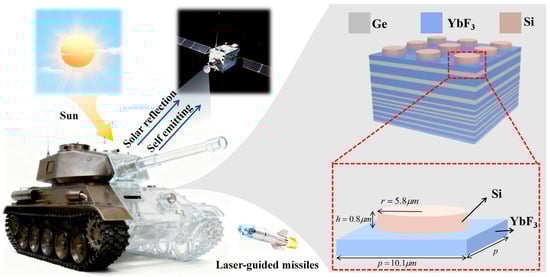
Figure 1.
Schematic diagram of thermal management functionality for infrared and laser dual-compatible camouflage. The designed photonic structure enables multi-band camouflage and thermal management for the target equipment. The enlarged image shows the schematic diagram of the designed photonic structure and the specific parameters of the cylindrical microstructure.
2.1. Structural Design and Measurement
Design of the Wavelength-Selective Multilayer Film Emitter
Multilayer thin-film structures are easy to fabricate and provide excellent spectral selectivity. In this work, we employ two commonly used high-temperature-resistant materials—Ge [38] and YbF3 [36]—to construct a coating capable of achieving visible camouflage, infrared camouflage, and radiative cooling simultaneously. In optical thin-film engineering, YbF3 is a widely used low-refractive-index infrared material due to its high infrared transmittance, strong mechanical stability, and compatibility with antireflection coatings for germanium and chalcogenide infrared glasses (YbF3: n ≈ 1.3–1.5 with low extinction). Germanium, on the other hand, is a stable infrared material with a refractive index greater than 4 (Ge: n ≈ 4.0, k ≈ small in the near-IR region). Its high refractive index leads to reflection losses exceeding 50%; however, applying antireflection coatings can significantly enhance its transmittance, reaching values above 98%. The large refractive-index contrast between Ge and YbF3, as well as their distinct absorption characteristics, forms the basis for strong optical interference and wavelength-selective absorption. To design the multilayer selective emitter, the transfer-matrix method (TMM) is employed to rapidly and accurately simulate the reflection and transmission characteristics of multilayer films across different wavelength regions. This enables precise prediction of the absorptance and emissivity of the structure in the corresponding spectral bands. For a multilayer system consisting of N dielectric layers, the electromagnetic propagation within each layer and across interfaces can be described using a 2 × 2 transfer matrix. Denoting the refractive index of the j-th layer as A and its thickness as B, the phase accumulation and wave propagation within that layer can be expressed by Equation (1):
where represents the phase shift, denotes the refraction angle, and is related to the dielectric permittivity of the medium and the polarization state (TE/TM). By sequentially multiplying the transfer matrices of all layers, the overall transfer matrix of the multilayer system can be obtained. For a given incident angle and polarization state, the complex reflection coefficient and transmission coefficient of the film stack can then be derived, allowing the corresponding reflectance and transmittance at each wavelength to be calculated. When the total thickness of the multilayer system is sufficiently large to effectively block transmission at the wavelength of interest, the transmittance can be approximated as . Under this condition, the absorptance can be approximated as .
A particle swarm optimization (PSO) algorithm is employed, in combination with the transfer-matrix method, to perform multi-objective optimization of the multilayer structure. The design process is shown in Figure 2.The optimization is carried out by defining an objective function as shown in Equation (2):
where represents the vector of layer thicknesses, while , , and other terms denote the deviation or residual metrics corresponding to different spectral bands. Different weights and constraints are applied to the visible region, the 1.55 μm band, and the two mid-infrared atmospheric windows to enable global optimization of the multilayer system across the entire spectral range. Since the 1.55 μm LiDAR band is particularly sensitive to high absorption, the objective function assigns an increased weighting to the absorptive response at this wavelength, ensuring a significant reduction in reflectance during the optimization process.
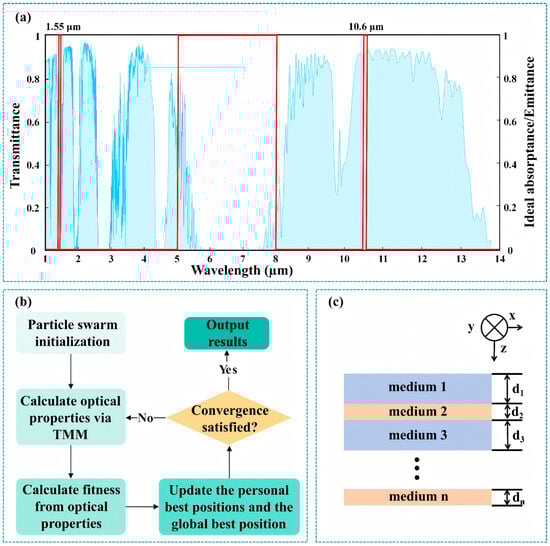
Figure 2.
Multilayer film design process. (a) Ideal selective infrared emission as the optimization objective function. (b) Flowchart of the particle swarm optimization algorithm for obtaining the optimized film structure. (c) Schematic diagram of the ideal multilayer film structure.
The high absorption at the 1.55 μm LiDAR wavelength originates from the carefully engineered refractive indices and extinction coefficients of the dielectric and metal/semiconductor layers at this wavelength. In this work, YbF3, which exhibits a broadband low refractive index, and Ge, a semiconductor with a medium-to-high refractive index, are selected as the primary coating materials. When arranged in an alternating sequence, these materials can generate a strong interference-induced absorption peak near 1.55 μm. The underlying physical mechanisms include: (i) Resonant interference absorption. The alternating YbF3 and Ge layers with different thicknesses form a one-dimensional, aperiodic photonic-crystal–like structure, which establishes a standing-wave field at a designated wavelength (e.g., 1.55 μm). By adjusting the thickness of the top and substrate-adjacent layers, the standing wave can be tuned such that the electromagnetic field approaches a node or antinode at this wavelength, thereby maximizing the local field intensity and dissipation and enabling strong laser absorption. (ii) Appropriate material loss. Compared with purely dielectric multilayers, introducing moderate optical loss (e.g., from an ultrathin metallic component) can enhance near-infrared absorption. Ge exhibits inherent absorption near the 1.5 μm region, and when combined with YbF3 layers containing suitable absorption loss, the attenuation at this wavelength can be further strengthened, thereby significantly increasing the overall absorption. The strong absorption at 1.55 µm is mainly attributed to interference-induced field localization in the aperiodic multilayer structure, while the intrinsic absorption of Ge provides the loss channel required to dissipate the confined optical energy. (iii) Coupled reflection-suppression structure.
After optimization using the PSO algorithm, a multilayer structure consisting of 21 alternating Ge/YbF3 layers was obtained. The optimized thicknesses of each layer are listed in Table 1.

Table 1.
Optimized multilayer configuration of the proposed YbF3/Ge thin-film stack obtained by the PSO algorithm.
2.2. Design of the Periodic Microstructure
2.2.1. Material Selection and Morphology Design of the Microstructure
At the wavelength of 1.55 μm, Ge [38] exhibits a very high refractive index and dielectric constant, making it well suited for precise spectral manipulation through interference effects in a multilayer thin-film structure. This property enables the realization of strong narrowband absorption, which is essential for LiDAR camouflage. By carefully engineering the thicknesses and stacking sequence of Ge and other dielectric layers (such as YbF3), the laser absorptance in the near-infrared region can be significantly enhanced, thereby reducing the reflected LiDAR signal intensity. However, when the wavelength extends to the long-wave infrared region at 10.6 μm, the refractive index of Ge decreases markedly. Under these conditions, the simple multilayer configuration of Ge/YbF3 becomes insufficient to achieve strong narrowband absorption. Therefore, for this long-wave infrared band, it is necessary to introduce micro-grating or other resonant structures to enhance absorption through localized surface plasmon resonances or grating-coupling effects. Such micro-grating designs can induce strong local electromagnetic-field enhancement at the material surface, substantially improving the spectral selectivity at 10.6 μm and further strengthening the LiDAR-camouflage capability of the structure.
The selection of a-Si as the microstructure material is primarily motivated by its favorable optical properties. Specifically, a-Si exhibits a relatively low absorption coefficient in the mid-infrared region, ensuring that it does not introduce significant additional absorption or emission (a-Si ≈ 3.4–3.8 in near-IR with low k in mid-IR). a-Si is chosen instead of crystalline silicon because it provides comparable optical constants in the long-wave infrared, while offering improved fabrication uniformity, isotropic optical response, and practical robustness for large-area microstructured coatings. Moreover, the designed microstructure thickness is much smaller than the mid-infrared wavelengths, which further guarantees that the a-Si microstructure layer does not generate noticeable extra radiative signals. The proposed microstructure can produce a pronounced narrowband absorption peak at specific wavelengths—such as 10.6 μm commonly used in LiDAR systems. This effect originates mainly from the local electromagnetic field enhancement and resonant modes induced by the grating structure under wavelength-specific excitation, rather than from the intrinsic material absorption of a-Si. Consequently, incorporating the a-Si microstructure does not introduce unwanted radiative interference or absorption loss across the broader mid-infrared range, nor does it adversely affect the spectral performance in other bands. This ensures the overall functionality and spectral compatibility required for efficient multispectral camouflage.
In designing a multispectral camouflage device compatible with both infrared and LiDAR camouflage, the use of a cylindrical two-dimensional (2D) array offers several important advantages: (i) Symmetry and isotropy. Cylindrical structures naturally possess rotational symmetry, resulting in an approximately isotropic in-plane optical response. This allows the structure to maintain stable electromagnetic behavior under variations in incident angle and polarization; (ii) Resonance control and narrowband absorption. Cylindrical geometries efficiently excite grating-resonance modes at laser wavelengths such as 10.6 μm, enabling strong narrowband absorption. Their smooth shape and uniform edge curvature provide precise control over local electromagnetic field distributions and enhancement effects, thereby achieving the desired absorption peak at the target wavelength. (iii) Mature and stable fabrication processes. Cylindrical microstructures are well supported by existing micro/nanofabrication techniques, including lithography, etching, and deposition, which can reliably realize high-precision cylindrical arrays. (iv) Simplified numerical modeling and high simulation accuracy. In numerical simulations such as FDTD, cylindrical 2D arrays allow simplified modeling with boundary conditions that are easier to handle. Their isotropic properties further improve simulation robustness and reproducibility.
Therefore, choosing a cylindrical 2D array enables effective excitation and control of narrowband absorption at specific wavelengths (e.g., 10.6 μm), while also offering isotropy and compatibility with mature fabrication processes. These advantages give the design high robustness and practical applicability, making cylindrical arrays a favorable choice for multispectral camouflage devices.
2.2.2. Optimization of the Microstructure Parameters
The narrowband high absorption observed at the 10.6 μm LiDAR wavelength originates from grating resonance. Grating resonance is a phenomenon that occurs in periodic structures and is closely related to both the wavelength of the incident light and the periodicity of the structure. In one-dimensional or two-dimensional grating systems, a strong optical resonance can be excited when the wavelength of the incident light matches the structural period, leading to pronounced absorption, scattering, or reflection within a specific spectral region.
For a periodic structure, the resonance wavelength is closely related to the grating period. As a simplified illustration, the free-space diffraction condition can be written as:
where m is the diffraction order (typically 1, 2, 3, …), λ is the wavelength of the incident light, is the grating period, and is the incident angle.
Which qualitatively reflects the dependence of the resonance wavelength on the grating period. However, for grating resonances coupled into dielectric materials or guided/localized modes, the resonance condition should more generally incorporate the effective refractive index of the supported mode. In such cases, the resonance condition can be expressed as:
where is the effective refractive index of the resonant mode supported by the a-Si microstructure.
Therefore, in this work, the exact resonance position at 10.6 μm is determined by full-wave FDTD simulations, which inherently account for material dispersion, effective mode index, and geometric parameters.
In the designed two-dimensional periodic microstructure, the strong absorption at 10.6 μm arises from the excitation of a grating-resonance mode. This indicates that the grating period is matched to the incident 10.6 μm wavelength, enabling efficient energy coupling and producing a sharp absorption peak at this band. The effects of the period , pillar height , and fill factor on the absorption peak were investigated individually, and FDTD simulations were employed to analyze and optimize their influence.
- (1)
- Effect of the period .
Since the grating resonance is strongly dependent on the structural period, tuning the period allows the resonance wavelength to shift accordingly. Simulations show that when the period increases from 9.5 μm to 10.8 μm, the absorption peak exhibits a redshift from 10.2 μm to 11.1 μm. To precisely match the 10.6 μm LiDAR wavelength, the optimal period is selected as P = 10.1 μm, at which the center of the absorption peak is located near 10.6 μm, as illustrated in Figure 3a.
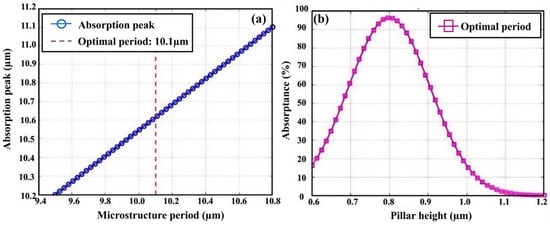
Figure 3.
Absorptance variations under different microstructure configurations and pillar heights. (a) Effect of the period on the position of the absorption peak. (b) Effect of the pillar height on the absorptance at the 10.6 μm wavelength.
- (2)
- Effect of the pillar height .
The pillar height affects both the standing-wave energy distribution and the intensity of the absorption peak. As shown in Figure 3b, when H < 0.6 μm, the resonance absorption is relatively weak, whereas for H > 1.0 μm, the absorption bandwidth increases while the peak absorptance decreases, which may compromise the LiDAR-camouflage performance. Considering both peak strength and bandwidth, the optimal pillar height is determined to be H = 0.8 μm, at which the absorption peak reaches 96.5%.
- (3)
- Effect of the fill factor .
The fill factor defines the area ratio occupied by the micro-pillars within the unit cell, and it can be calculated as:
where denotes the radius of the micro-pillars. Simulation results show that when the fill factor increases from 40% to 70%, the bandwidth of the absorption peak expands significantly, whereas the peak absorptance decreases. An excessively large fill factor enhances the coupling between resonance modes, which in turn reduces the spectral selectivity at the target wavelength. After optimization, a fill factor of (corresponding to a pillar radius of μm) is selected to achieve the optimal narrowband absorption performance at 10.6 μm.
By optimizing the period, pillar height, and fill factor, the a-Si two-dimensional periodic microstructure achieves high absorptance at the 10.6 μm wavelength. The optimized geometric parameters of the cylindrical array are as follows: pillar radius μm, pillar height μm and array period μm. The proposed 2D periodic microstructure produces a sharp narrowband absorption peak at 10.6 μm, enabling compatibility between infrared camouflage and LiDAR camouflage. This microstructure design not only enhances the applicability of the camouflage material but also provides new insights for the development of future multispectral camouflage technologies.
2.3. FDTD Simulation
Lumerical FDTD Solutions was employed to systematically simulate the electromagnetic responses of the designed photonic structures across different wavelength bands, focusing on their absorption, emission, and reflection characteristics. To ensure the accuracy and reliability of the simulation results, the refractive index (n) and extinction coefficient (k) of Ge [38], YbF3 [36], and a-Si [38] within the target spectral range were obtained from experimental measurements or authoritative literature and imported into the FDTD environment with high fidelity. The modeled a-Si microstructure used in the simulations is shown in Figure 4.
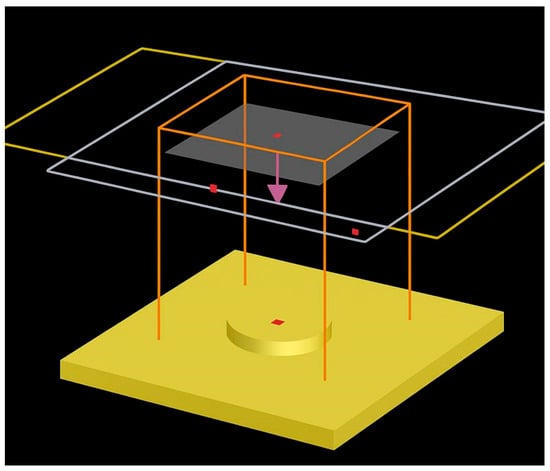
Figure 4.
Simulated a-Si microstructure.
Meanwhile, multiple rounds of testing and convergence verification were performed for key simulation parameters, including the geometric thickness of the layers, the meshing strategy at material interfaces, and the incident angle. By progressively refining the mesh, optimizing boundary conditions, and conducting sensitivity analyses on the incident-wave parameters, the simulation data achieved high reproducibility and numerical stability. These procedures provide a solid theoretical foundation for subsequent structural optimization and for comparison with experimental results.
From the simulation results shown in Figure 5a–c, several key features can be observed:
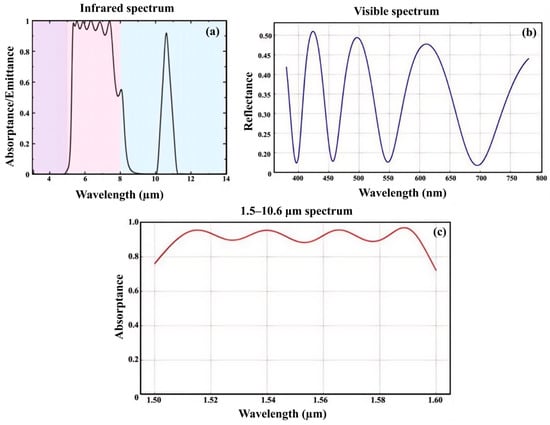
Figure 5.
Simulated camouflage performance of the designed structure. (a) Simulated emissivity spectrum (3–14 μm) of the multispectral camouflage photonic structure under normal incidence. (b) Simulated reflectance spectrum in the visible range. (c) Simulated absorptance spectrum in the 1.5–1.6 μm wavelength range.
- (1)
- Low emissivity in the MWIR and LWIR bands
Within the atmospheric windows of 3–5 μm and 8–14 μm, the structure exhibits low thermal emissivity (ε3–5 μm = 0.03; ε8–14 μm = 0.05). This indicates that the designed multilayer thin-film stack combined with the surface microstructure effectively suppresses infrared radiation from the target, thereby reducing the probability of detection by infrared imaging systems or IR-guided weapons.
- (2)
- Broad emission peak in the 5–8 μm non-atmospheric window
In contrast to the detection windows noted above, the 5–8 μm range is not a typical military surveillance band and exhibits relatively low atmospheric transmittance. In this work, a high emissivity in this non-detection band is intentionally introduced to enhance radiative cooling, thereby balancing thermal management and infrared camouflage requirements. The significant broadband emissivity peak in this region (ε5–8 μm = 0.84) validates this design strategy.
- (3)
- Low reflectance in the visible spectrum
In the visible range, the structure maintains a low overall reflectance, as shown in Figure 5b. This contributes to visible-light camouflage by reducing detectability against natural backgrounds such as vegetation, desert, or ocean environments. A lower reflectance minimizes the likelihood of noticeable specular highlights that could reveal the target’s location.
- (4)
- Strong narrowband absorption at the short-wave infrared wavelength of 1.55 μm
The 1.55 μm wavelength is widely used in fiber-based LiDAR systems and certain optical communication channels. By incorporating tailored interference-absorption layers and material loss into the multilayer design, a sharp and strong absorption peak appears near 1.55 μm, effectively reducing the reflected LiDAR return signal. The simulation curve shows an average absorptance of approximately 0.91 at this wavelength, as illustrated in Figure 5c, confirming the effectiveness of our design for LiDAR camouflage.
Moreover, the high selectivity of the absorption peak ensures minimal interference with adjacent infrared camouflage performance, enabling coordinated multispectral camouflage across multiple wavelength regions.
- (5)
- Narrowband high absorption near 10.6 μm
For the widely used CO2-LiDAR wavelength of 10.6 μm, the proposed two-dimensional periodic microstructure achieves “narrowband” absorption enhancement through localized resonance coupling. The simulation results show a significant increase in absorptance near 10.6 μm (average absorptance of 0.9), while maintaining low emissivity across the remaining mid- and far-infrared regions. This enables the structure to simultaneously satisfy both LiDAR camouflage and mid-infrared thermal-camouflage requirements.
Figure 6 illustrates the magnetic-field intensity (|H|) and electric-field vector distributions of the cylindrical microstructure at the wavelength of 10.6 μm in the X–Y and X–Z cross-sections, revealing its electromagnetic resonance characteristics. In the X–Y cross-section, the magnetic field forms a ring-shaped high-intensity region around the pillar edges, indicating the presence of a magnetic dipole resonance. This resonance corresponds to a localized magnetic field confined within the structure and enhanced at the edges. Meanwhile, the electric-field vectors exhibit a vortex-like circulating pattern, a feature widely associated with magnetic metamaterials and wavelength-selective absorbers, and highly relevant to infrared camouflage applications.
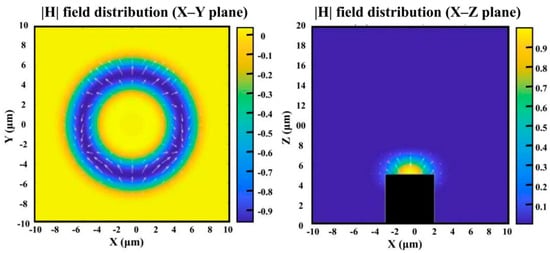
Figure 6.
Magnetic−field intensity (|H|) and electric-field vector distributions of the cylindrical microstructure at the wavelength of 10.6 μm in the X–Y and X–Z cross-sections.
The X–Z cross-section shows that the magnetic field is primarily concentrated near the top of the microstructure, producing a localized field-enhancement effect similar to a Fabry–Perot-type resonance. This confinement leads to the accumulation of electromagnetic energy in that region. Such localized enhancement demonstrates that the microstructure can effectively manipulate the electromagnetic-field distribution in the infrared, thereby improving the selectivity of absorption or reflection at specific wavelengths. This property is of significant importance in thermal-radiation control, infrared camouflage, and photothermal conversion, offering theoretical support for optimizing multispectral camouflage coatings, selective radiators, and IR detectors.
The absorption at 10.6 µm is mainly governed by a localized grating-resonance mode, which exhibits practical robustness for near-normal and moderate incidence angles. While a resonance shift may occur at large oblique angles, the laser-suppression functionality under typical illumination conditions is preserved.
Overall, the simulation results clearly demonstrate the multispectral camouflage capability of the proposed design—maintaining low emissivity inside infrared detection windows while introducing narrowband, high absorptance at specific laser wavelengths to suppress active LiDAR probing. Through the careful integration and optimization of material selection and micro/nanostructure engineering, the proposed structure achieves coordinated camouflage over a broad spectral range, laying a solid theoretical and technological foundation for future applications in military camouflage, spacecraft thermal management, and multispectral camouflage devices.
3. Conclusions
In this work, we developed a multispectral camouflage photonic structure that reconciles the spectral conflict between high absorptance at LiDAR wavelengths and low emissivity in the mid-infrared atmospheric windows. To address the distinct requirements of the two key LiDAR wavelengths (1.55 μm and 10.6 μm), we adopted a hybrid design that integrates a Ge/YbF3 multilayer selective emitter with an a-Si two-dimensional periodic microstructure.
The multilayer stack enables strong interference-enhanced absorption at 1.55 μm by tailoring the refractive-index contrast and layer thicknesses to form a pronounced standing-wave field, maximizing energy dissipation. Meanwhile, the surface micro-grating introduces a narrowband absorption peak at 10.6 μm through localized resonance coupling, further enhancing suppression of laser return signals from CO2-based LiDAR systems. This dual-mechanism design overcomes the limitations of single-layer strategies and ensures targeted absorption at both LiDAR wavelengths.
FDTD simulations confirm that the proposed structure maintains low emissivity in the MWIR (3–5 μm) and LWIR (8–14 μm) atmospheric windows while enabling high emissivity in the 5–8 μm non-detection band for radiative cooling. The structure also exhibits low reflectance in the visible spectrum and demonstrates robustness against variations in incident angle and polarization, supporting its potential for practical deployment.
Overall, the presented multilayer–microstructure approach provides a comprehensive solution for multispectral camouflage compatible with LiDAR camouflage, infrared suppression, and thermal management. This strategy offers a promising pathway toward next-generation camouflage materials and provides useful guidance for future developments in multispectral protection technologies for military defense, aerospace thermal control, and advanced energy systems.
4. Simulations
Simulations were performed using Lumerical FDTD Solutions v8.13. The relative permittivities of Ge, YbF3, and a-Si were obtained from Ref. [38], Ref. [36], and Ref. [38], respectively. According to Kirchhoff’s law of thermal radiation, the simulated emissivity can be replaced by the simulated absorptivity, and the observation angle can be replaced by the incidence angle.
Author Contributions
Conceptualization, L.H. and C.M.; methodology, C.M.; software, Y.G.; validation, B.P.; formal analysis, Y.G.; investigation, L.H.; resources, C.M.; data curation, Y.G.; writing—original draft preparation, L.H.; writing—review and editing, L.H.; visualization, Y.G.; supervision, C.M.; funding acquisition, C.M. All authors have read and agreed to the published version of the manuscript.
Funding
This work was supported by the National Key Research and Development Program of China (2021YFC2202103 and 2021YFC2202203) and the National Natural Science Foundation of China (Grant Nos. 61875257, 12103081, and 42101380).
Data Availability Statement
Data underlying the results presented in this paper are not publicly available at this time but may be obtained from the authors upon reasonable request.
Conflicts of Interest
There are no conflicts to declare.
References
- Liu, Y.; Feng, Z.; Xu, C.; Chatterjee, A.; Gorodetsky, A.A. Reconfigurable Micro- and Nano-Structured Camouflage Surfaces Inspired by Cephalopods. ACS Nano 2021, 15, 17299−17309. [Google Scholar] [CrossRef]
- Qin, B.; Zhu, H.; Zhu, R.; Zhao, M.; Qiu, M.; Li, Q. Space-to-ground Infrared Camouflage with Radiative Heat Dissipation. Light. Sci. Appl. 2025, 14, 137. [Google Scholar] [CrossRef]
- Li, J.; Fu, Y.; Zhou, J.; Yao, K.; Ma, X.; Gao, S.; Yu, X. Ultrathin, Soft, Radiative Cooling Interfaces for Advanced Thermal Management in Skin Electronics. Sci. Adv. 2023, 9, eadg1837. [Google Scholar] [CrossRef]
- Bao, A.T.; Xu, L.G.; Qu, H.Z.; Han, S.L.; Zhai, C.X.; Cao, S.Y.; Yang, J.J.; Li, A.K.; Wang, J.Z.; Chen, Y.F.; et al. Controlled Transmissivity, Absorptivity, and Reflectivity in IR Wavelengths Based on Multilayer Structure of Simulation. Cell Rep. Phys. Sci. 2025, 6, 102603. [Google Scholar] [CrossRef]
- He, M.; Nolen, J.R.; Nordlander, J.; Cleri, A.; McIlwaine, N.S.; Tang, Y.; Lu, G.; Folland, T.G.; Landman, B.A.; Maria, J.-P.; et al. Deterministic Inverse Design of Tamm Plasmon Thermal Emitters with Multi-Resonant Control. Nat. Mater. 2021, 20, 1663–1669. [Google Scholar] [CrossRef]
- Ying, Y.; Yu, J.; Qin, B.; Zhao, M.; Zhou, T.; Shen, W.; Qiu, M.; Li, Q. Directional Thermal Emission Covering Two Atmospheric Windows. Laser Photonics Rev. 2023, 17, 2300407. [Google Scholar] [CrossRef]
- Zhao, J.L.; Zhou, B.; Wang, G.L.; Ying, J.J.; Liu, J.; Chen, Q. Spectral Camouflage Characteristics and Recognition Ability of Targets Based on Visible/Near-Infrared Hyperspectral Images. Photonics 2022, 9, 957. [Google Scholar] [CrossRef]
- Ma, X.J.; Teng, X.Q.; Xu, L.G.; Zhu, J.Q.; Zhang, S.; Li, Q. Visible Light and Infrared Camouflage Based on Epsilon Near Zero Materials. Adv. Opt. Mater. 2025, 13, 2403438. [Google Scholar] [CrossRef]
- Ying, Y.; Yu, J.; Shen, W.; Ghosh, P.; Qiu, M.; Li, Q. Photonic Control of Thermal Radiation for Protective Windows. Light Adv. Manuf. 2025, 6, 34. [Google Scholar] [CrossRef]
- Tan, Q.; Qian, C.; Zhen, Z.; Xie, X.; Zou, X.; Yan, L. Inverse-Designed Multi-Directional Remote Cloak. Opt. Lett. 2025, 50, 1965–1968. [Google Scholar] [CrossRef] [PubMed]
- Wei, H.; Gu, J.; Ren, F.; Geng, C.; Guan, H.; Liang, S.; Fan, Q.; Zhao, J.; Wang, C.; Dou, S.; et al. Kirigami-Inspired Reconfigurable Thermal Mimetic Device. Laser Photonics Rev. 2022, 16, 2200383. [Google Scholar] [CrossRef]
- Deng, W.; Shang, S.; Cai, N.; Zhao, H.; Song, Y.; Xu, J. An Improved Differential Evolution Algorithm and Its Application in Optimization Problem. Soft Comput. 2021, 25, 5277–5298. [Google Scholar] [CrossRef]
- Huang, L.; Zhang, W.; Wei, Y.; Li, H.; Li, X.; Ma, C.; Zhang, C. Flexible Ge/Cu/ZnSe multilayer photonic structures for triple-band infrared camouflage, visible camouflage, and radiative cooling. Opt. Express 2024, 32, 37295–37309. [Google Scholar] [CrossRef] [PubMed]
- Huang, Y.; Pu, M.; Zhao, Z.; Li, X.; Ma, X.; Luo, X. Hierarchical Visible-Infrared-Microwave Scattering Surfaces for Multispectral Camouflage. Nanophotonics 2022, 11, 3613–3622. [Google Scholar] [CrossRef]
- Huang, Y.H.; Zhao, M.Y.; Li, Q.; Qiu, M.H.; Zhang, X.F.; Wang, J.Z. Adaptive Visible-Infrared Camouflage with Wide-Range Radiation Control for Extreme Ambient Temperatures. PhotoniX 2025, 6, 25. [Google Scholar] [CrossRef]
- Nong, J.Y.; Li, Q.; Qiu, M.H.; Zhang, X.F.; Wang, J.Z.; Chen, Y.F. Multifunctional Emitter Based on Inverse Design for Infrared camouflage, Thermal Imaging and Radiative Cooling. Opt. Express 2024, 32, 3379–3393. [Google Scholar] [CrossRef]
- Wang, Z.H.; Li, Q.; Qiu, M.H.; Zhang, X.F.; Wang, J.Z.; Chen, Y.F.; Han, S.L. 3D Intelligent Cloaked Vehicle Equipped with Thousand-Level Reconfigurable Full-Polarization Metasurfaces. Adv. Mater. 2024, 36, 2400797. [Google Scholar] [CrossRef]
- Zhou, Y.; Rather, L.J.; Yu, K.; Yang, M.; Lu, M.; Li, Q. Research Progress and Recent Advances in Development and Applications of Infrared camouflage Materials: A Comprehensive Review. Laser Photonics Rev. 2024, 18, 2400530. [Google Scholar] [CrossRef]
- Qin, B.; Zhu, Y.; Zhou, Y.; Qiu, M.; Li, Q. Whole-Infrared-Band Camouflage with Dual-Band Radiative Heat Dissipation. Light-Sci. Appl. 2023, 12, 246. [Google Scholar] [CrossRef] [PubMed]
- Yang, C.; Guo, H.; Chang, H.; Qu, Y.; Xiao, L. Infrared Camouflage and Radar Compatible camouflage Structure Based on Metamaterial. Opt. Mater. Express 2023, 13, 1513–1521. [Google Scholar] [CrossRef]
- Jiang, X.L.; Li, Q.; Qiu, M.H.; Zhang, X.F.; Wang, J.Z. Implementing of Infrared Camouflage with Thermal Management Based on Inverse Design and Hierarchical Metamaterial. Nanophotonics 2023, 12, 1891–1902. [Google Scholar] [CrossRef]
- Yu, J.; Qin, R.; Ying, Y.; Qiu, M.; Li, Q. Asymmetric Directional Control of Thermal Emission. Adv. Mater. 2023, 35, 2302478. [Google Scholar] [CrossRef]
- Kang, Y.L.; Liu, J.H.; Zhang, M.Y.; Wang, X.D.; Li, C.H.; Zhao, Y.N.; Sun, Q.J.; Guo, Z.G. One-dimension Hybrid Ge/ZnS Photonic Crystal Film Tailored for Thermal-stable Laser-infrared Compatible Camouflage. Opt. Mater. 2025, 161, 116776. [Google Scholar] [CrossRef]
- Yu, K.; Zhang, W.; Qian, M.; Shen, P.; Liu, Y. Multiband Metamaterial Emitters for Infrared and Laser Compatible camouflage with Thermal Management Based on Dissipative Dielectrics. Photon. Res. 2023, 11, 290–298. [Google Scholar] [CrossRef]
- Lin, H.J.; Zhang, M.L.; Liu, Y.H.; Chen, W.D.; Zhao, J.N.; Sun, X.Y.; Li, Q. Trans-scale Hierarchical Metasurfaces for Multispectral Compatible Regulation of Lasers, Infrared Light, and Microwaves. Nanophotonics 2025, 14, 2939–2952. [Google Scholar] [CrossRef]
- Zhao, M.Y.; Liu, C.H.; Zhang, J.X.; Wang, H.B.; Li, S.Q.; Zhou, Y.M.; Gu, C.D.; Qiu, M.H. High-Temperature camouflage Across Multi-Infrared and Microwave Bands with Efficient Radiative Thermal Management. Nano-Micro Lett. 2025, 17, 199. [Google Scholar] [CrossRef]
- Zhu, R.H.; Zhao, M.Y.; Li, Q.; Qiu, M.H.; Zhang, X.F.; Wang, J.Z.; Chen, Y.F.; Han, S.L. Digital Camouflage Encompassing Optical Hyperspectra and Thermal Infrared-Terahertz-Microwave Tri-Bands. Nat. Commun. 2025, 16, 8112. [Google Scholar] [CrossRef] [PubMed]
- Maccarone, A.; Drummond, K.; McCarthy, A.; Steinlehner, U.K.; Tachella, J.; Aguirre Garcia, D.; Pawlikowska, A.; Lamb, R.A.; Henderson, R.K.; McLaughlin, S.; et al. Submerged Single-Photon LiDAR Imaging Sensor Used for Real-Time 3D Scene Reconstruction in Scattering Underwater Environments. Opt. Express 2023, 31, 16690–16708. [Google Scholar] [CrossRef] [PubMed]
- Liu, H.M.; Zhang, C.Y.; Wang, T.; Li, M.N.; Zhao, X.J. High-Sensitivity Photonic Sensors for Real-Time Monitoring of Atmospheric Particulates. Photonics 2025, 12, 840. [Google Scholar]
- Belmekki, M.A.A.; Leach, J.; Tobin, R.; Buller, G.S.; McLaughlin, S.; Halimi, A. 3D Target Detection and Spectral Classification for Single-Photon LiDAR Data. Opt. Express 2023, 31, 23729–23745. [Google Scholar] [CrossRef]
- Kim, K.; Eliezer, Y.; Spitz, O.; Cao, H. Parallel Random LiDAR with Spatial Multiplexing of a Many-Mode Laser. Opt. Express 2023, 31, 11966–11981. [Google Scholar] [CrossRef]
- Xue, T.; Liu, J.Y.; Lu, C.; Liu, G.D. High Precision Range Extracting Method for FMCW LiDAR Using Semiconductor Laser Based on EO-PLL and NUDFT. Photonics 2025, 12, 466. [Google Scholar] [CrossRef]
- Li, X.Y.; Wang, H.B.; Zhao, J.N.; Liu, Y.H. Design and Optimization of Multilayer Infrared Absorbing Coatings for camouflage Applications. Opt. Laser Eng. 2023, 166, 107493. [Google Scholar]
- Chen, S.Y.; Wu, L.; Xu, L.; Zhang, Y.; Zhang, J.L. Photonic Signal Processing in Phase-Coded Lidar System. Photonics 2023, 10, 598. [Google Scholar] [CrossRef]
- Zhang, L.; Wang, C.; Liu, M.; Zhao, Y. Spatial-Temporal Variations of Forest Carbon Storage Estimated by Integrating Airborne LiDAR and Satellite Remote Sensing Data. Remote Sens. Environ. 2024, 308, 114161. [Google Scholar]
- Huang, L.; Li, H.; Li, Z.; Zhang, W.; Ma, C.; Zhang, C.; Wei, Y.; Zhou, X.; Li, Z.; Cheng, X.; et al. Multiband Camouflage Design with Thermal Management. Photon. Res. 2023, 11, 839–851. [Google Scholar] [CrossRef]
- Chen, X.; Qin, L.; Huang, J.; Liu, Y.; Zheng, S.; Qian, M. Controlling Thermal Radiation by Metasurface for Infrared and Laser Compatible camouflage with Radiative Cooling. Opt. Laser Technol. 2025, 189, 113017. [Google Scholar] [CrossRef]
- Palik, E.D. Handbook of Optical Constants of Solids; Palik, E.D., Ed.; Academic Press: Burlington, VT, USA, 1997; pp. 5–114. [Google Scholar]
Disclaimer/Publisher’s Note: The statements, opinions and data contained in all publications are solely those of the individual author(s) and contributor(s) and not of MDPI and/or the editor(s). MDPI and/or the editor(s) disclaim responsibility for any injury to people or property resulting from any ideas, methods, instructions or products referred to in the content. |
© 2025 by the authors. Licensee MDPI, Basel, Switzerland. This article is an open access article distributed under the terms and conditions of the Creative Commons Attribution (CC BY) license.