Communication

Photonic Nyquist Pulse Generation Based on Phase-Modulated Fiber Bragg Gratings in Transmission


1
School of Electronic Engineering, Wuhan Vocational College of Software and Engineering, Wuhan 430074, China
2
Wuhan National Laboratory for Optoelectronics & School of Optical and Electronic Information, Huazhong University of Science and Technology, Wuhan 430074, China
3
Aston Institute of Photonic Technologies, Aston University, Birmingham B4 7ET, UK
*
Author to whom correspondence should be addressed.
Photonics 2026, 13(1), 30; https://doi.org/10.3390/photonics13010030 (registering DOI)
Submission received: 14 November 2025 / Revised: 10 December 2025 / Accepted: 26 December 2025 / Published: 30 December 2025

Abstract

Nyquist pulses are critical in optical communication networks and signal processing systems. We present, to our best knowledge, the first demonstration of all-optical Nyquist pulse generation using phase-modulated fiber Bragg gratings (PM-FBGs) in transmission. PM-FBGs are a class of fiber gratings that have a nearly uniform coupling strength and a spatially varying grating period. As examples, we have designed and numerically simulated photonic Nyquist pulses with roll-off factors of 0.9, 0.5, and 0.1, respectively. The grating profiles are obtained employing numerical optimization algorithms. Numerical simulations confirm that the generated pulses are in good agreement with ideal Nyquist pulses over a 500 GHz bandwidth and have a good tolerance to the variations in the input pulse width.

1. Introduction

Nyquist pulses are a cornerstone for next-generation optical networks. Nyquist pulses enable high-speed data transmission by packing data within a minimal bandwidth while inherently avoiding inter-symbol interference [1]. The implementation of Nyquist pulse shaping can be categorized into two domains: electronics and photonics. Although electrical Nyquist pulse shaping achieves an excellent roll-off factor, its baud rate is ultimately constrained by digital-to-analog converter (DAC) bandwidth. However, Nyquist pulse shaping using optical methods can break this electronic bottleneck [2].
The generation of photonic Nyquist pulses has been demonstrated through several methods, including fiber optical parametric amplification [3], phase-locked flat frequency comb synthesis [4], a hybrid approach using intensity modulators and four-wave mixing [5], and spectral reshaping of a mode-locked laser [6]. Compared to other approaches, the spectral reshaping of mode-locked lasers offers the inherent advantages of simplicity and low energy consumption. This spectral filtering function has been implemented using diverse technologies, including programmable liquid-crystal-on-silicon optical processors [7], a Nyquist filter paired with a finely tunable dispersive delay line [8], an arrayed waveguide grating router (AWGR) [9], and fiber Bragg gratings (FBGs). Compared with other schemes, fiber Bragg grating spectral filters offer advantages such as low insertion loss, polarization independence, and good integration.
PM-FBGs are a class of fiber gratings that have a nearly uniform coupling strength and a spatially varying grating period. A range of devices using PM-FBG technology has been numerically and experimentally demonstrated. Notable implementations include virtual Gires–Tournois etalons [10], pulse shapers [11], photonic temporal differentiators [12], and photonic Hilbert Transformers [13]. Specifically, 9-cm-long PM-FBGs for use in delay-line interferometers [14] and signal format conversion [15] have been successfully fabricated via an ultraviolet laser direct-writing system. This system enables pitch-by-pitch inscription, where the coupling-coefficient profile and grating-period variation are precisely controlled via an acousto-optic modulator and by adjusting the phase mask–fiber relative position.
In this paper, we propose a scheme for generating photonic Nyquist pulses (PNPs) with arbitrary roll-off factors using PM-FBGs in transmission. Using PM-FBGs to achieve Nyquist pulse shaping can not only retain the low insertion loss, polarization independence, and easy integration of grating devices, but also facilitate large-scale production of such devices and improve production efficiency. By treating the Nyquist filter’s transfer function as the target spectral response, we compute the required grating profiles via numerical optimization. The transmission operation eliminates the need for circulators or couplers to separate reflected and incident light, thereby improving energy efficiency and reducing system cost and complexity.

2. Principle and Design

The spectral response (SR) of the Nyquist filter is characterized by a transfer function H ( f ) , which is defined as [7]:
H ( f ) = 1 , 0 f 1 α 2 P P 2 1 + cos π P α f 1 α 2 P ,   1 α 2 P f 1 + α 2 P 0 , f 1 + α 2 P
where P denotes the symbol period ( P = 1 + α B ), α   ( 0 α 1 ) is the roll-off factor, f is the frequency, and B represents the bandwidth of the Nyquist filter.
In transmission, a fiber Bragg grating (FBG) acts as a minimum-phase filter, linking its amplitude and phase responses via the logarithmic Hilbert transform [16]. If the target spectral response is itself a minimum-phase function, the corresponding amplitude and phase profiles can be derived directly. However, the transfer function of a photonic Nyquist pulse (PNP) with an arbitrary roll-off factor is generally non-minimum-phase. To address this, we apply a reported method [17] that converts a non-minimum-phase function into a minimum-phase version, relying on the principle that causal temporal functions with a dominant peak near the origin exhibit near-minimum-phase behavior [18]. In order to get the minimum-phase function, some of the system’s energy is wasted. Hence, the conversion of a non-minimum-phase function H n ( f ) to a minimum-phase function H m ( f ) can be accomplished using the following equation [18].
H m ( f ) = P 0 + P d H n ( f ) e x p ( j 2 π f τ 0 )
where P 0 denotes the power allocated to the delta function; P d represents the power of the designed Nyquist filter; and τ 0 is the relative time delay. The parameters P 0 and P d are governed by the fundamental constraint of the grating’s maximum reflectivity R m , and linked through the following relation [17]:
P 0 + P d 1 P 0 P d 1 R m
From Equation (3), we can see that the amount of power of the delta function P 0 will always be larger than the amount of power of the desired function P d , which means at least half of the system’s energy is wasted. Those P 0 and P d can be selected based on the specific system conditions. The amount of power of the desired function P d increases with the grating’s maximum reflectivity. To avoid temporal overlap between the two terms, the time delay τ 0 must be precisely chosen, thereby imposing a fundamental limit on the maximum operational time window of the desired pulse.

3. Numerical Results and Discussions

As examples, three PNPs with roll-off factors of 0.9, 0.5, and 0.1 have been designed. The grating’s maximum reflectivity R m is 0.96. From Equation (3), P 0 P d 1 R m = 0.2 . For all configurations, the following parameters were fixed: a grating length (L) of 4 cm, a delta function power ( P 0 ) of 0.6, a Nyquist filter power ( P d ) of 0.4, and a time delay ( τ 0 ) of 40 ps. The devices were designed to operate at a central wavelength of 1550 nm with a 4 nm (500 GHz) bandwidth. The grating length, while theoretically scalable to achieve an equivalent response with a reduced coupling coefficient, is practically bounded by the fabrication system’s translation range and positioning precision. The amount of power of the desired Nyquist filter is maximized subject to the given constraints. The specific profiles for the PM-FBGs were determined via a quasi-Newton optimization algorithm [13]. We need to point out that fixed parameters do not significantly affect the generality of the proposed method. The selection of different parameters can eventually converge, but the time required for convergence varies. The optimization function is the error between the simulated and ideal Nyquist spectrum. We optimize the grating profile to get the minimum of the optimization function. The smaller the value of the optimization function, the closer the simulated result is to the ideal result. The objective function is the RMSE value between the simulated spectrum and the ideal spectrum. The initial value of the period is uniformly distributed from −1 nm to 1 nm. The optimization will stop when the RMSE error value is less than 0.1. The final RMSE values of the three PNPs are 0.091, 0.0086, and 0.092, respectively.

3.1. Roll-Off Factor = 0.9

H 0.9 ( f ) = 1 , 0 f 0.9 2 P 1 2 1 + cos π P 0.9 f 0.9 2 T ,   0.1 2 P f 1.9 2 P 0 , f 1.9 2 P P = 0.5 * ( 1 + 0.9 ) H d 1 ( f ) = 0.6 + 0.4 × H 0.9 ( f ) e x p ( j 2 π f τ )
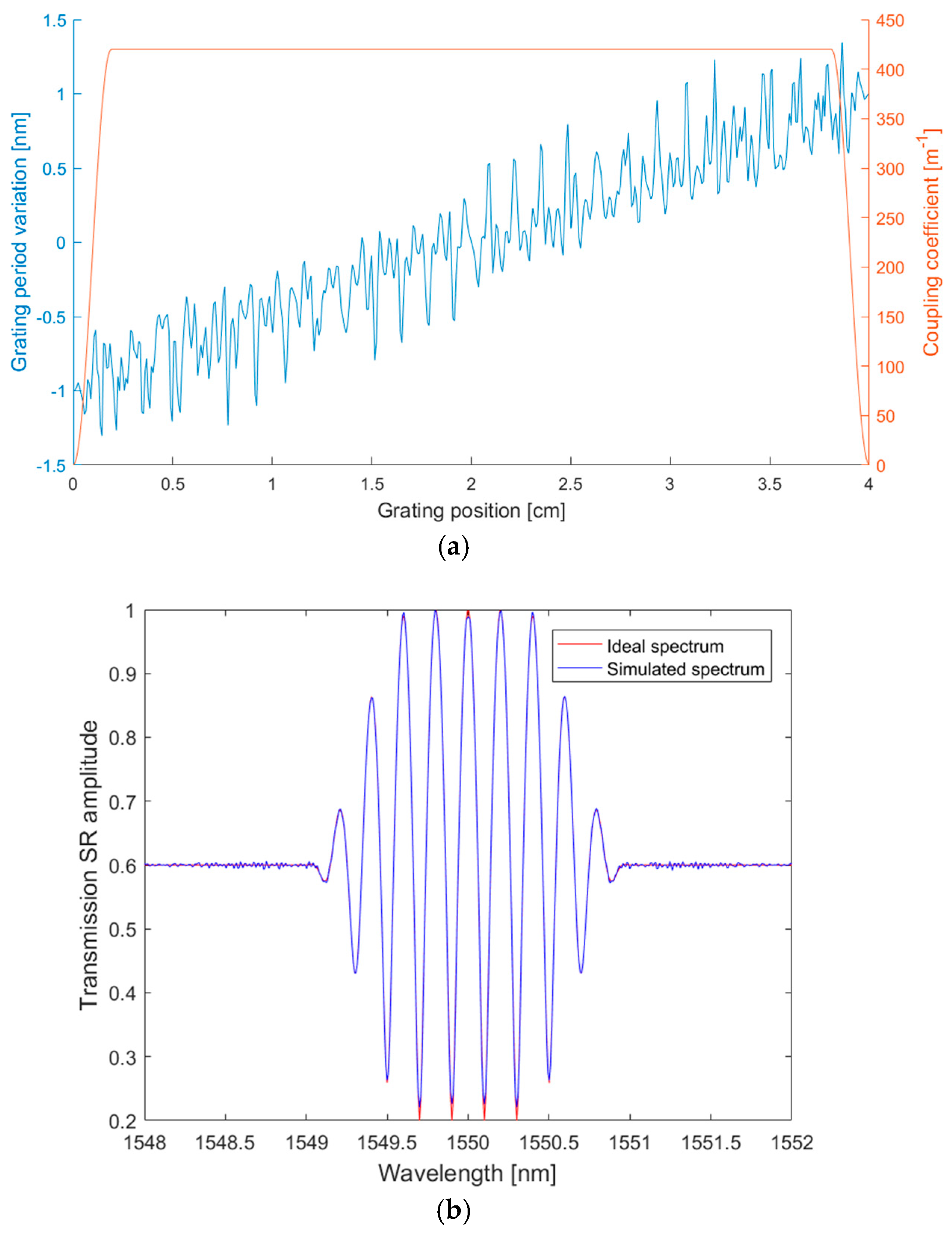
For α = 0.9 , the quasi-Newton algorithm yields the grating profile shown in Figure 1a, where the coupling coefficient remains nearly uniform and the maximum coupling coefficient is 420 m−1. The maximum grating period is 1.4 nm, and the minimum is −1.4 nm. Using this profile, we compute the spectral response via the transfer matrix method. As shown in Figure 1b, the simulated response closely matches the ideal Nyquist spectrum across the 4 nm bandwidth, confirming the successful generation of a photonic Nyquist pulse with a roll-off factor of 0.9.

3.2. Roll-Off Factor  α = 0.5

H 0.5 ( f ) = 1 , 0 f 0.5 2 P 1 2 1 + cos π P 0.5 f 0.5 2 P ,   0.5 2 P f 1.5 2 P 0 , f 1.5 2 P P = 0.5 * ( 1 + 0.5 ) H d 2 ( f ) = 0.6 + 0.4 × H 0.5 ( f ) e x p ( j 2 π f τ )
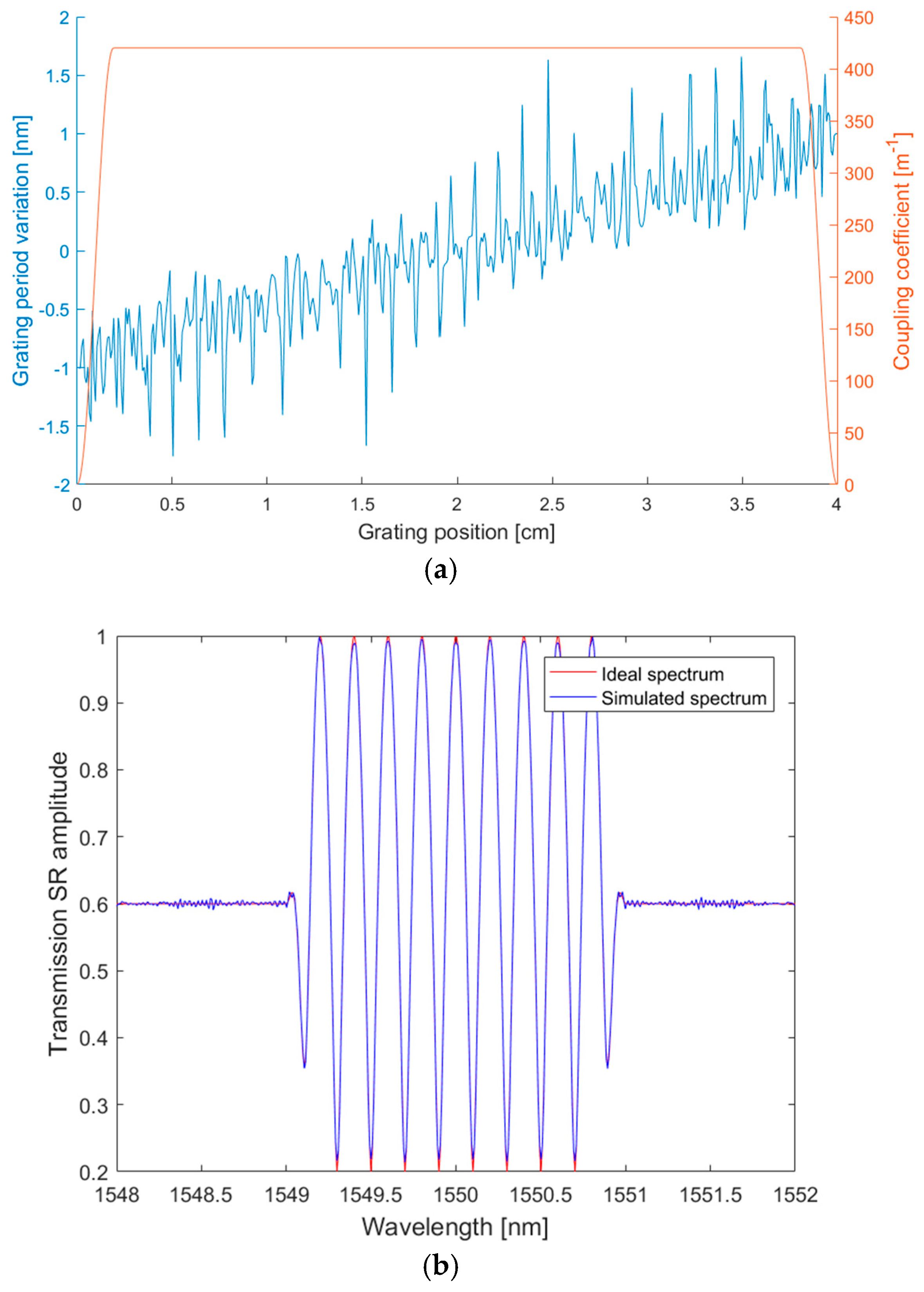
For α = 0.5 , the quasi-Newton algorithm yields the grating profile shown in Figure 2a, where the coupling coefficient remains nearly uniform and the maximum coupling coefficient is 420 m−1. The maximum grating period is 1.4 nm, and the minimum is −1.3 nm. Using this profile, we compute the spectral response via the transfer matrix method. As shown in Figure 2b, the simulated response closely matches the ideal Nyquist spectrum across the 4 nm bandwidth, confirming the successful generation of a photonic Nyquist pulse with a roll-off factor of 0.5.

3.3. Roll-Off Factor  α = 0.1

H 0.1 ( f ) = 1 , 0 f 0.1 2 P 1 2 1 + cos π P 0.1 f 0.1 2 T ,   0.9 2 P f 1.1 2 P 0 , f 1.1 2 P P = 0.5 * ( 1 + 0.1 ) H d 3 ( f ) = 0.6 + 0.4 × H 0.1 ( f ) e x p ( j 2 π f τ )
For α = 0.1 , the quasi-Newton algorithm yields the grating profile shown in Figure 3a, where the coupling coefficient remains nearly uniform and the maximum coupling coefficient is 420 m−1. The maximum grating period is 1.6 nm, and the minimum is −1.8 nm. Using this profile, we compute the spectral response via the transfer matrix method. As shown in Figure 3b, the simulated response closely matches the ideal Nyquist spectrum across the 4 nm bandwidth, confirming the successful generation of a photonic Nyquist pulse with a roll-off factor of 0.1.
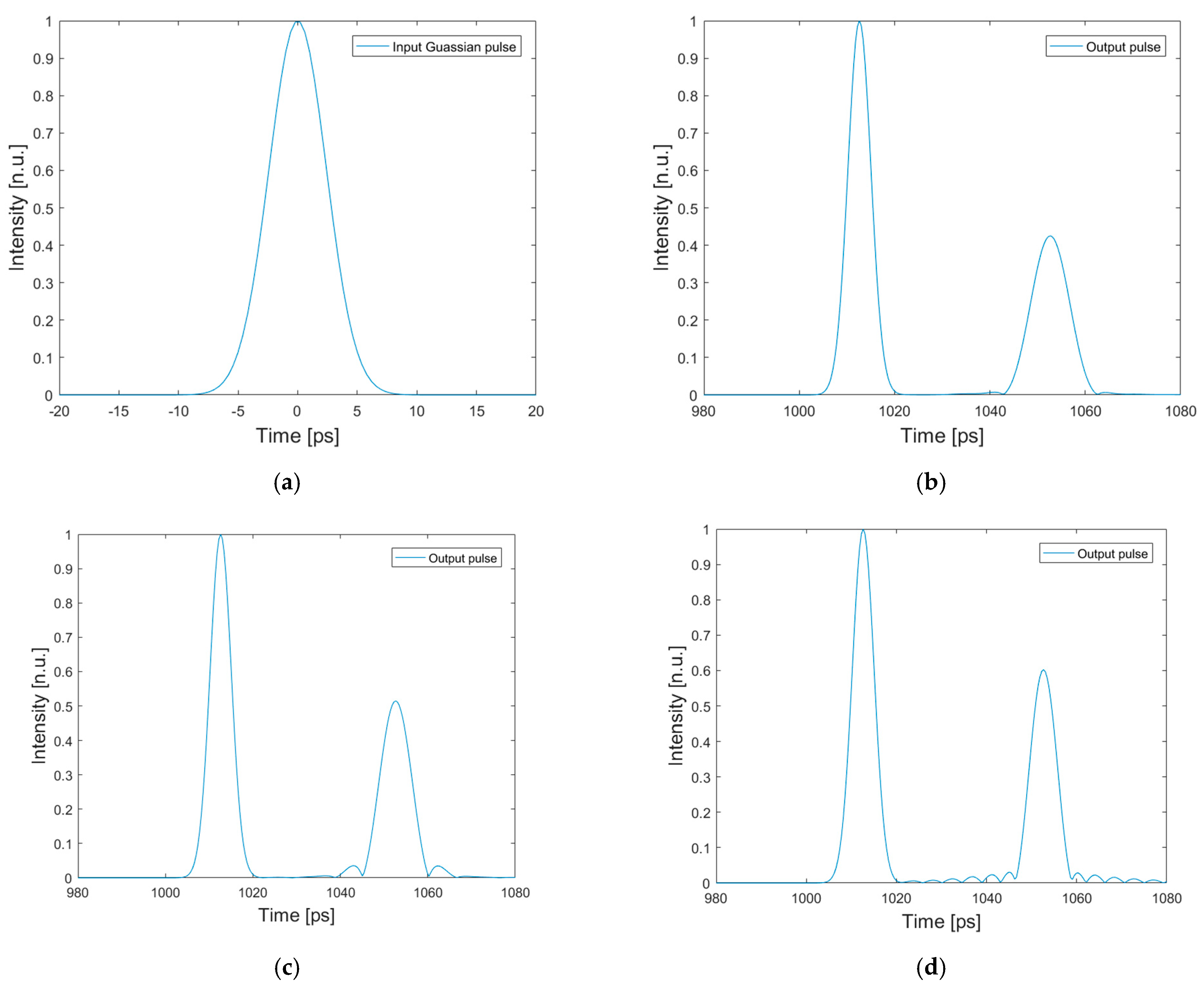
To numerically validate the performance of the PM-FBGs, we launched a 4 ps full-width at half-maximum (FWHM) Gaussian input pulse centered at 1550 nm into the designed gratings. The resulting temporal waveforms are shown in Figure 4. Figure 4a displays the input pulse, while Figure 4b–d present the output waveforms for roll-off factors of 0.9, 0.5, and 0.1, respectively. Each output consists of two distinct segments: an initial replica of the input Gaussian pulse, followed by the generated Nyquist pulse. The generated Nyquist pulse has a relatively low power compared to the replica of the input Gaussian pulse. The obtained Nyquist pulses with different roll-off factors have different sidebands. The desired Nyquist pulse can be isolated using a temporal gating device [16]. The temporal gating device requires an extinction ratio of 40–60 dB and a gating window width of 60 ps.
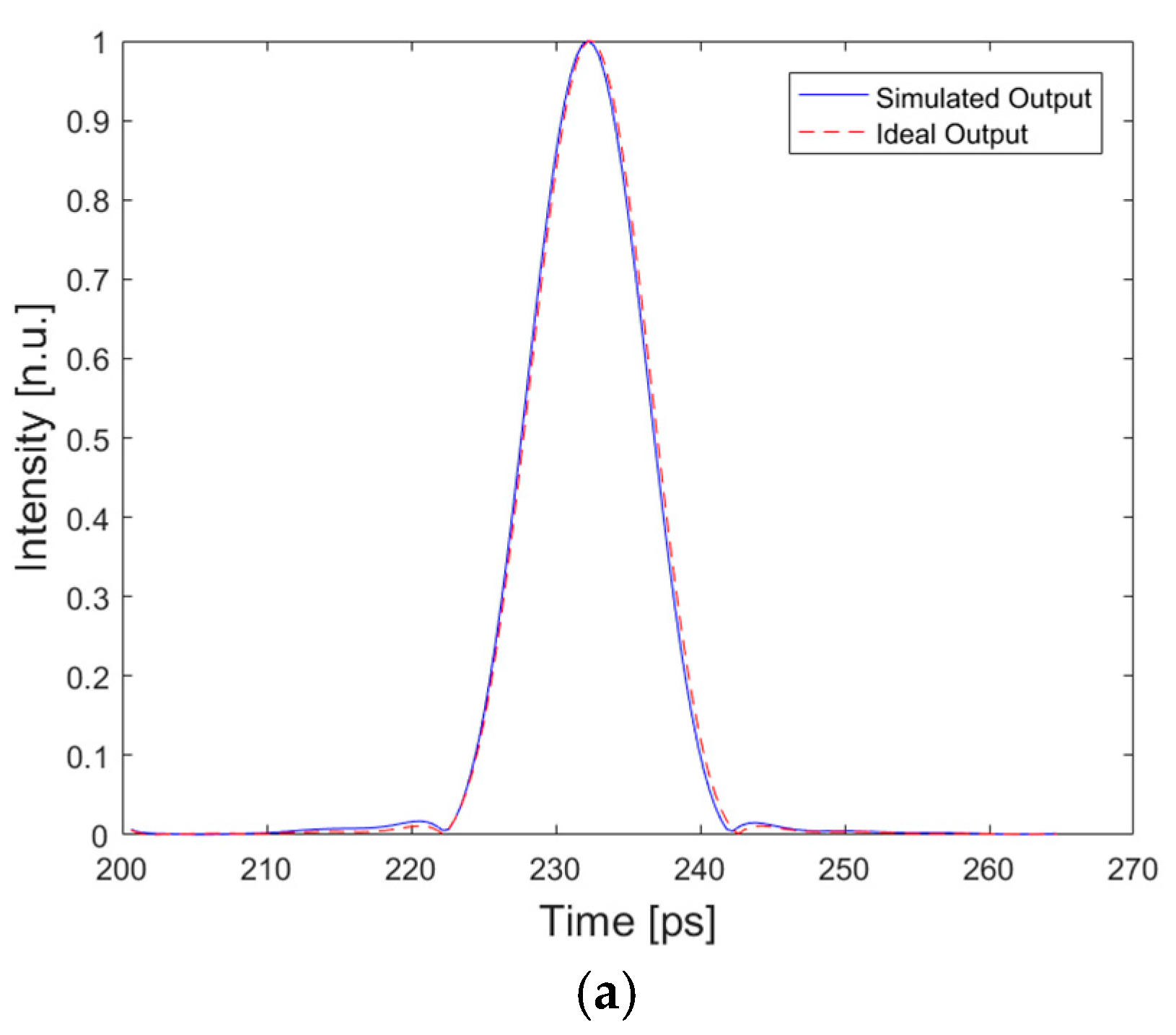
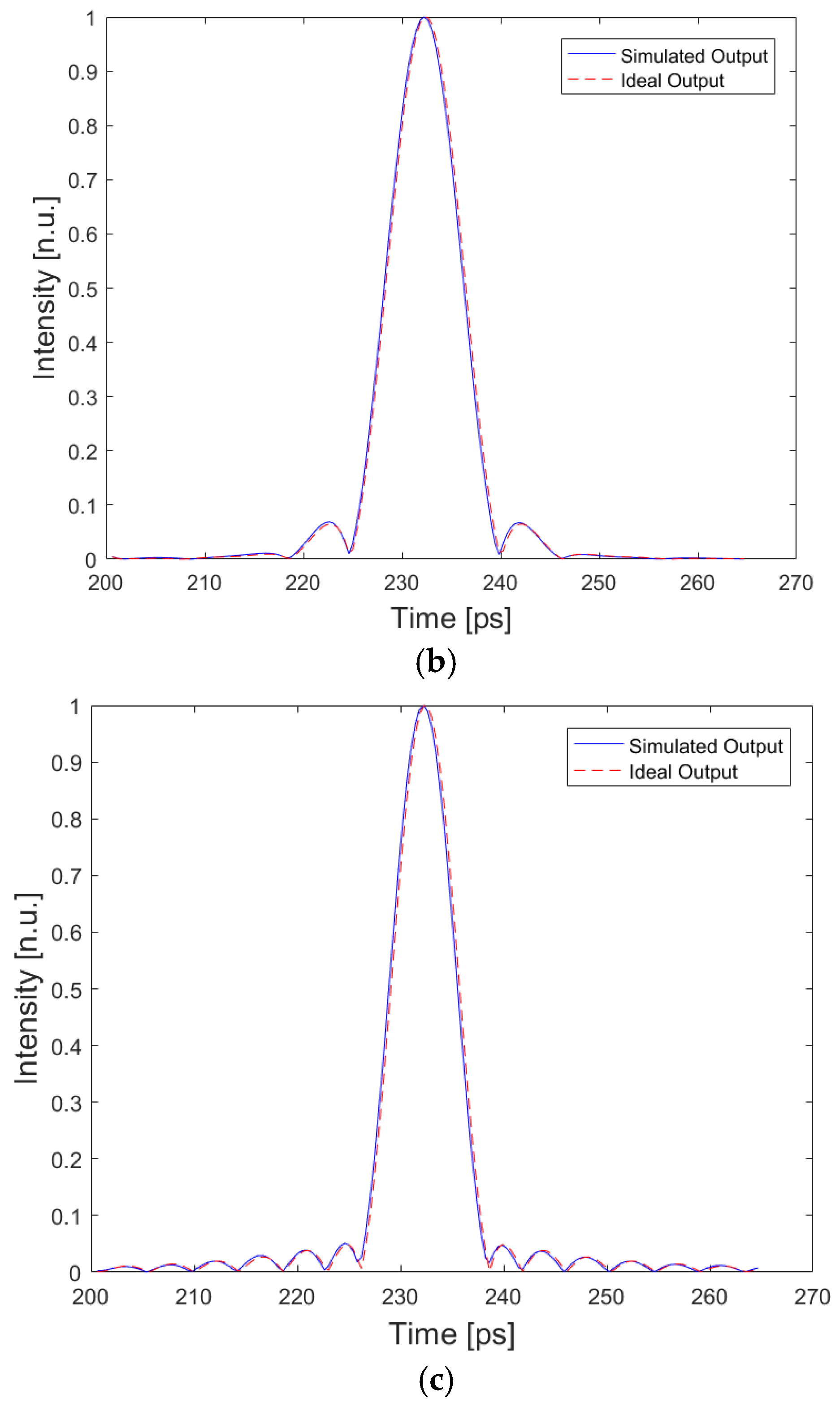
A detailed comparison of the temporal waveforms in Figure 5 reveals close agreement between the simulated outputs of the designed PM-FBGs and the ideal Nyquist pulses across all three roll-off factors (0.9, 0.5, and 0.1). We can roughly see from Figure 5 that the simulated temporal results with roll-off factors of 0.9, 0.5, and 0.1 are all in good agreement with the ideal temporal results.
To evaluate the performance of the three PNP devices more specifically, we use the parameter named cross-correlation (CC) coefficient:
C C = - + f o ( t ) f i ( t ) d t ( - + f o 2 ( t ) d t ) ( - + f i 2 ( t ) d t )
where f o ( t ) represents the amplitude envelope of the obtained and f i ( t ) represents the amplitude envelope of ideal Nyquist pulses. This coefficient quantifies the agreement between the two waveforms, thus serving as a metric for the achievable time-bandwidth product.
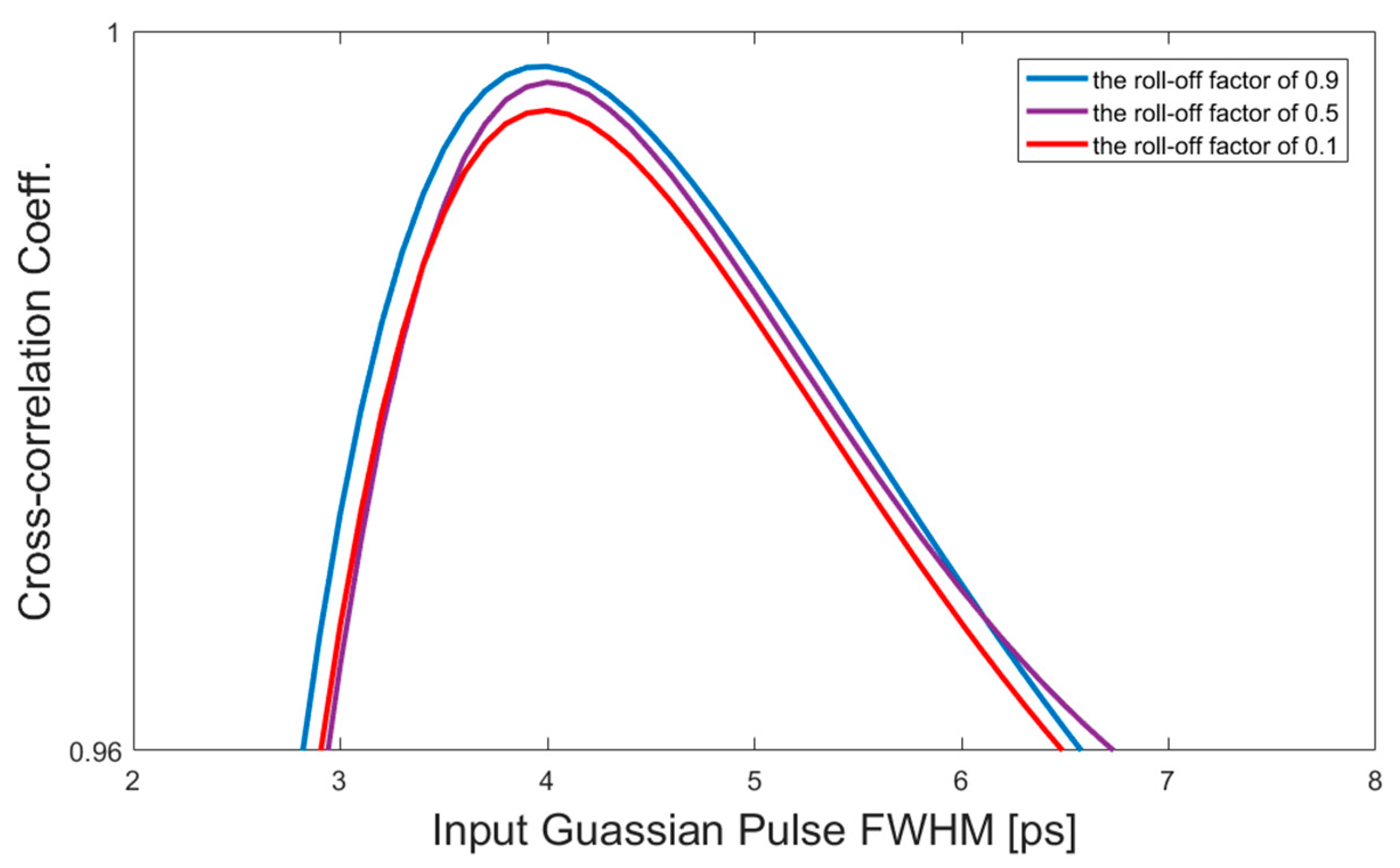
Figure 6 shows the cross-correlation (CC) coefficients for the three PNPs. All devices maintain CC values above 0.96 across a range of input pulse widths: for roll-off factors of 0.1, 0.5, and 0.9, the respective input pulse FWHM tolerances are 2.9–6.5 ps, 3.0–6.7 ps, and 3.0–6.4 ps. The maximum CC values reach 0.986, 0.987, and 0.990, respectively. These results confirm that the PM-FBG-based PNPs reliably generate accurate Nyquist pulses and exhibit robust tolerance to input pulse width variations.
Finally, we turn to the practical manufacturability of the proposed devices. In an ideal scenario, direct inscription of the designed grating periods onto a phase mask, followed by exposure to ultraviolet (UV) laser irradiation, would enable large-scale fabrication. However, for such phase masks with non-linear variations, it is still relatively difficult with the current manufacturing processes. Therefore, at present, we mainly use ultraviolet laser point-by-point fabrication technology to produce PM-FBGs [19]. As demonstrated in Ref. [15], we have successfully fabricated a PM-FBG with a grating period tunable across a ±1.8 nm range and a coupling coefficient of 300 m−1 by leveraging the UV laser facility at Aston University. Notably, the three Nyquist pulse shapers we designed, with roll-off factors of 0.9, 0.5, and 0.1, exhibit grating period ranges of −1.4 to 1.4 nm, −1.3 to 1.4 nm, and −1.8 to 1.6 nm, respectively, alongside a uniform coupling coefficient of 420 m−1. All these configurations are well within the feasible fabrication window of the aforementioned point-by-point writing approach.

4. Conclusions

In summary, we have proposed a new method for generating photonic Nyquist pulses with arbitrary roll-off factors using PM-FBGs in transmission. As examples, we designed three Nyquist pulse devices, including Nyquist pulses with roll-off factors of 0.1, 0.5, and 0.9, respectively. The grating profiles of those devices are optimized using a quasi-Newton algorithm. These PNPs exhibit excellent performance across a 500 GHz bandwidth, and the maximum cross-correlation coefficients are above 0.990. The operating bandwidth can be enhanced by broadening the modulation range of the grating period. The gratings operate in transmission, which avoids the need for optical circulators or couplers, leading to a simpler, more efficient architecture. Moreover, the grating pattern can be encoded into a phase mask, which enables simple fabrication and high reproducibility.

Author Contributions

Conceptualization, X.S.; methodology, X.S. and X.L.; software, X.L.; validation, X.L.; formal analysis, X.L.; investigation, X.L.; data curation, X.L.; writing—original draft preparation, X.L.; writing—review and editing, X.S. and L.Z. All authors have read and agreed to the published version of the manuscript.

Funding

This research was funded by the National Key R&D Program of China (2023YFE0105800) and the National Natural Science Foundation of China (62275093).

Institutional Review Board Statement

Not applicable.

Informed Consent Statement

Not applicable.

Data Availability Statement

Data are contained within the article.

Conflicts of Interest

The authors declare no conflicts of interest.

References

  1. Proakis, J.G.; Salehi, M. Digital Communications; McGraw-Hill: New York, NY, USA, 2001; Volume 4. [Google Scholar]
  2. Venema, L. Photonic technologies. Nature 2003, 424, 809–810. [Google Scholar] [CrossRef]
  3. Boscolo, S.; Finot, C.; Turitsyn, S.K. Optical Nyquist Pulse Generation in Mode-Locked Fibre Laser. In Proceedings of the 2015 European Conference on Lasers and Electro-Optics—European Quantum Electronics Conference, Optical Society of America, Munich, Germany, 21 June 2015. [Google Scholar]
  4. Soto, M.A.; Alem, M.; Amin Shoaie, M.; Vedadi, A.; Brès, C.-S.; Thévenaz, L.; Schneider, T. Optical sinc-shaped Nyquist pulses of exceptional quality. Nat. Commun. 2013, 4, 2898. [Google Scholar] [CrossRef]
  5. Vedadi, A.; Shoaie, M.A.; Brès, C.-S. Near-Nyquist optical pulse generation with fiber optical parametric amplification. Opt. Express 2012, 20, B558–B565. [Google Scholar] [CrossRef]
  6. Cordette, S.; Vedadi, A.; Shoaie, M.A.; Brès, C.S. Bandwidth and repetition rate programmable Nyquist sinc-shaped pulse train source based on intensity modulators and four-wave mixing. Opt. Lett. 2014, 39, 6668–6671. [Google Scholar] [CrossRef]
  7. Hirooka, T.; Ruan, P.; Guan, P.; Nakazawa, M. Highly dispersion-tolerant 160 Gbaud optical Nyquist pulse TDM transmission over 525 km. Opt. Express 2012, 20, 15001–15007. [Google Scholar] [CrossRef]
  8. Ziyadi, M.; Chitgarha, M.R.; Mohajerin-Ariaei, A.; Khaleghi, S.; Almaiman, A.; Cao, Y.; Willner, M.J.; Tur, M.; Paraschis, L.; Langrock, C.; et al. Optical Nyquist channel generation using a comb-based tunable optical tapped-delay-line. Opt. Lett. 2014, 39, 6585–6588. [Google Scholar] [CrossRef] [PubMed]
  9. Xie, Y.; Zhuang, L.; Zhu, C.; Lowery, A.J. Nyquist pulse shaping using arrayed waveguide grating routers. Opt. Express 2016, 24, 22357–22365. [Google Scholar] [CrossRef] [PubMed]
  10. Shu, X.; Sugden, K.; Bennion, I. Virtual Gires-Tournois etalons realized with phase-modulated wideband chirped fiber gratings. Opt. Lett. 2007, 32, 3546–3548. [Google Scholar] [CrossRef] [PubMed]
  11. Preciado, M.A.; Shu, X.; Sugden, K. Proposal and design of phase-modulated fiber gratings in transmission for pulse shaping. Opt. Lett. 2013, 38, 70–72. [Google Scholar] [CrossRef] [PubMed]
  12. Liu, X.; Shu, X. Design of Arbitrary-Order Photonic Temporal Differentiators Based on Phase-Modulated Fiber Bragg Gratings in Transmission. J. Light. Technol. 2017, 35, 2926–2932. [Google Scholar] [CrossRef]
  13. Li, Y.; Liu, X.; Shu, X.; Zhang, L. Arbitrary-Order Photonic Hilbert Transformers Based on Phase-Modulated Fiber Bragg Gratings in Transmission. Photonics 2021, 8, 27. [Google Scholar] [CrossRef]
  14. Preciado, M.A.; El-Taher, A.; Sugden, K.; Shu, X. Spatially distributed delay line interferometer based on transmission Bragg scattering. Opt. Lett. 2019, 44, 4319–4322. [Google Scholar] [CrossRef] [PubMed]
  15. Liu, X.; Xu, Z.; Preciado, M.A.; Gbadebo, A.; Zhang, L.; Xiong, J.; Yu, Y.; Cao, H.; Shu, X. Transmissive fiber Bragg grating-based delay line interferometer for RZ-OOK to NRZ-OOK format conversion. IEEE Access 2019, 7, 140300–140304. [Google Scholar] [CrossRef]
  16. Skaar, J. Synthesis of fiber Bragg gratings for use in transmission. J. Opt. Soc. Am. A 2001, 18, 557–564. [Google Scholar] [CrossRef]
  17. Fernandez-Ruiz, M.R.; Carballar, A.; Azana, J. Arbitrary Time-Limited Optical Pulse Processors Based on Transmission Bragg Gratings. IEEE Photonics Technol. Lett. 2014, 26, 1754–1757. [Google Scholar] [CrossRef]
  18. Ozcan, A.; Digonnet, M.J.; Kino, G.S. Characterization of fiber Bragg gratings using spectral interferometry based on minimum-phase functions. J. Light. Technol. 2006, 24, 1739. [Google Scholar] [CrossRef]
  19. Shu, X.; Sugden, K.; Bennion, I. Apodisation of photo-induced waveguide gratings using double-exposure with complementary duty cycles. Opt. Express 2008, 16, 2221–2225. [Google Scholar] [CrossRef] [PubMed]
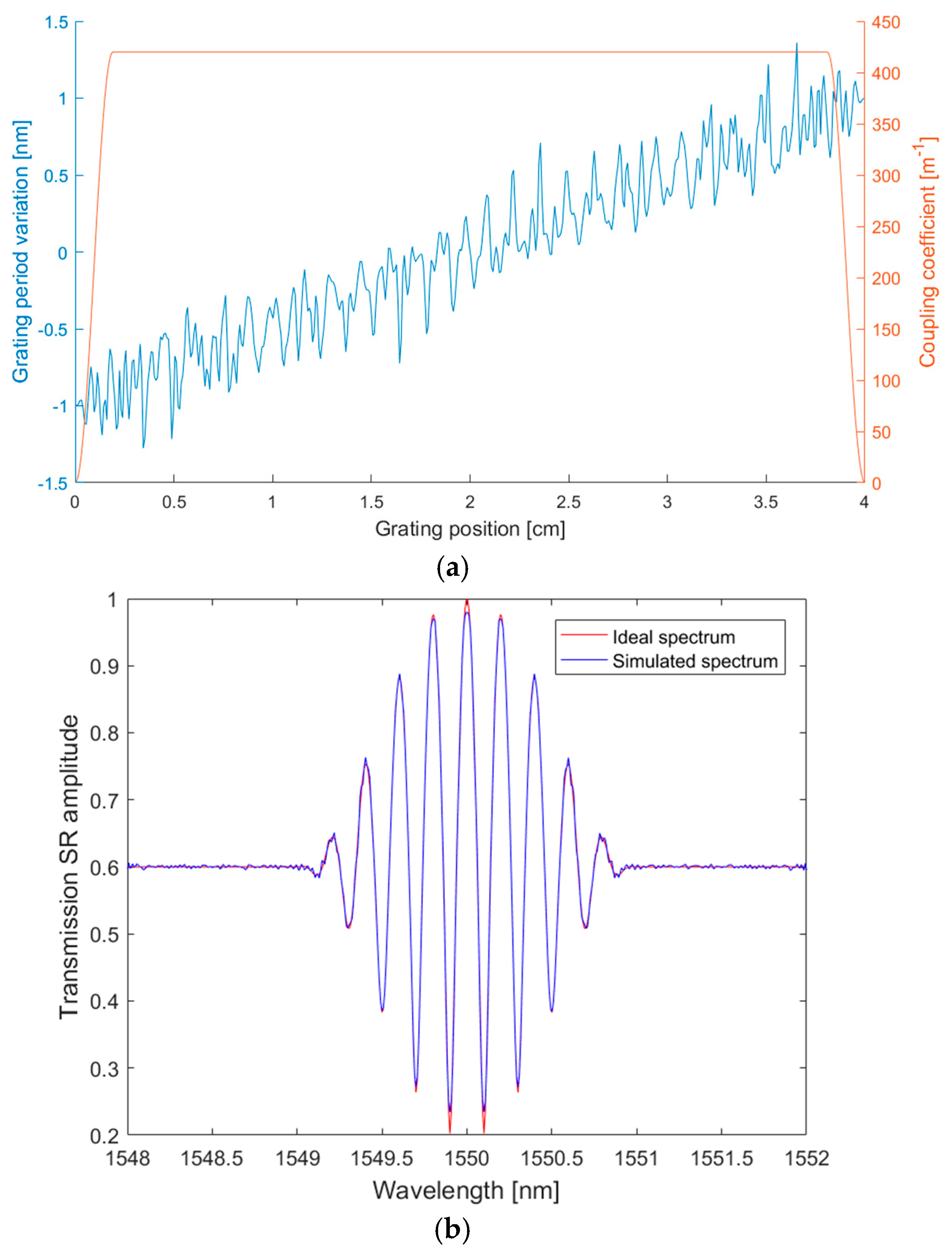
Figure 1. (a) Profile of the grating period (blue) and coupling coefficient (orange) for a roll-off factor of 0.9. (b) Spectral response: target (red) and simulated (blue).
Photonics 13 00030 g001
Figure 2. (a) Profile of the grating period (blue) and coupling coefficient (orange) for a roll-off factor of 0.5. (b) Spectral response: target (red) and simulated (blue).
Photonics 13 00030 g002
Figure 3. (a) Profile of the grating period (blue) and coupling coefficient (orange) for a roll-off factor of 0.1. (b) Spectral response: target (red) and simulated (blue).
Photonics 13 00030 g003
Figure 4. Temporal responses of the designed PM-FBGs: (a) Gaussian 4 ps FWHM input pulse; (b) output pulse when roll-off factor is 0.9; (c) output pulse when roll-off factor is 0.5; (d) output pulse when roll-off factor is 0.1.
Photonics 13 00030 g004
Figure 5. Temporal waveforms of the designed PM-FBGs: Simulated (blue) versus ideal (red dashed) Nyquist pulses for roll-off factors of (a) 0.9, (b) 0.5, and (c) 0.1.
Photonics 13 00030 g005aPhotonics 13 00030 g005b
Figure 6. Cross-correlation coefficient versus input Gaussian pulse width (FWHM) for the three designed PNPs.
Photonics 13 00030 g006
Disclaimer/Publisher’s Note: The statements, opinions and data contained in all publications are solely those of the individual author(s) and contributor(s) and not of MDPI and/or the editor(s). MDPI and/or the editor(s) disclaim responsibility for any injury to people or property resulting from any ideas, methods, instructions or products referred to in the content.