


Abstract
We present a utilization of the magnon Kerr effect to generate nonreciprocal genuine microwave entanglement in a hybrid system consisting of a yttrium iron garnet (YIG) sphere and three microwave cavities. Based on the quantum Langevin theory and linearization method under the condition of strong magnon driving, the system dynamics and covariance evolution are deduced and then applied to determinate the quantum correlations. It is found that three microwave cavities entangle with each other at the steady state. The basic root is that the Kerr nonlinearity can not only induce the enhanced parametric amplification of magnon but also cause the magnon frequency shift. Naturally, when the direction of the externally applied bias magnetic field is changed, switching of the magnon Kerr coefficient from positive to negative occurs and nonreciprocal tripartite entanglement among three microwave photons can be achieved. This may provide a fundamental resource for practical applications in quantum information processing and quantum networks.
1. Introduction
Magnons representing quanta of collective spin excitations in ordered ferrimagnetic materials [1,2,3,4,5], especially yttrium iron garnet (YIG) spheres [6,7,8], are recognized to play a crucial role in quantum information science. Due to their high spin density and excellent tunability, a variety of intriguing quantum phenomena have been demonstrated in hybrid magnon-based systems, including quantum entanglement [9,10], magnon blockades [3,11], quantum steering [12,13], microwave–optical transduction [14,15], and more. In YIG spheres, the Kittel mode [16] can strongly couple with microwave photons, leading to the formation of cavity polaritons [17,18]. Many intriguing phenomena observed in cavity magnonic systems originate from this strong coherent coupling, including exceptional points [19], remote manipulation of spin currents [20], magnon-induced transparency [21], Brillouin light scattering-based magnon lasing [22], bistability [23], and even nonreciprocal quantum states [24]. Furthermore, as collective excitations of a large number of spins, magnons can couple with various spin-dependent systems.
Nonreciprocal physics refers to physical phenomena that exhibit different behaviors in opposite directions within the same system. Currently, nonreciprocity is studied in the context of unidirectional flow of classical information and has also been extended to the investigation of nonreciprocal quantum effects, which holds profound implications for the development of nonreciprocal quantum devices and the study of quantum invisibility. Nonreciprocal quantum entanglement refers to the phenomenon in which the generation, transmission, or manipulation of entangled states exhibits directional dependence, characterized by asymmetric quantum correlations between forward and reverse pathways. This effect originates from time-reversal symmetry breaking (e.g., via external magnetic field control), non-Hermitian coupling, or topological protection mechanisms, and has been experimentally demonstrated in platforms such as superconducting quantum circuits [25,26], quantum optical systems [27,28], and cold atomic ensembles [29]. Nonreciprocal entanglement offers novel approaches for constructing unidirectional quantum networks, enhancing quantum communication security [30,31], and simulating nonequilibrium many-body systems [32,33,34]. The generation of such nonreciprocal entanglement generally relies on nonlinear effects [35], which has motivated extensive research into microwave entanglement in various nonlinear systems, including nonlinear cavity magnonic systems, cavity–magnon–magnon coupled systems [36], and cavity optomechanical architectures [37]. For instance, in a rotating cavity optomechanical system, quantum entanglement can be effectively protected or even enhanced [38]. The underlying mechanism lies in the spin-based cavity optomechanical interaction, which enables strong photon–phonon correlations along a specific direction while yielding weak or no correlation in the opposite direction. This can be achieved by inducing opposite frequency shifts in the cavity using the Sagnac Fizeau effect [39,40]. In addition to the Sagnac effect, the magnon Kerr effect can also be used to achieve nonreciprocal bipartite and tripartite entanglement magnon Kerr effect in cavity optomechanics, which represents the nonlinear interaction between the number of magnons caused by magnetic crystal anisotropy [41,42,43]. This has been experimentally demonstrated within the cavity magnon framework [21,44], resulting in nonlinear cavity magnons [45] and Kerr modified cavity–magnon–magnon systems [41,46,47,48]. This can also generate positive or negative frequency shifts [49] in Kittle mode by adjusting the direction of the magnetic field. The Kerr effect provides an excellent direction for studying long-range spin–spin interactions [50] and quantum phase transitions [51,52].
In this work, we propose a scheme for achieving nonreciprocal tripartite microwave entanglement based on the Kerr nonlinearity in a cavity–magnon system. The YIG sphere is positioned at the intersection of three microwave cavities, where its magnon mode couples linearly with three photons in each cavity. With the help of strong driving, the magnon correlation can be strengthened via the Kerr nonlinearity arising from the magnetocrystalline anisotropy, then be transferred to three microwave photons via magnon–photon beam splitter-type interactions. It is for this reason that genuine entanglement exists among the three microwave photons. Moreover, changing the Kerr coefficient from positive to negative by tuning the direction of the bias magnetic field will result in nonreciprocity of the tripartite entanglement. The scheme we present here is based on the process of correlation transfer via linear magnon–photon coupling and three cavities and also has no quantum correlation in the absence of Kerr nonlinearity, which is different from previous schemes for Kerr-mediated entanglement. The bipartite entanglement between two magnons has been extensively studied in [46], and the nonlinear magnetostrictive interaction and Sagnac shift are also involved to achieve nonreciprocal photon–phonon entanglement [47]. The four-mode system is considered for the scheme in [48], in which the cavity mode is virtually excited and the pairwise interactions among the two-nitrogen–vacancy–center ensemble and the magnon are all established.
In Section 2, we describe the physical model consisting of three single-mode microwave cavities and a YIG sphere. The total Hamiltonian of the system is presented and the quantum Langevin equations are used to achieve the system dynamics. In Section 3, we numerically investigate the characteristics of photon–photon bipartite entanglement and tripartite entanglement. Finally, Section 4 provides a conclusion of the entire work.
2. System Model and Dynamic Equations
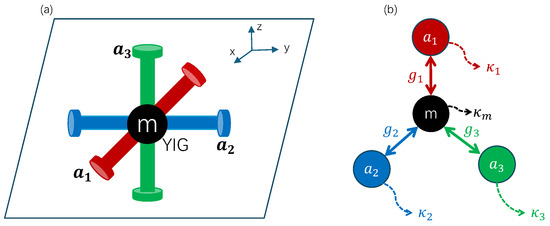
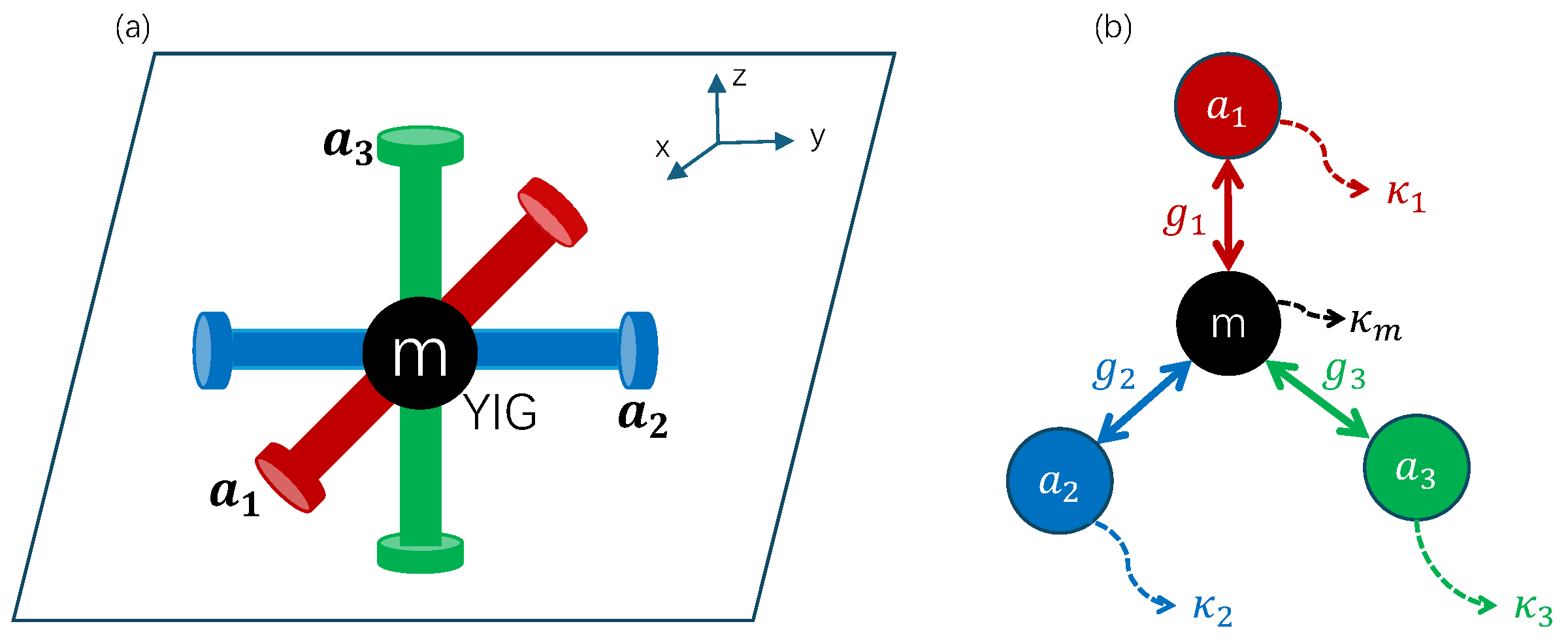
The physical model we consider includes three single-mode microwave cavities and a YIG sphere, shown in Figure 1. The YIG sphere is located at the center between three intersecting cavity fields (near the maximum magnetic field), where the magnon representing the collective excitation of a large number of spins interacts with the photons from the cavities. The total Hamiltonian of the system can be provided by ().
where and denote the annihilation (creation) operators for the j-th cavity and magnon, respectively, which satisfy (). The resonance frequencies of the cavity modes and magnon are denoted by , , respectively. The frequency of the magnon can be tuned by adjusting the strength of the bias magnetic field, where GHz/T is the gyromagnetic ratio [9]. Finally, is the coupling strength between the magnon and the j-th cavity.
Figure 1.
(a) The YIG sphere is positioned at the intersection of three microwave cavities, where its magnon mode is linearly coupled to the photon field in each cavity. Under a strong drive, the magnon correlation can be significantly enhanced by the Kerr nonlinearity originating from the magnetocrystalline anisotropy, and is subsequently transferred to three microwave photons. (b) Magnon m is linearly coupled with cavity photons , , and , with respective coupling strengths of , , and , while , , , and are the respective dissipation rates of the three cavities and magnon modes.
Here, describes the Kerr nonlinearity of the magnon in the Kittel mode of the YIG sphere, which is caused by magnetic crystal anisotropy. It is defined as positive when aligned with crystallographic axis [100] and negative when aligned with crystallographic axis [110]. The Kerr coefficient is inversely proportional to the volume of the YIG sphere, and can be adjusted to positive or negative by changing the direction of the static magnetic field [49]. The Rabi frequency represents the coupling strength between the the magnon and the microwave driving field, with a frequency of and input power [24]. In the rotating frame with axis , the Hamiltonian is rewritten as
with and . When the dissipation is included, the dynamics of the system can be governed by the quantum Langevin equation, and can be derived as follows:
where and are the dissipation rates of the magnon and cavity photon, respectively. Here, describes the input noise operators of the target mode o; its average value is zero and is fully characterized by the following correlation functions: and , with being the average number of thermal photons and magnons. Here, represents the Boltzmann constant and T is the ambient temperature of the entire system.
When a strong pumping field is used to continuously drive the magnon mode, the larger steady-state coherent amplitudes (≫1) can be obtained. Due to the coupling of the magnon to the cavity modes through the beam splitter-type interaction, the three cavity fields also exhibit large amplitudes. the system reaches its steady state for long time evolutions, which means that all of the time derivatives in Equation (3) disappear. Therefore, the operator can be rewritten as . When we insert these expressions into Equation (3) and ignore the second-order fluctuation term, the steady-state solution of the dynamic variable is as follows:
with being the effective detuning of the magnon mode caused by the frequency shift due to the effective Kerr nonlinearity . The linear Langevin dynamical equations can then be simplified to
We now further introduce the quadrature fluctuation operators, defined as and , and corresponding noise operators, defined as and . Then, the linearized quantum Langevin equations are in compact form, as follows:
where , = and the coefficient matrix A is expressed as
where . Here, we focus on the situation where the system starts from a Gaussian state. If the real parts of all eigenvalues of A are negative, then the system is stable. When , the steady-state condition can be determined by the Routh–Hurwitz criterion [53], i.e., . In this case, the system dynamics governed by the linearized Equation (5) always evolve in Gaussian fashion and the state of the system is completely determined by the correlation matrix, with matrix elements . In the steady state, the correlation matrix of the system satisfies the following Lyapunov equation [54]:
where is the noise matrix.
We employ logarithmic negativity to analyze the bipartite entanglement between different modes j and k in the coupled quantum system, which is defined as follows [55,56,57]:
where and is the covariance matrix of two modes. Here, A, B, and C are the blocks of , , and the minimum residual contact angle can be used to quantify the genuine tripartite entanglement among magnon and phonon. This is provided by the following expression [58]:
where is the residual contact, which is the continuous variable analogue of tripartite entanglement in discrete-variable systems, defined as the square of the logarithmic negativity between subsystems u and v (where v contains one or two subsystems). When v contains one mode, (the symplectic matrix and the y-Pauli matrices ), , . When v contains two modes, to calculation the logarithmic negativity one only needs to follow the definition by replacing with and with , where , , and are partial transposition matrices. The residual entanglement obeys the monogamy inequality; thus, a genuine tripartite entanglement exists in the system when .
3. Results and Discussion
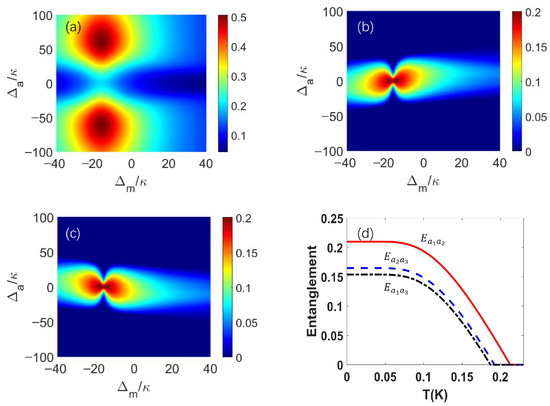
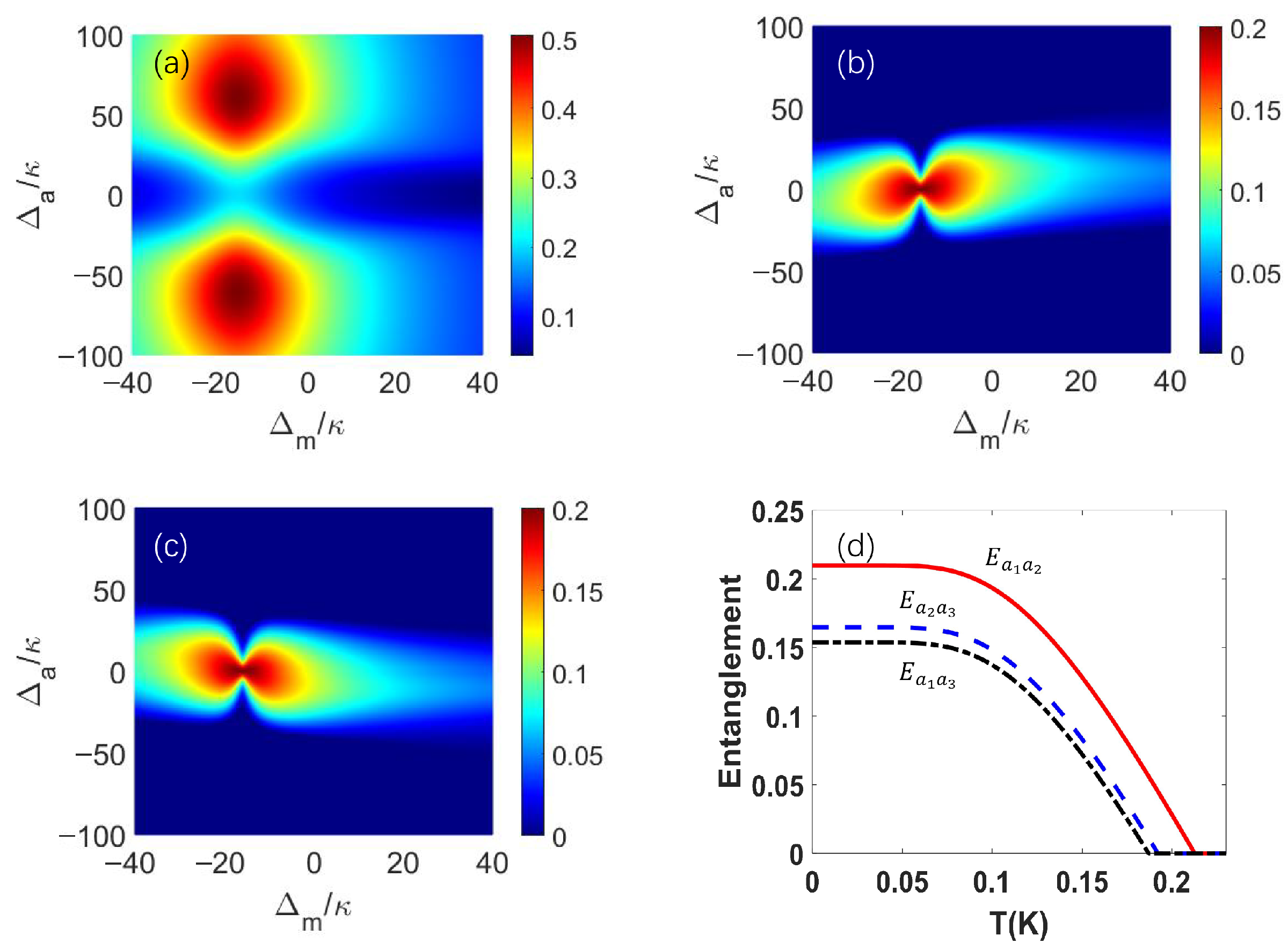
In this section, we study the bipartite and tripartite entanglements of three microwave cavities; meanwhile, the nonreciprocal quantum correlations of three photons are discussed based on the magnon Kerr nonlinearity. Notably, we are able to confirm that the parameters chosen in this paper can keep the system in stable regions. The parameters are chosen as GHz, MHz, and MHz, as shown in [9], where magnon–photon–phonon entanglement was discussed based on the nonlinear magnetostrictive interaction. Here, we focus on manipulation of the quantum correlation of three microwave cavities, including the correlation degree and nonreciprocity based on the Kerr effect of the magnon. Figure 2a–c displays the bipartite entanglement for all photons as functions of detuning and temperature T in the model, where the other parameters are MHz, , , MHz, and mK. In Figure 2a, it can be observed that the bipartite entanglement between cavity photons and reaches its maximum near . Similarly, the bipartite entanglements between the – and – modes also reach their maximum around , as shown in Figure 2b,c. It is found that the cavity detuning provides the major influence on bipartite entanglement. In order to achieve the optimal bipartite entanglement, the detunings are chosen as and . Figure 2d illustrates the effect of the environmental temperature on all bipartite entanglements under these optimized parameters. The entanglement between photons and persists up to 210 mK, while the entanglement between photons and and between photons and can be maintained up to 180 mK and 190 mK, respectively.
Figure 2.
The logarithmic negativities (a) , (b) , and (c) versus the detunings and ; (d) the bipartite entanglement , , as a function of temperature T with and .
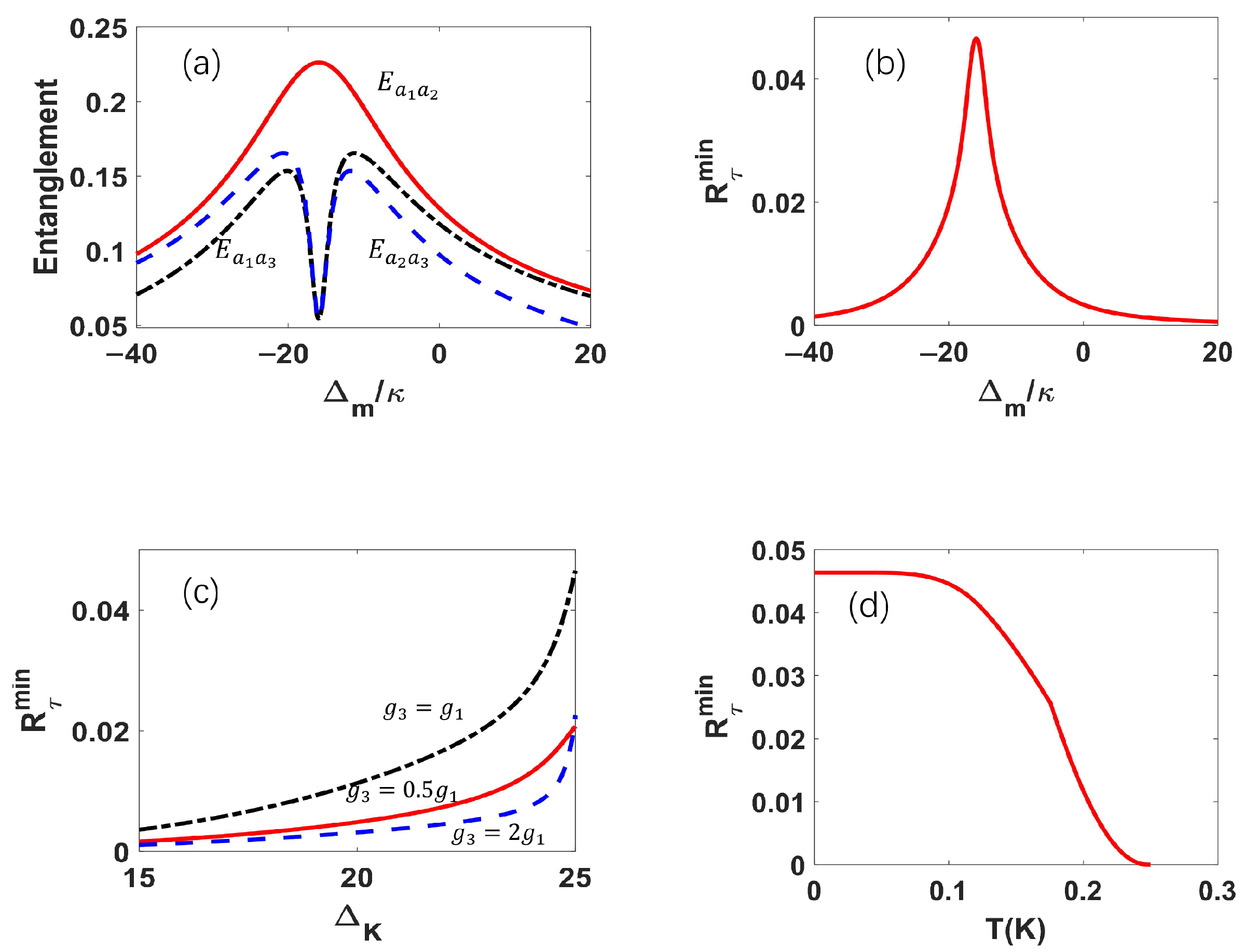
Next, we investigate the three-microwave tripartite entanglement by utilizing the magnon Kerr effect. To clearly demonstrate genuine tripartite entanglement, three types of bipartite entanglement are displayed in Figure 3a, where they interact competitively with amplitudes controllable via detuning . Crucially, the entanglement of photons and , represented by the solid red line, exhibits a distinct trend compared to that of photons and (black dotted line) and photons and (blue dotted line). Near , the best entanglement occurs between modes and ; however, the case of the other two types of entanglement is different. This indicates that cavity detuning has a major effect on entanglement generation. Figure 3b shows the tripartite entanglement of the three photons quantified by the minimum residual contangle. It can be observed that the three-photon entanglement is highly sensitive to the detuning . The maximum tripartite entanglement reaches the maximum value with at . Combining Figure 3a and Figure 3b, genuine microwave entanglement occurs among three cavities in the present system. Figure 3c illustrates the relationship between tripartite entanglement and the detuning under different coupling strengths. It can be seen that a higher degree of tripartite entanglement is achieved when the coupling ratio is as compared to the configurations with and . Thus, the condition represents the optimal for preparing tripartite entanglement. Figure 3d also illustrates the effect of temperature on the entanglement. Due to thermal fluctuations induced by the ambient temperature, the tripartite entanglement degrades. The three-photon tripartite entanglement persists down to the temperature of approximately 240 mK.
Figure 3.
(a) The logarithmic negativities , , and ; (b) the minimum residual contangle versus the detuning with and mK; (c) the minimum residual contangle related with at different values with MHz; and (d) as a function of temperature T with . The other parameters are the same as in Figure 2d.
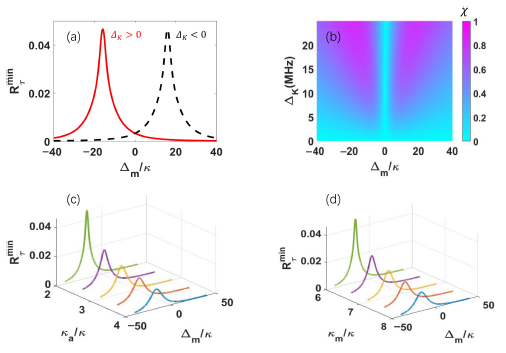
Next, we discuss nonreciprocal characteristics of the tripartite entanglement for three photons under control of the Kerr effect. As shown in Figure 4a, the tripartite entanglement (solid red line) appears at , where the Kerr detuning . For the opposite value of Kerr detuning , the tripartite entanglement in this region (black dotted line) deteriorates significantly and even vanishes. This means that the nonreciprocal nature of the three-photon tripartite entanglement is obtained. It should be noted that at , the maximum value of the minimum residual contangle appears and the system reaches the strongest entangled state, whereas the tripartite entanglement is almost zero in this detuning region with respect to the opposite Kerr effect. Figure 4b shows the density plot of the chiral factor for quantifying nonreciprocal tripartite entanglement as functions of magnon detuning and Kerr detuning , where the chiral factor is defined as . In the absence of Kerr nonlinearity , the chiral factor vanishes , indicating the absence of nonreciprocity in tripartite entanglement. When Kerr nonlinearity is present, the nonreciprocity of tripartite entanglement can be flexibly controlled by tuning the Kerr parameter . It is obvious that near-perfect nonreciprocal tripartite entanglement exists in the system with a choice of strong Kerr nonlinearity. Figure 4c,d illustrates the relationship between the tripartite entanglement strength and the magnon detuning under different dissipation rates of photons and magnons , with green-, purple-, yellow-, red-, blue-, respectively. The same is true for Figure d. Evidently, the variation trend of tripartite entanglement remains nearly consistent across different dissipation rate conditions. However, as the dissipation rates decreases, the peak value of the minimum residual contangle gradually increases and the tripartite entanglement will be enhanced.
Figure 4.
(a) The minimum residual contangle related with in the presence of ; (b) the chiral factor depending on the parameters and ; and (c,d) the minimum residual contangle related with at different and values.
Before concluding, we will elaborate the mechanism for generating genuine tripartite entanglement in this system. In order to do so, we investigate the linearized Hamiltonian of the system based on the fluctuation operators, which can be derived from Equation (2).
It can be clearly seen that the enhanced parameter amplification occurs for the magnon mode due to the strong magnon driving, which is shown by the term . Furthermore, we introduce Bogoliubov modes [59,60] with , , and . The effective Hamiltonian in Equation (11) becomes
where . It is seen from Equation (12) that the beam splitter-like and parametric-type interactions are simultaneously existent between Bogoliubov mode and cavity modes . As is well-known, the parametric-type interaction is one of the key methods for generating entanglement. It is obvious that parametric-type interaction will be prominent via appropriately choosing detunings such as , which is crucial for generating magnon–cavity entanglement. However, here we are considering the manipulation of cavity–cavity entanglement, meaning that entanglement transfer via beam splitter-like interaction should be performed. In order to obtain cavity–cavity entanglement, we have chosen the detuning parameters satisfying . The above formula can then be rewritten as
Here, the operators are provided by and . Obviously, for cavities and , two-mode squeezed transformation modes and appear. There is also a single-mode squeezed transformation mode for cavity . In particular, for , the resonant interaction occurs between and , while intervenes in the coupling for the case of . Thus, the best entanglement occurs between modes and for two such detunings. Taking into account the correlation among the three photons, we have chosen the above detuning parameters in the main text.
4. Conclusions
In conclusion, nonreciprocal three-microwave genuine entanglement is studied by manipulating the Kerr effect of the magnon. The scheme is implemented in a four-mode system composed of three photon modes and a magnon mode, where beam splitter-type couplings occur between the single magnon and three photon modes. When a strong driving field is applied to activate the magnon, it is found that the Kerr nonlinearity plays a crucial role in generating genuine microwave entanglement and inducing nonreciprocity. Fortunately, enhanced parametric interaction appears for the magnon modes, which leads to entanglement of the magnon with microwave photons and subsequently transfers the entanglement into the photon modes. With an appropriate choice of parameters, steady-state tripartite entanglement is established among the three microwave modes. In addition, by effectively controlling the Kerr effect by adjusting the externally applied magnetic field, direction-dependent nonreciprocal tripartite entanglement among photons can be achieved along specific directions. Our work opens up a new pathway for the design of nonreciprocal quantum devices operable in microwave domains, contributing significantly to the development of hybrid quantum systems and advanced quantum technologies.
Author Contributions
Conceptualization, G.C.; Methodology, J.Z.; Validation, Z.L.; Formal analysis, G.C., J.Z. and A.C.; Resources, A.C.; Data curation, Z.L. and J.Z.; Writing—original draft, Z.L.; Writing—review & editing, Z.L. and G.C.; Supervision, G.C. and A.C. All authors have read and agreed to the published version of the manuscript.
Funding
This work was supported by the National Natural Science Foundation of China (Grants Nos. 12465002, 12465003, and 12575031), the Natural Science Foundation of Jiangxi Province (Grant No. 20232ACB201013), and the Foundation of the Department of Science and Technology of Zhejiang Province (Grant No. 2022R52047).
Data Availability Statement
The original contributions presented in this study are included in the article. Further inquiries can be directed to the corresponding authors.
Conflicts of Interest
The authors declare no conflicts of interest.
References
- Rameshti, B.Z.; Kusminskiy, S.V.; Haigh, J.A.; Usami, K.; Lachance-Quirion, D.; Nakamura, Y.; Hu, C.M.; Tang, H.X.; Bauer, G.E.W.; Blanter, Y.M. Cavity magnonics. Phy. Rep. 2022, 979, 1–61. [Google Scholar] [CrossRef] [Scilit]
- Lachance-Quirion, D.; Tabuchi, Y.; Gloppe, A.; Usami, K.; Nakamura, Y. Hybrid quantum systems based on magnonics. Appl. Phys. Exp. 2019, 12, 070101. [Google Scholar] [CrossRef] [Scilit]
- Yuan, H.Y.; Cao, Y.S.; Kamra, A.; Duine, R.A.; Yan, P. Quantum magnonics: When magnon spintronics meets quantum information science. Phy. Rep. 2022, 965, 1–74. [Google Scholar] [CrossRef] [Scilit]
- Prabhakar, A.; Stancil, D.D. Spin Waves: Theory and Applications; Springer: Berlin, Germany, 2009. [Google Scholar] [CrossRef] [Scilit]
- Van Kranendonk, J.; Van Vleck, J.H. Spin waves. Rev. Mod. Phys. 1958, 30, 1. [Google Scholar] [CrossRef] [Scilit]
- Schmidt, G.; Hauser, C.; Trempler, P.; Paleschke, M.; Papaioannou, E.T. Ultra thin films of yttrium iron garnet with very low damping: A review. Phys. Status Solidi B 2020, 257, 1900644. [Google Scholar] [CrossRef] [Scilit]
- Geller, S.; Gilleo, M.A. The crystal structure and ferrimagnetism of yttrium-iron garnet, Y3Fe2(FeO4)3. J. Phys. Chem. Solids 1957, 3, 30–36. [Google Scholar] [CrossRef] [Scilit]
- Mallmann, E.J.J.; Sombra, A.S.B.; Goes, J.C.; Fechine, P.B.A. Yttrium iron carnet: Properties and applications review. Solid State Phenom. 2013, 202, 65–96. [Google Scholar] [CrossRef] [Scilit]
- Li, J.; Zhu, S.Y.; Agarwal, G.S. Magnon-photon-phonon entanglement in cavity magnomechanics. Phys. Rev. Lett. 2018, 121, 203601. [Google Scholar] [CrossRef] [Scilit]
- Yu, M.; Shen, H.; Li, J. Magnetostrictively induced stationary entanglement between two microwave fields. Phys. Rev. Lett. 2020, 124, 213604. [Google Scholar] [CrossRef] [Scilit]
- Liu, Z.X.; Xiong, H.; Wu, Y. Magnon blockade in a hybrid Ferromagnet-superconductor quantum system. Phys. Rev. B 2019, 100, 134421. [Google Scholar] [CrossRef] [Scilit]
- Tian, T.; Zhang, Y.C.; Zhang, L.; Wu, L.H.; Lin, S.C.; Zhou, J.W.; Duan, C.K.; Jiang, J.H.; Du, J.F. Experimental realization of nonreciprocal adiabatic transfer of phonons in a dynamically modulated nanomechanical topological insulator. Phys. Rev. Lett. 2022, 129, 215901. [Google Scholar] [CrossRef] [Scilit]
- Zhong, C.C.; Han, X.; Jiang, L. Quantum transduction with microwave and optical entanglement. Phys. Rev. Appl. 2022, 18, 054061. [Google Scholar] [CrossRef] [Scilit]
- Tian, L.; Li, Z. Nonreciprocal quantum-state conversion between microwave and optical photons. Phys. Rev. A 2017, 96, 013808. [Google Scholar] [CrossRef] [Scilit]
- Eshaqi-Sani, N.; Zippilli, S.; Vitali, D. Nonreciprocal conversion between radio-frequency and optical photons with an optoelectromechanical system. Phys. Rev. A 2022, 106, 032606. [Google Scholar] [CrossRef] [Scilit]
- Kittel, C. On the theory of ferromagnetic resonance absorption. Phys. Rev. 1948, 73, 155–161. [Google Scholar] [CrossRef] [Scilit]
- Huebl, H.; Zollitsch, W.C.; Lotze, J.; Hocke, F.; Greifenstein, M.; Marx, A.; Gross, R.; GoennenweinHans, S.T.B. High cooperativity in coupled microwave resonator ferrimagnetic Insulator hybrids. Phys. Rev. Lett. 2013, 111, 127003. [Google Scholar] [CrossRef] [Scilit]
- Tabuchi, Y.; Ishino, S.; Ishikawa, T.; Yamazaki, R.; Usami, K.; Nakamura, Y. Hybridizing ferromagnetic magnons and microwave photons in the quantum limit. Phys. Rev. Lett. 2014, 113, 083603. [Google Scholar] [CrossRef] [Scilit]
- Zhang, D.K.; Luo, X.Q.; Wang, Y.P.; Li, T.F.; You, J.Q. Observation of the exceptional point in cavity magnon-polaritons. Nat. Commun. 2017, 8, 1368. [Google Scholar] [CrossRef] [Scilit]
- Bai, L.H.; Harder, M.; Hyde, P.; Zhang, Z.H.; Hu, C.M. Cavity mediated manipulation of distant spin currents using a cavity-magnon-polariton. Phys. Rev. Lett. 2017, 118, 217201. [Google Scholar] [CrossRef] [Scilit]
- Wang, B.; Liu, Z.X.; Kong, C.; Xiong, H.; Wu, Y. Magnon induced transparency and amplification in PT-symmetric cavity magnon system. Opt. Express 2018, 26, 20248. [Google Scholar] [CrossRef] [Scilit]
- Liu, Z.X.; Xiong, H. Magnon laser based on Brillouin light scattering. arXiv 2008, arXiv:2008.06628. [Google Scholar] [CrossRef] [Scilit]
- Wang, Y.P.; Zhang, G.Q.; Zhang, D.K.; Li, T.F.; Hu, C.M.; You, J.Q. Bistability of cavity magnon polaritons. Phys. Rev. Lett. 2018, 120, 057202. [Google Scholar] [CrossRef] [Scilit] [PubMed]
- Yang, Z.B.; Liu, J.S.; Zhu, A.D.; Liu, H.Y.; Yang, R.C. Nonreciprocal transmission and nonreciprocal entanglement in a spinning microwave magnomechanical system. Ann. Phys. 2020, 532, 2000196. [Google Scholar] [CrossRef] [Scilit]
- Chen, M.; Owens, J.C.; Putterman, H.; Schaäfer, M.; Painter, O. Phonon engineering of atomic-scale defects in superconducting quantum circuits. Sci. Adv. 2024, 10, eado6240. [Google Scholar] [CrossRef] [Scilit] [PubMed]
- Oh, J.S.; Kopas, C.J.; Marshall, J.; Fang, X.T.; Joshi, K.R.; Datta, A.; Ghimire, S.; Park, J.M.; Kim, R.; Setiawan, D.; et al. Exploring the relationship between deposition method, microstructure, and performance of Nb/Si-based superconducting coplanar waveguide resonators. Acta Mater. 2024, 276, 120153. [Google Scholar] [CrossRef] [Scilit]
- Brandes, T. Coherent and collective quantum optical effects in mesoscopic systems. Phy. Rep. 2005, 408, 315–474. [Google Scholar] [CrossRef] [Scilit]
- Knöll, L.; Vogel, W.; Welsch, D.G. Action of passive, lossless optical systems in quantum optics. Phy. Rev. A. 1987, 36, 3803. [Google Scholar] [CrossRef] [Scilit]
- Kurosu, T.; Zinner, G.; Trebst, T.; Riehle, F. Method for quantum-limited detection of narrow-linewidth transitions in cold atomic ensembles. Phy. Rev. A 1998, 58, R4275. [Google Scholar] [CrossRef] [Scilit]
- Conlon, L.O.; Shajilal, B.; Walsh, A.; Zhao, J.; Janousek, J.; Lam, P.K.; Assad, S.M. Verifying the security of a continuous variable quantum communication protocol via quantum metrology. npj Q. Inf. 2024, 10, 35. [Google Scholar] [CrossRef] [Scilit]
- Pan, D.; Lin, Z.S.; Wu, J.W.; Sun, Z.; Ruan, D.; Yin, L.G.; Long, G.L. Experimental free-space quantum secure direct communication and its security analysis. Photon. Res. 2020, 8, 1522. [Google Scholar] [CrossRef] [Scilit]
- Karkheck, J. Dynamics: Models and Kinetic Methods for Non-Equilibrium Many Body Systems; Springer Science & Business Media: Berlin/Heidelberg, Germany, 2002; Volume 371. [Google Scholar] [CrossRef] [Scilit]
- Gezzi, R.; Pruschke, T.; Meden, V. Functional renormalization group for nonequilibrium quantum many-body problems. Phys. Rev. B 2007, 75, 045324. [Google Scholar] [CrossRef] [Scilit]
- Knap, M.; von der Linden, W.; Arrigoni, E. Nonequilibrium steady state for strongly correlated many-body systems: Variational cluster approach. Phys. Rev. B 2011, 84, 115145. [Google Scholar] [CrossRef] [Scilit]
- Adesso, G.; Illuminati, F. Entanglement in continuous-variable systems: Recent advances and current perspectives. J. Phy. A 2007, 40, 28. [Google Scholar] [CrossRef] [Scilit]
- Zuo, X.; Fan, Z.Y.; Qian, H.; Ding, M.S.; Tan, H.T.; Xiong, H.; Li, J. Cavity magnomechanics: From classical to quantum. New J. Phys. 2024, 26, 031201. [Google Scholar] [CrossRef] [Scilit]
- Aspelmeyer, M.; Kippenberg, T.J.; Marquardt, F. Cavity optomechanics. Rev. Mod. Phys. 2014, 86, 1391. [Google Scholar] [CrossRef] [Scilit]
- Jiao, Y.F.; Zhang, S.D.; Zhang, Y.L.; Miranowicz, A.; Kuang, L.M.; Jing, H. Nonreciprocal optomechanical entanglement against backscattering losses. Phys. Rev. Lett. 2020, 125, 143605. [Google Scholar] [CrossRef] [Scilit]
- Malykin, G.B. The Sagnac effect: Correct and incorrect explanations. Phys. Uspekhi 2000, 43, 1229. [Google Scholar] [CrossRef] [Scilit]
- Maayani, S.; Dahan, R.; Kligerman, Y.; Moses, E.; Hassan, A.U.; Jing, H.; Nori, F.; Christodoulides, D.N.; Carmon, T. Flying couplers above spinning resonators generate irreversible refraction. Nature 2018, 558, 569. [Google Scholar] [CrossRef] [Scilit]
- Shen, R.C.; Li, J.; Fan, Z.Y.; Wang, Y.P.; You, J.Q. Mechanical bistability in Kerr-modified cavity magnomechanics. Phys. Rev. Lett. 2022, 129, 123601. [Google Scholar] [CrossRef] [Scilit]
- Shen, R.C.; Wang, Y.P.; Li, J.; Zhu, S.Y.; Agarwal, G.S.; You, J.Q. Long-time memory and ternary logic gate using a multistable cavity magnonic system. Phys. Rev. Lett. 2021, 127, 183202. [Google Scholar] [CrossRef] [Scilit]
- Zhang, Z.D.; Scully, M.O.; Agarwal, G.S. Quantum entanglement between two magnon modes via Kerr nonlinearity. Phys. Rev. Res. 2019, 1, 023021. [Google Scholar] [CrossRef] [Scilit]
- Wang, Y.P.; Zhang, G.Q.; Zhang, D.K.; Luo, X.Q.; Xiong, W.; Wang, S.P.; Li, T.F.; Hu, C.M.; You, J.Q. Magnon Kerr effect in a strongly coupled cavity-magnon system. Phys. Rev. B 2016, 94, 224410. [Google Scholar] [CrossRef] [Scilit]
- Zheng, S.S.; Wang, Z.Y.; Wang, Y.P.; Sun, F.X.; He, Q.Y.; Yan, P.; Yuan, H.Y. Tutorial: Nonlinear magnonics. J. Appl. Phys. 2023, 134, 151101. [Google Scholar] [CrossRef] [Scilit]
- Guo, Q.; Wang, J.X.; Bai, C.H.; Zhang, Y.C.; Li, G.; Zhang, T.C. Nonreciprocal macroscopic entanglement between two magnon modes induced by Kerr nonlinearity. Phys. Rev. B 2025, 112, 144422. [Google Scholar] [CrossRef] [Scilit]
- Chen, J.J.; Fan, X.G.; Xiong, W.; Wang, D.; Liu, Y. Nonreciprocal photon-phonon entanglement in Kerr-modified spinning cavity magnomechanics. Phys. Rev. A 2024, 109, 043512. [Google Scholar] [CrossRef] [Scilit]
- Kong, D.Y.; Xu, J.; Wang, F. Nonreciprocal entanglement of ferrimagnetic magnons and nitrogen-vacancy-center ensembles by Kerr nonlinearity. Phys. Rev. Appl. 2024, 21, 034061. [Google Scholar] [CrossRef] [Scilit]
- Zhang, G.Q.; Wang, Y.P.; You, J.Q. Theory of the magnon Kerr effect in cavity magnonics. Sci. China Phys. Mech. Astron. 2019, 62, 987511. [Google Scholar] [CrossRef] [Scilit]
- Xiong, W.; Tian, M.; Zhang, G.Q.; You, J.Q. Strong long-range spin-spin coupling via a Kerr magnon interface. Phys. Rev. B 2022, 105, 245310. [Google Scholar] [CrossRef] [Scilit]
- Zhang, G.Q.; Chen, Z.; Xiong, W.; Lam, C.H.; You, J.Q. Parity-symmetry-breaking quantum phase transition via parametric drive in a cavity magnonic system. Phys. Rev. B 2021, 104, 064423. [Google Scholar] [CrossRef] [Scilit]
- Liu, G.; Xiong, W.; Ying, Z.J. Switchable Superradiant Phase Transition with Kerr Magnons. Phys. Rev. A 2023, 108, 033704. [Google Scholar] [CrossRef] [Scilit]
- DeJesus, E.X.; Kaufman, C. Routh-Hurwitz criterion in the examination of eigenvalues of a system of nonlinear ordinary differential equations. Phys. Rev. A 1987, 35, 5288. [Google Scholar] [CrossRef] [Scilit]
- Vitali, D.; Gigan, S.; Ferreira, A.; Boöhm, H.R.; Tombesi, P.; Guerreiro, A.; Vedral, V.; Zeilinger, A.; Aspelmeyer, M. Optomechanical entanglement between a movable mirror and a cavity field. Phys. Rev. Lett. 2007, 98, 030405. [Google Scholar] [CrossRef] [Scilit] [PubMed]
- Vidal, G.; Werner, R.F. Computable measure of entanglement. Phys. Rev. A 2002, 65, 032314. [Google Scholar] [CrossRef] [Scilit]
- Adesso, G.; Serafini, A.; Illuminati, F. Extremal entanglement and mixedness in continuous variable systems. Phys. Rev. A 2004, 70, 022318. [Google Scholar] [CrossRef] [Scilit]
- Plenio, M.B. Logarithmic negativity: A full entanglement monotone that is not convex. Phys. Rev. Lett. 2005, 95, 090503. [Google Scholar] [CrossRef] [Scilit] [PubMed]
- Adesso, G.; Illuminati, F. Continuous variable tangle, monogamy inequality, and entanglement sharing in Gaussian states of continuous variable systems. New J. Phys. 2006, 8, 15. [Google Scholar] [CrossRef] [Scilit]
- Lifshitz, E.M.; Pitaevskii, L.P. Statistical Physics: Theory of the Condensate State; Butterworth-Heinemann: Oxford, UK, 1980; Available online: https://www.sciencedirect.com/book/9780080503509/statistical-physics (accessed on 15 October 2025).
- Fetter, A.L.; Walecka, J.D. Quantum Theory of Many Particle Systems; Dover Publications: New York, NY, USA, 2003; Available online: https://store.doverpublications.com/products/9780486428277 (accessed on 15 October 2025).
Disclaimer/Publisher’s Note: The statements, opinions and data contained in all publications are solely those of the individual author(s) and contributor(s) and not of MDPI and/or the editor(s). MDPI and/or the editor(s) disclaim responsibility for any injury to people or property resulting from any ideas, methods, instructions or products referred to in the content. |
© 2025 by the authors. Licensee MDPI, Basel, Switzerland. This article is an open access article distributed under the terms and conditions of the Creative Commons Attribution (CC BY) license.