


Summary
Hypotheses about the mutual relationship between extraversion, introversion, neuroticism and the effects of autogenic training (AT) were empirically investigated on a sample of 65 subjects following a detailed discussion of Eysenck’s personality theory and the literature about autogenic training and personality available up to now. The prognosis of the effects of AT is mainly determined by extraversion. On the one hand, high scores on extraversion unfavourably affect the progress of AT, whereas low scores on extraversion (or high scores on introversion) favourably influence the effects of AT on the other hand. At the end of AT high scores in neuroticism decrease. As a result of AT both subjects with high or low scores in neuroticism showed considerable changes in the scales of EWL-K. The effects of AT were more distinct in subjects with high scores in neuroticism than in subjects with low scores. However, the latter showed more favourable scores at the beginning and more distinct effects during the process of AT. The expected decrease in extraversion caused by AT with extravert subjects and increase with introvert subjects were confirmed by the investigation. Concerning the state of mood extravert and introvert subjects show differences during AT. At the beginning of AT the scores in mood were comparable both in introvert and extravert subjects. At the end of AT introvert subjects show no different scores in positive mood, but due to more positive effects of AT lower scores in negative mood than extravert subjects. The negative mood did not change as much in extravert subjects. Considering the course of mood during AT in dependence of both personality dimensions, extraversion and neuroticism, introvert and neuroticistic subjects benefit more from AT than extravert and emotionally stable subjects. Subjects with low scores in extraversion and high scores in neuroticism show, due to AT, more distinct improvement in mood.
Einleitung
In [1] konnten wir als Folge des Autogenen Trainings (AT) neben anderen Veränderungen auf Stimmung und Befindlichkeit einen merkwürdig paradoxen Einfluss auf die Introvertiertheit im Sinne einer Abnahme und auf die Extravertiertheit im Sinne einer Zunahme feststellen. Dieser Befund überrascht zunächst, würde man doch naiv wegen des mit dem AT verbundenen Rückzugs auf sich selbst eher das Gegenteil erwarten, eine Zunahme der Introversion und eine Abnahme der Extraversion.
Ein ähnlich paradox erscheinender Zusammenhang findet sich beim sogenannten Drogenpostulat von Eysenck: Sedierende Pharmaka («depressant drugs») sollen die kortikale Hemmung vermehren, somit die kortikale Erregung vermindern und deswegen extravertiertes Verhalten induzieren und auch eine langsamere Konditionierung bewirken. Stimulierende Pharmaka («stimulant drugs») hingegen sollen einen introvertierenden Effekt ausüben und zu einer rascheren Konditionierung beitragen, weil sie die kortikale Hemmung vermindern und somit die kortikale Erregung vermehren ([2], S. 17). Aus diesem Grunde erscheint es sinnvoll diese beiden Phänomene, d.h. die Wirkung des Autogenen Trainings und sedierende bzw. stimulierende Pharmaka, in einen Zusammenhang zu bringen. Dieses ist möglich, weil das inverse Verhältnis zwischen Sedierung bzw. kortikaler Hemmung einerseits und Extraversion andererseits sich durch theoretische Überlegungen Eysencks zur Psychophysiologie der Extra- bzw. der Introversion erklären lässt ([3], S. 200; [4,5,6,7,8,9];
[10], S. 197). Danach haben Introvertierte normalerweise ein höheres Arousal-Niveau (level of activity), d.h. sie zeigen eine chronisch höhere kortikale Erregung (arousal) als Extravertierte. Diese Theorie (s. a. [11]), die von Brocke und Liepmann [12] als Theorie der situativen Erregung bezeichnet wird, zeichnet sich durch eine stärkere Betonung der Abhängigkeit der kortikalen Erregung von situativen Faktoren aus.
Welche Rolle spielen nun die situativen Erregungsfaktoren beim Autogenen Training? Im Autogenen Training wird eine Form der Beeinflussung der kortikalen Aktivität erlernt, die insbesondere bei zu starker Intensität ankommender Stimuli deren erregungserzeugende Potenz reduziert und damit dem Auftreten transmarginaler Hemmung vorbeugt. Betrachtet man das Autogene Training als eine Technik des selbstinduzierten
Reizentzugs, dann führt die Reduzierung situativer Erregungsfaktoren zur Abnahme des situativen Arousals. Aus der Abnahme des situativen Arousals wiederum ergibt sich nach Eysenck eine Zunahme der Extraversion. Zusammenfassend lässt sich folgern, dass im Verlauf des Autogenen Trainings die ARS (Arousal-produzierende situative Faktoren) zunehmend an Bedeutung für das Arousal verlieren, so dass in diesem konkreten Fall die ursprüngliche Theorie Eysencks Anwendung findet, wonach das Arousal eine Funktion der Extraversion ist.
Hinsichtlich der Methode wird auf [1] verwiesen. Die Bildung von Gruppen und Untergruppen erfolgte anhand der mit dem EPI-B erhobenen Werte. Von der Gesamtstichprobe (n = 65) wurden jeweils der Median für Extraversion (ME = 0,5) und für Neurotizismus (MN = 0,625) ermittelt. Folgende Gruppeneinteilung wurde gewählt:
- –
- Gruppe S («emotional Stabile»): x ≤MN (n = 32),
- –
- Gruppe N («emotional Labile»): x >MN (n = 33),
- –
- Gruppe I (Introvertierte): x ≤ME (n = 34),
- –
- Gruppe E (Extravertierte): x >ME (n = 31).
Darüber hinaus erfolgte eine Untergruppenbildung mit Berücksichtigung beider Persönlichkeitsdimensionen (Extraversion und Neurotizismus). Die Symbole entsprechen den obengenannten:
- –
- Untergruppe E/S: x >ME und x ≤MN (n = 16),
- –
- Untergruppe E/N: x >ME und x >MN (n = 15),
- –
- Untergruppe I/S: x ≤ME und x ≤MN (n = 16),
- –
- Untergruppe I/N: x ≤ME und x >MN (n = 18).
Bei doppelter oder dreifacher Anzahl an Probanden könnte das Kriterium für die Extremgruppenbildung verschärft werden, d.h. anstelle des Medians das obere und untere Quartil. Die Befunde würden dann noch deutlicher ausfallen als die vorliegenden.
Ergebnisse
Einfluss des Autogenen Trainings auf die Persönlichkeitsdimensionen Extraversion und Neurotizismus
Für die Gruppenbildung gelten die obengenannten Kriterien. Die Ergebnisse sind in Table 1 aufgelistet. Sowohl für das EPI als auch für die EWL werden aus statistischen Gründen nicht die Absolutwerte, sondern die Relativwerte bezogen auf einen maximalen Score von eins angegeben.
Table 1.
Extraversion und Neurotizismus im Prä-Post-Vergleich (Wilcoxon-Test); vor (BE, BN) und nach (AE, AN) Erlernen des Autogenen Trainings.
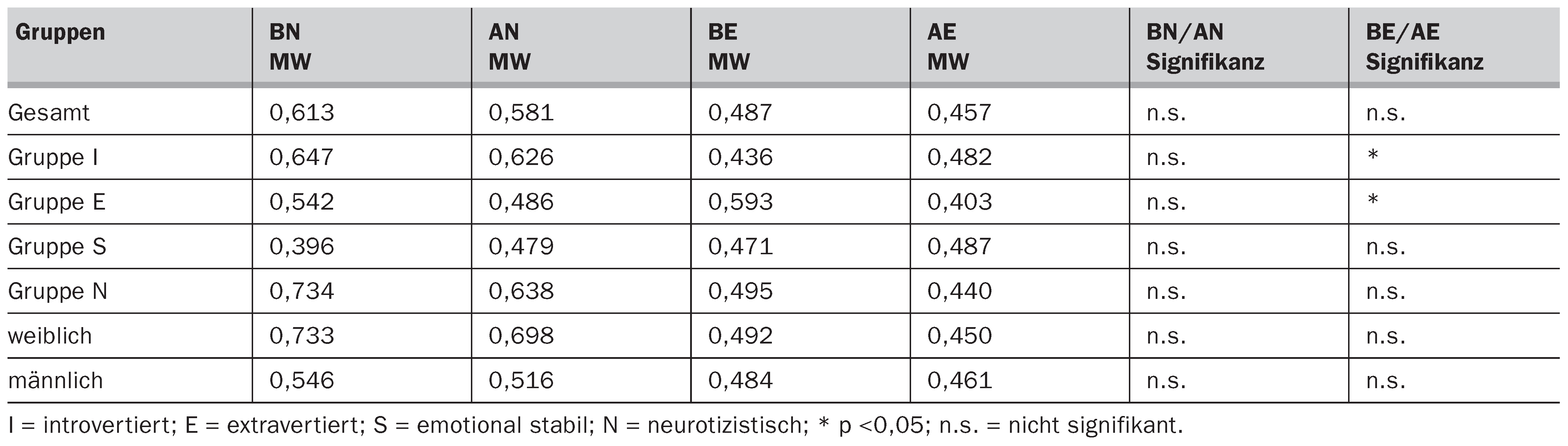
Ein Vergleich der Extraversionswerte vor (EPI-B) und nach Erlernen des Autogenen Trainings (EPI-A) zeigt für die Gesamtgruppe keine signifikante Veränderung. Betrachtet man jedoch für Gruppe I und Gruppe E die Extraversionswerte getrennt, resultiert für Gruppe I eine signifikante Zunahme des Extraversionsfaktors (p <0,05) und für Gruppe E eine signifikante Abnahme des Extraversionsfaktors (p <0,05).
Veränderung von Stimmung und Befindlichkeit in Abhängigkeit von der Persönlichkeitsdimension Neurotizismus
Bei vorliegender Fragestellung ist nicht ein Vergleich der absoluten Werte zwischen den Untergruppen zu den verschiedenen Messzeitpunkten von Interesse, sondern ein Vergleich der Veränderungen innerhalb der beiden Gruppen, d.h. ein Vergleich der Differenzen zwischen je zwei Messzeitpunkten (Table 2). Im vorliegenden Fall ergeben sich für die Summenfaktoren numerisch nur geringfügige und statistisch nicht signifikante Unterschiede der Befindlichkeitsänderung zwischen den Gruppen S und N. Weitere Testungen wurden daher nicht vorgenommen.
Table 2.
Vergleich der EWL-K-Differenzen zwischen den Gruppen S = emotional stabil; N = neurotizistisch; Mittelwertdifferenzen: MW(tn) – MW(tm); für tn <tm; U-Test nach Mann und Whitney; * p <0,05; n.s. = nicht signifikant.

Veränderung von Stimmung und Befindlichkeit in Abhängigkeit von der Persönlichkeitsdimension Extraversion
Im t1/t4-Vergleich (maximal mögliche Veränderung) wurde ein signifikanter Unterschied beobachtet, der auf eine Befindlichkeitsbesserung in der Gruppe I hinweist (Table 3). Hier zeigt sich ein signifikanter Unterschied hinsichtlich Faktor III. Auf der Ebene der Subskalen findet sich eine signifikant unterschiedliche Entwicklung der Subskala H «Selbstsicherheit» (Dieses Befindensmerkmal ist nach Angabe der Autoren [13], S. 15, durch das Fehlen von Befindensbeeinträchtigungen [z.B. sorglos, unbekümmert] gekennzeichnet, es ist lustbetont, aber nicht mit Euphorie [Freude] verbunden.), aber auch der Subskala F «Extravertiertheit» zwischen den Gruppen E und I.
Table 3.
Vergleich der EWL-K-Differenzen zwischen den Gruppen E = extravertiert; I = introvertiert; Mittelwertdifferenzen: MW(tn) – MW(tm); für tn <tm; U-Test nach Mann und Whitney; * p <0,05; ** p <0,01; n.s. = nicht signifikant.
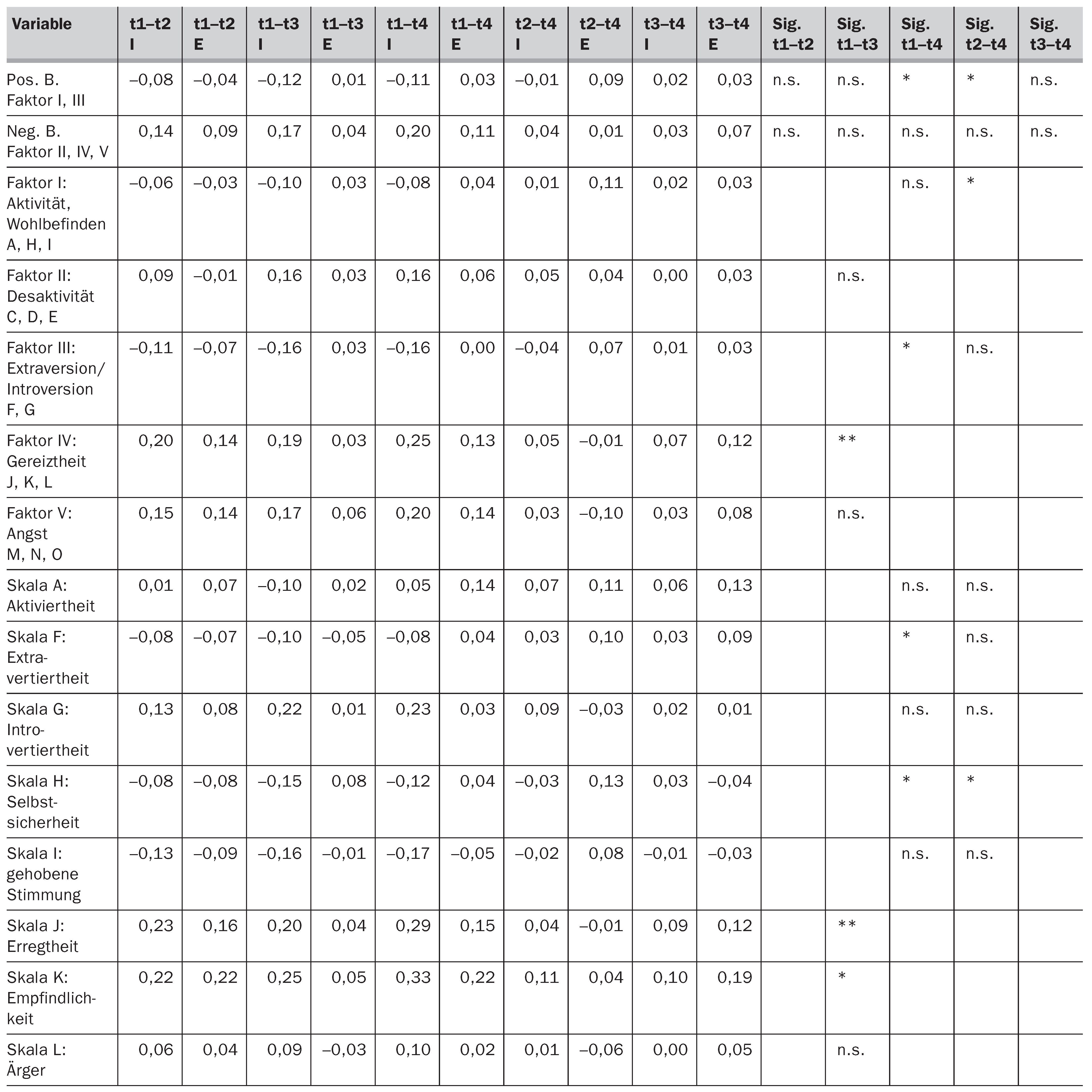
Die im t2/t4-Vergleich registrierte Verschlechterung der positiven Befindlichkeit bei Extravertierten im Gegensatz zu Introvertierten lässt sich auf der Ebene der zugehörigen Faktoren (I–III) dem Faktor I zuordnen. Für die entsprechenden Subskalen des Faktors I (A-H-I) ist nur die Änderung der Subskala H «Selbstsicherheit» zwischen den Gruppen E und I signifikant unterschiedlich (p <0,05), wobei für Introvertierte zum Zeitpunkt t4 ein höherer Mittelwert als zum Zeitpunkt t2 und für Extravertierte ein niedrigerer Mittelwert gemessen wurde.
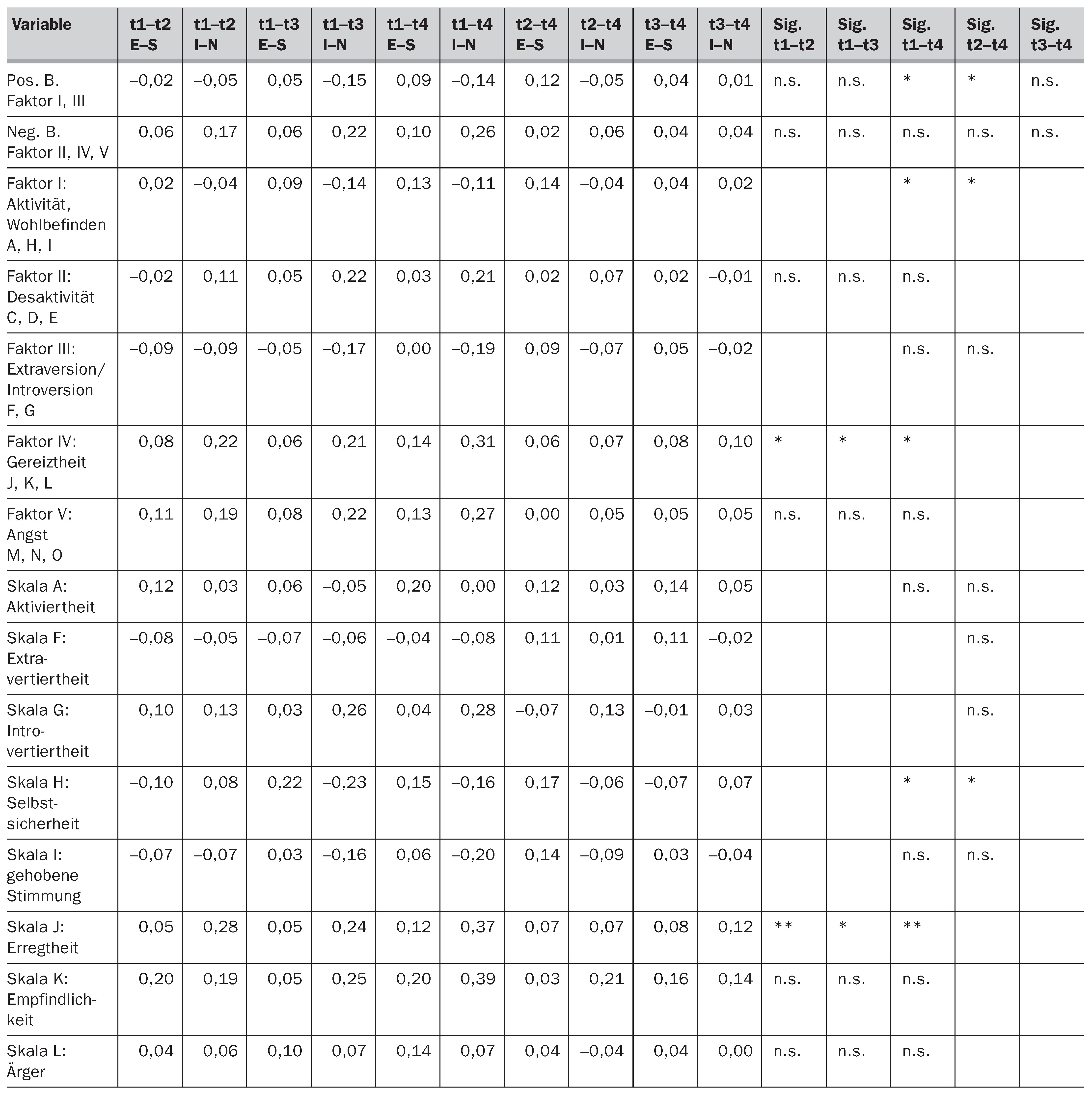
Vergleich der EWL-K-Differenzen zwischen den Gruppen E-S = extravertiert und emotional stabil; I-N = introvertiert und neurotizistisch
Für die positive Befindlichkeit lässt sich auf der Ebene der Summenfaktoren ein signifikanter Unterschied zwischen den Untergruppen E/S und I/N im t1/t4- (maximal mögliche Veränderung) und t2/t4-Vergleich nachweisen (Table 4). Während zum Zeitpunkt t4 in der Untergruppe I/N ein geringfügig höherer Mittelwert für positive Befindlichkeit gemessen wurde, lag der Mittelwert des Summenfaktors für positive Befindlichkeit in der Untergruppe E/S am Ende des Autogenen Trainings (t4) unter dem Anfangswert nach dem Üben in der ersten Kursstunde (t2) (p <0,05). Hinsichtlich der einzelnen Faktoren der positiven Befindlichkeit findet sich zwischen den Untergruppen E/S und I/N ein signifikanter Unterschied bezüglich Faktor I (t1/t4 und t2/t4). Von den Subskalen des Faktors I (A-H-I) lässt sich im t1/t4- und t2/t4-Vergleich eine signifikant unterschiedliche Befindensänderung der Subskala H «Selbstsicherheit» nachweisen, die auf eine Verschlechterung in der Untergruppe E/S zurückgeführt werden kann, während der Mittelwert der Subskala H in der Untergruppe I/N zum Zeitpunkt t4 geringfügig über dem entsprechenden Messwert zum Zeitpunkt t2 lag.
Table 4.
Vergleich der EWL-K-Differenzen zwischen den Gruppen E–S = extravertiert und emotional stabil; I–N = introvertiert und neurotizistisch; Mittelwertdifferenzen: MW(tn) – MW(tm); für tn <tm; U-Test nach Mann und Whitney; * p <0,05; ** p <0,01; n.s. = nicht signifikant.
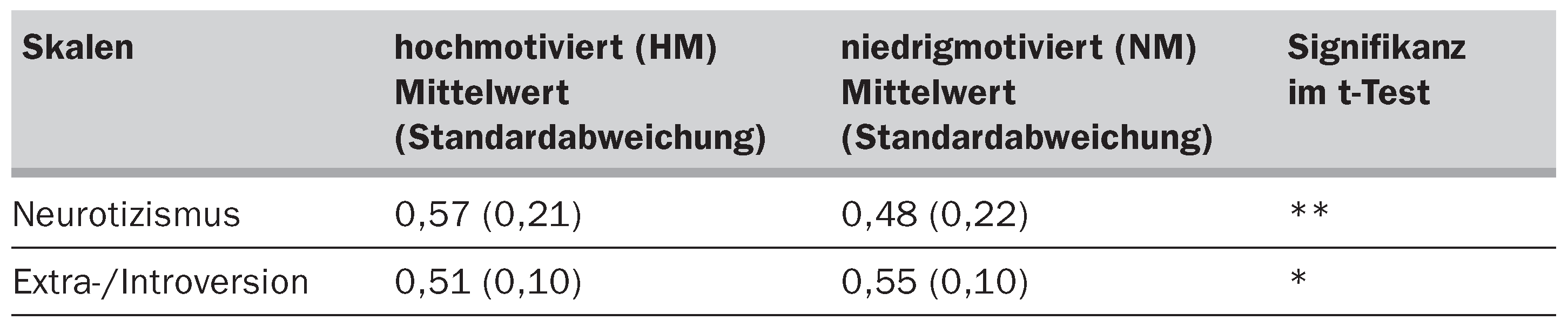
Vergleich der hochmotivierten mit den niedrigmotivierten Probanden hinsichtlich Extra-/Introversion und Neurotizismus im EPI-B
Im folgenden werden hochmotivierte mit niedrigmotivierten Probanden verglichen, einschliesslich «Abbrecher» hinsichtlich Extra-/Introversion und Neurotizismus mittels EPI-B (Table 5). Die hochmotivierten Patienten lagen hinsichtlich des Neurotizismus signifikant über und hinsichtlich der Extraversion signifikant unter den niedrigmotivierten Patienten einschliesslich der Abbrecher.
Table 5.
Vergleich der EPI-B-Mittelwerte (MW) zwischen hochmotivierten (HM), d.h. Probanden
der Untersuchungsstichprobe, und niedrigmotivierten (NM) Probanden (aus anderen Kursen)
beim Autogenen Training; t-Test; * p <0,05; ** p <0,01.
Diskussion
Die Tatsache des günstigen Einflusses des Autogenen Trainings auf Stimmung und Befindlichkeit kann als gesichert gelten [1]. Weniger eindeutig sind differentialtherapeutische Effekte einzuschätzen, dies betrifft die Indikationsstellung, d.h. die Wirkung des Autogenen Trainings in Abhängigkeit vom Krankheitsbild, aber auch die Abhängigkeit der Wirkung des Autogenen Trainings von grundlegenden Persönlichkeitsdimensionen, wie z.B. von Neurotizismus und von Extra-/Introversion. Bisher in der Literatur beschriebene Untersuchungen, die auch die Bereiche Introversion/Extraversion und emotionale Labilität bzw. Neurotizismus im Prä-Post- Vergleich (vor und nach Erlernen des AT) erfassten [14,15,16,17,18,19], zeichnen sich durch eine einheitliche Tendenz aus im Sinne einer Abnahme von Introversion bzw. Neurotizismus als Folge des Autogenen Trainings. Betrachtet man zusätzlich die Gruppe der Abbrecher bzw. Versager des Autogenen Trainings, so deuten die bisherigen Befunde [19,20,21,22,23,24] auf eine Abhängigkeit des AT-Erfolgs von den beiden Persönlichkeitsfaktoren Extraversion/Introversion und Neurotizismus hin. Teilbefunde (Tab. 5) unserer Studie bestätigen diese Ergebnisse. Theoretisch lässt sich dieser Sachverhalt erklären anhand der von Eysenck [3,9,11] aufgezeigten Beziehung zwischen Stimulationsniveau und Gefühlston (hedonic tone) in Abhängigkeit vom Extraversions-/Introversions-Faktor. Der Gefühlston (hedonic tone) kann nach Eysenck ([9], S. 109) entsprechend seiner biologischen Grundlage als eine Funktion des Arousals beschrieben werden: (1.) Sehr niedrige oder sehr hohe Grade der Stimulation erzeugen einen negativen Gefühlston. (2.) Ein positiver Gefühlston findet sich nur bei mittleren Graden der Stimulation. (3.) Zwischen positivem und negativem Gefühlston liegt ein neutraler Bereich (indifference level), der weder als angenehm noch als unangenehm empfunden wird ([3], S. 254).
Bei Introvertierten nun verursacht bereits niedrige Stimulation ein höheres Arousal- Niveau als bei Extravertierten. Umgekehrt tritt bei starker Stimulation bei Introvertierten die transmarginale Hemmung früher auf und damit auch früher ein Absinken des Arousal-Niveaus. Das bevorzugte Reizniveau ist also für Introvertierte niedriger als für Extravertierte, weshalb Introvertierte eher in der Lage sind, sich mit schwachen Aussenreizen zu begnügen, während Extravertierte hingegen eine bessere Anpassung an sehr starke Reize aufweisen ([3], S. 254).
Das Arousal-Niveau (AR) lässt sich auch als eine Funktion von Dispositionen, z.B. «Extraversion (E)» bzw. «Introversion (I)», einerseits und Arousal-produzierenden situativen Faktoren (ARS) andererseits beschreiben ([12], S. 20): Bei niedriger Stärke der Arousal-produzierenden situativen Erregungsfaktoren (ARS) ist das Arousal-Niveau Introvertierter (AR[I]) höher als das Arousal-Niveau Extravertierter (AR[E]). Ein wesentlicher Bestandteil der Arousal-Theorie ist die Vorstellung, «dass Introvertierte aufgrund ihres relativ hohen Erregungsniveaus die eingehenden Sinnesreize tendenziell vergrössern (‹augmentieren›), während andererseits Extravertierte mit ihrer allgemein geringeren Erregung die Reize verkleinern oder abschwächen (‹reduzieren›)» ([3], S. 289). So besitzen Introvertierte im Vergleich zu Extravertierten niedrigere Sinnesreizschwellen, insbesondere niedrigere Schmerzreizschwellen ([3], S. 257–60). Bei hohen ARS tritt zunächst im Sinne einer Gegenregulation transmarginale Hemmung ein, und zwar bei Introvertierten eher als bei Extravertierten. Wird diese Gegenregulation, beispielsweise im Bereich pathologischer Zustände, durchbrochen, tritt eine Übersteigerung des Arousals ein und somit Rastlosigkeit und hektisches Verhalten.
Durch das Autogene Training kann das kortikale Erregungsniveaus beeinflusst werden. Dafür sprechen auch die Befunde von Meyer et al. [25], wonach es im Autogenen Training zu einer Abnahme der regionalen Hirndurchblutung kommt, und von Dierks et al. [26] über eine anhand von EEG-Frequenzanalysen beobachtete neurophysiologische Desaktivierung im Autogenen Training. Somit bestehen mehrere Gründe dafür, das Autogene Training mit Eysencks neurophysiologischer Theorie der Extra-/Introversion in Verbindung zu bringen.Von dieser Theorie lassen sich Hypothesen ableiten, die in vorliegender Studie überprüft wurden.
Beim Autogenen Training wird zunächst systematisch eine Reduzierung situativer Erregungsfaktoren beabsichtigt, weil diese die «konzentrative Selbstentspannung» behindern. Daher erfordert eine erfolgreiche Übungspraxis eine weitgehende Aussenreizverarmung bzw. Monotonie der Sinnesreize ([27], S. 7). Dazu gehören eine passive Körperhaltung, ein dunkler, ruhiger Übungsraum und das Schliessen der Augen. Die Übenden selbst müssen zudem im Verlauf des Autogenen Trainings eine Blockade ankommender Stimuli aufbauen. Diese gelingt um so leichter, je weniger Stimuli wiederum vorhanden sind bzw. je geringer deren Intensität ist, d.h. durch Üben in entspannter, ruhiger Umgebung [28,29]. Diese Resistenz gegenüber Aussenreizen muss regelmässig und über eine Dauer von durchschnittlich 2 bis 3 Monaten trainiert werden.
Im Autogenen Training kommt es daher nach anfänglicher «mechanischer» Aussenreizabschirmung zu einer selbstinduzierten biologischen Verstärkung der Blockade von Aussenreizen. Sie stellt einen wesentlichen Teilerfolg des Autogenen Trainings dar, der die Voraussetzung für eine rasche Umschaltung bei im Autogenen Training geübten Personen ist. Die im Autogenen Training erlernte biologische Selbstruhigstellung kontrolliert den für Extravertierte typischen Reizhunger (stimulus hunger) in reizarmen Situationen und vermindert bis zu einem gewissen Masse eine die Wirkung des Autogenen Trainings behindernde Stimulussuche (stimulus seeking). Andererseits wirkt die Resonanzdämpfung der Affekte als Folge des Autogenen Trainings der für Introvertierte typischen Augmentation ankommender Stimuli entgegen, was wiederum dem Auftreten einer protektiven transmarginalen Hemmung in Situationen mit hohem Erregungscharakter vorbeugt.
Das vom Stimulationsniveau abhängige Absinken des positiven Gefühlstons in den negativen, mit Unlustgefühlen assoziierten Bereich erfolgt bei Introvertierten nach Erlernen des Autogenen Trainings erst bei einem höheren Stimulationsniveau als vor Erlernen des Autogenen Trainings. Weil auf diese Weise viele alltägliche Situationen, die ursprünglich bei Introvertierten zu starke Erregung verursachten und mit entsprechend negativer hedonischer Tönung verbunden waren, jetzt einen noch positiven oder zumindest neutralen Gefühlston erzeugen, reduziert sich auch die für Introvertierte typische «Reizvermeidung» (stimulus avoidance). Ihr Verhalten wird folglich reizbetonter, abwechslungsreicher, allgemein extravertierter, was sich anhand von Persönlichkeitsfragebogen (z.B. EPI, EWL, FPI) nachweisen lässt (vgl. auch [17,18,19]). Die einseitige Bevorzugung reizarmer von Introvertierten bzw. reizbetonter Situationen von Extravertierten wird dadurch aufgelockert, das Verhalten von Introvertierten wird extravertierter und umgekehrt das Verhalten von Extravertierten introvertierter.
Versteht man die Resonanzdämpfung der Affekte als Auflösung von Unlustgefühlen, dann kann die Auswirkung des Autogenen Trainings auch im Sinne einer Herabsetzung des Grenzwerts zwischen positivem und negativem hedonischem Tonus interpretiert werden. Introvertierte würden demnach auch bei höheren Stimulationsgraden den Zustand nicht als unangenehm empfinden, was ihre Zunahme an Extraversion als Folge des Autogenen Trainings erklären würde. Gleichermassen würden auch Zustände geringerer Stimulation bei Extravertierten noch keine Unlustgefühle hervorrufen. Folglich würde sich ihr Reizhunger in typisch introvertierten Situationen (lange, monotone Arbeit, niedriges Stimulationsniveau) verringern, weshalb eine tendenzielle Zunahme introvertierten Verhaltens zu erwarten wäre. Für einen Einfluss in diesem Sinne durch das Autogene Training sprechen die Untersuchungen von Hense-Krein [17], von Wietersheim [18] und Schrapper und Mann [19].
Betrachtet man die Auswirkungen des Autogenen Trainings auf Extravertierte allein, dann sollte die Selbstruhigstellung im Sinne einer Dämpfung starker Stimulation für diese keine wesentliche Bedeutung haben, da Personen mit hohen Extraversionswerten im allgemeinen Reize abschwächen und starke Stimulation benötigen, um einen positiven Gefühlston zu erreichen. Im Gegenteil wäre es kaum vorteilhaft, eine zusätzliche Hemmung sensorischer Reize zu erlernen. Nach Schultz ermöglicht das Autogene Training aber nicht nur eine Ausschaltung weiter Gebiete von Sinnesempfindungen ([30], S. 113), sondern auch umgekehrt die Fähigkeit, Empfindungserlebnisse durch konzentrative Hinwendung zu steigern ([30], S. 117). Interpretiert man diese Beobachtung als eine erlernte Verstärkung von sensorischen Reizen, dann ergäbe sich für extravertierte Personen bei geringem Stimulationsniveau sogar ein höheres Arousal-Niveau als vor Erlernen des Autogenen Trainings. Im Falle geringer äusserer Stimulation würde nicht zwangsläufig ein negativer Gefühlston entstehen und somit die Notwendigkeit des Aufsuchens von Reizen (stimulus seeking). In seinem Verhalten würde daher der Extravertierte introvertierter. Personen mit hohen Extraversionswerten, die das Autogene Training erfolgreich beenden, sollten somit niedrigere E-Werte nach Erlernen des Autogenen Trainings haben als zuvor (gemessen mit EPI oder anderen Fragebogen). Unsere Befunde entsprechen unseren Hypothesen, dass Extravertierte vom Autogenen Training weniger profitieren als Introvertierte.
Die Hypothese, wonach als Folge der Wirkung des Autogenen Trainings die Extraversion zu- und die Introversion abnimmt, fand im EPI (Table 1) ihre Bestätigung. Eine Zunahme der Extraversion nach Autogenem Training konnte in der Gruppe der introvertierten Personen nachgewiesen werden, ebenso eine Abnahme an Extraversion in der Gruppe der Extravertierten. Dieses Ergebnis entspricht der Hypothese 2 über den Einfluss eines erfolgreichen Autogenen Trainings auf den Introversions-/Extraversions-Faktor.
Ein weiterer Hinweis auf den Erfolg des Autogenen Trainings gibt dessen Einfluss auf den Neurotizismus (Table 1). In der Gruppe der emotional labilen Personen liess sich gegen Ende des Autogenen Trainings eine Abnahme des Neurotizismus im Vergleich zum Ausgangswert nachweisen, während sich in der Gruppe der emotional stabilen Personen die zu Beginn und am Ende des Autogenen Trainings gemessenen N-Scores nicht wesentlich unterscheiden. Dieses Ergebnis steht in Einklang mit unserer Hypothese, dass die als Folge des Autogenen Trainings auftretende Reduzierung des Neurotizismus bei Personen mit ursprünglich hohem N-Score ausgeprägter sein soll als bei Personen mit anfangs niedrigem N-Score. Untersuchungen mit Hilfe des MMPI oder des FPI im Prä-Post-Vergleich (vor und nach Erlernen des Autogenen Trainings) lassen ebenfalls eine Abnahme des Neurotizismus als Folge des Autogenen Trainings erkennen [14,15,19,31,32].
Durch das Autogene Training stellt sich also eine Reduzierung der Bedeutung situativer Erregungsfaktoren für das Arousal-Niveau ein. Die habituelle, durch die Persönlichkeitsdimension Extraversion/ Introversion vorgegebene biologische Neigung zu einem höheren Arousal wird dadurch aber nicht verändert. Hieraus ergibt sich eine Gefahr des Autogenen Trainings, wenn es zur Erhöhung der Leistungsfähigkeit, z.B. bei psychophysischen Erschöpfungszuständen, als alleinige Massnahme angewendet wird, und die Gründe, welche die hohe Leistungs-motivation bedingen, z.B. Kompensation bzw. Bewältigungsversuche durch Leistung, nicht aufgedeckt und verändert werden. Das Autogene Training führt in diesen Fällen nur zu einer scheinbaren Verbesserung der psychophysischen Verfassung des Patienten, denn es wird nur der Gefühlston, nicht aber biologische Neigung zu einem höheren Arousal verändert, im Gegenteil, der Patient kann aufgrund der angenehmeren Gefühlslage bei unveränderter Leistungsmotivation seine Belastungen noch weiter steigern, gleichsam die Warnzeichen seines Organismus überspielen, bis dann ein noch ausgeprägterer bzw. völliger psychophysischer Zusammenbruch erfolgt. Diese Überlegungen gelten vorwiegend für Introvertierte. Dieser Sachverhalt erklärt die Tatsache, dass vorwiegend entäusserungsschwache, d.h. in irgendeiner Form introvertierte Personen an einer Erschöpfungsdepression erkranken [33].
Während sich die bisherigen Ausführungen auf Veränderungen des Neurotizismus als Folge des Autogenen Trainings bezogen, sollen im folgenden Veränderungen von Stimmung und Befindlichkeit während des Autogenen Trainings in Abhängigkeit von unterschiedlichen Graden des Neurotizismus untersucht werden (Tab. 4). Emotional labile und introvertierte Personen (Gruppe I-N) zeigen ausgeprägtere positive Veränderungen in der positiven Befindlichkeit, bei allerdings schlechteren Ausgangswerten der EWL im Vergleich zu emotional stabilen und extravertierten Personen (Gruppe E-S), was unsere Hypothesen bestätigt. Stabile und extravertierte Personen (Gruppe E-S) zeigen hinsichtlich der positiven Befindlichkeit langfristig sogar eine Verschlechterung, was die geringere Motivation für die Übungen des Autogenen Trainings und die höhere Zahl der Abbrecher in diesem Personenkreis erklären würde.
Die positive Beeinflussung der EWLWerte in der Gruppe I-N entspricht der Annahme von der Abhängigkeit der Befindlichkeitsverbesserungen während des Autogenen Trainings vom Ausmass des anfänglich gemessenen N-Score. Bei relativ günstigen Ausgangswerten für Stimmung und Befindlichkeit dient Autogenes Training daher weniger zur Therapie als zur Prophylaxe. Bühler und König [34] fanden bei Depressiven höhere Neurotizismus- und Extraversionswerte als bei gesunden Kontrollpersonen. Aus diesem Grunde eignet sich für Depressive das Autogene Training gut als Prophylaxe, aber auch als ergänzende Therapieform.
Ein negativer Einfluss erhöhter N-Werte auf den Verlauf des Autogenen Trainings konnte nicht nachgewiesen werden. Auch Schumann [23] konnte keinen Zusammenhang zwischen dem Persönlichkeitsmerkmal Neurotizismus bzw. emotionaler Labilität (FPI) und einer erfolgreichen Teilnahme an autogenen Trainingskursen aufzeigen (Erfolgskriterium war die regelmässige Teilnahme an den gemeinsamen Kursstunden). Schliesslich kann auf eine Studie von Springub, Feiereis und Wilke [35] verwiesen werden, wonach die schwerer erkrankten Patienten die besseren Ergebnisse mit dem Autogenen Training erzielten. Die schwerer gestörten Patienten erfuhren in den Grundübungen eine deutlichere körperliche Reaktion; das Erlernen des Autogenen Trainings fiel ihnen leichter. Als Erklärung wird die hohe Compliance gerade bei schwerer gestörten Patienten angegeben. Mit Ausnahme der Untersuchung von Badura stimmen die Literaturberichte mit unseren Ergebnissen überein, wonach die Persönlichkeitsdimension Neurotizismus keinen negativen Einfluss auf den Verlauf des Autogenen Trainings nimmt, aufgrund der erhöhten Motivation und Compliance sogar von Vorteil sein kann.
Aufgrund der ausgeprägteren Befindlichkeitsverbesserungen bei emotional labilen sowie bei introvertierten Personen finden sich die grössten Unterschiede im Trainingsverlauf der Untergruppen zwischen den Untergruppen I/N und E/S. Nach der Persönlichkeitstheorie Eysencks unterscheiden sich diese Untergruppen auch in ihrem kortikalen Erregungsniveau am stärksten. Introvertierte besitzen im Vergleich zu Extravertierten das höhere habituelle Arousal-Niveau (Erregungsniveau), d.h., Stimuli wirken bei gleicher Intensität bei Introvertierten stärker erregend als bei Extravertierten. Darüber hinaus besteht ein Interaktionseffekt des Neurotizismus auf das Arousal-Niveau, wobei ein hoher Neurotizismusgrad zu einer deutlichen Erhöhung des kortikalen Erregungsniveaus führen kann. Folglich finden sich in der Untergruppe I/N Personen mit hohem kortikalem Erregungsniveau und grosser Empfindlichkeit für erregende Reize, wohingegen die Untergruppe E/S durch ein niedriges habituelles Erregungsniveau und geringe Empfindlichkeit für erregende Reize gekennzeichnet ist. Während die deutlichsten Verbesserungen der Stimmungslage in der Gruppe der emotional labilen Introvertierten (I/N) nachgewiesen wurden (t1/t4), fand in der Gruppe der emotional stabilen Extravertierten (E/S) nicht nur keine Verbesserung der Grundstimmung statt, hinsichtlich der positiven Befindlichkeit wurde sogar eine Verschlechterung beobachtet. Die Verbesserungen der Stimmung und Befindlichkeit während des Autogenen Trainings in der Untergruppe I/N und die fehlende langfristige Besserung der Stimmungslage in der Untergruppe E/S belegen die ungünstige Prognose hoher Extraversionswerte beim Autogenen Training.
Die Hypothese über die Beziehung der Persönlichkeitsdimension Extraversion zur Veränderung der Befindlichkeit im Verlauf des Autogenen Trainings wurde auch durch die vorliegenden Ergebnisse bestätigt (Tab. 3). Im Bereich der maximal möglichen Veränderung (t1/t4) ergab sich bei Introvertierten gegenüber Extravertierten ein signifikanter Unterschied zwischen diesen beiden Gruppen im Sinne einer ausgeprägteren Verbesserung der Befindlichkeit bei Introvertierten.
Als Hinweis für eine ungünstige Prognose hoher Extraversionswerte beim Autogenen Training kann die Beobachtung von Schumann [23] an 246 Teilnehmern von autogenen Trainingskursen an Volkshochschulen angesehen werden, wonach extravertierte Teilnehmer dem Training eher fernbleiben, während Introvertierte durchschnittlich häufiger regelmässig am Training teilnehmen (Signifikanzniveau 1%).
Betrachtet man die einzelnen Ergebnisse im Zusammenhang, so resultiert eine Bestätigung der Hypothese, dass ein erfolgreicher Verlauf des Autogenen Trainings an relativ niedrige Extraversionswerte gebunden ist bzw. hohe Extraversionswerte für Autogenes Training ungeeignet sind. Als mögliche Erklärungen dafür bieten sich die geringere Reizentzugstoleranz von Extravertierten an; der negative Gefühlston von Personen mit hohem E-Score in Situationen mit niedrigem Stimulationsniveau und deren kompensatorische, die Konzentration auf die Übungsformeln störende Selbststimulation oder der bei Extravertierten schneller einsetzende Prozess der Habituation bzw. die Bevorzugung schneller und ungenauer Arbeitsweise durch Extravertierte im Gegensatz zur langsamen und genauen Arbeitsweise der Introvertierten; ferner die Beobachtung, dass Extravertierte unter verhältnismässig anregenden Bedingungen (z.B. wirklich interessante oder kurze Aufgaben) schneller sind als Introvertierte, während diese schneller werden, wenn lange und monotone Aufgaben zum Einsatz kommen. Daher kann auch vermutet werden, dass das Autogene Training eine Methode darstellt, die den Introvertierten mehr liegen sollte als den Extravertierten.
Die hier aufgezeigten Befunde haben auch praktische Konsequenzen für das Üben des Autogenen Trainings. Erste Hinweise dazu geben die Untersuchungen von Colquhoun [36] und Revelle et al. [37], wonach Introvertierte am Morgen und Extravertierte am Abend das günstigere Erregungsniveau besitzen. Zusätzlich konnte in der Studie von Revelle et al. eine Verbesserung der Testleistung durch Einnahme von Koffein (ein stimulierendes Mittel) am Morgen bei Extravertierten und am Abend bei Introvertierten beobachtet werden. Entsprechend dem «Drogenpostulat» müsste daher auch durch Gabe von Pharmaka die Wirkung des Autogenen Trainings beeinflusst werden können.
Lässt sich also die relativ ungünstige Prognose hoher Extraversionswerte beim Autogenen Training durch regelmässiges Trainieren am Abend oder durch Verabreichung eines stimulierenden (das Arousal-Niveau steigernden) Mittels wie Koffein verbessern? In der vorliegenden Untersuchung wurden die Kursstunden zwar immer abends zwischen 18 und 19 Uhr abgehalten, Angaben über die Trainingszeiten zu Hause liegen jedoch nicht vor, so dass wir diese Frage vorerst unbeantwortet lassen müssen.
Literatur
- Bühler, K-E. Wirkung des Autogenen Trainings auf Befinden und Stimmung von Patienten einer psychotherapeutischen Ambulanz. Schweiz Arch Neurol Psychiatr. 2005, 156, 247–56. [Google Scholar]
- Eysenck HJ. Experiments with Drugs. London, New York: Pergamon Press; 1963.
- Eysenck HJ, Eysenck MW. Persönlichkeit und Individualität. Ein naturwissenschaftliches Paradigma. München-Weinheim: Psychologie Verlags-Union; 1987 (Originalausgabe: Eysenck & Eysenck; 1985).
- Welsh, l; Kubis, J. The effect of anxiety on the conditioning rate and stability of the PGR. J Psychol. 1947, 23, 83–91. [Google Scholar]
- Eysenck, HJ. Cortical inhibition, figural aftereffect and theory of personality. J Abnorm Soc Psychol. 1955, 51, 94–106. [Google Scholar] [CrossRef] [Scilit] [PubMed]
- Eysenck HJ. The Dynamics of Anxiety and Hysteria. London: Routledge & Kegan Paul; 1957.
- Franks, CM. Conditioning and personality: a study of normal and neurotic subjects. J Abnorm Soc Psychol. 1956, 52, 143–50. [Google Scholar] [CrossRef] [Scilit]
- Franks, CM. Personality factors and the rate of conditioning. Br J Psychol. 1957, 48, 119–26. [Google Scholar] [CrossRef] [Scilit] [PubMed]
- Eysenck HJ. The Biological Basis of Personality. Springfield: Thomas; 1967.
- Eysenck HJ, Eysenck MW. Personality and Individual Differences. New York, London: Plenum Press; 1985.
- Eysenck HJ. A Model for Personality. Berlin, New York: Springer; 1981.
- Brocke, B; Liepmann, D. Eysencks Theorie der situativen Erregung. Zeitschrift für Differentielle und Diagnostische Psychologie 1985, 6, 19–38. [Google Scholar]
- Janke W, Debus G. Eigenschaftswörterliste. Göttingen: Hogrefe; 1978.
- Sapir M, Javal I, Philibert R. Utilisation du test M.M.P.I. à propos du Training Autogène. In: Luthe W, editor. Autogenes Training. Correlationes Psychosomaticae. Stuttgart: Thieme; 1965. S. 106–10.
- Schejbal, P; Kröner, B; Niesel, W. Versuch einer Objektivierung der Auswirkungen des autogenen Trainings und der Transzendentalen Meditation auf Persönlichkeitsvariablen anhand eines Persönlichkeitsfragebogens. Psychother Med Psychol. 1978, 28, 158–64. [Google Scholar]
- Bühler, K-E; Biesenecher-Fjornes, R. Stimmung und Befindlichkeit beim Autogenen Training. Z Psychosom Med. 1989, 35, 130–42. [Google Scholar]
- Hense-Krein M. Physiologische und psychische Korrelate des AT und ihre Beziehungen zur sensorischen Suggestibilität [Med. Dissertation]. Mainz 1981.
- von Wietersheim A. Versuch der Ermittlung von Indikatoren und Prädiktoren für das AT anhand psychologischer und physiologischer Masse [Med. Dissertation]. Mainz 1981.
- Schrapper, DK; Mann, KF. Veränderung der Befindlichkeit durch AT. Z Psychother Med Psychol 1985, 35, 268–72. [Google Scholar]
- Schultz, JH. Das autogene Training in der Allgemeinpraxis. Med Klinik 1950, 45, 1012–5. [Google Scholar]
- Badura, HO. Vergleichende Untersuchungen von Persönlichkeitsvariablen bei Versagern im AT mit Hilfe des MMPI. Z Psychother Med Psychol. 1973, 23, 200–5. [Google Scholar]
- Badura, HO. Beitrag zur differentialdiagnostischen Validität des MMPI zur Prognose der Effizienz des AT. Arch Psychiatr Nervenkr 1977, 224, 389–94. [Google Scholar] [CrossRef] [Scilit] [PubMed]
- Schumann R. Vergleichende Untersuchung von Persönlichkeitsvariablen bei Trainingsfernbleibern und regelmässig Trainierenden in autogenen Trainingskursen an Volkshochschulen mit Hilfe des FPI [Med. Dissertation]. Mainz 1981.
- Rittmannsberger, H; Grausgruber, A. Effektivität von Kursen für autogenes Training im Rahmen der Volkshochschule. Psychother Med Psychol. 1990, 40, 264–70. [Google Scholar]
- Meyer, HK; Diehl, BJM; Ulrich, P; Meinig, G. Kurz- und langfristige Änderungen der kortikalen Durchblutung bei Autogenem Training. Z Psychosom Med. 1987, 33, 52–62. [Google Scholar]
- Dierks, T; Maurer, K; Zacher, A. Brain mapping of EEG in autogenic training (AT). Psychiatry Research 1989, 29, 433–4. [Google Scholar] [CrossRef] [Scilit]
- Schultz HJ, Luthe W. Autogenic Therapy. Vol. 1: Autogenic Methods. New York: Grune & Stratton; 1969.
- Hoffmann B. Handbuch des Autogenen Trainings. 7. Auflage. München: dtv; 1987.
- Bölle, M. Autogenes Training und die Verbesserung der Selbstwahrnehmung. Erfahrungen mit stationären internistischen Patienten. Prax Psychother Psychosom. 1987, 32, 201–5. [Google Scholar]
- Schultz JH. Das autogene Training. 11. Auflage. Stuttgart: Thieme; 1964.
- Büssing, A; Lehmkuhl, G; Bergmann, R. Anwendung und Übungserfolg des AT über einen längeren Zeitraum. Z Klin Psychol Psychother. 1982, 30, 141–8. [Google Scholar]
- Büssing, A; Lehmkuhl, G. Therapiekontrolle im AT. Einfluss von Motivation und Persönlichkeitsvariablen auf den Übungserfolg. Psychother Med Psychol. 1986, 36, 221–6. [Google Scholar]
- Faust V, Hole G, Wolfersdorf M. Diagnose der Depressionen. Ravensburg: Stein; 1984.
- Bühler, K-E; König, M. Depression und Biografie. Nervenheilkunde 2003, 22, 267–71. [Google Scholar] [CrossRef] [Scilit]
- Springub, J; Feiereis, H; Wilke, E. Der Einfluss der Compliance auf die Behandlung mit autogenem Training. Psychother Med Psychol. 1989, 39, 417–21. [Google Scholar]
- Colquhoun, ML. Temperament, inspection efficiency, and time of day. Ergonomics 1960, 3, 377–8. [Google Scholar] [CrossRef] [Scilit]
- Revelle, W; Humphreys, MS; Simon, L; Gilliland, K. The interactive effect of personality, time of day and caffeine: a test of the arousal model. J Exp Psychol Gen. 1980, 109, 1–31. [Google Scholar] [CrossRef]
This is an open-access article distributed under the terms of the Creative Commons Attribution Non-Commercial No Derivatives (CC BY-NC-ND) 4.0 License.