

When Resources Substitute for Each Other: How Emotional Intelligence and Organizational Support Interact in Relation to Resilience and Well-Being Among Healthcare Professionals


Abstract
1. Introduction
2. Literature Review
2.1. Theoretical Background
2.2. Hypothesis Development and Research Model
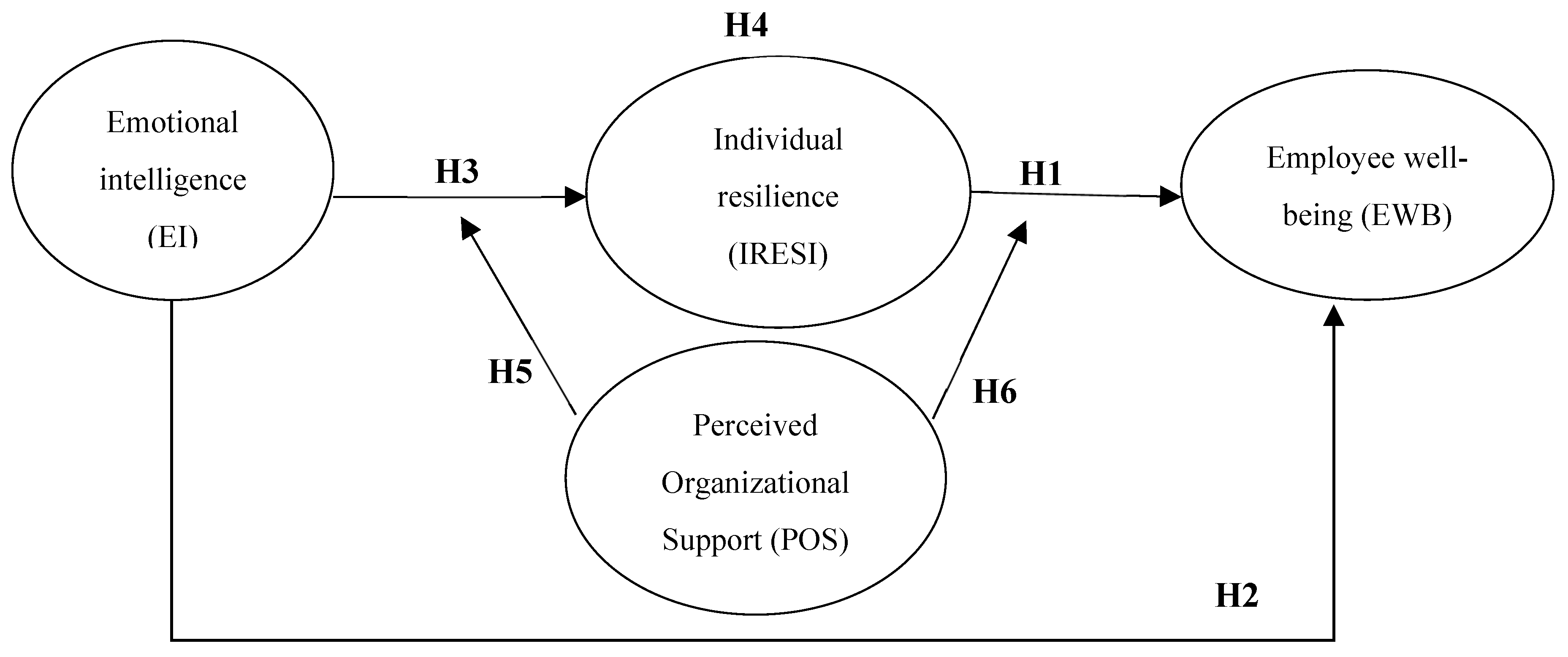
2.3. Research Model
3. Methods
3.1. Sampling and Data Collection
3.2. Instruments
3.3. Examination of the Reliability and Validity of the Study’s Variables
3.4. Common Method Bias Analysis
4. Results
4.1. Direct Relationships
4.2. Mediation Analysis
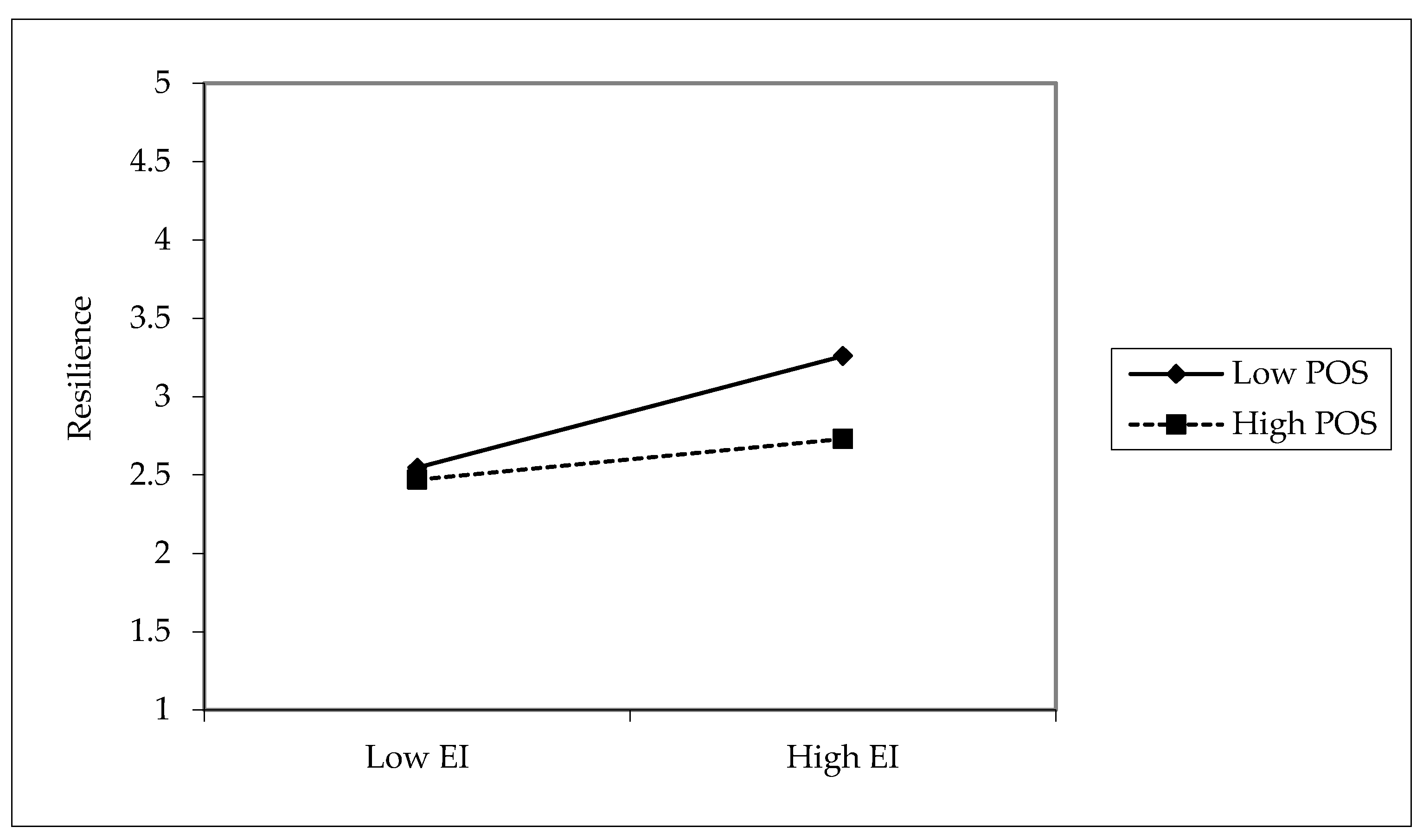
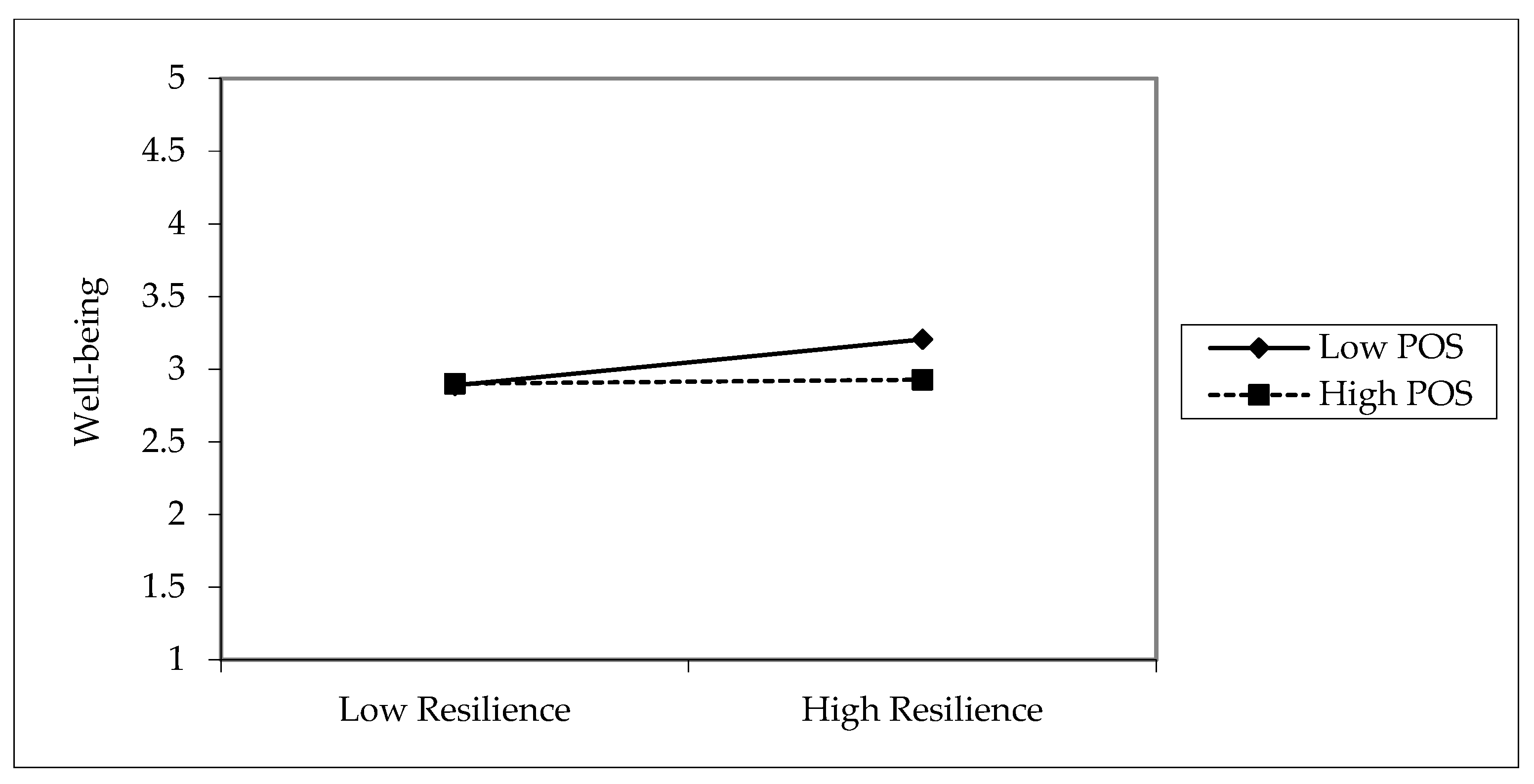
4.3. Moderation Analysis
4.4. Moderated Mediation Analysis with PROCESS
5. Discussion and Implications
5.1. Discussion
5.2. Theoretical Implications
5.3. Managerial Implications
6. Limitations and Future Research Perspectives
7. Conclusions
Funding
Institutional Review Board Statement
Informed Consent Statement
Data Availability Statement
Conflicts of Interest
Abbreviations
| EI | Emotional Intelligence |
| POS | Perceived Organizational Support |
| IRESI | Individual Resilience |
| EWB | Employee Well-Being |
References
- Akanni, A. A., Kareem, D. B., & Oduaran, C. A. (2020). The relationship between emotional intelligence and employee wellbeing through perceived person-job fit among university academic staff: A structural equation modelling approach. Cogent Psychology, 7(1), 1869376. [Google Scholar] [CrossRef]
- Al-Asfour, A., & Khan, S. A. (2014). Workforce localization in the Kingdom of Saudi Arabia: Issues and challenges. Human Resource Development International, 17(2), 243–253. [Google Scholar] [CrossRef]
- Alfaifi, A. J., Abdaly, A. Y., Alallah, S. M., Zaino, M., & El-Setouhy, M. (2024). Mental health variables affecting quality of life (QOL) among healthcare workers during the COVID-19 pandemic in Jazan City, Saudi Arabia. Frontiers in Psychology, 15, 1453494. [Google Scholar] [CrossRef] [PubMed]
- Alonazi, W. B. (2020). The impact of emotional intelligence on job performance during COVID-19 crisis: A cross-sectional analysis. Psychology Research and Behavior Management, 13, 749–757. [Google Scholar] [CrossRef] [PubMed]
- Aloulou, W. J. (Ed.). (2022). Handbook of research on entrepreneurship and organizational resilience during unprecedented times (736p). IGI Global Publishing. [Google Scholar]
- Aloulou, W. J., Almarshedi, R. F., Alharbi, S. S., & Alharbi, H. S. (2025). Fueling innovation from within: The psychological pathways to innovative work behavior in Saudi Public authorities. Administrative Sciences, 15(8), 295. [Google Scholar] [CrossRef]
- Aloulou, W. J., Amari, A., Ramadani, V., & Alboqami, A. A. N. (2023). Saudi teleworkers and determinant factors of their work-life balance and satisfaction: Testing a sequential mediation model. Technological Forecasting and Social Change, 188, 122312. [Google Scholar] [CrossRef]
- Alreshidi, S. M., & Rayani, A. M. (2023). Predictors of compassion satisfaction, compassion fatigue, and burnout among nursing professionals in a medical City in Saudi Arabia. Risk Management and Healthcare Policy, 16, 2883–2892. [Google Scholar] [CrossRef]
- Alsughayir, A. (2021). The effect of emotional intelligence on organizational commitment: Understanding the mediating role of job satisfaction. Management Science Letters, 11(4), 1309–1316. [Google Scholar] [CrossRef]
- Armstrong, A. R., Galligan, R. F., & Critchley, C. R. (2011). Emotional intelligence and psychological resilience to negative life events. Personality and Individual Differences, 51(3), 331–336. [Google Scholar] [CrossRef]
- Bakker, A. B., & Demerouti, E. (2017). Job demands–resources theory: Taking stock and looking forward. Journal of Occupational Health Psychology, 22(3), 273–285. [Google Scholar] [CrossRef]
- Benavides-Gil, G., Martínez-Zaragoza, F., Fernández-Castro, J., Sánchez-Pérez, A., & García-Sierra, R. (2024). Mindfulness-based interventions for improving mental health of frontline healthcare professionals during the COVID-19 pandemic: A systematic review. Systematic Reviews, 13(1), 160. [Google Scholar] [CrossRef]
- Brennan, E. J. (2017). Towards resilience and wellbeing in nurses. British Journal of Nursing, 26(1), 43–47. [Google Scholar] [CrossRef] [PubMed]
- Caesens, G., & Stinglhamber, F. (2020). Toward a more nuanced view on organizational support theory. Frontiers in Psychology, 11, 476. [Google Scholar] [CrossRef] [PubMed]
- Campbell-Sills, L., & Stein, M. B. (2007). Psychometric analysis and refinement of the connor–davidson resilience scale (CD-RISC): Validation of a 10-item measure of resilience. Journal of Traumatic Stress, 20(6), 1019–1028. [Google Scholar] [CrossRef] [PubMed]
- Carmeli, A., Yitzhak-Halevy, M., & Weisberg, J. (2009). The relationship between emotional intelligence and psychological wellbeing. Journal of Managerial Psychology, 24(1), 66–78. [Google Scholar] [CrossRef]
- Cazan, A. M., & Năstasă, L. E. (2015). Emotional intelligence, satisfaction with life and burnout among university students. Procedia—Social and Behavioral Sciences, 180, 1574–1578. [Google Scholar] [CrossRef]
- Chen, S., Westman, M., & Hobfoll, S. E. (2015). The commerce and crossover of resources: Resource conservation in the service of resilience. Stress and Health, 31(2), 95–105. [Google Scholar] [CrossRef]
- Chen, Y. L., & Hsieh, H. L. (2023). Do resources help or hurt? The critical roles of me, others, and organization in mitigating workplace demands. Psychological Reports, 128(5), 00332941231206354. [Google Scholar] [CrossRef]
- Collado-Soler, R., Trigueros, R., Aguilar-Parra, J. M., & Navarro, N. (2023). Emotional intelligence and resilience outcomes in adolescent period, is knowledge really strength? Psychology Research and Behavior Management, 16, 1365–1378. [Google Scholar] [CrossRef]
- Collier, J. E. (2020). Applied structural equation modeling using AMOS: Basic to advanced techniques. Routledge, Taylor & Francis Group. [Google Scholar]
- Connor, K. M., & Davidson, J. R. (2003). Development of a new resilience scale: The Connor-Davidson resilience scale (CD-RISC). Depression and Anxiety, 18(2), 76–82. [Google Scholar] [CrossRef]
- Cooper, A. L., Brown, J. A., Rees, C. S., & Leslie, G. D. (2020). Nurse resilience: A concept analysis. International Journal of Mental Health Nursing, 29(4), 553–575. [Google Scholar] [CrossRef] [PubMed]
- Danna, K., & Griffin, R. W. (1999). Health and well-being in the workplace: A review and synthesis of the literature. Journal of Management, 25(3), 357–384. [Google Scholar] [CrossRef]
- Delgado, C., Upton, D., Ranse, K., Furness, T., & Foster, K. (2017). Nurses’ resilience and the emotional labour of nursing work: An integrative review of empirical literature. International Journal of Nursing Studies, 70, 71–88. [Google Scholar] [CrossRef] [PubMed]
- Di Fabio, A., & Kenny, M. E. (2016). Promoting well-being: The contribution of emotional intelligence. Frontiers in Psychology, 7, 1182. [Google Scholar] [CrossRef] [PubMed]
- Dobles Villegas, M. T., & Schoeps, K. (2025). Emotional competencies and psychological well-being in Costa Rican emerging adults: The mediating role of self-esteem and resilience. European Journal of Investigation in Health, Psychology and Education, 15(5), 89. [Google Scholar] [CrossRef]
- Eisenberger, R., Rhoades Shanock, L., & Wen, X. (2020). Perceived organizational support: Why caring about employees counts. Annual Review of Organizational Psychology and Organizational Behavior, 7(1), 101–124. [Google Scholar] [CrossRef]
- Eisenberger, R., & Stinglhamber, F. (2011). Perceived organizational support: Fostering enthusiastic and productive employees. American Psychological Association. [Google Scholar]
- Eldeleklioglu, J., & Yildiz, M. (2020). Expressing emotions, resilience and subjective well-being: An investigation with structural equation modeling. International Education Studies, 13(6), 48–61. [Google Scholar] [CrossRef]
- Elsheikh, A. S., Alqurashi, A. M., Wahba, M. A., & Hodhod, T. E. (2018). Healthcare workforce in Saudi Arabia under Saudi vision 2030. Journal of Health Informatics in Developing Countries, 12(1), 1–11. [Google Scholar]
- Extremera, N., & Fernández-Berrocal, P. (2006). Emotional intelligence as predictor of mental, social, and physical health in university students. The Spanish Journal of Psychology, 9(1), 45–51. [Google Scholar] [CrossRef]
- Extremera, N., Sánchez-Álvarez, N., & Rey, L. (2020). Pathways between ability emotional intelligence and subjective well-being: Bridging links through cognitive emotion regulation strategies. Sustainability, 12(5), 2111. [Google Scholar] [CrossRef]
- Fornell, C., & Larcker, D. F. (1981). Evaluating structural equation models with unobservable variables and measurement error. Journal of marketing research, 18(1), 39–50. [Google Scholar] [CrossRef]
- Gallagher, E. N., & Vella-Brodrick, D. A. (2008). Social support and emotional intelligence as predictors of subjective well-being. Personality and Individual Differences, 44(7), 1551–1561. [Google Scholar] [CrossRef]
- Gameiro, F., & Ferreira, P. (2024). The relation between emotional intelligence, resilience and burnout in Portuguese individuals. Global Health Economics and Sustainability, 2(3), 2738. [Google Scholar] [CrossRef]
- García-Izquierdo, M., Soler-Sánchez, M. I., de Haro García, J. M., Ríos-Rísquez, M. I., & Meseguer-de Pedro, M. (2025). Resilience as a mediator between workplace violence and psychological well-being in hospital nurses. Nursing Reports, 15(7), 234. [Google Scholar] [CrossRef] [PubMed]
- García-Martínez, I., Augusto-Landa, J. M., Quijano-López, R., & León, S. P. (2022). What are pre-service teachers like? Analysis of their psychosocial profile. Scandinavian Journal of Psychology, 63(5), 555–564. [Google Scholar] [CrossRef]
- Gey, J. W., Yap, C. K., Leow, K., & Lo, Y. Y. (2025). Resilience as a mediator between emotional intelligence (EI) and perceived stress among young adults in Malaysia. Discover Mental Health, 5(1), 1–13. [Google Scholar] [CrossRef]
- Hair, J. F., Black, W. C., Babin, B. J., Anderson, R. E., Black, W., & Anderson, R. (2019). Multivariate data analysis. Cengage Learning EMEA. [Google Scholar]
- Halbesleben, J. R., Neveu, J. P., Paustian-Underdahl, S. C., & Westman, M. (2014). Getting to the “COR” understanding the role of resources in conservation of resources theory. Journal of Management, 40(5), 1334–1364. [Google Scholar] [CrossRef]
- Hart, P. L., Brannan, J. D., & De Chesnay, M. (2014). Resilience in nurses: An integrative review. Journal of Nursing Management, 22(6), 720–734. [Google Scholar] [CrossRef]
- Hashmi, S., Tahir, O., Nasir, Z., Hasnain, H., Riaz, R. S. U., Khan, H. M. A., Ramza, R., Alghzawi, H. M., Mukherjee, J., & Palav, A. (2024). Impact of emotional intelligence on professional performance and stress resilience among healthcare practitioners. Cureus, 16(11), e74113. [Google Scholar] [CrossRef]
- Hayes, A. F. (2022). Introduction to mediation, moderation, and conditional process analysis: A regression-based approach (3rd ed.). Guilford Press. [Google Scholar]
- Henshall, C., Davey, Z., Srikesavan, C., Hart, L., Butcher, D., & Cipriani, A. (2023). Implementation of a web-based resilience enhancement training for nurses: Pilot randomized controlled trial. Journal of Medical Internet Research, 25, e43771. [Google Scholar] [CrossRef]
- Higgs, M., & Dulewicz, V. (2014). Antecedents of well-being: A study to examine the extent to which personality and emotional intelligence contribute to well-being. The International Journal of Human Resource Management, 25(5), 718–735. [Google Scholar] [CrossRef]
- Hobfoll, S. E. (1989). Conservation of resources: A new attempt at conceptualizing stress. American Psychologist, 44(3), 513–524. [Google Scholar] [CrossRef] [PubMed]
- Hobfoll, S. E., Halbesleben, J., Neveu, J. P., & Westman, M. (2018). Conservation of resources in the organizational context: The reality of resources and their consequences. Annual Review of Organizational Psychology and Organizational Behavior, 5, 103–128. [Google Scholar] [CrossRef]
- Hodzic, S., Scharfen, J., Ripoll, P., Holling, H., & Zenasni, F. (2017). How efficient are emotional intelligence trainings: A meta-analysis. Emotion Review, 10(2), 1754073917708613. [Google Scholar] [CrossRef]
- Hu, Q., Schaufeli, W. B., & Taris, T. W. (2011). The job demands–resources model: An analysis of additive and joint effects of demands and resources. Journal of Vocational Behavior, 79(1), 181–190. [Google Scholar] [CrossRef]
- Kamboj, K. P., & Garg, P. (2021). Teachers’ psychological well-being role of emotional intelligence and resilient character traits in determining the psychological well-being of Indian school teachers. International Journal of Educational Management, 35(4), 768–788. [Google Scholar] [CrossRef]
- Karimi, L., Leggat, S. G., Bartram, T., Afshari, L., Sarkeshik, S., & Verulava, T. (2021). Emotional intelligence: Predictor of employees’ wellbeing, quality of patient care, and psychological empowerment. BMC Psychology, 9(1), 93. [Google Scholar] [CrossRef]
- Kartol, A., Üztemur, S., Griffiths, M. D., & Şahin, D. (2024). Exploring the interplay of emotional intelligence, psychological resilience, perceived stress, and life satisfaction: A cross-sectional study in the Turkish context. BMC Psychology, 12(1), 362. [Google Scholar] [CrossRef]
- Kawashima, T., Ota, Y., Aikawa, G., Watanabe, M., Ashida, K., & Sakuramoto, H. (2025). Effectiveness of emotional intelligence training on nurses’ and nursing students’ emotional intelligence, resilience, stress, and communication skills: A systematic review and meta-analysis. Nurse Education Today, 151, 106743. [Google Scholar] [CrossRef]
- Keefer, K. V., Saklofske, D. H., & Parker, J. D. (2018). Emotional intelligence, stress, and health: When the going gets tough, the tough turn to emotions. In L. D. Pool, & P. Qualter (Eds.), An introduction to emotional intelligence (pp. 161–183). John Wiley & Sons. Chapter 11. [Google Scholar]
- Kenely, N. (2019). Emotional intelligence, resilience and wellbeing. In S. Vella, R. Falzon, & A. Azzopardi (Eds.), Perspectives on wellbeing (pp. 21–34). Brill NV. [Google Scholar]
- Kong, F., Gong, X., Sajjad, S., Yang, K., & Zhao, J. (2019). How is emotional intelligence linked to life satisfaction? The mediating role of social support, positive affect and negative affect. Journal of Happiness Studies, 20(8), 2733–2745. [Google Scholar] [CrossRef]
- Kotsou, I., Mikolajczak, M., Heeren, A., Grégoire, J., & Leys, C. (2019). Improving emotional intelligence: A systematic review of existing work and future challenges. Emotion Review, 11(2), 151–165. [Google Scholar] [CrossRef]
- Köse, S., Baykal, B., & Bayat, İ. K. (2021). Mediator role of resilience in the relationship between social support and work life balance. Australian Journal of Psychology, 73(3), 316–325. [Google Scholar] [CrossRef]
- Kurtessis, J. N., Eisenberger, R., Ford, M. T., Buffardi, L. C., Stewart, K. A., & Adis, C. S. (2017). Perceived organizational support: A meta-analytic evaluation of organizational support theory. Journal of Management, 43(6), 1854–1884. [Google Scholar] [CrossRef]
- Lacomba-Trejo, L., Mateu-Mollá, J., Bellegarde-Nunes, M. D., & Delhom, I. (2022). Are coping strategies, emotional abilities, and resilience predictors of well-being? Comparison of linear and non-linear methodologies. International Journal of Environmental Research and Public Health, 19(12), 7478. [Google Scholar] [CrossRef] [PubMed]
- Langove, N., Javaid, M. U., Ayyasamy, R. K., Ibikunle, A. K., & Sabir, A. A. (2023). Job stressors and turnover intention of IT executives in Malaysia: The mediating role of employee well-being. Work: A Journal of Prevention, Assessment & Rehabilitation, 77(1), WOR–230103. [Google Scholar]
- Levey, E. J., Rondon, M. B., Sanchez, S., Williams, M. A., & Gelaye, B. (2021). Psychometric properties of the Spanish version of the 10-item Connor Davidson resilience scale (CD-RISC) among adolescent mothers in Peru. Journal of Child & Adolescent Trauma, 14, 29–40. [Google Scholar]
- Maan, A. T., Abid, G., Butt, T. H., Ashfaq, F., & Ahmed, S. (2020). Perceived organizational support and job satisfaction: A moderated mediation model of proactive personality and psychological empowerment. Future Business Journal, 6(1), 1–12. [Google Scholar] [CrossRef]
- MacKenzie, S. B., & Podsakoff, P. M. (2012). Common method bias in marketing: Causes, mechanisms, and procedural remedies. Journal of Retailing, 88(4), 542–555. [Google Scholar] [CrossRef]
- Masalat, B., Al-Ghamdi, S., Al-Asqa, W., & Elbolok, R. (2025). The moderating role of emotional intelligence in the relationship between employee resilience, perceived organizational support, and work engagement: A multi-sector study in Saudi Arabia. American Journal of Business Science Philosophy (AJBSP), 2(1), 86–99. [Google Scholar] [CrossRef]
- Mayer, J. D., & Salovey, P. (1997). What is emotional intelligence? In P. Salovey, & D. Sluyter (Eds.), Emotional development and emotional intelligence: Educational implications (pp. 3–31). Basic Books. [Google Scholar]
- Mealer, M., Jones, J., & Moss, M. (2012). A qualitative study of resilience and posttraumatic stress disorder in United States ICU nurses. Intensive Care Medicine, 38(9), 1445–1451. [Google Scholar] [CrossRef]
- Mehta, P., & Sharma, J. (2021). Moderation effect of social support and personal resources between emotional work and employee wellbeing. Asia-Pacific Journal of Business Administration, 13(2), 235–255. [Google Scholar] [CrossRef]
- Ngui, G. K., & Lay, Y. F. (2019). The predicting roles of self-efficacy and emotional intelligence and the mediating role of resilience on subjective well-being: A PLS-SEM approach. Pertanika Journal of Social Sciences & Humanities, 27(T2), 1–25. [Google Scholar]
- Page, K. M., & Vella-Brodrick, D. A. (2009). The “what,” “why” and “how” of employee well-being: A new model. Social Indicators Research, 90(3), 441–458. [Google Scholar] [CrossRef]
- Pham, L. N. T., Nguyen, D. T., Vo, A. H. K., & Nguyen, L. D. (2024). Well-being of migrant workers in Taiwan during COVID-19 pandemic: The role of perceived organisational support, employee resilience and ethical leadership. International Journal of Manpower, 45(6), 1132–1149. [Google Scholar] [CrossRef]
- Pierce, J. R., & Aguinis, H. (2013). The too-much-of-a-good-thing effect in management. Journal of Management, 39(2), 313–338. [Google Scholar] [CrossRef]
- Qin, Y., Liu, J., & Wu, D. (2023). The impact of emotional intelligence on life satisfaction among Chinese nurses: A chain mediating model. Frontiers in Psychology, 14, 1125465. [Google Scholar] [CrossRef]
- Rahman, R., & Al-Borie, H. M. (2021). Strengthening the Saudi Arabian healthcare system: Role of vision 2030. International Journal of Healthcare Management, 14(4), 1483–1491. [Google Scholar] [CrossRef]
- Ramaci, T., Santisi, G., Curatolo, K., & Barattucci, M. (2024). Perceived organizational support moderates the effect of job demands on outcomes: Testing the JD-R model in Italian oncology nurses. Palliative & Supportive Care, 22(5), 1338–1346. [Google Scholar] [CrossRef]
- Rhoades, L., & Eisenberger, R. (2002). Perceived organizational support: A review of the literature. Journal of Applied Psychology, 87(4), 698. [Google Scholar] [CrossRef]
- Sánchez-Álvarez, N., Extremera, N., & Fernández-Berrocal, P. (2016). The relation between emotional intelligence and subjective well-being: A meta-analytic investigation. Journal of Positive Psychology, 11(3), 276–285. [Google Scholar] [CrossRef]
- Schaufeli, W. B., & Taris, T. W. (2014). A critical review of the job demands–resources model: Implications for improving work and health. In G. F. Bauer, & O. Hämmig (Eds.), Bridging occupational, organizational and public health (pp. 43–68). Springer. [Google Scholar]
- Schneider, T. R., Lyons, J. B., & Khazon, S. (2013). Emotional intelligence and resilience. Personality and Individual Differences, 55(8), 909–914. [Google Scholar] [CrossRef]
- Schutte, N. S., Malouff, J. M., Thorsteinsson, E. B., Bhullar, N., & Rooke, S. E. (2007). A meta-analytic investigation of the relationship between emotional intelligence and health. Personality and Individual Differences, 42(6), 921–933. [Google Scholar] [CrossRef]
- Shantz, A., Alfes, K., & Latham, G. P. (2016). The buffering effect of perceived organizational support on the relationship between work engagement and behavioral outcomes. Human Resource Management, 55(1), 25–38. [Google Scholar] [CrossRef]
- Shuo, Z., Xuyang, D., Xin, Z., Xuebin, C., & Jie, H. (2022). The relationship between postgraduates’ emotional intelligence and well-being: The chain mediating effect of social support and psychological resilience. Frontiers in Psychology, 13, 865025. [Google Scholar] [CrossRef]
- Siraj, R. A., Alhaykan, A. E., Alrajeh, A. M., Aldhahir, A. M., Alqahtani, J. S., Bakhadlq, S., Alghamdi, S. M., Alqarni, A. A., Alqarni, M. M., Alanazi, T. M., Alruwaili, A., Algarni, S. S., Alahmadi, F. H., Alahmari, M., & Alahmadi, R. H. (2023). Burnout, resilience, supervisory support, and quitting intention among healthcare professionals in Saudi Arabia: A national cross-sectional survey. International Journal of Environmental Research and Public Health, 20(3), 2407. [Google Scholar] [CrossRef] [PubMed]
- Šimunjak, M. (2023). Teaching emotional intelligence for enhancing resilience in journalism. Journalism & Mass Communication Educator, 78(2), 10776958231165103. [Google Scholar] [CrossRef]
- Tabachnick, B. G., & Fidell, L. S. (2013). Using multivariate statistics (6th ed.). Pearson. [Google Scholar]
- ten Brummelhuis, L. L., & Bakker, A. B. (2012). A resource perspective on the work–home interface: The work–home resources model. American Psychologist, 67(7), 545–556. [Google Scholar] [CrossRef]
- Trigueros, R., Padilla, A. M., Aguilar-Parra, J. M., Rocamora, P., Morales-Gázquez, M. J., & López-Liria, R. (2020). The influence of emotional intelligence on resilience, test anxiety, academic stress and the Mediterranean diet. A study with university students. International Journal of Environmental Research and Public Health, 17(6), 2071. [Google Scholar] [CrossRef]
- Valdez, P. J. M., Padilla, Z. M., Sison, P. J., & De Luna, L. R. (2023, February 1–4). Emotional intelligence, self-efficacy and resilience among Filipino nursing university students in the blended learning setup: A mediation analysis using PLS-SEM. 14th International Conference on E-Education, E-Business, E-Management and E-Learning (pp. 25–31), Online. [Google Scholar]
- Vilca-Pareja, V., Luque Ruiz de Somocurcio, A., Delgado-Morales, R., & Medina Zeballos, L. (2022). Emotional intelligence, resilience, and self-esteem as predictors of satisfaction with life in university students. International Journal of Environmental Research and Public Health, 19(24), 16548. [Google Scholar] [CrossRef]
- West, C. P., Dyrbye, L. N., Erwin, P. J., & Shanafelt, T. D. (2016). Interventions to prevent and reduce physician burnout: A systematic review and meta-analysis. The Lancet, 388(10057), 2272–2281. [Google Scholar] [CrossRef]
- Wong, C. S., & Law, K. S. (2002). The effects of leader and follower emotional intelligence on performance and attitude: An exploratory study. The Leadership Quarterly, 13, 243–274. [Google Scholar] [CrossRef]
- Xanthopoulou, D., Bakker, A. B., Demerouti, E., & Schaufeli, W. B. (2007). The role of personal resources in the job demands-resources model. International Journal of Stress Management, 14(2), 121. [Google Scholar] [CrossRef]
- Xing, L., Deng, S. W., & Ho, G. W. (2023). From empathy to resilience: The mediating role of emotional intelligence. Psychological Reports, 128, 4533–4548. [Google Scholar] [CrossRef]
- Zheng, X., Zhu, W., Zhao, H., & Zhang, C. (2015). Employee well-being in organizations: Theoretical model, scale development, and cross-cultural validation. Journal of Organizational Behavior, 36(5), 621–644. [Google Scholar] [CrossRef]



| Respondent’s Characteristics | Frequency | Percent % | |
|---|---|---|---|
| Age | |||
| Less than 22 years old | 47 | 15.46 | |
| Between 23 and 30 years old | 126 | 41.45 | |
| Between 31 and 40 years | 87 | 28.62 | |
| Between 41 and 50 years | 35 | 11.51 | |
| 51 years and more | 9 | 2.96 | |
| Gender | |||
| Male | 209 | 68.75 | |
| Female | 95 | 31.25 | |
| Marital status | |||
| Single | 185 | 60.86 | |
| Married | 110 | 36.18 | |
| Divorced/Widowed | 9 | 2.96 | |
| Number of Children in charge | |||
| 0 | 190 | 62.50 | |
| 1–2 | 65 | 21.38 | |
| 3–4 | 31 | 10.20 | |
| 5 and more | 18 | 5.92 | |
| Educational level | |||
| Diploma | 34 | 11.18 | |
| Bachelor | 178 | 58.55 | |
| Master | 53 | 17.43 | |
| Ph.D. | 39 | 12.83 | |
| Work experience | |||
| −1 year | 64 | 21.05 | |
| Between 1 and 5 years | 110 | 36.18 | |
| Between 5 and 10 years | 61 | 20.07 | |
| Between 10 and 15 years | 41 | 13.49 | |
| +15 years | 28 | 9.21 | |
| Employment status | |||
| Full-time | 235 | 77.30 | |
| Part-time | 34 | 11.18 | |
| Other | 35 | 11.51 | |
| Shifting work | |||
| Fixed | 124 | 40.79 | |
| Rotating | 180 | 59.21 | |
| Nationality | |||
| Saudis | 201 | 66.12 | |
| Expatriates | 103 | 33.88 | |
| Job | |||
| Nurse | 73 | 24.01 | |
| Physician | 91 | 29.93 | |
| Technician | 65 | 21.38 | |
| Other allied healthcare worker | 75 | 24.67 | |
| Healthcare Organization’s Characteristics | Frequency | Percent % | |
|---|---|---|---|
| Sector | |||
| Public sector | 168 | 55.26 | |
| Private sector | 99 | 32.57 | |
| Other | 37 | 12.17 | |
| Localization of the healthcare organization | |||
| In Riyadh | 202 | 66.45 | |
| Outside Riyadh | 102 | 33.55 | |
| Healthcare organization | |||
| Primary health care center | 36 | 11.84 | |
| Hospital | 148 | 48.68 | |
| Medical Complex/Aggregate Clinics | 55 | 18.09 | |
| Medical laboratory | 17 | 5.59 | |
| Dental center | 14 | 4.61 | |
| Others | 33 | 10.86 | |
| Variables | Dimensions | Factor Loadings | % | KMO | Alpha | CR | AVE |
|---|---|---|---|---|---|---|---|
| Emotional intelligence (EI) | - Self-emotion appraisal (EI1–EI4) - Others’ emotion appraisal (EI5–EI8) - Use of emotion (EI9–EI12) - Regulation of emotion (EI13–EI16) | From 0.661 to 0.789 | 56.819 | 0.956 | 0.949 | 0.955 | 0.568 |
| Individual resilience (IRESI) | IRESI1-IRESI10 | From 0.765 to 0.845 | 63.377 | 0.957 | 0.935 | 0.945 | 0.634 |
| Perceived Organizational Support (POS) | POS1-POS10 | From 0.765 to 0.872 | 69.919 | 0.956 | 0.952 | 0.959 | 0.700 |
| Employee Well-being (EWB) | - Life well-being (EWB1–EWB6) - Work Well-being (EWB9–EWB12) (*) - Psychological Well-being (EWB13–EWB18) | From 0.661 to 0.823 | 57.831 | 0.956 | 0.951 | 0.956 | 0.578 |
| EI | IRESI | POS | EWB | |
|---|---|---|---|---|
| EI | 0.754 | |||
| IRESI | 0.678 ** | 0.796 | ||
| POS | 0.552 ** | 0.572 ** | 0.837 | |
| EWB | 0.637 ** | 0.679 ** | 0.606 ** | 0.760 |
| Model Fit Indices | CMIN/DF | RMR | GFI | IFI | TLI | CFI | RMSEA |
|---|---|---|---|---|---|---|---|
| One factor | 4.299 | 0.120 | 0.431 | 0.654 | 0.639 | 0.653 | 0.104 |
| Four factors | 1.671 | 0.079 | 0.871 | 0.948 | 0.940 | 0.948 | 0.048 |
| Hypothesized Relationship | U_Estimate | S_Estimate | S.E. | C.R. | p | Hypothesis | ||
|---|---|---|---|---|---|---|---|---|
| EWB | ← | IRESI | 0.348 *** | 0.444 | 0.059 | 5.940 | *** | H1 supported |
| EWB | ← | EI | 0.147 * | 0.159 | 0.061 | 2.425 | 0.015 | H2 supported |
| IRESI | ← | EI | 0.667 *** | 0.565 | 0.077 | 8.622 | *** | H3 supported |
| IRESI | ← | POS | 0.267 *** | 0.290 | 0.051 | 5.281 | *** | - |
| EWB | ← | POS | 0.207 *** | 0.286 | 0.042 | 4.984 | *** | - |
| IRESI | ← | EI × POS | −0.125 *** | −0.136 | 0.037 | −3.396 | *** | H5 supported |
| EWB | ← | IRESI × POS | −0.080 ** | −0.109 | 0.029 | −2.766 | 0.006 | H6 supported |
| IV | Mediator | DV | Direct | Indirect | Total | Hypothesis H4 |
|---|---|---|---|---|---|---|
| EI | IRESI | EWB | 0.159 * | 0.251 * | 0.410 * | Partial mediation |
| Indirect Effect: EI_c → IRESI_c → EWB | ||||
|---|---|---|---|---|
| POSm_c | Effect | BootSE | BootLLCI | BootULCI |
| −1.0222 | 0.2854 | 0.0597 | 0.1735 | 0.4038 |
| 0.0000 | 0.1874 | 0.0403 | 0.1135 | 0.2707 |
| 1.0222 | 0.1097 | 0.0368 | 0.0443 | 0.1890 |
Disclaimer/Publisher’s Note: The statements, opinions and data contained in all publications are solely those of the individual author(s) and contributor(s) and not of MDPI and/or the editor(s). MDPI and/or the editor(s) disclaim responsibility for any injury to people or property resulting from any ideas, methods, instructions or products referred to in the content. |
© 2025 by the author. Published by MDPI on behalf of the University Association of Education and Psychology. Licensee MDPI, Basel, Switzerland. This article is an open access article distributed under the terms and conditions of the Creative Commons Attribution (CC BY) license (https://creativecommons.org/licenses/by/4.0/).
Share and Cite
Aloulou, W.J. When Resources Substitute for Each Other: How Emotional Intelligence and Organizational Support Interact in Relation to Resilience and Well-Being Among Healthcare Professionals. Eur. J. Investig. Health Psychol. Educ. 2025, 15, 254. https://doi.org/10.3390/ejihpe15120254
Aloulou WJ. When Resources Substitute for Each Other: How Emotional Intelligence and Organizational Support Interact in Relation to Resilience and Well-Being Among Healthcare Professionals. European Journal of Investigation in Health, Psychology and Education. 2025; 15(12):254. https://doi.org/10.3390/ejihpe15120254
Chicago/Turabian StyleAloulou, Wassim J. 2025. "When Resources Substitute for Each Other: How Emotional Intelligence and Organizational Support Interact in Relation to Resilience and Well-Being Among Healthcare Professionals" European Journal of Investigation in Health, Psychology and Education 15, no. 12: 254. https://doi.org/10.3390/ejihpe15120254
APA StyleAloulou, W. J. (2025). When Resources Substitute for Each Other: How Emotional Intelligence and Organizational Support Interact in Relation to Resilience and Well-Being Among Healthcare Professionals. European Journal of Investigation in Health, Psychology and Education, 15(12), 254. https://doi.org/10.3390/ejihpe15120254