
Factors in the Mental Health of Children from Low-Income Families in the United States: An Application of the Multiple Disadvantage Model


Abstract
1. Introduction
1.1. Literature Review
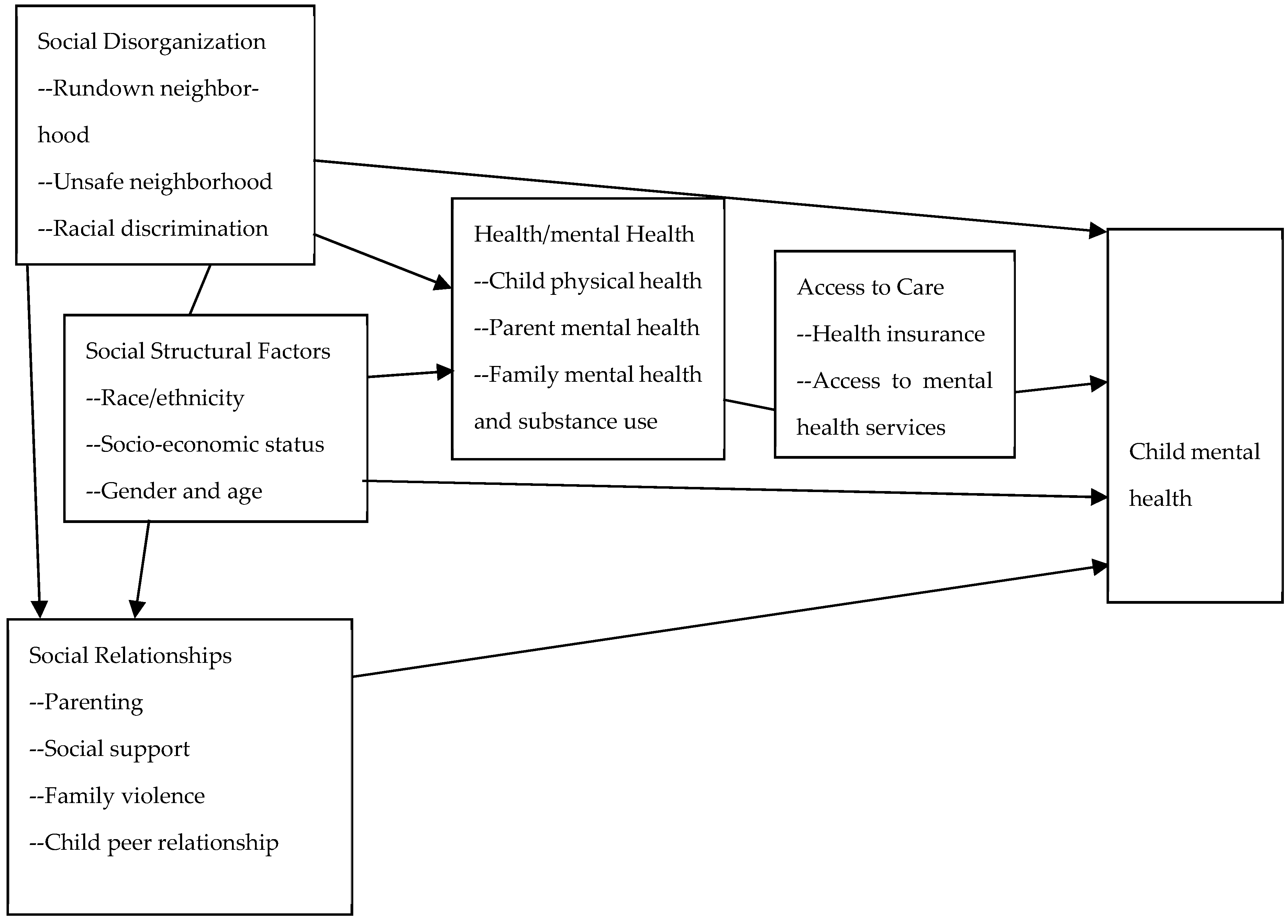
1.1.1. Social Disorganization
1.1.2. Social Structural Factors
1.1.3. Social Relationships
1.1.4. Health/Mental Health
1.1.5. Access to Care
1.2. Hypotheses
2. Methods
2.1. Sample
2.2. Measures
2.3. Data Analysis
3. Results
3.1. Descriptive Statistics
3.2. Multivariate Analysis
4. Discussion
4.1. Social Disorganization
4.2. Social Structural Factors
4.3. Social Relationships
4.4. Health/Mental Health
4.5. Access to Care
5. Conclusions
Author Contributions
Funding
Institutional Review Board Statement
Informed Consent Statement
Data Availability Statement
Conflicts of Interest
References
- Aarons, G. A., Brown, S. A., Hough, R. L., Garland, A. F., & Wood, P. A. (2001). Prevalence of adolescent substance use disorders across five sectors of care. Journal of the American Academy of Child and Adolescent Psychiatry, 40(4), 419–426. [Google Scholar] [CrossRef] [PubMed]
- Abe-Kim, J., Takeuchi, D. T., Hong, S., Zane, N., Sue, S., Spencer, M. S., Appel, H., Nicdao, E., & Alegría, M. (2007). Use of mental health–related services among immigrant and US-born Asian Americans: Results from the National Latino and Asian American Study. American Journal of Public Health, 97(1), 91–98. [Google Scholar] [CrossRef]
- Acosta-Pérez, E., Canino, G., Ramírez, R., Prelip, M., Martin, M., & Ortega, A. N. (2012). Do puerto rican youth with asthma and obesity have higher odds for mental health disorders? Psychosomatics, 53(2), 162–171. [Google Scholar] [CrossRef] [PubMed]
- Bringewatt, E. H., & Gershoff, E. T. (2010). Falling through the cracks: Gaps and barriers in the mental health system for America’s disadvantaged children. Children and Youth Services Review, 32(10), 1291–1299. [Google Scholar] [CrossRef] [PubMed]
- Buckner, J. C., Beardslee, W. R., & Bassuk, E. L. (2004). Exposure to violence and low-income children’s mental health: Direct, moderated, and mediated relations. American Journal of Orthopsychiatry, 74(4), 413–423. [Google Scholar] [CrossRef]
- Centers for Disease Control and Prevention. (2025). Data and statistics on children’s mental health. Centers for Disease Control and Prevention.
- Chase-Lansdale, P. L., Moffitt, R. A., Lohman, B. J., Cherlin, A. J., Coley, R. L., Pittman, L. D., Roff, J., & Votruba-Drzal, E. (2003). Mothers transitions from welfare to work and the well-being of preschoolers and adolescents. Science, 299(5612), 1548–1552. [Google Scholar] [CrossRef][Green Version]
- Cheng, T. C., & Li, Q. (2017). Adolescent delinquency in child welfare system: A multiple disadvantage model. Children and Youth Service Review, 73, 205–212. [Google Scholar] [CrossRef]
- Cheng, T. C., & Lo, C. C. (2016). Racial disparities in children’s health: A longitudinal analysis of mothers based on the multiple disadvantage model. Journal of Community Health, 41(4), 753–760. [Google Scholar] [CrossRef]
- Cheng, T. C., & Lo, C. C. (2017). Social risk and protective factors in adolescents’ reduction and cessation of alcohol use. Substance Use & Misuse, 52(7), 916–928. [Google Scholar] [CrossRef]
- Cheng, T. C., & Lo, C. C. (2022a). Factors related to immigrant/nonimmigrant children’s experience of being bullied: An analysis using the multiple disadvantage model. Community Mental Health Journal, 58(4), 689–700. [Google Scholar] [CrossRef]
- Cheng, T. C., & Lo, C. C. (2022b). Factors related to use of mental health services by immigrant children. Journal of Child and Family Studies, 31(1), 228–236. [Google Scholar] [CrossRef]
- Cheng, T. C., & Lo, C. C. (2025a). Factors related to mental health of 11- to 17-year-old adolescent low-birth-weight survivors in the United States: Application of multiple disadvantage model. Families in Society, 10443894241300628. [Google Scholar] [CrossRef]
- Cheng, T. C., & Lo, C. C. (2025b). Utilization of mental health services by low-income children in the United States: A multiple disadvantage model. Journal of Poverty, 1–17. [Google Scholar] [CrossRef]
- Coffman, M. J., Shobe, M. A., & O’Connell, B. (2008). Self-prescription practices in recent Latino immigrants. Public Health Nursing, 25(3), 203–211. [Google Scholar] [CrossRef] [PubMed]
- Copeland, V. C., & Snyder, K. (2011). Barriers to mental health treatment services for low-income African American women whose children receive behavioral health services: An ethnographic investigation. Social Work in Public Health, 26(1), 78–95. [Google Scholar] [CrossRef] [PubMed]
- Crouch, E., Figas, K., Radcliff, E., & Hunt, E. T. (2023). Examining bullying victimization, bullying perpetration, and positive childhood experiences. Journal of School Health, 93(8), 669–678. [Google Scholar] [CrossRef]
- De Marco, A., & Vernon-Feagans, L. (2013). Rural neighborhood context, child care quality, and relationship to early language development. Early Education and Development, 24(6), 792–812. [Google Scholar] [CrossRef]
- Drabick, D. A. G., Jakubovic, R. J., Everett, V. S., Friedman, A. L., Emory, G. O., & Kalchthaler, F. B. (2021). Conduct problems among children in low-income, urban neighborhoods: A developmental psychopathology- and RDoC-informed approach. Development and Psychopathology, 33(5), 1864–1881. [Google Scholar] [CrossRef]
- Dufford, A. J., Bianco, H., & Kim, P. (2019). Socioeconomic disadvantage, brain morphometry, and attentional bias to threat in middle childhood. Cognitive Affective & Behavioral Neuroscience, 19(2), 309–326. [Google Scholar] [CrossRef]
- Dukes, R. L., Portillos, E., & Miles, M. (2009). Models of satisfaction with police service. Policing: An International Journal of Police Strategies & Management, 32(2), 297–318. [Google Scholar] [CrossRef]
- Goldbach, J. T., Sterzing, P. R., & Stuart, M. J. (2018). Challenging conventions of bullying thresholds: Exploring differences between low and high levels of bully-only, victim-only, and bully-victim roles. Journal of Youth and Adolescence, 47(3), 586–600. [Google Scholar] [CrossRef]
- Goldweber, A., Waasdorp, T. E., & Bradshaw, C. P. (2013). Examining associations between race, urbanicity, and patterns of bullying involvement. Journal of Youth and Adolescence, 42(2), 206–219. [Google Scholar] [CrossRef]
- Hass, M. (2022). Racial harmony: The case of Hawaii. Journal for Social Thought, 6(1), 1–18. [Google Scholar]
- Hill, N. E., Bush, K. R., & Roosa, M. W. (2003). Parenting and family Socialization strategies and children’s mental health: Low-income Mexican-American and Euro-American mothers and children. Child Development, 74(1), 189–204. [Google Scholar] [CrossRef]
- Hillemeier, M. M., Foster, E. M., Heinrichs, B., Heier, B., & Conduct Problems Prevention Research Group. (2007). Racial differences in parental reports of attention-deficit/hyperactivity disorder Behaviors. Journal of Developmental and Behavioral Pediatrics, 28(5), 353–361. [Google Scholar] [CrossRef]
- Hoagwood, K. E., Cavaleri, M. A., Olin, S. S., Burns, B. J., Slaton, E., Gruttadaro, D., & Hughes, R. (2010). Family support in children’s mental health: A review and synthesis. Clinical Child and Family Psychology Review, 13(1), 1–45. [Google Scholar] [CrossRef] [PubMed]
- Howell, E. (2004). Access to children’s mental health services under medicaid and SCHIP. Urban Institute. [Google Scholar]
- Isasi, C. R., Rastogi, D., & Molina, K. (2016). Health issues in Hispanic/Latino youth. Journal of Latina-O Psychology, 4(2), 67–82. [Google Scholar] [CrossRef] [PubMed]
- Jenson, J. M., Brisson, D., Bender, K. A., & Williford, A. P. (2013). Effects of the youth matters prevention program on patterns of bullying and victimization in elementary and middle school. Social Work Research, 37(4), 361–372. [Google Scholar] [CrossRef]
- Kedia, S. K., Schmidt, M., Dillon, P. J., Arshad, H., & Yu, X. (2021). Substance use treatment in Appalachian Tennessee amid COVID-19: Challenges and preparing for the future. Journal of Substance Abuse Treatment, 124, 108270. [Google Scholar] [CrossRef]
- Keeton, V. F., Bell, J. F., Drake, C., Garcia, E., Pantell, M., Hessler, D., Wing, H., Silveira, P. P., Donnell, K. J. O., de Mendonça, E. J., Meaney, M. J., & Gottlieb, L. M. (2023). Household social needs, emotional functioning, and stress in low-income Latinx children and their mothers. Journal of Child and Family Studies, 32(3), 796–811. [Google Scholar] [CrossRef]
- Koroloff, N. M., Elliott, D. J., Koren, P. E., & Friesen, B. J. (1994). Connecting low-income families to mental-health-services: The role of the family associate. Journal of Emotional and Behavioral Disorders, 2(4), 240–246. [Google Scholar] [CrossRef]
- Koroloff, N. M., Elliott, D. J., Koren, P. E., & Friesen, B. J. (1996). Linking low-income families to children’s mental health services: An outcome study. Journal of Emotional and Behavioral Disorders, 4(1), 2–11. [Google Scholar] [CrossRef]
- Kowalski, R. M., & Limber, S. P. (2013). Psychological, physical, and academic correlates of cyberbullying and traditional bullying. Journal of Adolescent Health, 53(1), S13–S20. [Google Scholar] [CrossRef]
- Lakind, D., & Atkins, M. S. (2018). Promoting positive parenting for families in poverty: New directions for improved reach and engagement. Children and Youth Services Review, 89, 34–42. [Google Scholar] [CrossRef]
- Li, Q., & Cheng, C. T. (2017). New evidence in physical violent behaviors among school-aged children: A multiple disadvantages model. Children and Youth Services Review, 81, 301–308. [Google Scholar] [CrossRef]
- Lo, C. C., Howell, R. J., & Cheng, T. C. (2013). Explaining black-white differences in homicide victimization. Aggression and Violent Behavior, 18, 125–134. [Google Scholar] [CrossRef]
- Lo, C. C., Howell, R. J., & Cheng, T. C. (2015). Racial disparities in age at time of homicide victimization: A test of the multiple disadvantage model. Journal of Interpersonal Violence, 30(1), 152–167. [Google Scholar] [CrossRef] [PubMed]
- Lynch, V., & Clemans-Cope, L. (2023). Substance use disorder and mental health diagnoses among medicaid-enrolled youth before the pandemic: Summary of findings from four states and the District of Columbia. Urban Institute. [Google Scholar]
- Masho, S. W., Zirkle, K. W., Wheeler, D. C., Sullivan, T., & Farrell, A. D. (2019). Spatial analysis of the impact of a school-level youth violence prevention program on violent crime incidents in the community. Prevention Science, 20(4), 521–531. [Google Scholar] [CrossRef]
- McKelvey, L. M., Whiteside-Mansell, L., Bradley, R. H., Casey, P. H., Conners-Burrow, N. A., & Barrett, K. W. (2011). Growing up in violent communities: Do family conflict and gender moderate impacts on adolescents’ psychosocial development? Journal of Abnormal Child Psychology, 39(1), 95–107. [Google Scholar] [CrossRef]
- Nguyen, P. V., Leung, P., & Cheung, M. (2011). Bridging help-seeking options to Vietnamese Americans with parent-child conflict and depressive symptoms. Children and Youth Services Review, 33(10), 1842–1846. [Google Scholar] [CrossRef]
- Odgers, C. L., & Russell, M. A. (2017). Violence exposure is associated with adolescents’ same- and next-day mental health symptoms. Journal of Child Psychology and Psychiatry, 58(12), 1310–1318. [Google Scholar] [CrossRef] [PubMed]
- Olazagasti, M. A. R., Shrout, P. E., Yoshikawa, H., Bird, H. R., & Canino, G. J. (2012). The longitudinal relationship between parental reports of asthma and anxiety and depression symptoms among two groups of Puerto Rican youth. Journal of Psychosomatic Research, 73(4), 283–288. [Google Scholar] [CrossRef] [PubMed][Green Version]
- Overhage, L. N., Benson, N. M., Flores, M. W., & Le Cook, B. (2024). Self-pay outpatient mental health care for children and adolescents, by socioeconomic status. Psychiatric Services, 75(9), 833–838. [Google Scholar] [CrossRef] [PubMed]
- Ross, S. W., & Horner, R. H. (2014). Bully prevention in positive behavior support: Preliminary evaluation of third-, fourth-, and fifth-grade attitudes toward bullying. Journal of Emotional and Behavioral Disorders, 22(4), 225–236. [Google Scholar] [CrossRef]
- Santiago, C. D., Kaltman, S., & Miranda, J. (2013). Poverty and mental health: How do low-income adults and children fare in psychotherapy? Journal of Clinical Psychology, 69(2), 115–126. [Google Scholar] [CrossRef]
- Spencer, M. S., Chen, J. A., Gee, G. C., Fabian, C. G., & Takeuchi, D. T. (2010). Discrimination and mental health-related service use in a national study of Asian Americans. American Journal of Public Health, 100(12), 2410–2417. [Google Scholar] [CrossRef]
- Sterzing, P. R., Auslander, W. F., Ratliff, G. A., Gerke, D. R., Edmond, T., & Jonson-Reid, M. (2020). Exploring bullying perpetration and victimization among adolescent girls in the child welfare system: Bully-only, victim-only, bully-victim, and noninvolved roles. Journal of Interpersonal Violence, 35(5–6), 1311–1333. [Google Scholar] [CrossRef]
- Substance Abuse and Mental Health Services Administration. (2023). Strategic plan 2023–2026 (PEP23-06-00-002). Substance Abuse and Mental Health Services Administration.
- Turner, E. H., & Mueller, C. W. (2025). Therapeutic focus on strengths is associated with improved functioning and higher clinical progress in children’s public mental health care. Community Mental Health Journal, 61, 1047–1061. [Google Scholar] [CrossRef]
- Tyrell, F. A., Rogosch, F. A., & Cicchetti, D. (2024). Profiles of risk, allostatic load, and mental health in low-income children. Clinical Psychological Science, 12(4), 586–606. [Google Scholar] [CrossRef]
- U.S. Census Bureau. (2022). 2021 national survey of children’s health: Methodology report. U.S. Census Bureau.
- Wang, C., Do, K. A., Frese, K., & Zheng, L. (2019). Asian immigrant parents’ perception of barriers preventing adolescents from seeking school-based mental health services. School Mental Health, 11(2), 364–377. [Google Scholar] [CrossRef]
- Wang, Y. C., & McLeroy, A. M. (2023). Poverty, parenting stress, and adolescent mental health: The protective role of school connectedness reexamined. Children and Youth Services Review, 153, 107127. [Google Scholar] [CrossRef]
- Waylen, A., & Stewart-Brown, S. (2010). Factors influencing parenting in early childhood: A prospective longitudinal study focusing on change. Child Care Health and Development, 36(2), 198–207. [Google Scholar] [CrossRef] [PubMed]
- White, R. M. B., Roosa, M. W., & Zeiders, K. H. (2012). Neighborhood and family intersections: Prospective implications for Mexican American adolescents’ mental health. Journal of Family Psychology, 26(5), 793–804. [Google Scholar] [CrossRef] [PubMed]
- Woolhouse, H., Brown, S., Krastev, A., Perlen, S., & Gunn, J. (2009). Seeking help for anxiety and depression after childbirth: Results of the Maternal Health Study. Archives of Womens Mental Health, 12(2), 75–83. [Google Scholar] [CrossRef] [PubMed]
- Zacher, M., Arkin, M., Rhodes, J., & Lowe, S. R. (2022). The effects of maternal disaster exposure on adolescent mental health 12 years later. Research on Child and Adolescent Psychopathology, 50(9), 1191–1205. [Google Scholar] [CrossRef]
- Zhang, Z., Sun, K., Jatchavala, C., Koh, J., Chia, Y., Bose, J., Li, Z., Tan, W., Wang, S., Chu, W., Wang, J., Tran, B., & Ho, R. (2020). Overview of stigma against psychiatric illnesses and advancements of anti-stigma activities in six Asian societies. International Journal of Environmental Research and Public Health, 17(1), 280. [Google Scholar] [CrossRef]


| Percent | Mean | Range | Sd | |
|---|---|---|---|---|
| Outcome variable | ||||
| Mental health problem (yes) | 36.7 | |||
| (no) | 63.3 | |||
| Social disorganization factors | ||||
| Rundown neighborhood (yes) | 31.4 | |||
| (no) | 68.6 | |||
| Safe neighborhood (1 = definitely disagree) | 3.5 | 1–4 | 0.7 | |
| (2 = somewhat disagree) | ||||
| (3 = somewhat agree) | ||||
| (4 = definitely agree) | ||||
| Racial discrimination (yes) | 6.0 | |||
| (no) | 94.0 | |||
| Social structural factors | ||||
| White | 51.4 | |||
| Black | 11.6 | |||
| Hispanic | 22.5 | |||
| Asian | 5.8 | |||
| Other racial/ethnic minorities | 8.7 | |||
| Girl | 47.1 | |||
| Boy | 52.9 | |||
| Child age: 6 to 10 years | 38.7 | |||
| Child age: 11 to 13 years | 24.7 | |||
| Child age: 14 to 17 years | 36.6 | |||
| Parent age (years) | 41.7 | 18–75 | 8.1 | |
| Parent education (1 = 8th grade or below) | 4.9 | 1–9 | 2.0 | |
| (2 = 9th–12th grade) | ||||
| (3 = graduated high school or GED) | ||||
| (4 = vocational school) | ||||
| (5 = some college) | ||||
| (6 = associate degree) | ||||
| (7 = undergraduate degree) | ||||
| (8 = master’s degree) | ||||
| (9 = doctoral or professional degree) | ||||
| Employed parent (yes) | 65.1 | |||
| (no) | 34.9 | |||
| Family income-to-poverty ratio (%) | 112.1 | 50–199 | 50.1 | |
| Social relationships | ||||
| Single mother (yes) | 32.1 | |||
| (no) | 67.9 | |||
| Family violence (yes) | 8.0 | |||
| (no) | 92.0 | |||
| Neighbor support (1 = definitely disagree) | 9.4 | 3–12 | 2.2 | |
| (2 = somewhat disagree) | ||||
| (3 = somewhat agree) | ||||
| (4 = definitely agree) | ||||
| Poor parent-child communication (1 = very well) | 1.5 | 1–4 | 0.7 | |
| (2 = somewhat well) | ||||
| (3 = not very well) | ||||
| (4 = not well at all) | ||||
| Child argued (1 = never) | 2.1 | 1–4 | 0.9 | |
| (2 = sometimes) | ||||
| (3 = usually) | ||||
| (4 = always) | ||||
| Difficulty of parenting the child (1 = never) | 5.3 | 3–15 | 2.2 | |
| (2 = rarely) | ||||
| (3 = sometimes) | ||||
| (4 = usually) | ||||
| (5 = always) | ||||
| Child’s difficulty with peers (1 = no difficulty) | 1.3 | 1–3 | 0.6 | |
| (2 = a little difficulty) | ||||
| (3 = a lot of difficulty) | ||||
| Being bullied (yes) | 34.5 | |||
| (no) | 65.5 | |||
| Health/mental health | ||||
| Child general health (1 = poor) | 4.4 | 1–5 | 0.8 | |
| (2 = fair) | ||||
| (3 = good) | ||||
| (4 = very good) | ||||
| (5 = excellent) | ||||
| Parent mental health (1 = poor) | 3.8 | 1–5 | 1.0 | |
| (2 = fair) | ||||
| (3 = good) | ||||
| (4 = very good) | ||||
| (5 = excellent) | ||||
| Family mental health problem (yes) | 13.4 | |||
| (no) | 86.6 | |||
| Family substance use problem (yes) | 13.0 | |||
| (no) | 87.0 | |||
| Access to care | ||||
| Public health insurance | 56.5 | |||
| Private health insurance | 37.9 | |||
| Other health insurance | 4.7 | |||
| Uninsured | 7.7 | |||
| Difficulty of accessing mental health services (yes) | 9.8 | |||
| (no) | 90.2 |
| Variables | OR | RSE | 90% CI |
|---|---|---|---|
| Social disorganization factors | |||
| Rundown neighborhood (no) | 0.73 * | 0.11 | 0.56–0.94 |
| Safe neighborhood | 0.78 * | 0.09 | 0.65–0.93 |
| Racial discrimination (no) | 0.92 | 0.24 | 0.61–1.41 |
| Social structural factors | |||
| Black (White) | 0.99 | 0.19 | 0.72–1.36 |
| Hispanic (White) | 0.72 * | 0.13 | 0.53–0.97 |
| Asian (White) | 0.31 ** | 0.11 | 0.18–0.55 |
| Other racial/ethnic minorities (White) | 0.90 | 0.18 | 0.65–1.25 |
| Girl (boy) | 0.58 ** | 0.08 | 0.46–0.73 |
| Child age: 6 to 10 years (age: 14 to 17 years) | 0.90 | 0.13 | 0.71–1.15 |
| Child age: 11 to 13 years (age: 14 to 17 years) | 1.07 | 0.16 | 0.83–1.38 |
| Parent age | 0.99 | 0.01 | 0.98–1.01 |
| Parent education | 0.98 | 0.04 | 0.91–1.05 |
| Employed parent (no) | 0.91 | 0.12 | 0.73–1.12 |
| Family income-to-poverty ratio | 1.00 | 0.00 | 0.99–1.01 |
| Social relationships | |||
| Single mother (no) | 1.24 | 0.18 | 0.98–1.57 |
| Family violence (no) | 1.11 | 0.22 | 0.80–1.54 |
| Neighbor support | 0.99 | 0.04 | 0.94–1.06 |
| Poor parent-child communication | 0.85 | 0.12 | 0.66–1.08 |
| Child argued | 1.17 * | 0.09 | 1.03–1.33 |
| Difficulty of parenting the child | 1.13 ** | 0.05 | 1.05–1.21 |
| Child’s difficulty with peers | 3.29 ** | 0.35 | 2.77–3.91 |
| Being bullied (no) | 1.61 ** | 0.22 | 1.28–2.0 |
| Health/mental health | |||
| Child general health | 0.74 ** | 0.06 | 0.64–0.86 |
| Parent mental health | 0.84 ** | 0.06 | 0.76–0.94 |
| Family mental health problem (no) | 1.21 | 0.22 | 0.90–1.63 |
| Family substance use (no) | 1.58 ** | 0.26 | 1.21–2.07 |
| Access to care | |||
| Public health insurance (uninsured) | 1.78 ** | 0.30 | 1.35–2.35 |
| Private health insurance (uninsured) | 1.29 | 0.22 | 0.98–1.71 |
| Other health insurance (uninsured) | 1.58 | 0.47 | 0.97–2.59 |
| Difficulty of accessing mental health services (no) | 7.70 ** | 2.32 | 4.70–12.63 |
| Wald’s χ2 = | 562.52 ** |
Disclaimer/Publisher’s Note: The statements, opinions and data contained in all publications are solely those of the individual author(s) and contributor(s) and not of MDPI and/or the editor(s). MDPI and/or the editor(s) disclaim responsibility for any injury to people or property resulting from any ideas, methods, instructions or products referred to in the content. |
© 2025 by the authors. Published by MDPI on behalf of the University Association of Education and Psychology. Licensee MDPI, Basel, Switzerland. This article is an open access article distributed under the terms and conditions of the Creative Commons Attribution (CC BY) license (https://creativecommons.org/licenses/by/4.0/).
Share and Cite
Cheng, T.C.; Lo, C.C. Factors in the Mental Health of Children from Low-Income Families in the United States: An Application of the Multiple Disadvantage Model. Eur. J. Investig. Health Psychol. Educ. 2025, 15, 253. https://doi.org/10.3390/ejihpe15120253
Cheng TC, Lo CC. Factors in the Mental Health of Children from Low-Income Families in the United States: An Application of the Multiple Disadvantage Model. European Journal of Investigation in Health, Psychology and Education. 2025; 15(12):253. https://doi.org/10.3390/ejihpe15120253
Chicago/Turabian StyleCheng, Tyrone C., and Celia C. Lo. 2025. "Factors in the Mental Health of Children from Low-Income Families in the United States: An Application of the Multiple Disadvantage Model" European Journal of Investigation in Health, Psychology and Education 15, no. 12: 253. https://doi.org/10.3390/ejihpe15120253
APA StyleCheng, T. C., & Lo, C. C. (2025). Factors in the Mental Health of Children from Low-Income Families in the United States: An Application of the Multiple Disadvantage Model. European Journal of Investigation in Health, Psychology and Education, 15(12), 253. https://doi.org/10.3390/ejihpe15120253