


Abstract
Cachichín (Oecopetalum mexicanum) is a tropical fruit tree native to Mexico and Central America, whose fruit contains an edible seed with potential nutraceutical properties. Empirical toasting of the cachichín seed often compromises the quality of its bioactive compounds. In a first experiment, this study evaluated the effects of time (25, 35, and 45 min) and temperature (115, 134, and 148 °C) to establish a controlled toasting process. The colorimetric properties were evaluated using a HunterLab colorimeter. The stability and structural integrity of fatty acids were assessed through the iodine value and Fourier Transform Infrared Spectroscopy (FTIR) in oils extracted by two methods: extrusion and Soxhlet. The most intense thermal treatments caused progressive darkening and significant lipid degradation. Although chemical variability was observed among treatments, the main functional groups of both saturated and unsaturated fatty acids remained structurally stable. The treatment at 134 °C for 25 min mitigated excessive degradation, achieving a better balance among color preservation, physicochemical properties, and lipid stability. Furthermore, Soxhlet extraction resulted in better preservation of unsaturated fatty acids under these controlled toasting conditions. In a second experiment, this controlled method outperformed traditional treatments (boiling and commercial toasting), preserving a desirable color and low water activity (aw). Fatty acid analysis confirmed that this treatment maintained lipid stability, notably preserving unsaturated fatty acids (oleic, linoleic and linolenic acids) regardless of the extraction method. These results demonstrate that optimizing thermal processing is fundamental for maximizing the nutritional value of the cachichín seed, enhancing its potential in the food industry.
1. Introduction
Thermal treatments, such as toasting, boiling, frying, and baking, are fundamental processes in the food industry. These methods not only enhance texture and flavor but also eliminate microorganisms and improve the digestibility of certain components [1]. However, the application of heat can accelerate lipid oxidation, especially in foods rich in unsaturated fatty acids, which affects the product’s stability as well as its nutritional and functional quality [2,3]. Additionally, these processes promote the Maillard reaction, generating desirable volatile compounds such as pyrazines, pyrroles, and furans, which are essential for the characteristic nutty or toasted flavor of the seeds [4]. Notably, this reaction occurs simultaneously with lipid auto-oxidation, during which the degradation of fatty acids produces volatile aldehydes and ketones [3]. These compounds contribute to the complexity of the final flavor but, if uncontrolled, can generate unpleasant notes [5]. Therefore, the use of parameters like color, iodine value, or FTIR (Fourier Transform Infrared) spectroscopy analysis provides key indicators for assessing lipid degradation, along with specialized techniques like gas chromatography [6].
Understanding the mechanisms of oxidation and their effects during thermal treatments is crucial for developing processes that ensure functional foods while also satisfying consumer preference [7,8]. Consequently, precise thermal control preserves bioactive compounds and protein digestibility while minimizing the formation of oxidation by-products that could compromise health [9,10].
Currently, numerous oilseeds like peanuts (Arachis hypogaea L.), sesame (Sesamum indicum L.), sunflower (Helianthus annuus L.), or walnuts (Juglans regia L.) are subjected to thermal treatments like toasting to enhance their flavor, aroma, and texture, thereby increasing their commercial acceptance and nutritional value. Nevertheless, these seeds are especially vulnerable to lipid oxidation due to their high content of unsaturated fatty acids [11].
Beyond thermal processing, the extraction method itself plays a crucial role in determining both the yield and quality of edible oils. Conventional extraction approaches, such as mechanical pressing, extrusion, and solvent extraction, can significantly influence oxidative stability, fatty acid composition, and the preservation of bioactive compounds. Mechanical methods, including screw pressing and extrusion, are highly dependent on operational parameters like temperature, grinding degree, and rotation speed, which affect oil yield, residual content in the cake, and energy efficiency [12,13]. In contrast, solvent-based methods such as Soxhlet extraction generally achieve higher yields and improve antioxidant performance compared with mechanical approaches, but they may also promote oxidation or solvent exposure when not properly controlled [14]. Although emerging techniques such as supercritical CO2 extraction have shown potential for improving lipid recovery and minimizing oxidation [15], conventional methods remain the benchmark for assessing the physicochemical and nutritional quality of novel oilseeds from fruits of underutilized or neglected crops such as the Mesoamerican fruit tree cachichín (Oecopetalum mexicanum Greenm. & C.H. Thomps.). Therefore, selecting an appropriate extraction strategy is essential to maximize oil yield and maintain the functional and nutraceutical integrity of cachichín oilseed.
The cachichín tree belongs to the Metteniusaceae family and is native to Central America and southeastern Mexico, particularly the Sierra de Misantla, Veracruz. Cachichín seeds are currently consumed and commercialized mainly at a local and seasonal scale within rural communities of this region through fixed and street markets and traditional practices [16]. The absence of standardized processing, industrial valorization, and formal consumption records highlights its status as an underutilized food resource with limited integration into structured food systems. Although consumed raw, the edible seed is traditionally processed through empirical boiling and toasting methods. This lack of control over time and temperature in traditional processing is a critical issue, as it leads to significant fluctuations in the concentration of bioactive compounds and the overall quality of commercial batches. Recently, the cachichín seed has begun to be valued for its bioactive composition, primarily for its content of unsaturated fatty acids, mainly oleic acid (ω-9), linoleic acid (ω-6), and α-linolenic acid (ω-3) [17], which confer nutraceutical properties that contribute to the control of cardiovascular and metabolic diseases [18]. However, these compounds are susceptible to degradation and oxidation from the addition of heat, which highlights the importance of optimizing processing conditions [19], with the aim of preserving its bioactive composition. Therefore, selecting two contrasting oil extraction methods, namely extrusion as an industrially relevant technique, and Soxhlet as the gold standard for total yield, is essential for elucidating the combined effect of toasting and processing on the final oil quality. This approach establishes the cachichín seed’s potential as a source for industrial-scale functional edible oil.
This study aimed to evaluate the impact of toasting under controlled conditions, relative to raw seeds, by combining two variables: time, at 25, 35, and 45 min; and temperature, at 115, 134, and 148 °C, on the color, iodine value, and fatty acid degradation (through FTIR analysis) in the cachichín seed. Additionally, the effect of the thermal treatments was compared using two oil extraction methods, namely extrusion and Soxhlet, to determine which technique best mitigates lipid oxidation. Subsequently, the treatment with the best results (134 °C for 25 min) was compared with traditional processing methods (boiling and commercial toasting) in order to optimize the toasting process and preserve the colorimetric properties, water activity (aw), and fatty acid composition of the cachichín seed.
2. Materials and Methods
2.1. First Stage: Evaluation of Toasting
2.1.1. Raw Material Acquisition
The cachichín seeds were obtained from approximately 10-year-old trees reaching up to ~20 m in height, grown by the “Café Dorantes” producers’ collective in Misantla, Veracruz, Mexico, located at 19.89° N and −96.86° W, at an elevation of 366 m. The region has a tropical climate (Aw/Am). The harvest was carried out in April, coinciding with the beginning of spring. Subsequently, the seeds were subjected to a traditional drying method used in the region consisting of spreading them out on black high-density polyethylene sheets in a shaded area and leaving them there for at least two weeks. Finally, the dried seeds were stored at a relative humidity of 35–40% for 4 weeks until processing.
2.1.2. Seed Preparation
The specific ranges for time (25, 35, and 45 min) and temperature (115, 134, and 148 °C) were determined based on preliminary experiments. These tests indicated that temperatures above 148 °C and durations longer than 45 min led to seed carbonization, resulting in the loss of both desirable sensory attributes and nutritional quality. Although temperatures above this range and/or residence times longer than 45 min may induce surface carbonization, particularly under limited mixing or prolonged exposure, traditional toasting practices tend to mitigate this risk through continuous manual agitation and relatively short processing times, which reduce localized overheating and promote a more uniform heat distribution. Conversely, treatments shorter than 25 min or below 115 °C produced negligible changes, yielding a product highly similar to the raw seed [20]. Therefore, our selection focuses on the critical processing window that achieves the desired color development associated with toasting while minimizing excessive thermal damage to the bioactive composition.
For the first stage of the study, a 32 factorial experimental design was applied to evaluate the impact of toasting on cachichín seeds. Two main variables were considered: toasting time (25, 35, and 45 min) and temperature (115, 134, and 148 °C), resulting in nine treatment combinations, as described in Table 1. Untreated raw seeds (0 °C for 0 min) were used as an absolute control for comparative purposes but were not included in the factorial design.

Table 1.
Factors and levels considered in the 32 factorial experimental design for toasting treatments to obtain an optimal thermal process in cachichín (Oecopetalum mexicanum Greenm. & C.H. Thomps.) seeds.
The experimental combinations were as follows: T1 (115 °C for 25 min); T2 (134 °C for 25 min); T3 (148 °C for 25 min); T4 (115 °C for 35 min); T5 (134 °C for 35 min); T6 (148 °C for 35 min); T7 (115 °C for 45 min); T8 (134 °C for 45 min); T9 (148 °C for 45 min). Untreated raw seeds were included as an absolute control for comparison purposes.
Toasting was conducted in an aluminum pot equipped with a modified lid and a manually operated propeller to generate constant rotational movement, with the objective of simulating traditional toasting conditions. Heat was applied using a heating plate (Thermo-Scientific SP131015Q; Waltham, MA, USA) under the conditions described in Table 1. Subsequently, a shelling procedure was performed for all involved treatments.
The manually operated propeller provided continuous agitation of the seed bed, promoting frequent seed–wall contact and reducing localized overheating. The seed load was kept constant and distributed as a shallow layer, allowing heat transfer by conduction from the pot walls and convection within the rotating mass. Although no internal thermal mapping was performed, the reproducibility of the process was supported by the low intra-treatment variability observed across independent replicates for chemical (iodine value and FTIR spectral profiles) as well as physical responses (color parameters and yield). Moreover, the same operational procedure was consistently applied to the selected toasting condition (134 °C for 25 min), resulting in uniform outcomes across repetitions, which is reflected in the consistency of the measured responses reported in the results section.
2.1.3. Color Evaluation
Colorimetric evaluation was performed using a HunterLab colorimeter (Reston, VA, USA) [21]. The values for Lightness (L*), as well as the chromatic coordinates a* (red/green axis) and b* (yellow/blue axis), were obtained. Additionally, the total color change (ΔE) was calculated using Equation (1), where values approaching 0 represent greater color preservation relative to the raw seed. Color saturation, expressed as Chroma (C*), was determined with Equation (2). Finally, the hue angle (H°), which describes color perception, was calculated with Equation (3). H° values of 0°, 90°, 180°, and 270° correspond to the colors pure red, yellow, green, and blue, respectively.
H° = tan−1(b*/a*)
2.1.4. Oil Extraction Prior to Fatty Acid Evaluation
Prior to fatty acid evaluation, oil was extracted from cachichín seeds using two methods: extrusion (mechanical method) and Soxhlet (chemical method). Extrusion was performed using a semi-automatic screw oil press (Preenex, Shanghai, China) [20]. Twenty grams of seeds were processed at pressing chamber temperatures of 200, 250, and 300 °C. The temperature was applied to the cylindrical pressing chamber using an external electric resistance coupled to a heating clamp, allowing heat transfer by conduction to the chamber walls, while the screw provided mechanical shear and compression. Finally, the extracted oil and residual fiber were collected separately.
On the other hand, Soxhlet extraction was performed using four grams of crushed seeds placed in a filter paper cartridge. The extraction was carried out at 75 ± 5 °C for 2 h, with a drip rate of 2 drops per second. Subsequently, hexane (J.T. Baker; Madrid, Spain) was removed using a rotary evaporator (IKA, HB10 Basic; Staufen, Germany) at 70 °C, and any residual solvent was evaporated in an oven at 100 °C [17].
2.1.5. Quantification of Unsaturation by Iodine Value
The iodine value was determined in oil samples extracted from cachichín seeds according to the official AOAC technique [22]. The procedure included titration with sodium thiosulfate (0.1 M) in the presence of a Wijs solution (J.T. Baker; Madrid, Spain), using 1% starch as an indicator to determine the endpoint of the reaction. The iodine value (g iodine 100 g sample−1) was calculated using the following equation, where B is the volume of sodium thiosulfate (0.1 M) consumed in the blank, S is the volume consumed in the sample, M is the molarity of the sodium thiosulfate solution, P is the weight of the sample in grams and 12.69 is the conversion factor.
2.1.6. Evaluation of Fatty Acid Degradation by FTIR
The degradation of fatty acids in the oil of cachichín seeds, subjected to the aforementioned toasting treatments (Table 1), was evaluated using a Fourier Transform Infrared (FTIR) Spectrophotometer (Bruker; Vertex, MA, USA) equipped with Attenuated Total Reflectance (ATR). This technique was employed due to its ability to analyze lipid samples in a pure state (neat), without dilution or solvents, enabling rapid and non-destructive assessment of the fatty acid structure. The spectra of each treatment were obtained in triplicate and averaged, using 64 scans at a resolution of 4 cm−1 across the spectral region of 4000–400 cm−1. For the analysis of the spectra, Origin 6.1 software (OriginLab Corporation; Northampton, MA, USA) was used. The methodology followed the protocol adapted by Fernández-Cortés et al. [23], providing a validated analytical framework for monitoring thermal oxidation in vegetable oils through characteristic changes in lipid functional wavenumbers.
2.2. Second Stage: Comparison with Traditional Processes
2.2.1. Obtaining Seeds from Traditional Processes
In the second stage of the study, raw cachichín seeds (C1) were evaluated, as well as seeds processed using traditional methods, including boiling and commercial toasting. The boiling treatment (C2) was carried out in a stainless-steel pot over direct heat at the boiling point for 1 h. Commercial toasting (C3) was performed on a clay griddle at temperatures between 250 and 350 °C for 60 to 90 min using firewood; the “Colectivo-Café Dorantes” producers determined its completion visually and sensorially. A fourth treatment, a toasting under controlled conditions (C4: 134 °C for 25 min) which yielded the best results in the previous stage, was also included.
2.2.2. Determination of Water Activity (aw) and Colorimetric Analysis
The aw was determined according to AOAC methodology [24] using an Aqualab Series 3TE water activity meter (Pullman, WA, USA). Color analysis followed the methodology previously described, measuring the parameters L* (lightness), a* (red-green axis), and b* (yellow-blue axis). These values were used to calculate the total color change (ΔE, Equation (1)), color saturation or intensity (C*, Equation (2)), and hue angle (H°, Equation (3)).
2.2.3. Fatty Acid Profile by Gas Chromatography (GC)
Prior to chromatographic analysis, oil from the cachichín samples (C1, C2, C3, and C4) was extracted using extrusion and Soxhlet methods, as previously described. The resulting oil was stored in sealed tubes at 4 °C and protected from light until analysis. Fatty acid methyl esters (FAMEs) were prepared according to standardized AOAC [25] and Christie [26] methods. Analysis was conducted using a gas chromatograph (Agilent HP6890; Santa Clara, CA, USA) equipped with a flame ionization detector (FID) and a SP-2660 column (100 m × 0.25 mm × 0.20 μm; SUPELCO; Bellefonte, PA, USA). A 1 μL sample was injected in split mode (1:10), with injector and detector temperatures set at 250 °C and 260 °C, respectively. The oven temperature program began at 140 °C (held for 2.95 min), increasing to 210 °C (3 °C min−1) and then to 235 °C (0.7 °C min−1), for a total run time of 62 min.
Identification and quantification were performed via the external standard method using a FAME Mix C4–C24 (SUPELCO; Bellefonte, PA, USA). Quantified compounds corresponded to long-chain fatty acid methyl esters (C14–C24). Response factors were applied for quantification of the major peaks. Adherence to internationally standardized AOAC and Christie protocols ensured method reliability, precluding the need for additional in-house validation.
2.3. Experimental Design
The study was divided into two experimental stages using independent replicates. In the first stage, a 32 factorial experimental design was used to evaluate the impact of nine controlled toasting combinations across two variables: (1) time, at 25, 35, and 45 min; and (2) temperature, at 115, 134, and 148 °C; raw seeds (untreated) were included as an absolute control for comparison purposes. Subsequently, in the second stage, the optimal treatment (controlled toasting: 134 °C for 25 min) was compared with traditional and empirical processing methods used by local producers (boiling and commercial toasting), using raw seeds as an untreated control for reference purposes.
All analyses were performed using five independent replicates per treatment (n = 5), except for fatty acid composition, which was determined in triplicate (n = 3) via gas chromatography. For variables meeting the assumptions of normality and homogeneity of variance, data were analyzed via ANOVA followed by Tukey’s test (p ≤ 0.05) for multiple comparisons. Variables failing these assumptions were analyzed using the Kruskal–Wallis test and the Dunn post hoc test (p ≤ 0.05) were applied. All statistical analyses were carried out using the R statistical software, accessed through the RStudio integrated development environment (version 2025.5.1.513.3).
3. Results and Discussions
3.1. First Stage: Evaluation of Toasting
3.1.1. Colorimetric Evaluation of Cachichín Seeds Under Different Toasting Treatments
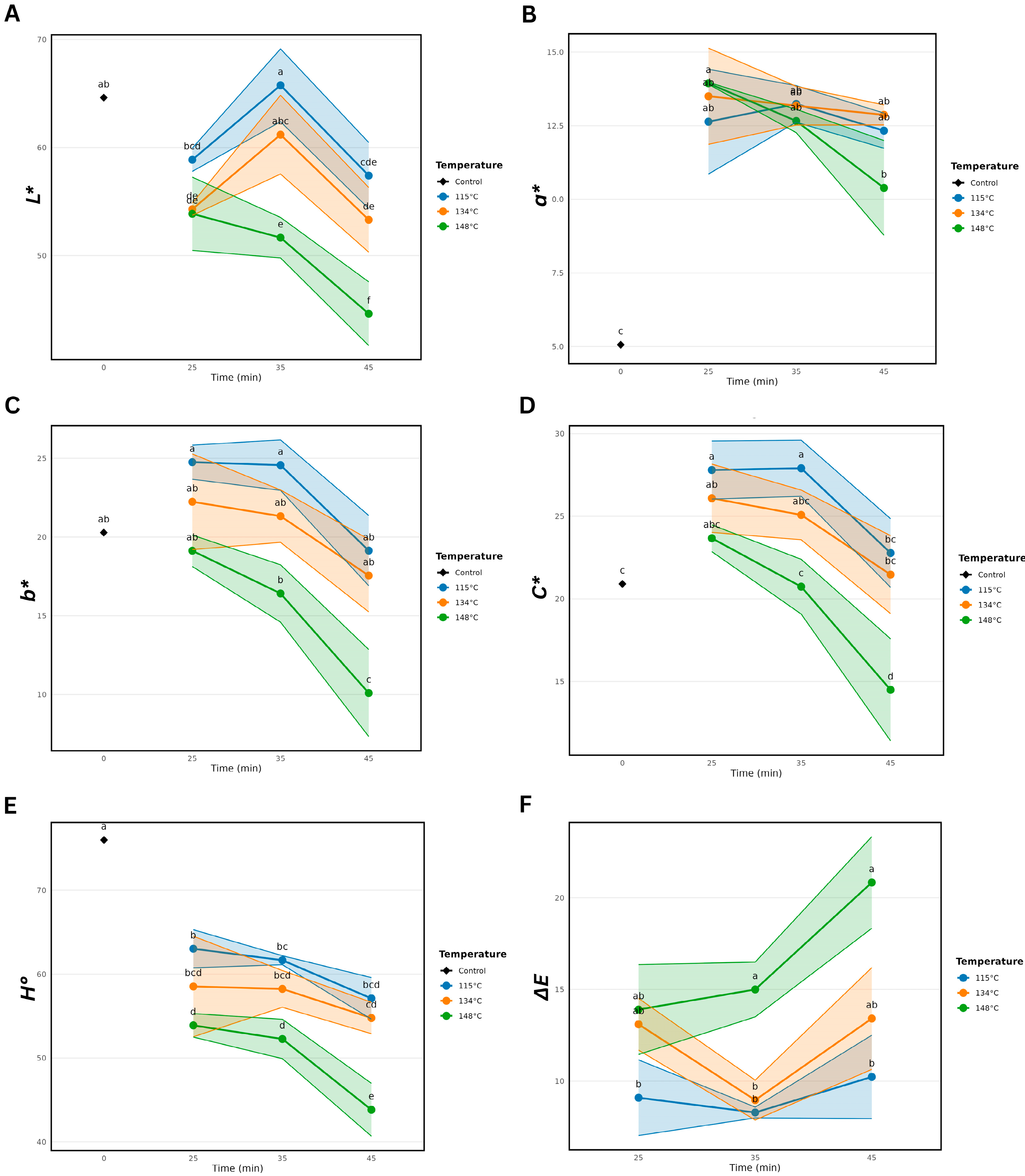
The color parameters (L*, a*, b*, C*, H°, and ΔE) in the cachichín seeds showed significant differences among the toasting treatments (Figure 1). In general, the increase in temperature and time caused a progressive decrease in lightness (L*), shown in Figure 1A, indicating a darkening that increased in more intense treatments (148 °C and 45 min). This behavior is consistent with non-enzymatic browning phenomena commonly reported in food matrices containing reducing sugars and amino compounds subjected to thermal processing, where heat promotes Maillard-type reactions [4]. Previous compositional studies on cachichín seeds have confirmed the presence of reducing sugars and free amino acids, whose concentrations are affected by thermal treatments, supporting this interpretation [27].
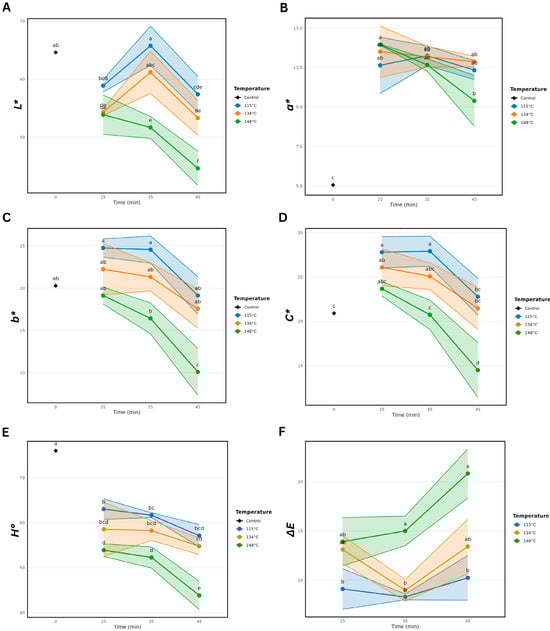
Figure 1.
CIELab* color parameters in cachichín (Oecopetalum mexicanum Greenm. & C.H. Thomps.) seeds under three toasting times (25, 35, and 45 min) and three temperatures (blue: 115 °C; orange: 134 °C; green: 148 °C), using raw seeds as a control. Parameters: lightness—L* (A); red to green—a* (B); yellow to green—b* (C); Chroma—C* (D); Hue angle—H° (E); color difference—ΔE (F). Different letters on the points for each graph indicate significant differences among treatments tested according to Tukey’s test (p ≤ 0.05). Data are mean ± SE. n = 5.
Although relative humidity was not monitored as an independent variable during toasting, moisture loss and redistribution effects associated with thermal treatments have been previously characterized in these seeds. These factors influence the microstructural organization and polar interactions linked to thermal darkening phenomena [27], which are indirectly captured through the chromatic responses discussed in this section.
Regarding chromatic coordinates, the a* value increased significantly with rising temperature (Figure 1B), suggesting the development of reddish tones typical of toasting [28]. Similarly, the b* value (Figure 1C) also increased, albeit to a lesser extent, indicating a shift towards yellow tones. As for C* (Figure 1D) and the H° angle (Figure 1E), they reflected an increase in chromatic intensity and a shift towards warm tones in the most intense treatments. Biochemically, this dark brown color development is directly associated with the formation of melanoidins, high-molecular-weight polymers generated during the advanced stages of the Maillard reaction which are responsible for non-enzymatic browning [29]. As a result, the ΔE parameter (Figure 1F) peaked in treatments at 148 °C, with 35 and 45 min of toasting, evidencing a significant impact on the seeds’ appearance.
Therefore, as toasting time and temperature increased, a progressive darkening (decrease in L*) and a development of warm tones (increase in a* and b*) were observed, which indicates the possible formation of chromophore compounds, mainly melanoidins and polymers of pyrazines and pyrroles, formed during the final stage of the Maillard reaction [30]. This behavior was observed in peanut kernels, where the toasting process increased the a* value and significantly decreased the L* value, which indicates a progressive darkening and the development of warm tones, a phenomenon closely related to the increase in Maillard reaction products (MRPs) [31]. Hence, these transformations are fundamental for the sensory perception of the final product. Because color is often the first indicator of food quality, consumers frequently associate darker tones with enhanced flavor and optimal cooking [32].
The toasting process consists of five phases: drying, growth, disintegration, full toasting, and cooling [33]. At initial temperatures of 50 °C, the first color changes occur. At 100 °C, the green color of the seeds turns into a yellow tone. Between 120 and 130 °C, the grain turns a brown color with variations in brownish tones. At temperatures of 180 °C, pyrolysis causes a characteristic odor from volatile compounds resulting from the decomposition of carbohydrates, proteins, and lipids, accompanied by CO, CO2, and water vapor; this process is known as the Maillard reaction [34]. Exothermic reactions occur at temperatures up to 200 °C, caused by internal biochemical reactions of the seed. Finally, after efficient carbohydrate caramelization, full toasting is achieved at a water content between 1.5% and 3.5% by weight, generating the sensory properties of toasted seeds [27,33].
3.1.2. Oil Fraction Yield in Cachichín Seeds Under Different Toasting Treatments
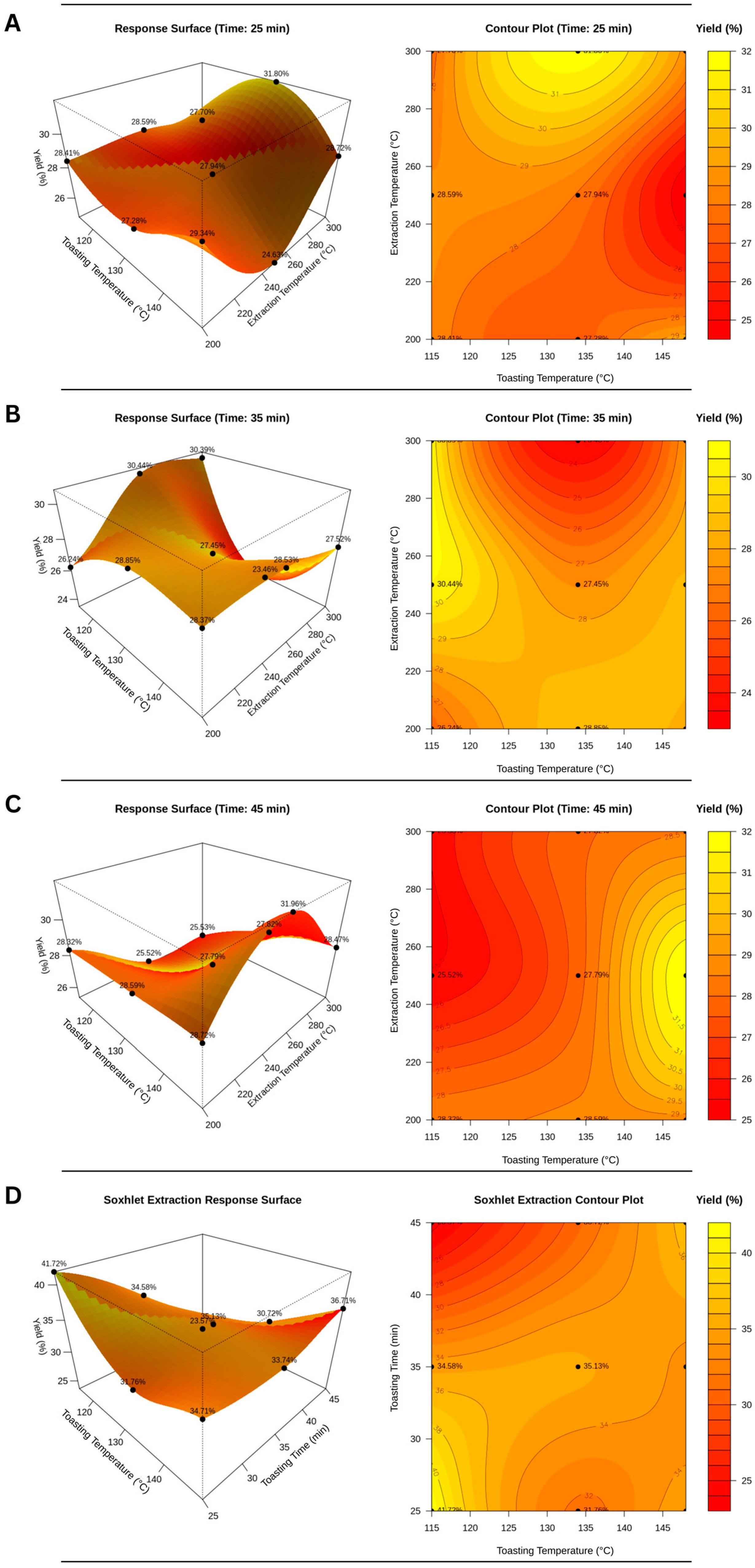
Figure 2 shows the response surface and contour plots for oil extraction yield from cachichín seeds under different toasting combinations (T1–T9) and using two extraction methods (extrusion and Soxhlet). For the extrusion method, the oil yield of the treatment at 134 °C for 25 min was relatively constant between 200 °C and 250 °C (27.28–27.94%), but increased notably at 300 °C, reaching a maximum of 31.80% (Figure 2A). This behavior suggests that a higher extraction temperature favors oil release in this specific treatment. On the other hand, the treatment at 148 °C for 25 min showed a more variable yield, with a decrease at 250 °C (24.63%) and a subsequent recovery at 300 °C (28.72%). This could be related to the thermal degradation of the lipid matrix at higher toasting temperatures, which hinders extraction at intermediate temperatures.
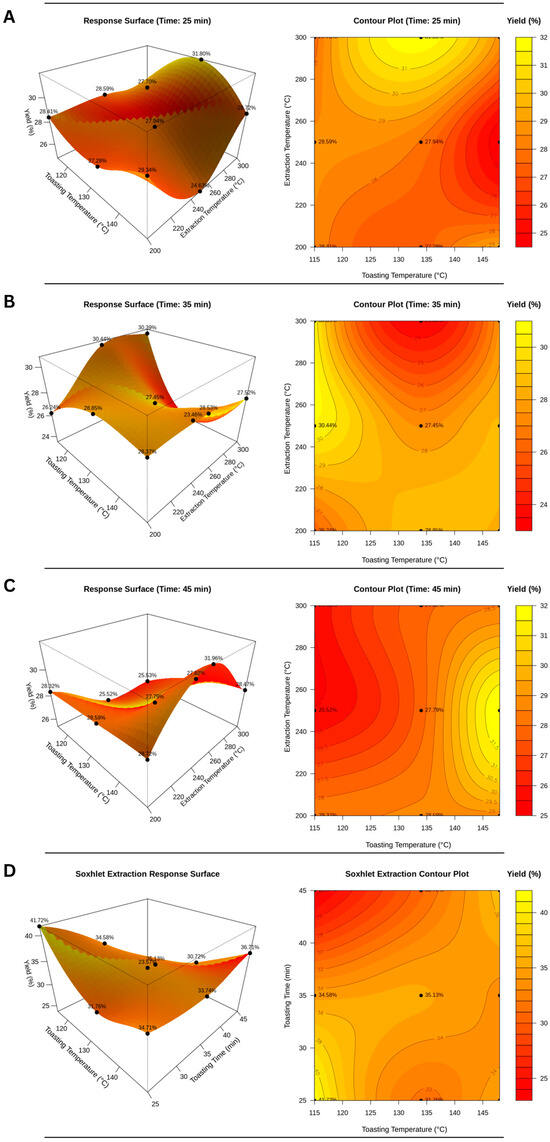
Figure 2.
Response surface and contour plots showing the oil extraction yield of cachichín (Oecopetalum mexicanum Greenm. & C.H. Thomps.) seeds under three toasting times (25, 35, and 45 min) and three toasting temperatures (115, 134, and 148 °C). The results obtained through two extraction methods are presented: extrusion (A–C) and Soxhlet (D). Data represent the mean (n = 5).
For the 35 min treatments (Figure 2B), the oil yield progressively increased with toasting temperatures up to 134 °C, with values ranging from 26.24% to 30.44% at extraction temperatures of 200 °C and 250 °C, respectively. However, at 300 °C, the extraction yield decreased notably for the sample toasted at 134 °C (23.46%), suggesting that prolonged times and higher extraction temperatures can impair oil release efficiency. In contrast, seeds toasted at 148 °C for 35 min showed a more stable yield, with values maintained between 27.52% and 28.53% across all extraction temperatures.
Finally, in the 45 min treatments (Figure 2C), the oil yield was generally low for the 115 °C toasting temperature, decreasing from 28.32% to 25.52% as the extraction temperature increased. The samples toasted at 134 °C showed a more consistent yield, with values ranging between 27.79% and 28.59%. An interesting behavior was observed in the 148 °C treatment, where the yield increased significantly at 250 °C (31.96%), followed by a decrease at 300 °C (28.47%). This suggests that the combination of prolonged toasting and a high extraction temperature can cause degradation of the matrix [35], which facilitates the initial release of oil but subsequently compromises the total yield [36].
Since solvents are not used, this method extracts the oil along with other components from the seed matrix, including proteins, carbohydrates, and bioactive compounds like polyphenols [21,37]. This can enrich the oil’s functional profile, but it also introduces impurities that can affect its quality and stability [38]. Traditional methods, such as mechanical extrusion, can produce a lower-quality oil compared to modern techniques, like supercritical fluid extraction, which produces cleaner extracts with a higher yield [39].
On the other hand, the oil fraction yield obtained by the Soxhlet extraction method (Figure 2D) showed a significant variation, with a clear interaction between toasting time and temperature. In general, the maximum yield with the Soxhlet method was 23% higher than the optimal point reached by the extrusion method.
The extraction yield using the Soxhlet method showed a significant dependence on toasting time and temperature (Figure 2D). For the 25 min treatment, the highest yield was obtained at 115 °C (41.72%), while yields decreased at 134 °C and 148 °C; this suggests that at short toasting times, low temperatures are optimal for oil extraction. Conversely, the 35 min treatments resulted in more consistent yields, with values ranging between 33.74% and 35.13%, peaking at 134 °C. Regarding the 45 min treatments, the lowest yield (23.57%) was recorded at 115 °C, indicating that prolonged times at a low temperature are not optimal for extraction. However, at 148 °C, the yield increased to 36.71%, indicating that a combination of prolonged toasting and high temperature can favor lipid release. Nevertheless, higher temperatures may begin to negatively affect the extraction [40]. The efficiency of Soxhlet extraction is attributed to its operation at relatively low temperatures, which minimizes the degradation of sensitive compounds like unsaturated fatty acids [41] and antioxidants, thereby preserving oil quality [20].
Soxhlet extraction and extrusion are methods with distinct approaches for obtaining vegetable oils, each with advantages and disadvantages in selectivity and composition [38,42]. Soxhlet, a method that uses non-polar solvents like hexane, is highly selective for triglycerides, resulting in a higher purity oil, although with the potential loss of polar bioactive compounds [40]. In contrast, extrusion is less selective, which allows for the co-extraction of polar compounds that enrich the oil’s bioactive composition, but with the possibility of affecting its quality and stability [38]. Therefore, this two-pronged approach to the extraction process was designed to evaluate whether the lipid stability of the cachichín seed, after controlled toasting, was influenced by the nature of the extraction method, providing a comprehensive analysis for its industrial application.
It is well established that extraction yield depends significantly on the type of method and operational conditions. In sunflower seeds, Kabutey et al. [13] reported that uniaxial compression increases yield up to 48.9% when repeated pressing is applied, demonstrating the influence of operating parameters on process efficiency. Similarly, Zhang et al. [14] found that Soxhlet extraction of field muskmelon (Cucumis melo L.) seeds resulted in higher oil yields and superior antioxidant capacity compared with press and aqueous extraction methods, highlighting the influence of extraction technique on oil quality. Abdilova et al. [12] demonstrated that screw pressing can be optimized by adjusting the milling speed and size, reducing residual oil in the cake, while Jitpinit et al. [15] observed that supercritical CO2 extraction yields solvent-free oils with a more balanced fatty acid profile, although typically at lower extraction yields than conventional solvent-based methods.
3.1.3. Iodine Value in Cachichín Seed Oil Under Different Thermal Treatments
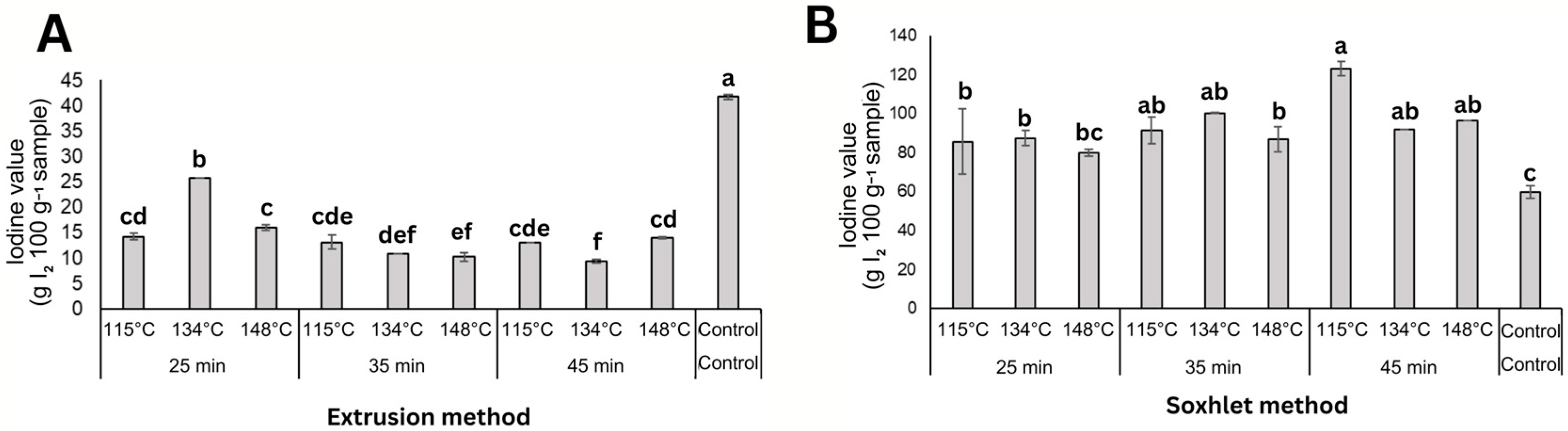
The iodine value of the cachichín oils, an indicator of the degree of unsaturation, was evaluated under the different combinations of toasting time and temperature. Figure 3 presents the average values obtained using the extrusion (Figure 3A) and Soxhlet (Figure 3B) extraction methods.
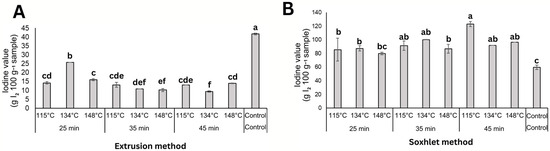
Figure 3.
Iodine values in cachichín (Oecopetalum mexicanum Greenm. & C.H. Thomps.) seed oil under three toasting times (25, 35, and 45 min) and three toasting temperatures (115, 134, and 148 °C). The results obtained through two extraction methods are presented: extrusion (A) and Soxhlet (B). Different letters on the columns for each graph indicate significant differences among treatments tested according to Tukey’s test (p ≤ 0.05). Data are mean ± SE. n = 5.
In the extrusion method (Figure 3A), the iodine value (gI2 100 g sample−1) in the cachichín oils decreased significantly (p ≤ 0.05) as toasting time and temperature increased. The control (raw seed) showed the highest value (41.70), while all thermal treatments presented a significant reduction in this index. Notably, the treatment at 134 °C for 25 min recorded a relatively higher iodine value (25.78) compared to other toasting conditions. At 35 and 45 min, values decreased even further, reaching the lowest levels at 134 °C (10.83 and 9.40, respectively). On the other hand, the 115 °C and 148 °C treatments, at all times, showed more stable and comparable values, with a slight increase in the iodine value of the treatment at 148 °C for 45 min (13.90). However, in the 45-min treatment, the lowest iodine value was observed at 134 °C. This behavior may be related to a more advanced stage of lipid oxidation at this intermediate temperature. Although 148 °C represents a greater thermal intensity, the oil’s lower effective exposure to oxygen due to the rapid volatilization of surface moisture may have reduced the degree of oxidation [3]. In contrast, at 134 °C, the remaining moisture within the seed matrix could have favored the formation of hydroperoxides and epiperoxides, followed by the subsequent degradation of the double bonds, resulting in a lower iodine value.
Iodine values obtained with the Soxhlet method (Figure 3B) were notably higher compared to extrusion. The control treatment (raw seed) presented a value of 59.86, while the oils from the toasted seeds showed a more variable behavior. At 25 min of toasting, the iodine value was numerically higher at 134 °C (87.43) and 115 °C (85.53), compared to 148 °C (79.95). At 35 min, the iodine value peaked at 134 °C (100.18), being significantly higher than at 115 °C (91.44) and 148 °C (86.91). However, at 45 min of toasting, the highest value was recorded at 115 °C (122.37), followed by 148 °C (96.47) and 134 °C (91.66). These significant statistical differences indicate that the treatment at 115 °C for 45 min presented the highest value, followed by the treatment at 134 °C for 35 min, suggesting that under these toasting and extraction conditions, the Soxhlet method favors the recovery of oil fractions with a higher degree of unsaturation, as reflected by the iodine value.
In general, the results indicate that the Soxhlet method yields oils with higher iodine values compared to extrusion, particularly under moderate thermal treatments. This difference may be attributed to variations in extraction efficiency and thermal–mechanical stress rather than to a direct preservation effect. Extrusion, being a mechanical process that operates at elevated temperatures (up to 300 °C), can accelerate the thermal oxidation of fatty acids such as oleic (ω-9), linoleic (ω-6), and α-linolenic (ω-3) [9]. Although toasting improves organoleptic properties, in seeds rich in polyunsaturated fatty acids it can induce significant oxidation [21]. Natural antioxidants can offer some protection; however, their effectiveness decreases with increasing temperature due to thermal degradation [37,43].
In relation to the search for an optimal toasting process, it is essential to consider the oleaginous quality of the oil present in oilseeds, which are acquired by consumers for both sensory enjoyment and their contribution to nutritional value and health-related attributes [44,45,46]. Lipids, particularly the unsaturated fatty acids contained in the cachichín seed, are of interest due to their relevance in the daily diet, as they represent, on average, 33% of the total seed weight [18]. These compounds are widely associated with potential health benefits when included as part of a balanced diet. However, because the primary objective of this study was to evaluate the stability of fatty acids under different thermal and extraction conditions rather than to assess physiological effects, it was necessary to employ complementary analytical approaches, such as infrared spectroscopy, which is described below.
3.1.4. Fourier Transform Infrared (FTIR) Spectroscopy Analysis
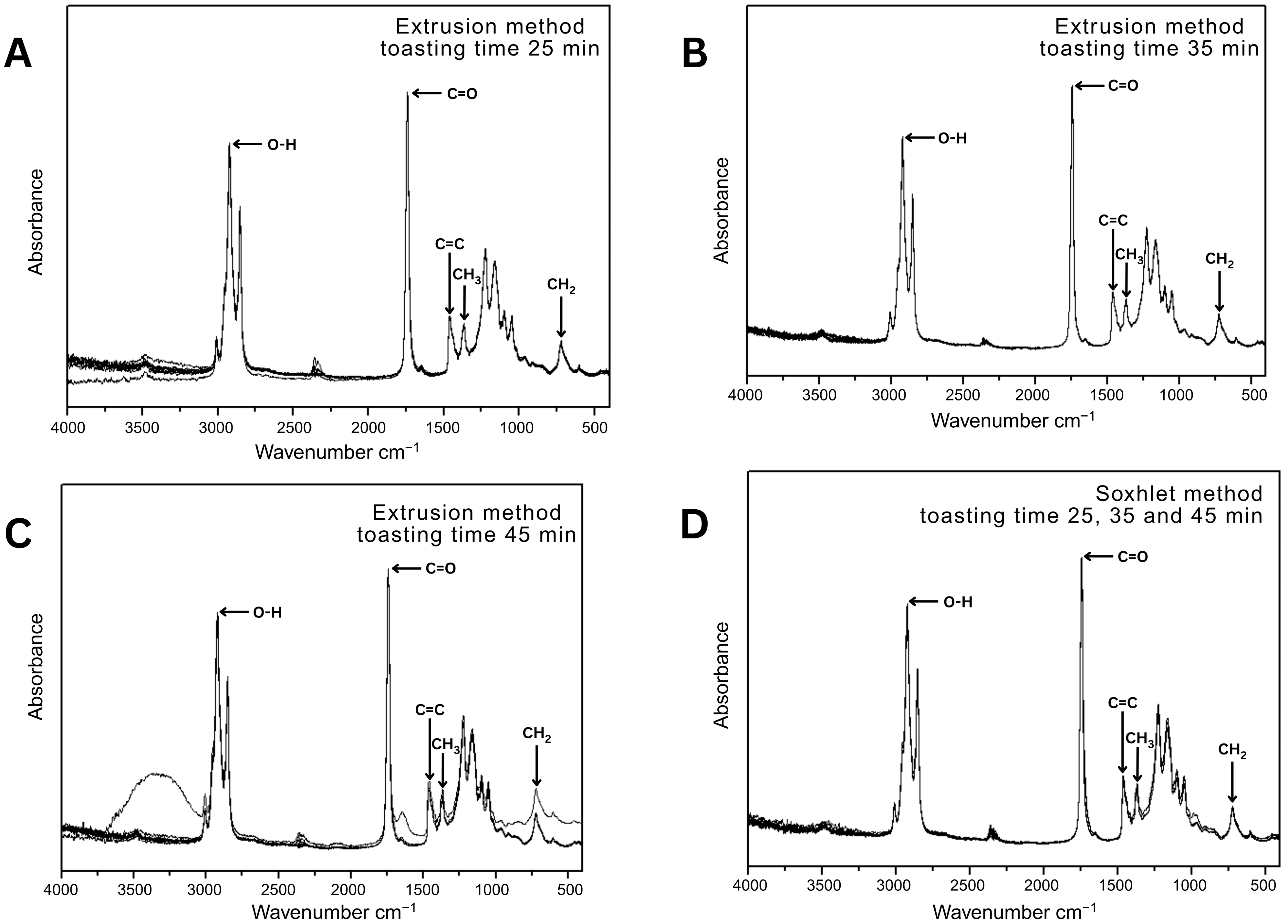
Figure 4 presents the infrared spectra obtained by Fourier Transform Infrared (FTIR) Spectrophotometry in oils extracted from cachichín seeds under different thermal treatments. The spectra were grouped according to toasting time (25, 35, and 45 min) and extraction method (extrusion and Soxhlet), allowing for the identification of the characteristic functional groups of the fatty acids present in the oils. The analysis was performed under atmospheric conditions, a factor which may have introduced baseline interference; however, this does not compromise the primary objective of the analysis, namely the qualitative identification of the major functional groups associated with the predominant fatty acids (oleic, linoleic, linolenic, palmitic, and stearic acids), previously reported for this species [17,21].
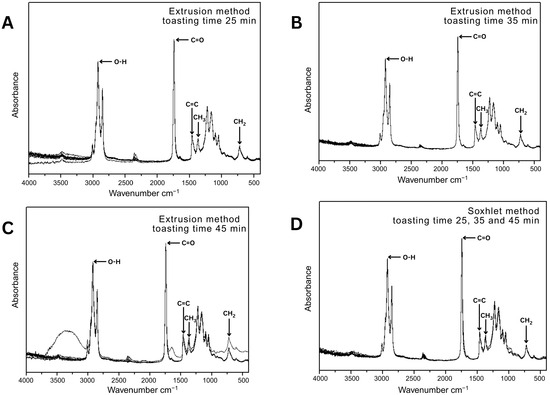
Figure 4.
Infrared (FTIR) spectra of cachichín (Oecopetalum mexicanum Greenm. & C.H. Thomps.) oils extracted by the extrusion and Soxhlet methods, under different thermal treatments. Spectra of oils obtained by extrusion, for toasting times of 25 min (A), 35 min (B), and 45 min (C). Spectra of oils obtained by Soxhlet, for all three toasting times (D). The spectra show characteristic absorption bands assigned to hydroxyl (O–H), carbonyl (C=O), carbon–carbon double bond (C=C), methyl (CH3), and methylene (CH2) functional groups within their typical infrared regions.
The FTIR spectra of cachichín oils extracted by both the extrusion (Figure 4A–C) and Soxhlet methods (Figure 4D) exhibited the characteristic absorption bands of fatty acids. Despite variations in toasting time and temperature, no relevant shifts in the position of the main absorption bands were observed, and the overall spectral profiles remained comparable among treatments. These results indicate that the principal molecular backbone of the lipids was preserved under the evaluated thermal conditions, regardless of the extraction method.
The apparent contrast between the FTIR results and the variability observed in the iodine value can be attributed to the different analytical sensitivities and scopes of these techniques. FTIR spectroscopy primarily provides qualitative information regarding the presence and integrity of functional groups within the lipid structure [47], whereas the iodine value is a sensitive chemical indicator that reflects quantitative changes in unsaturation through the consumption of C=C bonds during oxidative reactions [48]. Consequently, moderate reductions in unsaturation may occur without producing detectable alterations in the overall FTIR spectral pattern.
The presence of absorption bands associated with key lipid functional groups, including carbonyl (C=O), hydroxyl (O-H), C=C, CH3, and CH2 vibrations also reported for oils from Sacha inchi (Plukenetia volubilis L.) [49], bitter apple (Citrullus colocynthis (L.) Schrad.) [50], and njangsa seed (Ricinodendron heudelotii (Baill.) Pierre ex Pax) [51], supports the preservation of the essential chemical features of the oils [52]. Although minor constituents from the plant matrix may contribute to band overlap, the FTIR spectra indicate that no major structural degradation of the lipids occurred under the applied thermal treatments. From a technological perspective, these findings suggest that controlled toasting conditions allow the retention of the fundamental structural characteristics of cachichín oil, reinforcing its potential as a source of high-quality lipids for food applications [53].
3.2. Second Stage: Comparison with Traditional Thermal Processes
3.2.1. Selection of an Optimal Toasting Treatment
The toasting treatment at 134 °C for 25 min was selected as optimal based on a comprehensive balance between the preservation of functional properties and the improvement of sensory characteristics [35,54]. This selection was not intended to maximize a single response variable, but rather to identify a technologically feasible condition that integrates quality preservation with process efficiency.
Unlike traditional empirical methods, this controlled approach allowed the process to be optimized without compromising the quality of the seed [4]. In terms of color, the treatment showed a moderate change, maintaining warm tones and a favorable lightness for the consumer [5]. Regarding oil yield, this treatment reached high and consistent values, especially with the extrusion method (31.80% at 300 °C). In addition, the iodine value was significantly higher compared to more intense treatments, which indicates less oxidation of unsaturated fatty acids [36]. This evidence was complemented by the FTIR analysis, which indicated the preservation of the main lipid functional groups without major structural alterations.
Although other treatments showed superior performance in individual parameters, they required longer processing times or higher thermal intensities, which may increase oxidative risk and reduce operational efficiency. Together, these results support the selection of this condition as the most suitable for preserving the sensory, oleaginous, and functional quality of the cachichín seed, while also reducing processing time and thermal severity, establishing a scientific basis for future processing of this species.
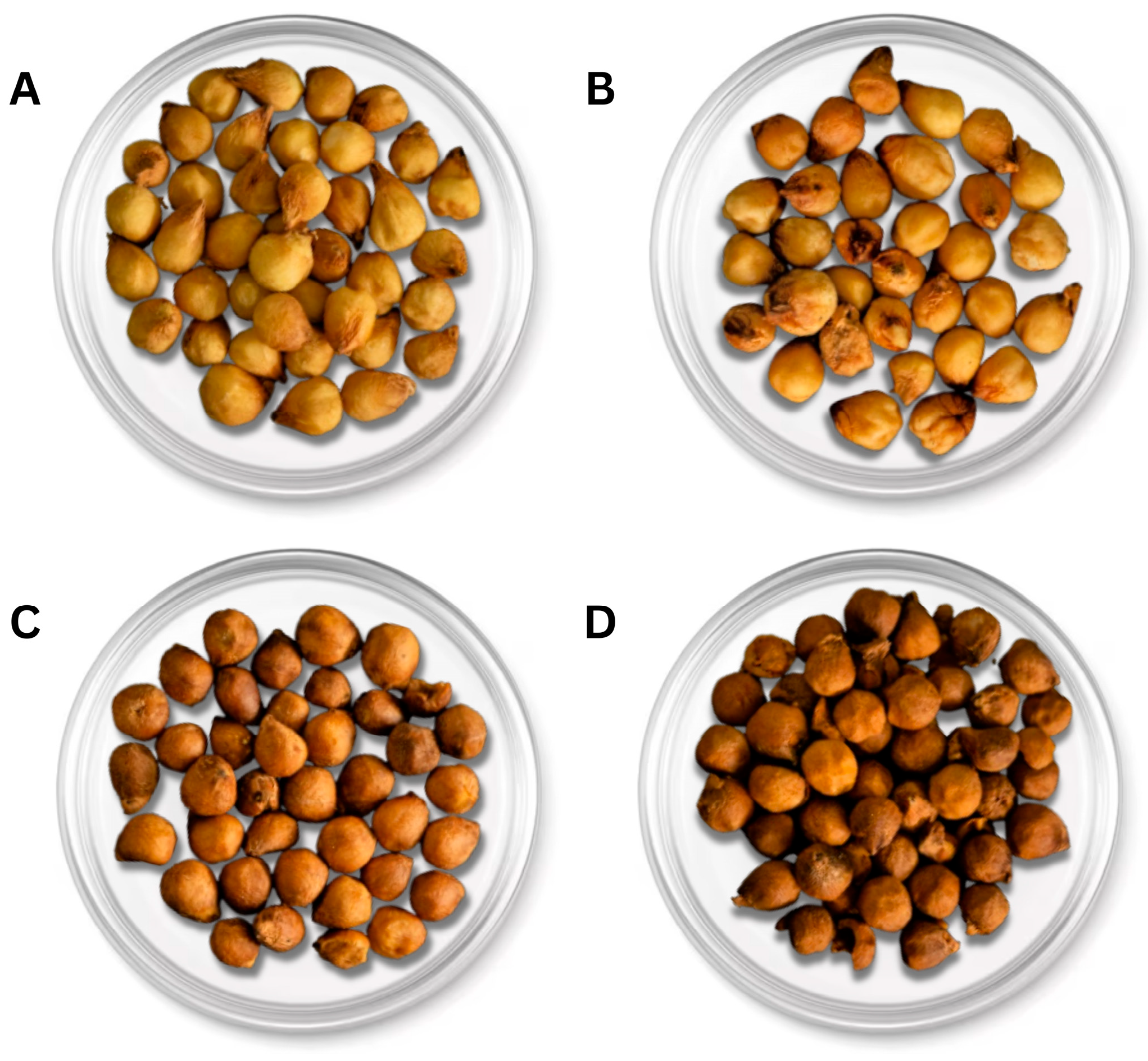
For the second stage of the study, the quality of the cachichín seed oil toasted under controlled conditions (C4: 134 °C for 25 min) was compared with traditional and empirical treatments already commercialized by producers in the Misantla, Veracruz region (Figure 5). This comparison validated the selected condition under practical processing scenarios, including raw (C1), boiled (C2), and commercially toasted (C3) seeds.
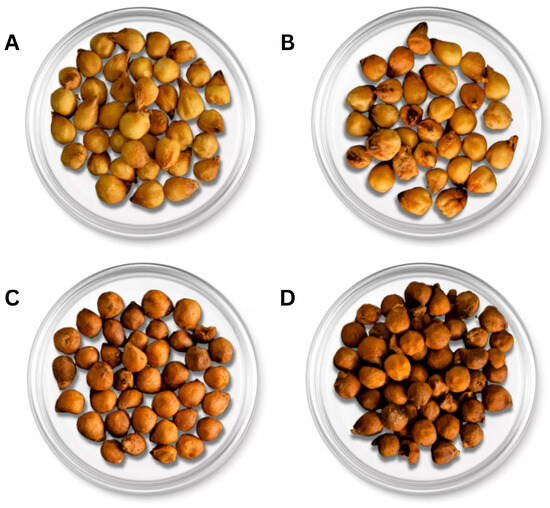
Figure 5.
Cachichín (Oecopetalum mexicanum Greenm. & C.H. Thomps.) seeds under different thermal treatments: raw: C1 (A); boiled: C2 (B); commercially toasted: C3 (C); and controlled toasted: C4 (D). Source: own authorship.
3.2.2. Water Activity
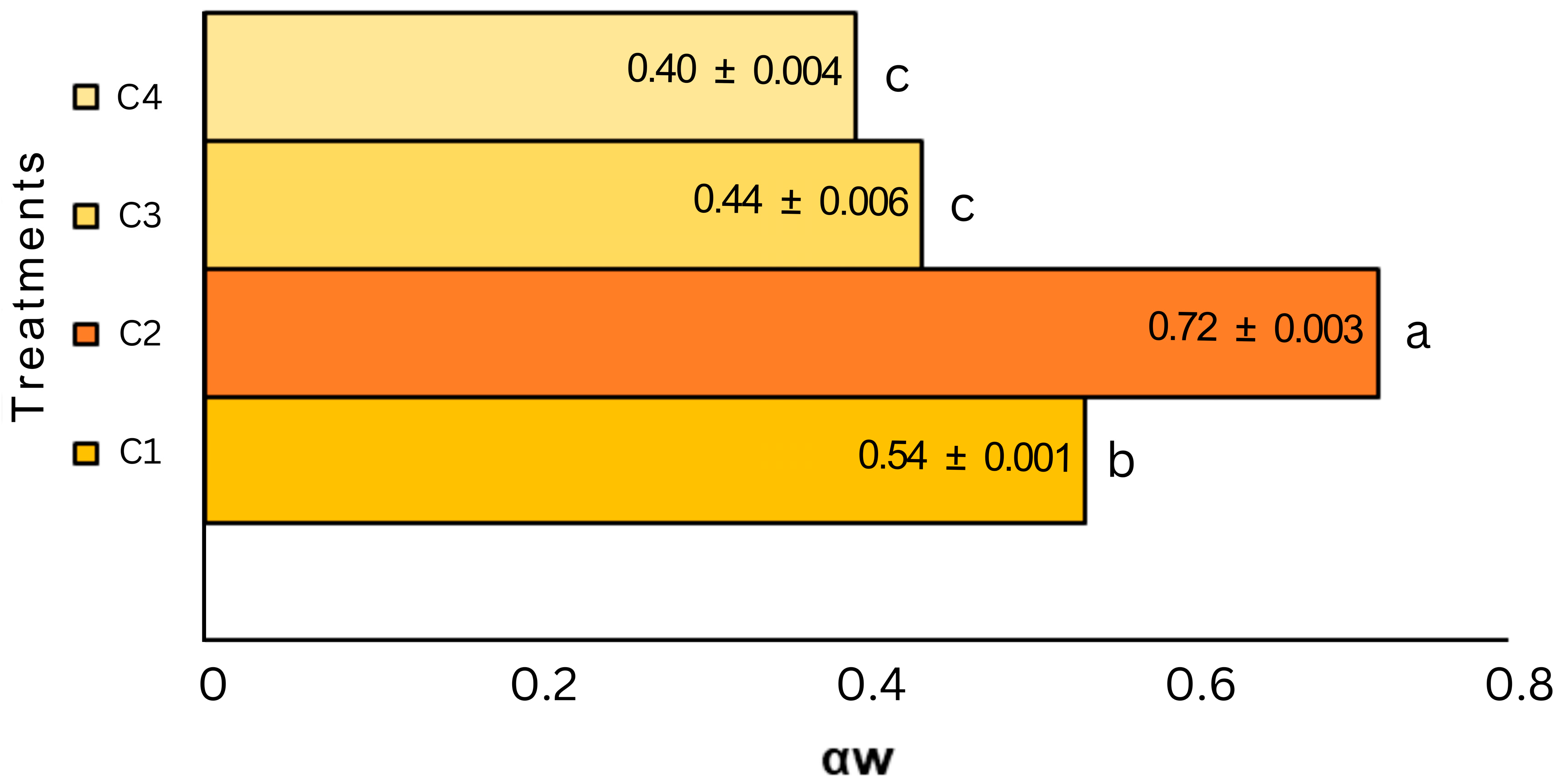
The evaluated treatments significantly influenced the water activity (aw) of the cachichín seed (Figure 6). Boiled seeds (C2) showed a notable increase in aw compared to the raw sample (C1), while the commercial (C3) and controlled (C4) toasting treatments showed a considerable decrease. The significant differences observed between C2 and C4 confirm that toasting is a more effective method for reducing water activity, compared to boiling [55]. These findings (Figure 6) highlight the effect of toasting on the decrease in aw, a phenomenon likely associated with thermal intensity and the evaporation of moisture during treatment [56]. Specifically, toasting reduces aw by removing free water, as reported in previous research [57].
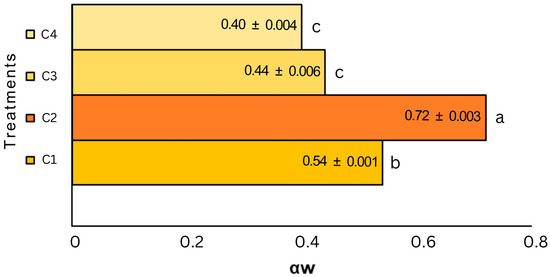
Figure 6.
Water activity (aw) in cachichín (Oecopetalum mexicanum Greenm. & C.H. Thomps.) seeds in the raw state (C1) and under three thermal treatments: boiled (C2), commercial toasting (C3), and controlled toasting (C4). Mean ± SE (n = 5) with different letters next to the bars (a, b, and c) indicate significant differences according to the Dunn test (p ≤ 0.05).
The reduction in moisture content directly influenced the perception of texture. Similar to studies with peanut kernels, where a decrease in moisture contributes to a crispier texture [58], the toasted cachichín seeds (C3 and C4) exhibited a crunchy texture, while the boiled seeds (C2) maintained a rubbery consistency to the touch. This reduction in aw not only improves storage stability but also influences sensory perception, especially in terms of flavor.
3.2.3. Colorimetric Analysis in Thermal Treatments
The color analysis revealed significant variations among the treatments for the L*, a*, b*, C*, and H° parameters, as detailed in Table 2. The C1 treatment recorded the highest L* value (mean of 64.62), which was significantly different from C4 (p = 0.0067). In contrast, the a* parameter for the C2 treatment reached the highest values, showing a statistical difference from C1 (p = 0.0097). The b* value significantly increased compared to C1 by 10%, 6%, and 4% in the C3, C2, and C4 treatments, respectively, and the C* parameter significantly increased in the C3 treatment by 19% relative to C1 (20.91); however, treatments C2 and C4 remained statistically similar to the control (C1) in terms of this parameter. Finally, the hue angle (H°) in treatment C2 significantly decreased by 18.6% compared to C1, while treatments C3 and C4 showed no significant difference from C1.
Table 2.
Color parameters (CIELab) in cachichín (Oecopetalum mexicanum Greenm. & C.H. Thomps.) seeds in a raw state and under applied thermal treatments.
Color is a fundamental sensory attribute that determines consumer acceptance of a food product [59]. Treatment C4 exhibited a significant reduction in L* compared to C1, while all thermal treatments showed a notable increase in the a* index. This phenomenon suggests a darkening of the product attributable to the Maillard reaction and the caramelization of sugars, processes that favor the formation of melanoidins and, therefore, the development of brown tones, which is characteristic of foods subjected to toasting [32]. Previous research, such as on cashew nuts (Anacardium occidentale L.), has reported decreased L* values and an increased red component (a*) due to the generation of brown pigments [60].
On the other hand, treatment C3 showed a significant increase in C* compared to C1, as detailed in Table 2. This reflects an increase in the chromatic intensity of the cachichín seeds. It has been observed that the absorption or loss of water is directly influenced by the applied thermal treatment, which is closely linked to color intensity [61]. This phenomenon is due to the Maillard reaction, which promotes the formation of melanoidins [62]; these compounds not only affect the flavor and aroma but also generate perceptible changes in color, making it warmer and more saturated [63].
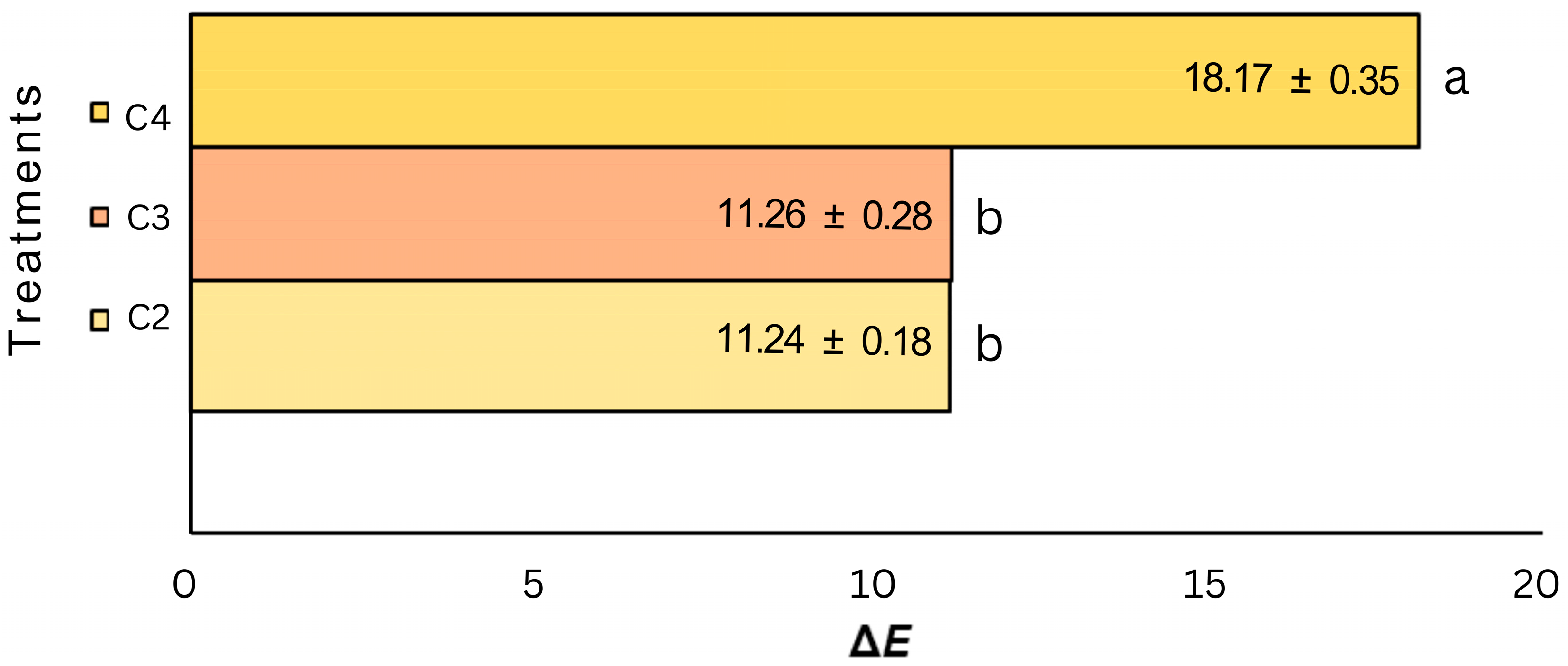
This effect is manifested in the ΔE value, as C4 produced a statistically significant variation in seed color (Table 2), evidenced by the increase in ΔE (Figure 7) compared to the other treatments. This indicates that the intensity of the thermal process has a direct impact on the visual characteristics of the final product, likely due to more intense chemical interactions associated with elevated temperatures and longer processing times [64].
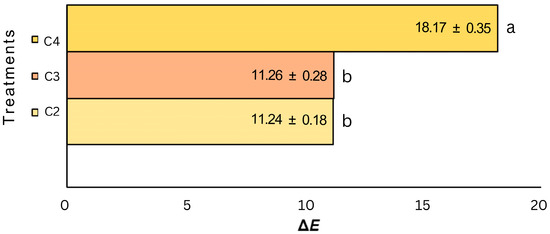
Figure 7.
Bar plot showing the color difference (ΔE) distribution across treatments applied to cachichín (Oecopetalum mexicanum Greenm. & C.H. Thomps.) seeds: boiled (C2), commercial toasting (C3), and controlled toasting (C4). Values represent Means ± SE (n = 5); different letters next to the bars (a, b) indicate significant differences according to Tukey’s test (p ≤ 0.05).
3.2.4. Fatty Acid Profile Under Different Thermal Treatments
Significant differences were observed in the concentrations of saturated (palmitic and stearic) and unsaturated (oleic, linoleic, and linolenic) fatty acids across the evaluated treatments (C1–C4) and the two extraction methods (Table 3). These results demonstrate the impact of thermal processing and the extraction method on the oil’s lipid composition.
Table 3.
Fatty acid profile of cachichín (Oecopetalum mexicanum Greenm. & C.H. Thomps.) seed oil obtained under different thermal treatments using two extraction methods.
Regarding the extrusion method, the raw treatment (C1) exhibited the highest concentrations of unsaturated fatty acids: oleic acid (2.42 g 100 g−1), linoleic acid (13.06 g 100 g−1), and linolenic acid (1.73 g 100 g−1). In contrast, commercial toasting (C3) yielded the lowest concentrations of these lipids (1.44, 6.78 and 0.75 g 100 g−1, respectively), suggesting that this process negatively affects their preservation. On the other hand, the boiled (C2) and controlled toasting (C4) treatments resulted in intermediate values.
In the Soxhlet method, results were consistent with the extrusion findings, although unsaturated fatty acid concentrations were slightly higher. The raw treatment (C1) presented the highest concentrations of oleic acid (2.36 g 100 g−1), linoleic acid (13.11 g 100 g−1) and linolenic acid (1.82 g 100 g−1), while commercial toasting (C3) showed the lowest (1.98, 8.27 and 1.40 g 100 g−1, respectively).
For both extraction cases, controlled toasting (C4) showed numerically higher values for unsaturated fatty acids compared to C3, albeit no statistically significant difference was found.
In both extraction methods, saturated fatty acids (palmitic and stearic) were less susceptible to thermal degradation than unsaturated fatty acids. Under the extrusion method, commercial toasting (C3) caused the greatest reduction in these compounds, while controlled toasting (C4) tended to better preserve saturated fatty acids, yielding values numerically closer to the raw seed (C1). However, it is important to note that, according to the statistical analysis, the concentrations of saturated fatty acids in C2 and C4 were not significantly different from C1 or each other (same letter in Table 3), indicating that the observed numerical differences are not statistically supported. Conversely, under Soxhlet extraction, boiled seeds (C2) presented concentrations numerically closer to C1, although again not significantly different, which points to a similar overall preservation of saturated fatty acids across treatments when variability is considered.
The observed differences between extraction methods can be attributed to their inherent mechanisms. Soxhlet extraction, employing a hot solvent in continuous cycles, accesses total lipids efficiently and is generally less susceptible to minor structural changes induced by heat [36]. Conversely, extrusion, which combines mechanical shearing and elevated temperatures, may physically disrupt the seed matrix more drastically, increasing lipid exposure to oxygen and accelerating the thermal degradation of the most susceptible compounds [21]. Given that saturated fatty acid concentrations did not differ significantly across most treatments (Table 3), true thermal effects may be partially masked by methodological variability. This highlights the need for additional specific investigations (e.g., controlled oxidation assays, identification of oxidation products, or differentiated solvent extractions) to confirm these findings.
It is critical to control toasting conditions to minimize the loss of essential lipid compounds. In general, the observed effects are closely linked to heat-induced oxidation and lipid degradation, which are key factors influencing the stability and composition of fatty acids in foods subjected to thermal treatments. These processes lead to the formation of lipid oxidation products (LOP) [65].
The stability of unsaturated fatty acids in food is compromised by lipid oxidation, a natural biochemical process accelerated during thermal processing [65]. This degradation occurs via auto-oxidation, a free-radical chain reaction that develops in three phases: initiation, propagation, and termination [66].
The initiation phase is crucial, as it is where catalytic factors converge. Transition metals such as iron (Fe), which can be found in lipoxygenases, act as potent catalysts by promoting the formation of reactive oxygen species (ROS), such as the hydroxyl radical (OH∙). These radicals attack the allylic and bis-allylic positions of unsaturated fatty acids, thereby triggering the oxidation reaction [66,67]. Concurrently, thermal treatments catalyze the Maillard reaction. This non-enzymatic browning reaction is initiated by the condensation of carbonyl groups (sugars) and amino groups (amino acids), leading to the formation of key intermediate compounds: Schiff bases and, upon rearrangement, Amadori and Heyns products [4]. The presence of metal ions (Cu, Fe, Zn) further accelerates this pathway by facilitating the formation of reactive intermediates [5].
During propagation, increased temperatures accelerate the rate of both reactions. The oxidation pathway forms lipid oxidation products (LOPs), such as hydroperoxides, aldehydes, and ketones [3]. Subsequently, the Maillard pathway progresses through the fragmentation of Amadori and Heyns products, leading to the formation of melanoidins, high-molecular-weight polymers responsible for characteristic toasting colors and the generation of specific aromas and flavors [4].
Oils rich in polyunsaturated fatty acids are especially vulnerable to this dual degradation. High temperatures and the presence of metal ions interact to alter the multiple physical and chemical properties of the final product [3,42]. Therefore, temperature control is fundamental to balancing organoleptic improvement with minimal lipid degradation, as demonstrated by the controlled treatment (C4), which significantly preserved the stability of the unsaturated fatty acids.
According to our results, it is essential to choose a thermal processing method that preserves the lipid composition and physical characteristics of the cachichín seed. The effect of thermal treatments on the preservation of unsaturated fatty acids is a critical aspect, as it directly impacts oil quality and stability. These findings not only broaden the knowledge about the behavior of the cachichín seed under thermal treatments but also lay the groundwork for optimizing processing to improving its texture, appearance, and bioactive properties. Additionally, previous reports indicate that the residual seed cake obtained after oil extraction retains a relevant lipid fraction, conserving approximately 39–47% of the unsaturated fatty acids originally present in the whole seed [68], depending on the thermal treatment applied. This supports the seed cake’s potential as a value-added by-product within an integrated processing scheme. This observation reinforces the importance of controlled thermal conditions not only for oil quality but also for the comprehensive valorization of the processed seed material.
3.3. Limitations and Future Perspectives
The present study contributes significantly to this emerging scientific field by establishing controlled thermal conditions that maximize the nutritional quality and stability of Oecopetalum mexicanum seeds. Optimization of the toasting process (25 min at 134 °C) successfully integrated physical and chemical attributes, such as color and water activity with lipid preservation, as evidenced by the iodine value and fatty acid profile.
Despite these achievements, we acknowledge certain limitations in the study, particularly the lack of exhaustive chemical characterization of degradation products, an analysis crucial for a deeper understanding of the chemical kinetics involved in this process. While the reduction in iodine value and the stability of characteristic peaks in the FTIR analysis clearly indicate the preservation of the lipid structure, a more detailed quantification of intermediate and secondary compounds is required to fully comprehend deterioration mechanisms. In addition, although the optimal toasting condition was established based on physical, chemical, and technological criteria, the study did not include sensory evaluation to directly assess consumer acceptance. Sensory analysis represents an important complementary approach to validate the practical relevance of color and quality attributes from the consumer perspective.
Based on these limitations, future research perspectives by this working group will focus on analyzing fatty acid degradation products specific to the lipid oxidation process at each stage of thermal treatment. This will facilitate the development of kinetic degradation models and more accurate shelf-life estimations for both the resulting oil and the toasted seed. To strengthen the relationship between physicochemical properties and consumer perception, sensory evaluations should be incorporated, thereby reinforcing the applicability of the optimized toasting conditions. Additionally, the scope will expand to include energy efficiency analyses, techno-economic evaluations, and environmental impact indicators to ensure the practical and sustainable applicability of the proposed processing conditions.
Finally, investigating the safety profile, specifically the potential formation of harmful compounds like acrylamide and heterocyclic amines (HCAs) at high temperatures, is essential to fully validate the cachichín seed as a safe, high-quality functional food.
4. Conclusions
This study demonstrated that toasting significantly impacts the multiple physical and chemical properties of the cachichín seed. It was observed that more aggressive treatments, such as at 148 °C for 35 and 45 min, caused a progressive darkening (decrease in L*) and evident lipid degradation, manifested by a significant reduction in the iodine value. These negative results highlight the vulnerability of bioactive compounds to extreme thermal conditions. In contrast, optimizing the toasting process, exemplified by the controlled treatment at 134 °C for 25 min, proved to be the most effective strategy. This approach not only optimized key parameters like color and water activity (aw), reducing moisture and preserving the seed’s lightness, but also maintained the stability of the lipid profile. Fatty acid analysis confirmed that this treatment notably preserved the unsaturated fatty acids more effectively than traditional treatments like boiling and commercial toasting. Furthermore, comparative analysis of the extraction methodologies established that the Soxhlet method was more effective than extrusion in preserving unsaturated fatty acids, underscoring the extraction process’s influence on final oil quality. Collectively, these findings support implementing controlled toasting to maximize the oleaginous and bioactive quality of cachichín seeds, positioning them as a high-potential functional food for the food industry.
Author Contributions
Conceptualization, A.E.H.-M. and F.C.G.-M.; Methodology, A.E.H.-M., A.S.H.-C. and M.C.-M.; Validation, F.C.G.-M. and A.E.H.-M.; Formal analysis, J.A.H.-C. and L.I.T.-T.; Investigation, A.E.H.-M., M.C.-M. and F.C.G.-M.; Resources, F.C.G.-M., J.A.H.-C. and A.C.-O.; Data curation, J.A.H.-C., A.E.H.-M., E.F.-A. and M.C.-M.; Original draft preparation, A.E.H.-M. and F.C.G.-M.; Writing—review and editing, A.E.H.-M., A.S.H.-C. and F.C.G.-M.; Visualization, L.I.T.-T., E.F.-A., A.C.-O. and M.C.-M.; Supervision, M.C.-M., E.F.-A., A.C.-O. and L.I.T.-T.; Project administration, F.C.G.-M. and J.A.H.-C. All authors have read and agreed to the published version of the manuscript.
Funding
The Secretariat of Science, Humanities, Technology and Innovation (SECIHTI) of Mexico funded this project through the “Becas Nacionales 2023-1” scholarship program (CVU. 960439).
Data Availability Statement
The original contributions presented in the study are included in the article; further inquiries can be directed to the corresponding author.
Acknowledgments
The authors thank the Laboratory of Animal Nutrition of the College of Postgraduates Montecillo Campus and the Faculty of Chemical Sciences of the Universidad Veracruzana, Córdoba-Orizaba Region for the facilities provided to carry out the analyses presented here.
Conflicts of Interest
The authors declare no conflicts of interest.
References
- Hii, C.L.; Tan, C.H.; Woo, M.W. Special issue “Recent advances in thermal food processing technologies”. Processes 2023, 11, 288. [Google Scholar] [CrossRef]
- Xia, C.; Wen, P.; Yuan, Y.; Yu, X.; Chen, Y.; Xu, H.; Cui, G.; Wang, J. Effect of roasting temperature on lipid and protein oxidation and amino acid residue side chain modification of beef patties. RSC Adv. 2021, 11, 21629–21641. [Google Scholar] [CrossRef]
- Zhuang, Y.; Dong, J.; He, X.; Wang, J.; Li, C.; Dong, L.; Zhang, Y.; Zhou, X.; Wang, H.; Yi, Y.; et al. Impact of heating temperature and fatty acid type on the formation of lipid oxidation products during thermal processing. Front. Nutr. 2022, 9, 913297. [Google Scholar] [CrossRef]
- El Hosry, L.; Elias, V.; Chamoun, V.; Halawi, M.; Cayot, P.; Nehme, A.; Bou-Maroun, E. Maillard reaction: Mechanism, influencing parameters, advantages, disadvantages, and food industrial applications: A review. Foods 2025, 14, 1881. [Google Scholar] [CrossRef]
- Lund, M.N.; Ray, C.A. Control of Maillard reactions in foods: Strategies and chemical mechanisms. J. Agric. Food Chem. 2017, 65, 4537–4552. [Google Scholar] [CrossRef]
- Arnuar, A.Z.M.; Nordin, N.; Tajuddin, H.A.; Abdullah, Z. Current methods for peroxide detection in food and the emerging role of heteroaromatic dyes as an efficient alternative. J. Food Compos. Anal. 2024, 131, 106191. [Google Scholar] [CrossRef]
- Rashid, M.T.; Liu, K.; Han, S.; Jatoi, M.A. The effects of thermal treatment on lipid oxidation, protein changes, and storage stabilization of rice bran. Foods 2022, 11, 4001. [Google Scholar] [CrossRef] [PubMed]
- Khalid, W.; Maggiolino, A.; Kour, J.; Arshad, M.S.; Aslam, N.; Afzal, M.F.; Meghwar, P.; Zafar, K.; De Palo, P.; Korma, S.A. Dynamic alterations in protein, sensory, chemical, and oxidative properties occurring in meat during thermal and non-thermal processing techniques: A comprehensive review. Front. Nutr. 2023, 9, 1057457. [Google Scholar] [CrossRef]
- Zhang, Y.; Yang, W.; Chen, Z. Lipid oxidation and its effect on the flavor of fried foods. Compr. Rev. Food Sci. Food Saf. 2019, 18, 669–685. [Google Scholar] [CrossRef]
- Zahra, M.; Abrahamse, H.; George, B.P. Flavonoids: Antioxidant powerhouses and their role in nanomedicine. Antioxidants 2024, 13, 922. [Google Scholar] [CrossRef] [PubMed]
- Cai, Z.; Li, K.; Lee, W.J.; Reaney, M.T.; Zhang, N.; Wang, Y. Recent progress in the thermal treatment of oilseeds and oil oxidative stability: A review. Fundam. Res. 2021, 1, 767–784. [Google Scholar] [CrossRef]
- Abdilova, G.; Sergibayeva, Z.; Orynbekov, D.; Shamenov, M.; Zhumadilova, G.; Bakiyeva, A.; Mukashev, N.; Bayadilova, A.; Dukenbayev, D. Influence of grinding degree and screw rotation speed on sunflower oil pressing process. Appl. Sci. 2023, 13, 9958. [Google Scholar] [CrossRef]
- Kabutey, A.; Herák, D.; Mizera, Č. Determination of maximum oil yield, quality indicators and absorbance spectra of hulled sunflower seeds oil extraction under axial loading. Foods 2022, 11, 2866. [Google Scholar] [CrossRef]
- Zhang, H.; Yuan, Y.; Zhu, X.; Xu, R.; Shen, H.; Zhang, Q.; Ge, X. The effect of different extraction methods on extraction yield, physicochemical properties, and volatile compounds from field muskmelon seed oil. Foods 2022, 11, 721. [Google Scholar] [CrossRef]
- Jitpinit, S.; Siraworakun, C.; Sookklay, Y.; Nuithitikul, K. Enhancement of omega-3 content in Sacha Inchi seed oil extracted with supercritical carbon dioxide in semi-continuous process. Heliyon 2022, 8, e08780. [Google Scholar] [CrossRef]
- Lascurain, M.; López-Binnqüist, C.; Emery, M.R. Culture and environment in the Sierra de Misantla, Veracruz, Mexico: The case of Oecopetalum mexicanum. Madera Bosques 2016, 22, 11–21. [Google Scholar] [CrossRef]
- Hernández, B.; Luna, G.; García, O.; Mendoza, M.R.; Azuara, E.; Beristain, C.I.; Jiménez, M. Extraction and characterization of Oecopetalum mexicanum seed oil. Ind. Crops Prod. 2013, 43, 355–359. [Google Scholar] [CrossRef]
- Hernández-Mora, A.E.; Trejo-Téllez, L.I.; Hernández-Cázares, A.S.; Contreras-Oliva, A.; Gómez-Merino, F.C. Cachichín seed (Oecopetalum mexicanum Greenm. & C.H. Thomps.): Source of nutrients and bioactive compounds. Rev. Chapingo Ser. Agric. Trop. 2021, 1, 57–69. [Google Scholar] [CrossRef]
- Zeng, M.; Heine, N.; Wilson, K.R. Evidence that Criegee intermediates drive autoxidation in unsaturated lipids. Proc. Natl. Acad. Sci. USA 2020, 117, 4486–4490. [Google Scholar] [CrossRef]
- Hernández-Mora, A.E.; Castillo-Morales, M.; García-Montalvo, E.A.; Flores-Andrade, E. Prueba de toxicidad aguda oral del aceite de la semilla Oecopetalum mexicanum en ratones BALB/c. J. CIM 2017, 5, 1043–1050. Available online: https://cimorizaba.wixsite.com/home/articulos (accessed on 15 January 2025).
- Hernández-Mora, A.E.; Gómez-Merino, F.C.; Castillo-Morales, M.; Herrera-Corredor, J.A.; Trejo-Téllez, L.I.; Aguiñiga-Sánchez, I.; Contreras-Oliva, A.; Hernández-Cázares, A.S. Thermal treatments affect the color, water activity, and fatty acid profile of cachichín seed (Oecopetalum mexicanum). Biol. Life Sci. Forum 2024, 40, 28. [Google Scholar] [CrossRef]
- AOCS. Official Methods and Recommended Practices of the AOCS, 5th ed.; AOCS Press: Champaign, IL, USA, 1998. [Google Scholar]
- Fernández-Corte, B.; Hernández-Cázares, A.S.; Gómez-Merino, F.C.; de Cangas, R.; Rodríguez-Palacio, M.; García-Gómez, O.; Ríos-Corripio, M.A. Effect of NaCl concentration on the production of Arthrospira maxima cultivated in the humid tropics. Agrociencia 2022, 56, 151–180. Available online: https://agrociencia-colpos.org/index.php/agrociencia/article/view/2735 (accessed on 30 January 2025). [CrossRef]
- AOAC International. Official Methods of Analysis of AOAC International, 19th ed.; AOAC International: Gaithersburg, MD, USA, 2010; Chapter 10. [Google Scholar]
- AOAC International. Official Methods of Analysis of AOAC International, 18th ed.; AOAC International: Gaithersburg, MD, USA, 2005; Chapter 4. [Google Scholar]
- Christie, W.W. Preparation of ester derivatives of fatty acids for chromatographic analysis. In Advances in Lipid Methodology; Christie, W.W., Ed.; The Oily Press: Dundee, UK, 1993; pp. 69–111. [Google Scholar]
- Hernández-Mora, A.E.; Trejo-Téllez, L.I.; Zavaleta-Mancera, H.A.; Herrera-Corredor, J.A.; Crosby-Galván, M.M.; Gómez-Merino, F.C. Biochemical, anatomical, and histochemical characterization of cachichín (Oecopetalum mexicanum Greenm. & C.H. Thomps: Metteniusaceae) seeds exposed to different thermal treatments. PeerJ 2024, 12, e16663. [Google Scholar] [CrossRef]
- Lu, T.; Sun, Y.J.; Huang, Y.; Chen, X.B. Effects of roasting on the chemical compositions, color, aroma, microstructure, and the kinetics of changes in coffee pulp. J. Food Sci. 2023, 88, 1430–1444. [Google Scholar] [CrossRef] [PubMed]
- Nunes, F.M.; Del Castillo, M.D.; Carbonero, F. Editorial: Food melanoidins: Chemistry and nutrition. Front. Nutr. 2022, 9, 881690. [Google Scholar] [CrossRef]
- Liên, D.T.P.; Loan, B.T.T.; Thanh, D.K.; Quế, P.T.T.; Trí, N.M. Effects of roasting on the quality of roasted jackfruit seed powder. Acta Sci. Pol. 2024, 23, 357–369. [Google Scholar] [CrossRef]
- Zhang, D.; Li, X.; Zhang, Z.; Zhang, J.; Sun, Q.; Duan, X.; Sun, H.; Cao, Y. Influence of roasting on the physicochemical properties, chemical composition and antioxidant activities of peanut oil. LWT Food Sci. Technol. 2022, 154, 112613. [Google Scholar] [CrossRef]
- Starowicz, M.; Zieliński, H. How Maillard reaction influences sensorial properties (color, flavor and texture) of food products? Food Rev. Int. 2019, 35, 707–725. [Google Scholar] [CrossRef]
- García, B.Y.P.; Caballero, P.L.A.; Maldonado, O.Y. Evaluación del color en el tostado de haba (Vicia faba). Alimentech Cienc. Tecnol. Aliment. 2016, 14, 54–67. Available online: https://ojs.unipamplona.edu.co/index.php/alimen/article/view/830/775 (accessed on 30 January 2024).
- Lee, S.J.; Kim, M.K.; Lee, K.G. Effect of reversed coffee grinding and roasting process on physicochemical properties including volatile compound profiles. Innov. Food Sci. Emerg. Technol. 2017, 44, 97–102. [Google Scholar] [CrossRef]
- Kathuria, D.; Hamid; Gautam, S.; Thakur, A. Maillard reaction in different food products: Effect on product quality, human health and mitigation strategies. Food Control. 2023, 153, 109911. [Google Scholar] [CrossRef]
- Hou, N.C.; Gao, H.H.; Qiu, Z.J.; Deng, Y.H.; Zhang, Y.T.; Yang, Z.C.; Gu, L.B.; Liu, H.M.; Zhu, X.L.; Qin, Z.; et al. Quality and active constituents of safflower seed oil: A comparison of cold pressing, hot pressing, Soxhlet extraction and subcritical fluid extraction. LWT Food Sci. Technol. 2024, 200, 116184. [Google Scholar] [CrossRef]
- Hernández-Mora, A.E.; Gómez-Merino, F.C.; Marín-Garza, T.; Herrera-Corredor, J.A.; Trejo-Téllez, L.I. Antioxidant activity and phenolic compounds in cachichín nuts (Oecopetalum mexicanum Greenm. & C.H. Thomps.) exposed to different thermal treatments. Agrociencia 2024, 58, 361–374. [Google Scholar] [CrossRef]
- Adesina, D.A.; Oyelade, O.J.; Adeyanju, J.A. Investigating the impact of solvent extraction parameters on oil yield and oil properties: A review. LAUTECH J. Eng. Technol. 2024, 18, 88–102. [Google Scholar] [CrossRef]
- Musa, S.; Alhassan, A.S.; Ahmed, U.; Magami, S.M.; Ahmad, Y.M. Recent advances in seed oil extraction science: A review. J. Appl. Chem. Sci. Int. 2023, 14, 28–34. [Google Scholar] [CrossRef]
- Hanafi, L.E.; Nekhla, H.; Mabchour, I.; Zahri, A.; Rhioui, W.; Beniaich, G.; Baghouz, A.; Greche, H. Effect of roasting time and temperature on the biochemical contents, phytochemical properties, and antioxidant activity of Sesamum indicum L. seeds. Trop. J. Nat. Prod. Res. 2023, 7, 5128–5134. [Google Scholar] [CrossRef]
- Ahmad, U.; Mateen, A.; Raja, N.I.; Mashwani, Z.-u.-R. Evaluation of mineral contents and antioxidant ability of black pepper seed oil by Soxhlet and cold pressing. Am. J. Pure Appl. Biosci. 2024, 6, 113–120. [Google Scholar] [CrossRef]
- Ameer, K.; Kim, Y.; Murtaza, M.A.; Nasir, M.A.; Khan, F.A.; Khan, M.A.; Mueen-ud-Din, G.; Mahmood, S.; Abid, M. Extraction of oil from oilseeds. In Food Engineering Series; Elsevier: Amsterdam, The Netherlands, 2024; pp. 149–175. [Google Scholar] [CrossRef]
- Ogundipe, S.O.; Usack, J.G.; Pegg, R.B.; Suh, J.H. Thermal and non-thermal processing on the physical and chemical properties of tree nuts: A review. Food Bioprocess Technol. 2024, 17, 1727–1751. [Google Scholar] [CrossRef]
- Nicoletti, M. Nutraceuticals and botanicals: Overview and perspectives. Int. J. Food Sci. Nutr. 2012, 63, 2–6. [Google Scholar] [CrossRef]
- Augustin, M.A.; Sanguansri, L. Challenges and solutions to the incorporation of nutraceuticals in foods. Annu. Rev. Food Sci. Technol. 2015, 6, 463–477. [Google Scholar] [CrossRef]
- Granato, D.; Barba, F.J.; Bursać-Kovačević, D.; Lorenzo, J.M.; Cruz, A.G.; Putnik, P. Functional foods: Product development, technological trends, efficacy testing, and safety. Annu. Rev. Food Sci. Technol. 2020, 11, 93–118. [Google Scholar] [CrossRef] [PubMed]
- Jamwal, R.; Kumari, S.; Sharma, S.; Kelly, S.; Cannavan, A.; Singh, D.K. Recent trends in the use of FTIR spectroscopy integrated with chemometrics for the detection of edible oil adulteration. Vib. Spectrosc. 2021, 113, 103222. [Google Scholar] [CrossRef]
- Samanta, A.; Kataria, N.; Dobhal, K.; Joshi, N.C.; Singh, M.P.; Verma, S.; Suyal, J.; Jakhmola, V. Wijs, Potassium iodate, and AOCS official method to determine the iodine value (IV) of fat and oil. Biomed. Pharmacol. J. 2023, 16, 1067–1075. [Google Scholar] [CrossRef]
- Muangrat, R.; Veeraphong, P.; Chantee, N. Screw press extraction of Sacha inchi seeds: Oil yield and its chemical composition and antioxidant properties. J. Food Process. Preserv. 2018, 42, e13635. [Google Scholar] [CrossRef]
- Teshome, A.G.; Tumsa, Z.; Tesfaye, M.; Satheesh, N. Synthesis and characterization of bio-lubricant from Citrullus colocynthis L. (Bitter Apple) seed oil: A two-step transesterification approach. Ind. Crops Prod. 2025, 231, 121218. [Google Scholar] [CrossRef]
- Akonjuen, B.M.; Wyatt, V.T.; Jones, K.; Sharma, B.K.; Martin, K.; Aryee, A.N.A. Encapsulation of a PUFA-rich oil in alginate-protein hydrogels. LWT Food Sci. Technol. 2025, 228, 117970. [Google Scholar] [CrossRef]
- Boutekedjiret, C.; Hellal, A.; Fabiano-Tixier, A.-S.; Abert-Vian, M.; Chemat, F. Essential oils for preserving foods. In Green Food Processing Techniques; Academic Press: Cambridge, MA, USA, 2019; pp. 369–390. [Google Scholar] [CrossRef]
- Oliver, L.; Dietrich, T.; Marañón, I.; Villarán, M.C.; Barrio, R.J. Producing omega-3 polyunsaturated fatty acids: A review of sustainable sources and future trends for the EPA and DHA market. Resources 2020, 9, 148. [Google Scholar] [CrossRef]
- Siger, A.; Józefiak, M. The effects of roasting and seed moisture on the phenolic compound levels in cold-pressed and hot-pressed rapeseed oil. Eur. J. Lipid Sci. Technol. 2016, 118, 1952–1958. [Google Scholar] [CrossRef]
- Nzewi, D.; Egbunonu, A.C.C. Effect of boiling and roasting on the proximate properties of asparagus bean (Vigna sesquipedalis). Afr. J. Biotechnol. 2011, 10, 11239–11244. [Google Scholar] [CrossRef]
- Kinge, E.E.; Djikeng, F.T.; Karuna, M.S.L.; Ngoufack, F.Z.; Womeni, H.M. Effect of boiling and roasting on the physicochemical properties of Djansang seeds (Ricinodendron heudelotii). Food Sci. Nutr. 2019, 7, 3425–3434. [Google Scholar] [CrossRef]
- Apaydın, H.; Demirci, M.; Bölük, E.; Kopuk, B.; Palabiyik, I. Effect of different roasting conditions on the physicochemical properties, acrylamide concentration, and mineral bioaccessibility of nuts. Food Biosci. 2024, 58, 103646. [Google Scholar] [CrossRef]
- Bagheri, H.; Kashaninejad, M.; Ziaiifar, A.M.; Aalami, M. Textural, color and sensory attributes of peanut kernels as affected by infrared roasting method. Inf. Process. Agric. 2019, 6, 255–264. [Google Scholar] [CrossRef]
- Pathare, P.B.; Opara, U.L.; Al-Said, F.A.J. Colour measurement and analysis in fresh and processed foods: A review. Food Bioprocess Technol. 2013, 6, 36–60. [Google Scholar] [CrossRef]
- Olatidoye, O.P. Effect of temperature and time combinations on colour characteristics, mineral and vitamin content of raw and roasted cashew kernel. J. Food Process. Technol. 2021, 12, 554. Available online: https://www.researchgate.net/profile/Olawale-Olatidoye-2/publication/351010326_Effect_of_Temperature_and_Time_Combinations_on_Colour_Characteristics_Mineral_and_Vitamin_Content_Raw_and_Roasted_Cashew_Kernel/links/607f66b52fb9097c0cf915d8/Effect-of-Temperature-and-Time-Combinations-on-Colour-Characteristics-Mineral-and-Vitamin-Content-Raw-and-Roasted-Cashew-Kernel.pdf (accessed on 30 January 2024).
- Batariuc, A.; Coțovanu, I.; Mironeasa, S. Sorghum flour features related to dry heat treatment and milling. Foods 2023, 12, 2248. [Google Scholar] [CrossRef]
- Bork, L.V.; Proksch, N.; Rohn, S.; Kanzler, C. Contribution of hydroxycinnamic acids to color formation in nonenzymatic browning reactions with key Maillard reaction intermediates. J. Agric. Food Chem. 2024, 72, 1708–1720. [Google Scholar] [CrossRef]
- Yang, Y.; Wang, Y.; Zhang, Q.; Chai, G.; Yang, C.; Meng, Y.; Xu, H.; Chen, S. Color characteristics and pyrolysis volatile properties of main-colored fractions from the Maillard reaction models of glucose with three amino acids. LWT Food Sci. Technol. 2024, 192, 115739. [Google Scholar] [CrossRef]
- Wang, Y.; Xiao, R.; Liu, S.; Wang, P.; Zhu, Y.; Niu, T.; Chen, H. The impact of thermal treatment intensity on proteins, fatty acids, macro/micro-nutrients, flavor, and heating markers of milk—A comprehensive review. Int. J. Mol. Sci. 2024, 25, 8670. [Google Scholar] [CrossRef]
- Zielinski, Z.A.; Pratt, D.A. Lipid peroxidation: Kinetics, mechanisms, and products. J. Org. Chem. 2017, 82, 2817–2825. [Google Scholar] [CrossRef]
- Ahmed, M.J.P.T.; Pickova, J.; Ahmad, T.; Liaquat, M.; Farid, A.; Jahangir, M. Oxidation of lipids in foods. Sarhad J. Agric. 2016, 32, 230–238. [Google Scholar] [CrossRef]
- Shahidi, F.; Hossain, A. Role of lipids in food flavor generation. Molecules 2022, 27, 5014. [Google Scholar] [CrossRef] [PubMed]
- Castillo-Romero, Z.C.; Herrera-Corredor, J.A.; Gómez-Merino, F.C.; Trejo-Téllez, L.I.; Hernández-Mora, A.E. Caracterización lipídica de la fracción fibrosa (subproducto) de la semilla de cachichín (Oecopetalum mexicanum) en estado crudo y bajo un tostado controlado. In Proceedings of the International Congress of Multidisciplinary Research and Innovation (CIIIM), 2025 Edition, Chemical Engineering, Orizaba, Veracruz, Mexico, 22–24 October 2025. [Google Scholar]
Disclaimer/Publisher’s Note: The statements, opinions and data contained in all publications are solely those of the individual author(s) and contributor(s) and not of MDPI and/or the editor(s). MDPI and/or the editor(s) disclaim responsibility for any injury to people or property resulting from any ideas, methods, instructions or products referred to in the content. |
© 2026 by the authors. Licensee MDPI, Basel, Switzerland. This article is an open access article distributed under the terms and conditions of the Creative Commons Attribution (CC BY) license.