Controlling Mechanisms of Burial Karstification in Gypsum Moldic Vug Reservoirs of the 4-1 Sub-Member, Member 5 of the Majiagou Formation, Central Ordos Basin

Abstract
1. Introduction
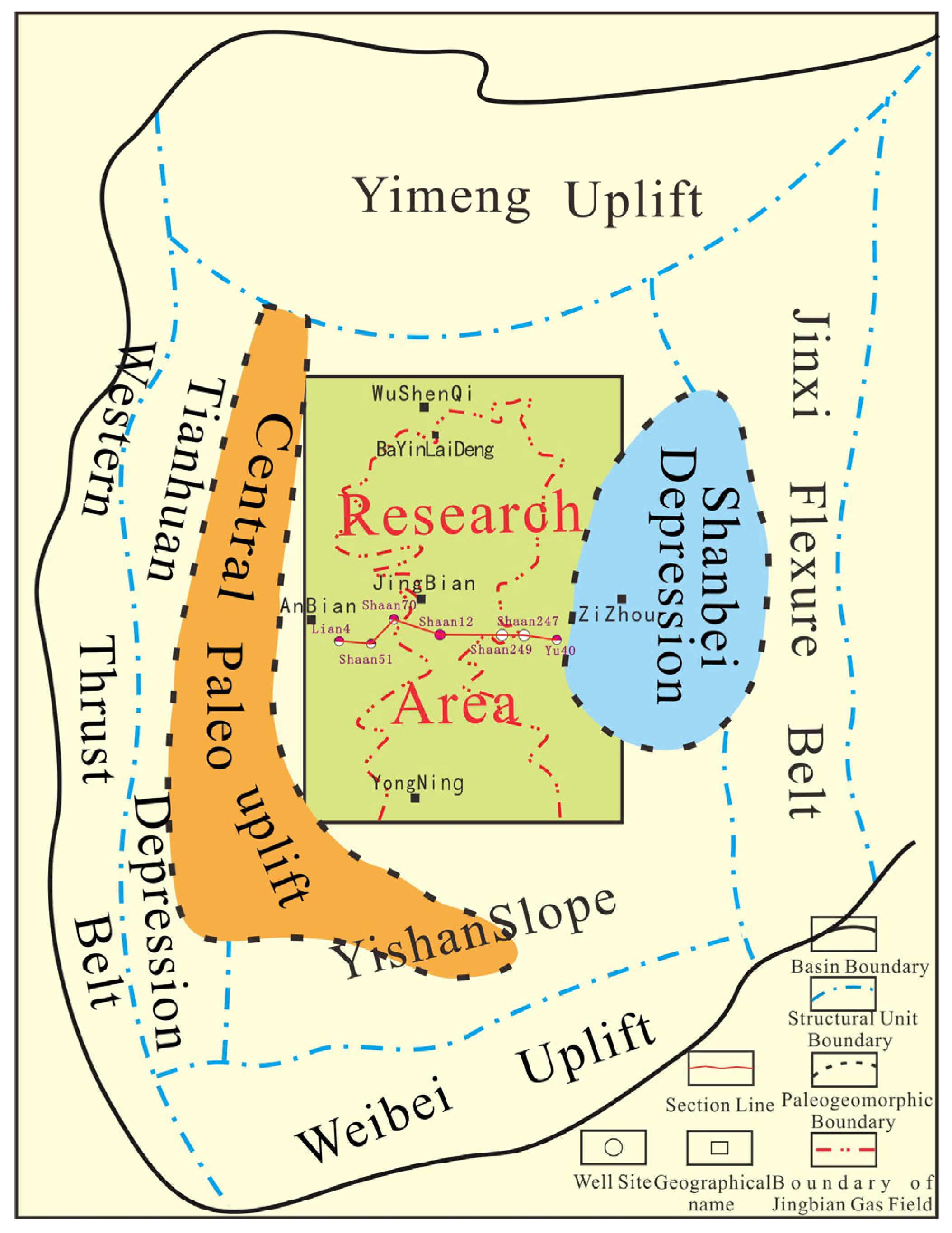
2. Regional Geological Background
3. Recognizing Burial Pressure-Released Water Karst in Moldic Pores
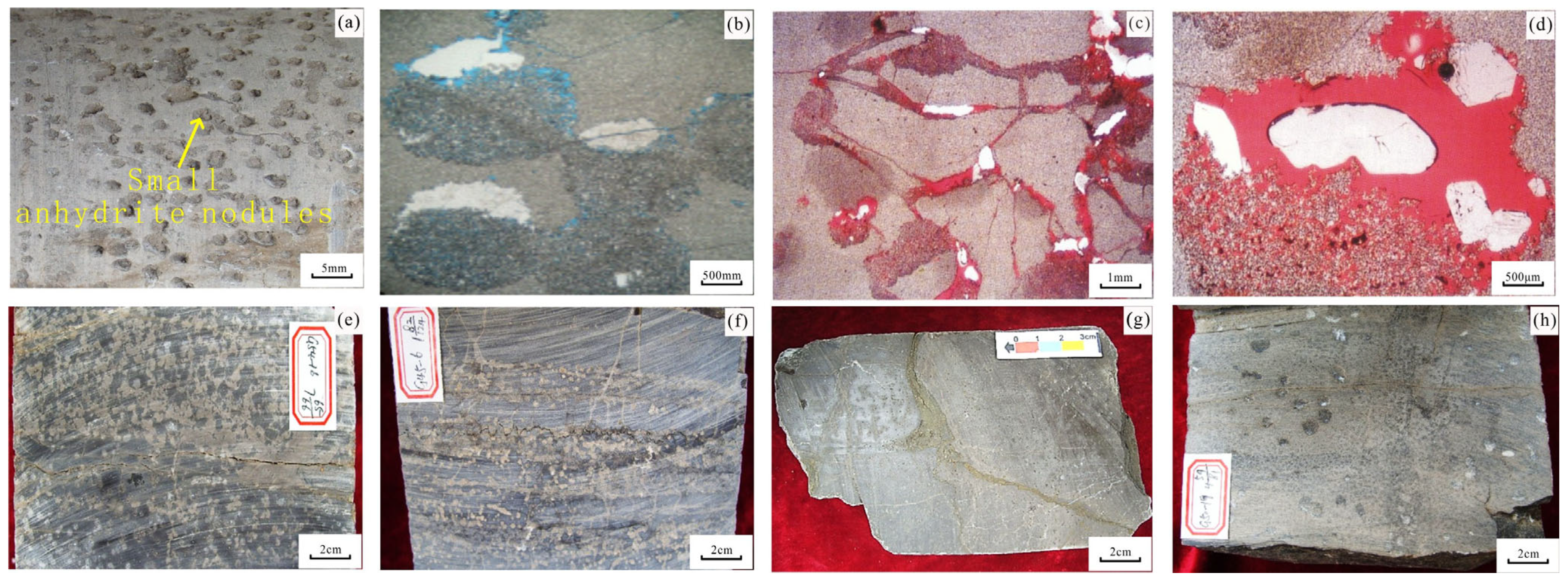
3.1. Morphological Characteristics of Moldic Pore Dissolution
3.2. Geochemical Signatures of the Main Fillings in Anhydrite Moldic Pores
4. Controls on Burial Dissolution and Filling of Anhydrite Moldic Pores by Pressure-Released Water
4.1. Diagenetic Environments and Material Foundations
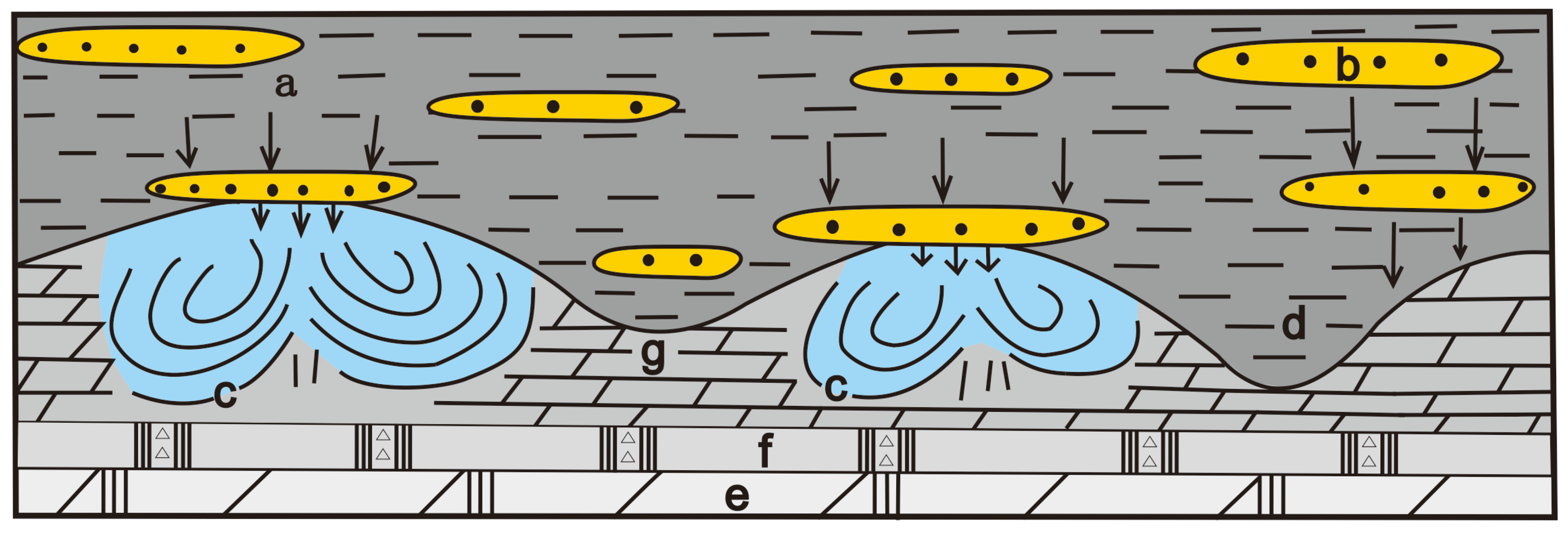
4.2. Source and Migration Pathways of Burial-Stage Pressure-Released Water
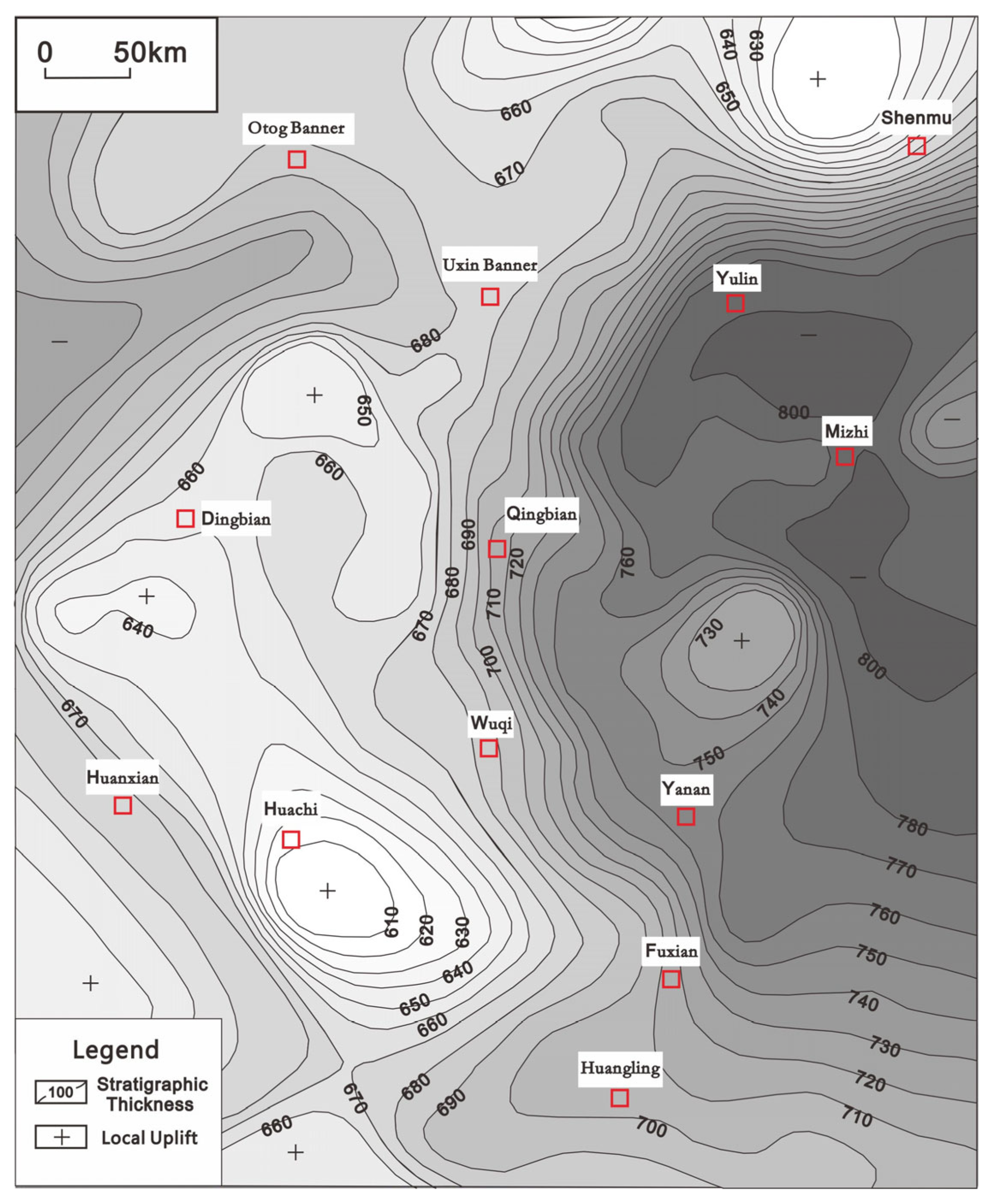
5. Distribution Patterns of Burial-Stage Pressolution Karst and Their Impact on Anhydrite-Mold Pore Reservoirs
6. Discussion
6.1. Interpretation of Key Research Findings
6.2. Limitations of This Study
7. Conclusions
Author Contributions
Funding
Data Availability Statement
Conflicts of Interest
References
- Hou, F.H.; Fang, S.X.; Dong, Z.X.; Zhao, J.S.; Lu, S.X.; Wu, Y.; Chen, Y.N. Sedimentary environment and lithofacies development of the Middle Ordovician Majiagou Formation in the Ordos Basin. Acta Sedimentol. Sin. 2003, 21, 106–112. [Google Scholar] [CrossRef]
- Zhao, H.T.; Zhang, Y.S.; Xing, E.Y.; Wang, L.L.; Gui, B.L.; Shang, W.J.; Peng, Y.; Shi, L.Z. Isotopic geochemistry of evaporite-carbonate sediments in Majiagou Formation euxinic systems with implications for evaluating the Ordovician Northern Shaanxi epicontinental sea, Ordos Basin. Acta Geol. Sin. Engl. Ed. 2018, 92, 418–419. [Google Scholar] [CrossRef]
- Fan, F.; Meng, F.W.; Zhang, Y.S.; Zheng, M.P.; Su, K.; Xing, E.Y. Differences in evaporite geochemistry of the Greater Ordos Ordovician salt basin, China: Evidence from the Ma56 submember of the Majiagou Formation. Carbonates Evaporites 2020, 35, 107. [Google Scholar] [CrossRef]
- Feng, M.; Wang, H.; Wu, X.N.; Cheng, M.; Sun, L.; Luo, J. Characteristics and main controlling factors of the Ordovician Ma55 gas reservoir in the Ordos Basin. Deep. Earth Energy Sci. Technol. 2025, 1, 57–65. [Google Scholar] [CrossRef]
- Zhou, W.J.; Pu, R.H.; Lu, Z.X.; Wang, K.L.; Zhang, P.; Wen, X.Y.; Wang, T.; Guan, Y.Y. Distribution characteristics and main controlling factors of gypsum-salt rocks in the Ordovician Ma5 Member, central-eastern Ordos Basin. Lithol. Reserv. 2025, 1–12. Available online: https://link.cnki.net/urlid/62.1195.TE.20251208.1136.002 (accessed on 2 January 2026).
- Su, Z.T.; Huang, H.; Wei, L.B.; Liu, Y.; Shi, P.P.; Ren, J.F.; Zhu, M.H.; Fu, S.Y. New insights into the lithofacies palaeogeographic evolution of the Middle–Late Ordovician in the Ordos Basin. Acta Geol. Sin. 2025, 1–13. [Google Scholar] [CrossRef]
- Fang, S.X.; He, J.; Hou, F.H.; Yang, X.Y.; Qiao, L.; Fu, S.T.; Yao, J.L.; Wu, Z.; Yan, R.H.; Xu, L.M. Reservoir pore types and evolution of the Middle Ordovician Ma55–Ma51 sub-members of the Majiagou Formation in the central gas field area, Ordos Basin. Acta Petrol. Sin. 2009, 25, 2425–2441. [Google Scholar]
- He, J.; Fang, S.X.; Hou, F.H.; Yang, X.Y. Characteristics of karst reservoirs in the Middle Ordovician Majiagou Formation, central gas field of the Ordos Basin. Oil Gas Geol. 2009, 30, 350–356. [Google Scholar]
- Bai, B.; Hu, S.Y.; Tao, S.Z.; Zhang, D.F.; Liu, W.; Yang, W.J.; Zhang, B.M.; Liu, X.S.; Liu, Y.; Xiong, P. Epigenetic karst effects and significance of the gypsum-salt rock-carbonate rock paragenetic assemblage in the Majiagou Formation, Ordos Basin. J. Yangtze Univ. (Nat. Sci. Ed.) 2017, 14, 7–12+15+91. [Google Scholar] [CrossRef]
- Lei, H.; Huang, W.H.; Yi, S.; Wang, Y.T. Burial dissolution of dolomite in the 5th Member of the Ordovician Majiagou Formation, southern Ordos Basin. J. Palaeogeogr. (Chin. Ed.) 2020, 22, 1041–1052. [Google Scholar]
- Xie, R.C.; Zhou, W.; Zhang, C.; Lei, T.; Yin, S.; Luo, Z.W. Characteristics, influencing factors, and prediction of fractures in weathered crust karst reservoirs: A case study of the Ordovician Majiagou Formation in the Daniudi Gas Field, Ordos Basin, China. Geol. J. 2020, 55, 7790–7806. [Google Scholar] [CrossRef]
- He, J. Evaluation and Prediction of Composite Paleokarst Reservoirs in Dolomite and Sulfate Rocks. Chengdu University of Technology, Chengdu, China, 2015. Available online: https://kns.cnki.net/kcms2/article/abstract?v=_mmQV6m3IPl4xoevAtphns0CdMBi_qNqZ-fYdFhCr9YWVHQJhQ0xT8WVJXSosPuawtmpCptdQ_K8vV_bcM4Y7WhA5iPCOyesvfDvONClKKu-1j5bWArI4JUNGSNbEBcRCvI_sk72xqnudq-P4rW6TBfe7fMLQPL5fXHd0KBGG3IvCSqpPPvwY1ZbY5o38oVu&uniplatform=NZKPT&language=CHS (accessed on 4 January 2026).
- Li, G.R.; Si, J.X.; Shi, F.Z. Types and formation mechanisms of reservoir storage-seepage spaces in the Ordovician Majiagou Formation, Ordos Basin. J. Chengdu Univ. Technol. 1997, 24, 21–27. Available online: https://kns.cnki.net/kcms2/article/abstract?v=_mmQV6m3IPnAx6UQ3jYe7S8nR7MgR5nPYIplVn45xX2Jt4XQtqwECdzLQUyt1IaQ0ba1o8yYwiK06GL6LNJJSSgsDktqeTO3L-fj3wpSrOBvPO46y97mDVLvUHf9qUEV5MvQz_xtMp_rRxqPgGQAa_J9NPi32OR3cy5Jo9uVVGd4z0qj_9tlFw==&uniplatform=NZKPT&language=CHS (accessed on 4 January 2026).
- Li, B.Q.; Wang, Q.C.; Zhang, X.L.; Zhang, Y.; Li, J.; Du, M.X.; Lei, Y.X. Diagenetic facies characteristics of dolomites in the Ma55–Ma51 sub-members of the Majiagou Formation and their impacts on reservoirs in the south-central Ordos Basin. J. Northwest Univ. (Nat. Sci. Ed.) 2018, 48, 255–260+267. [Google Scholar] [CrossRef]
- Di, L.J.; Yang, C.Y.; Yang, Y.H.; Ji, X.L.; Bao, H.P. Formation mechanism of dissolution spots in the Ordovician Majiagou Formation, Ordos Basin. Acta Sedimentol. Sin. 2003, 21, 260–265. [Google Scholar] [CrossRef]
- Luo, Q.Q.; Liu, B.; Jiang, W.M.; Yu, J.X.; Liu, S.Q.; Wang, Y.C.; Wei, L.B.; Cai, Z.H. Diagenesis and pore evolution of dolomite reservoirs in the 5th Member of the Ordovician Majiagou Formation, central Ordos Basin. Oil Gas Geol. 2020, 41, 102–115. [Google Scholar]
- Wang, Y.P.; Dong, C.M.; Chen, H.D.; Su, Z.T.; Zhang, C.J.; Hao, Z.M. Evidence of Ordovician hydrothermal activities and their impacts on reservoir development in the mid-western Ordos Basin. Mar. Orig. Pet. Geol. 2014, 19, 23–31. [Google Scholar]
- Huang, Q.Y.; Zhang, S.N.; Ding, X.Q.; Duan, J.; Xiang, L. Origin of dolomites in the Ordovician Majiagou Formation at the southwestern margin of the Ordos Basin. Pet. Geol. Exp. 2010, 32, 147–153+158. [Google Scholar]
- Wu, H.Y.; Liang, T.; Cao, H.X.; Qiao, X.Y.; Wang, K.; Li, K.Y.; Yu, J.; Guo, Y.Q. Sedimentary evolution model of evaporite sequences in the upper Ordovician Majiagou Formation, Yan’an area. Acta Geol. Sin. 2020, 94, 3819–3829. [Google Scholar] [CrossRef]
- Huang, Z.L.; Bao, H.P.; Ren, J.F.; Bai, H.F.; Wu, C.Y. Characteristics and genetic mechanism of dolomites in the Ordovician Majiagou Formation, southern Ordos Basin. Geoscience 2011, 25, 925–930. [Google Scholar]
- Zhao, W.Z.; Shen, A.J.; Zheng, J.F.; Qiao, Z.F.; Wang, X.F.; Lu, J.M. Origin of pore spaces in dolomite reservoirs of the Tarim, Sichuan, and Ordos Basins and its implications for reservoir prediction. Sci. China Earth Sci. 2014, 44, 1925–1939. [Google Scholar]
- Wang, Z.M.; Zhang, L.J.; Sun, C.H. Classification, episodes, and exploration strategy of Ordovician carbonate karst in the Tarim Basin. J. Palaeogeogr. (Chin. Ed.) 2015, 17, 635–644. [Google Scholar]
- Zhang, K.X.; Guo, Y.Q.; Bao, W.B.; Meng, Y.T.; Li, B.Q.; Wu, Z.Z. Distribution patterns, controlling factors, and impacts on hydrocarbon production of formation water in the Ma5 Member, southeastern Sulige Gas Field, Ordos Basin. Geol. Bull. China 2025, 44, 1007–1020. [Google Scholar]
- Guo, J.; Chen, H.D.; Su, Z.T. Controlling effect of the Central Paleo-uplift on sandbody development in the Taiyuan Formation, Ordos Basin. Nat. Gas Explor. Dev. 2014, 37, 5–8+85–86. [Google Scholar]
- Su, Z.T.; Chen, H.D.; Chen, A.Q.; Zhao, J.X. Sequence-lithofacies paleogeographic characteristics of the Cambrian in the Ordos Basin. Pet. Geol. Recovery Effic. 2012, 19, 15–18+30+112. [Google Scholar] [CrossRef]
- Yu, Z.; Ding, Z.C.; Wu, D.X.; Dong, Y.; Guo, T.; Liu, W. Study on the evolutionary model of sedimentary facies of the Ordovician Majiagou Formation in the central and eastern Ordos Basin. Mar. Orig. Pet. Geol. 2017, 22, 12–22. [Google Scholar]
- Li, M.; Liu, J.; Xia, Y. Risk Prediction of Gas Hydrate Fornation in the Wellbore and Subsea Gathering System ofDeep-Water Turbidite Reservoirs: Case Analysis from the South China Sea. Reserv. Sci. 2025, 1, 52–72. [Google Scholar] [CrossRef]
- Cao, L.; Lv, M.; Li, C.; Sun, Q.; Wu, M.; Xu, C.; Dou, J. Efects of Crosslinking Agents and Reservoir Conditions on the Propagation of Fractures inCoal Reservoirs During Hydraulic Fracturing. Reserv. Sci. 2025, 1, 36–51. [Google Scholar] [CrossRef]
- Wang, F.; Kobina, F. The Influence of Geological Factorsand Transmission Fluids on the Exploitation of Reservoir Geothermal Resources: Factor Discussion and Mechanism Analysis. Reserv. Sci. 2025, 1, 3–18. [Google Scholar] [CrossRef]
- Yu, Z.; Ding, Z.C.; Sun, L.Y.; Ma, Z.R.; Wu, X.N.; Dong, Y. Sedimentary evolution and lithofacies palaeogeography of the Ordovician Ma54 sub-member in the central and eastern Ordos Basin. J. Palaeogeogr. (Chin. Ed.) 2015, 17, 787–796. [Google Scholar]
- Li, C.T.; Qi, Z.Z.; Ding, X.Q.; Liu, S.H.; Gao, J.Y.; Zhu, Y. Characteristics and distribution patterns of dolomites in the 4th Member of the Majiagou Formation, Daniudi Gas Field, Ordos Basin. Nat. Gas Explor. Dev. 2023, 46, 32–41. [Google Scholar]
- Xi, S.L.; Zheng, C.B.; Xia, R.Y. Geochemical modeling of pressure-release water karstification in the Ordovician of the Ordos Basin. Acta Sedimentol. Sin. 2005, 23, 354–360. [Google Scholar] [CrossRef]
- Tian, W.; Chen, G.; Li, W.H.; Lv, J.W.; Li, J.D.; Yang, C. Constructive burial diagenesis and its significance of dolomite reservoirs in the Ma54-Ma51 sub-members of the Gaoqiao Block, Jingbian Gas Field, Ordos Basin. Geol. Bull. China 2016, 35, 454–460. [Google Scholar]
- Yang, H.; Liu, X.S.; Zhang, D.F. Main controlling factors of natural gas accumulation and exploration progress in Ordovician marine carbonate rocks of the Ordos Basin. Nat. Gas Ind. 2013, 33, 1–12. [Google Scholar]
- Du, H.; Liu, Y.F.; Fan, L.Y.; Ma, Z.R.; Luo, X.R.; Shen, A.J.; Zeng, S. Origin and evolutionary process of overpressure in Lower Paleozoic carbonate rocks of the Ordos Basin. Acta Pet. Sin. 2025, 46, 891–908. [Google Scholar]
- Wu, J.; Liu, T.L.; Zhang, H.; Su, K.D.; Yang, D.; Wang, J.J. Characteristics of formation water salinity and fluid identification in complex strata of the Beibuwan Basin. Pet. Geol. Eng. 2024, 38, 70–73+78. [Google Scholar]
- Deng, W.; Tan, X.C.; Zhang, D.F.; Zhong, S.K.; Dong, G.D.; Xiao, M.; Lu, Z.X.; Yang, M.Y.; Xiong, Y.; Nie, W.C. Occurrence types and genesis of anhydrite in the Ma56 sub-member of the Ordovician Majiagou Formation, central and eastern Ordos Basin. J. Palaeogeogr. (Chin. Ed.) 2022, 24, 226–244. [Google Scholar]
- Xu, J.; Xiao, D.; Su, W.J.; Yan, W.; Zhong, S.K.; Yang, M.Y.; Yang, M.Y.; Tan, X.C. Characteristics and genesis of leopard-spotted dolomitic limestones in the 4th Member of the Ordovician Majiagou Formation at the eastern margin of the Ordos Basin: A case study of the Guanjiaya Section. J. Palaeogeogr. (Chin. Ed.) 2022, 24, 261–277. [Google Scholar]
- Fang, J.Y.; Chen, H.D.; Shi, Y.H.; Li, L.; Deng, X.; Su, Z.T. Characteristics and formation mechanism of paleokarst reservoirs in the Majiagou Formation of the Yichuan–Huanglong area, Ordos Basin. J. Earth Sci. Environ. 2019, 41, 83–95. [Google Scholar]
- Tan, F.; Zhang, Y.F.; Wang, Z.Y.; Dong, Z.X.; Huang, Z.L.; Wang, Q.P.; Gao, J.W. Burial dissolution experiments on carbonate rocks with different textures from the Ordovician of the Ordos Basin. Acta Sedimentol. Sin. 2017, 35, 413–424. [Google Scholar] [CrossRef]
- Wang, Q.; Xu, Y.; Liu, X.S.; Ma, D.X.; Ma, X.F.; Li, S.T. Formation mechanism and main controlling factors of high-quality natural gas reservoirs under karst background: A case study of the Ma54-Ma51 reservoirs in the Ordovician Majiagou Formation, Ordos Basin. Nat. Gas Geosci. 2016, 27, 2103–2114. [Google Scholar]
- Han, B.; Feng, Q.; Zhao, Z.Y.; Wang, Q.Y.; Zhao, W.; Jiang, W.J.; Xue, C.; Lu, Y.J. Characteristics of weathering crust karst and reservoir analysis of the Ordovician in the central and eastern Ordos Basin. Mar. Geol. Front. 2011, 27, 24–30. [Google Scholar] [CrossRef]
- He, J.; Tang, C.J.; Zhao, G.; Du, J.; Mei, X.H.; Zhang, Z.H.; Zhao, Z.J.; Yao, J. Study on the development, evolution, and main controlling factors of gypsum moldic vugs in Ma541, central Ordos Basin. ACS Omega 2025, 10, 48155–48166. [Google Scholar] [CrossRef]
- Li, Z.H.; Hu, J.M. Tectonic evolution and paleokarst reservoir distribution in the Ordos Basin. Oil Gas Geol. 2010, 31, 640–647+655. [Google Scholar]






| Formation | Member | Sub-member | Layer | Preserved Thickness (m) | Dolomite-Anhydrite Composite Lithology | Depositional Environment |
|---|---|---|---|---|---|---|
| Majiagou | Ma5 | Ma51 | Ma511 | 0–8 | Argillaceous dolomicrite with anhydrite nodule-bearing dolomite interbeds | Peritidal dolomitic (mud) flat interbedded with peritidal gypsum-dolomite flat |
| Ma512 | 0–9 | Anhydrite nodule-bearing dolomite (dominant), fine dolomicrite | Peritidal gypsum-dolomite flat | |||
| Ma513 | 0–4 | Anhydrite nodule-bearing dolomite (dominant) with fine dolomicrite interbeds | Peritidal gypsum-dolomite flat | |||
| Ma514 | 0–6 | Argillaceous dolomicrite (dominant) with anhydrite nodule-bearing dolomite interbeds | Peritidal dolomitic (mud) flat interbedded with peritidal gypsum-dolomite flat | |||
| Ma52 | Ma521 | 0–4 | Argillaceous dolomicrite | Peritidal dolomitic (mud) flat | ||
| Ma522 | 0–4.5 | Fine dolomicrite (dominant) with anhydrite nodule-bearing dolomite interbeds | Peritidal dolomitic (mud) flat interbedded with peritidal gypsum-dolomite flat | |||
| Ma53 | Ma531 | 5–6 | Argillaceous dolomicrite | Peritidal dolomitic (mud) flat | ||
| Ma532 | 10–12 | Dolomicrite with dolomitic anhydrite interbeds | Peritidal dolomitic (mud) flat interbedded with peritidal anhydrite flat | |||
| Ma533 | 9–10 | Dolomitic anhydrite (dominant), micritic-fine dolomicrite | Peritidal anhydrite flat to peritidal dolomitic (mud) flat | |||
| Ma54 | Ma541 | 10–14 | Anhydrite nodule-bearing dolomite (dominant), dolomicrite with anhydrite interbeds | Peritidal gypsum-dolomite flat to peritidal dolomitic (mud) flat | ||
| Ma542 | 13–15 | Argillaceous dolomicrite (dominant) with dolomitic anhydrite interbeds | Peritidal dolomitic (mud) flat interbedded with peritidal anhydrite flat | |||
| Ma543 | 8–14 | Argillaceous dolomicrite (dominant) with dolomitic anhydrite interbeds | Peritidal dolomitic (mud) flat interbedded with peritidal anhydrite flat | |||
| Ma55–Ma510 | ||||||
| Well | Horizon | Mineral Type | Carbonate (PDB) | Inclusion | Note | |||||
|---|---|---|---|---|---|---|---|---|---|---|
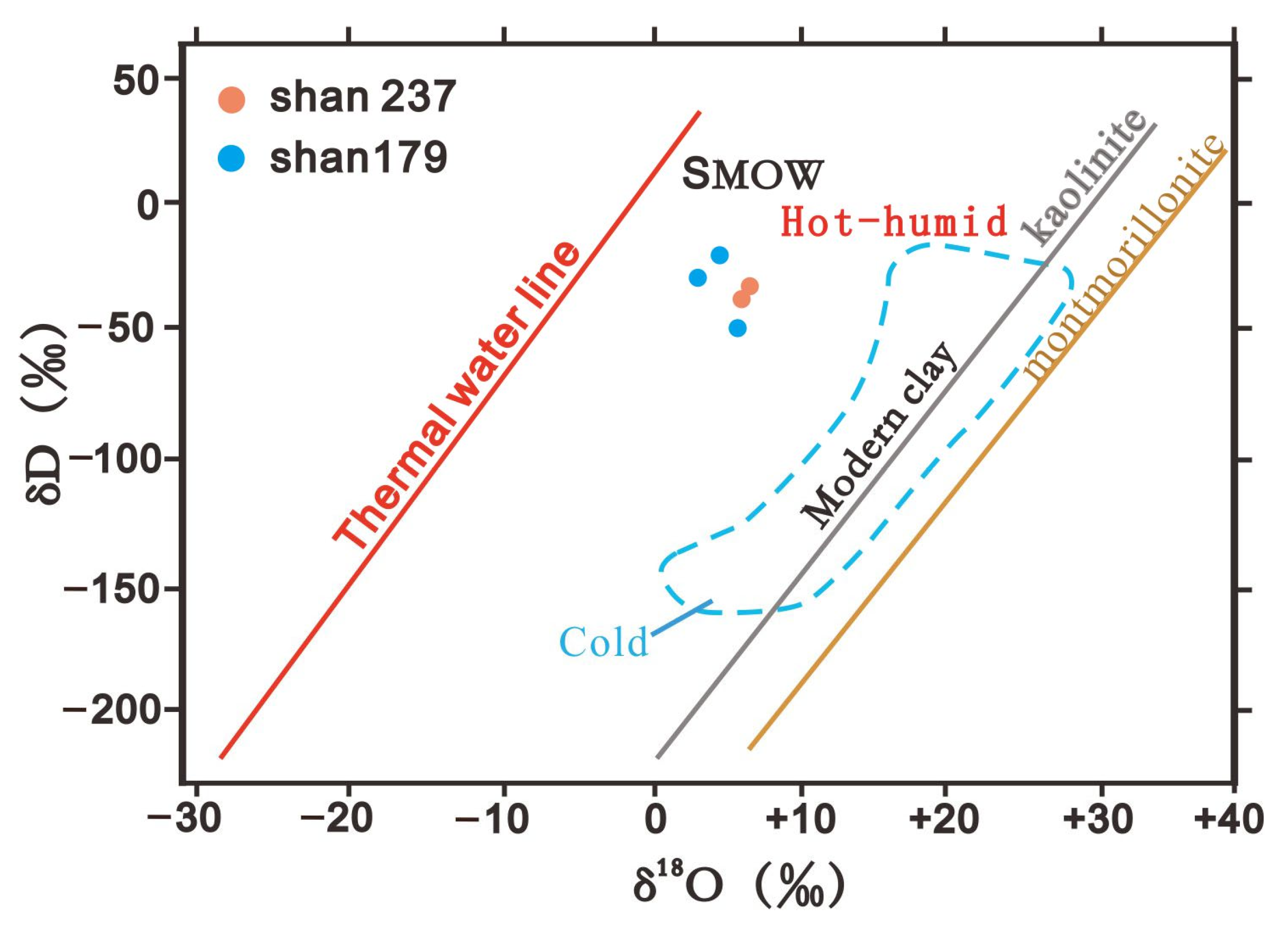
| Sr (ppm) | Mn (ppm) | δ13C (‰) | δ18O (‰) | Homogenization Temperature (°C) | δDwater | δ18Owater | / | |||
| Shan237 | Ma54 | Black Calcite Fill | 820 | 120 | −5.7 | −11.69 | 120 | −43 | 6.3 | Convert |
| Shan237 | Ma54 | Black Calcite Fill | 745 | 86 | −4.8 | −13.58 | 115 | −38 | 6.7 | Convert |
| Shan179 | Ma54 | Black Calcite Fill | 632 | 97 | −7.5 | −14.59 | 83 | −51 | 5.9 | Convert |
| Shan179 | Ma54 | Black Calcite Fill | 590 | 90 | −6.8 | −13.25 | 96 | −32 | 3.2 | Convert |
| Shan179 | Ma54 | Black Calcite Fill | 612 | 80 | −6.2 | −15.38 | 102 | −26 | 4.1 | Convert |
| Well | Horizon | Sample | Sample Name | δ34S (‰) |
|---|---|---|---|---|
| Shan42 | C2b | 2-84/98 | Pyrite | −5.2 |
| Ma511 | 3-18/61 | Pyrite | −2.63 | |
| Shan16 | Ma513 | 2-12/38 | Pyrite | −5.86 |
| Ma514 | 4-2/42 | Pyrite | 9.52 | |
| Cheng1 | Ma541 | 3-9/24 | Pyrite | 22.6 |
Disclaimer/Publisher’s Note: The statements, opinions and data contained in all publications are solely those of the individual author(s) and contributor(s) and not of MDPI and/or the editor(s). MDPI and/or the editor(s) disclaim responsibility for any injury to people or property resulting from any ideas, methods, instructions or products referred to in the content. |
© 2026 by the authors. Licensee MDPI, Basel, Switzerland. This article is an open access article distributed under the terms and conditions of the Creative Commons Attribution (CC BY) license.
Share and Cite
He, J.; Li, H.; Luo, L.; Qiao, L.; Li, J.; Ma, X.; Zhang, Y.; Yao, J.; Jiang, S.; Wang, Y. Controlling Mechanisms of Burial Karstification in Gypsum Moldic Vug Reservoirs of the 4-1 Sub-Member, Member 5 of the Majiagou Formation, Central Ordos Basin. Processes 2026, 14, 275. https://doi.org/10.3390/pr14020275
He J, Li H, Luo L, Qiao L, Li J, Ma X, Zhang Y, Yao J, Jiang S, Wang Y. Controlling Mechanisms of Burial Karstification in Gypsum Moldic Vug Reservoirs of the 4-1 Sub-Member, Member 5 of the Majiagou Formation, Central Ordos Basin. Processes. 2026; 14(2):275. https://doi.org/10.3390/pr14020275
Chicago/Turabian StyleHe, Jiang, Hang Li, Lei Luo, Lin Qiao, Juzheng Li, Xiaolin Ma, Yuhan Zhang, Jian Yao, Sisi Jiang, and Yaping Wang. 2026. "Controlling Mechanisms of Burial Karstification in Gypsum Moldic Vug Reservoirs of the 4-1 Sub-Member, Member 5 of the Majiagou Formation, Central Ordos Basin" Processes 14, no. 2: 275. https://doi.org/10.3390/pr14020275
APA StyleHe, J., Li, H., Luo, L., Qiao, L., Li, J., Ma, X., Zhang, Y., Yao, J., Jiang, S., & Wang, Y. (2026). Controlling Mechanisms of Burial Karstification in Gypsum Moldic Vug Reservoirs of the 4-1 Sub-Member, Member 5 of the Majiagou Formation, Central Ordos Basin. Processes, 14(2), 275. https://doi.org/10.3390/pr14020275