1. Introduction
Process Systems Engineering (PSE) is a multidisciplinary field dedicated to the systematic modeling, design, optimization, and integration of chemical and biochemical processes across multiple scales. Its methodologies enable the efficient use of materials and energy through rigorous mathematical and computational frameworks that capture the interactions among process units, plants, and entire industrial networks [
1]. Within the context of sustainability, PSE principles have been increasingly applied to industrial symbiosis (IS) [
2] and eco-industrial park (EIP) design, where inter-plant exchanges of resources can minimize waste and enhance overall system efficiency [
3]. Building upon these foundations, the concept of Carbon–Hydrogen–Oxygen Symbiosis Networks (CHOSYNs) emerged, reflecting the elemental composition of most industrial materials and energy carriers. CHOSYN frameworks integrate PSE tools with molecular-level analysis to optimize the transformation and utilization of C-H-O resources (where C-H-O refers to carbon, hydrogen, and oxygen as the elemental basis of most industrial streams), offering a more fundamental and scalable approach to achieving low-carbon and circular industrial ecosystems [
4].
The pursuit of net-zero emissions and the growing demand for resource efficiency have positioned IS and circular economy (CE) frameworks at the center of sustainable process design [
5]. Although traditional IS approaches primarily focused on byproduct exchange and shared utilities have demonstrated considerable environmental and economic benefits, their application remains constrained by the absence of molecular-level representation and limited capacity to capture complex, cross-sectoral interactions. To address these limitations, the CHOSYN concept was introduced, with its framework derived from the elemental basis of most materials, chemicals, and energy carriers [
6]. CHOSYN frameworks extend beyond conventional symbiosis by incorporating atomic-level mass integration, chemical transformations, and inter-process synergies, thereby bridging the gap between process systems engineering and sustainable resource management. This approach provides a more rigorous and unified platform for the design of low-carbon, resource-efficient industrial ecosystems, addressing the structural and methodological limitations of existing IS and CE models.
By representing industrial systems as networks of processes (nodes) and streams of carbon, hydrogen, and oxygen compounds (edges), CHOSYN enables atomic-level targeting, integration, and optimization. The central principles include the reuse of waste streams as feedstocks for other processes, multi-objective optimization that balances cost, efficiency, emissions, and social aspects, and structural flexibility to adapt to fluctuating markets and policy constraints. In this way, CHOSYN moves beyond process-by-process optimization and provides a systemic framework for designing eco-industrial parks and regional clusters aligned with decarbonization goals. The CHOSYN is a concept within process engineering that involves the synthesis and design of highly integrated chemical transformation complexes through mathematical optimization schemes and formulations. This concept is based on the utilization of waste streams and byproducts from one plant as inputs for other facilities, generating both economic and environmental benefits. However, traditional approaches to industrial symbiosis have significant limitations: they typically focus on simplified mass and energy balances, rely heavily on the availability of macro-level data, and often lack the flexibility to adapt to dynamic environments characterized by changing markets and regulations [
7].
The fundamental principles of the CHOSYN framework can be summarized into three pillars. First, the reuse of waste streams as raw materials for other processes, which promotes a more circular economy [
8]. Second, multi-objective optimization strategies, which balance costs, energy efficiency, emissions reduction, and social benefits [
9]. Finally, the structural flexibility offered by the framework enables systems to adapt to market fluctuations, regulatory constraints, and variations in resource availability [
10]. In this way, CHOSYNs goes beyond process-by-process optimization and offers a systemic and integrated framework for the design of eco-industrial parks and regional clusters aligned with decarbonization and carbon neutrality goals [
4].
The emergence of CHOSYNs, therefore, responds to the need for an integrative analytical framework capable of guiding the transition of industrial systems toward more sustainable, resilient, and socially responsible configurations. This potential makes CHOSYN one of the most promising emerging areas within sustainable process engineering, situated at the intersection of green chemistry, renewable energy, mathematical optimization, and decarbonization policies. The motivation for this review article is that, despite the progress made in the last decade, the literature on CHOSYN is still scattered across multiple works addressing partial aspects or specific case studies, including atomic-level targeting, anchor-tenant configurations, CO
2 monetization, multiperiod optimization, uncertainty treatment, process intensification, and applications restricted to isolated petrochemical, energy, or biorefinery clusters. To date, no comprehensive review systematizes the evolution of this field, identifies its main trends, and maps future directions. In this regard, this manuscript seeks to fill this gap through a comprehensive and chronological review of published contributions, complemented by an analysis of related approaches such as industrial symbiosis, the circular economy, and the integration of renewable energy, challenges and gaps in the literature, and, finally, future projections of the CHOSYN framework toward the year 2035. Finally, the article is organized as follows.
Section 1 introduces the motivation, scope, and contributions.
Section 2 details the review methodology following PRISMA 2020 [
11].
Section 3 presents a chronological account of the evolution of CHOSYNs.
Section 4 synthesizes applications and current insights in the design and optimization of industrial networks.
Section 5 examines future challenges and research gaps in the CHOSYN literature.
Section 6 outlines projections and a roadmap to 2035.
Section 7 concludes with implications for research, policy, and industrial practice. The aim is to offer the academic and industrial communities a consolidated overview of the state of the art in CHOSYNs and its potential contributions to the design of sustainable industrial systems within the framework of global commitments to climate change mitigation.
2. Methodology
This review was conducted following the Preferred Reporting Items for Systematic Reviews and Meta-Analyses (PRISMA 2020) guidelines [
11]. The objective was to systematically identify, evaluate, and synthesize peer-reviewed studies addressing the conceptual development, methodological formulation, and practical implementation of CHOSYN and equivalent frameworks for atomic-level process integration. The review period encompassed publications from 1 January 2015 to 15 October 2025, thereby capturing both foundational contributions and the most recent advances in the field.
The search strategy was designed to ensure comprehensiveness and reproducibility. Four major scientific databases (Scopus, Web of Science Core Collection, ScienceDirect, and SpringerLink) were queried, supplemented by Google Scholar for online-first and in-press works. The search string combined controlled vocabulary and Boolean operators:
(“CHOSYN” OR “Carbon Hydrogen Oxygen Symbiosis Network” OR “Carbon-Hydrogen-Oxygen symbiosis” OR “material conservation network*” OR “C-H-O integral*”) AND (“process integration” OR “industrial symbiosis” OR “eco-industrial park” OR “circular economy” OR optimization OR “multi-scale” OR “disjunctive programming”).
Filters were applied to include only peer-reviewed journal articles, book chapters, and conference papers, with no language or geographic restrictions. Reference lists of key publications were manually screened to identify additional relevant studies not captured through database queries.
Eligibility criteria were established prior to screening. Studies were included if they:
- (1)
explicitly addressed CHOSYN or comparable atomic-level integration frameworks within process systems engineering;
- (2)
presented quantitative or computational formulations (e.g., mixed-integer linear programming (MILP); mixed-integer nonlinear programming (MINLP); disjunctive, stochastic, or multi-objective optimization); and
- (3)
demonstrated applications to process integration, industrial symbiosis, eco-industrial parks, circular economy strategies, or energy transition systems.
Studies were excluded if they:
- (1)
lacked quantitative modeling or optimization components;
- (2)
focused exclusively on hydrogen, carbon, or oxygen networks without integrated C-H-O coupling;
- (3)
consisted of conceptual reviews, editorials, or gray literature;
- (4)
or duplicated earlier versions of the same research.
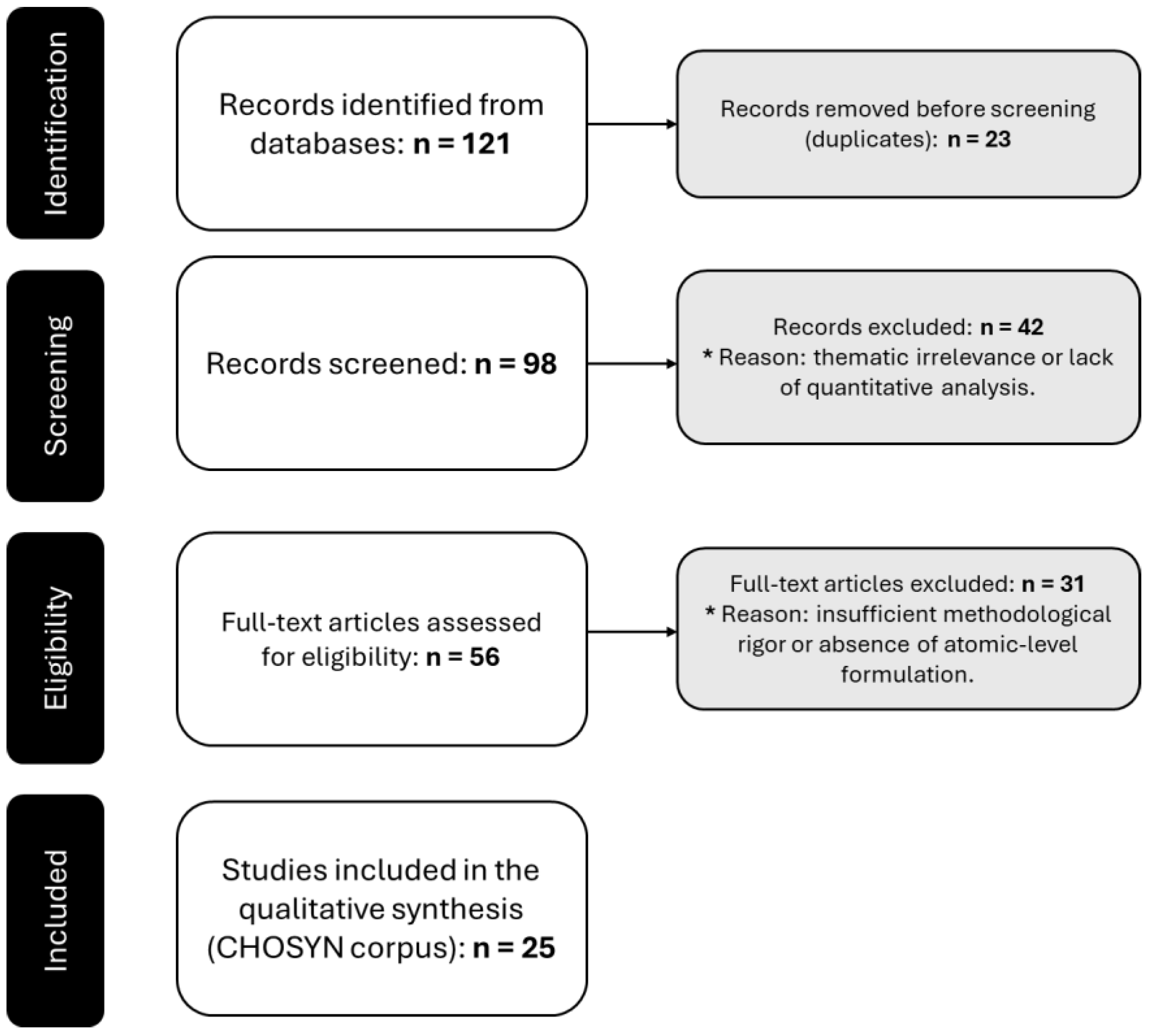
The identification and screening process followed the PRISMA flow sequence. A total of 121 records were retrieved; after removing 23 duplicates, 98 unique records were screened by title and abstract. Of these, 42 were excluded for thematic irrelevance or lack of quantitative analysis. The remaining 56 full-text articles were assessed in detail, and 31 were excluded due to insufficient methodological rigor or lack of atomic-level formulation. Consequently, 25 studies met all inclusion criteria and were incorporated into the final qualitative synthesis. The corresponding PRISMA 2020 [
11] flow diagram is provided in
Figure 1.
Data extraction was performed using a standardized template capturing: publication metadata, research objective, modeling framework, optimization method, scale of integration (intra-plant, inter-plant, or regional), treatment of uncertainty or dynamics, environmental and safety metrics, validation approach (simulation, industrial data, or sensitivity analysis), and key outcomes. To minimize bias, data were independently verified and cross-checked across databases for consistency.
The methodological quality and potential bias of computational studies were assessed using a customized checklist adapted from best practices in systems modeling. Criteria included model transparency, appropriateness of assumptions, completeness of input data, sensitivity and uncertainty analysis, and reproducibility of results. For works incorporating life-cycle or techno-economic assessment, consistency in system boundaries and inventory data was also verified.
Given the diversity of modeling approaches and objectives, a meta-analysis was not feasible. Instead, a qualitative synthesis was performed through thematic coding and comparative analysis. Studies were organized chronologically and by methodological contribution, enabling the identification of four main evolutionary phases: foundation (2015–2017), expansion (2018–2019), emergence (2020–2022), and consolidation (2023–2025). Cross-cutting themes such as anchor-tenant structures, Carbon Dioxide (CO2) monetization, distributive fairness, process intensification, resilience assessment, modularity, and digital integration were systematically examined to trace conceptual continuity and methodological innovation.
All steps of the review process (including search queries, inclusion decisions, data extraction matrices, and coding schemes) were documented to ensure transparency and reproducibility. The resulting corpus of 25 publications provides a coherent and traceable foundation for the subsequent analysis of CHOSYN evolution, applications, and future perspectives.
3. Evolution of CHOSYN Research
Building upon the limitations of conventional industrial symbiosis frameworks, the evolution of CHOSYN research represents a systematic effort to capture the underlying atomic and process-level interactions governing resource conversion and exchange. Since its conceptual inception, the CHOSYN paradigm has undergone progressive refinement from early formulations focused on atomic targeting and stoichiometric consistency to advanced multi-scale models integrating thermodynamic, economic, and environmental criteria. This evolution reflects an increasing recognition of the need to couple chemical process design with sustainability metrics and network optimization, positioning CHOSYN as a unifying platform for designing carbon-neutral and resource-synergistic industrial systems.
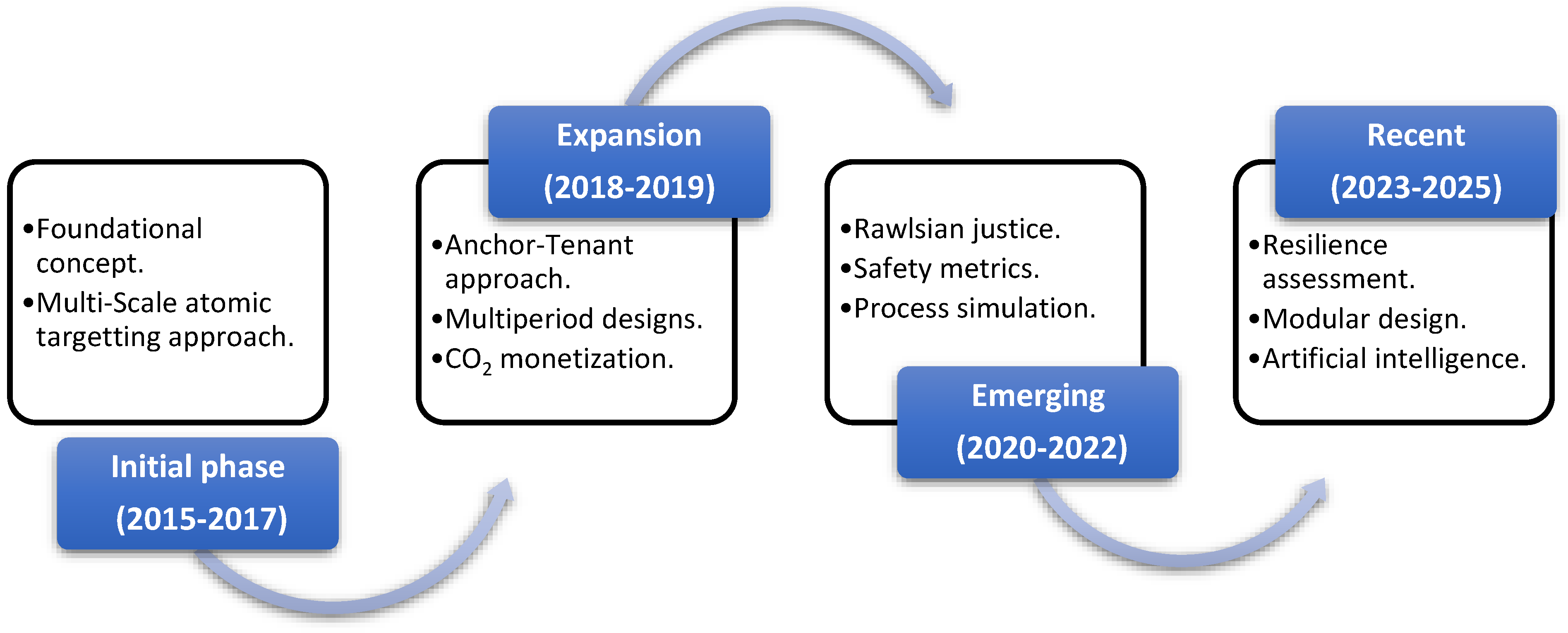
The development of CHOSYNs can be grouped into several phases: an initial phase (2015–2017), an expansion phase (2018–2019), an emerging-directions phase (2020–2022), and recent trends (2023–2025). This classification reflects the conceptual and methodological evolution of the field, beginning with atomic-level targeting and progressing toward advances in anchor-tenant design, multiperiod operation, uncertainty treatment, and large-scale optimization. Subsequent contributions incorporated fairness principles, safety considerations, process intensification, dynamic operation, and biorefinery applications. The most recent studies emphasize resilience, modular design, artificial intelligence, and explicit alignment with carbon-neutrality strategies.
Initial phase (2015–2017): Noureldin and El-Halwagi [
6] introduced the foundational concept of CHOSYNs as a systematic framework for material integration based on atomic balance principles. Their work established a novel approach to interconnect industrial processes through the optimal exchange of carbon, hydrogen, and oxygen-containing streams, aiming to minimize waste generation and enhance resource utilization. By employing graphical and mathematical optimization tools, the study demonstrated how CHOSYNs can achieve both economic and environmental improvements, laying the groundwork for subsequent developments in sustainable industrial symbiosis. El-Halwagi [
12] proposed a shortcut methodology for the multi-scale atomic targeting and design of CHOSYNs, aiming to streamline the synthesis process by linking molecular-level conservation with process and network design. The approach employs atomic balances of carbon, hydrogen, and oxygen to rapidly identify optimal integration opportunities across industrial systems without requiring detailed simulation. This method significantly reduces computational effort while preserving accuracy, enabling early-stage decision-making for sustainable process design and resource efficiency in eco-industrial networks. Topolski et al. [
13] expanded the CHOSYN framework by introducing the Anchor-Tenant model for the systematic synthesis of eco-industrial parks. This approach centers on a key industrial facility, the anchor-tenant around which other plants are integrated based on carbon, hydrogen, and oxygen exchanges. The model enables the identification of optimal material and energy linkages to maximize economic benefits while reducing emissions and waste. By combining process integration and symbiotic network design, the study provided a practical strategy for implementing CHOSYNs in real-world industrial clusters, strengthening the link between theory and application in sustainable industrial development.
Expansion (2018–2019): Anchor-tenant approaches, multiperiod designs, and CO
2 monetization were proposed. Contributions explored optimization via MILP, MINLP, and disjunctive programming, and considered both retrofitting and grass-roots design. The work by Topolski et al. [
10] marked a significant advancement in the development of sustainable industrial cities and eco-industrial parks (EIPs) by extending the CHOSYN framework toward the design of grassroots industrial ecosystems. While earlier studies focused on retrofitting and optimizing existing EIPs, this contribution addressed the more complex scenario in which the participating facilities were not predefined. The authors introduced the concept of “anchor” plants, key industrial entities initially established to attract “tenant” facilities whose selection depends on their integration potential, shared infrastructure, and compatibility with environmental and market constraints. Within this context, a comprehensive multi-scale targeting, synthesis, and optimization approach was proposed for the grassroots design of EIPs with known anchors. The CHOSYN methodology was extended to include candidate tenants, with the goal of identifying industrial participants, raw materials, byproducts, and waste streams that could be effectively integrated among themselves and with the surrounding markets. Atomic-based and techno-economic targeting techniques were incorporated to define mass integration benchmarks and to guide the preliminary screening of tenant types and capacities. The study culminated in the development of an optimization framework capable of synthesizing highly integrated, cost-effective industrial clusters, providing detailed insights into facility-level design and inter-plant interactions. A case study was presented to illustrate the practical implementation of this multi-scale methodology, highlighting its potential for guiding the sustainable and systematic creation of new eco-industrial parks. Building upon earlier developments in CHOSYN design, Topolski et al. [
13] addressed the challenge of multi-period operation in symbiotic industrial networks. Previous CHOSYN frameworks had been limited to a single operating mode, assuming constant flow rates and compositions across participating plants. Recognizing that real industrial systems often exhibit seasonal or demand-driven variability, the authors introduced a multi-period CHOSYN design approach capable of capturing such fluctuations throughout the year. The proposed multi-scale targeting framework enables the determination of optimal chemical conversion, separation, and allocation schemes while simultaneously identifying the most suitable type and size of shared infrastructure across different operating conditions. A case study involving five industrial plants and two distinct modes of operation was used to demonstrate the applicability of the approach, highlighting its value for designing flexible and resilient CHOSYNs that maintain integration efficiency under variable process conditions. Mukherjee and El-Halwagi [
7] advanced the CHOSYN framework by explicitly addressing the uncertainty associated with interplant material exchanges in eco-industrial parks. Recognizing that the flow rates and compositions of exchanged streams can fluctuate due to variable plant performance, the authors proposed a stochastic design methodology to enhance the reliability and robustness of CHOSYN implementations. The approach integrates response surface modeling to capture stream variability, followed by reliability analysis using gradient-based techniques such as the First-Order Reliability Method (FORM). This probabilistic treatment enables the iterative adjustment of design variables to ensure that both performance and sustainability targets, economic and environmental, are satisfied under uncertainty. A case study involving a five-plant demonstrated the practical applicability of the framework, showing how stochastic assessment can improve confidence in interplant connections and decision-making for multi-company eco-industrial integration. Juárez-García et al. [
14] addressed the complexity of multi-scale integration in hydrocarbon-based process industries. The authors developed two disjunctive programming approaches to systematically design CHOSYNs that incorporate chemical conversion, separation, and stream allocation. The first approach employed a two-stage optimization framework: an atomic-balance model to establish resource and discharge targets, followed by an economic optimization model to define network configuration and stream allocation among existing and potential industrial facilities. The second, simultaneous approach integrated both stages within a unified disjunctive formulation, optimizing resource utilization, waste minimization, and cost efficiency concurrently. By introducing these optimization-based methodologies, the study provided a rigorous mathematical foundation for CHOSYN synthesis, enhancing the capacity to achieve sustainable resource management across interconnected process industries. A detailed case study illustrated the practical relevance of the proposed approaches. Panu et al. [
4] addressed one of the most pressing challenges in sustainable process integration: the utilization of CO
2 as a chemical feedstock. Recognizing CO
2 as an abundant and low-cost carbon source, the authors developed a multi-scale synthesis and optimization methodology aimed at converting CO
2 into value-added chemicals while reducing the overall carbon footprint of interconnected industrial systems. The proposed approach combined atomic-level targeting with economic and life-cycle considerations to establish performance benchmarks for CO
2 utilization, external resource consumption, and emissions reduction. A pre-synthesis stage was employed to determine optimal CO
2 separation and conversion strategies, integrating feasible CO
2-based reactions into existing industrial infrastructures. Carbon-footprint constraints were incorporated to evaluate the environmental performance of reaction and separation pathways within the network. Through a detailed case study, the work demonstrated how systematic CHOSYN-based integration can facilitate the effective coupling of CO
2 sources and sinks across multiple plants, offering a pathway toward carbon-efficient and economically viable eco-industrial systems. Al-Fadhli et al. [
15] advanced the CHOSYN framework by introducing a modular and time-dependent design perspective for the progressive implementation of Carbon–Hydrogen–Oxygen Symbiosis Networks. Building upon earlier contributions addressing atomic targeting, anchor-tenant selection, and uncertainty in stream characteristics, the study proposed a dynamic optimization approach to guide decision-making throughout the CHOSYN development timeline. The proposed methodology incorporated resource availability constraints and temporal investment strategies, allowing for capital productivity and profitability to be optimized as the network expands or evolves over time. Through this modular design perspective, CHOSYN implementation was redefined as a staged, adaptable process rather than a static configuration, reflecting real-world industrial growth and resource limitations. An optimization-based computational framework was developed to support this conceptual model, providing a systematic foundation for strategic, phased deployment of CHOSYNs that align economic objectives with sustainable resource management.
Emerging directions (2020–2022): To promote more balanced integration, Juárez-García et al. [
9] applied optimization-based formulations by incorporating fairness principles. These approaches employ social welfare, Rawlsian justice, and Nash equilibrium schemes to ensure equitable distribution of resources among plants. Comparative analyses with conventional profit-maximization models demonstrate how these justice-oriented frameworks improve fairness without compromising the overall system performance. Wang et al. [
16] integrated safety considerations into the design stage of eco-industrial parks. The synthesis of C-H-O symbiosis networks has been addressed using the inherent safety (i-safe) index to minimize raw material consumption and waste generation while enhancing process safety. A superstructure-based nonlinear programming (NLP) model was proposed to optimize network configuration under safety constraints. Application to an industrial case study in Guizhou Province demonstrated the method’s effectiveness in supporting early-stage decision-making for safer and more sustainable process integration. Al-Fadhli et al. [
17] addressed the temporal dynamics of industrial CHOSYN integration. A systematic design methodology was proposed to synthesize CHOSYNs over a defined planning horizon, explicitly considering fluctuations in resource availability and market demand. The approach employed a moving-horizon superstructure formulation and optimization framework to capture system variability, while cash flow analysis based on net present value (NPV) was used to assess long-term economic performance. A hydrogen purification case study involving five plants demonstrated the benefits of incorporating time-dependent factors in eco-industrial park design. Juárez-García et al. [
18] introduced a systematic methodology integrating detailed process simulations into all stages of network synthesis. This computer-aided approach combines process simulators with simultaneous optimization to improve the accuracy of design and resource targeting. Simulated data on available resources and sinks, such as flow rate, composition, pressure, and temperature, are employed to identify integration opportunities and guide the design of new units or plants. A case study involving five existing facilities and seven potential additions demonstrated how this framework enables precise plant sizing, optimal resource allocation, and significant reductions in raw material consumption and operating costs, while providing detailed process and economic insights for the overall symbiotic network. Farouk et al. [
19] proposed a rigorous single-step optimization model to synthesize mass-water CHOSYNs using the sustainability-weighted return on investment (SWROI) metric as a multi-objective criterion. This approach identifies participating plants, optimal chemical pathways, and the configuration of mass and water exchanges to maximize overall system performance. Comparative scenario analyses demonstrated that the multi-objective formulation achieved superior results in profitability and environmental impact reduction, specifically higher return on investment and lower CO
2 and wastewater discharges, compared to separate or single-objective optimization schemes. Building on previous CHOSYN developments, Farouk et al. [
20] incorporated sustainability and safety as key objectives in the optimization of industrial symbiosis networks. A universal multi-criteria model was formulated to simultaneously address economic, environmental, and safety goals in CHOSYN design. This framework employs the safety and sustainability weighted return on investment (SSWROI) metric to reconcile multiple objectives and identify optimal plant participation, waste-to-value conversion pathways, and product allocation strategies. Application to a glycerol valorization case study demonstrated the model’s ability to transform industrial waste into value-added products while achieving balanced performance across economic, safety, and sustainability dimensions. Recent studies have advanced CHOSYN design by incorporating process intensification to enhance sustainability beyond conventional integration benefits. Juárez-García et al. [
21] evaluated the impact of intensified operations, particularly in distillation systems, on the economic, environmental, and safety performance of CHOSYNs. The methodology replaces traditional separation units with thermally coupled alternatives to improve energy efficiency and reduce operating costs. Comparative analyses between conventional and intensified configurations assess variable and fixed costs, environmental performance through the Eco-indicator 99, and process safety via individual risk metrics. Results demonstrate that integrating intensified separation processes within CHOSYNs significantly strengthens overall system sustainability. Expanding the application of CHOSYN concepts, recent research has explored their potential in bioplastic production to address sludge management and resource consumption challenges. Goh et al. [
22] extended the CHOSYN framework to the valorization of wastewater sludge for bioplastic precursor production. The study proposed an optimization-based design that integrates sludge-derived feedstocks into a Carbon–Hydrogen–Oxygen Symbiosis Network to minimize waste generation and resource consumption. By applying the CHOSYN methodology, the research achieved improved material utilization and sustainability performance, demonstrating the framework’s versatility for converting industrial residues into high-value chemical building blocks within circular bioeconomic systems. Juárez-García et al. [
23] advanced CHOSYN design by integrating process intensification strategies to enhance sustainability performance. The study developed an optimization-based framework to evaluate how intensified operations influence the economic, environmental, and safety outcomes of CHOSYNs. By incorporating intensified separation and reaction processes, the proposed approach achieved improved energy efficiency, reduced operating costs, and lower environmental impacts, demonstrating the potential of process intensification to refine sustainability targets in industrial symbiosis networks. Goh et al. [
8] proposed a multiperiod CHOSYN design framework to explore the valorization of glycerol into polyhydroxyalkanoates (PHA) within an eco-industrial context. The study formulated a time-dependent optimization model that captures variations in resource availability and production demand across multiple periods. By integrating process synthesis and dynamic resource allocation, the proposed approach enhanced the economic and environmental performance of glycerol-based PHA production. The results demonstrated the flexibility and long-term sustainability potential of multiperiod CHOSYN configurations in biorefinery applications.
Recent trends (2023–2025): The focus has shifted to resilience assessment, modular design, integration of artificial intelligence, and explicit alignment with carbon-neutrality strategies. Su et al. [
24] introduced a system framework integrating multi-stakeholder decision-making into the optimization of CHOSYNs. The proposed approach accounts for the diverse objectives and priorities of participating industries, aiming to balance economic, environmental, and social interests in network design. Through a multi-criteria optimization model, the framework enables coordinated decision-making and fair resource allocation among stakeholders. The study demonstrated that incorporating stakeholder perspectives enhances the overall sustainability, equity, and feasibility of CHOSYN implementation in real industrial contexts. El-Halwagi [
25] expanded the conceptual foundation of process integration by introducing material conservation networks as a systematic framework for optimizing resource utilization. This approach emphasizes the holistic conservation of materials through integrated design strategies that minimize waste generation and raw material consumption. The methodology provides a theoretical basis for advanced industrial symbiosis models such as CHOSYN by linking process integration principles with sustainable resource management and circular economy objectives. Thun and Chew [
26] introduced a resilience-based evaluation framework for CHOSYNs, focusing on the role of active and passive redundancy in maintaining system stability under disruptions. The study combined integrated and post-design analyses to assess the robustness and adaptability of CHOSYN configurations against operational uncertainties. By quantifying resilience indicators, the proposed method identified critical pathways and backup strategies that enhance network reliability without compromising economic or environmental performance. This work marked an important step toward developing resilient and adaptive industrial symbiosis systems. Juárez-García et al. [
27] conducted a theoretical assessment of control properties in CHOSYNs incorporating intensified processes. The study analyzed the dynamic behavior and controllability of symbiotic networks under integrated and intensified operation schemes to ensure stable performance. By applying control-oriented evaluation metrics, the research identified key variables influencing process stability and responsiveness. The results highlighted that intensified CHOSYN configurations can maintain effective controllability while enhancing efficiency, thereby supporting the design of more robust and sustainable industrial symbiosis systems. Juárez-García et al. [
28] evaluated the controllability of CHOSYN separation sections using the singular value decomposition (SVD) technique to compare conventional and intensified process configurations. The study aimed to assess how process intensification influences dynamic behavior and operational flexibility within symbiotic networks. Results revealed that intensified separation systems not only improve energy efficiency and resource utilization but also enhance controllability relative to traditional designs. These findings underscore the potential of combining process intensification and control analysis to strengthen the operational robustness of CHOSYNs. Lei et al. [
29] proposed a modular design methodology for chemical processes based on the CHOSYN framework to enhance flexibility, scalability, and sustainability in industrial systems. The approach decomposes complex process networks into modular units that can be efficiently integrated through Carbon–Hydrogen–Oxygen exchanges. Using optimization-based design, the study demonstrated how modular CHOSYN configurations facilitate resource efficiency, reduce waste generation, and simplify system expansion. This modular perspective offers a new pathway for developing adaptable and sustainable process integration strategies within eco-industrial networks. Medrano-Minet et al. [
30] developed a hybrid framework combining machine learning techniques with mathematical programming to optimize the sustainability of CHOSYNs within eco-industrial systems. The proposed approach enhances decision-making by integrating data-driven prediction models with deterministic optimization to minimize environmental impacts and operational costs simultaneously. The study demonstrates how hybrid intelligence-optimization can improve the efficiency, robustness, and scalability of CHOSYN synthesis, marking a significant step toward the digitalization and automation of sustainable industrial symbiosis design.
Across these phases, the evolution reflects a shift from static and deterministic models toward dynamic, multi-scale approaches that incorporate uncertainty, social equity, and long-term planning horizons, as illustrated in
Figure 2.
The main characteristics of the studies included in this review, along with their scope, modeling approaches, application domains, and identified gaps, are summarized in
Table 1.
5. Challenges and Research Gaps
Despite the methodological evolution of CHOSYN, several persistent challenges continue to limit the transition from conceptual frameworks to operational practice. Over the last decade, researchers have proposed increasingly sophisticated formulations integrating atomic targeting, process intensification, and multiobjective optimization. However, CHOSYN remains predominantly a computational construct, whose validation under real industrial conditions has yet to occur. The limitations are multidimensional, encompassing technical scalability, computational tractability, data transparency, resilience, governance, and regulatory feasibility. Addressing these constraints requires not incremental refinements but systemic innovation combining modeling science, process control, and institutional design.
One of the most fundamental challenges concerns scalability. Current CHOSYN models work efficiently for systems with a limited number of nodes and connections, but their computational performance deteriorates sharply as the network size increases. When a regional eco-industrial park includes tens or hundreds of potential facilities, thousands of possible C-H-O exchanges, and multiple reaction pathways, the resulting optimization problem becomes nonconvex and combinatorial. Traditional MINLP approaches face convergence issues and often yield locally optimal or computationally intractable solutions. Hybrid solution methods (combining metaheuristics, decomposition, or surrogate modeling) have emerged in parallel fields, but their integration into CHOSYN formulations remains incipient. Furthermore, there is a methodological gap between static optimization and dynamic adaptability. Most published studies optimize a single steady-state configuration, whereas real industrial systems operate under continuous perturbations [
7,
27,
28]. Developing scalable algorithms capable of handling both temporal variability and structural complexity is essential if CHOSYN is to evolve into a decision-support tool for industrial design and planning.
Equally critical is the challenge of validation. The overwhelming majority of CHOSYN applications rely on simulated datasets or theoretical flow compositions rather than measured industrial data. Although such abstractions are indispensable for early-stage model testing, they obscure the heterogeneity, intermittency, and uncertainty of real process streams. Without experimental verification, it remains uncertain how accurately CHOSYN predictions would align with observed mass and energy balances in practice. This gap stems not only from technical difficulty but also from institutional barriers: industrial data are often confidential, and companies are reluctant to disclose composition or production information even for research purposes. As a result, cross-validation across studies is rare, and benchmarking of models is almost nonexistent. A necessary step forward is the creation of standardized, anonymized datasets curated through collaborative agreements between academia, industry, and government agencies. These repositories could mirror the role that open databases have played in life-cycle assessment and materials design, allowing reproducibility and comparison among CHOSYN configurations.
A complementary challenge concerns the absence of standardized test problems that allow researchers to compare methodological developments on a common basis. Although the literature introduces multiple case studies of varying scales and assumptions, none of them has yet evolved into a widely accepted reference model analogous to the Tennessee Eastman challenge used in process control. Establishing such a benchmark would require consensus on representative C-H-O streams, system boundaries, degrees of freedom, and performance metrics, but this level of standardization has not emerged within the field. At this stage, proposing a formal benchmark dataset is beyond the scope of a review article; however, the need for a shared test platform remains evident. Future collaborative efforts among research groups could enable the gradual convergence toward a Standard CHOSYN Benchmark Problem, ideally supported by openly accessible yet anonymized industrial-inspired stream data. Such coordination would substantially advance comparability, reproducibility, and methodological rigor across CHOSYN studies.
Another area demanding attention is network resilience and controllability. Because CHOSYN configurations connect multiple interdependent plants through shared mass and energy streams, they introduce new forms of systemic vulnerability. Disturbances in one process (for instance, a shutdown, feedstock fluctuation, or market change) can propagate through the network, potentially destabilizing other participants. Classical process control methods cannot be directly applied, as CHOSYNs involve distributed ownership, asynchronous operation, and spatially separated units. Preliminary work has explored resilience evaluation through redundancy and flexibility metrics, yet these approaches remain qualitative. Quantitative resilience modeling must combine dynamic simulation, control theory, and stochastic optimization to assess how disturbances affect network performance over time. The development of robust control architectures capable of maintaining stability under uncertainty is, therefore, an open frontier, essential for transforming CHOSYN from a static optimization framework into a dynamically operable system.
Beyond technical factors, the implementation of CHOSYN raises significant questions of governance and distributive fairness. Industrial symbiosis involves multiple independent actors with different objectives, risk profiles, and financial capabilities. Even if optimization identifies a configuration that minimizes collective costs or emissions, the resulting distribution of benefits may be unequal. Without transparent mechanisms for cost sharing, risk allocation, and benefit distribution, cooperative arrangements are unlikely to persist. Some studies have proposed the incorporation of social welfare functions, Rawlsian equity, or Nash equilibrium formulations into CHOSYN optimization to address these inequities [
9,
35]. While these mathematical representations are useful for exploring theoretical fairness, they do not yet translate into enforceable agreements or legal frameworks. The creation of contractual models, standard benefit-sharing protocols, and institutional intermediaries (possibly in the form of regional symbiosis agencies) could provide the governance infrastructure needed to operationalize fairness and accountability.
A further barrier concerns policy and regulation. Current environmental and industrial policies remain structured around single-facility accountability and do not recognize inter-plant exchanges as legitimate compliance mechanisms [
36,
37]. Permitting systems, carbon pricing instruments, and emissions trading schemes are generally designed for individual emitters, not for cooperative networks. As a result, the regulatory incentives for companies to engage in CHOSYN-type integration are weak or nonexistent. In anchor–tenant CHOSYN configurations, however, the anchor company can lower its Scope 3 emissions by replacing conventional high-carbon inputs with waste-based or byproduct streams supplied by tenants, thereby reducing value-chain emissions associated with purchased materials and waste management. Making these value-chain benefits visible in carbon accounting and compliance schemes would create a direct financial incentive for anchor firms to invest in CHOSYN-type integration, beyond system-level emission reductions. Recent policy developments, however, introduce mechanisms that could indirectly support the adoption of CHOSYN. The EU Carbon Border Adjustment Mechanism (CBAM) increases the cost of carbon-intensive imports by internalizing their embedded emissions, thereby motivating firms to reduce process-level carbon intensity through deeper material and energy integration. Because CHOSYN systematically identifies cross-plant C-H-O exchanges that lower net emissions, it offers a pathway for firms (especially exporters to EU markets) to mitigate CBAM-related compliance costs [
38]. Similarly, Scope 3 emissions reporting under the GHG Protocol requires companies to quantify indirect emissions across their supply chains, making value-chain collaboration more visible and material. CHOSYN provides a structured framework for reallocating resources, reducing waste, and lowering shared emissions across participating plants, which can support firms in achieving more competitive Scope 3 profiles [
39]. Nevertheless, aligning CHOSYN with national decarbonization strategies and international agreements such as the Paris Accord will require explicit regulatory recognition of cross-plant cooperation as a valid route to emission reduction. CHOSYN also lacks standardized sustainability metrics compatible with policy reporting mechanisms such as life-cycle impact categories or the United Nations Sustainable Development Goals. Bridging this divide demands collaboration between technical researchers and policy analysts to codify quantifiable indicators that can inform regulation and public investment strategies.
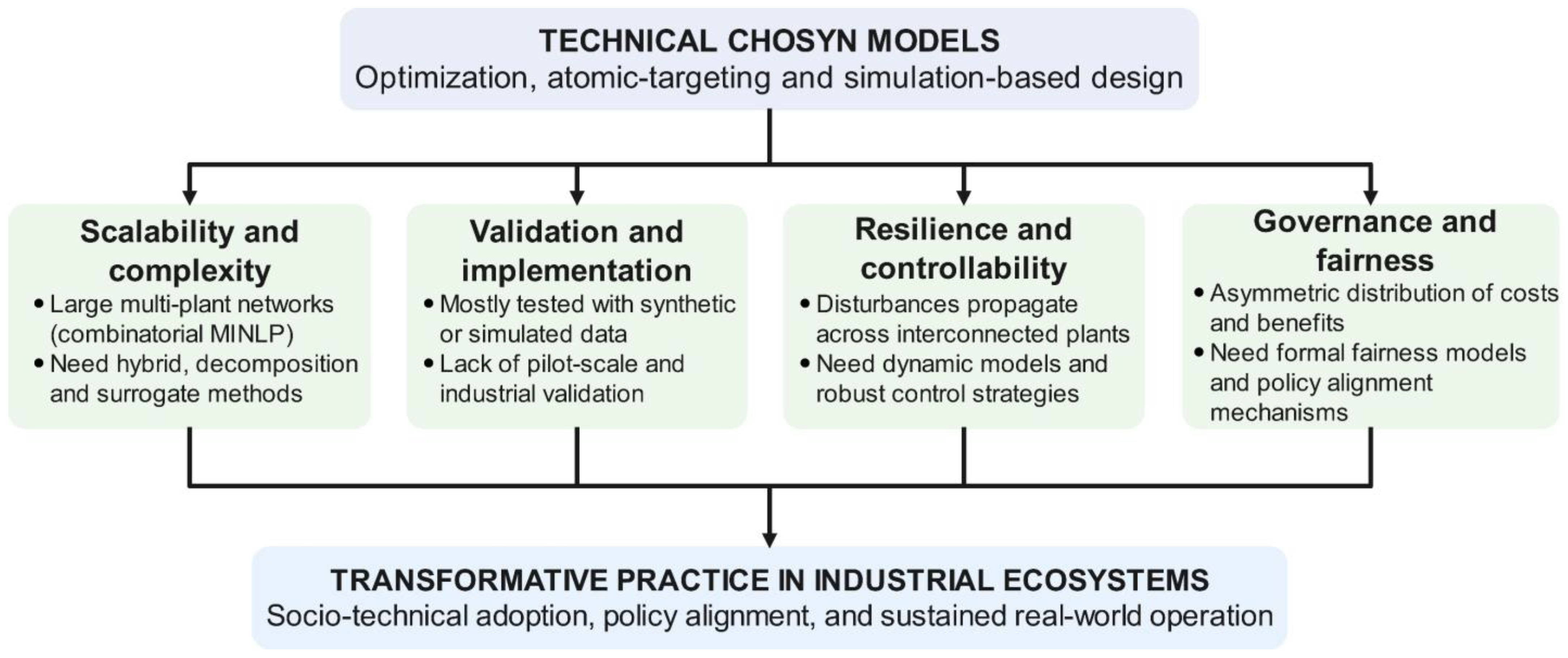
Finally, a subtle yet pervasive gap is epistemological: the CHOSYN concept, although grounded in rigorous process systems engineering, remains disconnected from broader industrial ecology and socio-technical transition research. Industrial symbiosis unfolds within cultural, institutional, and economic contexts that shape technology adoption, meaning that purely technical models offer limited explanatory and predictive power when confronted with real organizational behaviors. To overcome this limitation, future research must incorporate transdisciplinary approaches that integrate systems engineering with social sciences, enabling the understanding of behavioral incentives, institutional decision-making mechanisms, and governance structures that determine sustained industrial collaboration. These cross-cutting challenges, which constrain the transition from computational potential to real-world implementation, are summarized in
Figure 4, highlighting the need to bridge technical optimization frameworks with socio-technical and policy-oriented dimensions to enable transformative practice in industrial ecosystems.
6. Roadmap to 2035
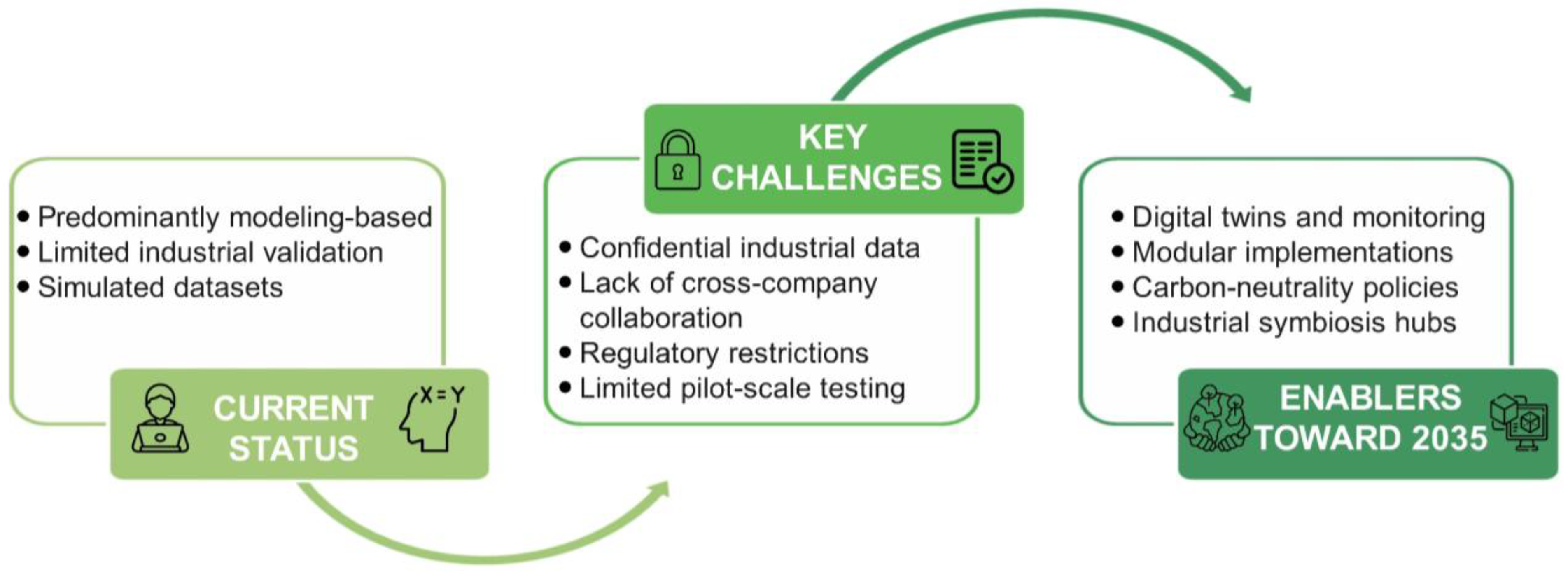
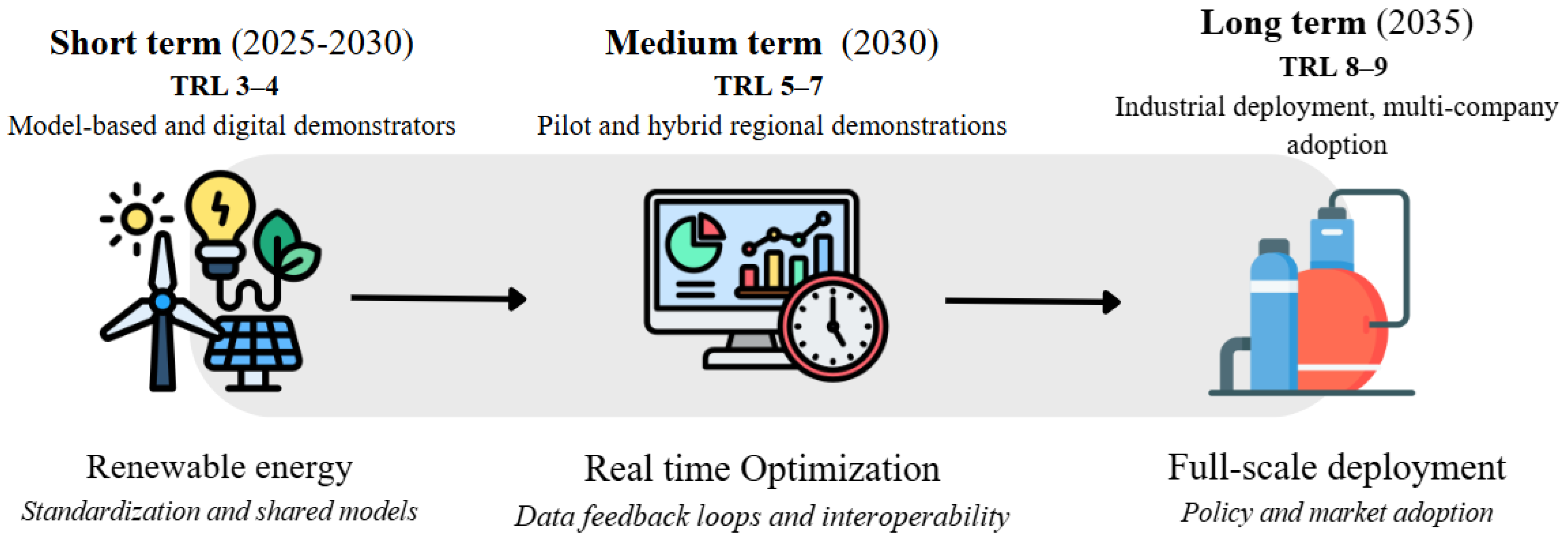
The future trajectory of CHOSYN research and application can be delineated through a gradual but interlinked progression that reflects the field’s true state of maturity in 2025. The roadmap toward 2035 does not represent a rigid timeline but a series of overlapping transitions encompassing digital integration, hybrid validation, and institutional embedding. To improve transparency regarding technological maturity, this roadmap is explicitly aligned with indicative Technology Readiness Levels (TRLs), connecting each stage to a corresponding range of development and deployment readiness. These transitions define the evolution from a theoretical construct into a practical, policy-relevant framework for sustainable industrial transformation.
The first stage, which will dominate the second half of this decade, involves consolidation and digital integration. This early phase corresponds approximately to TRL 3–4, where CHOSYN exists as a validated conceptual and computational framework but remains confined to model-based analysis and virtual demonstrators. By 2025, the concept of CHOSYNs is a solid methodological foundation but lacks standardized tools and shared datasets. The immediate objective is to harmonize existing formulations, integrate them with digital platforms, and validate them through data-rich simulations. This period should emphasize the creation of open-access modeling libraries and shared repositories of atomic-level and process-level information. Integrating CHOSYN with digital twins, artificial intelligence, and life-cycle assessment tools will make it possible to simulate dynamic operation, evaluate environmental trade-offs, and test governance scenarios before any physical deployment occurs. Rather than focusing on pilot plants, the short-term horizon should prioritize the establishment of digital demonstrators supported by industrial data. Such virtual ecosystems would allow researchers to test the impact of different configurations, control strategies, and policy conditions in a controlled environment, building the confidence necessary for subsequent physical trials [
40,
41]. Although these demonstration pathways present broad potential, CHOSYN adoption is not geographically uniform and depends strongly on industrial density. In practice, the most viable early deployment regions are those already hosting multi-plant industrial corridors, refineries, petrochemical clusters, port-based hubs, and established eco-industrial parks. Examples include Western Europe (Rotterdam–Antwerp industrial zone), U.S. Gulf Coast complexes, Arabian Gulf petrochemical corridors, and East-Asian refinery-chemical hubs, where shared pipelines, utilities, and logistics platforms already exist. These regions concentrate diversified industries (fuels, wastewater treatment, fertilizers, refining), enabling cost-competitive inter-plant exchanges and shared infrastructure. Conversely, regions characterized by dispersed or single-industry manufacturing will likely adopt CHOSYN later, once regional co-location strategies or policy-driven clustering initiatives are developed. By 2035, this uneven spatial maturity suggests that CHOSYN may expand following a hub-and-expansion pattern, starting from existing industrial clusters and progressively diffusing into emerging economic regions.
During the early 2030s, attention is expected to shift toward hybrid validation and regional demonstration. At this point, CHOSYN is expected to progress toward TRL 5–7, as digitally designed configurations are tested in laboratory, pilot, and regional demonstration settings under real operating conditions. Once digital prototypes achieve stability and interoperability, the next logical step is to test CHOSYN modules within existing industrial symbiosis initiatives. These demonstration projects should focus on specific, high-potential subsystems such as CO2 utilization, renewable hydrogen integration, or shared wastewater treatment. The aim is not to construct new plants but to retrofit existing infrastructure to enable symbiotic exchanges among nearby facilities. This hybrid validation phase will provide the first empirical evidence of CHOSYN’s technical feasibility and economic viability. Real-time data acquisition and monitoring will allow continuous feedback between digital models and physical operations, transforming theory into an adaptive learning process. In parallel, researchers must assess the social and institutional dimensions of these pilots, evaluating the mechanisms that facilitate or hinder cooperation among industrial partners. Establishing performance metrics that account for cost reduction, emission savings, and resilience will be essential for scaling the results to larger systems. In this phase, explicit business structures between Anchors and Tenants are also expected to consolidate. Industrial pilots frequently involve contractual agreements where the Anchor pays for valorized waste streams or contributes to the shared CAPEX of inter-plant infrastructure. This monetization mechanism enables measurable Scope-3 reductions for Anchor companies, while improving economic viability for Tenants through avoided disposal costs and product valorization.
The final horizon, projected for the mid-2030s, concerns institutionalization and global embedding. This stage is associated with TRL 8–9, where CHOSYN configurations are fully integrated into industrial practice, supported by long-term operation, monitoring, and regulatory recognition. If hybrid demonstrations prove successful, CHOSYN will be positioned to transition from an academic methodology into an operational framework recognized by policy and industry. Institutionalization will require the codification of standards, certification schemes, and policy instruments that formalize symbiotic exchanges. International bodies such as the International Energy Agency or the United Nations Environment Programme could play a central role in defining common guidelines for data transparency, emission accounting, and benefit allocation in inter-plant networks. The inclusion of CHOSYN indicators in national decarbonization strategies or industrial roadmaps would provide the regulatory legitimacy needed for large-scale adoption. Moreover, integration with Industry 5.0 and Digital Circular Economy paradigms could enable the development of adaptive, human-centered industrial ecosystems that balance technological efficiency with resilience and social inclusion [
42].
By 2035, if these transitions succeed, CHOSYN could emerge as a standard design and decision-support methodology for sustainable process integration. Its digital foundations would enable continuous optimization and predictive control of industrial networks, while its institutional embedding would ensure that economic and environmental gains are distributed equitably among participants. Educational programs in chemical and environmental engineering could incorporate CHOSYN as part of their core curriculum, ensuring the next generation of engineers is equipped to design symbiotic, low-carbon systems. In this envisioned future, CHOSYNs would function not merely as an optimization tool but as a systemic framework connecting molecular transformation, industrial policy, and circular-economy practice.
However, realizing this vision will depend on three enabling conditions: open data infrastructures that foster collaboration while protecting confidentiality; regulatory environments that reward cooperation rather than competition; and transdisciplinary alliances that bridge scientific, industrial, and societal domains. The success of CHOSYNs will ultimately depend less on mathematical elegance than on institutional and cultural acceptance. If these elements converge, the framework could redefine how industrial systems are conceived, managed, and regulated, transforming the pursuit of decarbonization into a collective, systemic endeavor grounded in shared resource stewardship and scientific rigor. This staged transformation is now summarized in
Figure 5, where short-, medium-, and long-term milestones are explicitly aligned with TRL, clarifying the expected evolution from digital demonstrators to full-scale industrial deployment.
7. Conclusions
The concept of Carbon–Hydrogen–Oxygen Symbiosis Networks has evolved as a consistent and technically grounded extension of industrial symbiosis and process integration. By introducing atomic-level targeting into the analysis of material and energy exchanges, CHOSYN establishes a unified framework for managing and transforming resources within interconnected industrial systems. Its structure connects the principles of process systems engineering with the objectives of circular economy and decarbonization, allowing the simultaneous optimization of efficiency, emissions, and resource use.
Current research demonstrates that CHOSYNs can integrate economic, environmental, and operational criteria within a single modeling architecture. Studies in hydrogen production, petrochemical clusters, CO2 valorization, and bio-based processes show that this approach can identify resource synergies and cross-sectoral linkages that remain invisible under conventional plant-level analyses. Such results confirm that CHOSYN is not merely an academic abstraction but a strategic methodology for redesigning industrial networks toward low-carbon and circular configurations.
Despite these advances, the field remains primarily theoretical; most studies have been validated through simulation using idealized or synthetic datasets, limiting their applicability under real industrial conditions. The lack of empirical data, confidentiality constraints, and regulatory fragmentation continue to hinder large-scale validation. Bridging this gap requires stronger collaboration among academia, industry, and public institutions, supported by data-sharing protocols, common metrics, and transparent life-cycle indicators. The establishment of open repositories and standardized models would facilitate reproducibility and comparison across different CHOSYN configurations.
Future research must address three technical priorities. First, improving computational scalability is essential to allow optimization of large, multi-plant networks without loss of precision or feasibility. Second, integrating CHOSYNs with dynamic simulation, control theory, and resilience assessment will enable stable operation under market fluctuations and process disturbances. Third, the inclusion of governance and fairness criteria is crucial for ensuring the equitable distribution of costs and benefits among participants, strengthening the social and institutional viability of symbiotic systems. These challenges highlight the interdisciplinary nature of CHOSYNs and the need for cooperation among engineers, economists, and policymakers.
In strategic terms, CHOSYN aligns closely with global efforts to achieve carbon neutrality and circular resource management. Its capacity to link carbon capture, renewable hydrogen, and chemical valorization supports the transition toward integrated, low-emission industrial ecosystems. Over the next decade, progress is expected in digital validation, hybrid demonstration projects, and the creation of regulatory mechanisms that formally recognize inter-plant cooperation as a legitimate path for emission reduction.
CHOSYN represents a step forward toward a systemic understanding of industrial sustainability. Its potential lies in uniting molecular transformation, process optimization, and institutional governance into a coherent analytical platform. With continued methodological refinement, data transparency, and institutional support, CHOSYNs can become a practical foundation for designing industrial systems that combine efficiency, environmental integrity, and long-term resilience.




 ,
,