


Abstract
Early prediction of casing-running sticking is essential, as the mitigation of stuck-pipe incidents often incurs significant time and economic costs. Previous studies have largely relied on purely theoretical torque and drag models that are constrained by simplified assumptions, preventing them from fully leveraging available field data and often leading to insufficient prediction accuracy. To address this challenge, we developed a hybrid mechanistic-data-driven intelligent model for hook-load prediction and casing-sticking risk assessment. The model combines mechanical models with ensemble learning algorithms, incorporating both mechanically derived parameters (theoretical hook load, casing–borehole compatibility, casing-bottom deflection and tilt angle) as well as operational and casing structural features. To evaluate its cross-field generalizability, the proposed model was trained on 13,449 samples from 14 wells across three oilfields and tested on 3961 samples from an independent well in a separate Oilfield. Three ensemble algorithms (XGBoost, Random Forest, and LightGBM) were evaluated, among which XGBoost achieved the highest predictive accuracy (RMSE = 3.50, MAE = 2.51, R2 = 0.97) and was selected for subsequent friction-factor-based casing sticking risk assessment. A genetic-algorithm-based optimization framework was further developed to minimize sticking risk by optimizing the centralizer configuration under a friction constraint. The proposed sticking-risk assessment and optimization strategy was validated through field implementation. This mechanistic-data-driven intelligent model outperforms traditional theoretical approaches in predictive accuracy, interpretability, and engineering applicability, providing a practical and explainable tool for casing-running risk mitigation and design optimization in complex three-dimensional wells.
1. Introduction
With the intensified exploration and development of oil and gas resources, complex well types such as horizontal wells and 3D curved wells have been increasingly applied in field practice [1,2,3,4,5]. Casing running is a key operation in the well completion process, which directly affects the wellbore integrity and production performance throughout the entire lifecycle of the well [6,7,8,9]. However, under complex downhole conditions, mechanical obstructions and excessive running drag often pose significant challenges to successful casing deployment. In some cases, unexpected sticking or high drag forces prevent the casing from reaching the planned setting depth, forcing operators to perform cementing prematurely and resulting in considerable non-productive time and economic losses [10,11,12,13,14]. Therefore, operating companies attempt to develop models that can predict tubular running-related operational risks in advance, enabling them to successfully execute the operation by taking proper action in a timely manner [15].
The hook load, as a key indicator during tubular string running operations, has long been a primary focus in the prediction of sticking and running risks [16,17,18]. Previous studies on hook load prediction have predominantly relied on mechanical models for torque and drag (T&D) calculations, which can be broadly categorized into soft string models [19,20,21,22], stiff string models [23,24,25,26], and finite element models [27,28,29]. Among them, the soft string model has been the most widely adopted in field practice due to its simplicity, lower computational cost, and reasonable accuracy. It simplifies the string by neglecting bending stiffness and assuming continuous contact along the wellbore trajectory. The stiff string model, which considers bending stiffness, offers improved accuracy in high dogleg severity sections. Finite element models can further capture local string-wall interactions and potential collisions, providing the most detailed mechanical analysis; however, their significant computational cost and complexity limit their practical application for full wellbore simulations, especially in irregular or complex trajectories. Although substantial progress has been made in tubular string mechanics, most existing models are built on idealized assumptions that simplify wellbore trajectory, borehole geometry, casing string design, and mechanical properties of the casing string. These simplifications limit their accuracy and applicability under complex downhole conditions. Consequently, accurately predicting hook load variations and assessing the risk of sticking—when running casing in challenging wellbores remains a significant technical challenge.
In recent years, the rapid development of artificial intelligence has facilitated the application of data-driven approaches, and the use of ML models for parameter prediction under complex operating conditions has become increasingly mature [30,31], including in drilling and completion engineering using large volumes of historical field data to enhance prediction performance [32,33,34]. For T&D analysis and prediction, Song et al. [35] developed an intelligent prediction model for drilling hook load combining BP neural networks and long short-term memory (LSTM) networks with a dual-input architecture, achieving relatively accurate prediction results in field applications. Bai et al. [36] further proposed a hybrid method that combines soft-string physical models with machine learning to model residuals and incorporate additional downhole factors, improving prediction accuracy and stability. Mayouf and Hadjadj [37] evaluated several machine learning algorithms for real-time hook load prediction in drilling operations and found that linear regression offered the best balance of accuracy and computational efficiency, while emphasizing that predicting at least 25 future steps enhances anomaly detection. However, research applying intelligent methods to hook load prediction for casing running is still largely absent, even though this operation is critically important in field practice.
For pipe sticking prediction, one of the earliest statistical approaches was proposed by Hempkins et al. [38] in 1987. They applied discriminant analysis to establish functions derived from correlations between dependent and independent drilling parameters, classifying operational conditions into mechanical sticking, differential sticking, and non-stuck scenarios. Their method evaluated twenty commonly monitored drilling parameters to estimate the probability of stuck pipe incidents in specific wells. Subsequently, many other researchers have contributed to this area. Salminen et al. [39] used torque and drag models to generate predicted results based on the initial well plan. During drilling operations, these predictions were continuously compared with real-time measured data, and potential stuck pipe risks were identified by analyzing the deviation values and trends in real-time operational parameters. More recently, Elahifar and Hosseini [40] applied a hybrid particle swarm optimization-based artificial neural network (PSO-ANN) trained on parameters including mud properties, hole size, hydraulic data, and drilling parameters collected from 85 wells in a Middle Eastern field. The model predicted the probability of stuck pipe occurrences in future wells, demonstrating improved predictive accuracy. Zhang et al. [41] addressed the challenge of limited stuck pipe samples by proposing a data augmentation approach combining percentage scaling, random dithering, and generative adversarial networks (GAN). They further introduced an attention-based LSTM model (ATT-LSTM) capable of dynamically weighting sequence information, which improved recognition accuracy and generalization.
However, most existing AI-based models have primarily focused on drill string running or drilling conditions rather than casing running operations, and often treat the tubular string running process as a black box without explicitly incorporating key mechanical parameters or casing string structural parameters. Since casing structural and mechanical properties significantly influence casing running drag and sticking risk, this omission limits model generalization and reliability when applied to casing running scenarios, particularly under complex or irregular downhole conditions.
In this study, we developed a novel hybrid intelligent model that integrates mechanical analysis of casing running parameters with machine learning algorithms. Based on the casing running design and measured wellbore survey data, we first used a torque and drag soft-string model to calculate the theoretical hook load. Key mechanical features of the casing string—such as casing–borehole compatibility, casing bottom-end deflection, casing bottom-end tilt angle—and wellbore parameters including dogleg severity and wellbore diameter variation, together with structural parameters such as centralizer spacing and the casing bottom–first centralizer spacing, were then incorporated as input features. Using these features, an ensemble learning–based model was constructed to predict the hook load during casing running. The model was trained and validated on field data collected from real wells, and potential sticking risks were further identified through friction factor inversion. Compared with traditional theoretical models and existing intelligent approaches, the proposed model explicitly targets casing running operations, enabling both pre-job full-trajectory risk assessment and risk mitigation. Based on this model, we further propose a genetic-algorithm-based optimization methodology to minimize casing running risk through casing structure design optimization. The effectiveness of the model and optimization strategy is verified through field case studies.
2. Mechanical Model for Casing Running Operations
2.1. Methodology Overview
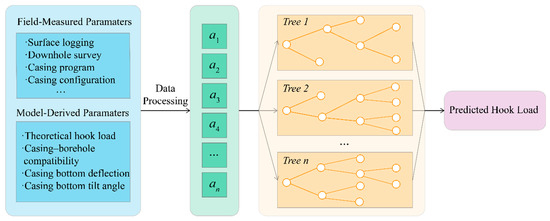
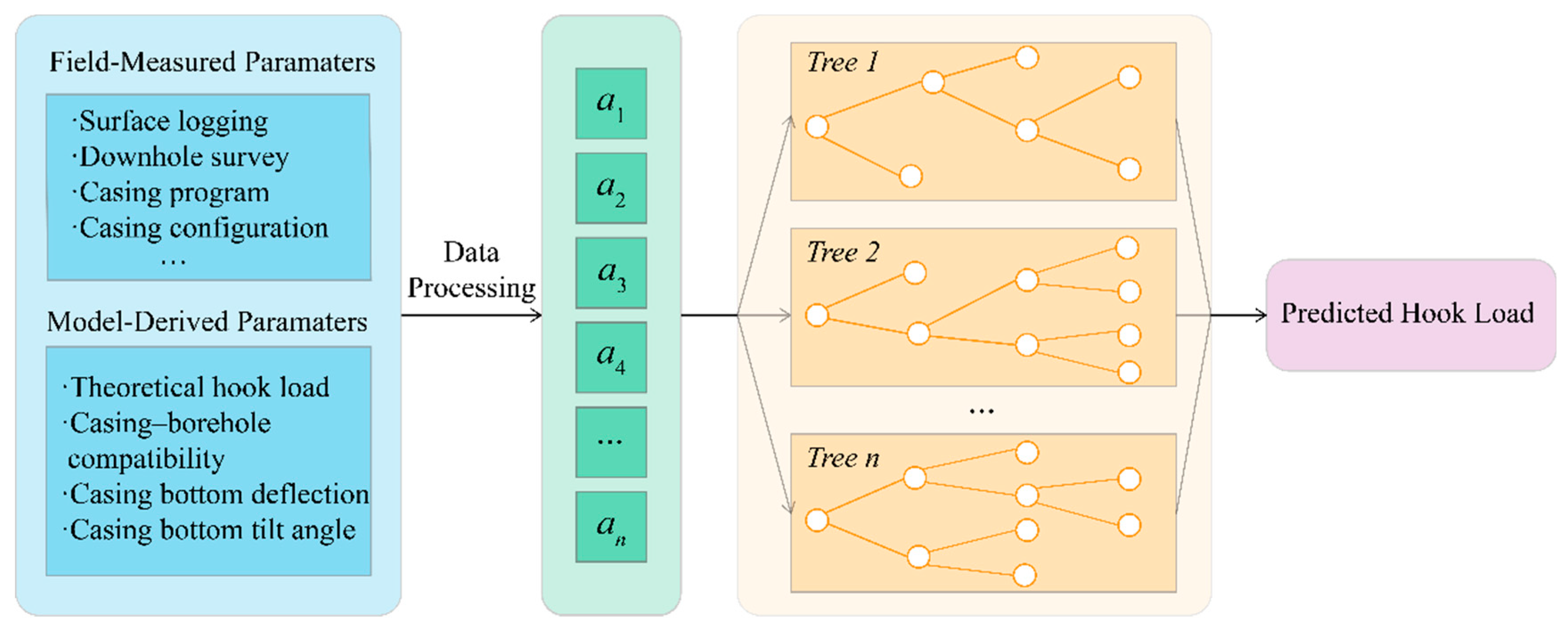
The overall workflow of the proposed hybrid intelligent hook load model is illustrated in Figure 1. It consists of data collection, data processing, and feature selection, followed by machine learning model training to obtain the target hook load prediction model.
Figure 1.
Workflow of intelligent hook load prediction model.
The collected data can be classified into two categories: field-measured data and indirectly calculated parameters. The field-measured data include surface logging data, downhole survey data, casing program, and casing structural parameters. In addition, to enable accurate prediction of hook load and sticking risk during casing running operations and to capture critical mechanical effects influencing casing running performance, a reliable mechanical modeling framework is essential.
This section introduces the torque and drag (T&D) model as the core of the mechanistic approach, complemented by models for casing–borehole compatibility, casing bottom-end deflection, and tilt angle. Based on the field data and the mechanical models, indirectly calculated parameters can be subsequently obtained.
2.2. Torque and Drag
In this study, the T&D model is used to calculate the theoretical hook load as an input for subsequent data-driven modeling the machine learning model, as well as for friction factor inversion. To ensure model stability, robustness, and engineering efficiency, we adopt the widely used soft-string model [21,42] as the basis while incorporating tubular stiffness [36] and buckling effects [43].
The axial force along the string is expressed as shown in Equation (1).
where T1 and T2 are the axial forces at the lower end and upper ends of the casing string element respectively, N; Ls is the length of the casing string element, m; α is the average deviation angle, rad; μ is friction factor, dimensionless; Fntot is the total contact force per unit length on casing string element, N/m; θ is overall angle change, rad; E is the elastic modulus of the steel, Pa; I is the moment of inertia of the casing cross-section, m4; K1 and K2 are the wellbore curvature on the upper end and lower end of the casing string element respectively, m−1; q is buoyed weight of casing, N/m, calculated by Equation (2):
where qo is air weight of casing, kg/m; Ai and Ao are inner and outer cross-section areas of casing string element respectively, m2; ρi and ρo are fluid densities inside and outside the casing string respectively, kg/m3, normally, both are equal to the mud density, for floating casing operations, the density of the fluid inside the floating section is taken as zero; g is acceleration of gravity, 9.8 m/s2.
The total contact force can be expressed as:
where Fndp is the lateral force in principal normal direction, N; Fnp is the lateral force in binormal direction, N; Fnb is buckling contact force (zero in non-buckled conditions), N/m.
The contact force components are calculated as follows:
where n3 is the third component in the unit principal normal vector n; m3 is the third component in the unit binormal vector m.
When axial compression exceeds the critical buckling loads, the casing string may experience either sinusoidal or helical buckling [41,42]. The contact force due to sinusoidal buckling can be estimated as:
where rc is the radial clearance between the casing string and the wellbore; F is the axial compressive force of the casing string, N.
The normal contact force for helical buckling is given by:
It can be found from Equations (1)–(7) that the axial force in the casing string and the total contact force on the casing string are mutually coupled, which can be obtained by the iterative method. The theoretical hook load is defined as the axial force calculated at the wellhead.
Although the mechanistic module is formulated within a torque and drag framework, the present study focuses on hook load responses during casing running. Therefore, we primarily use the drag related axial force formulation to compute the theoretical hook load at the wellhead, which is then used for feature construction and friction factor inversion.
2.3. Casing–Borehole Compatibility
During casing running operations, in addition to insufficient overall running capacity caused by frictional drag, localized sticking may occur due to geometric incompatibility between the casing string and high-dogleg severity wellbores [43].
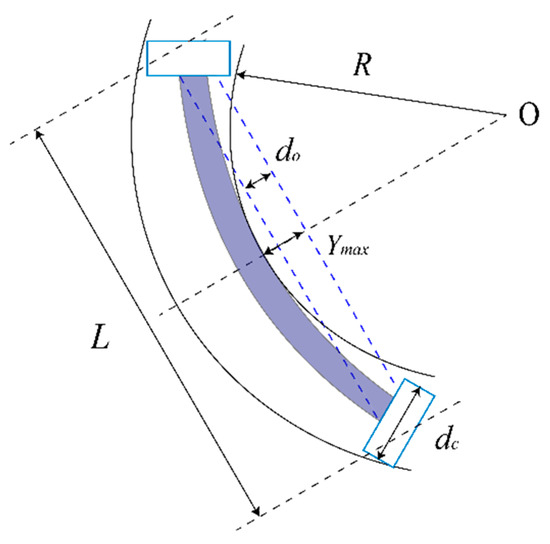
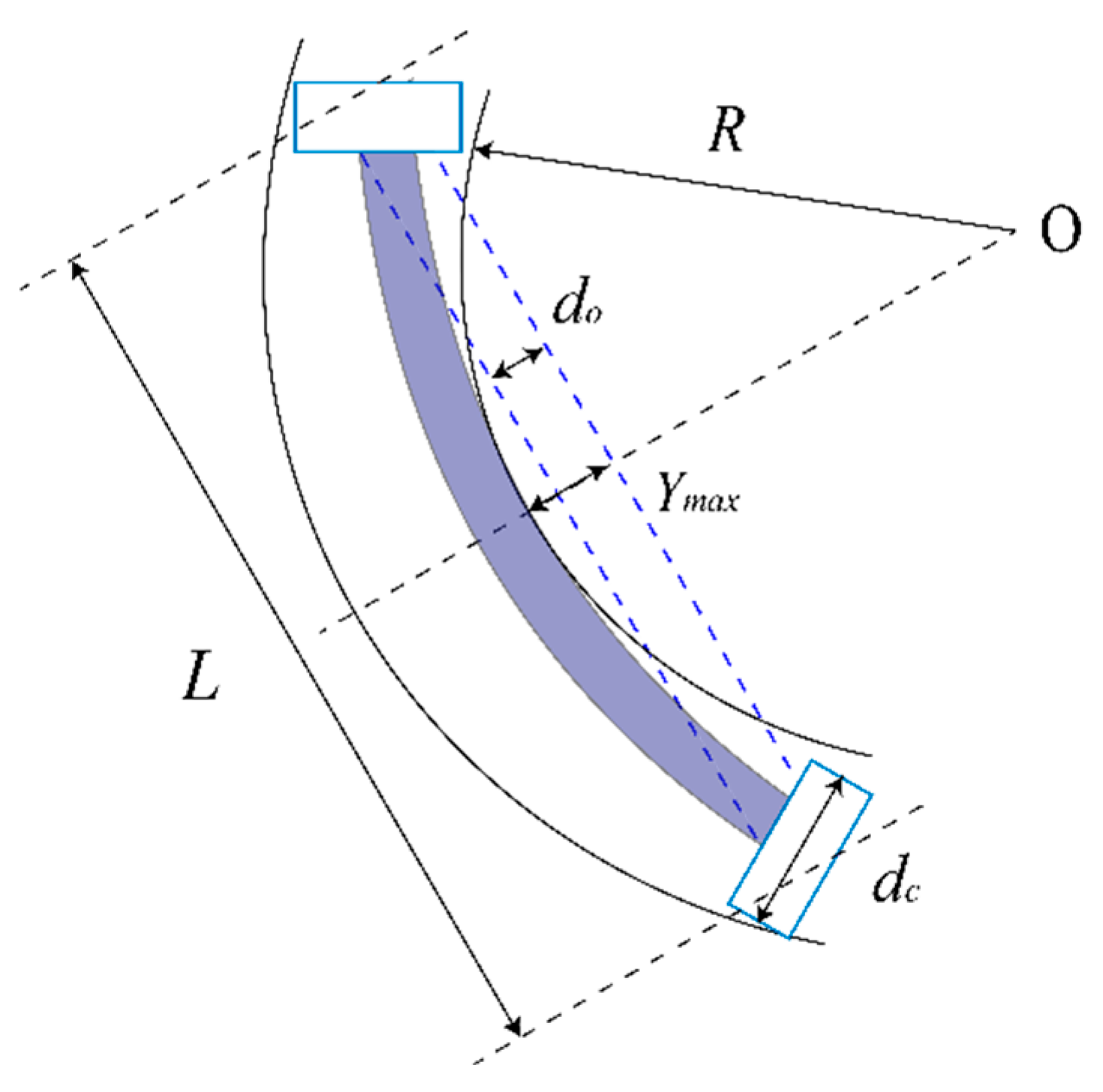
The casing–borehole compatibility refers to the maximum allowable wellbore curvature that the casing can traverse. This passability based curvature limit is closely related to the classical concept of maximum permissible dogleg severity [44]; however, maximum permissible dogleg severity is typically defined as an operational limit for the drillstring, whereas the present parameter is used here only to quantify casing passability for geometric sticking during casing running. In curved well sections, insufficient casing deflection may cause it to become stuck against the borehole wall. If the actual wellbore curvature exceeds the maximum curvature that the string can pass, a geometric sticking incident is likely to occur [45,46,47]. The casing–borehole compatibility of the casing can be analyzed using the geometric relationship between the wellbore and casing, as illustrated in Figure 2, the minimum deflection condition required to avoid mechanical sticking is that the casing centralizers contact the lower side of the wellbore, while the midpoint of the casing string contacts the upper side [48].
Figure 2.
Schematic of casing–borehole compatibility.
By modeling the casing as a wellbore-constrained beam with centralizers acting as hinge supports, the maximum deflection of the casing can be calculated using the following equations [48,49]:
where Ymax is the maximum deflection of the casing string, m; L is the casing length between centralizers, m; E is the elastic modulus of the casing string, Pa; I is the moment of inertia of the casing string, m4; α is the inclination angle of the well, rad; R is the radius of curvature of the wellbore, m; Mi is the bending moment at the i-th support of the casing string, N·m; u is the stability coefficient, dimensionless, ; P is the axial force in the casing string, defined as positive for compression and negative for tension, N.
In this study, the bending moment at each centralizer is estimated based on the local wellbore curvature ki:
where ki is the local wellbore curvature at the i-th support of the casing string, m−1.
Based on the wellbore–casing geometric relationship [45,48], the maximum passable localized casing length in curved sections can be calculated by Equation (12).
where yw is the minimum bending deflection required for the casing string element to pass through the wellbore, m; do is casing outer diameter, m; dc is outer diameter of centralizers at both ends of the casing string, m; dw is wellbore diameter, m.
Given the wellbore and casing geometry and the applied casing forces, the passable wellbore curvature Kc—representing the casing–borehole compatibility—can be calculated from Equation (13):
where Kc is the casing–borehole compatibility, m−1.
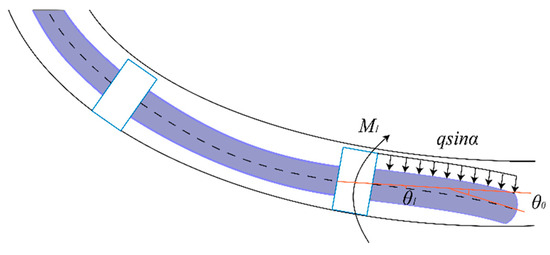
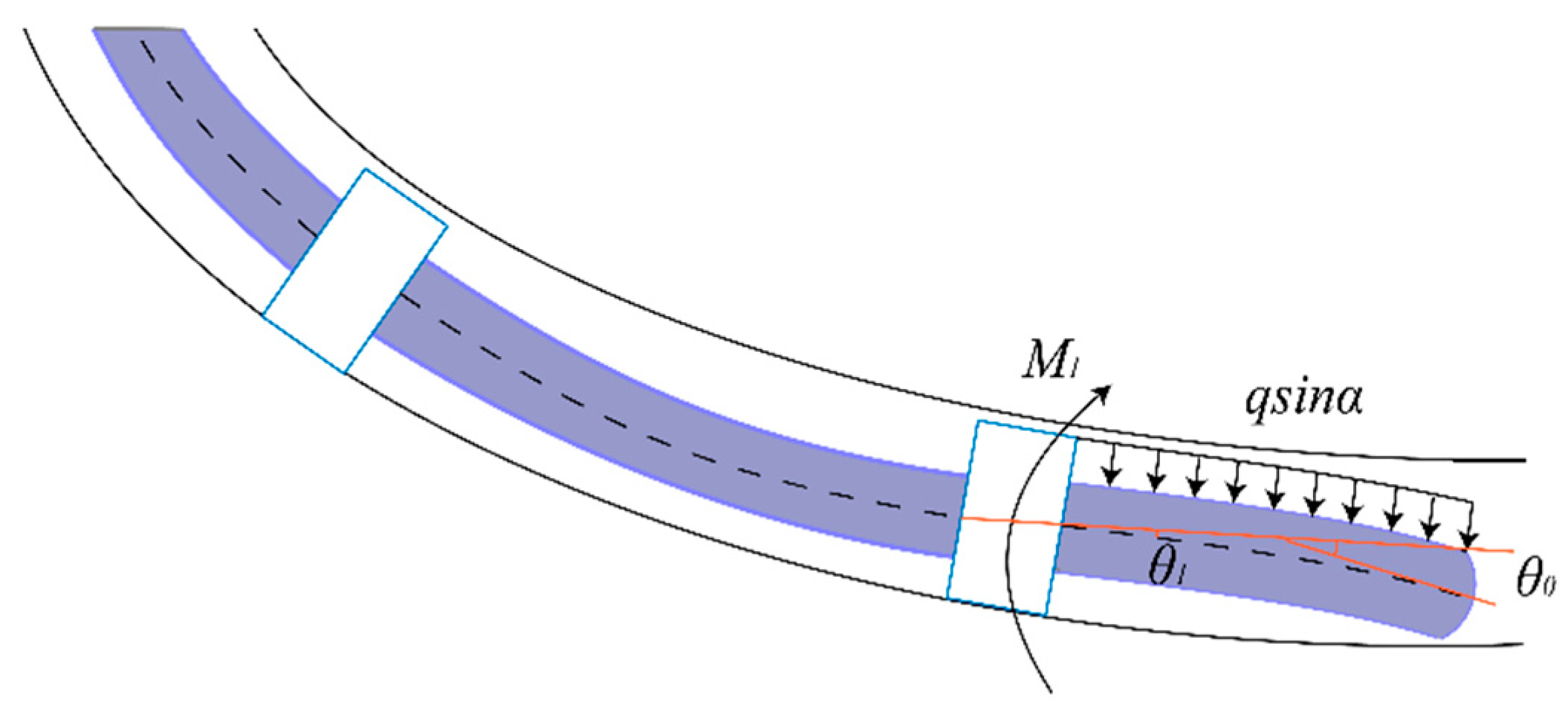
2.4. Casing Bottom-End Deflection and Tilt Angle
In drilling operations, the bit tilt angle is recognized as one of the key factors determining the drilling trajectory tendency [50,51]. By analogy, for casing running operations, although this concept has not been explicitly discussed in previous studies, the bottom-end tilt angle of the casing string can similarly be introduced as an indicator to describe the behavior of the casing tail as it moves through the wellbore. The casing bottom is equipped with a float shoe, and based on field practice, the first centralizer above the casing shoe is typically installed at a certain distance from the float shoe [52,53]. The casing segment between the float shoe and the first centralizer can therefore be regarded as a cantilever beam constrained by the first centralizer [54], as illustrated in Figure 3. In this configuration, the bottom end of the casing exhibits a corresponding radial offset and a tilt angle relative to the wellbore axis, herein referred to as the bottom-end deflection and tilt angle. Considering the irregular curvature and complex trajectory of actual wellbores, both the deflection and the tilt angle at the bottom end of the casing may significantly affect the compatibility between the casing and wellbore, thereby influencing running drag and the risk of mechanical sticking.
Figure 3.
Schematic diagram of the casing bottom deflection.
Based on beam–column theory and the principle of superposition [54,55], the bottom-end deflection y0 and tilt angle θ0 can be calculated as follows:
where y0 is the casing bottom-end deflection, m; θ1 is the rotation angle at the first centralizer above the bottom, rad; L0 is the spacing between the casing bottom and the first centralizer, m.
The rotation angle at the first centralizer can be calculated by Equation (16) [56]:
where M1 and M2 are the bending moments at the first and second centralizers, respectively, N·m; X(u), Y(u), and Z(u) are beam–column deflection magnification factors, dimensionless.
It should be noted that Equations (14) and (15) are derived under the free-end assumption at the casing bottom. In practice, due to wellbore confinement, the absolute value of the deflection cannot exceed the wellbore clearance, and the absolute magnitude of the theoretical deflection obtained under the free-end condition should be smaller than the clearance. If the theoretical bottom-end deflection computed from Equation (14) has an absolute value greater than or equal to the clearance, the casing tail is assumed to contact the wellbore wall. Under this condition, the casing bottom is treated as a support rather than a free end. In this case, the bottom-end rotation angle should be recalculated using Equation (20), while the absolute magnitude of the deflection is set equal to the wellbore clearance, with its sign consistent with that of the rotation angle [57].
where e0 and e1 are the displacements at the casing bottom and the first centralizer, respectively, m.
As indicated by Equations (14)–(20), the deflection and tilt angle calculations require measured wellbore parameters, such as the inclination angle and borehole diameter. Due to numerical variations in the field measurements, the computed results may exhibit non-smooth fluctuations; however, these fluctuations do not affect the stability or interpretability of the results.
3. Data Processing
3.1. Data Cleaning
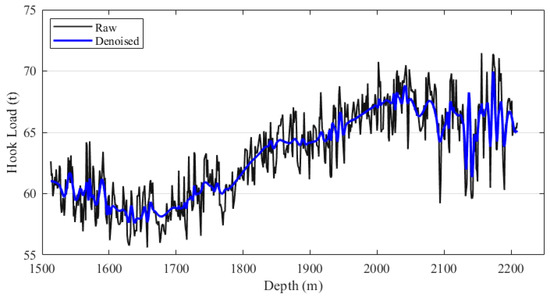
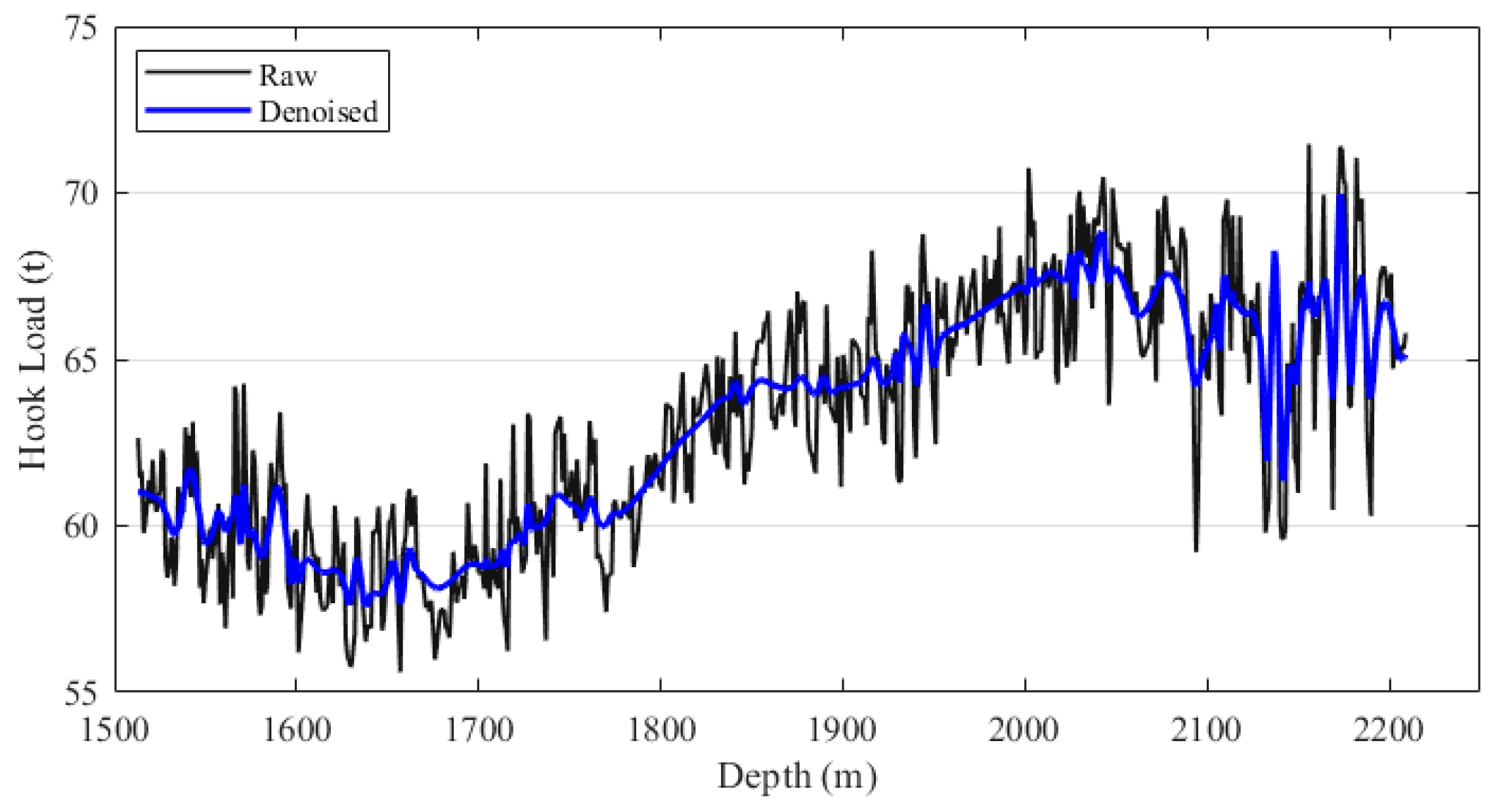
The field-measured engineering parameters during casing running operations are often affected by sensor noise, operational irregularities, and transient events such as pipe connections and intermittent vibrations of the running string. These factors can introduce random fluctuations and outliers into the measured hook-load data, which may reduce the accuracy of the predictive model if used without preprocessing. To ensure data reliability, a wavelet decomposition and reconstruction–based denoising method was applied to remove high-frequency noise while preserving the main trend of hook-load variation with depth.
Wavelet analysis is a localized time–frequency (or scale–space) technique that can effectively represent both global trends and local variations of a non-stationary signal. Given a measured hook-load signal HL(z), where z denotes the measured depth, its discrete wavelet expansion can be expressed as:
where represents the scaling (approximation) function describing the low-frequency trend; denotes the wavelet (detail) function corresponding to high-frequency fluctuations; cJ,k and dj,k are the approximation and detail coefficients, respectively.
During denoising, the high-frequency coefficients dj,k are thresholded according to:
where λj is the threshold value for level, ; σj is the estimated standard deviation of noise at level j, and N is the total number of depth samples.
After thresholding, the denoised coefficients and approximation coefficients are used to reconstruct the smoothed hook-load profile.
Figure 4 shows the comparison between the raw and denoised hook-load curves for Well A in the East Baghdad Oilfield during casing running operation. It is evident that the denoised curve is significantly smoother, and random short-scale fluctuations have been effectively suppressed. Meanwhile, the overall trend of hook-load variation with depth is preserved. This demonstrates that the wavelet-based denoising approach effectively eliminates high-frequency noise without distorting the mechanical characteristics of the casing running process.
Figure 4.
Comparison of raw and denoised hook-load versus depth for Well A.
3.2. Feature Selection
This study utilized field data from 15 wells across three blocks: the Yuedong Oilfield, the Missan Oilfield, the East Baghdad Oilfield, and the Karamay Oilfield. The measured hook load is used as the target variable for model training and evaluation. Candidate input parameters include parameters from surface logging, downhole survey, casing program and casing structure. In addition, model-derived mechanical features—namely, theoretical hook load, casing–borehole compatibility, bottom-end deflection and tilt angle—are also incorporated.
To evaluate both linear and nonlinear dependencies between each candidate predictor and the measured hook load, distance correlation coefficients were calculated. The coefficient dCor(X,Y) between a predictor X and the target variable Y is defined as:
where dCor(X,X) and dCor(X,Y) represent the distance covariance.
The resulting dCor(X,Y) lies within [0, 1], where dCor = 0 indicates complete independence, and larger values indicate stronger statistical dependence.
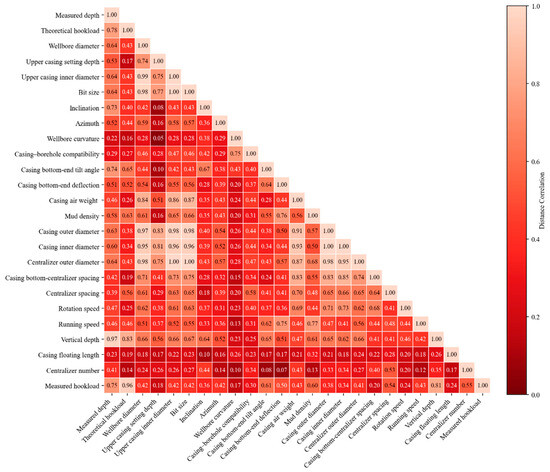
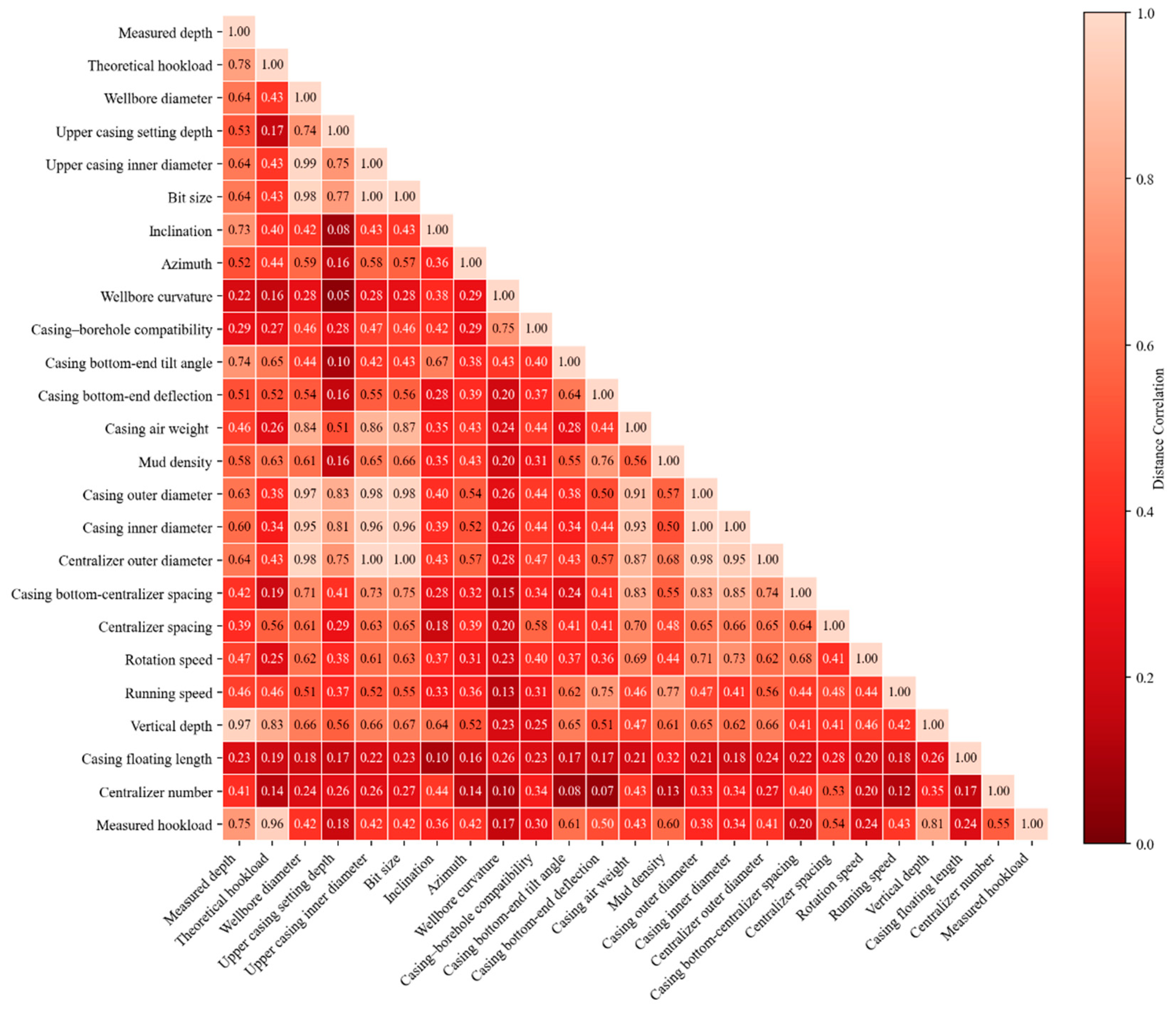
Based on this definition, distance correlation coefficients were calculated between each feature and the measured hook load, as illustrated in Figure 5. An absolute correlation threshold of 0.3 was adopted as the primary criterion for feature selection. The results indicate that the correlation coefficients of the theoretical hook load, casing–borehole compatibility, the casing bottom-end deflection and tilt angle are all greater than or equal to 0.3, which confirms that these mechanical parameters exert significant influence on the actual hook load during casing running. From the data alone, the upper casing running depth, the casing bottom–centralizer spacing, the rotation speed and the casing floating length show relatively weak correlations with the measured hook load. However, they constitute major input parameters of the mechanical model, and the rotation speed and the casing floating length are key design parameters in field operations. These parameters influence the running drag force through distinct mechanical mechanisms. Therefore, they were also included as input features.
Figure 5.
Distance correlation results.
Apparent redundancies among features were further scrutinized. Examples include parameters with potentially overlapping definitions or dimensions, such as the wellbore diameter, the upper casing inner diameter, the bit size, the centralizer outer diameter, the casing air weight, the casing outer and inner diameters, as well as the measured depth and the vertical depth. Based on this comprehensive screening process, 16 features were ultimately selected: measured depth, wellbore diameter, inclination, azimuth, mud density, casing floating length, rotation speed, running speed, upper casing setting depth, casing bottom–first centralizer spacing, centralizer spacing, centralizer number, theoretical hook load, casing–borehole compatibility, casing bottom-end deflection and tilt angle.
After these processing steps, the resulting dataset consisted of 17,410 samples, where each sample contained the measured depth together with the corresponding field-measured parameters and model-derived mechanical parameters. Figure 5 reports the distance correlations for all 25 initial candidate features, and Table 1 summarizes the statistical characteristics of the 16 final input features together with the target variable (measured hook load).
Table 1.
Statistics summary of partial parameter information.
3.3. Normalization
To eliminate scale effects among features and accelerate the convergence of machine learning algorithms, the selected features were normalized to a [0, 1] range using min–max scaling:
3.4. Dataset Construction
To evaluate the generalization capability of the proposed model, the dataset was partitioned by oilfield rather than being randomly split. Specifically, field data from 14 wells in the Yuedong, Missan, and East Baghdad Oilfields (13,449 samples in total) were used for training, while data from one representative well in the Karamay Oilfield (3961 samples) were held out for exclusive use in testing. The proportions of training and testing samples relative to the entire dataset were therefore 77.25% and 22.75% respectively. This cross-field division ensures that the testing dataset comes from a geologically distinct block, thereby providing a more rigorous assessment of the model’s predictive performance under unseen conditions.
4. Machine Learning Model for Hook Load Prediction
4.1. Ensemble Learning Methods
Ensemble learning is a widely adopted machine learning approach that integrates multiple base learners to improve predictive performance. Compared with single-model approaches, ensemble methods are generally more robust to overfitting and more effective at capturing complex relationships in data [58].
In this study, three representative ensemble algorithms were applied individually—Random Forest (RF), Extreme Gradient Boosting (XGBoost), and Light Gradient Boosting Machine (LightGBM)—to construct predictive models for casing hook load estimation. The objective is to compare their relative performance under complex well conditions. Random Forest builds multiple decision trees using bootstrap sampling and averages their predictions to reduce variance and improve robustness. XGBoost implements gradient boosting with optimized regularization, shrinkage, and parallel processing to achieve high predictive accuracy. LightGBM employs histogram-based gradient boosting and leaf-wise tree growth to improve computational efficiency and scalability, particularly for large datasets. These algorithms were selected due to their proven capability to model nonlinear relationships and handle high-dimensional engineering data.
4.2. Model Training
Model performance during training and optimization was quantitatively evaluated using three commonly adopted metrics: the root mean square error (RMSE), mean absolute error (MAE), and coefficient of determination (R2).
RMSE quantifies the overall deviation between predicted and measured values, serving as an indicator of prediction accuracy. MAE reflects the average magnitude of prediction errors and is less affected by outliers. R2 measures the proportion of variance in the observed data explained by the model, with values closer to 1 indicating better fitting performance. In general, lower RMSE and MAE values and higher R2 values indicate a more accurate and reliable predictive model. These metrics are defined as follows:
where ri and denote the measured and predicted hook load values, respectively; is the mean of the measured values, and m represents the total number of samples.
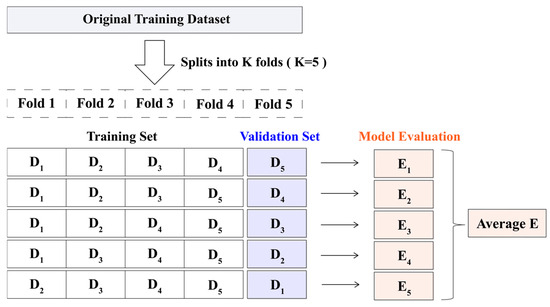
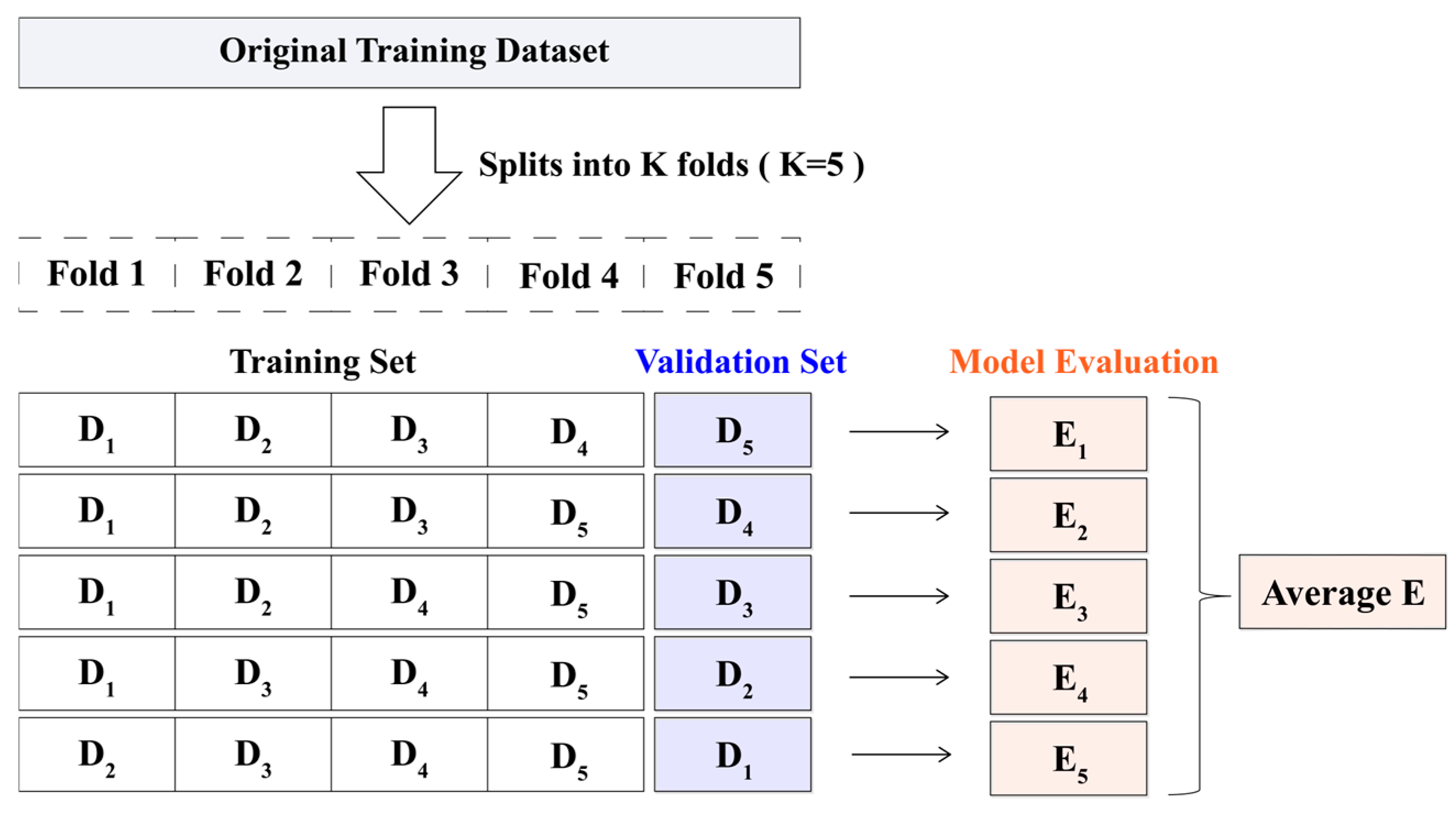
Each ensemble algorithm is trained and optimized using 5-fold cross-validation method on the training dataset. The flowchart is shown in Figure 6. In 5-fold cross-validation, the training data are randomly divided into five approximately equal subsets. In each iteration, one subset is used as the validation set while the remaining four subsets are used for model training. This process is repeated five times so that each subset serves once as the validation set. The validation results from all iterations are then averaged to obtain a comprehensive estimate of model performance, which guides the selection and optimization of hyperparameters.
Figure 6.
Flowchart of the machine learning model development, training, and evaluation.
The optimization of model hyperparameters follows a hierarchical criterion: (1) RMSE was prioritized and minimized as the primary objective; (2) if multiple configurations yielded similar RMSE values, the one with the lower MAE was preferred; (3) in case of further ties, the model with the higher R2 was selected; (4) if all metrics were comparable, the configuration with lower model complexity was chosen to ensure generalization and computational efficiency.
In this study, the training times of the three hook-load prediction models (LightGBM, XGBoost, and Random Forest) were 0.738 s, 0.657 s, and 20.319 s, respectively.
5. Results and Discussion
5.1. Model Performance Evaluation
To evaluate the predictive capability of the proposed ensemble learning models, field data from Well X in the Karamay Oilfield were used as the testing instance. Three trained ensemble models, including RF, XGBoost, and LightGBM, were applied to predict the hook load for the production casing running operation. The basic information of Well X is summarized in Table 2, Table 3 and Table 4.
Table 2.
Casing program of Well X.
Table 3.
Centralizer configuration for the production casing of Well X.
Table 4.
Production casing running parameters of Well X.
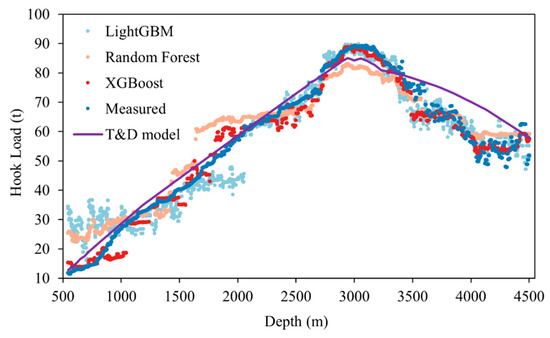
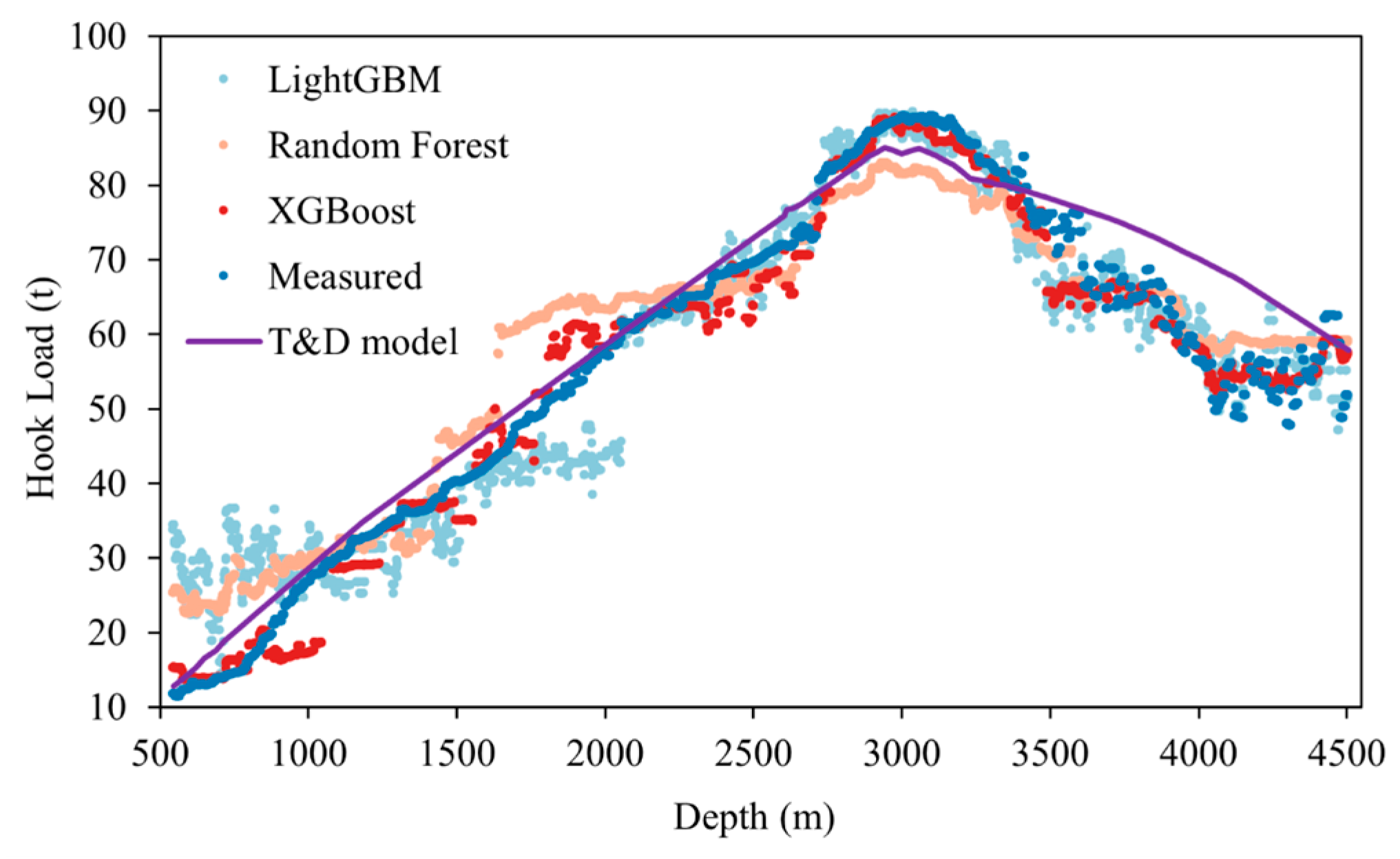
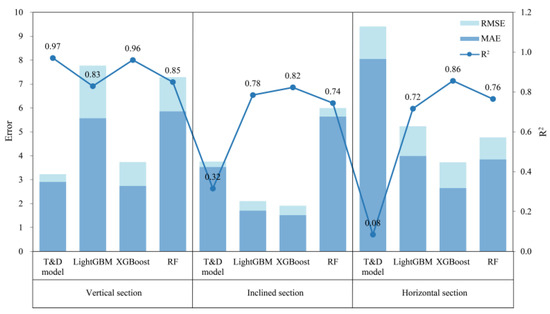
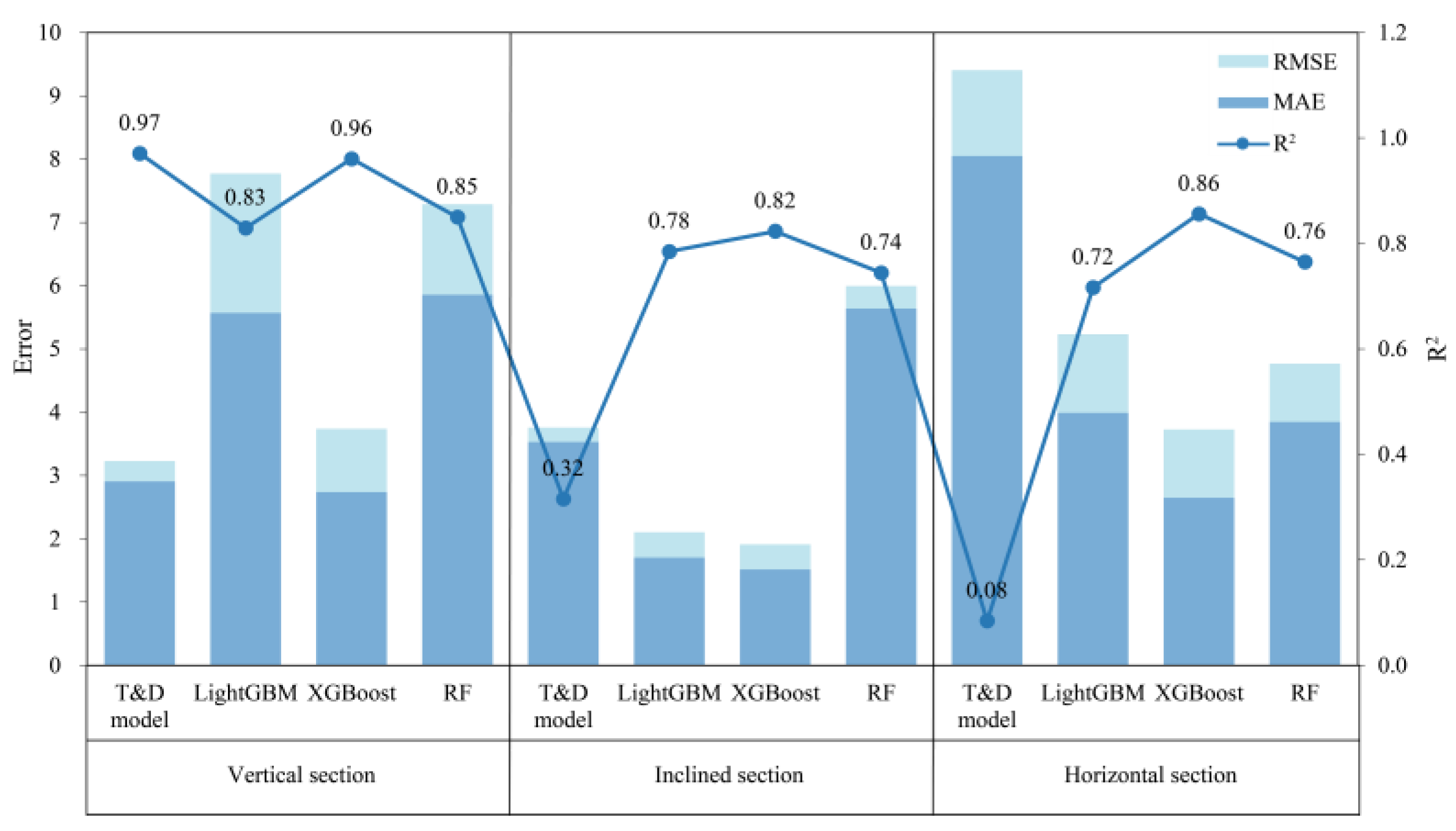
Figure 7 compares the hook load predicted by the T&D model and the three ensemble learning models with the field-measured hook load along the wellbore. The mechanical model captures the general increasing trend in the upper cased interval; however, once the casing enters the open hole, the theoretical hook load becomes consistently higher than the measured values, illustrating the limitations of a purely mechanistic formulation under complex downhole conditions. Figure 8 further presents a segment-wise evaluation of the prediction performance along the wellbore. For the vertical section, the T&D model exhibits the highest accuracy; however, its performance deteriorates markedly in the build-up and horizontal intervals, where the R2 drops from approximately 0.97 to 0.32 and further down to 0.08. In contrast, the three ensemble learning models maintain relatively stable accuracy across all well sections, with XGBoost in particular achieving consistently high performance in both the inclined and open-hole horizontal intervals. This demonstrates that the proposed mechanistic–data integrated framework is especially effective in complex wellbore sections characterized by strong nonlinear behavior and high dogleg severity.
Figure 7.
Comparison of measured and predicted hook loads using the T&D model and ensemble learning models.
Figure 8.
Model prediction statistics across different well sections.
The full-well prediction statistics summarized in Table 5 indicate that the XGBoost model exhibits the highest predictive accuracy, achieving the lowest RMSE (3.50) and MAE (2.51) values as well as the highest coefficient of determination (R2 = 0.97). In comparison, the theoretical hook-load estimates from the T&D model show larger errors (RMSE = 5.88, MAE = 4.56) and reduced accuracy in complex well sections, reflecting the limitations of a purely mechanistic formulation under strong nonlinear and high-dogleg conditions. Regarding computational efficiency, both XGBoost and LightGBM demonstrate millisecond-level runtime (0.003 s and 0.008 s, respectively), confirming that the proposed ensemble models are suitable for real-time or near-real-time field applications. Overall, these results show that XGBoost provides the most accurate and stable performance and is therefore selected as the preferred model for subsequent analysis.
Table 5.
Prediction results of the T&D model and ensemble learning models.
5.2. Contribution of Mechanically Derived Features
To assess the contribution of mechanically derived parameters to model performance, two XGBoost models were constructed and compared: one excluding and one including mechanical parameters: theoretical hook load, casing–borehole compatibility, bottom-end deflection and bottom-end tilt angle.
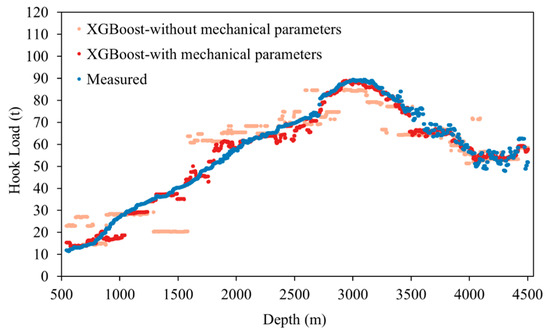
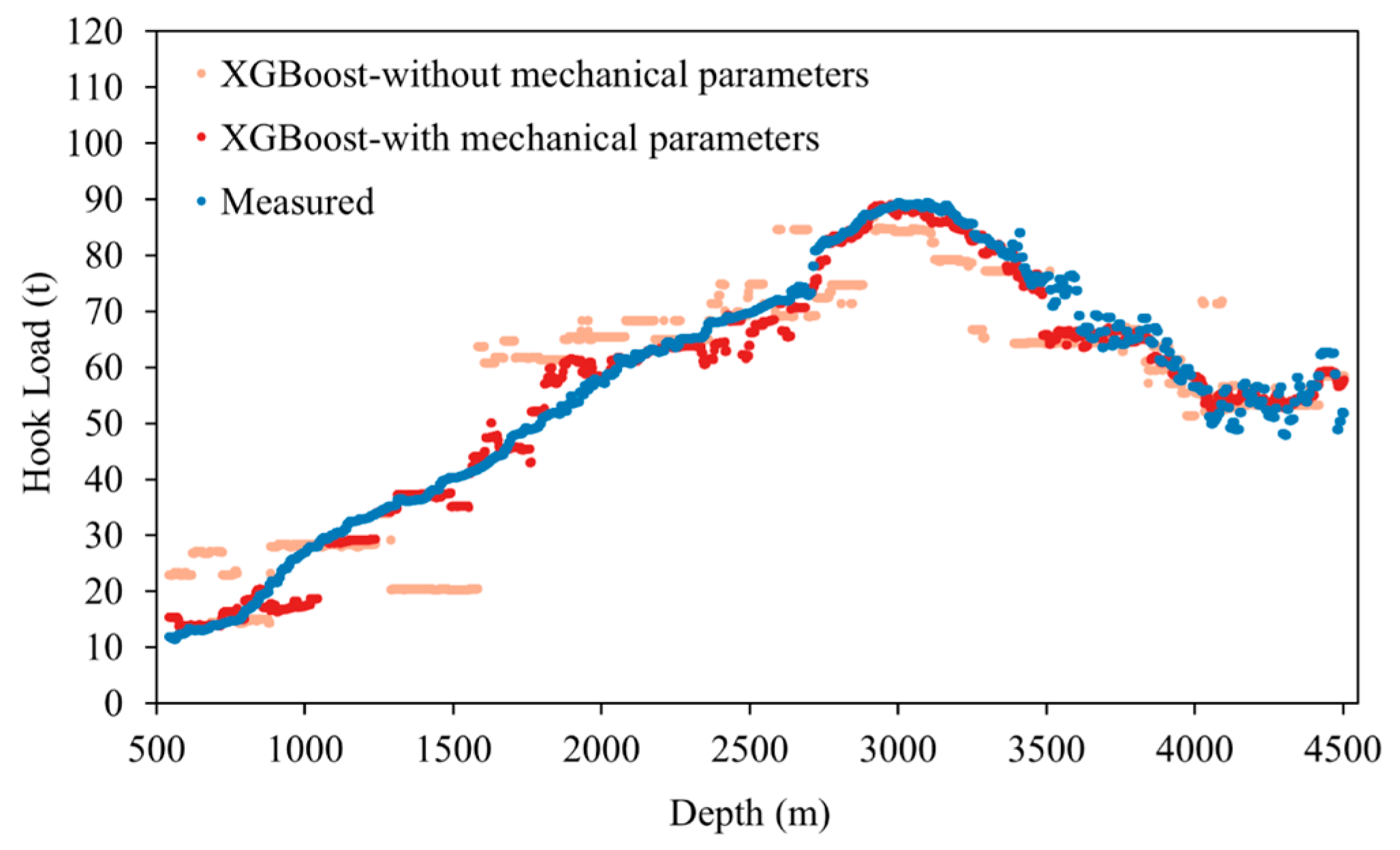
Figure 9 illustrates the comparison between the measured hook load and the predictions obtained from the XGBoost model with and without the inclusion of mechanical parameters. The well trajectory consists of a vertical section (0–2650 m), an inclined section (2650–3305 m), and a horizontal section (3305–4506 m). Overall, the XGBoost model incorporating mechanical parameters exhibits a closer agreement with the measured data across all well sections, particularly in the build-up and horizontal intervals characterized by more complex running conditions. In contrast, although the model without mechanical parameters generally follows the overall trend of the measured data, it presents more pronounced deviations, particularly in some intervals of the vertical and build-up sections, where its predictions fluctuate considerably.
Figure 9.
Comparison between predicted and measured hook load using XGBoost model with and without mechanical parameters.
The enhanced performance of the XGBoost model with mechanical parameters can be attributed to the inclusion of theoretical hook load, casing–borehole compatibility, bottom-end deflection, and bottom-end tilt angle. These parameters effectively capture the mechanical behavior of the casing running process and the potential physical interactions between the casing and the wellbore. By incorporating such physically meaningful variables, the model is able to better represent the nonlinear relationships between the input parameters and the hook load response. Consequently, the integration of these mechanical parameters not only improves predictive accuracy but also enhances the model’s physical interpretability, offering a more reliable reflection of the mechanics governing hook load variations during casing running operations.
To verify the generality of this contribution, the performance metrics of the XGBoost, LightGBM, and Random Forest models without mechanical parameters were calculated. As summarized in Table 6, all three ensemble learning models achieved better performance when mechanical parameters were included. Among them, XGBoost (with mechanical parameters) produced the overall best results. The inclusion of mechanical parameters led to lower MAPE and RMSE values and higher R2, indicating that mechanical parameters enhance the model’s physical interpretability and predictive accuracy.
Table 6.
Comparison of model performance with and without mechanical parameters.
The above results demonstrate that integrating mechanical parameters substantially improves the predictive performance and generalization of ensemble learning models. Building on this foundation, the optimized XGBoost model with mechanical parameters is further used to quantitatively calculate wellbore friction, assess the risk of casing sticking and formulate optimization strategies.
6. Sticking Risk Assessment and Optimization Strategy
6.1. Friction Factor Inversion
Sticking risk assessment in this study is based on the inverted friction factor, which serves as a well-established indicator of downhole running safety [59,60,61]. According to field experience and previous studies, a friction factor exceeding 0.6 indicates a high-risk sticking region [62,63,64].
The inversion follows a bisection-based iterative scheme, in which the friction factor is repeatedly adjusted until the calculated hook load from the mechanical model matches the predicted hook load from the machine-learning model within a predefined tolerance. An initial upper and lower bound (0.1–5) was assigned to the friction factor. This broader range was selected to account for extreme downhole conditions, such as severe friction or sticking scenarios, ensuring that the iterative inversion remains robust even under high-risk circumstances. During each iteration, the computed hook load is compared with the predicted value: if the calculated hook load is greater, the upper bound of the friction factor is reduced; otherwise, the lower bound is increased.
This process continues until the difference between the two hook-load values satisfies the convergence criterion. The inversion is performed independently at each depth sample using the same depth interval as the measured hook load. The initial guess of the friction factor is taken as the midpoint of the prescribed bounds, and the bisection updates continue until the absolute difference between the calculated and predicted hook loads satisfies the convergence tolerance or the maximum iteration count is reached.
6.2. GA-Based Optimization for Casing Structure Design
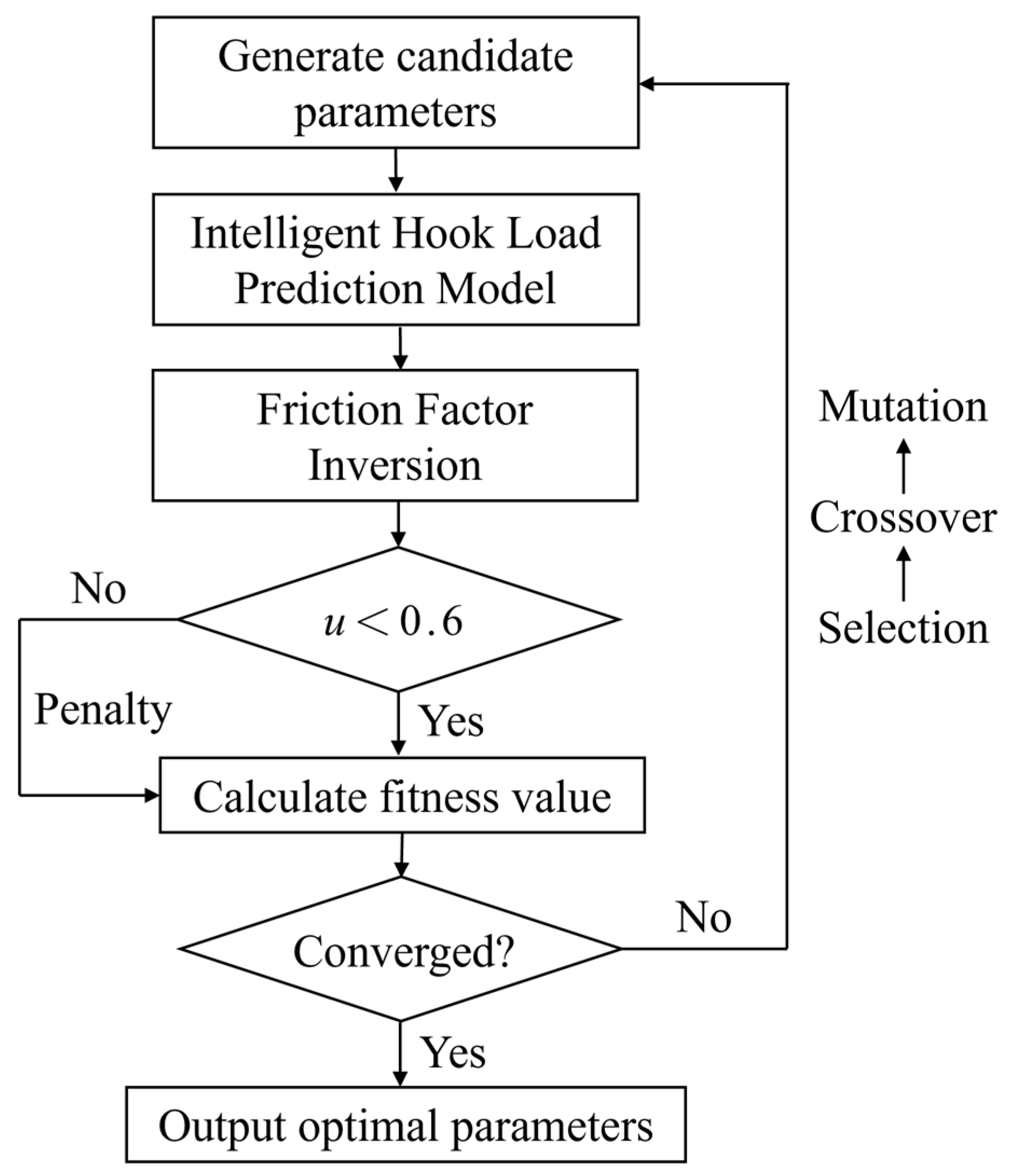
To mitigate the risk of casing sticking and enhance the running capability of the casing string, a genetic algorithm (GA)–based optimization framework was developed, as illustrated in Figure 10. The decision parameters were selected by considering their operational adjustability and their significant influence on casing mechanical behavior. In this study, the optimization focuses on two key casing configuration parameters: the centralizer spacing and the casing shoe-to-centralizer spacing. The upper and lower bounds of these parameters were determined according to operational feasibility and engineering judgment.
Figure 10.
Genetic Algorithm Optimization Framework.
At each iteration, the parameter set generated by the GA is passed to the intelligent hook-load prediction model. The model outputs the predicted hook load distribution along the wellbore, which is then used for the friction factor back-calculation process to obtain the corresponding friction coefficient profile. The results are evaluated against the optimization constraint, ensuring that the friction factor along the entire wellbore remains below the predefined threshold (0.6 in this study).
It should be noted that the friction factor is not treated as a decision variable of the GA; instead, it is obtained by inversion for each candidate casing configuration and used as a constraint indicator in the fitness evaluation. To handle constraint violations, a penalty function was incorporated into the fitness evaluation, expressed as:
where Fe denotes the fitness value of a candidate solution, a larger F indicates better fitness; λ is a penalty coefficient that enforces the friction factor constraint; St is the hook load safety margin at the target depth, ; HLt is the predicted hook load at target depth; HLs is the safety threshold of hook load.
The GA iterates through selection, crossover, and mutation until convergence, yielding the optimal parameter combination that minimizes sticking risk during casing running.
7. Field Case Study
To verify the applicability of the proposed intelligent hook load prediction model and to demonstrate the practical application of the sticking-risk assessment and optimization strategy developed in this study, two wells from different fields were analyzed. Well X, located in the Karamay Oilfield, is the same well used for model testing. Here, a further sticking-risk assessment was conducted. Well H, from the Mahu Oilfield, was investigated to illustrate the complete workflow of hook-load prediction, sticking-risk assessment, and optimization design of casing structure.
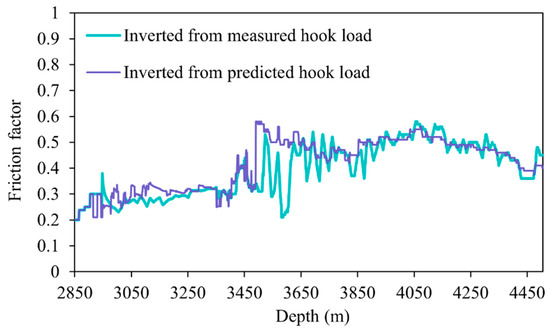
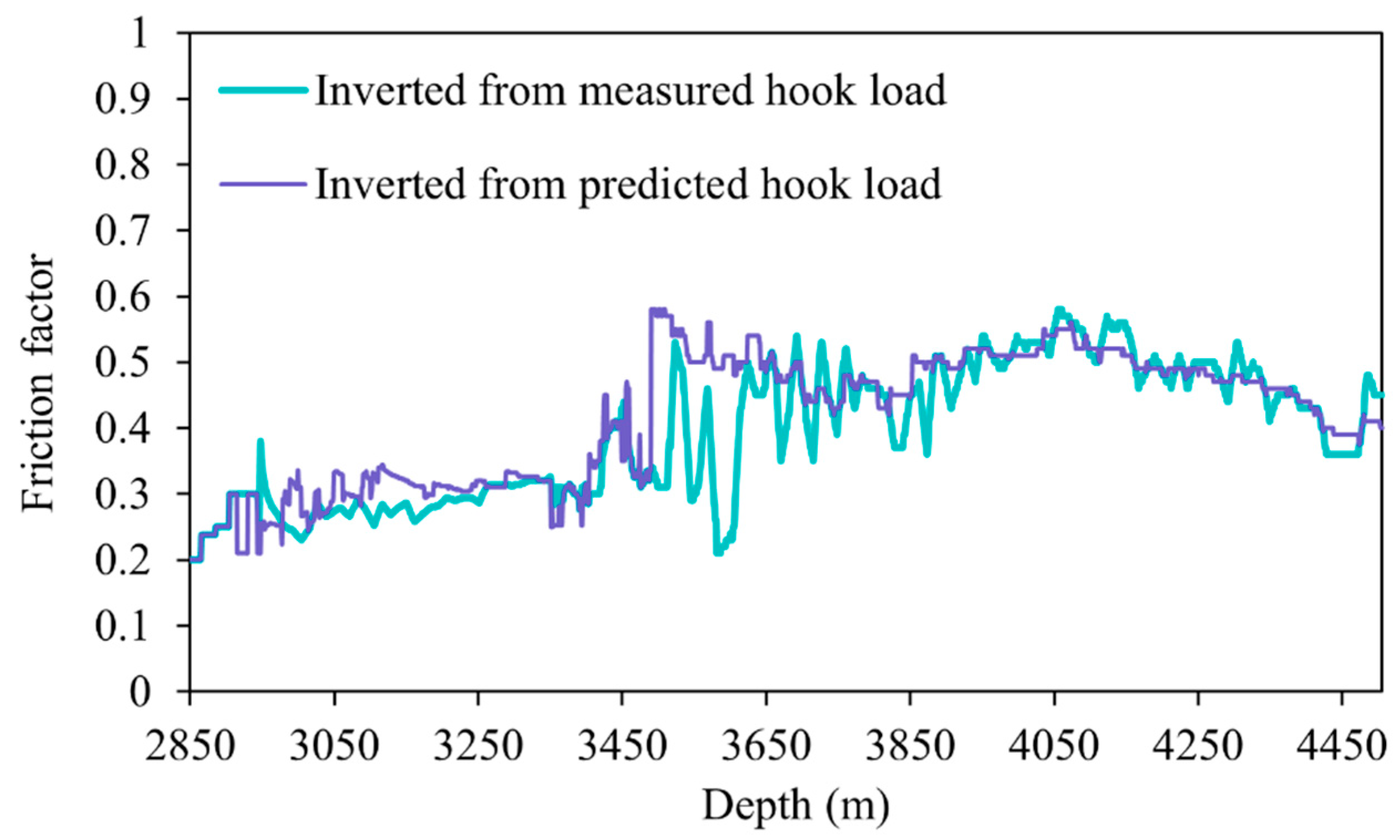
For Well X, the friction factors in the open hole section inverted from the predicted and measured hook loads are shown in Figure 11. The maximum predicted friction factor is 0.58 over the depth interval of 3490–3509 m, while the maximum value inverted from the measured hook load is 0.53 at 3523 m. The two curves show a consistent overall trend (RMSE = 0.04; MAE = 0.01). The friction factors remain below 0.6 along the entire well depth. No casing-sticking event was reported in the field, confirming the reliability of the proposed model under normal casing-running conditions.
Figure 11.
Friction factors inverted from the predicted and measured hook loads of Well X.
In contrast to Well X, Well H from the Mahu Oilfield experienced severe resistance during the first casing-running operation, leading to a complete withdrawal of the production casing string. A second casing-running operation was therefore required.
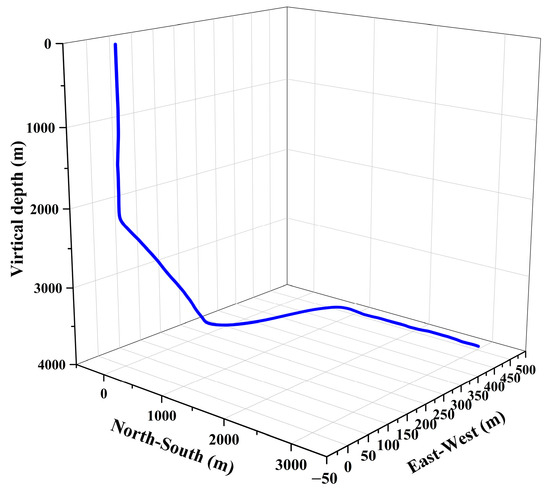
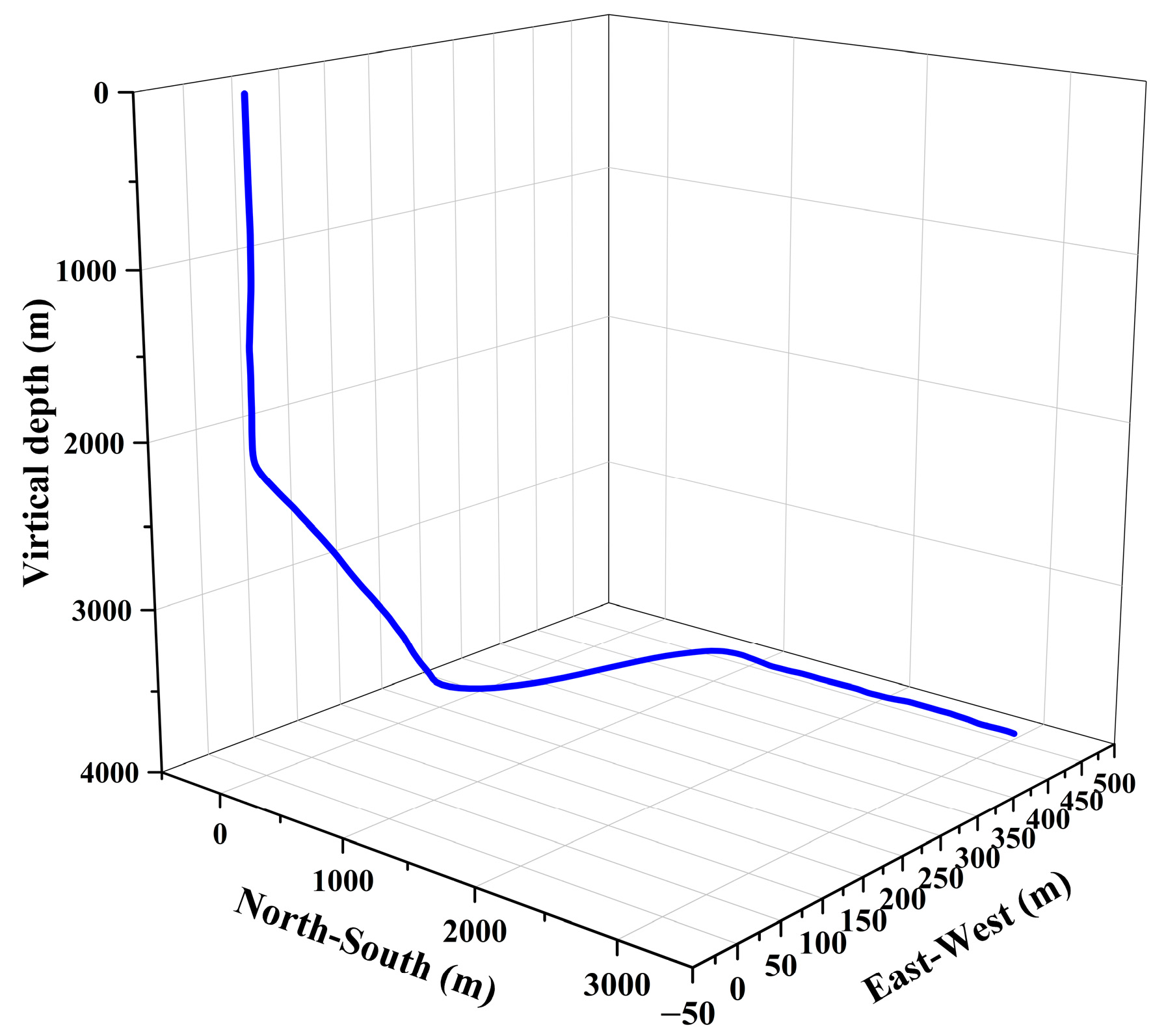
To analyze the cause of the first sticking incident and to prevent sticking in the subsequent operation, the proposed sticking-risk assessment method and optimization strategy were applied to re-evaluate the operational parameters for both runs. The basic information of Well H is summarized in Table 7, Table 8 and Table 9, and the 3D wellbore trajectory is shown in Figure 12. The first casing-running operation used a floating casing running technique, whereas the second operation used a rotational casing running technique designed by field engineers.
Table 7.
Casing program of Well H.
Table 8.
Centralizer configuration for the production casing of Well H.
Table 9.
Production casing running parameters of Well H.
Figure 12.
3D trajectory profile of Well H.
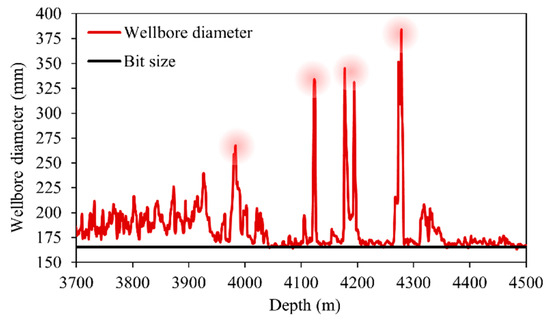
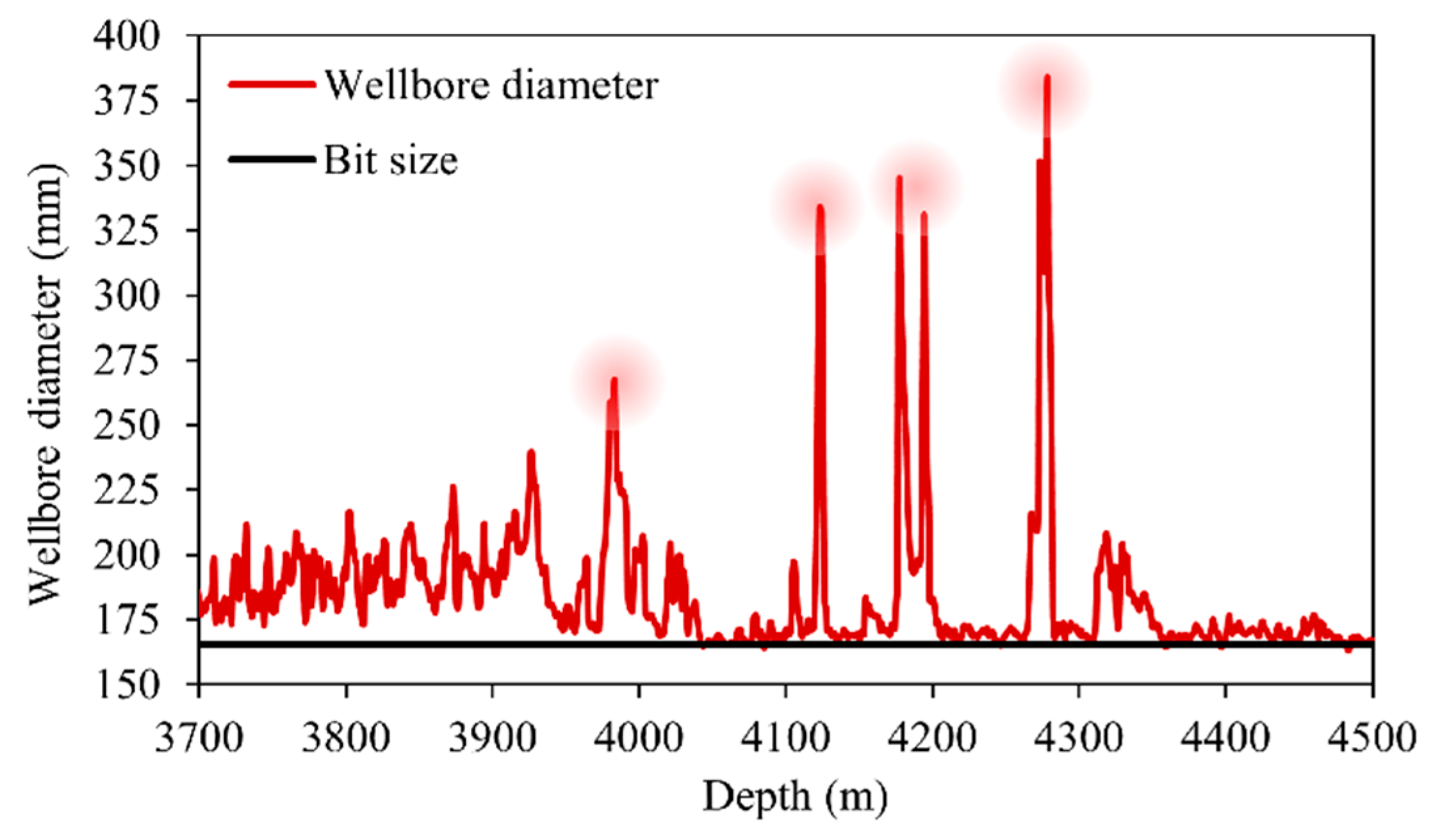
It should be noted that caliper logging indicated severe borehole enlargement in Well H. The caliper profiles of partial open hole section are shown in Figure 13, where four distinct irregularly enlarged sections can be observed between the depths of 3965 and 4295 m.
Figure 13.
Caliper log of Well H (Partial Section).
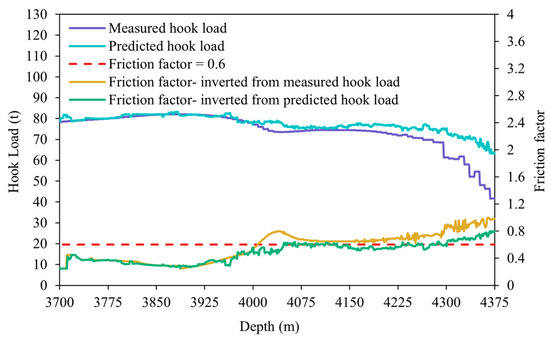
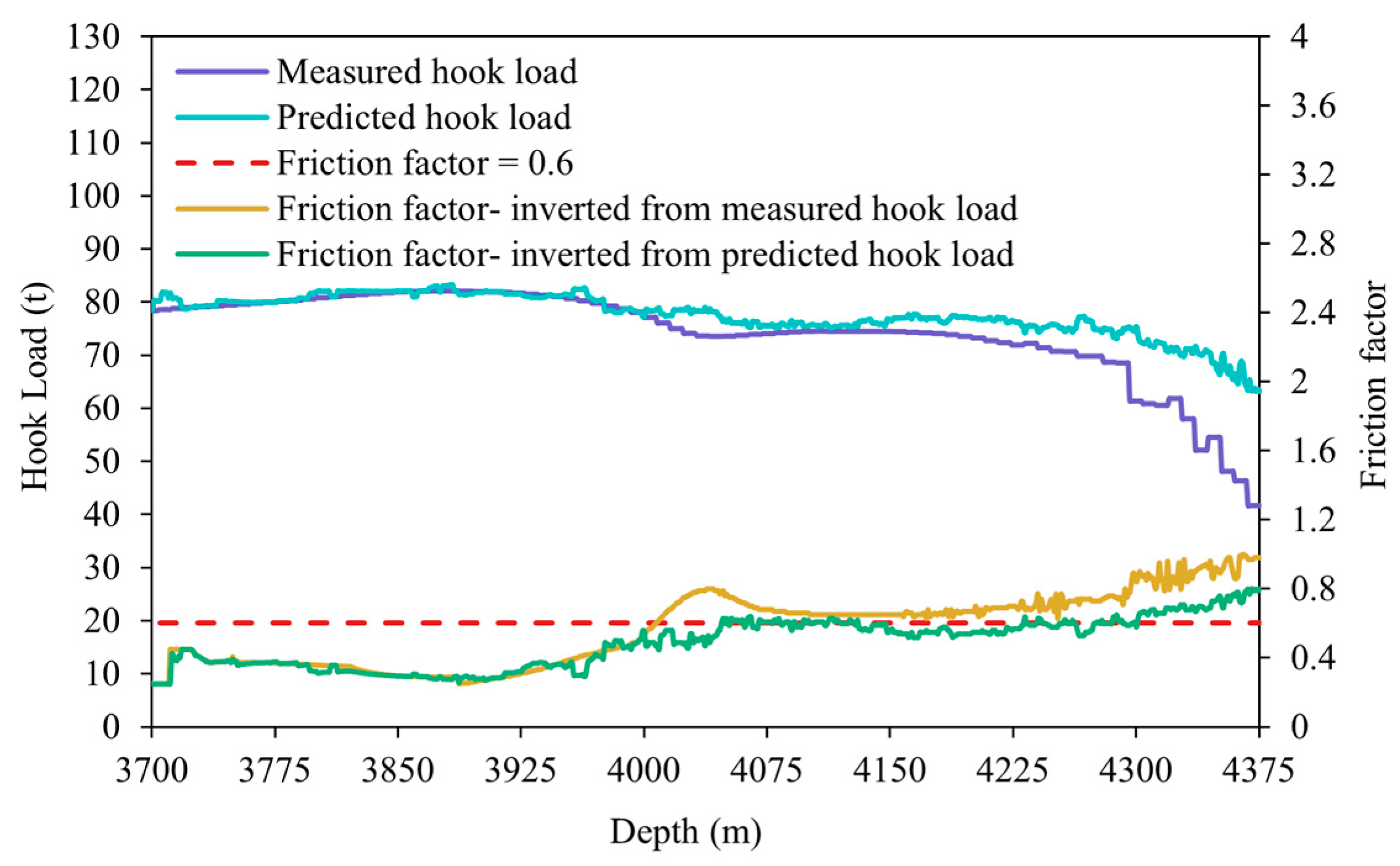
For the first casing-running operation, the predicted and measured hook loads, together with the inverted friction factors, are shown in Figure 14. The predicted and measured hook-load curves exhibit a generally consistent trend along the well depth. The friction factor inverted from the measured hook load exceeds 0.6 at approximately 4000 m, reaches 0.8 at 4038 m, then slightly decreases before increasing continuously, with a maximum value of 1.0 at 4365 m. In the field, severe resistance occurred between 3989 and 4360 m. The casing was repeatedly picked up and released, but the downward movement remained difficult, and the casing string was eventually pulled out of the hole at 4375 m. Notably, a slight deviation between the predicted and measured hook loads and friction factors occurs at a depth of approximately 4000 m, where sticking resistance had already been encountered by the casing. The friction factor prediction errors yielded RMSE values of 0.03 before 4000 m and 0.15 after 4000 m, while the corresponding MAE values were 0.02 before 4000 m and 0.13 after 4000 m. Nevertheless, the overall variation pattern remains highly consistent with the measured response, indicating that even under sticking conditions the proposed model can accurately capture the hook-load behavior and reliably identify the potential risk interval from 4000 to 4375 m.
Figure 14.
Hook loads and friction factors of Well H (first run).
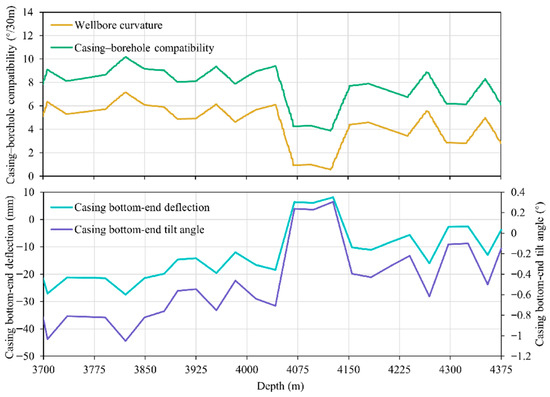
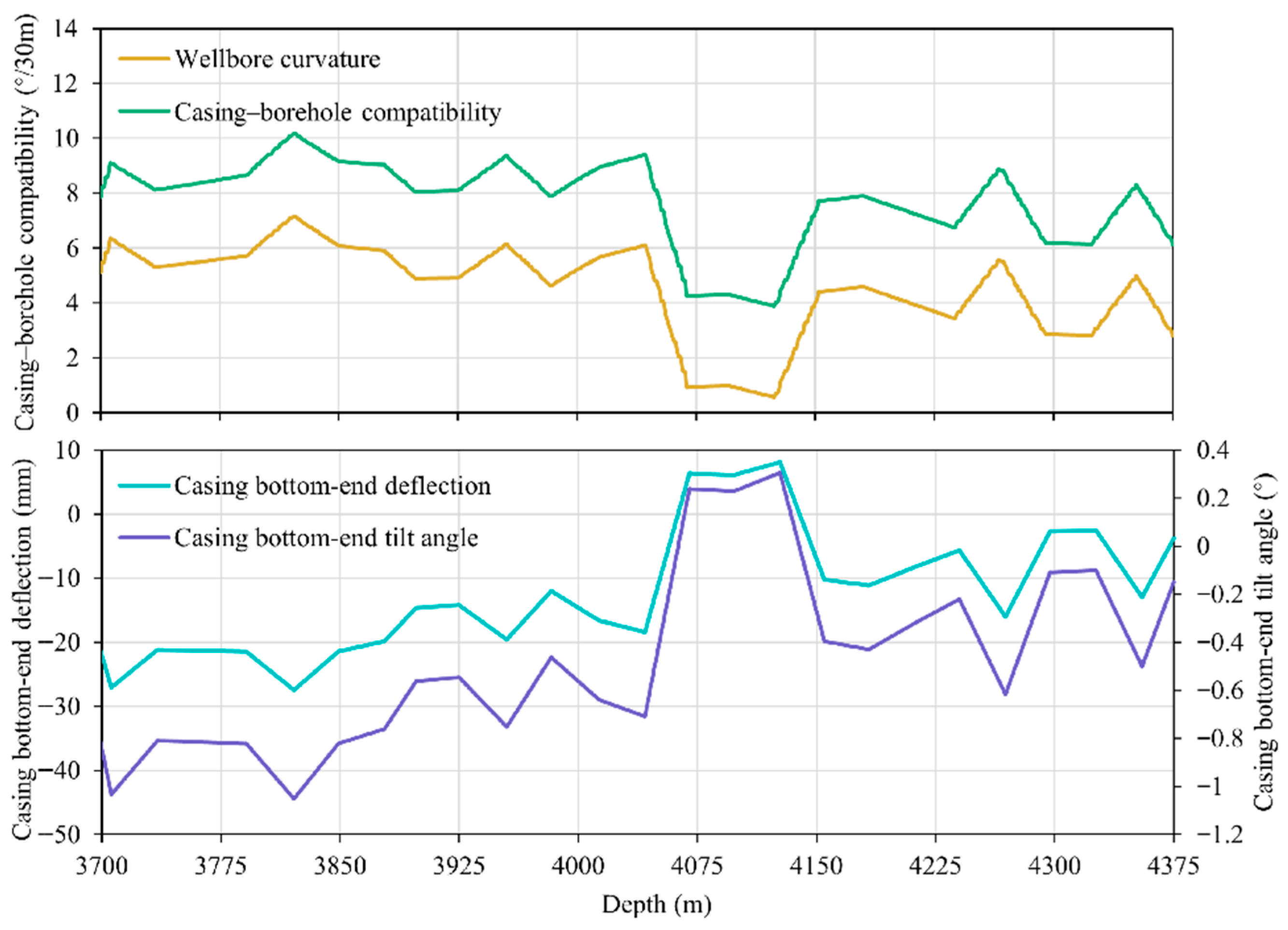
To investigate the cause of sticking, the casing–borehole compatibility and the bottom-end deflection and tilt angle were analyzed, as shown in Figure 15. It can be observed that the casing–borehole compatibility values are consistently higher than the measured wellbore curvature, indicating that the casing compatibility satisfies the mechanical requirement. The casing bottom-end deflection and tilt angle, however, are negative at most depths, suggesting that the casing bottom was bent downward. The previously identified sticking interval (3989–4375 m) lies within the build-up section, where severe local borehole enlargement occurred. Under such conditions, the casing bottom is likely to have sagged into the enlarged borehole, resulting in additional mechanical resistance or even mechanical sticking. This inference is consistent with the field observation that, although a sufficient hook-load reserve (40.24 t) remained, the casing failed to be run further into the wellbore.
Figure 15.
Casing–borehole compatibility and bottom-end deflection of Well H (first run).
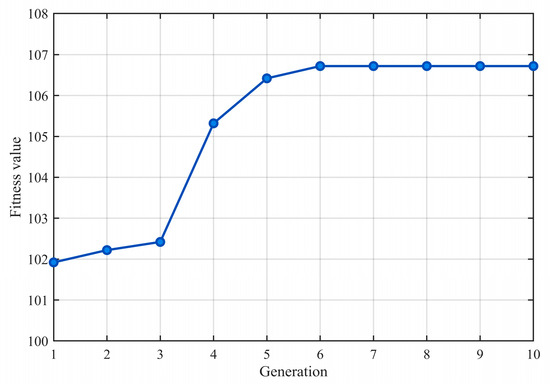
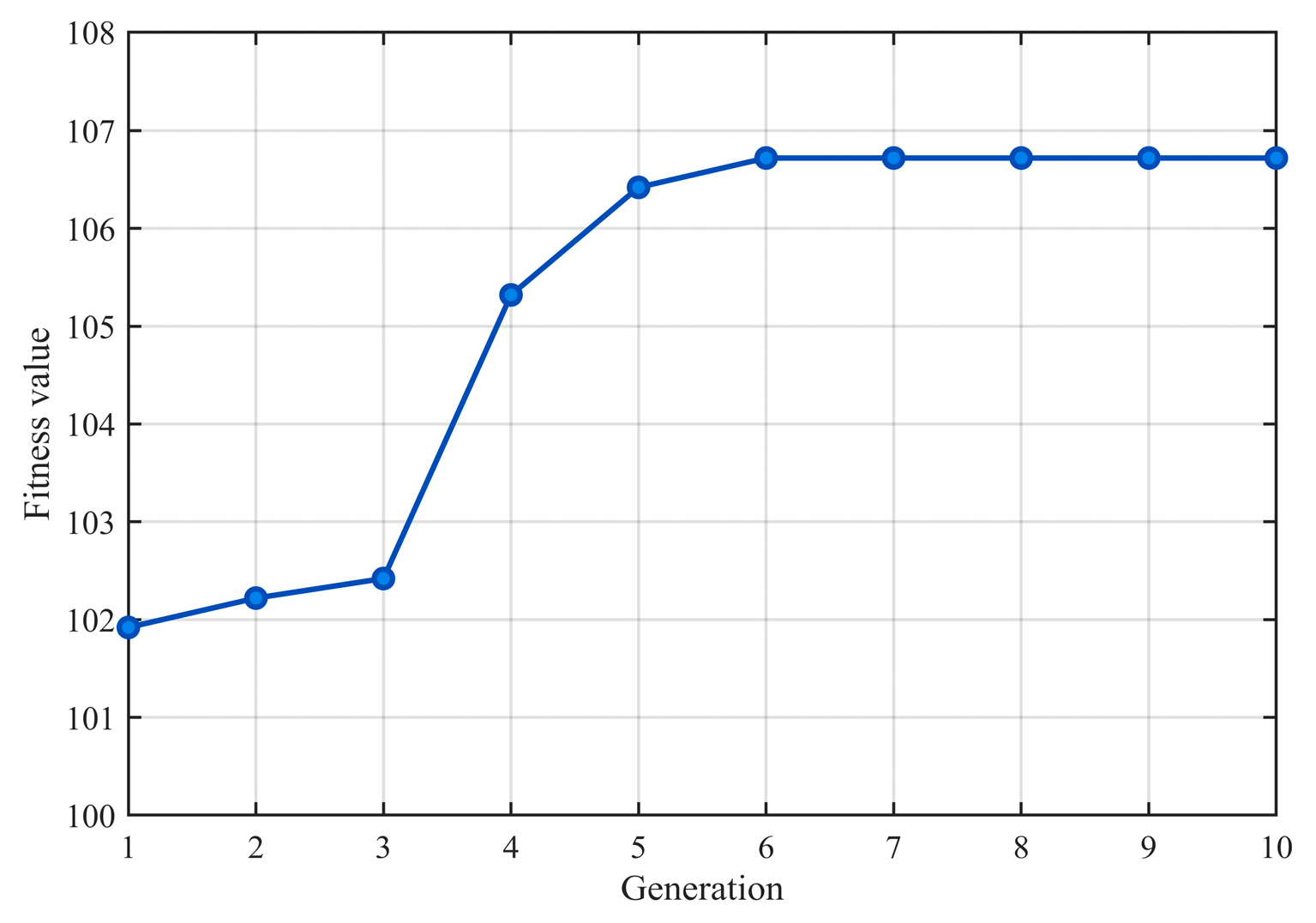
To prevent sticking during the second casing-running operation, the genetic algorithm (GA) was employed to optimize the casing centralizer configuration by maximizing the objective function defined in Equation (28), while the other parameters followed the design proposed by the field engineers. The search space for the centralizer spacing was discretized as {11, 22, 33 m}, and the distance between the casing bottom and the first centralizer was varied from 0.5 m to 11.0 m in increments of 0.5 m. A penalty coefficient λ = 50 was applied to balance the objective function with the friction constraint (μ < 0.6). The GA was configured with a population size of 33, a maximum of 10 generations, and a crossover fraction of 0.8. The optimization converged after six generations, yielding the optimal design parameters as shown in Figure 16. The optimal design resulted in a centralizer spacing of 33 m and a casing bottom–first centralizer spacing of 2.5 m.
Figure 16.
Genetic algorithm convergence curve for the casing design optimization of Well H.
In the actual field operation, the engineers adjusted the design slightly based on the recommended parameters and practical experience, as well as the centralization requirement. The final design adopted a centralizer spacing of 22 m and a bottom centralizer position of 2 m. For this configuration, the hook load and friction factors during the second casing-running operation were predicted using the proposed model and compared with the measured hook loads and inverted friction factors, as shown in Figure 17.
Figure 17.
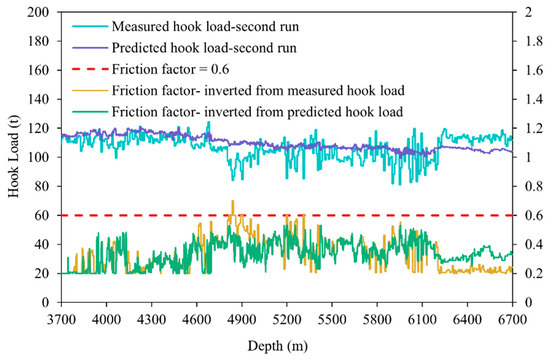
Hook loads and friction factors of Well H (second run).
The results show that the predicted hook load was 104.2 t at the well bottom depth, and the predicted friction factors remained below 0.6 throughout the well, with a maximum value of 0.5. These results suggest that the final design would allow the casing to be successfully run to bottom. The predicted and measured hook loads exhibit similar variation trends (RMSE = 0.08, MAE = 0.05); however, after approximately 4600 m, certain deviations were observed. This difference was mainly attributed to mud losses and subsequent operational activities, including casing movement and circulation, which caused fluctuations in the measured hook load. Consequently, the locally inverted friction factors became slightly higher, reaching 0.7 at 4843 m; however, they generally remained below 0.6 along the well depth. Finally, the casing was successfully run to bottom without any sticking, further confirming the accuracy of the proposed intelligent hook-load prediction model and the effectiveness of the sticking-risk assessment and optimization strategy.
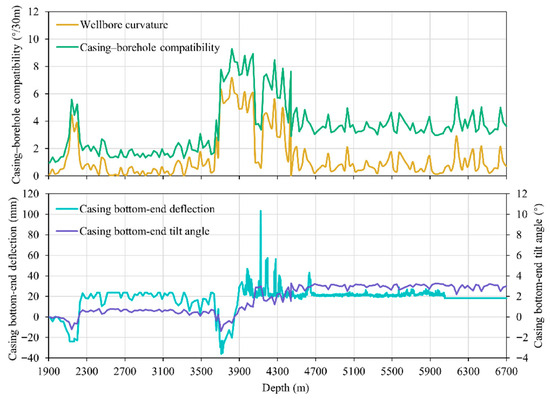
Furthermore, the mechanical parameters during the second casing-running operation were analyzed, as shown in Figure 18. Compared with the first run, the casing–borehole compatibility decreased slightly due to the increased centralizer spacing, but it remained higher than the measured borehole curvature, satisfying the compatibility requirement. In addition, the casing bottom deflection in the high-risk interval changed from negative to positive, implying that the casing bottom tilted upward rather than downward. This upward deflection reduces the risk of the casing bottom entering the locally enlarged borehole section. This finding further confirms the proposed mechanical sticking mechanism and demonstrates the interpretability of the mechanical parameters introduced in this study.
Figure 18.
Casing–borehole compatibility and bottom-end deflection of Well H (second run).
8. Model Limitation
Although the proposed mechanistic–data integrated framework has demonstrated promising performance for hook load prediction and sticking risk assessment, several limitations should be acknowledged.
- (1)
- In this study, torque is not treated as a prediction target. Considering that rotational casing running is common in field operations, torque will be investigated in future work.
- (2)
- All input mechanical parameters in this study were obtained from drilling history and field records and were treated as fixed values in the mechanical calculations. Future work will incorporate sensitivity analyses to quantify the influence of individual mechanical inputs on model performance. In addition, the use of real-time or segment-wise friction-factor inversion as an updated input for predicting deeper intervals will be explored to further reduce parameter uncertainty and enhance the robustness of the integrated framework.
- (3)
- The dataset used in this study includes a limited number of fields and wells, and the number of wells exhibiting severe sticking events remains relatively small. Although cross-field generalization has been demonstrated for the available cases, additional validation across more fields and more diverse operational scenarios is needed before the model can be considered universally applicable.
- (4)
- While this study focused on three representative ensemble learning algorithms (Random Forest, XGBoost, and LightGBM) due to their proven performance and suitability for structured engineering datasets, future work will evaluate additional model families. These include deep learning architectures and alternative boosted or linear models, which may further improve predictive accuracy and cross-field generalization when larger and richer datasets become available.
9. Conclusions
- (1)
- A mechanistic-data-integrated intelligent model was developed to predict hook load by combining mechanical models with ensemble learning algorithms. The incorporation of mechanically derived and structural parameters, such as theoretical hook load, casing–borehole compatibility, and centralizer configuration, significantly improved the interpretability and predictive accuracy of the model.
- (2)
- The model was trained on multi-field datasets and tested on an independent oilfield to evaluate its cross-field generalization. Among the three ensemble methods (Random Forest, XGBoost, and LightGBM), XGBoost achieved the best overall performance (R2 = 0.97, RMSE = 3.50), demonstrating reliable predictive capability across different well sections and operational conditions.
- (3)
- Mechanically derived features—including theoretical hook load, casing–borehole compatibility, casing-bottom deflection and tilt angle—were shown to substantially improve model performance, particularly in deviated and horizontal well sections, confirming the necessity of integrating physical understanding into data-driven models, highlighting their importance for capturing the physical behavior of the casing string.
- (4)
- Based on the mechanistic–data integrated hook load prediction model combined with the friction coefficient inversion approach, a casing-running sticking risk assessment method was developed. Furthermore, a genetic-algorithm-based optimization framework was established to reduce casing-running friction and mitigate sticking risk by optimizing centralizer spacing and casing bottom-first centralizer position under μ < 0.6. The optimization provided feasible engineering guidance for field application.
- (5)
- Field case studies validated the proposed approach: Well X confirmed the model’s reliability under normal conditions, while Well H illustrated its ability to identify mechanical sticking mechanisms, guide parameter design, and enable successful casing running after an initial stuck event.
Author Contributions
Conceptualization, H.Z., Y.Z. (Yuting Zhou) and B.W.; methodology, B.W. and Y.Z. (Yuting Zhou); validation, B.W., Y.R. and X.L.; investigation, K.L. and Y.Z. (Yuhang Zhao); writing—original draft preparation, Y.Z. (Yuting Zhou); writing—review and editing, H.Z. and B.W.; supervision, Y.Y.; project administration, H.Z. All authors have read and agreed to the published version of the manuscript.
Funding
This research was supported by the National Natural Science Foundation of China (Grant No. 52574017), National Oil and Gas Major Project (Grant No. 2025ZD1401905).
Data Availability Statement
The data are not publicly available due to privacy restrictions.
Conflicts of Interest
The authors declare that there is no conflict of interest regarding the publication of this paper.
Abbreviations
The following abbreviations are used in this manuscript:
| GA | Genetic algorithm |
| LightGBM | Light Gradient Boosting Machine |
| MAE | Mean absolute error |
| R2 | Coefficient of determination |
| RF | Random Forest |
| RMSE | Root mean square error |
| T&D | Torque and drag |
| XGBoost | Extreme Gradient Boosting |
Nomenclature
| Ai | Inner cross-sectional area of casing string element, m2 |
| Ao | Outer cross-sectional area of casing string element, m2 |
| cJ,k | Approximation coefficient at level J and position k in the wavelet decomposition, dimensionless |
| dj,k | Detail coefficient at level j and position k in the wavelet decomposition, dimensionless |
| dc | Outer diameter of centralizers at both ends of the casing string, m |
| do | Casing outer diameter, m |
| dw | Wellbore diameter, m |
| E | Elastic modulus of the casing, Pa |
| e0 | Displacement at the casing bottom, m |
| e1 | Displacement at the first centralizer, m |
| F | Axial compressive force of the casing string, N |
| Fe | Fitness value of a candidate solution |
| Fnb | Buckling contact force, N/m |
| Fndp | Lateral force in principal normal direction, N |
| Fnp | Lateral force in binormal direction, N |
| Fntot | Total contact force per unit length on casing string element, N/m |
| g | Acceleration of gravity, 9.8 m/s2 |
| HLs | Safety threshold of hook load |
| HLt | Predicted hook load at target depth |
| I | Moment of inertia of the casing cross-section, m4 |
| K1 | Wellbore curvature at the upper end of the casing string element, m−1 |
| K2 | Wellbore curvature at the lower end of the casing string element, m−1 |
| Kc | Casing–borehole compatibility, m−1 |
| ki | Local wellbore curvature at the i-th support of the casing string, m−1 |
| L | Casing length between centralizers, m |
| L0 | Spacing between the casing bottom and the first centralizer, m |
| Ls | Length of the casing string element, m |
| M1 | Bending moment at the first centralizer, N·m |
| M2 | Bending moment at the second centralizer, N·m |
| Mi | Bending moment at the i-th support of the casing string, N·m |
| m | Total number of samples, dimensionless |
| m3 | Third component of the unit binormal vector m, dimensionless |
| N | Total number of depth samples, dimensionless |
| n3 | Third component of the unit principal normal vector n, dimensionless |
| P | Axial force in the casing string, N |
| q | Buoyed weight of casing per unit length, N/m |
| qo | Air weight of casing, kg/m |
| rc | Radial clearance between the casing string and the wellbore, m |
| ri | Measured hook load value at sample i, N |
| R | Radius of curvature of the wellbore, m |
| St | Hook load safety margin at the target depth |
| T1 | Axial force at the lower end of the casing string element, N |
| T2 | Axial force at the upper end of the casing string element, N |
| u | Stability coefficient, dimensionless |
| X(u) | Beam–column deflection magnification factor, dimensionless |
| Y(u) | Beam–column deflection magnification factor, dimensionless |
| Z(u) | Beam–column deflection magnification factor, dimensionless |
| y0 | Casing bottom-end deflection, m |
| yw | Minimum bending deflection required for the casing string element to pass through the wellbore, m |
| Ymax | Maximum deflection of the casing string, m |
| α | Inclination angle of the well, rad |
| Average deviation angle, rad | |
| θ | Overall angle change, rad |
| θ0 | Casing bottom-end tilt angle, rad |
| θ1 | Rotation angle at the first centralizer above the bottom, rad |
| λ | Penalty coefficient that enforces the friction factor constraint, dimensionless |
| λj | Threshold value at level j, dimensionless |
| μ | Friction factor, dimensionless |
| ρi | Fluid density inside the casing string, kg/m3 |
| ρo | Fluid density outside the casing string, kg/m3 |
| σj | Estimated standard deviation of noise at level j, dimensionless |
| Scaling (approximation) function describing the low-frequency trend, dimensionless | |
| Wavelet (detail) function corresponding to high-frequency fluctuations, dimensionless | |
| dCor(X,X) | Distance covariance between X and itself, dimensionless |
| dCor(X,Y) | Distance covariance between X and Y, dimensionless |
References
- Chen, D.; Mao, K.; Ye, Z.; Li, W.; Yan, W.; Wang, H. An artificial intelligent well trajectory design method combining both geological and engineering objectives. Geoenergy Sci. Eng. 2024, 236, 212736. [Google Scholar] [CrossRef] [Scilit]
- Cheng, L.; Che, X.; Qiao, W.; Zhao, T. 3D trajectory inversion of an adjacent well using scattered P-wave. Petrol. Sci. 2023, 20, 857–865. [Google Scholar] [CrossRef] [Scilit]
- Dou, Z.; Liu, Y.; Xia, J.; Yang, G. Multi-objective optimization design method for marine deepwater relief well 3D trajectory. Mar. Georesour. Geotec. 2025, 1–9. [Google Scholar] [CrossRef] [Scilit]
- Shu, J.; Han, G.; Yue, Z.; Cheng, L.; Dong, Y.; Liang, X. Optimizing Well Trajectories for Enhanced Oil Production in Naturally Fractured Reservoirs: Integrating Particle Swarm Optimization with an Innovative Semi-Analytical Model Framework. SPE J. 2025, 30, 957–975. [Google Scholar] [CrossRef] [Scilit]
- Zhang, H.; Chen, Y.; Wu, W.; Zhang, H.; Ma, D.; Lu, Z. Study on open-hole extended-reach limit in horizontal drilling with wavy wellbore trajectory. Energy Sci. Eng. 2024, 12, 1124–1136. [Google Scholar] [CrossRef] [Scilit]
- Hao, C.; Wang, Y.; Xu, Y.; Zhuo, L.; Chen, W.; Li, P.; Ren, M. Investigation of the Effect of Casing-to-Wellbore Clearance on Equivalent Circulating Density During Casing Running. Processes 2024, 12, 2894. [Google Scholar] [CrossRef] [Scilit]
- Tang, B.; Feng, S.; Zhao, J.; Chen, J.; Guo, D.; Wang, Y. Study on ECD during the Construction of Extended Reach Wells. Chem. Tech. Fuels Oil. 2025, 60, 1491–1502. [Google Scholar] [CrossRef] [Scilit]
- Zhang, Q.; Liao, T.; Ding, L.; Yang, H.; Lian, Z. Theoretical and numerical study on residual strength of worn casing considering wellbore curvature. Geoenergy Sci. Eng. 2023, 227, 211874. [Google Scholar] [CrossRef] [Scilit]
- Zhang, Z.; Xiang, S.; Yang, H.; Hou, D. Study on the integrity assessment of geothermal wellbore under thermal and non-uniform in-situ stresses coupling effects. Appl. Therm. Eng. 2024, 255, 123744. [Google Scholar] [CrossRef] [Scilit]
- Obuobi, I.F. A Novel Experimental Approach for Investigating Torsional Vibration in a Casing String During Rotation; University of Oklahoma–Graduate College: Oklahoma, OK, USA, 2025; p. 111. [Google Scholar]
- Tan, T.; Zhang, H. A risk prediction method of pipe sticking accidents due to wellbore uncleanness for long horizontal section wells. J. Petrol. Sci. Eng. 2022, 210, 110023. [Google Scholar] [CrossRef] [Scilit]
- Xu, K.; Liu, Z.; Chen, Q.; Zhang, Q.; Ling, X.; Cai, X.; He, Q.; Yang, M. Application of machine learning in wellbore stability prediction: A review. Geoenergy Sci. Eng. 2024, 232, 212409. [Google Scholar] [CrossRef] [Scilit]
- Zhang, J.; Peng, C.; Fu, J.; Cao, Q.; Su, Y.; Pang, J.; Yu, Z. Analysis of mechanical strengths of extreme line casing joint considering geometric, material, and contact nonlinearities. Petrol. Sci. 2024, 21, 1992–2004. [Google Scholar] [CrossRef] [Scilit]
- Zhang, X.; Sun, L.; Li, W.; Zheng, Q. Research on Casing Running Limit Prediction of Shallow Extended-Reach Wells in Bohai Oilfield. In Proceedings of the International Conference on Computational & Experimental Engineering and Sciences, Changsha, China, 25–29 May 2025; pp. 981–992. [Google Scholar]
- Elmgerbi, A.; Les, B.; Ashena, R.; Atkin, T. A Practical Decision Tool to Evaluate and Rank Potential Solutions for Expected Downhole Drilling Problems During the Well-planning Phase. J. Inst. Eng. Ser. D 2022, 103, 25–36. [Google Scholar] [CrossRef] [Scilit]
- Guo, B.; Nguyen, V.; Lee, J. Mathematical Modeling of Friction Reduction in Drilling Long Horizontal Wells Using Smooth Catenary Well Trajectories. Processes 2025, 13, 1573. [Google Scholar] [CrossRef] [Scilit]
- Khadr, M.; Williford, J.; Osama, M.; Palumbo, D.; Saragih, N. Expandable Liner Hanger Installation in Middle East Exploration Well–South Arabic Gulf Offshore. In Abu Dhabi International Petroleum Exhibition and Conference; Society of Petroleum Engineers (SPE): Richardson, TX, USA, 2024; pp. D41S–D152S. [Google Scholar]
- Yin, G.; Almasmoom, S.; Ali, M.; Almalki, N. Technical Challenges and Strategic Solutions for a New Historical Milestone: The Success of Delivering the First Two 10 K ft Lateral Wells in an Unconventional Drilling Operation. In Middle East Oil, Gas and Geosciences Show; Society of Petroleum Engineers (SPE): Richardson, TX, USA, 2023; pp. D31S–D89S. [Google Scholar]
- Chen, P.; Gao, D.; Wang, Z.; Huang, W. Study on aggressively working casing string in extended-reach well. J. Petrol. Sci. Eng. 2017, 157, 604–616. [Google Scholar] [CrossRef] [Scilit]
- Ding, L.; Zhou, L.; Han, C.; Sun, Q.; Wang, K. Analysis of Casing String Running Characteristics in Negative-Displacement Horizontal Wells. SPE Drill. Complet. 2023, 38, 546–560. [Google Scholar] [CrossRef] [Scilit]
- Johancsik, C.A.; Friesen, D.B.; Dawson, R. Torque and Drag in Directional Wells-Prediction and Measurement. J. Pet. Technol. 1984, 36, 987–992. [Google Scholar] [CrossRef] [Scilit]
- Zhao, J.; Huang, W.; Gao, D. Interaction between Pipe Rotation and Cuttings Transport in Extended-Reach Drilling: Mechanism, Model, and Applications. SPE J. 2024, 29, 2857–2876. [Google Scholar] [CrossRef] [Scilit]
- Ho, H.S. An Improved Modeling Program for Computing the Torque and Drag in Directional and Deep Wells. In SPE Annual Technical Conference and Exhibition; Society of Petroleum Engineers (SPE): Richardson, TX, USA, 1988; p. 18047. [Google Scholar]
- Liyanarachchi, S.; Rideout, G. Improved stiff string torque and drag prediction using a computationally efficient contact algorithm. Math. Comp. Model. Dyn. 2024, 30, 417–443. [Google Scholar] [CrossRef] [Scilit]
- Mitchell, R.F.; Samuel, R. How Good Is the Torque/Drag Model? SPE Drill. Complet. 2009, 24, 62–71. [Google Scholar] [CrossRef] [Scilit]
- Tikhonov, V.; Valiullin, K.; Nurgaleev, A.; Ring, L.; Gandikota, R.; Chaguine, P.; Cheatham, C. Dynamic Model for Stiff-String Torque and Drag. SPE Drill. Complet. 2014, 29, 279–294. [Google Scholar] [CrossRef] [Scilit]
- Deng, Q.; Jiang, J.; Yang, D.; Han, H.; Qi, G. Dynamic analysis and optimization of perforated tubing strings in deep-water wells under diverse operating conditions. Ocean Eng. 2025, 322, 120535. [Google Scholar] [CrossRef] [Scilit]
- Li, B.; Zhu, X.; Dong, L. Numerical analysis of running resistance of a completion string with packers and sliding sleeves in horizontal wells. Petrol. Sci. Technol. 2024, 43, 1–20. [Google Scholar] [CrossRef] [Scilit]
- Lin, T.; Zhao, Z.; Yu, H.; Lian, Z.; Zhu, Z.; Wan, Z. A novel method for predicting mechanical properties of casing in shale extended-reach wells considering random friction. Proc. Inst. Mech. Eng. Part C J. Mech. Eng. Sci. 2025, 239, 2091–2105. [Google Scholar] [CrossRef] [Scilit]
- Basar, G. Experimental Evaluation and Machine Learning-Based Prediction of Laser Cutting Quality in FFF-Printed ABS Thermoplastics. Polymers 2025, 17, 1728. [Google Scholar] [CrossRef] [Scilit]
- Der, O. Multi-Output Prediction and Optimization of CO2 Laser Cutting Quality in FFF-Printed ASA Thermoplastics Using Machine Learning Approaches. Polymers 2025, 17, 1910. [Google Scholar] [CrossRef] [Scilit]
- Chuanshu, Y.; Changsheng, L.; Xudong, S.; Liming, H.; Haolin, Z. Research Method and Practice of Artificial Intelligence Drilling Technology. Pet. Drill. Tech. 2021, 49, 7–13. [Google Scholar]
- Davoodi, S.; Al-Shargabi, M.; Wood, D.A.; Mehrad, M. Advancement of artificial intelligence applications in hydrocarbon well drilling technology: A review. Appl. Soft Comput. 2025, 176, 113129. [Google Scholar] [CrossRef] [Scilit]
- Rahmanifard, H.; Gates, I.D. Innovative integrated workflow for data-driven production forecasting and well completion optimization: A Montney Formation case study. Geoenergy Sci. Eng. 2024, 238, 212899. [Google Scholar] [CrossRef] [Scilit]
- Song, X.; Zhu, S.; Li, G.; Zeng, Y.; Guo, H.; Hu, Z. Prediction of hook load and rotary drive torque during well-drilling using a BP-LSTM network. J. China Univ. Pet. (Ed. Nat. Sci.) 2022, 46, 76–84. [Google Scholar]
- Bai, K.; Fan, H.; Zhang, H.; Zhou, F.; Tao, X. Real time torque and drag analysis by combining of physical model and machine learning method. In Proceedings of the Unconventional Resources Technology Conference (URTeC), Houston, TX, USA, 20–22 June 2022; pp. 3152–3163. [Google Scholar]
- Mayouf, M.; Hadjadj, A. Real-Time Torque and Drag Prediction in Oilwell Drilling: A Comparative Study of Machine Learning Models; Springer Nature: Cham, Switzerland, 2024; pp. 113–127. [Google Scholar]
- Hempkins, W.B.; Kingsborough, R.H.; Lohec, W.E.; Nini, C.J. Multivariate Statistical Analysis of Stuck Drillpipe Situations. SPE Drill. Eng. 1987, 2, 237–244. [Google Scholar] [CrossRef] [Scilit]
- Salminen, K.; Cheatham, C.; Smith, M.; Valiullin, K. Stuck-Pipe Prediction by Use of Automated Real-Time Modeling and Data Analysis. SPE Drill. Complet. 2017, 32, 184–193. [Google Scholar] [CrossRef] [Scilit]
- Elahifar, B.; Hosseini, E. Machine learning algorithm for prediction of stuck pipe incidents using statistical data: Case study in middle east oil fields. J. Pet. Explor. Prod. Technol. 2022, 12, 2019–2045. [Google Scholar] [CrossRef] [Scilit]
- Zhang, X.; Dong, P.; Yang, Y.; Zhang, Q.; Sun, Y.; Song, X.; Zhu, Z. Identification Method of Stuck Pipe Based on Data Augmentation and ATT-LSTM. Processes 2024, 12, 1296. [Google Scholar] [CrossRef] [Scilit]
- Gao, D. Down-Hole Tubular Mechanics and its Applications; China University of Petroleum Press: Dongying, China, 2006; pp. 80–87. [Google Scholar]
- Huang, W.; Gao, D. Combined Effects of Wellbore Curvature, Connector, and Friction Force on Tubular Buckling Behaviors. Spe. J. 2019, 24, 2083–2096. [Google Scholar] [CrossRef] [Scilit]
- Lubinski, A. Maximum Permissible Dog-Legs in Rotary Boreholes. J. Pet. Technol. 1961, 13, 175–194. [Google Scholar] [CrossRef] [Scilit]
- Du, Z.; Liu, J.; Guo, X.; Kai, T.; Chen, J.; Xiang, H. Investigation of key problems of clustering perforation string running in horizontal well with unconventional oil-gas reservoirs. Petrol. Sci. Technol. 2024, 42, 2106–2132. [Google Scholar] [CrossRef] [Scilit]
- Lindsey, J.H.E.; Mclarnan, C.W.; Nickel, J.A. Determining clearances in helically buckled tubing. World Oil 1980, 190, 195. [Google Scholar]
- Paslay, P.R.; Cernocky, E.P. Bending Stress Magnification in Constant Curvature Doglegs with Impact on Drillstring and Casing. In Proceedings of the SPE Annual Technical Conference and Exhibition, Dallas, TX, USA, 6–9 October 1991; p. 22547. [Google Scholar]
- Zhang, H.; Chen, Q.; Wu, Y.; Song, L.; Zhang, H. Optimized Design of Casing Centralizers for Complex Well Structures. In Proceedings of the 59th U.S. Rock Mechanics/Geomechanics Symposium, Santa Fe, NM, USA, 8–11 June 2025; pp. D21S–D22S. [Google Scholar]
- Juvkam-Wold, H.C.; Wu, J. Casing Deflection and Centralizer Spacing Calculations. SPE Drill. Eng. 1992, 7, 268–274. [Google Scholar] [CrossRef] [Scilit]
- Willerth, M.; Dodson, B.; Mccue, K.; Farrag, M. When Slick Is Not Smooth: Bottomhole Assembly Selection and Its Impact on Wellbore Quality. SPE Drill. Complet. 2022, 37, 126–140. [Google Scholar] [CrossRef] [Scilit]
- Wilson, J.K. New Efficient Drillstring-Wellbore Contact Model Makes Real-Time BHA Directional Estimation Possible. In Proceedings of the SPE/IADC International Drilling Conference and Exhibition, Stavanger, Norway, 4–6 March 2025; pp. D11S–D15S. [Google Scholar]
- Esteva, M. Implications of Setting a Centralized Production Liner on Bottom: A Numerical Approach. In Proceedings of the IADC/SPE International Drilling Conference and Exhibition, Galveston, TX, USA, 5–7 March 2024; pp. D11S–D15S. [Google Scholar]
- Portillo, O.; Almalki, N.; Qahtani, F.; Almuraisel, A.; Yin, G. Systematic Strategies to Conquer the Technical Challenges to Successfully Deliver the First 15,000 Ft Lateral Well in an Unconventional Drilling Operation. In Proceedings of the Middle East Oil, Gas and Geosciences Show (MEOS GEO), Manama, Bahrain, 16–18 September 2025; pp. D21S–D44S. [Google Scholar]
- Timoshenko, S.P.; Goodier, J.N.; Abramson, H.N. Theory of Elasticity (3rd Ed.). J. Appl. Mech. 1970, 37, 888. [Google Scholar] [CrossRef] [Scilit]
- Bai, J.Z. An Exact Solution for Bottomhole Assembly Analysis. In Proceedings of the Annual Technical Meeting, Calgary, AB, Canada; 1986; pp. 37–86. [Google Scholar]
- Wang, G.; Liu, G.; Wang, K.; Li, Y.; Hu, Y. Tripability Analysis of Casing Strings in Directional Wells Using the Continuous Beam-Column and Buckling Theory. Geofluids 2022, 2022, 1–15. [Google Scholar] [CrossRef] [Scilit]
- Qin, X.; Gao, D. Effects of Buckled Tubing on Coiled Tubing Passibility. In Proceedings of the SPE/ICoTA Coiled Tubing and Well Intervention Conference and Exhibition, Houston, TX, USA, 21–22 March 2017; pp. D12S–D22S. [Google Scholar]
- Yavari, H.; Qajar, J. A Comparative Study of Ensemble Learning Techniques and Mathematical Models for Rigorous Modeling of Solution Gas/Oil Ratio. SPE J. 2025, 30, 1588–1613. [Google Scholar] [CrossRef] [Scilit]
- Bi, Y.; Xian, B.; Gao, D.; Cao, Y. A novel calculation model for friction and torque of tubular string in horizontal well. Geoenergy Sci. Eng. 2024, 243, 213324. [Google Scholar] [CrossRef] [Scilit]
- Chen, P.; Gao, D.; Wang, Z.; Huang, W. Study on multi-segment friction factors inversion in extended-reach well based on an enhanced PSO model. J. Nat. Gas Sci. Eng. 2015, 27, 1780–1787. [Google Scholar] [CrossRef] [Scilit]
- Zhao, J.; Huang, W.; Gao, D. Research on dynamic prediction of tubular extension limit and operation risk in extended-reach drilling. J. Nat. Gas Sci. Eng. 2022, 107, 104542. [Google Scholar] [CrossRef] [Scilit]
- Liu, M.; Song, X.; Zhu, Z.; Li, G.; Xiao, H.; Fu, L.; Pan, T.; Li, X.; Yang, Y. Inertial Effect of Drill Pipe Friction Trend and Early Warning of Stuck Pipe. In Proceedings of the SPE Annual Technical Conference and Exhibition, New Orleans, LA, USA, 23–25 September 2024; pp. D15S–D21S. [Google Scholar]
- Vanova, G.; Mercier, F. Pushing the Limits of ERD: Integrating Mechanical and Hydraulic Simulations for Efficient Well Planning. In Proceedings of the SPE Annual Technical Conference and Exhibition, Houston, TX, USA, 20–22 October 2025; pp. D31S–D43S. [Google Scholar]
- Zhan, J.; Li, J.; Yang, H.; Guo, B.; Chen, K.; Wang, B.; Long, Z. A Prediction Model of Pipe Sticking Position Based on Segmented Friction Coefficient Inversion; Springer Nature: Cham, Switzerland, 2025; pp. 866–879. [Google Scholar]

Disclaimer/Publisher’s Note: The statements, opinions and data contained in all publications are solely those of the individual author(s) and contributor(s) and not of MDPI and/or the editor(s). MDPI and/or the editor(s) disclaim responsibility for any injury to people or property resulting from any ideas, methods, instructions or products referred to in the content. |
© 2025 by the authors. Licensee MDPI, Basel, Switzerland. This article is an open access article distributed under the terms and conditions of the Creative Commons Attribution (CC BY) license.