Abstract
This paper provides a comprehensive and systematic review of fault diagnosis methods based on artificial intelligence (AI) in smart distribution networks described in the literature. For the first time, it systematically combs through the main fault diagnosis objectives and corresponding fault diagnosis methods for a smart distribution network from the perspective of combined signal processing and artificial intelligence algorithms. The paper provides an in-depth analysis of the advantages and disadvantages of various signal processing techniques and intelligent algorithms in different fault diagnosis tasks, focusing on the impact of different data dimensions on the effect of fault diagnosis. This paper points out that data security issues and the question of how to combine expert domain knowledge with artificial intelligence technology are essential directions for the future development of fault diagnosis in smart distribution network.
1. Introduction
The electrical distribution network is the core component connecting the transmission system and electricity consumers in the power system; its stable and reliable operation is not only the basis for guaranteeing the stability of the power supply but is also closely related to the regular operation of the national economy. However, with the increasing scales of the renewable energy resources of the distribution network, power system faults present diverse characteristics, of which distribution network faults comprise a large proportion. After the occurrence of faults, it is usually necessary to perform operations such as fault location, fault isolation, and network reconfiguration based on the fault diagnosis results [1]. According to the different objectives and tasks in the fault diagnosis process, fault diagnosis can be divided into four stages, including fault detection, fault classification, fault localization (faulty feeder identification, fault section location, and fault position location), and fault reason determination.
There are many types of distribution network faults, the most common of which include three-phase short-circuit faults, single phase-to-ground faults, phase-to-phase faults, and phase-to-phase-to-ground faults. Among these, single phase-to-ground faults are the most common type of distribution network fault, accounting for about 70% or more of the total number of faults. According to the characteristics of fault signals manifested in different periods, distribution network fault diagnosis methods are usually divided into diagnosis methods based on steady-state characteristics and transient characteristics. The steady-state characteristics diagnostic method mainly analyzes the electrical quantity characteristics when the system reaches a steady state after the fault occurs. The commonly used techniques include the harmonic analysis method, symmetrical component method, impedance method, and power direction method. In [2], fault classification is accomplished by analyzing the harmonic components in the current and voltage and by utilizing the law that states that different types of faults cause other changes in the harmonic components. Studies have [3,4] analyzed the shift in power direction before and after a fault to achieve fault location. Other studies [5,6,7] have determined the location and type of faults based on the change of line impedance during their occurrence. The analysis process of this type of method is relatively simple and is not easily affected by system noise and transient disturbances, making it suitable for stable traditional distribution network fault analysis. However, fault diagnosis methods based on steady-state characteristics still have limitations, such as long considerable fault processing time and difficulty when capturing the steady-state characteristics of unstable faults, especially for a single phase-to-ground fault in non-effectively grounded distribution networks. These limitations are becoming increasingly highlighted with access to distributed renewable sources and the broad application of power electronic devices, significantly reducing the powerβfrequency fault current. Hence, fault diagnosis methods based on transient characteristics have gradually gained the attention of scholars. These methods can quickly capture and analyze the transient changes of signals at the instant of fault occurrence, thus realizing faster and more accurate fault diagnosis based on the multi-dimensional signals [8], and mainly include wavelet transform, modal decomposition, principal component analysis algorithms, etc.
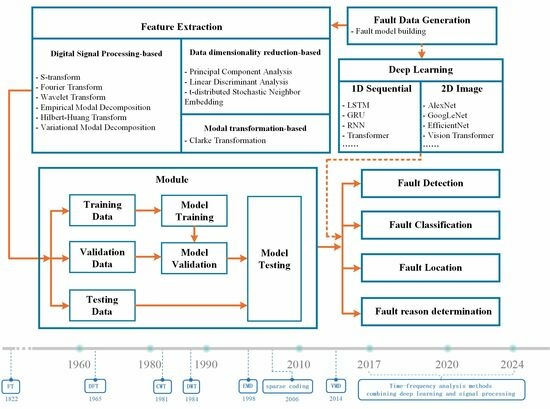
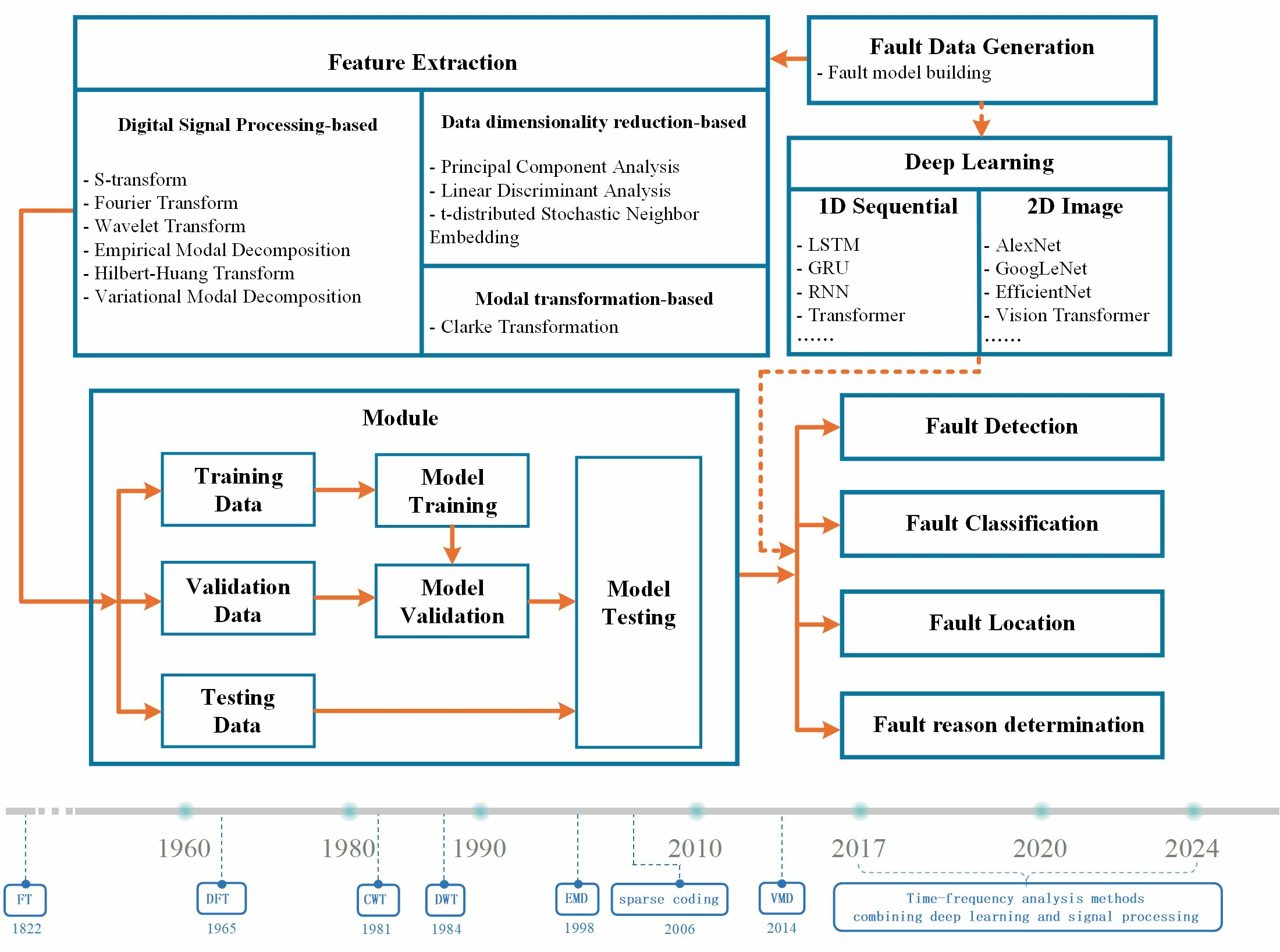
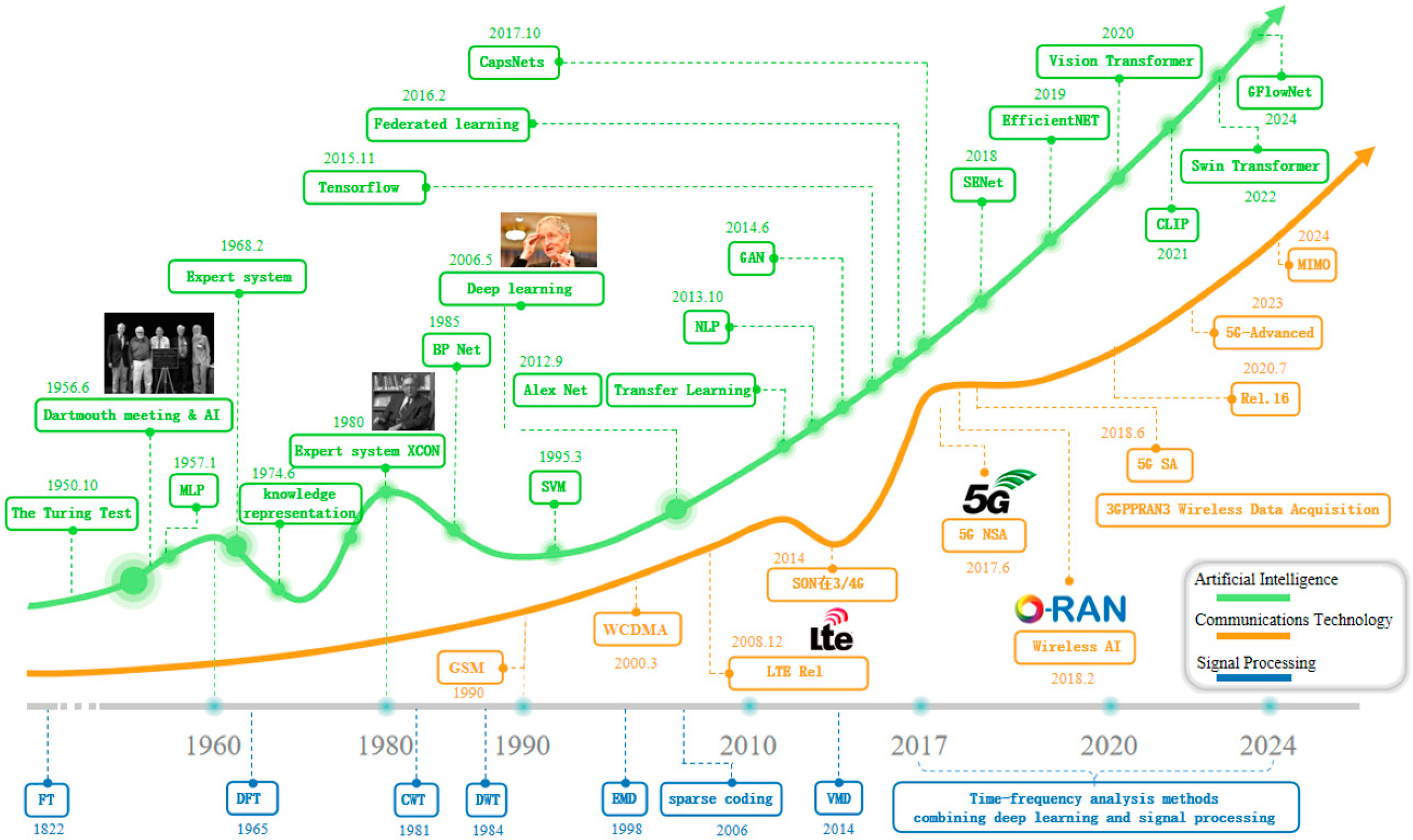
In recent years, the rapid development of communication, signal processing, and artificial intelligence technology have promoted both each other and the intelligent process of power system fault diagnosis technology, as shown in Figure 1. Among these, the rapid improvement of communication technology provides a solid data foundation for the comprehensive monitoring and fault diagnosis of power systems. For example, the widespread deployment of 5G networks has brought about a high-bandwidth, low-latency, and highly reliable communication platform, making real-time data transmission and processing possible. The development of technology around the internet of things (loT) has enabled the efficient collection and transmission of large amounts of sensor data [9]. In addition, advances in artificial intelligence technology have led to the widespread application of data-driven approaches in various fields. Since Hinton proposed the concept of deep learning in 2006 [10], AI has witnessed a transformative third wave. The classification and prediction performance of complex data has been significantly improved by automatic feature extraction and learning through multi-layer neural networks. With the continuous optimization of deep learning models such as convolutional neural networks (CNNs) and recurrent neural networks (RNNs), breakthroughs in power system fault diagnosis have also been achieved. In this process, signal processing techniques play a crucial role. Advanced signal processing methods such as variational modal decomposition (VMD) and empirical modal decomposition (EMD) can decompose complex power signals into multiple intrinsic modal functions, thus capturing the transient characteristics of the signals more effectively [11]. Combined with the application of deep learning models, these techniques provide more efficient and accurate power system fault diagnosis solutions.
Figure 1.
Communication, AI, and signal processing technology development routes.
The development of intelligent AI technology in distribution networks has concomitantly promoted the continuous progress of AI-based fault diagnosis methods for distribution networks, and many scholars have reviewed and analyzed the techniques in fault diagnosis for distribution networks in this context. For example, Rezapour et al. discussed, in detail, the advantages and disadvantages of artificial intelligence techniques such as neural networks, fuzzy logic, and reinforcement learning in fault localization and briefly analyzed the question of how to select appropriate fault localization methods according to the type of fault and the number of distributed power supplies [12]. However, there is less discussion in the literature about new AI techniques, such as deep learning and transfer learning, which have developed rapidly in recent years and cannot reflect the latest progress in AI techniques. Ref. [13] reviewed the commonly used techniques to locate and detect faults in distribution grids containing distributed power sources and focused on the working principles, advantages, and disadvantages of the existing traditional fault localization and AI techniques, but did not cover the analysis related to new types of faults brought by new energies. Ref. [14] focuses more on a comparison of fault classification algorithms in distribution grids but lacks an in-depth discussion of new faults in innovative grid environments. Ref. [15] focuses on fault detection, isolation, and service restoration processes in modern distribution grids. The limitation of this literature is that it fails to offer an in-depth analysis of the processing of the multi-source data present in modern distribution grids. Unlike previous studies, this paper reviews the combined application of signal processing techniques and AI algorithms in distribution network fault diagnosis, focuses on the synergistic effect of the two in fault diagnosis, and emphasizes the innovativeness and development potential of multi-source data fusion as well as the combination of signal processing and AI techniques.
In this paper, we review the application of AI techniques in fault diagnosis techniques for an electrical distribution network. The article is organized into six sections. The introduction section describes the challenges faced by traditional distribution network fault diagnosis methods and smart distribution network fault diagnosis, and proposes new solutions by developing AI techniques and signal processing technologies to cope with these challenges. Section 2 categorizes fault diagnosis tasks in electrical distribution networks according to the purpose of fault diagnosis and analyzes the differences between fault diagnosis tasks in traditional and smart distribution networks. Section 3 summarizes the feature extraction methods in power system fault diagnosis from the perspective of signal processing techniques by placing them into three categoriesβdigital signal processing, modal transformation, and data dimensionality reduction. Based on this, the applications of traditional artificial intelligence methods and shallow machine learning methods in power system fault diagnosis are introduced. Section 4 divides deep learning-based fault diagnosis methods into fault diagnosis methods that utilize 1D data and fault diagnosis methods that utilize 2D data from the perspective of data dimensionality. Section 5 compares the advantages and disadvantages of algorithms based on the fusion of shallow machine learning and deep learning for power system fault diagnosis applications. Section 6 summarizes the main conclusions of this paper.
2. Overview of Fault Diagnosis in an Electrical Distribution Network
2.1. Classification of Fault Diagnosis Tasks in an Electrical Distribution Network
Fault diagnosis tasks in the distribution network can be categorized according to different principles, such as fault types, diagnostic objectives, and system size. In this paper, according to the diagnostic objectives, the fault diagnosis tasks of the distribution network are divided into several key aspects, such as fault detection, fault classification, fault localization (faulty feeder identification, fault section location, fault position location), and fault reason determination.
- (1)
- The main task of fault detection is to identify abnormal operating conditions in the distribution network and to trigger the action of protection equipment. The detection method can either determine the fault threshold through mechanism analysis or consider the fault and normal operation as a binary classification problem and utilize classifiers to realize fault detection. The accuracy of detection directly affects the accuracy of the subsequent links. In addition, the speed of detection also directly affects the efficiency of the subsequent links. Some fault detection methods can complete fault detection within 2 ms, which greatly improves the efficiency of the entire fault diagnosis process [16].
- (2)
- Fault classification aims to identify fault types, such as short-circuit faults (line to line (LL), triple line (LLL)) and grounding faults [17] (line to ground (LG), double line to ground (LLG)), and the correct classification helps to select appropriate fault handling measures. Therefore, it is necessary to determine the phase of the fault to know whether it is a single phase-to-ground fault, a phase-to-phase fault, or a three-phase short-circuit fault.
- (3)
- Fault localization includes faulty feeder identification, fault section location, and fault position location, which sequentially realize the detection of the fault line, fault section, and the specific location of the fault, respectively. Fault localization is currently receiving the most attention from scholars, and the accuracy of localization determines the efficiency and cost of fault repair.
- (4)
- Fault reason determination is used to obtain the cause of the feeder failure in depth. Causes might include insulator flashover, feeder breakage and grounding, bird damage, etc. This provides clear guidance for the subsequent maintenance program and helps develop targeted preventive measures to reduce the recurrence of similar failures.
2.2. Fault Diagnosis Methods for an Electrical Distribution Network
Due to the limitations of device sampling rate and computational power, the early fault diagnosis of a traditional distribution network mainly focuses on fault detection tasks. Its fault diagnosis methods rely mainly on rules and electrical characterization, usually through the preset logic of the protection device and the electrical quantity measurement data, to identify the abnormal operation in the system. The commonly used methods include rule-based fault detection, waveform analysis, and transient analysis methods. These methods can effectively identify and respond to faults by analyzing changes in current and voltage waveforms, combined with information on circuit breaker operation and overcurrent or overvoltage protection.
Fault diagnosis methods for smart distribution networks combine data-driven smart technologies and distributed monitoring methods to meet the development needs of modernized and complex power systems. These methods exhibit greater adaptive capabilities in fault classification and fault localization. The system can automatically recognize fault patterns from historical data by employing shallow machine learning and deep learning techniques. Various techniques can achieve fault classification, including rule-based expert systems [18], shallow machine learning algorithms [19], and deep learning algorithms [20]. Shallow machine learning algorithms such as support vector machines (SVMs), decision trees, and random forests construct classification models by learning many fault data samples. Deep learning models, such as convolutional neural networks (CNNs) and long short-term memory networks (LSTMs), on the other hand, have more robust feature extraction and classification capabilities and are especially suitable for processing complex, high-dimensional fault data and can effectively handle large amounts of sensor data and multi-dimensional fault information. In addition, smart sensors and IoT technologies make real-time monitoring of the distribution network possible, supporting the accuracy and efficiency of fault localization tasks. As for the fault reason determination task, the novel AI approach extracts key features from massive operational data through big data analytics to help determine the root cause of a fault occurrence.
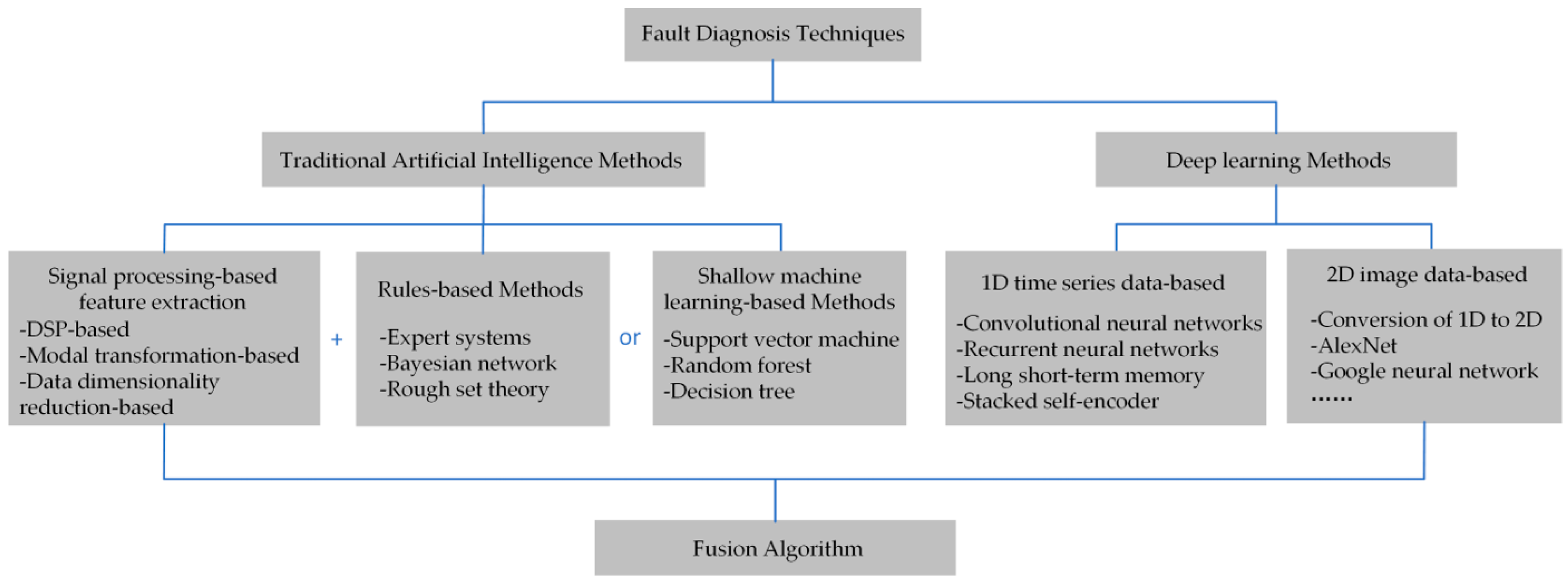
In this paper, AI-based fault diagnosis techniques for distribution networks are categorized according to the classification shown in Figure 2 into traditional AI methods and deep learning methods based on whether or not they require hand-designed features. Rule-based and shallow machine-learning-based AI are collectively called traditional AI methods. Traditional AI methods rely on manually designed feature extraction and rule-based models such as decision trees and support vector machines. These methods require manually selecting and processing features to help the model learn for classification. On the other hand, deep learning utilizes neural networks to automatically learn features from large amounts of data, avoiding human intervention. Deep learning models can automatically extract hierarchical features from raw data and thus usually show significant advantages when dealing with complex tasks.
Figure 2.
Structure of the article framework.
3. Fault Diagnosis Method for an Electrical Distribution Network Based on Traditional Artificial Intelligence Methods
3.1. Signal Processing-Based Fault Feature Extraction Methods
Affected by environmental factors and power electronics, the current and voltage signals obtained by the signal acquisition device are often mixed with a large amount of noise and irrelevant information. These interferences not only increase the complexity of signal processing but also directly affect the accuracy and reliability of fault diagnosis. Therefore, the preprocessing and feature extraction of fault signals become the first step in fault diagnosis, which is also a crucial link. The quality of feature extraction largely determines the accuracy of fault diagnosis results. There are various standard fault signal feature extraction methods and these can be divided into three categories: digital signal processing (DSP)-based feature extraction methods, modal transformation-based feature extraction methods, and data dimensionality reduction-based feature extraction methods.
3.1.1. DSP-Based Feature Extraction Methods
Currently, the signal processing and feature extraction methods commonly used in distribution network fault diagnoses include Fourier transform (FT), wavelet transform (WT), S transform, empirical modal decomposition (EMD), HilbertβHuang transform (HHT), and variational modal decomposition (VMD). The advantages and disadvantages of these signal-processing techniques are derived from their theoretical backgrounds and implementations.
The Fourier transform is a mathematical method to convert time series signals into frequency domain signals. It can reveal the frequency components in the signals and effectively process and analyze periodic oscillatory signals. Therefore, it is often used to process periodic or steady-state signals with relatively stable frequency components. However, the Fourier transform does not contain time information and only reflects the overall distribution of the frequency components. It cannot characterize the dynamic change of frequency over time, so it is unsuitable for dealing with non-stationary signals whose statistical characteristics change over time.
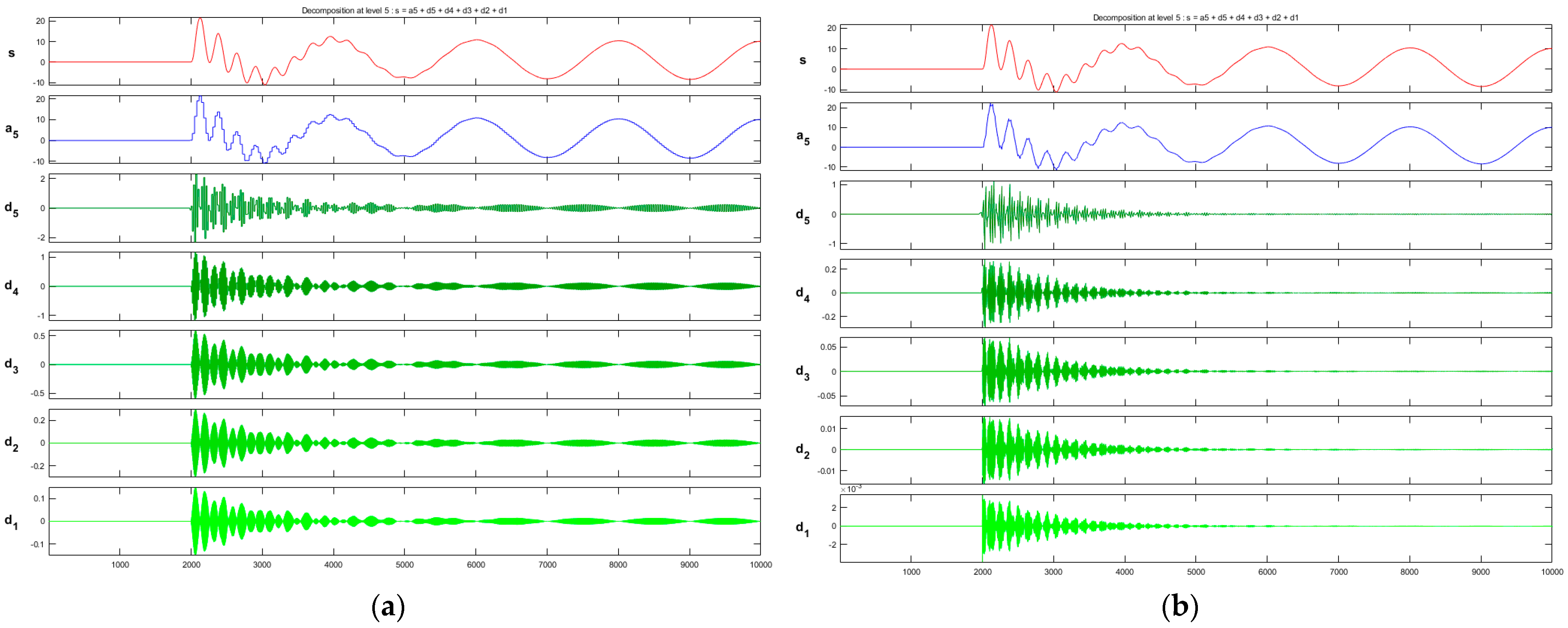
WT analyzes signals through a series of wavelet functions with different scales (frequencies) and positions (times), where high-frequency wavelet coefficients highlight the detailed features of signals and low-frequency wavelet coefficients portray the overall trend of signals. Compared with FT, WT is more suitable for dealing with non-stationary signals, especially in local mutation or anomaly detection, with significant advantages [21]. However, in the signal decomposition process, the WT must preset the appropriate wavelet basis function and the number of decomposition layers according to the actual needs. If not correctly preset, it may be unable to capture the critical information in the signal effectively. This is shown in Figure 3, where the horizontal axis shows the sample points and the vertical axis the amplitude in A. In the figure, s denotes the original current signal, a5 is the low-frequency approximation component obtained from wavelet decomposition, which indicates the overall trend of the signal, and d1βd5 is the high-frequency detail component obtained from wavelet decomposition. When the signal is decomposed using the haar wavelet and sym wavelet basis functions, the decomposition results show that the different wavelet basis functions significantly affect the analysis results. However, selecting appropriate wavelet basis functions usually depends on experience and specific application scenarios, and there is no uniform standard. In addition, compared with the Fourier transform, the wavelet transform has a higher computational complexity and requires more computational resources and time when dealing with large-scale data.
Figure 3.
Comparison of results of different wavelet basis functions for the same signal. (a) Decomposition results using haar wavelet basis functions; (b) decomposition results using sym wavelet basis functions.
The S transform combines the global properties of the FT and the local properties of the WT to become an effective tool for timeβfrequency analysis. It can provide detailed information on the frequency change over time without pre-setting the wavelet basis functions. However, due to the S transformβs high computational cost and strong dependence on the window function parameter, its applicability and efficiency in practical applications are usually not as good as those of the fast Fourier transform (FFT) or WT.
EMD is an adaptive analytical method suitable for nonlinear and unsmoothed signals. Instead of relying on predefined bases or window functions, EMD adaptively determines the frequency and time scales of the decomposition based on the data. This adaptivity gives EMD a unique advantage when analyzing complex signals but also suffers from limitations such as mode mixing and endpoint effects [22]. The HHT is a signal analysis method further developed based on EMD, one which provides a richer dimension of signal analysis and deeper timeβfrequency information by combining the Hilbert transform with the output of EMD. However, this method does not solve the modal aliasing problem induced by EMD but further affects the accuracy of timeβfrequency representations due to the accumulation of errors. VMD provides an important addition and improvement to EMD regarding methodology, and its objective function is shown in Equation (1). VMD effectively controls the phenomenon of modal aliasing by decomposing the signal into a preset number of band-limited modal components. However, the method relies on setting a preset parameter, i.e., the number of decomposition layers, K. If the value of K is too small, it may easily lead to modal aliasing, which is against the original design intention of VMD. At the same time, a too significant value of K may introduce unnecessary, redundant modes [23,24,25].
where uk is the kth modal function, wk is its corresponding center frequency, Ξ΄(t) is the dirichlet function, and K is the number of modes.
3.1.2. Feature Extraction Method Based on Modal Transformation
Clarke transformation is a mathematical method widely used in power systems to convert voltage and current signals in a three-phase coordinate system to signals in a two-phase stationary coordinate system, as given in Equation (2). This transformation simplifies the analysis and processing of three-phase signals. It plays a vital role in the fault diagnosis and data processing of new power systems where power electronics are widely used. The principle is to convert the voltages and currents in the three-phase coordinate system to the Ξ±Ξ² coordinate system through the Clarke transformation, where the Ξ± axis is in phase with the A phase voltages or currents while the Ξ² axis is in phase with the A phase with a difference of 120 degrees.
where ia, ib, and ic are the three-phase currents, iΞ±, and iΞ² are the quantities of the Ξ± and Ξ² axes obtained by the Clark transformation.
Ref. [26] proposed a line fault classification and detection method combining discrete wavelet transform (DWT) and back propagation (BP) neural networks, and the experimental results were found to show that the training data obtained by decoupling the three-phase currents using the Clarke transformation significantly reduces the mean-square error in the model training. Ref. [27] proposed a fault classification method based on WT and an artificial neural network, using Clarke transformation to obtain the Ξ±, Ξ², and zero components of the fault signal and extract the magnitude of the space vector from the Ξ± and Ξ² components, followed by WT to extract the energy features. Ref. [28] proposed two parallel schemes for fault phase detection and classification of radial distribution systems. Clarke extracts significant features of fault voltage signals to identify ground and unground faults successfully. The Clarke transform is mainly used as a data preprocessing tool in power system fault diagnosis. It is usually used with other techniques or algorithms to achieve specific diagnostic tasks. For example, when combined with the FT or WT, the transformed signal is subjected to spectral analysis to detect the frequency components of fault signals; when combined with model identification methods, the transformed signal is fitted to identify abnormalities in the power system; and when combined with machine learning algorithms, the transformed data are subjected to feature extraction and classification to realize fault diagnosis and prediction.
3.1.3. A Feature Extraction Method Based on Data Dimensionality Reduction
In power system fault diagnosis, dealing with massive data in multiple dimensions is often necessary. These data are usually mixed with noise and redundant information, which will increase the complexity and computational burden of the diagnostic process if such data are directly processed. Therefore, data dimensionality reduction techniques are widely used to extract features from high-dimensional data as the basis for fault detection and classification. Principal component analysis (PCA), linear discriminant analysis (LDA), and t-distributed stochastic neighbor embedding (t-SNE) are commonly used dimensionality reduction techniques and have significant application value in power system fault diagnosis.
Principal component analysis (PCA) is a linear dimensionality reduction technique that can project high-dimensional data into a low-dimensional space while retaining the main features of the data. This method of analysis simplifies data processing and analysis, effectively reducing computational volume and dimensional complexity. In power system fault diagnosis, PCA can extract the dataβs main features and group the data to distinguish different fault types [29,30]. In [31], the researchers first used the wavelet packet transform (WPT) technique to analyze the three-phase voltages and currents in the grid, extracted the wavelet packet energy entropy as the original feature parameters, and then used the dynamic principal component analysis (DPCA) technique to perform sensitivity analysis and dimensionality reduction of these feature parameters, thus highlighting the critical fault characteristics while reducing the complexity of data processing. Ref. [32] combines the SVM classifier with the PCA technique to process the extracted features and then implement the classification to differentiate the fault states.
t-SNE is a nonlinear dimensionality reduction technique that maps high-dimensional data into 2D or 3D space by maintaining the relative distance between the original data points while preserving the local structure and features of the data. In [33], researchers used the t-SNE technique for feature extraction. They input the extracted features into the RSLVQ classifier for fault detection and localization, which successfully overcame the problems of traditional protection in terms of response speed and over-reliance on high-end equipment, thus improving the reliability and response speed of the system. In addition to being directly used for the dimensionality reduction of fault signals, t-SNE can also be used for power data visualization to intuitively present the distribution and differences between different fault types, helping engineers better understand the fault mechanisms. Ref. [34], on the other hand, uses the t-SNE technique for visualization clustering and the clustering results to evaluate the networkβs performance and the modelβs effectiveness and prediction ability through the compactness and separation of the clusters.
LDA is a supervised learning-based dimensionality reduction technique that aims to find a projection surface that maximizes the inter-class distance and minimizes the intra-class distance [35]. In [36], researchers used the LDA technique for line fault feature extraction, which guarantees the algorithmβs detection accuracy and significantly reduces the time required for fault diagnosis. Ref. [37], on the other hand, eliminates redundant features in the fused features by LDA, thus improving the accuracy of transformer fault diagnosis.
In power system fault diagnosis, PCA and t-SNE are often used in combination with other techniques and algorithms, e.g., they can be combined with clustering algorithms to cluster the dimensionality-reduced data for fault diagnosis; they can be combined with deep learning algorithms to extract and classify features of the dimensionality-reduced data for fault diagnosis and prediction; and they can also be combined with time series analysis and predictive algorithms to predict and warn the data after dimensionality reduction to improve the reliability and safety of the system.
3.2. Fault Diagnosis Method for Electrical Distribution Network Based on Rules
Currently commonly used fault diagnosis methods include expert systems (ES), fuzzy logic (FL), rough set (RS), Bayesian networks, Petri nets, and data-driven analysis methods. When the data collected by the SCADA system have a high degree of accuracy and completeness, these methods can usually allow for a more accurate judgment of power system faults. However, rule-based methods, such as diagnostic methods based on ES, Bayesian networks, and FL, show significant advantages in the case of missing fault information, incorrect information from mis-activation or refusal of circuit breakers or relay protection devices, or large-scale faults that make it difficult to obtain complete fault information.
3.2.1. Fault Diagnosis Methods Based on Expert System
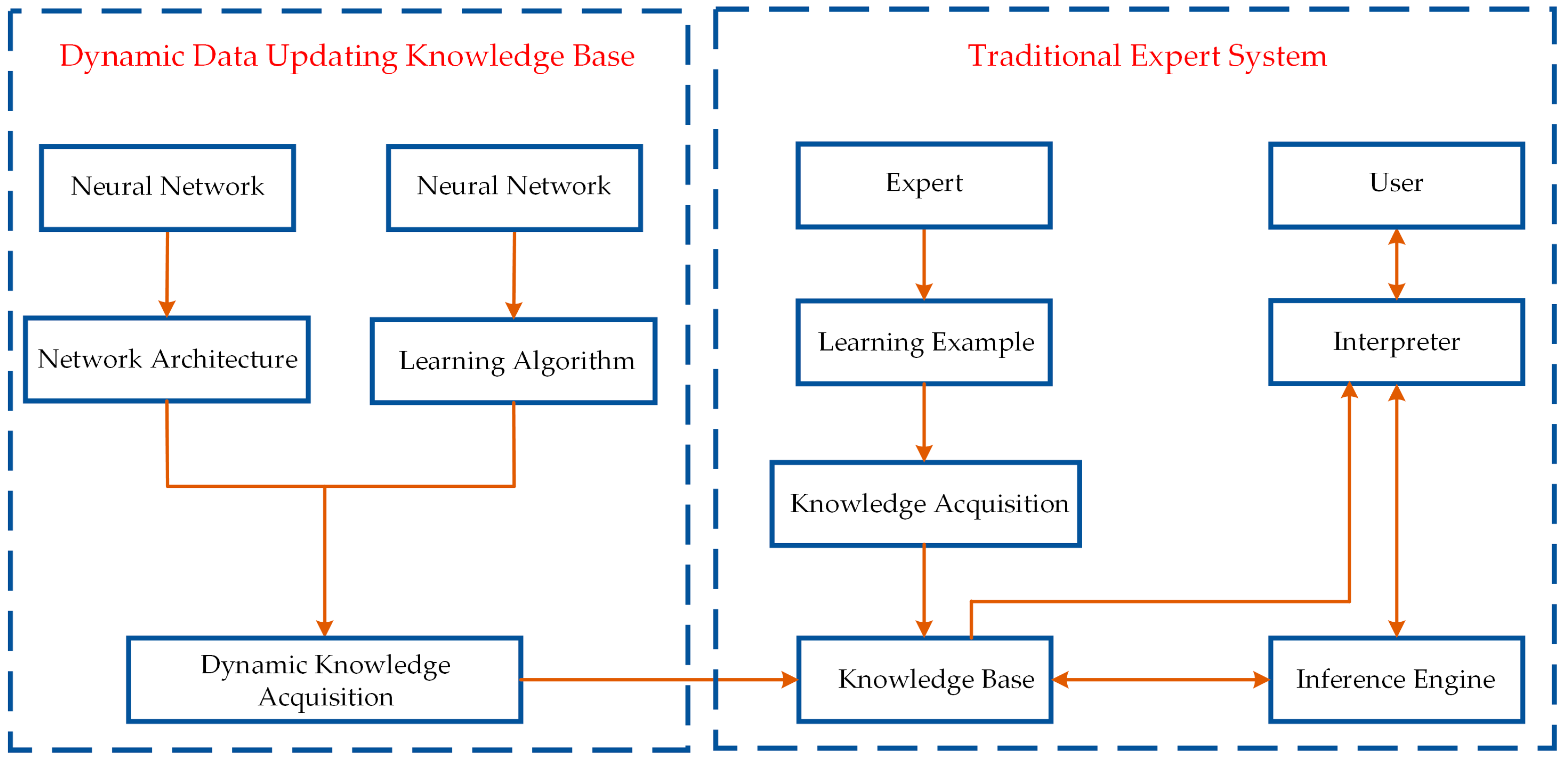
Expert system, a knowledge-based system, is one of the earliest artificial intelligence techniques applied to power system fault diagnosis. Its core architecture usually consists of three main components: a knowledge base, a database, and a reasoner [38], and the interrelationship among the three is shown in Figure 4.
Figure 4.
Schematic diagram of automatic database updating architecture of a traditional expert system combined with an artificial intelligence algorithm.
The concept of ES has been widely recognized since the 1970s, and the exploration of its application to power system fault diagnosis started in the early 1980s. Refs. [39,40,41,42] analyzed faults and operational problems in power systems by constructing a reasoning system containing a rich database of rules and facts, effectively simulating the decision-making process of power system experts, thus significantly improving the efficiency and accuracy of fault diagnosis.
Aiming at the problem that traditional power system fault diagnosis methods are often limited by incomplete fault data and processing delay, Ma D et al. proposed an expert system based on a multilevel BP neural network for power system fault diagnosis [43]. The system fully utilizes the advantages of expert systems in dealing with uncertain information, especially in coping with data incompleteness, which is common in power systems. Compared with traditional specialist systems, this system not only optimizes the performance of the diagnostic model by integrating multiple BP networks but also learns historical data autonomously and dynamically updates the expert library, thus reducing the model construction and maintenance costs. Amaya et al. introduced hierarchical meta-rules to cope with the complex and changing power system fault diagnosis scenarios [44]. Introducing a multi-layer rule framework based on the traditional rule system allows the system to handle typical and simple faults at the first layer. For more complex scenarios, the system will undertake an in-depth, layer-by-layer analysis until a solution is found. This approach enhances the flexibility and adaptability of the expert system, enabling it to dynamically adjust the application of inference rules according to different fault scenarios, thus effectively responding to complex or unconventional faults. In addition, to comprehensively assessing transformersβ health status and improving fault diagnosis accuracy, Xu et al. proposed an expert system based on multidimensional data fusion technology [45]. The system combines information integration and processing capabilities, calculates the fusion coefficients between fault characteristics by factor analysis, and considers the complex interactions between different data types. The system integrates multiple data streams, such as online monitoring data, operating conditions, and geographic information. It transforms them into a knowledge base available to the expert system, thus improving the accuracy and speed of diagnosis.
Expert systems express the subjective experience of experts through rules, and their knowledge base cannot be automatically updated. Although the knowledge base, consisting of protection devices and circuit breaker action logic, is highly interpretable, the knowledge acquisition process is complex and the realization of automatic updating is challenging. When a fault occurs, the inference engine will match the fault information with all the rules in the knowledge base one by one in order to determine the faulty component. This rule-based fault diagnosis system shows strong reasoning when dealing with deterministic information. The system is more effective in diagnosing within the coverage of the knowledge base, and the diagnostic results have good interpretability. However, with the complexity of the model structure and the increasing number of rules, the reasoning speed of the inference engine will be slowed down as a result, thus affecting the diagnostic efficiency. To overcome the above defects, many expert systems have begun to combine with other algorithms to form various combinations, commonly including fuzzy expert systems and artificial neural network expert systems. Among these, the artificial neural network-based diagnosis method overcomes the limitations of traditional expert systems regarding knowledge base construction and inference mechanisms through sample training. It thus improves the automation and flexibility of fault diagnosis.
3.2.2. Fault Diagnosis Methods Based on Bayesian Network
Bayesian networks, also known as belief networks or directed acyclic graph models, were first proposed by Turing Award winner Judea Pearl in 1986 to describe uncertain information [46]. Bayesian networks express knowledge graphically and use conditional probabilities to represent the probability of interactions between random variables. They are, therefore, well suited to deal with the problem of expressing and reasoning about uncertain knowledge and are more tolerant of strange information (e.g., missing or incorrect information). A Bayesian network consists of a series of nodes and edges, where the nodes represent random variables and the edges represent dependencies between variables. In a Bayesian network, the nodes can be described by probability distributions, while the arrows represent conditional dependencies. Each node is connected to its parent node through an edge, indicating that the value of that node depends on the value of its parent node.
Bayesian networks are often used for load forecasting in power systems [47,48,49,50] and can also be used to build power system fault diagnosis models. The power system fault diagnosis method based on the traditional Bayesian network mainly includes three steps: first, based on expert analysis and experimental validation, the variables that are highly relevant to power system fault diagnosis and can provide sufficient information are selected as the nodes of the Bayesian network. Then, the conditional probability table is created according to the conditional dependency relationship between the nodes and the structure of the Bayesian network that is being constructed. Finally, the collected on-site fault data information is fed into the trained Bayesian network, and the most likely cause of the fault is determined by the probability distribution results [51]. Some core challenges exist in applying Bayesian algorithms, especially in Bayesian fault diagnosis models for component-oriented modeling. First, obtaining sufficient statistical samples for complex systems is often difficult, making it difficult to obtain accurate prior probabilities, directly affecting the model inferenceβs accuracy and reliability. Second, the structure of traditional Bayesian networks is relatively fixed, and the connections between nodes may not be reasonable enough, limiting the ability of the model to express the dynamics of complex systems. In addition, the computational process of Bayesian networks is also highly dependent on the protection nodes, making the information processing and updating complex and inefficient. Finally, a vital issue to be addressed in current Bayesian models is the question of how to effectively fuse different information sources to enhance the modelβs ability to describe and predict complex phenomena.
Koraz Y et al. combined a Bayesian network with an adaptive neuro-fuzzy inference system [52]. They utilized the Bayesian network to deal with the uncertainty and incomplete information in the fault data of the power system, which improved the systemβs adaptability. Refs. [53,54], on the other hand, combine traditional Bayesian networks with Noisy-OR and Noisy-AND nodes to construct object-oriented Bayesian network models. The model in [53] designs specialized Bayesian networks for different fault scenarios, uses Noisy-OR and Noisy-AND nodes to deal with specific protective relay and circuit breaker operations, and expresses the cause and effect of faults through a small number of conditional probability tables, which reduces the storage requirements and improves the processing speed. In contrast, the model in [54] emphasizes the combination of fault diagnosis with the specific states of protection devices and circuit breakers and constructs a network based on the a priori knowledge of domain experts, which enhances the generality and adaptability of the model in dealing with the uncertainty and complexity in power system fault diagnosis.
3.2.3. Fault Diagnosis Methods Based on Rough Set Theory
Rough set theory was proposed by Polish mathematician Pawlak in 1982. It has gradually been demonstrated to have an essential role in power system fault diagnosis because it effectively deals with incomplete and uncertain information. The core idea of the theory is to describe the uncertainty of fault information through the boundary region of lower and upper approximation, which provides an effective method for analyzing and reasoning about the implicit knowledge in fault data without relying on any a priori knowledge or external information sources.
Although the research on RST in power system fault diagnosis started relatively late, the number of related studies has gradually increased since 1997, when Brazilian scholar Lambert published the first article applying RST to the field of power systems, relying on [44]. Ref. [55] proposed a new method for grid fault diagnosis based on incomplete alarm information using RST, aiming at the challenge of uncertainty information of fault types in distribution network fault diagnosis. The method first takes the signals of relay protection devices and circuit breakers as the set of conditional attributes for fault classification, builds a decision table based on various possible single fault scenarios, and subsequently searches the decision table by simplifying and approximating it to extract diagnostic rules. This method can effectively distinguish between critical and non-critical signals, and the system can still make correct fault diagnoses when the lost or erroneous signals are non-critical signals. However, as fault scenarios become more complex, the size of the decision table may expand rapidly, and the problem of βcombinatorial explosionβ may even occur. In addition, when critical information is missing, the accuracy of the diagnosis decreases dramatically.
This section introduces the power system fault diagnosis scheme based on traditional intelligent methods, detailed in Table 1. To help readers understand the basic principles of these methods faster, the previous section simplifies the related formulas and explains the core ideas in laypersonβs terms. Most distribution network fault diagnosis research has concentrated on medium- and low-voltage distribution networks. Studies have shown that combining multiple diagnostic methods can significantly improve the accuracy and reliability of fault diagnosis in a distribution network. This is because it is often difficult for a single method to capture fault characteristics comprehensively. In contrast, combining multiple methods can compensate for their deficiencies, thus realizing more accurate fault detection and diagnosis. However, traditional AI methods have some limitations in dealing with the complexity of a smart distribution network. With the continuous development of AI and communication technologies, fault diagnosis methods are gradually evolving towards machine learning to cope with the increasingly complex fault diagnosis challenges.
Table 1.
Fault diagnosis (fault detection, fault classification, fault localization, fault reason determination) based on feature extraction and traditional AI methods.
3.3. Fault Diagnosis Method for Electrical Distribution Network Based on Shallow Machine Learning Methods
Shallow machine learning-based fault diagnosis methods for power systems are usually divided into two main phases: fault feature extraction and classifier training, as shown in Figure 5.
Figure 5.
Flowchart of the practical application of machine learning algorithms for fault detection, classification, and localization in power systems.
The accuracy of the subsequent classification can be significantly improved by characterizing the signal in the time and frequency domains and combining domain knowledge for feature selection. The core of feature extraction lies in distilling key features from power system data that can effectively characterize faults, with the aim of providing high-quality inputs for machine learning algorithms in order to understand and distinguish between different types of faults more accurately. Based on these extracted features, appropriate shallow machine learning algorithms are selected to build classification models that can accurately recognize faults.
Traditional intelligent methods such as expert systems and Bayesian networks have unique advantages in terms of explanatory ability and transparency of decision logic [70,71]. With this advantage, such methods have been widely used in many areas of fault diagnosis, such as fault diagnosis in nuclear power plants [72], satellite anomaly detection [73], fault diagnosis in electric servo mechanisms [74], and other areas, and significant research progress has been made. However, with the advancement of technology and the increase of data volume, shallow machine learning algorithms (e.g., support vector machine, random forest, decision tree, etc.) have gradually replaced traditional methods as essential tools in the field of power system fault diagnosis and decision analysis due to their strong generalization ability and adaptivity.
A support vector machine (SVM) is a supervised learning algorithm for classification and regression and is mainly applied to solve binary classification problems. Its core idea is to find an optimal hyperplane in the feature space to divide the dataset into two categories and maximize the interval between the data points of the two categories. The training dataset is assumed to be where the input features and the category labels are. The optimization objective of an SVM is to find a hyperplane that satisfies Equation (3). For the linearly indivisible case, SVM introduces a kernel function that maps the original data to a high-dimensional feature space, thus being able to find a linearly divisible hyperplane in the high-dimensional space. Commonly used kernel functions include linear kernel function, polynomial kernel function, Gaussian kernel function, etc.
where w and b are the parameters defining the hyperplane, xi denotes the feature vector of the input sample, and yi represents the sampleβs label.
A decision tree is a tree-structured model used for classification and regression tasks. The basic idea is to divide the dataset by calculating the information gained to realize the classification and prediction of data. The information gain measures the change in uncertainty of the datasetβs information before and after the division. It is usually used to select the optimal splitting attribute, calculated as shown in Equation (4).
where Entropy(D) (Equation (5)) denotes the classification uncertainty, |Dv| refers to the number of subsets of samples that take the value of v in feature A, and |D| refers to the number of samples in dataset D.
where k denotes the number of classes in the dataset and pk denotes the proportion of the kth class of samples in the dataset.
Random forest is an integrated learning algorithm based on decision trees, which improves the stability and accuracy of the model by constructing multiple decision trees and combining the prediction results of each tree. Each decision tree makes independent predictions based on Equation (6), and the final model output usually combines the prediction results of each tree by majority voting or averaging to obtain a more robust conclusion.
where T is the number of decision trees, and ft(x) is the decision treeβs prediction result.
Support vector machines (SVMs) have significant advantages in processing high-dimensional spatial data and finding optimal segmentation hyperplanes [75,76,77,78]. Ref. [79] applied an SVM to electrical fault classification in radial distribution network. Here, the author proposed a particle swarm optimization (PSO)-based support vector machine classifier, which successfully identified ten types of short-circuit faults in a radial distribution network. Ref. [80] proposed an SVM-based microgrid protection scheme to achieve fault classification and fault section location by training classifiers for grid-connected and islanded operation modes, respectively. Random forest (RF), as an integrated learning method, effectively improves the performance of the classification task by combining the prediction results of multiple decision trees [81]. Ref. [76] realized feature extraction by performing a wavelet transform on current and voltage data to address the difficulty of fault localization in distribution networks due to complex line structures and high impedance faults. The author used random forest to perform classification and regression analyses to determine the fault segments and specific locations. A decision tree (DT) is an intuitive machine-learning method commonly used in power system fault diagnosis. DT realizes fault category judgment by gradually dividing the fault data set and making decisions at each node. Ref. [82] proposed a discrete wavelet transform and rule-based decision tree method for fault line detection and classification. The technique accurately detects and classifies different types of faults in transmission lines by multilevel wavelet decomposition of current signals and calculation of fault indices. With the introduction of distributed power sources, the operation and control of power systems have become more complex, which brings new challenges to fault identification. To cope with this challenge, a fault classification method based on the combination of SVM and decision tree was proposed in [83]. The process extracts the critical information of fault signals through discrete cosine transform, which effectively improves the recognition accuracy of the detection model for two-phase ground faults in microgrids.
In addition to the impact of the AI algorithms themselves on the diagnostic effectiveness of fault diagnostic models for distribution networks, the reliability of measurement equipment under extreme weather conditions is an issue that needs to be emphasized, including the impacts of magnetic storms, temperature and humidity, and wind variations on the operation of networks and measurement equipment [84]. It has been found that geomagnetic disturbances due to magnetic storms can affect the normal operation of transformers, distribution equipment, and measurement instruments, especially by inducing currents that threaten the grid equipmentβs safety [85]. In addition, ambient temperature and humidity changes can negatively affect the accuracy and responsiveness of sensors and measurement equipment. Especially in extreme climatic conditions, drastic changes in temperature and humidity make equipment performance unpredictable, which poses a challenge to the reliability of power systems [86]. However, extreme weather conditions have not been adequately considered in existing studies related to shallow machine learning-based fault diagnosis in distribution networks. This is shown in Table 2, where most of these studies are found to focus on tasks such as fault detection, classification, and localization but do not incorporate the effects of external environmental changes on equipment into fault diagnosis models.
Table 2.
Power system fault diagnosis (fault detection, fault classification, fault localization, fault reason determination) based on feature extraction and shallow machine learning.
4. Fault Diagnosis Method for an Electrical Distribution Network Based on Deep Learning Methods
In AI-based power system fault diagnosis techniques, the main difference between shallow machine learning and deep learning is the way the features of fault information are acquired. Shallow machine learning relies on manually designed features, i.e., users must manually extract features based on experience. On the other hand, deep learning can autonomously learn advanced features from data and automatically create new features without relying on manual expertise. This avoids accuracy errors due to poor design or subjective factors.
Deep learning-based power system fault diagnosis can fully utilize large-scale data in power systems. In power system fault diagnosis, data can be categorized into 1D raw sequences and into 2D sequences obtained by signal processing according to their structure and usage. One-dimensional sequence data are usually measured values such as voltage and current collected along the time axis, which are simple in form and easy to collect and analyze initially. On the other hand, 2D data are converted from 1D data by mapping, such as by converting time series data into image format. The introduction of 2D data aims to utilize modern deep learning techniques, especially image processing techniques, to improve the accuracy of power system fault diagnosis.
4.1. Fault Diagnosis Method Based on Deep Learning and 1D Data
Shallow machine learning techniques usually focus only on the features of the currently specified data, while deep learning techniques have the advantage of constructing spatiotemporal relationships between data [96]. Standard deep learning techniques include convolutional neural networks (CNNs), recurrent neural networks (RNNs), long short-term memory (LSTM), stacked self-encoders (SAEs), etc. CNN processes sequentially process data through sliding convolutional filters and offer local solid feature extraction capability [97,98]. LSTM was first proposed by Hutcher et al. [99], which is good at capturing long-term dependencies in time series and is widely used in time series modeling and forecasting [100,101,102]. Some studies have combined CNN with LSTM to deal with power fault data with both spatial and temporal features. On the other hand, SAE is commonly used for data compression and feature extraction, which helps identify anomalous patterns in sequence data [103]. Ref. [104] used CNN for the automatic feature extraction of voltage dips in order to achieve the classification of voltage dips and multiple power quality disturbances. Ref. [101] used LSTM to model spatiotemporal sequences of high-dimensional multivariate features and constructed three models for fault detection, classification, and location. Ref. [99] proposed a transmission line fault classification method based on LSTM combined with corrective training filters and tested it on a 300 km-long double-bus single-line test system. Ref. [105] constructed a hybrid model for line fault classification and location identification by adding an LSTM layer before the fully connected layer of CNN to alleviate the overfitting phenomenon of CNN when processing high-dimensional data. Ref. [96] used a stacked self-encoder (SAE) to solve the local optimum and gradient diffusion problems in traditional neural networks, providing new ideas and methods for power system fault diagnosis.
The 1D time series data method based on deep learning has made significant progress in power system fault diagnosis, effectively filling the technical gap of the traditional model-driven method, which cannot deal with massive data, and thus marking the critical transition from model-driven to data-driven methods. Data-driven methods optimize the power system fault diagnosis process, improve the detection accuracy, and reduce the dependence on traditional models. However, 1D time series data essentially comprise a linear sequence of time points, which makes it challenging to capture multidimensional correlations and complex dynamic interactions among the data. In power systems, faults involve the interaction of multiple variables, and these complex relationships are often challenging to recognize accurately with 1D time series data. In addition, when the signal is weak or the data are interfered with by noise, it is often difficult to distinguish the noise from the actual signal in 1D time series analysis methods, affecting the accuracy and reliability of diagnosis. Therefore, the 1D time series method still has certain limitations in dealing with complex patterns and weak signals.
4.2. Fault Diagnosis Method Based on Deep Learning and 2D Data
The rapid development of deep learning in image processing has brought new tools and methods for power system fault diagnosis. To fully utilize the advantages of deep learning in 2D data analysis, researchers have explored the conversion technology of 1D time series data to 2D image data. This conversion not only enriches the data representation but also enables the analysis of time series data with the help of mature algorithms in the field of image recognition, which improves the interpretability of the model and the accuracy of diagnosis.
The conversion of 1D time series data to 2D image data is an innovative data processing method that can analyze data that initially belonged to the time series category using image processing techniques. This approach avoids the sample length limitation and ensures no signal information is lost. Researchers have developed a variety of transformation techniques to achieve this goal. For example, the method of generating timeβfrequency diagrams can present the signalβs time and frequency information, which is suitable for analyzing the dynamic characteristics of non-stationary signals. The reconstructed image method rearranges the time series data points into a 2D matrix according to a specific logic, reflecting the dataβs dynamic changes and periodic characteristics. The Gramian angular field (GAF), on the other hand, generates images by calculating the relative angles between data points and is particularly suitable for application scenarios in which changes in angles have an essential effect on the state of the system.
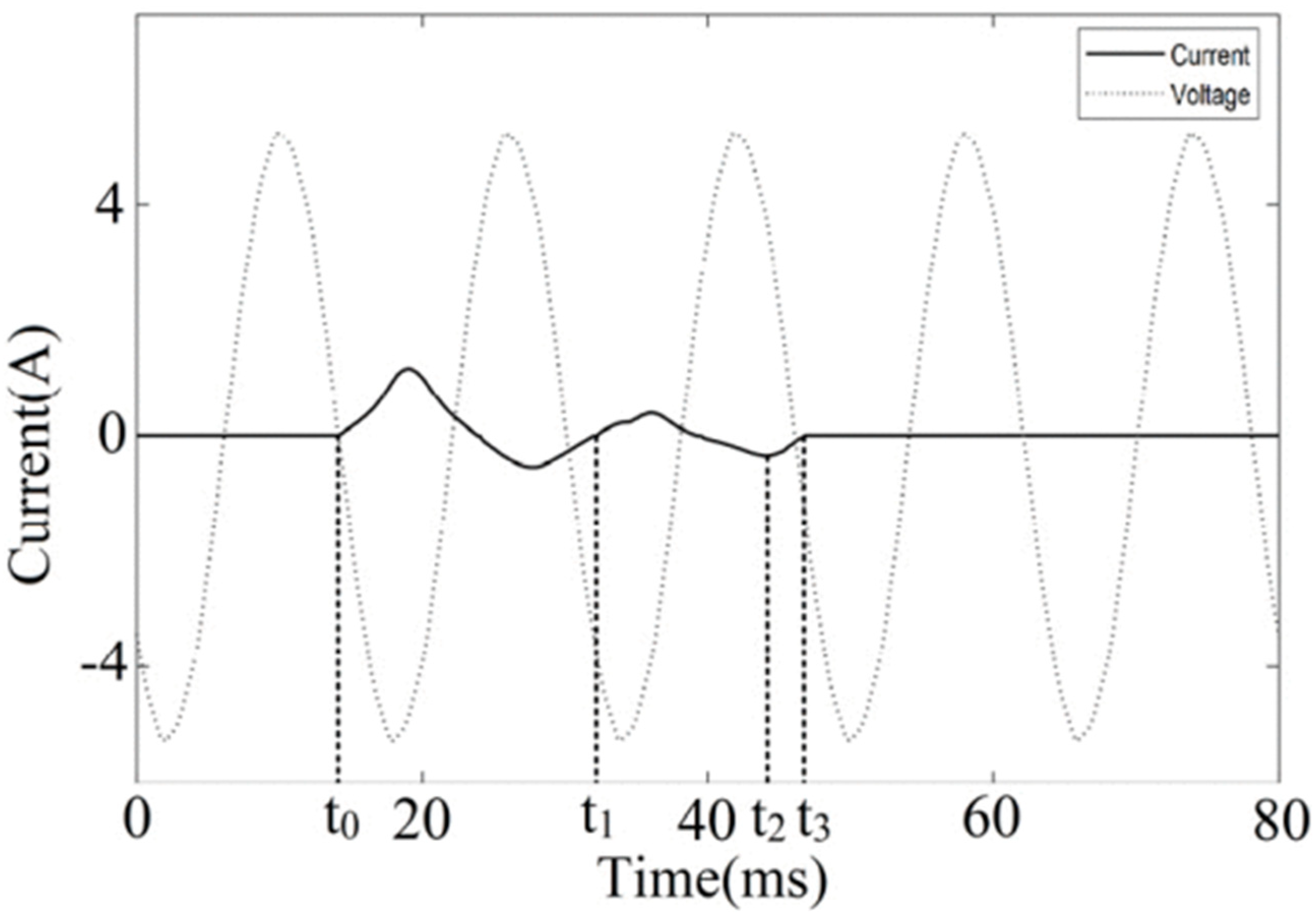
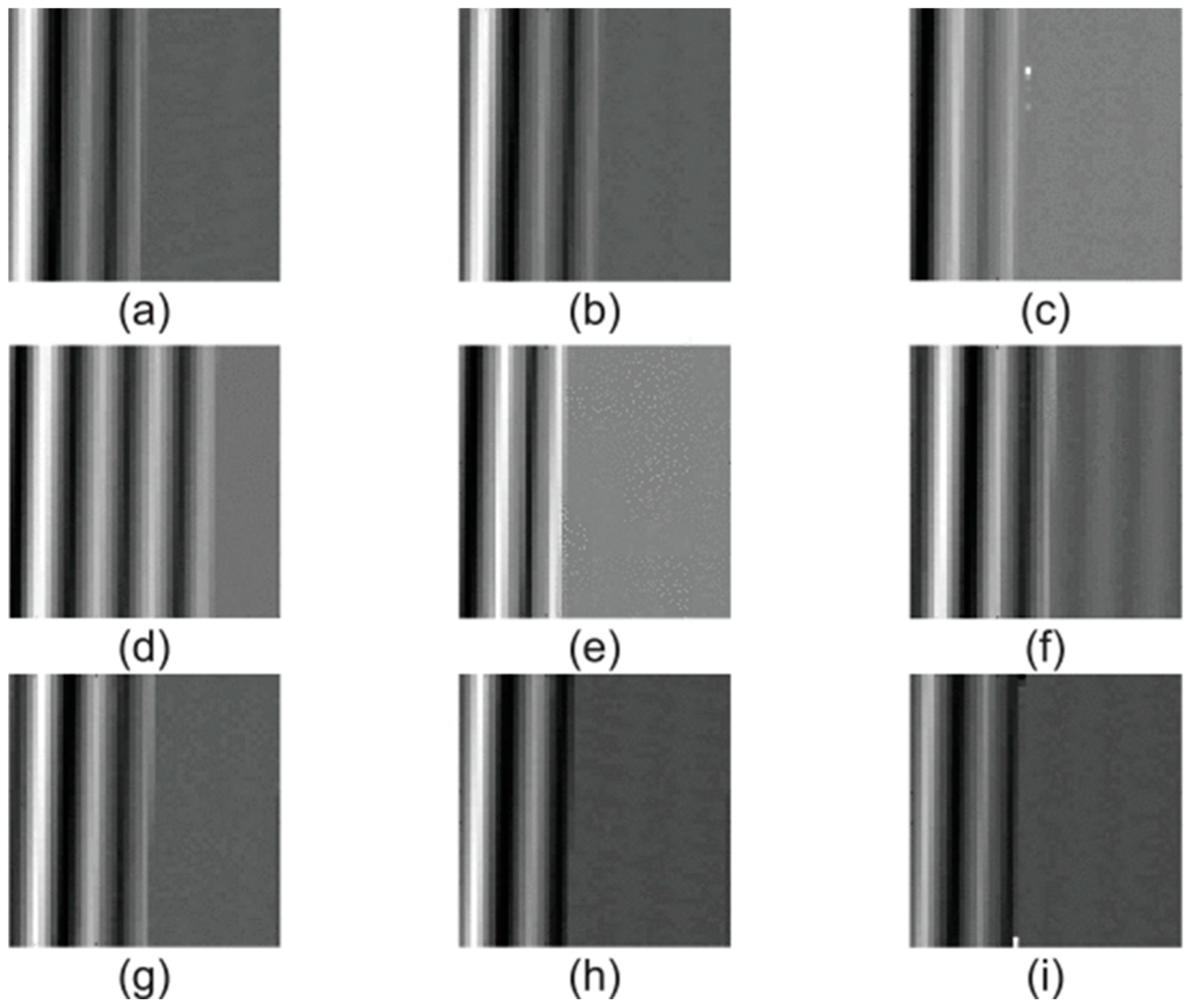
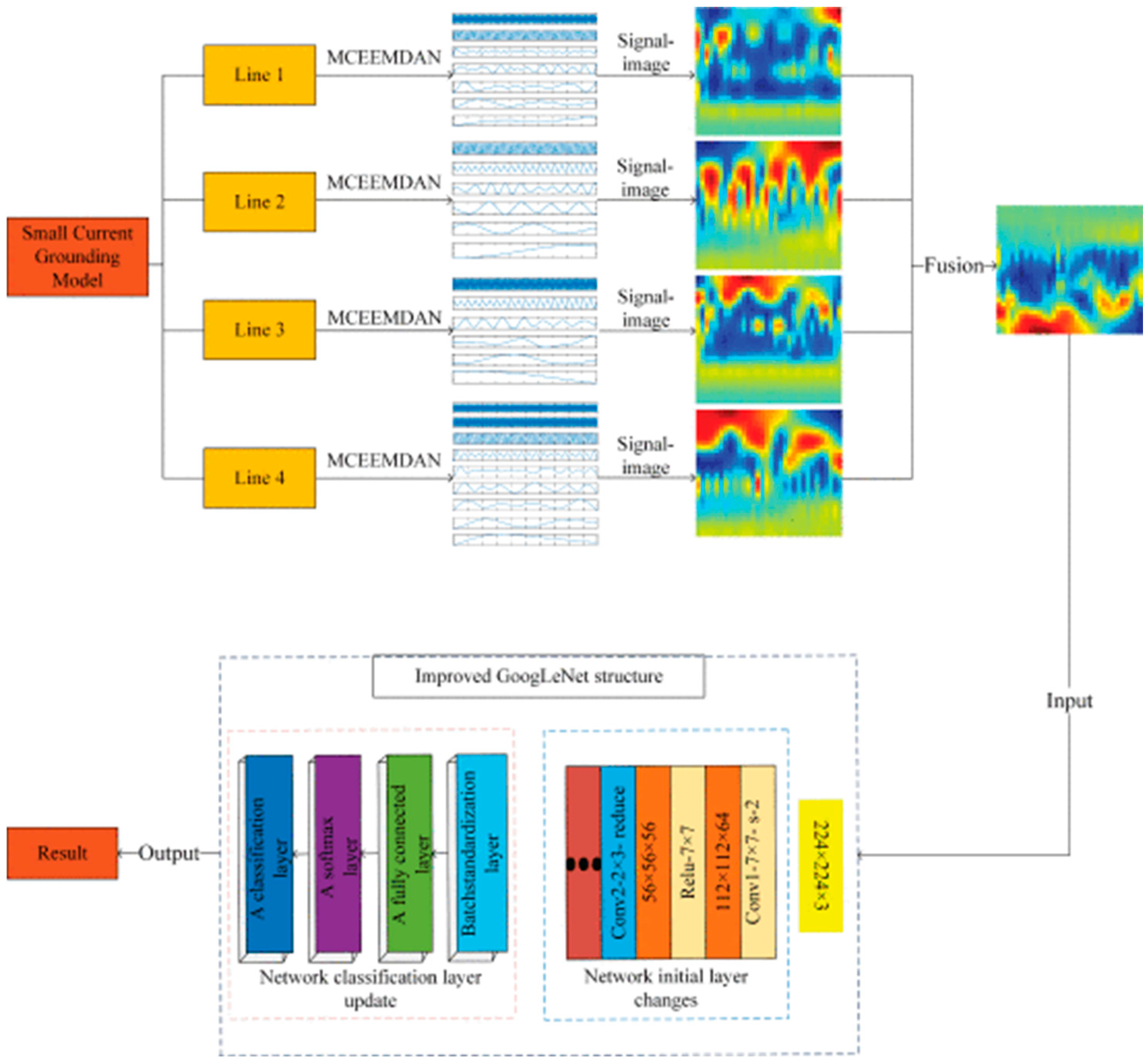
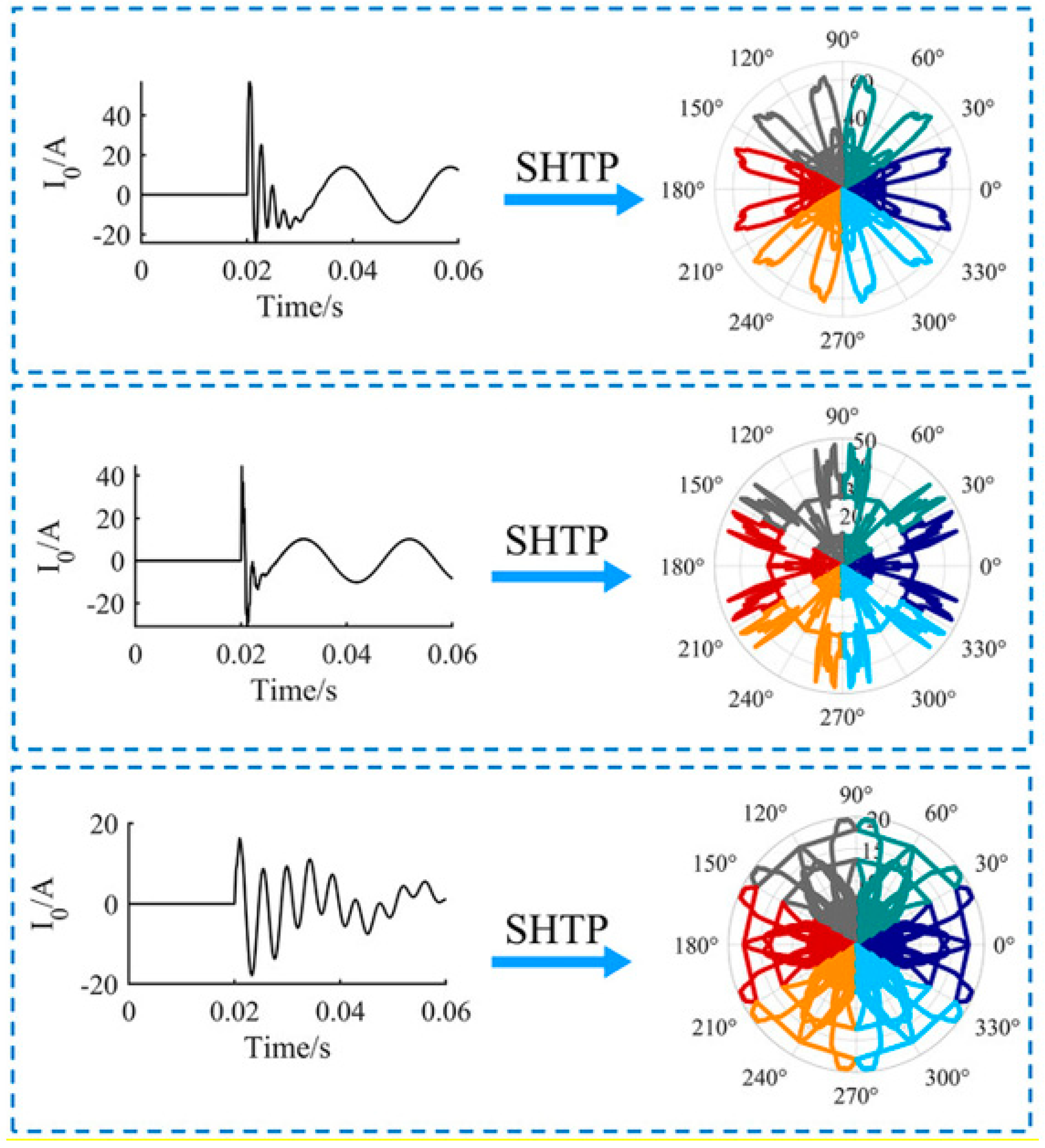
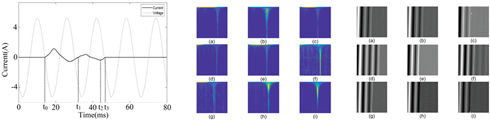
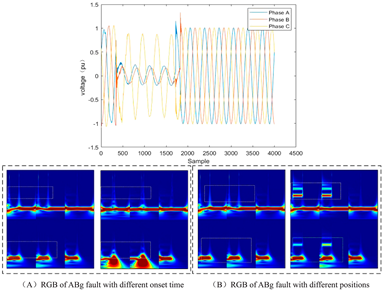
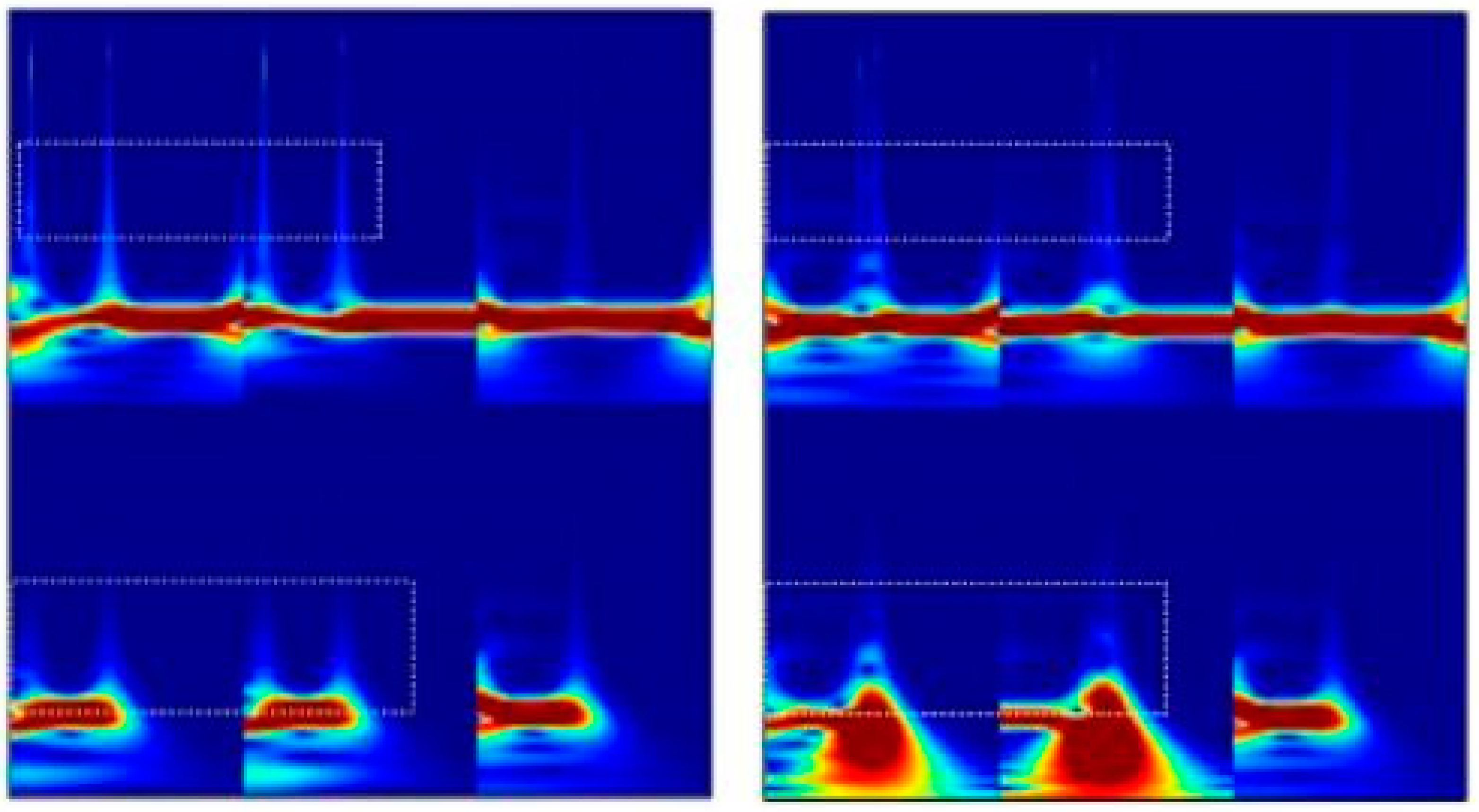
Ref. [106] compared the effects of two data transformation methods, wavelet transform and signal superposition, on the training effect of grid fault classification models. The researcher used wavelet transform and signal superposition methods to process the signal into timeβfrequency images and 2D grayscale images (as shown in Figure A1, Figure A2 and Figure A3) and fed the obtained datasets into the AlexNet network for model training. The average fault recognition rates obtained were 80.31% and 92.87%, respectively. The results show that the distribution of features after timeβfrequency processing is more concentrated, which increases the difficulty of image recognition. Ref. [107] proposed a distribution network faulty feeder identification method based on improved CEEMDAN and convolutional neural networks. The method first decomposes the zero-sequence current signal into a series of intrinsic modal functions by the improved MCEEMDAN. The method maps the sampled values to a gray interval of 0β255 to obtain a grayscale image. Then, a pseudo-color-coding method converts the grayscale image into an RGB image with three channels (as shown in Figure A4). Finally, the RGB images obtained from the zero-sequence currents of different lines are fused by pixel-weighted averaging fusion to form the dataset used for model training and are fed into the Google neural network, which ultimately obtains up to 99.33% accuracy in line selection. Ref. [108] utilized the HilbertβYellow transform to construct the timeβfrequency energy matrix (as shown in Figure A5 and Figure A6). It used this matrix as the pixel matrix of the digital image to classify faults using the image similarity recognition method based on convolutional neural networks to verify its accuracy and adaptability. Ref. [109] used continuous wavelet transform to encode three-phase voltage and current signals as timeβfrequency images (as shown in Figure A7 and Figure A8) and introduced the SA module in MobileNetV3 to capture feature dependencies in spatial and channel dimensions to improve fault classification accuracy. Ref. [110], on the other hand, mapped zero-sequence currents into colorful wreath images via symmetric Hilbert transform (as shown in Figure A9), compared the detection results of five deep learning models and four kernel functions, including AlexNet, VGG16, and ResNet50, and proposed that ResNet50-SVM-Polynomial is the optimal fault diagnosis model in this scenario. Methods that directly extract features from 1D data often fail to effectively express the interrelationships between data corresponding to different points in time, and methods that encode 1D data into 2D images to extract features may also lose part of the information due to differences in encoding methods. Aiming at the above problems, [111] proposes a fault classification model that integrates 1D time-series data and 2D image data, fusing 1D time series features extracted based on convolutional neural network and 2D image features extracted based on Gramian angle field and other coding methods through weight settings, and finally obtaining an accuracy improvement of 3.35%. The results corresponding to the conversion methods mentioned in [106,107,108,109,110] are shown in Table 3.
Table 3.
Comparison of results of different signal conversion methods.
The conversion from 1D time series data to 2D data is not only a simple transformation of the data format but also an expansion of the depth and breadth of the data processing capability. Through this mapping, the signal can show more hidden information about itself in two-dimensional space, thus enhancing the overall performance of the power system fault diagnosis. However, standardized conversion method evaluation indexes applicable to different scenarios have not yet been formed. Overall, the conversion effect is mainly evaluated by relying on the detection accuracy of the model, and there is a lack of authoritative and compelling indicators by which to measure the effectiveness of the conversion method itself. This limitation makes the signal conversion process lack theoretical guidance and increases the blindness of method selection. There are various sources of measurement data in distribution networks, and factors such as differences in data dimensions and types, different sensor models, and extreme environments all impact the fault diagnosis effect of distribution networks. Related research has proposed multi-sensor fusion technology to fully explore the information of various types of measurement data. The technology applied in the distribution network should mainly include real-time monitoring, fault diagnosis, load forecasting, and so on [112]. The system can provide a more accurate analysis of grid operation status by fusing data from different sensors, such as temperature sensors, meteorological data, current sensors, and equipment health status monitoring, thus improving the gridβs adaptability to environmental changes.
5. Fault Diagnosis Method for an Electrical Distribution Network Based on Fusion Algorithm
Deep learning methods are widely used in power system fault diagnosis because of their powerful feature extraction capability. Nevertheless, model training often requires a large amount of data and a long training time, and the interpretability of the model is poor. In contrast, although not as good as deep learning regarding feature extraction capability, shallow machine learning algorithms, such as DT and SVM, are more efficient in classification, have good interpretability, and can achieve effective fault classification with less data support. The strengths and limitations of deep learning and machine learning have motivated researchers to explore models that combine the two to fully utilize the advantages of deep learning in processing complex data and the excellent interpretability of machine learning. Studying such fusion models will provide more efficient and accurate power system fault diagnosis solutions.
Zhang et al. combined a long short-term memory (LSTM) network for feature extraction from power system time series fault data and random forest (RF) for fault prediction classification [113]. The method was validated on actual power line fault data, successfully extracted time series features, and accurately predicted the occurrence of fault events. Zheng [114] combined deep neural networks (DNNs) with traditional machine learning methods (e.g., decision trees) for the prediction of the mechanical state of high-voltage equipment. This was validated with a high-voltage equipment dataset, and the failure events of the equipment were successfully predicted. Ref. [115] utilized a 2D CNN to extract fault feature vectors autonomously and realized fault classification in distribution network by classification algorithms such as SVM and RF. Ref. [116] proposed a cable fault classification and localization model based on a CNN-LSTM structure for a distribution network. It extended the proposed method with the help of migration learning to different systems with similar configurations. Ref. [117] considered the effects of the changes in the location and number of distributed power sources to extract fault features. It used LSTM as a classifier to build a fault detection, classification, and localization model. In addition, such fusion algorithms have made significant progress in the fault diagnosis of industrial pumps [118] and bearings [119] (Table 4).
Table 4.
Advantages and disadvantages of power system fault diagnosis methods based on deep learning and a combination of deep learning and shallow machine learning.
6. Conclusions and Discussion
Distribution network fault diagnosis has important socio-economic significance. This paper outlines the main fault types of traditional and smart distribution networks and their corresponding fault detection, fault classification, fault location (fault feeder identification, fault section localization, fault position location), and fault reason determination techniques from the perspective of the combination of signal processing and artificial intelligence. The article compares the performance of fusion algorithms combining different signal processing techniques with intelligent algorithms in various fault diagnosis tasks. It analyzes the impact of multiple data types obtained by signal processing on the diagnostic effect. Traditional fault diagnosis methods for power grids rely mainly on rule- and model-based diagnoses, expert systems, and statistical methods. Rule- and model-based diagnosis methods are highly interpretable due to their explicit rules and transparent diagnostic process. They are particularly suitable for diagnosing common line faults and equipment faults. Expert systems can formalize expert experience and are ideal for diagnosing complex equipment faults and power system protection. Statistical methods, however, are good at dealing with large amounts of historical data and are suitable for early warning and diagnosis of faults such as overload and overcurrent. Deep learning techniques are widely used in smart distribution networks. Among these, the deep learning method based on 1D time series data can effectively deal with complex time series data, meet real-time diagnosis requirements and is especially suitable for diagnosing time-varying faults such as distributed power supply access and electronic device faults. Combining the advantages of deep learning and shallow machine learning, both the strong feature extraction capability of deep learning and the efficient classification capability of shallow machine learning can be utilized to improve overall diagnostic accuracy and efficiency, which is suitable for fault diagnosis in complex scenarios such as bidirectional current flow.
In summary, artificial intelligence methods have been widely used in power system fault diagnosis but still face great challenges. (1) Fewer faults occur in the actual power system operation, which leads to difficulty in acquiring fault data, so fault samples can only be obtained through simulation modelling. When the simulation run time is short, we can obtain enough fault samples by batching the simulation. However, when the model has a high proportion of renewable energy resources, the simulation runtime increases dramatically, and a single simulation may be several hours long. In this case, obtaining sufficient samples through batch simulation becomes very difficult. To address this problem, the sample generation method based on generative adversarial networks has excellent potential for development. This method has been studied in the fields of power system load forecasting and medical diagnosis with good results, and it is expected to provide an effective solution for distribution network fault diagnosis in the future. (2) Due to the distribution network structure diversity and parameter configuration differences, a unified standard model can be challenging to apply to all application scenarios. Thus, fault diagnosis models need to have strong generalization capabilities. However, it is often too difficult to apply AI models trained on one distribution networkβs fault data sample sets to other distribution network scenarios with different structures or configurations. Transfer learning reduces the need for large amounts of new data by enabling the migration of models pre-trained on large-scale and well-labelled datasets to fewer data or domain-specific datasets, which have great potential to improve scalability and generalization capabilities under different grid configurations. (3) Industrial data often contains the core information of an enterprise, with strong privacy and security. Techniques such as federal learning or encrypted computing have become an effective means of coping with such problems. However, the high computational complexity of these techniques remains a major challenge for practical deployment. Many researchers have proposed reducing computational complexity while maintaining the accuracy and performance of the model through optimization algorithms, hardware acceleration, and model compression. These strategies effectively combine AI models with practical deployment requirements, providing a viable solution for deploying fault diagnostic models in distribution networks. (4) The power system domain has a complex mechanistic background, and purely data-driven AI methods may not be able to capture the deeper features of it. Combining domain expert knowledge with AI techniques is an important idea by which to solve this problem, one which not only helps AI algorithms to tap into the underlying laws but also improves the interpretability of the AI models, thus increasing the acceptance of such techniques in the industrial field. (5) The impact of extreme weather, such as lightning, on the effectiveness of fault diagnosis in distribution networks cannot be ignored. Therefore, the combination of meteorological data with distribution network sensor data for lightning strike prediction and fault diagnosis, together with the optimization of lightning protection design and fault diagnosis strategies according to the climatic characteristics of different regions, form an important research direction upon which to improve the accuracy of distribution network fault diagnosis under lightning weather conditions.
Author Contributions
Conceptualization, Y.C. and J.T.; methodology, Y.C. and J.T.; formal analysis, Y.C.; investigation, D.C.; resources, S.S. and P.X.; data curation, S.S.; writingβoriginal draft preparation, Y.C.; writingβreview and editing, J.T.; supervision, L.Z., D.C. and P.X.; project administration, J.T.; funding acquisition, L.Z. All authors have read and agreed to the published version of the manuscript.
Funding
This research was funded by Science and Technology Project of Yunnan Power Grid Co., Ltd., grant number YNKJXM20222034.
Data Availability Statement
Dataset available on request from the authors.
Conflicts of Interest
Author Li Zhang was employed by the company Yunnan Power Grid Co., Ltd. The remaining authors declare that the research was conducted in the absence of any commercial or financial relationships that could be construed as a potential conflict of interest. The Yunnan Power Grid Co., Ltd. had no role in the design of the study; in the collection, analyses, or interpretation of data; in the writing of the manuscript, or in the decision to publish the results.
Appendix A
Figure A1.
Current waveform of the opening accessory under normal state at 0Β° phase.
Figure A1.
Current waveform of the opening accessory under normal state at 0Β° phase.

Figure A2.
Timeβfrequency images under various operation conditions at 0Β° phase. (a) NC. (b) CF1. (c) CF2. (d) CF3. (e) CF4. (f) NO. (g) OF1. (h) OF2. (i) OF3.
Figure A2.
Timeβfrequency images under various operation conditions at 0Β° phase. (a) NC. (b) CF1. (c) CF2. (d) CF3. (e) CF4. (f) NO. (g) OF1. (h) OF2. (i) OF3.

Figure A3.
Grayscale images under various operation states at 0Β° phase. (a) NC. (b) CF1. (c) CF2. (d) CF3. (e) CF4. (f) NO. (g) OF1. (h) OF2. (i) OF3.
Figure A3.
Grayscale images under various operation states at 0Β° phase. (a) NC. (b) CF1. (c) CF2. (d) CF3. (e) CF4. (f) NO. (g) OF1. (h) OF2. (i) OF3.

Figure A4.
Flow chart of the line selection.
Figure A4.
Flow chart of the line selection.

Figure A5.
Original fault signals.
Figure A5.
Original fault signals.

Figure A6.
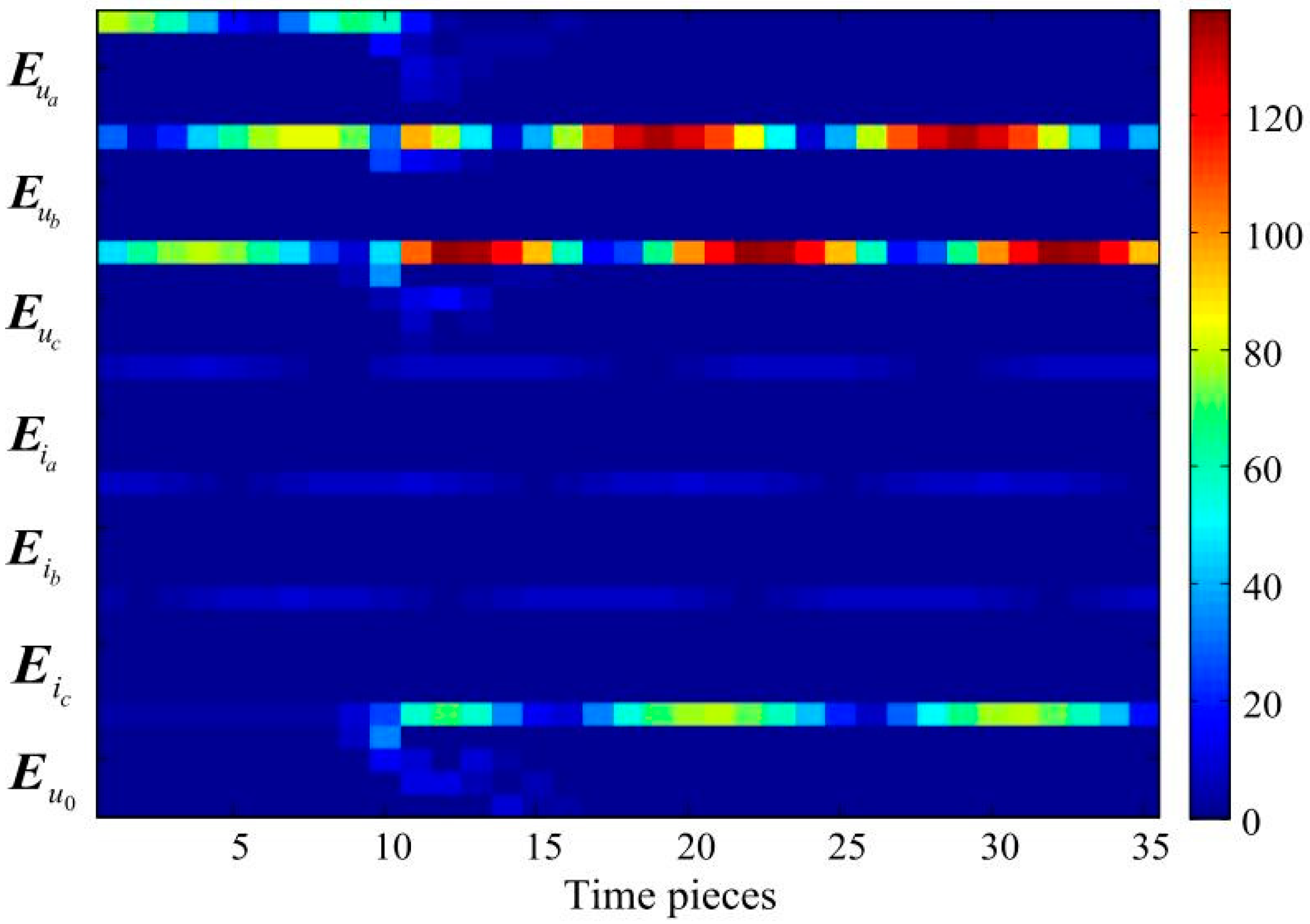
Timeβfrequency energy image.
Figure A6.
Timeβfrequency energy image.

Figure A7.
Three-phase voltage signals for ABg fault.
Figure A7.
Three-phase voltage signals for ABg fault.

Figure A8.
RGB of ABg fault with different parameters.
Figure A8.
RGB of ABg fault with different parameters.

Figure A9.
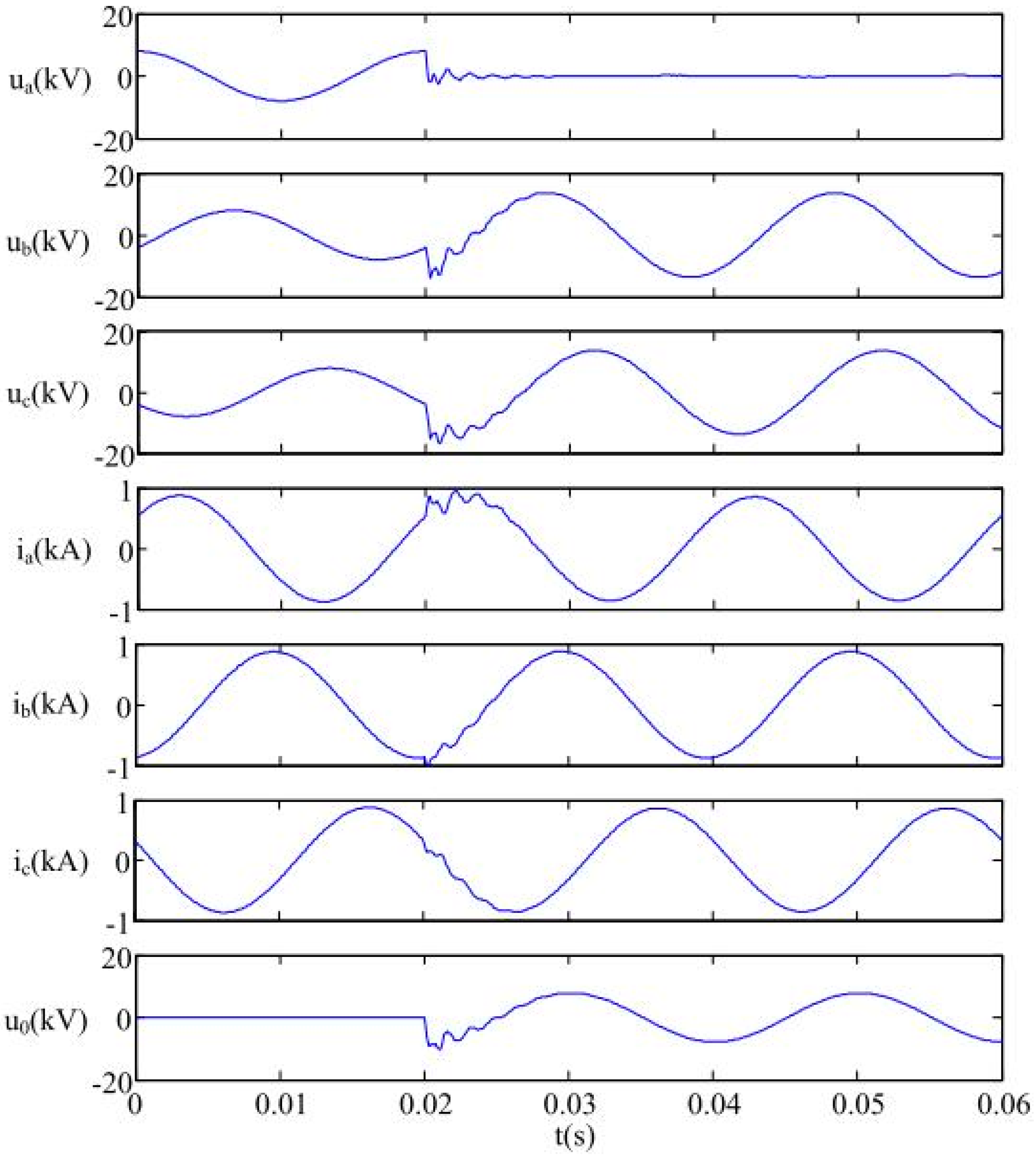
SHTP images of different zero-sequence current signals.
Figure A9.
SHTP images of different zero-sequence current signals.

References
- Liu, J.; Duan, Z.; Liu, H. A Grid Fault Diagnosis Framework Based on Adaptive Integrated Decomposition and Cross-Modal Attention Fusion. Neural Netw. 2024, 178, 106400. [Google Scholar] [CrossRef] [PubMed]
- Duc, M.L.; Bilik, P.; Martinek, R. Harmonics Signal Feature Extraction Techniques: A Review. Mathematics 2023, 11, 1877. [Google Scholar] [CrossRef]
- ZubiΔ, S.J.; DjuriΔ, M.B. A Distance Relay Algorithm Based on the Phase Comparison Principle. Electr. Power Syst. Res. 2012, 92, 20β28. [Google Scholar] [CrossRef]
- Fan, Z.; Song, G.; Kang, X.; Tang, J.; Wang, X. Three-Phase Fault Direction Identification Method for Outgoing Transmission Line of DFIG-Based Wind Farms. J. Mod. Power Syst. Clean Energy 2019, 7, 1155β1164. [Google Scholar] [CrossRef]
- Guo, M.-F.; Liu, W.-L.; Gao, J.-H.; Chen, D.-Y. A Data-Enhanced High Impedance Fault Detection Method Under Imbalanced Sample Scenarios in Distribution Networks. IEEE Trans. Ind. Appl. 2023, 59, 4720β4733. [Google Scholar] [CrossRef]
- Rai, K.; Hojatpanah, F.; Ajaei, F.B.; Guerrero, J.M.; Grolinger, K. Deep Learning for High-Impedance Fault Detection and Classification: Transformer-CNN. Neural Comput. Appl. 2022, 34, 14067β14084. [Google Scholar] [CrossRef]
- Sousa Carvalho, J.G.; Rocha Almeida, A.; Ferreira, D.D.; Dos Santos, B.F.; Pereira Vasconcelos, L.H.; De Oliveira Sobreira, D. High-Impedance Fault Modeling and Classification in Power Distribution Networks. Electr. Power Syst. Res. 2022, 204, 107676. [Google Scholar] [CrossRef]
- Kou, L.; Liu, C.; Cai, G.; Zhou, J.; Yuan, Q. Data-driven Design of Fault Diagnosis for Three-phase PWM Rectifier Using Random Forests Technique with Transient Synthetic Features. IET Power Electron. 2020, 13, 3571β3579. [Google Scholar] [CrossRef]
- Tong, F.; Sun, Y.; He, S. On Positioning Performance for the Narrow-Band Internet of Things: How Participating eNBs Impact? IEEE Trans. Ind. Inform. 2019, 15, 423β433. [Google Scholar] [CrossRef]
- Skansi, S. (Ed.) Guide to Deep Learning Basics: Logical, Historical and Philosophical Perspectives; Springer International Publishing: Cham, Switzerland, 2020; ISBN 978-3-030-37590-4. [Google Scholar]
- Li, H.; Xu, B.; Zhou, F.; Yan, B.; Zhou, F. Empirical Variational Mode Decomposition Based on Binary Tree Algorithm. Sensors 2022, 22, 4961. [Google Scholar] [CrossRef]
- Rezapour, H.; Jamali, S.; Bahmanyar, A. Review on Artificial Intelligence-Based Fault Location Methods in Power Distribution Networks. Energies 2023, 16, 4636. [Google Scholar] [CrossRef]
- Gururajapathy, S.S.; Mokhlis, H.; Illias, H.A. Fault Location and Detection Techniques in Power Distribution Systems with Distributed Generation: A Review. Renew. Sustain. Energy Rev. 2017, 74, 949β958. [Google Scholar] [CrossRef]
- Stefanidou-Voziki, P.; Sapountzoglou, N.; Raison, B.; Dominguez-Garcia, J.L. A Review of Fault Location and Classification Methods in Distribution Grids. Electr. Power Syst. Res. 2022, 209, 108031. [Google Scholar] [CrossRef]
- Srivastava, I.; Bhat, S.; Vardhan, B.V.S.; Bokde, N.D. Fault Detection, Isolation and Service Restoration in Modern Power Distribution Systems: A Review. Energies 2022, 15, 7264. [Google Scholar] [CrossRef]
- Chen, K.; Huang, C.; He, J. Fault Detection, Classification and Location for Transmission Lines and Distribution Systems: A Review on the Methods. High Volt. 2016, 1, 25β33. [Google Scholar] [CrossRef]
- Alam, M.K.; Khan, F.; Johnson, J.; Flicker, J. A Comprehensive Review of Catastrophic Faults in PV Arrays: Types, Detection, and Mitigation Techniques. IEEE J. Photovolt. 2015, 5, 982β997. [Google Scholar] [CrossRef]
- Yang, N.; Yang, C.; Wu, L.; Shen, X.; Jia, J.; Li, Z.; Chen, D.; Zhu, B.; Liu, S. Intelligent Data-Driven Decision-Making Method for Dynamic Multisequence: An E-Seq2Seq-Based SCUC Expert System. IEEE Trans. Ind. Inform. 2022, 18, 3126β3137. [Google Scholar] [CrossRef]
- Ahmad, T.; Madonski, R.; Zhang, D.; Huang, C.; Mujeeb, A. Data-Driven Probabilistic Machine Learning in Sustainable Smart Energy/Smart Energy Systems: Key Developments, Challenges, and Future Research Opportunities in the Context of Smart Grid Paradigm. Renew. Sustain. Energy Rev. 2022, 160, 112128. [Google Scholar] [CrossRef]
- Ganaie, M.A.; Hu, M.; Malik, A.K.; Tanveer, M.; Suganthan, P.N. Ensemble Deep Learning: A Review. Eng. Appl. Artif. Intell. 2022, 115, 105151. [Google Scholar] [CrossRef]
- Zhang, S.; Wang, J.; Liu, H.; Tong, J.; Sun, Z. Prediction of Energy Photovoltaic Power Generation Based on Artificial Intelligence Algorithm. Neural Comput. Appl. 2021, 33, 821β835. [Google Scholar] [CrossRef]
- Ye, X.; Hu, Y.; Shen, J.; Chen, C.; Zhai, G. An Adaptive Optimized TVF-EMD Based on a Sparsity-Impact Measure Index for Bearing Incipient Fault Diagnosis. IEEE Trans. Instrum. Meas. 2020, 70, 3507311. [Google Scholar] [CrossRef]
- Guo, Y.; Zhang, Z. Generalized Variational Mode Decomposition: A Multiscale and Fixed-Frequency Decomposition Algorithm. IEEE Trans. Instrum. Meas. 2021, 70, 3516013. [Google Scholar] [CrossRef]
- Dragomiretskiy, K.; Zosso, D. Variational Mode Decomposition. IEEE Trans. Signal Process. 2014, 62, 531β544. [Google Scholar] [CrossRef]
- Rehman, N.U.; Aftab, H. Multivariate Variational Mode Decomposition. IEEE Trans. Signal Process. 2019, 67, 6039β6052. [Google Scholar] [CrossRef]
- Asuhaimi Mohd Zin, A.; Saini, M.; Mustafa, M.W.; Sultan, A.R.; Rahimuddin, R. New Algorithm for Detection and Fault Classification on Parallel Transmission Line Using DWT and BPNN Based on Clarkeβs Transformation. Neurocomputing 2015, 168, 983β993. [Google Scholar] [CrossRef]
- Perez, R.S.; Oviedo, A.C.; Camarillo-Penaranda, J.; Ramos, G. A Novel Fault Classification Method Using Wavelet Transform and Artificial Neural Networks. In Proceedings of the 2016 17th International Conference on Harmonics and Quality of Power (ICHQP), Belo Horizonte, Brazil, 16β19 October 2016; pp. 448β453. [Google Scholar]
- Alanzi, E.A.; Younis, M.A.; Ariffin, A.M. Detection of Faulted Phase Type in Distribution Systems Based on One End Voltage Measurement. Int. J. Electr. Power Energy Syst. 2014, 54, 288β292. [Google Scholar] [CrossRef]
- Hichri, A.; Hajji, M.; Mansouri, M.; Harkat, M.-F.; Kouadri, A.; Nounou, H.; Nounou, M. Fault Detection and Diagnosis in Grid-Connected Photovoltaic Systems. In Proceedings of the 2020 17th International Multi-Conference on Systems, Signals & Devices (SSD), Monastir, Tunisia, 20β23 July 2020; pp. 201β206. [Google Scholar]
- Yahyaoui, Z.; Hajji, M.; Mansouri, M.; Harkat, M.-F.; Kouadri, A.; Nounou, H.; Nounou, M. Efficient Fault Detection and Diagnosis of Wind Energy Converter Systems. In Proceedings of the 2020 17th International Multi-Conference on Systems, Signals & Devices (SSD), Monastir, Tunisia, 20β23 July 2020; pp. 213β218. [Google Scholar]
- Dai, L.; Li, C. Research on Micro-Grid Line Fault Diagnosis Method Based on Dynamic PCA and Improved SVM. In Proceedings of the 2020 5th Asia Conference on Power and Electrical Engineering (ACPEE), Chengdu, China, 4β7 June 2020; pp. 1434β1439. [Google Scholar]
- Wang, Y.; Liu, M.; Bao, Z.; Zhang, S. Stacked Sparse Autoencoder with PCA and SVM for Data-Based Line Trip Fault Diagnosis in Power Systems. Neural Comput. Appl. 2019, 31, 6719β6731. [Google Scholar] [CrossRef]
- Afrasiabi, S.; Afrasiabi, M.; Behdani, B.; Mohammadi, M.; Javadi, M.S.; Osorio, G.J.; Catalao, J.P.S. Detection and Localization of Transmission Line Faults Based on a Hybrid Two-Stage Technique Considering Wind Power Generation. In Proceedings of the 2021 IEEE International Conference on Environment and Electrical Engineering and 2021 IEEE Industrial and Commercial Power Systems Europe (EEEIC/I&CPS Europe), Bari, Italy, 7β10 September 2021; pp. 1β5. [Google Scholar]
- Wang, H.; Li, S.; Song, L.; Cui, L.; Wang, P. An Enhanced Intelligent Diagnosis Method Based on Multi-Sensor Image Fusion via Improved Deep Learning Network. IEEE Trans. Instrum. Meas. 2020, 69, 2648β2657. [Google Scholar] [CrossRef]
- Cai, Y.; Chow, M.-Y. Exploratory Analysis of Massive Data for Distribution Fault Diagnosis in Smart Grids. In Proceedings of the 2009 IEEE Power & Energy Society General Meeting, Calgary, AB, Canada, 26β30 July 2009; pp. 1β6. [Google Scholar]
- Balakrishnan, P.; Gopinath, S. A New Intelligent Scheme for Power System Faults Detection and Classification: A Hybrid Technique. Int. J. Numer. Model. Electron. Netw. Devices Fields 2020, 33, e2728. [Google Scholar] [CrossRef]
- Le, X.; Yijun, Z.; Keyu, Y.; Mingzhen, S.; Wenbo, L.; Dong, L. Interpretation of DGA for Transformer Fault Diagnosis with Step-by-Step Feature Selection and SCA-RVM. In Proceedings of the 2021 IEEE 16th Conference on Industrial Electronics and Applications (ICIEA), Chengdu, China, 1β4 August 2021; pp. 1372β1377. [Google Scholar]
- Kezunovic, M.; Spasojevic, P.; Fromen, C.W.; Sevcik, D.R. An Expert System for Transmission Substation Event Analysis. IEEE Trans. Power Deliv. 1993, 8, 1942β1949. [Google Scholar] [CrossRef]
- Liu, C.-C.; Tomsovic, K. An Expert System Assisting Decision-Making of Reactive Power/Voltage Control. IEEE Trans. Power Syst. 1986, 1, 195β201. [Google Scholar] [CrossRef]
- Fukui, C.; Kawakami, J. An Expert System for Fault Section Estimation Using Information from Protective Relays and Circuit Breakers. IEEE Trans. Power Deliv. 1986, 1, 83β90. [Google Scholar] [CrossRef]
- Kirschen, D.S.; Wollenberg, B.F. Intelligent Alarm Processing in Power Systems. Proc. IEEE 1992, 80, 663β672. [Google Scholar] [CrossRef]
- Talukdar, S.N.; Cardozo, E.; Perry, T. The Operatorβs Assistant--An Intelligent, Expandable Program for Power System Trouble Analysis. IEEE Trans. Power Syst. 1986, 1, 182β187. [Google Scholar] [CrossRef]
- Ma, D.; Liang, Y.; Zhao, X.; Guan, R.; Shi, X. Multi-BP Expert System for Fault Diagnosis of Powersystem. Eng. Appl. Artif. Intell. 2013, 26, 937β944. [Google Scholar] [CrossRef]
- Amaya, E.J.; Alvares, A.J. Expert System for Power Generation Fault Diagnosis Using Hierarchical Meta-Rules. In Proceedings of the 2012 IEEE 17th International Conference on Emerging Technologies & Factory Automation (ETFA 2012), Krakow, Poland, 17β21 September 2012; pp. 1β8. [Google Scholar]
- Xu, Y.; Xie, T.; Zhou, Z.; Lu, Y.; Jun, J.; Chen, S.; Li, J.; Ma, Y.; Chao, J. Research of Practical Expert System for Transformer Fault Diagnosis Based on Multidimensional Data Fusion. In Proceedings of the 2016 IEEE PES Asia-Pacific Power and Energy Engineering Conference (APPEEC), Xiβan, China, 25β28 October 2016; pp. 300β304. [Google Scholar]
- Pearl, J. Fusion, Propagation, and Structuring in Belief Networks. Artif. Intell. 1986, 29, 241β288. [Google Scholar] [CrossRef]
- Bracale, A.; Caramia, P.; Carpinelli, G.; Di Fazio, A.R.; Varilone, P. A Bayesian-Based Approach for a Short-Term Steady-State Forecast of a Smart Grid. IEEE Trans. Smart Grid 2013, 4, 1760β1771. [Google Scholar] [CrossRef]
- Hu, J.; Hu, W.; Cao, D.; Huang, Y.; Chen, J.; Li, Y.; Chen, Z.; Blaabjerg, F. Bayesian Averaging-Enabled Transfer Learning Method for Probabilistic Wind Power Forecasting of Newly Built Wind Farms. Appl. Energy 2024, 355, 122185. [Google Scholar] [CrossRef]
- Yang, Y.; Li, W.; Gulliver, T.A.; Li, S. Bayesian Deep Learning-Based Probabilistic Load Forecasting in Smart Grids. IEEE Trans. Ind. Inform. 2020, 16, 4703β4713. [Google Scholar] [CrossRef]
- Sun, M.; Zhang, T.; Wang, Y.; Strbac, G.; Kang, C. Using Bayesian Deep Learning to Capture Uncertainty for Residential Net Load Forecasting. IEEE Trans. Power Syst. 2020, 35, 188β201. [Google Scholar] [CrossRef]
- Cai, B.; Huang, L.; Xie, M. Bayesian Networks in Fault Diagnosis. IEEE Trans. Ind. Inform. 2017, 13, 2227β2240. [Google Scholar] [CrossRef]
- Koraz, Y.; Gabbar, H.A. Fault Diagnosis of Micro Energy Grids Using Bayesian Belief Network and Adaptive Neuro-Fuzzy Interference System. In Proceedings of the 2017 IEEE International Conference on Smart Energy Grid Engineering (SEGE), Oshawa, ON, Canada, 14β17 August 2017; pp. 143β147. [Google Scholar]
- Yongli, Z.; Limin, H.; Jinling, L. Bayesian Networks-Based Approach for Power Systems Fault Diagnosis. IEEE Trans. Power Deliv. 2006, 21, 634β639. [Google Scholar] [CrossRef]
- Tao, W.; Yi, Z.; Zhanjun, G. Fault Diagnosis for Power System Based on a Special Bayesian Network. In Proceedings of the TENCON 2015β2015 IEEE Region 10 Conference, Macao, 1β4 November 2015; pp. 1β6. [Google Scholar]
- Zhang, Q. A New Approach for Fault Diagnosis in Power Systems Based on Rough Set Theory. In Proceedings of the International Conference on Advances in Power System Control, Operation and Management, APSCOM-97, Hong Kong, 11β14 November 1997; Volume 1997, pp. 597β602. [Google Scholar]
- Wei, X.; Wang, X.; Gao, J.; Yang, D.; Wei, K.; Guo, L. Faulty Feeder Detection for Single-Phase-to-Ground Fault in Distribution Networks Based on Transient Energy and Cosine Similarity. IEEE Trans. Power Deliv. 2022, 37, 3968β3979. [Google Scholar] [CrossRef]
- Wang, B.; Cui, X. Nonlinear Modeling Analysis and Arc High-Impedance Faults Detection in Active Distribution Networks With Neutral Grounding via Petersen Coil. IEEE Trans. Smart Grid 2022, 13, 1888β1898. [Google Scholar] [CrossRef]
- Wei, M.; Shi, F.; Zhang, H.; Jin, Z.; Terzija, V.; Zhou, J.; Bao, H. High Impedance Arc Fault Detection Based on the Harmonic Randomness and Waveform Distortion in the Distribution System. IEEE Trans. Power Deliv. 2020, 35, 837β850. [Google Scholar] [CrossRef]
- Azzaoui, M.E. Islanding Detection Method With Load Power Factor Improvement and High Frequency Transient Suppressing. IEEE Trans. Smart Grid 2021, 12, 4176β4184. [Google Scholar] [CrossRef]
- Yadav, N.; Tummuru, N.R. Short-Circuit Fault Detection and Isolation Using Filter Capacitor Current Signature in Low-Voltage DC Microgrid Applications. IEEE Trans. Ind. Electron. 2022, 69, 8491β8500. [Google Scholar] [CrossRef]
- Youssef, O.A.S. Combined Fuzzy-Logic Wavelet-Based Fault Classification Technique for Power System Relaying. IEEE Trans. Power Deliv. 2004, 19, 582β589. [Google Scholar] [CrossRef]
- Wang, W.; Gao, X.; Fan, B.; Zeng, X.; Yao, G. Faulty Phase Detection Method Under Single-Line-to-Ground Fault Considering Distributed Parameters Asymmetry and Line Impedance in Distribution Networks. IEEE Trans. Power Deliv. 2022, 37, 1513β1522. [Google Scholar] [CrossRef]
- Yang, S.; Jiao, Y.; Chen, Q.; Li, H.; Zhou, L.; Zhu, H. A Single-Phase to Ground Fault Identification Method Based on Extremely Low Frequency Current Detection in Distribution Grids. IEEE Trans. Power Deliv. 2022, 37, 5214β5223. [Google Scholar] [CrossRef]
- Wei, X.; Yang, D.; Wang, X.; Wang, B.; Gao, J.; Wei, J. Faulty Feeder Detection Based on Fundamental Component Shift and Multiple-Transient-Feature Fusion in Distribution Networks. IEEE Trans. Smart Grid 2021, 12, 1699β1711. [Google Scholar] [CrossRef]
- Wang, Y.; Huang, Y.; Zeng, X.; Wei, G.; Zhou, J.; Fang, T.; Chen, H. Faulty Feeder Detection of Single Phase-Earth Fault Using Grey Relation Degree in Resonant Grounding System. IEEE Trans. Power Deliv. 2017, 32, 55β61. [Google Scholar] [CrossRef]
- Bian, Y.; Sun, S.; Li, G.; Chen, C.; Bie, Z. A Generic Bayesian Method for Faulted Section Identification in Distribution Systems Against Wind-Induced Extreme Events. IEEE Trans. Smart Grid 2024, 15, 1821β1836. [Google Scholar] [CrossRef]
- Luo, X.; Zhang, L.; Shan, H.; Ji, T. Traveling Wave Velocity Independent Fault Location Scheme with Adaptive Mathematical Filters for Distribution Network. Electr. Power Syst. Res. 2022, 209, 108040. [Google Scholar] [CrossRef]
- Yang, W.-J.; Yin, X.-Q.; Tao, J.; Zhang, H.-Y. Fault Current Constrained Impedance-Based Method for High Resistance Ground Fault Location in Distribution Grid. Electr. Power Syst. Res. 2024, 227, 109998. [Google Scholar] [CrossRef]
- Jiang, X.; Stephen, B.; McArthur, S. Automated Distribution Network Fault Cause Identification With Advanced Similarity Metrics. IEEE Trans. Power Deliv. 2021, 36, 785β793. [Google Scholar] [CrossRef]
- He, W.; Cheng, X.; Zhao, X.; Zhou, G.; Zhu, H.; Zhao, E.; Qian, G. An Interval Construction Belief Rule Base with Interpretability for Complex Systems. Expert Syst. Appl. 2023, 229, 120485. [Google Scholar] [CrossRef]
- Li, X.; Gao, X.; Wang, Q.; Wang, C.; Li, B.; Wan, K. Feature Analysis Network: An Interpretable Idea in Deep Learning. Cogn. Comput. 2024, 16, 803β826. [Google Scholar] [CrossRef]
- Qi, B.; Zhang, L.; Liang, J.; Tong, J. Combinatorial Techniques for Fault Diagnosis in Nuclear Power Plants Based on Bayesian Neural Network and Simplified Bayesian Network-Artificial Neural Network. Front. Energy Res. 2022, 10, 920194. [Google Scholar] [CrossRef]
- Liu, M.; Luo, T.; Zhang, L.; Cao, X.; Duan, G. An Adjustable Feature-Weighted Bayesian Model for Hybrid Satellite Telemetry Variables Anomaly Detection Under Multioperating Conditions. IEEE Trans. Instrum. Meas. 2023, 72, 3536014. [Google Scholar] [CrossRef]
- Li, C.; Shen, Q.; Wang, L.; Qin, W.; Xie, M. A New Adaptive Interpretable Fault Diagnosis Model for Complex System Based on Belief Rule Base. IEEE Trans. Instrum. Meas. 2022, 71, 3529111. [Google Scholar] [CrossRef]
- Zakri, A.A.; Darmawan, S.; Usman, J.; Rosma, I.H.; Ihsan, B. Extract Fault Signal via DWT and Penetration of SVM for Fault Classification at Power System Transmission. In Proceedings of the 2018 2nd International Conference on Electrical Engineering and Informatics (ICon EEI), Batam, Indonesia, 16β17 October 2018; pp. 191β196. [Google Scholar]
- Magagula, X.G.; Hamam, Y.; Jordaan, J.A.; Yusuff, A.A. Fault Detection and Classification Method Using DWT and SVM in a Power Distribution Network. In Proceedings of the 2017 IEEE PES PowerAfrica, Accra, Ghana, 27β30 June 2017; pp. 1β6. [Google Scholar]
- Magagula, X.G.; Hamam, Y.; Jordaan, J.A.; Yusuff, A.A. A Fault Classification and Localization Method in a Power Distribution Network. In Proceedings of the 2017 IEEE AFRICON, Cape Town, South Africa, 18β20 September 2017; pp. 1337β1343. [Google Scholar]
- Malathi, V.; Marimuthu, N.S.; Baskar, S. Intelligent Approaches Using Support Vector Machine and Extreme Learning Machine for Transmission Line Protection. Neurocomputing 2010, 73, 2160β2167. [Google Scholar] [CrossRef]
- Cho, M.-Y.; Hoang, T.T. Feature Selection and Parameters Optimization of SVM Using Particle Swarm Optimization for Fault Classification in Power Distribution Systems. Comput. Intell. Neurosci. 2017, 2017, 4135465. [Google Scholar] [CrossRef] [PubMed]
- Manohar, M.; Koley, E. SVM Based Protection Scheme for Microgrid. In Proceedings of the 2017 International Conference on Intelligent Computing, Instrumentation and Control Technologies (ICICICT), Kerala, India, 6β7 July 2017. [Google Scholar]
- Ma, S.; Li, J.; Wu, Y.; Xin, C.; Li, Y.; Wu, J. A Novel Multi-Information Decision Fusion Based on Improved Random Forests in HVCB Fault Detection Application. Meas. Sci. Technol. 2022, 33, 055115. [Google Scholar] [CrossRef]
- Malhotra, A.; Mahela, O.P.; Doraya, H. Detection and Classification of Power System Faults Using Discrete Wavelet Transform and Rule Based Decision Tree. In Proceedings of the 2018 International Conference on Computing, Power and Communication Technologies (GUCON), Greater Noida, India, 28β29 September 2018; pp. 142β147. [Google Scholar]
- Panigrahi, B.K.; Parija, B.; Pattanayak, R.; Tripathy, S.K. Faults Classification In A Microgrid Using Decision Tree Technique And Support Vector Machine. In Proceedings of the 2018 Second International Conference on Green Computing and Internet of Things (ICGCIoT), Bangalore, India, 16β18 August 2018; pp. 145β148. [Google Scholar]
- Li, Z.; Han, X.; Shahidehpour, M.; Ju, P.; Yu, Q. Analyzing the Resilience of Active Distribution Networks to Hazardous Weather Considering Cyber-Physical Interdependencies. Engineering, 2024; in press. [Google Scholar] [CrossRef]
- Gritsutenko, S.; Korovkin, N.; Sakharov, Y.; Sokolova, O. Assessment of Geomagnetically Induced Currents Impact on Power Grid Modelling. Magnetism 2023, 3, 135β147. [Google Scholar] [CrossRef]
- Mahmood, M.; Chowdhury, P.; Yeassin, R.; Hasan, M.; Ahmad, T.; Chowdhury, N.-U.-R. Impacts of Digitalization on Smart Grids, Renewable Energy, and Demand Response: An Updated Review of Current Applications. Energy Convers. Manag. X 2024, 24, 10079. [Google Scholar] [CrossRef]
- Le, V.; Yao, X.; Miller, C.; Tsao, B.-H. Series DC Arc Fault Detection Based on Ensemble Machine Learning. IEEE Trans. Power Electron. 2020, 35, 7826β7839. [Google Scholar] [CrossRef]
- Chen, L.; Dong, X.; Wang, B.; Shang, L.; Liu, C. An Edge Computing-Oriented Islanding Detection Using Differential Entropy and Multi-Support Vector Machines. IEEE Trans. Smart Grid 2024, 15, 191β202. [Google Scholar] [CrossRef]
- Joshi, A.; Khathoon, R.; Devikrishna; PV, A.P.; Vinood, V. A Very Fast and Easily Implementable Support Vector Machine Based Relay Algorithm to Classify the Fault and Non Fault Disturbance in VSC HVDC Terminals. Electr. Power Syst. Res. 2023, 220, 109380. [Google Scholar] [CrossRef]
- Rizeakos, V.; Bachoumis, A.; Andriopoulos, N.; Birbas, M.; Birbas, A. Deep Learning-Based Application for Fault Location Identification and Type Classification in Active Distribution Grids. Appl. Energy 2023, 338, 12093. [Google Scholar] [CrossRef]
- Liang, Y.; Li, K.-J.; Ma, Z.; Lee, W.-J. Multilabel Classification Model for Type Recognition of Single-Phase-to-Ground Fault Based on KNN-Bayesian Method. IEEE Trans. Ind. Appl. 2021, 57, 1294β1302. [Google Scholar] [CrossRef]
- Saxena, A.; Sharma, N.K.; Samantaray, S.R. An Enhanced Differential Protection Scheme for LVDC Microgrid. IEEE J. Emerg. Sel. Top. Power Electron. 2022, 10, 2114β2125. [Google Scholar] [CrossRef]
- Shaik, M.; Yadav, S.K.; Shaik, A.G. An EMD and Decision Tree-Based Protection Algorithm for the Solar PV Integrated Radial Distribution System. IEEE Trans. Ind. Appl. 2021, 57, 2168β21777. [Google Scholar] [CrossRef]
- Jiang, H.; Zhang, J.J.; Gao, W.; Wu, Z. Fault Detection, Identification, and Location in Smart Grid Based on Data-Driven Computational Methods. IEEE Trans. Smart Grid 2014, 5, 2947β2956. [Google Scholar] [CrossRef]
- Abdelgayed, T.S.; Morsi, W.G.; Sidhu, T.S. A New Approach for Fault Classification in Microgrids Using Optimal Wavelet Functions Matching Pursuit. IEEE Trans. Smart Grid 2018, 9, 4838β4846. [Google Scholar] [CrossRef]
- Wang, Y.; Liu, M.; Bao, Z. Deep Learning Neural Network for Power System Fault Diagnosis. In Proceedings of the 2016 35th Chinese Control Conference (CCC), Chengdu, China, 27β29 July 2016; pp. 6678β6683. [Google Scholar]
- Pereira, J.; Saraiva, F. Convolutional Neural Network Applied to Detect Electricity Theft: A Comparative Study on Unbalanced Data Handling Techniques. Int. J. Electr. Power Energy Syst. 2021, 131, 107085. [Google Scholar] [CrossRef]
- Wang, D.; Gan, J.; Mao, J.; Chen, F.; Yu, L. Forecasting Power Demand in China with a CNN-LSTM Model Including Multimodal Information. Energy 2023, 263, 126012. [Google Scholar] [CrossRef]
- Li, M.; Yu, Y.; Ji, T.; Wu, Q. On-Line Transmission Line Fault Classification Using Long Short-Term Memory. In Proceedings of the 2019 IEEE 12th International Symposium on Diagnostics for Electrical Machines, Power Electronics and Drives (SDEMPED), Toulouse, France, 27β30 August 2019; pp. 513β518. [Google Scholar]
- Bao Huy, T.H.; Vo, D.N.; Nguyen, K.P.; Huynh, V.Q.; Huynh, M.Q.; Truong, K.H. Short-Term Load Forecasting in Power System Using CNN-LSTM Neural Network. In Proceedings of the 2023 Asia Meeting on Environment and Electrical Engineering (EEE-AM), Hanoi, Vietnam, 13β15 November 2023; pp. 1β6. [Google Scholar]
- Belagoune, S. Deep Learning through LSTM Classification and Regression for Transmission Line Fault Detection, Diagnosis and Location in Large-Scale Multi-Machine Power Systems. Measurement 2021, 177, 109330. [Google Scholar] [CrossRef]
- Yadav, R.; Pradhan, A.K. PCA-LSTM Learning Networks With Markov Chain Models for Online Classification of Cyber-Induced Outages in Power System. IEEE Syst. J. 2021, 15, 3948β3957. [Google Scholar] [CrossRef]
- Ma, S.; Chen, M.; Wu, J.; Wang, Y.; Jia, B.; Jiang, Y. High-Voltage Circuit Breaker Fault Diagnosis Using a Hybrid Feature Transformation Approach Based on Random Forest and Stacked Autoencoder. IEEE Trans. Ind. Electron. 2019, 66, 9777β9788. [Google Scholar] [CrossRef]
- Bagheri, A.; Gu, I.Y.H.; Bollen, M.H.J.; Balouji, E. A Robust Transform-Domain Deep Convolutional Network for Voltage Dip Classification. IEEE Trans. Power Deliv. 2018, 33, 2794β2802. [Google Scholar] [CrossRef]
- Moradzadeh, A.; Teimourzadeh, H.; Mohammadi-Ivatloo, B.; Pourhossein, K. Hybrid CNN-LSTM Approaches for Identification of Type and Locations of Transmission Line Faults. Int. J. Electr. Power Energy Syst. 2022, 135, 107563. [Google Scholar] [CrossRef]
- Sun, S.; Sun, L.; Wang, J.; Gao, H. Fault Diagnosis of Conventional Circuit Breaker Accessories Based on Grayscale Image of Current Signal and Improved ZFNet-DRN. IEEE Sens. J. 2023, 23, 1343β1356. [Google Scholar] [CrossRef]
- Cheng, X.-R.; Cui, B.-J.; Hou, S.-Z. Fault Line Selection of Distribution Network Based on Modified CEEMDAN and GoogLeNet Neural Network. IEEE Sens. J. 2022, 22, 13346β13364. [Google Scholar] [CrossRef]
- Fa, G.M.; Che, Y.N.; Fan, C.W. Deep-Learning-Based Fault Classification Using HilbertβHuang Transform and Convolutional Neural Network in Power Distribution Systems. IEEE Sens. J. 2019, 19, 6905β6913. [Google Scholar]
- Xi, Y.; Zhang, W.; Zhou, F.; Tang, X.; Li, Z.; Zeng, X.; Zhang, P. Transmission Line Fault Detection and Classification Based on SA-MobileNetV3. Energy Rep. 2023, 9, 955β996. [Google Scholar] [CrossRef]
- Guo, W.; Shi, Y. A Visual Faulty Feeder Detection Method for Power Distribution Network Based on Spatial Image Generation and Deep Learning. IET Gener. Transm. Distrib. 2023, 17, 5430β5445. [Google Scholar] [CrossRef]
- Quan, S.; Sun, M.; Zeng, X.; Wang, X.; Zhu, Z. Time Series Classification Based on Multi-Dimensional Feature Fusion. IEEE Access 2023, 11, 11066β11077. [Google Scholar] [CrossRef]
- Ukoba, K.; Olatunji, K.O.; Adeoye, E.; Jen, T.-C.; Madyira, D.M. Optimizing Renewable Energy Systems through Artificial Intelligence: Review and Future Prospects. Energy Environ. 2024, 35, 3833β3879. [Google Scholar] [CrossRef]
- Zhang, S.; Wang, Y.; Liu, M.; Bao, Z. Data-Based Line Trip Fault Prediction in Power Systems Using LSTM Networks and SVM. IEEE Access 2018, 6, 7675β7686. [Google Scholar] [CrossRef]
- Zheng, X. Prediction Method of Mechanical State of High-Voltage Circuit Breakers Based on LSTM-SVM. Electr. Power Syst. Res. 2023, 218, 109224. [Google Scholar] [CrossRef]
- Hou, S.; Guo, W. Fault Identification Method for Distribution Network Based on Parameter Optimized Variational Mode Decomposition and Convolutional Neural Network. IET Gener. Transm. Distrib. 2022, 16, 737β749. [Google Scholar] [CrossRef]
- Swaminathan, R.; Mishra, S.; Routray, A.; Swain, S.C. A CNN-LSTM-Based Fault Classifier and Locator for Underground Cables. Neural Comput. Appl. 2021, 33, 15293β15304. [Google Scholar] [CrossRef]
- Alhanaf, A.S.; Farsadi, M.; Balik, H.H. Fault Detection and Classification in Ring Power System With DG Penetration Using Hybrid CNN-LSTM. IEEE Access 2024, 12, 59953β59975. [Google Scholar] [CrossRef]
- Liu, J.; Qu, Q.; Yang, H.; Zhang, J.; Liu, Z. Deep Learning-Based Intelligent Fault Diagnosis for Power Distribution Networks. Int. J. Comput. Commun. Control. 2024, 19, 6607. [Google Scholar] [CrossRef]
- Han, Y.; Qi, W.; Ding, N.; Geng, Z. Short-Time Wavelet Entropy Integrating Improved LSTM for Fault Diagnosis of Modular Multilevel Converter. IEEE Trans. Cybern. 2022, 52, 7504β7512. [Google Scholar] [CrossRef] [PubMed]
Disclaimer/Publisherβs Note: The statements, opinions and data contained in all publications are solely those of the individual author(s) and contributor(s) and not of MDPI and/or the editor(s). MDPI and/or the editor(s) disclaim responsibility for any injury to people or property resulting from any ideas, methods, instructions or products referred to in the content. |
Β© 2024 by the authors. Licensee MDPI, Basel, Switzerland. This article is an open access article distributed under the terms and conditions of the Creative Commons Attribution (CC BY) license (https://creativecommons.org/licenses/by/4.0/).