The Impact of Nirsevimab on the Transport of Critically Ill Children
 , ,
, ,
Highlights
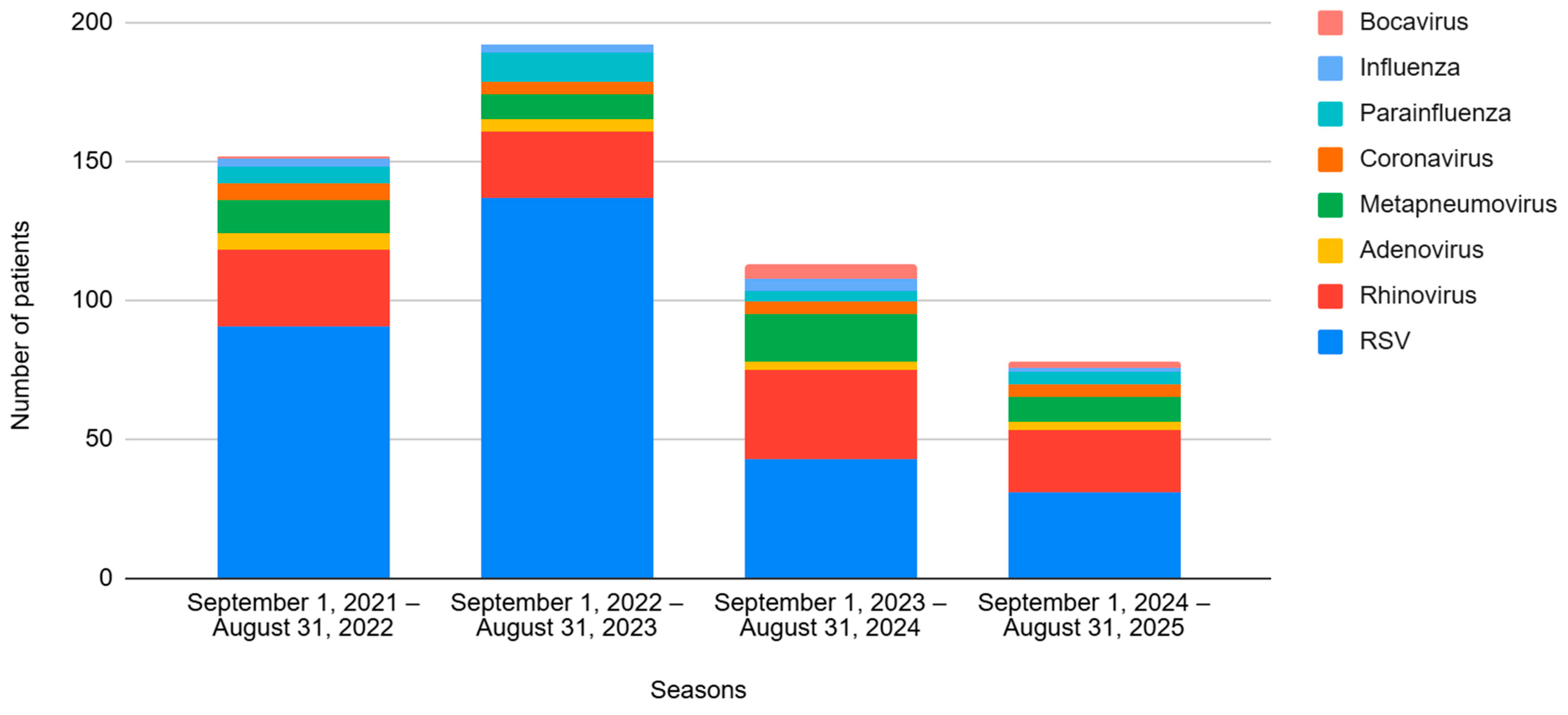
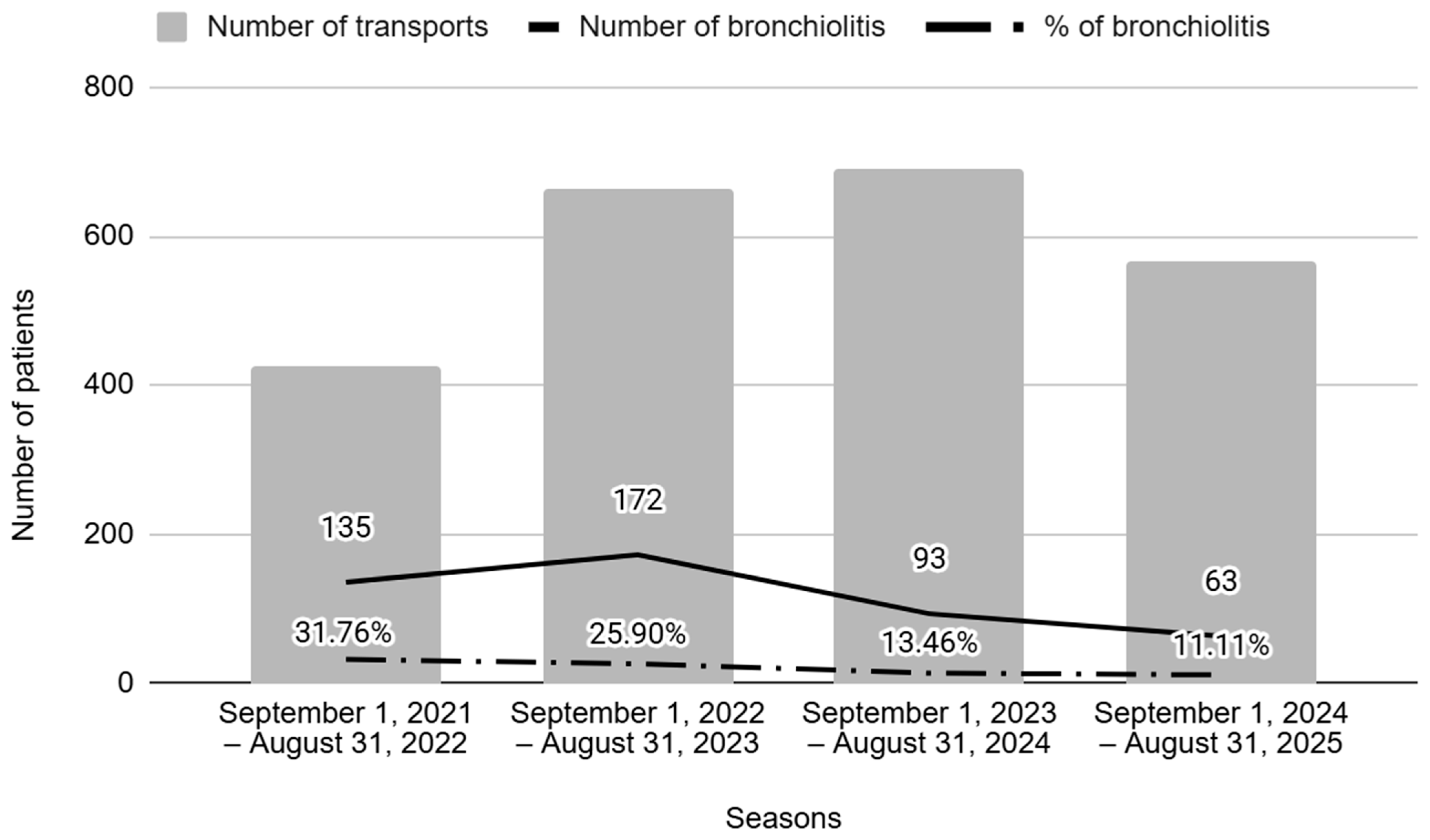
- Respiratory syncytial virus (RSV)-positive bronchiolitis is the leading cause of interfacility transport in children <1 year, especially in winter.
- In October 2023, universal immunization against RSV in children under 6 months of age was started in Spain.
- Immunization with nirsevimab was associated with lower rates of bronchiolitis requiring specialized transport in pediatric patients, particularly in RSV-related cases, without modifying disease severity among those requiring transfer.
Abstract
1. Introduction
2. Materials and Methods
2.1. Study Design, Setting and Population
2.2. Data Collection
2.3. Microbiological Testing
2.4. Statistical Analysis
3. Results
3.1. General Results
3.2. Differences Between the Two Periods: Pre-n vs. Post-n
3.3. Differences Between Immunized and Non-Immunized Patients
4. Discussion
5. Limitations
6. Conclusions
Supplementary Materials
Author Contributions
Funding
Institutional Review Board Statement
Informed Consent Statement
Data Availability Statement
Acknowledgments
Conflicts of Interest
References
- Ralston, S.L.; Lieberthal, A.S.; Meissner, H.C.; Alverson, B.K.; Baley, J.E.; Gadomski, A.M.; Johnson, D.W.; Light, M.J.; Maraqa, N.F.; Mendonca, E.A.; et al. Clinical practice guideline: The diagnosis, management, and prevention of bronchiolitis. Pediatrics 2014, 134, e1474–e1502. [Google Scholar] [CrossRef] [Scilit]
- Martinón-Torres, F.; Carmo, M.; Platero, L.; Drago, G.; López-Belmonte, J.; Bangert, M.; Díez-Domingo, J. Clinical and economic hospital burden of acute respiratory infection (BARI) due to respiratory syncytial virus in Spanish children, 2015–2018. BMC Infect. Dis. 2023, 23, 385. [Google Scholar] [CrossRef] [Scilit] [PubMed]
- Hasegawa, K.; Tsugawa, Y.; Brown, D.F.; Mansbach, J.M.; Camargo, C.A. Trends in bronchiolitis hospitalizations in the United States, 2000–2009. Pediatrics 2013, 132, 28–36. [Google Scholar] [CrossRef] [Scilit]
- Guitart, C.; Bobillo-Perez, S.; Alejandre, C.; Armero, G.; Launes, C.; Cambra, F.J.; Balaguer, M.; Jordan, I.; Catalonia, H.N.F.R.S.V.S.I.; Pagarolas, A.A.; et al. Bronchiolitis, epidemiological changes during the SARS-CoV-2 pandemic. BMC Infect. Dis. 2022, 22, 84. [Google Scholar] [CrossRef] [Scilit] [PubMed]
- Ghazaly, M.; Nadel, S. Characteristics of children admitted to intensive care with acute bronchiolitis. Eur. J. Pediatr. 2018, 177, 913–920. [Google Scholar] [CrossRef] [Scilit]
- Hasegawa, K.; Pate, B.M.; Mansbach, J.M.; Macias, C.G.; Fisher, E.S.; Piedra, P.A.; Espinola, J.A.; Sullivan, A.F.; Camargo, C.A. Risk factors for requiring intensive care among children admitted to ward with bronchiolitis. Acad. Pediatr. 2015, 15, 77. [Google Scholar] [CrossRef] [Scilit] [PubMed]
- Mansbach, J.M.; Piedra, P.A.; Stevenson, M.D.; Sullivan, A.F.; Forgey, T.F.; Clark, S.; Espinola, J.A.; Camargo, C.A. Prospective multicenter study of children with bronchiolitis requiring mechanical ventilation. Pediatrics 2012, 130, e492–e500. [Google Scholar] [CrossRef] [Scilit]
- Kempley, S.T.; Baki, Y.; Hayter, G.; Ratnavel, N.; Cavazzoni, E.; Reyes, T. Effect of a centralised transfer service on characteristics of inter-hospital neonatal transfers. Arch. Dis. Child. Fetal Neonatal Ed. 2007, 92, F185–F188. [Google Scholar] [CrossRef] [Scilit]
- Pearson, G.; Shann, F.; Barry, P.; Vyas, J.; Thomas, D.; Powell, C.; Field, D. Should paediatric intensive care be centralized? Trent versus Victoria. Lancet 1997, 349, 1213–1217. [Google Scholar] [CrossRef] [Scilit]
- American Academy of Pediatrics. Committee of Pediatric Emergency Medicine, American College of Critical Care Medicine, Society of Critical Care Medicine Consensus report for regionalization of services for critically ill or injured children. Pediatrics 2000, 105, 152–155. [Google Scholar] [CrossRef] [Scilit]
- Carreras, E.; Ginovart, G.; Caritg, J.; Esqué, M.; Domínguez, P. Transporte interhospitalario del niño crítico en Cataluña. Med. Intensiv. 2006, 30, 309–313. [Google Scholar] [CrossRef] [Scilit]
- del Real, N.M.G.; García, L.S.; Diez, Y.B.; Merlo, R.R.; Ballestín, A.S.; Lucas, R.J.; García, N.d.L. Importancia del transporte pediátrico y neonatal especializado. Situación actual en España: Hacia un futuro más equitativo y universal. An. Pediatr. (Engl. Ed.) 2021, 95, 485.e1–485.e10. [Google Scholar] [CrossRef] [Scilit]
- Lin, J.A.; Madikians, A. From bronchiolitis guideline to practice: A critical care perspective. World J. Crit. Care Med. 2015, 4, 152. [Google Scholar] [CrossRef] [Scilit]
- Chkhaidze, I.; Zirakishvili, D. Acute viral bronchiolitis in infants (Review). Georgian Med. News 2017, 264, 43–50. [Google Scholar]
- Shanklin, A.; Olson, T.; Patel, A.K.; Rivera, E.A.T.; Pollack, M.M. Respiratory Syncytial Virus and US Pediatric Intensive Care Utilization. JAMA Netw. Open 2024, 7, e2440997. [Google Scholar] [CrossRef] [Scilit] [PubMed]
- Garegnani, L.; Styrmisdóttir, L.; Roson Rodriguez, P.; Escobar Liquitay, C.M.; Esteban, I.; Franco, J.V. Palivizumab for preventing severe respiratory syncytial virus (RSV) infection in children. Cochrane Database Syst. Rev. 2021, 11, CD013757. [Google Scholar]
- Griffin, M.P.; Yuan, Y.; Takas, T.; Domachowske, J.B.; Madhi, S.A.; Manzoni, P.; Simões, E.A.F.; Esser, M.T.; Khan, A.A.; Dubovsky, F.; et al. Single-Dose Nirsevimab for Prevention of RSV in Preterm Infants. N. Engl. J. Med. 2020, 383, 415–425, Correction in N. Engl. J. Med. 2020, 383, 698.. [Google Scholar] [CrossRef] [Scilit] [PubMed]
- Hammitt, L.L.; Dagan, R.; Yuan, Y.; Cots, M.B.; Bosheva, M.; Madhi, S.A.; Muller, W.J.; Zar, H.J.; Brooks, D.; Grenham, A.; et al. Nirsevimab for Prevention of RSV in Healthy Late-Preterm and Term Infants. N. Engl. J. Med. 2022, 386, 837–846. [Google Scholar] [CrossRef] [Scilit] [PubMed]
- Muller, W.J.; Madhi, S.A.; Nuñez, B.S.; Cots, M.B.; Bosheva, M.; Dagan, R.; Hammitt, L.L.; Llapur, C.J.; Novoa, J.M.; Llorens, X.S.; et al. Nirsevimab for Prevention of RSV in Term and Late-Preterm Infants. N. Engl. J. Med. 2023, 388, 1533–1534. [Google Scholar] [CrossRef] [Scilit]
- Simões, E.A.F.; A Madhi, S.; Muller, W.J.; Atanasova, V.; Bosheva, M.; Cabañas, F.; Cots, M.B.; Domachowske, J.B.; Garcia-Garcia, M.L.; Grantina, I.; et al. Efficacy of nirsevimab against respiratory syncytial virus lower respiratory tract infections in preterm and term infants, and pharmacokinetic extrapolation to infants with congenital heart disease and chronic lung disease: A pooled analysis of randomised controlled trials. Lancet Child. Adolesc. Health 2023, 7, 180–189. [Google Scholar]
- Sun, M.; Lai, H.; Na, F.; Li, S.; Qiu, X.; Tian, J.; Zhang, Z.; Ge, L. Monoclonal Antibody for the Prevention of Respiratory Syncytial Virus in Infants and Children: A Systematic Review and Network Meta-analysis. JAMA Netw. Open 2023, 6, e230023. [Google Scholar] [CrossRef] [Scilit] [PubMed]
- Drysdale, S.B.; Cathie, K.; Flamein, F.; Knuf, M.; Collins, A.M.; Hill, H.C.; Kaiser, F.; Cohen, R.; Pinquier, D.; Felter, C.T.; et al. Nirsevimab for prevention of hospitalizations due to RSV in infants. N. Engl. J. Med. 2023, 389, 2425–2435. [Google Scholar] [CrossRef] [Scilit]
- Francisco, L.; Cruz-Cañete, M.; Pérez, C.; Couceiro, J.A.; Otheo, E.; Launes, C.; Rodrigo, C.; Jiménez, A.B.; Llorente, M.; Montesdeoca, A.; et al. Nirsevimab for the prevention of respiratory syncytial virus disease in children. Statement of the Spanish Society of Paediatric Infectious Disease (SEIP). An. Pediatr. (Engl. Ed.) 2023, 99, 257–263. [Google Scholar] [PubMed]
- Available online: https://govern.cat/salapremsa/notes-premsa/566382/immunitzacio-contra-vrs-ha-reduit-77-percent-visites-urgencies-nadons-menors-6-mesos (accessed on 1 June 2024).
- Spanish Ministry of Health; Working Group on the Use of Nirsevimab Against Respiratory Syncytial Virus Infection, Vaccination Program and Registry Subcommittee. Actualización de Recomendaciones de Utilización de Nirsevimab para la Temporada 2024–2025 en España; Spanish Ministry of Health: Madrid, Spain, 2024. Available online: https://www.sanidad.gob.es/areas/promocionPrevencion/vacunaciones/VRS/poblacionInfantil/docs/NirsevimabActualizacion.pdf (accessed on 16 June 2025).
- Martínez, D.A.; Teruel, G.C.; Mediavilla, M.G.; Otegui, A.C.; López, L.B.; Lavisier, B.d.M.; García-Loygorri, C.F.; Tatay, V.S.; Nesic, S.P.; Arrieta, N.C.; et al. Impact of universal Respiratory Syncytial Virus prophylaxis in Spain Working Group. Nirsevimab and Acute Bronchiolitis Episodes in Pediatric Emergency Departments. Pediatrics 2024, 154, e2024066584. [Google Scholar] [CrossRef] [Scilit]
- Alejandre, C.; Penela-Sánchez, D.; Alsina, J.; Agüera, M.; Soler, A.; Moussalam, S.; Muñoz-Almagro, C.; Brotons, P.; Cambra, F.J.; Forner, O.R.; et al. Impact of universal immunization program with monoclonal antibody nirsevimab on reducing the burden of serious bronchiolitis that need pediatric intensive care. Eur. J. Pediatr. 2024, 183, 3897–3904. [Google Scholar] [CrossRef] [Scilit]
- Jeziorski, E.; Ouziel, A.; Cotillon, M.; Bridonneau, C.; Bizot, E.; Basse, C.; Portefaix, A.; Dubos, F.; Béchet, S.M.; Domitien, L.; et al. Impact of nirsevimab on respiratory syncytial virus bronchiolitis in hospitalized infants: A real-world study. Pediatr. Infect. Dis. J. 2025, 44, e124–e126. [Google Scholar] [CrossRef] [Scilit]
- Núñez, O.; Olmedo, C.; Moreno-Perez, D.; Lorusso, N.; Martínez, S.F.; Villalba, P.E.P.; Gutierrez, Á.; Garcia, M.A.; Latasa, P.; Sancho, R.; et al. Effectiveness of catch-up and at-birth nirsevimab immunisation against RSV hospital admission in the first year of life: A population-based case-control study, Spain, 2023/24 season. Euro Surveill 2025, 30, 2400596. [Google Scholar] [CrossRef] [Scilit] [PubMed]
- Hsiao, A.; Hansen, J.; Fireman, B.; Timbol, J.; Zerbo, O.; Mari, K.; Rizzo, C.; La Via, W.; Izikson, R.; Klein, N.P. Effectiveness of Nirsevimab Against RSV and RSV-Related Events in Infants. Pediatrics 2025, 156, e2024069510. [Google Scholar] [CrossRef] [Scilit]
- Xu, H.; Aparicio, C.; Wats, A.; Araujo, B.L.; Pitzer, V.E.; Warren, J.L.; Shapiro, E.D.; Niccolai, L.M.; Weinberger, D.M.; Oliveira, C.R. Estimated Effectiveness of Nirsevimab Against Respiratory Syncytial Virus. JAMA Netw. Open 2025, 8, e250380. [Google Scholar] [CrossRef] [Scilit]
- Moline, H.L.; Toepfer, A.P.; Tannis, A.; A Weinberg, G.; A Staat, M.; Halasa, N.B.; A Boom, J.; Klein, E.J.; Williams, J.V.; E Schuster, J.; et al. Respiratory Syncytial Virus Disease Burden and Nirsevimab Effectiveness in Young Children from 2023–2024. JAMA Pediatr. 2025, 179, 179–187. [Google Scholar] [CrossRef] [Scilit]
- Mallah, N.; Pardo-Seco, J.; Pérez-Martínez, O.; Durán-Parrondo, C.; Martinón-Torres, F.; Santiago-Pérez, M.-I.; Otero-Barrós, M.-T.; Suárez-Gaiche, N.; Kramer, R.; Jin, J.; et al. Full 2023-24 season results of universal prophylaxis with nirsevimab in Galicia, Spain: The NIRSE-GAL study. Lancet Infect. Dis. 2025, 25, e62–e63. [Google Scholar] [CrossRef] [Scilit]
- Coma, E.; Martinez-Marcos, M.; Hermosilla, E.; Mendioroz, J.; Reñé, A.; Fina, F.; Perramon-Malavez, A.; Prats, C.; Cereza, G.; Ciruela, P.; et al. Effectiveness of nirsevimab immunoprophylaxis against respiratory syncytial virus-related outcomes in hospital and primary care settings: A retrospective cohort study in infants in Catalonia (Spain). Arch. Dis. Child. 2024, 109, 736–741. [Google Scholar] [CrossRef] [Scilit] [PubMed]
- Perramon-Malavez, A.M.; Hermosilla, E.M.; Coma, E.; Fina, F.; Reñé, A.M.; Martínez-Marcos, M.M.; Mendioroz, J.; Prats, C.; Soriano-Arandes, A.; Cabezas, C. Effectiveness of Nirsevimab Immunoprophylaxis Against Respiratory Syncytial Virus-related Outcomes in Hospital Care Settings: A Seasonal Cohort Study of Infants in Catalonia (Spain). Pediatr. Infect. Dis. J. 2025, 44, 394–398. [Google Scholar] [CrossRef] [Scilit] [PubMed]
- Moreno-Pérez, D.; Korobova, A.; Croche-Santander, F.d.B.; Cordón-Martínez, A.; Díaz-Morales, O.; Martínez-Campos, L.; Pérez-González, E.; Martínez-Padilla, M.d.C.; Santos-Pérez, J.L.; Brioso-Galiana, J.; et al. Nirsevimab Prophylaxis for Reduction of Respiratory Syncytial Virus Complications in Hospitalised Infants: The Multi-Centre Study During the 2023–2024 Season in Andalusia, Spain (NIRSEGRAND). Vaccines 2025, 13, 175. [Google Scholar] [CrossRef] [Scilit]
- Agüera, M.; Soler-Garcia, A.; Alejandre, C.; Moussalam-Merino, S.; Sala-Castellví, P.; Pons, G.; Penela-Sánchez, D.; González-Grado, C.; Alsina-Rossell, J.; Climent, C.; et al. Nirsevimab immunization’s real-world effectiveness in preventing severe bronchiolitis: A test-negative case-control study. Pediatr. Allergy Immunol. 2024, 35, e14175. [Google Scholar] [CrossRef] [Scilit] [PubMed]
- Ares-Gómez, S.; Mallah, N.; Santiago-Pérez, M.-I.; Pardo-Seco, J.; Pérez-Martínez, O.; Otero-Barrós, M.-T.; Suárez-Gaiche, N.; Kramer, R.; Jin, J.; Platero-Alonso, L.; et al. Effectiveness and impact of universal prophylaxis with nirsevimab in infants against hospitalisation for respiratory syncytial virus in Galicia, Spain: Initial results of a population-based longitudinal study. Lancet Infect. Dis. 2024, 24, 817–828. [Google Scholar] [CrossRef] [Scilit]
- López-Lacort, M.; Muñoz-Quiles, C.; Mira-Iglesias, A.; López-Labrador, F.X.; Mengual-Chuliá, B.; Fernández-García, C.; Carballido-Fernández, M.; Pineda-Caplliure, A.; Mollar-Maseres, J.; Benavent, M.S.; et al. Early estimates of nirsevimab immunoprophylaxis effectiveness against hospital admission for respiratory syncytial virus lower respiratory tract infections in infants, Spain, October 2023 to January 2024. Eurosurveillance 2024, 29, 2400046. [Google Scholar] [CrossRef] [Scilit]
- Ernst, C.; Bejko, D.; Gaasch, L.; Hannelas, E.; Kahn, I.; Pierron, C.; Del Lero, N.; Schalbar, C.; Carmo, E.D.; Kohnen, M.; et al. Impact of nirsevimab prophylaxis on paediatric respiratory syncytial virus (RSV)-related hospitalisations during the initial 2023/24 season in Luxembourg. Euro Surveill 2024, 29, 2400033. [Google Scholar] [CrossRef] [Scilit]
- Vazquez-Lopez, P.; Rivas-Garcia, A.; Luaces-Cubells, C.; Perez-Gonzalez, E.; Ales-Palmer, M.L.; Cahis-Vela, N.; Lera-Carballo, E.; Solano-Navarro, C.; Romero-Castillo, E.; Torres-Begara, E.P.; et al. Changes in Care in Spanish Pediatric Emergency Departments After the First Immunization With Nirsevimab. Pediatr. Emerg. Care 2025, 41, 365–371. [Google Scholar] [CrossRef] [Scilit]
- Bermúdez-Barrezueta, L.; del Pozo, V.M.; Marugán-Miguelsanz, J.M.; López, E.I.; Uribe-Reina, P.; del Hombrebueno, Y.R.; Morales-Moreno, A.J.; Rojo-Rello, S.; Eiros, J.M.; Pino-Vázquez, M.A. Universal administration of nirsevimab in infants: An analysis of hospitalisations and paediatric intensive care unit admissions for RSV-associated lower respiratory tract infections. Eur. J. Pediatr. 2025, 184, 345. [Google Scholar] [CrossRef] [Scilit]
- Assad, Z.; Romain, A.-S.; Aupiais, C.; Shum, M.; Schrimpf, C.; Lorrot, M.; Corvol, H.; Prevost, B.; Ferrandiz, C.; Giolito, A.; et al. Nirsevimab and hospitalization for RSV bronchiolitis. N. Engl. J. Med. 2024, 391, 144–154. [Google Scholar] [CrossRef] [Scilit]
- Wadia, U.; Moore, H.C.; Richmond, P.C.; Levy, A.; Bell, L.; Pienaar, C.; Harvey, J.; Finucane, C.; van der Helder, E.; Bloomfield, L.; et al. Effectiveness of nirsevimab in preventing RSV-hospitalisation among young children in Western Australia 2024. J. Infect. 2025, 90, 106466. [Google Scholar] [CrossRef] [Scilit]
- Cantais, A.; Annino, N.; Thuiller, C.; Tripodi, L.; Cesana, P.; Seigle-Ferrand, E.; Zekre, F.; Pillet, S.; Pozzetto, B. First RSV epidemic with nirsevimab. Older children than previous epidemics, even when hospitalized. J. Med. Virol. 2024, 96, e29483. [Google Scholar] [CrossRef] [Scilit]
- Rius-Peris, J.M.; Palomo-Atance, E.; Muro-Díaz, E.; Llorente-Ruiz, C.; Murcia-Clemente, L.; Alcaraz, R. Nirsevimab Immunisation Significantly Reduces Respiratory Syncytial Virus-Associated Bronchiolitis Hospitalisations and Alters Seasonal Patterns. Acta Paediatr. 2025, 114, 1963–1976. [Google Scholar] [CrossRef] [Scilit]
- Calvo, C.; García-García, M.L. Respiratory syncytial virus prophylaxis with nirsevimab: Impact beyond hospitalisations. Lancet Reg. Health Eur. 2025, 55, 101349. [Google Scholar] [CrossRef] [Scilit] [PubMed]
- Sumsuzzman, D.M.; Wang, Z.; Langley, J.M.; Moghadas, S.M. Real-world effectiveness of nirsevimab against respiratory syncytial virus disease in infants: A systematic review and meta-analysis. Lancet Child. Adolesc. Health 2025, 9, 393–403. [Google Scholar] [CrossRef] [Scilit] [PubMed]
- Linssen, R.S.; Teirlinck, A.C.; van Boven, M.; Biarent, D.; Stona, L.; Amigoni, A.; Comoretto, R.I.; Leteurtre, S.; Bruandet, A.; Bentsen, G.K.; et al. Increasing burden of viral bronchiolitis in the pediatric intensive care unit; an observational study. J. Crit. Care 2022, 68, 165–168. [Google Scholar] [CrossRef] [Scilit] [PubMed]
- Kieffer, A.; Beuvelet, M.; Sardesai, A.; Musci, R.; Milev, S.; Roiz, J.; Lee, J.K.H. Expected Impact of Universal Immunization with Nirsevimab Against RSV-Related Outcomes and Costs Among all US Infants in their First RSV season: A Static Model. J. Infect. Dis. 2022, 226, S282–S292. [Google Scholar] [CrossRef] [Scilit]



| Pre-Nirsevimab n = 307 | Post-Nirsevimab n = 156 | p | |
|---|---|---|---|
| Total transports, n % Bronchiolitis | 1089 28.1 | 1258 12.4 | <0.001 |
| Age in months, median (IQR) | 2.2 (1.1–4.6) | 3.4 (1.7–9.4) | <0.001 |
| <6 months, n (%) | 250 (81.4) | 99 (63.5) | <0.001 |
| Sex: males, n (%) | 159 (52.0) | 95 (60.9) | 0.068 |
| Microbiological data | |||
| RSV, n (%) | 228 (74.3) | 74 (47.4) | <0.001 |
| Rhinovirus, n (%) | 51 (16.6) | 54 (34.6) | <0.001 |
| Metapneumovirus, n (%) | 21 (6.8) | 26 (16.7) | <0.001 |
| Adenovirus, n (%) | 10 (3.3) | 6 (3.8) | 0.743 |
| Coronavirus, n (%) | 11 (3.6) | 10 (6.4) | 0.167 |
| Parainfluenza, n (%) | 16 (5.2) | 7 (4.5) | 0.734 |
| Influenza, n (%) | 6 (2.0) | 7 (4.5) | 0.119 |
| Bocavirus, n (%) | 1 (0.3) | 6 (3.8) | 0.007 |
| Viral coinfection, n (%) | 52 (16.9) | 39 (25.0) | 0.039 |
Bacterial superinfection, n (%)
| 27 (8.8) 14 (4.6) 11 (3.6) 2 (0.7) 0 (0) | 14 (9.0) 8 (5.1) 3 (1.9) 2 (1.3) 1 (0.6) | 0.949 |
| Supportive therapy and outcomes | |||
| PICU admission, n (%) | 268 (87.3) | 133 (85.3) | 0.542 |
| Respiratory support | |||
| NIV, n (%) | 256 (83.4) | 126 (80.8) | 0.483 |
| AV, n (%) | 37 (12.1) | 21 (13.5) | 0.665 |
| Inotropic treatment, n (%) | 7 (2.3) | 4 (2.6) | 1.000 |
| ECMO, n (%) | 0 (0) | 0 (0) | |
| LOS in hospital, median (IQR) | 7.0 (5.0–9.0) | 7.0 (5.0–9.0) | 0.176 |
| LOS in PICU, median (IQR) | 3.0 (2.0–5.5) | 4.0 (3.0–6.0) | 0.776 |
| Exitus, n (%) | 0 (0) | 0 (0) | |
| Nirsevimab n = 78 | No Nirsevimab n = 385 | p | |
|---|---|---|---|
| Age in months, median (IQR) | 2.7 (1.4–5.1) | 2.4 (1.3–5.8) | 0.400 |
| Sex: males, n (%) | 45 (57.7) | 210 (54.5) | 0.610 |
| Microbiological data | |||
| RSV, n (%) | 33 (42.3) | 269 (69.9) | <0.001 |
| Rhinovirus, n (%) | 25 (32.1) | 80 (20.8) | 0.030 |
| Metapneumovirus, n (%) | 19 (24.4) | 28 (7.3) | <0.001 |
| Adenovirus, n (%) | 1 (1.3) | 15 (3.9) | 0.492 |
| Coronavirus, n (%) | 5 (6.4) | 16 (4.2) | 0.383 |
| Parainfluenza, n (%) | 5 (6.4) | 18 (4.7) | 0.520 |
| Influenza, n (%) | 3 (3.8) | 10 (2.6) | 0.467 |
| Bocavirus | 6 (7.7) | 1 (0.3) | <0.001 |
| Viral coinfection, n (%) | 22 (28.2) | 69 (17.9) | 0.037 |
Bacterial superinfection, n (%)
| 6 (7.7) 5 (6.4) 1 (1.3) 0 (0) 0 (0) | 35 (9.1) 17 (4.4) 13 (3.4) 4 (1.04) 1 (0.3) | 0.692 |
| Supportive therapy and outcomes | |||
| PICU admission, n (%) | 13 (16.7) | 49 (12.7) | 0.352 |
| Respiratory support | |||
| NIV, n (%) | 59 (75.6) | 323 (83.9) | 0.080 |
| AV, n (%) | 14 (17.9) | 44 (11.4) | 0.113 |
| Inotropic treatment, n (%) | 4 (5.1) | 7 (1.8) | 0.096 |
| ECMO, n (%) | 0 (0) | 0 (0) | |
| LOS in hospital, median (IQR) | 7.0 (5.0–9.3) | 7.0 (5.0–9.0) | 0.658 |
| LOS in PICU, median (IQR) | 4.0 (2.8–6.0) | 4.0 (2.0–6.0) | 0.392 |
| Exitus, n (%) | 0 (0) | 0 (0) | |
Disclaimer/Publisher’s Note: The statements, opinions and data contained in all publications are solely those of the individual author(s) and contributor(s) and not of MDPI and/or the editor(s). MDPI and/or the editor(s) disclaim responsibility for any injury to people or property resulting from any ideas, methods, instructions or products referred to in the content. |
© 2026 by the authors. Licensee MDPI, Basel, Switzerland. This article is an open access article distributed under the terms and conditions of the Creative Commons Attribution (CC BY) license.
Share and Cite
Alejandre, C.; Pazos, E.; Gonzalez-Alvarez, P.; Girona-Alarcón, M.; Millán, N.; Rodriguez, M.; Covas, A.; Martinez Planas, A.; Esteban, E. The Impact of Nirsevimab on the Transport of Critically Ill Children. Children 2026, 13, 268. https://doi.org/10.3390/children13020268
Alejandre C, Pazos E, Gonzalez-Alvarez P, Girona-Alarcón M, Millán N, Rodriguez M, Covas A, Martinez Planas A, Esteban E. The Impact of Nirsevimab on the Transport of Critically Ill Children. Children. 2026; 13(2):268. https://doi.org/10.3390/children13020268
Chicago/Turabian StyleAlejandre, Carme, Enrique Pazos, Pablo Gonzalez-Alvarez, Mònica Girona-Alarcón, Nuria Millán, Manuel Rodriguez, Aina Covas, Aina Martinez Planas, and Elisabeth Esteban. 2026. "The Impact of Nirsevimab on the Transport of Critically Ill Children" Children 13, no. 2: 268. https://doi.org/10.3390/children13020268
APA StyleAlejandre, C., Pazos, E., Gonzalez-Alvarez, P., Girona-Alarcón, M., Millán, N., Rodriguez, M., Covas, A., Martinez Planas, A., & Esteban, E. (2026). The Impact of Nirsevimab on the Transport of Critically Ill Children. Children, 13(2), 268. https://doi.org/10.3390/children13020268