Parental Burnout and Early-Childhood Behavioral Problems: Longitudinal Associations Beyond Maternal Depression

Highlights
- This was a 3-year follow-up study investigating the distinct adverse effect of parental burnout on child development while controlling for maternal depression.
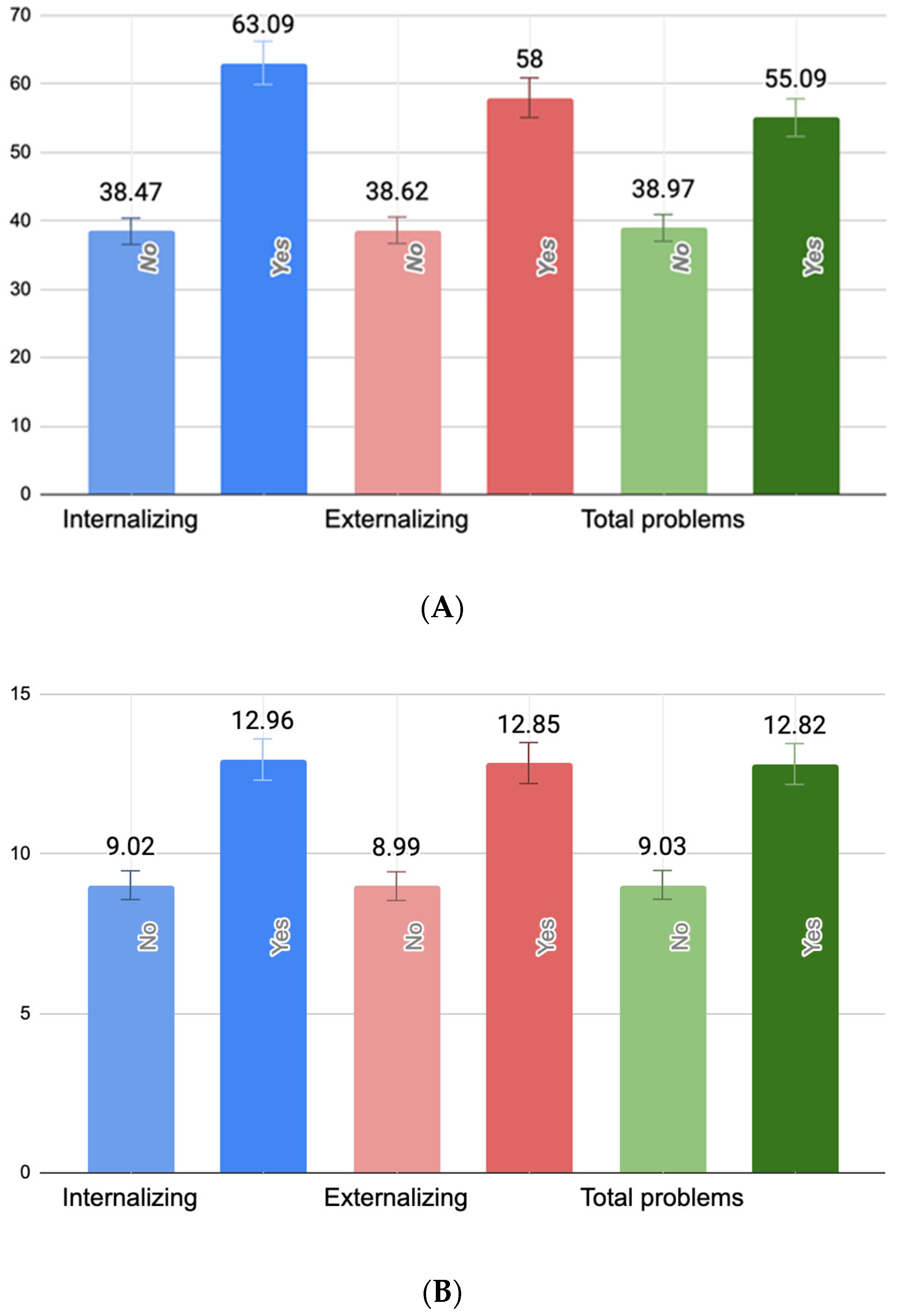
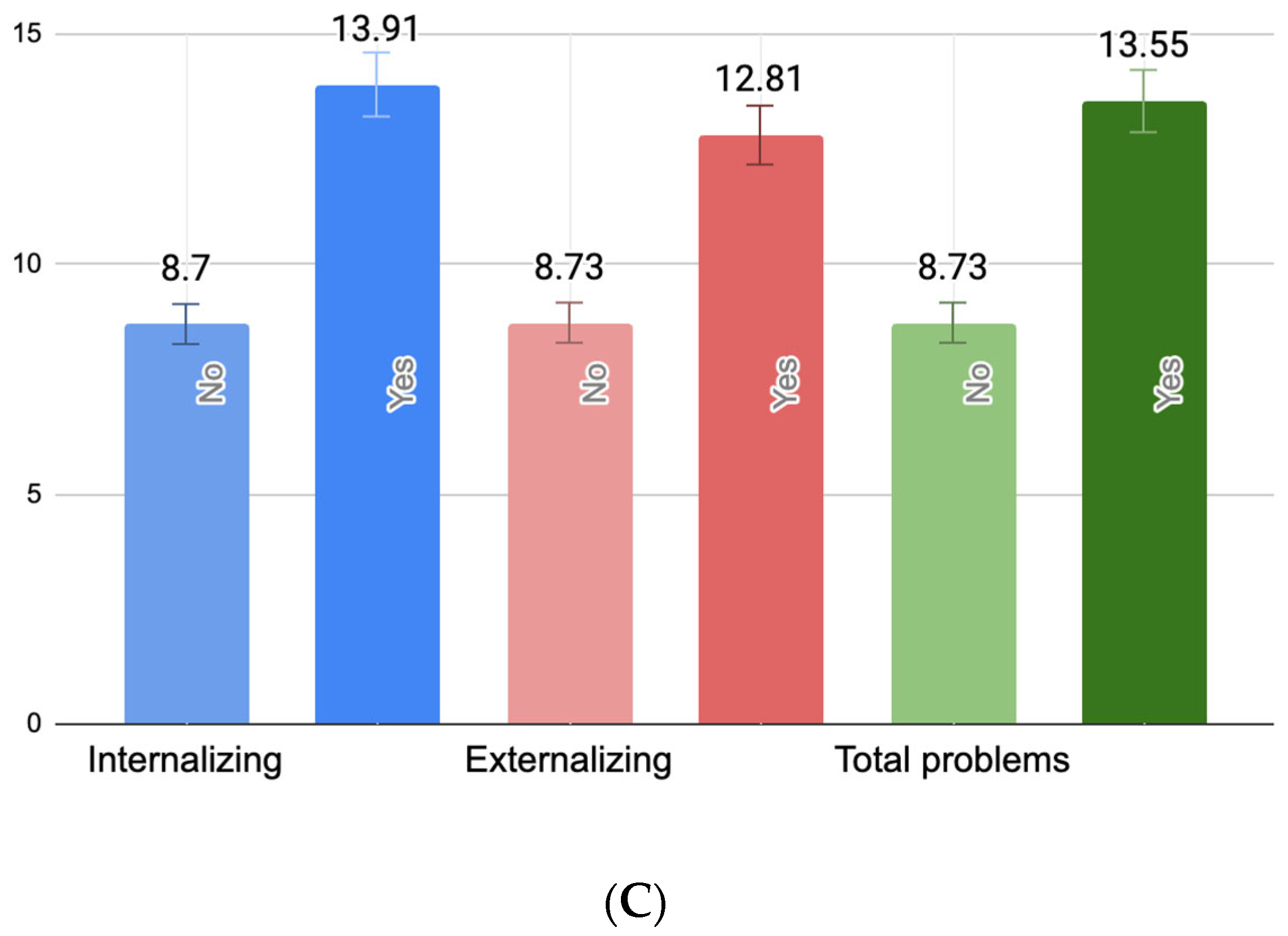
- Parental burnout was significantly associated with child internalizing and externalizing problems, independently of postpartum or present maternal depression at the dimensional level, even though associations with borderline/clinically significant outcomes were attenuated once overlapping maternal mental health factors were considered.
- Parental burnout presents a unique risk factor for child adverse outcomes in toddlerhood, distinct from maternal depression, which requires further research.
- It is crucial to recognize and support families where parents are experiencing significant burnout and caregiving-related exhaustion, particularly in contexts of limited social and institutional resources, regardless of the presence of a formal mental health diagnosis.
Abstract
1. Introduction
1.1. Background
1.2. Russia-Specific Context
1.3. Aims of the Study
2. Materials and Methods
2.1. Procedure and Participants
2.2. Measures
2.2.1. The Demographic Questionnaire
2.2.2. Parental Burnout
2.2.3. Edinburgh Postnatal Depression Scale
2.2.4. Beck Depression Inventory
2.2.5. Child Behavior Problems and Emotional Development
2.3. Covariates
2.4. Statistical Analysis
3. Results
4. Discussion
4.1. Strengths and Limitations
4.2. Further Directions
5. Conclusions
Supplementary Materials
Author Contributions
Funding
Institutional Review Board Statement
Informed Consent Statement
Data Availability Statement
Acknowledgments
Conflicts of Interest
References
- Roskam, I.; Aguiar, J.; Akgun, E.; Arikan, G.; Artavia, M.; Avalosse, H.; Aunola, K.; Bader, M.; Bahati, C.; Barham, E.J.; et al. Parental Burnout Around the Globe: A 42-Country Study. Affect. Sci. 2021, 2, 58–79. [Google Scholar] [CrossRef]
- Roskam, I.; Brianda, M.E.; Mikolajczak, M. A step forward in the conceptualization and measurement of parental burnout: The parental burnout assessment (PBA). Front. Psychol. 2018, 9, 758. [Google Scholar] [CrossRef]
- Mikolajczak, M.; Brianda, M.E.; Avalosse, H.; Roskam, I. Consequences of parental burnout: A preliminary investigation of escape and suicidal ideations, sleep disorders, addictions, marital conflicts, child abuse and neglect. Child Abuse Negl. 2018, 80, 134–145. [Google Scholar] [CrossRef]
- Furutani, K.; Kawamoto, T.; Alimardani, M.; Nakashima, K. Exhausted parents in Japan: Preliminary validation of the Japanese version of the Parental Burnout Assessment. New Dir. Child Adolesc. Dev. 2020, 174, 33–49. [Google Scholar] [CrossRef]
- Lai, J.; Cleary, M.; Sitharthan, T.; Hunt, G.E. Prevalence of comorbid substance use, anxiety and mood disorders in epidemiological surveys, 1990–2014: A systematic review and meta-analysis. Drug Alcohol Depend. 2015, 151, 1–13. [Google Scholar] [CrossRef]
- Moussavi, S.; Chatterji, S.; Verdes, E.; Tandon, A.; Patel, V.; Ustun, B. Depression, chronic diseases, and decrements in health: Results from the World Health Surveys. Lancet 2007, 370, 851–858. [Google Scholar] [CrossRef]
- Shelton, K.H.; Harold, G.T. Interparental conflict, negative parenting, and children’s adjustment: Bridging links between parents’ depression and children’s psychological problems. In Rutter’s Child and Adolescent Psychiatry; Rutter, M.J.H., Bishop, D.V.M., Pine, D.S., Scott, S., Stevenson, J., Taylor, E., Thapar, A., Eds.; Blackwell Publishing: Oxford, UK, 2008; pp. 330–350. [Google Scholar]
- Van Bakel, H.J.A.; Van Engen, M.L.; Peters, P. Validity of the Parental Burnout Inventory Among Dutch Employees. Front. Psychol. 2018, 9, 697. [Google Scholar] [CrossRef] [PubMed]
- Mikolajczak, M.; Gross, J.J.; Stinglhamber, F.; Lindahl Norberg, A.; Roskam, I. Is parental burnout distinct from job burnout and depressive symptoms? Clin. Psychol. Sci. 2020, 8, 673–689. [Google Scholar] [CrossRef]
- Sánchez-Rodríguez, R.; Orsini, É.; Laflaquière, E.; Callahan, S.; Séjourné, N. Depression, anxiety, and guilt in mothers with burnout of preschool and school-aged children: Insight from a cluster analysis. J. Affect. Disord. 2019, 259, 244–250. [Google Scholar] [CrossRef] [PubMed]
- Chen, B.-B.; Qu, Y.; Yang, B.; Chen, X. Chinese mothers’ parental burnout and adolescents’ internalizing and externalizing problems: The mediating role of maternal hostility. Dev. Psychol. 2022, 58, 58–69. [Google Scholar] [CrossRef]
- Lebert-Charron, A.; Dorard, G.; Wendland, J.; Boujut, E. Who are and are not the burnout moms? A cluster analysis study of French-speaking mothers. J. Affect. Disord. Rep. 2021, 5, 100173. [Google Scholar] [CrossRef]
- Séjourné, N.; Sanchez-Rodriguez, R.; Leboullenger, A.; Callahan, S. Maternal burn-out: An exploratory study. J. Reprod. Infant Psychol. 2018, 36, 276–288. [Google Scholar] [CrossRef] [PubMed]
- Huang, Y.; Mao, F.; Zhang, X.; Wang, J.; Xu, Z.; Cao, F. Exploring the relationship between postnatal depressive symptoms and parental burnout from the perspective of the population and individual level. BMC Psychiatry 2023, 23, 409. [Google Scholar] [CrossRef]
- Yakupova, V.A.; Suarez, A. Parental burnout, depression and emotional development of the preschoolers. Front. Psychol. 2023, 14, 1123456. [Google Scholar] [CrossRef]
- Yakupova, V.A.; Suarez, A. Maternal depression and burnout and preschoolers’ executive function development. Panam. J. Neuropsychol. 2024, 18, 203. [Google Scholar]
- Woine, A.; Escobar, M.J.; Panesso, C.; Szczygieł, D.; Mikolajczak, M.; Roskam, I. Parental Burnout and Child Behavior: A Preliminary Analysis of Mediating and Moderating Effects of Positive Parenting. Children 2024, 11, 353. [Google Scholar] [CrossRef] [PubMed]
- Paula, A.J.; Condeles, P.C.; Moreno, A.L.; Ferreira, M.B.G.; Fonseca, L.M.M.; Ruiz, M.T. Parental burnout: A scoping review. Rev. Bras. Enferm. 2021, 74, e20210203. [Google Scholar] [CrossRef]
- He, Q.; Zhao, B.; Wei, H.; Huang, F. The relationship between parental phubbing and learning burnout of elementary and secondary school students: The mediating roles of parent-child attachment and ego depletion. Front. Psychol. 2022, 13, 963492. [Google Scholar] [CrossRef]
- Apanovich, T.M.; Serykh, A.B. Emotional Burnout Symptoms in Mothers of Primary School Children: Role of Intensive Parenting Attitudes and Parenting Styles. Russ. Psychol. J. 2024, 21, 22–34. [Google Scholar]
- Kalabikhina, I.; Kyznetsova, P. Who needs (or doesn’t) three years of parental leave? Demogr. Rev. 2022, 9, 24–43. [Google Scholar] [CrossRef]
- Avdeeva, A.; Isupova, O.; Kuleshova, A.; Chernova, Z.H.; Shpakovskaya, L. Parenting 2.0: Why Modern Parents Need to Know Everything; Alpina Publisher: Moscow, Russia, 2021. [Google Scholar]
- Woodard, K.; Pollak, S.D. Is there evidence for sensitive periods in emotional development? Curr. Opin. Behav. Sci. 2020, 36, 1–6. [Google Scholar] [CrossRef]
- Roskam, I.; Raes, M.E.; Mikolajczak, M. Exhausted parents: Development and preliminary validation of the parental burnout inventory. Front. Psychol. 2017, 8, 163. [Google Scholar] [CrossRef] [PubMed]
- Starchenkova, E. Social-psychological factors of parental burnout. In Psychology of Stress and Coping Behavior: Challenges, Resources, Well-Being; Kostroma State University: Kostroma, Russia, 2019; pp. 109–113. [Google Scholar]
- Brianda, M.E.; Mikolajczak, M.; Bader, M.; Bon, S.; Déprez, A.; Favez, N.; Holstein, L.; Le Vigouroux, S.; Lebert-Charron, A.; Sánchez-Rodríguez, R.; et al. Optimizing the Assessment of Parental Burnout: A Multi-informant and Multimethod Approach to Determine Cutoffs for the Parental Burnout Inventory and the Parental Burnout Assessment. Assessment 2023, 30, 2234–2246. [Google Scholar] [CrossRef]
- Cox, J.L.; Holden, J.M.; Sagovsky, R. Detection of postnatal depression: Development of the 10-item Edinburgh Postnatal Depression Scale. Br. J. Psychiatry 1987, 150, 782–786. [Google Scholar] [CrossRef]
- Yakupova, V.A. The impact of psychological and physiological conditions of motherhood on postnatal depression. Russ. Psychol. J. 2018, 15, 8–23. [Google Scholar] [CrossRef]
- Beck, A.T.; Ward, C.H.; Mendelson, M.; Mock, J.; Erbaugh, J. An inventory for measuring depression. Arch. Gen. Psychiatry 1961, 4, 561–571. [Google Scholar] [CrossRef]
- Zlobina, M.V.; Pervushina, O.N. Analysis of Two Depression Questionnaires PHQ-9 and BDI-II. Reflexio 2018, 11, 83–98. [Google Scholar] [CrossRef]
- Achenbach, T.M.; Rescorla, L.A. Manual for the ASEBA Preschool Forms & Profiles: An Integrated System of Multi-Informant Assessment; Department of Psychiatry, University of Vermont: Cardiff, UK, 2000. [Google Scholar]
- Kolmagorova, A.V.; Slobodskaya, E.R.; Kinsht, I.A. Assessment of mental health in early age. Bull. Sib. Branch Russ. Acad. Med. Sci. 2007, 125, 45–52. [Google Scholar]
- IBM Corp. IBM SPSS Statistics for Macintosh; mIBM Corp: New York, NY, USA, 2020. [Google Scholar]
- Thériault, R.L.; Bernier, A.; Deneault, A.A. Maternal and paternal parenting stress: Direct and interactive associations with child externalizing and internalizing behavior problems. Early Child. Res. Q. 2025, 71, 114–122. [Google Scholar] [CrossRef]
- Nisskaya, A.K.; Tsyganova, E.M. Parental Practices of Controlling and Supporting the Autonomy of Elementary School Children and Early Adolescents in Russia: A Qualitative Study. Psychol. Russ. State Art 2024, 17, 3–22. [Google Scholar] [CrossRef] [PubMed]
- Schittek, A.; Roskam, I.; Mikolajczak, M. Parental burnout and borderline personality stand out to predict child maltreatment. Sci. Rep. 2023, 13, 12153. [Google Scholar] [CrossRef]
- Lowthian, E.; Bedston, S.; Kristensen, S.M.; Akbari, A.; Fry, R.; Huxley, K.; Johnson, R.; Kim, H.S.; Owen, R.K.; Taylor, C.; et al. Maternal Mental Health and Children’s Problem Behaviours: A Bi-Directional Relationship? Res. Child Adolesc. Psychopathol. 2023, 51, 1611–1626. [Google Scholar] [CrossRef]
- Zhou, Y.B.; Ruan, S.J.; Bu, Y.R.; Zhong, C.; Bao, Q. Effects of parental burnout and psychological intrusion on adolescent resilience. Sci. Rep. 2025, 15, 38441. [Google Scholar] [CrossRef]
- Curci, S.G.; Somers, J.A.; Winstone, L.K.; Luecken, L.J. Within-dyad bidirectional relations among maternal depressive symptoms and child behavior problems from infancy through preschool. Dev. Psychopathol. 2023, 35, 547–557. [Google Scholar] [CrossRef]
- Gawlik, K.S.; Melnyk, B.M.; Tan, A. Burnout and Mental Health in Working Parents: Risk Factors and Practice Implications. J. Pediatr. Health Care. 2025, 39, 41–50. [Google Scholar] [CrossRef] [PubMed]
- Roskam, I.; Aguiar, J.; Akgun, E.; Arena, A.F.; Arikan, G.; Aunola, K.; Besson, E.; Beyers, W.; Boujut, E.; Brianda, M.E.; et al. Three reasons why parental burnout is more prevalent in individualistic countries: A mediation study in 36 countries. Soc. Psychiatry Psychiatr. Epidemiol. 2024, 59, 681–694. [Google Scholar] [CrossRef] [PubMed]
- Closa-Monasterolo, R.; Gispert-Llaurado, M.; Canals, J.; Luque, V.; Zaragoza-Jordana, M.; Koletzko, B.; Grote, V.; Weber, M.; Gruszfeld, D.; Szott, K.; et al. The Effect of Postpartum Depression and Current Mental Health Problems of the Mother on Child Behaviour at Eight Years. Matern. Child Health J. 2017, 21, 1563–1572. [Google Scholar] [CrossRef]
- Kingston, D.; Kehler, H.; Austin, M.P.; Mughal, M.K.; Wajid, A.; Vermeyden, L.; Benzies, K.; Brown, S.; Stuart, S.; Giallo, R. Trajectories of maternal depressive symptoms during pregnancy and the first 12 months postpartum and child externalizing and internalizing behavior at three years. PLoS ONE 2018, 13, e0195365. [Google Scholar] [CrossRef] [PubMed]
- Netsi, E.; Pearson, R.M.; Murray, L.; Cooper, P.; Craske, M.G.; Stein, A. Association of Persistent and Severe Postnatal Depression with Child Outcomes. JAMA Psychiatry 2018, 75, 247–253. [Google Scholar] [CrossRef]
- Suarez, A.; Shraibman, L.; Yakupova, V. Long-Term Effects of Maternal Depression during Postpartum and Early Parenthood Period on Child Socioemotional Development. Children 2023, 10, 1718. [Google Scholar] [CrossRef]
- Ren, X.; Cai, Y.; Wang, J.; Chen, O. A systematic review of parental burnout and related factors among parents. BMC Public Health 2024, 24, 376. [Google Scholar] [CrossRef]
- Guseva, U. Features of emotions understanding development in Russian children. Natl. Psychol. J. 2025, 20, 100–114. [Google Scholar] [CrossRef]
- Tsunga, L.; Heron, J.; Lake, M.T.; Halligan, S.L.; Malcolm-Smith, S.; Hoffman, N.; Zar, H.J.; Fraser, A.; Stein, D.J.; Donald, K.A. Exposure to Violence and Mental Health Outcomes Among Pre-schoolers in a South African Birth Cohort. Res. Child Adolesc. Psychopathol. 2024, 52, 1635–1646. [Google Scholar] [CrossRef] [PubMed]
- Ivanov, M.V.; Boksha, I.S.; Balakireva, E.E.; Klyushnik, T.P. Epidemiological Study on the Early Detection of Mental Disorders in Young Children in Russia. Consort. Psychiatr. 2022, 3, 18–26. [Google Scholar] [CrossRef] [PubMed]
- Rean, A.; Egorova, A.; Konovalov, И. The Relationship Between Screen Time Use and Various Types of Aggression in Late Adolescence. Moscow Univ. Bull. Ser. 14 Psychol. 2025, 48, 60–83. [Google Scholar] [CrossRef]
- Tikhonova, I.V.; Misiyk, Y.V.; Khazova, S.A. About some factors of stress generation of parental role in “intensive” parents. Vestn. Kostroma State Univ. Ser. Pedagogy Psychol. Sociokinetics 2023, 29, 99–108. [Google Scholar]
- Misiyk, Y.; Khazova, S. Study of the expression of attitudes on intensive parenting in Russian women. Vestn. Kostroma State Univ. Ser. Pedagogy Psychol. Sociokinetics 2021, 27, 91–98. [Google Scholar] [CrossRef]



| Characteristics | Mean/N | SD/% | Range | |
|---|---|---|---|---|
| Parental characteristics | ||||
| Age (years) | 33.34 | 4.29 | 23–49 | |
| Education | primary/secondary | 19 | 4.5% | |
| tertiary | 400 | 95.5% | ||
| Family status | married/cohabiting with a partner | 399 | 95.2% | |
| single/divorced | 20 | 4.8% | ||
| Gestational age at childbirth | 39.36 | 1.92 | 27–42 | |
| The number of children in a family | 1 | 252 | 60.1% | |
| 2 | 92 | 22.0% | ||
| 3 | 49 | 11.7% | ||
| 4 | 18 | 4.3% | ||
| 5 | 4 | 1.0% | ||
| 6 | 2 | 0.5% | ||
| 7 | 2 | 0.5% | ||
| Mode of birth | Vaginal (including medical interventions | 300 | 71.6% | |
| Cesarean (planned/emergency) | 119 | 28.4% | ||
| EPDS total score | 9.23 | 6.01 | 0–29 | |
| Had clinically significant PPD symptoms (score ≥ 10) | 148 | 35% | ||
| BDI total score | 8.99 | 7.66 | 0–39 | |
| Had clinically significant present maternal depressive symptoms (score ≥ 20) | 43 | 10.3% | ||
| PBI total score | 39.82 | 33.51 | 0–138 | |
| PBI score above the cut-off point | 68 | 16.2% | ||
| Child characteristics | ||||
| Age (years) | 2.24 | 0.63 | 1.5–4 | |
| Child’s complications during pregnancy/childbirth | No | 329 | 78.5% | |
| Yes | 90 | 21.5% | ||
| CBCL checklist | ||||
| Internalizing problems | 48.15 | 9.78 | 29–78 | |
| Had borderline/clinically significant internalizing problems (score ≥ 65) | 23 | 5.5% | ||
| Externalizing problems | 48.92 | 8.96 | 28–80 | |
| Had borderline/clinically significant externalizing problems (score ≥ 65) | 26 | 6.2% | ||
| CBCL total score | 49.35 | 9.24 | 28–76 | |
| Had borderline/clinically significant total behavioral problems (score ≥ 65) | 22 | 5.3% | ||
| DSM-oriented scales | ||||
| Depressive problems | 1.28 | 1.34 | 0–9 | |
| Anxiety problems | 3.21 | 2.25 | 0–13 | |
| Autism spectrum problems | 1.53 | 1.83 | 0–11 | |
| Attention deficit/Hyperactivity problems | 4.57 | 2.52 | 0–12 | |
| Oppositional defiant problems | 2.61 | 2.05 | 0–11 | |
| Regression Models/Outcomes | β (95%CI) | β (95%CI) | Adjusted R2 |
|---|---|---|---|
| Model 1. Parental Burnout | |||
| Internalizing problems | 0.202 (0.109, 0.295) ** | 0.10 | |
| Externalizing problems | 0.309 (0.219, 0.400) ** | 0.15 | |
| Total problems | 0.294 (0.204, 0.384) ** | 0.15 | |
| DSM Depressive problems | 0.211 (0.116, 0.305) ** | 0.07 | |
| DSM Anxiety problems | 0.667 (0.457, 0.877) ** | 0.10 | |
| DSM Autism spectrum problems | 0.147 (0.051, 0.242) ** | 0.05 | |
| DSM Attention deficit/hyperactivity problems | 0.264 (0.172, 0.356) ** | 0.12 | |
| DSM Oppositional defiant problems | 0.208 (0.117, 0.300) ** | 0.13 | |
| Model 2. Parental Burnout (PB) and Postpartum Depression (PPD) | |||
| PB | PPD | ||
| Internalizing problems | 0.181 (0.083, 0.279) ** | 0.067 (−0.033, 0.168) | 0.10 |
| Externalizing problems | 0.301 (0.206, 0.397) ** | 0.025 (−0.073, 0.124) | 0.14 |
| Total problems | 0.282 (0.187, 0.377) ** | 0.038 (−0.059, 0.136) | 0.15 |
| DSM Depressive problems | 0.201 (0.101, 0.301) ** | 0.031 (−0.071, 0.134) | 0.07 |
| DSM Anxiety problems | 0.619 (0.397, 0.840) ** | 0.153 (−0.074, 0.380) | 0.10 |
| DSM Autism spectrum problems | 0.166 (0.065, 0.266) ** | −0.060 (−0.163, 0.044) | 0.05 |
| DSM Attention deficit/hyperactivity problems | 0.263 (0.165, 0.360) ** | 0.004 (−0.096, 0.104) | 0.11 |
| DSM Oppositional defiant problems | 0.213 (0.116, 0.309) ** | −0.015 (−0.114, 0.085) | 0.13 |
| Model 3. Parental Burnout (PB) and Present Maternal Depression | |||
| PB | Present Maternal Depression | ||
| Internalizing problems | 0.142 (0.030, 0.254) * | 0.109 (−0.005, 0.223) | 0.10 |
| Externalizing problems | 0.292 (0.183, 0.402) ** | 0.031 (−0.080, 0.143) | 0.14 |
| Total problems | 0.243 (0.135, 0.352) ** | 0.092 (−0.019, 0.202) | 0.16 |
| DSM Depressive problems | 0.150 (0.036, 0.264) ** | 0.110 (−0.006, 0.225) | 0.08 |
| DSM Anxiety problems | 0.665 (0.411, 0.919) ** | 0.003 (−0.255, 0.262) | 0.09 |
| DSM Autism spectrum problems | 0.149 (0.034, 0.265) * | -0.004 (−0.122, 0.113) | 0.05 |
| DSM Attention deficit/hyperactivity problems | 0.283 (0.171, 0.394) ** | −0.034 (−0.147, 0.079) | 0.11 |
| DSM Oppositional defiant problems | 0.246 (0.135, 0.356) ** | −0.068 (−0.18, 0.045) | 0.13 |
| Regression Models/Outcomes | OR (95% CI) | OR (95% CI) |
|---|---|---|
| Model 1. Parental Burnout | ||
| Internalizing problems | 1.70 (1.03, 2.82) * | |
| Externalizing problems | 1.74 (1.05, 2.87) * | |
| Total problems | 1.44 (0.87, 2.37) | |
| Model 2. Parental Burnout (PB) and Postpartum Depression (PPD) | ||
| PB | PPD | |
| Internalizing problems | 1.54 (0.92, 2.61) | 1.36 (0.80, 2.34) |
| Externalizing problems | 1.59 (0.94, 2.67) | 1.32 (0.79, 2.23) |
| Total problems | 1.32 (0.79, 2.21) | 1.37 (0.79, 2.37) |
| Model 3. Parental Burnout (PB) and Present Maternal Depression | ||
| PB | Present Maternal Depression | |
| Internalizing problems | 1.42 (0.78, 2.56) | 1.36 (0.77, 2.39) |
| Externalizing problems | 1.69 (0.92, 3.14) | 1.04 (0.60, 1.79) |
| Total problems | 1.21 (0.67, 2.20) | 1.33 (0.75, 2.38) |
Disclaimer/Publisher’s Note: The statements, opinions and data contained in all publications are solely those of the individual author(s) and contributor(s) and not of MDPI and/or the editor(s). MDPI and/or the editor(s) disclaim responsibility for any injury to people or property resulting from any ideas, methods, instructions or products referred to in the content. |
© 2026 by the authors. Licensee MDPI, Basel, Switzerland. This article is an open access article distributed under the terms and conditions of the Creative Commons Attribution (CC BY) license.
Share and Cite
Suarez, A.; Yakupova, V. Parental Burnout and Early-Childhood Behavioral Problems: Longitudinal Associations Beyond Maternal Depression. Children 2026, 13, 176. https://doi.org/10.3390/children13020176
Suarez A, Yakupova V. Parental Burnout and Early-Childhood Behavioral Problems: Longitudinal Associations Beyond Maternal Depression. Children. 2026; 13(2):176. https://doi.org/10.3390/children13020176
Chicago/Turabian StyleSuarez, Anna, and Vera Yakupova. 2026. "Parental Burnout and Early-Childhood Behavioral Problems: Longitudinal Associations Beyond Maternal Depression" Children 13, no. 2: 176. https://doi.org/10.3390/children13020176
APA StyleSuarez, A., & Yakupova, V. (2026). Parental Burnout and Early-Childhood Behavioral Problems: Longitudinal Associations Beyond Maternal Depression. Children, 13(2), 176. https://doi.org/10.3390/children13020176