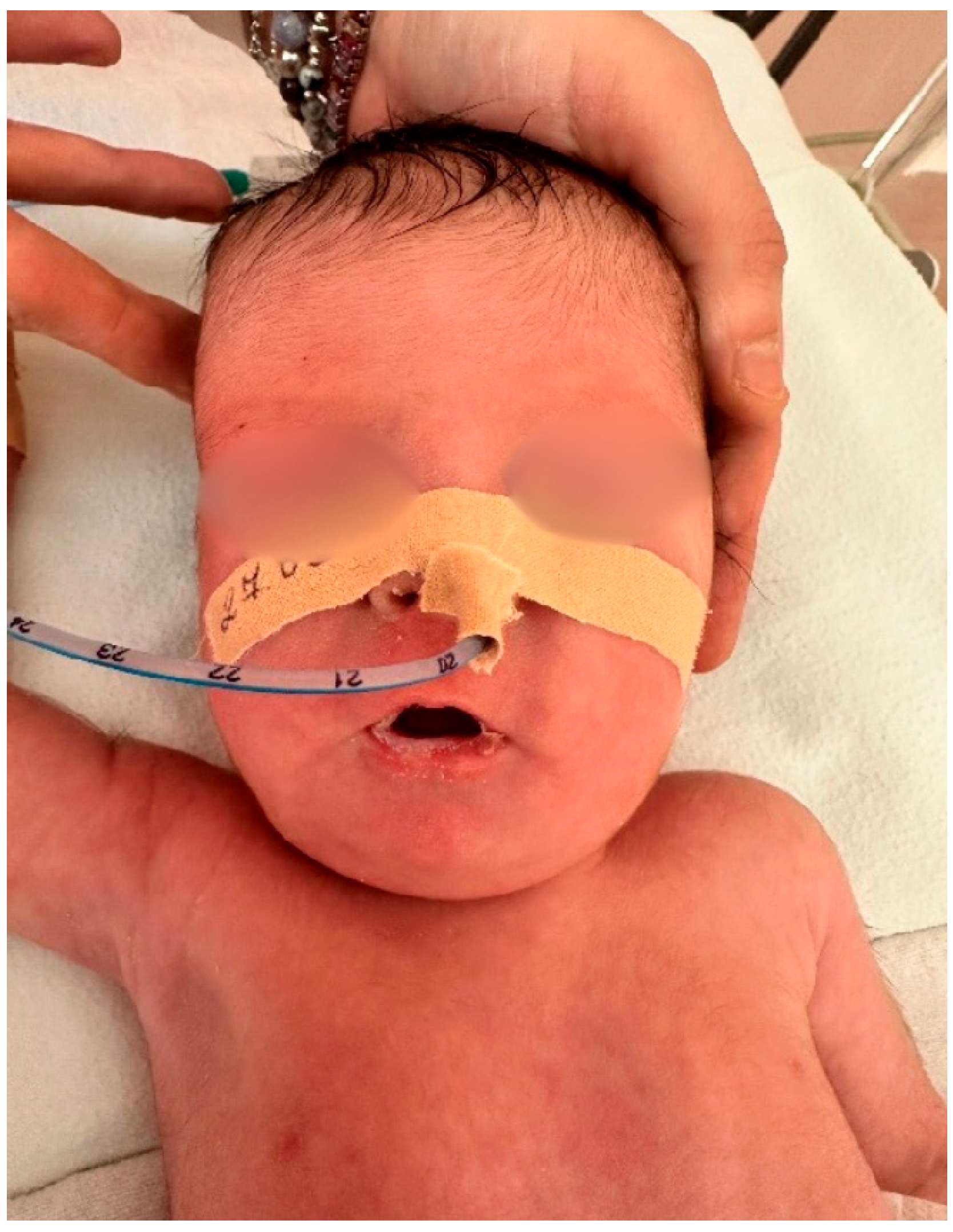

Possibilities and Limitations of Prenatal Diagnosis of Rare Imprinting Syndromes: Prader–Willi Syndrome

Abstract
1. Introduction
2. Case Presentation
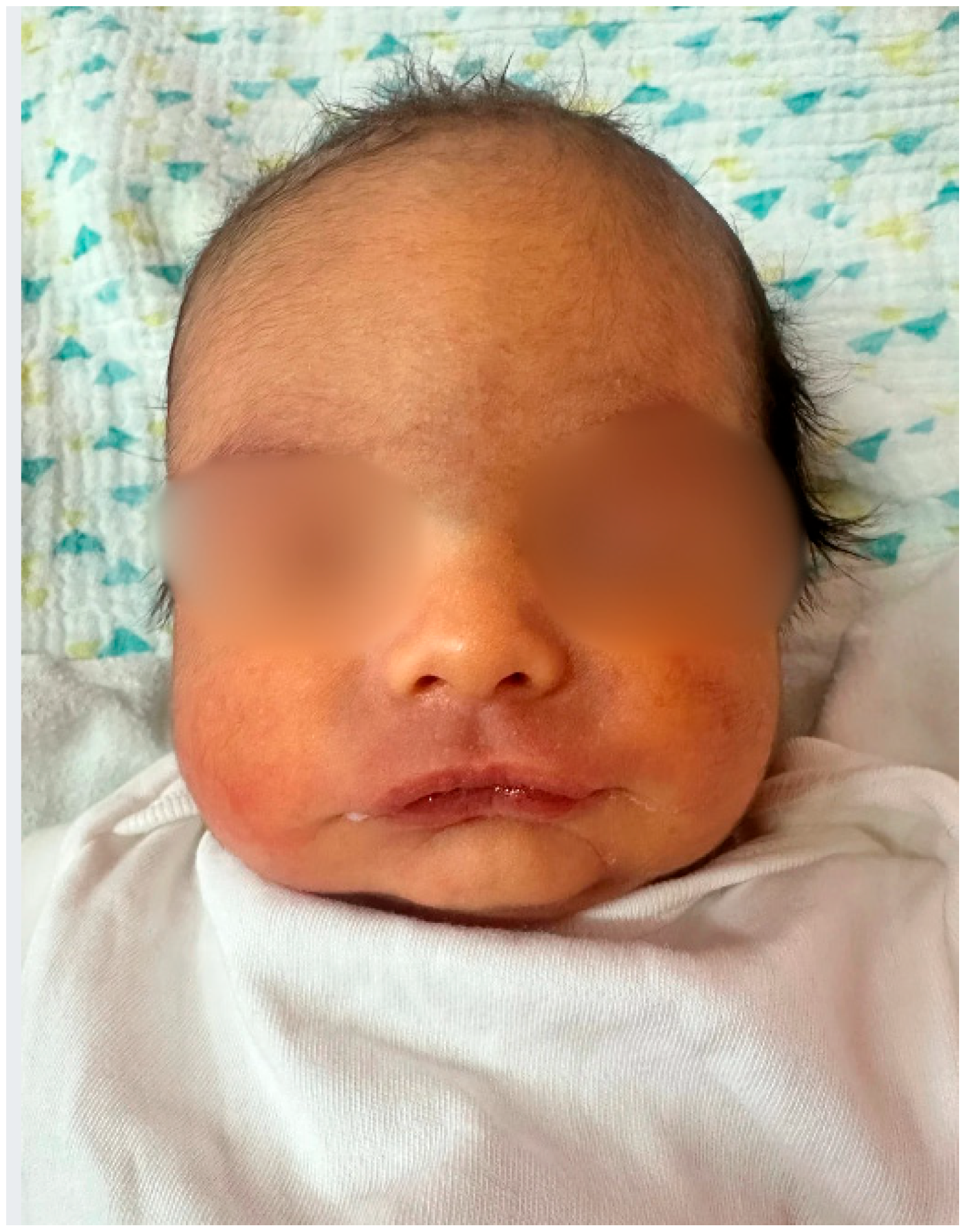
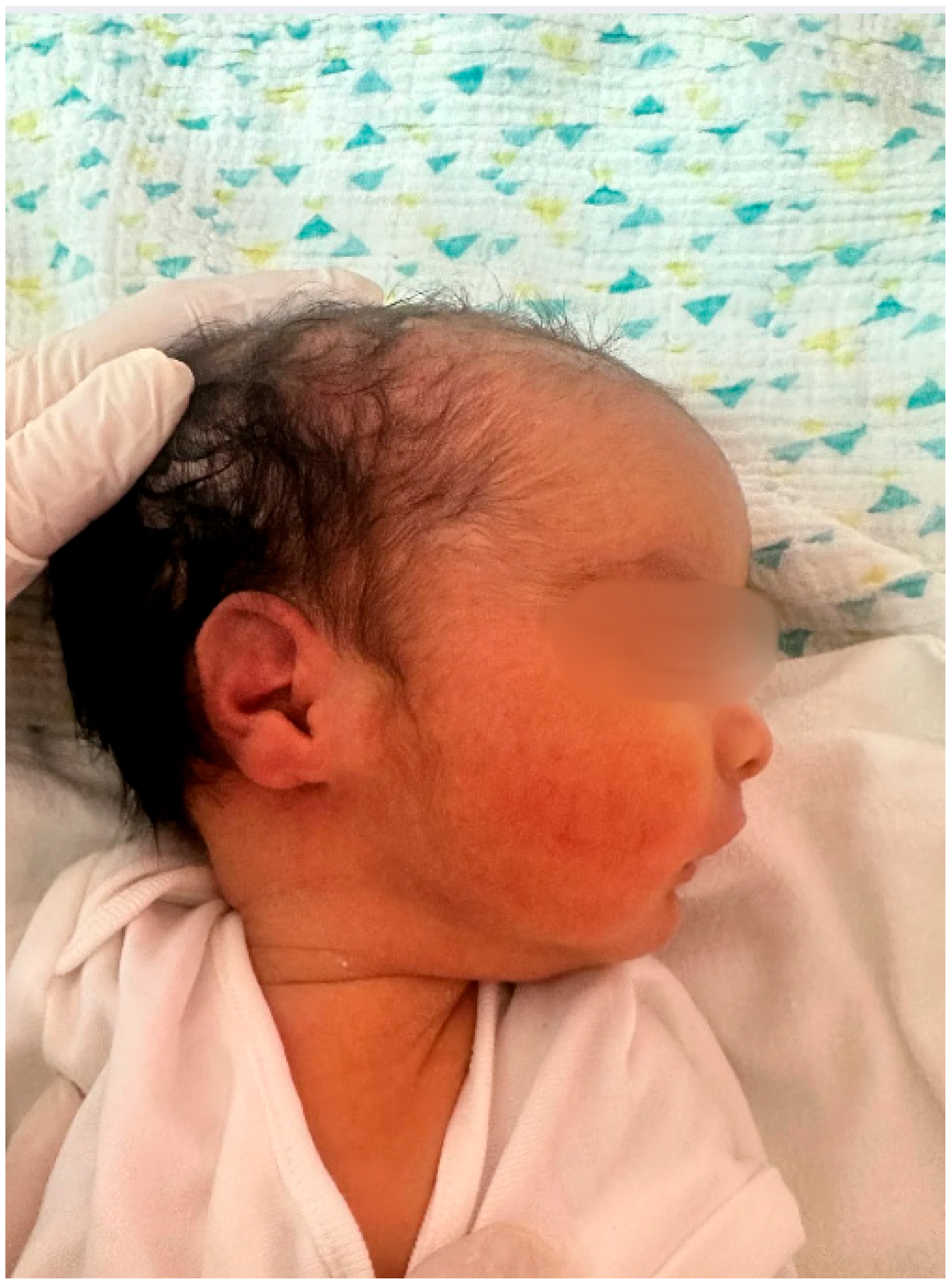
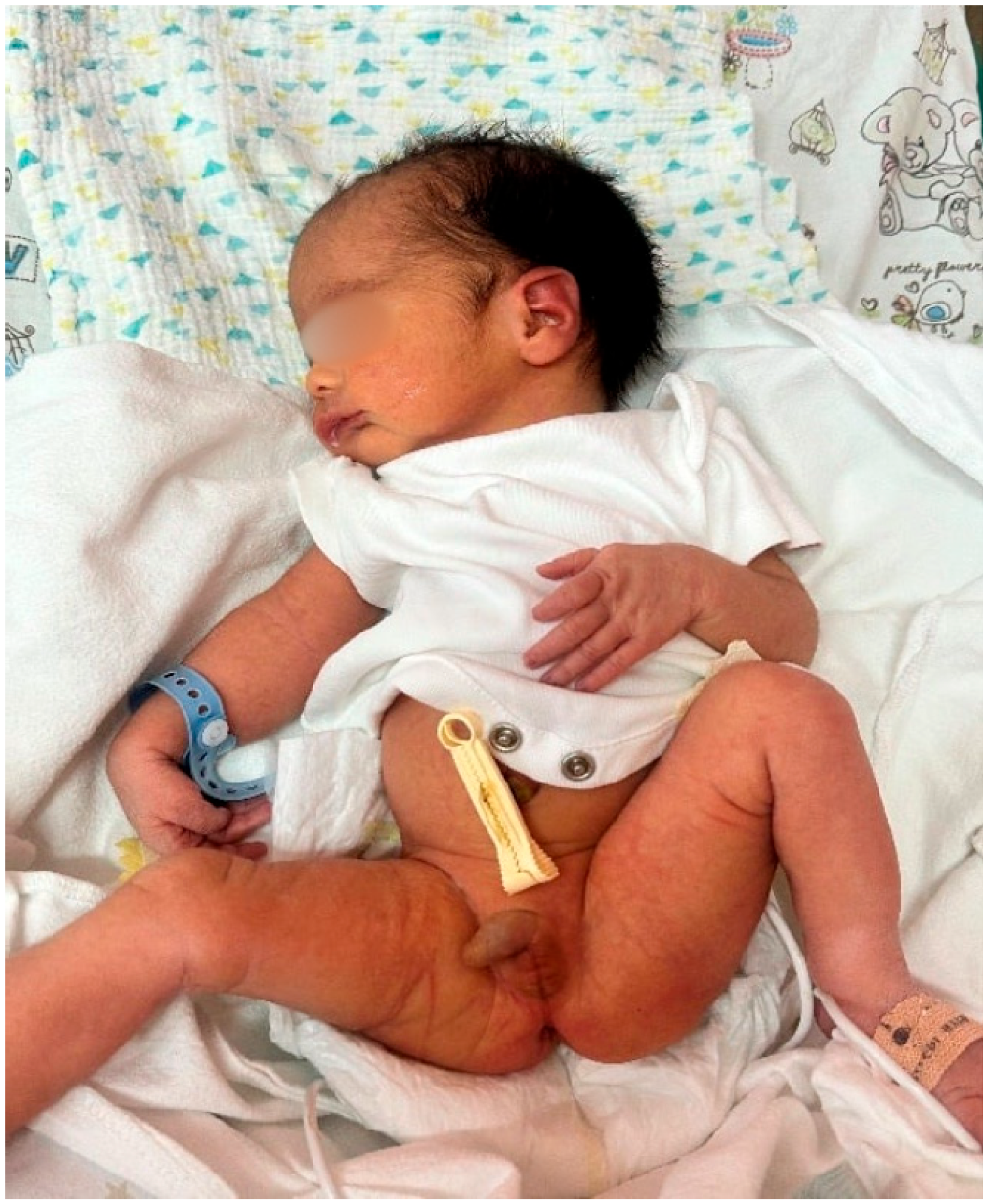
2.1. Case 1
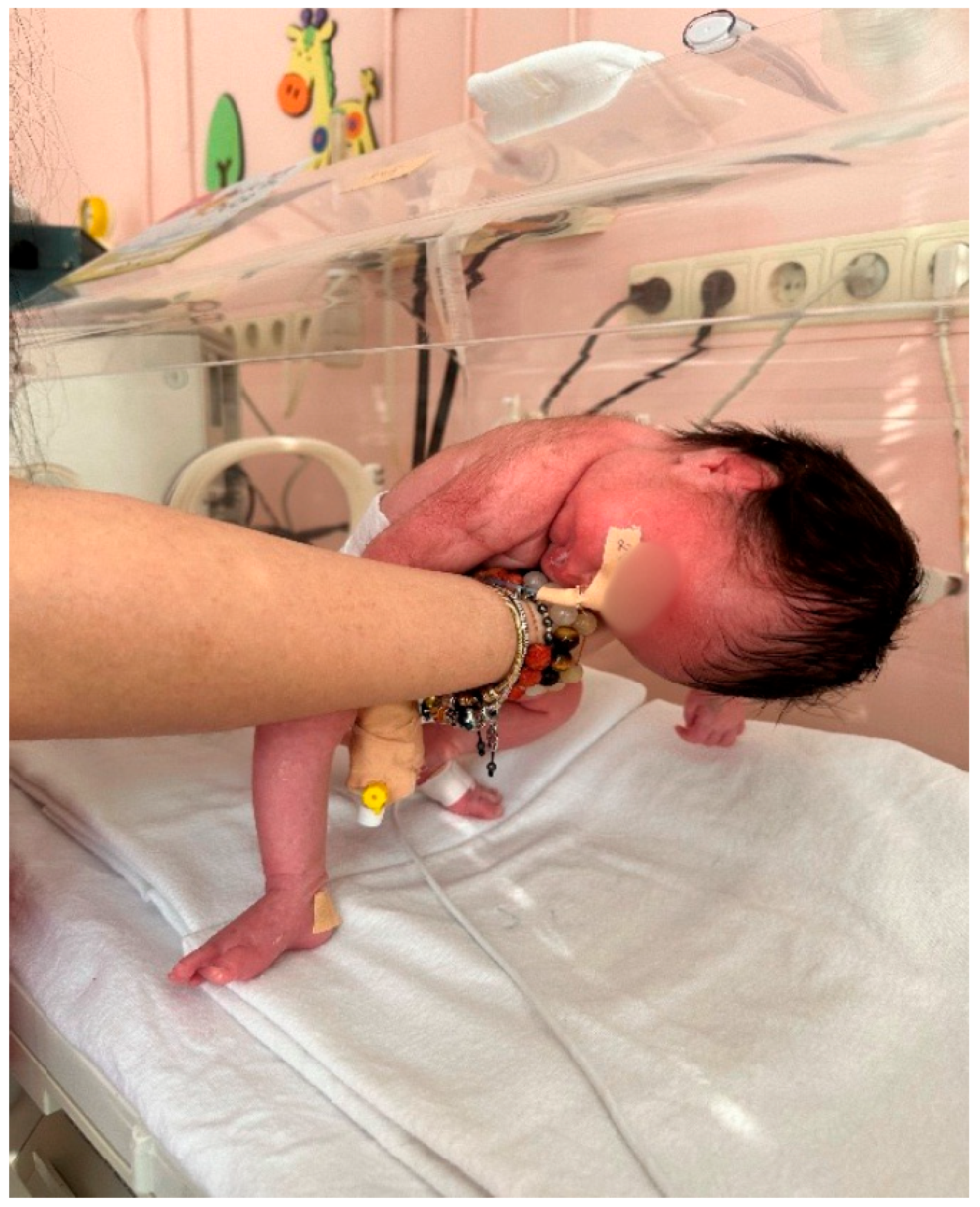
2.2. Case 2
3. Discussion
4. Conclusions
Author Contributions
Funding
Institutional Review Board Statement
Informed Consent Statement
Data Availability Statement
Acknowledgments
Conflicts of Interest
Abbreviations
| AC | abdominal circumference |
| HC | head circumference |
| IUGR | intrauterine growth restriction |
| NIPT | noninvasive prenatal testing |
| NST | non-stress test |
| PWS | Prader–Willi syndrome |
| rhGH | recombinant human growth hormone |
| SGA | small for gestational age |
| UPD | uniparental disomy |
References
- Hirsch, H.J.; Eldar-Geva, T.; Bennaroch, F.; Pollak, Y.; Gross-Tsur, V. Sexual dichotomy of gonadal function in Prader–Willi syndrome from early infancy through the fourth decade. Hum. Reprod. 2015, 30, 2587–2596. [Google Scholar] [CrossRef] [PubMed]
- Butler, M.G.; Hartin, S.N.; Hossain, W.A.; Manzardo, A.M.; Kimonis, V.; Dykens, E.; Gold, J.A.; Kim, S.J.; Weisensel, N.; Tamura, R.; et al. Molecular genetic classification in Prader–Willi syndrome: A multisite cohort study. J. Med. Genet. 2019, 56, 149–153. [Google Scholar] [CrossRef]
- Chen, C.P.; Lin, M.H.; Chen, Y.Y.; Chern, S.R.; Wu, P.S.; Chen, S.W.; Wu, F.T.; Town, D.D.; Lee, M.S.; Pan, C.W.; et al. Prenatal diagnosis of a 15q11.2–q14 deletion of paternal origin associated with increased nuchal translucency, mosaicism for de novo multiple unbalanced translocations and Prader–Willi syndrome. Taiwan J. Obstet. Gynecol. 2021, 60, 335–340. [Google Scholar] [CrossRef] [PubMed]
- Bigi, N.; Faure, J.M.; Coubes, C.; Puechberty, J.; Lefort, G.; Sarda, P.; Blanchet, P. Prader–Willi syndrome: Is there a recognizable fetal phenotype? Prenat. Diagn. 2008, 28, 796–799. [Google Scholar] [CrossRef]
- Gross, N.; Rabinowitz, R.; Gross-Tsur, V.; Hirsch, H.J.; Eldar-Geva, T. Prader–Willi syndrome can be diagnosed prenatally. Am. J. Med. Genet. A 2015, 167A, 80–85. [Google Scholar] [CrossRef]
- Fridman, C.; Koiffmann, C.P. Origin of uniparental disomy 15 in patients with Prader–Willi or Angelman syndrome. Am. J. Med. Genet. 2000, 94, 249–253. [Google Scholar] [CrossRef]
- Ye, Y.; Fu, Y.; Zhang, Z.; Ning, H.; Tao, F.; Wang, X.; Fang, Q.; Chen, Z.; Hao, X. Prenatal diagnosis of Prader–Willi syndrome via maternal UPD15 with placental mosaicism: Incidental discovery of fetal DMD carrier status. Front. Genet. 2025, 16, 1675663. [Google Scholar] [CrossRef] [PubMed]
- Srebnik, N.; Gross-Even Zohar, N.; Salama, A.; Sela, H.Y.; Hirsch, H.J.; Gross-Tsur, V.; Eldar-Geva, T. Recognizing the unique prenatal phenotype of Prader–Willi syndrome indicates the need for a diagnostic methylation test. Prenat. Diagn. 2020, 40, 878–884. [Google Scholar] [CrossRef]
- Adam, M.J.; Enderle, I.; Le Bouar, G.; Cabaret-Dufour, A.S.; Tardif, C.; Contin, L.; Arnaud, A.; Proisy, M.; Jaillard, S.; Pasquier, L.; et al. Performance of diagnostic ultrasound to identify causes of hydramnios. Prenat. Diagn. 2021, 41, 111–122. [Google Scholar] [CrossRef]
- Insoft, R.M.; Hurvitz, J.; Estrella, E.; Krishnamoorthy, K.S. Prader–Willi syndrome associated with fetal goiter: A case report. Am. J. Perinatol. 1999, 16, 29–31. [Google Scholar] [CrossRef]
- Akiba, Y.; Ono, M.; Shirahashi, M.; Noda, S.; Nishijima, S.; Amagata, T.; Kusano, R.; Fuke, T.; Hayashida, S.; Ikeda, T.; et al. Polyhydramnios associated with Prader–Willi syndrome. J. Obstet. Gynaecol. 2015, 35, 752–753. [Google Scholar]
- Dong, Y.; Liu, S.; Li, J.; Chen, Q.; Luo, J.; Li, C.; Li, H.; Qi, H.; Li, R. Possibility of early diagnosis in a fetus affected by Prader–Willi syndrome with maternal hetero-UPD15: A lesson to be learned. Mol. Med. Rep. 2019, 20, 95–102. [Google Scholar] [CrossRef]
- Naotunna, C.; Lucas-Herald, A.; Donaldson, M.; Shaikh, M. Prader–Willi syndrome: An update on the multidisciplinary approach. Paediatr. Child Health 2025, 35, 118–123. [Google Scholar] [CrossRef]
- Denizot, S.; Boscher, C.; Le Vaillant, C.; Rozé, J.C.; Le Guen, C.G. Distal arthrogryposis and neonatal hypotonia: An unusual presentation of Prader–Willi syndrome. J. Perinatol. 2004, 24, 733–734. [Google Scholar] [CrossRef][Green Version]
- Rodprasert, W.; Virtanen, H.E.; Mäkelä, J.A.; Toppari, J. Hypogonadism and cryptorchidism. Front. Endocrinol. 2020, 10, 906. [Google Scholar] [CrossRef] [PubMed]
- McCandless, S.E.; Committee on Genetics. Clinical report—Health supervision for children with Prader–Willi syndrome. Pediatrics 2011, 127, 195–204. [Google Scholar] [CrossRef]
- Gozal, D. Absent peripheral chemosensitivity in Prader–Willi syndrome. J. Appl. Physiol. 1994, 77, 2231–2236. [Google Scholar] [CrossRef]
- Arens, R.; Gozal, D.; Omlin, K.J.; Livingston, F.R.; Liu, J.; Keens, T.G.; Ward, S.L. Hypoxic and hypercapnic ventilatory responses in Prader–Willi syndrome. J. Appl. Physiol. 1994, 77, 2224–2230. [Google Scholar] [CrossRef]
- Lindgren, A.C.; Hellström, L.G.; Ritzén, E.M.; Milerad, J. Growth hormone treatment increases CO2 response, ventilation and central inspiratory drive in children with Prader–Willi syndrome. Eur. J. Pediatr. 1999, 158, 936–940. [Google Scholar] [CrossRef] [PubMed]
- Nixon, G.M.; Brouillette, R.T. Sleep and breathing in Prader–Willi syndrome. Pediatr. Pulmonol. 2002, 34, 209–217. [Google Scholar] [CrossRef] [PubMed]
- Urquhart, D.S.; Gulliver, T.; Williams, G.; Harris, M.A.; Blackmore, A.M. Central sleep-disordered breathing and the effect of oxygen therapy in infants with Prader–Willi syndrome. Arch. Dis. Child. 2013, 98, 592–595. [Google Scholar] [CrossRef] [PubMed]
- Cohen, M.; Hamilton, J.; Narang, I. Clinically important central sleep apnea in infants with Prader–Willi syndrome. PLoS ONE 2014, 9, e115011. [Google Scholar] [CrossRef]
- Tan, H.L.; Urquhart, D.S. Respiratory complications in children with Prader–Willi syndrome. Paediatr. Respir. Rev. 2017, 23, 52–59. [Google Scholar] [CrossRef] [PubMed]
- Çizmecioğlu, F.M.; Jones, J.H.; Paterson, W.F.; Kherra, S.; Kourime, M.; McGowan, R.; Shaikh, M.G.; Donaldson, M. Neonatal features of Prader–Willi syndrome: The case for making the diagnosis during the first week of life. J. Clin. Res. Pediatr. Endocrinol. 2018, 10, 264–273. [Google Scholar] [CrossRef] [PubMed]
- Carrel, A.L.; Moerchen, V.; Myers, S.E.; Bekx, M.T.; Whitman, B.Y.; Allen, D.B. Growth hormone improves mobility and body composition in infants and toddlers with Prader–Willi syndrome. J. Pediatr. 2004, 145, 744–749. [Google Scholar] [CrossRef]
- Reus, L.; Pelzer, B.J.; Otten, B.J.; Siemensma, E.P.; Velden, J.A.V.A.-V.D.; Festen, D.A.; Hokken-Koelega, A.C.; der Sanden, M.W.N.-V. Growth hormone combined with child-specific motor training improves motor development in infants with Prader–Willi syndrome: A randomized controlled trial. Res. Dev. Disabil. 2013, 34, 3092–3103. [Google Scholar] [CrossRef]
- Festen, D.A.M.; Wevers, M.; Lindgren, A.C.; Böhm, B.; Otten, B.J.; Wit, J.M.; Duivenvoorden, H.J.; Hokken-Koelega, A.C.S. Mental and motor development before and during growth hormone treatment in infants and toddlers with Prader–Willi syndrome. Clin. Endocrinol. 2008, 68, 919–925. [Google Scholar] [CrossRef]
- Donze, S.H.; Damen, L.; Mahabier, E.F.; Hokken-Koelega, A.C.S. Improved mental and motor development during 3 years of growth hormone treatment in very young children with Prader–Willi syndrome. J. Clin. Endocrinol. Metab. 2018, 103, 3714–3719. [Google Scholar] [CrossRef]



| Parameter | Case 1 | Case 2 |
|---|---|---|
| Gestational age at delivery | 35 weeks | 36 weeks |
| Onset of growth restriction | Late second/early third trimester | From 20th week |
| Abdominal circumference (AC) | Disproportionately reduced | Disproportionately reduced |
| Head circumference (HC) | Relatively preserved | Relatively preserved |
| HC/AC ratio | Increased | Increased |
| Fetal movements | Reduced | Markedly reduced |
| Amniotic fluid volume | Normal | Oligohydramnios |
| Umbilical artery Doppler | Normal | Normal |
| Middle cerebral artery Doppler | Normal | Normal |
| Non-stress test (NST) | Normal reactivity | Reduced to absent reactivity |
| Structural anomalies on ultrasound | None detected | None detected |
| Noninvasive prenatal testing (NIPT) | Normal | Normal |
Disclaimer/Publisher’s Note: The statements, opinions and data contained in all publications are solely those of the individual author(s) and contributor(s) and not of MDPI and/or the editor(s). MDPI and/or the editor(s) disclaim responsibility for any injury to people or property resulting from any ideas, methods, instructions or products referred to in the content. |
© 2026 by the authors. Licensee MDPI, Basel, Switzerland. This article is an open access article distributed under the terms and conditions of the Creative Commons Attribution (CC BY) license.
Share and Cite
Anzhel, S.; Yordanova, N.; Kovachev, E.; Krumova, D.; Ismail, E. Possibilities and Limitations of Prenatal Diagnosis of Rare Imprinting Syndromes: Prader–Willi Syndrome. Children 2026, 13, 177. https://doi.org/10.3390/children13020177
Anzhel S, Yordanova N, Kovachev E, Krumova D, Ismail E. Possibilities and Limitations of Prenatal Diagnosis of Rare Imprinting Syndromes: Prader–Willi Syndrome. Children. 2026; 13(2):177. https://doi.org/10.3390/children13020177
Chicago/Turabian StyleAnzhel, Simona, Nikolinka Yordanova, Emil Kovachev, Darina Krumova, and Elis Ismail. 2026. "Possibilities and Limitations of Prenatal Diagnosis of Rare Imprinting Syndromes: Prader–Willi Syndrome" Children 13, no. 2: 177. https://doi.org/10.3390/children13020177
APA StyleAnzhel, S., Yordanova, N., Kovachev, E., Krumova, D., & Ismail, E. (2026). Possibilities and Limitations of Prenatal Diagnosis of Rare Imprinting Syndromes: Prader–Willi Syndrome. Children, 13(2), 177. https://doi.org/10.3390/children13020177