


Trends and Effectiveness of ICT Interventions for the Elderly to Reduce Loneliness: A Systematic Review

Abstract
1. Introduction
2. Materials and Methods
2.1. Search Strategy
2.2. Eligibility Criteria and Study Selection
2.3. Data Items and Data Collection Process
2.4. Risk of Bias in Individual Studies
3. Results
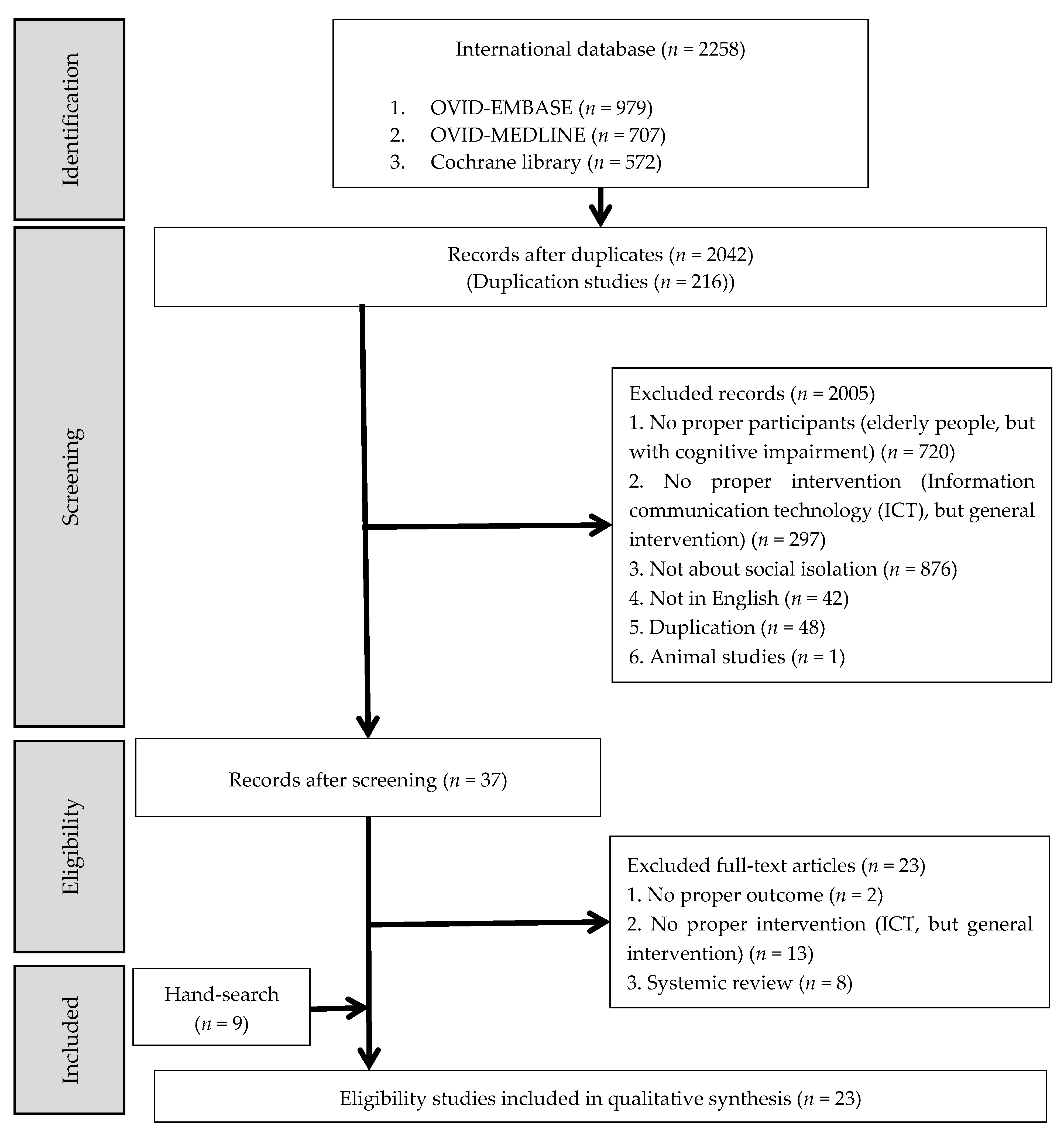
3.1. Study Selection
3.2. Characteristics of Included Studies
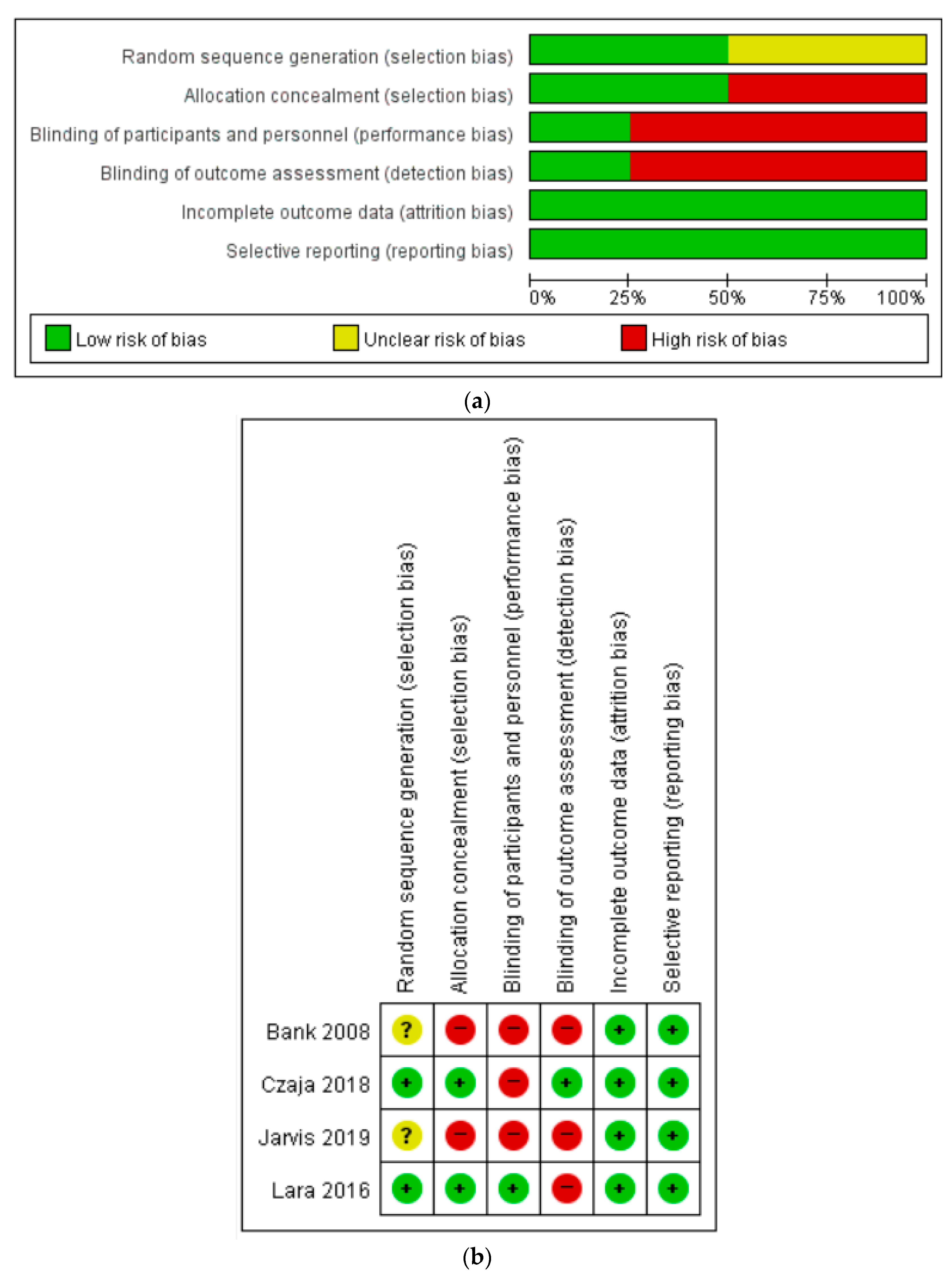
3.3. Quality Assessment
3.4. Development Trend
3.4.1. Animal Robot
3.4.2. Humanoid Agent
3.4.3. Mobile Robot
3.4.4. Exercise Game
3.4.5. Interpersonal Communication
3.4.6. Online Social Platform
3.5. Effectiveness of ICT Interventions Designed for the Elderly
3.5.1. Loneliness and Social Isolation
3.5.2. Life Satisfaction
3.5.3. Social Support
3.5.4. Quality of Life
3.5.5. Other Affective Responses
3.5.6. Usage and Usability
3.5.7. Attitude toward ICT Interventions
3.5.8. Others: Diet Management, Weight Control, and Physical Activity
4. Discussion
5. Conclusions
Author Contributions
Funding
Institutional Review Board Statement
Acknowledgments
Conflicts of Interest
Appendix A. Search Term
| Population | Intervention | Outcome |
| “The elderly” OR “elderly people” OR “older people” OR “elderly” OR “elderly person” OR “older frail adults” OR “seniors” OR “older adults” OR “aging population” OR “elderly population” OR “aging” OR “exp. aging/” AND | “information communication technology” OR “ICT” OR “social media” OR “exp. social media/” OR “telepresence robot” OR “robotic assistants” OR “assistive robotics” OR “rehabilitation robots” OR “exp. rehabilitation robot/” OR “mobile robotic systems” OR “robotic assistive technologies” OR “service robot” OR “virtual reality and social media OR virtual reality-based application” OR “rehabilitative applications” OR “VR-based social application” OR “virtual reality cognitive training programs” OR “video conference application” OR “social application” OR “technology applications” OR “mobile instant messaging” OR “online platforms” OR “social platform” OR “online service platform” OR “online social support tool” OR “social media platforms” OR “active video game” OR “persuasive video gaming” OR “video game role-play” OR “persuasive social impact game” OR “computer system” OR “exp. computer system/” OR “living in network connected communities” OR “exergames” OR “the Personal Reminder Information and Social Management system (PRISM)” OR “PRISM Buddy” OR “mHealth-supported intervention” OR “WhatsApp” OR “Social Bike application” OR “Will Sports game package” AND | “social isolation” OR “exp. social isolation/” OR “social support” OR “exp. social support/” OR “social connection” OR “social connectedness” OR “loneliness” OR “exp. loneliness/” OR “social interaction” OR “exp. social interaction/” OR “well-being” OR “exp. wellbeing/” OR “social ties” OR “social connectivity” OR “the quality of elderly life” OR “physical and cognitive training” OR “health care” |
References
- Ammar, A.; Bouaziz, B.; Trabelsi, K.; Glenn, J.; Zmijewski, P.; Müller, P.; Chtourou, H.; Jmaiel, M.; Chamari, K.; Driss, T.; et al. Applying digital technology to promote active and healthy confinement lifestyle during pandemics in the elderly. Biol. Sport 2021, 38, 391–396. [Google Scholar] [CrossRef] [Scilit]
- Bartlett, H.; Warburton, J.; Lui, C.-W.; Peach, L.; Carroll, M. Preventing social isolation in later life: Findings and insights from a pilot Queensland intervention study. Ageing Soc. 2013, 33, 1167. [Google Scholar] [CrossRef] [Scilit]
- Cornwell, E.Y.; Waite, L.J. Social disconnectedness, perceived isolation, and health among older adults. J. Health Soc. Behav. 2009, 50, 31–48. [Google Scholar] [CrossRef] [Scilit]
- Eng, P.M.; Rimm, E.B.; Fitzmaurice, G.; Kawachi, I. Social ties and change in social ties in relation to subsequent total and cause-specific mortality and coronary heart disease incidence in men. Am. J. Epidemiol. 2002, 155, 700–709. [Google Scholar] [CrossRef] [Scilit] [PubMed]
- Nicholson, N.R., Jr. Social isolation in older adults: An evolutionary concept analysis. J. Adv. Nurs. 2009, 65, 1342–1352. [Google Scholar] [CrossRef] [Scilit] [PubMed]
- Dickens, A.P.; Richards, S.H.; Greaves, C.J.; Campbell, J.L. Interventions targeting social isolation in older people: A systematic review. BMC Public Health 2011, 11, 1–22. [Google Scholar] [CrossRef] [Scilit] [PubMed]
- Sum, S.; Mathews, M.R.; Pourghasem, M.; Hughes, I. Internet technology and social capital: How the Internet affects seniors’ social capital and wellbeing. J. Comput. Mediat. Commun. 2008, 14, 202–220. [Google Scholar] [CrossRef] [Scilit]
- Li, J.; Erdt, M.; Chen, L.; Cao, Y.; Lee, S.Q.; Theng, Y.L. The Social Effects of Exergames on Older Adults: Systematic Review and Metric Analysis. J. Med. Internet Res. 2018, 20, e10486. [Google Scholar] [CrossRef] [Scilit]
- Van Bel, D.T.; Smolders, K.; IJsselsteijn, W.A.; de Kort, Y. Social connectedness: Concept and measurement. Intell. Environ. 2009, 2, 67–74. [Google Scholar]
- Drageset, J.; Kirkevold, M.; Espehaug, B. Loneliness and social support among nursing home residents without cognitive impairment: A questionnaire survey. Int. J. Nurs. Stud. 2011, 48, 611–619. [Google Scholar] [CrossRef] [Scilit]
- Baker, S.; Warburton, J.; Waycott, J.; Batchelor, F.; Hoang, T.; Dow, B.; Ozanne, E.; Vetere, F. Combatting social isolation and increasing social participation of older adults through the use of technology: A systematic review of existing evidence. Australas. J. Ageing 2018, 37, 184–193. [Google Scholar] [CrossRef] [Scilit] [PubMed]
- Li, J.; Xu, X.; Pham, T.P.; Theng, Y.L.; Katajapuu, N.; Luimula, M. Exergames Designed for Older Adults: A Pilot Evaluation on Psychosocial Well-Being. Games Health J. 2017, 6, 371–378. [Google Scholar] [CrossRef] [Scilit]
- D’Onofrio, G.; Fiorini, L.; de Mul, M.; Fabbricotti, I.; Okabe, Y.; Hoshino, H.; Limosani, R.; Vitanza, A.; Greco, F.; Giuliani, F.; et al. Agile Co-Creation for Robots and Aging (ACCRA) Project: New technological solutions for older people. Eur. Geriatr. Med. 2018, 9, 795–800. [Google Scholar] [CrossRef] [Scilit]
- McTavish, F.; Gustafson, D.H.; Mahoney, J.E.; Johnson, R.A.; Lee, J.D.; Quanbeck, A.; Atwood, A.K.; Isham, A.; Veeramani, R.; Clemson, L.; et al. The effect of an information and communication technology (ICT) on older adults’ quality of life: Study protocol for a randomized control trial. Trials 2015, 16, 191. [Google Scholar]
- Arlati, S.; Colombo, V.; Spoladore, D.; Greci, L.; Pedroli, E.; Serino, S.; Cipresso, P.; Goulene, K.; Stramba-Badiale, M.; Riva, G.; et al. A Social Virtual Reality-Based Application for the Physical and Cognitive Training of the Elderly at Home. Sensors 2019, 19, 261. [Google Scholar] [CrossRef] [Scilit]
- Rochat, J.; Nap, H.H.; Ricci, A.; Cornelisse, L.; Lukkien, D.; Lovis, C.; Ehrler, F. Designing an Online Social Support Platform Through Co-Creation with Seniors. Stud. Health Technol. Inform. 2018, 247, 760–764. [Google Scholar]
- Vercelli, A.; Rainero, I. My-AHA, an ICT platform to detect frailty risk and propose personalized intervention. Syst. Med. 2019, 2, A32–A33. [Google Scholar]
- Banks, M.R.; Willoughby, L.M.; Banks, W.A. Animal-assisted therapy and loneliness in nursing homes: Use of robotic versus living dogs. J. Am. Med. Dir. Assoc. 2008, 9, 173–177. [Google Scholar] [CrossRef] [Scilit]
- Czaja, S.J.; Boot, W.R.; Charness, N.; Rogers, W.A.; Sharit, J. Improving Social Support for Older Adults Through Technology: Findings From the PRISM Randomized Controlled Trial. Gerontologist 2018, 58, 467–477. [Google Scholar] [CrossRef] [Scilit]
- Jarvis, M.A.; Padmanabhanunni, A.; Chipps, J. An Evaluation of a Low-Intensity Cognitive Behavioral Therapy mHealth-Supported Intervention to Reduce Loneliness in Older People. Int. J. Environ. Res. Public Health 2019, 16, 1305. [Google Scholar] [CrossRef] [Scilit] [PubMed]
- Kanamori, M.; Suzuki, M.; Oshiro, H.; Tanaka, M.; Inoguchi, T.; Takasugi, H.; Saito, Y.; Yokoyama, T. Pilot study on improvement of quality of life among elderly using a pet-type robot. In Proceedings of the 2003 IEEE International Symposium on Computational Intelligence in Robotics and Automation. Computational Intelligence in Robotics and Automation for the New Millennium (Cat. No. 03EX694), Kobe, Japan, 16–20 July 2003; pp. 107–112. [Google Scholar]
- Ring, L.; Barry, B.; Totzke, K.; Bickmore, T. Addressing loneliness and isolation in older adults: Proactive affective agents provide better support. In Proceedings of the 2013 Humaine Association Conference on Affective Computing and Intelligent Interaction, Geneva, Switzerland, 2–5 September 2013; pp. 61–66. [Google Scholar]
- Bickmore, T.W.; Caruso, L.; Clough-Gorr, K.; Heeren, T. ‘It’s just like you talk to a friend’ relational agents for older adults. Interact. Comput. 2005, 17, 711–735. [Google Scholar] [CrossRef] [Scilit]
- Hemberg, J.; Santamaki Fischer, R. A Window Toward the World: Older Adults’ Experiences of Becoming in Health and Developing as Human Beings Through Interacting with Others Using Real Video Communication. Holist. Nurs. Pract. 2018, 32, 90–97. [Google Scholar] [CrossRef] [Scilit]
- Koceska, N.; Koceski, S.; Beomonte Zobel, P.; Trajkovik, V.; Garcia, N. A Telemedicine Robot System for Assisted and Independent Living. Sensors 2019, 19, 834. [Google Scholar] [CrossRef] [Scilit]
- Lara, J.; O’Brien, N.; Godfrey, A.; Heaven, B.; Evans, E.H.; Lloyd, S.; Moffatt, S.; Moynihan, P.J.; Meyer, T.D.; Rochester, L.; et al. Pilot Randomised Controlled Trial of a Web-Based Intervention to Promote Healthy Eating, Physical Activity and Meaningful Social Connections Compared with Usual Care Control in People of Retirement Age Recruited from Workplaces. PLoS ONE 2016, 11, e0159703. [Google Scholar] [CrossRef] [Scilit]
- Wada, K.; Shibata, T. Social effects of robot therapy in a care house-change of social network of the residents for two months. In Proceedings of the 2007 IEEE International Conference on Robotics and Automation, Rome, Italy, 10–14 April 2007; pp. 1250–1255. [Google Scholar]
- Koceski, S.; Koceska, N. Evaluation of an Assistive Telepresence Robot for Elderly Healthcare. J. Med. Syst. 2016, 40, 1–7. [Google Scholar] [CrossRef] [Scilit] [PubMed]
- Chen, Y.R.; Schulz, P.J. The Effect of Information Communication Technology Interventions on Reducing Social Isolation in the Elderly: A Systematic Review. J. Med. Internet Res. 2016, 18, e18. [Google Scholar] [CrossRef] [Scilit]
- Chipps, J.; Jarvis, M.A.; Ramlall, S. The effectiveness of e-Interventions on reducing social isolation in older persons: A systematic review of systematic reviews. J. Telemed. Telecare 2017, 23, 817–827. [Google Scholar] [CrossRef] [Scilit] [PubMed]
- Khosravi, P.; Ghapanchi, A.H. Investigating the effectiveness of technologies applied to assist seniors: A systematic literature review. Int. J. Med. Inform. 2016, 85, 17–26. [Google Scholar] [CrossRef] [Scilit]
- Wada, K.; Shibata, T. Living with seal robots—its sociopsychological and physiological influences on the elderly at a care house. IEEE Trans. Robot. 2007, 23, 972–980. [Google Scholar] [CrossRef] [Scilit]
- Wada, K.; Shibata, T.; Saito, T.; Tanie, K. Effects of robot-assisted activity for elderly people and nurses at a day service center. Proc. IEEE 2004, 92, 1780–1788. [Google Scholar] [CrossRef] [Scilit]
- Beer, J.M.; Takayama, L. Mobile remote presence systems for older adults: Acceptance, benefits, and concerns. In Proceedings of the 6th International Conference on Human-Robot Interaction, Lausanne, Switzerland, 8–11 March 2011; pp. 19–26. [Google Scholar]
- Khoo, E.T.; Cheok, A.D.; Nguyen, T.H.D.; Pan, Z. Age invaders: Social and physical inter-generational mixed reality family entertainment. Virtual Real. 2008, 12, 3–16. [Google Scholar] [CrossRef] [Scilit]
- Barbosa Neves, B.; Franz, R.; Judges, R.; Beermann, C.; Baecker, R. Can Digital Technology Enhance Social Connectedness Among Older Adults? A Feasibility Study. J. Appl. Gerontol. 2019, 38, 49–72. [Google Scholar] [CrossRef] [Scilit]
- Czaja, S.J.; Boot, W.R.; Charness, N.; Wendy, R.; Sharit, J.; Fisk, A.D.; Lee, C.C.; Nair, S.N. The personalized reminder information and social management system (PRISM) trial: Rationale, methods and baseline characteristics. Contemp. Clin. Trials 2015, 40, 35–46. [Google Scholar] [CrossRef] [Scilit]
- Forsman, A.K.; Nordmyr, J.; Matosevic, T.; Park, A.L.; Wahlbeck, K.; McDaid, D. Promoting mental wellbeing among older people: Technology-based interventions. Health Promot. Int. 2018, 33, 1042–1054. [Google Scholar] [CrossRef] [Scilit]
- Fuss, B.G.; Dorstyn, D.; Ward, L. Computer-mediated communication and social support among community-dwelling older adults: A systematic review of cross-sectional data. Australas. J. Ageing 2019, 38, e103–e113. [Google Scholar] [CrossRef] [Scilit]
- Morris, M.E.; Adair, B.; Ozanne, E.; Kurowski, W.; Miller, K.J.; Pearce, A.J.; Santamaria, N.; Long, M.; Ventura, C.; Said, C.M. Smart technologies to enhance social connectedness in older people who live at home. Australas. J. Ageing 2014, 33, 142–152. [Google Scholar] [CrossRef] [Scilit] [PubMed]
- Carr, K.; Weir, P.L.; Azar, D.; Azar, N.R. Universal design: A step meet toward successful aging. J. Aging Res. 2013, 2013, 324624. [Google Scholar] [CrossRef] [Scilit] [PubMed]
- Lee, C.; Coughlin, J.F. PERSPECTIVE: Older adults’ adoption of technology: An integrated approach to identifying determinants and barriers. J. Prod. Innov. Manag. 2015, 32, 747–759. [Google Scholar] [CrossRef] [Scilit]
- Portet, F.; Vacher, M.; Golanski, C.; Roux, C.; Meillon, B. Design and evaluation of a smart home voice interface for the elderly: Acceptability and objection aspects. Pers. Ubiquitous Comput. 2013, 17, 127–144. [Google Scholar] [CrossRef] [Scilit]
- Alexander, G.L.; Wakefield, B.J.; Rantz, M.; Skubic, M.; Aud, M.A.; Erdelez, S.; Al Ghenaimi, S. Passive sensor technology interface to assess elder activity in independent living. Nurs. Res. 2011, 60, 318. [Google Scholar] [CrossRef] [Scilit]

| Type | Information Communication Technology (ICT) | Reference | Study Design | Development Country | Effectiveness Analysis |
|---|---|---|---|---|---|
| Animal robot | AIBO | [18] | RCT | USA | √ |
| [21] | Before after study | Japan | √ | ||
| Paro | [32] | Before after study | Japan | √ | |
| [27] | Before after study | Japan | √ | ||
| [33] | Before after study | Japan | √ | ||
| Humanoid agent | Relational agent | [23] | Non RCT | USA | √ |
| Conversational agent | [22] | Mixed methods | USA | √ | |
| Mobile robot | Mobile remote presence systems | [34] | Semi-structured interview | India, USA | |
| Assistive telepresence robot | [25] | Mixed methods | Macedonia | √ | |
| [28] | Mixed methods | Macedonia | √ | ||
| Astro robot, Buddy robot, Socialization application | [13] | In-depth interview | Italy | ||
| Exercise game | Age invaders | [35] | Observational and qualitative study | Japan | |
| Wii exergame | [12] | Non RCT | Finland, Singapore, and Japan | √ | |
| Social Bike | [15] | Review | Italy | ||
| Interpersonal communication | Real video communication | [24] | Interview | Finland | |
| iPad-based communication app | [36] | Before after study | Canada | √ | |
| Online social platform | Elder Tree | [14] | RCT protocol | USA | |
| PRISM | [19] | RCT | USA | √ | |
| [37] | RCT protocol | USA | |||
| LEAP | [26] | RCT | England | √ | |
| Palette V2 platform | [16] | Focus group interview | Netherlands, Romania, and Switzerland | ||
| LI-CBT | [20] | RCT | South Africa | √ | |
| My-AHA | [17] | Review | European union |
| Type | Information Communication Technology (ICT) | Country | Subject | Objective | Main Function and Method of Use | Expectation of Effectiveness |
|---|---|---|---|---|---|---|
| Animal robot | AIBO [18,21] | Japan | Elderly people in nursing homes | To maintain and improve the quality of life among elderly patients in nursing home | A dog-shaped robot has several functions including autonomy, emotional expression, learning its name, recognizing languages. The robot can learn and grow vicariously through communication. | It can be used as an alternative to animal therapy in the aseptic room, ICU, nursing homes for the elderly persons and children’s ward, and as psychosocial therapy. |
| Paro [27,32,33] | Japan | Elderly people and nurses in a day service center | To provide psychological, physiological, and social effects in human beings through interaction | A seal-shaped robot has tactile, vision, auditory, and posture sensors. The robot reacts to sudden stimulation. It has a diurnal rhythm and several spontaneous needs, such as sleep, based on this rhythm. | Interaction with Paro has psychological, physiological, and social effects on elderly people. | |
| Humanoid agent | Relational agent [23] | USA | Elderly people | To establish social-emotional relationships with users | Relational agents are software humanoid animated agents that appear as a person on the screen. The daily conversation involves the number of steps on the previous day, showing a graph of their progress, providing feedback, discussing obstacles, and negotiating a goal for the following day. | It provides an effective automated health educator with unbounded patience and empathy for these patients. |
| Conversational agent [22] | USA | Elderly people | To provide social support and wellness counseling to isolated elderly people in their homes | The agent that appears as a person on the screen assesses the elderly person’s affective state and provides appropriate feedback designed to promote physical activity and help combat depression. | It assesses affect in users through dialogue and provides potential treatment for affect related disorders. | |
| Mobile robot | Mobile remote presence systems [34] | India, USA | Community-dwelling elderly people | To foster social interaction between people | It allows the users to control navigation and webcam angles to enhance one’s sense of remote presence. It can be used in the workplace or home. | It assists the elderly in improving social connectivity with remote people. |
| Assistive telepresence robot [25,28] | Macedonia | Elderly people and caregivers in nursing homes | To improve the well-being of the elderly by supporting daily activities independently | The robot permits various interactions in a remote environment, like navigation, fetch and carry small objects, measuring vital parameters of an elderly person, and providing reminders, a calendar, and interpersonal communication. The robot can be remotely controlled by a caregiver. | It assists the elderly in daily activities and provides video contact with other people. | |
| Astro Robot, Buddy Robot, Socialization application [13] | Italy | Elderly people | To promote well aging in daily life | It helps users to stand up and walk, contributing to improving walking capacity. It helps users to promote independence by detecting potential risks, in addition to inducing conversation rehabilitation. | It is more useful for independent living, considering demographic shift, economic constraint, and societal change. | |
| Exercise game | Age invaders [35] | Japan | Grandparents and grandchildren | To emphasize inter-generational social interaction | Age invaders is a novel interactive inter-generation social-physical game. Two teams consist of one elderly and one young player. According to the players’ age, the game will be automatically balanced by the system. Parents can interact by using energy or barrier items for the player. | It is a good platform for grandparents to interact in real time with their grandchildren. |
| Wii exergame developed for study [12] | Finland, Singapore, and Japan | Community-dwelling elderly people | To reduce loneliness, increase quality of life, and improve self-efficacy for the elderly | Exergame is a combination of videogames and exercise. Considering the interests and physical conditions of the elderly, five new exergames have been designed to enhance their well-being. | It promotes exercise adherence, reduces the barriers to digital technologies, and improves psychosocial well-being. | |
| Social Bike [15] | Italy | Elderly people at home | To reduce the risk of falling and promote social participation | All the users ride a virtual game-connected bike in their home and talk to others in their group. They wear sensors and maintain the cycling velocity. They push the button when the randomly assigned target appears. The cognitive task is represented by a score. | It encourages the elderly to converse with other elderly people and promotes their social participation. | |
| Interpersonal communication | Real video communication [24] | Finland | Elderly people living at home | To have technological solutions that enhance health and quality of life | The system allows the elderly to contact each other in their homes. It enables users to hear about new things such as a range of gymnastics, memory training, and health education. | It enables the elderly to remain in contact with each other easily and to improve their quality of life while living at home. |
| iPad-based communication app [36] | Canada | Elderly people in residential care | To support asynchronous communication among the elderly with family and friends | The app allows users to send and receive photos, audios, videos, and text messages. The interface offers large non-textual touch icons; not typing, only swiping or tapping. | It is an opportunity for social connectedness, helping alleviate social isolation and loneliness. | |
| Online social platform | Elder Tree [14] | USA | Elderly people and their family caregivers | To support social connectedness, driving, caregiving, medication management, and fall prevention | Elder Tree is a multifaceted intervention with interacting services. Elder Tree comprises the following modules: “Learning,” “Communication,” and “Self-assessment Using tools.” | It reduces the physical, emotional, and financial burdens of the elderly and their families. |
| PRISM [19,37] | USA | Elderly people who live independently in the community | To provide support and reduce isolation among the elderly | It is a robust support system with training and instructional support. PRISM comprises the following modules: “Internet access,” “Resource guide,” “Classroom,” “Calendar,” “Photo,” “E-mail,” “Game,” and “Online help.” | It reduces loneliness among the elderly. It increases technology self-efficacy. | |
| LEAP [26] | England | Elderly adults of retirement age | To promote healthy eating, physical activity, and meaningful social roles | LEAP comprises the following modules: “Time,” “Moving more,” “Being social,” “Eating well,” “Diary,” and “Dashboard.” | It helps the elderly to participate in the intervention to improve diet, physical activity, and social connections that are expected to enhance healthy aging. | |
| Palette V2 platform [16] | Netherlands, Romania, and Switzerland | Elderly people | To support seniors using an online support platform | The online platform matches elderly people that have similar interests and encourages participation in social activities. Design concepts comprise the following as: “Facilitate human contact rather than substituting it,” “Facilitate connection between users,” “Focus, without limiting, on a local operating scale,” “Create confidence,” “Respect the privacy of personal information,” and “Provide a content rating.” | It makes seniors attach importance to the trustworthiness and the need to maintain social ties. | |
| LI-CBT [20] | South Africa | Elderly people in residential care | To target maladaptive cognitions in elderly people experiencing loneliness | The intervention has distinct phases, requiring WhatsApp. Technology acceptance is developed through activities. Psycho-education is delivered on facts underlying loneliness. Individualized messages aimed at countering cognitions are sent. The weekly face-to-face Help Desk is continued. | It is effective in adjusting maladaptive social cognitions and reducing loneliness in elderly people. | |
| My-AHA [17] | European Union | Elderly people with pre-frailty symptoms | To improve physical activity, cognitive function, psychological state, nutrition, sleep, and well-being in the elderly | Physical, behavioral, psychological, cognitive, and nutritional data used by an ICT platform are retrieved from the user’s wearable sensors. Personal interventions generated by the system minimize health-related risks. | It monitors their current status and reduces the risk for frailty by following a tailored intervention. |
| Type | ICT | Study Design | Sample Size N (I/C) | Age (Mean ± SD) | Female N (%) | Subject Criteria | Outcome Measurements | Outcome |
|---|---|---|---|---|---|---|---|---|
| Animal robot | AIBO | RCT [18] | 38(12/13/13)
| N/A | N/A |
| Loneliness (UCLA loneliness scale) |
|
| Attachment to pets (MLAPS) |
| |||||||
| Before after study [21] | 5 | 68.2 ± 3.7 | 5(100) |
| Loneliness (AOK) |
| ||
| HR-QoL (SF-36) |
| |||||||
| Activity evaluation |
| |||||||
| Salivary Chromogranin A |
| |||||||
| Paro | Before after study [32] | 12 | 77.5 ± 7.3 | 11(91.6) |
| Urinary test (17-KS-S values and the ratios of 17-KS-S/17-OHCS) |
| |
| Before after study [27] | 13 | 77.5 ± 7.4 | 11(84.6) |
| Density of objective social network |
| ||
| Average time spent/day |
| |||||||
| Before after study [33] | 29
| Elderly 73 to 93 Nurses N/A | Elderly 23(100) Nurses 6(100) |
| Facial expression (Face scale) |
| ||
| Questionnaires concerning moods (POMS) |
| |||||||
| Urinary tests (17-KS-S values and the ratios of 17-KS-S/17-OHCS) |
| |||||||
| Humanoid agent | Relational agent | Non RCT [23] | 21(8/8)(5 drop)
| I: 73.8 C: 74.2 | I: 8(100) C: 5(63) |
| Loneliness (UCLA loneliness scale) |
|
| Well-being (Satisfaction with life scale) |
| |||||||
| Perceptions of relational agent |
| |||||||
| Daily recorded steps |
| |||||||
| Usage |
| |||||||
| Usability |
| |||||||
| Conversational agent | Mixed methods [22] | 14 (2 drop)
| N/A | 11(78.5) |
| Loneliness (UCLA loneliness scale) |
| |
| Comport Satisfaction Happiness |
| |||||||
| Open-ended feedback |
| |||||||
| Mobile robot | Assistive telepresence robot | Mixed methods [25] | 35
| Elderly 64 Caregiver 40 | Elderly 12(46.1) Caregiver N/A |
| Semi-Structured Interviews |
|
| Mixed methods [28] | 35
| Elderly 71 Caregiver N/A | Elderly 13(43) Caregiver N/A |
| Perceived usefulness |
| ||
| Perceived ease of use |
| |||||||
| Exercise game | Wii exergame developed for study | Non RCT [12] | 30(10/10/10)
| I: 71 ± 6.58 C: 71.6 ± 5.15 C: 71.4 ± 8.46 | I: 7(70) C: 8(80) C: 6(60) |
| Loneliness (Short form of ULS) |
|
| Life satisfaction (SWLS) |
| |||||||
| Exercise enjoyment (PACES) |
| |||||||
| Self-efficacy (GSE) |
| |||||||
| Interpersonal communication | iPad-based communication app | Before after study [36] | 21 (9 drop) | 82.5 | 8(66.6) |
| Social support (Duke social support scale) Loneliness (UCLA loneliness scale) |
|
| Interview |
| |||||||
| Online social platform | LI-CBT | RCT [20] | 32(13/16) (3 drop)
| 74.93 ± 6.41 | I: 13(86.7) C:13(76.5) |
| Loneliness (DJGLS) |
|
| Mental well-being (WHO-5) |
| |||||||
| Social cognition (YSQ-SF) |
| |||||||
| Usage |
| |||||||
| PRISM | RCT [19] | 300(105/119) (56 drop)
| I: 76.9 ± 7.3 C: 75.3 ± 7.4 | I:119(79.3) C:115(76.7) |
| Social isolation (Friendship scale) |
| |
| Loneliness (UCLA loneliness scale) |
| |||||||
| Social support (Interpersonal support evaluation list) |
| |||||||
| Changes in health-related well-being (SF-36) |
| |||||||
| Changes in attitudes toward technology |
| |||||||
| Perceptions of the usefulness and usability (Technology acceptance questionnaire) |
| |||||||
| Perceived vulnerability (Perceived vulnerability scale) |
| |||||||
| LEAP | RCT [26] | 75(48/22) (5 drop)
| I: 60.9 ± 3.4 C: 62 ± 3.9 | I: 38(76) C: 19(76) |
| Food consumption measures |
| |
| Physical activity measures |
| |||||||
| Interview |
|
Publisher’s Note: MDPI stays neutral with regard to jurisdictional claims in published maps and institutional affiliations. |
© 2021 by the authors. Licensee MDPI, Basel, Switzerland. This article is an open access article distributed under the terms and conditions of the Creative Commons Attribution (CC BY) license (http://creativecommons.org/licenses/by/4.0/).
Share and Cite
Choi, H.K.; Lee, S.H. Trends and Effectiveness of ICT Interventions for the Elderly to Reduce Loneliness: A Systematic Review. Healthcare 2021, 9, 293. https://doi.org/10.3390/healthcare9030293
Choi HK, Lee SH. Trends and Effectiveness of ICT Interventions for the Elderly to Reduce Loneliness: A Systematic Review. Healthcare. 2021; 9(3):293. https://doi.org/10.3390/healthcare9030293
Chicago/Turabian StyleChoi, Hee Kyung, and Seon Heui Lee. 2021. "Trends and Effectiveness of ICT Interventions for the Elderly to Reduce Loneliness: A Systematic Review" Healthcare 9, no. 3: 293. https://doi.org/10.3390/healthcare9030293
APA StyleChoi, H. K., & Lee, S. H. (2021). Trends and Effectiveness of ICT Interventions for the Elderly to Reduce Loneliness: A Systematic Review. Healthcare, 9(3), 293. https://doi.org/10.3390/healthcare9030293

