Global Perspectives on Patient Safety: The Central Role of Nursing Management


Highlights
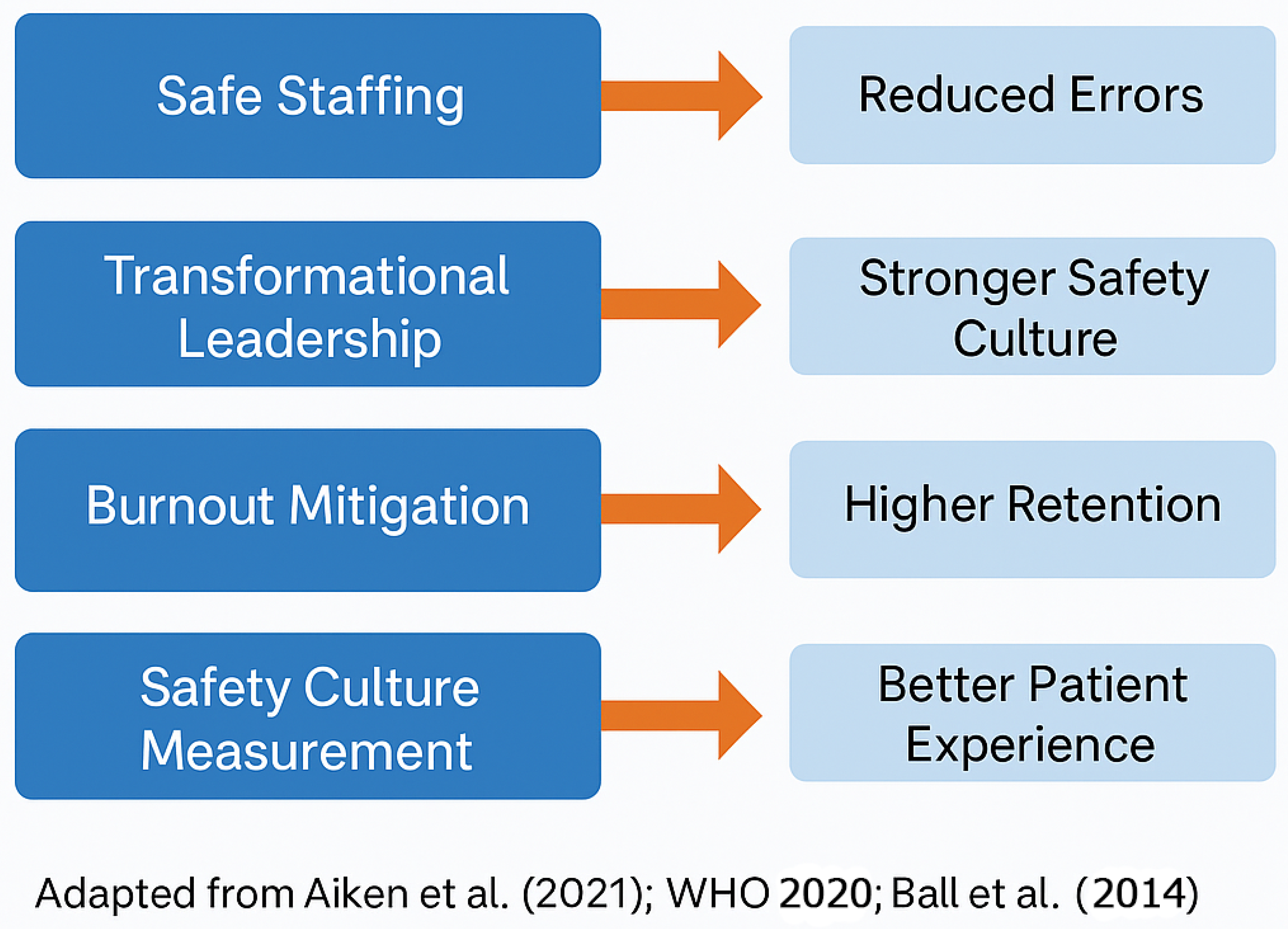
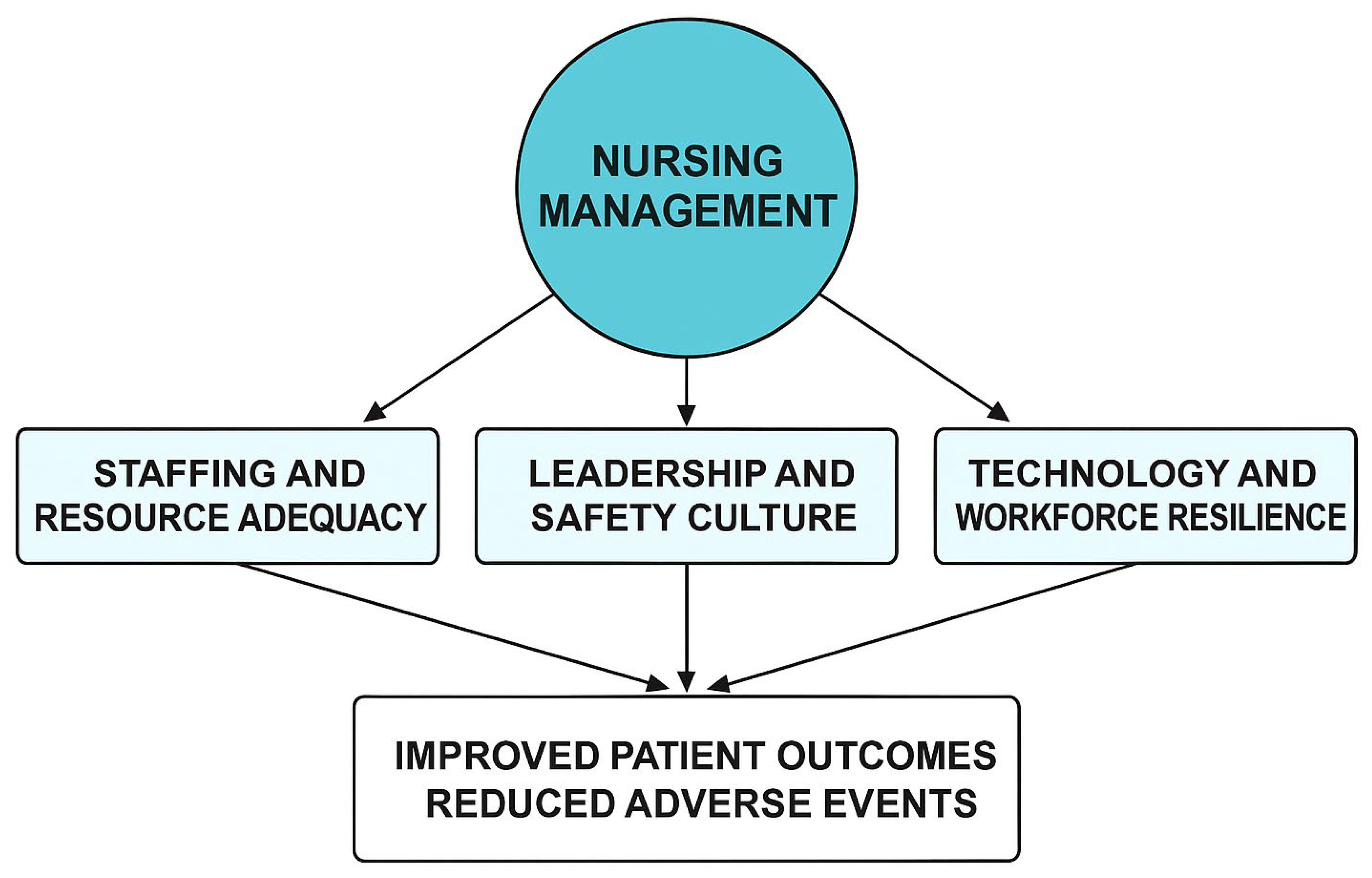
- Nursing management forms the structural foundation of patient safety systems worldwide.
- Transformational and authentic leadership enhance communication, teamwork, and psychological safety.
- Adequate staffing, supportive governance, and resilience programs reduce burnout and prevent harm.
- Strong safety cultures emerge when leaders model transparency, just culture, and continuous improvement.
- Achieving WHO’s 2030 global safety vision depends on empowering nurse leaders at every level of health systems.
Abstract
1. Introduction
1.1. Conceptual Foundations
1.2. Global Context and Persistent Disparities
1.3. Rationale and Objectives
2. Methods
2.1. Design
2.2. Review Question
2.3. Data Sources and Search Strategy
2.4. Inclusion and Exclusion Criteria
2.5. Data Extraction and Quality Appraisal
2.6. Data Synthesis and Thematic Coding
2.7. Trustworthiness and Rigor
2.8. Ethical Considerations
3. Results
3.1. Leadership and Safety Culture
3.2. Staffing and Patient Outcomes
3.3. Workforce Resilience and Technology Integration
3.3.1. Individual-Level Strategies
3.3.2. Organizational-Level Strategies
3.3.3. Technological Integration
3.3.4. Post-COVID Global Recovery
4. Discussion
4.1. Linking Evidence to Global Policy Frameworks
4.2. Ethical and Humanistic Dimensions
4.3. Implementation Challenges and Sustainability
4.4. Technological and Post-Pandemic Evolution
4.5. Practical Applications for Nurse Managers
4.6. Toward a Global Culture of Safety
5. Limitations
6. Conclusions
Supplementary Materials
Funding
Institutional Review Board Statement
Informed Consent Statement
Data Availability Statement
Acknowledgments
Conflicts of Interest
References
- Kohn, L.T.; Corrigan, J.M.; Donaldson, M.S. To Err Is Human; National Academies Press: Washington, DC, USA, 2000. [Google Scholar] [CrossRef]
- Välimäki, M.; Hu, S.; Lantta, T.; Hipp, K.; Varpula, J.; Chen, J.; Liu, G.; Tang, Y.; Chen, W.; Li, X. Evidence The impact of evidence-based nursing leadership in healthcare settings: A mixed methods systematic review. BMC Nurs 2024, 23, 452. [Google Scholar] [CrossRef] [PubMed]
- Hesgrove, B.; Zebrak, K.; Yount, N.; Sorra, J.; Ginsberg, C. Associations between patient safety culture and workplace safety culture in hospital settings. BMC Health Serv. Res. 2024, 24, 568. [Google Scholar] [CrossRef] [PubMed]
- World Health Organization. State of the World’s Nursing 2020; WHO Press: Geneva, Switzerland, 2020. [Google Scholar]
- Donabedian, A. Evaluating the quality of medical care. Milbank Meml. Fund Q. 1966, 44, 166–206. [Google Scholar] [CrossRef]
- Reason, J. Human Error; Cambridge University Press: Cambridge, UK, 1990. [Google Scholar]
- Drennan, V.M.; Ross, F. Global nurse shortages: Facts and action. Br. Med. Bull. 2019, 130, 25–37. [Google Scholar] [CrossRef]
- Choi, E.Y.; Pyo, J.; Lee, W.; Jang, S.G.; Park, Y.-K.; Ock, M.; Lee, S.-I. Nurses’ experiences of patient safety incidents in Korea. BMJ Open 2020, 10, e037741. [Google Scholar] [CrossRef] [PubMed]
- Alfadhalah, T.; Al Mudaf, B.; Alghanim, H.; Al Salem, G.; Ali, D.; Abdelwahab, H.M.; Elamir, H. Baseline assessment of patient safety culture in primary health care centres in Kuwait. BMC Health Serv. Res. 2021, 21, 1172. [Google Scholar] [CrossRef]
- Alsaleh, F.M.; Albraikan, S.; Alzoubi, H.; Abahussain, E.A.; Elamir, H. Assessment of patient-safety culture in public vs. private hospitals in Kuwait. BMC Health Serv. Res. 2025, 25, 579. [Google Scholar] [CrossRef]
- Abuosi, A.A.; Poku, C.A.; Attafuah, P.Y.A.; Anaba, E.A.; Abor, P.A.; Setordji, A.; Nketiah-Amponsah, E. Safety culture and adverse event reporting in Ghanaian healthcare facilities: Implications for patient safety. PLoS ONE 2022, 17, e0275606. [Google Scholar] [CrossRef]
- Adamuz, J.; González-Samartino, M.; Jiménez-Martínez, E.; Tapia-Pérez, M.; López-Jiménez, M.-M.; Valero-Valdelvira, P.; Zuriguel-Pérez, E.; Berbis-Morelló, C.; Asensio-Flores, S.; Juvé-Udina, M.-E. Impact of nurse staffing coverage and care complexity factors on health outcomes in hospitalized COVID-19 patients: A cross-sectional study. BMC Nurs 2025, 24, 520. [Google Scholar] [CrossRef]
- Galanis, P.; Vraka, I.; Fragkou, D.; Bilali, A.; Kaitelidou, D. Nurses’ burnout during COVID-19. J. Adv. Nurs. 2021, 77, 3286–3302. [Google Scholar] [CrossRef]
- Havaei, F.; Ma, A.; Staempfli, S.; MacPhee, M. Nurses’ workplace conditions and mental health during COVID-19. Healthcare 2021, 9, 84. [Google Scholar] [CrossRef]
- White, E.M.; Aiken, L.H.; McHugh, M.D. Registered Nurse burnout and missed care in nursing homes. J. Am. Geriatr. Soc. 2019, 67, 2065–2071. [Google Scholar] [CrossRef]
- Li, L.Z.; Yang, P.; Singer, S.J.; Pfeffer, J.; Mathur, M.B.; Shanafelt, T. Nurse Burnout and Patient Safety, Satisfaction, and Quality of Care: A Systematic Review and Meta-Analysis. JAMA Netw. Open 2024, 7, e2443059. [Google Scholar] [CrossRef] [PubMed]
- Lucero, R.J.; Lake, E.T.; Aiken, L.H. Nursing care quality and adverse events in U.S. hospitals. J. Clin. Nurs. 2010, 19, 2185–2195. [Google Scholar] [CrossRef]
- French, R.; Aiken, L.H.; Rosenbaum, K.E.F.; Lasater, K. Conditions of Nursing Practice in Hospitals and Nursing Homes Before COVID-19: Implications for Policy Action. J. Nurs. Regul. 2022, 13, S5–S18. [Google Scholar] [CrossRef]
- Welp, A.; Meier, L.L.; Manser, T. The interplay between teamwork, clinicians’ emotional exhaustion, and clinician-rated patient safety: A longitudinal study. Crit. Care 2016, 20, 110. [Google Scholar] [CrossRef]
- Slawomirski, L.; Klazinga, N. The Economics of Patient Safety: From Analysis to Action; OECD Health Working Papers No. 145; OECD Publishing: Paris, France, 2022. [Google Scholar] [CrossRef]
- Dirik, H.F.; Intepeler, S.S. An authentic leadership training programme to increase nurse empowerment and patient safety: A quasi-experimental study. J. Adv. Nurs. 2024, 80, 1417–1428. [Google Scholar] [CrossRef] [PubMed]
- Boamah, S.A.; Spence Laschinger, H.K.; Wong, C.; Clarke, S. Effect of transformational leadership on job satisfaction and patient safety outcomes. Nurs. Outlook 2018, 66, 180–189. [Google Scholar] [CrossRef] [PubMed]
- Hamdan, M.; Jaaffar, A.H.; Khraisat, O.; Issa, M.R.; Jarrar, M. Transformational leadership and safety practices among nurses. Risk Manag. Healthc. Policy 2024, 17, 1687–1700. [Google Scholar] [CrossRef]
- Laschinger, H.K.S.; Wong, C.A.; Grau, A.L. The influence of authentic leadership on newly graduated nurses’ experiences of workplace bullying, burnout and retention outcomes: A cross-sectional study. Int. J. Nurs. Stud. 2012, 49, 1266–1276. [Google Scholar] [CrossRef]
- Bernardes, A.; Dias, B.M.; Moura, A.A.; Morcelli, L.M.B.; Gardim, L.; Araújo, A.A.C.; Gabriel, C.S.; Cummings, G.G. Authentic nursing leadership and safety climate across hospital settings during the COVID-19 pandemic: A cross-sectional study. J. Adv. Nurs. 2025, 81, 7587–7596. [Google Scholar] [CrossRef]
- Saleh, E.R.; Kaabi, B.; Al-Malki, A.; Al-Ali, A.; Al-Tamimi, A.; Al-Otaibi, M.; Al-Otaibi, R.; Ismail, M. Recent update in implementation of patient safety culture in Saudi Arabia. Saudi J. Nurs. Health Care 2025, 8, 183–188. [Google Scholar] [CrossRef]
- Aiken, L.H.; Simonetti, M.; Sloane, D.M.; Cerón, C.; Soto, P.; Bravo, D.; Galiano, A.; Behrman, J.R.; Smith, H.L.; McHugh, M.D.; et al. Hospital nurse staffing and patient outcomes in Chile: A multilevel cross-sectional study. Lancet Glob. Health 2021, 9, e1145–e1153. [Google Scholar] [CrossRef] [PubMed]
- Griffiths, P.; Maruotti, A.; Recio Saucedo, A.; Redfern, O.C.; Ball, J.E.; Briggs, J.; Dall’Ora, C.; Schmidt, P.E.; Smith, G.B. Nurse staffing, nursing assistants, and hospital mortality: Retrospective longitudinal cohort study. BMJ Qual. Saf. 2019, 28, 609–617. [Google Scholar] [CrossRef]
- McHugh, M.D.; Aiken, L.H.; Sloane, D.M.; Windsor, C.; Douglas, C.; Yates, P. Effects of nurse-to-patient ratio legislation on nurse staffing and patient mortality, readmissions, and length of stay: A prospective study in a panel of hospitals. Lancet 2021, 397, 1905–1913. [Google Scholar] [CrossRef]
- Tencic, M.; Roche, M.A. Nurse-patient ratios and infection control practices: A cross-sectional study. Collegian 2023, 30, 828–834. [Google Scholar] [CrossRef]
- Ball, J.E.; Murrells, T.; Rafferty, A.M.; Morrow, E.; Griffiths, P. Care left undone during nursing shifts. BMJ Qual. Saf. 2014, 23, 116–125. [Google Scholar] [CrossRef]
- Bagnasco, A.; Catania, G.; Zanini, M.; Dasso, N.; Rossi, S.; Aleo, G.; Timmins, F.; Sermeus, W.; Aiken, L.H.; Sasso, L. Are data on missed nursing care useful for nursing leaders? The RN4CAST@IT cross-sectional study. J. Nurs. Manag. 2020, 28, 2136–2145. [Google Scholar] [CrossRef] [PubMed]
- Senek, M.; Robertson, S.; Ryan, T.; King, R.; Wood, E.; Tod, A. The association between care left undone and temporary Nursing staff ratios in acute settings: A cross-sectional survey of registered nurses. BMC Health Serv. Res. 2020, 20, 637. [Google Scholar] [CrossRef]
- Carayon, P.; Xie, A.; Kianfar, S. Human factors and ergonomics in patient safety: A review of the topic. BMJ Qual. Saf. 2014, 23, 196–205. [Google Scholar] [CrossRef]
- Insani, W.N.; Zakiyah, N.; Puspitasari, I.M.; Permana, M.Y.; Parmikanti, K.; Rusyaman, E.; Suwantika, A.A. Digital Health Technology Interventions for Improving Medication Safety: Systematic Review of Economic Evaluations. J. Med. Internet Res. 2025, 27, e65546. [Google Scholar] [CrossRef] [PubMed]
- Dyrbye, L.N.; Shanafelt, T.D.; Sinsky, C.A.; Cipriano, P.F.; Bhatt, J.; Ommaya, A.; West, C.P.; Meyers, D. Burnout Among Health Care Professionals: A Call to Explore and Address This Underrecognized Threat to Safe, High-Quality Care. NAM Perspect. 2017, 7, 1–11. [Google Scholar] [CrossRef]
- Hurtado-Arenas, P.; Guevara, M.R.; González-Chordá, V.M. Patient Safety Culture from a Nursing Perspective in a Chilean Hospital. Nurs. Rep. 2024, 14, 1439–1451. [Google Scholar] [CrossRef]
- El-Sayed, H.A.; Ahmed, R.A.; Shehata, H.S. The Relationship Between Authentic Leadership and Nurses’ Resilience: A Mediating Role of Self-Efficacy. SAGE Open Nurs. 2023, 9, 23779608231214213. [Google Scholar] [CrossRef]
- Alkubati, S.A.; Al-Qalah, T.; Salameh, B.; Alsabri, M.; Alrubaiee, G.G.; Loutfy, A.; Alwesabi, S.A.; El-Monshed, A.H.; Elsayed, S.M. Understanding the Relationship Between Critical Care Nurses’ Perception of Patient Safety Culture and Adverse Events. Sage Open Nurs. 2024, 10, 23779608241292847. [Google Scholar] [CrossRef]
- Cui, Y.; Wang, Y.; Liu, H.; Xu, S.; Zhang, X. Patient safety culture and adverse medical events via FMEA. Risk Manag. Healthc. Policy 2025, 18, 1367–1376. [Google Scholar] [CrossRef] [PubMed]
- Tamblyn, R.; Abrahamowicz, M.; Buckeridge, D.L.; Bustillo, M.; Forster, A.J.; Girard, N.; Habib, B.; Hanley, J.; Huang, A.; Kurteva, S.; et al. Effect of an Electronic Medication Reconciliation Intervention on Adverse Drug Events: A Cluster Randomized Trial. JAMA Netw. Open 2019, 2, e1910756. [Google Scholar] [CrossRef]
- Pereira, A.J.; Noritomi, D.T.; dos Santos, M.C.; Corrêa, T.D.; Ferraz, L.J.R.; Schettino, G.P.P.; Cordioli, E.; Morbeck, R.A.; Morais, L.C.; Salluh, J.I.F.; et al. Effect of Tele-ICU on Clinical Outcomes of Critically Ill Patients: The TELESCOPE Randomized Clinical Trial. JAMA 2024, 332, 1798–1807. [Google Scholar] [CrossRef]
- Chiu, P.; Cummings, G.G.; Thorne, S.; Schick-Makaroff, K. Policy Advocacy and Nursing Organizations: A Scoping Review. Policy Politics Nurs. Pract. 2021, 22, 276–296. [Google Scholar] [CrossRef]



| Management Strategy | Evidence Level | Practical Implementation Steps |
|---|---|---|
| Safe staffing ratios | High (Aiken et al., 2021; Griffiths et al., 2019; McHugh et al., 2021) [27,28,29] | Maintain ≤ 4 patients per RN on med–surg units; monitor overtime < 10%. |
| Transformational-leadership training | Moderate (Boamah et al., 2018; Hamdan et al., 2024; Bernardes et al., 2025) [22,23,25] | Integrate leadership modules, coaching, and peer-mentoring. |
| Safety-culture measurement | High (Alfadhalah et al., 2021; Abuosi et al., 2022; Hesgrove et al., 2024) [3,9,11] | Conduct regular HSOPS-based or equivalent safety-culture surveys and debrief unit-level action plans. |
| Missed-care reduction programmes | High (Ball et al., 2014; Bagnasco et al., 2020; Senek et al., 2020) [31,32,33] | Apply MISSCARE or similar tools; track missed-care items and adjust staffing and workflows. |
| Burnout and fatigue mitigation | Moderate (Welp et al., 2023; Galanis et al., 2021; Havaei et al., 2021; White et al., 2019; Li et al., 2024) [13,14,15,16,19] | Implement resilience rounds and mental-health supports; monitor burnout and turnover intention. |
| Technology safety integration | Moderate (Carayon et al., 2014; Insani et al., 2025; Cui et al., 2025; Tamblyn et al., 2019; Pereira et al., 2024) [34,35,40,41,42] | Involve nurses in EHR design; monitor alert fatigue; evaluate digital safety tools, medication reconciliation, and tele-ICU support. |
| Continuous learning systems | Moderate (Kohn et al., 2000; OECD 2022; WHO 2020) [1,4,20] | Establish daily huddles and unit-level safety debriefings; integrate learnings into ongoing improvement cycles. |
| Domain | Global Action Required | Potential Outcomes |
|---|---|---|
| Leadership development | National leadership academies; integration of evidence-based leadership frameworks; inclusion of nurses on national and international policy boards [2,4] | Stronger safety culture; reduced regional and institutional variance; improved strategic decision-making. |
| Workforce sustainability | Implementation of safe-staffing legislation; global alignment of nurse-migration policies; investment in retention and mental-health supports [4,7,27,29] | Lower turnover; improved retention in LMICs; enhanced workforce stability and patient outcomes. |
| Ethics and governance | Embedding just-culture principles into accreditation and regulatory standards; strengthening organizational accountability structures [1,36] | Greater transparency; reduction in punitive climates; increased reporting of safety incidents. |
| Technology and data | Investment in human-centered digital systems; reducing alert fatigue; expanding interoperability and real-time data analytics [34,35,40] | Real-time monitoring; predictive risk analytics; improved medication and documentation safety. |
| Education and research | Standardized global metrics linking leadership, well-being, and safety; expansion of cross-national research consortia [2,4,20] | Robust benchmarking; stronger policy evidence base; accelerated adoption of best practices. |
Disclaimer/Publisher’s Note: The statements, opinions and data contained in all publications are solely those of the individual author(s) and contributor(s) and not of MDPI and/or the editor(s). MDPI and/or the editor(s) disclaim responsibility for any injury to people or property resulting from any ideas, methods, instructions or products referred to in the content. |
© 2025 by the author. Licensee MDPI, Basel, Switzerland. This article is an open access article distributed under the terms and conditions of the Creative Commons Attribution (CC BY) license (https://creativecommons.org/licenses/by/4.0/).
Share and Cite
Anders, R.L. Global Perspectives on Patient Safety: The Central Role of Nursing Management. Healthcare 2025, 13, 3240. https://doi.org/10.3390/healthcare13243240
Anders RL. Global Perspectives on Patient Safety: The Central Role of Nursing Management. Healthcare. 2025; 13(24):3240. https://doi.org/10.3390/healthcare13243240
Chicago/Turabian StyleAnders, Robert L. 2025. "Global Perspectives on Patient Safety: The Central Role of Nursing Management" Healthcare 13, no. 24: 3240. https://doi.org/10.3390/healthcare13243240
APA StyleAnders, R. L. (2025). Global Perspectives on Patient Safety: The Central Role of Nursing Management. Healthcare, 13(24), 3240. https://doi.org/10.3390/healthcare13243240