Lion Hearts: Using the Intervention Mapping Framework to Develop a Family-Based CrossFit Program for Health Behavior Change

 ,
,
Abstract
1. Introduction
2. Materials and Methods
2.1. Overall Study Design
2.2. Research Context
2.3. Planning Team Eligibility and Recruitment
2.4. Theories, Models, and Frameworks for Implementation Strategies
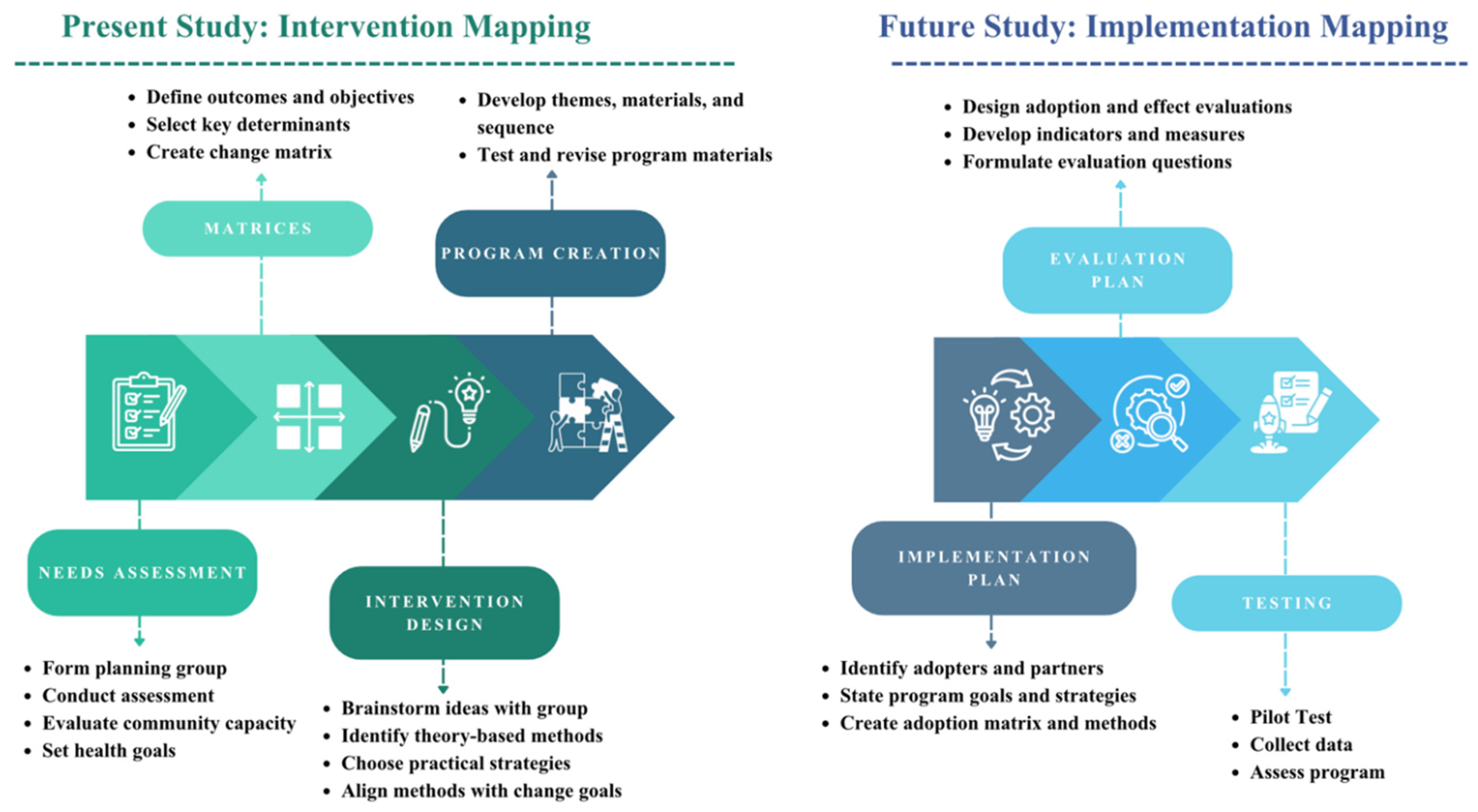
2.5. Intervention Mapping (IM) Steps
3. Results
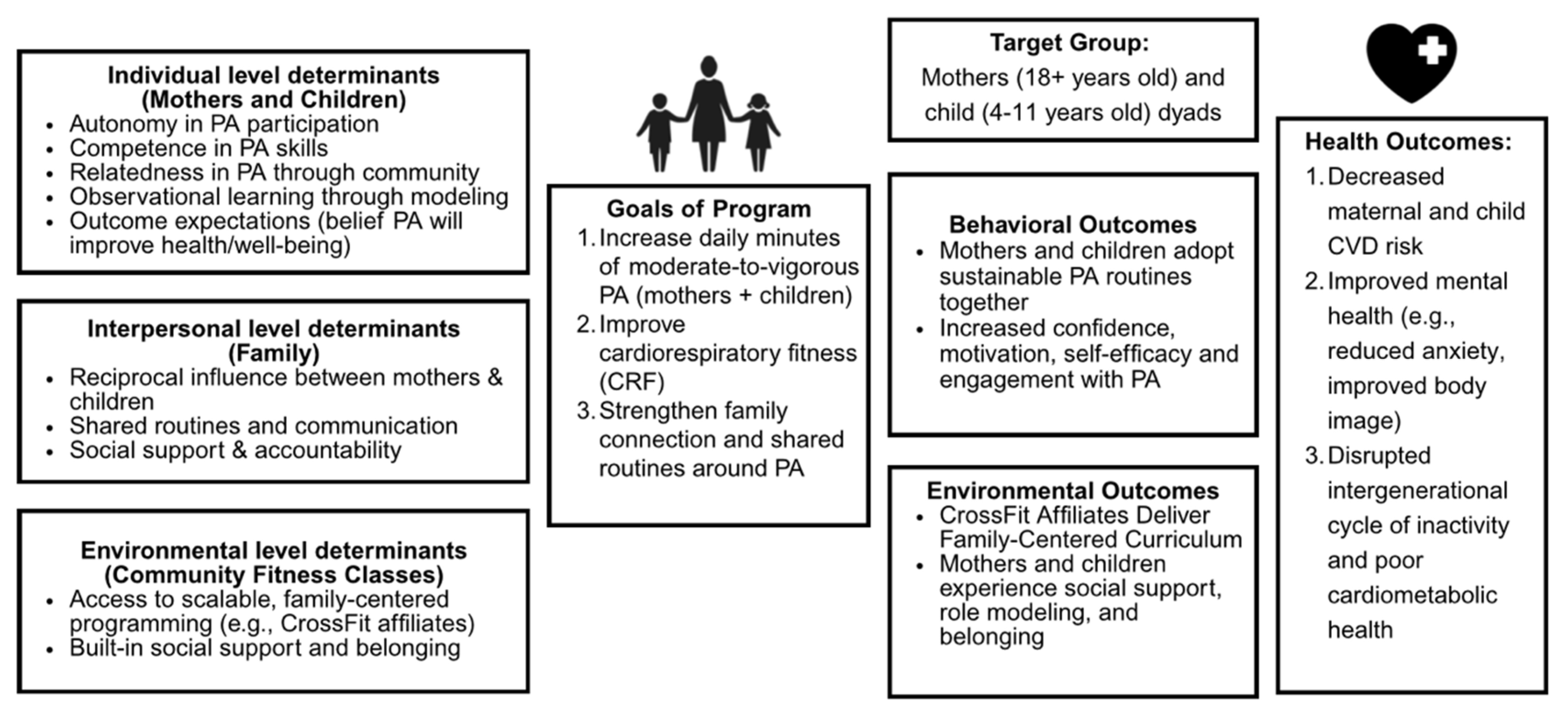
3.1. Step 1: Logic Model of the Problem
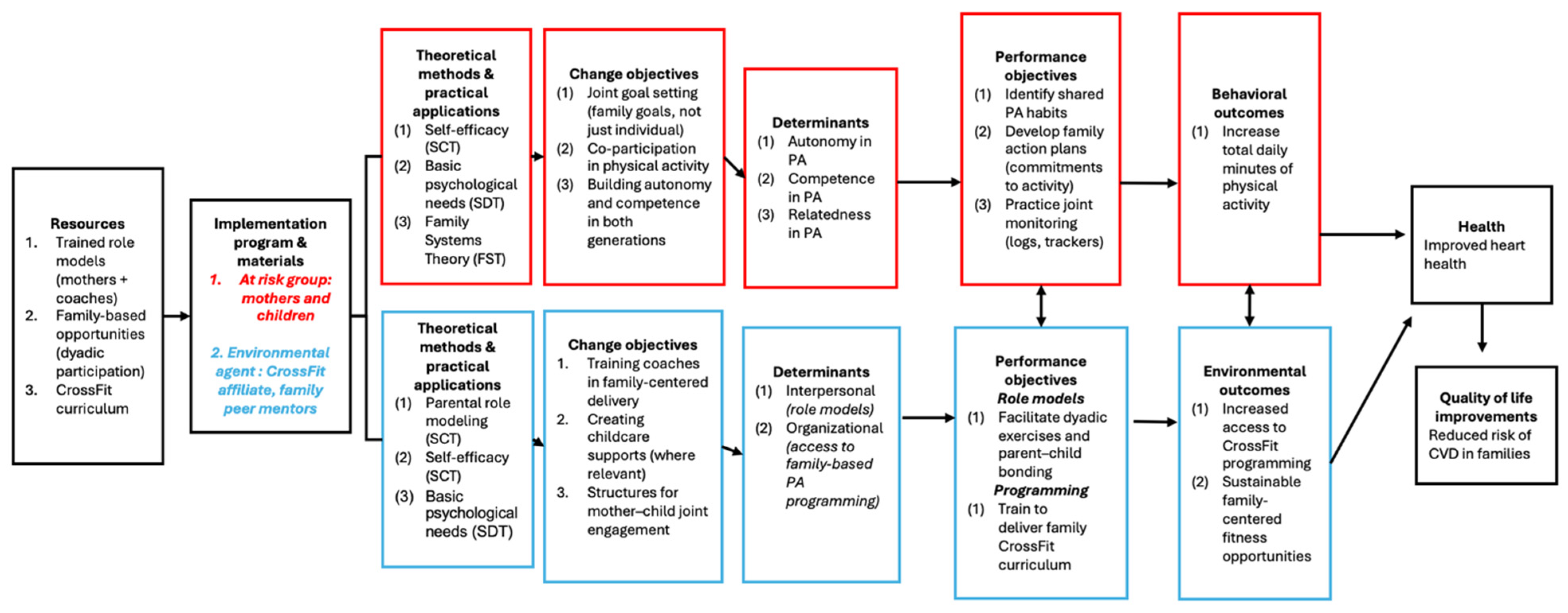
3.2. Step 2: Logic Model of Change and Performance Objectives
3.3. Step 3: Program Design
3.4. Step 4: Program Production
3.5. Steps 5–6: Implementation Mapping
4. Discussion
Author Contributions
Funding
Institutional Review Board Statement
Informed Consent Statement
Data Availability Statement
Conflicts of Interest
Abbreviations
| Abbreviation | Meaning |
| CVD | Cardiovascular Disease |
| PA | Physical Activity |
| CRF | Cardiorespiratory Fitness |
| IM | Intervention Mapping |
| SCT | Social Cognitive Theory |
| SDT | Self-Determination Theory |
| FST | Family Systems Theory |
| CBPR | Community-Based Participatory Research |
| MVPA | Moderate-to-Vigorous Physical Activity |
References
- Virani, S.S.; Alonso, A.; Aparicio, H.J.; Benjamin, E.J.; Bittencourt, M.S.; Callaway, C.W.; Carson, A.P.; Chamberlain, A.M.; Cheng, S.; Delling, F.N.; et al. Heart Disease and Stroke Statistics—2021 Update. Circulation 2021, 143, 8. [Google Scholar] [CrossRef]
- Mehta, L.S.; Warnes, C.A.; Bradley, E.; Burton, T.; Economy, K.; Mehran, R.; Safdar, B.; Sharma, G.; Wood, M.; Valente, A.M.; et al. Cardiovascular Considerations in Caring for Pregnant Patients: A Scientific Statement from the American Heart Association. Circulation 2020, 141, e884–e903. [Google Scholar] [CrossRef]
- Timpka, S.; Macdonald-Wallis, C.; Hughes, A.D.; Chaturvedi, N.; Franks, P.W.; Lawlor, D.A.; Fraser, A. Hypertensive Disorders of Pregnancy and Offspring Cardiac Structure and Function in Adolescence. J. Am. Heart Assoc. 2016, 5, e003906. [Google Scholar] [CrossRef]
- Wen, J.; Lv, A.; Aihemaitijiang, S.; Li, H.; Zhou, Y.; Liu, J. The association of maternal gestational weight gain with cardiometabolic risk factors in offspring: A systematic review and meta-analysis. Nutr. Rev. 2025, 83, e106–e115. [Google Scholar] [CrossRef]
- Petersen, T.L.; Møller, L.B.; Brønd, J.C.; Jepsen, R.; Grøntved, A. Association between parent and child physical activity: A systematic review. Int. J. Behav. Nutr. Phys. Act. 2020, 17, 67. [Google Scholar] [CrossRef] [PubMed]
- Julius, B.R.; O’Shea, A.M.; Francis, S.L.; Janz, K.F.; Laroche, H. Leading by Example: Association Between Mother and Child Objectively Measured Physical Activity and Sedentary Behavior. Pediatr. Exerc. Sci. 2021, 33, 49–60. [Google Scholar] [CrossRef] [PubMed]
- Hesketh, K.R.; Brage, S.; Cooper, C.; Godfrey, K.M.; Harvey, N.C.; Inskip, H.M.; Robinson, S.M.; Van Sluijs, E.M. The association between maternal-child physical activity levels at the transition to formal schooling: Cross-sectional and prospective data from the Southampton Women’s Survey. Int. J. Behav. Nutr. Phys. Act. 2019, 16, 23. [Google Scholar] [CrossRef] [PubMed]
- Morgan, P.J.; Collins, C.E.; Lubans, D.R.; Callister, R.; Lloyd, A.B.; Plotnikoff, R.C.; Burrows, T.L.; Barnes, A.T.; Pollock, E.R.; Fletcher, R.; et al. Twelve-month outcomes of a father–child lifestyle intervention delivered by trained local facilitators in underserved communities: The Healthy Dads Healthy Kids dissemination trial. Transl. Behav. Med. 2019, 9, 560–569. [Google Scholar] [CrossRef]
- Eisenberg, N.; Spinrad, T.L.; Eggum, N.D. Emotion-Related Self-Regulation and Its Relation to Children’s Maladjustment. Annu. Rev. Clin. Psychol. 2010, 6, 495–525. [Google Scholar] [CrossRef]
- Stodden, D.F.; Goodway, J.D.; Langendorfer, S.J.; Roberton, M.A.; Rudisill, M.E.; Garcia, C.; Garcia, L.E. A Developmental Perspective on the Role of Motor Skill Competence in Physical Activity: An Emergent Relationship. Quest 2008, 60, 290–306. [Google Scholar] [CrossRef]
- Telama, R. Tracking of Physical Activity from Childhood to Adulthood: A Review. Obes. Facts 2009, 2, 187–195. [Google Scholar] [CrossRef] [PubMed]
- US Department of Health and Human Services. Youth Risk Behavior Surveillance—United States, 2019; US Department of Health and Human Services: Washington, DC, USA, 2019.
- Katzmarzyk, P.; Denstel, K.D.; Carlson, J.; Crouter, S.E.; Greenberg, J.; Pate, R.R.; Sisson, S.B.; Staiano, A.E.; Stanish, H.I.; Ward, D.S.; et al. The 2022 United States Report Card on Physical Activity for Children and Youth; Physical Activity Alliance: Washington, DC, USA, 2022. [Google Scholar]
- Bellows-Riecken, K.H.; Rhodes, R.E. A birth of inactivity? A review of physical activity and parenthood. Prev. Med. 2008, 46, 99–110. [Google Scholar] [CrossRef]
- Nomaguchi, K.M.; Bianchi, S.M. Exercise Time: Gender Differences in the Effects of Marriage, Parenthood, and Employment. J. Marriage Fam. 2004, 66, 413–430. [Google Scholar] [CrossRef]
- Simpson, R.F.; Hesketh, K.R.; Crozier, S.R.; Baird, J.; Cooper, C.; Godfrey, K.M.; Harvey, N.C.; Westgate, K.; Inskip, H.M.; van Sluijs, E.M. The association between number and ages of children and the physical activity of mothers: Cross-sectional analyses from the Southampton Women’s Survey. PLoS ONE 2022, 17, e0276964. [Google Scholar] [CrossRef]
- Yao, C.A.; Rhodes, R.E. Parental correlates in child and adolescent physical activity: A meta-analysis. Int. J. Behav. Nutr. Phys. Act. 2015, 12, 10. [Google Scholar] [CrossRef]
- Gustafson, S.L.; Rhodes, R.E. Parental Correlates of Physical Activity in Children and Early Adolescents. Sports Med. 2006, 36, 79–97. [Google Scholar] [CrossRef]
- Su, D.L.Y.; Tang, T.C.W.; Chung, J.S.K.; Lee, A.S.Y.; Capio, C.M.; Chan, D.K.C. Parental Influence on Child and Adolescent Physical Activity Level: A Meta-Analysis. Int. J. Environ. Res. Public Health 2022, 19, 16861. [Google Scholar] [CrossRef]
- Brennan, C.; Streight, E.; Cheng, S.; Rhodes, R.E. Parents’ experiences of family-based physical activity interventions: A systematic review and qualitative evidence synthesis. Int. J. Behav. Nutr. Phys. Act. 2025, 22, 90. [Google Scholar] [CrossRef]
- Centers for Disease Control and Prevention (CDC). Trends in strength training—United States, 1998–2004. MMWR Morb. Mortal. Wkly. Rep. 2006, 55, 769–772. [Google Scholar]
- Nuzzo, J.L. Narrative Review of Sex Differences in Muscle Strength, Endurance, Activation, Size, Fiber Type, and Strength Training Participation Rates, Preferences, Motivations, Injuries, and Neuromuscular Adaptations. J. Strength Cond. Res. 2023, 37, 494–536. [Google Scholar] [CrossRef] [PubMed]
- Morbidity and Mortality Weekly Report (MMWR). QuickStats: Percentage* of Adults Aged ≥18 Years Who Met the Federal Guidelines for Muscle-Strengthening Physical Activity,† by Age Group and Sex—National Health Interview Survey, United States, 2020; Centers for Disease Control and Prevention (CDC): Atlanta, GA, USA, 2022.
- Brown, W.J.; Heesch, K.C.; Miller, Y.D. Life Events and Changing Physical Activity Patterns in Women at Different Life Stages. Ann. Behav. Med. 2009, 37, 294–305. [Google Scholar] [CrossRef]
- Rhodes, R.E.; Boudreau, P.; Josefsson, K.W.; Ivarsson, A. Mediators of physical activity behaviour change interventions among adults: A systematic review and meta-analysis. Health Psychol. Rev. 2021, 15, 272–286. [Google Scholar] [CrossRef]
- Drenowatz, C.; Sui, X.; Fritz, S.; Lavie, C.J.; Beattie, P.F.; Church, T.S.; Blair, S.N. The association between resistance exercise and cardiovascular disease risk in women. J. Sci. Med. Sport 2015, 18, 632–636. [Google Scholar] [CrossRef]
- Paluch, A.E.; Boyer, W.R.; Franklin, B.A.; Laddu, D.; Lobelo, F.; Lee, D.C.; McDermott, M.M.; Swift, D.L.; Webel, A.R.; Lane, A. Resistance Exercise Training in Individuals With and Without Cardiovascular Disease: 2023 Update: A Scientific Statement From the American Heart Association. Circulation 2024, 149, e217–e231. [Google Scholar] [CrossRef]
- Wagener, S.; Hoppe, M.W.; Hotfiel, T.; Engelhardt, M.; Javanmardi, S.; Baumgart, C.; Freiwald, J. CrossFit®—Development, Benefits and Risks. Sports Orthop. Traumatol. 2020, 36, 241–249. [Google Scholar] [CrossRef]
- Goins, J.M. Physiological and Performance Effects of Crossfit. Ph.D. Thesis, The University of Alabama, Tuscaloosa, AL, USA, 2014. [Google Scholar]
- Mailey, E.L.; Huberty, J.; Irwin, B.C. Feasibility and Effectiveness of a Web-Based Physical Activity Intervention for Working Mothers. J. Phys. Act. Health 2016, 13, 822–829. [Google Scholar] [CrossRef]
- Rhodes, R.E.; Hollman, H.; Sui, W. Family-based physical activity interventions and family functioning: A systematic review. Fam. Process 2024, 63, 392–413. [Google Scholar] [CrossRef]
- Downs, D.S.; Hausenblas, H.A. Women’s Exercise Beliefs and Behaviors During Their Pregnancy and Postpartum. J. Midwifery Women’s Health 2004, 49, 138–144. [Google Scholar] [CrossRef] [PubMed]
- Lloyd, R.S.; Cronin, J.B.; Faigenbaum, A.D.; Haff, G.G.; Howard, R.; Kraemer, W.J.; Micheli, L.J.; Myer, G.D.; Oliver, J.L. National Strength and Conditioning Association Position Statement on Long-Term Athletic Development. J. Strength Cond. Res. 2016, 30, 1491–1509. [Google Scholar] [CrossRef] [PubMed]
- Faigenbaum, A.D.; Myer, G.D. Resistance training among young athletes: Safety, efficacy and injury prevention effects. Br. J. Sports Med. 2010, 44, 56–63. [Google Scholar] [CrossRef]
- Robinson, L.E.; Stodden, D.F.; Barnett, L.M.; Lopes, V.P.; Logan, S.W.; Rodrigues, L.P.; D’Hondt, E. Motor Competence and its Effect on Positive Developmental Trajectories of Health. Sports Med. 2015, 45, 1273–1284. [Google Scholar] [CrossRef]
- CrossFit Training. Level 1 Training Guide, 3rd ed.; CrossFit LLC: Boulder, CO, USA, 2020. [Google Scholar]
- Lautner, S.C.; Patterson, M.S.; Spadine, M.N.; Boswell, T.G.; Heinrich, K.M. Exploring the social side of CrossFit: A qualitative study. Ment. Health Soc. Incl. 2021, 25, 63–75. [Google Scholar] [CrossRef]
- Whiteman-Sandland, J.; Hawkins, J.; Clayton, D. The role of social capital and community belongingness for exercise adherence: An exploratory study of the CrossFit gym model. J. Health Psychol. 2018, 23, 1545–1556. [Google Scholar] [CrossRef] [PubMed]
- CrossFit Education. Crossfit Kids Certificate Course; CrossFit LLC: Boulder, CO, USA; Available online: https://www.crossfit.com/certificate-courses/online-kids (accessed on 19 September 2025).
- Claudino, J.G.; Gabbett, T.J.; Bourgeois, F.; Souza, H.D.S.; Miranda, R.C.; Mezêncio, B.; Soncin, R.; Cardoso Filho, C.A.; Bottaro, M.; Hernandez, A.J.; et al. CrossFit Overview: Systematic Review and Meta-analysis. Sports Med. Open 2018, 4, 11. [Google Scholar] [CrossRef] [PubMed]
- Gianzina, E.A.; Kassotaki, O.A. The benefits and risks of the high-intensity CrossFit training. Sport Sci. Health 2019, 15, 21–33. [Google Scholar] [CrossRef]
- Swift, D.L.; Johannsen, N.M.; Lavie, C.J.; Earnest, C.P.; Church, T.S. The Role of Exercise and Physical Activity in Weight Loss and Maintenance. Prog. Cardiovasc. Dis. 2014, 56, 441–447. [Google Scholar] [CrossRef]
- Wang, Y.; Xu, D. Effects of aerobic exercise on lipids and lipoproteins. Lipids Health Dis. 2017, 16, 132. [Google Scholar] [CrossRef]
- Ross, S.M.; Bogart, K.R.; Logan, S.W.; Case, L.; Fine, J.; Thompson, H. Physical Activity Participation of Disabled Children: A Systematic Review of Conceptual and Methodological Approaches in Health Research. Front. Public Health 2016, 4, 187. [Google Scholar] [CrossRef]
- Eldredge, L.K.B.; Markham, C.M.; Ruiter, R.A.; Fernández, M.E.; Kok, G.; Parcel, G.S. Planning Health Promotion Programs: An Intervention Mapping Approach, 4th ed.; Jossey-Bass Inc.: San Francisco, CA, USA, 2016. [Google Scholar]
- Bandura, A. Social Cognitive Theory: An Agentic Perspective. Annu. Rev. Psychol. 2001, 52, 1–26. [Google Scholar] [CrossRef]
- Deci, E.L.; Ryan, R.M. Intrinsic Motivation and Self-Determination in Human Behavior, 1st ed.; Springer: Boston, MA, USA, 1985. [Google Scholar] [CrossRef]
- Watson, W.H. Family Systems. In Encyclopedia of Human Behavior; Elsevier: Amsterdam, The Netherlands, 2012; pp. 184–193. [Google Scholar]
- Friel, C.P.; Duran, A.T.; Shechter, A.; Diaz, K.M. U.S. Children Meeting Physical Activity, Screen Time, and Sleep Guidelines. Am. J. Prev. Med. 2020, 59, 513–521. [Google Scholar] [CrossRef]
- CrossFit LLC. CrossFit Affiliate List. Available online: https://www.crossfit.com/map (accessed on 19 September 2025).
- Fernández, J.F.; Solana, R.S.; Moya, D.; Marin, J.M.S.; Ramón, M.M. Acute Physiological Responses During Crossfit® Workouts. Eur. J. Human Mov. 2015, 35, 114–124. Available online: https://www.eurjhm.com/index.php/eurjhm/article/view/362 (accessed on 19 June 2023).
- Rios, M.; Pyne, D.B.; Fernandes, R.J. The Effects of CrossFit® Practice on Physical Fitness and Overall Quality of Life. Int J Environ Res. Public Health 2024, 22, 19. [Google Scholar] [CrossRef]
- Ross, R.; Blair, S.N.; Arena, R.; Church, T.S.; Després, J.P.; Franklin, B.A.; Haskell, W.L.; Kaminsky, L.A.; Levine, B.D.; Lavie, C.J.; et al. Importance of Assessing Cardiorespiratory Fitness in Clinical Practice: A Case for Fitness as a Clinical Vital Sign: A Scientific Statement From the American Heart Association. Circulation 2016, 134, e653–e699. [Google Scholar] [CrossRef]
- Major, M.G.; Watkins, J.M.; Goss, J.M.; Craig, D.W.; Waggoner, Z.; Martinez Kercher, V.M.; Kercher, K.A. Intervention Mapping for Refining a Sport-Based Public Health Intervention in Rural Schools. Int. J. Environ. Res. Public Health 2024, 21, 1557. [Google Scholar] [CrossRef]
- De Craemer, M.; De Decker, E.; De Bourdeaudhuij, I.; Verloigne, M.; Duvinage, K.; Koletzko, B.; Ibrügger, S.; Kreichauf, S.; Grammatikaki, E.; Moreno, L.; et al. Applying the Intervention Mapping protocol to develop a kindergarten-based, family-involved intervention to increase European preschool children’s physical activity levels: The ToyBox-study. Obes. Rev. 2014, 15, 14–26. [Google Scholar] [CrossRef]
- Stea, T.H.; Haugen, T.; Berntsen, S.; Guttormsen, V.; Øverby, N.C.; Haraldstad, K.; Meland, E.; Abildsnes, E. Using the Intervention Mapping protocol to develop a family-based intervention for improving lifestyle habits among overweight and obese children: Study protocol for a quasi-experimental trial. BMC Public Health 2016, 16, 1092. [Google Scholar] [CrossRef] [PubMed]
- Watkins, J.M.; Greeven, S.J.; Heeter, K.N.; Brunnemer, J.E.; Otile, J.; Solá, P.A.F.; Dutta, S.; Hobson, J.M.; Evanovich, J.M.; Coble, C.J.; et al. Human-centered participatory co-design with children and adults for a prototype lifestyle intervention and implementation strategy in a rural middle school. BMC Public Health 2024, 24, 845. [Google Scholar] [CrossRef] [PubMed]
- Chinsen, A.; Berg, A.; Nielsen, S.; Trewella, K.; Cronin, T.J.; Pace, C.C.; Pang, K.C.; Tollit, M.A. Co-design methodologies to develop mental health interventions with young people: A systematic review. Lancet Child Adolesc. Health 2025, 9, 413–425. [Google Scholar] [CrossRef] [PubMed]



| Behavioral Outcome 1: Mothers and Children Adopt Sustainable PA Routines Together | ||||
| Performance Objective | Autonomy | Competence | Relatedness | Self-Efficacy/Modeling (SCT) |
| PO1. Identify opportunities for PA together | Mothers/children choose activities they enjoy | Knowing safe, accessible activities and how to initiate them | Identifying shared interests | Mothers confident in planning PA and modeling it for children |
| PO2. Establish family routines for PA | Choosing times/locations that work for family | Demonstrating knowledge of simple, scalable PA (e.g., functional fitness) | Negotiating shared routines | Mothers modeling consistent PA habits |
| PO3. Engage in PA with family/peers | Choosing to join a group/family PA | Demonstrating skills to participate together | Strengthening peer/family connection through shared activities | Building confidence through practice and role modeling |
| PO4. Commit to sustained PA | Choosing ongoing involvement | Recognizing fitness progress | Maintaining supportive relationships | Mothers reinforcing positive expectations and outcomes |
| Behavioral Outcome 2: Increased Confidence and Engagement with PA | ||||
| Performance Objective | Autonomy | Competence | Relatedness | Self-Efficacy/Modeling (SCT) |
| PO1. Recognize personal preferences and motivators for PA | Participants independently choose the types of activities they are interested in. | Learn to assess what kinds of PAs feel good, are feasible, and match their fitness level. | Share preferences and motivations within family or peer groups. | Mothers/peers model enthusiasm for selected activities, reinforcing that “there is no one right way.” |
| PO2. Experiment with different PA forms to find “fit” | Choose to try new or varied physical activities. | Acquire basic skills or techniques in those new activities (e.g., walking, dance, cycling, bodyweight circuits). | Engage together (family, friends, groups) in trial sessions of different PA types. | Mothers or peer “buddies” model trying new PA and share learning from trial and error. |
| PO3. Set and adjust individualized PA goals | Autonomously set goals that feel challenging but achievable. | Learn how to break larger goals into smaller steps; monitor progress. | Share goal setting and progress with a supportive network. | Mothers model self-regulatory behaviors (tracking, adapting goals when needed) and verbalize coping with setbacks. |
| PO4. Regularly participate in PA and expand engagement | Make ongoing choices to schedule and attend PA sessions. | Develop increasing proficiency, stamina, and variety in movement. | Deepen connection by exercising together or participating in group/community PA. | Mothers model persistence, reinforce success, and encourage overcoming barriers. |
| Environmental Outcome 1: CrossFit Affiliates Deliver Family-Centered Curriculum | ||||
| Performance Objective | Role Modeling (FST/SCT) | Family and Environmental Reinforcement (FST/SCT) | ||
| PO1. Identify and align local opportunities for family PA | Coaches and affiliate leaders model proactive engagement—identifying community resources and demonstrating initiative in creating family-inclusive spaces. | Affiliates and families collaborate to reinforce shared goals for accessible PA environments, shaping collective norms that value family involvement. | ||
| PO2. Promote and communicate family-friendly programming | Coaches and mothers model enthusiasm and inclusivity when presenting family sessions, highlighting that PA is a shared experience. | Affiliates reinforce participation through environmental cues (e.g., posters, success stories) and social reinforcement from peers and families. | ||
| PO3. Ensure accessible equipment and supportive spaces | Coaches model equitable use and care of equipment, showing adaptability in scaling for different ages and abilities. | Families and coaches co-create supportive settings—reinforcing expectations that all members can participate safely and effectively. | ||
| PO4. Establish consistent, predictable scheduling | Coaches model reliability and consistency, demonstrating that structured routines help sustain engagement. | Families and affiliates co-develop schedules and reinforcement systems (e.g., check-ins, progress tracking) that sustain family attendance. | ||
| Environmental Outcome 2: Mothers and Children Experience Social Support, Role Modeling, and Belonging | ||||
| Performance Objective | Environmental Determinants | |||
| PO1. Recruit and empower positive role models | Affiliates identify and engage coaches, mothers, and peer mentors who model supportive, inclusive, and family-centered physical activity behaviors. | |||
| PO2. Train and equip role models to deliver the family-centered curriculum | Affiliates provide structured onboarding and ongoing mentorship for coaches, service-learning students, and assistants to ensure fidelity, empathy, and developmental appropriateness in delivery. | |||
| PO3. Integrate role models into family sessions and community networks | Affiliates establish systems that embed role models in family classes, peer circles, and community partnerships to promote consistent social reinforcement and shared accountability. | |||
| PO4. Evaluate and celebrate social support and belonging | Affiliates monitor participation, gather family feedback, and publicly recognize role models and families to strengthen community connection and sustain engagement. | |||
| Component | Description | Duration/Frequency | Lead Personnel and Supervision | Behavioral Targets (IM Constructs) |
|---|---|---|---|---|
| Welcome and Goal Review | Families review previous week’s progress and set new goals collaboratively. Coaches prompt reflection on intrinsic motivation and self-monitoring. | 5–10 min, at start of each session | Certified CrossFit coach and assistant; 1:6 coach-to-family ratio | Autonomy, self-efficacy, self-regulation |
| Warm-Up and Skill Development | Introduction and scaling of fundamental functional movements (e.g., squats, carries, balance drills) tailored for mothers and children. | 10–15 min | Lead coach models proper technique; assistants ensure safety | Competence, modeling, confidence |
| Workout of the Day (WOD) | Family participation workout combining strength, endurance, and agility (e.g., partner AMRAPs, relay circuits). Movements scaled by age and ability. | 20–25 min, twice weekly | Supervised by certified CrossFit coach trained in family-centered delivery | Relatedness, mastery experience, enjoyment |
| Cool Down and Reflection | Guided discussion and stretching period to reinforce teamwork, effort, and positive feedback. | 10–15 min | Coach-led reflection with family discussion prompts | Relatedness, positive reinforcement, competence |
| Supervision Model | Sessions overseen by certified CrossFit coaches with Lion Hearts orientation; ongoing fidelity monitoring through checklists and monthly mentor calls. | Continuous | Research team and affiliate owner provide oversight | Fidelity, sustainability, implementation quality |
| Component | Content Example | Timing/Frequency | Delivery Personnel | Behavioral Focus (IM Constructs) |
|---|---|---|---|---|
| Workshop 1—Understanding Heart Health | Interactive demonstrations on heart rate, blood pressure, and recognizing exertion. Families measure their pulse and discuss intensity zones. | Week 1 (90 min) | Researcher and coach co-facilitation | Knowledge, outcome expectations |
| Workshop 2—Fueling Movement | Education on balanced nutrition, hydration, and family meal planning to support activity. | Week 4 (90 min) | Registered dietitian or trained coach | Environmental support, self-efficacy |
| Workshop 3—Goal Setting and Stress Management | SMART goal training, stress-coping techniques, and strategies to overcome barriers to PA. | Week 8 (90 min) | Researcher or behavioral specialist | Self-regulation, problem solving |
| Workshop 4—Celebrating Progress | Family reflection on achievements, long-term planning for maintenance, and group celebration. | Week 12 (90 min) | Coaches and research team | Reinforcement, sustainability |
| Weekly Family Challenges | Examples include: Family Step Challenge, Strength Circuit Saturday, and Active Kindness activity. Each challenge reinforces PA and family bonding. | Weekly, self-paced | Families with remote coach support | Autonomy, modeling, social support |
| Support Materials | Family handbooks, child workbooks, and coach guides include visual instructions, reflection prompts, and tracking charts. | Throughout 12 weeks | Research and coaching team | Accessibility, engagement, consistency |
| Domain | Measure/Indicator | Description and Method | Purpose/Rationale |
|---|---|---|---|
| Cardiorespiratory Fitness (CRF) | Graded bike erg test (mothers); 20 m shuttle run (children) | Proposed standardized field tests conducted pre- and post-program; optional heart rate monitoring with wearable sensors. | Evaluate changes in cardiovascular endurance and aerobic capacity. |
| Physical Activity and Sedentary Behavior | Accelerometry (ActiGraph or Fitbit) | Proposed continuous wear over seven days at pre-, mid-, and post-intervention to assess MVPA, step counts, and sedentary time. | Quantify objective changes in daily activity and inactivity patterns. |
| Body Composition | Height, weight, BMI, waist circumference, bioelectrical impedance (optional) | Standardized anthropometric and composition data collected by trained personnel. | Assess body composition changes associated with improved cardiovascular health. |
| Blood Pressure and Resting Heart Rate | Automated sphygmomanometer (average of two seated readings) | Measurements taken after five minutes of rest at baseline and post-program. | Monitor cardiovascular risk indicators and physiological responses. |
| Behavioral and Psychosocial Indicators | Self-efficacy for PA, enjoyment, family cohesion, parental modeling, workshop satisfaction | Validated questionnaires administered pre- and post-program to capture psychosocial and motivational mechanisms. | Examine behavioral mediators influencing engagement and adherence. |
| Implementation Metrics | Attendance, retention, coach fidelity checklists, participant feedback | Logs, fidelity assessments, and interviews collected during delivery; finalized through implementation mapping. | Evaluate feasibility, reach, and sustainability of program delivery. |
Disclaimer/Publisher’s Note: The statements, opinions and data contained in all publications are solely those of the individual author(s) and contributor(s) and not of MDPI and/or the editor(s). MDPI and/or the editor(s) disclaim responsibility for any injury to people or property resulting from any ideas, methods, instructions or products referred to in the content. |
© 2025 by the authors. Licensee MDPI, Basel, Switzerland. This article is an open access article distributed under the terms and conditions of the Creative Commons Attribution (CC BY) license (https://creativecommons.org/licenses/by/4.0/).
Share and Cite
Watkins, J.; Goss, J.; Mehls, K.; Dlugonski, D.; Downs, D.S. Lion Hearts: Using the Intervention Mapping Framework to Develop a Family-Based CrossFit Program for Health Behavior Change. Healthcare 2025, 13, 3127. https://doi.org/10.3390/healthcare13233127
Watkins J, Goss J, Mehls K, Dlugonski D, Downs DS. Lion Hearts: Using the Intervention Mapping Framework to Develop a Family-Based CrossFit Program for Health Behavior Change. Healthcare. 2025; 13(23):3127. https://doi.org/10.3390/healthcare13233127
Chicago/Turabian StyleWatkins, Janette, Janelle Goss, Kelton Mehls, Deirdre Dlugonski, and Danielle Symons Downs. 2025. "Lion Hearts: Using the Intervention Mapping Framework to Develop a Family-Based CrossFit Program for Health Behavior Change" Healthcare 13, no. 23: 3127. https://doi.org/10.3390/healthcare13233127
APA StyleWatkins, J., Goss, J., Mehls, K., Dlugonski, D., & Downs, D. S. (2025). Lion Hearts: Using the Intervention Mapping Framework to Develop a Family-Based CrossFit Program for Health Behavior Change. Healthcare, 13(23), 3127. https://doi.org/10.3390/healthcare13233127