


Abstract
The paper deals with the problem of construction and investigation of branched continued fraction expansions of special functions of several variables. We give some recurrence relations of Horn hypergeometric functions By these relations the branched continued fraction expansions of Horn’s hypergeometric function ratios have been constructed. We have established some convergence criteria for the above-mentioned branched continued fractions with elements in and In addition, it is proved that the branched continued fraction expansions converges to the functions which are an analytic continuation of the above-mentioned ratios in some domain (here domain is an open connected set). Application for some system of partial differential equations is considered.
MSC:
33C65; 32A17; 40A99
1. Introduction
Special functions with several variables (such as famous Appell, Lauricella, and Horn hypergeometric functions, etc.) appear in many areas of mathematics and its applications. Many authors have contributed works on this subject; we have mentioned a few: Res. [1,2,3,4]. In recent years, several authors have considered some interesting branched continued fraction expansions of the special functions of several variables (see [5,6,7,8,9,10]). In the paper, we construct the branched continued fraction expansions of Horn’s hypergeometric function ratios and investigate their convergence.
Horn hypergeometric function [11] is defined by double power series
where a, b and c are complex constants, c is not equal to a non-positive integer, is the Pochhammer symbol defined for any complex number and non-negative integers k by and
Branched continued fractions are one of the multidimensional generalizations of continued fractions and are used, in particular, in numerical theory to express algebraic irrational numbers, in computational mathematics for the solution of systems of linear algebraical equations, in analysis for approximating functions of several variables [12,13,14].
Let be a multiindex and let
be a set of multiindices. Holomorphic functions of two complex variables and can be represented by various generalizations of continued fractions, in particular, branched continued fractions of the form
where the and the elements and are certain polynomials (see [15,16]). Other constructions of branched continued fractions are considered in [9,17,18,19,20,21].
The paper is organized as follows. In Section 2, we construct the formal branched continued fraction expansions of the Horn’s hypergeometric function ratios. The construction of the expansions is based on the recurrence relations of the Horn hypergeometric functions In Section 3, we derive some convergence criteria for the above-mentioned branched continued fractions. Here is also a proof that the branched continued fraction expansions converge to the functions which are an analytic continuation of Horn’s hypergeometric function ratios in some domain (here, domain is an open connected set). Finally, in Section 4, we consider the application for some system of partial differential equations.
2. Expansions
The problem of constructing the expansion of the ratio of hypergeometric series of one or several variables by means of a branched continued fraction is to obtain the simplest structure of a branched continued fraction expansion whose elements are simple polynomials. The various structures of the branched continued fractions have been given in [22] for ratios of contiguous hypergeometric series, in [5,23] for ratios of Lauricella hypergeometric functions, in [16,17] for ratios of Appell hypergeometric functions, and in [10] for ratios of Lauricella–Saran hypergeometric functions.
In the section, we will construct two formal expansions of the ratios of Horn hypergeometric functions by means of branched continued fractions of the form (2). The question of the convergence of branched continued fraction expansions to the ratios will be considered in Section 3.
2.1. Recurrence Relations of Horn Hypergeometric Functions
To construct the expansion of the ratio of hypergeometric series of one or several variables, the recurrence relations between these series are used. Here, we give the necessary three- and four-term recurrence relations of Horn hypergeometric functions
By direct verification, the following recurrence relations hold
Indeed, let us show, for example, the validity of the relation (6). We have
Next, in view of Formula (1), we directly obtain the relation (6).
From the relations (3) and (4) it follows
2.2. Branched Continued Fraction Expansions
We set
where is the Kronecker delta. Then from (6) it follows
Use the relations (4), (5) and (7) gives
Hence
that is
For convenience, we now write relations (9) and (10) as follows
where Hence, for we obtain
and for each and for we have
Next, we will construct branched continued fraction expansions for where Using relations (12) from (11) on the first step, for we obtain
where
and for and for
Hence, applying recurrence relations (13) after n-th steps, we get
where and are defined by (14)–(16), and , are defined by (17)–(19). In the right part (20) there are two different finite branched continued fractions: one for and the other for Finally, by the relations (13), one obtains the branched continued fraction expansions for
where the symbol∼denotes a formal expansion, and are defined by (14)–(19).
Remark 1.
In (21) there are two different branched continued fraction expansions: one for and the other for
Remark 2.
If then
where is a hypergeometric series, and, if then
where These are, on the one hand, two confluent branched continued fraction expansions and, on the other, two known continued fraction expansions, called respectively regular C-fraction [24] and general T-fraction [25] (more about it see [26,27,28,29]).
3. Convergence
Central to the theory of branched continued fractions is their problem of convergence. Various methods are used to prove the convergence of branched continued fractions, in particular, methods using the theorem on the continuation of convergence from an already known small domain to a larger [6,30], the value set technique for branched continued fraction [31], the even part of another branched continued fraction [32], the difference formula between its two approximants [33,34,35,36,37], and induction by dimension of a branched continued fraction [36,38,39].
In the section, we will set a some convergence criteria for branched continued fraction
where and defined by (14)–(19) with equals to 1 and/or
3.1. Definitions and Preliminaries
Let denote the ‘tails’ of branched continued fraction (22), that is
and
where It is clear that the following recurrence relations hold
The branched continued fraction (22) is said to converge at if its sequence of approximants converges, and
is called its value.
The branched continued fraction (22), whose elements are functions of two variables in the certain domain is called uniformly convergent on set if its sequence of approximants converges uniformly on When this occurs for an arbitrary set E such that (here is the closure of the set E) we say that the branched continued fraction converges uniformly on every compact subset of
If for all then for each the following formula is valid (see ([12], p. 28))
Let
where be a formal double power series at Let be function holomorphic in a neighbourhood of the origin Let the mapping associate with its Taylor expansion in a neighbourhood of the origin.
A sequence of functions holomorphic at the origin is said to correspond at to a formal double power series if
where is the function defined as follows: ; if then if then where m is the smallest degree of homogeneous terms for which that is
If corresponds at to a formal double power series then the order of correspondence of is defined to be
By the definition of the series and agree for all homogeneous terms up to and including degree
A branched continued fraction is said to correspond at to a formal double power series if its sequence of approximants corresponds to
3.2. Convergence of Branched Continued Fractions with Elements in
We will prove the following result.
Theorem 1.
Remark 3.
Proof of Theorem 1.
We will find the upper bound of for and for Let be an arbitrary fixed point in (28). From (15), (16), (18), and (19) it is clear that for each the elements of branched continued fraction (22) take non-negative values in the assumption of this theorem. In addition, use of relations (27) and inequalities in (28) to (17) for any leads to
Also, let n be an arbitrary integer number, moreover, Using relations (25) and (30), by induction on k we show that the following inequalities are valid
For and for each inequalities (31) are obvious. By induction hypothesis that (31) hold for where and for each we prove (31) for and for all Indeed, use of relations (25) and (30) for any lead to
From (30) and (31) it follows that for all and for all Therefore, from (26) for each and for each we get
where if n is even, and if n is odd.
Let’s estimate the elements for and for Let be an arbitrary fixed point in (28). Then, using of relations (27) to (15) we get
and to (16) lead to
Next, from (18) and (19) for and for any and we have for
and we obtain for
Thus, for all and for all
Remark 4.
It follows from the proof of Theorem 1 that for every nonzero from (28) the (22) is a branched continued fraction with positive elements. This means that (see, ([12], p. 29))
(here ), so that the even and odd parts of (22) both converge to finite value This system of inequalities expresses a so-called ‘fork property’ for branched continued fractions.
3.3. Convergence of Branched Continued Fractions with Elements in
We will prove a theorem.
Theorem 2.
Let (1) be a hypergeometric function with parameters and c satisfying
If there exist positive numbers and such that
then:
Remark 5.
If
then it is clear that the inequalities (36) hold. In addition, if then the domain (37) can be written as
where
In our proof, we will use the auxiliary lemma derived from [5].
Lemma 1.
Let (22) be a branched continued fraction with and defined by (14)–(19) with Let the elements and be the functions defined in some domain If there exists positive numbers and such that
for all and for all then for each
where defined by (23) and (24).
We note that the idea of proving Lemma 4.41 [27] is essentially used in proving this result. In addition, we will use the convergence continuation theorem, which immediately follows from Theorem 2.17 [12] (see also ([29], Theorem 24.2)).
Theorem 3.
Let be a sequence of functions, holomorphic in the domain which is uniform bounded on every compact subset of Let the sequence converge at each point of the set which is the real neighborhood of the point in i.e.,
Then, converges uniformly on every compact subset of D to a function holomorphic in
Proof of Theorem 2.
Let be an arbitrary fixed point in (37). From (17) it is clear that for each such that Moreover, use of relations (35) and inequalities in (37) for any such that lead to
Now, for any from (18) we have
and from (19)
Since, as follows from the inequalities (36) that and then for any such that we obtain
and for any such that we get
Thus, by Lemma 1, for each the following inequalities hold
where defined by (23) and (24). The approximants of (22) form a sequence of functions holomorphic in (37).
Let K is an arbitrary compact subset of (37). Then there exists an open ball around the origin with radius containing Using inequalities (39), for the arbitrary we obtain for any
i.e., is a uniformly bounded sequence on Thus, the sequence is uniformly bounded on every compact subset of the domain (37).
It is clear that the elements of (22) satisfy the conditions of Theorem 1, and that the domain where defined by (28), contains in G for each It follows from Theorem 1 that (22) converges in Therefore by Theorem 3, the branched continued fraction (22) converges uniformly on compact subsets of G to a function holomorphic in This proves part (A).
Now, we prove the second statement of the theorem. We set
where the expression in the right-hand side is defined by (13), and
where Then
Since and for any then there exist and e.i. the and have Taylor expansions in a neighbourhood of the origin. It is clear that and for all indices. Taking into account (23), (25), (40), and (41) from (26) for each one obtains
From this formula in a neighborhood of zero for any we have
where are some coefficients. It follows that
tends monotonically to ∞ as
Thus, the branched continued fraction (22) corresponds at to a formal double power series
From part (A) it follows that the sequence converges uniformly on each compact subset of the domain to function which is holomorphic in Then according to Weierstrass’s theorem ([40], p. 288) for arbitrary we have
on each compact subset of the domain And now, according to the above proven, the expansion of each approximant into formal double power series and series (42) agree for all homogeneous terms up to and including degree Then for arbitrary we obtain
Hence,
for all
Finally, by the principle of analytic continuation ([41], p. 53) follows part (B). □
Setting and replacing c by in Theorem 2, we obtain a corollary.
Corollary 1.
Let (1) be a hypergeometric function with parameters b and c satisfying inequalities If there exist positive numbers and such that (36) hold, then:
- (A)
- The branched continued fractionwhereand for and forconverges uniformly on every compact subset of (37) to a function holomorphic in
- (B)
- The function is an analytic continuation of function in the domain
Here it is suffices to note that if denotes the n-th approximant of (43), then
and
where and are defined by (23) and (24), respectively. By analogy to proof of (39) it can be shown that
where G is defined by (37). Hence is a sequence of functions holomorphic in
The following theorem can be proved in much the same way as Theorem 2.
4. Application
Horn hypergeometric functions (1) satisfies the system of partial differential equations (see ([1], Volume 1, p. 234))
in which and are the independent variables, is an unknown function of and If the conditions of Corollary 1 are satisfied, then the branched continued fraction (42) satisfies (48) in which This means that the approximations of (42) can be used to approximate the solution of this system of partial differential equations in the domain (37).
For example, we set and choose the parameters and as in (38). Then from (44)–(47) we have the following approximations for
The results of computation of the approximations for different values of and are given in Table 1.

Table 1.
Values of for different values of and
In view of table, the results of the approximation calculations in points and confirm the ‘fork property’ for branched continued fraction (43) (see Remark 4). At point it is clearly traced to what value the sequence of approximants of (43) coincides (see also Figure 1).
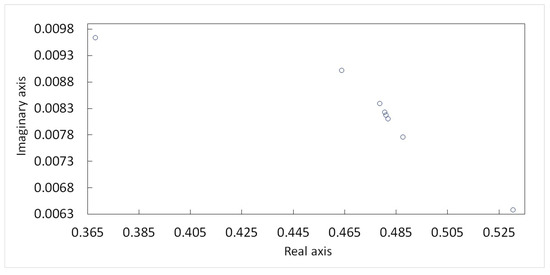
Figure 1.
Dot plot for in point
5. Conclusions
In the paper, the branched continued fraction expansions of the Horn’s hypergeometric function ratios are constructed and investigated. This allows, in particular, to approximate this function by means of a branched continued fraction. The result is a generalization of the classical continued fraction expansions of the Gauss’s hypergeometric function ratios.
Branched continued fractions, being a multidimensional generalization of continued fractions, in comparison with multiple power series under certain conditions have wider convergence domain and endowed with the property of numerical stability. All this makes them an effective tool for approximating the analytical functions of several variables. The problem of studying the convergence of branched continued fractions is that the methods of studying the convergence of continued fractions are not transferred to the multidimensional case.
In the paper, we establish a convergence domain for the constructed expansions that is wider than the convergence domain of the corresponding Horn hypergeometric function . However, in view of the convergence domains of continued fractions, the problem of studying a wider convergence domain and establishing estimates of the rate of convergence of the above-mentioned expansions still remains open.
The application of the obtained results is also an approximation of the solution of a certain system of partial differential equations, which can be used in applied problems in physics, astronomy, economics, and others. The calculation of the values of the approximants of the branched continued fraction expansion at the points of its convergence confirms the properties described above.
The proposed methods for constructing and studying the branched continued fraction expansions of the Horn’s hypergeometric function ratios can also be applied to construct the expansions of other relations of generalizations of the Gauss hypergeometric function.
Author Contributions
T.A., R.D. and V.K. contributed equally to this work. All authors have read and agreed to the published version of the manuscript.
Funding
This research was funded by the National Research Foundation of Ukraine, 2020.02/0025, 0120U103996.
Institutional Review Board Statement
Not applicable.
Informed Consent Statement
Not applicable.
Data Availability Statement
Not applicable.
Conflicts of Interest
The authors declare no conflict of interest.
References
- Erdélyi, A.; Magnus, W.; Oberhettinger, F.; Tricomi, F.G. Higher Transcendental Functions; McGraw-Hill Book Co.: New York, NY, USA, 1953; Volumes 1 and 2. [Google Scholar]
- Erdélyi, A.; Magnus, W.; Oberhettinger, F.; Tricomi, F.G. Higher Transcendental Functions; McGraw-Hill Book Co.: New York, NY, USA, 1955; Volume 3. [Google Scholar]
- Exton, H. Multiple Hypergeometric Functions and Applications; Horwood, E., Ed.; Halsted Press: Chichester, UK, 1976. [Google Scholar]
- Srivastava, H.M.; Karlsson, P.W. Multiple Gaussian Hypergeometric Series; Halsted Press: New York, NY, USA, 1985. [Google Scholar]
- Antonova, T.M.; Hoyenko, N.P. Approximation of Lauricella’s functions FD ratio by Nörlund’s branched continued fraction in the complex domain. Mat. Metody Fiz. Mekh. Polya 2004, 47, 7–15. (In Ukrainian) [Google Scholar]
- Bodnar, D.I.; Dmytryshyn, R.I. Multidimensional associated fractions with independent variables and multiple power series. Ukr. Math. J. 2019, 71, 370–386. [Google Scholar] [CrossRef]
- Dmytryshyn, R.I. Multidimensional regular C-fraction with independent variables corresponding to formal multiple power series. Proc. R. Soc. Edinb. Sect. A 2020, 150, 1853–1870. [Google Scholar] [CrossRef]
- Dmytryshyn, R.I. On the expansion of some functions in a two-dimensional g-fraction with independent variables. J. Math. Sci. 2012, 181, 320–327. [Google Scholar] [CrossRef]
- Dmytryshyn, R.I. The two-dimensional g-fraction with independent variables for double power series. J. Approx. Theory 2012, 164, 1520–1539. [Google Scholar] [CrossRef][Green Version]
- Hoyenko, N.; Antonova, T.; Rakintsev, S. Approximation for ratios of Lauricella–Saran fuctions FS with real parameters by a branched continued fractions. Math. Bul. Shevchenko Sci. Soc. 2011, 8, 28–42. (In Ukrainian) [Google Scholar]
- Horn, J. Hypergeometrische Funktionen zweier Veranderlichen. Math. Ann. 1931, 105, 381–407. [Google Scholar] [CrossRef]
- Bodnar, D.I. Branched Continued Fractions; Naukova Dumka: Kyiv, Ukraine, 1986. (In Russian) [Google Scholar]
- Bodnarchuk, P.I.; Scorobogatko, V.Y. Branched Continued Fractions and Their Applications; Naukova Dumka: Kyiv, Ukraine, 1974. (In Ukrainian) [Google Scholar]
- Scorobogatko, V.Y. Theory of Branched Continued Fractions and Its Applications in Computational Mathematics; Nauka: Moscow, Russia, 1983. (In Russian) [Google Scholar]
- Bodnar, D.I. Multidimensional C-fractions. J. Math. Sci. 1998, 90, 2352–2359. [Google Scholar] [CrossRef]
- Bodnar, D.I.; Manzii, O.S. Expansion of the ratio of Appel hypergeometric functions F3 into a branching continued fraction and its limit behavior. J. Math. Sci. 2001, 107, 3550–3554. [Google Scholar] [CrossRef]
- Bodnar, D.I. Expansion of a ratio of hypergeometric functions of two variables in branching continued fractions. J. Math. Sci. 1993, 64, 1155–1158. [Google Scholar] [CrossRef]
- Cuyt, A.; Verdonk, B. A review of branched continued fraction theory for the construction of multivariate rational approximants. Appl. Numer. Math. 1988, 4, 263–271. [Google Scholar] [CrossRef]
- Dmytryshyn, R.I. Associated branched continued fractions with two independent variables. Ukr. Math. J. 2015, 66, 1312–1323. [Google Scholar] [CrossRef]
- Murphy, J.A.; O’Donohoe, M.R. A two-variable generalization of the Stieltjes-type continued fraction. J. Comput. Appl. Math. 1978, 4, 181–190. [Google Scholar] [CrossRef]
- Kuchminskaya, K.; Siemaszko, W. Rational Approximation and Interpolation of Functions by Branched Continued Fractions; Lecture Notes in Mathematics; Springer: Berlin/Heidelberg, Germany, 1987; Volume 1237, pp. 24–40. [Google Scholar]
- Petreolle, M.; Sokal, A.D.; Zhu, B.X. Lattice paths and branched continued fractions: An infinite sequence of generalizations of the Stieltjes-Rogers and Thron-Rogers polynomials, with coefficientwise Hankel-total positivity. arXiv 2020, arXiv:1807.03271v2. [Google Scholar]
- Bodnar, D.I.; Hoyenko, N.P. Approximation of the ratio of Lauricella functions by a branched continued fraction. Mat. Studii 2003, 20, 210–214. [Google Scholar]
- Gauss, C.F. Disquisitiones generales circa seriem infinitam etc. In Commentationes Societatis Regiae Scientiarum Gottingensis Recentiores; Classis Mathematicae, 1812; H. Dieterich: Gottingae, Germany, 1813; Volume 2, pp. 3–46. [Google Scholar]
- Cooper, S.C.; Jones, W.B.; Magnus, A. General T-fraction expansions for ratios of hypergeometric functions. Appl. Numer. Math. 1988, 4, 241–251. [Google Scholar] [CrossRef]
- Cuyt, A.A.M.; Petersen, V.; Verdonk, B.; Waadeland, H.; Jones, W.B. Handbook of Continued Fractions for Special Functions; Springer: Dordrecht, The Netherlands, 2008. [Google Scholar]
- Jones, W.B.; Thron, W.J. Continued Fractions: Analytic Theory and Applications; Addison-Wesley Pub. Co.: Reading, MA, USA, 1980. [Google Scholar]
- Lorentzen, L.; Waadeland, H. Continued Fractions—Volume 1: Convergence Theory, 2nd ed.; Atlantis Press: Amsterdam, The Netherlands, 2008. [Google Scholar]
- Wall, H.S. Analytic Theory of Continued Fractions; D. Van Nostrand Co.: New York, NY, USA, 1948. [Google Scholar]
- Dmytryshyn, R.I. On some of convergence domains of multidimensional S-fractions with independent variables. Carpathian Math. Publ. 2019, 11, 54–58. [Google Scholar] [CrossRef]
- Dmytryshyn, R.I. Convergence of some branched continued fractions with independent variables. Mat. Stud. 2017, 47, 150–159. [Google Scholar]
- Dmytryshyn, R.I. The multidimensional generalization of g-fractions and their application. J. Comput. Appl. Math. 2004, 164–165, 265–284. [Google Scholar] [CrossRef][Green Version]
- Antonova, T.M. On convergence criteria for branched continued fraction. Carpathian Math. Publ. 2020, 12, 157–164. [Google Scholar]
- Antonova, T.M.; Dmytryshyn, R.I. Truncation error bounds for branched continued fraction . Ukr. Math. J. 2020, 72, 1018–1029. [Google Scholar] [CrossRef]
- Antonova, T.M.; Dmytryshyn, R.I. Truncation error bounds for branched continued fraction whose partial denominators are equal to unity. Mat. Stud. 2020, 54, 3–14. [Google Scholar]
- Bodnar, D.I.; Bilanyk, I.B. On the convergence of branched continued fractions of a special form in angular domains. J. Math. Sci. 2020, 246, 188–200. [Google Scholar] [CrossRef]
- Bodnar, O.S.; Dmytryshyn, R.I.; Sharyn, S.V. On the convergence of multidimensional S-fractions with independent variables. Carpathian Math. Publ. 2020, 12, 353–359. [Google Scholar] [CrossRef]
- Bilanyk, I.B. A truncation error bound for some branched continued fractions of the special form. Mat. Stud. 2019, 52, 115–123. [Google Scholar] [CrossRef]
- Bodnar, D.I.; Bilanyk, I.B. Estimates of the rate of pointwise and uniform convergence for branched continued fractions with nonequivalent variables. Mat. Method. Fiz. Mech. Polya 2019, 6, 72–82. (In Ukrainian) [Google Scholar]
- Shabat, B.V. Introduce in the Complex Analysis; Nauka: Moskow, Russia, 1969. (In Russian) [Google Scholar]
- Vladimirov, V.S. Methods of the Theory of Functions of Several Complex Variables; Nauka: Moscow, Russia, 1964. (In Russian) [Google Scholar]
Publisher’s Note: MDPI stays neutral with regard to jurisdictional claims in published maps and institutional affiliations. |
© 2021 by the authors. Licensee MDPI, Basel, Switzerland. This article is an open access article distributed under the terms and conditions of the Creative Commons Attribution (CC BY) license (http://creativecommons.org/licenses/by/4.0/).