


Abstract
This work is devoted to review the modern geometric description of the Lagrangian and Hamiltonian formalisms of the Hamilton–Jacobi theory. The relation with the “classical” Hamiltonian approach using canonical transformations is also analyzed. Furthermore, a more general framework for the theory is also briefly explained. It is also shown how, from this generic framework, the Lagrangian and Hamiltonian cases of the theory for dynamical systems are recovered, as well as how the model can be extended to other types of physical systems, such as higher-order dynamical systems and (first-order) classical field theories in their multisymplectic formulation.
1. Introduction
The Hamilton–Jacobi theory is a topic of interest in mathematical physics since it is a way to integrate systems of first-order ordinary differential equations (Hamilton equations in the standard case). The classical method in Hamiltonian mechanics consists of obtaining a suitable canonical transformation, which leads the system to equilibrium [1,2,3,4], and is given by its generating function. This function is the solution to the so-called Hamilton–Jacobi equation, which is a partial differential equation. The “classical” Hamilton–Jacobi problem consists of finding this canonical transformation. Because of its interest, the method was generalized in other kinds of physical systems, such as, for instance, singular Lagrangian systems [5] or higher-order dynamics [6], and different types of solutions have been proposed and studied [7,8].
Nevertheless, in recent times, a lot of research has been done to understand the Hamilton–Jacobi equation from a more general geometric approach, and some geometric descriptions to the theory were done in Reference [9,10,11,12,13]. From a geometric way, the above mentioned canonical transformation is associated with a foliation in the the phase space of the system which is represented by the cotangent bundle of a manifold (the configuration manifold Q). This foliation has some characteristic geometric properties: it is invariant by the dynamics, transversal to the fibers of the cotangent bundle, and Lagrangian with respect to the canonical symplectic structure of (although this last property could be ignored in some particular situations). The restriction of the dynamical vector field in to each leaf of this foliation projects onto another vector field on Q, and the integral curves of these vector fields are one-to-one related. Hence, the complete set of dynamical trajectories are recovered from the integral curves of the complete family of all these vector fields in the base. These geometric considerations can be done in an analogous way in the Lagrangian formalism; hence, this geometrical picture of the Hamilton–Jacobi theory can be also stated for this formalism. The geometric Hamilton–Jacobi problem consists of finding this foliation and these vector fields .
Following these ideas, the Lagrangian and Hamiltonian versions of the Hamilton–Jacobi theory, for autonomous and non-autonomous mechanical systems, was formulated in another geometrical way in Reference [14]. The foundations of this geometric generalization are similar to those given in Reference [9,15]. Later, this framework was used to develop the Hamilton–Jacobi theory for many other kinds of systems in physics. For instance, other applications of the theory are to the case of singular Lagrangian and Hamiltonian systems [16,17,18,19], higher-order dynamical systems [20,21], holonomic and non-holonomic mechanics [19,22,23,24,25,26,27], and control theory [28,29]. The theory is also been extended for dynamical systems described using other geometric structures, such as Poisson manifolds [18,30], Lie algebroids [31,32], contact manifolds (which model dissipative systems) [33,34], and other geometric applications and generalizations: [35,36,37]. Furthermore, in Reference [38,39], the geometric discretization of the Hamilton–Jacobi equation was analyzed. Finally, the Hamilton–Jacobi theory is developed for the usual covariant formulations of first-order classical field theories, the k-symplectic and k-cosymplectic [40,41] and the multisymplectic ones [42,43], for higher-order field theories [44,45], for the formulation in the Cauchy data space [46], and for partial differential equations in general [47,48].
This review paper is devoted, first of all, to present, in Section 2, the foundations of this modern geometric formulation of the Hamilton–Jacobi theory, starting from the most general problem and explaining how to derive the standard Hamilton–Jacobi equation for the Hamiltonian and the Lagrangian formalisms of autonomous mechanics. After this, the notion of complete solution allows us to establish the relation with the “classical” Hamilton–Jacobi theory based on canonical transformations, which is summarized in Section 3, where this relation is also analyzed (this topic had been already discussed in Reference [48]). We also present briefly a more general geometric framework for the Hamilton–Jacobi theory which was stated in Reference [36], from which we can derive the majority of the applications of the theory to other kinds of physical systems, including the case of autonomous dynamical systems. This is done in Section 4. Finally, among all the extensions of the theory, we have selected two of them for reviewing: the case of higher-order autonomous dynamical systems (Lagrangian and Hamiltonian formalisms), which is a direct application of the above general framework, and the generalization to the Lagrangian and Hamiltonian multisymplectic formalisms of first-order classical field theories, which can also be interpreted as a special case of the general framework. Both of them are treated in Section 5.
Throughout the work it is considered that the manifolds are real, smooth, and second countable. In the same way, all the maps are assumed to be smooth. The summation convention for repeated cross indices is also assumed.
2. The Geometric Hamilton–Jacobi Theory
We summarize the main features of the geometric Hamilton–Jacobi theory for the Hamiltonian and Lagrangian formalisms of autonomous dynamical systems, as it is stated in Reference [14] (also see Reference [9,15]).
2.1. Hamiltonian Hamilton–Jacobi Problem
Typically, a (regular autonomous) Hamiltonian system is a triad , where the bundle represents the phase space of a dynamical system (Q is the configuration space), is the natural symplectic form in , and is the Hamiltonian function. The dynamical trajectories are the integral curves of the Hamiltonian vector field associated with H, which is the solution to the Hamiltonian equation
(Here, and are the sets of differentiable k-forms and vector fields in , and denotes the inner contraction of and ). In natural coordinates of , we have that , and the curves are the solution to the Hamilton equations
Definition 1.
The generalized Hamiltonian Hamilton–Jacobi problem for a Hamiltonian systemis to find a vector fieldand a 1-formsuch that, ifis an integral curve of X, thenis an integral curve of, i.e., if, then. Then, the coupleis a solution to the generalized Hamiltonian Hamilton–Jacobi problem.
Theorem 1. 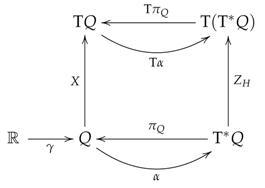
The following statements are equivalent:
- 1.
- The coupleis a solution to the generalized Hamiltonian Hamilton–Jacobi problem.
- 2.
- The vector fields X andare α-related, i.e.,. As a consequence,, and it is called the vector field associated with the form.
- 3.
- The submanifoldofis invariant by the Hamiltonian vector field(or, which means the same thing,is tangent to).
- 4.
- The integral curves ofwhich have their initial conditions inproject onto the integral curves of X.
- 5.
- The equationholds for the 1-form α.
Proof.
(Guidelines for the proof):
The equivalence between 1 and 2 is a consequence of the Definition 1 and the definition of integral curves. Then, the expression is obtained by composing both members of the equality with and taking into account that .
Items 3 and 4 follow from 2.
Item 5 is obtained from Definition 1 and using the dynamical Equation (1). □
In order to solve the generalized Hamilton–Jacobi problem, it is usual to state a less general version of it, which constitutes the standard Hamilton–Jacobi problem.
Definition 2.
The Hamiltonian Hamilton–Jacobi problem for a Hamiltonian systemis to find a 1-formsuch that it is a solution to the generalized Hamiltonian Hamilton–Jacobi problem and is closed. Then, the form α is a solution to the Hamiltonian Hamilton–Jacobi problem.
As is closed, for every point in Q, there is a function S in a neighborhood such that . It is called a local generating function of the solution .
Theorem 2.
The following statements are equivalent:
- 1.
- The formis a solution to the Hamiltonian Hamilton–Jacobi problem.
- 2.
- is a Lagrangian submanifold ofwhich is invariant by, and S is a local generating function of this Lagrangian submanifold.
- 3.
- The equationholds for α, or, which is equivalent, the functionis locally constant.
Proof.
(Guidelines for the proof): They are consequences of Theorem 1 and Definition 2. □
The last condition, written in natural coordinates, gives the classical form of the Hamiltonian Hamilton–Jacobi equation, which is
These forms are particular solutions to the (generalized) Hamilton–Jacobi problem, but we are also interested in finding complete solutions to the problem. Then,
Definition 3.
Let. A family of solutions, depending on n parameters, is a complete solution to the Hamiltonian Hamilton–Jacobi problem if the map
is a local diffeomorphism.
Remark 1.
Given a complete solution, as,, there is a family of functionsdefined in neighborhoodsof every point such that. Therefore, we have a locally defined function
which is called alocal generating functionof the complete solution.
A complete solution defines a Lagrangian foliation inwhich is transverse to the fibers, and such thatis tangent to the leaves. The functions that locally define this foliation are the components of a mapand give a family of constants of motion of. Conversely, if we havenfirst integralsofin involution, such that, then, with, define this transversal Lagrangian foliation, hence having a local complete solution. Thus, we can locally isolate, replace them in, and project to the basis, then obtaining the family of vector fieldsassociated with the local complete solution. Ifis a complete solution, then all the integral curves ofare obtained from the integral curves of the associated vector fields.
2.2. Lagrangian Hamilton–Jacobi Problem
The above framework for the Hamilton–Jacobi theory can be easily translated to the Lagrangian formalism of mechanics. Now, the phase space is the tangent bundle of the configuration bundle Q and the dynamics is given by the Lagrangian function of the system, . Using the canonical structures in , i.e., the vertical endomorphism , and the Liouville vector field , the Lagrangian forms , , and the Lagrangian energy are constructed. Then, the Lagrangian equation is
and is a Lagrangian dynamical system. Furthermore, the Legendre transformation associated with , denoted by , is defined as the fiber derivative of the Lagrangian function. We assume that is regular, i.e., is a local diffeomorphism, or, equivalently, is a symplectic form (the Lagrangian is hyper-regular if is a global diffeomorphism). In that case, the Lagrangian Equation (3) has a unique solution , which is called the Lagrangian vector field, in which integral curves are holonomic, and are the solutions to the Euler–Lagrange equations. (see Reference [49] for details).
Definition 4.
The generalized Lagrangian Hamilton–Jacobi problem for a Lagrangian systemis to find a vector fieldsuch that, ifis an integral curve of X, thenis an integral curve of, i.e., if, then. Then, the vector field X is a solution to the generalized Lagrangian Hamilton–Jacobi problem.
Theorem 3. 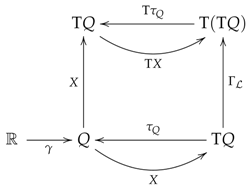
The following statements are equivalent:
- 1.
- The vector field X is a solution to the generalized Lagrangian Hamilton–Jacobi problem.
- 2.
- The vector fields X andare X-related, i.e.,.
- 3.
- The submanifold of is invariant by the Lagrangian vector field (or, which means the same thing, is tangent to ).
- 4.
- The integral curves ofwhich have their initial conditions inproject onto the integral curves of X.
- 5.
- The equationholds for the vector field X.
Proof.
(Guidelines for the proof): The proof follows the same patterns as Theorem 1. □
As in the Hamiltonian formalism, we consider the following simpler case:
Definition 5.
The Lagrangian Hamilton–Jacobi problem for a Lagrangian systemis to find a vector field X such that it is a solution to the generalized Lagrangian Hamilton–Jacobi problem and satisfies that. Then, this vector field X is a solution to the Lagrangian Hamilton–Jacobi problem.
Since , then, for every point of Q, there is a neighborhood and a function S such that (in U).
Theorem 4.
The following statements are equivalent:
- 1.
- The vector field X is a solution to the Lagrangian Hamilton–Jacobi problem.
- 2.
- is a Lagrangian submanifold ofwhich is invariant by the Lagrangian vector field(and S is a local generating function of this Lagrangian submanifold).
- 3.
- The equationholds for X, or, which is equivalent, the functionis locally constant.
Proof.
(Guidelines for the proof): They are consequences of Theorem 3 and Definition 5. □
The last condition leads to the following expression which is the form of the Lagrangian Hamilton–Jacobi equation in natural coordinates,
As in the Hamiltonian Hamilton–Jacobi theory, we are interested in the complete solutions to the problem, which are defined as:
Definition 6.
Let. A family of solutions, depending on n parameters, is a complete solution to the Lagrangian Hamilton–Jacobi problem if the map
is a local diffeomorphism.
If we have a complete solution to the Lagrangian Hamilton–Jacobi problem, all the integral curves of the Lagrangian vector field are obtained from the integral curves of all the vector fields .
The equivalence between the Lagrangian and the Hamiltonian Hamilton–Jacobi problems is stated as follows:
Theorem 5.
Letbe a (hyper)regular Lagrangian system, andits associated Hamiltonian system. Ifis a solution to the (generalized) Hamiltonian Hamilton–Jacobi problem, thenis a solution to the (generalized) Lagrangian Hamilton–Jacobi problem; conversely, ifis a solution to the (generalized) Lagrangian Hamilton–Jacobi problem, thenis a solution to the (generalized) Hamiltonian Hamilton–Jacobi problem.
Proof.
(Guidelines for the proof): It can be proven that ; then, bearing in mind that , the proof follows using items 2 and 5 of Theorems 1 and 3 (or item 3 of Theorems 2 and 4). □
3. The “Classical” Hamilton–Jacobi Theory
In this section, we review the geometric description of the classical Hamiltonian Hamilton–Jacobi theory (for autonomous systems), based on using canonical transformations [1,2,9,12,13]. It is stated in the Hamiltonian formalism.
3.1. Canonical Transformations and the Classical Hamiltonian Hamilton–Jacobi Problem
First, we recall the following well-known results [9]:
Proposition 1.
Let, be symplectic manifolds and, . Then,is a symplectic manifold.
Proposition 2.
Letbe a diffeomorphism and.
Φ is a symplectomorphism (i.e., ) if, and only if, is a Lagrangian submanifold of .
If , ; being a Lagrangian submanifold, we have
is a function defined in an open neighborhood of every point, which depends on the choice of and .
Definition 7.
is called a generating function of the Lagrangian submanifoldand, hence, of the symplectomorphism Φ.
If , are Darboux charts such that , local coordinates in can be chosen in several ways. This leads to different possible choices for . Thus, for instance, if is a chart, then (5) gives the symplectomorphism explicitly as
Now, let be a Hamiltonian system.
Definition 8.
A canonical transformation for a Hamiltonian systemis a symplectomorphism. As a consequence, Φ transforms Hamiltonian vector fields into Hamiltonian vector fields.
Definition 9.
The Hamilton–Jacobi problem for a Hamiltonian systemis to find a canonical transformationleading the system to equilibrium, i.e., such that.
The canonical transformation is given by a generating function :
where the general solution to the Hamilton–Jacobi equation
Then, the Hamilton equations for the transformed Hamiltonian function are
and solving (7), from (8) and (6), the dynamical curves of the original Hamiltonian system are obtained.
3.2. Relation between the “Classical” and the Geometric Hamilton–Jacobi Theories
The relation between the “classical” and the geometric Hamilton–Jacobi theories is established through the equivalence of complete solutions and canonical transformations (also see Reference [48]).
Theorem 6.
Letbe a Hamiltonian system. A complete solutionto the Hamilton–Jacobi problem provides a canonical transformationleading the system to equilibrium, and conversely.
Proof.
In a neighborhood of every point, consider a complete solution , and let be a generating function of it. As , we can identify with a subset of coordinates in , and then can be thought as a generating function of a local canonical transformation and, hence, of an open set of the Lagrangian submanifold . Making this construction in every chart, we have the transformation and the submanifold . Now, as (2) holds for every particular solution , we have that
Conversely, if we have the canonical transformation , from a generating function , taking , we obtain a family of functions and, hence, a local complete solution to the Hamiltonian Hamilton–Jacobi problem. Making this construction in every chart, we have the complete solution. □
Geometrically, this means that, on each local chart of , fixing the coordinates of a point, we obtain a local submanifold wherein the image by gives the image of a local section which is a particular solution to the Hamiltonian Hamilton–Jacobi problem.
4. General Geometric Framework for the Hamilton–Jacobi Theory
The geometric Hamilton–Jacobi theory can be stated in a more general framework which allows us to extend the theory to a wide variety of systems and situations. Next, we present a summary of this general framework, as it is stated in Reference [36] (also see Reference [31] for another similar approach).
4.1. Slicing Problems
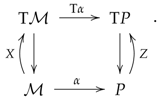
In general, a dynamical system is just a couple , where P is a manifold and is a vector field which defines the dynamical equation on P. Then, in order to state the analogous to the Hamilton–Jacobi problem for this system in a more general context, consider a manifold , a vector field , and a map , as it is showed in the following diagram:
Proposition 3.
The following statements are equivalent:
- 1.
- If γ is an integral curve of X, thenis an integral curve of Z.
- 2.
- The vector fields X and Z are α-related:Furthermore, if α is an injective immersion, (inducing a diffeomorphism), then these properties are equivalent to:
- 3.
- The vector field Z is tangent to, and, if, then.Then, the mapis a bijection between the integral curves of X and the integral curves of Z in.
Proof.
They are immediate, bearing in mind the commutativity of the above diagram. □
Definition 10.
A slicing of a dynamical systemis a triplewhich is a solution to the slicing Equation (9).
If and are coordinates in and P, respectively, and , , and , then , and is a solution to the slicing equation if, and only if,
We say that the vector field X gives a “partial dynamics” or a “slice” of the “whole dynamics” which is given by Z, and the whole dynamics can be recovered from these slices. In fact, the integral curves of Z contained in can be described by a solution to the slicing equation; but we need a complete solution to describe all the integral curves of Z, and it can be defined as a family of solutions depending on the parameters of a space .
Definition 11. 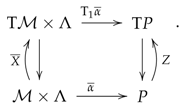
A complete slicing of a dynamical systemis a mapand a vector fieldalong the projectionsuch that:
- 1.
- The mapis surjective,
- 2.
- for every, the mapandare a slicing of Z.
Thus, a complete slicing is a family of maps and vector fields satisfying the above conditions.
As for every point there exists such that , the integral curve of Z through p is described by the integral curve of through x by means of the map . In addition, if each is an immersion (for instance, when it is a diffeomorphism), then are determined by the .
The hypothesis of being an embedding holds in many situations, for instance, for the sections of a fiber bundle . Then, we can consider the slicing problem for sections of , as before. In this case, as is an embedding, Equation (9) determines X, and X is given from by the equation
In this case, Proposition 3 states that a section of is a solution to the slicing equation for if, and only if,
4.2. Recovering the Hamilton–Jacobi Equation for Hamiltonian and Lagrangian Dynamical Systems
Consider the case of a Hamiltonian system , where is a symplectic manifold, is a Hamiltonian function, and is its Hamiltonian vector field, i.e., the solution to (1). Then,
Theorem 7.
Ifis a solution to the slicing Equation (9) for, then
In addition, ifis an embedding satisfying the condition, then
conversely, ifand α satisfies this equation and, then α is a solution to the slicing Equation (9).
In the particular case where is a fiber bundle (for instance, and ), we can consider the slicing problem as before, but only for sections of ,
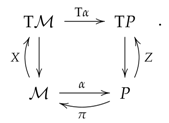
Being an embedding, the Equation (9) determines X, and, composing this equation with , we obtain that . Therefore, the slicing Equation (9) reads
In this way, Equation (9) can be considered as a generalization of the Hamilton–Jacobi equation in the Hamiltonian formalism, which is just the slicing equation for a closed 1-form in Q. Therefore, locally, and the slicing equation looks in the ordinary form .
The same applies to the Lagrangian formalism. In this case , and, if is a regular Lagrangian function, is the Lagrangian vector field solution to the Lagrangian Equation (3). Then, all proceeds as in the Hamiltonian case.
The Definitions 3 and 6 of complete solutions to the Hamiltonian and Lagrangian Hamilton–Jacobi problems, respectively, are particular cases of the Definition 11 of complete slicings.
5. The Hamilton–Jacobi Problem for Other Physical Systems
Using the general framework presented in the above section, the Hamilton–Jacobi problem can be stated for a wide kind of physical systems. Next, we review two of them. Other applications of the theory are listed in detail in the Introduction.
5.1. Higher-Order (Autonomous) Dynamical Systems
Let Q be a n-dimensional manifold and let the kth-order tangent bundle of Q, which is endowed with natural coordinates , , . If is the Lagrangian function of an autonomous kth-order Lagrangian system, using the canonical structures of the higher-order tangent bundles, we can construct the Poincaré-Cartan forms and the Lagrangian energy in which coordinate expressions are
where , and . Thus, we have the higher-order Lagrangian system . Assuming that the Lagrangian function is regular, i.e., is a symplectic form, the Lagrangian equation has a unique solution (the Lagrangian vector field) in which the integral curves are holonomic (i.e., they are canonical liftings of curves ) and are the solutions to the Otrogradskii or higher-order Euler–Lagrange equations (see Reference [50,51,52] for details).
The Hamilton–Jacobi problem for higher-order Lagrangian dynamical systems is just the slicing problem for the particular situation represented in the diagram
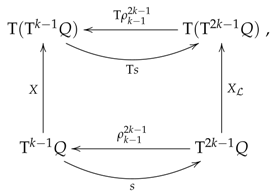
i.e., for sections of the natural projection , ; thus, we have the following settings (see Reference [20,21] for the details and proofs):
Definition 12.
The generalized kth-order Lagrangian Hamilton–Jacobi problem for the higher-order Lagrangian systemis to find a sectionand a vector fieldsuch that, ifis an integral curve of X, thenis an integral curve of; i.e., if, then. Then, the coupleis a solution to the generalized kth-order Lagrangian Hamilton–Jacobi problem.
Theorem 8.
The following statements are equivalent:
- 1.
- The coupleis a solution to the generalized kth-order Lagrangian Hamilton–Jacobi problem.
- 2.
- The vector fields X andare s-related, i.e.,. As a consequence,, and X is said to be the vector field associated with the sections.
- 3.
- The submanifoldofis invariant by the Lagrangian vector field(or, which means the same thing,is tangent to).
- 4.
- The integral curves ofwhich have initial conditions inproject onto the integral curves of X.
- 5.
- The equationholds for α.
Proof.
(Guidelines for the proof): The proof follows a pattern similar to that of Theorem 1, but now using Definition 12. □
Definition 13.
The kth-order Lagrangian Hamilton–Jacobi problem for the higher-order Lagrangian systemis to find a sectionsuch that it is a solution to the generalized kth-order Lagrangian Hamilton–Jacobi problem and satisfies that. Then, this section s is a solution to the kth-order Lagrangian Hamilton–Jacobi problem.
Observe that that ; i.e., is a closed 1-form and then there exists , , such that .
Theorem 9.
The following statements are equivalent:
- 1.
- The section s is a solution to the generalized kth-order Lagrangian Hamilton–Jacobi problem.
- 2.
- is a Lagrangian submanifold of, which is invariant by the Lagrangian vector field(and S is a local generating function of this Lagrangian submanifold).
- 3.
- The equationholds for s, or, which is equivalent, the functionis locally constant.
Proof.
(Guidelines for the proof): They are consequences of Theorem 8 and Definition 13. □
In natural coordinates, from this last condition, we obtain that
This system of partial differential equations for S generalizes Equation (4) to higher-order systems.
Definition 14.
Let. A family of solutions, depending on n parameters, is a complete solution to the kth-order Lagrangian Hamilton–Jacobi problem if the map
is a local diffeomorphism.
For the Hamiltonian formalism, let be the Hamiltonian function of a (regular) higher-order dynamical system. Using the canonical Liouville forms of the cotangent bundle, and , where () are canonical coordinates in , the dynamical equation for the Hamiltonian system is , and it has a unique solution . As we are working in the cotangent bundle , the Hamiltonian Hamilton–Jacobi problems for higher-order systems is stated in the same way as in the first-order case; hence, it is the slicing problem for the particular situation represented in the diagram
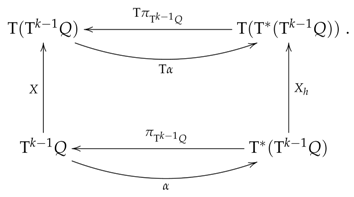
Therefore, all the definitions and results are like in the first-order case, and the relation between both the Lagrangian and the Hamiltonian Hamilton–Jacobi problems is stated as in Theorem 5.
5.2. Multisymplectic Field Theories
The Hamilton–Jacobi theory for multisymplectic field theories has been studied in Reference [42,43,45]. Next, we state the Lagrangian and the Hamiltonian problems for these systems. For details on multisymplectic field theories, see, for instance, Reference [53,54,55] and the references therein.
5.2.1. Multisymplectic Lagrangian Hamilton–Jacobi Problem
Let a bundle, where M is an oriented manifold with and . The Lagrangian description of multisymplectic classical field theories is stated in the first-order jet bundle , which is also a bundle . Natural coordinates in adapted to the bundle structure are (; ). Giving a Lagrangian density associated to a Lagrangian function and using the canonical structures of , we can define the Poincaré–Cartan forms associated with , , and , in which local expression is
where and . The Lagrangian function is regular if is a multisymplectic -form (i.e., 1-nondegenerate). Then, the couple is a multisymplectic Lagrangian system. The Lagrangian problem consists of finding m-dimensional, -transverse, and holonomic distributions in such that their integral sections are canonical liftings of sections that are solutions to the Lagrangian field equation
In coordinates, the components of satisfy the Euler–Lagrange equations
Definition 15.
The generalized Lagrangian Hamilton–Jacobi problem for the multisymplectic Lagrangian systemis to find a section(which is called a jet field ) and an m-dimensional integrable distributionin E such that, ifis an integral section of, thenis an integral section of; i.e., if, for every, then, for every. Then, the coupleis a solution to the generalized Hamiltonian Hamilton–Jacobi problem.
Remark 2. 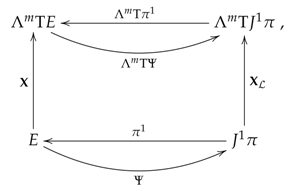
The Hamilton–Jacobi problem can also be stated associating the distributionsandwithmultivector fields. Anm-multivector field, on a manifoldis a section of the bundle, where(i.e, a skew-symmetric contravariant tensor field). Ifis anm-multivector field in, then, for every, there is a neighborhoodand local vector fieldssuch that. Then, ifis anm-dimensional distribution in, sections ofarem-multivector fields in, and a multivector field isintegrableif its associated distribution is also.
Now, if, letandbe them-multivector fields associated with the distributionsand, respectively, then, the Lagrangian Hamilton–Jacobi problem can be represented by the diagram
whereanddenote the natural extensions of the mapsandto the multitangent bundles; thus, this problem can be considered as a special case of aslicing problem.
Theorem 10.
The following statements are equivalent:
- 1.
- The coupleis a solution to the generalized Lagrangian Hamilton–Jacobi problem.
- 2.
- The distributionsandare Ψ-related. As a consequence,and is called the distribution associated with.
- 3.
- The distributionis tangent to the submanifoldof.
- 4.
- Integral sections ofwhich have boundary conditions inproject onto the integral sections of.
- 5.
- If γ is an integral section of the distributionassociated with the jet field Ψ, then, for every, the equationholds for Ψ.
Proof.
(Guidelines for the proof):
The equivalence between 1 and 2 is a consequence of the Definition 15, the equivalence between distributions and multivector fields, and the definition of integral sections.
Items 3 and 4 follow from 2.
Item 5 is obtained from Definition 15 and using field Equation (10). □
Definition 16.
The Lagrangian Hamilton–Jacobi problem for the multisymplectic Lagrangian systemis to find a jet fieldsuch that it is solution to the generalized Lagrangian Hamilton–Jacobi problem and satisfies that. Then, the jet field Ψ is a solution to the Lagrangian Hamilton–Jacobi problem.
The condition is equivalent to asking that the form is closed and then there exists a -form , with , such that . Furthermore, is -semibasic, since , and, hence, , are also.
Theorem 11.
The following statements are equivalent:
- 1.
- The jet field Ψ is a solution to the Lagrangian Hamilton–Jacobi problem.
- 2.
- is an m-Lagrangian submanifold ofand the distributionis tangent to it.
- 3.
- The formis closed.
In coordinates, , and the Lagrangian Hamilton–Jacobi equation has the form
Definition 17.
Let. A family of solutions, depending on n parameters, is a complete solution to the Lagrangian Hamilton–Jacobi problem if the map
is a local diffeomorphism.
A complete solution defines an -dimensional foliation in which is transverse to the fibers and such that the distribution is tangent to it. Then, all the sections which are solutions to the Euler–Lagrange equations (i.e., all the integral sections of the distribution ) are recovered from a complete solution.
5.2.2. Multisymplectic Hamiltonian Hamilton–Jacobi Problem
The Hamiltonian formalism for a regular first-order multisymplectic field theory is developed in the so-called reduced dual jet bundle of , , where is the bundle of m-forms over E vanishing when they act on -vertical bivectors. It is endowed with the canonical projections and , and natural coordinates in are denoted . The physical information is given by a Hamiltonian section h of the natural projection , which is associated with a local Hamiltonian function such that . Then, from the canonical form , we construct the Hamilton-Cartan multisymplectic form in which coordinate expression is
and the couple is a multisymplectic Hamiltonian system. Then, the Hamiltonian problem consists of finding integrable m-dimensional -transverse distributions in such that their integral sections are solutions to the Hamiltonian field equation
The existence of such distributions is assured. In coordinates, this equation gives the Hamilton–De Donder–Weyl equations
Definition 18.
The generalized Hamiltonian Hamilton–Jacobi problem for the multisymplectic Hamiltonian systemis to find a sectionand an integrable m-dimensional distributionin E such that, ifis an integral section of, thenis an integral section of, i.e., if, for every, then, for every. Then, the coupleis a solution to the generalized Hamiltonian Hamilton–Jacobi problem.
Remark 3. 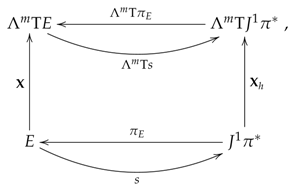
As in the Lagrangian case, the Hamiltonian Hamilton–Jacobi problem can be considered as a special case of the followingslicing problem:
where and are m-multivector fields associated with the distributions and , respectively.
The following Theorems and Definitions are analogous to those of the Lagrangian case.
Theorem 12.
The following conditions are equivalent.
- 1.
- The coupleis a solution to the generalized Hamiltonian Hamilton–Jacobi problem.
- 2.
- The distributionsandare s-related. As a consequence, the distributionis given by, and it is called the distribution associated withs.
- 3.
- The distributionis tangent to the submanifoldof.
- 4.
- Integral sections ofwhich have boundary conditions inproject onto the integral sections of.
- 5.
- If γ is an integral section of the distributionassociated with s, then, for every, the equationholds for s.
Definition 19.
The Hamiltonian Hamilton–Jacobi problem for the multisymplectic Hamiltonian systemis to find a sectionsuch that it is a solution to the generalized Hamilton–Jacobi problem and satisfies that. The section s is a solution to the Hamiltonianian Hamilton–Jacobi problem.
Theorem 13.
The following conditions are equivalent.
- 1.
- The coupleis a solution to the generalized Hamiltonian Hamilton–Jacobi problem.
- 2.
- is an m-Lagrangian submanifold ofand the distributionis tangent to it.
- 3.
- The formis closed.
As the -semibasic m-form is closed, there exists a local -semibasic -form , such that . In coordinates, if , where are local functions, we obtain that
from which we obtain the classical Hamiltonian Hamilton–Jacobi equation
The definition and the characteristics of complete solution are like in the Lagrangian case.
5.2.3. Relation between the Multisymplectic Hamilton–Jacobi Problems
Let be the Legendre map defined by the Lagrangian , which is locally given by
If is a regular or a hyperregular Lagrangian (i.e., is a local or global diffeomorphism), then and . In addition, the integral sections of the distributions and , which are the solution to the Lagrangian and the Hamiltonian problems, respectively, are in one-to-one correspondence through . (see Reference [43] for definitions and details). Then, we have:
Theorem 14.
Letbe a regular or a hyperregular Lagrangian. Then, ifis a jet field solution to the (generalized) Lagrangian Hamilton–Jacobi problem, then the sectionis a solution to the (generalized) Hamiltonian Hamilton–Jacobi problem. Conversely, ifis a solution to the (generalized) Hamiltonian Hamilton–Jacobi problem, then the jet fieldis a solution to the (generalized) Lagrangian Hamilton–Jacobi problem.
Proof.
(Guidelines for the proof): The proof is like in Theorem 5, but using multivector fields. □
Remark 4.
As a final remark, notice that the Hamilton–Jacobi theory fornon-autonomous(i.e.,time-dependent) dynamical systemscan be recovered from the multisymplectic Hamilton–Jacobi theory as a particular case takingand identifying the distributions, , and their associated multivector fields, , with time-dependent vector fields (see Reference [43]).
6. Discussion
In this work, the Lagrangian and the Hamiltonian versions of the Hamilton–Jacobi theory are reviewed from a modern geometric perspective.
First, this formulation is done for autonomous dynamical systems, and, in particular, the Hamiltonian case is compared with the “classical” Hamiltonian Hamilton–Jacobi theory, which is based in using canonical transformations.
There is also a general framework for the theory, which is also reviewed in the work. It contains the above standard theory for autonomous dynamical systems as a particular case and allows us to extend the Hamilton–Jacobi theory to a wide range of physical systems. In particular, two of these extensions have been analyzed here: the higher-order (autonomous) dynamical systems and the (first-order) classical Lagrangian and Hamiltonian field theories, using their multisymplectic formulation.
This geometric model has been extended and applied to many kinds of physical systems (as it is mentioned in the Introduction and cited in the bibliography). As a future line of research that has not been explored yet, the application of this geometric framework to state the Hamilton–Jacoby equation for dissipative systems in classical field theories should be explored, using an extension of the contact formalism which has been recently introduced to describe geometrically these kinds of dissipative field theories [56,57].
Funding
I acknowledge the financial support from project PGC2018-098265-B-C33 of the Spanish Ministerio de Ciencia, Innovación y Universidades and the project 2017–SGR–932 of the Secretary of University and Research of the Ministry of Business and Knowledge of the Catalan Government.
Institutional Review Board Statement
Not applicable.
Informed Consent Statement
Not applicable.
Data Availability Statement
Not applicable.
Conflicts of Interest
The author declares no conflict of interest.
References
- Arnold, V.I. Mathematical Methods of Classical Mechanics; Graduate Texts in Mathematics; Springer: New York, NY, USA, 1989; Volume 60. [Google Scholar] [CrossRef]
- José, J.V.; Saletan, E.J. Classical Dynamics: A Contemporary Approach; Cambridge University Press: Cambridge, UK, 1998; ISBN 9780521636360. [Google Scholar]
- Landau, L.; Lifschitz, E. Mécanique, 3rd ed.; Butterworth-Heinemann: Oxford, UK, 1976; Volume 1, ISBN 978-0-7506-2896-9. [Google Scholar]
- Saletan, E.J.; Cromer, A.H. Theoretical Mechanics; J. Wiley: New York, NY, USA, 1971; ISBN 13:9780471749868. [Google Scholar]
- Dominici, D.; Gomis, J.; Longhi, G.; Pons, J.M. Hamilton–Jacobi Theory For Constrained Systems. J. Math. Phys. 1984, 25, 2439–2460. [Google Scholar] [CrossRef]
- Constantelos, G.C. On the Hamilton–Jacobi Theory with Derivatives of Higher Order. Il Nuovo Cim. B (1971-1996) 1984, 84, 91–101. [Google Scholar] [CrossRef]
- Crandall, M.G.; Evans, L.C.; Lions, P.L. Some properties of viscosity solutions of Hamilton–Jacobi equations. Trans. Am. Math. Soc. 1984, 282, 487–502. [Google Scholar] [CrossRef]
- Crandall, M.G.; Lions, P.L. Viscosity solutions of Hamilton–Jacobi equations. Trans. Am. Math. Soc. 1983, 277, 1–42. [Google Scholar] [CrossRef]
- Abraham, R.; Marsden, J.E. Foundations of Mechanics, 2nd ed.; Benjamin/Cummings: Reading, MA, USA, 1978. [Google Scholar] [CrossRef]
- Benenti, S.; Tulczyjew, W.M. The geometrical meaning and globalization of the the Hamilton–Jacobi method, Differential Geometric Methods in Mathematical Physics. In Differential Geometrical Methods in Mathematical Physics; Springer: Berlin/Heidelberg, Germany, 1980; Volume 836, pp. 9–21. [Google Scholar] [CrossRef]
- Esposito, G.; Marmo, G.; Sudarshan, G. From Classical to Quantum Mechanics; Cambridge University Press: Cambridge, UK, 2004. [Google Scholar] [CrossRef]
- Libermann, P.; Marle, C.M. Symplectic Geometry and Analytical Dynamics; D. Reidel Publishing Company: Dordrecht, The Netherlands, 1987. [Google Scholar] [CrossRef]
- Marmo, G.; Morandi, G.; Mukunda, N. The Hamilton–Jacobi theory and the analogy between classical and quantum mechanics. J. Geom. Mech. 2009, 1, 317–355. [Google Scholar] [CrossRef]
- Cariñena, J.F.; Gràcia, X.; Marmo, G.; Martínez, E.; Muñoz–Lecanda, M.C.; Román–Roy, N. Geometric Hamilton–Jacobi theory. Int. J. Geom. Meth. Mod. Phys. 2006, 3, 1417–1458. [Google Scholar] [CrossRef]
- Krupková, O.; Vondra, A. On some integration methods for connections on fibered manifolds. In Proceedings of the Conference in Differential Geometry and Its Applications, Opava, Czech Republic, 24–28 August 1992; Silesian University: Opava, Czech Republic, 1993. [Google Scholar]
- Cariñena, J.F.; Gràcia, X.; Marmo, G.; Martínez, E.; Muñoz–Lecanda, M.C.; Román–Roy, N. Hamilton–Jacobi theory and the evolution operator. In Mathematical Physics and Field Theory. Julio Abad, in Memoriam; Asorey, M., García Esteve, J.V., Rañada, M.F., Sesma, J., Eds.; Prensas Universitarias de Zaragoza: Zaragoza, Spain, 2009; pp. 177–186. ISBN 978-84-92774-04-3. [Google Scholar]
- de León, M.; Martín de Diego, D.; Vaquero, M. A Hamilton–Jacobi theory for singular Lagrangian systems in the Skinner and Rusk setting. Int. J. Geom. Meth. Mod. Phys. 2012, 9, 1250074. [Google Scholar] [CrossRef]
- de León, M.; de Diego, M.D.; Vaquero, M. A Hamilton–Jacobi theory on Poisson manifolds. J. Geom. Mech. 2014, 6, 121–140. [Google Scholar] [CrossRef]
- Leok, M.; Ohsawa, T.; Sosa, D. Hamilton–Jacobi theory for degenerate Lagrangian systems with holonomic and nonholonomic constraints. J. Math. Phys. 2012, 53, 072905. [Google Scholar] [CrossRef]
- Colombo, L.; de León, M.; Román-Roy, N.; Prieto-Martínez, P.D. Geometric Hamilton–Jacobi theory for higher-order autonomous systems. J. Phys. A Math. Gen. 2014, 47, 235203. [Google Scholar] [CrossRef]
- Colombo, L.; de León, M.; Román-Roy, N.; Prieto-Martínez, P.D. Unified formalism for the generalized kth-order Hamilton–Jacobi problem. Int. J. Geom. Meth. Mod. Phys. 2014, 11, 1460037. [Google Scholar] [CrossRef]
- Bates, L.M.; Fassò, F.; Sansonetto, N. The Hamilton–Jacobi equation, integrability, and nonholonomic systems. J. Geom. Mechs. 2014, 6, 441–449. [Google Scholar] [CrossRef]
- Cariñena, J.F.; Gràcia, X.; Marmo, G.; Martínez, E.; MUñoz–Lecanda, M.C.; Román–Roy, N. Geometric Hamilton–Jacobi theory for nonholonomic dynamical systems. Int. J. Geom. Meth. Mod. Phys. 2010, 7, 431–454. [Google Scholar] [CrossRef]
- de León, M.; Marrero, J.C.; de Diego, M.D. Linear almost Poisson structures and Hamilton–Jacobi equation, Applications to nonholonomic mechanics. J. Geom. Mech. 2010, 2, 159–198. [Google Scholar] [CrossRef]
- Iglesias-Ponte, D.; de León, M.; Martín de Diego, D. Towards a Hamilton–Jacobi theory for nonholonomic mechanical systems. J. Phys. A Math. Theor. 2008, 41, 015205. [Google Scholar] [CrossRef]
- Ohsawa, T.; Bloch, A.M.; Leok, M. Nonholonomic Hamilton–Jacobi theory via Chaplygin Hamiltonization. J. Geom. Phys. 2011, 61, 1263–1291. [Google Scholar] [CrossRef]
- Ohsawa, T.; Bloch, A.M. Nonholomic Hamilton–Jacobi equation and integrability. J. Geom. Mech. 2011, 1, 461–481. [Google Scholar] [CrossRef]
- Barbero-Liñán, M.; de León, M.; Martín de Diego, D.; Marrero, J.C.; Muñoz-Lecanda, M.C. Kinematic reduction and the Hamilton–Jacobi equation. J. Geom. Mech. 2012, 4, 207–237. [Google Scholar] [CrossRef]
- Wang, H. Symmetric Reduction and Hamilton–Jacobi Equation of Rigid Spacecraft with a Rotor. J. Geom. Symm. Phys. 2013, 32, 87–111. [Google Scholar] [CrossRef][Green Version]
- Grillo, S.; Padrón, E. A Hamilton–Jacobi Theory for general dynamical systems and integrability by quadratures in symplectic and Poisson manifolds. J. Geom. Phys. 2016, 10, 101–129. [Google Scholar] [CrossRef]
- Balseiro, P.; Marrero, J.C.; Martín de Diego, D.; Padrón, E. A unified framework for mechanics: Hamilton–Jacobi equation and applications. Nonlinearity 2010, 23, 1887–1918. [Google Scholar] [CrossRef]
- Leok, M.; Sosa, D. Dirac structures and Hamilton–Jacobi theory for Lagrangian mechanics on Lie algebroids. J. Geom. Mechs. 2012, 4, 421–442. [Google Scholar] [CrossRef]
- de León, M.; Laínz, M. A review on contact Hamiltonian and Lagrangian systems. arXiv 2020, arXiv:2011.05579. [Google Scholar]
- Grillo, S.; Padrón, E. Extended Hamilton–Jacobi theory, contact manifolds, and integrability by quadratures. J. Math. Phys. 2020, 61, 012901. [Google Scholar] [CrossRef]
- Barbero-Liñán, M.; de León, M.; Martín de Diego, D. Lagrangian submanifolds and Hamilton–Jacobi equation. Monatshefte Math. 2013, 171, 269–290. [Google Scholar] [CrossRef]
- Cariñena, J.F.; Gràcia, X.; Marmo, G.; Martínez, E.; Muñoz–Lecanda, M.C.; Román–Roy, N. Structural aspects of Hamilton–Jacobi theory. Int. J. Geom. Meth. Mod. Phys. 2016, 13, 1650017. [Google Scholar] [CrossRef]
- Wang, H. Hamilton–Jacobi theorems for regular reducible Hamiltonian systems on a cotangent bundle. J. Geom. Phys. 2017, 119, 82–102. [Google Scholar] [CrossRef]
- Barbero-Liñán, M.; Delgado-Téllez, M.; Martín de Diego, D. A geometric framework for discrete Hamilton–Jacobi equation. Proceedings of the XX International Fall Workshop on Geometry and Physics. Madrid. AIP Conf. Proc. 2012, 1460, 164–168. [Google Scholar] [CrossRef]
- Ohsawa, T.; Bloch, A.M.; Leok, M. Discrete Hamilton–Jacobi theory. SIAM J. Control Optim. 2011, 49, 1829–1856. [Google Scholar] [CrossRef]
- de León, M.; Martín de Diego, D.; Marrero, J.C.; Salgado, M.; Vilariño, S. Hamilton–Jacobi theory in k-symplectic field theories. Int. J. Geom. Meth. Mod. Phys. 2010, 7, 1491–1507. [Google Scholar] [CrossRef]
- de León, M.; Vilariño, S. Hamilton–Jacobi theory in k-cosymplectic field theories. Int. J. Geom. Methods Mod. Phys. 2014, 11, 1450007. [Google Scholar] [CrossRef]
- de León, M.; Marrero, J.C.; Martín de Diego, D. A geometric Hamilton–Jacobi theory for classical field theories. In Variations, Geometry and Physics; Nova Science Publisher: New York, NY, USA, 2009; pp. 129–140. Available online: http://hdl.handle.net/10261/4169 (accessed on 1 August 2008).
- De León, M.; Prieto-Martínez, P.D.; Román-Roy, N.; Vilariño, S. Hamilton–Jacobi theory in multisymplectic classical field theories. J. Math. Phys. 2017, 58, 092901. [Google Scholar] [CrossRef]
- Vitagliano, L. The Hamilton–Jacobi formalism for higher-order field theory. Int. J. Geom. Meth. Mod. Phys. 2010, 7, 1413–1436. [Google Scholar] [CrossRef]
- Vitagliano, L. Geometric Hamilton-Jacobi field theory. Int. J. Geom. Methods Mod. Phys. 2012, 9, 1260008. [Google Scholar] [CrossRef]
- Campos, C.M.; de León, M.; Martín de Diego, D.; Vaquero, M. Hamilton–Jacobi theory in Cauchy data space. Rep. Math. Phys. 2015, 76, 359–387. [Google Scholar] [CrossRef]
- Vitagliano, L. Hamilton–Jacobi diffieties. J. Geom. Phys. 2011, 61, 1932–1949. [Google Scholar] [CrossRef][Green Version]
- Vitagliano, L. Characteristics, bicharacteristics, and geometric singularities of solutions of PDEs. Int. J. Geom. Meth. Mod. Phys. 2014, 11, 1460039. [Google Scholar] [CrossRef]
- Crampin, M. Tangent bundle geometry for Lagrangian dynamics. J. Phys. A Math. Gen. 1983, 16, 3755–3772. [Google Scholar] [CrossRef]
- de León, M.; Rodrigues, P.R. Generalized Classical Mechanics and Field Theory; North-Holland Math. Studies; Elsevier Science Publishers B.V.: Amsterdam, The Netherlands, 1985; Volume 112, ISBN 9780444877536. [Google Scholar]
- Gràcia, X.; Pons, J.M.; Román-Roy, N. Higher-order Lagrangian systems: Geometric structures, dynamics and constraints. J. Math. Phys. 1991, 32, 2744–2763. [Google Scholar] [CrossRef]
- Prieto-Martínez, P.D.; Román-Roy, N. Lagrangian-Hamiltonian unified formalism for autonomous higher-order dynamical systems. J. Phys. A Math. Theor. 2011, 44, 385203. [Google Scholar] [CrossRef]
- Cariñena, J.F.; Crampin, M.; Ibort, L.A. On the multisymplectic formalism for first order field theories. Differ. Geom. Appl. 1991, 1, 345–374. [Google Scholar] [CrossRef]
- Echeverría-Enríquez, A.; Muñoz-Lecanda, M.C.; Román-Roy, N. Geometry of Lagrangian first-order classical field theories. Fortschr. Phys. 1996, 44, 235–280. [Google Scholar] [CrossRef]
- Román-Roy, N. Multisymplectic Lagrangian and Hamiltonian formalisms of classical field theories. Symmetry Integr. Geom. Methods Appl. (SIGMA) 2009, 5, 25. [Google Scholar] [CrossRef]
- Gaset, J.; Gràcia, X.; Muñoz–Lecanda, M.; Rivas, X.; Román–Roy, N. A contact geometry framework for field theories with dissipation. Ann. Phys. 2020, 414, 168092. [Google Scholar] [CrossRef]
- Gaset, J.; Gràcia, X.; Muñoz–Lecanda, M.; Rivas, X.; Román–Roy, N. A k-contact Lagrangian formulation for nonconservative field theories. arXiv 2020, arXiv:2002.10458. [Google Scholar]
Publisher’s Note: MDPI stays neutral with regard to jurisdictional claims in published maps and institutional affiliations. |
© 2021 by the author. Licensee MDPI, Basel, Switzerland. This article is an open access article distributed under the terms and conditions of the Creative Commons Attribution (CC BY) license (http://creativecommons.org/licenses/by/4.0/).