

BP Neural Network Calculus in Economic Growth Modelling of the Group of Seven



Abstract
1. Introduction
The G7
2. Model Description

| y | t | ||||||||
|---|---|---|---|---|---|---|---|---|---|
| LA | AL | TP | AYS | GCF | EGS | GGFCE | BM | GDP | year |
2.1. Adaptive Lasso Method
- Calculate Lasso’s solution as the initial solution by using the previous LARS algorithm;
- Let ;
- For a sufficiently small positive number , the algorithm stops when .
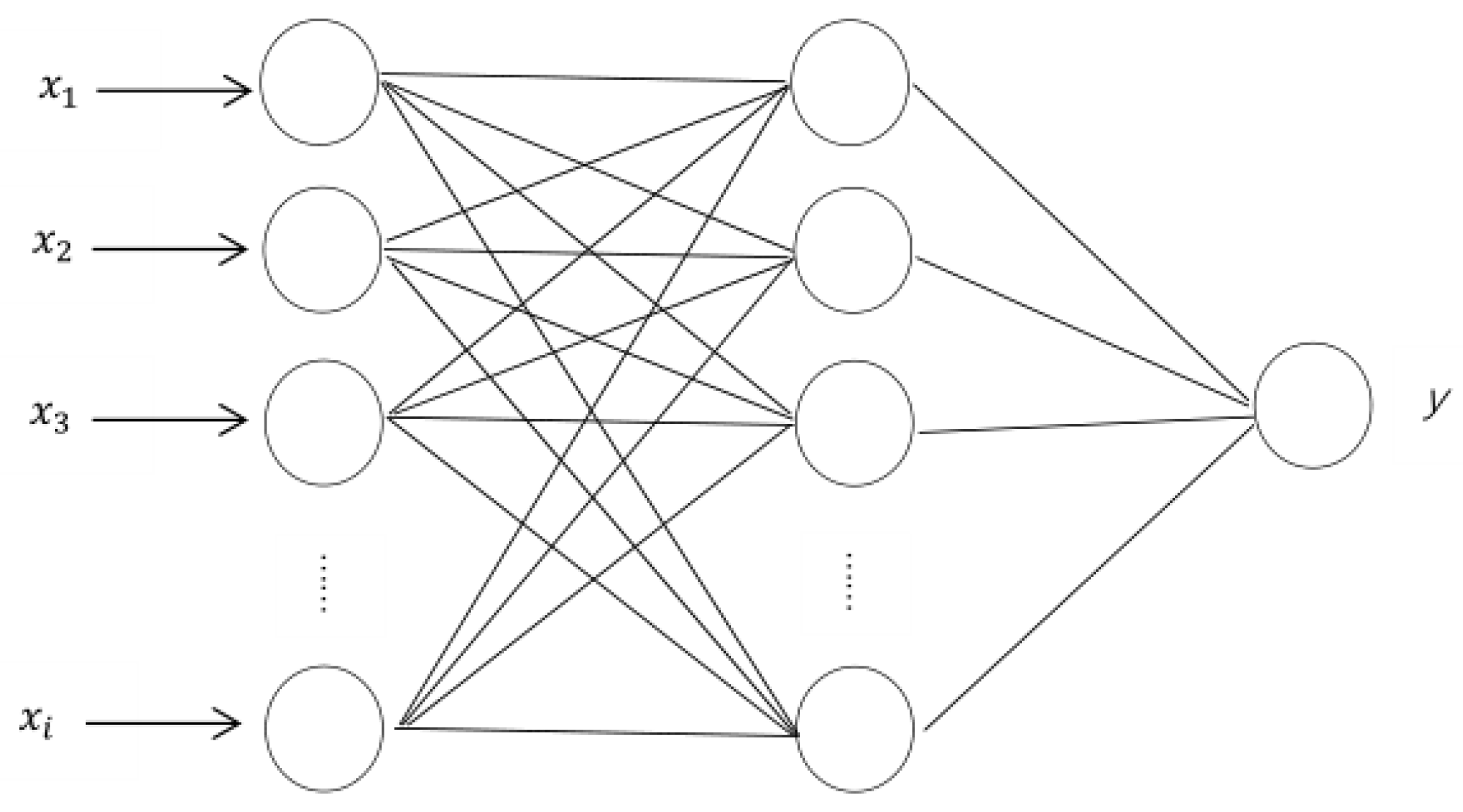
2.2. BP Neural Network
- Step 1: The sample input and output parameters are normalized to the interval ;
- Step 2: Weight and threshold initialization, assign a random value in ;
- Step 3: Calculate the state of the hidden layer of the network and the output value of the output layer;
- Step 4: Calculate the error between the output value and the actual value;
- Step 5: Determine whether the sample error is within the acceptable range. If it is satisfied, the training ends. If it is not satisfied, continue to modify the weight and threshold, and go to Step 3 until the error reaches an acceptable range.
3. Main Results
3.1. Variable Selection
3.2. The Importance of Input Variables
3.3. Fitting Result
3.4. Predicted Result
4. Conclusions
Author Contributions
Funding
Acknowledgments
Conflicts of Interest
References
- Sadeghi, B. A BP-neural network predictor model for plastic injection molding process. J. Inequal. J. Mater. Process Technol. 2000, 103, 411–416. [Google Scholar] [CrossRef] [Scilit]
- Xiao, Z.; Ye, S.; Zhong, B.; Sun, C. BP neural network with rough set for short term load forecasting. Appl. Artif. Intell. Rev. 2009, 36, 273–279. [Google Scholar] [CrossRef] [Scilit]
- Yu, S.; Zhu, K.; Diao, F. A dynamic all parameters adaptive BP neural networks model and its application on oil reservoir prediction. Appl. Math. Comput. 2008, 195, 66–75. [Google Scholar] [CrossRef] [Scilit]
- Guo, Z.; Wu, J.; Lu, H.; Wang, J. A case study on a hybrid wind speed forecasting method using BP neural network. Knowl.-Based Syst. 2011, 24, 1048–1056. [Google Scholar] [CrossRef] [Scilit]
- Feng, L.; Zhang, J. Application of artificial neural networks in tendency forecasting of economic growth. Am. Econ. J.-Econ. Polic. 2014, 40, 76–80. [Google Scholar] [CrossRef] [Scilit]
- Wang, H.; Leng, C. A note on adaptive group lasso. Appl. Comput. Stat. Data Anal. 2008, 52, 5277–5286. [Google Scholar] [CrossRef] [Scilit]
- Ren, Y.; Zhang, X. Model Selection for Vector Autoregressive Processes via Adaptive Lasso. Commun. Stat.-Theory Methods 2013, 42, 2423–2436. [Google Scholar] [CrossRef] [Scilit]
- Tejado, I.; Pérez, E.; Valxexrio, D. Fractional calculus in economic growth modelling of the group of seven. Fract. Calc. Appl. Anal. 2019, 22, 139–157. [Google Scholar] [CrossRef] [Scilit]
- Ming, H.; Wang, J.; Fečkan, M. The application of fractional calculus in Chinese economic growth models. Mathematics 2019, 7, 665. [Google Scholar] [CrossRef] [Scilit]
- Gerardo-Giorda, L.; Germano, G.; Scalas, E. Large-scale simulations of synthetic markets. Commun. Appl. Ind. Math. 2014, 6, 535–842. [Google Scholar]
- Tarasov, V.E.; Tarasova, V.V. Dynamic Keynesian model of economic growth with memory and lag. Mathematics 2019, 7, 178. [Google Scholar] [CrossRef] [Scilit]
- Tarasova, V.V.; Tarasov, V.E. Elasticity for economic processes with memory: Fractional differential calculus approach. Fract. Differ. Calc. 2016, 6, 219–232. [Google Scholar] [CrossRef] [Scilit]
- Luo, D.; Wang, J.; Fečkan, M. Applying Fractional calculus to analyze economic growth modelling. J. Appl. Math. Stat. Inform. 2018, 14, 25–36. [Google Scholar] [CrossRef] [Scilit]
- Tarasov, V.E.; Tarasova, V.V. Macroeconomic models with long dynamic memory: Fractional calculus approach. Appl. Math. Comput. 2018, 338, 466–486. [Google Scholar] [CrossRef] [Scilit]
- Zou, H. The adaptive lasso and its oracle properties. J. Am. Stat. Assoc. 2006, 101, 1418–1492. [Google Scholar] [CrossRef] [Scilit]
- Fulger, D.; Scalas, E.; Germano, G. Monte Carlo simulation of uncoupled continuous-time random walksyielding a stochastic solution of the space-time fractional diffusion equation. Phys. Rev. E 2008, 77, 021122. [Google Scholar] [CrossRef] [Scilit]
- Fan, J.; Li, R. Variable selection via nonconcave penalized likelihood and its oracle properties. J. Am. Stat. Assoc. 2011, 96, 1348–1360. [Google Scholar] [CrossRef] [Scilit]
- Shojaie, A.; Michailidis, G. Penalized likelihood methods for estimation of sparse high-dimensional directed acyclic graphs. Biometrika 2010, 97, 519–538. [Google Scholar] [CrossRef] [Scilit]
| Country | Parameter | Value |
|---|---|---|
| three-layer structure | 6-6-1 | |
| CAN | hidden layer function | tansig |
| output layer function | purelin | |
| three-layer structure | 4-6-1 | |
| FRA | hidden layer function | tansig |
| output layer function | purelin | |
| three-layer structure | 7-6-1 | |
| ITA | hidden layer function | tansig |
| output layer function | purelin | |
| three-layer structure | 5-6-1 | |
| JPN | hidden layer function | tansig |
| output layer function | purelin | |
| three-layer structure | 7-6-1 | |
| GBR | hidden layer function | tansig |
| output layer function | purelin | |
| three-layer structure | 6-6-1 | |
| USA | hidden layer function | tansig |
| output layer function | purelin | |
| three-layer structure | 5-6-1 | |
| EUU | hidden layer function | tansig |
| output layer function | purelin |
| Country | ||||||||
|---|---|---|---|---|---|---|---|---|
| CAN | ✓ | ✓ | ✓ | ✓ | ✓ | ✓ | ||
| FRA | ✓ | ✓ | ✓ | ✓ | ||||
| DEU | ✓ | ✓ | ✓ | ✓ | ||||
| ITA | ✓ | ✓ | ✓ | ✓ | ✓ | ✓ | ✓ | |
| JPN | ✓ | ✓ | ✓ | ✓ | ✓ | |||
| GBR | ✓ | ✓ | ✓ | ✓ | ✓ | ✓ | ✓ | |
| USA | ✓ | ✓ | ✓ | ✓ | ✓ | ✓ | ||
| EUU | ✓ | ✓ | ✓ | ✓ | ✓ |
| Countries | Variables | Importance | The Importance of Standardization |
|---|---|---|---|
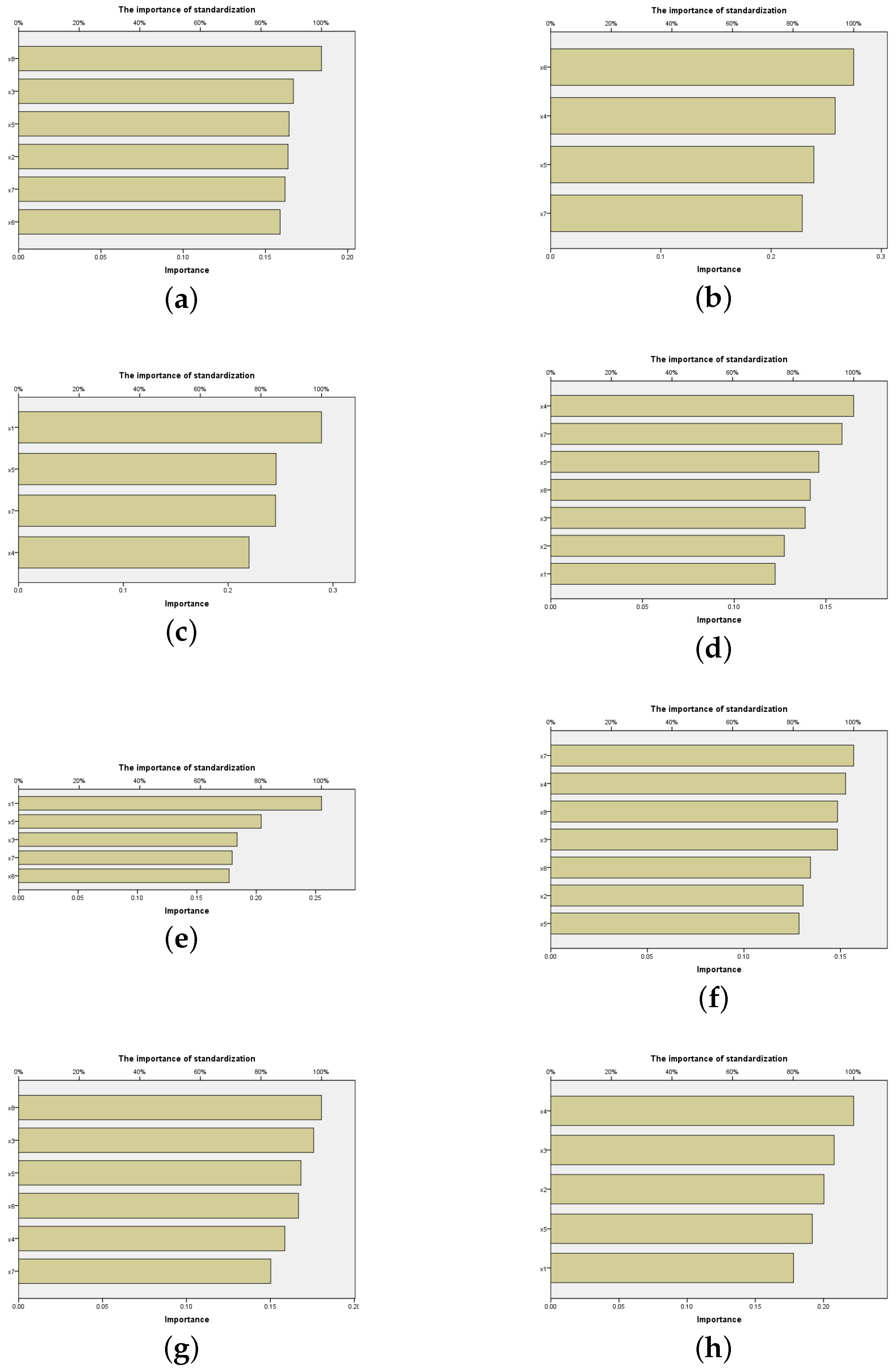
| CAN | 0.164 | 88.9% | |
| 0.167 | 90.7% | ||
| 0.164 | 89.3% | ||
| 0.159 | 86.3% | ||
| 0.162 | 88.0% | ||
| 0.184 | 100.0% | ||
| FRA | 0.258 | 93.9% | |
| 0.239 | 86.9% | ||
| 0.275 | 100.0% | ||
| 0.228 | 83.0% | ||
| DEU | 0.289 | 100.0% | |
| 0.220 | 76.1% | ||
| 0.246 | 85.0% | ||
| 0.245 | 84.8% | ||
| ITA | 0.122 | 74.1% | |
| 0.127 | 77.1% | ||
| 0.139 | 84.0% | ||
| 0.165 | 100.0% | ||
| 0.146 | 88.5% | ||
| 0.141 | 85.7% | ||
| 0.159 | 96.1% | ||
| JPN | 0.255 | 100.0% | |
| 0.184 | 72.1% | ||
| 0.204 | 80.1% | ||
| 0.177 | 69.5% | ||
| 0.180 | 70.5% | ||
| GRB | 0.131 | 83.3% | |
| 0.148 | 94.6% | ||
| 0.153 | 97.3% | ||
| 0.129 | 82.0% | ||
| 0.134 | 85.7% | ||
| 0.157 | 100.0% | ||
| 0.148 | 94.7% | ||
| USA | 0.176 | 97.4% | |
| 0.159 | 87.9% | ||
| 0.168 | 93.2% | ||
| 0.167 | 92.4% | ||
| 0.150 | 83.3% | ||
| 0.180 | 100.0% | ||
| EUU | 0.178 | 80.0% | |
| 0.200 | 90.2% | ||
| 0.208 | 93.5% | ||
| 0.222 | 100.0% | ||
| 0.192 | 86.3% |
| MAD | BIC | ||
|---|---|---|---|
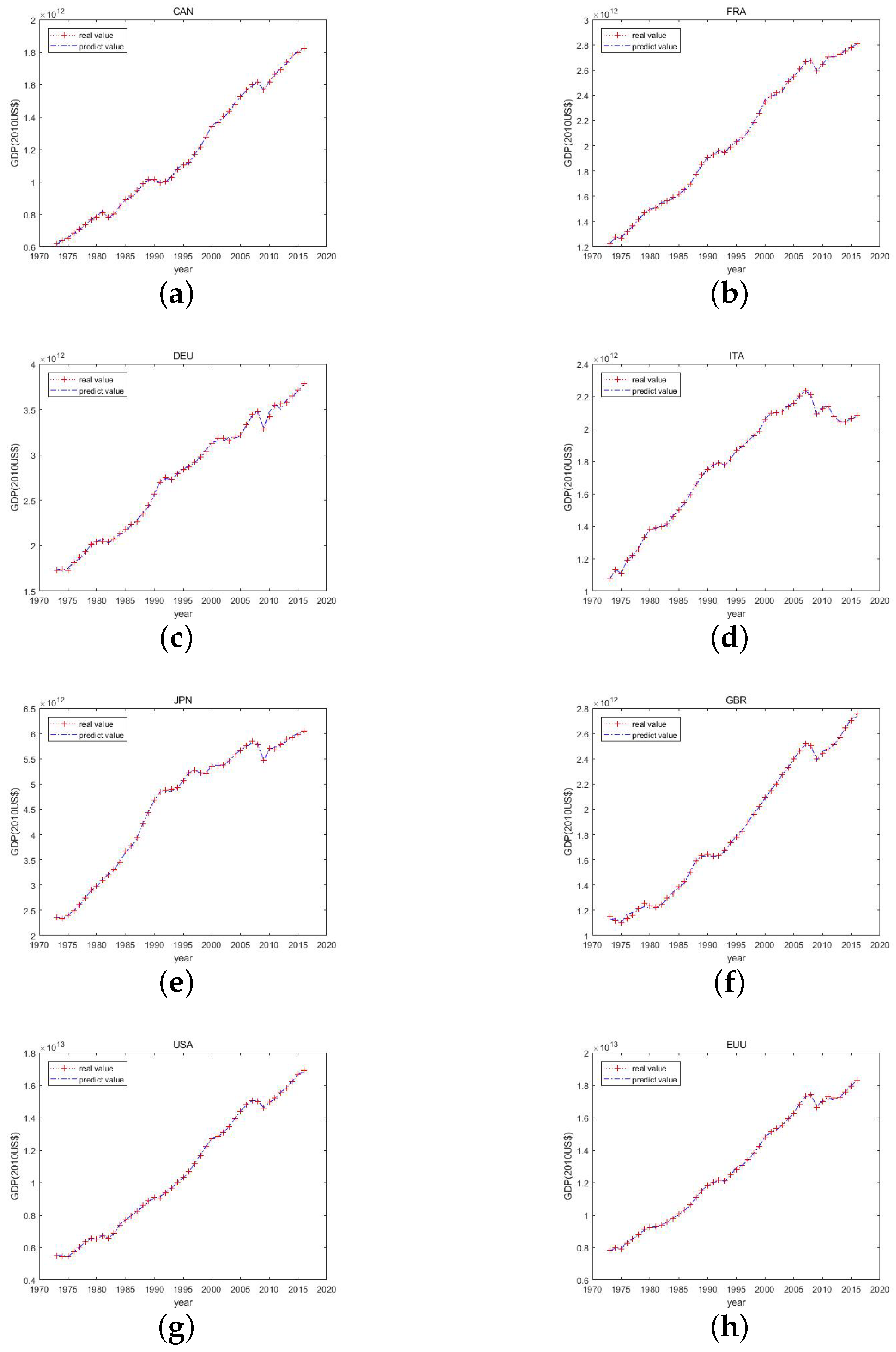
| CAN | 4,979,833,005 | 0.9997 | 45.3517 |
| FRA | 5,354,234,528 | 0.9998 | 45.6559 |
| DEU | 14,770,977,340 | 0.9992 | 46.9995 |
| ITA | 971,799,315,896 | 0.9999 | 44.9924 |
| JPN | 14,963,447,015 | 0.9997 | 57.8385 |
| GBR | 895,719,476,802 | 0.9995 | 53.0472 |
| USA | 27,207,015,544 | 0.9999 | 48.9367 |
| EUU | 2,269,209,989,327 | 0.9998 | 49.7041 |
| Year | Real Value | Predict Value | ||
|---|---|---|---|---|
| 2012 | 1,693,194,096,275.46 | 1,700,796,254,959.84 | 0.004492 | |
| 2013 | 1,735,100,681,636.87 | 1,728,839,650,854.99 | 0.003608 | |
| CAN | 2014 | 1,779,611,206,826.42 | 1,773,972,857,272.54 | 0.003168 |
| 2015 | 1,796,369,375,909.66 | 1,804,725,880,265.16 | 0.004652 | |
| 2016 | 1,822,735,534,879.33 | 1,819,578,502,324.51 | 0.001734 | |
| 2012 | 2,706,807,051,174.77 | 2,705,120,885,014.09 | 0.000623 | |
| 2013 | 2,722,404,797,996.28 | 2,723,028,718,241.47 | 0.000229 | |
| FRA | 2014 | 2,748,201,937,555.55 | 2,757,977,826,977.9 | 0.003557 |
| 2015 | 2,777,537,939,261.97 | 2,779,786,370,549.96 | 0.000810 | |
| 2016 | 2,810,525,379,194.34 | 2,804,990,064,602.12 | 0.001969 | |
| 2012 | 3,559,587,403,262.56 | 3,502,904,570,253.34 | 0.015924 | |
| 2013 | 3,577,014,590,829.77 | 3,608,327,110,971.49 | 0.008754 | |
| DEU | 2014 | 3,646,039,898,346.43 | 3,634,064,010,446.31 | 0.003285 |
| 2015 | 3,709,597,862,509.39 | 3,707,557,695,995.23 | 0.000550 | |
| 2016 | 3,781,698,549,834.74 | 3,768,496,346,567.67 | 0.003491 | |
| 2012 | 2,077,060,704,620.29 | 2,076,240,180,028.15 | 0.000395 | |
| 2013 | 2,041,165,755,679.07 | 2,045,595,010,254.51 | 0.002168 | |
| ITA | 2014 | 2,043,486,014,884.01 | 2,043,977,764,656.97 | 0.000239 |
| 2015 | 2,063,873,410,309.19 | 2,064,207,266,781.75 | 0.000163 | |
| 2016 | 2,083,322,583,449.54 | 2,078,694,598,826.19 | 0.002220 | |
| 2012 | 5,778,636,370,123.56 | 5,788,841,843,578.57 | 0.001766 | |
| 2013 | 5,894,237,388,118.86 | 5,842,619,130,629.46 | 0.008757 | |
| JPN | 2014 | 5,914,022,267,462.79 | 5,943,377,013,580.25 | 0.004964 |
| 2015 | 5,986,140,110,537.86 | 6,005,743,218,991.7 | 0.003275 | |
| 2016 | 6,047,894,004,051.61 | 6,028,452,852,492.38 | 0.003215 | |
| 2012 | 2,513,321,589,693.39 | 2,509,553,645,802.85 | 0.001499 | |
| 2013 | 2,564,904,713,179.98 | 2,574,393,456,751.26 | 0.003701 | |
| GBR | 2014 | 2,643,243,341,332.76 | 2,646,191,494,885.59 | 0.001117 |
| 2015 | 2,705,252,231,411.39 | 2,717,092,799,299.32 | 0.004378 | |
| 2016 | 2,753,793,133,582.5 | 2,733,135,616,113.89 | 0.007500 | |
| 2012 | 15,542,161,722,300 | 15,584,345,914,523.5 | 0.002714 | |
| 2013 | 15,802,855,301,300 | 15,863,586,662,748.6 | 0.003843 | |
| USA | 2014 | 16,208,861,247,400 | 16,251,038,963,537.9 | 0.002602 |
| 2015 | 16,672,691,917,800 | 16,674,989,794,495 | 0.000138 | |
| 2016 | 16,920,327,941,800 | 1,682,106,154,6143.1 | 0.005867 | |
| 2012 | 17,206,500,000,000 | 17,097,457,864,107.1 | 0.006337 | |
| 2013 | 17,251,100,000,000 | 17,252,390,426,035.3 | 0.000075 | |
| EUU | 2014 | 17,551,100,000,000 | 17,637,790,796,812.8 | 0.004939 |
| 2015 | 17,957,000,000,000 | 17,978,401,657,980.2 | 0.001192 | |
| 2016 | 18,305,200,000,000 | 18,277,752,838,514.5 | 0.001499 |
© 2020 by the authors. Licensee MDPI, Basel, Switzerland. This article is an open access article distributed under the terms and conditions of the Creative Commons Attribution (CC BY) license (http://creativecommons.org/licenses/by/4.0/).
Share and Cite
Wang, X.; Wang, J.; Fečkan, M. BP Neural Network Calculus in Economic Growth Modelling of the Group of Seven. Mathematics 2020, 8, 37. https://doi.org/10.3390/math8010037
Wang X, Wang J, Fečkan M. BP Neural Network Calculus in Economic Growth Modelling of the Group of Seven. Mathematics. 2020; 8(1):37. https://doi.org/10.3390/math8010037
Chicago/Turabian StyleWang, Xu, JinRong Wang, and Michal Fečkan. 2020. "BP Neural Network Calculus in Economic Growth Modelling of the Group of Seven" Mathematics 8, no. 1: 37. https://doi.org/10.3390/math8010037
APA StyleWang, X., Wang, J., & Fečkan, M. (2020). BP Neural Network Calculus in Economic Growth Modelling of the Group of Seven. Mathematics, 8(1), 37. https://doi.org/10.3390/math8010037

