


Abstract
An embedding of an interconnection network into another is one of the main issues in parallel processing and computing systems. Congestion, dilation, expansion and wirelength are some of the parameters used to analyze the efficiency of an embedding in which resolving the wirelength problem reduces time and cost in the embedded design. Due to the potential topological properties of enhanced hypercube, it has become constructive in recent years, and a lot of research work has been carried out on it. In this paper, we use the edge isoperimetric problem to produce the exact wirelengths of embedding enhanced hypercube into windmill and necklace graphs.
1. Introduction
Graph theory is one of the most interesting branches of mathematics, with wide applications in the domain of computer science, leading to the choice of a network in the development of parallel computers on a commercial basis. An interconnection network can be modeled by a graph, in which processors and links between processors are denoted as vertices and edges of a graph, respectively. Interconnection network has many advantages and inherent applications in the field of system designs such as scheduling of multiprocessor systems and distributed systems. The problem of efficiently implementing a parallel algorithm developed for one network into another can be modeled by a graph-embedding problem [1]. A graph embedding of a guest graph G into a host graph H is defined by a bijective mapping f : → together with a mapping which assigns to each edge of G a path between and in H [2].
An edge congestion of an embedding of G into H is the maximum number of edges of a graph G that are embedded on any single edge of H. Let denote the number of edges of graph G such that e is in a path between and of H [2,3]. In other words,
The wirelength of an embedding f of G into H is computed by
The wirelength of G into H is defined as
where the minimum is taken over all embeddings f of G into H. The wirelength problem of a graph embedding emerges from VLSI designs [4], networks for parallel computer systems [5] and structural engineering [6,7].
Wirelength problems have been considered for enhanced hypercube into wounded lobsters [8], r-rooted complete binary tree [1], complete binary tree [9], caterpillar and path [10]. The wirelength of hypercubes into necklace, windmill and snake graphs have been examined in [11]. In this paper, we explore the exact wirelength of enhanced hypercube into necklace and windmill graphs and the main contributions are presented in Theorems 2, 3 and 4.
The rest of the paper is organized as follows. In Section 2, we study edge isoperimetric problem and 2-partition lemma. Enhanced hypercube and its properties will be discussed in Section 3. In Section 4, we compute the minimum wirelength of embedding enhanced hypercube into windmill and necklace graphs. Finally, Section 5 concludes the paper.
2. Edge Isoperimetric Problem
Consider an interesting NP-complete problem [12] namely combinatorial isoperimetric problem which optimizes or selects the best structure among several possibilities and arises naturally in communication engineering, computer science, physical sciences and mathematics [13]. The following two versions of the EIP of a graph G have been considered in the literature [14,15,16].
EIP (1): Find a subset of the vertices of a given graph such that the edge cut separating this subset from its complement has minimal size among all subsets of the same cardinality.
Mathematically, if for a given m, where m = , = , where , then the problem is to find such that = m and = . Such subsets are called optimal with respect to EIP (1). If a set of vertices is optimal with respect to EIP (1), then it is trivial that its complement is also optimal to EIP (1).
EIP (2): Find a subset of the vertices of a given graph such that the number of edges in the subgraph induced by this subset is maximal among all induced subgraphs with the same number of vertices.
Mathematically, if for a given m, where m = , = , where = , then the problem is to find such that = m and = . Such subsets are called optimal with respect to EIP (2).
Clearly, if a subset of vertices is optimal with respect to EIP (2), then its complement is also an optimal set only for regular graphs and moreover, if a subset of vertices is optimal with respect to EIP (2), it is also optimal with respect to EIP (1). In the case of non-regular graphs, if a subset of vertices is optimal with respect to EIP (2), it need not be optimal to EIP (1) and there is no specific condition to optimality [16].
We now state the congestion and partition lemmas which will be used to compute the exact wirelengths in our paper.
Lemma 1.
(Congestion Lemma) [3] Let G be an r-regular graph and f be an embedding of G into H. Let S be an edge cut of H such that the removal of edges of S leaves H into two components and and let = and = . Also S satisfies the following conditions:
- (i)
- For every edge , has no edges in S.
- (ii)
- For every edge with and , has exactly one edge in S.
- (iii)
- is an optimal set.Then is minimum and =
Lemma 2.
(2-Partition Lemma) [17] Let be an embedding. Let denote a collection of edges of H repeated exactly 2 times. Let be a partition of such that each is an edge cut of H. Then
3. Properties of Enhanced Hypercubes
The hypercube has received extensive attention in view of its regular structure, small diameter and good connection with a relatively small vertex degree [7,18]. As the effort to improve its efficiency, several variants of have been proposed.
In many variants of hypercube, the topological structure of enhanced hypercube network is considered to be a significant topology due mainly to its reliability, efficiency and the fault tolerance of are better than , which shows that the enhanced hypercube is an excellent choice of network topology to improve traffic distributions, bandwidth capabilities and performance in parallel processing computer systems [18].
Definition 1
([19]). The enhanced hypercube , , is an -regular graph with vertex set = labeled as and edge set , , , . The edges of in are called hypercube edges and the remaining edges of are called complementary edges.
Remark 1.
and .
Theorem 1
([10]). For , = is an optimal set in .
Lemma 3
([10]). For , = ++ where x = and
4. Computation of Wirelength
In this section, we compute the exact wirelength of enhanced hypercubes into windmill and necklace graphs. The basic definitions and results to obtain the minimum wirelength are explained as follows.
Lemma 4.
For i = , is an optimal set in .
Proof.
Define by =p. Let the binary representation of be . Then the binary representation of p is . To show that is isomorphic to , we discuss the following cases for .
Case 1. Let be the hypercube edge in . Suppose the binary representations of x and y are
Then,
hence ⇔ the binary representation of x and y differ in exactly one bit ⇔ the binary representation of and differ in exactly one bit ⇔.
Case 2. Let be the complementary edge in . Suppose the binary representations of x and y are
Then,
hence ⇔ the binary representations of x and y differ from the to bits ⇔ the binary representations of and differ from the to bits ⇔. Hence and are isomorphic.
From the above cases and Theorem 1, we infer that is an optimal set in . □
The following result is an easy consequence of Lemma 4.
Lemma 5.
For i = , is an optimal set in .
Definition 2.
[11] Let be a complete graph on vertices, . Let and for all such that has one vertex as common. The resultant graph is called a windmill graph and is denoted by .
Remark 2.
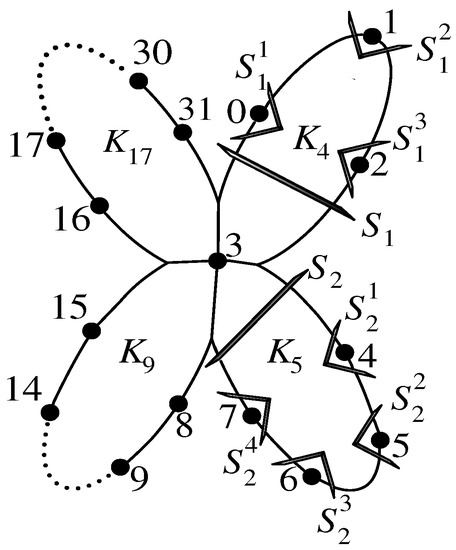
We denote = , and . Then the windmill graph has vertices, see Figure 1.
Figure 1.
The edge cuts of windmill .
Theorem 2.
The wirelength of into is given by
Proof.

The proof is divided into three parts A, B, and C comprising of the embedding algorithm, proof of correctness, and computation of wirelength, respectively.
Part A:
Label the vertices of by lexicographic order from 0 to . Label the vertices of in as such that is the label of common vertex s. For , label the vertices of (except s) in as . Define an embedding f of into given by .
Part B:
We assume that the labels represent the vertices to which they are assigned. Table 1 gives the notations for edge cuts of windmill graph as depicted in Figure 1.
Table 1.
Edge cuts in windmill graph.
Then {: } ∪ { :, } is a partition of . The edge cut of disconnects into two components and where . Let and be the preimage of and under f respectively. By Lemmas 4 & 5, is an optimal set and each satisfies conditions (i)–(iii) of the Congestion Lemma. Therefore, is minimum.
Similarly, the edge cut of disconnects into two components and where . Let and be the preimage of and under f respectively. Since is an optimal set and each satisfies conditions of the Congestion Lemma. Therefore, is minimum. The 2-Partition Lemma implies that = .
Part C:
By Part B, we have , for all , . Therefore, the wirelength of enhanced hypercube into windmill graph is given by = = □
Definition 3
([11]). Let be a star graph on vertices (say ) and be complete graphs on vertices, . Let , for all and such that has as common. The resultant graph is called a complete star necklace and is denoted by .
Remark 3.
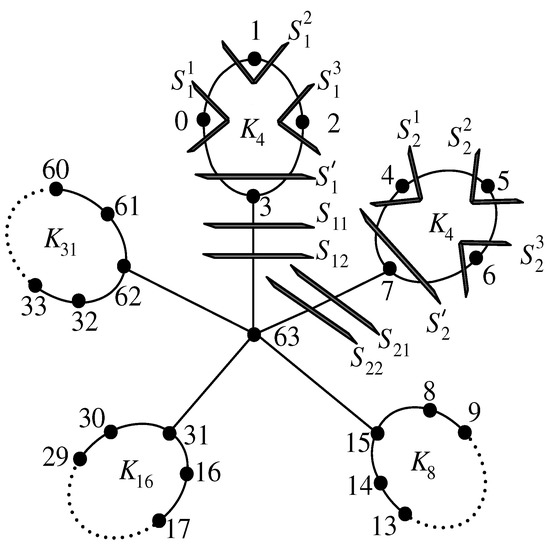
We denote = , where . Then the complete star necklace has vertices, see Figure 2.
Figure 2.
The edge cuts of complete star necklace .
Theorem 3.
Proof.
The proof technique is similar to Theorem 2 as divided into three parts A, B, and C.
Part A:
Label the vertices of by lexicographic order from 0 to . For , label the vertices of in as such that is the label of , and as . Define an embedding f of into given by .
Part B:
We assume that the labels represent the vertices to which they are assigned. Table 2 gives the notations for edge cuts of complete star necklace graph as depicted in Figure 2.
Table 2.
Edge cuts in complete star necklace graph.
Then {, , : } ∪ {:, } is a partition of . The edge cut of disconnects into two components and where . Let and be the preimage of and under f respectively. By Lemma 4, is an optimal set and each satisfies conditions (i)–(iii) of the Congestion Lemma. Therefore, is minimum. Similarly, is minimum.
The edge cut of disconnects into two components and where . Let and be the preimage of and under f respectively. By Lemma 5, is an optimal set and each satisfies conditions (i)–(iii) of the Congestion Lemma. Therefore, is minimum.
The edge cut of disconnects into two components and where . Let and be the preimage of and under f respectively. Since is an optimal set and each satisfies conditions of the Congestion Lemma. Therefore, is minimum. The 2-Partition Lemma implies that .
Part C:
By Part B, we have , , for all , . Therefore, the wirelength of enhanced hypercube into complete star necklace graph is given by . □
Definition 4
([11]). Let be a complete graph on m vertices (say ) and be complete graphs on vertices, . Let and for all such that has as common. The resultant graph is called a circular necklace graph and is denoted by .
Remark 4.
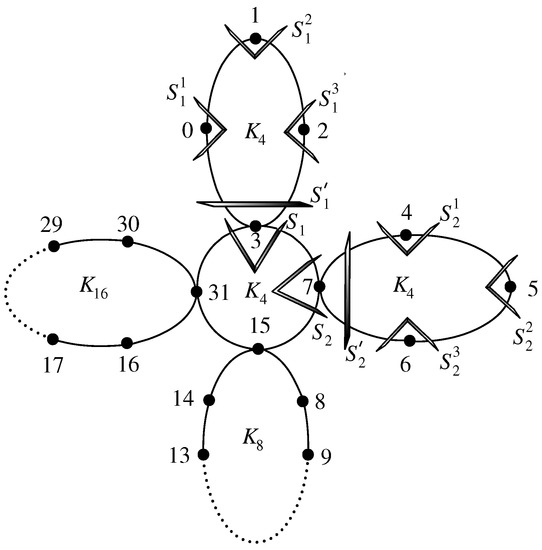
We denote = , where . Then the circular necklace has vertices, see Figure 3.
Figure 3.
The edge cuts of circular necklace .
Theorem 4.
The wirelength of into is given by
Proof.
We label the vertices of by lexicographic order from 0 to . For , label the vertices of in as such that is the label of . Define an embedding f of into given by .
We assume that the labels represent the vertices to which they are assigned. Table 3 gives the notations for edge cuts of circular necklace graph as depicted in Figure 3.
Table 3.
Edge cuts in circular necklace graph.
Then { , : } ∪ { :, } is a partition of . The edge cut of disconnects into two components and where . Let and be the preimage of and under f respectively. By Lemma 4, is an optimal set and each satisfies conditions of the Congestion Lemma. Therefore, is minimum.
The edge cut of disconnects into two components and where . Let and be the preimage of and under f respectively. By Lemma 5, is an optimal set and each satisfies conditions (i)–(iii) of the Congestion Lemma. Therefore, is minimum.
The edge cut of disconnects into two components and where . Let and be the preimage of and under f respectively. Since is an optimal set and each satisfies conditions (i)–(iii) of the Congestion Lemma. Therefore is minimum. The 2-Partition Lemma implies that .
Now, we have , , for all , . Therefore, the wirelength of enhanced hypercube into circular necklace graph is given by = = □
5. Conclusions
In this paper, we have computed the minimum wirelength of embedding enhanced hypercube into host graph such as windmill and necklace graphs by partitioning the edge set of the host graph. On comparing with the wirelength of hypercube into windmill and necklace graphs, we found that the computation varies by degree of enhanced hypercube. The results obtained in this paper would build a great impact on parallel computing systems. Furthermore, it would be an interesting line of research to compute the wirelength of general r-regular graph into windmill and necklace graphs.
Author Contributions
Conceptualization, M.A. and J.N.D.; methodology, M.A. and J.N.D.; investigation, M.A. and J.N.D.; writing—original draft preparation, M.A.and J.N.D.; writing—review and editing, M.A. and J.N.D.; supervision, M.A. and J.-B.L.; funding acquisition, J.-B.L.
Funding
This research was funded by the China Postdoctoral Science Foundation under Grant 2017M621579; the Postdoctoral Science Foundation of Jiangsu Province under Grant 1701081B; Project of Anhui Jianzhu University under Grant no. 2016QD116 and 2017dc03.
Conflicts of Interest
The authors declare no conflict of interest.
References
- Abraham, J.; Arockiaraj, M. Wirelength of enhanced hypercubes into r-rooted complete binary trees. Electron. Notes Discrete Math. 2016, 53, 373–382. [Google Scholar] [CrossRef]
- Bezrukov, S.L.; Chavez, J.D.; Harper, L.H.; Röttger, M.; Schroeder, U.-P. The congestion of n-cube layout on a rectangular grid. Discret. Math. 2000, 213, 13–19. [Google Scholar] [CrossRef]
- Manuel, P.; Rajasingh, I.; Rajan, B.; Mercy, H. Exact wirelength of hypercubes on a grid. Discrete Appl. Math. 2009, 157, 1486–1495. [Google Scholar] [CrossRef]
- Bhatt, S.N.; Leighton, F.T. A framework for solving VLSI graph layout problems. J. Comp. Syst. Sci. 1984, 28, 300–343. [Google Scholar] [CrossRef]
- Leighton, F.T. Introduction to Parallel Algorithms and Architectures: Arrays, Trees, Hypercubes; Morgan Kaufmann Publishers: San Mateo, CA, USA, 1992. [Google Scholar]
- Lai, Y.L.; Williams, K. A survey of solved problems and applications on bandwidth, edgesum, and profile of graphs. J. Graph Theory 1999, 31, 75–94. [Google Scholar] [CrossRef]
- Xu, J. Topological Structure and Analysis of Interconnection Networks; Springer Publishing Company: Dordrecht, The Netherlands, 2001. [Google Scholar]
- Rajasingh, I.; Rajan, B.; Mercy, H.; Manuel, P. Exact wirelength of hypercube and enhanced hypercube layout on wounded lobstars. In Proceedings of the 4th International Multiconference on Computer Science and Information Technology, Amman, Jordan, 5–7 April 2006; pp. 449–454. [Google Scholar]
- Manuel, P. Minimum average congestion of enhanced and augmented hypercubes into complete binary trees. Discret. Appl. Math. 2011, 159, 360–366. [Google Scholar] [CrossRef]
- Arockiaraj, M.; Liu, J.B.; Shalini, A.J. Vertex decomposition method for wirelength problem and its applications to enhanced hypercube networks. IET Comput. Digit. Tech. 2019, 13, 87–92. [Google Scholar] [CrossRef]
- Rajasingh, I.; Rajan, B.; Rajan, R.S. Embedding of hypercubes into necklace, windmill and snake graphs. Inf. Process. Lett. 2012, 112, 509–515. [Google Scholar] [CrossRef]
- Garey, M.R.; Johnson, D.S.; Stockmeyer, L. Some simplified NP-complete problems. In Proceedings of the Sixth Annual ACM Symposium on Theory of Computing, Seattle, WA, USA, 30 April–2 May 1974; pp. 47–63. [Google Scholar]
- Harper, L.H. Global Methods for Combinatorial Isoperimetric Problems; Cambridge University Press: Cambridge, UK, 2004. [Google Scholar]
- Boals, A.J.; Gupta, A.K.; Sherwani, N.A. Incomplete hypercubes: Algorithms and embeddings. J. Supercomput. 1994, 8, 263–294. [Google Scholar] [CrossRef]
- Garey, M.R.; Johnson, D.S. Computers and Intractability, A Guide to the Theory of NP-Completeness; Freeman: San Francisco, CA, USA, 1979. [Google Scholar]
- Bezrukov, S.L.; Das, S.K.; Elsässer, R. An edge-isoperimetric problem for powers of the petersen graph. Ann. Comb. 2000, 4, 153–169. [Google Scholar] [CrossRef]
- Arockiaraj, M.; Manuel, P.; Rajasingh, I.; Rajan, B. Wirelength of 1-fault Hamiltonian graphs into wheels and fans. Inf. Process. Lett. 2011, 111, 921–925. [Google Scholar] [CrossRef]
- Liu, H. The Structural Features of Enhanced Hypercube Networks. In Proceedings of the 5th International Conference on Natural Computation, Tianjin, China, 14–16 April 2009; pp. 345–348. [Google Scholar]
- Tzeng, N.F.; Wei, S. Enhanced hypercubes. IEEE Trans. Comput. 1991, 40, 284–294. [Google Scholar] [CrossRef]
© 2019 by the authors. Licensee MDPI, Basel, Switzerland. This article is an open access article distributed under the terms and conditions of the Creative Commons Attribution (CC BY) license (http://creativecommons.org/licenses/by/4.0/).