


Abstract
This study examines the stability and instability of a Casson fluid in a horizontal porous medium with magnetic effect using linear and global theories. Both linear and nonlinear analyses are conducted using the normal modes. The study proves that the linear and nonlinear stability thresholds coincide. Two different methodologies were used to solve the system of equations. The eigenvalue problem for linear and global theories were solved using a Galerkin scheme and bvp4c routine in MATLAB. The results show that the Casson parameter destabilizes the flow, while the solutal Rayleigh number and Darcy number stabilize it.
MSC:
70K20; 65L10; 76W05
1. Introduction
Chocolate, a popular product worldwide, is made of cocoa beans, sugar, and milk powder. During chocolate processing, rheological behaviour is one of the salient features that needs to be checked. The rheological features of chocolate are generally influenced by the ingredients used to make chocolate and chocolate production technology. Hence, controlling the characteristics of chocolate is essential [1,2,3,4]. The perfect mathematical flow model is essential for the illustration of the characteristics of chocolate. Casson fluid model is one of the important models that are used to study the characteristics of chocolate [5,6].
Aghighi et al. [7] have studied the stability theory of convection in Casson fluids numerically. They showed the influence of the yield stress on convective motion and heat transfer. Aghighi et al. [8] have investigated the RBC of viscoplastic fluid in a trapezoidal enclosure, where they used Galerkin’s method to simultaneously solve differential equations. Urvashi Gupta et al. [9] have discussed the thermohaline convection of Casson nanofluid under different boundaries, and have obtained the algebraic expressions for the solution of system for all cases. Internally heated convection of Casson nanofluid has been studied by Urvashi Gupta et al. [10], and have shown their results using neutral curves and found that the internal heat source destabilizes the Casson nanofluid layer. Haldar et al. [11] examined the steady boundary layer flow of a non-Newtonian Casson fluid over a power-law stretching sheet. Recently, Ramesh and Misbah [12] made an attempt to study the hydromagnetic flow of Casson fluid. They used temporal stability to investigate the Poiseuille flow of a Casson fluid. Reddy et al. [13] studied the thermohaline instability of a Casson fluid, and they presented the algebraic expressions for the solution of system by using Galerkin’s method. Very recently, Reddy et al. [14] investigated the onset of instability of Casson fluid in porous slab with dissipative effect.
The aim of the present analysis is to study the thermal convection in Casson fluids with magnetic effect [15]. Casson fluid is one type of non-Newtonian fluids, where a lot of research articles on the thermal convection in Newtonian fluids [16,17,18] whereas only a few research articles are found on the thermal convection in non-Newtonian fluids. These fluids have complex flow behavior, hence to analyze the properties of these fluids researchers suggested different types of models such as the power–law model [19], Jeffrey model [20], Maxwell model [21], and other viscoplastic fluid models. In non-Newtonian fluids, viscoplastic fluids are of a special type, which flows only when yield stress is less than the applied stresses. In order to study the flow behavior of such types of fluids, rheological models such as Herschel–Bulkley [22], the Bingham model [23], and the Casson model [24] have been developed by researchers.
The present work is an extension of the work done by Reddy et al. [13] by considering the effect of magnetic field. The paper is organized as follows: Section 2 discusses the governing equations. Section 3 and Section 4 cover the linear and nonlinear theories, respectively, and Section 5 presents the outcomes of results. The paper concludes with a discussion of the findings.
2. Basic Equations
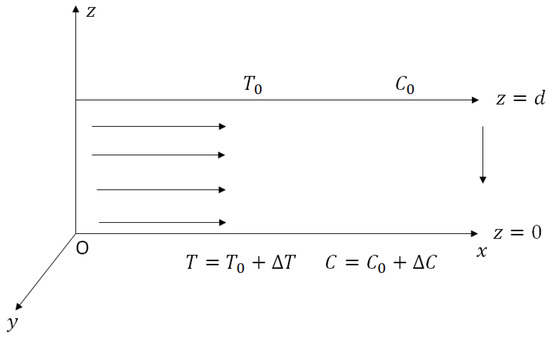
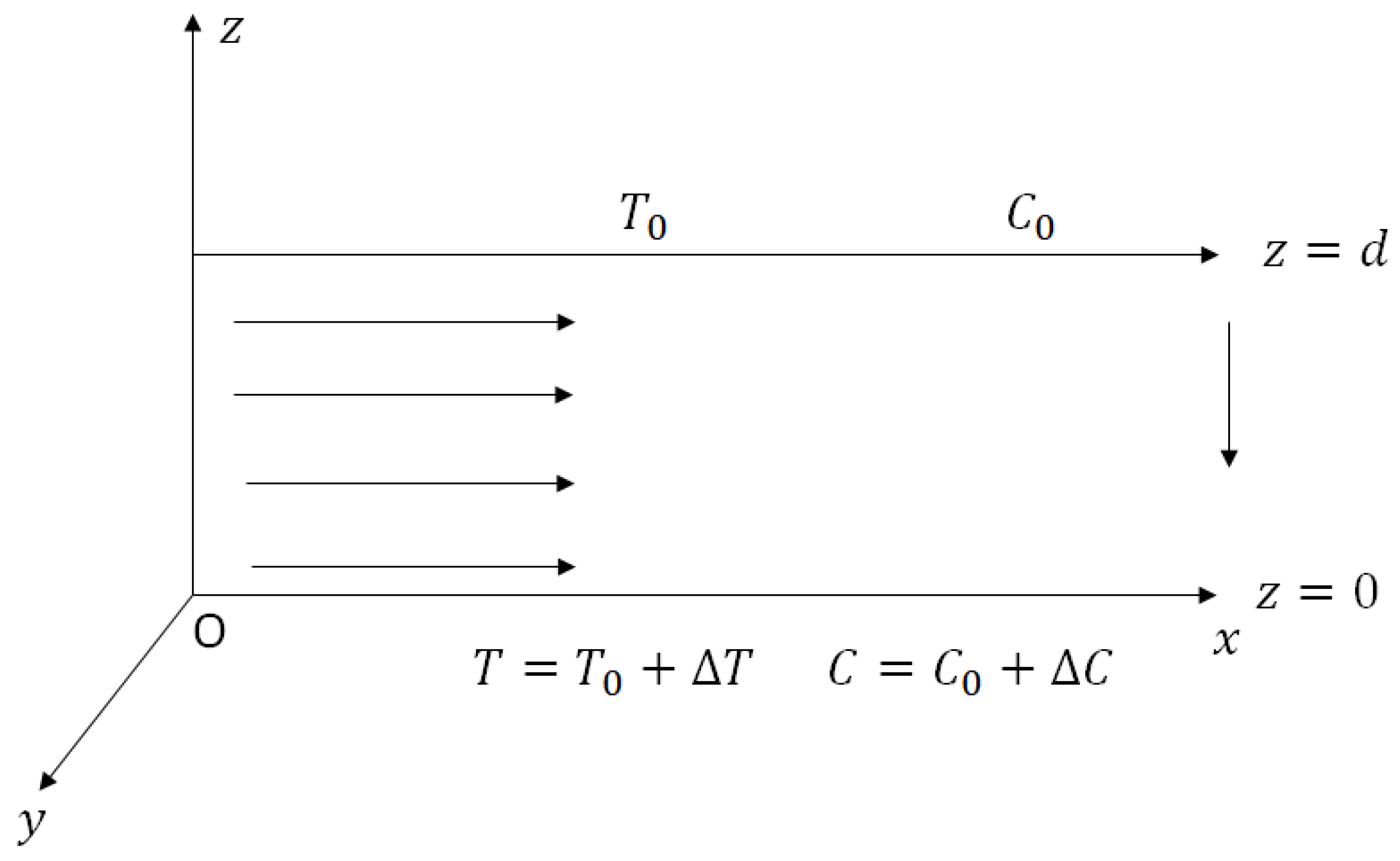
This work examines the porous medium confined between two horizontal infinite planes with distance d. A (non-Newtonian) Casson fluid is considered inside the medium. Horizontal axes denoted by x and y, and the vertical axes by z. The bottom surface is held at temperature and concentration at , while the upper surface is at temperature , concentration at , respectively (see Figure 1). The model operates under the following assumptions:
Figure 1.
Geometrical representation of the flow.
- Brinkmann’s law is used to characterize the flow of the fluid.
- Oberbeck–Boussinesq approximation, i.e., variation of density considered with body force term only.
- Density varies linearly with temperature and concentration, i.e.,Density of the solute is greater than the density of the solvent.
- Local thermal equilibrium is assumed between solid and fluid phases.
- Viscous dissipation is negligible.
The stress tensor of Casson fluid is considered as
where
Casson fluid’s yield stress mathematically in terms of Casson parameter can be expressed as
The viscosity of Casson fluid is expressed as follows:
From above equations the viscosity of the fluid is given by
According to assumption of the present problem, energy balance equation that describes the temperature field’s behavior is given as
The governing mathematical equations for a binary Casson fluid layer, which is heated and soluted from below are (after using Equation (1))
with
where
Let us define
Basic State
The basic flow is assumed as
where the subscript b indicates for basic state.
3. Linear Instability
Minor perturbation for basic flow is applied as
The solution in terms of normal modes is considered as
where is wave number and is growth rate.
One Term Galerkin Method
The solution can be chosen in the form of
The classical stability analysis on Equation (29) is now floowed. Hence, the analytical expression of the stationary thermal Rayleigh number, , and oscillatory thermal Rayleigh number, , are obtained in the following form
where
For Newtonian fluid, in the absence of Brinkmann law, magnetic field and concentration (), the above stationary Rayleigh number reduces to with the critical values and , which agrees with the results of Horton and Rogers [25] and Lapwood [26] for the onset of convection in a porous layer.
4. Nonlinear Instability
The energy functional is defined as
Here, and are positive coupling parameters. Now we multiply Equation (15) by , Equation (16) by and Equation (17) by , integrating over V,
On integrating Equation (37), confirms as for . Here, we choose ,
where is a Lagrange multiplier. Taking the third component of curl of curl of Equation (39),
Solution Methodology
The eigenvalue problem specified by Equations (45)–(47) with (27) is solved using the bvp4c in MATLAB R2024b. For obtaining a non-trivial solution to the eigenvalue problem, the normalization condition is considered. With this normalization condition, the eigenvalue of Rayleigh number is established. The wave number and critical Rayleigh number are acquired using index-linked instructions in MATLAB. For achieving higher-order accuracy, the comparative and conclusive tolerances are set to and , respectively.
5. Discussion
The numerical results and discussions are shown in this section. The present analysis is aimed to analyze the nonlinear magnetoconvection of Casson fluid in a horizontal porous slab. Table 1 shows the linear and nonlinear critical Rayleigh numbers for different values of with , , and . It is observed from this table that the linear and nonlinear thresholds coincide. Hence, the linear instability analysis predicts the beginning of convective motion accurately.
Table 1.
Comparison between the linear and the nonlinear stability critical for ; ; .
In Table 2, Table 3 and Table 4, the effect of on linear instability is shown and the existence of stationary or oscillatory instability sets in. From these tables, it is clear that stationary stability sets in for the case for all values of . For , there exist a such that the convection arises via an oscillatory mode for . Moreover, the stabilizing effect of the solute Rayleigh number () observed in these tables indicates that adding a solute to a fluid can enhance its stability against convective instabilities. This finding can be utilized in applications such as the cooling of electronic components or the operation of geothermal power plants, where the presence of dissolved salts can affect the convective stability of the fluids. Furthermore, both and increasing functions of indicate the stabilizing effect of the Hartmann number.
Table 2.
Critical with various values of and ; ; ; .
Table 3.
Critical with various values of and ; ; ; .
Table 4.
Critical with various values of and ; ; ; .
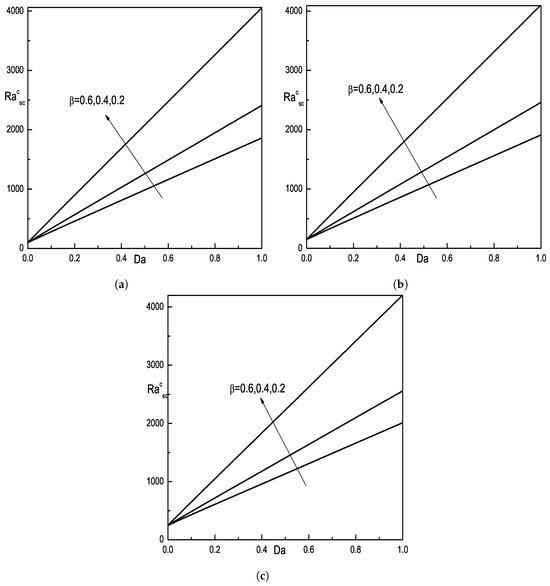
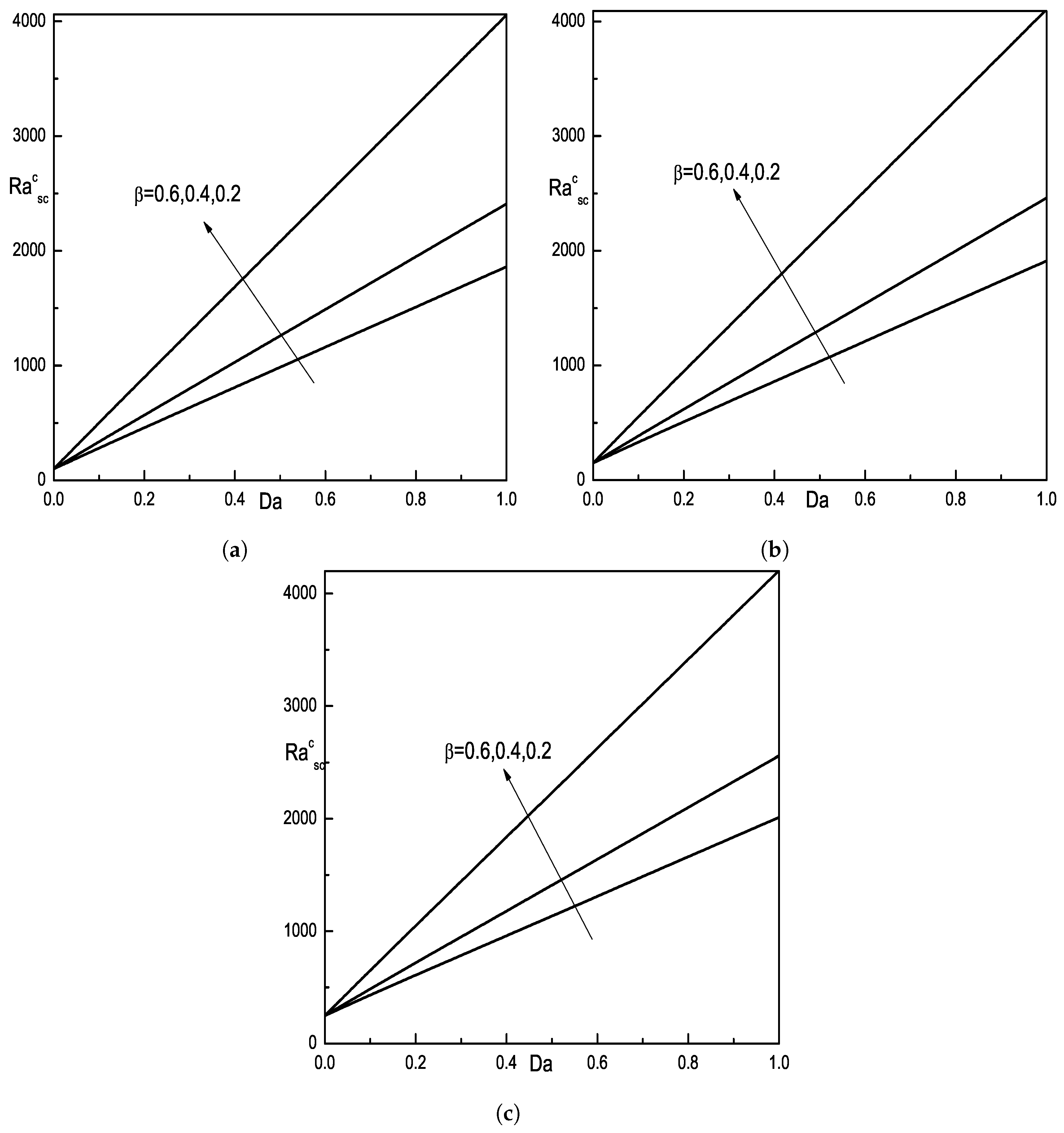
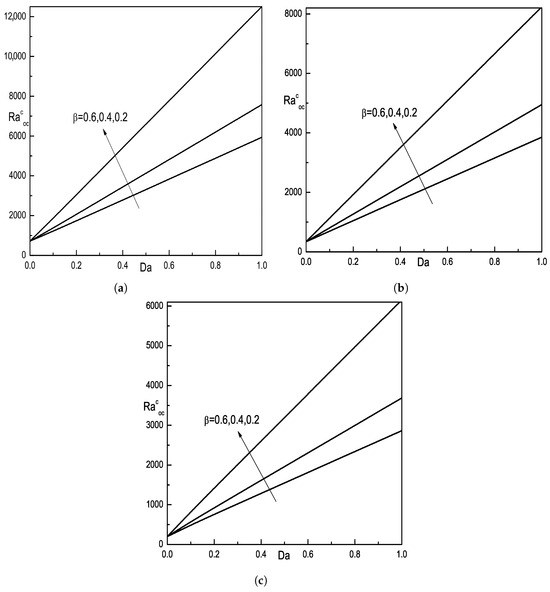
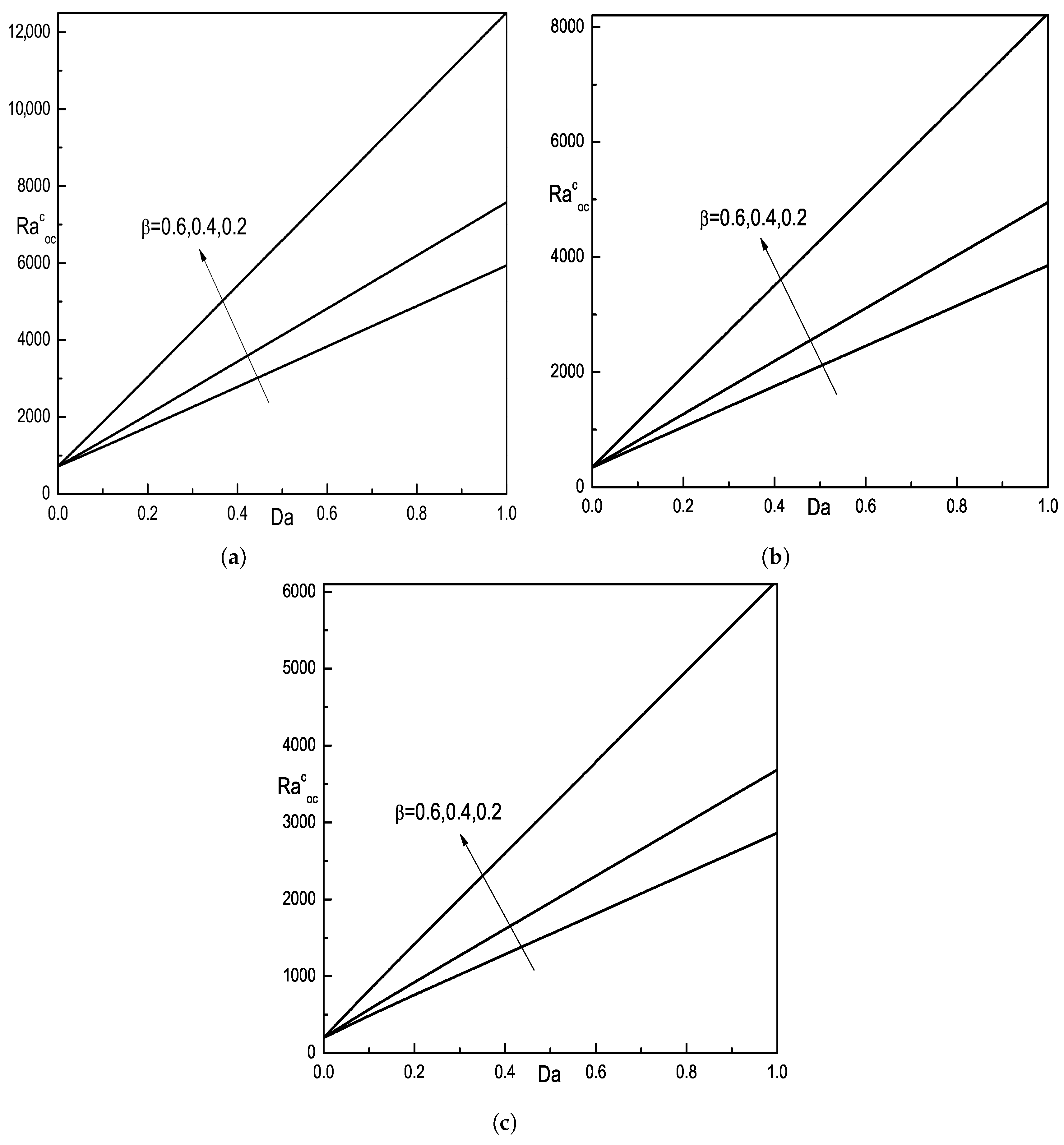
Figure 2 shows the effect of Casson parameter on stationary convection. It is obvious from this graph that as increases, the critical is observed to decrease and the has a destabilizing effect on the system, which implies that a fluid with a higher will be more prone to convective instabilities. And also, the graphical results in Figure 2 are an illustration of the change in critical as a function of (Darcy number), for different values of . From this graph, it is observed that the critical is increasing as increases. In other words, has stabilizing nature on the flow, i.e., the presence of a porous medium can also enhance the stability of the fluid against convective instabilities.
Figure 2.
Plot of versus Darcy number and and for fixed value of ; ; ; (a) ; (b) ; (c) .
Figure 3 shows the variation of critical with Darcy number and Casson parameter for the fixed values of , , . From this figure, it is observed that the critical decreases as increases. Hence, has a destabilizing effect on the system. It is also identified that the enhancement of critical with , indicating that the has a stabilizing effect on the system.
Figure 3.
Plot of versus Darcy number and and for fixed value of ; ; ; (a) ; (b) ; (c) .
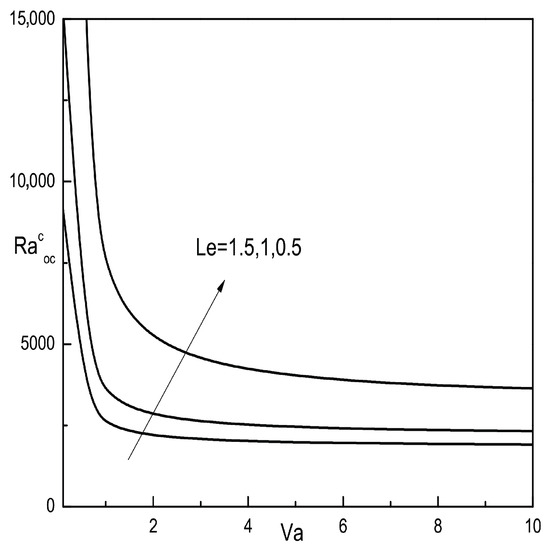
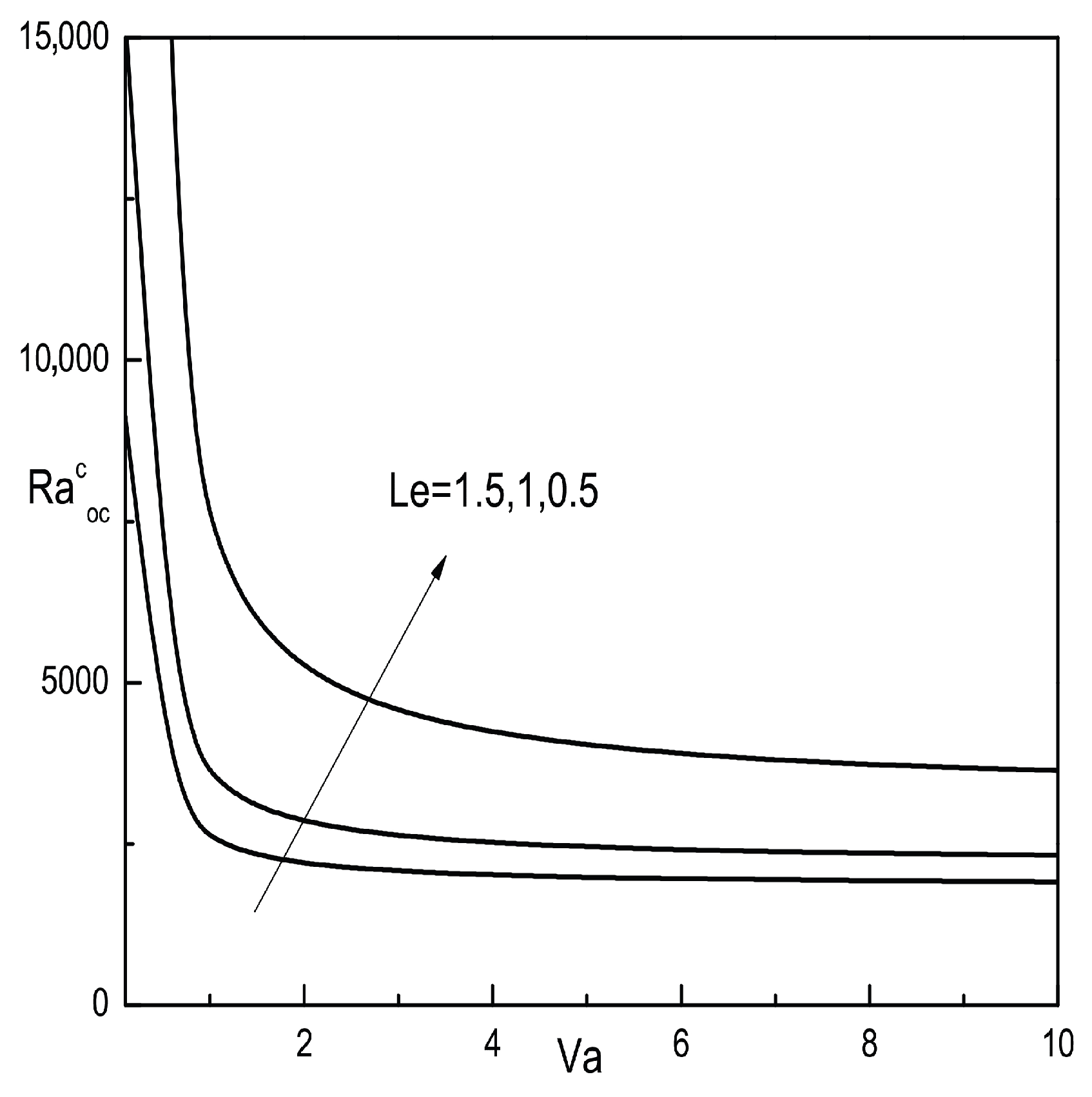
The decreasing nature of the Vadasz number on oscillatory convection is displayed in Figure 4. Moreover, the change of threshold with is illustrated in this figure. The Lewis number has a destabilizing nature on oscillatory instability.
Figure 4.
Plot of versus Vadasz number and and for fixed value of ; ; ; .
6. Conclusions
In this paper, linear analysis and nonlinear analysis of a Casson fluid in a porous layer with magnetic field are analyzed. Both linear and nonlinear theories have been studied. In linear and nonlinear analyses, the critical Rayleigh number is calculated. The eigenvalue problem for linear instability is solved by the Galerkin scheme, whereas the eigenvalue problem for nonlinear instability is solved numerically by using the bvp4c routine in MATLAB. The study shows that the linear and nonlinear theory thresholds coincide. The Casson parameter has a destabilizing nature on the flow, while Darcy number and and solutal Rayleigh number have a stabilizing nature on the flow.
Author Contributions
Conceptualization, S.S.K.R.; Methodology, S.S.K.R.; Software, F.H.H.A.M.; Validation, H.M.; Writing—original draft, S.S.K.R. and F.H.H.A.M.; Writing—review & editing, H.M. and S.M. All authors have read and agreed to the published version of the manuscript.
Funding
This work was supported by the Deanship of Scientific Research, Vice Presidency for Graduate Studies and Scientific Research, King Faisal University, Saudi Arabia [Grant No. KFU253881].
Data Availability Statement
The original contributions presented in this study are included in the article. Further inquiries can be directed to the corresponding author.
Conflicts of Interest
The authors declare no conflicts of interest.
References
- Chevalley, J. Rheology of chocolate. J. Texture Stud. 1975, 6, 177–196. [Google Scholar] [CrossRef] [Scilit]
- Gonçalves, E.V.; Lannes, S.C.D.S. Chocolate rheology. Food Sci. Technol. 2010, 30, 845–851. [Google Scholar] [CrossRef] [Scilit]
- Kumbár, V.; Kouřilová, V.; Dufková, R.; Votava, J.; Hřivna, L. Rheological and pipe flow properties of chocolate masses at different temperatures. Foods 2021, 10, 2519. [Google Scholar] [CrossRef] [Scilit] [PubMed]
- Cahyani, A.; Kurniasari, J.; Nafingah, R.; Rahayoe, S.; Harmayani, E.; Saputro, A.D. Determining casson yield value, casson viscosity and thixotropy of molten Chocolate using viscometer. IOP Conf. Ser. Earth Environ. Sci. 2019, 355, 012041. [Google Scholar] [CrossRef] [Scilit]
- Afoakwa, E.O. Chocolate Science and Technology; John Wiley Sons: Hoboken, NJ, USA, 2016. [Google Scholar]
- Chevalley, J. An adaptation of the Casson equation for the rheology of chocolate. J. Texture Stud. 1991, 22, 219–229. [Google Scholar] [CrossRef] [Scilit]
- Aghighi, M.S.; Ammar, A.; Metivier, C.; Gharagozlu, M. Rayleigh-Bénard convection of Casson fluids. Int. J. Therm. Sci. 2018, 127, 79–90. [Google Scholar] [CrossRef] [Scilit]
- Aghighi, M.S.; Ammar, A.; Masoumi, H.; Lanjabi, A. Rayleigh–Bénard convection of a viscoplastic liquid in a trapezoidal enclosure. Int. J. Mech. Sci. 2020, 180, 105630. [Google Scholar] [CrossRef] [Scilit]
- Gupta, U.; Sharma, J.; Devi, M. Double-diffusive instability of Casson nanofluids with numerical investigations for blood-based fluid. Eur. Phys. J. Spec. Top. 2021, 230, 1435–1445. [Google Scholar] [CrossRef] [Scilit]
- Gupta, U.; Sharma, J.; Devi, M. Casson nanofluid convection in an internally heated layer. Mater. Today Proc. 2020, 28, 1748–1752. [Google Scholar] [CrossRef] [Scilit]
- Haldar, S.; Mukhopadhyay, S.; Layek, G.C. Dual solutions of Casson fluid flows over a power-law stretching sheet. J. Appl. Mech. Tech. Phys. 2017, 58, 629–634. [Google Scholar] [CrossRef] [Scilit]
- Kudenatti, R.B. The onset of instability in a hydromagnetic channel flow of Casson fluid: The accurate solutions. Appl. Math. Comput. 2023, 436, 127475. [Google Scholar] [CrossRef] [Scilit]
- Reddy, G.; Ragoju, R.; Shekhar, S. Thermohaline convection of a Casson fluid in a porous layer: Linear and non-linear stability analyses. Phys. Fluids 2023, 35, 094101. [Google Scholar] [CrossRef] [Scilit]
- Reddy, G.S.K.; Bhavyashree, S.M.; Ragoju, R.; Yadav, D. Viscous dissipation effects in thermosolutal convection of Casson fluid in porous layer with vertical throughflow: Global stability analysis. Chin. J. Phys. 2025, 97, 625–637. [Google Scholar] [CrossRef] [Scilit]
- Reddy, G.S.K.; Ragoju, R.; Dey, P.; Matta, A. Nonlinear magneto convection in an inclined porous layer with artificial neural network prediction. Math. Methods Appl. Sci. 2022, 48, 7025–7036. [Google Scholar] [CrossRef] [Scilit]
- Chandrasekhar, S. Hydrodynamic and Hydrodynamic Stability; Clarendon Press, Oxford University: Oxford, UK, 1961. [Google Scholar]
- Koschmieder, E.L. Bénard Cells and Taylor Vortices; Cambridge University Press: Cambridge, UK, 1993. [Google Scholar]
- Bodenschatz, E.; Pesch, W.; Ahlers, G. Recent developments in Rayleigh-Bénard convection. Annu. Rev. Fluid Mech. 2000, 32, 709–778. [Google Scholar] [CrossRef] [Scilit]
- Reddy, G.S.K.; Ragoju, R. Thermal instability of a power-law fluid-saturated porous layer with an internal heat source and vertical throughflow. Heat Transf. 2022, 51, 2181–2200. [Google Scholar] [CrossRef] [Scilit]
- Yadav, D.; Mohamad, A.A.; Awasthi, M.K. The Horton–Rogers–Lapwood problem in a Jeffrey fluid influenced by a vertical magnetic field. Proc. Inst. Mech. Eng. Part E J. Process Mech. Eng. 2021, 235, 2119–2128. [Google Scholar] [CrossRef] [Scilit]
- Reddy, G.S.K.; Ragoju, R. Thermal instability of a maxwell fluid saturated porous layer with chemical reaction. Spec. Top. Rev. Porous Media Int. J. 2022, 13, 33–47. [Google Scholar] [CrossRef] [Scilit]
- Herschel, W.; Bulkley, R. Measurement of consistency as applied to rubber-benzene solutions. In Proceedings of the Twenty-Ninth Annual Meeting, Atlantic City, GA, USA, 21–25 June 1926; American Society for Testing and Materials: Philadelphia, PA, USA, 1926; Volume 26, pp. 621–633. [Google Scholar]
- Bingham, E.C. An Investigation of the Laws of Plastic Flow (No. 278); US Government Printing Office: Washington, DC, USA, 1917. [Google Scholar]
- Casson, N. A flow equation for pigment-oil suspensions of the printing ink type. Rheology of Disperse Systems; Mill, C.C., Ed.; Symposium Publications Division, Pergamon Press: Oxford, UK, 1959; pp. 84–104. [Google Scholar]
- Horton, C.W.; Rogers, F.T. Convection currents in a porous medium. J. Appl. Phys. 1945, 16, 367–370. [Google Scholar] [CrossRef] [Scilit]
- Lapwood, E.R. Convection of a fluid in a porous medium. Math. Proc. Camb. Philos. Soc. 1948, 44, 508–521. [Google Scholar] [CrossRef] [Scilit]

Disclaimer/Publisher’s Note: The statements, opinions and data contained in all publications are solely those of the individual author(s) and contributor(s) and not of MDPI and/or the editor(s). MDPI and/or the editor(s) disclaim responsibility for any injury to people or property resulting from any ideas, methods, instructions or products referred to in the content. |
© 2025 by the authors. Licensee MDPI, Basel, Switzerland. This article is an open access article distributed under the terms and conditions of the Creative Commons Attribution (CC BY) license (https://creativecommons.org/licenses/by/4.0/).