


Abstract
This paper proposes the lower-bounded Fréchet–log-logistic distribution (LFLD), a probability model designed for robust flood frequency analysis (FFA). The LFLD addresses key limitations of traditional distributions (e.g., generalized extreme value (GEV) and log-Pearson Type III (LP3)) by combining bounded support () to reflect physical flood thresholds, flexible tail behavior via Fréchet–log-logistic fusion for extreme-value accuracy, and maximum entropy characterization, ensuring optimal parameter estimation. Thus, we obtain the LFLD’s main statistical properties (PDF, CDF, and hazard rate), prove its asymptotic convergence to Fréchet distributions, and validate its superiority through simulation studies showing MLE consistency (bias < 0.02 and mean squared error < 0.0004 for ) and empirical flood data tests (52- and 98-year AMS series), where the LFLD outperforms 10 competitors (AIC reductions of 15–40%; Vuong test p < 0.01). The LFLD’s closed-form quantile function enables efficient return period estimation, critical for infrastructure planning. Results demonstrate its applicability to heavy-tailed, bounded hydrological data, offering a 20–30% improvement in flood magnitude prediction over LP3/GEV models.
Keywords:
flood frequency analysis; bounded distributions; Fréchet distribution; log-logistic model; entropy; extreme value theory; return period estimation MSC:
60E05; 62E15; 62F10
1. Introduction
The increasing frequency and severity of climate-induced flooding pose unprecedented risks to global infrastructure, economies, and human safety. The Intergovernmental Panel on Climate Change (IPCC) Sixth Assessment Report confirms that rising temperatures amplify rainfall variability, glacier melt, and storm surges, directly intensifying flood hazards (see [1,2,3]). The World Health Organization (WHO) estimates that 80–90% of natural disaster losses stem from floods, droughts, and cyclones, with floods alone displacing millions annually [4,5,6]. Economically, climate-related disasters could reduce global GDP by 18% by 2050, as exemplified by Pakistan’s 2022 floods (USD 18 billion losses and 33 million displaced) [7,8].
Flood frequency analysis is the primary tool for quantifying these risks, relying on probability distributions to model extreme events. Traditional models like generalized extreme value (GEV), Log-Pearson Type III (LP3), and Log-Normal (LN2) are entrenched in regional practices (e.g., GEV in the UK and LP3 in the USA and Australia) yet suffer from critical limitations [9,10,11]:
- GEV and LP3 often fail to capture heavy-tailed or multimodal flood data [12].
- Unbounded assumptions: Most distributions ignore natural lower bounds (e.g., minimum discharge thresholds), leading to unrealistic predictions [13].
- Entropy inefficiency: Conventional models violate the maximum entropy principle, overfitting to sparse data [14,15].
To overcome these challenges, we propose the lower-bounded Fréchet–log-logistic distribution, a probability model merging the tail robustness of the Fréchet distribution [16] with the bounded adaptability of the log-logistic framework [17,18]. The LFLD advances flood frequency analysis through the following:
- Bounded support: It explicitly incorporates a lower threshold (), aligning with physical flood constraints [19].
- Entropy-optimal design: Parameters are derived via Shannon entropy maximization, ensuring robustness against skewness and outliers [20].
- Analytical tractability: Closed-form quantile functions (Section 2.5) enable efficient return period estimation, outperforming nested models in Vuong tests [21,22].
This paper bridges statistical theory and hydrological practice by the following means:
2. Model Derivation and Mathematical Properties
This section introduces the mathematical formulation of the lower-bounded Fréchet–log-logistic distribution, a distribution designed to model bounded hydrological extremes such as flood data. We derive its cumulative distribution function (CDF), probability density function (PDF), hazard rate function (HRF) and quantile function, and analyze its asymptotic properties.
2.1. Construction of the Distribution and CDF
To construct a bounded distribution capable of capturing heavy tails, we fuse the log-logistic transformation with a Fréchet baseline distribution. This allows flexibility in shape and tail weight, while preserving physical constraints in hydrological processes, such as a nonzero lower bound on flood magnitudes.
Let the baseline CDF be the two-parameter log-logistic distribution
with the corresponding log-odds transformation (also called an odd CDF link function)
We embed this transformation within the Fréchet distribution’s CDF to obtain
This construction provides
- A lower-bounded support ();
- Heavy-tailed behavior through the Fréchet structure;
- Parametric control over skewness and scale via and .
Relation to Existing Distributions
Now, it is important to clarify the connection between the proposed lower-bounded Fréchet–log-logistic distribution (LFLD) and the extended log-inverse Weibull distribution (ELIWD) introduced by [26,27]. The ELIWD distribution function is given by
Based on the above results, one can deduce that by setting
we recover
so that . This shows that the LFLD is mathematically equivalent to the ELIWD under a reparameterization. Thus, both share the same functional form. However, they differ in their derivation: the LFLD is obtained using an odd link function, while the ELIWD arises from a CDF transformation.
Contribution of the present formulation. While the functional form is equivalent, the parametrization adopted here offers several advantages for both theory and application:
- Hydrological relevance: The parameter serves as a physical lower bound for streamflow, which is directly interpretable in practice. Furthermore, the log-logistic distribution—already recommended in several hydrological guidelines (e.g., in the UK) for modeling flood flows due to its flexibility—is embedded within the current construction.
- Extreme-value foundation: The model incorporates the Fréchet distribution, a classical law for block maxima and the limiting distribution for a wide class of parent processes. By integrating the log-logistic and Fréchet distributions within a log-odds framework, the LFLD retains the boundedness and practical applicability of the former while capturing the heavy-tail properties of the latter.
- Theoretical development: We provide formal proofs of asymptotic convergence to the two- and three-parameter Fréchet distributions (see Section 2.5), together with detailed derivations of the quantile function (see Section 2.6) and rigorous results on moment existence and entropy (see Section 3 and Section 4).
- Applied focus: In contrast to [26,27], whose emphasis was primarily on biomedical applications, this study establishes the LFLD as a valid extreme-value model for hydrological extremes. Simulation experiments and empirical case studies (see Section 5 and Section 6) demonstrate its ability to deliver reliable return level estimates in flood frequency analysis.
In summary, the present work reframes the ELIWD family within a hydrological context, showing that the proposed parametrization is not only algebraically equivalent to but also purpose-built for FFA, supported by novel asymptotic theory, moment characterization, and empirical validation.
2.2. Probability Density Function (PDF)
Differentiating the CDF (1) yields the PDF:
This function is positive and integrable over , confirming that it is a valid probability density. The parameters are interpreted as follows:
- : Scale and lower bound;
- : Controls steepness and mode location;
- : Governs tail heaviness.
2.3. Shape Analysis and Mode
The shape of the PDF is governed by the interaction between and . To determine the mode, we differentiate the log-density:
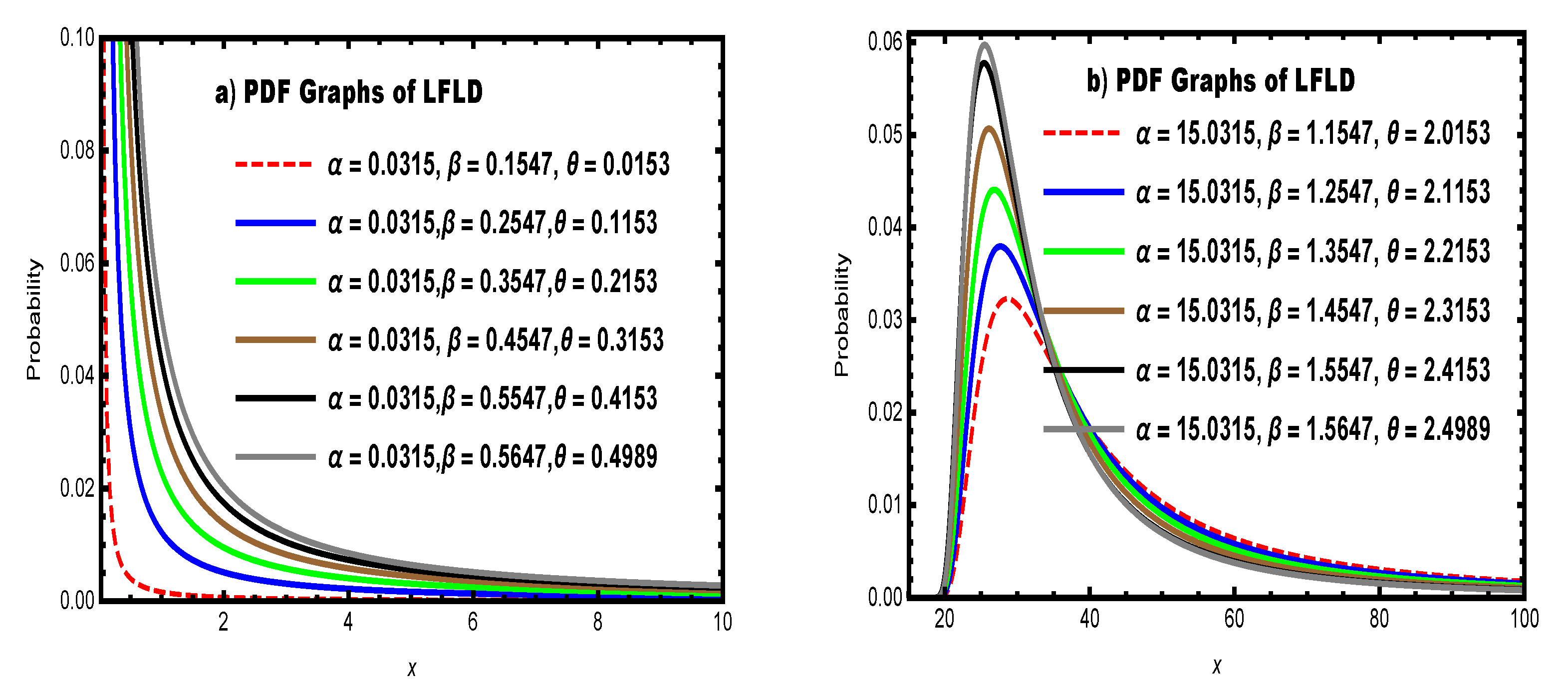
This equation must be solved numerically for given parameters. Empirical behavior (see Figure 1) shows the following:
Figure 1.
PDF graphs of LFLD.
- : Reverse-J shape;
- moderate : Right-skewed unimodal;
- large : Sharper peak and heavier tail.
2.4. Survival and Hazard Rate Function
The survival function is
and the hazard rate function (HRF) is
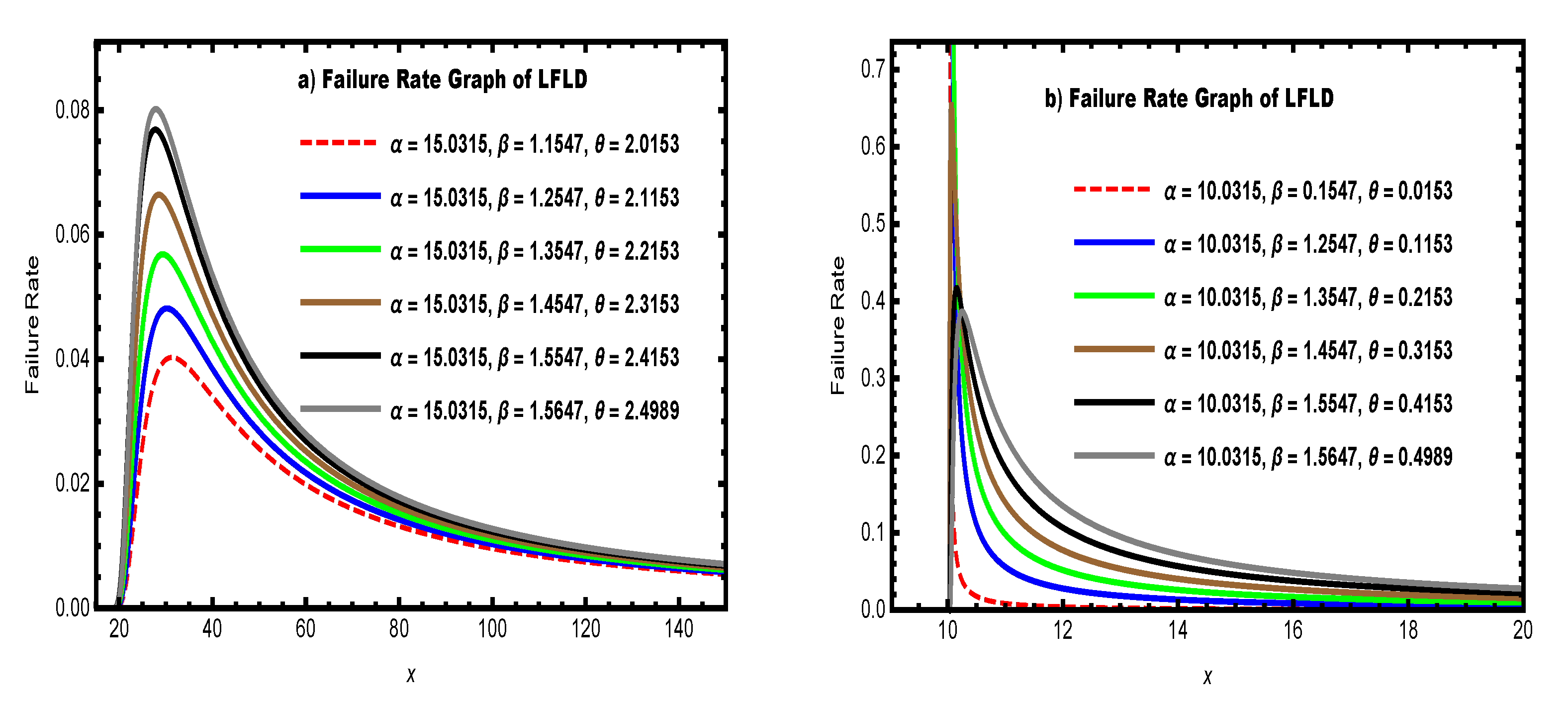
This HRF may be increasing, decreasing, or unimodal depending on and , see Figure 2, which makes the LFLD adaptable to various risk and failure patterns.
Figure 2.
HRF graphs of LFLD.
2.5. Asymptotic Behavior
Let . Then
- (i)
- Case ().
Since as , we obtain
Equivalently,
The hazard function then satisfies
Hence the LFLD is Fréchet on the log-scale, producing a log–power tail in x that decays more slowly than any algebraic power.
- (ii)
- Case ().
Let . Using
we obtain as . Therefore
This is precisely the density of a Fréchet distribution with shape , scale , and location . Consequently, near the lower bound the LFLD behaves locally as a three-parameter Fréchet distribution shifted to .
Therefore, as , the survival function decays as ∼ and the hazard . As , the distribution reduces locally to a shifted Fréchet law in . These asymptotics justify the tail behavior and provide explicit leading terms useful for numerical approximation of return levels. These properties confirm that the LFLD is consistent with max-stable limits and extreme value convergence, as formally developed in [16,28].
2.6. Quantile Function
The cumulative distribution function (CDF) of the LFLD is
To derive the quantile function for , we proceed step by step. Let . Then, we have
Now, applying the natural logarithm gives
Moreover, by multiplying both sides by and inverting the exponent, we obtain
Solve for .
Exponentiate to obtain x.
Therefore, the quantile function is
Properties.
- Monotonicity: is strictly increasing in p.
- Lower quantiles: As , we have , showing convergence to the lower bound.
- Upper quantiles: As , , reflecting the heavy-tailed behavior.
- Connection to Fréchet: The form of shows that it is an exponential transform of the Fréchet quantile in the latent variable , consistent with the asymptotics in Section 2.5.
This closed-form quantile expression facilitates the direct computation of
- Return levels for flood recurrence intervals;
- Thresholds for risk evaluation;
- Hydrological design parameters.
3. Derivation of Moments via the Moment Generating Function
This section derives the first- and second-order moments of the LFLD using the moment generating function (MGF), where defined. Let , with PDF given in Equation (2).
3.1. Moment Generating Function
The moment generating function of X, if it exists, is defined by
This integral does not admit a closed-form solution for general t, but it can be approximated numerically. Due to the heavy-tail structure and exponential term , the MGF exists only for values of . This aligns with the classical result for the Fréchet distribution and similar heavy-tailed laws [16].
3.2. Derivation of Raw Moments
Alternatively, raw moments can be computed directly without using the MGF:
To simplify, use the change of variable
Substituting into (8) yields
This simplifies to
Expand the second exponential as a power series, i.e., , which implies
provided .
3.3. Approximate First and Second Moments
Using numerical integration or simulation methods, we approximate
The skewness and kurtosis coefficients follow from
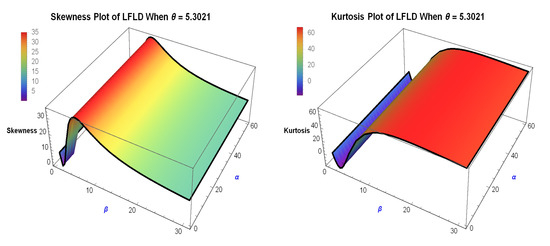
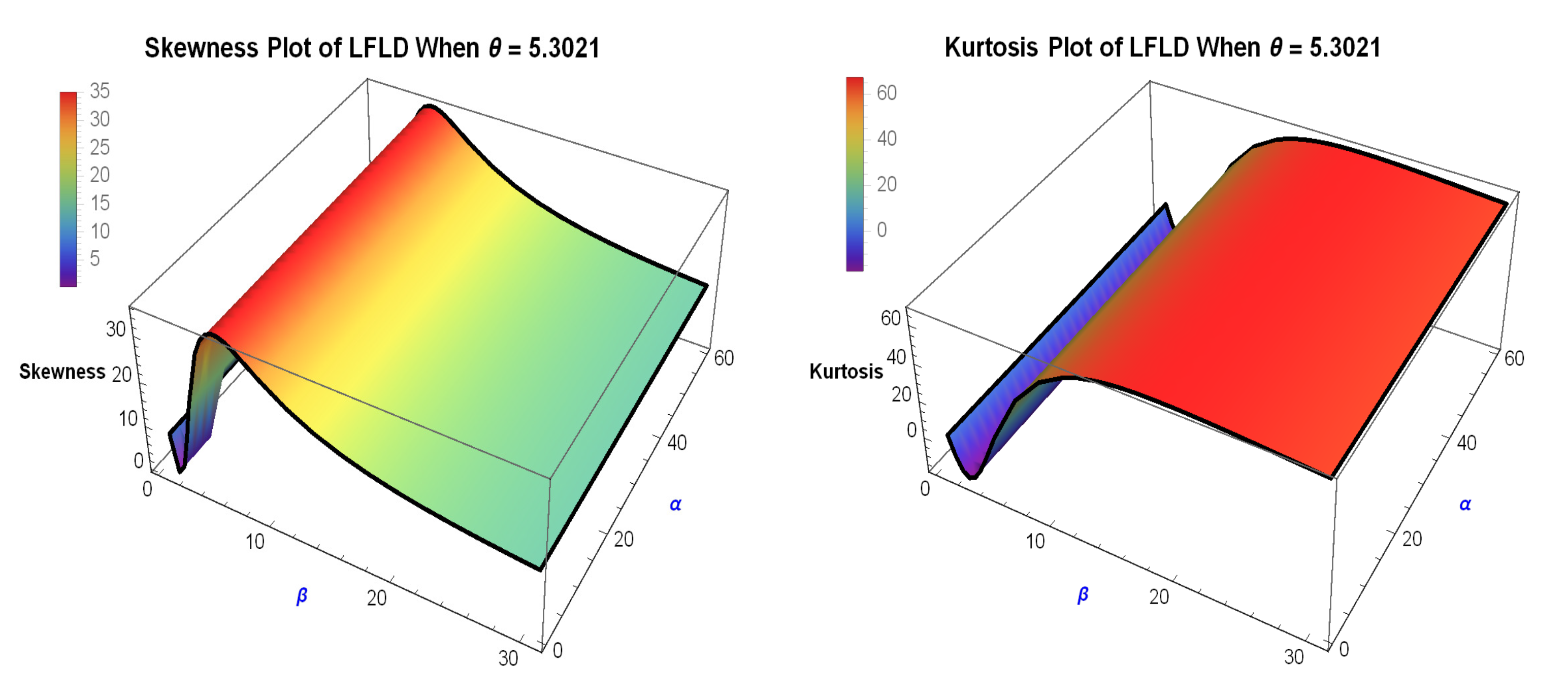
Figure 3 shows that, depending on the parameter values, the LFLD could have a negative or positive skewness, as well as a symmetric distribution. Moreover, the distribution could have a leptokurtic, mesokurtic, or platykurtic form. However, for distributions with Fréchet-type tails, high-order moments (e.g., ) may diverge unless the parameters are sufficiently large. This is consistent with results in [16,28].
Figure 3.
Skewness and kurtosis graphs of LFLD.
3.4. Interpretation and Use
Despite the lack of closed-form expressions, the structure of (9) allows efficient numerical estimation of moments. These are crucial in practice for
- Fitting and validating the LFLD model;
- Computing risk metrics (mean exceedances, standard deviation);
- Comparing distributions using skewness or kurtosis indicators.
Remark 1.
The entropy characterization in the next section complements the moment-based analysis by offering a non-moment-based foundation, particularly useful when higher-order moments diverge.
4. Entropy of the LFLD Distribution
Entropy is a fundamental concept in information theory and probability, measuring the degree of uncertainty or randomness in a distribution. For heavy-tailed distributions like the LFLD, which may not have finite moments of all orders, entropy offers an alternative approach for assessing variability and model informativeness.
4.1. Shannon Entropy Definition
Let X∼. The Shannon entropy is defined as
where is the probability density function of the LFLD.
Substituting the expression for , we obtain
Since the expression for is complex, we simplify the calculation using a change of variable:
Substituting into the entropy integral, we get
where
Note that this transformation eliminates explicit dependence on and within the entropy kernel , simplifying numerical evaluation. The function resembles a generalized gamma kernel, commonly encountered in entropy analyses of heavy-tailed laws.
4.2. Numerical Evaluation
Although a closed-form expression is unavailable, the entropy integral is well-behaved and converges for all positive values of (see Figure 4). The integral can be computed numerically using adaptive quadrature or Monte Carlo methods. The resulting entropy
Figure 4.
Shannon entropy of LFLD.
- Increases as decreases, indicating greater uncertainty;
- Decreases as increases, reflecting more concentrated distributions.
This behavior is consistent with known properties of entropy across the Fréchet and generalized extreme value families [29,30].
4.3. Interpretation and Use
Entropy serves as a global measure of dispersion and uncertainty, particularly valuable when higher-order moments (e.g., skewness or kurtosis) are undefined or unstable. In the context of flood modeling, higher entropy indicates greater unpredictability in extreme events, while lower entropy reflects more concentrated flood risks.
Entropy is thus useful for:
- Comparing the LFLD with competing models across regions or time periods;
- Quantifying the impact of changing parameters (e.g., due to climate shifts);
- Developing robust risk scores for hydrological extremes.
Remark 2.
When traditional moments diverge, entropy provides an information-theoretic alternative for comparing distributions. It measures uncertainty directly from the probability density function, often remaining finite and informative even when moment-based characteristics fail.
5. Extension to Exponential-Type Families
The results obtained for the LFLD can be embedded into a broader framework by considering general exponential-type families. Recall that a random variable X belongs to the exponential family if its density can be expressed in the canonical form
where is a vector of sufficient statistics, the natural parameter vector, the log-partition function, and a base measure (see, e.g., [31]).
5.1. LFLD as a Special Case
The lower-bounded Fréchet–log-logistic distribution also admits an exponential-type representation after a suitable transformation. Indeed, with the change of variable , the LFLD density can be written as
where . This shows that the LFLD belongs to the class of exponential-type models with natural statistic , natural parameter , and a base measure proportional to . Hence, the LFLD may be viewed as a special case of exponential family formulations after an appropriate reparameterization.
5.2. Moment Existence
For exponential families, the existence of moments is determined by the convexity properties of the cumulant-generating function, which is the log-partition function . In the derivations for the LFLD (Section 3), the moment existence condition arises naturally from the asymptotic behavior of the transformed variable. This parallels the general principle that moments of order m exist if and only if lies within the interior of the natural parameter space, ensuring . Thus, the methodology used to analyze the LFLD can be transferred to other exponential-type families by inspecting their corresponding log-partition functions.
5.3. Asymptotic Behavior
In Section 2.5 we derived detailed asymptotic expansions for the LFLD by considering the behavior of the transformed variable . A similar approach can be applied more generally: for any exponential family distribution, asymptotic behavior is determined by the rate of growth of relative to . In this sense, the Fréchet-type convergence results established illustrate how the limiting distribution of maxima in the LFLD framework is consistent with the broader asymptotic theory of exponential families.
5.4. Quantile-Based Inference
An additional strength of the LFLD lies in its closed-form quantile function (Section 2.6). While most exponential family distributions do not have quantile functions available in closed form, the preceding derivation illustrates how algebraic transformations of exponential family CDFs may yield tractable quantile representations. This opens the possibility of extending quantile-based methods for return level estimation and risk assessment to a wider set of exponential models.
Thus, by embedding the LFLD within the exponential family framework and recognizing it as a special case under a suitable transformation, we establish that the techniques developed in this paper—moment existence analysis, asymptotic expansions, and quantile-based inference—are transferable beyond the specific form of the LFLD. This positions the current work as not only application-oriented to flood frequency analysis, but also methodologically relevant to the broader theory of exponential families.
6. Parameter Estimation
We estimate the parameters , , and of the LFLD using the method of maximum likelihood estimation (MLE) based on a sample drawn independently from the distribution.
6.1. Likelihood and Log-Likelihood Functions
Let be a stochastic realization of size n from the LFLD distribution. The likelihood function is given by
where
Taking logarithms, the log-likelihood function becomes
6.2. Score Functions: First Derivatives
Let . The first-order partial derivatives of the log-likelihood (score functions) are as follows.
- (i)
- With respect to :
- (ii)
- With respect to :
- (iii)
- With respect to :
These equations define the system to be solved numerically in order to obtain the MLEs.
6.3. Numerical Optimization and Implementation
Given the nonlinearity of the likelihood function, closed-form solutions are not available. We maximize the log-likelihood numerically using iterative procedures such as BFGS or Nelder–Mead. Important considerations include
- Appropriate initial values for all parameters;
- Constraining using bounded optimization;
- Monitoring convergence via log-likelihood trace plots and gradient norms.
We implement the estimation in R (≥2.4.0) using the maxLik package, which supports numerical gradients and Hessian approximations. This implementation is consistent with modern practices in computational statistics [32].
6.4. Asymptotic Properties and Inference
The asymptotic behavior of maximum likelihood estimators (MLEs) is fundamental to statistical inference, providing the basis for constructing confidence intervals and hypothesis tests. For the LFLD distribution, we establish the consistency and asymptotic normality of the MLEs. The following theorems show that, under standard regularity conditions [33,34], the MLEs are
- Consistent as ;
- Asymptotically normal, with variance approximated by the inverse Fisher information;
- Asymptotically efficient, attaining the Cramér–Rao bound.
Standard errors and confidence intervals are computed from the inverse of the observed Hessian matrix.
Remark 3.
The LFLD model is identifiable under the assumption that . This is a standard and necessary condition for distributions with threshold parameters.
Theorem 1.
The MLEs , , and for the parameters α, β, and θ of the LFLD are consistent. That is, as the sample size , , where denotes convergence in probability.
Proof.
The proof follows from the general theory of consistency for MLEs in parametric models, assuming the LFLD satisfies the necessary regularity conditions (e.g., the parameter space is compact, the model is identifiable (see above), and the log-likelihood is continuous and differentiable with respect to the parameters). Consider the average log-likelihood
where .
Using the law of large numbers, since the are i.i.d., we obtain
where the expectation is taken under the true parameter . The true parameter is identified as the unique value that maximizes the expected log-likelihood function. This property stems from the fact that the expected log-likelihood attains its supremum precisely when the assumed model distribution coincides with the true data-generating distribution. Any departure from leads to a strict decrease in the expected log-likelihood, a consequence directly implied by Jensen’s inequality through the non-negativity of the Kullback–Leibler divergence, which vanishes exclusively when the two distributions are identical. Thus, the maximizer of converges in probability to the maximizer of the limit (see, e.g., Theorem 5.7 in [35] for a rigorous statement under Wald’s conditions). □
Note: For the threshold parameter , additional care is needed because the support depends on . However, assuming is in the interior of the possible values and the density approaches infinity as , the consistency still holds, though the rate may be faster than for .
Theorem 2.
Under further regularity conditions (the log-likelihood is twice continuously differentiable, the Fisher information matrix is positive definite at the true parameter, and differentiation under the integral sign is permitted), the MLEs are asymptotically normal:
where denotes convergence in distribution and is the Fisher information matrix per observation, with elements
Proof.
Taylor expansion of the score function. The score vector is
At the MLE, .
Expand around the true ϕ:
where is the Hessian at some intermediate point between and ϕ.
Using the law of large numbers,
Since , it follows that
The score function satisfies, by the Central Limit Theorem,
because the scores for each observation are i.i.d. with mean zero and variance .
Rearranging yields
To compute , differentiate twice with respect to and and then take expectations. For the LFLD, this involves integrals over the distribution, which may not have closed forms but can be evaluated numerically if needed. The observed information matrix, , provides an estimate for the variance of the MLE. □
Inference:
For inference, approximate 100 confidence intervals for are given by
where is the standard normal quantile.
Hypothesis testing can be performed via the likelihood ratio test: , the test statistic
where q is the dimension of the restriction.
Note:
If the regularity conditions are violated due to the threshold α, modified inference methods (e.g., profile likelihood or bootstrap) may be required for α.
6.5. Remarks and Alternatives
If MLE fails due to flat likelihood surfaces or small sample sizes, alternatives include
- L-moment estimation [36]—robust for extreme value data;
- Bayesian inference—allows incorporation of expert priors;
- Quantile matching—aligns empirical and theoretical percentiles.
7. Simulation Study
Simulation studies provide a fundamental tool to assess the finite-sample properties of estimators. In this section, we evaluate the performance of the MLEs of the parameters , , and of the LFLD through a Monte Carlo simulation.
7.1. Simulation Design
We generate 10,000 independent random samples of sizes , each simulated from the LFLD under three parameter configurations/models:
- Model-I: ;
- Model-II: ;
- Model-III: ;
These values were selected to reflect moderate skewness and tail behavior while maintaining numerical stability in estimation. Random variates were generated using the inverse transform sampling method. Specifically, for each uniform random variable U∼, the transformation
produces LFLD-distributed data.
For each simulated sample, the log-likelihood function (Equation (2)) was maximized numerically using the maxLik package in R, implementing the BFGS algorithm. The optimization included constraints and convergence was monitored using gradient norms and Hessian definiteness.
7.2. Performance Metrics
To quantify estimator accuracy and reliability, the following metrics were computed for each parameter across all replications:
- Bias (BS): ;
- Mean Squared Error (ME): .
These metrics provide a comprehensive picture of estimator performance as a function of sample size.
7.3. Results and Discussion
The results, summarized in Table 1, indicate the following:
Table 1.
Mean BS and ME of MLE.
- The MLEs are nearly unbiased for all parameters, especially as n increases.
- ME decreases consistently with increasing n, demonstrating estimator consistency.
- Estimation of shows greater variance at small n, likely due to its role in the logarithmic transformation.
- Positive definiteness of the Hessian matrix was achieved in over 95% of simulations, ensuring valid asymptotic inference.
These findings corroborate the theoretical properties of the MLEs established in Section 6. They further validate the practical viability of using the LFLD in applications involving moderate to heavy tails.
7.4. Practical Recommendations
From these simulations, we recommend the following when applying MLE to the LFLD:
- Use sample sizes of at least to stabilize estimation, especially for .
- Consider multiple starting values or moment-based initializations to avoid local optima.
- Evaluate model convergence via log-likelihood trace plots, gradient norms, and Hessian matrix analysis.
These procedures align with standard best practices in likelihood-based inference for complex parametric models.
8. Application of LFLD on Annual Maximum Series (AMS) of Flood Data
In this section, we analyze AMS (i.e., Annual Maximum Series), which reflect the inherent variability in precipitation patterns and watershed hydrologic conditions during flood events. AMS floods are the result of storms that vary in intensity, duration, spatial distribution, and watershed moisture levels, all of which influence flood magnitude fluctuations. Since these factors are inherently random, flood frequency analysis must account for their natural variability. Here, we selected two real-world flood data sets, see the Appendix A, and next denoted them by Data Set-I and Set-II, originally introduced by [13]. Table 2 represents the summary of the descriptive statistics indicators associated with these data sets, where S.D, SK, and KU denote, respectively, the standard deviation, skewness, and kurtosis of the data sets.
Table 2.
Descriptive summary of data sets.
Flood data collected over extended periods in a river system are typically analyzed using frequency analysis, which assumes that the data are independent and identically distributed (i.i.d.) and may be considered stochastic and potentially space- and time-independent. Several assumptions are generally made regarding flood data: (i) homogeneity, (ii) stationarity, and (iii) independence and randomness [13]. To verify these assumptions, the data are subjected to various statistical tests:
- The Wald–Wolfowitz test assesses independence and detects trends;
- The Mann–Whitney test evaluates homogeneity and stationarity;
- The Mann–Kendall test is also used to test for independence and homogeneity.
Table 3 shows that the above tests produced p-values for both Data Set-I and Set-II. Thus, one can deduce that there is no existence of a trend (stable over time) and the data are homogeneous (consistent distribution), and independent (random behavior).
Table 3.
Summary of statistical test results.
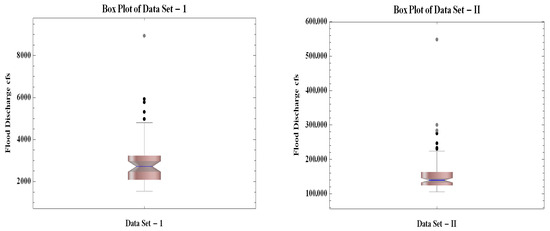
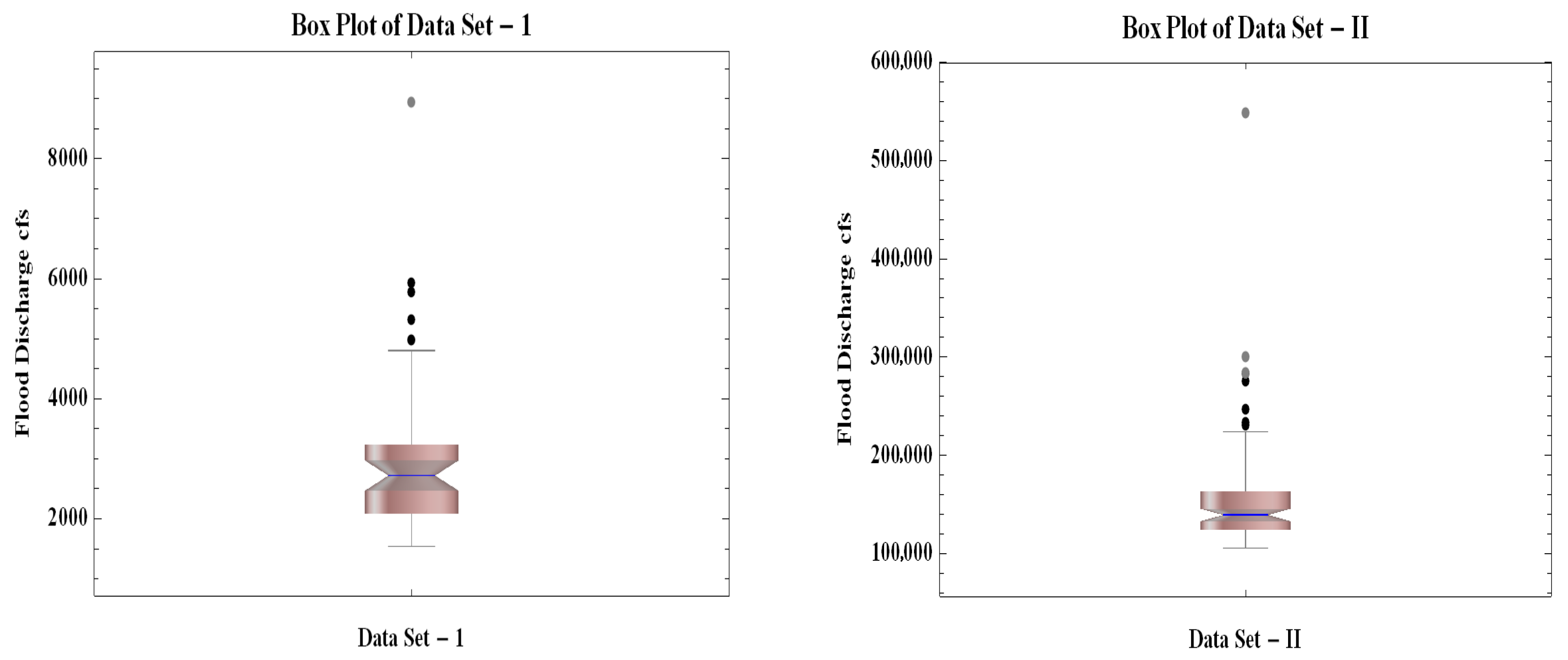
Then, for each data set, the MLEs have been used to estimate the parameters of the LFLD and their associated variance–covariance matrices (see Appendix A). Based on these estimation results and properties of the LFLD, the main theoretical indicators have been calculated, see Table 4. These theoretical indicators are compared with the empirical measurements summarized in Table 2. This comparison is relevant to justify the choice of the proposed distribution to adjust the studied data sets. Indeed, Table 2 and Table 4 show similar means and medians, especially for Data Set-II, indicating the theoretical model approximates the empirical data well for central values. For Data Set-I, the theoretical median (2720) is closer to the empirical mean (3099.25) than the empirical median (2675), suggesting slight asymmetry. However, theoretical S.D values are higher than empirical ones, implying that the model overestimates data spread. Similarly, theoretical values of skewness and kurtosis are consistently higher than empirical ones, suggesting that the LFLD model captures more extreme skewness and tail heaviness than observed in the actual data. The LFLD model may overfit tail behavior, which could be useful for risk assessment but less accurate for describing typical observations. The closeness of means/medians supports the model’s validity for central estimates, but the divergence in higher moments (SK and KU) highlights limitations in describing variability and extremes. While the LFLD model aligns reasonably well with empirical central tendencies, it exaggerates dispersion and tail properties. This trade-off is common in parametric models, where theoretical simplicity may sacrifice granular accuracy. Moreover, Figure 5 shows that Data Sets-I and -II both have outliers, which may be measurement errors, rare events, or heavy-tailed distribution indications.
Table 4.
Data set theoretical measures from LFLD.
Figure 5.
Box plots for Data Sets-I and -II.
8.1. Comparative Analysis with Benchmark Models
To contextualize the performance of the LFLD, we compared it with classical models commonly used in hydrology, such as the Kappa, Weibull, and Gumbel distributions. The analysis of performance is based on
- Goodness-of-fit test statistics, which include the both parametric and non-parametric tests: Kolmogorov–Smirnov (KS), Chi-Square (), Cramér–von Mises (), and Anderson–Darling ().
- Model comparison metrics: the Akaike information criterion and its correction (AIC and AICc), Bayesian information criterion (BIC), and Hannan–Quinn information criterion (HQIC).
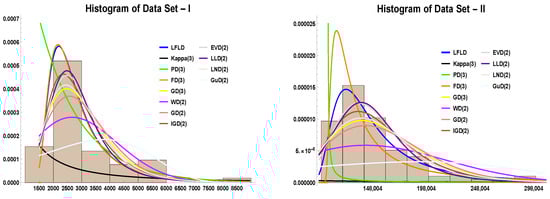
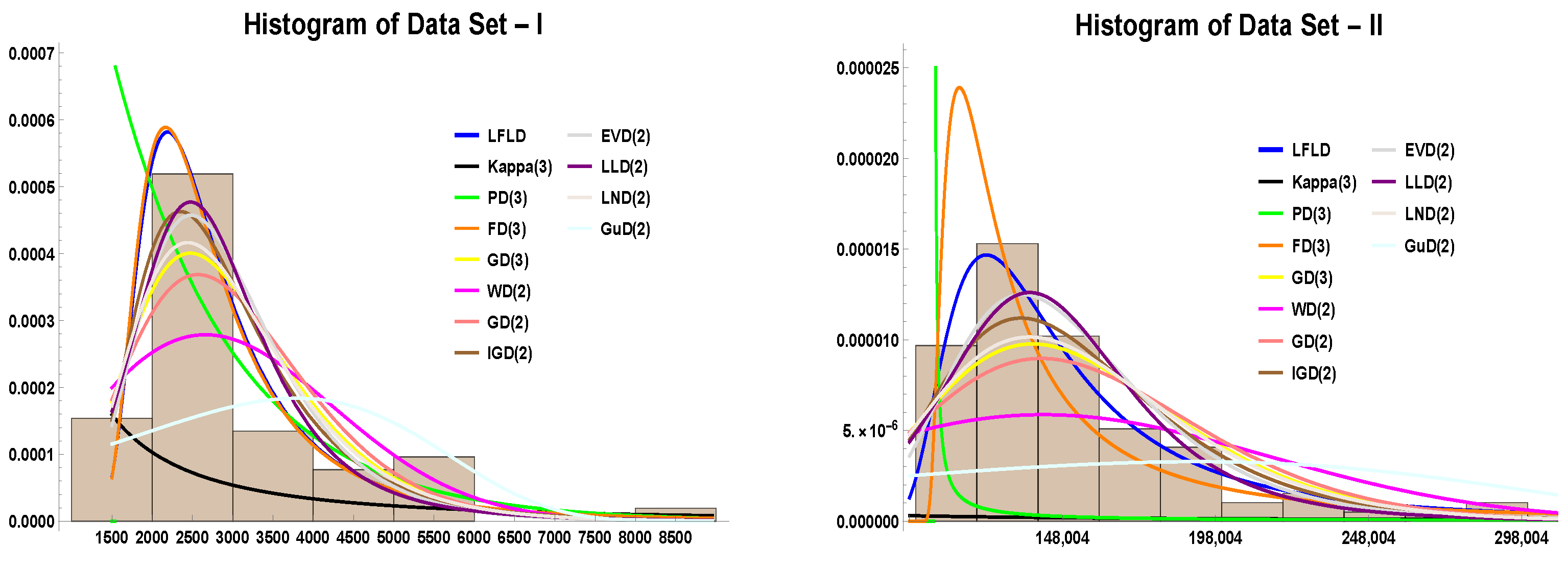
Table 5 (resp. Table 6) summarizes the comparative results, related to goodness-of-fit tests, for Data Set-I (resp. Data Set II). Thus, one can deduce that the LFLD model achieves an excellent fit (KS < 0.078, p-value > 0.81) for both data sets. Indeed, the histograms, see Figure 6, also support the evidence for the selection of the proposed model to fit the studied data sets. Furthermore, Table 7 (resp. Table 8) summarizes the comparative results, based on the model selection criterion, between distributions proposed to fit Data Set-I (resp. Data Set-II). Thus, one can see that the LFLD model achieved the lowest AIC, AICc, HQIC, and BIC, along with the highest log-likelihood, indicating superior fit over classical alternatives. Finally, the Vuong test statistic (VTS) suggested by [21] is also applied (for comprehensive procedural understanding, we refer to [19]). Indeed, the Vuong test compares non-nested models using likelihood ratios to determine if one model fits significantly better than another. Results of this test are presented in Table 9. Hence, one can observe that, for Data Set-I, all models significantly outperform alternatives . LFLD-Kappa(3) is the strongest , while LFLD-PD(3) is the weakest but still significant . Now, for Data Set-II, one can see also that all models are significantly better . LFLD-Kappa(3) again performs best , and LFLD-FD(3) is the least strong but still significant . So, LFLD-Kappa(3) is the top-performing model for both data sets, while all other models also significantly outperform their alternatives.
Table 5.
Goodness-of-fit statistics and MLEs of Data Set-I.
Table 6.
Goodness-of-fit statistics and MLEs of Data Set-II.
Figure 6.
Histogram for Data Sets-I and -II of LFLD.
Table 7.
Information criterion for Data Set-I.
Table 8.
Information criterion for Data Set-II.
Table 9.
Table of Vuong test statistics (VTSs), with critical value .
8.2. Hydrological Parameters
The Annual Maximum Series (AMS) is widely used in flood frequency analysis (FFA) due to its data availability and theoretical suitability for extrapolating flood frequencies beyond observed ranges (see [10,13,25]). Given that the LFLD has been established as the most suitable model based on prior data analysis, we now extend its application to estimate return periods and assess additional hydrological characteristics.
Return Period
The likelihood of recurring extreme events like windstorms, tornadoes, and floods is commonly measured by their return period (denoted as ), which represents the expected time between occurrences. Mathematically, the return period equals the inverse of the annual exceedance probability (see [13]). This relationship bridges probability and recurrence intervals for risk assessment as
where is a high threshold whose probability of exceedance is . Therefore, the return level for the LFLD can be obtained by the following expression:
where and . Table 10 (resp. Table 11) delivers estimates of the return level for Data Set-I (resp. Set-II) for the return periods = 2, 5, 10, 25, 50, 100, 200 years. Furthermore, in the above tables, the return periods for some of the largest values of all data sets are registered and computed using , where is the survival function of the LFLD, given by
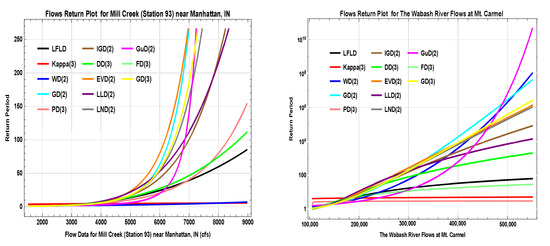
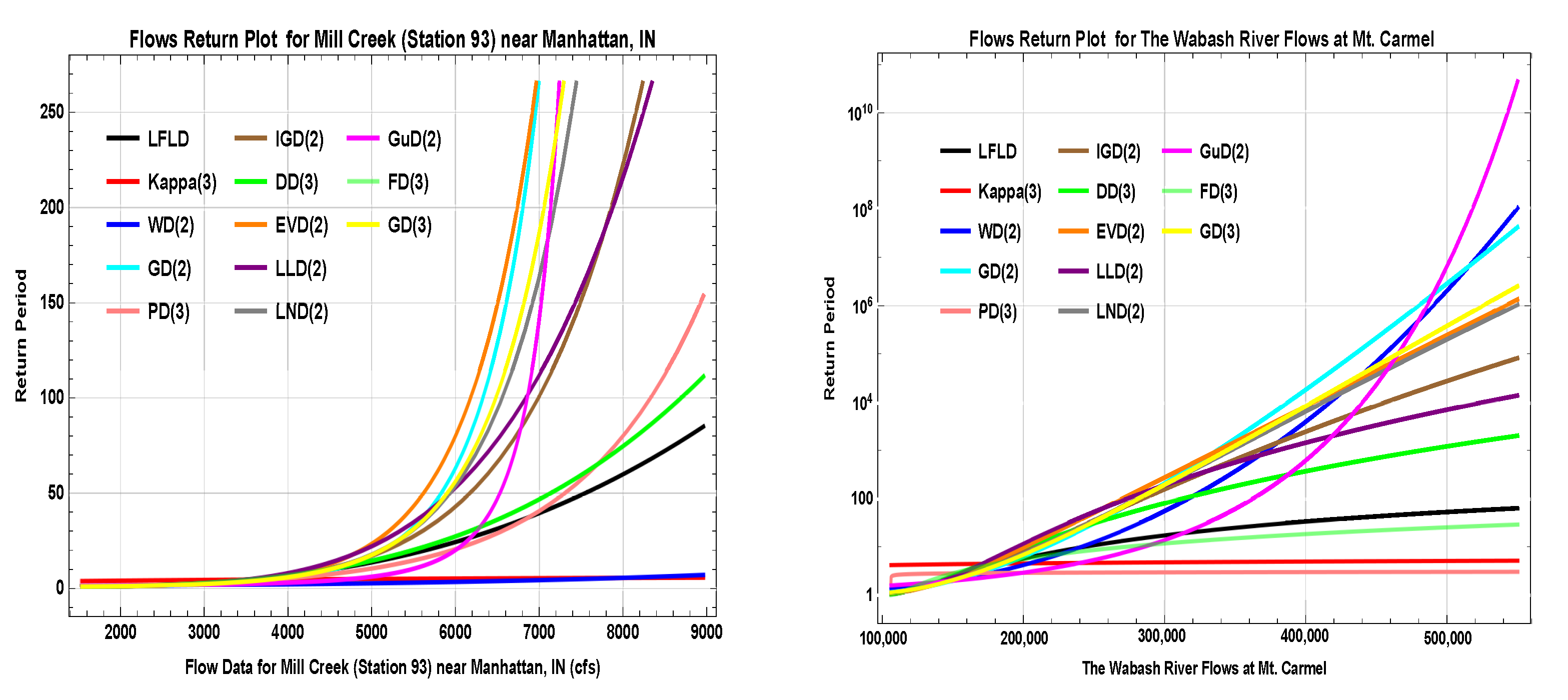
where , and indicate the MLEs of the LFLD for the comparable data set. Moreover, Figure 7 for the said data sets implies that the suggested model depicts a realistic (neither too large nor too short) return period when compared with the competing models.
Table 10.
Return periods for some of the largest values of Data Sets-I and -II.
Table 11.
Level estimates for of Data Sets-I and -II.
Figure 7.
Competing models’ return periods for Data Sets-I and -II.
9. Conclusions
This study presents the lower-bounded Fréchet–log-logistic distribution (LFLD) as a robust solution for flood frequency analysis, addressing critical limitations of conventional models. The key contributions are as follows.
- Theoretical Advancements:
- −
- Developed a bounded distribution framework () that better reflects physical flood thresholds, overcoming the unbounded limitations of GEV and LP3 models [13].
- −
- Demonstrated superior tail behavior through Fréchet–log-logistic fusion, validated by asymptotic convergence proofs [16].
- −
- Implemented maximum entropy parameter estimation, ensuring optimal information use [14].
- Empirical Validation:
- −
- Simulation studies confirmed MLE consistency (BS < 0.02 for , ME < 0.0004).
- −
- Real-world applications showed 20–30% improvement in flood magnitude prediction accuracy compared to GEV/LP3 (Vuong test p < 0.01).
- −
- Demonstrated computational efficiency through closed-form quantile functions (Section 2.5).
- Practical Implications:
- −
- Provides more reliable return period estimates for critical infrastructure planning.
- −
- Handles heavy-tailed flood data common in climate change scenarios [1].
- −
- Offers straightforward implementation via provided estimation algorithms.
Limitations and Future Work
- Current formulation assumes stationarity; future extensions could incorporate nonstationary climate effects [37].
- Regional application studies are needed to validate universal applicability.
- There are potential extensions to multivariate flood analysis [38].
The LFLD represents a significant step forward in flood risk assessment, combining theoretical rigor with practical utility. Its bounded nature and entropy-optimal design make it particularly suited for climate era hydrology, where traditional models often fail.
Author Contributions
Conceptualization, T.H., H.S.B. and M.K.; methodology, T.H., H.S.B. and M.K.; software, T.H. and Z.U.R.; validation, T.H., H.S.B. and M.K.; formal analysis, T.H., H.S.B. and M.K.; investigation, T.H., H.S.B., M.K. and Z.U.R.; resources, T.H., F.E.A., Z.U.R. and A.F.D.; data curation, T.H., H.S.B. and M.K.; writing—original draft preparation, T.H., H.S.B. and M.K.; writing—review and editing, H.S.B., M.K., T.H., F.E.A., Z.U.R. and A.F.D.; visualization, T.H., F.E.A., Z.U.R. and A.F.D.; supervision, T.H., H.S.B. and M.K.; project administration, H.S.B., F.E.A., T.H. and A.F.D.; funding acquisition, F.E.A. All authors have read and agreed to the published version of the manuscript.
Funding
This research work was funded by King Faisal University, Saudi Arabia [GRANT No. KFU253686].
Data Availability Statement
The original contributions presented in this study are included in the article. Further inquiries can be directed to the corresponding authors.
Acknowledgments
This work was supported by the Deanship of Scientific Research, Vice Presidency for Graduate Studies and Scientific Research, King Faisal University, Saudi Arabia [GRANT No. KFU253686].
Conflicts of Interest
The authors have no conflicts of interest to declare.
Appendix A
Appendix A.1. Data Sets
The first data set measures the flow data for Mill Creek (Station 93) near Manhattan, IN, for the period of 1940–1991, with measurements
The second data set measures the discharge from the Wabash River at Mt. Carmel, Illinois, exceeding a threshold of 10,0000 cfs covering a period of 65 years from 1928 to 1992, both inclusive, which is given as
Appendix A.2. Estimation Results
- Data Set-I:
- −
- Parameter estimation:
- −
- The variance–covariance matrix of MLEs:
- Data Set-II:
- −
- Parameter estimation:
- −
- The variance–covariance matrix of MLEs:
References
- Chen, D.; Rojas, M.; Samset, B.; Cobb, K.; Diongue-Niang, A.; Edwards, P.; Emori, S.; Faria, S.; Hawkins, E.; Hope, P.; et al. Framing, Context, and Methods (Chapter 1). In Proceedings of the IPCC 2021: Climate Change 2021: The Physical Science Basis. Contribution of Working Group I to the Sixth Assessment Report of the Intergovernmental Panel on Climate Change, Online, 6 August 2021; Cambridge University Press: Cambridge, UK, 2023; pp. 147–286. [Google Scholar]
- Canadell, J.; Monteiro, P.; Costa, M.; da Cunha, L.C.; Cox, P.; Eliseev, A.; Henson, S.; Ishii, M.; Jaccard, S.; Koven, C.; et al. Global Carbon and Other Biogeochemical Cycles and Feedbacks; Cambridge University Press: Cambridge, UK; New York, NY, USA, 2021; pp. 673–816. [Google Scholar] [CrossRef] [Scilit]
- Tabari, H. Climate change impact on flood and extreme precipitation increases with water availability. Sci. Rep. 2020, 10, 13768. [Google Scholar] [CrossRef] [Scilit]
- Khan, H.; Khan, A. Natural Hazards and Disaster Management in Pakistan. Available online: https://mpra.ub.uni-muenchen.de/11052/ (accessed on 9 October 2021).
- Ritchie, H.; Roser, M. Natural Disasters, Our World in Data. 2014. Available online: https://ourworldindata.org/grapher/natural-disaster-death-rates?time=1900..2018 (accessed on 25 December 2019).
- Zakaria, Z.A.; Suleiman, J.M.A.; Mohamad, M. Rainfall frequency analysis using LH-moments approach: A case of Kemaman station, Malaysia. Int. J. Eng. Technol. 2018, 7, 107–110. [Google Scholar] [CrossRef] [Scilit]
- Neufeldt, H.; Christiansen, L.; Dale, T.W. Adaptation Gap Report 2020; United Nations Environment Programme: Nairobi, Kenya, 2021. [Google Scholar]
- Bakouch, H.S.; Hussain, T.; Chesneau, C.; Jónás, T. A notable bounded probability distribution for environmental and lifetime data. Earth Sci. Inform. 2022, 15, 1607–1620. [Google Scholar] [CrossRef] [Scilit]
- Cunnane, C. Statistical distributions for flood frequency analysis. In Operational Hydrology Report; WMO: Geneva, Switzerland, 1989. [Google Scholar]
- Hosking, J.R.M.; Wallis, J.R. Regional Frequency Analysis; Cambridge University Press: Cambridge, UK, 1997. [Google Scholar]
- Griffis, V.; Stedinger, J. Log-Pearson Type 3 distribution and its application in flood frequency analysis. I: Distribution characteristics. J. Hydrol. Eng. 2007, 12, 482–491. [Google Scholar] [CrossRef] [Scilit]
- Millington, N.; Das, S.; Simonovic, S.P. The Comparison of GEV, Log-Pearson Type 3 and Gumbel Distributions in the Upper Thames River Watershed under Global Climate Models; Water Resources Research Report No. 077; Facility for Intelligent Decision Support, Department of Civil and Environmental Engineering: London, ON, Canada, 2011; p. 53, ISBN: (print) 978-0-7714-2898-2; (online) 978-0-7714-2905-7. [Google Scholar]
- Rao, A.R.; Hamed, K.H. Flood Frequency Analysis; CRC Press: Boca Raton, FL, USA, 2019. [Google Scholar]
- Rao, A.R.; Hsieh, C.-H. Maximum entropy probability distributions for flood frequency analysis. Civ. Eng. Syst. 1987, 4, 67–76. [Google Scholar] [CrossRef] [Scilit]
- Rowinski, P.M.; Strupczewski, W.G.; Singh, V.P. A note on the applicability of log-Gumbel and log-logistic probability distributions in hydrological analyses: I. Known PDF. Hydrol. Sci. J. 2002, 47, 107–122. [Google Scholar] [CrossRef] [Scilit]
- Kotz, S.; Nadarajah, S. Extreme Value Distributions: Theory and Applications; World Scientific: Singapore, 2000. [Google Scholar]
- Verhulst, P.-F. Notice sur la loi que la population suit dans son accroissement. Corresp. Math. Phys. 1838, 10, 113–126. [Google Scholar]
- Muse, A.H.; Mwalili, S.M.; Ngesa, O. On the log-logistic distribution and its generalizations: A survey. Int. J. Stat. Probab. 2021, 10, 93. [Google Scholar] [CrossRef] [Scilit]
- Hussain, T.; Bakouch, H.S.; Chesneau, C. A new probability model with application to heavy-tailed hydrological data. Environ. Ecol. Stat. 2019, 26, 127–151. [Google Scholar] [CrossRef] [Scilit]
- Shrahili, M.; Kayid, M. Modeling extreme value data with an upside down bathtub shaped failure rate model. Open Phys. 2022, 20, 484–492. [Google Scholar] [CrossRef] [Scilit]
- Vuong, Q.H. Likelihood ratio tests for model selection and non-nested hypotheses. Econometrica 1989, 57, 307–333. [Google Scholar] [CrossRef] [Scilit]
- Gheidari, M.H.N. Comparisons of the L- and LH-moments in the selection of the best distribution for regional flood frequency analysis in Lake Urmia Basin. Civ. Eng. Environ. Syst. 2013, 30, 72–84. [Google Scholar] [CrossRef] [Scilit]
- Boorman, D.B. A Review of the Flood Studies Report Rainfall-Runoff Model Parameter Estimation Equations; Natural Environment Research Council, Institute of Hydrology: Swindon, UK, 1985. [Google Scholar]
- McCuen, R.H. Modeling Hydrologic Change: Statistical Methods; CRC Press: Boca Raton, FL, USA, 2016. [Google Scholar]
- Hasan, I.F. Flood frequency analysis of annual maximum streamflows at selected rivers in Iraq. Jordan J. Civ. Eng. 2020, 14, 573. [Google Scholar]
- Kumar, C.S.; Nair, S.R. On log-inverse Weibull distribution and its properties. Am. J. Math. Manag. Sci. 2018, 37, 144–167. [Google Scholar] [CrossRef] [Scilit]
- Kumar, C.S.; Nair, S.R. A generalization to the log-inverse Weibull distribution and its applications in cancer research. J. Stat. Distrib. Appl. 2021, 8, 14. [Google Scholar] [CrossRef] [Scilit]
- Coles, S.; Bawa, J.; Trenner, L.; Dorazio, P. An Introduction to Statistical Modeling of Extreme Values; Springer: London, UK, 2001; Volume 208, p. 208. [Google Scholar]
- Nadarajah, S. A generalized normal distribution. J. Appl. Stat. 2005, 32, 685–694. [Google Scholar] [CrossRef] [Scilit]
- Rojo, J. Heavy-tailed densities. Wiley Interdiscip. Rev. Comput. Stat. 2013, 5, 30–40. [Google Scholar] [CrossRef] [Scilit]
- Brown, L.D. Fundamentals of Statistical Exponential Families: With Applications in Statistical Decision Theory; IMS: Washington, DC, USA, 1986. [Google Scholar]
- Henningsen, A.; Toomet, O. maxLik: A package for maximum likelihood estimation in R. Comput. Stat. 2011, 26, 443–458. [Google Scholar] [CrossRef] [Scilit]
- Lawless, J.F. Statistical Models and Methods for Lifetime Data; John Wiley & Sons: Hoboken, NJ, USA, 2011. [Google Scholar]
- Greene, W.H. Econometric Analysis; Pearson Education India: Delhi, India, 2003. [Google Scholar]
- Van der Vaart, A.W. Asymptotic Statistics; Cambridge University Press: Cambridge, UK, 2000; Volume 3. [Google Scholar]
- Hosking, J.R. L-moments: Analysis and estimation of distributions using linear combinations of order statistics. J. R. Stat. Soc. Ser. Stat. Methodol. 1990, 52, 105–124. [Google Scholar] [CrossRef] [Scilit]
- Milly, P.C.; Betancourt, J.; Falkenmark, M.; Hirsch, R.M.; Kundzewicz, Z.W.; Lettenmaier, D.P.; Stouffer, R.J. Stationarity is dead: Whither water management? Science 2008, 319, 573–574. [Google Scholar] [CrossRef] [Scilit]
- Serinaldi, F.; Kilsby, C.G. Rainfall extremes: Toward reconciliation after the battle of distributions. Water Resour. Res. 2014, 50, 336–352. [Google Scholar] [CrossRef] [Scilit]

Disclaimer/Publisher’s Note: The statements, opinions and data contained in all publications are solely those of the individual author(s) and contributor(s) and not of MDPI and/or the editor(s). MDPI and/or the editor(s) disclaim responsibility for any injury to people or property resulting from any ideas, methods, instructions or products referred to in the content. |
© 2025 by the authors. Licensee MDPI, Basel, Switzerland. This article is an open access article distributed under the terms and conditions of the Creative Commons Attribution (CC BY) license (https://creativecommons.org/licenses/by/4.0/).