1. Introduction
Aerospace technology encompasses advanced engineering and innovation that enable the design, development, and deployment of aircraft, spacecraft, and associated systems. One of its most transformative applications is in satellite constellation networks of interconnected satellites working together to provide global coverage for communication, navigation, and Earth observation. These constellations leverage aerospace advancements in propulsion, miniaturization, and autonomous operation to deliver unprecedented capabilities. By combining cutting-edge aerospace technology with scalable satellite networks, these systems are reshaping industries, fostering global connectivity, and addressing critical challenges such as disaster management and climate monitoring. However, as satellite constellations like SpaceX’s Starlink and GPS expand, they face challenges related to reliability, fault tolerance, and operational resilience. Failures caused by environmental factors, hardware malfunctions, or collisions with space debris can disrupt communication, leading to degraded performance or service outages [
1]. To maintain seamless operations under these conditions, innovative strategies like fault detection, efficient routing, and recovery mechanisms are required. Current satellite networks depend on large constellations of orbiting satellites to provide a variety of services. While redundancy has been the traditional approach to ensure fault tolerance, it leads to inefficiencies, high operational costs, and scalability challenges as constellations expand. Redundancy-based strategies also lack real-time adaptability, making them ill-suited for addressing unpredictable failures. Graph theory-based strategies, such as acyclic matching, provide a scalable mathematical approach to improve fault-tolerant signal routing and ensure network reliability through static loop-free paths.
Honeycomb networks are geometric structures characterized by interconnected hexagonal cells. The hexagonal arrangement allows for high bisection widths and reduced overall link costs compared to traditional mesh networks, making them suitable for multiprocessor interconnection systems [
2]. These networks are celebrated for their combination of lightweight properties, structural stability, efficient load distribution and fault-tolerant properties, making them widely used in aerospace and satellite engineering. Honeycomb networks allow for even load distribution across multiple communication paths, ensuring stability and aerodynamic efficiency in satellite constellations. Their unique geometry provides redundancy by offering multiple pathways that can maintain signal integrity even under failure conditions. The properties of honeycomb networks make them particularly well-suited for analysis using graph theory methods. Their symmetrical and recursive nature aligns with mathematical strategies like acyclic matching to optimize communication pathways. The neural networks are widely applied in the field of aviation [
3]. These networks are integral to modern aerospace designs, supporting advanced composite materials and fault recovery. Honeycomb networks allow signals to reroute seamlessly during failures, minimizing communication interruptions while maintaining operational efficiency. Routing and broadcasting algorithms for the honeycomb mesh networks have been described to find a path from a source to a destination and forward a message along the path [
4]. Recently, research has concentrated on identifying dominating sets in honeycomb networks, which play a crucial role in ensuring secure communications [
5] and exhibit certain coloring properties [
6]. While these bipartite networks have been studied extensively for their mechanical properties [
7,
8], their integration in space networks with fault-tolerant communication strategies is an area of growing research [
9,
10].
Graph theory provides mathematical tools for analyzing complex communication networks [
11,
12], which have more applications in medical [
13], chemical, and aeronautical fields, and even in satellite constellations. Honeycomb networks assist in designing optimal network topologies by determining efficient arrangements of nodes and links. This is essential for minimizing latency, maximizing throughput, and enhancing fault tolerance. In communication networks, graph theory aids in the design and analysis of routing algorithms, identifying critical nodes, and optimizing overall network performance [
14,
15]. One of the key concepts in graph theory is matching, defined as a subset of edges in a graph where no two edges share a common node. Various types of matching exist, including perfect matching, min–max matching, and acyclic matching [
16]. Of these, acyclic matching is a specialized type of matching that imposes an additional constraint, the subgraph induced by the matched edges must be loop-free (acyclic), which was introduced by Noga et al. [
17]. Subsequently, Panda and Pradhan [
18] made a key contribution by demonstrating that the acyclic matching problem can be efficiently solved for certain bipartite graphs and particularly those classified as P4-free and 2P3-free. Other researchers further advanced the field by presenting an algorithm for finding maximal acyclic matching [
19,
20]. Building on this work, [
21] explored the complexities of comb-convex and dually chordal graphs, proving that they cannot be solved in polynomial time. Juhi Chaudhary also made a notable contribution by creating a linear-time algorithm to compute a maximal acyclic matching with the minimal cardinality for proper interval graphs, and he recently derived an algorithm for min–max acyclic matching problems and vertex cover numbers [
22,
23]. Lately, acyclic matching numbers have been computed for various bipartite graphs and utilized in electrical networks to tackle unforeseen power outage emergencies [
24]. Acyclic matching properties are also classified and applied in abelian groups in [
25,
26]. Ref. [
27] developed a tree width algorithm using induced matching under the perspective of parameterized complexity, with which induced matching and acyclic matching were explained. Ref. [
28] demonstrated that a maximum acyclic matching in a graph can be computed recursively with a recursion depth for unidirectional graphs.
Although research in acyclic matching has been steadily growing, its application to graph networks remains relatively unexplored. In particular, determining the cardinal value of acyclic matching has received limited attention in the literature. Moreover, generalizing such solutions for arbitrary
n-dimensional graphs poses significant challenges due to the complexity of these structures. Acyclic matching is essential for fault-tolerant communication because it ensures stable signals and fault-free routing paths without delays caused by interference or loops. The properties of acyclic matching include maximizing the number of independent signal paths and ensuring that no signal loops form. This allows satellite networks to dynamically respond to faults by rerouting signals across independent, non-overlapping paths, ensuring uninterrupted communication. Graph theorists such as Lovász and Plummer have contributed foundational insights into matching and its optimization [
29]. These principles now underpin modern fault-tolerant communication strategies.
Real-time fault detection and routing are critical for satellite reliability. Integrating honeycomb network topologies with acyclic matching algorithms enables fast, fault-free rerouting by computing loop-free paths during failures. Honeycomb networks provide a geometric foundation for redundancy and resilience, while acyclic matching offers computational algorithms for fault detection and rerouting. This integration allows satellite constellations to maintain efficient and reliable communications even under crucial environmental disruptions or failure conditions. Recent research highlights that the combination of mathematical and geometric strategies offers scalable, efficient, and adaptive fault detection and routing mechanisms, particularly for satellite constellations [
30]. Despite their theoretical promise, these strategies remain underexplored in practical aerospace and satellite communication applications [
31]. This motivates further research into computational algorithms, mathematical derivations, and real-world satellite designs that incorporate honeycomb networks and acyclic matching for improved reliability and fault recovery. This paper makes the following novel contributions to aerospace technology and graph theory applications. First, it explains existing fundamental properties needed to understand upcoming results. Second, it introduces two linear-time algorithms, AMCV and AMES, designed for computing maximum acyclic matching sets in honeycomb structures. Third, it derives a general solution for acyclic matching cardinality in n-dimensional honeycomb networks, proven as
through a rigorous mathematical proof, based on induction and contradiction analysis. Finally, it presents the future practical application framework demonstrating how acyclic matching can enhance fault-tolerant communication in satellite constellations by preventing signal loops and enabling static rerouting. Collectively, these contributions bridge theoretical graph theory with practical aerospace engineering, offering scalable solutions to improve the reliability of next-generation satellite networks.
The rest of the paper is organized as follows:
Section 2 presents the methodology, including formal definitions of acyclic matching and honeycomb networks.
Section 3 details our main results, presenting two algorithms (AMCV for cardinal value computation and AMES for edge set determination) along with theoretical proofs.
Section 4 discusses practical applications in satellite constellation fault tolerance with illustrative examples, along with its limitations and future work.
Section 5 concludes the work.
3. Results
The linear-time algorithms for calculating the maximum number of acyclic matching edges and sets are derived below, where the cardinal value is denoted as , and a proof of correctness is given in the subsequent theorem.
3.1. ALGORITHM 1-AMCV: Acyclic Matching Cardinal Value for Honeycomb
To find the maximum cardinal value of an acyclic matching set of a honeycomb network with .
Input: Dimension of the honeycomb network.
Output: AMCV,
Step 1: Matching Conditions
Ensure the following conditions are met:
The matching set must be maximum.
All matching edges must be independent.
The induced subgraph formed by the matching edges must be acyclic (contains no cycles).
Step 2: Base Case (Initialization)
Step 3: Iterative Computation for Higher Dimensions
For each :
Output:
The total number of acyclic matching edges for the honeycomb network with dimension is given by
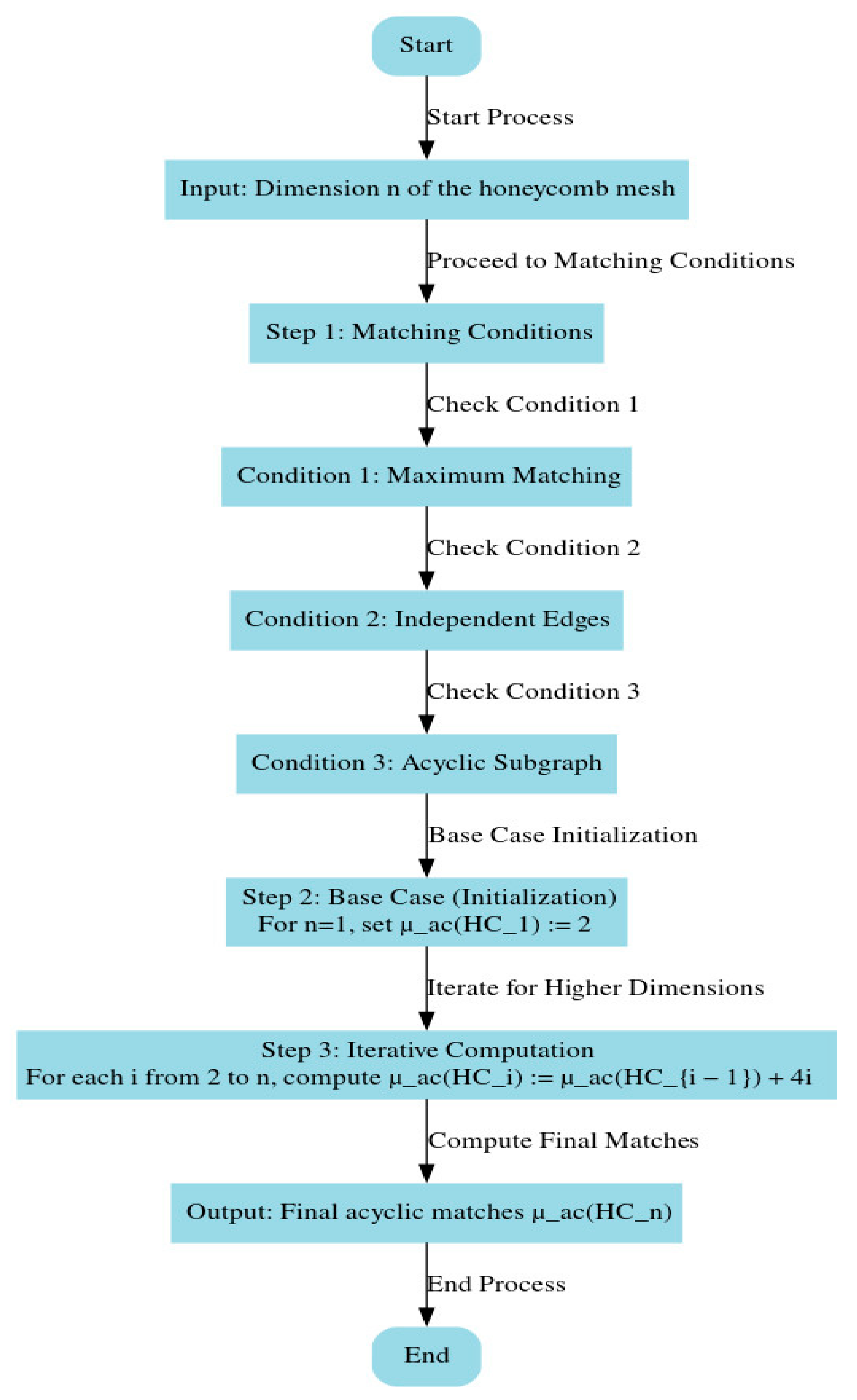
The flowchart (refer
Figure 4) depicts the procedure of finding the cardinal value
.
3.2. ALGORITHM 2-AMES: Acyclic Matching Edge Set for HCn
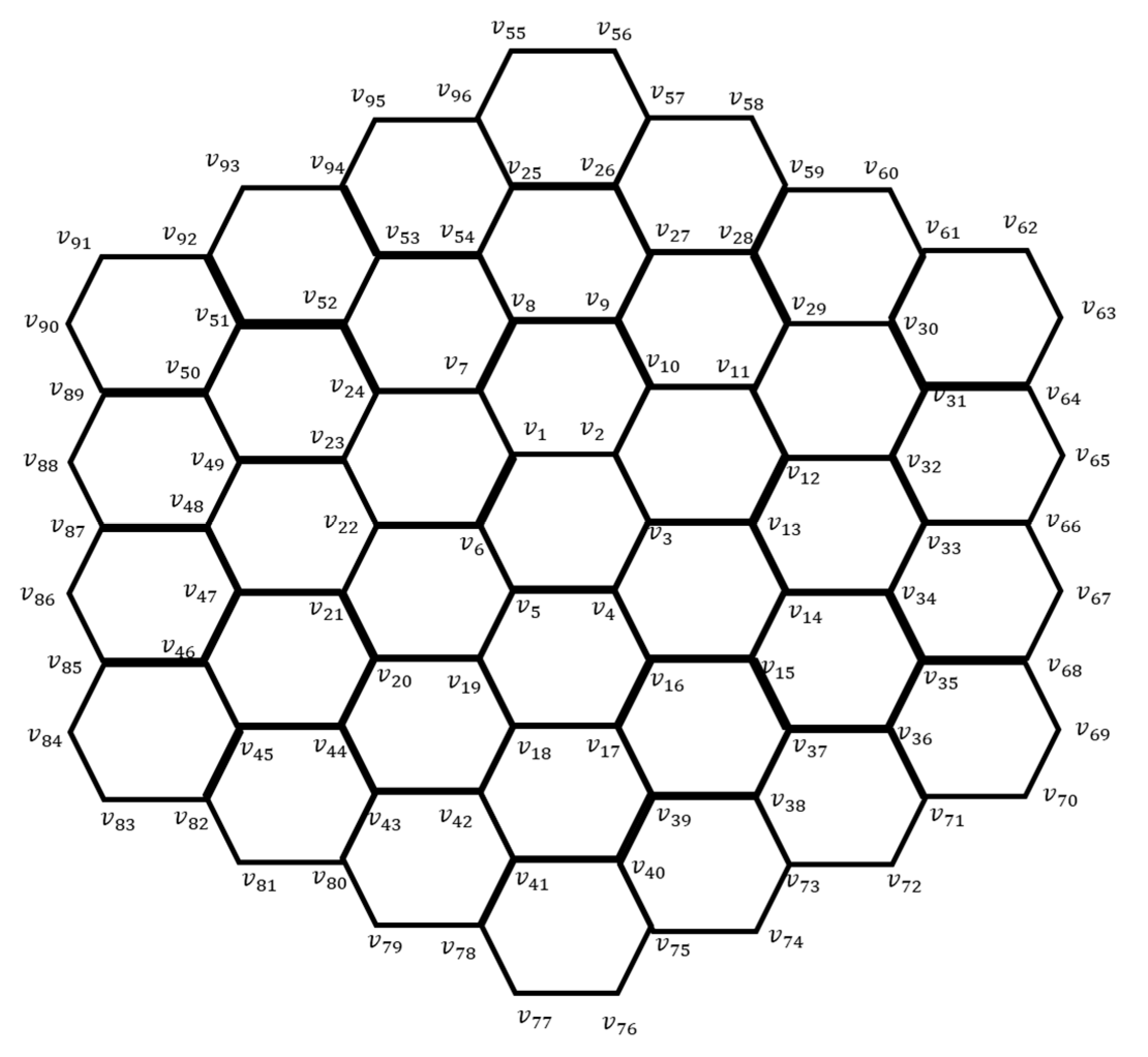
A linear-time algorithm for assessing the maximum number of acyclic matching edges is derived. The edge is formed from its own vertices where since there are no loops in the honeycomb. is the matching set of edges. The induced subgraph formed from the edges with no cycles of length and gives the cardinal value.
To find acyclic matching edge set of a honeycomb network with .n-dimension
Input: A honeycomb graph, , where .
Output: The AMES, of and .
Initialize
Choose
if
then and
if
then go to step 2
if
then go to step 2
else go to step 4
end if
end if
Computational Complexity Analysis
The AMCV and AMES algorithms offer significant computational advantages. The results are summarized in
Table 1.
Time Complexity:
AMCV: The iteration across dimensions requires O(n) steps, while all other operations are constant. Therefore, the overall time complexity is O(n). AMCV executes in
time, which is sublinear in the number of satellites. Runtime grows linearly with the dimension parameter n,
. Higher order results are calculated approximately in
Table 2.
AMES: O(n2) linear time, where n is the honeycomb dimension. This is optimal since the number of edges in is 9n2 − 3n.
Space Complexity:
AMCV: Additional data structures are not required, which yields an overall space requirement of O(1).
AMES: O(n2) for storing the matching set.
The advantages over general matching algorithms include specialized structure exploitation. Unlike general maximum matching algorithms (e.g., Edmonds’ algorithm with O(|V|3) complexity), AMES and AMCV exploit honeycomb network regularity for direct computation. General algorithms require complex augmenting path searches. However, AMES uses the proven formula = 2(n2 + n − 1) for direct edge selection. Additionally, the linear time complexity makes the algorithms suitable for real-time satellite constellation reconfiguration, unlike exponential-time general acyclic matching algorithms.
The upcoming theorem derives the proof of correctness for the algorithms provided.
Theorem 1. If
, then the cardinality series of acyclic matching is for
Proof. Case (i): If , .
For the graph
, the matching edges must be selected in such a way that the induced subgraph
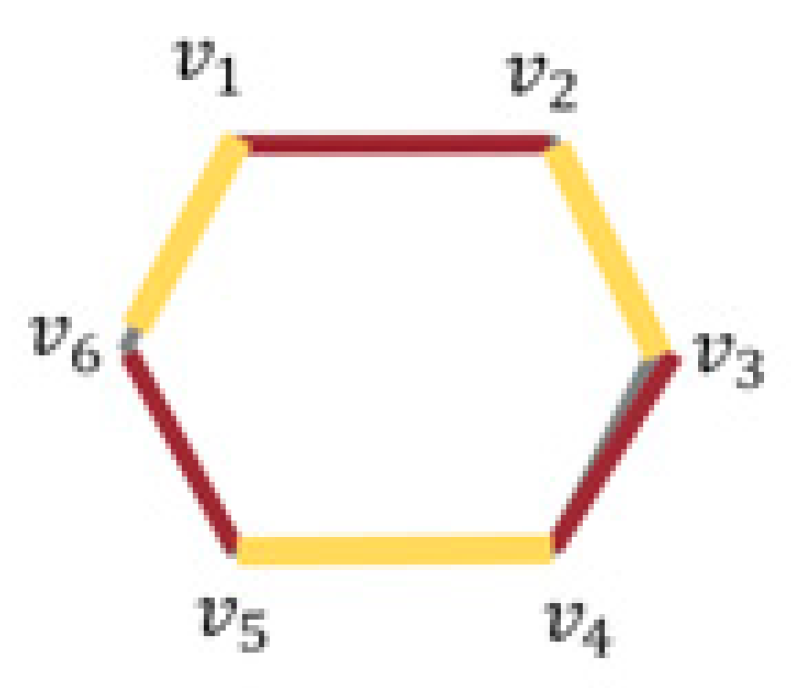
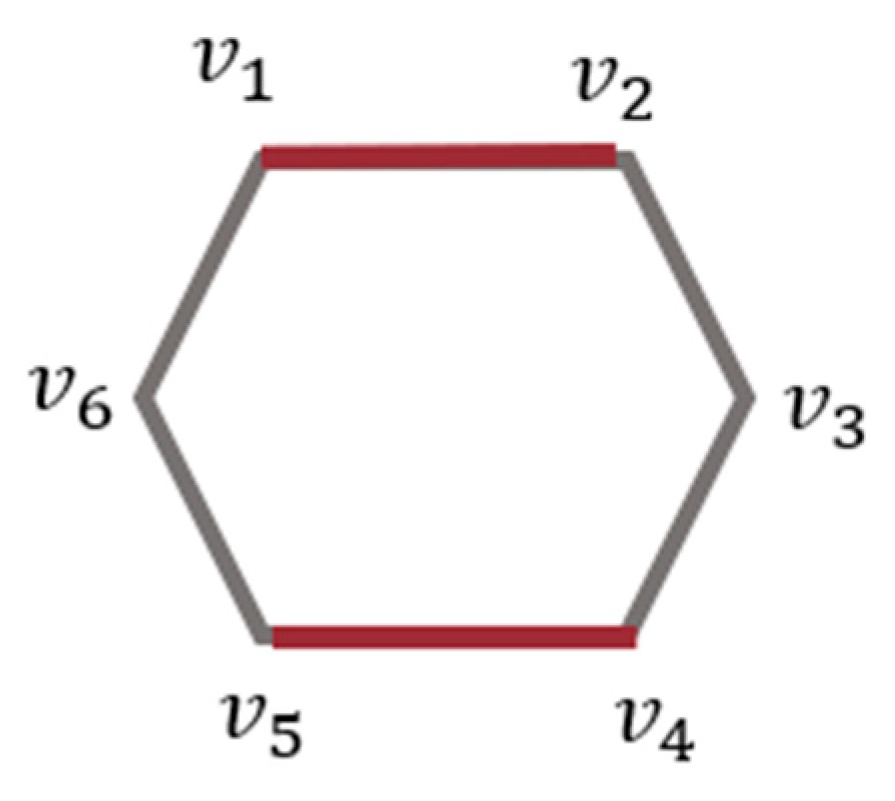
must be acyclic. Since it contains a single cell of a hexagon (refer
Figure 5), edges can be chosen without even creating
. The independent edge set for acyclic matching
(
is selected, which is marked red in
Figure 5, and there are also other possible matching sets. Therefore, the cardinality of acyclic matching of
is 2.
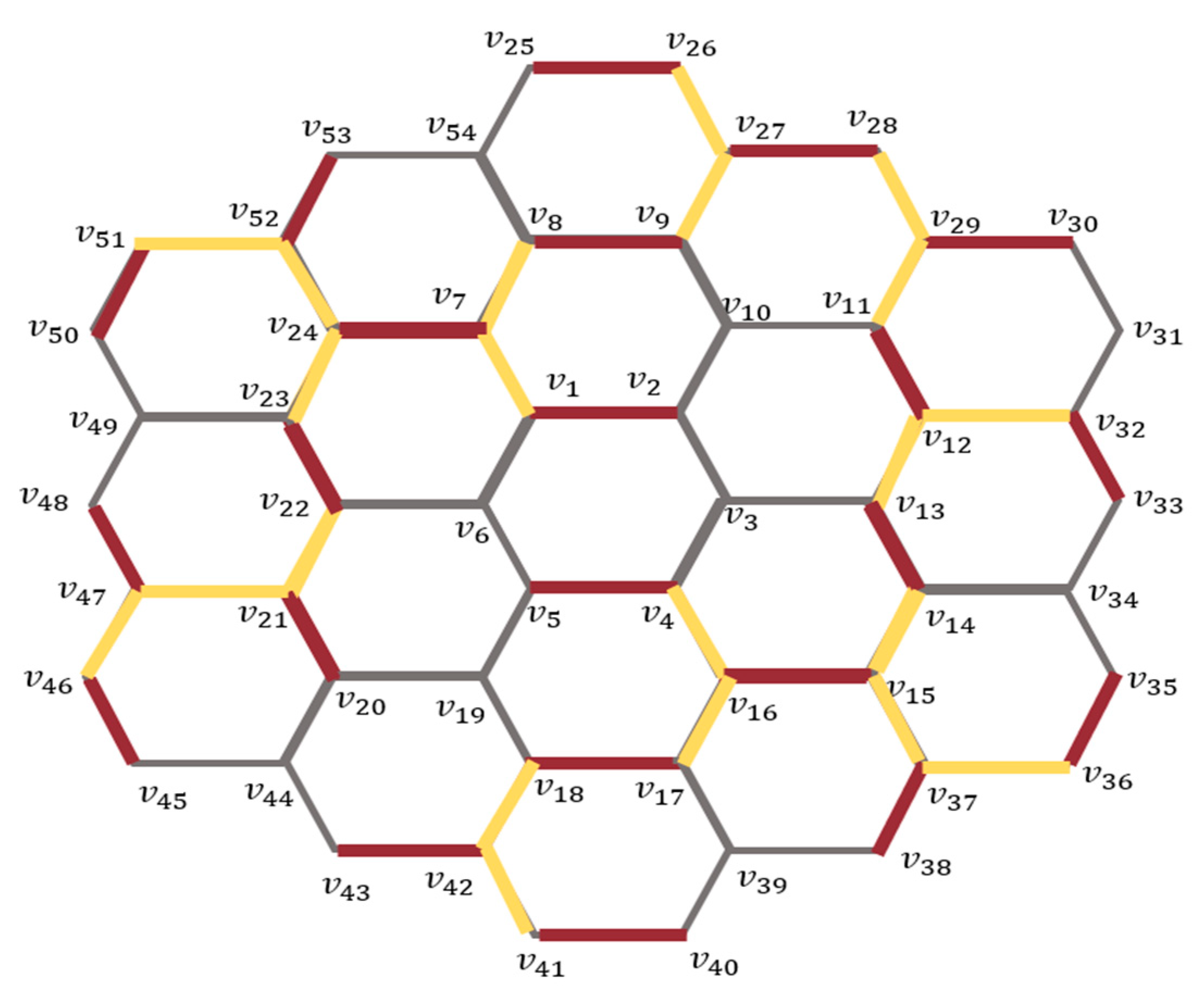
Case (ii):
is constructed from
by gluing six hexagons to all the edges of
. An acyclic path formed by
is shown in
Figure 6.
.
Case (iii):
Each and every boundary edges in
gets attached to
and forms the mesh
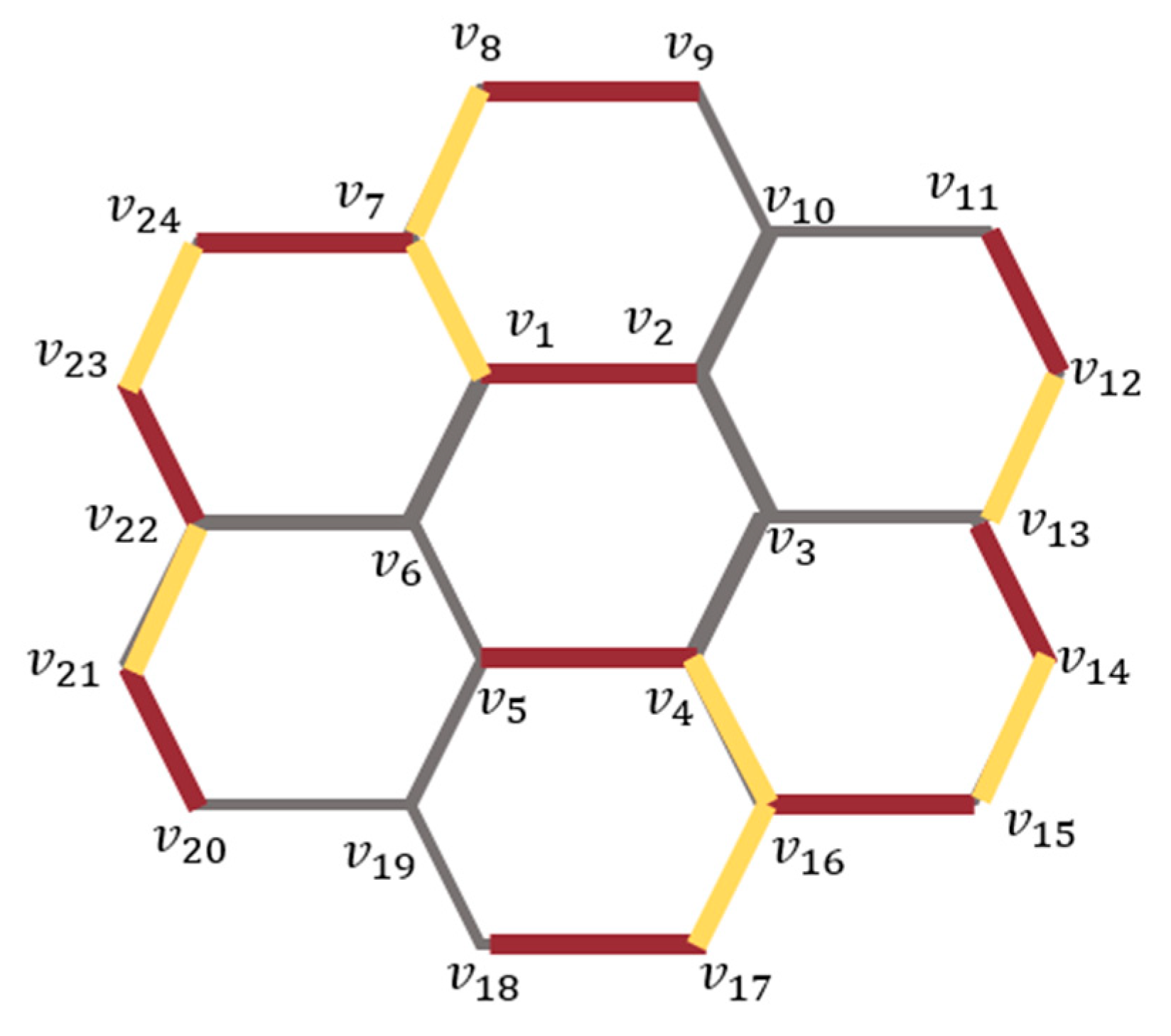
. The
Figure 7 depicts the induced subgraph forms an acyclic path traced in yellow along with
.
(refer
Figure 7).
Case (iv): For any , the recursive relationship of arises because each new dimension adds exactly 4n edges to the maximum acyclic matching set. This can be proven by induction:
For n = 1,
Inductive step: Assume for some .
For
For any, the result is .
Let be our proposed cardinality.
Case 1. If
, assume. By our construction, there exist at least independent edges in that form an acyclic subgraph. Since our current matching uses fewer than edges, there exists at least one additional edge such that M ∪ {e} maintains all three properties:
The matching remains maximum after adding e (contradiction with assumption).
Independence is preserved (e shares no vertices with edges in M).
Acyclic property is maintained (adding e creates no cycles in G[M∪ {e}]).
This contradicts the assumption that .
Case 2. If
: Assume . This implies either:
Two edges share a vertex (violating independence property), or
The induced subgraph G[M] contains a cycle (violating acyclic property)
With more than K edges in , at least one of these violations must occur, contradicting the definition of acyclic matching.
Therefore, is the unique optimal solution.
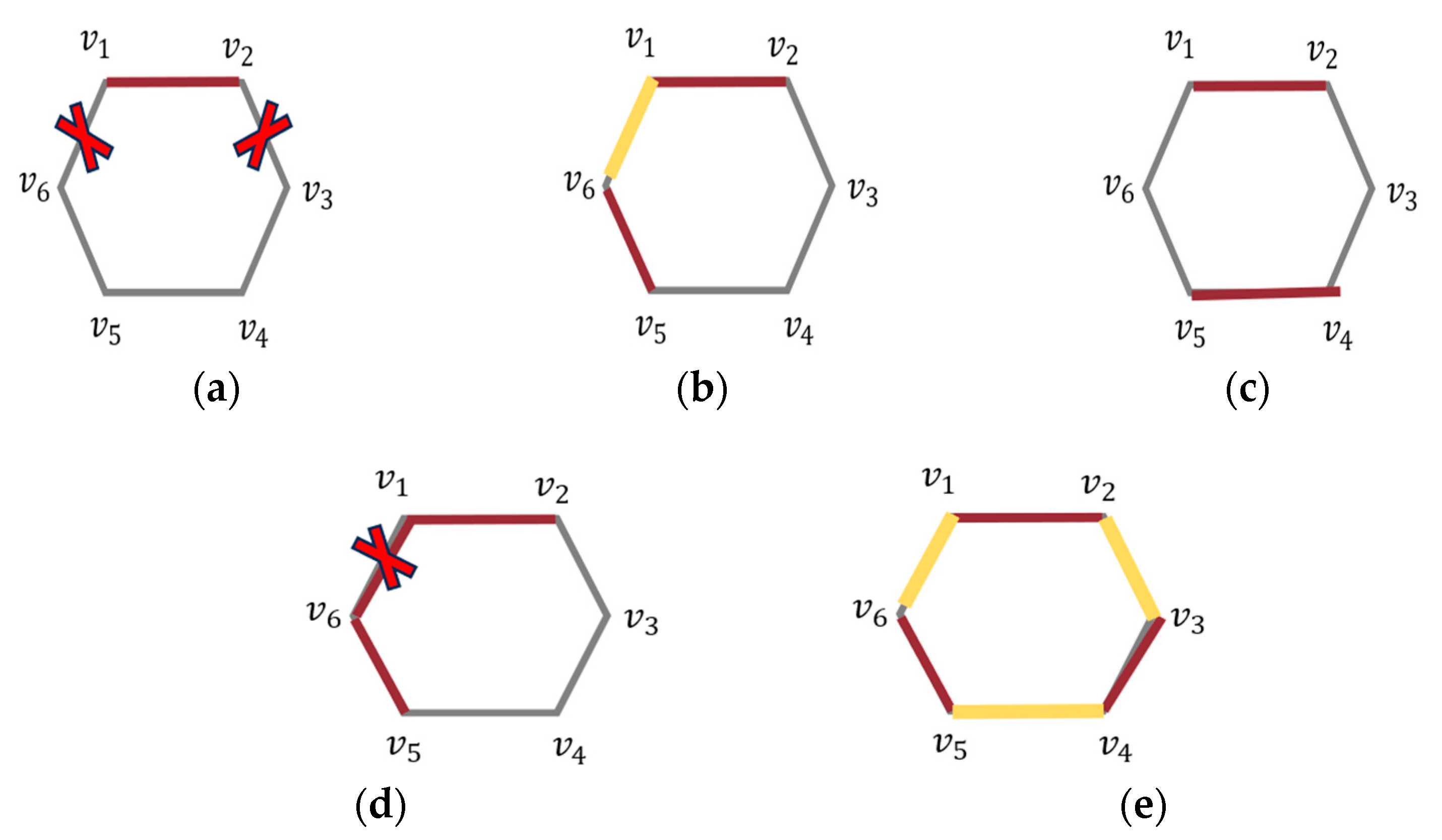
For example, for ,
The value of
from case(i) is 2. Let us assume
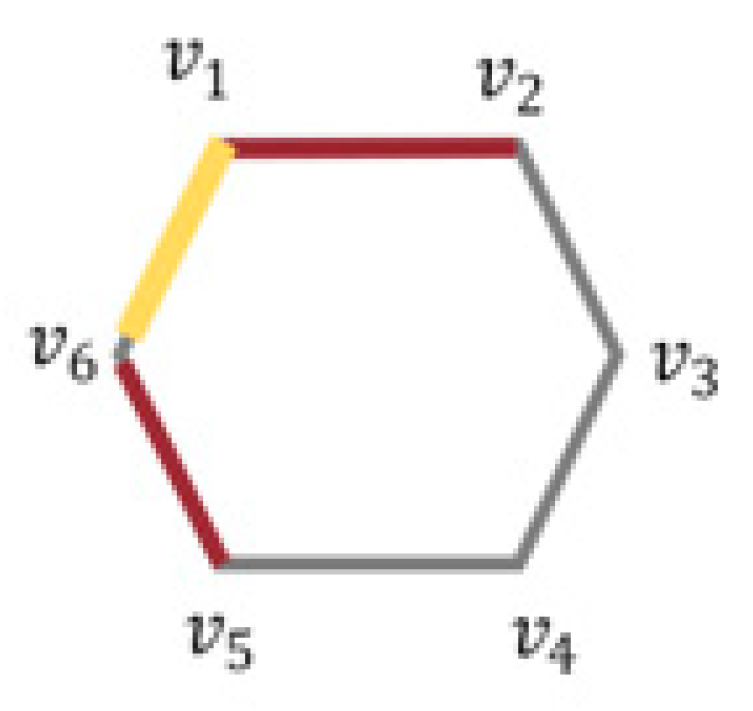
. We can see from the
Figure 8a there is a possibility of selecting one more edge without affecting the first property (cross mark edges),where red denotes
.
Figure 8b,c show two different possibilities, here yellow edge connects adjacent acyclic matching edges forms induced path. Therefore,
must be equal to 2.
If
, then at least one edge in the matching set will share a vertex with another edge, which contradicts that M must have independent edge property or the induced subgraph formed by
edges must form a cycle, as shown in the
Figure 8d,e, respectively.
Therefore, the only possible cardinality value for acyclic matching must be
. The given
Figure 8a–e strengthen the result through the contradiction method.
Thus for any n–dimensional honeycomb, the general acyclic matching number can be derived as . □
The applications of acyclic matching in aerospace technology, focusing on enhancing operational stability and enabling fault-tolerant communication in satellite constellations, are discussed in the upcoming section.
4. Discussion
In satellite constellations, the satellites are distributed in space in a structured way to maintain communication coverage [
35]. Representing a static satellite constellation in a honeycomb-designed network geometry is efficient in path optimization and fault tolerance. In the honeycomb structure, each satellite represents a node. The communication links or edges are those that connect neighboring satellites. A graph network having redundant cycles in a cyclic communication path leads to the risk of signal interference, feedback loops, or delays in that network. To mitigate this, acyclic matching ensures that only specific paths are active within the network while strictly avoiding cycles.
Acyclic matching provides a structured way to select communication links between satellites so that no two paths share the same node and no closed loops are formed. This ensures that the network operates with minimal redundancy and maximum stability. When a fault occurs, whether due to a satellite failure, debris collision, or signal degradation [
36], the acyclic matching framework allows the system to adapt dynamically. Each satellite is continuously monitored through health-check mechanisms that evaluate signal strength and connectivity. If a satellite fails, its neighboring satellites quickly detect the disruption. The system then refers to pre-computed acyclic matching sets, which contain alternative, fault-tolerant communication paths. These backup edges can be activated to reroute signals without introducing cycles or overloading other links. In honeycomb-based satellite constellations, this approach guarantees that communication is rerouted through mathematically optimized paths that remain interference-free and stable. Thus, even when faults occur, satellites within the acyclic matching set effectively provide recovery by maintaining uninterrupted global communication coverage.
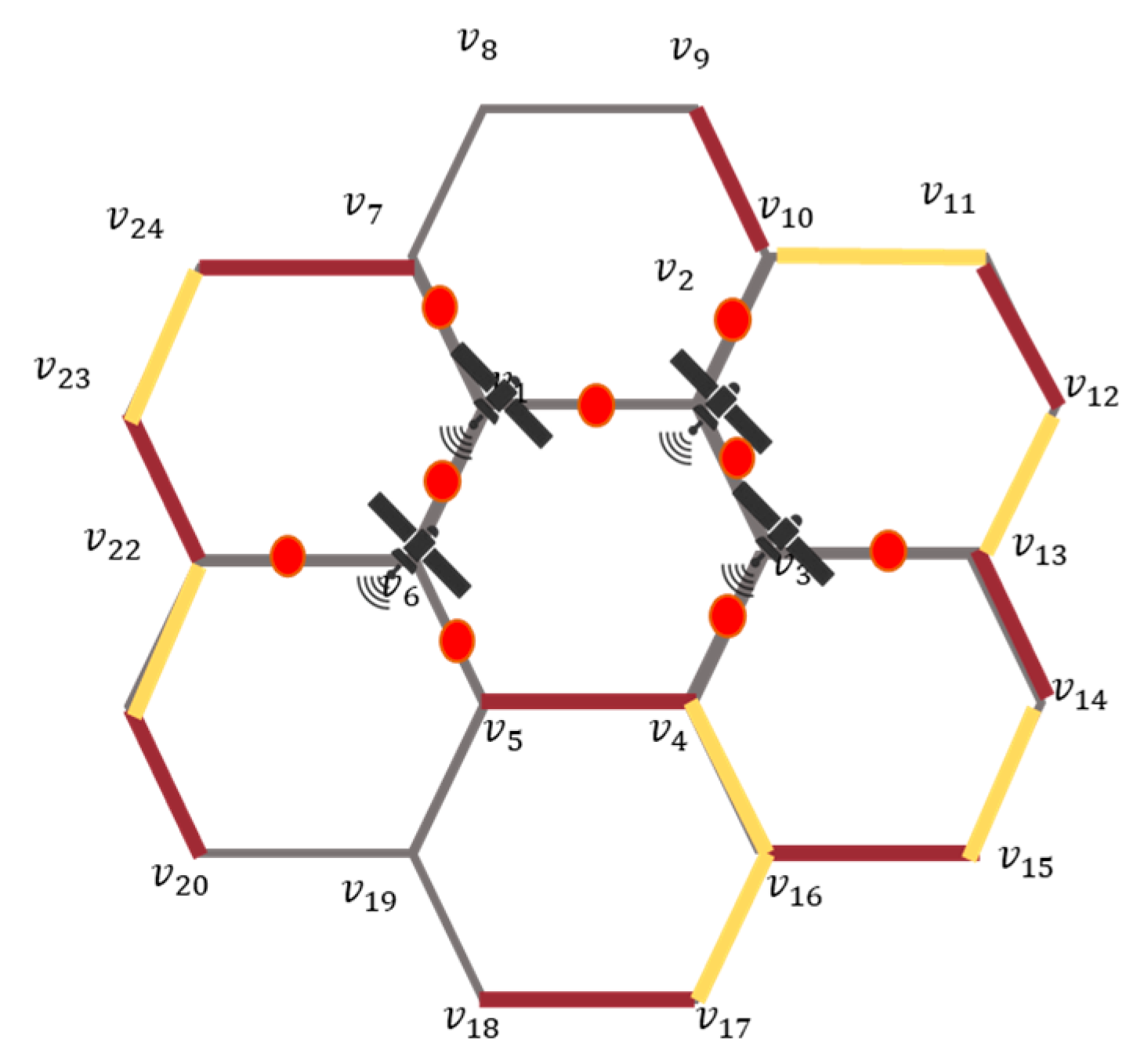
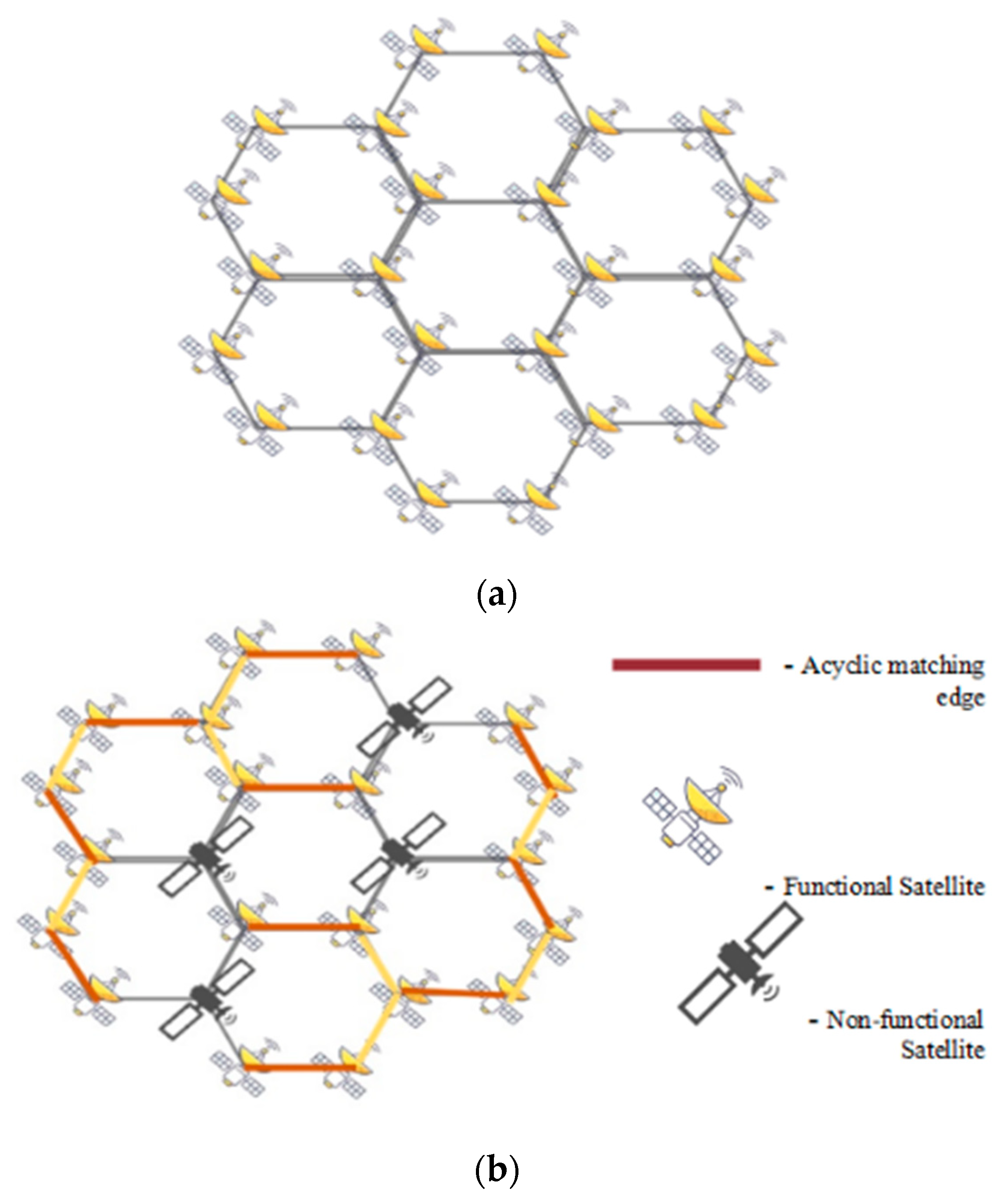
Figure 9a illustrates a honeycomb-designed satellite network that ensures uninterrupted communication (taken from Theorem 1(ii)). If one or more satellites experience a malfunction, the nearest operational satellite reroutes the communication through an acyclic matching set. In the depicted scenario, four satellites have malfunctioned (there are other possibilities). When a disruption occurs in a satellite, its three-way communication link is severed. However, acyclic matching ensures seamless connectivity by rerouting signals through the nearest functional satellite, as each satellite in the matching set is adjacent to a faulty one (refer
Figure 9b). This acyclic path prevents redundant information transfer between satellites, optimizing the network. As a result, communication loss is minimized while maintaining maximum coverage.
4.1. Technical Mechanisms for Fault Tolerance
The honeycomb network offers several key advantages that make it a robust choice for satellite communication systems. Its structural redundancy ensures that each satellite (node) has multiple communication paths through hexagonal connectivity, providing inherent backup routes. The load distribution feature further enhances performance, as the geometric structure naturally balances even signal flow across the network, effectively minimizing the risk of bottlenecks. Additionally, the design supports scalability, since its modular hexagonal pattern allows seamless expansion of the constellation without topology reconfiguration.
Complementing this, acyclic matching plays a crucial role in maintaining network integrity. It prevents loops by ensuring that G[M] remains acyclic, and signals follow deterministic paths without infinite loops or oscillations. Furthermore, the use of independent edges eliminates interference and cross-talk between communication channels. Acyclic matching also enables rapid reconfiguration, as pre-computed sets allow immediate fault recovery without the need for complex recalculations.
When combined, these two approaches create a powerful synergy: the honeycomb structure provides multiple path options, while acyclic matching selects optimal loop-free subsets for active communication, resulting in both reliability and efficiency.
4.2. Limitations and Future Work
This research paper has so far discussed random dysfunctional satellites in between the network. But if the satellites simultaneously fail in the honeycomb network, then the cardinal value will decrease, yielding
. For example, in
the cardinality is 10 (refer case (ii) in Theorem 1). If
satellites fail, communication between 9 satellites will be interrupted as shown in
Figure 10, where the red dots denote interruption in between the communications. When we apply acyclic matching,
.
The failure set cannot be included because of the interruption caused by .
Thus, for any n-dimensional honeycomb network, though the theoretical derivation of acyclic matching is precise, when applying in a satellite constellation, the simultaneous failure is the limitation that is yet to be explored as an open problem.
The current work models satellite constellations using a two-dimensional honeycomb structure. Future research can extend this framework to better align with real-world satellite dynamics. A promising direction is to rearrange the satellite constellation into an advanced honeycomb structure. Applying acyclic matching to a more complex 3D honeycomb model could make practical implementation possible and more efficient. Thus, while our work does not directly capture the full dynamics of real constellations, it sets the stage for adapting the presented framework towards realistic 3D orbital topologies and evolving network scenarios.




 ,
,