


Abstract
This paper investigates a new subclass of bi-univalent analytic functions defined on the open unit disk in the complex plane, associated with the subordination to . Coefficient bounds are obtained for the initial Taylor–Maclaurin coefficients, with a particular focus on the second- and third-order Hankel determinants. To illustrate the non-emptiness of the proposed class, we consider the function , which maps the unit disk onto a bean-shaped domain. This function satisfies the required subordination condition and hence serves as an explicit member of the class. A graphical depiction of the image domain is provided to highlight its geometric characteristics. The results obtained in this work confirm that the class under study is non-trivial and possesses rich geometric structure, making it suitable for further development in the theory of geometric function classes and coefficient estimation problems.
Keywords:
bean-shaped; Fekete-Szegö; starlike functions; Hankel determinants; bi-univalent functions MSC:
30C45
1. Introduction
Hankel determinants, formed from sequences in Hankel matrices, are essential in complex analysis and geometric function theory. They aid in studying analytic function coefficients, especially for bi-univalent functions, and estimating their second and third Hankel determinants reveals structural behavior and subclass properties [1,2,3,4].
Let represent the set of all analytic functions defined in the open unit disk , which can be written as
and satisfy the normalization conditions and .
Further, by S we shall denote the class of all functions in which are univalent in ; for definitions and further details on analytic and univalent functions, we refer the reader to the standard reference in the field [5]. A classical result known as the Koebe one-quarter theorem [6,7,8] guarantees that the image of under any univalent function always contains a disk of radius at least . Because of this, each such univalent function f has an inverse such that
with the inverse given by the expansion
A function is called bi-univalent if both f and its inverse are univalent in the open unit disk . The class of all such functions is denoted by . Various aspects and properties of bi-univalent functions have been extensively discussed in [9,10].
Research on bi-univalent functions saw a big rise after the contributions of Srivastava and his co-authors [10]. Some well-known examples in the class are as follows:
On the other hand, functions like the Koebe function, , and are univalent but not bi-univalent [11,12,13].
A lot of work has been done on finding coefficient bounds for bi-univalent functions. For example, Lewin [14] showed that , while Brannan and Clunie [15] suggested . Netanyahu [16] later gave the sharp bound . To get better estimates, many subclasses of , such as starlike and convex functions, were studied [17,18,19]. A key functional used in this area is the Fekete–Szegö expression , which has been explored for various subclasses [20,21,22].
Let . The function is said to be subordinate to , denoted by , if there exists a Schwarz function , analytic in , such that and for all , satisfying
This concept of subordination was discussed in detail in [23,24,25]. Furthermore, if is univalent in , then the subordination relation is equivalent to the conditions
The class of starlike functions is defined by
which is the same as
This means that lies in the right half-plane. For more details, see [10,26,27,28].
In 1976, Noonan and Thomas [29] introduced the idea of the q-th Hankel determinant for the function f defined in (1). It involves forming a square matrix from the Taylor coefficients of f and calculating its determinant. The general form is given by
Over time, many researchers have studied these determinants. For example, the growth of as has been explored for functions f with bounded boundaries [26,29,30]. More recently, sharp estimates have been found for special cases like , especially for certain subclasses of analytic or bi-univalent functions [31,32,33].
To get a clearer idea of how Hankel determinants work for small values of q, consider the following examples for :
These compact expressions capture relationships between coefficients and are widely used in geometric function theory. In particular, the quantity , known as the Fekete–Szegö functional, has been central in many coefficient bound problems. Recently, Shakir et al. [34] pushed this further by providing sharp bounds for in specific subclasses of analytic functions (see also [35,36,37,38]).
In this work, our main focus shifts to the third-order Hankel determinant:
Since for functions in , this reduces to
Using the triangle inequality, we get a useful upper bound:
Throughout the paper, we focus on estimating this expression. To do that, we first study the sharp bounds of the quantities involved:
These estimates play a key role in determining the behavior of in certain subclasses of analytic and bi-univalent functions. Special attention is also given to the second-order determinant , due to its frequent appearance in recent coefficient-related studies.
2. Definition and Lemmas
The sine function, with its well-known analytic and oscillatory properties in the unit disk, provides a powerful tool for constructing and analyzing subclasses of analytic functions. In this study, we utilize the sine function as a dominant function in a subordination relationship to capture geometric features such as bounded boundary rotation and symmetry. Specifically, we consider the subordination where , to define new classes of functions whose behavior is controlled by the sine function. This approach allows us to investigate coefficient estimates and derive sharp bounds for Hankel determinants within these sine based subclasses.
Definition 1.
Let , and let g be defined as in (2). The function f is said to belong to the class if the following subordination conditions hold:
and
where .
Figure 1 shows the image of the grid in the domain under the mapping , illustrating the corresponding structure in the co-domain.
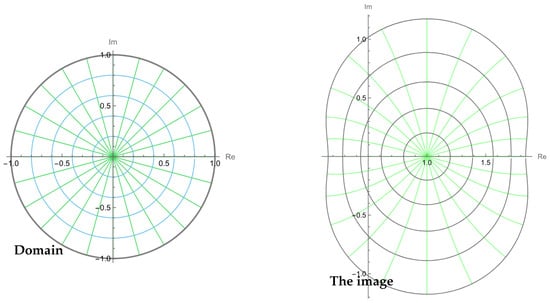
Figure 1.
Grid in domain and co-domain under .
Remark 1.
This remark presents two special cases for specific values of ϑ.
- (i)
- If , then the function f is said to belong to the class , and the definition simplifies to
- (ii)
- If , then the function f is said to belong to the class , and the subordination becomes
Remark 2.
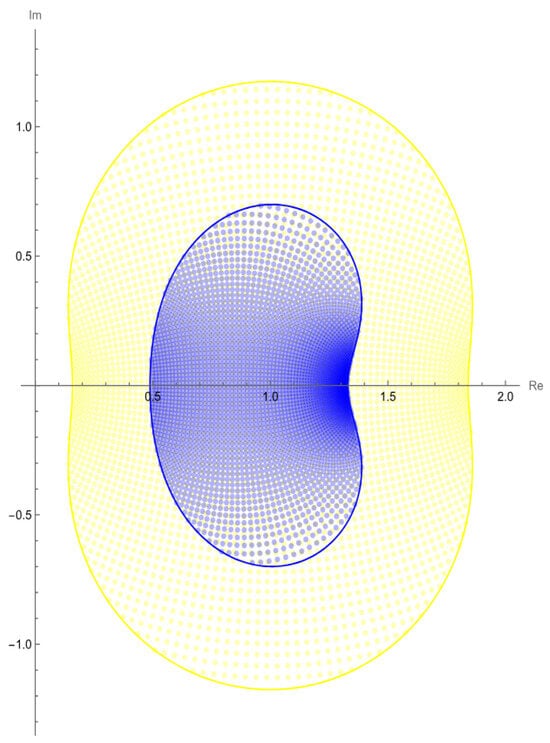
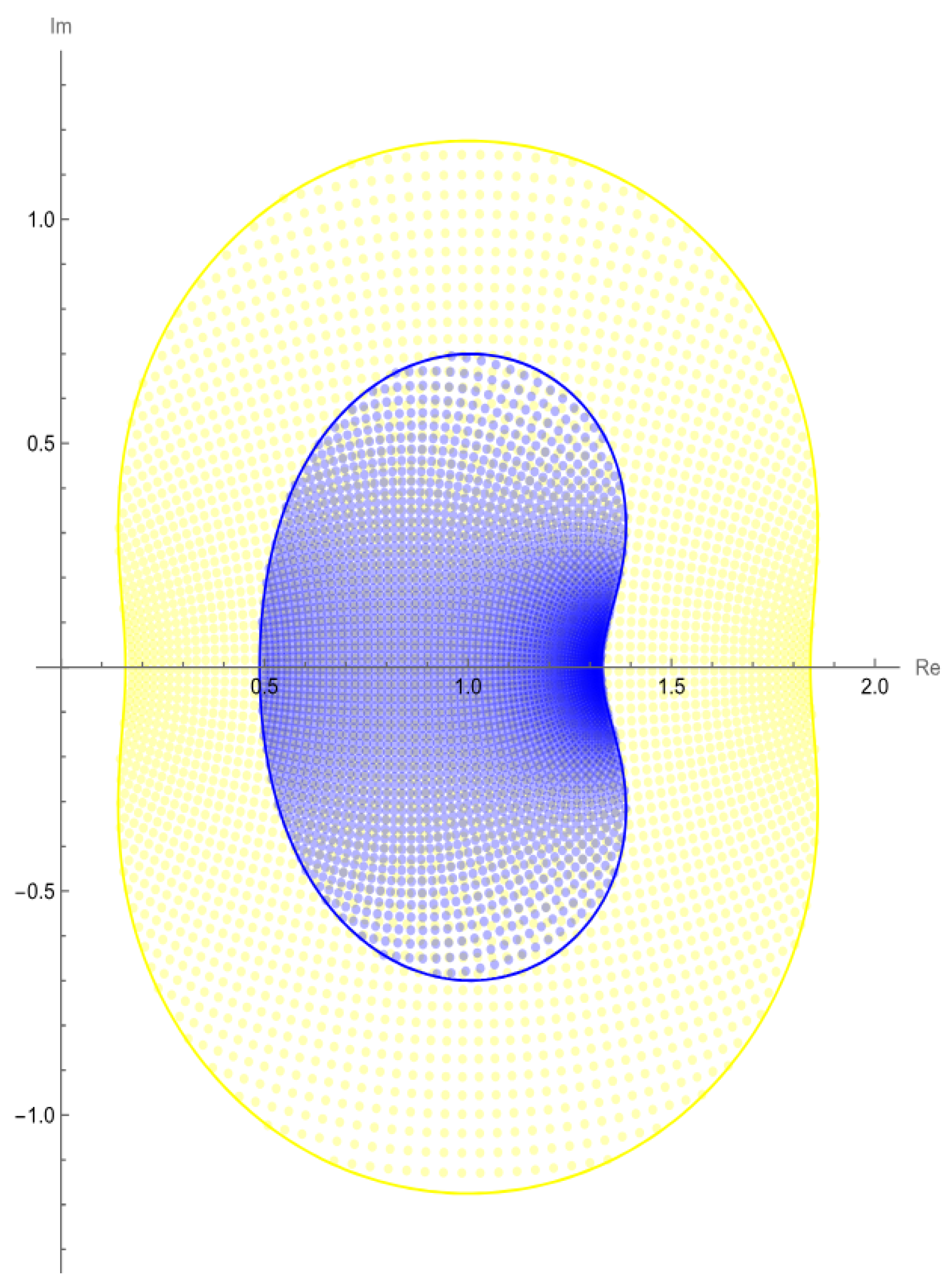
The class is not empty, since the domain generated by the function
(corresponding to the yellow region in Figure 2) clearly contains other subordinating domains.
Figure 2.
The image illustrating the domain of the function .
In particular, consider the function
whose image is the well-known bean-shaped domain (illustrated in blue in Figure 2). From the figure, it is evident that the blue bean-shaped region is entirely contained within the yellow domain of .
Thus, the function belongs to the class , confirming that this class is non-empty. A detailed discussion on the mapping and bean-shaped domains can be found in [38,39].
Let be the class of analytic functions defined in the open unit disk that satisfy
Lemma 1.
(see [5])
Suppose has the form
then the following inequality holds:
Lemma 2.
(see [40])
Let and be written as
then we have
and
for some complex numbers k and z such that and and .
3. On the Second Hankel Determinant Associated with the Class
Theorem 1.
Let given by (1) belong to the class , where . Then the following holds:
Proof.
Let . Then there exist two functions , both satisfying and , , such that
and
Assume that the functions and belong to the class , and take the forms
Then, the functions and can be written as
Since , its Taylor expansion is given by (1), and the series for its inverse is given in (2). Then, we compute
and
By comparing the coefficients of powers of z in Equations (17) and (19), we derive the following equations:
and
By comparing the coefficients of powers of w in Equations (18) and (20), we derive the following equations:
and
According to Lemma 2 and , we get
and
for some with , , and .
Since , it holds that . By setting , we can, without loss of generality, assume . Now, using the expressions in (34) and (35) and substituting them into (33), and by letting and , we obtain
where
Next, we aim to find the maximum value of over the closed square , with the parameter . Given that and , it follows that , and the determinant of the Hessian, is strictly negative. This implies that cannot attain a local maximum in the interior of the square. Therefore, we analyze the maximum of along the boundary.
Consider the case when and , then
Next, we consider two separate scenarios:
Case 1: Suppose . In this case, for all and a fixed , the derivative
This implies that is strictly increasing, so the maximum value is achieved at . Thus,
Case 2: Assume . Given that , and for , it follows that
Therefore, , and again the maximum occurs at . Thus, we have:
From both cases, we conclude that
Since , it follows that the maximum value of on the boundary of the domain is given by
Define the real-valued function on the interval by
By substituting the expressions of into , we obtain the desired bound.
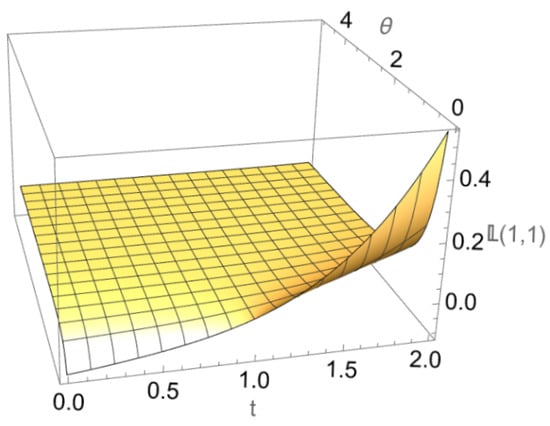
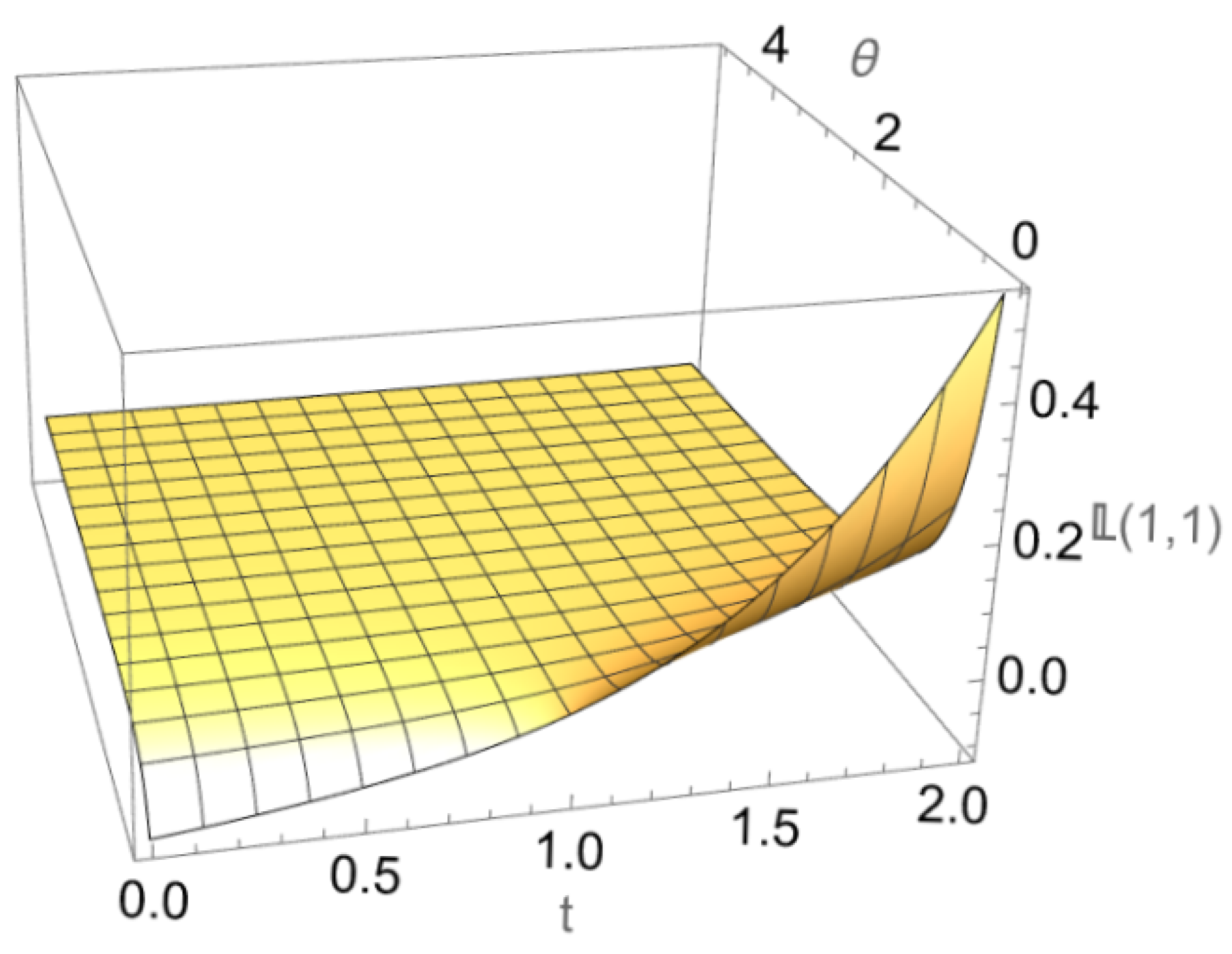
Now, due to the complexity of the explicit form of , we illustrate its monotonicity numerically. Figure 3 shows the plot of , which clearly demonstrates that the function attains its maximum at . This figure was generated using Mathematica 14.3.
Figure 3.
Three-dimensional plot of the function .
Therefore, the maximum value of the function occurs at , giving
This completes the proof. □
Theorem 2.
Let , with . Then, we have
where
and
Proof.
By virtue of Lemma (2), we may assume, without loss of generality, that , where . Hence, for and , it follows that
where
and
By using the same method as in Theorem 2, the maximum occurs at and in the closed square , leading to
Substituting the values of , and in , we get
By simplifying slightly, we obtain
where
and
We have
If , meaning , then . Thus, the function is increasing over the closed interval , reaching its maximum value at , which gives
If , solving gives
For , we find that , indicating that is increasing throughout the interval . Therefore, the maximum value of occurs at . On the other hand, if is decreasing on , then its maximum is attained at . As a result, we conclude
This completes the proof. □
Remark 3.
During the proof, we computed , which leads to a quadratic equation. Setting gives the critical point m. Consequently, the inequality splits into two cases depending on the behavior of over , and we analyzed the value of t for each branch separately.
4. Third Hankel Determinant and Some Inequalities
In this section, we establish sharp upper bounds related to the Fekete–Szegö problem when the parameter . In particular, we derive important inequalities involving the coefficients and , which enable us to estimate the upper bounds for and . These results are fundamental for bounding the coefficients and .
Theorem 3.
Let , with . Then, the following inequalities hold:
Proof.
By using (31) along with Lemma 1, we establish (52). The Fekete–Szegö functional, given and , satisfies
By applying Lemma 1, we obtain
For , we derive inequality (51), completing the proof. □
Theorem 4.
Let , given by Equation (1), belong to the class , where . Then the following upper bounds hold for the coefficients and :
Proof.
Taking the subtraction of Equations (24) and (28) gives us
by substituting Equations (29), (31), and (32) into Equation (55), we obtain
By applying Lemma 2, we obtain the result (53). □
Theorem 5.
Proof.
Since
applying the triangle inequality yields (56). □
5. Examples of the Main Results
We present the special cases of the main theorems for and , using the class notation introduced in the previous remark.
Example 1 (Case : ).
The bounds are
The corresponding bound for is
Example 2 (Case : ).
The bounds are
The corresponding bound for is
6. Conclusions
In this paper, we explored a new subclass of bi-univalent analytic functions associated with the function . Our main focus was to establish sharp estimates for the initial Taylor–Maclaurin coefficients, particularly the second- and third-order Hankel determinants. These findings contribute to the ongoing research in geometric function theory, especially in the area of bi-univalent functions. To confirm that the class is non-empty, we provided the example , which maps the unit disk onto a bean-shaped domain. This example satisfies the conditions stated in Definition 1 and offers insight into the behavior of the class, and since this function belongs to the considered class, one can directly apply the main results to obtain the explicit coefficient estimates for this function. Overall, the results indicate that this class has meaningful properties deserving further investigation. Future research could consider more general cases, higher-order determinants, or extend the approach to other function classes.
Author Contributions
Conceptualization, M.E.-I.; Methodology, M.E.-I. and B.F.; Validation, M.A.S. and S.H.; Formal analysis, M.A.S. and S.H.; Investigation, F.Y.; Data curation, T.A.-H.; Writing—original draft, M.E.-I.; Writing—review and editing, M.A.S., S.H. and T.A.-H.; Visualization, F.Y.; Supervision, B.F. and T.A.-H. All authors have read and agreed to the published version of the manuscript.
Funding
This research received no external funding.
Data Availability Statement
The original contributions presented in this study are included in the article. Further inquiries can be directed to the corresponding author.
Conflicts of Interest
The authors declare that they have no conflicts of interest.
References
- Mamon, M.A.; Halouani, B.; Elshazly, I.S.; Murugusundaramoorthy, G.; El-Qadeem, A.H. Second Hankel Determinant Bound Application to Certain Family of Bi-Univalent Functions. Axioms 2024, 13, 819. [Google Scholar] [CrossRef]
- El-Ityan, M.; Ali, S.Q.; Al-Hawary, T.; Rafid, B.; Breaz, D.; Luminita-Ioana, C. On the Third Hankel Determinant of a Certain Subclass of Bi-Univalent Functions Defined by (p, q)-Derivative Operator. Mathematics 2025, 13, 1269. [Google Scholar] [CrossRef]
- Hussen, A.; Illafe, M.; Zeyani, A. Fekete-Szegö and Second Hankel Determinant for a Certain Subclass of Bi-Univalent Functions associated with Lucas-Balancing Polynomials. Int. J. Neutrosophic Sci. 2025, 25, 417–434. [Google Scholar]
- Shakir, Q.A.; Atshan, W.G. On Third Hankel Determinant for Certain Subclass of Bi-Univalent Functions. Symmetry 2024, 16, 239. [Google Scholar] [CrossRef]
- Duren, P.L. Univalent Functions; Grundlehren der Mathematischen Wissenschaften, Band 259; Springer: New York, NY, USA; Berlin/Heidelberg, Germany; Tokyo, Japan, 1983. [Google Scholar]
- Alhily, S.S. Some Results on Koebe one-quarter theorem and Koebe distortion theorem. J. Iraqi Al-Khwarizmi Soc. 2018, 2, 29–38. [Google Scholar]
- Singh, S.; Singh, R. Subordination by univalent functions. Proc. Am. Math. Soc. 1981, 82, 39–47. [Google Scholar] [CrossRef]
- Dmitrishin, D.; Dyakonov, K.; Stokolos, A. Univalent polynomials and Koebe’s one-quarter theorem. Anal. Math. Phys. 2019, 9, 991–1004. [Google Scholar] [CrossRef]
- Yousef, F.; Frasin, B.A.; Al-Hawary, T. Fekete-Szegö Inequality for Analytic and Bi-univalent Functions Subordinate to Chebyshev Polynomials. Filomat 2018, 32, 3229–3236. [Google Scholar] [CrossRef]
- Srivastava, H.M.; Mishra, A.K.; Gochhayat, P. Certain subclasses of analytic and bi-univalent functions. Appl. Math. Lett. 2010, 23, 1188–1192. [Google Scholar] [CrossRef]
- Altinkaya, Ş.; Tokgöz, S.Y. Construction of the Second Hankel Determinant for a New Subclass of Bi-Univalent Functions. Turk. J. Math. 2018, 42, 2876–2884. [Google Scholar] [CrossRef]
- Zhang, L.; Wang, Z.; Shi, L. Sharp Bounds on Hankel Determinant of q-Starlike and q-Convex Functions Subordinate to Secant Hyperbolic Functions. Fractal Fract. 2025, 9, 346. [Google Scholar] [CrossRef]
- Illafe, M.; Mohd, M.H.; Yousef, F.; Supramaniam, S. Bounds for the Second Hankel Determinant of a General Subclass of Bi-Univalent Functions. Int. J. Math. Eng. Manag. Sci. 2024, 9, 1226. [Google Scholar] [CrossRef]
- Lewin, M. On a coefficient problem for bi-univalent functions. Proc. Am. Math. Soc. 1967, 18, 63–68. [Google Scholar] [CrossRef]
- Brannan, D.; Clunie, J. Aspects of Contemporary Complex Analysis; Academic Press: London, UK, 1980. [Google Scholar]
- Natanyahu, E. The minimal distance of the image boundary from the origin and the second coefficient of a univalent function in |z|<1. Arch. Ration. Mech. Anal. 1969, 32, 100–112. [Google Scholar]
- Hussen, A.; Madi, M.S.; Abominjil, A.M. Bounding coefficients for certain subclasses of bi-univalent functions related to Lucas-Balancing polynomials. AIMS Math. 2024, 9, 18034–18047. [Google Scholar] [CrossRef]
- Brannan, D.A.; Taha, T.S. On some classes of bi-univalent functions. Studia Univ. Babes-Bolyai Math. 1986, 31, 70–77. [Google Scholar]
- Al-Ityan, M.; Amourah, A.; Alsoboh, A.; Anakira, N.; Raba’a, M.B.; Hammad, S.; Sasa, T. Fekete-Szegö Inequalities for a New Class of Bi-Univalent Functions Defined via the Mittag-Leffler Function. Eur. J. Pure Appl. Math. 2025, 18, 6064. [Google Scholar] [CrossRef]
- Fekete, M.; Szegö, G. Eine bemerkung über ungerade schlichte funktionen. J. Lond. Math. Soc. 1933, 1, 85–89. [Google Scholar] [CrossRef]
- Tayyah, A.S.; Atshan, W.G.; Oros, G.I. Third-Order Differential Subordination Results for Meromorphic Functions Associated with the Inverse of the Legendre Chi Function via the Mittag-Leffler Identity. Mathematics 2025, 13, 2089. [Google Scholar] [CrossRef]
- Al-Hawary, T.; Illafe, M.; Yousef, F. Certain Constraints for Functions Provided by Touchard Polynomials. Int. J. Math. Math. Sci. 2025, 2025, 2581058. [Google Scholar] [CrossRef]
- Miller, S.S.; Mocanu, P.T. Second Order Differential Inequalities in the Complex Plane. J. Math. Anal. Appl. 1978, 65, 289–305. [Google Scholar] [CrossRef]
- Miller, S.S.; Mocanu, P.T. Differential Subordination: Theory and Applications; Marcel Dekker, Inc.: New York, NY, USA, 2000. [Google Scholar]
- Deniz, E. Certain subclasses of bi-univalent functions satisfying subordinate conditions. J. Class. Anal. 2013, 2, 49–60. [Google Scholar] [CrossRef]
- Abbas, M.; Alhefthi, R.K.; Ritelli, D.; Arif, M. Sharp Second-Order Hankel Determinant Bounds for Alpha-Convex Functions Connected with Modified Sigmoid Function. Axioms 2024, 13, 844–862. [Google Scholar] [CrossRef]
- Haji, N.H.; Buti, R.H.; Darwish, H.E. On a Class of Analytic Univalent Functions Associated with (HR) Fractional Derivative. Muthanna J. Pure Sci. 2024, 11, 94–99. [Google Scholar] [CrossRef]
- Tayyah, A.S.; Atshan, W.G. Starlikeness and Bi-Starlikeness Associated with a New Carathéodory Function. J. Math. Sci. 2025, in press. [Google Scholar] [CrossRef]
- Noonan, J.W.; Thomas, D.K. On the Second Hankel Determinant of Areally Mean p-Valent Functions. Trans. Am. Math. Soc. 1976, 223, 337–346. [Google Scholar] [CrossRef]
- Wang, Z.G.; Srivastava, H.M.; Arif, M.; Liu, Z.H.; Ullah, K. Sharp Bounds on Hankel Determinants of Bounded Turning Functions Involving the Hyperbolic Tangent Function. Appl. Anal. Discret. Math. 2024, 18, 551–571. [Google Scholar] [CrossRef]
- Srivastava, H.M.; Khan, N.; Bah, M.A.; Alahmade, A.; Tawfiq, F.M.; Syed, Z. Fourth Order Hankel Determinants for Certain Subclasses of Modified Sigmoid-Activated Analytic Functions Involving the Trigonometric Sine Function. J. Inequal. Appl. 2024, 2024, 84. [Google Scholar] [CrossRef]
- Sun, Y.; Wang, Z.G. The Second Hankel Determinants of Logarithmic Coefficients of Ma-Minda Type Functions. Bull. Korean Math. Soc. 2025, 62, 663–678. [Google Scholar]
- Lupaş, A.A.; Tayyah, A.S.; Sokół, J. Sharp Bounds on Hankel Determinants for Starlike Functions Defined by Symmetry with Respect to Symmetric Domains. Symmetry 2025, 17, 1244. [Google Scholar] [CrossRef]
- Shakir, Q.A.; Tayyah, A.S.; Breaz, D.; Cotîrlă, L.-I.; Rapeanu, E.; Sakar, F.M. Upper Bounds of the Third Hankel Determinant for Bi-Univalent Functions in Crescent-Shaped Domains. Symmetry 2024, 16, 1281. [Google Scholar] [CrossRef]
- Hadi, S.H.; Darus, M.; Alamri, B.; Altınkaya, Ş.; Alatawi, A. On Classes of ζ-Uniformly q-Analogue of Analytic Functions with Some Subordination Results. Appl. Math. Sci. Eng. 2024, 32, 2312803. [Google Scholar] [CrossRef]
- Altınkaya, S.; Magesh, N.; Yalçın, S. Construction of Toeplitz Matrices Whose Elements Are the Coefficients of Univalent Functions Associated with Q-Derivative Operator. Casp. J. Math. Sci. 2019, 8, 51–57. [Google Scholar]
- El-Ityan, M.; Al-Hawary, T.; Frasin, B.A.; Aldawish, I. A New Subclass of Bi-Univalent Functions Defined by Subordination to Laguerre Polynomials and the (p, q)-Derivative Operator. Symmetry 2025, 17, 982. [Google Scholar] [CrossRef]
- Vijayalakshmi, S.P.; Yalçın, S.; Sudharsan, T.V. Sharp Estimates of Hermitian Toeplitz Determinants for Some Subclasses of Sakaguchi Type Function Related to Sine Function. Sahand Commun. Math. Anal. 2025, 22, 175–191. [Google Scholar]
- Nandhini, B.; Sruthakeerthi, B. On Sharp Estimates of the Bounded Turning Functions Associated with a Bean Shaped Domain. Complex Anal. Oper. Theory 2025, 19, 36. [Google Scholar] [CrossRef]
- Grenander, U.; Szegö, G. Toeplitz Forms and Their Applications; California Monographs in Mathematical Sciences; University California Press: Berkeley, CA, USA, 1958. [Google Scholar]
Disclaimer/Publisher’s Note: The statements, opinions and data contained in all publications are solely those of the individual author(s) and contributor(s) and not of MDPI and/or the editor(s). MDPI and/or the editor(s) disclaim responsibility for any injury to people or property resulting from any ideas, methods, instructions or products referred to in the content. |
© 2025 by the authors. Licensee MDPI, Basel, Switzerland. This article is an open access article distributed under the terms and conditions of the Creative Commons Attribution (CC BY) license (https://creativecommons.org/licenses/by/4.0/).