


Abstract
This paper explores the common neighborhood energy () of graphs derived from the dihedral group and generalized quaternion group , specifically the non-commuting graph (NCM-graph) and the commuting graph (CM-graph). Studying graphs associated with groups offers a powerful approach to translating algebraic properties into combinatorial structures, enabling the application of graph-theoretic tools to understand group behavior. The common neighborhood energy, defined as the sum of the absolute values of the eigenvalues of the common neighborhood (CN) matrix, i.e., , where are the CN eigenvalues, provides insights into the structural properties of these graphs. We derive explicit formulas for the CN characteristic polynomials and corresponding CN eigenvalues for both the NCM-graph and CM-graph as functions of n. Consequently, we establish closed-form expressions for the of these graphs, which are parameterized by n. The validity of our theoretical results is confirmed through computational examples. This study contributes to the spectral analysis of algebraic graphs, demonstrating a direct connection between the group-theoretic structure of and , as well as the combinatorial energy of their associated graphs, thus furthering the understanding of group properties through spectral graph theory.
MSC:
05C25; 05C50; 20D99
1. Introduction
Let be a graph. The order and the size of are denoted, respectively, by and . As usual, the complete graph and null graph with p vertices are denoted in this paper by and , respectively.
The join of two graphs and with disjoint vertex sets and is the graph obtained by connecting each vertex of to each vertex of while keeping all edges of both graphs.
In graph theory, the study of energy of graphs has been studied widely because of its connection with various topics of science. The energy of a graph , , has been introduced by Gutman [1] as , where , are the eigenvalues of the adjacency matrix of [2]. The definition of the energy of a graph is stated in the following.
Definition 1
([3] Energy of Graph). Let Γ be a simple graph, A be its adjacency matrix, and be the eigenvalues of A. The energy of Γ is defined as
Based on that, Alwardi et al. [4] have introduced the CN matrix and the CN energy of the graph as follows.
Definition 2
([4] CN Matrix and CN Energy of Graph). Let Γ be a graph with a set of vertices . The CN neighborhood of two vertices and , with , is the set of vertices of Γ which are adjacent to both and , except for and .
The CN matrix of Γ is , where
The CN characteristic polynomial of the CN matrix of Γ, , is defined by
where I is the unit matrix of order p. The roots of are the CN eigenvalues of Γ. The CN energy of Γ is given as .
In the following, some results are used in this paper.
Theorem 1
([4]). For the complete graph on p vertices, the CN energy is given by .
Proposition 1
([4]). If the graph Γ consists of (connected) components , then
Proposition 2
([4]). if and only if all the components of Γ contain less than three vertices.
Proposition 3
([5]). Let a, b, c, and d be real numbers, be the identity matrix, and be the matrix in which all its entries are equal to 1. Then, the determinant of the matrix of the form
can be simplified in an expression as
Proposition 4
([6]). If a square matrix can be partitioned into four blocks W, X, Y, and Z, where , then
The dihedral group , representing symmetries of regular gons, and the generalized quaternion group , a non-abelian Hamiltonian group, are pivotal in algebraic and applied studies due to their structural richness and broad applicability. serves as a foundational model for discrete symmetry, with applications in crystallography (classifying crystal lattices), cryptography (group-based encryption), and spectral graph theory (Cayley graphs), while , extending Hamilton’s quaternions, plays a critical role in topology (manifold classification), quantum mechanics, and error-correcting codes; see [7,8,9]. For further details on the applications of groups, graph representations, and their various energies in computer science, we refer the reader to [10,11,12,13,14].
The integration of graph-theoretic methods into the study of algebraic structures has emerged as a significant area of interdisciplinary research, owing to its profound implications for establishing explicit connections between graph theory and algebraic systems. A prominent focus within this domain involves the investigation of graphs of groups, where combinatorial representations elucidate structural properties of algebraic entities. Among these, the CM-graph (commuting graph) and NCM-graph (non-commuting graph) associated with finite groups have garnered considerable attention. For instance, CM-graphs have been extensively investigated in the context of specific group families: seminal contributions include the analyses by Vahidi and Talebi [15], Segev and Seitz [16], Raza and Faizi [17], and Parker [18]. In contrast, NCM-graphs have been the subject of comprehensive studies by Abdollahi et al. [19], Moradipour et al. [20], and Ahanjideh and Iranmanesh [21], demonstrating their utility in characterizing non-commutative group behaviors. These frameworks not only bridge discrete mathematics and abstract algebra but also serve as powerful tools for analyzing group-theoretic properties through combinatorial invariants.
In this research, we aim to determine general formulas for the CN energy of the NCM-graph and the CM-graph associated with two types of non-abelian groups, which are the dihedral group, , and the generalized quaternion group, .
In the following, the definition of and some of its properties are presented.
Definition 3
([22] ). The dihedral group, denoted by , is a group of symmetries of a regular polygon, which include rotations and reflections, and its order is , where n is an integer at least 3. The dihedral groups can be presented in the form of generators and relations given as follows:
The following proposition presents some properties of .
Proposition 5
([22]). Let G be a dihedral group of order , i.e.,
Then, has the following properties:
- 1.
- For odd n,
- (a)
- The center .
- (b)
- The elements of the form , where , commute with each other, and does not commute with the elements of the form , where .
- (c)
- The elements of the form , where , commute with any element in except the identity element.
- 2.
- For even n,
- (a)
- The center ,
- (b)
- The non-central elements of the form , i.e., and , commute with each other, and does not commute with the elements of the form , where .
- (c)
- Each element of the form , where do not commute with any element in except the identity element and the element of the form .
Next, the definition of the generalized quaternion group, , and some of its properties are provided.
Definition 4
([23] Generalized Quaternion Group ). The generalized quaternion group, , is a non-abelian group of order , where n is an integer and , with the group presentation
Proposition 6 presents some properties of .
Proposition 6
([23]). Let G be a generalized quaternion group of order , with , i.e.,
Then, has the following properties:
- 1.
- The center .
- 2.
- The non-central elements of the form , i.e., , commute with each other, and does not commute with the elements of the form , where .
- 3.
- Each element of the form , where , does not commute with any element in except the identity element and the element of the form .
- 4.
- has a unique involution .
Next, the definitions of the NCM-graph and CM-graph related to a non-abelian finite group G are provided.
Definitio 5
([19] The NCM-Graph). Suppose that G is a non-abelian finite group and is its center. An NCM-graph of G, , is a graph with a set of vertices corresponding to the non-central elements of G, i.e., , and the two vertices and are adjacent if .
Definition 6
([15] The CM-Graph). Suppose that G is a non-abelian finite group and is its center. A CM-graph of G, , is a graph with a set of vertices corresponding to , and the two vertices and are adjacent if .
Next, the general form of the NCM-graph related to is provided in Proposition 7.
Proposition 7
([24]). Let be a dihedral group of order . Then, the NCM-graph of , , is one of the following forms:
where is an -regular graph with n vertices.
In the following section, the CN energy of the NCM-graph associated with dihedral groups, , is found in terms of n and illustrated by some examples.
2. CN Energy of the NCM-Graph of D2n
Here, the general formula of the CN characteristic polynomial and the CN eigenvalues for the NCM-graph of , , are presented. In addition, the general formula of the CN energy of is determined in terms of n. Moreover, two examples are given to illustrate the results based on the parity of n.
In the following, Lemma 1 gives the general formula of the CN characteristic polynomial and the CN eigenvalues of in the case of n being an odd integer.
Lemma 1.
Let , with being an odd integer and being its NCM-graph. Then, the characteristic polynomial of the CN matrix of is given as follows:
and hence, the CN eigenvalues of are with multiplicity , with multiplicity , and
Proof.
Let , with being an odd integer. Then, by Definition 5 and Proposition 5,
which means . Thus, the CN matrix of is a square matrix of order .
By Proposition 7, , where the vertices of are the elements of form , , and the vertices of are the elements of form , where . Therefore, there exist three cases to determine the number common neighborhoods between the vertices of .
Case 1. The number of common neighborhoods between the vertices of (which are the vertices of form ). By Proposition 5 and Definition 5, every vertex of form is adjacent only to all the vertices of form , (recall that are the vertices of ). Therefore, , , where .
Case 2. The number of common neighborhoods between the vertices of (which are the vertices of form ). By Proposition 5 and Definition 5, these vertices are adjacent to themselves, and each of them is adjacent also to all the vertices of form . Hence, , , where .
Case 3. Consider the value for all . Since vertices of the form are adjacent only to vertices of the form (for all ), it follows that for all .
Hence, the CN matrix of is given by
Therefore, the CN characteristic polynomial of is found as follows:
Thus, by Proposition 3 (with , , and ), is given as follows:
Hence, the CN eigenvalues of are with multiplicity , with multiplicity , and
Next, the CN characteristic polynomial and the CN eigenvalues of when n is an even integer are provided in Lemma 2.
Lemma 2.
Let , with being an even integer, and be its NCM-graph. Then the characteristic polynomial of the CN matrix of is given as follows:
and hence, the CN eigenvalues of are with multiplicity , with multiplicity , with multiplicity , and
Proof.
Suppose , with being an even integer. Then, by Definition 5 and Proposition 5,
which means . Thus, the CN matrix of is a square matrix of order .
By Proposition 7, , where the vertices of are the elements of form , , with (recall that ), and the vertices of are the elements of form , where . Therefore, the entries of the CN matrix of are obtained in four cases:
Case 1. The number of common neighborhoods between the vertices of form . By Definition 5 and Proposition 5, every vertex of form is only adjacent to the vertices . Therefore, , , where .
Case 2. The number of common neighborhoods between the vertices of form and (i.e., ). By Proposition 5, these two elements commute, thus as vertices of , they are pairwise non-adjacent but adjacent to all other vertices of . Therefore,
Case 3. The number of common neighborhoods between the vertices of form and with (i.e., ). By Definition 5 and Proposition 5, the vertex is adjacent to all the vertices of except the vertex , and the vertex is adjacent to all the vertices of except the vertex . Therefore,
Case 4. It remains now to calculate , . By Definition 5 and Proposition 5, the vertices of form are adjacent only to the vertices of form , . Therefore,
Hence, the CN matrix of is of the form:
Therefore, the CN characteristic polynomial of is given by
The symbol is employed to denote the zero matrix of dimensions , where a and b correspond to the number of rows and columns, respectively.
In order to obtain , the determinant in Equation (1) needs some elementary rows and columns operations as follows:
- Replace by the operation for all ; then, the determinant becomes
- Replace by the operation for all ; then, the determinant becomeswhere, , and
Therefore, by Proposition 4,
It can be seen that . Thus, we need to calculate . First, can be written as
Next, is calculated by placing the following operation:
- Replace for all ; then, becomes
- Replace ; then,Therefore, by Proposition 4,where and
Finally, is calculated by placing the following operations:
- Replace for all ; then,
- Replace ; then,
Hence, Equation (1) is obtained as
and hence, the CN eigenvalues of are with multiplicity , with multiplicity , with multiplicity , and
□
Based on Lemmas 1 and 2, the general formula of the CN energy of is found as follows.
Theorem 2.
Let , with being an integer and being its NCM-graph. Then, the CN energy of , , is given by
Proof.
Based on the value of n to be odd or even, the proof contains two cases.
Case 1. Assume that n is odd. Then, by Lemma 1, the CN eigenvalues of the CN matrix of of the dihedral groups with are with multiplicity , with multiplicity , and
Therefore, by Definition 2, the CN energy of the when n is an odd integer is
Case 2. Assume that n is even. Then, by Lemma 2, the CN eigenvalues of the CN matrix of of the dihedral groups with are with multiplicity , with multiplicity , with multiplicity , and
Therefore, by Definition 2, the CN energy of the when n is an even integer is
□
Next, the following two examples illustrate the results in Theorem 2. First, Example 1 illustrates the result of the case of n is odd.
Example 1.
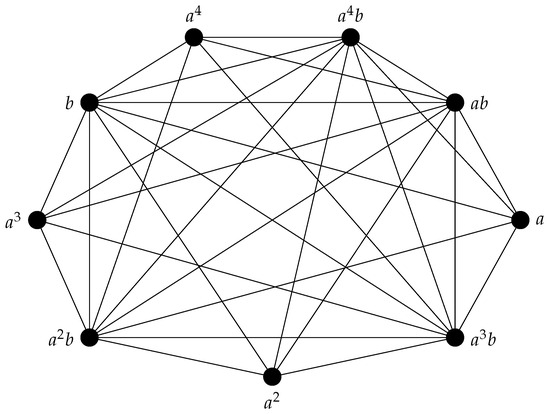
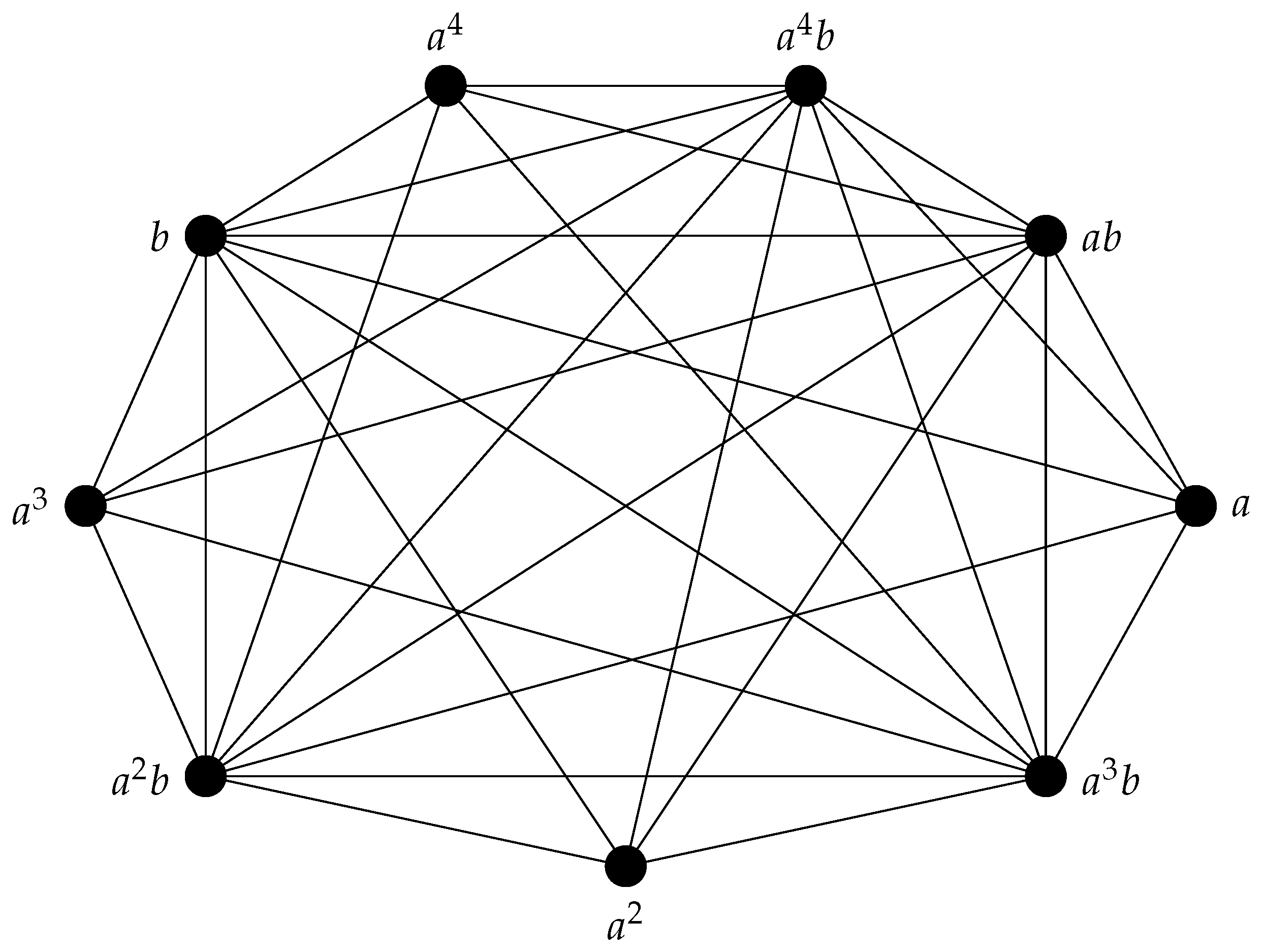
Let , where .
By applying Definition 5 and the properties of the dihedral group established in Proposition 5 to the case of , we conclude that the set of vertices of is
Figure 1.
The NCM-graph of ; .
Therefore, the CN matrix of is
Now, the CN characteristic polynomial of the CN matrix of , where , is obtained as
Assisted by Matlab Version 9.14 (R2023a) software [25], the CN eigenvalues of are with multiplicity 3, with multiplicity 4, and . Hence, the CN energy of is
Now, by Theorem 2, the CN energy of is given as
which is the same result.
Next, this example illustrates the result of the case where n is even.
Example 2.
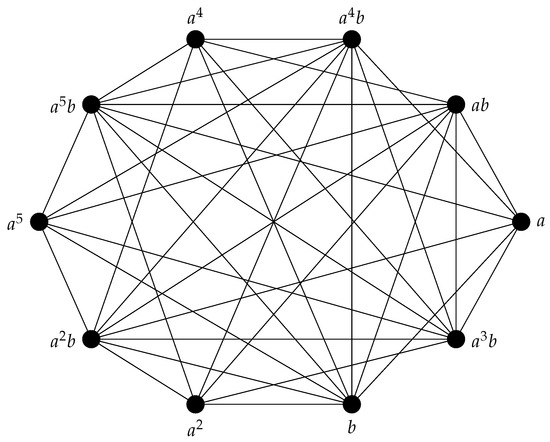
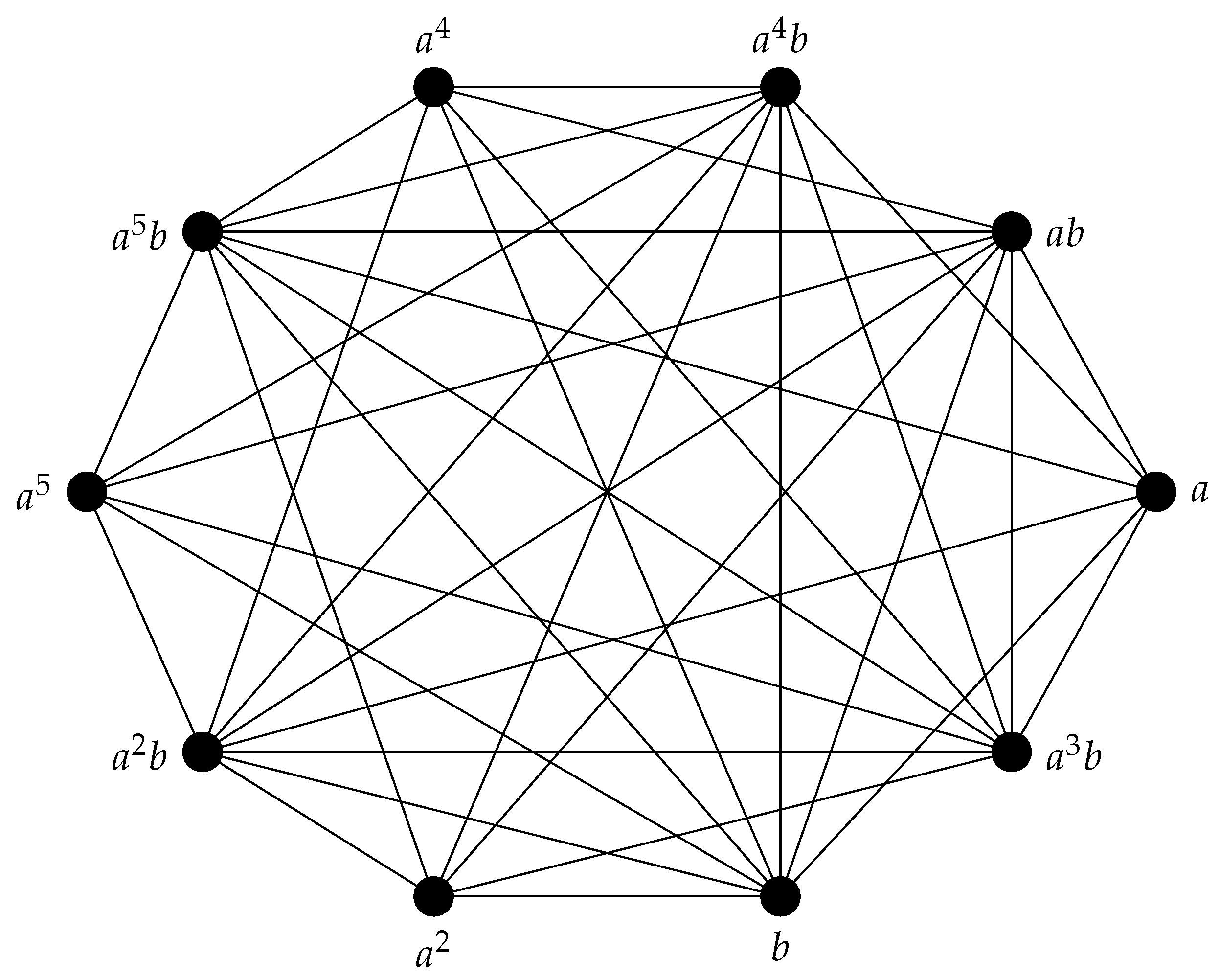
Let , where .
By applying Definition 5 and the properties of the dihedral group established in Proposition 5 to the case of , we conclude that the set of vertices of is
Figure 2.
The NCM-graph of ; .
Therefore, the CN matrix of is
Now, the CN characteristic polynomial of , where , is given as
Assisted by Matlab software [25], the CN eigenvalues of are with multiplicity 3, with multiplicity 2, with multiplicity 3, and . Hence, the CN energy of is obtained as
and by Theorem 2,
which is the same result.
Next, the CN energy of the CM-graph associated with dihedral groups, , is obtained in terms of n, and the results are illustrated by some examples.
3. CN Energy of the CM-Graph of D2n
In this part, the general formula of the CN energy of the CM-graph of is determined in terms of n.
First, in two lemmas (based on the value of n as either odd or even) the CN characteristic polynomials of the CN matrix of are provided along with their CN eigenvalues.
Next, based on the two lemmas, Theorem 3 determines the general formula of the CN energy of the CM-graph of in terms of n. Moreover, two examples are presented to illustrate the results of Theorem 3.
The following two lemmas are necessary to determine the CN energy of . First, Lemma 3 obtains the CN characteristic polynomial and the CN eigenvalues of in the case where n is an odd integer.
Lemma 3.
Let , with being an odd integer and being its CM-graph. Then, the characteristic polynomial of the CN matrix of is given as follows:
and hence, the CN eigenvalues of are with multiplicity n, with multiplicity , and .
Proof.
Suppose that , where is an odd integer, and is its CM-graph. Then, by Definition 6 and Proposition 5, the number of vertices of is in this case (recall that ). Because the elements of the form commute each other and the elements of the form do not commute with each other and also commute with the elements , then there exists three situations of CN neighborhoods of the vertices of , which are the following:
- , , where .
- , , where .
- , .
Thus, the CN matrix of , , is given by
Therefore, the CN characteristic polynomial of is found as follows:
Then, by Proposition 4,
Now, by Proposition 3—with , , , and — is found as
and hence, the CN eigenvalues of are with multiplicity n, with multiplicity , and . □
Next, the CN characteristic polynomial and the CN eigenvalues of when n is an even integer are provided in Lemma 4.
Lemma 4.
Let , where is an even integer, and is its CM-graph. Then, the characteristic polynomial of the CN matrix of is given as follows:
and hence, the CN eigenvalues of are with multiplicity n, with multiplicity , and .
Proof.
Suppose , where is an even integer, and is its CM-graph. Then, by Definition 6 and Proposition 5, the number of vertices of is in this case (recall that ). Because the elements of the form commute with each other and any element of the form commutes only with the element , then there exist three cases of the CN neighborhoods between the vertices of which are the following:
- , , where .
- , .
- , , where .
Thus, the CN matrix of , where , is given by
By the same argument of Lemma 3,
and hence, the CN eigenvalues of are with multiplicity n, with multiplicity , and . □
Now, Theorem 3 gives the general formula of as follows.
Theorem 3.
Let , with , and be its CM-graph. Then, the CN energy of is given by
Proof.
The result follows directly from Lemma 4. □
Next, two examples are provided to illustrate the results in Theorem 3. The first example illustrates the case when n is odd, and the second example illustrates the case when n is even.
Example 3.
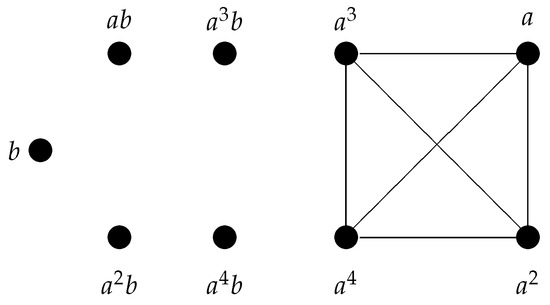
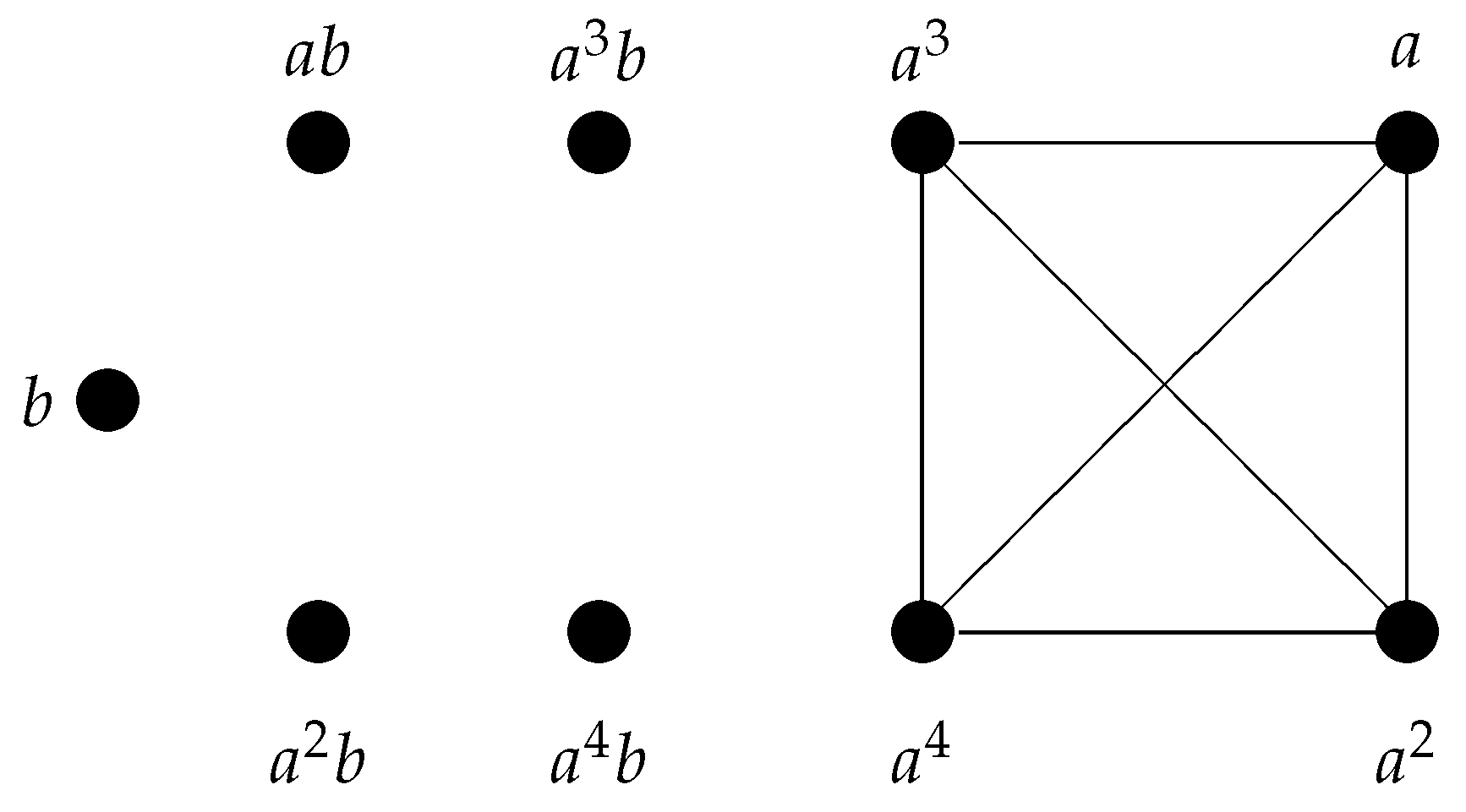
Let , where .
By utilizing the Definition 6 and the properties of the dihedral group established in Proposition 5 to the case of , we conclude that and the set of vertices of is
Figure 3.
CM-graph .
Therefore, the CN matrix of is
The characteristic polynomial of is
Thus, the CN eigenvalues of are with multiplicity 5, with multiplicity 3, and . Hence, the CN energy of is
and by Theorem 3, the CN energy of is given by
which is the same result.
Now, Example 4 illustrates the case where n is even.
Example 4.
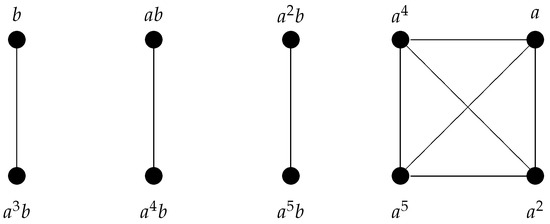
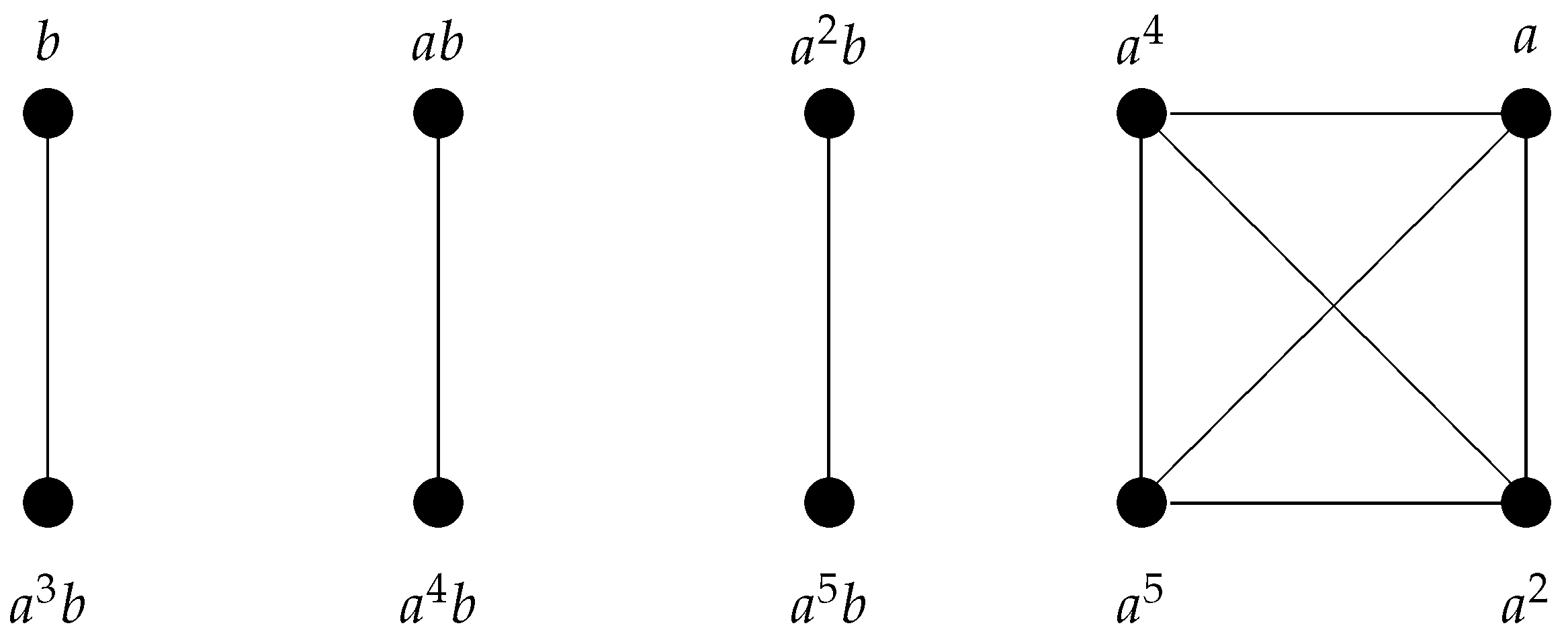
Consider , where .
By utilizing Definition 6 and the properties of the dihedral group established in Proposition 5 to the specific case of , we conclude that , and then the set of vertices of is
Figure 4.
CM-graph .
Thus, the CN matrix of is
The characteristic polynomial of is
Therefore, the CN eigenvalues of are with multiplicity 6, with multiplicity 3, and . Hence, the CN energy of is
and by using Theorem 3,
which is the same result.
In the following section, general formulas for the CN energy of the CM- and NCM-graphs associated to the generalized quaternion group, , are provided.
4. CN Energy of the CM- and NCM- Graphs of Q4n
In this section, based on Proposition 1 (which determines the CN energy of the complete graph on p vertices, ) and Proposition 1 (which determines the CN energy of disconnected graphs), a general formula of the CN energy of the CM-graph for is obtained in terms of n. In addition, the CN characteristic polynomial, CN eigenvalues, and a general formula of the CN energy of the NCM-graph of are provided.
First, Theorem 4 presents a general formula of of the CM-graph associated with .
Theorem 4.
Let , with , and be its CM-graph. Then, the CN energy of is given by
Proof.
Suppose that , with , and be its CM-graph. Then, by Definition 6 and Proposition 6, the number of vertices of in this case is (recall that ). Because the elements of the form , where and , commute with each other, they form a complete graph . Furthermore, any element of the form , where , only commutes with the element . Consequently, these vertices form n connected components, each isomorphic to the complete graph .
Therefore, by Proposition 1,
Now, by Proposition 1 and Proposition 2, the CN energy of is given by
□
Next, a general formula of of the NCM-graph associated with , , is found in Theorem 5.
Theorem 5.
Let , with , and be its NCM-graph. Then, the CN energy of is given by
Proof.
Suppose that , with , and let be its NCM-graph. Then, by Definition 5 and Proposition 6, the number of vertices of in this case is (recall that ).
It can be seen from Definition 5 and Definition 6 that , where G is a group. Therefore, by Equation (2),
Again, by Proposition 6, there exist four situations of common neighborhoods of the vertices of , which are clarified as follows:
- , , where .
- , .
- , , where .
- , , where .
Then, the CN matrix of is written as
Thus, the CN characteristic polynomial of is given by
Now, to obtain , the determinant in Equation (3) needs some elementary operations for its rows and columns, which are defined as follows:
- Replace by the operation for all ; then, the determinant becomes
- Replace by the operation for all ; then the determinant becomeswhere, , and
Therefore, by Proposition 4,
It can be seen that . Thus, we need to calculate . First, can be written as
Next, has been calculated by placing the following operation:
- Replace for all ; then becomes
- Replace , thenTherefore, by Proposition 4,where and
Finally, is calculated by placing the following operations:
- Replace for all ; then,
- Replace , then
Hence, Equation (3) is obtained as
and hence, the CN eigenvalues of are with multiplicity , with multiplicity , with multiplicity , and
Hence, by Definition 2, the CN energy of is given by
□
5. Conclusions
Motivated by the interplay between algebraic graph theory and spectral analysis, particularly in applications to mathematical chemistry and symmetric network design, this paper systematically investigates the CN spectral properties of non-commuting (NCM) and commuting (CM) graphs derived from the dihedral group and the generalized quaternion group . These groups, renowned for their rich symmetries, provide a natural framework for studying graph invariants, yet their CN energy and spectral structures remain undercharacterized in the literature.
We first construct the CN matrix for NCM- and CM- graphs of and , explicitly defining their entries as functions of the parameter n. From this foundation, we derive closed form expressions for the CN characteristic polynomial and rigorously compute the CN eigenvalues, revealing spectral patterns intrinsic to the groups’ algebraic structure. Subsequently, we establish general formulas for the CN energy of these graphs in terms of n, unifying their energetic behavior.
The theoretical results are validated through illustrative examples, confirming the consistency of the derived formulas with direct computational methods. This work not only advances the spectral theory of group based graphs but also provides tools for quantifying energetic properties in chemical and physical networks modeled by such structures.
This study opens several directions for further research:
- Extending the methodology to other non-abelian groups, such as symmetric groups or polyhedral groups, to identify universal spectral invariants.
- Implementing the closed form CN energy formulas in computational frameworks for large-scale network analysis or quantum chemical simulations.
- Investigating the relationship between the CN energy of graphs associated with groups and the inherent properties of those groups.
- Investigating links between CN energy and physical properties, such as molecular stability in chemical graph models or robustness in engineering networks.
- Comparative studies of CN energy with other graph energies (e.g., adjacency, Laplacian) to uncover deeper connections in spectral graph theory.
These efforts would further bridge algebraic structures, spectral analysis, and interdisciplinary applications, enriching both theoretical and applied graph theory.
Author Contributions
Conceptualization, H.A. and A.S.; methodology, H.A. and A.S.; formal analysis, H.A. and A.S.; investigation, H.A. and A.S.; writing—original draft preparation, H.A. and A.S.; writing—review and editing, H.A. and A.S.; supervision, H.A. All authors have read and agreed to the published version of the manuscript.
Funding
This research received no external funding.
Data Availability Statement
The data used to support the findings of this study are available within this article.
Conflicts of Interest
The authors declare no conflicts of interest.
References
- Gutman, I. The energy of a graph. Der. Math. Stat. Sekt. Forschungszent Graz. 1978, 103, 1–22. [Google Scholar]
- Ramaswamy, H.; Veena, C. On the energy of unitary Cayley graphs. Electron. J. Comb. 2009, 16, N24. [Google Scholar] [CrossRef] [PubMed]
- Bapat, R.B. Graphs and Matrices; Springer: Berlin/Heidelberg, Germany, 2010; Volume 27. [Google Scholar]
- Alwardi, A.; Nandappa, D.S.; Gutman, I. On the common-neighborhood energy of a graph. Bull. Cl. Des. Sci. Math. Natturalles 2011, 143, 49–59. [Google Scholar]
- Ramane, H.; Shinde, S. Degree exponent polynomial of graphs obtained by some graph operations. Electron. Notes Discret. Math. 2017, 63, 161–168. [Google Scholar] [CrossRef]
- Gantmacher, F.R. The Theory of Matrices; Chelsea Publishing Company: New York, NY, USA, 1959. [Google Scholar]
- Baez, J.C. On quaternions and octonions: Their geometry, arithmetic, and symmetry by John H. Conway and Derek A. Smith. Bull. Amer. Math. Soc. 2005, 42, 229–243. [Google Scholar] [CrossRef]
- Druţu, C.; Kapovich, M. Geometric Group Theory; American Mathematical Society: Providence, RI, USA, 2018; Volume 63. [Google Scholar]
- Rotman, J.J. An Introduction to the Theory of Groups, 9th ed.; Springer: Berlin/Heidelberg, Germany, 2024. [Google Scholar]
- Lv, H.; Zeng, J.; Zhu, Z.; Dong, S.; Li, W. Study on prestress distribution and structural performance of heptagonal six-five-strut alternated cable dome with inner hole. Structures 2024, 65, 106724. [Google Scholar] [CrossRef]
- Zhai, L.; Ma, X.; Shao, L.; Zhai, Y.; Zhong, G. Metric and strong metric dimension in commuting graphs of finite groups. Commun. Algebr. 2023, 51, 1000–1010. [Google Scholar] [CrossRef]
- Zhang, X.; Zhang, Y.; Chen, A.L.; Yu, M.; Zhang, L. Optimizing multi label student performance prediction with GNN-TINet: A contextual multidimensional deep learning framework. PLoS ONE 2025, 20, e0314823. [Google Scholar] [CrossRef] [PubMed]
- Zheng, D.; Cao, X. Provably efficient service function chain embedding and protection in edge networks. IEEE/ACM Trans. Netw. 2024, 33, 178–193. [Google Scholar] [CrossRef]
- Zhu, Y.; Zhou, Y.; Yan, L.; Li, Z.; Xin, H.; Wei, W. Scaling graph neural networks for large-scale power systems analysis: Empirical laws for emergent abilities. IEEE Trans. Power Syst. 2024, 39, 7445–7448. [Google Scholar] [CrossRef]
- Vahidi, J.; Talebi, A.A. The commuting graphs on groups D2n and Qn. J. Math. Comput. Sci. 2010, 1, 123–127. [Google Scholar] [CrossRef][Green Version]
- Segev, Y.; Seitz, G.M. Anisotropic groups of type An and the commuting graph of finite simple groups. Pac. J. Math. 2002, 202, 125–225. [Google Scholar] [CrossRef]
- Raza, Z.; Faizi, S. Commuting graphs of dihedral type groups. Appl. Math. E-Notes 2013, 13, 221–227. [Google Scholar]
- Parker, C. The commuting graph of a soluble group. Bull. Lond. Math. Soc. 2013, 45, 839–848. [Google Scholar] [CrossRef]
- Abdollahi, A.; Akbari, S.; Maimani, H. Non-commuting graph of a group. J. Algebra 2006, 298, 468–492. [Google Scholar] [CrossRef]
- Moradipour, K.; Sarmin, N.H.; Erfanian, A. On non-commuting graphs of some finite groups. Int. J. Appl. Math. Stat. 2013, 45, 473–476. [Google Scholar] [CrossRef]
- Ahanjideh, N.; Iranmanesh, A. On the relation between the non-commuting graph and the prime graph. Int. J. Group Theory 2012, 1, 25–28. [Google Scholar]
- Dummit, D.S.; Foote, R.M. Abstract Algebra; Wiley: Hoboken, NJ, USA, 2004. [Google Scholar]
- Roman, S. Fundamentals of Group Theory. An Advanced Approach; Springer Science & Business Media: Berlin/Heidelberg, Germany, 2011. [Google Scholar]
- Salah, V.; Sarmin, N.H.; Mat Hassim, H.I. Maximum Degree Energy of the Non-Commuting Graphs Associated to Dihedral Groups. Adv. Appl. Math. Sci. 2022, 21, 1913–1923. [Google Scholar]
- The MathWorks, Inc. MATLAB, Version 9.14 (R2023a); The MathWorks, Inc.: Natick, MA, USA, 2023; Available online: https://www.mathworks.com/products/matlab.html (accessed on 15 October 2023).
Disclaimer/Publisher’s Note: The statements, opinions and data contained in all publications are solely those of the individual author(s) and contributor(s) and not of MDPI and/or the editor(s). MDPI and/or the editor(s) disclaim responsibility for any injury to people or property resulting from any ideas, methods, instructions or products referred to in the content. |
© 2025 by the authors. Licensee MDPI, Basel, Switzerland. This article is an open access article distributed under the terms and conditions of the Creative Commons Attribution (CC BY) license (https://creativecommons.org/licenses/by/4.0/).