


The High-Order ADI Difference Method and Extrapolation Method for Solving the Two-Dimensional Nonlinear Parabolic Evolution Equations

Abstract
1. Introduction
- We propose an alternating-direction implicit Crank–Nicolson difference scheme for the two-dimensional nonlinear parabolic equations.
- The stability and the priori bounds are strictly proved.
- The extrapolation method is further constructed and applied to improve the numerical solution accuracy. To our knowledge, it is the first time that the ADI extrapolation method is given.
2. Establishment of Difference Scheme
3. Theoretical Analysis of Difference Scheme
4. Richardson Extrapolation
5. Numerical Investigations
6. Conclusions
Author Contributions
Funding
Data Availability Statement
Conflicts of Interest
References
- Sun, Z. Numerical Methods for Partial Differential Equations; Science Press: Beijing, China, 2005. (In Chinese) [Google Scholar]
- Khebchareon, M.; Pani, A.; Fairweather, G. Convergence analyses of crank-nicolson orthogonal spline collocation methods for linear parabolic problems in two space variables. Int. J. Numer. Anal. Model. 2016, 13, 58–72. [Google Scholar]
- Ji, C.; Du, R.; Sun, Z. Stability and convergence of difference schemes for multi-dimensional parabolic equations with variable coefficients and mixed derivatives. Int. J. Comput. Math. 2018, 95, 255–277. [Google Scholar] [CrossRef]
- Liao, H.; Sun, Z. Maximum norm error bounds of ADI and compact ADI methods for solving parabolic equations. Numer. Methods Partial. Differ. Equ. Int. J. 2010, 26, 37–60. [Google Scholar] [CrossRef]
- Liao, H.L.; Zhao, Y.; Teng, X.H. A weighted ADI scheme for subdiffusion equations. J. Sci. Comput. 2016, 69, 1144–1164. [Google Scholar] [CrossRef]
- Liao, H.L.; Sun, Z.Z.; Shi, H.S.; Wang, T.C. Convergence of compact ADI method for solving linear Schrodinger equations. Numer. Methods Partial. Differ. Equ. 2012, 28, 1598–1619. [Google Scholar] [CrossRef]
- Liao, H.L.; Li, D.; Zhang, J. Sharp error estimate of the nonuniform L1 formula for linear reaction-subdiffusion equations. Siam J. Numer. Anal. 2018, 56, 1112–1133. [Google Scholar] [CrossRef]
- Putri, E.; Shahab, M.; Iqbal, M.; Mukhlash, I. A deep-genetic algorithm (deep-GA) approach for high-dimensional nonlinear parabolic partial differential equations. Comput. Math. Appl. 2024, 154, 120–127. [Google Scholar] [CrossRef]
- Kazakov, A.; Nefedova, O.; Spevak, L. Solution to a Two-Dimensional Nonlinear Parabolic Heat Equation Subject to a Boundary Condition Specified on a Moving Manifold. Comput. Math. Math. Phys. 2024, 64, 266–284. [Google Scholar] [CrossRef]
- Sazaklioglu, A. An iterative numerical method for an inverse source problem for a multidimensional nonlinear parabolic equation. Appl. Numer. Math. 2024, 198, 428–447. [Google Scholar] [CrossRef]
- Xiao, L.; Li, M. Initial boundary value problem for a class of higher-order n-dimensional nonlinear pseudo-parabolic equations. Bound. Value Probl. 2021, 2021, 1–24. [Google Scholar] [CrossRef]
- Tan, W.; Hoang, V. High dimensional finite element method for multiscale nonlinear monotone parabolic equations. J. Comput. Appl. Math. 2019, 345, 471–500. [Google Scholar] [CrossRef]
- Eso, R.; Napirah, M.; Usman, I.; Aba, L. The Two-Dimensional Conduction Heat Transfer Equation on a Square Plate: Explicit vs. Crank-Nicolson Method in MS Excel Spreadsheet. J. Phys. Conf. Ser. 2024, 2734, 012050. [Google Scholar] [CrossRef]
- Dehghan, M. Fully implicit finite differences methods for two-dimensional diffusion with a non-local boundary condition. J. Comput. Appl. Math. 1999, 106, 255–269. [Google Scholar] [CrossRef]
- Yang, X.; Zhang, Z. On conservative, positivity preserving, nonlinear FV scheme on distorted meshes for the multi-term nonlocal Nagumo-type equations. Appl. Math. Lett. 2024, 150, 108972. [Google Scholar] [CrossRef]
- Yang, X.; Zhang, Z. Analysis of a new NFV scheme preserving DMP for two-dimensional sub-diffusion equation on distorted meshes. J. Sci. Comput. 2024, 99, 80. [Google Scholar] [CrossRef]
- Yang, X.; Zhang, H.; Zhang, Q.; Yuan, G. Simple positivity preserving nonlinear finite volume scheme for subdiffusion equations on general non-conforming distorted meshes. Nonlinear Dyn. 2022, 108, 3859–3886. [Google Scholar] [CrossRef]
- Zhang, Q.; Zhang, J.; Zhang, Z. Error estimates of invariant-preserving difference schemes for the rotation-two-component Camassa–Holm system with small energy. Calcolo 2024, 61, 9. [Google Scholar] [CrossRef]
- Zhang, Q.; Yan, T.; Xu, D.; Chen, Y. Direct/split invariant-preserving Fourier pseudo-spectral methods for the rotation-two-component Camassa–Holm system with peakon solitons. Comput. Phys. Commun. 2024, 302, 109237. [Google Scholar] [CrossRef]
- Zhang, Q. Error estimates of compact and hybrid Richardson schemes for the parabolic equation. Appl. Math. Lett. 2024, 153, 109078. [Google Scholar] [CrossRef]
- Yan, T.; Zhang, J.; Zhang, Q. Fully conservative difference schemes for the rotation-two-component Camassa–Holm system with smooth/nonsmooth initial data. Wave Motion 2024, 129, 103333. [Google Scholar] [CrossRef]
- Xue, L.; Zhang, Q. Soliton solutions of derivative nonlinear Schrodinger equations: Conservative schemes and numerical simulation. Phys. D Nonlinear Phenom. 2024, 470, 134372. [Google Scholar] [CrossRef]
- Xue, L.; Zhang, Q.; Matus, P.P. Error estimate of the conservative difference scheme for the derivative nonlinear Schrodinger equation. Appl. Math. Lett. 2025, 159, 109283. [Google Scholar] [CrossRef]
- Zhang, H.; Yang, X.; Xu, D. Unconditional convergence of linearized OSC algorithm for semilinear subdiffusion equation with non-smooth solution. Numer. Methods Partial. Differ. Equ. 2021, 37, 1361–1373. [Google Scholar] [CrossRef]
- Zhang, H.; Yang, X.; Liu, Y.; Liu, Y. An extrapolated CN-WSGD OSC method for a nonlinear time fractional reaction-diffusion equation. Appl. Numer. Math. 2020, 157, 619–633. [Google Scholar] [CrossRef]
- Yang, X.; Zhang, Z. Superconvergence analysis of a robust orthogonal Gauss collocation method for 2D fourth-order subdiffusion equations. J. Sci. Comput. 2024, 100, 62. [Google Scholar] [CrossRef]
- Wang, J.; Jiang, X.; Yang, X.; Zhang, H. A new robust compact difference scheme on graded meshes for the time-fractional nonlinear Kuramoto-Sivashinsky equation. Comput. Appl. Math. 2024, 43, 381. [Google Scholar] [CrossRef]
- Shi, Y.; Yang, X.; Zhang, Z. Construction of a new time-space two-grid method and its solution for the generalized Burgers’ equation. Appl. Math. Lett. 2024, 158, 109244. [Google Scholar] [CrossRef]
- Jiang, Y.; Chen, H. Local convergence analysis of L1-ADI scheme for two-dimensional reaction-subdiffusion equation. J. Appl. Math. Comput. 2024, 70, 1953–1964. [Google Scholar] [CrossRef]
- Jiang, Y.; Chen, H. Convergence analysis of a L1-ADI scheme for two-dimensional multiterm reaction-subdiffusion equation. Numer. Methods Partial. Differ. Equ. 2024, 40, e23115. [Google Scholar] [CrossRef]
- Jiang, Y.; Chen, H.; Sun, T.; Huang, C. Efficient L1-ADI finite difference method for the two-dimensional nonlinear time-fractional diffusion equation. Appl. Math. Comput. 2024, 471, 128609. [Google Scholar] [CrossRef]
- Wang, Z.; Cen, D.; Mo, Y. Sharp error estimate of a compact L1-ADI scheme for the two-dimensional time-fractional integro-differential equation with singular kernels. Appl. Numer. Math. 2021, 159, 190–203. [Google Scholar] [CrossRef]
- Chen, L.; Wang, Z.; Vong, S. A second-order weighted ADI scheme with nonuniform time grids for the two-dimensional time-fractional telegraph equation. J. Appl. Math. Comput. 2024, 1–18. [Google Scholar] [CrossRef]
- Qiu, W.; Xu, D.; Chen, H.; Guo, J. An alternating direction implicit Galerkin finite element method for the distributed-order time-fractional mobile–immobile equation in two dimensions. Comput. Math. Appl. 2020, 80, 3156–3172. [Google Scholar] [CrossRef]
- Guo, T.; Nikan, O.; Avazzadeh, Z.; Qiu, W. Efficient alternating direction implicit numerical approaches for multi-dimensional distributed-order fractional integro differential problems. Comput. Appl. Math. 2022, 41, 236. [Google Scholar] [CrossRef]
- Jiang, H.; Xu, D.; Qiu, W.; Zhou, J. An ADI compact difference scheme for the two-dimensional semilinear time-fractional mobile–immobile equation. Comput. Appl. Math. 2020, 39, 1–17. [Google Scholar] [CrossRef]
- Luo, M.; Qiu, W.; Nikan, O.; Avazzadeh, Z. Second-order accurate, robust and efficient ADI Galerkin technique for the three-dimensional nonlocal heat model arising in viscoelasticity. Appl. Math. Comput. 2023, 440, 127655. [Google Scholar] [CrossRef]
- Qiu, W.; Nikan, O.; Avazzadeh, Z. Numerical investigation of generalized tempered-type integrodifferential equations with respect to another function. Fract. Calc. Appl. Anal. 2023, 26, 2580–2601. [Google Scholar] [CrossRef]
- Qiu, W.; Li, Y.; Zheng, X. Numerical analysis of nonlinear Volterra integrodifferential equations for viscoelastic rods and plates. Calcolo 2024, 61, 50. [Google Scholar] [CrossRef]
- Qiao, L.; Qiu, W.; Xu, D. Error analysis of fast L1 ADI finite difference/compact difference schemes for the fractional telegraph equation in three dimensions. Math. Comput. Simul. 2023, 205, 205–231. [Google Scholar] [CrossRef]
- Qiao, L.; Guo, J.; Qiu, W. Fast BDF2 ADI methods for the multi-dimensional tempered fractional integrodifferential equation of parabolic type. Comput. Math. Appl. 2022, 123, 89–104. [Google Scholar] [CrossRef]
- Qiao, L.; Qiu, W.; Xu, D. Crank-Nicolson ADI finite difference/compact difference schemes for the 3D tempered integrodifferential equation associated with Brownian motion. Numer. Algorithms 2023, 93, 1083–1104. [Google Scholar] [CrossRef]
- Qiao, L.; Qiu, W.; Tang, B. A fast numerical solution of the 3D nonlinear tempered fractional integrodifferential equation. Numer. Methods Partial. Differ. Equ. 2023, 39, 1333–1354. [Google Scholar] [CrossRef]
- Li, C.; Zhang, H.; Yang, X. A fourth-order accurate extrapolation nonlinear difference method for fourth-order nonlinear PIDEs with a weakly singular kernel. Comput. Appl. Math. 2024, 43, 288. [Google Scholar] [CrossRef]
- Yang, X.; Qiu, W.; Chen, H.; Zhang, H. Second-order BDF ADI Galerkin finite element method for the evolutionary equation with a nonlocal term in three-dimensional space. Appl. Numer. Math. 2022, 22, 497–513. [Google Scholar] [CrossRef]
- Yang, X.; Qiu, W.; Zhang, H.; Tang, L. An efficient alternating direction implicit finite difference scheme for the three-dimensional time-fractional telegraph equation. Comput. Math. Appl. 2021, 102, 233–247. [Google Scholar] [CrossRef]
- Cao, D.; Chen, H. Pointwise-in-time error estimate of an ADI scheme for two-dimensional multi-term subdiffusion equation. J. Appl. Math. Comput. 2023, 69, 707–729. [Google Scholar] [CrossRef]
- Li, K.; Chen, H.; Xie, S. Error estimate of L1-ADI scheme for two-dimensional multi-term time fractional diffusion equation. Netw. Heterog. Media 2023, 18, 1454–1470. [Google Scholar] [CrossRef]
- Wang, Y.; Chen, H. Pointwise error estimate of an alternating direction implicit difference scheme for two-dimensional time-fractional diffusion equation. Comput. Math. Appl. 2021, 99, 155–161. [Google Scholar] [CrossRef]
- Wang, Y.; Chen, H.; Sun, T. α-robust H1-norm convergence analysis of ADI scheme for two-dimensional time-fractional diffusion equation. Appl. Numer. Math. 2021, 168, 75–83. [Google Scholar] [CrossRef]
- Burg, C.; Erwin, T. Application of Richardson extrapolation to the numerical solution of partial differential equations. Numer. Methods Partial. Differ. Equ. 2009, 25, 810–832. [Google Scholar] [CrossRef]
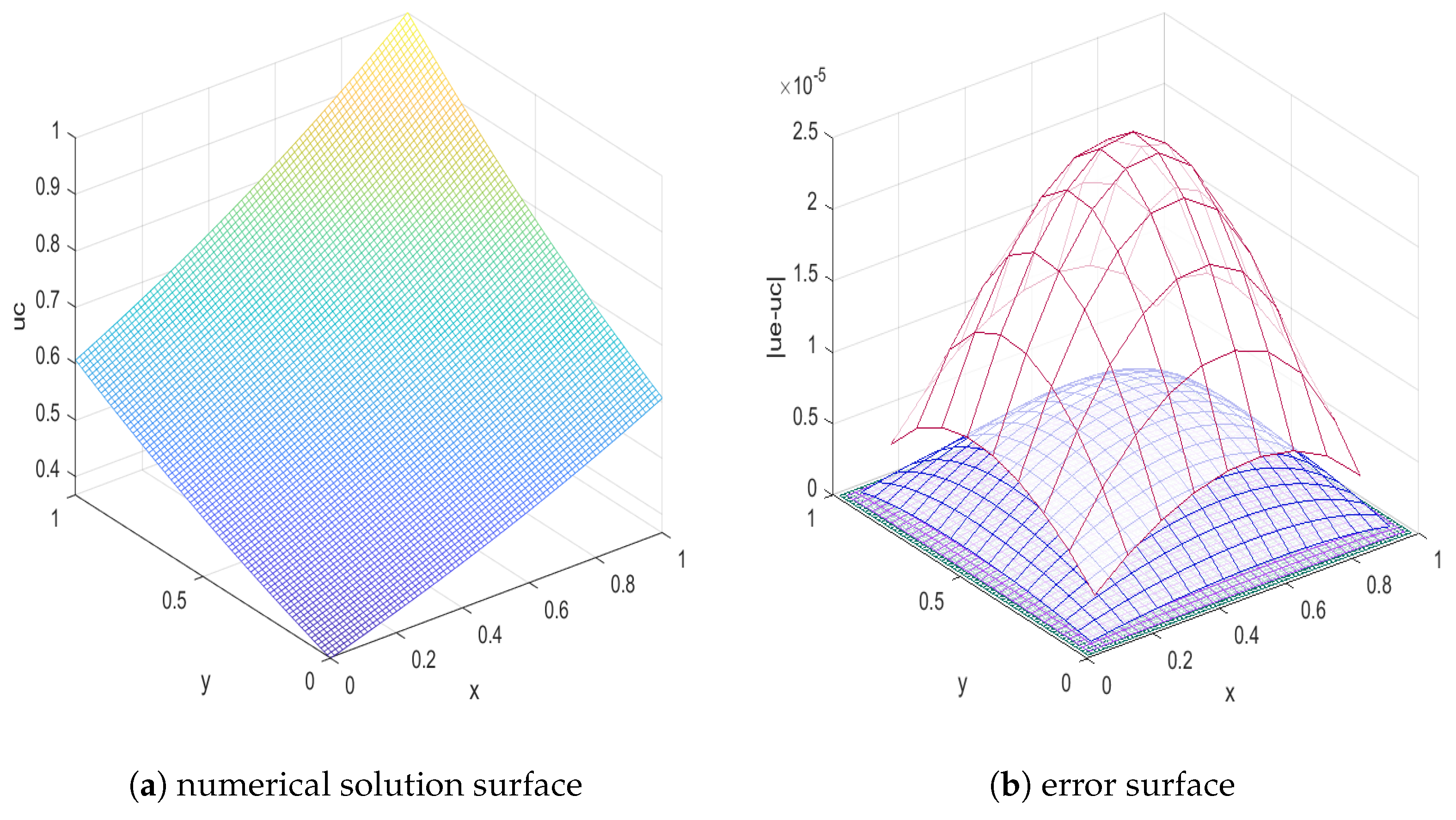
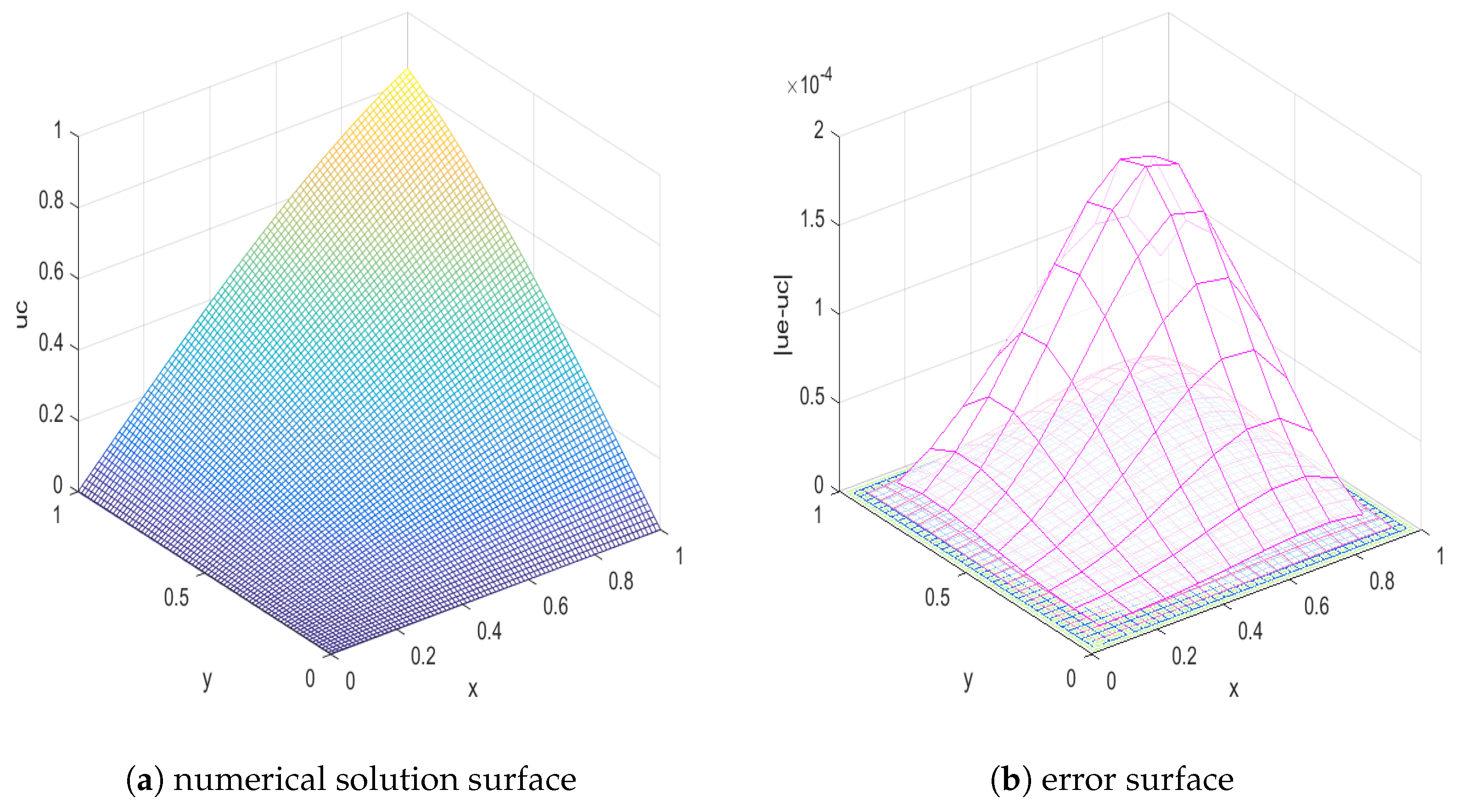
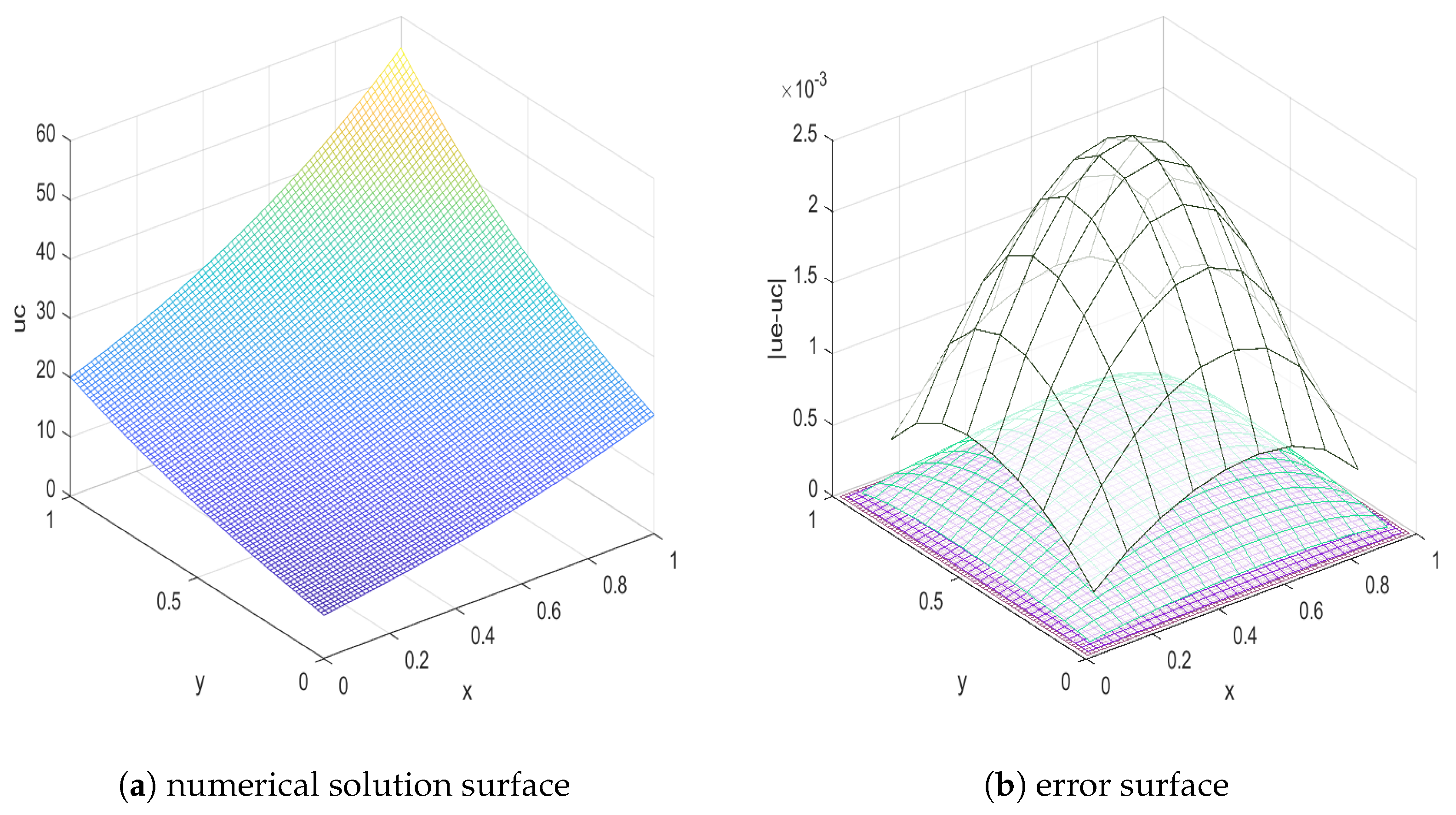

| Scheme | Mesh Size (h) | Mesh Size () | Rate | Time (s) | |
|---|---|---|---|---|---|
| ADI | 1/10 | 1/100 | * | 0.154 | |
| 1/20 | 1/400 | 1.944 | 0.352 | ||
| 1/40 | 1/1600 | 1.983 | 2.798 | ||
| 1/80 | 1/6400 | 1.997 | 34.196 | ||
| 1/10 | 1/100 | * | * | ||
| Extrapolation | 1/20 | 1/400 | 3.383 | * | |
| 1/40 | 1/1600 | 3.647 | * |
| Scheme | Mesh Size (h) | Mesh Size () | Rate | Time (s) | |
|---|---|---|---|---|---|
| ADI | 1/10 | 1/100 | * | 0.197 | |
| 1/20 | 1/400 | 2.020 | 0.582 | ||
| 1/40 | 1/1600 | 2.010 | 2.812 | ||
| 1/80 | 1/6400 | 2.000 | 33.559 | ||
| 1/10 | 1/100 | * | * | ||
| Extrapolation | 1/20 | 1/400 | 3.929 | * | |
| 1/40 | 1/1600 | 3.984 | * |
| Scheme | Mesh Size (h) | Mesh Size () | Rate | Time (s) | |
|---|---|---|---|---|---|
| ADI | 1/10 | 1/100 | * | 0.160 | |
| 1/20 | 1/400 | 2.030 | 0.493 | ||
| 1/40 | 1/1600 | 2.004 | 2.318 | ||
| 1/80 | 1/6400 | 2.002 | 28.769 | ||
| 1/10 | 1/100 | * | * | ||
| Extrapolation | 1/20 | 1/400 | 3.925 | * | |
| 1/40 | 1/1600 | 3.983 | * |
| x | y | Crank–Nicolson Error | Alternating-Direction Implicit Error |
|---|---|---|---|
| 0.1 | 0.1 | ||
| 0.2 | 0.2 | ||
| 0.3 | 0.3 | ||
| 0.4 | 0.4 | ||
| 0.5 | 0.5 | ||
| 0.6 | 0.6 | ||
| 0.7 | 0.7 | ||
| 0.8 | 0.8 | ||
| 0.9 | 0.9 |
Disclaimer/Publisher’s Note: The statements, opinions and data contained in all publications are solely those of the individual author(s) and contributor(s) and not of MDPI and/or the editor(s). MDPI and/or the editor(s) disclaim responsibility for any injury to people or property resulting from any ideas, methods, instructions or products referred to in the content. |
© 2024 by the authors. Licensee MDPI, Basel, Switzerland. This article is an open access article distributed under the terms and conditions of the Creative Commons Attribution (CC BY) license (https://creativecommons.org/licenses/by/4.0/).
Share and Cite
Shen, X.; Yang, X.; Zhang, H. The High-Order ADI Difference Method and Extrapolation Method for Solving the Two-Dimensional Nonlinear Parabolic Evolution Equations. Mathematics 2024, 12, 3469. https://doi.org/10.3390/math12223469
Shen X, Yang X, Zhang H. The High-Order ADI Difference Method and Extrapolation Method for Solving the Two-Dimensional Nonlinear Parabolic Evolution Equations. Mathematics. 2024; 12(22):3469. https://doi.org/10.3390/math12223469
Chicago/Turabian StyleShen, Xin, Xuehua Yang, and Haixiang Zhang. 2024. "The High-Order ADI Difference Method and Extrapolation Method for Solving the Two-Dimensional Nonlinear Parabolic Evolution Equations" Mathematics 12, no. 22: 3469. https://doi.org/10.3390/math12223469
APA StyleShen, X., Yang, X., & Zhang, H. (2024). The High-Order ADI Difference Method and Extrapolation Method for Solving the Two-Dimensional Nonlinear Parabolic Evolution Equations. Mathematics, 12(22), 3469. https://doi.org/10.3390/math12223469


