Abstract
The paper mainly investigates a stochastic SIRS epidemic model with Logistic birth and nonlinear incidence. We obtain a new threshold value () through the Stratonovich stochastic differential equation, different from the usual basic reproduction number. If , the disease-free equilibrium of the illness is globally asymptotically stable in probability one. If , the disease is permanent in the mean with probability one and has an endemic stationary distribution. Numerical simulations are given to illustrate the theoretical results. Interestingly, we discovered that random fluctuations can suppress outbreaks and control the disease.
Keywords:
stochastic SIRS epidemic model; Logistic birth; nonlinear incidence; global stability; stationary distribution MSC:
60H05; 60H35
1. Introduction
In the past few decades, researchers have provided various SIR models to study the spread of epidemics [1,2,3,4,5]. For example, Beretta and Takeuchi [1] proposed a deterministic SIR model with varying population sizes, and Lu et al. [2] analyzed a SIR epidemic model with horizontal and vertical transmission. In practice, the persistence of infectious diseases and disease-related deaths may lead to changes in birth rates as the population size increases toward its carrying capacity. In other words, these SIR models should consider density-dependent limited growth. Suppose that the total population can be divided into three compartments at time t: susceptible , infectious , and removed . Zhang, Li, and Ma [3] introduced a SIR epidemic model with Logistic birth as follows
where K is the environmental capacity, b is the birth rate, is the exposure rate, is the natural mortality rate, is the intrinsic rate, is the mortality rate due to disease, and is the recovery rate of the infected.
For some diseases, the recovered individuals will lose immunity after a certain period and become susceptible again. The SIRS model can be used to describe this phenomenon [6,7,8,9]. However, most SIRS models often ignore the density-dependent demographics and heterogeneous populations. Inspired by the above models, we propose a deterministic SIRS model with Logistic birth and a nonlinear incidence rate, which is formed by
where f is a positive function, and denotes the immunity loss rate of the recovered. The model (1) is a special case of model (2) with and .
In the real world, all dynamic systems are affected by environmental noise [10,11,12,13]. It is necessary to study a stochastic SIRS epidemic model with Logistic birth and a nonlinear incidence rate is necessary. Considering the effect of random perturbations, we assume that the perturbations in the environment are expressed as a parameter change to the random variable and obtain the following stochastic SIRS model
where represents the intensity of white environmental noise and is a one-dimensional standard Brownian motion. Obviously, model (2) is also a special case of model (3) for . This paper aims to analyze the asymptotic properties of the stochastic model (3) by studying global stability, persistence, and stationary distribution.
In epidemiological studies, the basic reproduction number is an indicative factor in considering whether a disease is endemic or not. In this paper, we introduce a new threshold value through the Stratonovich stochastic differential equation and further analyze the dynamic properties of model (3).
2. Preliminaries
Denote , and . Let be a complete probability space with a filtration satisfying the usual conditions ( is increasing and right continuous while contains all -null sets). From [14], we give Itô’s formula for general stochastic differential equations. Consider a 3-dimensional stochastic differential equation
with an initial value , denotes a 3-dimensional vector of standard Brownian motions defined on the complete probability space. Let the function be continuously twice differentiable in W and once in t. The differential operator L is defined as
Let a function , we obtain
where . Then,
Lemma 1.
[15] The Itô stochastic differential equation (SDE)
is equivalent (has the same solution) as the Stratonovich SDE
is nonnegative and twice continuously differentiable for all , and .
, for any , and , where .
Under assumptions and , it is obvious that
Lemma 2.
For any constants , let . Under and , we have
The proof of Lemma 2 is similar to that of Lemma 2.1 in Ramziya et al. [16]. Denote . Define a bounded set
Lemma 3.
Suppose that and hold.
(i) The region Γ is almost surely positive invariant in model (3).
(ii) For any initial value , model (3) has a unique positive solution on . That is to say, the solution will remain in a compact subset of Γ. Furthermore,
The proof of Lemma 3 can be obtained using a similar method in Cai et al. [17]. The lemma shows that we can study the dynamic properties of model (3) in the bounded set . To obtain the basic reproduction number of model (3), we define a function . By using Itô’s formula, it follows that
Thus, we have
We transform (5) into a Stratonovich SDE and obtain
Taking the mean value of the above equations derives
As a result, the study of model (3) can be turned into
Denote . Then system (6) can be given as
where
Through the calculation, model (3) has a unique disease-free equilibrium , which is also that of model (6). The Jacobian matrices of and at are denoted as F and V, respectively. Under the assumption , by the calculation, there are
and
Then the basic reproduction number of model (6) is
which is also that of model (3). In view of , model (6) is then transformed into model (2). The basic reproduction number of model (2) is easily obtained as
In the following, we present some properties of model (2).
Theorem 1.
The disease-free equilibrium of model (2) is locally asymptotically stable if .
Proof.
Given that assumptions and hold, the Jacobian matrix of model (2) evaluated at is
Thus, the characteristic equation at is
which has eigenvalues and . Therefore, the disease-free equilibrium is locally asymptotically stable. The proof is complete. □
Theorem 2.
If , model (2) has a unique endemic equilibrium , which is locally asymptotically stable.
Proof.
We can verify that . Therefore, is locally asymptotically stable by employing the Routh–Hurwitz criterion. □
3. Existence and Uniqueness of the Global Positive Solution
Theorem 3.
There is a unique solution of model (3) on for any given initial value , and this solution remains in with probability one.
Proof.
The coefficients of model (3) are locally Lipschitz continuous. For any given initial value , there exists a unique local solution on , where denotes the explosion time. To prove the existence of a unique global solution to the stochastic model (3), it is only necessary to prove .
Let be sufficiently large, such that and all lie within the interval . For each integer , define a stopping time
where (as usual ∅ = the empty set). Clearly, increases as . Let , then a.s. If a.s., then a.s. Otherwise, there exists a pair of constants and , such that . Hence, there exists an integer , such that
Define a Lyapunov function by
For any and , applying Itô’s formula to V, we obtain
where
where is a positive constant. Then according to (8), we have
Integrating both sides of (9) from 0 to and taking the expectation, we have
Let for . From (7) we have . For every , we learn or or equals either l or . Therefore, from (10), there is
where is the indicator function of . Taking results
Hence, . It completes the proof. □
4. Global Stability of Disease-Free Equilibrium
Denote
The following result reveals the asymptotic property of in model (3).
Theorem 4.
Under and , the disease-free equilibrium is globally asymptotically stable in probability one if one of the following conditions holds: (a) , or (b)
Proof.
Let and be two positive constants. Define a Lyapunov function
Obviously, in the region . Through Itô’s formula and model (3), it follows that
where
For any constant and , we have
Based on the above inequalities and , it yields that
Denote . The function increases for . If and , then . We obtain
If , we have
Suppose the condition (a) or (b) holds. Then,
We choose the constant , such that
and two positive constants (, ) satisfy
Therefore, is negative definite in the region . By applying the global asymptotic stability theorem [14,18], we can obtain that the disease-free equilibrium of model (3) is globally asymptotically stable in probability one. The proof is complete. □
For the stochastic model (3), Theorem 4 reflects the asymptotic property of the disease-free equilibrium under conditions (a) and (b). Denote
Based on the relationship of and , we analyze the properties under the ranges of .
Corollary 1.
Under and , the disease-free equilibrium is globally asymptotically stable in probability one if one of the following conditions holds: (a) , (b) and , or (c) and .
5. Permanence in the Mean of Disease
In this section, we discuss permanence in the mean of the disease. For any , the average value of a continuous function is defined by .
Theorem 5.
If and , then any solution of model (3) with initial values is permanent in the mean with probability one. That is, there exists a constant , such that
where
Proof.
Through Lemma 3, . Using Itô’s formula, we have
From , for any , it follows that
By Lagrange’s mean value theorem, we have
where and . Hence,
From Lemma 2, it is obvious that
and
For any , , , and Thus,
and
Further, we have
For the above inequality, we integrate from 0 to t and then divide by t into both sides. It follows that
Since
we substitute (11) into (12) and have
where
From the large number theorem for martingales [19], we have
Hence, . That is to say, by , where
6. Existence of Stationary Distribution
Theorem 6.
Suppose and hold. If , then model (3) has a unique stationary distribution.
Proof.
From Lemma 2, let
Since
we choose a constant and make it small enough, such that
and . Let be a large enough constant, and
Next, we construct a nonnegative -function V, such that for any . For convenience, we can divide into three domains, as follows
Clearly, . Next, we will prove that for any . Define a nonnegative Lyapunov function as follows
where
and is the minimum value of . Through Itô’s formula and , we have
By Lagrange’s mean value theorem, we have
where and . Hence,
where
Based on the inequality of and , for any we can obtain
where
For a larger enough , if , then
For , we have
and if . Therefore, we have for all Based on the theorem for a unique stationary distribution [14,18], we complete the proof. □
7. Numerical Simulations
In this section, the effect of white noise on model (3) can be determined by the Milstein method in Higham [20]. Thus, we obtain the discretization equations of model (3):
where are the independent Gaussian random variables that follow the distribution for . Here, .
Example 1.
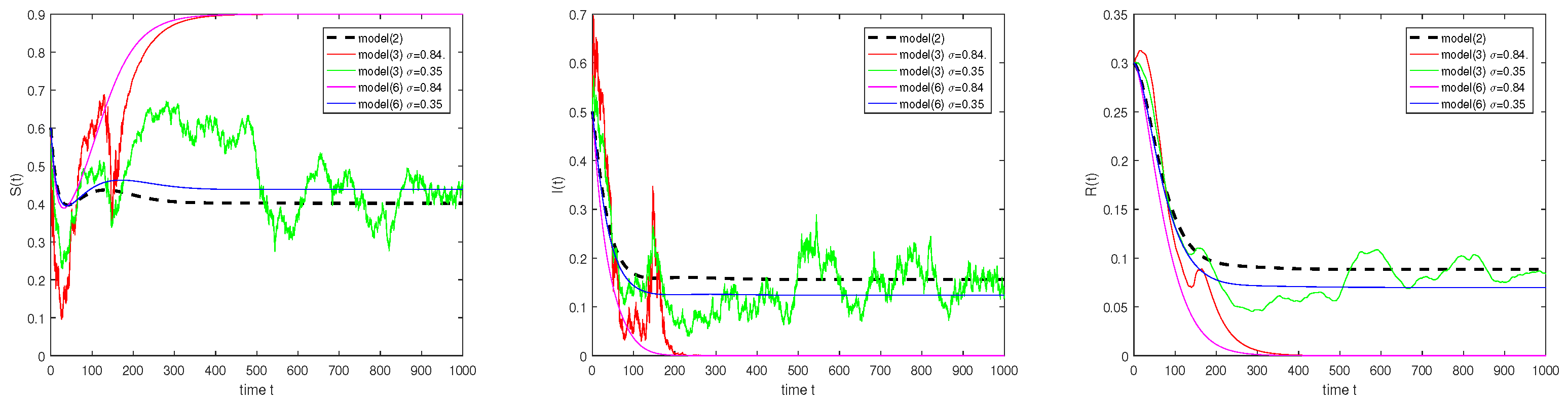
Assume that , , , , , , , , and . Obviously, . For model (2), the endemic equilibrium is globally asymptotically stable. In model (3), if , then and . Based on Theorem 4 (a), the disease-free equilibrium of model (3) is globally asymptotically stable. It reveals that of the models (3) and (6) are close to the environmental capacity K, but and are close to 0. When , and , the disease is persistent. In addition, the intensity of white noise can suppress the disease outbreak. Figure 1 shows the curves of under these parameters.
Figure 1.
The paths of , and under the initial value .
Example 2.
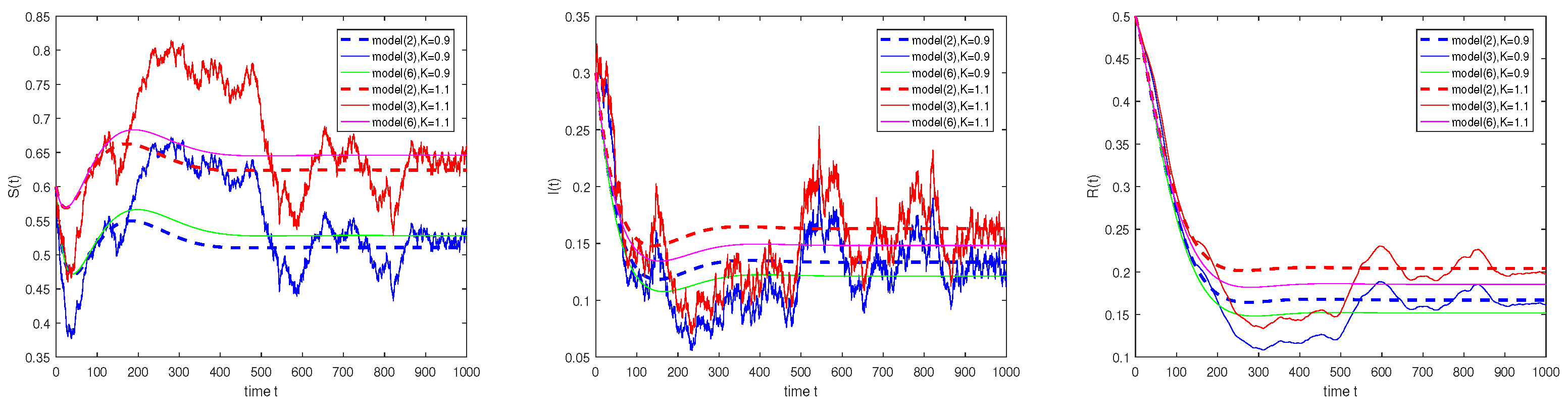
Take the initial value , and parameters , , , , and . The time step size . Through the calculation, we have , , and . Based on Theorem 5, the disease is permanent. Next, we consider the effects of the environmental capacity K and the birth rate b according to two cases:
(i) , and . We observe that , and will increase when K increases. Figure 2 illustrates the different evolutions of , and .
Figure 2.
The paths of , and under the environmental capacity .
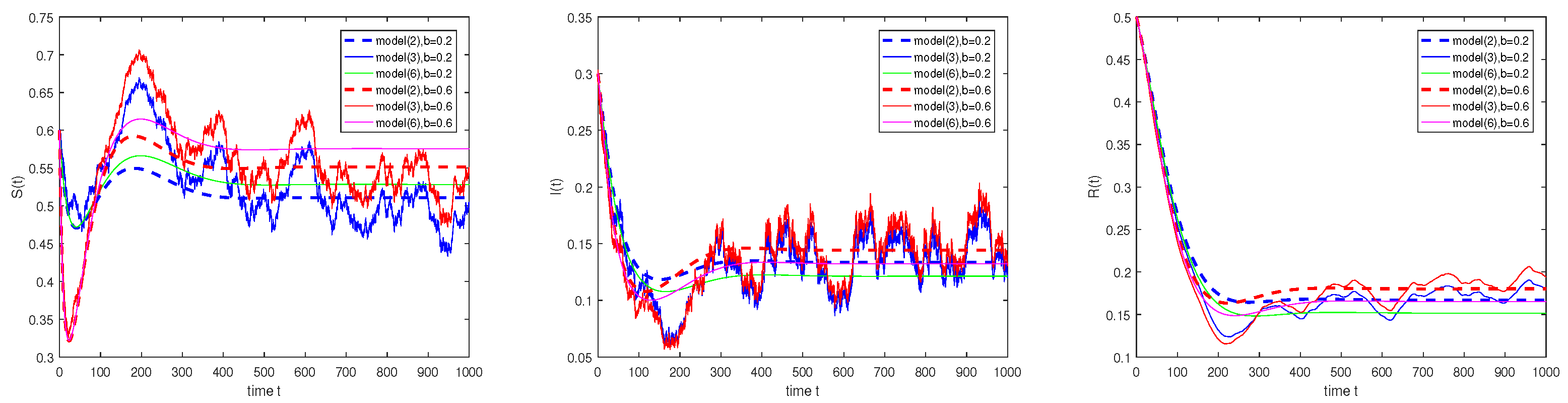
(ii) , and . The nonlinear incidence initially becomes larger due to the increase of b, so that , and become smaller at the beginning. Moreover, the population slightly increases when the birth rate plays a major role (see Figure 3).
Figure 3.
The paths of , and under the birth rate .
8. Discussion
In this paper, we analyzed the dynamic properties of a stochastic SIRS epidemic model with Logistic birth and nonlinear incidence. Through a Stratonovich SDE, we obtained a new threshold value to analyze the stability of model (3). Under the threshold value , we derived some interesting results, including the global asymptotic stability of the disease-free equilibrium, permanent in the mean of the disease, and the existence of stationary distribution. We observed that environmental noise is a crucial influence in describing the dynamic behaviors of an epidemic. However, there are still some unsolved problems. For example, how to study the relationship of models (6) and (2), as well as (3). It is an exciting issue and will be the subject of our future work.
Author Contributions
Conceptualization, H.W. and Z.L.; methodology, H.W.; software, H.W.; validation, H.W., G.Z., T.C. and Z.L.; formal analysis, H.W. and Z.L.; resources, Z.L.; data curation, H.W.; writing—original draft preparation, H.W.; writing—review and editing, G.Z., T.C. and Z.L.; visualization, H.W.; supervision, Z.L.; project administration, Z.L.; funding acquisition, Z.L. All authors have read and agreed to the published version of the manuscript.
Funding
This work is supported by the National Natural Science Foundation of China (Grant No. 12061070) and the Science and Technology Department of Xinjiang Uygur Autonomous Region (Grant No. 2021D01E13).
Data Availability Statement
The data presented in this study are available upon request from the corresponding author.
Acknowledgments
We thank the reviewers and editors for their valuable and constructive feedback, which has greatly contributed to the improvement of this article.
Conflicts of Interest
The authors declare that they have no conflict of interest.
References
- Beretta, E.; Takeuchi, Y. Convergence results in SIR epidemic models with varying population sizes. Nonlinear Anal. Theory Methods Appl. 1997, 28, 1909–1921. [Google Scholar] [CrossRef]
- Lu, Z.; Chi, X.; Chen, L. The effect of constant and pulse vaccination on SIR epidemic model with horizontal and vertical transmission. Math. Comput. Model. 2002, 36, 1039–1057. [Google Scholar] [CrossRef]
- Zhang, J.; Li, J.; Ma, Z. Global analysis of SIR epidemic models with population size dependent contact rate. J. Eng. Math. 2004, 21, 259–267. [Google Scholar]
- Ma, Z.; Zhou, Y.; Wu, J. Modeling and Dynamics of Infectious Diseases; World Scientific: Singapore, 2009. [Google Scholar]
- Allen, L.J.; Burgin, A.M. Comparison of deterministic and stochastic SIS and SIR models in discrete time. Math. Biosci. 2000, 163, 1–33. [Google Scholar] [CrossRef] [PubMed]
- Gao, L.Q.; Hethcote, H.W. Disease transmission models with density-dependent demographics. J. Math. Biol. 1992, 30, 717–731. [Google Scholar] [CrossRef] [PubMed]
- Korobeinikov, A. Lyapunov functions and global stability for SIR and SIRS epidemiological models with non-linear transmission. Bull. Math. Biol. 2006, 68, 615–626. [Google Scholar] [CrossRef] [PubMed]
- Vargas-De-León, C. Constructions of Lyapunov functions for classic SIS, SIR and SIRS epidemic models with variable population size. Foro-Red-Mat: Rev. Electron Conten. Mat. 2009, 26, 1–12. [Google Scholar]
- Lahrouz, A.; Omari, L.; Kiouach, D. Global analysis of a deterministic and stochastic nonlinear SIRS epidemic model. Nonlinear Anal. 2011, 16, 59–76. [Google Scholar] [CrossRef]
- Li, D.; Cui, J.; Liu, M.; Liu, S. The evolutionary dynamics of stochastic epidemic model with nonlinear incidence rate. Bull. Math. Biol. 2015, 77, 1705–1743. [Google Scholar] [CrossRef] [PubMed]
- Song, Y.; Miao, A.; Zhang, T.; Wang, X.; Liu, J. Extinction and persistence of a stochastic SIRS epidemic model with saturated incidence rate and transfer from infectious to susceptible. Adv. Differ. Equ. 2018, 2018, 1–11. [Google Scholar] [CrossRef]
- Liu, Q.; Jiang, D.; Hayat, T.; Alsaedi, A.; Ahmad, B. A stochastic SIRS epidemic model with logistic growth and general nonlinear incidence rate. Physica A 2020, 551, 124152. [Google Scholar] [CrossRef]
- He, X.; Wei, Y. Dynamics of a Class of Stochastic SIRS Infectious Disease Models With Both Logistic Birth and Markov. Appl. Math. Mech. 2021, 42, 1327–1337. [Google Scholar]
- Mao, X. Stochastic Differential Equations and Applications; Horwood Publishing: Chichester, UK, 2007. [Google Scholar]
- Braumann, C.A. Introduction to Stochastic Differential Equations with Applications to Modelling in Biology and Finance; John Wiley & Sons: Hoboken, NJ, USA, 2019. [Google Scholar]
- Rifhat, R.; Muhammadhaji, A.; Teng, Z. Asymptotic properties of a stochastic SIRS epidemic model with nonlinear incidence and varying population sizes. Dynam. Syst. 2020, 35, 56–80. [Google Scholar] [CrossRef]
- Cai, Y.; Kang, Y.; Wang, W. A stochastic SIRS epidemic model with nonlinear incidence rate. Appl. Math. Comput. 2017, 305, 221–240. [Google Scholar] [CrossRef]
- Khasminskii, R. Stochastic Stability of Differential Equations; Springer Science & Business Media: Berlin/Heidelberg, Germany, 2011. [Google Scholar]
- Liptser, R.S. A strong law of large numbers for local martingales. Stochastics 1980, 3, 217–228. [Google Scholar] [CrossRef]
- Higham, D.J. An algorithmic introduction to numerical simulation of stochastic differential equations. SIAM Rev. 2001, 43, 525–546. [Google Scholar] [CrossRef]
Disclaimer/Publisher’s Note: The statements, opinions and data contained in all publications are solely those of the individual author(s) and contributor(s) and not of MDPI and/or the editor(s). MDPI and/or the editor(s) disclaim responsibility for any injury to people or property resulting from any ideas, methods, instructions or products referred to in the content. |
© 2023 by the authors. Licensee MDPI, Basel, Switzerland. This article is an open access article distributed under the terms and conditions of the Creative Commons Attribution (CC BY) license (https://creativecommons.org/licenses/by/4.0/).