


Abstract
Due to the flexibility of the Weibull distribution and the proportional hazard (PH) model, Weibull PH is widely used in survival analysis under right censored data and interval censored data but it is seldom investigated under current status data, partially because there is less information in current status data than in right censored data and interval censored data. This paper considers the Weibull PH model under the current status data and introduces the Poisson latent variables to augment the data, then uses the expectation-maximization (EM) algorithm to obtain the maximum likelihood estimators of the model parameters. The EM algorithm is compared with the Newton–Raphson (NR) algorithm from several perspectives in the simulation studies, and the results show that the proposed method has several highlights, such as computational simplicity, improved convergence stability, and overall estimator results that are either comparable or slightly better in terms of bias. Furthermore, the performance of the Weibull PH model and the semi-parametric PH model is compared under two simulation scenarios, and two standard model selection criteria are used for model selection. The results indicate that the Weibull PH model has significant advantages when failure time follows a Weibull distribution. Lastly, the Weibull PH model along with EM algorithm is applied to lung tumor data and intraocular lens (IOL) calcification data with the aim of assessing the impact of covariates, including environmental factors and gender, on event timing and risk.
MSC:
62N02
1. Introduction
The proportional hazard (PH) model proposed by Cox [1] has gradually gained popularity as one of the most widely used models in survival analysis. The PH model is a semi-parametric model consisting of two parts: the parametric part assuming that the explanatory variables have exponentially multiplicative effects on the hazard function of survival time, and the non-parametric part with an unspecified baseline hazard function. The two-parameter Weibull distribution [2] can have increasing, decreasing, or constant hazard function depending on the shape parameter; thus, it is flexible to describe hazard functions with different shapes. When the baseline hazard function is specified as the Weibull distribution, we obtain the Weibull PH model, which has wide applications in survival analysis and reliability analysis. For example, Alakuş [3] estimated confidence intervals for the survival function of the Weibull PH model with censored survival time data; Gong and Fang [4] investigated the performance of the Weibull PH model, exponential PH model, and 10-piece exponential PH model under interval censored data with different underlying data distributions and censoring patterns, and they advocated the use of a parametric PH model to analyze interval censored data; Sha and Pan [5] used the Weibull PH model to analysis the step-stress accelerated life testing data in a Bayesian framework; Nemati et al. [6] used the Weibull PH model to assess the impact of different factors on the failure rate of cables; Liu and Xie [7] estimated the parameters of the Weibull PH model for right censored data. Few studies on Weibull PH modeling concerned current status data.
In survival analysis, current status censoring also refers to Case I interval censoring, which is an extreme case of interval censoring. It happens if each subject is observed only once and the survival time of interest is known only to be either smaller or greater than the observation time. Sun [8] gave a detailed introduction to the estimation theories and applications for current status data. Current status data often appear along with covariates in cross-sectional studies and tumorigenicity experiments. Under current status censoring, the event times are left censored for events prior to the examination and are otherwise right censored. The main interest in such studies includes estimating the distribution of the lifetime and evaluating the effect of covariates on the lifetime or hazard of failure. A major challenge in the analysis of current status data is that information on lifetime for an individual is limited to the status of the event under consideration at a single monitoring time.
Compared to right censored data, current status data is less informative, and current statistical techniques for right censored data cannot be directly used to analyze current status data. So, it is necessary to develop new techniques to efficiently deal with these kinds of data. Recently, McMahan et al. [9] introduced a two-stage Poisson data augmentation method for estimating a PH model and proportional odds model with current status data. This approach was characterized by its simplicity and high effectiveness; furthermore, it provided closed-form variance estimators. Subsequently, numerous scholars applied this methodology to various models and data types. For example, Wang et al. [10] extended it to a PH model with interval censored data; Zhou et al. [11] discussed the problem of fitting a PH model to interval censored data with missing covariates; Withana et al. [12] analyzed a left-truncated arbitrarily censored data under PH model; Cui and Tee [13] analyzed the Bayesian additive PH model for the current status data. Most of the literature that used this Poisson data augmentation method to study the PH model estimated the cumulative baseline hazard function using splines, such as monotone spline, I-splines, and B-spline. However, it is more reasonable to utilize the corresponding parametric model when the baseline hazard function can be approximated by a flexible parameter distribution.
In this paper, we focus on the Weibull PH model under current status data with the baseline hazard function characterized by the popular Weibull distribution, and discuss the maximum likelihood estimators (MLE) of the model parameters. Instead of directly maximizing the observed likelihood function with the Newton–Raphson (NR) method, we propose a one-step Poisson data augmentation expectation-maximization (EM) algorithm inspired by McMahan et al. [9]. This methodology introduces Poisson latent variables to augment the data; thus, it establishes a missing data structure and produces a simpler complete likelihood. The procedure simplifies the likelihood structure and improves the computation efficiency as well as the convergence speed of the algorithm. Simultaneously, the variance estimators can be provided in closed form by Louis’ method [14]. We evaluate the performance of the EM algorithm through simulation studies involving various sample sizes and censoring ratios, and compare the results with the ones from the NR method. In summary, the EM method in this study yields estimator results comparable to those of the NR method, with the advantage of simplicity and computational convenience. Furthermore, it guarantees that the scale parameter remains positive, contributing to slightly improved convergence. In addition, we compare the Weibull PH model with the I-spline-based semi-parametric PH model through parameter estimation and model selection. Finally, we apply the Weibull PH model with EM algorithm to analyze lung tumor experimental data and IOL calcification data, and obtain some interesting findings.
2. The Proposed Method
2.1. The Weibull PH Model
The PH model is one of the most popular models in survival analysis, with a multiplicative effect of its covariates on the hazard function with
where is the baseline hazard function, , and . When the baseline hazard function is unknown, it is often estimated by splines. However, when its distribution is known, the use of the corresponding specific parameter model makes the results more precise. The two-parameter Weibull model is a popular parametric model in survival analysis with the flexible hazard function
where scale parameter and shape parameter . Obviously, this hazard function is monotone decreasing for and increasing for , and it degenerates to an exponential distribution with a scale parameter when . In this paper, we assume that the baseline hazard function comes from the two-parameter Weibull distribution which is given by (1), and discuss the Weibull PH model
The distribution function and the survival function of the failure time T have the following forms
and
Assume that there are n independently observed samples. Let , and denote the failure time, censoring time, and covariate for subject i, respectively. In current status data, the failure time is not directly observable; we only know whether is larger than the observation time . Let denote the censoring indicator, where is the indicator function. When , it indicates that the failure time is smaller than the observation time, which is left censored. Conversely, it is right censored in the case . Let denote all observed data and denote all parameters. Then, the observed data likelihood is given by
Correspondingly, the observed data log-likelihood is given by
The NR method obtains the MLEs of the parameters by directly maximizing the above equation, and the corresponding derivation procedure is shown in Appendix A. It can be seen that the method is complicated in the calculation process, the expression is tedious, and there is no closed-form solution for all three parameters.
2.2. Data Augmentation
Motivated by McMahan et al. [9] and Wang et al. [10], we introduce Poisson latent variables to augment the data and obtain the complete data likelihood by considering the relationship between the PH model and the non-homogeneous Poisson process. According to the idea of Wang et al. [10], consider a non-homogenous Poisson process with mean parameter , where is the cumulative baseline hazard function, and in the Weibull situation, . The lifetime T can be viewed as the time of the first jump of this process, i.e., ; then, the survival function of T is
thus, T follows the PH model. This equivalence between the Poisson process and PH model makes the augmentation of the likelihood feasible. In the Weibull PH model, let denote the latent Poisson process for subject i with mean parameter , and lifetime . We introduce latent variable , then
and
therefore, follows the Poisson distribution with mean , that is, , and as a byproduct, we have .
Based on the latent variable , the augmented likelihood has the following form
Its corresponding log-likelihood is
According to the augmented likelihood, the conditional distribution of can be obtained as
Then, the conditional expectation and conditional variance of can be easily calculated, which are given by
and
2.3. EM Algorithm
The EM algorithm is an iterative algorithm used to obtain MLEs of model parameters when the model has a missing data structure [15]. The EM algorithm in this paper operates on the augmented likelihood by treating it as the complete data likelihood, where Z is viewed as missing data. The E-step is to compute the expectation of with respect to the conditional distribution of Z given the current iteration values and the observed data. According to Equation (3), the expression for the Q function can be obtained as
where is obtained by (6) with replaced by .
The M-step seeks to find . For this purpose, we need to derive the first-order partial derivatives of with respect to all components of .
Setting these derivatives equal to zero, we can obtain
These equations are considerably simple and easy to solve compared to Appendix A. Specifically, Equation (7) provides an explicit solution for and guarantees that is positive, while the NR method has no explicit solution for any of the three parameters. Then, we summarize the EM algorithm as follows:
Denote as the final convergence value, that is, the MLE of .
2.4. Asymptotic Variances and Covariance
According to the asymptotic normality of the MLE, we have , where is the information matrix of the observed likelihood, and Appendix A gives the calculation of . Within the EM framework, Louis’ method [14] gives a closed-form expression for the observed information matrix in a simple and straightforward way, that is,
where represents . The second-order derivatives of Q-function with respect to are a symmetric matrix with upper triangle components given by
where . To this end, consider the conditional covariance matrix , whose upper triangle components are given by
where denotes given by (6). Apparently, the EM algorithm is simpler and has a more concise expression regarding the computation of the covariance matrix than the NR method in Appendix A.
3. Simulation Study
In this section, a series of simulations are used to evaluate the performance of the proposed method. We compare the proposed EM method with the NR method and compare the Weibull PH model with the semi-parametric PH model.
3.1. Simulation Study I: Compare the Proposed EM Method with the NR Method
This study considers that the failure time is generated from the following Weibull PH model
where , , , , , .
In the simulation, the sample sizes are set to be 100, 200 and 400. Both and can be taken as , 0 and , totaling nine parameter combinations, and the left censoring ratio P is set as , , and , respectively. The failure time can be obtained by solving , where , and the censoring time obeys , where a is calculated according to the censoring ratio.
Each simulation is repeated 1000 times, with an initial value , where . Then, the algorithm is recognized to have reached convergence when . The bias (Bias), the estimated standard errors (ESE), the standard deviation (SD), and the coverage probabilities (CP) are used as indicators of the goodness of the estimators, where the Bias is the absolute value of the difference between the estimated value and the true value, the ESE is the average of the estimated standard errors obtained by squaring the diagonal elements of the asymptotic covariance matrix computed by Louis’ method, the SD is the standard deviation of the 1000 estimates of , and the CP is the proportion of the true value that falls into the confidence interval. Here, we compare the results of the proposed EM method with the ones based on the NR algorithm. All of the above simulations are implemented in R [16]. Table 1, Table 2, Table 3, Table 4 and Table 5 are the estimate results, from which we can draw the following conclusion:
Table 1.
Comparison of the EM method and the NR method with different censoring ratios at .
Table 2.
Comparison of the EM method and the NR method with different censoring ratios at .
Table 3.
Comparison of the EM method and the NR method with different censoring ratios at .
Table 4.
Comparison of the EM method and the NR method with different censoring ratios at .
Table 5.
Comparison of the EM method and the NR method with different censoring ratios at .
- 1.
- For small sample sizes, such as , 60 and 100, both the Bias and ESE of the EM method are generally smaller than those of the NR method. For example, Table 2 presents the estimation results for . Among 54 cases, the EM method exhibits smaller biases in 35 cases, and a majority of the ESEs are also smaller than those of the NR method. Similar trends are observed in Table 1 and Table 3.
- 2.
- When the sample size is medium or large, such as and 400, the EM method still maintains an advantage in terms of the Bias, with over half of the 54 cases exhibiting smaller Bias. However, when considering ESEs, the EM method performs unsatisfactorily. For instance, when , the EM method produces smaller Bias and only smaller ESE.
- 3.
- With the increase in sample size, the Bias and ESE from both methods diminish towards zero, indicating that the performance of both methods improves with larger sample sizes, and the estimates can converge to the true values.
- 4.
- The estimated standard errors and sample standard deviations decrease and approach each other as the sample size increases, suggesting that the asymptotic covariance matrix obtained by Louis’ method performs well for finite sample sizes.
In summary, the estimate results of the EM method are comparable to those of the NR method, and even have an advantage when the sample size is small. In terms of bias, the EM method consistently outperforms the NR method; in terms of SD and ESE, the EM method performs better when the sample size is small, and the NR method slightly outperforms when the sample size is large; in terms of CP, both methods perform well, essentially around , and the censoring ratio has no impact on the performance of the two methods. With the increase in sample size, the estimation performance of both methods improves.
Remark 1.
It should be noted that when the small sample size is small, both the EM algorithm and the NR algorithm can sometimes fail to converge, which is similar to the case in Balakrishnan and Mitra [17], and in this case, the simulation data are excluded from the experiment. The EM algorithm fails to converge much less frequently than the NR approach. This is partially due to the fact that the scale parameter λ in the EM algorithm has an analytical solution and is guaranteed to be positive, whereas the NR method relies on numerical computation to solve for all three parameters. When the sample size is large, none of the methods fail to converge.
3.2. Simulation Study II: Compare the Weibull PH Model with the Semi-Parametric PH Model
In this simulation, we compare the Weibull PH model with a semi-parametric PH model proposed by McMahan et al. [9], who utilize a spline-based EM method for estimating the PH model under the current status data. This semi-parametric PH model can be implemented using the R package ICsurv [18]. To ensure a comprehensive comparison, we consider two scenarios:
- 1.
- The failure time follows a Weibull distribution, withwhere , .
- 2.
- Referring to the simulation setting in McMahan et al. [9], the failure time follows a non-Weibull distribution, withwhere .
In the above equation, , , , . Regression coefficients and can be taken as , 0 and , totaling nine parameter combinations, and the sample size n is specified as 200. The failure time can be obtained by solving , where , and the censoring time obeys a truncated exponential distribution with support .
Each simulation is repeated 500 times, with an initial value of for the Weibull PH model, and for the semi-parametric PH model. In McMahan et al. [9], the I-spline with suitable degree is used to control the smoothness of the hazard function. For comparison, we consider the degree to be 1, 2, and 3, corresponding to the linear, quadratic, and cubic basis function, respectively, and the number of knots is set as 5. The algorithm is recognized to have reached convergence when . All evaluation criteria are consistent with the Simulation study I. Table 6 and Table 7 show the results.
Table 6.
Estimates for the Weibull PH model and semi-parametric PH model when the failure time comes from the Weibull distribution.
Table 7.
Estimates for the the Weibull PH model and semi-parametric PH model when the failure time comes from the non-Weibull distribution.
Table 6 presents the results when the failure times follow the Weibull distribution. In this case, the Weibull PH model performs overwhelmingly superior to the semi-parametric model, with smaller Bias and ESE in the majority of the 54 cases. For instance, when the degree is 2, the proportion with smaller biases from the Weibull PH model is , and almost all ESEs are smaller than those from the semi-parametric PH model. Meanwhile, in the non-Weibull situation, Table 7 indicates the superiority of the semi-parametric PH model. This finding is natural and consistent with expectations.
Simultaneously, we utilize Akaike’s information criterion (AIC) and the Bayesian information criterion (BIC) for model selection and the results are shown in Table 8 and Table 9. Clearly, the Weibull PH model produces smaller AIC and BIC values in all situations, indicating that the Weibull PH model is superior to the semi-parametric PH model in some sense. This may be explained by the fact that the AIC and BIC values prefer a concise model with fewer parameters, while the semi-parametric PH model introduces several splines to describe the smoothness of the unspecified baseline hazard function, which increases the complexity of the model.
Table 8.
The AIC and BIC of the Weibull PH model and the semi-parametric PH model when the failure time comes from a Weibull distribution.
Table 9.
The AIC and BIC of the Weibull PH model and the semi-parametric PH model when the failure time does not follow a Weibull distribution.
Remark 2.
The function provided by the R package ICsurv [18] sometimes converges too slowly; therefore, in this paper, we add a restriction of 1000 iterations to the simulations using this function.
4. Real Data Analysis
In this section, we use the Weibull PH model to fit two real data, and use the proposed EM method to estimate all unknown parameters.
4.1. Lung Tumor Data
Lung tumor data were obtained by Hoel and Walberg [19] in 1972 from 144 male RFM mice that were examined in a tumorigenicity experiment on lung tumors. The tumorigenicity experiment focused on whether drugs or the environment accelerate the time to tumor onset. In this experiment, the time to tumor onset was of interest, but lung tumors were primarily non-lethal and insidious, meaning that the onset of the tumor did not affect the survival of the mice, so the time to tumor onset was not directly observable. Instead, we were only able to observe the time of death and the presence or absence of lung tumors when the mice died. The experiment recorded the death time of mice in days, and used indicator variable to note the presence (1) or absence (0) of lung tumors for each subject at the death time.
The experiment placed the mice in two different environments, a conventional environment (CE) and a germ-free environment (GE). There were 96 rats in the CE, and 27 had lung tumors at the time of death. Similarly, there were 48 rats in GE and 35 with lung tumors. The right censoring rate of the tumor onset was approximately . Detailed variable descriptions are shown in Table 10.
Table 10.
Variable description of lung tumor data.
In order to estimate the impact of environmental factors on tumor development, we consider the Weibull PH model and use the EM algorithm to estimate the parameters:
Based on Louis’ method, we can easily calculate that the estimated standard deviation of is 0.247. This results in a p-value of for the comparison of the two groups, meaning that the incidence rates of lung tumors in the two different environments differ significantly. The corresponding hazard function and survival function are
and
The baseline hazard function increases with time since , indicating that the risk of cancer in mice increases over time. Furthermore, the risk ratio of lung tumors in mice under GE and CE is
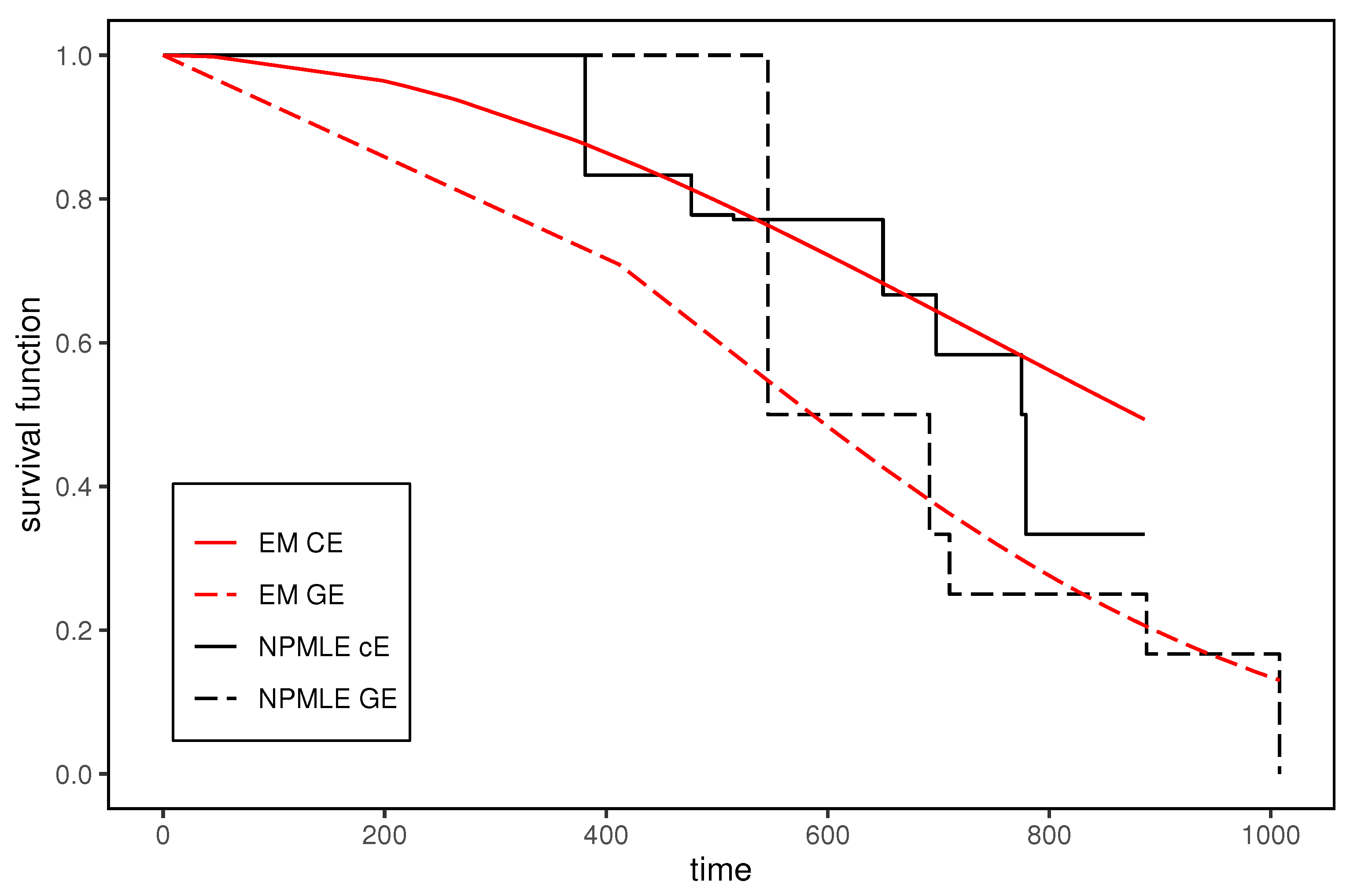
This suggests that the risk of tumor growth in mice in the GE is times higher than that in the CE. Sun [8] discussed the non-parametric maximum likelihood estimation (NPMLE) of the survival function based on current status data. Figure 1 presents the estimators of the survival functions for the EM method and the NPMLE method.
Figure 1.
Estimates of survival functions of time for lung onset tumor by EM method and NPMLE method.
It is noteworthy that the estimator of the survival function from the Weibull PH model is very close to that from the NPMLE. Both the EM method and NPMLE method suggest that lung tumors tend to develop earlier in the CE compared to the GE. However, overall, mice in the GE appear to have a higher risk of developing lung tumors than mice in the CE. At the same time, this indicates that the Weibull PH model is appropriate to fit these data. In addition, the EM algorithm can effectively estimate model parameters in the Weibull PH model, which provides a continuous expression for the survival function, enabling the estimation of survival probabilities at any given time. In contrast, the NPMLE method is limited to approximating survival probabilities only at the endpoints of the observation interval.
Furthermore, we compare the Weibull PH model with the semi-parametric PH model, and the results are presented in Table 11. There are slight differences in the regression coefficient estimates from the two methods. Moreover, the Weibull PH model demonstrates smaller variances, and smaller AIC and BIC values compared to the semi-parametric PH model. These findings suggest that the Weibull PH model may be more suitable for modeling the lung tumor data.
Table 11.
The estimation results of the Weibull PH model and the semi-parametric PH model for lung tumor data, where the value in parentheses represents the degree of the spline basis function in the semi-parametric PH model and the denotes the estimated variance of .
4.2. The Data of IOL Calcification
The calcification of hydrogel intraocular lenses (IOL) [20,21] is a rare complication of cataract treatment. At examination time for each subject i, an ophthalmologist classified the severity of a patient’s IOL calcification into four grades. We simply consider mild or serious calcification as calcified , and no or little calcification as not calcified . There are 379 samples, including 142 males and 237 females. The variables are described in Table 12.
Table 12.
Variable description of IOL calcification data.
We aim to assess the effect of the gender factor on IOL calcification. Assuming that the failure time follows the Weibull PH model, we use the proposed EM algorithm to obtain the corresponding parameter estimates as follows:
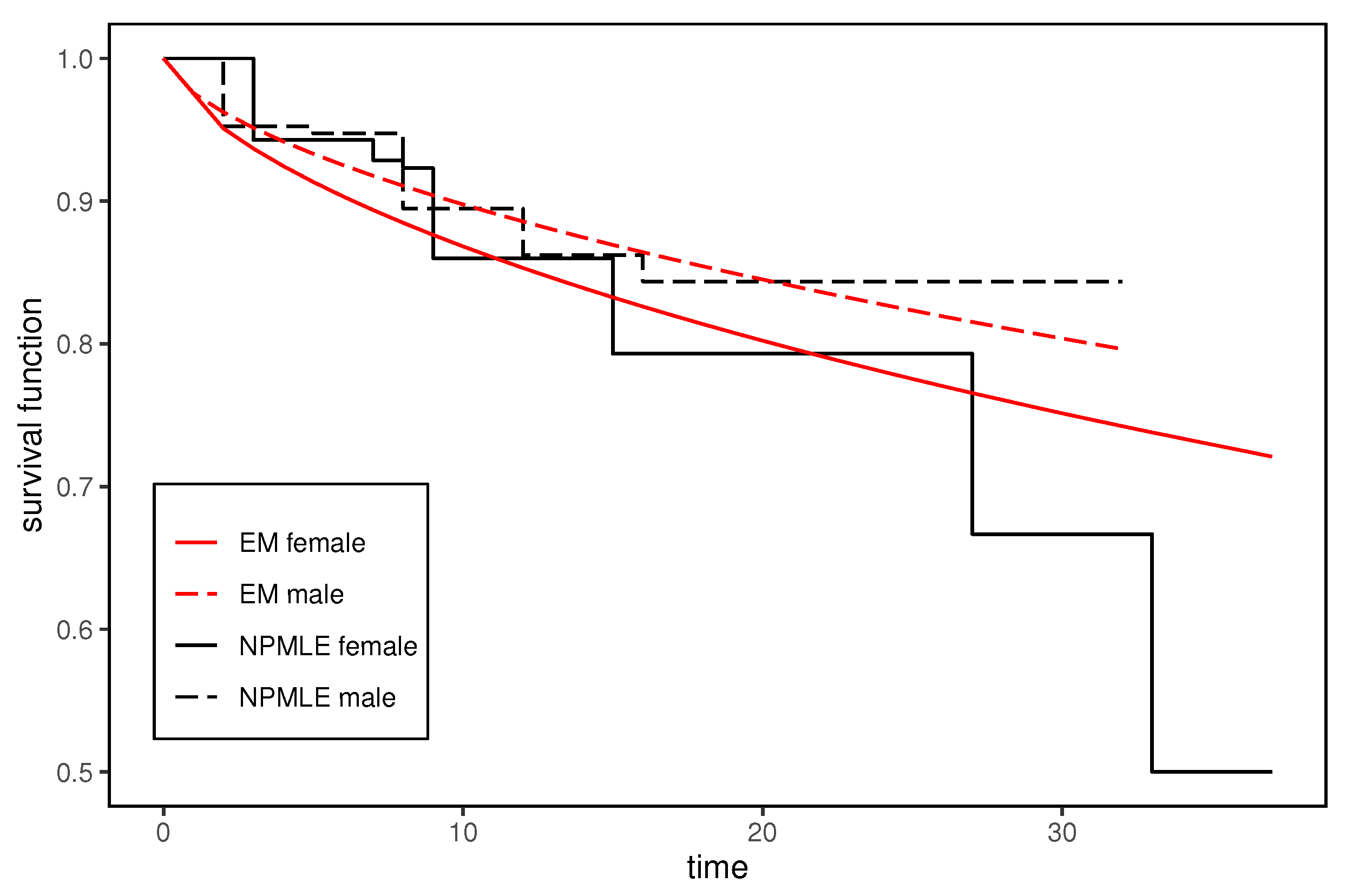
Meanwhile, the estimated standard error of is , calculated by Louis’ method. This results in a p-value of for testing according to the asymptotic normality of the MLE, indicating that there is no significant difference between males and females in terms of the time to calcification. The estimator suggests that the risk of IOL calcification decreases with time. Although the gender is not significant, it appears that the risk of IOL calcification in males is roughly times that of females based on the risk ratio. Figure 2 shows the estimators of the survival functions for the IOL calcification data by the EM method and the NPMLE method [8], respectively. Figure 2 suggests that calcification tends to occur earlier in males, but overall, the risk of calcification is slightly higher in females than in males. In addition, the estimators of the survival function from the Weibull PH model for the IOL data are close to those from the NPMLE, suggesting the suitability of the Weibull PH model for describing the IOL data.
Figure 2.
Estimates of survival functions of time for IOL calcification by EM method and NPMLE method.
Table 13 summarizes the comparison results of the Weibull PH model and semi-parametric PH models with varying degrees. The estimates of of these models are relatively close, but the Weibull PH model provides smaller variances, and smaller AIC and BIC values, indicating that it is better suited for this dataset.
Table 13.
The estimation results of the Weibull PH model and the semi-parametric PH model for the IOL data, where the value in parentheses represents the degree of the spline basis function in the semi-parametric PH model and the denotes the estimated variance of .
5. Conclusions
The Weibull PH model is a commonly used parametric model in fields like reliability analysis and survival analysis. In this paper, we consider the Weibull PH model under current status data. A Poisson-based EM algorithm is developed to estimate the parameters, where the M-step of the EM algorithm is realized by the NR method. Louis’ method is used to estimate the asymptotic variance–covariance matrix, whose diagonal elements are estimators of the variance. Then, the proposed EM method is compared with the NR method through simulations. On the whole, the estimator results of the two methods are close; the bias of the EM algorithm is consistently smaller than that of the NR method, especially when the sample size is small, while the variance of EM is smaller in small samples but larger in larger sample sizes. In addition, the proportion that the true parameter value falls in the confidence intervals is close for both methods. Moreover, the EM algorithm offers several advantages. It simplifies the process of parameter estimation and covariance matrix estimation. Additionally, the EM algorithm ensures that the critical scale parameter remains positive throughout the estimator process, which is a crucial requirement in the Weibull PH model. The comparison between the Weibull PH model and the semi-parametric PH model reveals that the Weibull PH model demonstrates significant advantages when the failure time follows a Weibull distribution. This is also supported by the smaller values of AIC and BIC for the Weibull PH model. The method and model of this paper are applied to two practical examples. In the lung tumor experiment, the results indicate that the risk of lung tumor increases over time, and the environment significantly influences tumor growth. Specifically, mice in the GE exhibit a higher risk of developing lung tumors compared to those in the CE. In the IOL calcification data, the risk of calcification decreases over time, and gender has no impact on the risk of IOL calcification.
The discussion in this paper is based on current status data; the EM algorithm of the Weibull PH model can be extended to analysis of general interval censored data. In addition, our future research plans include exploring Bayesian analysis for the Weibull PH model.
Author Contributions
Methodology, F.Y., S.C.; Supervision, F.Y.; Writing—original draft, S.C.; Writing—review and editing, F.Y. All authors have read and agreed to the published version of the manuscript.
Funding
This research was funded by the National Science Foundation of Shandong province of China under grant ZR2019MA026.
Data Availability Statement
All datasets in the real data analysis are from Sun [8].
Conflicts of Interest
The authors declare no conflict of interest.
Abbreviations
The following abbreviations are used in this manuscript:
| PH | Proportional hazard model |
| EM | Expectation-maximization algorithm |
| NR | Newton–Raphson method |
| MLE | Maximum likelihood estimator |
| AIC | Akaike’s information criterion |
| BIC | Bayesian information criterion |
| GE | Germ-free environment |
| CE | Conventional environment |
| IOL | Intraocular lenses |
| NPMLE | Non-parametric maximum likelihood estimation |
Appendix A
The NR method is a direct maximization of the observed log-likelihood to obtain MLEs of the parameters. Given the value of , the estimator for the is given by
where the first-order derivatives with respect to all components of are given by
And the second-order derivatives of with respect to are
Let denote MLEs of the NR method. Then, the covariance matrix of can be estimated by the inverse of the observation information matrix, that is,
References
- Cox, D.R. Regression models and life-tables. J. R. Stat. Soc. Ser. Stat. Methodol. 1972, 34, 187–202. [Google Scholar] [CrossRef] [Scilit]
- Weibull, W. A statistical distribution function of wide applicability. J. Appl. Mech. 1951, 18, 293–297. [Google Scholar] [CrossRef] [Scilit]
- Alakuş, K. Confidence intervals estimation for survival function in Weibull proportional hazards regression based on censored survival time data. Sci. Res. Essays 2010, 5, 1589–1594. [Google Scholar]
- Gong, Q.; Fang, L. Comparison of different parametric proportional hazards models for interval-censored data: A simulation study. Contemp. Clin. Trials 2013, 36, 276–283. [Google Scholar] [CrossRef] [Scilit]
- Sha, N.; Pan, R. Bayesian analysis for step-stress accelerated life testing using Weibull proportional hazard model. Stat. Pap. 2014, 55, 715–726. [Google Scholar] [CrossRef] [Scilit]
- Nemati, H.M.; Sant’Anna, A.; Nowaczyk, S.; Jürgensen, J.H.; Hilber, P. Reliability evaluation of power cables considering the restoration characteristic. Int. J. Electr. Power Energy Syst. 2019, 105, 622–631. [Google Scholar] [CrossRef] [Scilit]
- Liu, K.; Xie, T. Parameter estimation of Weibull distribution model with covariate under right censored data. J. Syst. Sci. Math. Sci. 2022, 42, 2497–2507. [Google Scholar]
- Sun, J. The Statistical Analysis of Interval-Censored Failure Time Data; Springer: New York, NY, USA, 2006. [Google Scholar]
- McMahan, C.S.; Wang, L.; Tebbs, J.M. Regression analysis for current status data using the EM algorithm. Stat. Med. 2013, 32, 4452–4466. [Google Scholar] [CrossRef] [Scilit] [PubMed]
- Wang, L.; McMahan, C.S.; Hudgens, M.G.; Qureshi, Z.P. A flexible, computationally efficient method for fitting the proportional hazards model to interval-censored data. Biometrics 2016, 72, 222–231. [Google Scholar] [CrossRef] [Scilit]
- Zhou, R.; Li, H.; Sun, J.; Tang, N. A new approach to estimation of the proportional hazards model based on interval-censored data with missing covariates. Lifetime Data Anal. 2022, 28, 335–355. [Google Scholar] [CrossRef] [Scilit] [PubMed]
- Withana Gamage, P.W.; McMahan, C.S.; Wang, L. A flexible parametric approach for analyzing arbitrarily censored data that are potentially subject to left truncation under the proportional hazards model. Lifetime Data Anal. 2023, 29, 188–212. [Google Scholar] [CrossRef] [Scilit]
- Cui, D.; Tee, C. The expectation–maximization approach for Bayesian additive Cox regression with current status data. J. Korean Stat. Soc. 2023, 52, 361–381. [Google Scholar] [CrossRef] [Scilit]
- Louis, T.A. Finding the observed information matrix when using the EM algorithm. J. R. Stat. Soc. Ser. Stat. Methodol. 1982, 44, 226–233. [Google Scholar] [CrossRef] [Scilit]
- Dempster, A.P.; Laird, N.M.; Rubin, D.B. Maximum likelihood from incomplete data via the EM algorithm. J. R. Stat. Soc. Ser. Stat. Methodol. 1977, 39, 1–22. [Google Scholar] [CrossRef] [Scilit]
- R Core Team. R: A Language and Environment for Statistical Computing; R Foundation for Statistical Computing: Vienna, Austria, 2022; Available online: https://www.R-project.org/ (accessed on 31 October 2022).
- Balakrishnan, N.; Mitra, D. Left truncated and right censored Weibull data and likelihood inference with an illustration. Comput. Stat. Data Anal. 2012, 56, 4011–4025. [Google Scholar] [CrossRef] [Scilit]
- McMahan, C.S.; Wang, L. ICsurv: Semiparametric Regression Analysis of Interval-Censored Data. R Package Version 1.0.1. Available online: http://CRAN.R-project.org/package=ICsurv (accessed on 22 June 2022).
- Hoel, D.G.; Walburg, H., Jr. Statistical analysis of survival experiments. J. Natl. Cancer Inst. 1972, 49, 361–372. [Google Scholar] [PubMed]
- Yu, A.K.F.; Kwan, K.Y.W.; Chan, D.H.Y.; Fong, D.Y.T. Clinical features of 46 eyes with calcified hydrogel intraocular lenses. J. Cataract. Refract. Surg. 2001, 27, 1596–1606. [Google Scholar] [CrossRef] [Scilit] [PubMed]
- Xue, H.; Lam, K.; Li, G. Sieve maximum likelihood estimator for semiparametric regression models with current status data. J. Am. Stat. Assoc. 2004, 99, 346–356. [Google Scholar] [CrossRef] [Scilit]



Disclaimer/Publisher’s Note: The statements, opinions and data contained in all publications are solely those of the individual author(s) and contributor(s) and not of MDPI and/or the editor(s). MDPI and/or the editor(s) disclaim responsibility for any injury to people or property resulting from any ideas, methods, instructions or products referred to in the content. |
© 2023 by the authors. Licensee MDPI, Basel, Switzerland. This article is an open access article distributed under the terms and conditions of the Creative Commons Attribution (CC BY) license (https://creativecommons.org/licenses/by/4.0/).